With impeachment hearings and the tension between the executive and legislative branches taking up most of the news bandwidth, it’s easy to forget there’s a third co-equal branch of constitutional government: the judicial branch.
On Nov. 19, Wilshire Boulevard Temple hosted Loyola law professor Jessica Levinson at its westside Irmas campus on West Olympic Boulevard. Levinson spoke on “Update on the Supreme Court: Cases on the Docket and What’s at Stake.”
Around 50 people turned out to hear Levinson, known for her regular appearances on KCRW’s “Press Play.” She spoke about the way a case makes its way before the court; what kind of cases the court hears; and how the justices reach their decisions and decide who writes the opinions.
She also dropped in telling details, such as the differing styles of the justices, from Clarence Thomas’ mute disinterest to Sonia Sotomayor’s rapid-fire questioning;and why even the liberal justices have “forgiven” newest Justice Brett Kavanaugh.
“They have to work with him for the next 40 some-odd years,” Levinson said. “You might want his vote in the future, and you won’t get it if you can’t even stand to look at him.”
She then highlighted some of the cases appearing before the court this term (from October to the end of June 2020). There are three LGTBQ discrimination cases. Levinson boiled down all three, explaining they are over the definition of the word “sex” as written into the 1964 Civil Rights Act.
Conservatives, Levinson said, argue that in 1964 no one would have believed the word covered sexual orientation or gender identity. Liberals, on the other hand, are arguing, “Don’t look at the context, just look at the word. Based on other opinions, it should be read broadly.”
“[Chief Justice John Roberts] is not a moderate jurist by any stretch of the imagination, but he is the ideological center of the court.” — Jessica Levinson
She went on to say the court is divided on the issue and the decision will come down to Chief Justice John Roberts, noting, “He is not a moderate jurist by any stretch of the imagination, but he is the ideological center of the court.”
Also before the court is the Deferred Action for Childhood Arrivals (DACA): President Barack Obama’s decision in November 2014 to grant undocumented immigrants who arrived as children before 2007 the right to stay in the country under certain conditions.
Levinson said President Donald Trump can repeal the program but the question is whether the court can get involved and if so, did the administration follow the proper procedures outlined in the Federal Administrative Procedure Act?
The DACA discussion took up so much time, Levinson was forced to rush through cases on gun control and freedom of religion, so that the audience could ask questions about impeachment.
With Trump continuing to insist that a sitting president not only can’t be indicted but can’t even be investigated, Levinson said, “This would essentially take the legs out from under Congress’ oversight authority. It’s an argument so broad in scope it’s not likely to be upheld.”
She believes the court will take the long view, something she said she also advises her students. “Don’t think about whether you want President Trump to be able to do this — think if you want another president to do this,” she said. However, she worries that the framers of the Constitution never envisioned a man like Donald Trump in the Oval Office.
After the talk, attendee Jackie Bogin told the Journal she found Levinson “very articulate and had the facts down pat, and didn’t hesitate to answer questions.”
Wilshire Boulevard Temple’s Rabbi Susan Nanus, who organized the evening, said Levinson “answered everything I wanted to know. And I liked the cases she chose.”
Speaking with the Journal at the end of the evening, Levinson said she was impressed by the audience’s questions and hoped the impeachment inquiry would increase the public’s interest in and understanding of the law. “Think of all the words we now know,” she said. “Like ‘emoluments.’ In some ways, it’s been an enormously educational moment.”
What do Jonah Hill, Beanie Feldstein and Adam Levine have in common? Aside from critical acclaim in the entertainment industry, they have moms who care. A lot.
In 2014, longtime best friends and Los Angeles residents Sharon Feldstein (Hill and Feldstein’s mother) and Patsy Noah (Levine’s mother), were asked by the Barack Obama White House to take part in a Public Service Announcement for the Affordable Care Act urging young people to access health insurance.
Noah and Feldstein were so inspired by the initiative that they took ownership of the brand with permission from the Obama administration and created YourMomCares(#YMC).
“It’s turning into a very big deal,” Feldstein told the Journal. “Even more than we ever imagined it would be. I’m so overwhelmed by it. I’m kind of speechless. [The White House] told us to ‘do good things’ and we did. It’s been a little over a year now.”
Their mission is to ensure that all children in the United States feel safe and healthy. YourMomCares works with carefully vetted organizations that provide mental wellness to children and young adults around the country.
Among their partnerships with the Children’s Health Fund and the University of Pittsburgh Medical Center, #YMC has donated to the Trevor Project, Moms Demand Action, Young Center for Immigrant Children’s Rights, Operation Gratitude and Flint Child Health and Development Fund, to name a few.
Noah said when she and Feldstein were figuring out which issues to focus on, it was their kids who told them that mental wellness was the key.
“In my son’s case, he became a dad and it became evident to him that it would be the most important cause to him,” she said.
After collaborating with different mobile health units from Children’s Health Fund, they realized they needed to focus their attention on children living on Skid Row in downtown LA. According to the Los Angeles Homeless Services Authority and based on the 2018 Los Angeles Homeless Count, there are more than 300 young adults and children (ages 24 and younger) living on Skid Row.
The YMC funds go to the Children’s Health Fund-supported COACH (Community Outreach Assistance for Children’s Health) for Kids and Their Families program at Cedars-Sinai Medical Center. There, COACH for Kids Program Director Michele Rigsby Pauley, RN, MSN,CPNP oversees the team which offers mental, medical and dental health services to children ages 0 to 18. Of the patients they serve, 32 percent are homeless.
Feldstein and Noah said money from the Children’s Health Fund is being used to establish a weekly children’s group therapy session at Union Rescue Mission (URM) on Skid Row. URM hosts around 200 homeless children and families nightly.
“If you don’t know where you are going to sleep at night or you don’t know where your next meal is coming from, there’s stress and anxiety involved in that and these are youngkids. It’s heartbreaking.” — Patsy Noah
Launched on Oct. 30 and called “Rising Stars,” Feldstein and Noah said this eight-week initiative is important because homeless children are significantly more likely than other groups to experience behavioral problems, depression and anxiety.
“Everything circles back to mental health,” Noah said. “If you don’t know where you are going to sleep at night or you don’t know where your next meal is coming from, there’s stress and anxiety involved in that and these are young kids. It’s heartbreaking.”
Rigsby Pauley told the Journal over the phone that mental health has become a growing issue among children and young adults especially for children and families who are homeless.
“So many people need access to mental health services, but children especially these days, are significantly more likely to have behavioral issues, sleeping problems [and] eating problems, as a result of homelessness. I’m pleased that we are able to bring services directly to the children, they don’t have to go anywhere we are going to them.”
COACH for Kids clinical social worker Leslie Frank Cedeno has been leading the group sessions since the launch and told the Journal the session started out smaller than anticipated because parents and children were cautious to open up.
“We had to build up a lot of rapport with some of these kids. I think it’s going well. The kids are really opening up,” Cedeno said. “They have trust in us. They can tell us what they are experiencing and so the goal is the make sure that they have the coping skills for the problems they are facing.”
As the program heads into future sessions, Cedeno said, “the overall goal is to have these kids express themselves emotionally and to be able to open up. They have troubled backgrounds and so they don’t have that voice so what we do is come in and allow them to feel what they are feeling. Also giving them the tools that they need to cope.”
Feldstein, who has a background in costume design and marketing, said in order to continue raising funds for kids, she wanted to get creative and ensure that every fundraiser was an opportunity to spark conversation on mental health.
One of the ways they have done this is through bead bracelet parties. Feldstein said that the idea came during a Passover seder when a family friend came over to her house with #YMC bracelets. After unintentionally raising money during the seder by selling the bracelets, they decided to keep it going.
“As a stylist, I thought, ‘These are super cool and [making them] is very mediating because it’s very relaxing, it’s like knitting.’ I starting making a zillion of them, I wear them all the time,” Feldstein said. “People started posting them on social media and I realized they started a conversation.”
She added that beading parties have become popular because they allow people of all ages to talk about problems they are facing while concentrating on an art project. The parties have become a safe space for parents, teachers and children to talk openly and realize that everyone shares these feelings.
Noah and Feldstein also were recently in New York for a collaboration with clothing designer Lingua Franca, which created a knitted sweater with the cursive words “it’s ok to feel blue,” sewn on it. A portion of the sale goes to #YMC.
After writing an entry for British author Scarlett Curtis’ book “It’s Not OK to Feel Blue (and Other Lies),” Lingua Franca decided to riff off the title for the sweater.
Feldstein said she feels that when people see the phrase on the sweater, it will be another opportunity to talk about mental illness. “We want our kids to be happy,” she said. “My motto is ‘just show up.’ If you show up for your children, with that time you have to spare, I feel like [it] is a wonderful thing.”
She added devoting so much time to #YMC is a no-brainer because it has become a passion.
“You must give back; if you have a voice you can’t just do nothing,” she said. “That’s ridiculous. That’s a waste.”
Noah added at their core they are just moms who want to “give these kids a voice and start that conversation.”
Editor’s note: On Nov. 17, members of IKAR traveled with Rabbi Sharon Brous to Montgomery, Ala. These two pages are reflections from that trip— one by an adult, Adam Wergeles, and the other by teenager Ezra Golub.
“With Hope.”
These are the last words visitors see as they exit Bryan Stevenson’s groundbreaking Legacy Museum in Montgomery, Ala. Through the museum and Stevenson’s National Memorial for Peace and Justice, Stevenson’s goal is to end the silence regarding the wretched and wrenching history of black Americans.
I was one of more than 100 people who took part in IKAR’s inaugural Civil Rights Trip to examine the legacy of slavery and racial subjugation, and explore what our Jewish tradition offers — indeed, requires — in response to this violent and shameful history.
As Jews, we are keenly aware of the dangers and success of genocidal motivations. For many of us, the Holocaust became the organizing principle around which we centered our Jewish identity. Our own generational trauma leaves us with a moral imperative to understand and fight against the degradation of others.
Our group’s visit began with a rousing sermon by Reverend Raphael G. Warnock at the famed Ebenezer Baptist Church in Atlanta. We ended at Dexter Ave. Baptist Church in Montgomery, where Martin Luther King Jr., at age 25, found the voice that would launch a civil rights movement. There, we had the privilege of meeting Steven Reed, the first African-American mayor of Montgomery. However, the focus of our visit was the trip to the museum and monument, and our meeting with Stevenson.
Rabbi Sharon Brous led us through texts that brought to bear the voices of Jewish sages on what it means to reckon with one’s transgressions. Her approach to racial justice is grounded in a Talumudic debate between Hillel and Shammai over one’s moral obligation if an edifice is constructed on the foundation of a stolen beam. Should we destroy the entire building as Shammai contends, or should the injured party receive monetary compensation for the beam, as Hillel argues? What ought to happen if the whole country is built on a stolen beam — the stolen labor of enslaved people?
In “Just Mercy,” Stevenson’s memoir about his legal work fighting for death-row inmates and others, he explains the burden people of color bear being constantly suspected, accused and presumed guilty – a burden that can’t “be understood or confronted without a deeper conversation about our history of racial injustice.” The museum starts that conversation.
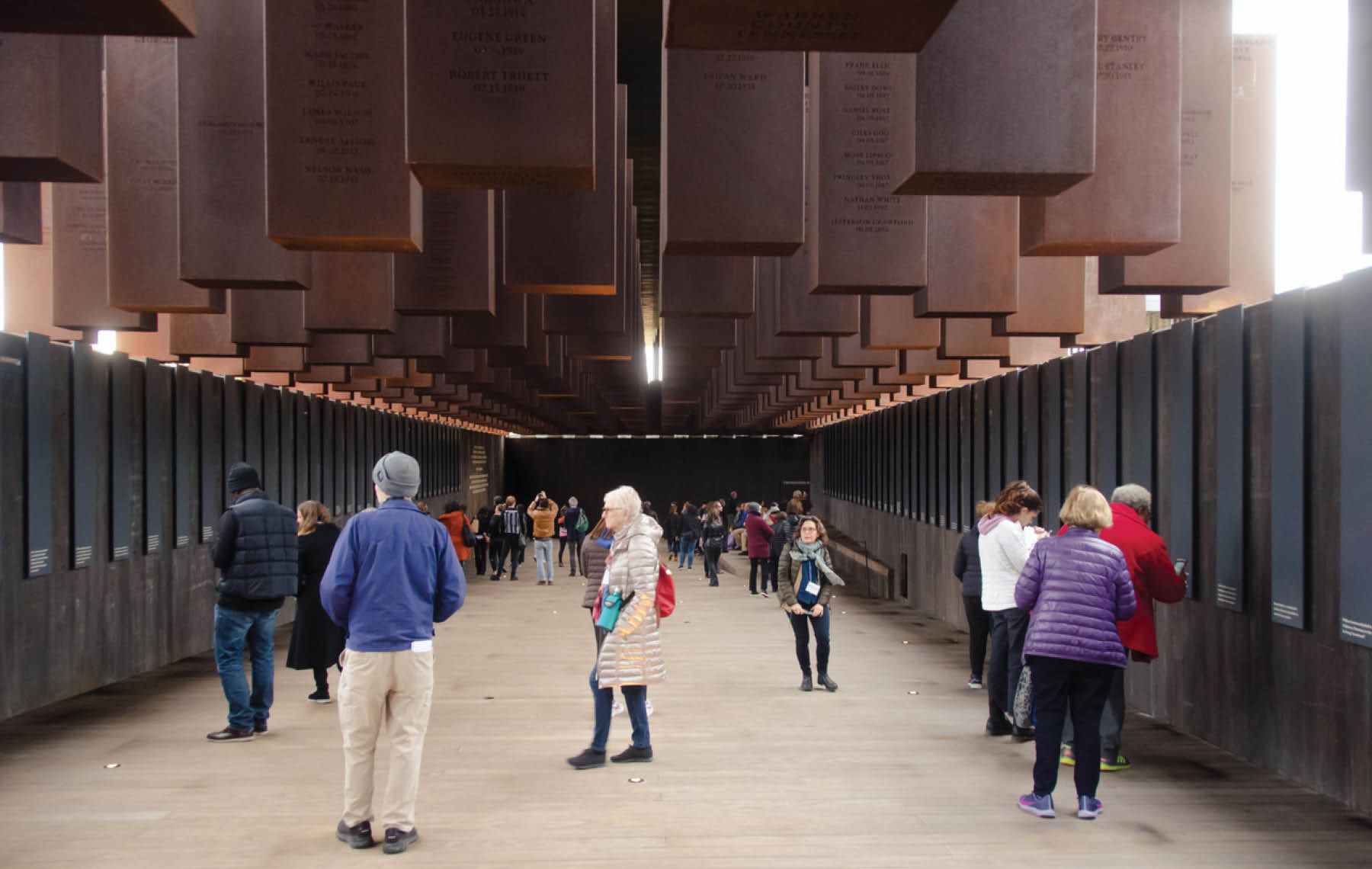
IKAR members remember victims of lynching in the American South at the National Memorial for Peace and Justice in Montgomery, Ala.
As you walk in, you immediately are confronted with holographic images of black adults and children in slave pens. The museum is built on the site of a 19th-century slave warehouse. The visceral, almost tactile experiences of the suffering and degradation perpetrated in our country cracks you open in a way no history book ever could.
From there, visitors walk into a pictorial chronology of racial injustice. It begins in 1619 when the first slave ship darkened our shores. Slavery in the United States lasted for 244 years — well after most western nations had abandoned the barbaric practice.
After the Emancipation Proclamation, there were 100 years of Jim Crow, including legalized segregation and state-tolerated and sanctioned racial terrorism in the form of lynching. And lest we believe all that ended with the civil rights movement in the 1960s, the museum shows how the war on drugs and similar policies have led to the mass-incarceration society we now live in, in which 1 in 3 black children will go through the criminal justice system.
In “Just Mercy,” Stevenson’s memoir about his legal work fighting for death-row inmates and others, he explains the burden people of color bear being constantly suspected, accused and presumed guilty – a burden that can’t “be understood or confronted without a deeper conversation about our history of racial injustice.”
The museum connects the dots, painting a picture of centuries of systemic and systematic subjugation of an entire race. It exposes that widespread social consent at all levels of government, business and civic institutions made the entire racist enterprise possible.
Our group later headed to the National Memorial of Peace and Justice, where we were confronted with a graphic sculpture depicting enslaved men, women and babies shackled together. In the memorial, large, brown rectangular structures resembling coffins hang from the ceiling, each representing a Southern county where lynching occurred, and bearing the names of those murdered, along with their dates of death. A number of the blocks listed multiple members of one family. On several, we saw many people were killed in one county on the same day, in some kind of racist-fueled paroxysm of murder.
Walking through the monuments, which initially are eye level, the ground sinks so the structures get higher and higher, until they are completely overhead. One visitor described the sensation as the weight of history bearing down on you. Another felt the sensation of drowning. To me, each rectangle felt like a reclaiming of the dead and tortured body left hanging on a tree in furtherance of white supremacist terror. Finally, we encountered a shimmering wall of water, a kind of tomb of the Unknown Soldier, giving memory to the many who were murdered but forever lost to history.
Stevenson explained to us how his work for condemned prisoners, kids serving life sentences and others without a voice led him to create the museum and the memorial — to offer a new, more honest narrative of race in America.
After a career of courtroom battles, he concluded that indifference to racism was a direct result of a widescale conspiracy of silence governing the black experience. So Stevenson undertook the herculean effort to chronicle this history and expose its ongoing and profoundly corrosive effects. Without this embrace of truth, he posits, there is no possibility of reconciliation; without reconciliation, progress is an illusion.
Despite this grim realization, Stevenson firmly believes in the redemptive possibility of reconciliation. There’s a wall of mason jars in the museum filled with soil from each known place a lynching occurred. Stevenson described the army of volunteers sent out to collect this soil.
One middle-aged black woman agreed to collect soil from a particularly isolated part of a Southern town. A white man in a pick-up truck approached her in a way that felt menacing to her. He asked what she was doing. She explained. He asked if he could help, then started digging with his hands. She asked him why he was crying, and he said he wondered whether his grandfather had participated in this lynching. This moment of shared human vulnerability and recognition is, Stevenson explained, the purpose of this gargantuan effort to correct the historical record and force us to look squarely in the face of unspeakable evil.
It is these moments, we realized, where hope lies. Hope is not the wild-eyed optimism that people will change overnight. It is not the denial of our history and shared responsibility. Hope exists in the call to do the work necessary to reckon with the truth and create the possibility of human redemption. As Stevenson said, “Hopelessness is the enemy of justice. Our hope is our super power.”
Adam F. Wergeles is a Los Angeles technology lawyer and a co-founder of IKAR.
Editor’s note: On Nov. 17, members of IKAR traveled with Rabbi Sharon Brous to Montgomery, Ala. These two pages are reflections from that trip— one by an adult, Adam Wergeles, and the other by teenager Ezra Golub.
On the weekend of Nov. 17, I went with my synagogue, IKAR, to Montgomery, Ala., to learn about our country’s history of racial slavery, lynching and the modern criminal justice system.
We visited the Legacy Museum and the National Memorial for Peace and Justice, and met with Bryan Stevenson, founder of the Equal Justice Initiative (EJI), the organization that created the museum and memorial. EJI is a nonprofit organization providing legal representation to those who have been illegally convicted, unfairly sentenced or abused in state jails and prisons.
The museum and memorial bear witness to the horrific racial violence carried out during the time between the Civil War and the civil rights movement, but what spoke to me the most were the stories of people who have undergone the same kind of racial injustice in modern times under our legal system.
The story of Anthony Ray Hinton was particularly shocking and emotionally powerful to me. In 1985, Hinton was 29 and living with his mother just north of Birmingham. One day, two white detectives came to his house and charged him with two separate murders. Hinton insisted he was innocent. The detectives listed five reasons why it didn’t matter: a white jury, a white judge, a white prosecutor, a white witness and Hinton’s black skin.
They were correct. Despite a lack of verifiable evidence, Hinton was sent to death row, where he remained in solitary confinement for 30 years. Fourteen years into his sentence, Stevenson and the EJI took his case. It took another 16 years before the Supreme Court overturned his conviction, after reviewing the same evidence the state had refused to consider.
I asked Stevenson about his work with juvenile offenders and he reminded us of something very important: They are kids just like us. I think this is something that sounds obvious when stated so plainly, but within our criminal justice system, it seems to be completely ignored.
Hinton described his ordeal, saying, “They took off the white robes and put on the black ones.” To me, that quote is the connection between the system of racial terror enforced by lynching and the way it is now, completely institutionalized and done through our criminal justice system. What happened to Hinton was a lynching. He was an innocent black man in a court where a white “witness” called him a murderer, a white prosecutor argued he was guilty, a white jury confirmed his guilt, and a white judge sentenced him to death.
It is nice to think that as children and teenagers, people my age are safe from this kind of injustice, but sadly, that isn’t true. I asked Stevenson about his work with juvenile offenders and he reminded us of something very important: They are kids just like us. I think this is something that sounds obvious when stated so plainly, but within our criminal justice system, it seems to be completely ignored. Thirteen states still do not have a minimum age requirement for trying someone as an adult. And when kids are tried as adults, terrible things happen.
Joe Sullivan was only 13 when he was falsely accused of raping an old woman. His public defender did nothing to stop the state from trying him as an adult. He received a life sentence in a Florida prison. Sullivan was sent to an adult prison when he was just 14, where older inmates repeatedly and brutally victimized him. He was released 25 years later. If we had treated Sullivan as a child − which he was − he wouldn’t have been subjected to 25 years of trauma. As a teenager, it is hard to imagine myself being sentenced to more years in prison than I have been alive. It is unfathomable that our system could condemn young people for the rest of their lives.
Stevenson said that when his clients are teenagers, he sends them books to read and discuss in future visits. Hearing this both warmed and shattered my heart. It is encouraging he is using books as a way to open up the world and build human connection for kids who have been ripped out of school and locked up. But even more than that, it created a searing image of the humanity of people my age and even younger behind bars, reading books just like me. It was a stark reminder that they think, feel and can be easily influenced by someone caring about them. Teenagers are not particularly well known for their decision-making capabilities. It is terrifying to know that a bad decision one of my friends or I could make might result in years spent in prison based on our skin color.
I learned so much on this trip about the history of racial injustice in America and the way it persists to this day. My biggest takeaway is that lynching isn’t gone; it has been institutionalized. Because it is people of color in our generation who are suffering right now from modern lynching, it is our generation’s responsibility to end it.
Ezra Golub is a junior at North Hollywood High School.
Pumpkin pie is so good that I can’t believe people have it only for Thanksgiving. For calorie counters, pumpkin pie is the most low-calorie pie on any pie list. For the carb watchers, pumpkin pie has fewer carbs than other pies because it’s made from a vegetable. And canned pumpkin, the major ingredient, has more nutrients than fresh pumpkin so there’s no need to sacrifice a jack-o’-lantern.
A few Thanksgivings ago, I was at a family gathering for about 40 people. At dessert, other pies remained but the pumpkin pie was gone. Finished. Pecan, apple and cherry pies remained but that wasn’t satisfactory. My cousin and my brother got up in the middle of dessert, hopped in the car and went to the store to buy more pumpkin pies.
From this, I learned that I probably couldn’t make too much pumpkin pie for my crew.And when I started to see recipes for slab pies — pies the size of cookie sheets — I adapted a pie recipe to the slab.
So how does something huge, with a name like “slab,” become gorgeous? Looking through Food & Wine magazine, I saw a pie decorated with sugared pecans. Great idea — and it might just get me out of making a pecan pie, too. Be sure to select intact pecan halves and precisely arrange them into a pattern. This is a pie after my own heart: efficient yet pretty.
A side note, regarding pie crusts:
While working with Kay Israel on my bourekas story (Sept. 13), I learned that the best pie crust might just be boureka dough. Israel’s dough uses oil instead of butter, Crisco or margarine. It’s a pretty crust, it has a nice crunch and it’s yummy.
Slab Pumpkin Pie with Sugared Pecans
Sugared pecans:
2 cups pecan halves
3 tablespoons brown sugar
1/4 teaspoon kosher salt
1 egg white, beaten
Crust:
2/3 cup canola oil
2 2/3 cups all-purpose flour
1/2 teaspoon kosher salt
1/2 teaspoon cinnamon, optional
1/2 cup ice water
Filling:
1 1/2 cups granulated sugar
2 teaspoons ground cinnamon
Scant teaspoon salt
1 teaspoon ground ginger
1/2 teaspoon ground cloves
4 large eggs
1 28-ounce can 100% pure pumpkin(not pumpkin pie filling), or two 15-ounce cans
3 cups unsweetened Rice Dream,almond, soy or oat milk or wholemilk
For the sugared pecans: Preheat the oven to 350 F.
Line a cookie sheet with baking parchment.
In a small bowl, combine all ingredients well. Spread the mixture evenly on prepared cookie sheet.
Bake until golden brown and crunchy, about 15 minutes. Separate clumped nuts with a fork and let cool completely.
Pecans can be stored in airtight container at room temperature for up to a week.
For the crust:
Preheat the oven to 425 F. Place a rack just below center of oven.
In the work bowl of a food processor, place oil, flour and salt (and cinnamon, if using). Slowly add the ice water and process just until dough forms a ball. (All ice water might not be used.)
Place ball of dough on sheet of plastic wrap and flatten into a disc. Dough can be refrigerated for up to two days or used as is.
For the filling:
In large mixing bowl or electric mixer bowl, add the first six ingredients and mix to combine well.
Add the pumpkin your choice of milk. Stir until well combined.
Set aside.
Create the slab:
Between two layers of plastic wrap, roll crust into a large rectangle, about an inch or two bigger than a sheet pan. Remove the top plastic layer and replace it with baking parchment.
Carefully flip dough, parchment side down, onto the pan. Remove remaining plastic wrap.
Gently fit the crust into the pan and fold the edges to be about 1/4 to 1/2 inch higher than the rim of the pan.
Pour filling into the pan and bake the pie at 425 F for 15 minutes.
Lower heat to 350 F and continue to bake until pie is set at the center, about 25-30 minutes more.
Cool pie at least an hour before serving.
Just before serving, decoratively arrange the pecans on the top.
Serves 24-30.
Debby Segura lives in Los Angeles. She designs dinnerware and textiles, and teaches cooking classes.
One verse, five voices. Edited by Salvador Litvak, Accidental Talmudist
And the youths grew up, and Esau was a man who understood hunting, a man
of the field, whereas Jacob was an innocent man, dwelling
in tents. –Genesis 25:27
Ilana Wilner Judaic Studies teacher, Shalhevet High School
In the pasuk, we learn that as the twin boys grew up, Esav became a hunter, a man of the field, and Yaakov became a simple man who dwelled in tents. I read simple here not in the sense of limitation but rather of possibility. Yaakov was tam in that he was someone who understood there’s more to learn. Esav, on the other hand, saw himself as an expert, not needing to learn anything more.
What is even more striking about this is the juxtaposition with the second half of the description of Yaakov as a dweller in tents. Sforno’s interpretation of the plural word “tents” is helpful here. He comments that Yaakov dwelled in multiple tents, one used by shepherds and the other a tent of Torah study. We see Yaakov as being of both the physical and spiritual worlds — a shepherd and a scholar, a learner and an earner. The text says, “Yaakov dwelled in tents”; it does not say he dwelled in “this tent” and he dwelled in “that tent,” meaning he did more than balance the physical and spiritual world: he blended them. This tells us that Yaakov’s imperative to continue learning applied not just to one aspect of his life but to all. He was committed to continuing his learning both in the professional and spiritual spheres. In this way, Yaakov’s multiple tents didn’t create different lives and separate realities. He was able, through continuous learning, to blend them into a single identity.
Michael Berenbaum Professor of Jewish Studies, American Jewish University
Jews read the same text each year, even the same commentaries yet see them differently because we are different, and we encounter a different world.
From the womb onward the tension between the fraternal twins is acute. Our tradition is naturally inclined toward Jacob. The Rabbis understand Jacob not so much as a tent-dweller but rather inhabiting the tent of Shem and Ever, studying Torah, modeling and mirroring what they do. Esau’s depiction as a hunter portends for the Rabbis the violence that Jews have experienced from his descendants, our oppressors.
Yet the plain meaning of the Torah passes no judgment on Esau, the hunter. In fact, middle-aged Isaac seems to favor Esau, enjoying the fruits of his bounty. Toward the end of his life, he makes a final request of him that is within his skill set. The archetype of Esau is a man of the body and of Jacob a man of the spirit. And yet Isaac’s blessing to the son he thinks is Esau is not one of the body but of the spirit. Rebecca seems to sense that her elderly and blind husband cannot truly see his sons’ character so she deceptively and aggressively intervenes and ensures that Jacob receives the blessing.
Sibling rivalry is matched by parental rivalry and our tradition struggles mightily to find a harmony that is not achieved until the brothers meet decades later. At that point, both are blessed with much — but their harmony is not quite trusted. Is the embrace of these brothers a reconciliation or a trap?
Rabbi Adam Kligfeld Senior Rabbi, Temple Beth Am
I love Rashi. I thrill at his moving sermonica emanating from picayune grammatical oddities in a verse. I resonate with his role as rabbi, rather than mere commentator, knowing (hoping?) his words would have an impact on his community. And I am in awe of his prolific production and his encyclopedic mastery of our tradition. And just sometimes, he shows too many of his cards.
Our verse is benign on its face. Two youths grew. One became a hunter, a master of the outdoors. The other was simpler, and lingered in his tent. No value judgment or moral valence is represented by the words themselves. But these are not just two youths. They are Jacob and Esau. In the rabbinic eye, they are Israel and Rome. Our self, and our archenemy. All things good, and all things repulsive. Rashi collapses layers of commentary, and hundreds of years of lived reality, into this verse about growing up: As children, they were similar, but when they “grew up,” one went to study (in tents) and the other hunted after … idolatry. Esau was not just a hunter of game, but rather trapped and deceived with his words. Jacob was simple, in that he refrained from deception [if only!].
Here, Rashi gains and contributes. And he loses, too. He gains another layer of satisfying pride in the people of Israel, still in battle with Esau. And he loses an opportunity to look at two boys, and just see them as they were. And perhaps could still be.
Dini Coopersmith Trip leader and coordinator, reconnectiontrips.com
This verse introduces us to the character differences that appeared between Yaakov and Esav as they matured into young men. Esav was a man of the fields, a ruddy, cunning hunter pursuing physical and materialistic interests, whereas Yaakov was a spiritual scholar who preferred study and the internal work of the soul.
The Netivot Shalom comments on the strange preference of Yitzhak for Esav. Couldn’t he see that Esav was materialistic and deceitful while Yaakov was spiritual and morally upright? How could Esav be a Patriarch? In fact, he says, both brothers had equal potential initially and Esav could very well have been the better leader. He was immersed in the physical world, but could have elevated that materialism and sanctified it, imbuing it with spirituality, by overcoming his evil inclinations. Yaakov, on the other hand, lived a life of holy pursuits, reserved for the unique few, removed from and disenchanted with the material world.
Of course, Yitzhak knew his sons but he believed that the ideal path for a Jew is to live in the physical world and to bring God in to our day-to-day activities. One should not remove oneself from the world, and live in an ashram meditating and praying.
In the end, Esav did not actualize this potential for perfection. He became too immersed in the physical world, chose aggression and violence, deceit and immorality. Yaakov, on the other hand, became a man of wholeness and balance. He did engage in the physical world, and worked to perfect it with sanctity and truth.
Yehudit Garmaise Journalist, teacher of Pizza and Parsha at the Community Shul
Some say that Rivka loved only Yaakov, who sat learning Torah, while Eisav stayed outdoors. However, Rivka, who had been barren for 20 years, must have felt only joyful love for her twins. Rivka, a holy woman, developed her sterling middos, character traits, at a young age, despite a negative upbringing. Rivka probably thought red-haired Eisav was cuter than Elmo and davened continuously for her little cutie to choose a holy, vigorous life that used his kochos, powers, productively for HaShem.
We often find that criminals were unloved as children. If Rivka did not love Eisav, what chance did he have?
Yitzchak knew that Eisav was superficially evil, but also that he contained great sparks of holiness. Yitzchak foresaw not only Eisav’s potential to fight as a fearless, Godly warrior, but Eisav’s descendant Ovadya, the prophet. Yitzchak believed his blessing could transform his son’s violent nature into one that fought evil, just as red-haired King David later made himself into a holy warrior.
Rabbi Shneur Zalman tells us that Yitzchak was mistaken in believing that his blessing would elevate Eisav, who was not yet able to use the blessing for good purposes. Rivka understood that Yaakov, who was already pure, should receive the blessing, and in turn, influence and refine his brother Eisav.
We learn from this story that HaShem plants great spiritual power within everyone, even those with spiritual difficulties. We must learn from the righteous: Do the work of removing our negativity, cultivate our strengths, and direct our natures creatively toward positivity and holiness.
On a cold Tuesday morning, in a relatively anonymous west London hotel, a little bit of history was made.
It’s not unusual to see veiled or head-scarved women in this area, or prosperous men gathering in the Millennium Gloucester hotel’s lobby, all obviously Middle Eastern in origin. But it is almost certainly the first time that the men and women from the Arab world, gathering in this hotel, had such striking things to say about their countries’ fractured relationships with Israel and Jews — not least condemning the boycott, divestment and sanctions (BDS) movements — and how to go about mending these broken bridges.
Thirty people from all walks of civil society, from 15 Arab countries, took part in the creation of a new body, the Arab Council for Regional Integration. Their mission is one of “peace and love and friendship,” whose aim is to repair relations with the Jewish state.
In any other setting, the gigantic indoor palm trees shadowing the table for the council’s deliberations might have been deemed incongruous. But somehow they felt right: a touch of home for the delegates, who came from Arab countries ranging from Algeria to Yemen.
Each of the participants had been invited by the incentive of the U.S.-based Center for Peace Communications (CPC), whose board of directors is headed by veteran Middle East peace negotiator Dennis Ross. The CPC describes itself as “a group of Americans who believe that security and prosperity in the Middle East and North Africa require a peace between peoples.” Joseph Braude, the co-convener of the conference, is a senior fellow at the Middle East Program of the Foreign Policy Research Institute in Philadelphia, and is CPC’s founder and president.
No Israelis were present because some of the delegates could have been subjected to prosecution in their home countries for the “crime” of normalizing relations. It was clearly, Braude said, “a civil initiative in which no government had a hand,” but the views expressed are bound to resonate throughout the Middle East.
Not all the participants knew one another before the intensive two-day conference, but as Saida Agrebi, a Tunisian women’s rights and peace activist who lives in France, declared: “I now feel I have known you all my life.”
Without a doubt, many of those present were taking a real risk in attending the conference. Two important religious figures, Hassen Chalghoumi, a Paris-based Tunisian cleric, and Lebanese imam Saleh Hamed, each had faced serious personal security issues, including death threats, in order to attend.
Others — who work in arts or media — are frequently at odds with the public pronouncements taken by their governments. The views expressed — and the reason for the invitations — have been aired in private and behind closed doors for the past several years. What made this conference so different was that for the first time, the radical opinions were being expressed in public.
Two opening presentations electrified the listeners: one from the urbane Muhammed Anwar el-Sadat, nephew of the late president who signed the first peace treaty with Israel; and the other, a passionate address by former Kuwaiti information ministerSami Abdul-Latif Al-Nisf, outlining the “mistakes” made by the Arab world in dealing with the Jewish state.
The Egyptian politician, who lives in Heliopolis, heads the Reform and Development Party in Egypt’s parliament. His lecture looked at the frequently deplored “cold peace” that exists between Egypt and Israel, and also between Jordan and Israel. His conclusion was that the peace treaties essentially failed because of “the absence of any serious thought about how to integrate the Israeli, Egyptian and Jordanian populations into the implementation process. “In short,” he said, “too little thought was given as to how to turn a peace of the elites into a peace of the peoples.”
Sadat’s analysis does not let Israel off the hook in the way it is perceived by Egyptian citizens. He cited what he calls human rights infractions and continuing sporadic violence against Palestinians, saying, “It is fair to conclude that most Egyptians resent Israel, doubt its credibility and find it hard to trust. Not all of these attitudes are fair-minded and based on actual Israeli misdeeds, but enough are to credit the sentiment.”
However, he added in a passage rarely heard anywhere except in Israel, that “the revived tendency toward demonizing Israelis and Jews in general in Egypt” needs to look at the role of the Egyptian media.
Sadat said, “Television shows and newspapers of all persuasions continuously depict Jews as inherently evil. Using their influence, Egyptian media, backed by the government, have installed fear and paranoia in the heads of the population, and have driven a wedge between the populations of the two countries.”
But despite all its flaws, Sadat appeared convinced that the Egyptian-Israel peace treaty is worth saving, saying, “We … have to do whatever it takes, whatever works, to prevent the Egyptian-Israeli peace, such as it is, from backsliding, and to urge it forward to fulfill its promise. If that means involving neutral actors to enforce humanitarian law, so be it. If it involves shielding the peace-making process from partisan electoral excesses by enforcing the law more vigorously and consistently, so be it. If joint NGO (nongovernment organization) projects and partnerships will help, let’s fund them and get them operational. The only way to build trust as the foundation for true peace is to give as many people as possible a concrete and visible stake in the process. Incorporating grassroots energies has to become our No. 1 operational priority.”
If the Egyptian member of parliament’s address set out some difficult home truths for his listeners, the presentation by Kuwait’s Al-Nisf, was a coruscating litany of “mistakes” committed by the Arab world in its dealings with Israel.
The former minister, who lives in Kuwait City, gave a no-holds-barred presentation. Many of his targets overturned what have been conventional arguments in the Arab world for years as to why the Israel-Palestinian conflict had not been resolved.
Al-Nisf, whose chocolate-brown, flat leather cap seemed to lend extra vehemence to his speech, had plenty to condemn. It was, he said, “a mistake to insist on Israel’s being a racist apartheid state when it clearly is not. At the beginning of their immigration to Palestine, Jews did not treat Arabs as whites treated the indigenous peoples of America, South Africa and Rhodesia. There have never been segregated public facilities in Israel, nor any question of basic democratic rights being denied to Arab citizens of Israel. Enough of this ridiculous charade.”
Palestinians, he said, had made “a huge mistake” in focusing “labor activity on the dissemination of hate speech instead of investing in professionals such as doctors, engineers, lawyers and teachers.”
He warned: “It is better to raise peaceful and educated Arab generations that have no problem with Israel, and who may even prefer to study in Israeli universities and get treatment in Israeli hospitals, than it is to raise hateful, frustrated people who will wreak violence and harm in their own societies.”
The Arab world, he said, “cannot achieve the regional integration we need unless we first put aside the Arab-Israeli conflict, and we cannot do that until we stop thinking about it in a zero-sum mode. This would be no favor to ‘the Jews.’ This would be a favor to ourselves.”
He went on to say it had been a mistake to “keep Palestinian refugees in camps for 70 years in Syria, Lebanon, Jordan, the West Bank and Gaza as a means of spiting Israel, at the expense of the misery and suffering of the Palestinians. This was not the case in similar migrations, where immigrants were able to integrate into new communities without forgetting their grievances. In Kuwait, we hosted half a million Palestinians who lived among us, rather than in refugee camps, and even naturalized some, without doing harm to their cause.”
“[It is] a mistake to insist on Israel’s being a racist apartheid state when it clearly is not. … There have never been segregated public facilities in Israel, nor any question of basic democratic rights being denied to Arab citizens of Israel. Enough of this ridiculous charade.”
— Sami Abdul-Latif Al-Nisf, Kuwait
He also said that insisting on “the impossible Right of Return for all those with official refugee status, the vast majority of whom have never seen or lived in Palestine at all,” was yet another error, as was a “lurid mistake” on the Palestinian side “to believe that the ends justify the means, and so to show no regret about hijacking of planes, ships and buses, bombing of airports and embassies, and in general murdering innocents through terrorist attacks. Other liberation movements, such as in Algeria and South Africa, did not privilege such methods, and those Palestinian organizations that did — from Abu Nidal’s to George Habash’s — have never been criticized publicly for the harm to the Palestinian cause they wrought.”
Not mincing his words, the Kuwaiti said it was “ludicrous that major anti-Israel writers write about the Palestinian issue without themselves ever visiting the West Bank, Gaza and Jerusalem, and that anti-Israel editors publish such unprofessional tripe anyway.”
He added: “It is a mistake that no Palestinians ever dared raise the question in public of what might be if a rich, civilized, democratic Palestinian state in the West Bank arose instead of a backward, rump semi-state seething with hatred and filled with warring militias.”
A third paper, which could be said to have set a benchmark for the new Arab council, was a forensic analysis of BDS, given via video link by London-based Egyptian lawyer Eglal Gheita, who serves as legal affairs adviser for the council.
Successive boycotts of Israel and its people, she said, have strengthened both while doing incalculable harm to Arab countries. It was “time to move forward to a post-boycott region.”
Examining the history of different kinds of anti-Israeli boycotts, Gheita said, “One might think that given such a track record compiled over more than half a century, the illogic of boycotting Israel would have become clear. Not so. While a rising tide of Arab elites and youth have come to reject the boycott and call for direct civil relations with Israel, a new, predominantly foreign coalition of far-left activists, Islamists and hardline Palestinian factions consolidated the boycott, divestment and sanctions movement.”
She said, “The BDS movement, unable to marshal unified Arab state support for its programs, has put a premium on trying to attract international governmental and NGO support, predominantly from left-wing quarters. The original boycott was explicit about its aim of extirpating Israel as a Jewish state; the BDS movement on the whole maintains the same aim, but obscures it by referring only to the ‘right of return’ for Palestinian refugees, apparently in order to appeal more effectively to global audiences.”
In any event, she said BDS has failed in its aim to make an economic impact on Israel, “largely because of the specific nature of Israeli-Western economic exchanges. Unlike many of its Arab neighbors, whose economies are dominated by commodities that can be easily substituted from alternate suppliers, nearly 60 percent of Israeli exports are what economists classify as ‘differentiated goods,’ meaning they cannot easily be substituted by consumers. This is particularly the case in the technology sector. As one observer noted, ‘View a video of a BDS rally, and there’s a fair chance the footage was taken on a device that utilizes Israeli technology: The boycott is broken before it begins.’ ”
The boycott, Gheita told delegates, had done “enough damage already,” preventing Arab countries “from gaining the benefits of partnership with Israelis. It has impeded Arab civil society from exercising a positive influence on Israelis and Palestinians alike by way of friendship.”
“One might think that given such a track record compiled over more than half a century, the illogic of boycotting Israel would have become clear. Not so. While a rising tide of Arab elites and youth have come to reject the boycott and call for direct civil relations with Israel, a new, predominantly foreign coalition of far-left activists, Islamists and hardline Palestinian factions consolidated the boycott, divestment and sanctions movement.” — London-based Egyptian lawyer Eglal Gheita
She laid out a series of recommendations for the Arab Council for Regional Integration to pursue in repudiation of the boycott — and said BDS should be challenged, “by explaining through our own banners and slogans that Arabs are the boycott’s first — and only — victims.”
Aside from the overtly political presentations there were a series of “softer” discussions, including dialogue about how music and art could reach from the Arab world to Israel. Praise was even given to Israeli singer Netta Barzilai, the 2018 Eurovision winner, whose part-Moroccan heritage was mentioned with pride.
Other notable contributions were the numerous personal stories about good relations with Jews, and a plea from several participants for Jews to return to Arab countries and work there for reconciliation.
Sanaa Wajid Ali, a doctoral researcher from Iraq now based in Germany, said she left Iraq when she received a scholarship to study in Berlin. Money was extremely tight, but she made a Jewish friend who asked her to be her flatmate. “My experience with Jews was extremely positive,” she said. “She supported me and I suppose you could say symbolically adopted me. My relationship with her was stronger than with some of my own family.”
From left, former Kuwaiti Information Minister Sami al-Nesf, American Jewish Middle East expert Joseph Braude and Egyptian MP Muhammad Anwar al-Sadat.
Palestinian peace activist and academic Mohammed Dajani, who shocked the Arab world by taking a group of his students from Al-Quds University to Auschwitz in 2014 — and lost his job as a result — was once a member of Fatah who went to study in the United States. “Even in America, I avoided Jews” and was “totally against any interaction with Jews,” he said. But he dramatically changed his mind when his father was treated in an Israeli hospital for cancer. He was not treated as an Arab or a Muslim, he said, but “as a patient” at Jerusalem’s Hadassah Ein Kerem hospital, and for the first time, Dajani “saw the Other” in Israel.
As more and more contributors spoke of their personal relations with Jews — and a large number regretted the loss of Jews in different Arab countries and called for their return — Dajani suggested that such personal recollections should be collected and published “throughout the Arab world.” One delegate from Tunisia spoke wistfully of the hemorrhaging of Jewish musicians from the Arab world, particularly from his country, Algeria and Iraq.
Extremism and terrorism were deplored, and concern expressed about “brainwashing” of children in school and of students at university level; and, remarkably, from clerics Chalghoumi, a condemnation of the “politicization” of Islam, and from Lebanon’s Hamed, a plea to Europe to crack down on the number of mosques in which imams were preaching hatred.
Sudanese delegate Ibrahim Sayyid Ahmed called for “community dialogue” projects to connect Israelis and Arabs far beyond the realm of traditional “people-to-people” efforts. He said, “Who will promote the dialogue the region needs? It is not necessary for civil actors to start from scratch: Serious efforts have already begun in this realm, thanks to myriad Arab, Israeli and Western organizations.”
He highlighted what he felt was a remarkable development, the American-based “Kivunim” — devoted to “Building World Consciousness” — which has formed a network of human bonds through youth dialogue, spanning America’s Muslim, Christian and Jewish communities; Arab North Africa; Israel; and elsewhere.
He added, “Both in Israel and the Palestinian areas, interfaith NGOs have begun to bring people together on the basis of their common humanity and shared faith. A world of untold possibility lies in store for these and other initiatives. I believe that Arab countries farther afield, long considered off-limits to international networks of bridge-building, will soon become a part of them.”
In a video link from Washington, D.C., Ross told the participants that their deliberations “would have been wonderful if they had happened years ago,” but nevertheless he welcomed the initiative. He said, “You represent the voices who say enough. The more voices like yours who are prepared to speak out, the more you will build your voice [in talking] with Israel, and the more you will influence Israel’s leaders. You represent a ray of hope. It is a courageous endeavor but also the right endeavor, and I am inspired by your example. You know you are on the right path.”
Former Prime Minister Tony Blair delivering the keynote address at the group’s concluding ceremonies.
Former Middle East envoy and British Prime Minister Tony Blair made a surprise appearance by video link at the conclusion of the event to commend the conference and its aims.
In its founding statement, read by British peace activist Simon Rufus Isaacs, the delegates said they sought “to support every effort to strengthen peace, coexistence and reconciliation as well as integration among the countries of the region.”
To benefit their countries, they said they wanted to “break the barrier of boycotting within the region — in particular, the Arab boycott of Israelis — which hindered partnership in technology, medicine, infrastructure, business, economy and the expanse of human aspiration.”
The boycott, they said, “also stymied hopes for peace between the Israeli and Palestinian peoples. Prevented from engaging either of the two peoples directly, Arabs were unable to cultivate ties that could have enabled us to foster conciliation and compromise on both sides. In sum, the boycott increased the suffering of our societies and weakened our capacities.”
But the delegates, while applauding “the emergence of fair, level-headed voices calling for change” in the Middle East, also acknowledged “a range of actors, both within the region and outside it, [who] have been applying pressure to intensify the culture of exclusion and spread hate. … These tragic campaigns have arrested development, prosperity and progress in Arab nations, led to the spread of terrorism, extremism and economic collapse, and hindered national reconciliation and economic peace.”
Braude told the Journal that the gathering had been “an opportunity for voices that share the same convictions but had been denied an organizational platform to express them.”
The council is now establishing a series of dedicated committees for arts, politics and a separate social media platform, and plans another meeting in Washington, D.C., in two months to review progress.
Corrections: This article has been updated to include that Joseph Braude is the co-convener of the conference; that his work at the Foreign Policy Research Institute is in Philadelphia; and that Saida Agrebi is from Tunisia.
Jenni Frazer is a London-based freelance journalist and former assistant editor of London’s Jewish Chronicle and its bureau chief in Israel.
The Washington Post issued a correction on a Nov. 26 tweet that described the allegations of anti-Semitism against the Labour Party as being the result of the party’s “strong statements on Palestinian rights.”
The Post’s since-deleted tweet was linking to an article about Britain’s Chief Rabbi Ephraim Mirvis writing an op-ed in The London Times earlier in the day urging people to vote against Labour Party Leader Jeremy Corbyn in the upcoming Dec. 12 elections for prime minister. The full tweet read, “Britain’s chief rabbi blasts Labour Party for anti-Semitic ‘poison.’ The Labour Party has been hit by claims of [anti-Semitism] because of strong statements on Palestinian rights.”
Anti-Defamation League CEO Jonathan Greenblatt was among those that the Post’s characterization of the allegations against Labour as “categorically false. @UKLabour has been accused of anti-Semitism due to their support of Holocaust deniers, anti-Semitic terrorists & perpetuation of anti-Semitic stereotypes & conspiracies. Very different from strong statements on Palestinian rights. Do better, @washingtonpost.”
Categorically false. @UKLabour has been accused of anti-Semitism due to their support of Holocaust deniers, anti-Semitic terrorists & perpetuation of anti-Semitic stereotypes & conspiracies. Very different from strong statements on Palestinian rights. Do better, @washingtonpost. pic.twitter.com/Gd7QQG55MM
The Post later tweeted, “Labour members have been accused of making anti-Jewish statements, which should not have been conflated with statements on Palestinian rights.”
We've deleted a tweet that was not accurate and incorrectly summarized Post reporting.
“Especially in a climate where #antiSemitism is on the rise in the UK, it is critical that we not diminish experiences felt by the British Jewish community,” Greenblatt wrote.
Especially in a climate where #antiSemitism is on the rise in the UK, it is critical that we not diminish experiences felt by the British Jewish community. https://t.co/Zkk9IV2Rhq
Tablet Senior Writer Yair Rosenberg similarly tweeted, “Glad to see this correction— and hope lots of folks read the excellent article itself, and learn more about the anti-Semitism on the British left that has wreaked havoc for Jews over the last few years.”
Pro-Israel activist Arsen Ostrovsky, on the other hand, tweeted, “I am more interested how such major f— up happened in first place and what steps [will be] taken to ensure there will not be a repeat!”
You don’t say you geniuses!
I am more interested how such major fu&k up happened in first place and what steps taken to ensure there wil not be a repeat! pic.twitter.com/WRoz6R50ku
Omri Ceren, national security adviser to Sen. Ted Cruz (R-Tex.) and former managing director of The Israel Project, was more critical of the article itself.
“Easy to see why your social media team thought your story meant to conflate anti-Jewish [statements] with pro-Palestinian [statements], since it does,” Ceren wrote, noting that the article used the phrases ‘… dogged by claims of anti-Semitism’ and ‘… strong supporters of Palestinian rights.’”
Easy to see why your social media team thought your story meant to conflate anti-Jewish stmts with pro-Palestinian stmts, since it does. Here it is paragraph by paragraph, in order:
In his op-ed, Mirvis criticized Labour’s handling of anti-Semitism in the party.
“According to the Jewish Labour Movement, there are at least 130 outstanding cases currently before the party – some dating back years and thousands more have been reported but remain unresolved,” Mirvis wrote. “The party leadership have never understood that their failure is not just one of procedure, which can be remedied with additional staff or new processes. It is a failure to see this as a human problem rather than a political one. It is a failure of culture. It is a failure of leadership. A new poison – sanctioned from the very top – has taken root in the Labour Party.”
He later added, “It is not my place to tell any person how they should vote. I regret being in this situation at all. I simply pose the following question: What will the result of this election say about the moral compass of our country?”
The BBC’s Andrew Neil asked Corbyn four times if he wanted to issue an apology to the Jewish community over the allegations of ant-Semitism against his party. Corbyn said in response, “I am determined that our society is safe for people of all faiths. I don’t want anyone to be feeling insecure, in our society and our government will protect every community against the abuse they receive on the streets, on the trains, or in any other form of life.”
“There’s a crack in everything,” Leonard Cohen famously wrote in one of his songs. “That’s how the light gets in.”
For the better part of a century, one issue in particular has stubbornly resisted that poetic prophecy — the issue of relations between Israel and Arab nations. On that front, what has fallen through the cracks are resentment, violence and darkness, not light.
Even the “successful” efforts, such as Israel’s peace treaties with Egypt and Jordan, have led to, at best, a “cold peace” of convenience. The much-ballyhooed Oslo Peace process of 1993, which was supposed to end the intractable conflict between Israel and the Palestinians, today feels like a bitter and distant memory that only made the conflict even more intractable.
Into this darkness enters a group of prominent Arabs who decided they’ve had enough. Enough with the animosity. Enough with the boycotts. Enough with failure.
On Nov. 19, this group entered a London hotel to begin rewriting history.
This was not one of those contrived photo ops between adversaries who pretend to smile for the benefit of powerful sponsors, usually the United States. Over the years, God knows we’ve seen hundreds of these faux peace meetings between Israelis and Palestinians — and what have they gotten us? Not just failure after failure, but cynicism and despair.
This London conference was different — it was not between Arabs and Jews but between Arabs and Arabs. It was not interfaith but innerfaith.
This London conference was different — it was not between Arabs and Jews but between Arabs and Arabs. It was innerfaith, not interfaith.
The attendees were not there to negotiate land and water rights; they were there to negotiate love, friendship and integration; to discuss how to repair relations with the Jewish state.
We were lucky enough to find an experienced freelance reporter in London, Jenni Frazer, who covered this historic conference for the Jewish Journal. This is how she begins her story:
“On a cold Tuesday morning, in a relatively anonymous west London hotel, a little bit of history was made.
“It’s not unusual to see veiled or head-scarved women in this area, or prosperous men gathering in the Millennium Gloucester hotel’s lobby, all obviously Middle Eastern in origin. But it is almost certainly the first time that the men and women from the Arab world, gathering in this hotel, had such striking things to say about their countries’ fractured relationships with Israel and Jews — not least condemning the boycott and boycott, divestment and sanctions (BDS) movement — and how to go about mending these broken bridges.
“Thirty people from all walks of civil society, from 15 Arab countries, took part in the creation of a new body, the Arab Council for Regional Integration. Their mission is one of ‘peace and love and friendship,’ whose aim is to repair relations with the Jewish state.”
I encourage you to read the entire story to see how the conference came about, what it accomplished in London, and what it hopes to accomplish in the future. If the miracle of peace ever comes about, history may look back on that cold Tuesday morning in London as the little moment of truth that started it all.
What I find especially poignant is that this ray of light is coming at a moment of growing darkness for world Jewry. In fact, the day after the conference, the Anti-Defamation League released its global survey showing that about 1 in 4 Europeans polled “harbor pernicious and pervasive attitudes toward Jews.”
If the miracle of peace ever comes about, history may look back on that cold Tuesday morning in London as the little moment of truth that started it all.
On the day that we were covering the London story, I was at a luncheon in Los Angeles for donors and activists fighting BDS. The last thing on everyone’s mind was that a ray of light may come from the “other side.” Unfortunately, especially in recent years and especially on college campuses, Jews have been conditioned by reality to see mostly anger and hatred coming from the other side.
The anti-Israel movement, in the U.S. and abroad, has mushroomed beyond all proportion. No failure of Israeli policies can justify the level of animosity and discrimination directed at the Jewish state from all sides of the ideological spectrum.
For decades now, the pro-Israel community has assumed that those best positioned to fight Jew-hatred and BDS were the Jews themselves. The London conference has shuffled the cards. “You’re not alone,” the founders of the new group seem to be telling us. “We may be on the other side, but we understand your side, too.”
It’s tempting to be cynical and say there’s no way 30 prominent Arab figures can move the boulder of a century-old conflict. That may be true, but it would be taking the road most traveled.
The Jewish way is to never give up on hope. Certainly not when that hope comes from an unlikely group of courageous people who found a little crack in the darkness — and showed us a ray of light.
Thankful for streaming and social media, Erin and Esther explore Disney+ offerings including the Mandalorian and Jeff Goldblum’s new show; schmooze about their theater kid pasts; address fan rebellions against content creators who are “mishandling” treasured stories; and talk turkey about popular culture building relationship bridges. Plus what we’re looking forward to at the box office (including “Frozen 2: Do You Wanna Build Another Snowman?”) and on streaming…just in time for Gratitudesgiving.