fbpx

November 26, 2019

What’s Happening: Sephardic-Latino Concert, ‘For Sama’ Doc

FRI NOV 29

Wolrd AIDS Day Shabbat
Beth Chayim Chadashim (BCC) and Congregation Kol Ami, the community’s largest LGBTQ+ congregations, observe World AIDS Day, which takes place Dec. 1. After BCC’s monthly Shabbat Dinner in the Neighborhood, the congregation holds a World AIDS Day Ruach Chayim Shabbat service. On Dec. 1, the Center for Spiritual Living joins Kol Ami for an interfaith ceremony. Beth Chayim Chadashim: Dinner 6-7:45 p.m., service 8-9:30 p.m. Service is free. 6090 Pico Blvd. (323) 931-7023. bcc-la.org. Congregation Kol Ami 5-6 p.m. Free. 1200 N. La Brea Ave., West Hollywood. (323) 606-0996.

SAT NOV 30

Federation Toy and Book Sale
Today is the final day for the Jewish Federation of Greater Los Angeles’ monthlong, 14th annual Festival of Lights Toy and Book Drive, which yields thousands of gifts each December for the neediest and most deserving children and their families across Los Angeles. Order and ship toys directly to the Federation via its Amazon Wish List. All donations must be received by 5 p.m. For additional information, contact Melissa at (323) 761-8161 or myork@jewishla.com.

SUN DEC 1

Hiking with Families
F
amilies that hike together stay together. So come join families of Shomrei Torah Synagogue at Malibu Creek State Park for three hours of hiking and socializing. Meet in the park’s parking lot and be sure to bring water, snacks and a blanket to rest at the post-hike picnic. 10 a.m.-1 p.m. Malibu Creek State Park, 1925 Las Virgenes Rd., Calabasas. (818) 854-7650.

Seniors Comedy Show
What happens when you bring together comedian Mark Schiff and two other comics? The answer is comedy that seniors can relate to. The latest installment of Senior Comedy Afternoons, “Holly Jolly Holidays,” features Schiff, who is also a Journal columnist; Brian Kiley, lead writer for Conan O’Brien; and stand-up comedian Jann Karam. Entry fee includes a three-course luncheon. First five 100-year-olds enter free. Noon doors. 12:30 p.m. luncheon, 1:30 p.m. show. $75 luncheon and show. $40 show only. Proud Bird Restaurant and Events Center, 11022 Aviation Blvd., near LAX. (714) 914-2565.

Lilly Maier

“Arthur and Lily”
At the Los Angeles Museum of the Holocaust, Lilly Maier, author of “Arthur and Lilly,” relates the story of her almost accidental friendship with a Holocaust survivor, despite their 60-year age difference. Arthur Kern was placed on a Kindertransport at age 10. Returning to his native Vienna 60 years later, he met then-11-year-old Maier. She explains the story behind “Arthur and Lilly,” Maier’s account of how she and Kern have come to shape each other’s lives. 3-4 p.m. $10 suggested donation. Los Angeles Museum of the Holocaust in Pan Pacific Park, 100 S. The Grove Drive. (323) 651-3704.

MON DEC 2
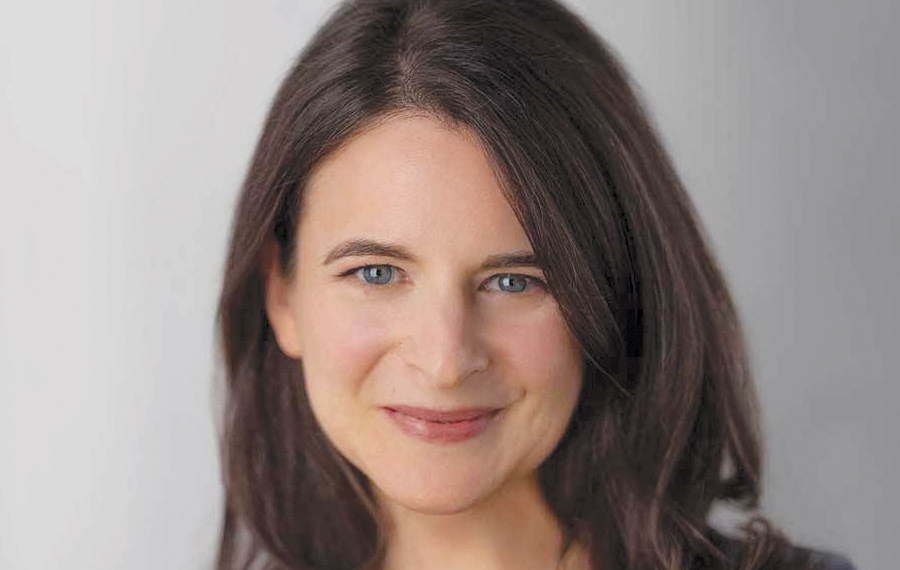
Sarah Hurwitz

“Here All Along”
Sarah Hurwitz, former first lady Michelle Obama’s chief speechwriter for both terms of the Obama presidency, discusses her new book, “Here All Along,” with Stephen Wise Temple Rabbi David Woznica. Hurwitz’s focus will be on her happy reintroduction to Judaism, which, she says, has been “Here All Along.” Registration required. Light wine and cheese reception opens the evening. 6:30 p.m. reception, 7:30 p.m. program. Free for temple members, $18 guests. Stephen Wise Temple, 15500 Stephen S. Wise Drive. (310) 476-8561.

Jews and Early Cinema
While Jews’ influence on the early studio system and American cinema a century ago is indisputable, Rabbi Jon Hanish poses a seldom-asked question during his series at Kol Tikvah: The next two Monday nights, Hanish, who holds a graduate degree in film production from USC, questions whether Jewish pioneers in Hollywood hid, denied or openly demonstrated their religious and cultural identities. In these two classes, he focuses on Hollywood’s heyday, the 1920s-1950s. Class time tonight and Dec. 9: 7-8:30 p.m. $18 per class. Kol Tikvah, 20400 Ventura Blvd., Woodland Hills. (818) 348-0670.

Sephardic-Latino Connection
Attention third-, fourth- and fifth-graders: It’s time for the Los Angeles Jewish Symphony’s annual two-day visit to two Valley day schools. The ensemble performs free education concerts at Adat Ari El this morning and at Valley Beth Shalom the morning of Dec. 3. The concerts feature guest artist Cantor Marcelo Gindlin, and their theme is, “A Patchwork of Cultures: Exploring the Sephardic-Latino Connection,” which is about getting acquainted with our Spanish ancestors. 11 a.m. today at Adat Ari El, 12020 Burbank Blvd., Valley Village. (818) 766-9426. adatariel.org. Dec. 3: 11 a.m. Valley Beth Shalom, 15739 Ventura Blvd., Encino. (818) 788-6000.

TUE DEC 3

 

“We Shall Not Die Now”

“We Shall Not Die Now”
Seventy-five years after the Holocaust, the new documentary “We Shall Not Die Now,” by the Los Angeles Museum of the Holocaust and Blackbird Pictures, features Ben Ferencz, the last living prosecutor from the Nuremberg Trials and Cantor Moshe Taube, No. 22 on Schindler’s List, demonstrating the resilience of those who rebuilt their lives after the unimaginable. Michael Berenbaum, director of the Sigi Ziering Institute at American Jewish University, and film director Ashton Gleckman participate in a post-screening Q-and-A. 7-10 p.m. $10. Downtown Independent Theater, 251 S. Main St. (213) 617-1033. Tickets available at eventbrite.com. For additional information, visit the link above.

The Battle of My Life”
Peace of Mind: The Israel Psychotrauma Center, which helps Israeli Defense Forces (IDF) veterans recover from the stresses of military life, organizes a multimedia evening at Sinai Temple, featuring music and remarks by IDF veteran Nir Rubin. During the program, which is free and open to the public, Rubin reflects on his career and life after the military. 6:30 p.m. reception, 7 p.m. program. Sinai Temple, 10400 Wilshire Blvd. (310) 474-1518. Register by clicking the link above.

WED DEC 4

Saba Soomekh

“Forty Years After”
The culture and flavor of the Jewish community of Los Angeles has become more diversified in the past four decades. With that in mind, the migration and mutual impact of tens of thousands of Persian Jews after the 1979 Iran Revolution are the subject of a three-part monthly series, “Forty Years After: The Los Angeles Persian Jewish Community,” featuring Iranian-Jewish scholar Saba Soomekh in dialogue with Stephen Wise Temple Senior Rabbi Yoshi Zweiback. Their subject tonight is “Identity.” Their Jan. 8 program focus on “Sexuality” and their Feb. 19 event examines “Culture.” Tonight: 7:30-9 p.m. Free. Stephen Wise Temple, 15500 Stephen S. Wise Drive. (310) 476-8561.

The Great Debates
Almost since the beginning of the Jewish people, scholars and ordinary Jews have argued over whether Hillel or Shammai was the superior teacher. Professor Gail Labovitz of American Jewish University revisits the millennia-old disagreement and the distinctions between Hillel and Shammai when she joins Valley Beth Shalom (VBS) Senior Rabbi Ed Feinstein in discussion. Feinstein and VBS Rabbi Noah Farkas host this series of Wednesday evenings about the controversies that shaped Judaism. 7-9 p.m. Free. Valley Beth Shalom, 15739 Ventura Blvd., Encino. (818) 788-6000.

“Sustainable Nation”
The film “Sustainable Nation” follows three people committed to bringing sustainable water solutions, many of which were developed by Israel, to a planet perceived to be growing thirstier.  Kehillat Israel calls the program a Hanukkah sustainability screening, caring for a water-starved world. 6:30 p.m. dinner, 7 p.m. film. Panel discussion to follow. Free. Kehillat Israel, 16019 W. Sunset Blvd., Pacific Palisades. (310) 459-2328. 
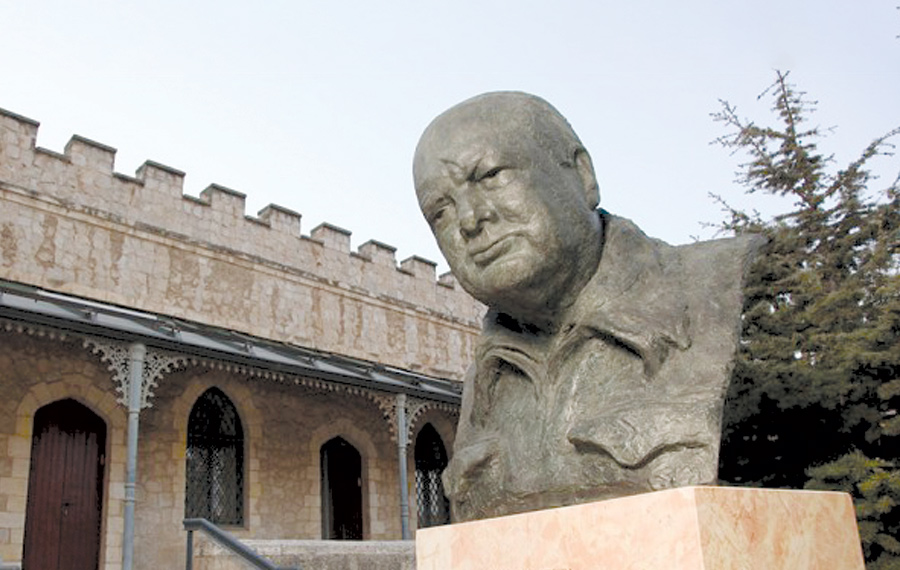
“Churchill and the Jews”
Join Holocaust scholar Michael Berenbaum at his home campus, American Jewish University, for “Churchill and the Jews.” He discusses Churchill’s remarkable loyalty to the Jews during the war years when anti-Semitism was more prevalent and explains why an oversized bust of Churchill stands today near the Western Wall. 7:30 p.m. $20. American Jewish University, Alan Shapiro Memorial Synagogue, 15600 Mulholland Drive. (310) 440-1572.

THU DEC 5

“For Sama”

“For Sama”
For more than five years, Waad al-Kateab filmed her life throughout the deadly conflict in Aleppo, Syria. During this period, she married a doctor and they had a baby, Sama. She never let any event interrupt her filming of the deadly violence that engulfed the region. The documentary, “For Sama,” is a moving film about love, laughter, loss and sacrifice. After the film, al-Kateab and fellow director Edward Watts will take questions. Not recommended for children younger than 12. 7:30 p.m. Arrive early to view the exhibitions. Free. Skirball Cultural Center, 2701 N. Sepulveda Blvd. (310) 440-4500.


Have an event coming up? Send your information two weeks prior to the event to ryant@jewishjournal.com for consideration. For groups staging an event that requires an RSVP, please submit details about the event the week before the RSVP deadline.

What’s Happening: Sephardic-Latino Concert, ‘For Sama’ Doc Read More »
Israel Bonds Event, Jewish Home Gala, HUC-JIR Chief

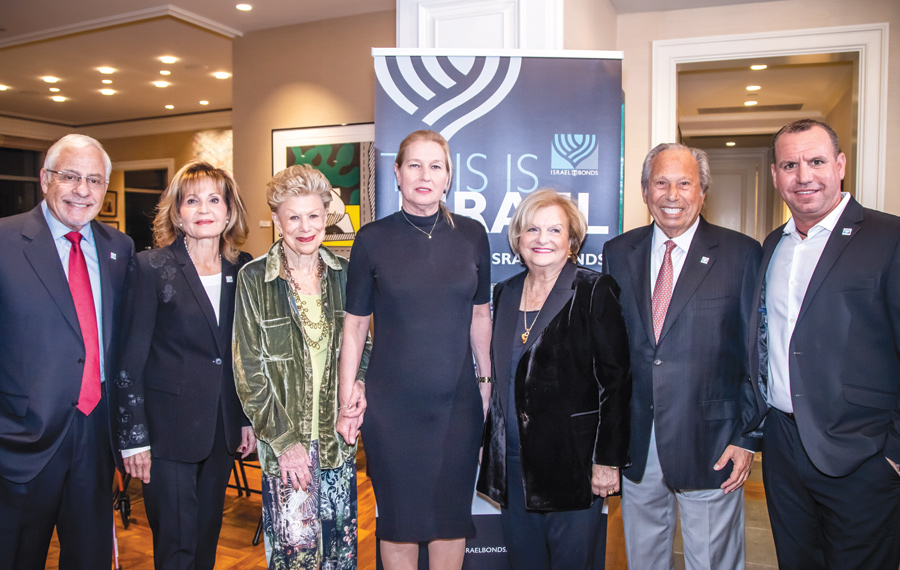
A recent Israel Bonds event in Los Angeles featured high-profile Israeli leaders, including former Israeli Foreign Minister Tzipi Livni and Consul General of Israel in Los Angeles Hillel Newman.

The event, Israel Bonds’ inaugural Builders Division Reception, took place on Nov. 13 at the Los Angeles home of Annette Shapiro. The gathering honored women and
men who have held leadership positions with Israel Bonds
for decades.

Additional attendees included event co-chairs Daniel and Dalia Farkas; Jean and Jerry Friedman; Erez Goldman, executive director for Israel Bonds’ Western region; and Gina Raphael, the organization’s Los Angeles campaign chair.

Israel Bonds allows supporters of Israel to invest in the Jewish state by underwriting securities issued by Israel in the United States.


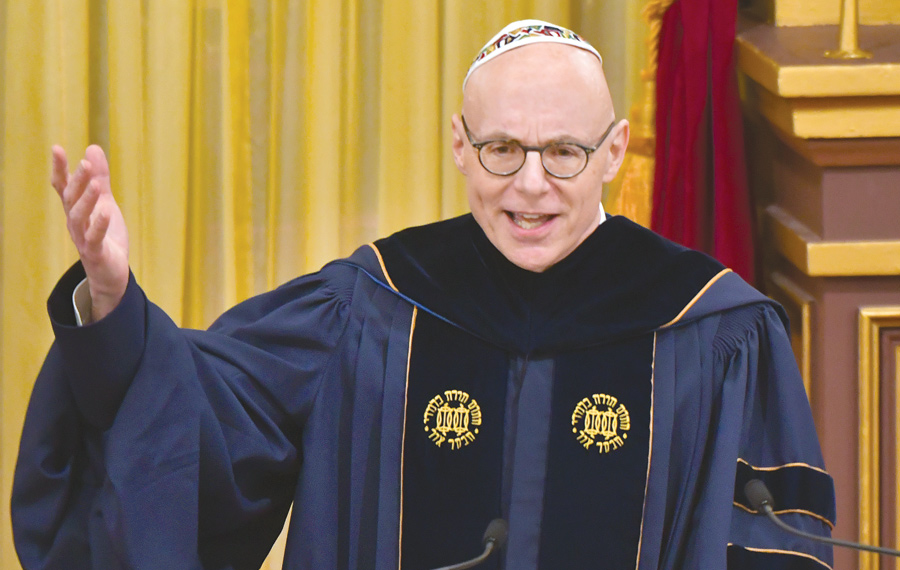
Andrew Rehfeld, who was recently inaugurated as the president of Hebrew Union College-Jewish Institute of Religion. PhotoHebrew Union College-Jewish Institute of Religion

Andrew Rehfeld was inaugurated as the 10th president in the 144-year history of Hebrew Union College-Jewish Institute of Religion (HUC-JIR), the academic and professional leadership center of Reform Judaism on Oct. 27.

The event was held at Cincinnati’s Isaac M. Wise Temple and was attended by the international leaders of the Reform Movement, dignitaries from international academic institutions and organizations, Cincinnati communal and civic leaders and HUC-JIR alumni, faculty and students.

According to an HUC-JIR statement, Rehfeld brings intellectual, spiritual and professional qualities to lead HUC-JIR. His passion for teaching and scholarship, as well as leadership skills, have set him apart as a dynamic visionary and community builder. 

“His deep personal commitment to Reform Judaism and Jewish values, profound understanding of the impact of nonprofit Jewish institutions and entrepreneurial spirit of innovation will lead HUC-JIR to greater excellence,” the HUC-JIR statement said.
He previously served as an assistant professor of political science and associate professor of political science at Washington University in St. Louis and as president and CEO of the Jewish Federation of St. Louis. A tenured professor of political thought at HUC-JIR, he contributes a combination of teaching and scholarship, experience in Jewish nonprofit administration and volunteer community leadership to HUC-JIR.

Speakers at the inauguration included Sue Neuman Hochberg, chair of the HUC-JIR board of governors. Afterward, Rehfeld began his inaugural address with a memorial tribute to the 11 lives lost at the Tree of Life synagogue in Pittsburgh a year ago.
Addressing HUC-JIR’s mission, he said, “I am filled with optimism for our institution and its future, because HUC drives the development of ideas and leadership that strengthen the Jewish public sphere: the institutions that form the canvas of communal life upon which we as a people realize our collective values to serve the highest good and the holy, and lead our world to justice, including our welfare and security in these times in which we once again are targeted and attacked simply for being Jews.”

As HUC-JIR president, Rehfeld leads HUC-JIR’s four-campuses in Cincinnati, Jerusalem, Los Angeles and New York. It represents the largest Jewish denomination in North America. 

Joy Greenberg, chair of the inauguration committee and chair of the presidential search committee, and Elizabeth Squadron, HUC-JIR vice president for program and business development, organized the gathering.

— Ayala Or-El, Contributing Writer


L.A. Jewish Home honorees Cecilia and Jeffrey Glassman (center) with Pat Benson (far right) and Gerry Chaleff. Photo courtesy of L.A. Jewish Home

Los Angeles Jewish Home supporters and community leaders attended the Home’s annual gala, “Reflections 2019: Celebration of Life.” The evening honored Cecilia and Jeffrey Glassman for their decade-plus dedication and leadership to the Jewish Home. 

The gala was held at the Beverly Hilton Hotel on Oct. 27.

Lenore and Fred Kayne; Pamela and Mark Rubin; and Marcie Polier-Swartz and David Swartz served as co-chairsd. 

The Glassmans’ friends and colleagues Arlene and Lee Alpert; Susan and Greg Burger; Kathy Gallagher and Greg Scott; Vera and Paul Guerin; Renee Kumetz and Robert Hirsch; and Susan and Alan Wohl were the honorary co-chairs. The evening raised funds to support the Home’s residents, services and programs.

The Glassmans’ involvement and personal connection to the Jewish Home was featured in a video and comments throughout the evening. Jeffrey is a past-chair of the Jewish Home’s board of directors, and the Glassmans are founding members of the Jewish Home’s donor recognition group, the Century Club. 

“Their leadership has been essential to meeting an explosive growth of senior need across Southern California,” according to the Jewish Home.

Jewish Home CEO-President Molly Forrest emphasized how the Home has adapted and grown over the past 23 years. During her tenure, the Home has increased its ability to serve the community’s seniors by providing assistance to 4,000 seniors. In the future, she said, the Jewish Home “will continue to meet our mission, which is to provide ‘excellence in senior care, reflective of Jewish values.’ The Home should be the first-choice provider of state-of-the-art senior care in Los Angeles.”

“All of us in this room play a vital role in building a Jewish Home that honors our seniors and offers some of the most innovative programs and services of any senior health care provider nationwide,” said Andy Berman, chair of the Jewish Home’s board of directors.

Southern California broadcasting icon Fritz Coleman emceed the program, which featured a jazz performance from noted trumpeter Ilya Serov and his band.

To the delight of the crowd, two Jewish Home residents, Judith Karon and Jerry Braverman, thanked Coleman at the end of the evening and presented him with a hand-crocheted blanket.


Jewish actress Mila Brener appeared at the Westwood premiere of her new Netflix film, “Klaus.” Photo courtesy of Ayala Or-EL

The premiere of “Klaus,” an animated Netflix film, took place at the Bruin Theater in Westwood on Nov. 2.  

Despite the warm weather the streets outside the theater looked like the North Pole as Netflix turned the area to a winter wonderland featuring fake snow, bubbles and a white carpet instead of the traditional red.

The family holiday film by director Sergio Pablos centers on a big, white-bearded guy, Klaus — portrayed by Oscar-winner J.K. Simmons — who gives out toys to children. The story might be a Christmas one, but the voices of some of the leading cast are Jewish, including Rashida Jones and Jason Schwartzman.

“I loved the original story about this greedy person trying to get a certain amount of letters written so he could leave this area,” said Schwartzman, who plays the part of a postman who meets a carpenter named Klaus while stationed at the Arctic Circle. “It was a sweet story about how love can change someone and the importance of communicating with other people we don’t know to better understand them and say, ‘Hey, why are we fighting and let’s talk.’ ”

Among the young actors who lent their voice to the town’s children was 14-year-old Mila Brener. Brener, the daughter of artist Bruce Rubenstein and Israeli American actress Shirly Brener, has appeared in guest roles on television series including “Ray Donovan,” “Mom” and “NCIS.”

“This is not necessarily just a Christmas story,” Brener said at the premiere. “I think this movie speaks to all religions because the message is how important it is to do good deeds, something that is shared by Jewish believers, the importance of giving to others.”

— Ayala Or-El, Contributing Writer


Wanna be in Movers & Shakers? Send us your highlights, events,
honors and simchas. Email ryant@jewishjournal.com.

Israel Bonds Event, Jewish Home Gala, HUC-JIR Chief Read More »

AJC Criticizes Seattle Leaders’ Handling of Anti-Semitism

American Jewish Committee (AJC) Seattle Regional Director Regina Sassoon Friedland criticizes political leaders in Seattle, Wash. over how they handle anti-Semitism in a Nov. 22 Seattle Times op-ed.

Friedland wrote about an instance in June, when then-City Council candidate Ari Hoffman – who ran on a platform opposing several of the city council’s progressive polices – received anti-Semitic death threats online. AJC urged Seattle Mayor Durkan to condemn those threats. 

“A full eight days later, the mayor issued an important statement on anti-Semitism, but it was sent only to me, not issued publicly,” Friedland wrote. “Our repeated requests for the mayor to share her statement on the city’s website, on the mayor’s page or in her weekly Friday newsletter so the general Seattle community could be made aware of the problem of anti-Semitism and the need to combat it were ignored.”

Durkan did issue a statement saying that she condemned “any anti-Semitic attacks and threats of violence on Mr. Hoffman and his family.” Hoffman criticized her for taking a week to provide such a statement.

Friedland also recounted how during Sukkot, “two visibly Jewish individuals were assaulted by an Antifa activist shouting anti-Semitic epithets as they erected a Sukkah in Westlake Park.” The man also shouted anti-Semitic slurs at people eating in the Sukkah days later and later followed a couple of them as they left synagogue the next day.

“One of the victims, a rabbi, shared with me his shock that anti-Semitism, including blatant threats of violence, does not incite outrage from our elected officials,” Sassoon wrote. “Indeed, Seattle leadership said nothing after the perpetrator was arrested and charged with a hate crime and criminal harassment.”

She posited that those in the Pacific Northwest region of the United States – which spans from the Pacific Ocean to the Rocky Mountains – like to condemn anti-Semitism on the right but are more hesitant to condemn anti-Semitism when it comes from the left.

“This myopic approach is an affront to Jews and allows a threat to the wider community to grow unhindered,” Friedland wrote. “One can see a similar hesitancy to identify the individuals, obviously not white supremacists, who have carried out a rash of attacks on Jews in New York City. Americans would do well to view anti-Semitism with a trifocal lens.”

AJC CEO David Harris tweeted that Friedland’s op-ed is “a must-read on #antisemitism & how our leaders choose—or fail—to react. Courageous. Sobering. Painful. Why are Seattle’s leaders silent about anti-Semitism?”

The Simon Wiesenthal Center similarly tweeted, “Silence in face of #antiSemitism by political establishment in any democracy is extremely dangerous for Jews and erodes sacred values.”

Jason Rantz, a conservative radio host who is based in Seattle and is Jewish, tweeted, “This is an important article. It’s unclear why @MayorJenny refuses to publicly condemn anti-Semitism. But this city doesn’t really take Jewish concern seriously. We’re seen as privileged whites. Maybe that’s why she’s silent?”

Durkan’s office did not respond to the Journal’s request for comment.

AJC Criticizes Seattle Leaders’ Handling of Anti-Semitism Read More »

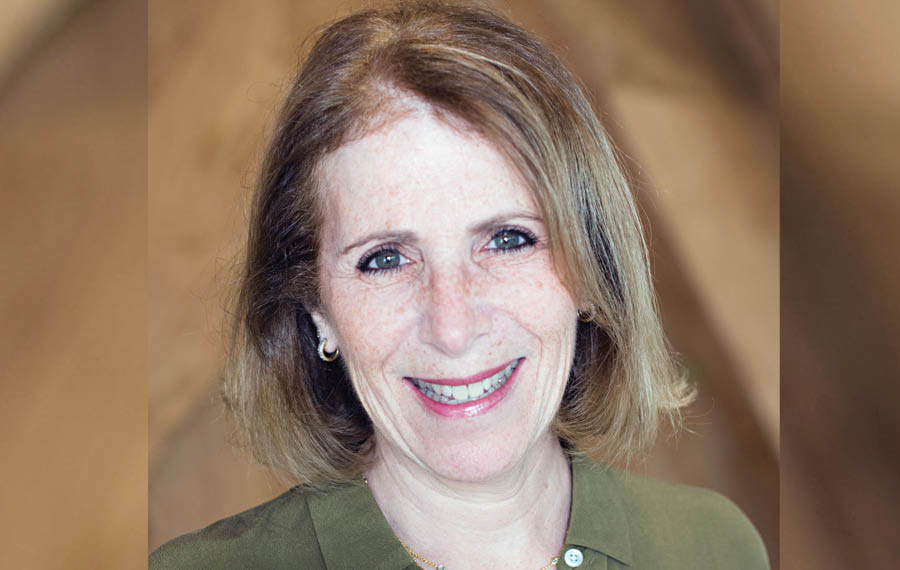
Esther Netter on the Value of Play and Santa Monica’s New Children’s Museum

Esther Netter is perhaps best known as the founding CEO and leader of the museum known as the Zimmer Children’s Museum. (The Zimmer closed earlier this year.) This past summer, Netter, 61, became CEO of the new Cayton Children’s Museum. Located on the third floor of Santa Monica Place, the colorful, hands-on museum is designed for children from infancy to 10 years. The Journal spoke with Netter about her life’s work, why a mall location was chosen for the Cayton and how children’s museums can make the world a better place.

Jewish Journal: How did you end up working in children’s museums? 

Esther Netter: I studied informal education. It’s the power of summer camp, youth groups, travel, arts education … experiential learning. And my journey to the world of children’s museums was paved with many summers at summer camp, in particular Camp Ramah in Ojai. I’m a summer camp girl. And a day in a children’s museum is like a day at summer camp, where kids are in charge.

JJ: Is there a relationship with the now-closed Zimmer museum and the Cayton? 

EN: For the last 20 years the Zimmer was housed at the Jewish Federation building. Before that we were My Jewish Discovery Children’s Museum that was birthed and grew at the Westside Jewish Community Center. The Cayton is standing on the shoulders of all the creative and generous donors of the past 30 years who got us to this moment. And the Cayton is about teaching children, youth and families how to be a mensch; how to be the best version of themselves; how each of us is responsible one for the other and how we each have the ability to make a difference in this world and the responsibility to do so. 

We are grateful to Andrea and Barry Cayton for their generosity and belief in us. Their gift to us was made to honor the memory of Andrea’s father, Jona Goldrich, who was a significant philanthropist in the Los Angeles community. He was a Holocaust survivor and he believed that each of us is responsible one for the other.

JJ: Unlike the Zimmer, the Cayton is not a Jewish museum, correct?

EN: Perception I would say is key here. Up until we became the Cayton, we were always housed in a Jewish building. So the Zimmer, when we incorporated as our own 501(c)(3), was an arts and culture institution, a children’s museum focused on reaching families with young children and was anchored in teaching the lessons of menschlikite. Our mission is to support families in raising kids to be their best version of themselves, which is the same as being focused on teaching menschlikite. One’s in Yiddish and one’s in English.

JJ: Can you talk a little about the mall location? 

EN: The move to Cayton was predicated on needing to expand our hours and expand our footprint to expand our accessibility. With that came this opportunity to be a part of Santa Monica Place, which has welcomed us with open arms. We have triple the exhibit footprint. There are two city parking lots that flank either side of the urban center and we are a stone’s throw from the Metro. We were looking for how can we be more accessible and visible. At the Federation we had 31 parking spaces and limited hours and limited square footage.

“Our mission is to support families in raising kids to be their best version of themselves, which is the same as being focused on teaching menschlikite. One’s in Yiddish and one’s in English.”

JJ: The tagline for the museum is “Playing Our Way to a Better World.” How does that work? 

EN: The way kids learn is through play. So the context of all of our exhibits and programming, when they play at rescue, they’re imagining what it’s like to help someone. When they dress up as a veterinarian and take care of animals that’s when they practice what it means to take care of something else, and then that becomes a behavior that they can apply in the family. When kids dress up in costumes, that’s how children lay the tracks for empathy and compassion. When you put on bunny ears and start hopping, you’re imagining what it’s like to be a bunny and that helps you imagine what it’s like to be the new kid in school who is scared, and when you feel that, you are more likely to go to that new child in school and ask them to come eat lunch with you.

JJ: Do you have a favorite part of the museum?

EN: I have three favorites. Our “courage climber,” has perspective windows. You get to experience being like a human drone. It’s the way kids can practice seeing things from a different vantage point and imagine how someone else feels. And then I love “in tune with nature.” The wishing wall is beautiful wood shapes and Jerusalem stone. So that’s building on the wall we had at the Zimmer. Across from the wishing wall is that little dark room with the [projected] butterflies. (It’s butterflies during the day and fireflies at night.) That back area is part of our exhibit called “reflect on,” which is counterintuitive in a children’s museum. It’s about being reflective, being still, being quiet, slowing down. The third thing is the “hello booth.” That is a nod to the telephone of the wind in Japan. Thousands and thousands of visitors make pilgrimages to the telephone of the wind to speak to people that they can’t speak to or access in real life. So as we were thinking about this museum and wanting kids to practice rescue, to practice cooperation, to have fun climbing and take risks, we thought if we’re here for families raising kids most families don’t have access to clergy, because most families are unaffiliated. Not everybody is connected to extended community, when everyone experiences loss and challenge. So why not have magic phones that are available for families who visit?

Esther Netter on the Value of Play and Santa Monica’s New Children’s Museum Read More »

Turn Old Jewish Journal Covers Into Bows

A couple of weeks ago, I showed readers how to repurpose old Jewish Journal covers into gift bags. People had so much fun with that project, I decided to do a sequel and turn the covers into bows. Bows that you buy in stores can be really expensive, but you can make your own for practically nothing; all you have to buy is a glue stick. Of course, this bow technique also works with any paper you have, so get creative with whatever you have at home.

What you’ll need:
Jewish Journal cover
Glue stick


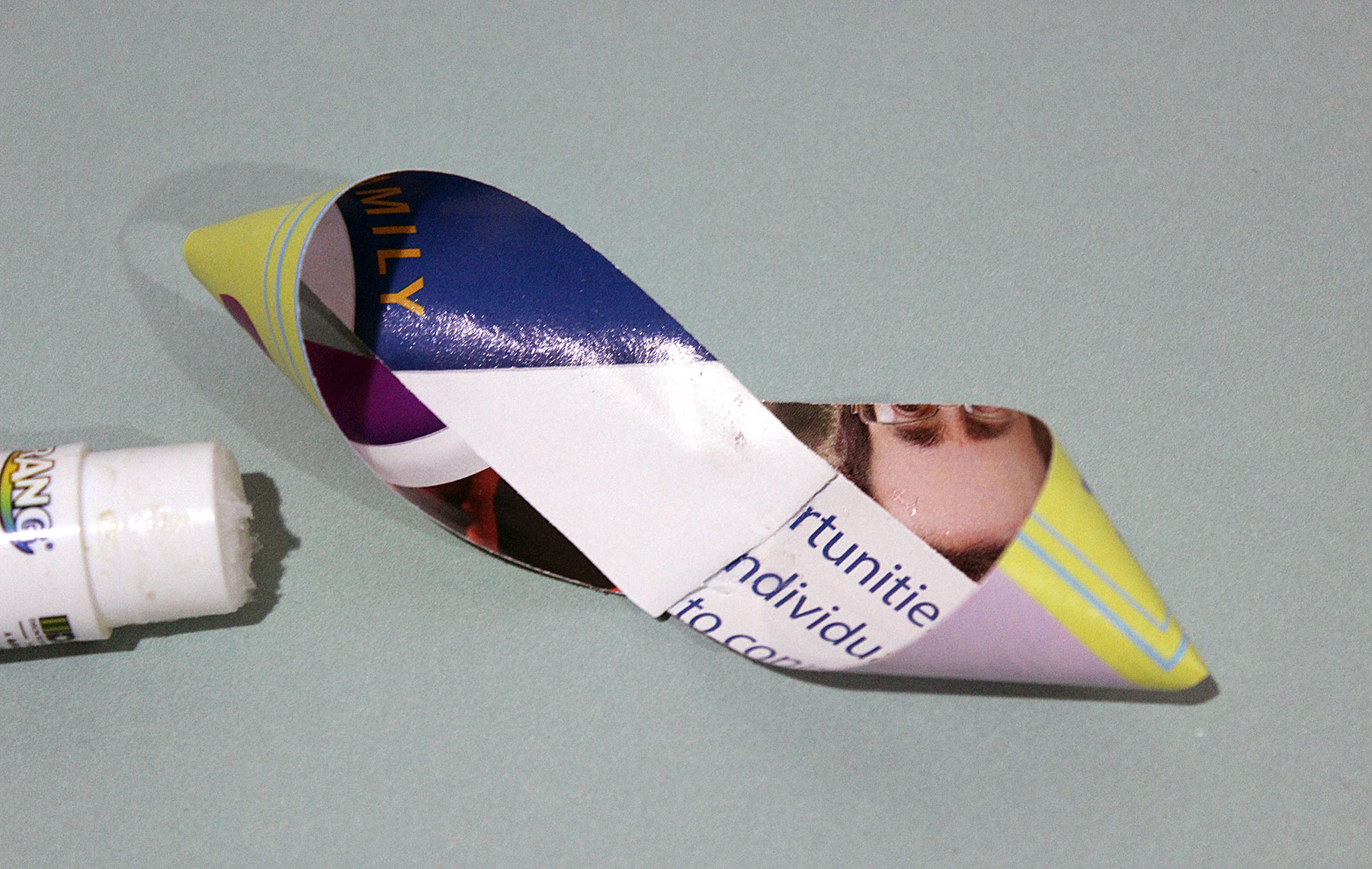
1. Turn the cover sideways to a landscape orientation, and cut seven strips that are 1 inch wide. Make three strips 10 1/2 inches long (the width of the cover), three strips 9 1/2 inches long and one strip 4 1/2 inches long.


2. Fold one of the long strips in half to locate the center point. Then loop one end of the strip to create a point, and secure the end to the middle with a glue stick.


3. Do the same with the opposite end, and you’ll have one bow section with two pointed loops.


4. Continue folding the other strips until you have three large and three small loop sections. Don’t fold the 4 1/2-inch long strip.


5. Stack the three large loops together, attaching each layer with a glue stick. Notice that it looks like a Star of David.


6. Then stack the three smaller loops on top of the larger loops, securing them with a glue stick.


7. Roll the 4 1/2-inch strip into a cylindrical loop.


8. Attach it to the middle of the bow with a glue stick.


Jonathan Fong is the author of “Flowers That Wow” and “Parties That Wow,” and host of “Style With a Smile” on YouTube. You can see more of his do-it-yourself projects online.

Turn Old Jewish Journal Covers Into Bows Read More »

Branko Lustig, Holocaust Survivor and ‘Schindler’s List’ Producer, 87

Branko Lustig, a survivor of Auschwitz and Bergen-Belsen who became a Hollywood film producer, died of heart failure on Nov. 13 in Croatia. He was 87.

His death was announced by Yad Vashem, the Holocaust memorial in Jerusalem, where Lustig donated his best picture Oscar for “Schindler’s List” (1994), one of two he received. The other was for “Gladiator” (2000).

Lustig was born on June 10, 1932, in Osijek, a small town in eastern Croatia. During the war, his family was interned in labor camps, and Lustig was sent to Auschwitz in 1944 and liberated from Bergen-Belsen a year later. The only other member of his family to survive was his mother, Vilma.

After the war, Lustig returned to Croatia and started to work in film. In 1971, he was a production manager for “Fiddler on the Roof” and “The Tin Drum,” in 1978. He also was a producer on the television miniseries’ “The Winds of War” (1983), based on Herman Wouk’s 1971 novel, and “War and Remembrance” (1988), based on Wouk’s 1978 follow-up novel to “The Winds of War,” and “Sophie’s Choice” (1982).

Lustig moved to the United States in 1988. He met Steven Spielberg, and after telling the director of his experiences in the camps, Spielberg signed Lustig to work as a producer on “Schindler’s List.”  

“Maybe the reason I survived the camps was to help make movies about them, to show people what happened.” — Branko Lustig

Accepting the Academy Award for the movie, Lustig said, “It’s a long way from Auschwitz to this stage. I hope I fulfilled my obligation to the innocent victims of the Holocaust.” He told the Los Angeles Times that “maybe the reason I survived the camps was to help make movies about them, to show people what happened.”

Spielberg told Variety, “Emerging from the horror of the Holocaust, his personal journey is a triumph of hope and determination; a story to which children from some of today’s unthinkable environments can aspire. He will be truly missed.”

Lustig’s other credits include “Black Hawk Down” (2002), “Kingdom of Heaven” (2005), and “American Gangster” (2007).

Lustig is survived by his wife, Mirjana, and his daughter, Sara.

Branko Lustig, Holocaust Survivor and ‘Schindler’s List’ Producer, 87 Read More »

Digging Into the Roots of Religion

“Religion As We Know It: An Origin Story” by Jack Miles (Norton) is modest in length, only 152 pages, but literally cosmic in its aspirations. Indeed, Miles aspires to answer the ultimate questions of religion: How does religion differ, if it does at all, from other kinds of “human activity” such as business, politics, warfare, art, law, sport, science, “or even entertainment”? 

Or, to put the same question in another way, Miles points out that each religion comes with its own primal myth, and he asks: “What is the origin story behind all these origin stories, and how far back in human evolution must we go to find it?”

The questions he asks and seeks to answer, as Miles readily acknowledges, are potentially “explosive” and “disruptive” precisely because they invite us to imagine that religion can be understood as yet another example of human invention rather than a supernatural truth imposed on humanity from above. Intriguingly, and ironically, he describes the Christian act of “abstracting Jewish religious ideas from the rich and complex Jewish way of life” — as the beginning of “a full-fledged distinction between the religious and the secular.”

Miles himself is a towering figure in American letters and, especially, in the study of religion. Starting with the Pulitzer Prize-winning “God: A Biography” in 1995, and continuing with “Christ: A Crisis in the Life of God” (2002) and “God in the Qur’an” (2018),” Miles has come to serve as the Boswell to the Almighty’s Johnson. (Significantly, the Pulitzer was awarded in the category of “biography or autobiography.”) He taught religion at the Irvine campus of the University of California for many years, and, most recently, he held the 2018-19 Corcoran Visiting Chair in Christian-Jewish Relations at Boston College. And he continues to serve as the general editor of “The Norton Anthology of World Religions,” a multi-volume work in which most of “Religion as We Know It” first appeared as a general introduction. 

For centuries, the Western world recognized only four faiths — Christianity, Judaism, Islam and “Paganism.”

Yet Miles wears his learning lightly, and he invites all to partake of the conversation. “Strictly speaking,” he quips, “there is no entrance requirement for the study of religion.” He points out “[t]he inconvenient truth that no definition of religion now enjoys general acceptance,” and he quotes the “wry or rueful” title of a recent article in the Journal of the American Academy of Religion: “Religions: Are There Any?” A former Jesuit seminarian, he acknowledges the divide that separates the believer from the scholar: “The term religion itself … may not be of much practical utility to the practitioner of any one of the traditions.”

Above all, he insists that every religion is essentially a moving target. “Every major religion has contained multiple versions of itself both over time and at any given time,” he writes. “Just as there is no Hinduism as such but only a polythetic array of practices that may be differently combined, so there may be no religion as such but only a far greater array of practices.” Perhaps the best example is found in the intimate linkages in the origins of Judaism and Christianity, which were finally broken only when the first Christians argued that “their own Jewish religiosity [was] distinguishable from their Jewish culture and ethnicity” and Jews argued that “Jewish religiosity and Jewish ethnicity are one and indistinguishable.”

Our notion of “world religions” is purely modern, as Miles points out. For centuries, the Western world recognized only four faiths — Christianity, Judaism, Islam and “Paganism,” a catch-all term for the beliefs and practices that Western explorers, conquerors and settlers encountered in Asia, Africa and the Americas. Only in 1773, with the publication of an encyclopedia that Miles calls “the direct ancestor of ‘The Norton Anthology of World Religions,’ ” did Westerners open their eyes to what people in the rest of the world believed and practiced. The encyclopedia was titled “Religious Ceremonies and Customs of All the Peoples of the World,” and Miles sees in its pages “a pioneering openness and breadth of vision.”

“All religions resemble each other in something,” wrote Jean Frederic Bernard, one of its co-authors. “How beautiful it would be … to make people with an overly opinionated character understand that with the help of charity one finds everywhere brothers.”

Miles, who earned a doctorate at Harvard University in Near Eastern language and is fluent in Hebrew and Aramaic, emphasizes that the recovery of ancient languages and literatures played a crucial role in our understanding of the origins of modern religion. “[S]ince the Bible is an anthology produced over a millennium,” he explains, “it enabled illuminating comparisons of key motifs in Hebrew mythology with their counterparts in other ancient Near Eastern mythologies.” Yet, at the same time, scholarship was a threat to true belief “because though it corroborated the historicity of some biblical events, it undermined that of others.”

As if to remind us that religion can be a danger, Miles briefly ponders the Jewish movement known as the Haskalah, which resulted in the social, cultural and political liberation of Jews in many European countries during the 18th century. The so-called Maskilim, as the participants in the Jewish enlightenment were known, included Jewish scholars who entered the secular study of religion. Even as the Haskalah represented a turn away from “oppressive and once inescapable social restriction and confinement,” however, the ancient religious hatreds were only concealed and not eliminated.

“The dynamic entry of Europe’s Jews not just into the European study of religion but also into many other areas of European life brought about a massive backlash in the late nineteenth century, then the Nazi genocide in the twentieth, the post-World War II triumph of Zionism, and belatedly, among other consequences, a distinct mood of remorse and repentance in late twentieth-century European Christianity,” Miles writes.

Miles suggests various answers to the fundamental questions that he raises at the outset of his book, but he declines to give us the answer. “Religion seems to me to bear one aspect when considered as a special claim of knowledge,” he concludes, “and quite another aspect when considered as a special acknowledgment of ignorance.” In such modesty, we find his real wisdom.

“Religion As We Know It: An Origin Story” is available on Amazon. 


Jonathan Kirsch, author and publishing attorney, is the book editor of the Jewish Journal.

Digging Into the Roots of Religion Read More »

Stand-Up Comedy With a Kippah

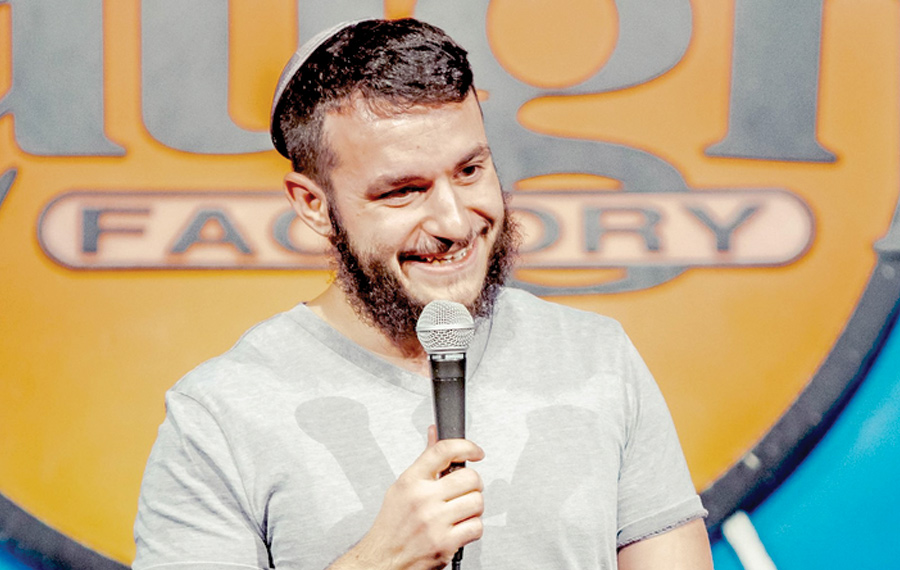
Growing up in a Chabad-Lubavitch family in Crown Heights, N.Y., 27-year-old Menachem Silverstein didn’t have much exposure to entertainment. It was only through his secular grandmother — who recorded television shows and mailed the tapes to him — that he discovered his love for vintage comedians like Mel Brooks and Gene Wilder. 

When Silverstein got older, he started to perform during open mic nights but didn’t believe he could pursue comedy as a full-time career given his lifestyle. “I thought it was a pipe dream because a religious Jew couldn’t be a comedian,” he told the Journal.

Then, when he was 18 and working as a camp counselor, he took his campers to a show at the Improv on Melrose Avenue. There, he saw Jewish comedian Stephen Kramer Glickman perform. Silverstein introduced himself, and the two became fast friends. “That was almost nine years ago, and since then I’ve invited him for Shabbos and we’ve texted every Friday to check in with each other,” Silverstein said.

Silverstein started to write for Glickman’s live show at the Improv, “The Night Time Show.” (Glickman also hosts a podcast with the same name). From there, he found a literary manager and wrote sketches for cable television’s TBS and IFC networks, including for a sketch for National Bacon Day. In the sketch, a bacon manufacturer wants to market its product to Jews, so they hire a rabbi to be the face of the company. 

Then, during the 2016 holiday season, Silverstein appeared on a “Jimmy Kimmel Live!” sketch about Hanukkah. “Kimmel wanted dancing rabbis for it,” he said. “I got a phone call to be a part of it because someone saw me on the Chabad Telethon.”

An opportunity came along for Silverstein to write a pilot for Amazon. It was about a fictional female comedian making a comedy special. The producer he was working with suggested that he act as a religious Jewish comedian on the show, which is when he got the idea to try stand-up again. “If I could play a comedian in my show, I thought I should do this,” he said. 

“When I get on stage, I obviously look Jewish, so I address it so that it’s not an elephant in the room. I play up the fact that no one can pronounce my name.”
— Menachem Silverstein

Over the past four years, Silverstein has performed at the Laugh Factory, where he plays every Monday, at the Comedy Store and the Improv. He performs at secular and Jewish gigs, and no matter what, he always wears his yarmulke. 

“When I get on stage, I obviously look Jewish, so I address it so that it’s not an elephant in the room,” he said. “I play up the fact that no one can pronounce my name.” 

He also makes jokes about his relationship with his wife, Raizel; being a young father of two; and how he sticks out wherever he goes because of how he looks. On his TikTok and Instagram accounts — where he collectively has nearly 40,000 followers — he makes short, humorous videos featuring Raizel and his children. In one video he posted during Sukkot, he and his kids are shaking the lulav to Metro Station’s hit song, “Shake It.” 

Along with posting original videos online three times a week, Silverstein is a guest on comedian Tehran’s recurring live stand-up show, comprising Jewish and Muslim performers. He’s working on three TV shows with producers attached at three production companies, and he’s trying to go on tour with his comedy without performing on Friday nights.

Although Silverstein jokes about his Judaism he hopes to change people’s
perceptions of Orthodox Jews through his work, whether he’s on stage, making fun videos for TikTok or Instagram, or writing for television.

“I like humanizing religious Jews because people look at us as weird entities sometimes,” Silverstein said. “When religious Jews are humanized, we become a little more relatable.”  

Stand-Up Comedy With a Kippah Read More »

Jewish Comedy ‘Motti Wolkenbruch’ Is a Netflix Hit

Mining Orthodox Jewish family life for comedy and romance, the Swiss import “The Awakening of Motti Wolkenbruch” is one of Netflix’s most popular new titles. 

Comically chronicling the title character’s love life, which he tries to keep secret from his overbearing, matchmaking mother, the movie originally was released as “Wolkenbruch’s Wondrous Journey into the Arms of a Shiksa,” and it’s Switzerland’s Oscar entry for best international feature this year.

Joel Basman (“Land of Mine”) plays Mordechai “Motti” Wolkenbruch, a college student who endures a series of excruciating shidduchs arranged by his mama (Inge Maux) while clandestinely dating Laura (Noémie Schmidt), a non-Jewish classmate. The screenplay is by Thomas Meyer adapted from his novel, and is directed by Michael Steiner, who appeared at a Los Angeles Times-sponsored screening with Basman and Maux. 

Although he’s not Jewish, Steiner told the audience that he had lived in an Orthodox neighborhood in Zurich, where he was sometimes called upon to be a “Shabbos goy.” His research and preparation for the project included an extended pre-production period when the cast could learn their Hebrew and Yiddish lines and share Shabbat dinners. (Both languages and German are spoken in the film.) 

Sam Cohen, a former member of the Orthodox community, served as an adviser. “He was kind of the real Motti,” Steiner told the Journal later. “He was with us every day while shooting.” 

Basman was also helpful with the Hebrew language. His father is Israeli. 

“The mother-son conflict is not specifically Jewish. It’s a global topic.” —  Michael Steiner

The winner of the Swiss Film Prize for best actor, he recalled sweltering in a wool suit during the summer shoot, and the disapproving glances he’d sometimes get from the Orthodox locals. “On Shabbat you’re not allowed to work or ride a bicycle or smoke, and I’m standing around on my phone, smoking,” he said. “I waved, but they didn’t wave back.”

Steiner, who has known writer Meyer for over 20 years, endeavored to be true to his friend’s story. “He has a great imagination and a good eye for detail. I tried to visualize it the best that I can,” the director said, noting that the plot does diverge a bit in not using the book’s third act in favor of a more open-ended finale. His overall goal, he added, was “to shoot a tragicomedy that respects the religion and the culture the story is set in.”

Achieving the right comic tone “wasn’t always easy, but we rehearsed quite a lot before shooting to get it right,” he said. “I think we did the right thing. The film was the No. 1 movie in Switzerland last year.” 

Now, with the film achieving global popularity via streaming on Netflix, Steiner is not surprised that his very Jewish story has become universally relatable. “The mother-son conflict is not specifically Jewish,” he said. “It’s a global topic.”

Steiner’s next film is a distinct departure from “Motti Wolkenbruch.” It’s a hostage drama set in Pakistan, based on a true story. Basman also has several projects forthcoming, including “Adventures of a Mathematician,” in which he plays Edward Teller, a Hungarian Jew who participated in the Manhattan Project and the development of the atomic bomb.

“Motti” may have less gravitas than those subjects but Steiner thinks that it can have an impact nonetheless. “I am certain that giving a glimpse into the Orthodox Jewish world brings everything you see and feel a bit closer and helps to fight prejudices, no matter if it concerns religion, color or gender,” he said. For him, the takeaway message is a simple one: “Be tolerant, be loving and let people go their own way.”

“The Awakening of Motti Wolkenbruch” is streaming now on Netflix.

Jewish Comedy ‘Motti Wolkenbruch’ Is a Netflix Hit Read More »

Film About Porto’s Jewish Community Raises Questions About Its Funding

You may not have heard of Artur Carlos de Barros Basto, but when you watch “Sefarad,” a new 90-minute feature produced by the small Jewish community of Porto, Portugal, you’ll understand why he has been called “the Portuguese Dreyfus.” Like Dreyfus, Barros Basto was stripped of his army officer status because of unjust accusations. 

“Sefarad’s” opening four-minute scene takes place at the end of the 15th century. Thousands of Jews who were ejected from Castile in 1492 descend on Portugal, including the city of Porto. It’s a colorful medieval cityscape with surprisingly lush production values. Hundreds of extras — merchants, beggars, blacksmiths, rabbis, all dressed in period clothing — interact with one another, speaking in Portuguese and Hebrew.

But danger lurks. The Portuguese king has decreed Jews cannot stay. While Jews gather to pray, mobs, waving crosses, force the Jews to flee Portugal, just as they had left Spain.

The film then takes a 400-year leap to 1923 in Porto, where Barros Basto, then in his mid-30s and an active military officer, is the leader of the Jewish community, which has (again) swelled − this time because Eastern Europeans have converged on Portugal in hopes of continuing west to North or South America. The rest of “Sefarad” focuses on Barros Basto’s triumphs and setbacks as the driving force of the small Porto Jewish community.

In recent days, however, it’s not Barros Basto’s compelling story that has drawn the attention of Jewish press in the U.S. and Israel; it’s the opening four minutes with its large number of extras in period costumes. These four minutes apparently led The Jewish Telegraphic Agency (JTA) to report that “Sefarad” cost more than $1.2 million to make and is “likely the costliest production by any European Jewish community.” Ha≠aretz,  the Times of Israel and the Jerusalem Post all echoed JTA in pointing out that this was a huge amount for a small Jewish community to spend on a feature film about its own history.

“There is a lot of romanticism around crypto-Jews and sadly, the story is not the happy fairy tale some people make it out to be.” 

— Dara Jeffries 

More scathing was JTA quoting an anonymous source — a “former member” of the Porto Jewish community — who said the funds to make the film came from money the community had received for vetting applications for Portuguese citizenship from those who claimed Sephardic/Portuguese roots.

When asked about this, Dara Jeffries, a Porto community member who divides her time between Portugal and Miami, defended the Porto Jewish community’s actions.

“When we were quiet in our corner, nobody bothered us,” Jeffries told the Journal, “but now that we’re visible, people question our motives … . I hate to say this, but people tend to be lashon harah [evil speech; gossipy] … . I have no idea who was JTA’s source. Maybe it’s a former porter who was dismissed or someone like that. The community provides a very important service [by vetting applicants who claim Sephardic roots], and it works with the Ministry of Justice in Portugal, but it’s completely separate from the film, [which was] privately funded.”

Jeffries gave no additional details on the source of funding, but added the Porto Jewish community uses its funds to carry out “an incredibly broad public service mission. It’s opened a museum recently and [“Sefarad”] is shown in the museum. We have thousands of students and visitors every year, and we have an enormous goal in explaining Judaism, the history of Jews in Portugal … . So the film is also for that purpose, to tell people our story.”

It’s quite a story. Barros Basto led the Porto Jewish community from the 1920s until his death in 1961. During the course of the film, we learn he didn’t find out about his Jewish background until he was 17, when his dying grandfather told him about his ancestors. As an adult, he studied with rabbis in Morocco, converted to Judaism, married a Jewish woman and made it his life’s work to give new life to Portugal’s disappeared Jewish community.

“The idea [for the film] was my husband’s,” Jeffries said. “He was a former president of the community.” The community discussed the idea and thought it would be a good idea to make a film.

The screenplay credit doesn’t go to an individual or even several people, but to “The Oporto Jewish Historical Society.” Jeffries conceded there was one person who structured the story and spearheaded most of the drafts. “I don’t think he wants to be particularly known, [and] a lot of it was a group decision.”

In the film, we see Barros Basto on horseback ride out to remote villages, where he finds pockets of crypto-Jews (previously called Marranos and now referred to as anusim), who have carried out secretive versions of Jewish-like rituals for hundreds of years. They are surprised when Barros Basto tells them there are other Jews in the world. Barros Basto is determined to merge these crypto-Jews with Porto’s traditional Jewish community, but some Jews resist his struggle to include them.

“There is a lot of romanticism around crypto-Jews,” Jeffries said, “and sadly, the story is not the happy fairy tale some people make it out to be … . There was a lot of opposition from some quarters, and the Marranos themselves weren’t so keen on it. Initially, [folding them in] seemed like a good idea, but for logistical and religious reasons [it didn’t work out]. Some did convert, many did not, and there are no crypto-Jews left in Portugal as far as I know.”

One of the most dramatic sequences in the film occurs in 1937, when Barros Basto’s military superior receives an anonymous letter accusing the Jewish captain of homosexuality. The charge is dismissed, but the investigation leads to the discovery that Barros Basto has supervised circumcision of crypto-Jewish men. Circumcision is legal in Portugal in 1937, but it is against military regulations for Barros Basto to be involved in it, so he is stripped of his military rank and status. 

There is a subsequent scene, where Barros Basto’s accusers are held accountable. His supporters in the Jewish community excommunicate their fellow Jews for having written the anonymous letter accusing Barros Basto of homosexuality, of having committed the sin of lashon harah, which caused him so much harm. 

It is ironic that lashon harah, a harmful anonymous comment, is a major plot point in the movie, since it’s also how Jeffries characterized some Jewish media’s reaction to the film.

“Sefarad,” directed by Luis Ismael and written by the Oporto Jewish Historical Society, currently is streaming on Amazon Prime and will be released Dec. 15 on iTunes.

Film About Porto’s Jewish Community Raises Questions About Its Funding Read More »