fbpx

November 18, 2019

Pompeo’s Settlement Statement: Facts on the Ground

The Bluff

Note the double negative in the statement by Secretary of State Mile Pompeo: “the establishment of Israeli civilian settlements in the West Bank is not, per se, inconsistent with international law”. Pompeo did not say that establishing settlement is consistent with international law. He said it is not inconsistent. And more importantly he said it does not matter. That is, international law does not matter. In. fact, I’d argue that his most important observation was the following sentence: “The hard truth is that there will never be a judicial resolution to the conflict, and arguments about who is right and who is wrong as a matter of international law will not bring peace.”

Are settlements illegal? Thoughtful people can have a sincere debate about that.

Can there be a judicial resolution to the conflict? There can be no serious debate about that.

This means that Pompeo’s most important observation is plainly true. International law has no practical meaning in the context of the Israeli-Palestinian conflict (and one could legitimately wonder if it has any meaning anywhere). Inserting it into the conversation is a disruption. Inserting it into the conversation is a manipulation. It is a tactic aimed at presenting Israel as a pariah state, a state guilty of criminality.

We should thank Secretary Pompeo and the Trump administration for calling this bluff.


The Settlements

When Pompeo said that settlements were not illegal, he did not say that they were not damaging to the cause of peace. He did not say they were not stupid. Again, this is less a statement on the settlements, and more a statement on the role and the limitations of international law.

The settlements are a separate issue. As Pompeo said, they create new realities on the ground. They create realities that some people see as disastrous. True, international law is irrelevant to talking about the settlements. And yet, we need to talk about the settlements, the strategy behind them, their advantages and disadvantages. We still need to talk about an area in which millions live under Israel’s control without having full political rights. We still need to consider the options for Israel as it moves forward, mixing settlers and Palestinians in ways that could make separation complicated, if not impossible.


The Timing

A few days ago, the European Union’s top court ruled that European countries must label products made in Israeli settlements. Pompeo’s declaration is a clear and immediate rebuff of this unwise decision by the court. Again, it is calling a bluff: this is not a judicial decision based on law, it is a political decision expressing Europe’s opposition to settlement activity.

So, the timing is important, but Israel will still have to deal with a European Union – its largest business partner – whose policy is to use international law as an excuse for labeling products made by Jews who live in a certain, disputed area.

Timing is also important because Israel is in the midst of a nutty political process. And Pompeo’s statement – on the heels of last week’s Gaza eruption – make a coalition supported by the Arab Party seem less viable. The leader of Blue and White, Benny Gantz, responded favorably to the U.S. change of policy. The leaders of the Arab bloc are furious. In other words, Pompeo added another wedge to the many wedges that separate Gantz and the Arabs, and made a coalition headed by him and supported by them, seem unrealistic (if not impossible).


The Response

Europe disagrees with the Trump administration. This was to be expected.

The Palestinians are unhappy. That’s natural.

Most Jewish organizations meekly support the statement (AIPAC), or strongly oppose it (Reform rabbis). Unfortunate, and yet predictable.

Democratic presidential candidates disagree with the Trump administration. “The Trump administration’s statement on West Bank settlements is not only a significant step backward in our efforts to achieve a two-state solution to the Israeli-Palestinian conflict, it is the latest in a pattern of destructive decisions that harm our national interests,” said Presidential candidate Pete Buttigieg. That’s important because of simple truth: The Trump administration altered a position that can be altered back. In other words, should Sanders, Biden, Warren or Buttigieg enter the Oval Office, they can conceivably restore the “settlements illegal” policy.

And yet, unlike statements, some facts on the ground are not easy to undo. When the US embassy was moved to Jerusalem, Democratic candidates were unhappy, but it’s unlikely that any of them would attempt to move the embassy back to Tel Aviv. With settlement activity they will have a similar problem: What Israel decides to build under a Trump umbrella will add “facts on the ground” to the statement. Reversing the statement will be possible, evacuating these settlements much more difficult.

—–

Syria Situation: To understand the situation on the Israel-Syria border (rockets, Iron Dome activated, reports on recent attacks), listed to Rosner’s Podcast with Prof. Eyal Zisser, a leading expert on Israel-Syria relations. It is here.


Pompeo’s Settlement Statement: Facts on the Ground Read More »

Jennifer Bliss

Jennifer Bliss: Why Do We So Rarely Talk About Adoption?

Dr. Jennifer Bliss, director of adoptions and foster care at Vista Del Mar, shares her expertise on a world few of us really know.

Jennifer Bliss
This podcast is Sponsored by the IAC ANNUAL NATIONAL SUMMIT December 5-8, 2019 in South Florida. Register Today at www.iackenes.org and use the Discount Code JJLAIAC for an exclusive 10% discount! 

Follow David Suissa on FacebookTwitter and Instagram

Jennifer Bliss: Why Do We So Rarely Talk About Adoption? Read More »

Amendment Advocating Right of Return Fails At CA Dem Convention

A proposed amendment to the California Democratic Party platform advocating for the Palestinian right of return failed at the Californian Democratic Party convention at the Long Beach Convention and Entertainment Center on Nov. 17.

The amendment, authored by delegate David Mandel, stated that the party should “oppose any unilateral annexation of territory, and support the right of all those who were forced from their homes to return to their homelands and receive compensation for their losses.”

State Assemblyman Jesse Gabriel (D-San Fernando Valley), who is the vice chair of the California Legislative Jewish Caucus, told the Journal in a phone interview that the amendment’s text was “problematic,” saying that it called for the Palestinian right of return to Israel. This would essentially be “a one-state solution,” Gabriel argued.

He said that the amendment failed, with an estimated 75% of delegates opposing it. 

“It is very reassuring to see the California Democratic Party reaffirm its support for Israel, to the peace process, and for the Jewish community,” Gabriel said.

The Progressive Zionists of California similarly said in a statement that the amendment “included language calling for an unprecedented ‘right of return’ — a policy that would preclude a two-state solution.

We are pleased the party has once again rejected extremism, and decided to focus on unifying issues,” Progressive Zionists of California Co-Founder Susan George said. “[The 2020 election] is the election of a lifetime, and we must focus on keeping the tremendous gains California Democrats made in 2018, not get derailed by a divisive conversation.”

https://www.facebook.com/ProgressiveZionistsofCalifornia/photos/a.244540719420265/587988478408819/?type=3&theater

Democrats for Israel President Andrew Lachman also said in a statement that the California Democrats’ support for Israel “provides a national model of how to come together to reclaim our place in the Democratic Party to reflect and support the interests and values of our community while fighting one-sided narratives by the anti-Israel community that seek to deny our legitimate rights to security and self-determination and promote anti-Semitism.”

Democratic Majority for Israel President Mark Mellman said in a statement that he was “thrilled” that the California Democratic Party thwarted efforts “to incorporate extreme and one-sided, anti-Israel planks into their platform. Instead, the platform continues the Party’s proud history of supporting both Israel and the peace process.”

UPDATE: Mandel wrote in an email to the Journal that he was among the Jewish Voice for Peace Action organizers who objected “to a ‘two-state solution’ and affirmation of a “secure, democratic Jewish state” with no mention of occupation, settlements, annexation, racist discrimination or refugees. The party, we argued, must focus squarely at these core issues and at the asymmetry of the conflict, and should not pre-ordain the number or nature of states that must result from eventual negotiations between representatives of the two peoples.”

He added that those who argued against the amendment on the floor invoked “the Holocaust and rail about how the proposal was tantamount to the destruction of Israel – an embarrassing display, but effective enough to sow doubt and fear among delegates whom we had not reached and who were not tuned in to how much the party’s position is inconsistent with its professed – if often left wanting for action – values of democracy, equality and freedom.”

Despite the amendment’s failure, Mandel wrote that he took solace in that “growing numbers of young delegates, delegates of color and many others, including large numbers of Jews who responded emotionally to our materials, are newly emboldened to speak out. We’re confident that a tipping point is fast approaching regarding support for Palestinian rights in the California Democratic Party. “

Amendment Advocating Right of Return Fails At CA Dem Convention Read More »

Swastika Drawn in Snow Near Syracuse Among Latest ‘Racist Incidents’ on Campus

A swastika was found drawn in the snow close to Syracuse University on Nov. 14.

The student newspaper Daily Orange reports that the swastika was across the street from an apartment building where several students reside.

Syracuse Mayor Ben Walsh condemned the swastika in a statement.

“This is another of several such racist incidents in our City in the past week. These acts are vile and appalling, and they will not be tolerated,” Walsh said. “The Syracuse Police Department is actively investigating this most recent incident, and they are also involved in the prior cases. We will keep working to find the people responsible.”

Syracuse University Hillel Director Jillian Juni similarly told the Daily Orange that the swastika “is extremely upsetting for Jewish students on campus, especially on the heels of the racist incidents earlier this week targeting both Black and Asian students.”

The prior incidents involved other “racist and bigoted graffiti” found on campus or nearby the school, according to The Washington Post.  Additionally, an unnamed fraternity was suspended on Nov. 17 after video emerged of members hurling “racist language at a black woman” on Nov. 16, 1010 WINS reports.

Kent Syverud, the chancellor of the university, said in a Nov. 17 video to students that “Our Orange values are stronger than these shameful acts. We will be sharing further detailed updates early this coming week.”

Syracuse University Department of Public Safety Chief Bobby Maldonado also said in the video that people with information regarding the various instances on campus could receive an award of up to $50,000.

Anti-Defamation League New York and New Jersey tweeted, “Good to see the strong response from local law enforcement and the @SyracuseU leadership in wake of the series of incidents on campus.”

Swastika Drawn in Snow Near Syracuse Among Latest ‘Racist Incidents’ on Campus Read More »

These Manhattan Synagogues Want to Become Condominiums

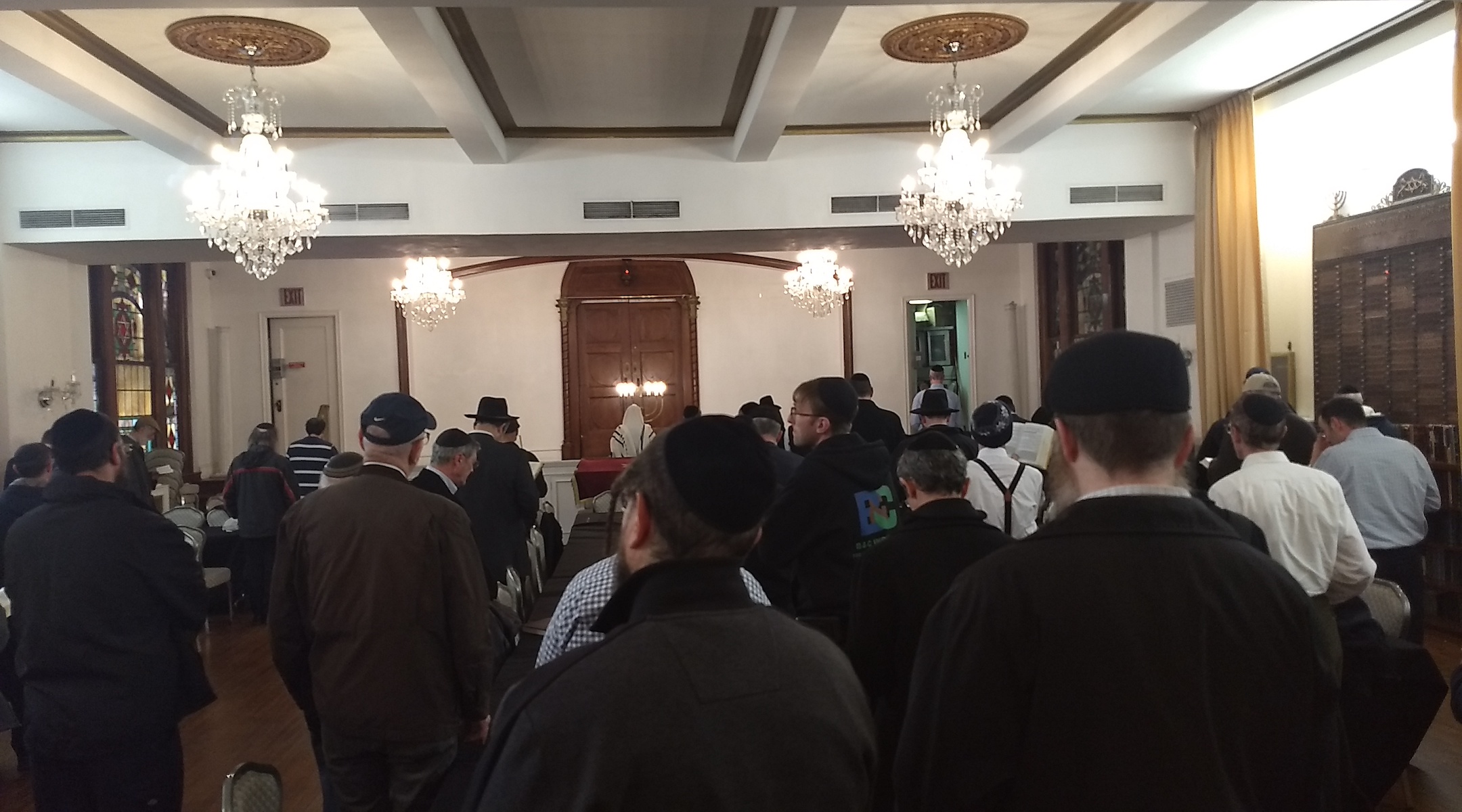
NEW YORK (JTA) — One of the most active times of day at the West Side Jewish Center begins precisely at 1:40 p.m., when 60 or so middle-aged men trudge in, mutter through the afternoon prayer service with their coats on, maybe throw a couple dollars of charity into a metal cup and walk back to their jobs. The whole thing is over in about 15 minutes.

Other than that and two shifts of morning prayers, the building is mostly empty during the day. On a recent weekday afternoon, two men studied Jewish texts in Yiddish in a wide room at the front of the building. Long curtains obscured boards bearing the names of generations of congregants who have died. Hot water boiled in a machine that looked like straight out of a 1980s diner.

The overall impression of mustiness belies what is, in fact, an active congregation with good prospects. Not many synagogues can boast more than 100 people praying on a daily basis. The congregation, established by immigrants in 1890, recently renamed itself the Hudson Yards Synagogue to better attract residents of the posh new development of the same name that just sprung up nearby.

But as the 94-year-old synagogue stands on the cusp of a new era, its building is both its greatest asset and liability. On the one hand, the structure is dilapidated and inaccessible to people with disabilities — a significant problem when a good portion of your regulars are senior citizens. On the other hand, it’s valued at $55 million thanks to its location on one of the busiest streets in the busiest city in America.

That’s why the congregation is looking into demolishing the whole thing and rebuilding it as a condominium — with a synagogue on the lower floors.

“This building needs major work,” Rabbi Jason Herman said. “We’re putting a lot of Band-Aids on it. In addition to funding the building, we want to fund programming and operations, so we can become the shul that’s attractive to the neighborhood in the Hudson Yards.”

The SynaCondo concept, as architect Esther Sperber calls it, could be a win-win for developers and the synagogue. Developers get to build in some of the most desirable parts of the city, while synagogues get much-needed cash and state-of-the-art spaces.

Sperber’s renderings envision a wood-paneled basement sanctuary lit by a skylight and an outdoor garden for the synagogue’s exclusive use one floor above. Additional space that could be used for social events is available beneath the sanctuary, two floors below ground level.

“This was an opportunity to think about a problem that seems really relatable to other properties in the city,” Sperber said. “If you give up that dream of being above grade and use that space that’s less valuable to the developer, you can actually get more space and find a way to make that space unique and special and beautiful.”

The afternoon prayer service at the West Side Jewish Center, held in its multipurpose room, is one of the synagogue’s busiest times of day. (Ben Sales)

The West Side Jewish Center would not be the first synagogue in New York City to attempt such a transformation, but it could be the first to succeed. Though on paper it seems like a great idea, in practice deals like this can turn into nightmares.

Both The Young Israel of Manhattan on the Lower East Side and the Fort Tryon Jewish Center in Washington Heights — both historically Jewish Manhattan neighborhoods now in the throes of gentrification — sought to go the condo route. But developers who began working on the buildings were unable to complete them, leaving the projects in limbo and the synagogues renting space elsewhere. (Full disclosure: I am a member of the Fort Tryon Jewish Center.)

“Unfortunately, in 2008, everything fell apart, so our contractor also sort of fell apart,” Rabbi Yeshaya Siff of the Young Israel said. “Since then, the question is, what to do now because the people [at the synagogue] are older and the whole area is becoming upgraded, gentrified. The question is, how realistic is building all of this now?

Other synagogues in the city have also faced hurdles in rebuilding. Lincoln Square Synagogue, a prominent Modern Orthodox congregation on the Upper West Side, sold its property and began construction on a new facility nearby. But the synagogue nearly ran out of cash and had to be bailed out by an anonymous $20 million donation in 2010. It opened its new doors three years later.

Kehilath Jeshurun, a tony Upper East Side synagogue whose building was charred by a fire in 2011, received $9 million from insurance. But the rebuilt interior, which reopened in 2015, cost nearly $40 million to complete, according to The New York Times.

Sperber says synagogue real estate deals like these are especially fraught because they combine Manhattan’s complex market with the unique demands of an Orthodox community that generally cannot change locations and whose chain of command is at times confusing.

“When you look at shuls compared to other nonprofit institutions, the decision-making process at a shul is a little bit less clear,” she said. “The chair of the board may be a very important person or may not. There’s an executive director — they may be the decision maker but they may not. The rabbi may be the decision maker but may not.”

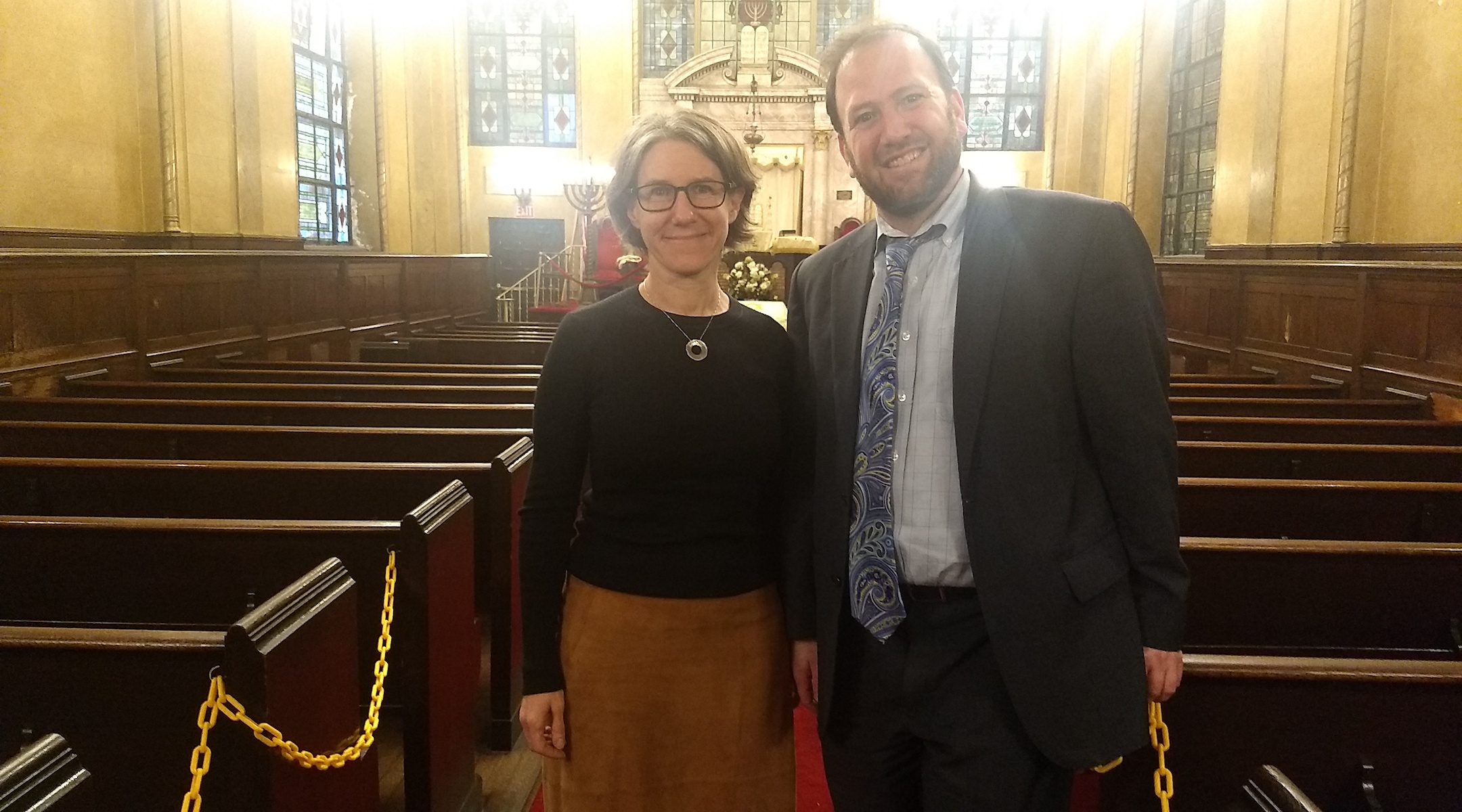
Rabbi Jason Herman and architect Esther Sperber stand in the sanctuary of the West Side Jewish Center. (Ben Sales)

Other synagogues appear to be executing the condo transition more successfully.

Habonim, a congregation on the Upper West Side, had a nursery school that was outgrowing its existing space. Constructing a new building would have cost too much, so instead the synagogue inked a deal with a condo developer. In the meantime, the synagogue has been operating out of rented space.

Richard Verner, Habonim’s board president, estimates it will take another three to four years for the synagogue to move into its new building — a longer timeline than it expected when it began planning the sale several ago.

“It’s a long process and any change is difficult for a community, so it would have been great if we could have closed the doors on the old building and a year later moved into a lovely new building, but that’s not the way things work in New York,” Verner said. “We’re trying to keep everyone excited about the end result.”

Shaare Zedek, another Upper West Side synagogue, also has been in a temporary space since 2017 as its SynaCondo is being built. The synagogue is partnering with Kehillat Hadar, an egalitarian prayer group in the neighborhood.

Michael Firestone, the synagogue president, said the choice to demolish the old building was difficult but obvious, and he remains optimistic that everything will work out.

“We’re the third-oldest shul in Manhattan. We started in the Financial District, went to the Lower East Side, then Harlem,” Firestone said. “There was a lot of emotion tied up in it, but the vote to do the deal was unanimous. The community recognized that this was a moment in history that had to be met boldly.”

These Manhattan Synagogues Want to Become Condominiums Read More »

A Statue Unveiled: A Jewish War Hero Honored in a Muslim Land

Nov. 15, 2019 was a particularly special day for the Jewish communities of Azerbaijan, and for Jews worldwide, who know the story of our most decorated war hero, Albert Agarunov. On this day in our capital city of Baku, an enormous statue of this National Hero of Azerbaijan was unveiled with military honors before a crowd of government and community leaders, and the broader community and foreign guests that had come to celebrate one of our greatest heroes. Some traveled from afar to attend the special unveiling, including Rabbi Abraham Cooper of the Simon Wiesenthal Center; Commissioner for the United States Commission on International Religious Freedom and President of Congress of Christian Leaders Rev. Johnnie Moore; Chief Sephardic Rabbi Emeritus of Israel Shlomo Amar, several other rabbis from Europe, the United States and Latin America, as well as state senators from the Western United States.


Albert is a symbol of national pride, in a 95% Muslim nation that has a thriving and prosperous Jewish presence, both in the capital city of Baku and in smaller cities across the nation. Our history in Azerbaijan is very old and very special. I suppose all Azerbaijani Jews can consider themselves lucky, in a sense, because our nation has for thousands of years been the one safe space for Jews in an otherwise turbulent region. Each of us here has a story, perhaps from long ago and for others much more recent history, of our family coming to and settling in Azerbaijan, after a dangerous journey fleeing from antisemetic nations.


Albert was a Mountain Jew, born in 1969 to a large family with 10 siblings. He worked in oil production and loved music, and was known by friends, family and neighbors as a particularly kind and spirited young man – with a strong sense of justice and a zest for life. In 1991, despite being given total freedom to refrain from service or leave the country following the collapse of the USSR, Albert joined the army voluntarily to fight for Azerbaijan as Armenia led a brutal military invasion of our Karabakh region, as he was passionate about defending his country, a place that has protected him and all Jewish residents for thousands of years. He was a renowned tankist, and his ability to subvert the enemy at many turns led to the status of a hunted man, as the Armenian army placed the bounty of $100,000 on his head. Albert was unparalleled in his skills as a tankist, navigating in the most dangerous and compromised situations, managing to outmaneuver thousands of soldiers and achieved exceptional military feats, such as disabling nine Armenian tanks and two armored trucks in one day. His ability to disarm two tanks at once, was called by his combat friends as the “Jewish Sandwich”. Rare was his ability, his bravery and his willingness to fight for what he knew to be right, for his country, and what he believed in.


Albert’s kindness and bravery extended beyond his service in our military. On the worst of days at the height of the Armenian invasion and massacres, Albert drove his tank into areas where the ground was literally covered in bodies of men, women and children – slain, innocent Azerbaijani civilians. On those days, Albert would leave the safety of his tank, even under the threat of immediate fire, and navigate the driver, so as to avoid harming those tragically murdered bodies anymore than they had already suffered. He had immense respect for the dead, equal to his insatiable respect for life.


Albert lived and died with his good values and his good heart. He was killed in Shusha, the city he had been the last to defend before it was invaded by Armenia. Albert was shot by an Armenian sniper while he was out of his tank, making sure his driver avoided the slain bodies of his comrades on the ground. On May 8, 1992, the Jewish world, Azerbaijan, and all those who loved him, lost a true hero. He was only 23 years old. His fellow soldiers, overcome by his loss and with the need to continue fighting, painted the name “Albert” on their tanks, as a way to keep him with them as they carried on.


This statue is a national treasure, honoring a beloved national hero, revered across Azerbaijan, in all communities, Jewish, Muslim and Christian. It is not the first time Albert Agarunov has been recognized by our country, and I am sure it will not be the last. A plaque of remembrance is affixed to his childhood home, the school he once attended is now named in his honor, and Albert is buried at Martyrs Lane, an impressive monument overlooking the Caspian Sea, one of Baku’s most visited destinations. And last year one of Baku’s most beautiful streets was named after him, adorned now by his statue. In June of 1992, Albert was awarded the honor of National Hero of Azerbaijan, the highest honor awarded for military service. Thus he became one of the first Azerbaijanis awarded this highest honor. The naming of a Baku street after Albert and this amazing statue on the same street became a reality thanks to President Ilham Aliyev, under whose leadership Azerbaijan is now a world-renowned place of interfaith peace, harmony and acceptance.


Albert’s bravery represents all that we hold dear in Azerbaijan, and he is a source of immense pride to the 30,000 Jews that live here today in Azerbaijan, and the many that live in Israel, the United States and in Europe. He is a symbol of brotherhood and friendship between Azerbaijani and Jewish people, and between Muslims and Jews in general. Albert is also an epitome of bravery and peace for all people across the globe, that believe in fairness, justice, and kindness – a person who lived a truly exceptional life. I hope this statue brings happiness to his family, hope to all who visit and hear of it, and inspiration for all of us to continue fighting for what is good.

A Statue Unveiled: A Jewish War Hero Honored in a Muslim Land Read More »

Pompeo Says Israeli Settlements Aren’t Illegal

Secretary of State Mike Pompeo announced on Nov. 18 that Israeli settlements in the West Bank aren’t illegal, marking a shift in State Department policy.

Pompeo told reporters during a press briefing, “The establishment of Israeli civilian settlements in the West Bank is not, per se, inconsistent with international law.” He later added, “There will never be a judicial resolution to the conflict, and arguments about who is right and who is wrong as a matter of international law will not bring peace.”

The Times of Israel noted that Pompeo’s statement is a repudiation of a 1978 State Department legal opinion calling such settlements illegal. Israeli Prime Minister Benjamin Netanyahu’s office called Pompeo’s comments mark “an important policy that rights a historical wrong when the Trump administration clearly rejected the false claim that Israeli settlements in Judea and Samaria are inherently illegal under international law.”

Nabil Abu, a spokesperson for Palestinian Authority President Mahmoud Abbas, said in a statement that the U.S. “has lost all credibility” on the Israel-Palestinian conflict with the policy change and urged countries to condemn it.

George Mason University Constitutional and International Law Professor Eugene Kontorovich argued in a Twitter thread that Pompeo’s statement is accurate on the parameters set forth under the 1978 legal opinion.

“It said the state of occupation, and with it [questions] about settlements, would end when peace treaties signed [with] Jordan,” Kontorovich wrote. “That happened in ’94; State Dept just failed to update policy to reflect changes on the ground.”

He added in a subsequent tweet: “Even if there was an occupation, the notion that people voluntarily moving— or in some cases returning— to such a territory is a war crime is an idea invented solely for the case of Israel, and has never been applied elsewhere.”

Simon Wiesenthal Center Dean and Founder Rabbi Marvin Hier and Associate Dean Rabbi Abraham Cooper praised Pompeo’s remarks as “historic” in a statement.

“Israelis have been demonized and Jewish history denied,” Hier and Cooper said. “However, it must still be up to Israel and Palestinians to negotiate peace.”

Zionist Organization of America President Morton Klein similarly praised the move in a phone interview with the Journal.

“The settlements there are only 2 percent of Judea and Samaria,” Klein said. “[The Palestinians have] been offered a state three times in the last 20 years – rejected every time – proving the issue’s not statehood. The issue’s not settlements. The issue is Israel’s existence.”

Lawfare Project Executive Director Brooke Goldstein said in a statement, “Last week, the European Court of Justice shamefully mandated a discriminatory labeling regime exclusively for Jewish goods from disputed Israeli territories. By weaponizing consumer protection laws in pursuit of an anti-Israel political agenda, the EU made its position clear. It required American leadership to stand up for what’s right. Today, the United States recognized Jews’ right to live in our historic homeland. The contrast could not be more clear and the timing cannot be coincidental. We’re thrilled to see the United States recognize reality and clearly articulate its commitment to justice and equality under the law.”

Jewish Democratic Council of America President Halie Soifer tweeted that the policy change “is a green light for Israeli annexation of the West Bank, which will permanently impede prospects for a two-state solution. @realDonaldTrump doesn’t understand what it means to be pro-Israel & Jewish voters reject his recklessness.”

The Israeli B’Tselem NGO similarly tweeted that the Pompeo announcement sets a precedent “other human rights violations around the world by obliterating the principles of international law… in so doing, the American administration is pushing the world over 70 years backwards, to the period at the end of the 2nd world war, when only in its aftermath did the world come to terms with the consequences of the absence of such protections.”

Pompeo Says Israeli Settlements Aren’t Illegal Read More »

STAY TUNED: Auditioning

 Q: 1: Is walking into an audition already in character, something you recommend? 2. I auditioned for the role of a “cold eye stranger,” though my monologue was a piece from “The Girl on the Via Flaminia.” Since the details were limited on this role, should I have just stuck to a “cold eye monologue”? 

Gabriel is a new actor and has just started his professional course. His question is a two-parter on auditioning. Let’s go! 

First of all, auditioning is challenging. Anyone that doesn’t admit that isn’t being honest. You are generally acting a piece of material out of context, and you are aware you have a job on the line. However, there are ways to hone your perspective that can really help to make it a positive experience for everyone involved, and I want to offer those before answering the great questions you provided. 

First of all, auditioning is a chance to act, which is what you love. So, look at it as such. You get to go in, live in character, and be in the world of the story that you’ve created. You are a working actor in those moments, and you can embrace that. The people in the casting room want you to be terrific. So, you’re in a room where everyone is supporting your creative process. Feel the love in that, and then do your work, that’s what it’s about. Prepare, be off book, make specific and personal choices, and go for it. That’s where the actor’s concentration should be- not on the people in the room- but on the love of the story you’re telling. 

As for your first question, the answer is yes, in a way. The whole point of auditioning is so the people casting believe you are the character. And this comes if YOU believe you are the character. So whatever prep you do to drop you into your character, have that plugged in. Then, your character also has a personality (see my blog on DUALITY). You have an inner life, and you have an outward personality. Just like a real human being, because that’s what your character is. So, you’ve created the inner life: what drives your character emotionally and psychologically, and what he’s trying to do and get from the other person in the scene. And you create his behavior: he talks, walks, expresses himself, dresses a certain way, and behaves. (See top of page 23 of The Actor Prepares, and answer each of the questions for every character you play, and you’ll begin to get properly connected). 

It’s good to live the character, once you’ve prepared it. Stay in. Brush your teeth in character, eat your breakfast in character, drive the car or ride the bus in character, walk around in character. Get it in your body. If the character is super extreme, like is in a rage or something, you don’t walk in that way, no. You are a professional who will be working with other professionals. But you’ve plugged in all the necessary parts so that you can go right into the work once you hit your mark. If it’s theatre, it’s easier to just live in character until you hit the stage, because they’re less inclined to have a conversation with you before you start. Sometimes in film and TV casting rooms, there will be a tiny chat beforehand, or an explanation of who the reader is, or where the camera is. In that case, you maintain your connection as much as you can, and drop in fully once it’s time to film. 

When working, I like staying in character as much as possible, because I feel it makes these transitions most seamless. But that can mean simply fanning the flames of your inner life, or it can mean staying fully in the personality. This can be a case by case basis, and you will know what’s possible and best once you’re on set. But the more you can stay in, the more fluid the transition into “curtain up” or “action!” will be. 

As for your choice of using “The Girl on the Via Flaminia” for the role of a “cold eyed stranger,” it’s great. I expect you picked that monologue because you prepared it well and love it and do it well. And guess what? To LISA you are a “cold eyed stranger!” So, it is possible to turn that color in yourself up, if you know that is what the character you are auditioning for requires, and still stay very true to the piece you’re in. 

Thanks for these questions. Keep the flames of passion for your work alive, embrace that an artist’s life is process, stay in process and in gratitude, and one day you will be exactly right for the project you are auditioning for. 

Please send your specific questions about the art of acting to staytuned@gmail.com and Kymberly will respond to a different question each week! There are no invalid questions, as long as they pertain to your craft and life as an actor. 


Kymberly Harris is an actor’s director. She specializes in character-driven stories, whether the genre is drama, comedy, thriller, or action. Her extensive experience as a method acting coach to professional actors of all ages has led actors to seek her out to direct them towards their best performances in film, television, and theatre projects.

STAY TUNED: Auditioning Read More »

Ruth Bader Ginsburg Returns to Bench After Absence Due to Illness

(JTA) — Supreme Court Justice Ruth Bader Ginsburg returned to the bench on Monday after missing courtroom arguments last week due to illness.

Ginsburg was in court in a session to grant new admissions to the bar, CNN reported. The report said she was wearing one of her lace collars.

The court will not return to the bench until Dec. 2.

A court spokesman told reporters on Wednesday that Ginsburg was home with a stomach virus and would read the briefs and transcripts of the oral arguments in the cases. That came after Chief Justice John Roberts announced from the bench that Ginsburg was “indisposed due to illness.”

Ginsburg, 86, underwent treatment in August for “a localized malignant tumor” on her pancreas. She had surgery last year to remove a cancerous growth from her left lung, her third bout with cancer.

She is one of three Jewish justices on the court and leads its liberal minority. She is the high court’s oldest justice.

Ruth Bader Ginsburg Returns to Bench After Absence Due to Illness Read More »