fbpx

August 28, 2019

Director Ben Berman Searches for Humanity in ‘The Amazing Johnathan Documentary’

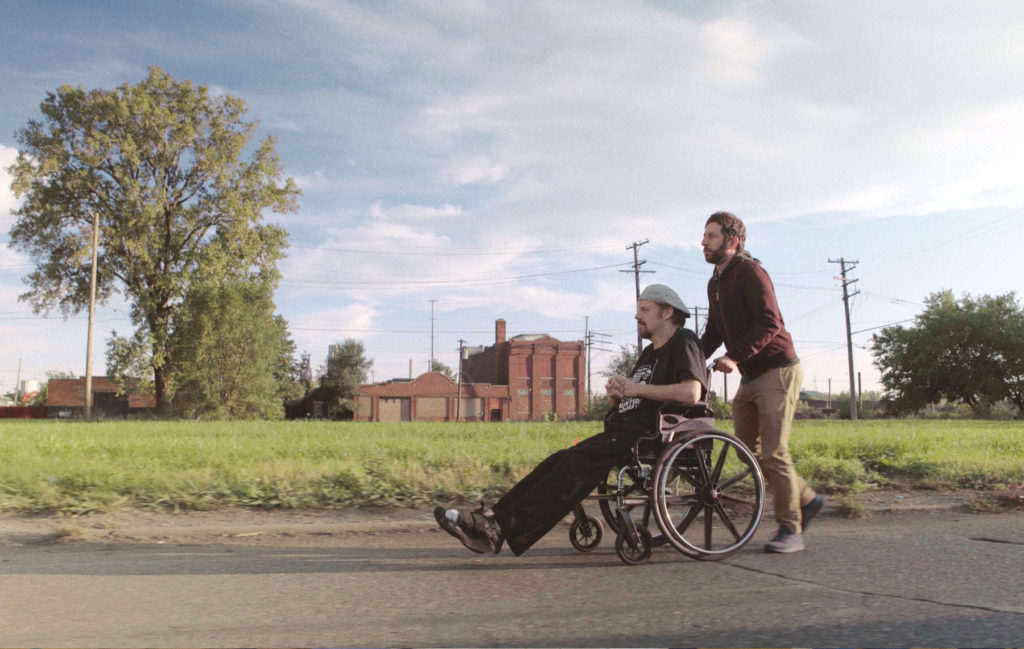
It was the perfect subject for a documentary. Beloved American stand-up comedian and magician John Edward Szeles — aka The Amazing Johnathan —known for his pranks, charm and addiction to hard-core drugs, is diagnosed with cardiomyopathy and given one year to live.

First-time documentarian Ben Berman had always been interested in Johnathan’s work. The 37-year-old director told the Journal he wanted to do a story on Szeles and had originally intended to make a short film.

“The idea I had was more of a short film, fly-on-the-wall, almost a D.A. Pennebaker modern-day documentary: living with the guy, sitting in Vegas waiting for death with emotion and sincerity and with dark humor. I wasn’t super nervous. It was pretty low-stakes.”

But they say truth is stranger than fiction for a reason, and the filming of “The Amazing Johnathan Documentary” took a decidedly unique turn when Berman discovered a second camera crew was filming Johnathan, 60, for another documentary. That “second camera crew” turned out to be the producers behind two Academy Award-winning documentaries, “Searching for Sugar Man” (2012) and “Man on Wire” (2008). 

“At first, I had no roadmap, it was exploratory time,” Berman, a Los Angeles resident, said. “Then Johnathan announces that he was going to map a comeback. … Then when the second camera crew came into his life, I ultimately was faced with a choice: Do I give up and not compete with this professional documentary crew when I’m just an amateur or do I continue to make this movie?”

Berman chose to move forward and insisted on incorporating everything, including telling Johnathan’s story while filming the other crew filming Johnathan’s story.

This rapid change also forced Berman to become a character in his own narrative.

“I didn’t set out to be in front of the camera. I’m a behind-the-scenes guy,” Berman said. “I never intended to go as deep into my past and my family and my potential motivations. I’m very happy with it, but it was a big, big struggle. I would like to think this movie is a very, very transparent documentary. It becomes so referential and self-reflective.”

Because the standard rules of storytelling were broken early on, Berman felt comfortable experimenting with various documentary tropes. He shows Johnathan in his Las Vegas home smoking meth and spending time with family and friends, and the director has star comedians Carrot Top and “Weird Al” Yankovic appear in interviews.

“I didn’t set out to be in front of the camera. I’m a behind-the-scenes guy,” -Ben Berman

Berman said at a time when there are “so many of me, dumb Ben Bermans who need a story to tell and there aren’t so many Johnathans,” creating new and original content is important. He cited last year’s Netflix and Hulu documentaries that exposed the fiasco behind the Fyre Festival as examples.

Berman also went one step further in his film, psychoanalyzing himself by featuring family home videos and allowing his friends and family to offer advice during the filming process. Home is Allentown, Pa., where Berman attended Hebrew school and became a bar mitzvah. He attributes his exploration of comedy in his film about Johnathan to his Jewish roots. 

“I feel my sensibility regarding dark humor is entwined with my Jewish upbringing and the Jewish mentality of seeing humor in darkness and darkness in humor,” he said. That’s why authenticity and regret also play large roles in the film. At one point, Berman, who thinks Johnathan is potentially faking his diagnosis, is so determined to seek the truth that he ends up crossing a line and having a tough conversation with the magician. It was a conversation Berman said he needed to rehearse prior to filming.

“I was really, really nervous,” he said. “Even though Johnathan put a lot of obstacles in my way and would make fun of me, I still considered him as a friend. We were around each other overall 2 1/2 years. It sucks to sit 4 feet away from someone and look them in the eyes and ask them something you know they are going to be offended by.” 

Though Berman said the movie takes you on a mental roller-coaster ride, a surprising through line in the film is just trying to do something that makes your mom proud. He added that many Jewish and non-Jewish mothers reached out to him following the documentary’s screening at the Sundance Film Festival, saying how beautiful it was.

“This movie is about the journey, and maybe less about truth and more about humanity with the struggles both in Johnathan’s life and my life … and motivations for why you do things,” Berman said. “There are two pretty flawed dudes up on screen and there’s a lot of humanity there. At the end of the day, you just want your mom to be proud of you, which is so far from where the movie starts.”

“The Amazing Johnathan Documentary” is available on Hulu. 

Director Ben Berman Searches for Humanity in ‘The Amazing Johnathan Documentary’ Read More »

Trump Administration Will Not Release Peace Plan Before Israeli Elections

JERUSALEM (JTA) — It’ll be at least more three weeks before we see any of the Trump administration’s Israeli-Palestinian peace plan.

“We have decided that we will not be releasing the peace vision (or parts of it) prior to the Israeli election,” White House special Mideast envoy Jason Greenblatt wrote in a tweet Wednesday.

Days earlier, President Donald Trump had told reporters on the sidelines of the G7 conference in France that while the whole plan would not be released before the Sept. 17 vote, they “may see what the deal looks like before the election.”

The plan, which has been shepherded by White House senior adviser Jared Kushner, originally had been scheduled for release after a new Israeli government was in place following elections in April. But Prime Minister Benjamin Netanyahu, the winner of the spring vote, was unable to form a coalition and new elections were called unexpectedly.

The economic component of the plan was rolled out in June at an economic peace summit in Bahrain boycotted by the Palestinians. No Israeli officials were invited to the meeting.

The “Peace to Prosperity” plan calls for $50 billion in investments to transform the Palestinian economy and build democratic infrastructures, including making the Palestinian judiciary more independent and expanding Palestinian higher education.

https://twitter.com/jdgreenblatt45/status/1166728342852251648

Trump Administration Will Not Release Peace Plan Before Israeli Elections Read More »

Jewish Women’s Choir Sings From the Heart

A religious law called kol isha (a woman’s voice), prohibits men from hearing women sing. As such, Orthodox women cannot sing in public if there are men present. 

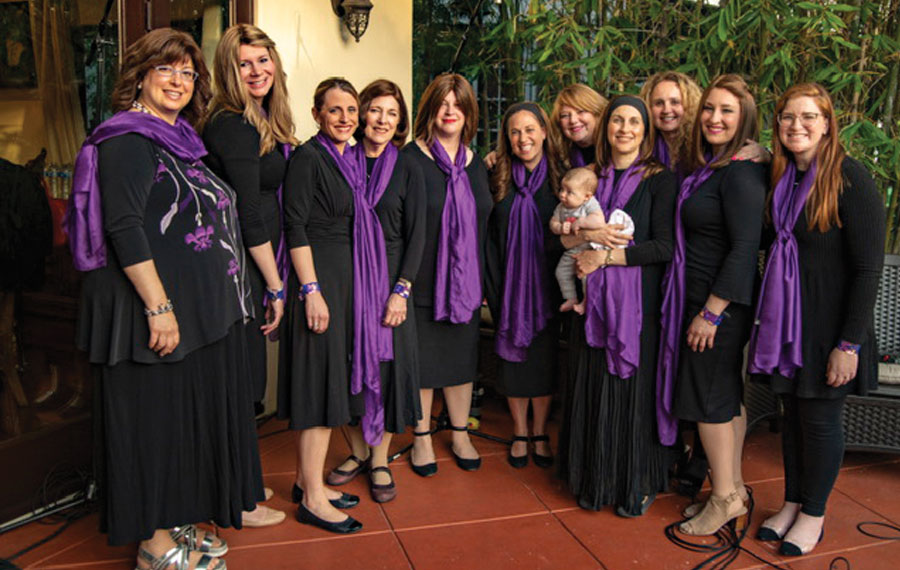
For women in Los Angles seeking an outlet that does not violate the laws of kol isha, there is now an organization that enables them to fulfill that dream: the Los Angeles Jewish Ladies Chorale (LAJLC).

Established in 2017, the nonprofit choir currently boasts 12 women who range in age from 20 to 80. They sing at community events in front of all-female audiences throughout the year. 

“A lot of the women grew up singing in professional choirs and then they became religious and stopped singing altogether,” LAJLC co-founder  Chaya Rochel Lipsker told the Journal. “When they heard this choir existed, they were so excited.” 

The LAJLC performs a mixture of Jewish songs, from Sephardic tunes including those of Yaakov Shwekey, to traditional songs like “Eishet Chayil” and “Mishenichnas Adar.” They do so accompanied by pre-recorded instrumental music. 

The group has performed for Chai Lifeline, Friendship Circle and at private events throughout the community. They have several upcoming gigs including a Holocaust survivors’ luncheon for Café Europa and an event at Chabad of Poway, where they will perform a song they wrote about the late Lori Gilbert-Kaye, who was killed during the shooting there on April 27.

Member Gila Sacks, who is a licensed clinical social worker at Chai Lifeline and lives in Pico-Robertson said, “It’s given me not only the chance to sing, which I love and is one of the biggest joys in my life, but it’s been really nice to just build something with these people who were strangers. Now, we really care about each other and we’re very supportive of one another.”

“This is such a treat because I feel safe in the religious context. I’m able to be within Jewish law and also singing HaShem’s song.” — Gila Sacks

Raised in a non-religious home, Sacks grew up singing and playing her guitar in front of mixed audiences. When she became religious, she dropped that hobby, but now, several years later, she’s back on stage thanks to LAJLC.

“This is such a treat because I feel safe in the religious context,” she said. “I’m able to be within Jewish law and also singing HaShem’s song. Jewish women need to be uplifted. They have a big burden to bear emotionally. We take care of kids and do chesed in the community. I’m a social worker for families with difficult challenges. Coming together to sing and bring out spiritual music and uplift people is amazing.”

“Some women had emptiness and were depressed,” Lipsker said of certain members. “Some were recently divorced or widowed. They said now they had something to look forward to. It’s almost like a sisterhood they feel this connection to.” 

LAJLC also offers members vocal training and feedback. Co-founder Alexandra Blaker said the group hired a conductor who is also a vocal coach, and the more formally trained members will give tips to other members on how to refine their voices.

“We not only have an opportunity to connect socially and do community building through expressing ourselves,” Blaker said, “we’re also really training the instrument of the voice and pushing people’s skill levels.”

With the vocal training and a passion for the material they’re singing, Lipsker added that LAJLC has been able to bond with other Jewish women in their audiences and help them feel spiritually elevated. 

“The feedback from the audiences is that we touch their souls, and we make them feel so proud to be Jewish,” she said. “That’s really what the goal is.”

Jewish Women’s Choir Sings From the Heart Read More »

Honduras Will Recognize Jerusalem As Israel’s Capital

(JTA) — Honduras will recognize Jerusalem as Israel’s capital.

President Juan Orlando Hernandez will travel to Israel on Friday to inaugurate a “diplomatic office” in Jerusalem, the French news agency AFP reported Wednesday.

The Honduran Foreign Ministry said in a statement that the office in Jerusalem will be an extension of its embassy in Tel Aviv.

“For me it’s the recognition that Jerusalem is the capital of Israel,” Hernandez told reporters during the dedication of a bridge on Tuesday. “This has been much debated in the world, and I know that I will be criticized for this, but if Honduras has as its capital Tegucigalpa, and another country refuses to recognize it, it is [equivalent to] not recognizing our sovereignty.”

Hernandez graduated from an Israeli leadership course from the Israeli Foreign Ministry’s Agency for International Development Cooperation, or Mashav, in 1992 at the beginning of his diplomatic career.

President Donald Trump recognized Jerusalem as Israel’s capital and officially moved the U.S. Embassy to Jerusalem in May. Guatemala moved its embassy to Jerusalem just two days later. Earlier this year, Paraguay also announced plans to move its embassy, but reversed the decision months later.

Government officials from several countries, including the Czech Republic, Romania, Lithuania, Australia and Brazil, have expressed interest in moving their embassies to Jerusalem. In March, Hungary opened a diplomatic trade mission in Jerusalem, which is considered a branch of the Hungarian Embassy in Tel Aviv.

Honduras Will Recognize Jerusalem As Israel’s Capital Read More »

LA Jury Indicts Man for Allegedly Scamming Members of Jewish Community

A Los Angeles grand jury indicted a man on July 18 for allegedly defrauding more than $3 million from more than 40 people in Los Angeles, New York and Israel since June 2012.

According to an Aug. 26 Securities and Exchange Commission (SEC) litigation release, 46-year-old Motty Mizrahi, allegedly lured people — primarily from his unidentified Los Angeles synagogue and members of the Israeli-American community — to invest in his MBIG Company, run out of his parents’ Encino apartment.

Mizrahi allegedly told investors he was a certified public accountant (CPA) and broker, despite not having a CPA license or a broker registration. He also guaranteed his investors a return of 2% to 3% a month with the investments being risk-free, and that his compensation would be only 25% of the generated profits.

“According to the indictment, Mizrahi transferred millions of investor monies to his personal trading accounts, where he accumulated persistent, extensive losses; he converted investor monies to personal use, and he converted certain of the monies deployed in his investment scheme from his employer,” the SEC’s litigation release states. 

A March 29 SEC complaint states Mizrahi told clients that cash reserves backed their funds. However, those cash reserves did not exist. Mizrahi also allegedly pledged to provide various payments to clients in 2018 that never materialized and fabricated E*Trade statements purportedly showing a balance of $9.4 million for MBIG, even though MBIG never had an E*Trade account. Additionally, the complaint states, Mizrahi encouraged clients to falsely tell the SEC that their investments to MBIG were loans.

Financial Advisor News reported that Mizrahi used his clients’ money toward “high-risk options trading” from his personal account resulting in more than $2.2 million in losses, and that he transferred $1.4 million of his clients’ money into his personal account.

Some of the clients that Mizrahi allegedly scammed spoke to the Journal on condition of anonymity. One client said he invested in MBIG in 2012 and didn’t suspect anything was amiss until 2018, when he asked Mizrahi to withdraw his money. Mizrahi told him that he could view the account once a month. When he did so in October 2018, he realized the numbers were fake.

“You have to understand, it’s not like I had met them on a street corner next to Home Depot. I met them at the synagogue,” he said. “Those were people I know. Their father, the cantor, was working as a councilman at the Israeli Consulate. Our children go to the same school. He never gave me a reason to suspect that something was amiss.”

A second client invested his and his mother’s savings, despite protestations from his wife. They never received their money back from Mizrahi.

“I called Motty and left messages but he didn’t answer,” the wife said. “[Mizrahi’s brother] Sassi did call me back because we were good friends. I told him, ‘My husband is in a bad state, he started drinking, I’m at the hospital with my son. We don’t have any money.’ I begged him, ‘Please, give me at least $5,000 so I can pay the medical bills and my rent,’ but he declined. He said that it’s impossible to withdraw the money. He told me, ‘You’ll get every dollar back and more, but for now, it’s impossible.’ Can you believe it that I had to beg to receive my own money?”

The brothers were arrested in March under similar charges. If convicted, both could face up to 20 years in federal prison.

LA Jury Indicts Man for Allegedly Scamming Members of Jewish Community Read More »

USC Hillel Launches New Mental Wellness Initiative for Students

After the accidental death in December 2017 of their 21-year-old son Bradley, who was diagnosed with anxiety and depression, Andrea and Glenn Sonnenberg chose to honor him by ensuring that college students have access to programs that focus on their mental health and well-being. 

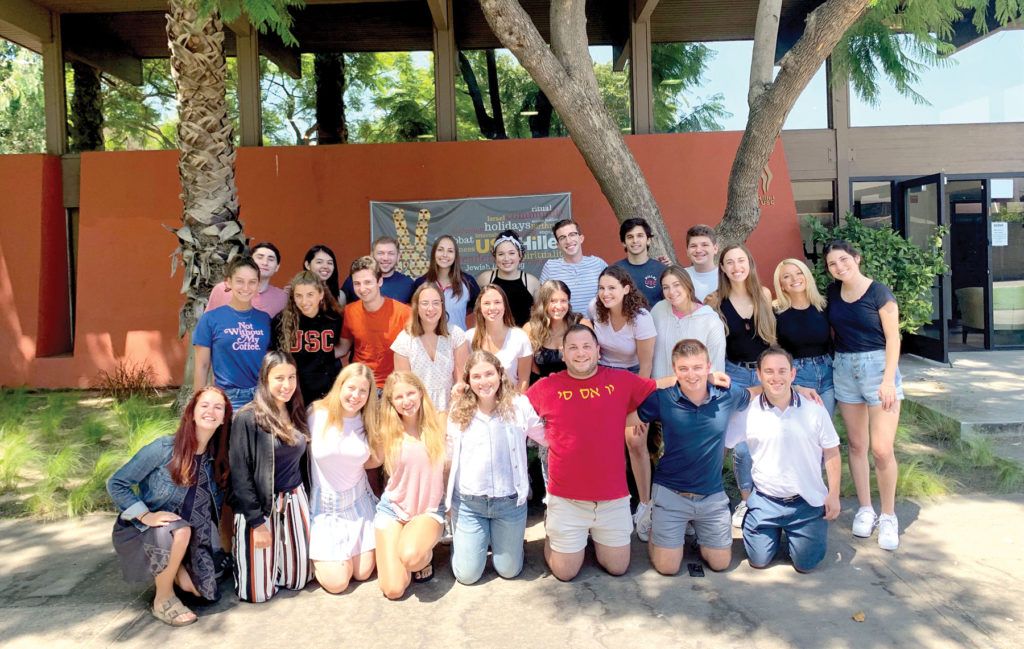
With the help of the Jewish Community Foundation, the Sonnenberg family launched the Bradley Sonnenberg Wellness Initiative at USC Hillel on Aug. 6. Glenn, Andrea and Bradley all attended the university. 

The main goal is to help students cope with stress and mental health issues. USC Hillel also will appoint a full-time licensed social work professional to serve as associate director of health and wellness, and continue to offer classes in mindfulness and healthy living to all students regardless of religious affiliation. 

“[Bradley] was like most kids. He was very well read, he loved musical theater and music,” Glenn Sonnenberg told the Journal. “He was also very self-critical, harder on himself than he probably should have been. In his travels with his illness, he met a lot of people and he helped a lot of people. He would go to Starbucks and start schmoozing with the barista and he started to help the guy deal with his depression … but he couldn’t solve his own problems.” 

In a 2012 study conducted by the National Alliance on Mental Illness, nearly three-quarters of students on college campuses experienced a mental health crisis; 15% of them said their schools’ response was “poor.”

While Sonnenberg said Bradley was able to receive the medical and therapeutic treatment he needed, he noted that not all children and their families are able to access the proper resources, or even feel comfortable asking for help.

“Too often people feel they are all alone and their situation is uniquely handicapped. They are not.” — Glenn Sonnenberg

“There is stigmatization around mental illness,” he said. “We would never think twice about someone who is wheelchair-bound going to the doctor. But I think as a society we tend to think differently of someone who has a mental illness, which is fundamentally the same. It’s an illness they didn’t ask for. It’s very difficult. The resources at the universities are not as robust as one would like. I don’t think they have bad intent; I just don’t think they focus on this.”

In 2015, a group of USC Hillel students created mindfulness programs connecting wellness and Judaism, like ShalOM Yoga, Hiking with Hillel and a campuswide Wellness Fair.  The programs have expanded into staff training, meditation classes, art therapy, puppy therapy and physical activities. 

Jeremy Miller, a sophomore and co-vice president of USC Hillel’s health and wellness student executive board, told the Journal, “As a student first coming into Hillel, I did have a wall around myself. I didn’t talk about my personal struggle. I don’t like bringing up my emotions. But Hillel says, ‘It’s OK to talk about [depression]. You are safe. It’s OK to take time for yourself, it’s OK to put yourself first.’ If you don’t have a stable self, you can’t be successful, and Hillel does a good job of breaking down that wall.” 

USC Hillel Executive Director Dave Cohn said thanks to the Bradley Sonnenberg Wellness Initiative, the organization will be able to have a full-time social worker dedicated to creating a safe environment where students can speak freely and develop coping mechanisms. He added a search is underway and the hope is to have the social worker ready to begin after the High Holy Days.  

 “It is really crucial that the social worker is a full-time Hillel staff member and a familiar face on campus,” Cohn said. “It is a big job and we expect that they will have 16 regular clients, which will be seen weekly. In some ways, it will work like a traditional environment with confidentiality safeguards, but along with our social worker, we will be training our entire staff so we can provide services and provide referrals when appropriate.”

He added that students also would be able to participate in wellness internship opportunities so they can receive training and become mentors to other students. 

“Too often people feel they are all alone and their situation is uniquely handicapped,” Sonnenberg said. “They are not. You are a normal person. You are as normal as someone hard of hearing or [who] can’t walk. They should be able to share their feelings in a safe environment — one’s anxieties and concerns — and seek professional advice on how to overcome them.”

USC Hillel Launches New Mental Wellness Initiative for Students Read More »

ADL Addresses High Holy Days During Security Briefing

With the High Holy Days around the corner, how do we keep our synagogues safe but also welcoming?

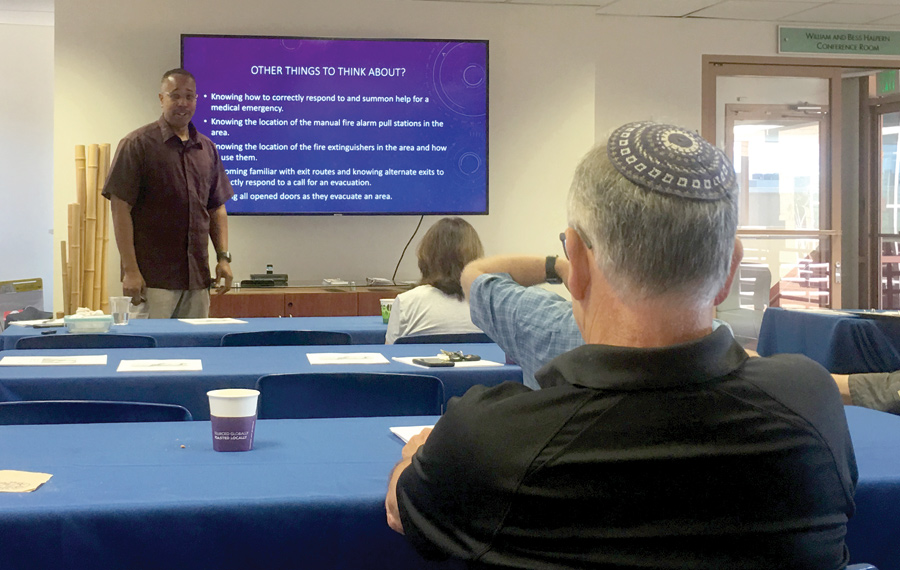
This was just one of the questions the Anti-Defamation League (ADL) addressed on Aug. 27 at its annual pre-High Holy Days security briefing at its Century City office.

Speaking to approximately 30 people, including security representatives and staff members of Jewish and non-Jewish organizations, ADL Deputy Regional Director Ariella Loewenstein said everyone has a role to play in ensuring their institutions are friendly but secure during Rosh Hashanah and Yom Kippur. 

“Security is driven by people, not by dollar signs,” she said. 

Lowenstein also spoke about national hate crime trends, stating that those facing threats today include not just Jews but Muslims, immigrants, the LGBTQ+ community and women. Unfortunately for Jews, she said, the basis of all hatred is anti-Semitism. “The victims may differ, but the ideology remains the same.”

The day’s speakers included two law enforcement experts whom the ADL asked the Journal not to name.

“We’re living in an era now where hate travels very quickly.” — Ariella Loewenstein

While the presenters spotlighted recent shootings at the Tree of Life synagogue in Pittsburgh and at the Chabad of Poway, they also discussed hate crimes that have affected the wider community, including the mass shooting in El Paso, Texas, by
a white supremacist who published a manifesto targeting Hispanics before the incident.

Loewenstein said the shooter at the Tree of Life synagogue set the precedent for a perpetrator sharing his hateful beliefs before committing the violence, and through online forums and social media, the message spread like wildfire. 

“We’re living in an era now where hate travels very quickly,” she said.

A longtime member at Temple Beth Ohr in La Mirada who volunteers on his synagogue’s security board asked what the best practices are for handling visitors who come to the synagogue and want to participate in services and events. He asked if security guards were allowed to physically search nonmembers of a synagogue.

Speakers responded that everyone must be treated the same regardless of their membership status at the synagogue. However, following the briefing, the man, who requested only his first name, Ted, be used, told the Journal he is concerned that Jews are at greater risk than ever following President Donald Trump’s rhetoric about Jews being disloyal. 

He said on the High Holy Days, when a large group of Jews is in a single area, Temple Beth Ohr is ramping up efforts to keep its members safe. 

“We’re taking efforts to secure our building and population,” he said. “I’d be surprised if other temples or churches weren’t trying to protect themselves.”

ADL Addresses High Holy Days During Security Briefing Read More »

Booker, Garcetti Lead Gun Violence Panel

Before an Aug. 22 Los Angeles round table panel discussion on gun violence prevention, 2020 presidential hopeful Sen. Cory Booker (D. N.J.) asked the 50 or so attendees, “Can I just get an ‘Amen’ from everybody? We can treat it like a black church.”

And later, when a cameraman called out that he couldn’t see one of the other panelists because of the light bouncing off a window, Booker quipped: “There’s no glare off my bald head?” 

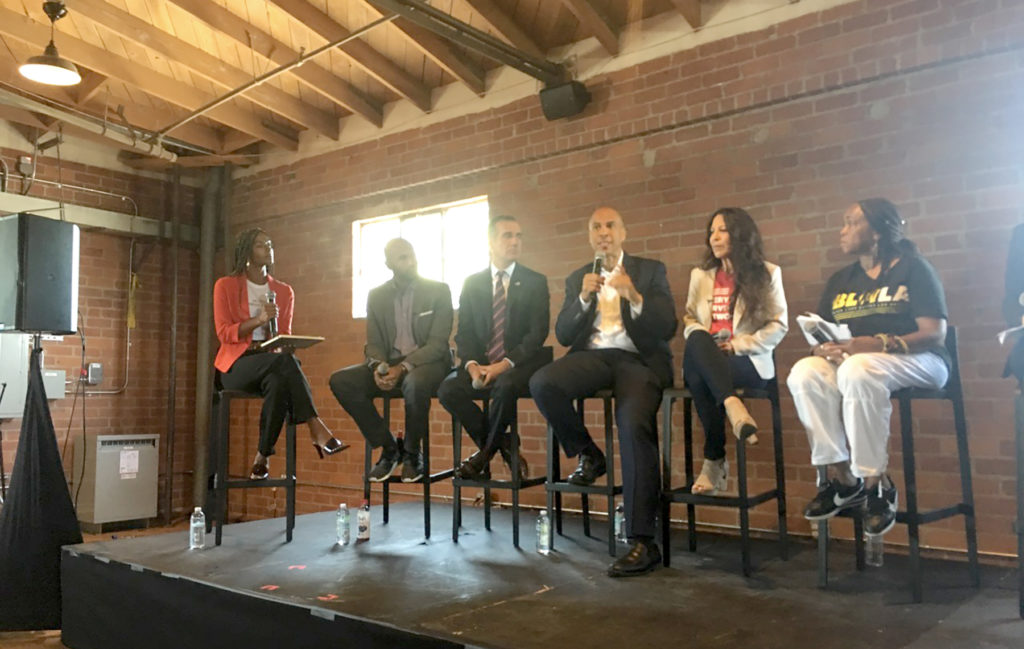
For the most part, though, Booker struck a serious tone during the 40-minute discussion, which also featured L.A. Mayor Eric Garcetti, San Gabriel resident and gun violence survivor Cindy Montoya, volunteer leader for Moms Demand Action for Gun Sense in America Samantha Dorf, Black Lives Matter activist Paula Minor, and actor Stephen Bishop.

The event, moderated by writer and community organizer Ericka Claudio, was held in the Crenshaw district at the co-working space and cultural hub Vector90, co-founded by rapper Nipsey Hussle, who was shot and killed on March. 31.

In town for a campaign fundraising event, Booker, 50, spoke about both the deadly and traumatic impact of mass shootings and gun violence as well as its economic ramifications. He said what was needed were solutions that are people-focused and community-focused. The pattern of gun violence in this country “looks like a
public health problem,” he said, adding that there is an “impotency of empathy” preventing gun reform.

“The pattern of gun violence in this country looks like a public health problem. 

— Sen. Cory Booker

Noting that African American men comprise the majority of homicide victims in the U.S., Booker said the American public “cannot let the debate be framed by the corporate gun lobby and the NRA” (National Rifle Association), and he pushed back against arguments that mental health problems are to blame for many mass shootings. 

“I’m so angry about the mental health conversation in this country,” he said. “A Muslim with an assault rifle is a terrorist and a white supremacist with an assault rifle needs mental health training.” 

Garcetti spoke about how young people, including those who survived the Parkland, Fla., school shooting on Valentine’s Day in 2018, are driving the conversation on gun reform. “In some ways,” he said, “the leadership today is following young people.” 

Bishop said he believed reparations for the African American community could alleviate some of the systemic reasons behind black youths often succumbing to lives of violence.  He suggested doing so could allow recipients to pool their money and create much-needed resources in the community. 

Dorf, who said she is trying mitigate the impact of gun violence on minority communities, offered her perspective as a self-described outsider.

“I am coming from a place of privilege,” she said. “It’s not enough to not be racist. You have to be anti-racist. Our job as those who are privileged is to make this not a moment but a movement.”

Booker, Garcetti Lead Gun Violence Panel Read More »

Outreach Temple Nefesh Brings Soul and Spirit to the Eastside

On a recent Friday night at the Silverlake Independent Jewish Community Center, Nefesh, an outreach temple that was incubated as a project of Wilshire Boulevard Temple (WBT), was stretching its wings as a newly independent community. 

About 150 people gathered to mark the end of another week and the beginning of Shabbat while founder Rabbi Susan Goldberg danced, sang and prayed with them. 

“It was buzzing, the room was electric,” said Beth Pickens, a Los Feliz resident and a Nefesh lay leader. Pickens brought a group of new people to experience the Nefesh service. “They said, ‘OMG, I’m in, I want to do this again.’ ‘I didn’t know temple could feel like this.’ It exceeded all of our expectations.” 

Goldberg also led the project in its previous incarnation, in her former position at WBT. 

“Nefesh began as a service and then became a community,” Goldberg said. “The hope now is that it will continue to do outreach in a neighborhood where there isn’t a temple, serving a community that’s not being served.” 

“It’s a Jewish community for Jews who feel like they can’t be part of the Jewish community, myself included,” Pickens said. She found Nefesh when she moved to the area in 2014 and a friend recommended she seek out Goldberg at WBT.

“Rabbi Susan’s sensibility and what she’s like as a rabbi creates the container for everyone to have a Jewish experience,” Pickens said. “I have a lot of Jewish friends who are not interested in participating in ongoing Jewish life. My spouse is not Jewish and doesn’t want to go. Judaism isn’t something I want to do alone. You can have an internal Jewish spiritual life, but it’s also about community, doing things together and showing up as a group and for each other.” People who go to Nefesh, she said, “are showing up and want to be doing this together. These are the people who want to be in relationship with each other.” 

Goldberg, who grew up in Silver Lake and Echo Park, said Nefesh is designed for those in the Silver Lake, Echo Park and Los Feliz surrounding neighborhoods who have not felt drawn to or included in Jewish life because of age, gender, sexual orientation, race, or because they have a desire for spirituality, creativity and deeper meaning.

“Nefesh began as a service and then became a community. The hope now is that it will continue to do outreach in a neighborhood where there isn’t a temple, serving a community that’s not being served.” — Rabbi Susan Goldberg

The Silverlake JCC serves as fiscal sponsor for the community and will host many of Nefesh’s gatherings. A previous Friday night service was held in Griffith Park, and according to NefeshLA.org, Rosh Hashanah morning services will be held at Friendship Auditorium near Griffith Park and Yom Kippur services at the First Unitarian Church on 8th Street.

The services are led by Goldberg and Nefesh musicians Duvid Swirsky, Sally Dworsky and Ari Herstand. 

“They have skillful hearts and incredible skill as musicians,” Goldberg said, adding that they write “original liturgical music and also use secular music as part of the service as relating to the teaching.” 

Swirsky, officially Nefesh’s cantor and band leader who grew up playing for the band Moshav, said Goldberg’s “enthusiasm for making the music an essential piece of the spirituality” drew him from the start. 

“I believe that music, at its best, when it is honest, soulful and real, becomes prayer. That is what we try to create at Nefesh,” Swirsky said. 

The Nefesh membership model speaks not of “members,” but of “kin,”and contributions are based on a percentage of household income. And if financial commitment represents a challenge for someone, “Nefesh’s practice is that they can reach out to us. No one is turned away,” Goldberg said.

Nefesh also continues Goldberg’s devotion to social justice work. One of its first events was a candlelighting ceremony at the Lights of Liberty event in July at the Metropolitan Detention Center in downtown Los Angeles. Goldberg said Nefesh is building relationships with interfaith clergy and leadership, in particular with New Ground: A Muslim-Jewish Partnership for Change, and has worked with clergy on social justice actions. 

“Rabbi Susan models how to be involved and show up in your local city, how your Jewish tradition directly relates to something like ICE detention,” Pickens said, referring to U.S. Immigration and Customs Enforcement. “At the same time, there’s a full way to be part of Nefesh even if what you’re doing in your life isn’t political. [Social activism is] a point of entry but not the only point of entry.”

Another entry point is personal reflection.

“The way Rabbi Susan structures Jewish lifecycle [events] is thinking about individual middot, the soul traits, of the Mussar tradition,” Pickens said, explaining that during the High Holy Days, Nefesh participants select a trait they will focus on for the coming year, both individually and in small groups. 

Attendees range from those in their late 20s and early 30s to those with children and “some baby boomers who never fully got what they were looking for in the Jewish community. … It’s about what they’re seeking rather than their age,” Goldberg said. 

“Whoever makes their way to Nefesh will find an open, loving, socially conscious and deeply spiritual community full of beautiful music and friendly people,” Swirsky said. “I think these vibrant communities that we have in Los Angles are vital for our souls. Yes, we are connected in a million ways through social media and the internet, but we as humans long for deeper connection and this is what is available at Nefesh.”

Pickens said, “I describe Nefesh as a Jewish community that promotes a spiritual interior and community, with a good mix of Jewish tradition and contemporary interpretation.” 

“In a lot of Jewish institutional spaces, people are implicitly or explicitly asked to check their experiences at the door and only bring forth their Jewishness,” Goldberg said. “But at Nefesh, there is this implicit and explicit sense that we welcome all the parts of who you are.”

Outreach Temple Nefesh Brings Soul and Spirit to the Eastside Read More »

Temple Israel of Hollywood Interim Senior Rabbi, Peter Knobel Dies

Temple Israel of Hollywood (TIOH) Rabbi Peter Knobel died on Aug. 20. He was 76. 

Knobel passed away two months after being named TIOH’s interim senior rabbi.

The Central Conference of American Rabbis (CCAR) issued a statement on Aug. 21 saying it  “grieves deeply the death yesterday of our beloved Past President, Rabbi Peter S. Knobel.”

The statement, signed by CCAR president Rabbi Ronald Segal, also stated,Rabbi Knobel was an exemplar of our rabbinate. Scholar and Zionist, pastor and prophetic voice, Peter Knobel was as devoted to interfaith relations as he was to meaningful worship.”

Knobel was named interim senior rabbi at TIOH on July 1, after Senior Rabbi John Rosove retired. Knobel was to serve as interim rabbi through June 30, 2020.

According to the TIOH website, Knobel was a congregational rabbi for 50 years, first serving Temple Emanu-El in Connecticut and then as senior rabbi at Beth Emet The Free Synagogue in Evanston, Ill. for 30 years, until his retirement in 2010. 

After his retirement, Knobel worked as an interim rabbi, guiding synagogues through rabbinic transitions in England, New Zealand, Chicago and Coral Gables, Fla. 

“Despite the short time that Rabbi Knobel served our congregation, he made remarkably deep connections, touching many congregants and staff members with his gentle manner, kindness, accessibility and vast wisdom,” according to a statement on TIOH’s website.

Knobel’s funeral service was held on Aug. 26 at Beth Emet and he was buried Memorial Park Cemetery in Skokie, Ill. 

Knobel is survived by his wife, Elaine, his sons Jeremy and Seth, and their families.

Temple Israel of Hollywood Interim Senior Rabbi, Peter Knobel Dies Read More »