History is filled with examples of memorable events that remind us how great humanity is. It’s also filled with events that reveal the dark side of humankind. Among them is the Armenian genocide of 1915-16, perpetrated by the Ottoman Turkish government, which resulted in the deaths of 1.5 million of this Christian minority in a Muslim state.
It’s this tragedy that forms the basis of Richard Kalinoski’s haunting play “Beast on the Moon,” which opens Aug. 23 at the International City Theatre at the Long Beach Performing Arts Center.
Kalinoski’s play debuted in 1995 at the Humana Festival of New American Plays at Actors Theatre of Louisville. The intimate four-actor show has subsequently been performed in 15 countries, winning more than 30 awards (including five Moliere Awards in Paris and five Ace Awards in Buenos Aires, and taking the award for best play in both cities).
The Holocaust comes to mind as another prime example of horrific crimes against the human race, and International City Theatre Artistic Director caryn desai, who doesn’t use capital letters to depict her name, told the Journal, “Anyone that survives this kind of trauma and genocide, I don’t think you ever forget. The difference is with the Holocaust you knew who the villain was. It was Hitler, and Germany had to accept responsibility for what they did. In this case, Turkey still has not. I think that must be especially painful — not to have someone acknowledge what they did to your family.”
“Beast on the Moon” begins in 1921 Milwaukee — six years after the genocide — and all the scenes take place in the dining room of Aram Tomasian, an Armenian immigrant who has paid to bring over a 15-year-old Armenian orphan, Seta, to be his wife. Burdened with the loss of their families and unable to have a child of their own, the scarred survivors struggle toward understanding and reconciliation.
In her role as Seta, actress Rachel Weck drew on her own experiences to help develop the character. While studying musical theater at UCLA, Weck, who isn’t Jewish, participated in a Jewish studies program to launch student-curated audio tours at the Los Angeles Museum of the Holocaust. As part of that program, the students met and interviewed Holocaust survivors and it was during this time that she formed a close bond with one
of the survivors — Helen Freeman — who died in 2017.
“Her story has stuck with me,” Weck said. “Seta is 15 when she immigrates to the U.S. as a mail-order bride. Helen was also young [when she came here] and there is something about Helen’s beauty and her belief in goodness in people. I will be drawing from Helen in playing Seta.”
In the play, Seta clings to a homemade doll, the one thing she has kept from her mother. Weck relates this to Freeman, who was able to keep and hide one earring from her mother — in the lining of her shoe — for years.
“Wouldn’t it be nice if we could watch this play and say, ‘Oh, I’m so glad this was in the past?’ instead of saying, ‘Oh, this is still going on and these are the choices we continue to make.’” — Rachel Weck
“Helen was in multiple work camps as well as Auschwitz and, throughout her entire journey, she carried this one earring,” Weck said. “I remember her so vividly telling me that every time she felt like giving up and just crawling into a hole in the ground, she would touch her shoe with the earring and she would be reminded of her family.”
Even though the play covers events beginning more than a century ago, its relevance to the plight of refugees today resonates.
“I think that’s the beauty of the play,” desai said. “Even though it is taking place in the 1920s and 1930s, the issues being talked about are still relevant and it make you question whether we are ever going to move forward.”
Continuing to work toward a better society is crucial, she added, “because without that, we are defeated. We just have to be reminded and vigilant to continue that struggle.”
Weck concurred. “There is this line in the play that is so ironic,” she said.
“ ‘America, it is so easy for immigrants to get in. It seems like they welcome everyone.’ We read that line and just laughed. It is just a shocking world that we would turn away such pain and suffering after having hundreds of years of knowledge. That is what’s so disappointing.”
Dreaming of a better world, Weck said, “Wouldn’t it be nice if we could watch this play and say, ‘Oh, I’m so glad this was in the past?’ instead of saying, ‘Oh, this is still going on and these are the choices we continue to make.’ We continue to turn people away and turn a blind eye toward suffering. It is really upsetting.”
“Beast on the Moon” runs Aug. 23 through Sept. 8. Visit internationalcitytheatre.org.
Rep. Rashida Tlaib (D-Mich.) called for a boycott of Bill Maher and his HBO show on Aug. 17 after the comedian called the boycott, divestment and sanctions (BDS) movement “a bull—- purity test.”
Maher made his remarks on “Real Time With Bill Maher,” on Aug. 16, saying that BDS supporters “want to appear woke but actually slept through history class. It’s predicated on this notion — I think it’s very shallow thinking — that the Jews in Israel are mostly white and the Palestinians are brown, so they must be innocent and correct and the Jews must be wrong.”
He added that BDS supporters believe “the [Israeli] occupation came right out of the blue” and ignore “the Intifadas and the suicide bombings and the rockets,” pointing out that BDS co-founder Omar Barghouti said in 2013, “No Palestinian, rational Palestinian, not a sell-out Palestinian, will ever accept a Jewish state in Palestine.”
“Somehow this side never gets presented in the America media,” Maher said. “It’s very odd.”
Tlaib responded to Maher’s comments in a tweet saying, “Maybe folks should boycott his show. I am tired of folks discrediting a form of speech that is centered on equality and freedom. This is exactly how they tried to discredit & stop the boycott to stand up against the apartheid in [South] Africa. It didn’t work then and it won’t now.”
Simon Wiesenthal Center founder and dean Rabbi Marvin Hier told the Journal that Maher is being “lambasted for speaking the truth” and that Tlaib would prefer to tell her constituents to “watch Bill Maher if he participated in telling the lies that have unfortunately been told about the State of Israel.”
“BDS is predicated on this notion that the Jews in Israel are mostly white and the Palestinians are brown, so they must be innocent and correct and the Jews must be wrong.” — Bill Maher
He added that what he found particularly unbelievable about Tlaib was that she said in May that her Palestinian ancestors allowed the Jews to take refuge in mandated Palestine during the Holocaust, “but she has the nerve of ignoring the fact that the head of the Palestinians was a principal collaborator with Adolf Hitler in murdering the Jews,” Hier said. “She never says anything about the Grand Mufti [Muhammad Haj Amin al-Husseini], never says anything about the fact that the Grand Mufti came to Hitler’s side in 1941… where he conducted radio programs urging Hitler to exterminate the Jews.”
The World Jewish Congress (WJC) condemned Tlaib’s tweet as “deeply disturbing” in an Aug. 19 press release, with WJC President Ronald Lauder saying, “It is outrageous that Tlaib, who has repeatedly deployed anti-Semitic tropes, would promote the boycott of the only democracy in the Middle East and the one nation that fully respects human rights and guarantees freedom for Muslims, Christian and Jews.”
Lauder added that “Adolf Hitler infamously boycotted Jewish-owned businesses” and censored his entertainment and media critics. “We Jews know what boycotts can lead to,” Lauder said. “We find it concerning that a member of the U.S. Congress would lobby for BDS and so easily suggest that Maher’s show should be boycotted simply because he expressed an opinion with which she disagrees.”
StandWithUs CEO and co-founder Roz Rothstein similarly tweeted, “Rashida Tlaib is very upset with Bill Maher because he ridiculed the BDS movement for wanting to destroy #Israel. Now, she calls for a boycott of @billmaher. Maybe she should listen to Bill, and rethink her own racism against Jews and Israel.”
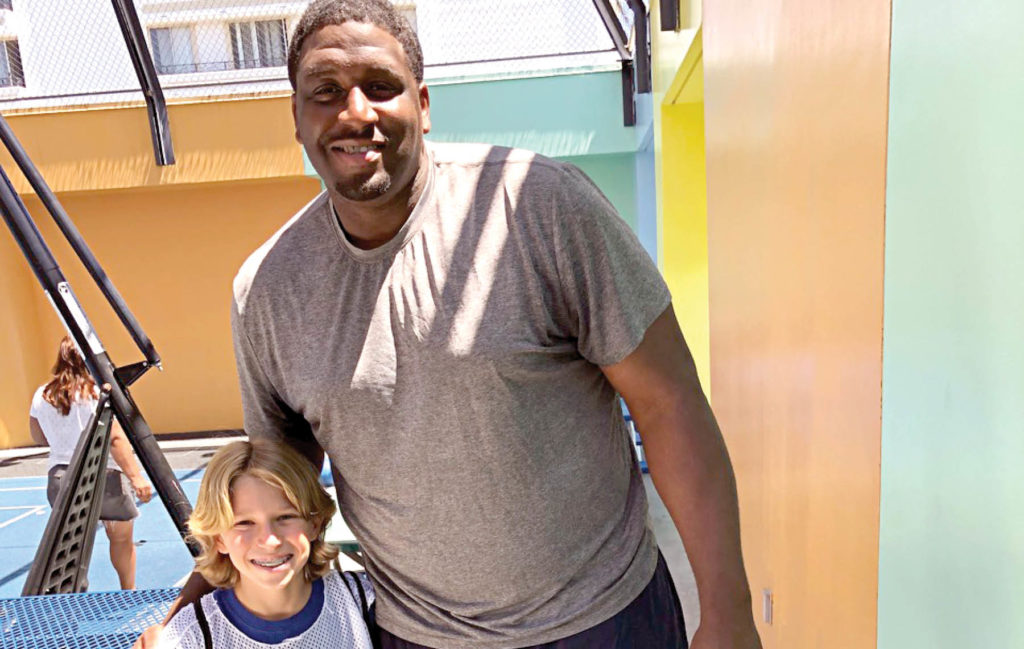
When second- to eighth-grade campers at Sinai Temple Basketball Camp (STBC) took part in slam dunk, 3-point shooting and dribbling contests, they also got some pointers from former NBA player Mike Sweetney, who visited the weeklong camp on Aug. 15 and 16.
Sweetney recently returned from spending eight days in Israel working at a basketball clinic organized by Nefesh B’Nefesh and Israeli American former pro basketball player Tamir Goodman.
“I watch the news here and you think Israel is this bad place to go,” Sweetney told the Journal, “[but] when I went over there, I was telling everybody, ‘This is one of the most peaceful places you ever want to go.’ People are like, ‘What?’ And I’m like, ‘Yeah, it’s peaceful.’”
During his time in Israel, the 36-year-old 6-foot-8 former power forward for the New York Knicks and Chicago Bulls stayed in Jerusalem, wandered around the Old City and visited the Western Wall. He also traveled to Haifa, where the basketball clinic was held.
“I’m watching Christians, Jews and Muslims, all in the same area, kind of interacting,” Sweetney said. “That blew my mind. I was under the impression if a Jew and a Muslim cross paths, it’s not going to be a good sign. [In Israel] you see they are good with each other.”
Rabbi Erez Sherman, the camp’s co-founder, told the Journal he read an interview Sweetney did with JNS.org about his visit to Israel and invited him to speak at the camp. “For me, it’s bridge-building for our kids to see someone who is not Jewish care about what we do here,” Sherman said.
“I watch the news here and you think Israel is this bad place to go, [but] when I went over there, I was telling everybody, ‘This is one of the most peaceful places you ever want to go.’ ”— Mike Sweetney
Established in 2015, the camp blends Jewish action, tzedakah and caring for one’s neighbor with basketball instruction. This year, approximately 80 kids took part in the camp. Students from Sinai Akiba Academy and Los Angeles Unified School District schools, and even a 13-year-old visiting for the summer from France, were among the campers, along with “littles” from Jewish Big Brothers Big Sisters of Los Angeles (JBBBSLA) and special needs athletes from Kids Enjoy Exercise Now (KEEN). Sinai offered the camp to the children from JBBBSLA for free.
“Families that can’t afford it, we don’t charge,” said Sinai Religious School Director Danielle Salem-Kassin, who co-founded the Sinai camp with Sherman.
For the kids, though, meeting Sweetney was definitely a highlight. Eleven-year-old Aaron Kashani didn’t hesitate to ask Sweetney to autograph a basketball.
“It’s fun,” Aaron said, holding his signed ball. “We got to play a lot of games. We learned drills and get to be with our friends and have fun.”
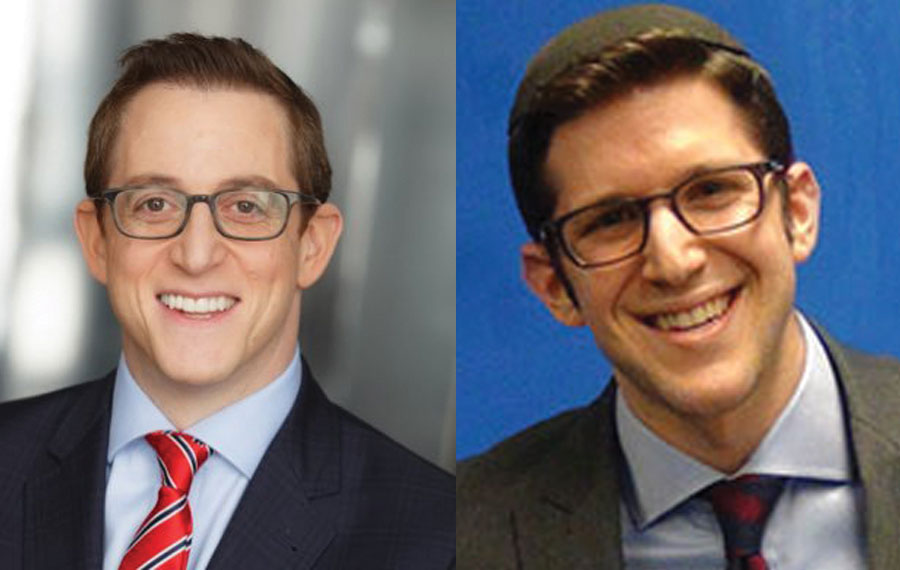
Rabbi Ari Segal, head of school at Shalhevet High School, announced he plans to step down and instead serve as the modern Orthodox high school’s chief strategy officer.
In an Aug. 12 email to the Shalhevet community, Segal discussed his intention to make aliyah with his family at the end of the 2019-20 academic year. He stated he will continue to work at Shalhevet four days a week throughout the 2020-2021 academic year.
However, during the second half of 2020-2021 academic year, Segal said he will move into his new position as chief strategy officer while Rabbi David Block, Shalhevet’s assistant principal of Judaic studies, will become head of school.
Segal, who has served as Shalhevet’s head of school since 2011, said he expects to continue to make an impact on Shalhevet in his new position.
“In this role, I will focus on how we can grow and prosper in the coming decade and devote my time to developing new initiatives and serve as the ambassador for the Shalhevet hashkafa [worldview] on issues locally, nationally and internationally,” he said.
According to the release, Block will be appointed associate head of school at the start of the 2019-20 year, with Segal mentoring him so that he is ready to take on the role of head of school in the second half of the 2020-2021 academic year.
“I have been extremely humbled and gratified by the outpouring of support and incredibly excited that Rabbi Block will be taking over for me.”— Rabbi Ari Segal
“This will allow for a smooth and seamless transition in the leadership of the school — a rarity in the Jewish day school world,” Segal said. “For those of you who don’t know him, Rabbi Block has the respect and admiration of his colleagues and students at Shalhevet, in our community and beyond. This is no small part due to his passion, dedication, talent, and perhaps more importantly, his deep humility.”
In an email to the Journal, Segal wrote, “I have been extremely humbled and gratified by the outpouring of support [of our decision to make aliyah], and incredibly excited that Rabbi Block with be taking over for me.”
The Shalhevet board of directors made the decision to appoint Block as Segal’s successor in consultation with national Jewish education experts. In a statement, Shalhevet Board President Noam Drazin said Segal informed the board of his decision to make aliyah a few months ago. He said it was not surprising news given Segal’s passion for Israel but is a “significant change for our school community.”
Drazin said that Segal, working from Israel as the school’s chief strategy officer, will allow Shalhevet to enter into “new and greater opportunities and partnerships with institutions both here and in Israel.”
“Rabbi Block brings and has brought a passion for learning, cooperative leadership and a sense of humility to our institution for the past three years, first as Mashgiach Ruchani [spiritual supervisor], and currently as assistant principal of Judaic studies,” Drazin said.
“The Board is confident in this decision and looks forward to Shalhevet’s accomplishments under Rabbi Block’s leadership.”
Block, 31, is a founder of the Maccabeats Jewish a capella group.
Segal’s wife, Atara, who also is on the Shalhevet Judaic studies faculty, became the first woman to teach Gemara at an Orthodox high school in Los Angeles, and is referred to at Shalhevet by the title of “Yoetzet Halachah,” a designation given to a woman certified to be an adviser for other women on family purity issues.
Drazin said that Segal and Atara have made an important contribution to the school and they would be missed.
“Shalhevet has never been stronger — academically, Jewishly and financially,” Drazin said. “And that is due, in large part, to their commitment to our school and community at large.”
Pearl Berg is an avid reader, a current member of Temple Israel of Hollywood, likes to sew, and does intricate bead stringing. She will also turn 110 in a few months.
Born in Pittsburgh, Berg moved to Los Angeles with her family in 1930. Her son, Robert Berg, told the Journal in a phone interview, “I would say she’s clearly one of the oldest people in California and we are not aware of an older Jewish person in California. She’s got to be among a small handful of the oldest Jews in the United States.”
Berg became a member of Temple Israel in 1937 and continues to attend occasional services at the synagogue, usually during the High Holy Days. She was active in Temple Israel’s Sisterhood and was asked to write notes to bereaved families on behalf of the temple, which she continued to do until the age of 105. Temple Israel’s former rabbi, John Rosove, said that Berg was a member of his congregation for the entire 30 years he was there.
“I blessed her at services every year since she was about 100 and, at 100 I said, ‘To 120,’ and [Berg responded], ‘Please God, no,’ and here she is, almost 110.”
Rosove described Berg as someone with “a great sense of humor. She was asked by a local television network when she turned 107, ‘How did you get to be 107?’ and she responded, ‘Well, first you have to get to be 106.’
“Every time I see her, she brings a smile to my heart, and she doesn’t complain about anything,” Rosove said. “If you ask her, ‘How are you?’ she says, ‘I’m 109, what do you think?’ She’s one of those favorite people that you come across from time to time [who] is somewhat ageless.”
“I blessed her at services every year since she was about 100 and at 100 I said, ‘To 120,’ and [Berg responded], ‘Please God, no.’ And here she is, almost 110.” — Rabbi John Rosove
During Rosove’s final service at Temple Israel, he acknowledged Berg and introduced her to the congregation as “the oldest member in the history of the Temple,” Robert recalled. “People came up to her afterward like she was some superstar.”
Going to synagogue has become a natural part of Berg’s life. “I’ve always gone to temple since I was 10 or 11 years old,” she said.
“[My mother] really resonates to the theme of compassion and love [in Judaism],” Robert said. “She’s been very supportive of charities her whole life and she’s been a peacemaker, in her family particularly. All those Old Testament values are very much ingrained in her.”
As a dedicated “homemaker” as Robert described her, “She cared deeply for [her ill husband]. She was just such a sparkling figure and such a good cook that her dinners for his business colleagues from around the country did probably more to get business than anything else.”
After Berg’s husband died in 1989, she carved out an active social life for herself by joining a book club, regularly attending concerts and plays and becoming more involved with a bridge group.
“She was not celebrating her widowhood, she was just moving on in life,” Robert said. “One of her great abilities [is] to make friends and keep friends. As she got older, friends died and she had the ability into her hundreds to make new friends.”
Asked about her secret to living such a long life, Berg said:“That is a question I have no answer for because you don’t have a secret for living. You just live.”
Melissa Simon is a senior studying journalism at the University of Wisconsin-Madison and a Jewish Journal summer intern.
In November 2016, after nine years as head of school at YULA Girls High School, Rabbi Abraham Lieberman left and took a position at Shalhevet High School. Many other faculty members also left or were let go at the end of the 2016-2017 school year.
The move was surprising and rumors swirled. Rabbi Joshua Spodek, the head of Judaic Studies and Hebrew Language at Scheck Hillel Community School in North Miami Beach since 2010 before becoming that school’s director of Fine and Performing Arts in 2012, was tapped as Lieberman’s replacement.
As students head into the 2019-20 school year, the Journal met with Spodek and several other members of the administration (at Spodek’s request) to discuss that transitional period, the changes they have made over the past two years and the school’s future direction.
Spodek admitted the period between November 2016 and July 2017, when he officially became head of school, was a difficult time for everyone involved. Between November and February, he flew between Florida and Los Angeles once a month and then every other week between February and July. He said it was a strategic decision made by the board to make the transition as smooth as possible, but added that this is not the norm.
“There was a team in place that had been here for close to 10 years, I think, with very little turnover,” Spodek said. “I came in with a mandate from the board to make sweeping changes, and that comes with fear and trepidation and concern in terms of students not knowing who their teachers are going to be the following year, to faculty not knowing if they’re going to have jobs the following year, administrators not knowing if they were going to [either], and for parents.”
Nonetheless, Spodek said he believed he and his team did their best “to try to manage and mitigate the emotions, but it was certainly raw.”
Director of General Studies Yehudis Benhamou recalled the time, saying, “Coming in after a very beloved administration, when we went home and sometimes felt a little bit beaten up that day, it was difficult. And from the students’ perspective, they had seen us as this sort of mammoth that was coming in and taking over.”
That “mammoth” included 18 new faculty members at the start of the 2017-18 school year. Spodek also spent six months in the old library learning from and observing students and meeting with faculty members, parents and alumni.
Today, the library is the Schlessinger STEAM (Science, Technology, Engineering, Arts and Mathematics) Academy and Innovation lab, one of the numerous changes Spodek and his team have made.
From the outset, Spodek said he wanted more full-time Jewish faculty members, to create the STEAM lab and have both a psychologist and a college guidance counselor on staff. To achieve this, he launched a $2 million fundraising campaign.
Alya Shriki, who graduated from YULA this summer, said it was difficult to find a place to study after the library was converted to the STEAM lab and that the beit midrash usually was occupied by teachers giving classes. But she said if Spodek hadn’t come along, the school wouldn’t have a 3D printer housed in the STEAM lab, which she said students can use to add logos to shirts.
“When you come into a new environment … there’s going to be a transition that’s going to be uncomfortable for a little while until you can start to see us as people who can also love you and care for you.”
Shriki said she was informed of Lieberman’s departure from an email blast but said Lieberman himself would never talk about it. “It was hard for us to adapt to a whole new administration,” she said. “We knew no one.”
But, she added, even though 14 girls left following the change in administration, in her final year it was clear “the administration really cared about us.”
“I think what I underestimated during that time is how close the kids were, the students were, with the [former] faculty and administration,” Spodek said. “And so, when you come into a new environment … there’s going to be a transition that’s going to be uncomfortable for a little while until you can start to see us as people who can also love you and care for you.”
Spodek and his team have additional curricular enhancements in the works for the ninth- through 11th-graders, including Kedushat haChayim: a Jewish law, philosophy, and sexual health and wellness curriculum. Teachers introduced parts of the curriculum within the existing biology and Jewish law classes last year, and they will continue to do so this year.
“We don’t shy away from giving information that’s accurate and real, but it has to be presented properly and obviously under the auspices of what’s appropriate,” Director of Judaic Studies Racheli Luftglass said.
Spodek also discussed his hopes for future enrollment. There are 171 girls enrolled this year, the same number as last year. The four feeder schools whose students apply to YULA Girls are Harkham Hillel Hebrew Academy, Yavneh Academy, Gindi Maimonides Academy and Emek Hebrew Academy. Spodek said of the 87 students who could have come from those schools this year, 47 chose to attend YULA Girls. Next year, Spodek said there are potentially 104 students from those schools who could attend YULA. The school’s projected enrollment three years from now, he said, is 202 students.
“This is YULA now,” Spodek said, “and people are celebrating who we are, our identity, our vision, the excitement that’s on campus.”
Michelle Naim is a senior studying English with a concentration in journalism at Stern College for Women in Manhattan and a Jewish Journal summer intern. She graduated from YULA in 2015.
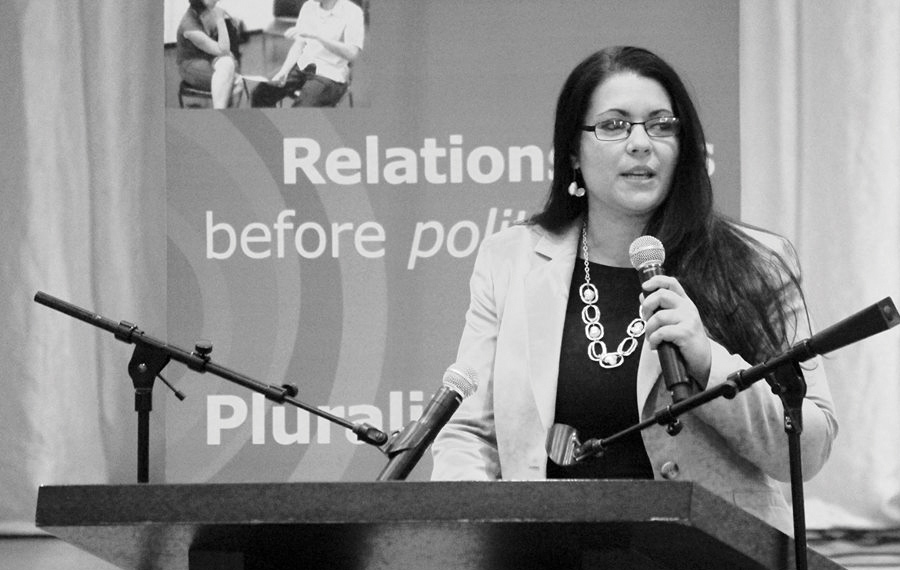
In an effort to help people navigate conflict and debate contentious issues, Aziza Hasan is eager to share her ideas. The executive director of NewGround: A Muslim-Jewish Partnership for Change drew around 50 people at a talk she gave on that subject on Aug. 17.
The event was hosted by Jeff and Naomi Selick in their Beverlywood home’s backyard as part of B’nai David-Judea Congregation’s Shabbat afternoon “Nosh N’ Drosh” series. Hasan, accompanied by three alumni of NewGround’s MAJIC (Muslims and Jews Inspiring Change) program, spoke about how to “create a space to have meaningful conversations. It’s not rocket science,” she said, “but it’s very difficult.”
The hardest part, she explained, is “to actually hear and see one another,” and that everyone has “different stories, different truths.” In order to achieve that, she said, the most important skill is to learn how to listen and how to ask questions without coming off as aggressive or judgmental.
The alumni — Cindy Kaplan, Serra Demircii and Yael Rubin — spoke about how they have used the skills they learned in the program in their personal life.
“There’s a hunger and thirst for having constructive conversation, to really be willing to work in a process that might lead down a constructive path.” — Aziza Hasan
Demircii, a Muslim, said she found herself in a similar situation discussing the Armenian genocide with another Muslim girl. She too managed to keep the conversation from turning into a fight. What she learned, she said, is “how to talk without breaking anybody’s heart. You have to respect the point of view of the other person. People get triggered. You have to separate the person from the belief.”
To put these ideas in action, Hasan had attendees pair up with someone they didn’t know well. Each person had two minutes to tell their partner a problem they were having, either at work, at home or with themselves. After waiting a minute, the partner could ask just two questions, the simpler the better.
“Don’t answer the questions,” Hasan instructed. “Just tell the person if the question was helpful or not.” The exercise, she explained, was not about problem-solving; it was to help focus on listening with intent and asking productive questions.
In one example, a man starting a new project couldn’t decide between hiring someone younger or going with a more experienced candidate. He was asked who would bring more passion to the job and whether he would prefer to train a new employee or work with someone who already had set ideas about the job. The man said he found both questions helpful.
In the Q&A session following the exercise, Marvin Epstein said he found the experience surprising. Being face to face with the other person, looking them in the eye, made him feel listened to. It was, he said, “intense.”
Asked how these tools can be used in the real world, especially when discussing thorny issues regarding Israel and the Middle East, Hasan said, “In those cases, you have to agree to disagree. We have the best of intentions but we all have our blind spots.”
Hasan told the Journal she was pleased with how the event went.
“It felt like a breath of fresh air,” she said. “People were willing to bring themselves to the table and see other people.” The large turnout and willingness of people to take part in the exercise, she said, showed “there’s a hunger and thirst for having constructive conversation, to really be willing to work in a process that might lead down a constructive path.
“I know there’s a future that’s different,” she concluded. “This is how we build community.”
CORRECTION: Cindy Kaplan was identified as a Shalhevet High School student. She is a B’nai David member and an alumna of the Professional Fellowship for adults. Yael Rubin is still a student at Shalhevet High School.
Have you ever had a dream in which you’re unable to move or get your vocal cords to work? No matter how hard you try to scream or how much you struggle to utter a word, you simply cannot. For most of us, these stress dreams point to a metaphorical lack of control or a feeling of being ignored or overlooked and, although unpleasant, usually fade within a few minutes after awakening.
But for inmates released from the U.S. prison system trying to assimilate back into society, this feeling is a living nightmare, leading to an almost 50% chance that they will reoffend during the first year after their release. And although the first year out of prison features the highest rates of recidivism, the percentage of ex-convicts returning to prison within three years of their release is also shockingly high.
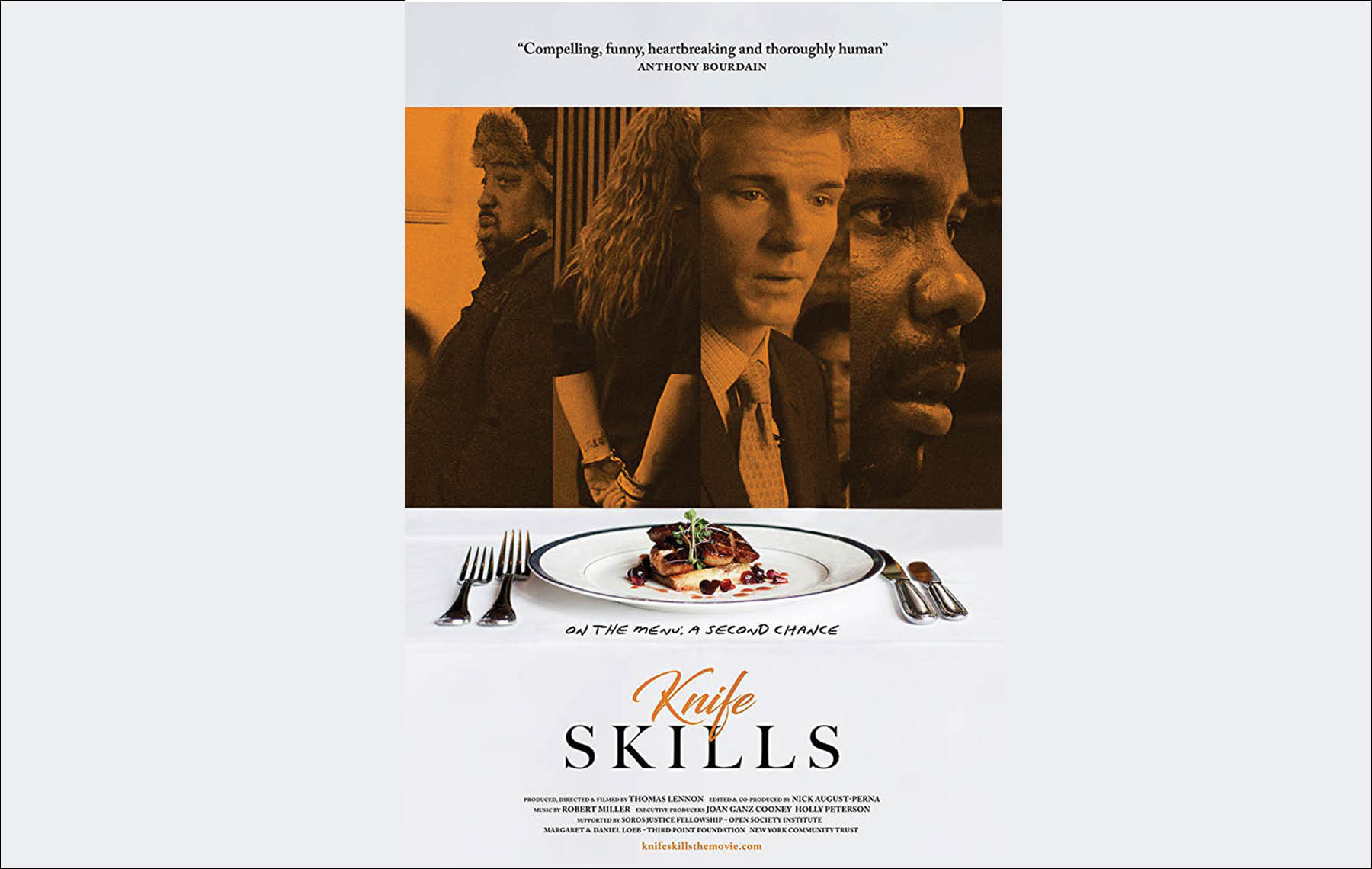
This is the subject of an unexpectedly touching documentary exploring a world that is unknown to many viewers; a humbling, throat-catching, sometimes difficult to watch but ultimately uplifting journey through the eyes of a collection of newly released prisoners and their fiercely passionate teachers and leader. The film focuses on the ex-prisoners six weeks before they graduate from a program designed to teach them skills in the world of fine dining. It follows their struggles as they try to navigate the frenzy of opening a high-end French restaurant called Edwins in Cleveland.
“Knife Skills” (2017), is the brainchild of documentary filmmaker Thomas Lennon. He was inspired at a dinner party at friends David and Karen Waltuck’s apartment. The husband-and-wife team who for 30 years ran Chanterelle, one of New York City’s most influential restaurants, introduced Lennon to one of the restaurant’s former dining room managers named Brandon Chrostowski, who told the guests about an idea he had.
Midway through his time at Chanterelle, Chrostowski incorporated a nonprofit called Edwins, which, according to him, would be “the very best French restaurant in the country, staffed almost exclusively by people coming out of the justice system.”
“Brandon had such ferocity of purpose. He’s a force of nature — he was not going to be denied.” — Thomas Lennon
Chrostowski insisted that one of the keys to keeping ex-cons out of prison was to find them jobs that paid enough to maintain a living. But because businesses prefer to hire people with no criminal record, these highly vulnerable individuals face a catch-22 situation that often can lead to problems and risk of a relapse.
Lennon was intrigued by Chrostowski and his passion of purpose. “Here’s this young guy, a former inmate, a gritty working-class kid from Detroit, raised by a single mother, who goes to the Culinary Institute, becomes a chef working in some of the most exclusive restaurants in the world, and then decides to become a nonprofit entrepreneur. He had grit but more than that, it was his calling.”
Chrostowski recalled Lennon saying to him, “Look, man, if it’s a bust, it’s a great movie; if it’s a hit, it’s a great movie.”
But Lennon confessed to being nervous initially to take on the project. “Documentary filmmakers are generally driven by the impulse to do good in the world, to make an impact and shed light on a topic,” he said, “but the ‘do gooding’ impulse can propel you into a project that’s a train wreck, and it’s often only after months and years of work that you even know if it was worth it.”
As much as his curiosity was piqued, Lennon was unsure if it was wise to make that investment based on one conversation with the tough-talking Chrostowski. It wasn’t until Lennon went to Cleveland to research the program that would launch Edwins’ opening, that he knew he had to do the film.
“Brandon had such ferocity of purpose. He’s a force of nature — he was not going to be denied,” Lennon said. “I realized I wanted to illuminate people who have no voice, to bring people here and plunge them into an improbable universe to think about the issue of reentry.”
Indeed, the film compels viewers to think about the challenges of its protagonists but also leaves room to draw conclusions, which is one of the film’s great humanizing forces.
Despite a long career in film that has earned him an Academy Award and multiple Oscar and Emmy nominations, Lennon said making the film was achallenge. He and Chrostowski almost came to blows several times, and co-editor Nick August-Perna, who also co-produced the film with Lennon, agreed that it was the hardest editing job they’d ever done. Still, Lennon said, “Despite the challenges, Brandon was the person making everyone move. He was the catalyst.”
The film begins six weeks before the restaurant’s opening night as Edwins’ first graduating class is fitted for chef’s jackets, and then delves into their struggles as they learn — from two heavily accented French chefs — how to prepare the 25 classic French dishes on the menu. Trainees also take crash courses from Chrostowski in French wine and cheese pairings as well as restaurant finance.
It’s a high-pressure rehabilitation program and not everyone can handle the demanding schedule or the level of discipline. Unsurprisingly, out of the 70 men and women who enter the program, that number dwindles to fewer than half for a variety of reasons: Some drop out on their own, others are pulled out by Chrostowski.Cooks, servers and bartenders, must become familiar not only with the food and wine but their origins along with the correct French pronunciation. For some, it’s their first exposure to the restaurant business and, for many, their first glimpse into the world of fine dining.
For those in the business who have lived through the chaos of a restaurant opening, it’s difficult to fathom the seemingly impossible task of guiding newly released inmates, many with past and present struggles with addiction, post-traumatic stress disorder and childhood trauma, through something as perilous and ambitious as the launch of a fine French dining establishment, and the film’s viewersdiscover the challenges the trainees face after their release.
“It’s just hard work,” Chrostowski said. “It’s all about giving people confidence. As a kid, I was in jail twice, and if it wasn’t for a judge who gave me 10 years’ probation and allowed me to stay out of jail for the third time, I don’t know where I’d be right now.”
“If it wasn’t for a judge who gave me 10 years’ probation and allowed me to stay out of jail for the third time, I don’t know where I’d be right now.”
— Brandon Chrostowski
Lennon managed to capture the raw and sometimes bitterly honest interviews with the program’s participants as well as their emotional fragility and the big hearts of those in charge. In essence, this is what “Knife Skills” is about — imperfect people going above and beyond to give redemption to others who desperately need a second chance when they have been all but forgotten by the rest of the world, in some cases even by their families. What joy viewers feel for one of the graduates when he impresses his cooking-show obsessed mother with stories and photographs of his French mentors and his newly learned skills.
In these moments, which are abundant in the film, viewers get a glimpse of what drives Chrostowski to achieve the seemingly impossible and to never accept failure as an option.
“Human beings amaze me — we can do anything,” he said, his voice cracking a little. “Once people realized what we were trying to do here, that everyone deserves a fair and equal future regardless of their past, it was incredible how the peripheral community contributed to the project.”
He added that 15,000 donors pulled together sums big and small and offered their time, expertise and support to ensure the program was a success.
In total, Edwins received more than $200,000 from foundations and individuals. One day, Chrostowski received an anonymous check for $50,000, but nothing prepared him for the envelope filled with $4 in coins from a 9-year-old who mailed Edwins her entire allowance along with a note of thanks.
Poster for the movie “Knife Skills.”
Although “Knife Skills” was a success, earning an “Audience Favorite” award at Michael Moore’s film festival in Michigan as well as the ultimate accolade, an Academy Award nomination, Ed Levine, a bestselling author and founder of Serious Eats website, summed up the film’s success saying, “I’ve seen that movie 10 times and it still gets me. In many ways, I think the beauty of the film is that Lennon lets the stories reveal themselves and never passes judgment. There’s so much humor amidst the struggles. At one point, we are riding along with this ex-drug dealer who completely surprises by quoting Shakespeare — ‘Oh, what a tangled web we weave when first we practice to deceive.’ ” Levine laughed when recalling the scene and then summed up the film. “It’s just a perfectly told story and I still cry every single time I watch it.”
Chrostowski has graduated hundreds of ex-convicts. He now runs a six-month training program in prisons, which has grown to include the restaurant, on-campus housing for his trainees and, recently, a full-service butcher shop he opened in Cleveland’s Shaker Square.
According to Chrostowski, the biggest challenge is the saddest one, too. Some students clash with the foreign world of classic French fine dining, some are cut for insubordination, while others reoffend even while working through the program.
Still, he said he has faith in every student, even when they have little to no faith in themselves. “The biggest challenge has been to help build self-esteem in a man or woman who has had it ripped away during incarceration or because of poverty or childhood trauma.”
Chrostowski said that he, too, is haunted by his struggles with his past and self-esteem issues. “I feel like a piece of s— most of the time, like I don’t deserve anything good.”
And with that, the veil of false bravado abruptly dropped and it became impossible not to appreciate the necessity of community, the kindness of strangers and the undeniable knock on positive effect of second chances.
Yamit Behar Wood, an Israeli-American food and travel writer, is the executive chef at the U.S. Embassy in Kampala, Uganda, and founder of the New York Kitchen Catering Co.
One verse, five voices. Edited by Salvador Litvak, Accidental Talmudist
You will eat and you will be satisfied and you will bless HaShem your God for the good land that He gave you. –Deuteronomy 8:10
Jackie Redner Rabbi-in-residence, Vista Del Mar
Israel is the place of my heart. It is not an easy place nor is it simple. It is squeezed from all sides and from within. Watched. Always watched … with judging eyes, rightfully and wrongfully. The complexity of choices Israel faces and the harsh realities of any outcome are hard for us to tolerate, to hold. We want the Israel of our ideals — the perfect Israel. And it just doesn’t feel quite fair — at least to me.
Too often, while our conversations about Israel generate much passion, they fail at compassion, as if there is not enough space to hold the magnitude of the situation in all its complexity. And even so, amid the constant watching and commentary, out of that land and out of that tension, a steady stream of blessing and nourishment flow into human life with almost a limitless generosity in every arena under the sun — from medicine to art, from technology to agriculture, from disaster relief to psychology to poetry.
Let us take a moment to hold our people and land with compassion — to behold the goodness of Israel. Let us allow the miracle that is Israel, with all of its imperfection, to rest in our consciousness and just be. And then let us give thanks and be satisfied.
Rabbi Adam Kligfeld Senior rabbi, Temple Beth Am
The most compelling part of this verse is what is missing. And what was “added” later by the sages. Here, the Torah compels a blessing of gratitude. When? Only when sated, after one’s needs have been met. The rabbis added a blessing that appears nowhere in the Torah: before one eats. For who knows whether satiety will be reached. The blessing-after is nearly obvious. Who would not say, “thank you” to one who provided so completely for one’s needs? Hopefully very few. But gratitude pre-satisfaction is a more elusive stance.
The medieval Sefer HaHinukh notes that when one has eaten one’s fill is subjective. Many can sit for the same meal, and yet feel full at different moments. While a group Birkat ha-Mazon is commonplace, the command in the verse is to bless when one is full. It is thus a supremely personal and individualized offering of gratitude.
But the blessing before? All of us stand together, somewhat tenuously, in the not-knowing of whether the food that is provided will satisfy. Most of us who live, blessedly, without food-worry, can glide over the opening blessing. What is the mystery? “Of course the food will suffice. I ordered it exactly as I wanted it!” The grand beauty of the blessing missing from our verse is that it impels a hopeful and expectant gratitude for what is to come. With no guarantee. Were it so that such anticipatory — and patient — grace was the norm in our society. May that be God’s will.
Rabbi Peretz Rodman Head of Israel’s Masorti Bet Din
This verse is cited in Birkat ha-Mazon, the “grace after meals.” After all, here is the obvious source of the Jew’s obligation to express gratitude for each meal after it has been consumed. It is surprising, though, that the verse is cited in the second of that series of blessings, not the first. What takes precedence over the obligation to express thanks for the bounty of the Land of Israel?
Before thanking the Lord for “having bequeathed to our ancestors a fine, broad land of desire’s fulfillment,” we are enjoined to recite — originally, actually, to improvise — a blessing for the gift of ample food enjoyed by all the world. God is praised as “the One who feeds all.”
Economist Shlomo Reutlinger, who died earlier this year in Jerusalem, found in a World Bank study a generation ago that the world’s food supply was and would remain adequate for the world’s population. Hunger was a function of uneven distribution — i.e., of poverty — not of a shortage of food on our planet.
Praise for the Divine Provider of food for all implies that being the one to deliver that sustenance over “the last mile” is a God-like endeavor. Before focusing on the unique blessing of our own promised land, we view our planet, the home we all share, as a gift that enables humankind to sustain itself — if the human race stewards it with care and sees to it that everyone on Earth gets an adequate share.
Cantor Michelle Bider Stone Shalom Hartman Institute of North America
If you hear of an eggplant shortage in Israel this summer, blame me. I just returned from my annual summer there staffing the Shalom Hartman Institute’s community and rabbinic leadership programs. Wherever I travel, I relish the opportunity to taste the culture around me. Israel, after all, is an internationally recognized “foodie” culture. But eating in Israel is more than mere culinary exploration.
In this verse, the Israelites are anticipating the food in Israel, a land of wheat, figs, olives and honey; foods they have been denied for 40 years in the desert. They will eat, be satisfied, and thank God for the land. Not just for the food, but for the land itself. Because eating in Israel can be a celebration of the vitality of Jewish life and culture in our homeland. It can be a celebration of the ingathering of the exiles: Iraqi kubbe soup is served next to Georgian khachapuri, followed by Bulgarian burekas. Israel’s thriving cuisine is an example of the land’s role in our Jewish identity and of what possibilities we can achieve.
Someone recently tried to explain to me why the tomatoes in Israel are the sweetest, juiciest tomatoes in the world: something to do with sugar infused in the fields. And indeed, we should celebrate the kind of agricultural innovation that enables the desert to bloom. But Israeli tomatoes don’t taste so good only because of agricultural processes. They taste good because they are ours, grown by our hands, on our land.
Rabbi Aryeh Markman Executive director, Aish LA
Why is it necessary to tell me to bless God when I am satisfied? Rather, when my bank account is overdrawn I shouldn’t forget to bless God!
The Torah commands us to bless God after eating a specific quantity of bread. The Talmud says God shows His Jewish nation favoritism because its inhabitants took it upon themselves to bless Him, even if they eat a much smaller quantity. Less than the size of a piece of bread they were fed daily on a starvation diet in Auschwitz.
The word Jew derives from the name Yehuda, which in Hebrew means “one given more than one’s fair share.” Our outlook from the earliest days of the patriarchs and matriarchs is that whatever we have is more than we deserve. Understand the power you have when you exercise this state of mind. You would feel satisfied and complete, no matter what you have. Imagine that!
This attitude enables us to weather all storms. Last week we observed Tisha b’Av, the day set aside to mourn the Jewish tragedies throughout history. One lesson is there is always a silver lining no matter how abandoned we feel by God. He has given us what we need, even though we don’t realize it. It is with this outlook that we are able to find the strength and indefatigable optimism that has carried us through four millennia. This ideal, though so incredibly lofty, is our greatness. May it be within our reach to attain this inner strength.
Five years ago,the images that filled our television news screens were of the horrific executions perpetrated by the Islamic State (ISIS) against the Yazidis — a Kurdish minority living in northern Iraq — as ISIS sought to create a caliphate in the region.
However, at the height of the Yazidi genocide in August 2014, when thousands of men were massacred, ISIS also captured thousands more Yazidi women and children and sold them into sexual slavery. Some managed to escape and some were eventually released. But all bear scars — some physical, some psychological, some both — of their time spent in brutal captivity where they were subject to rape, beatings and torture.
Today, as ISIS’s stronghold wanes, much of the world has forgotten about the plight of the Yazidi people and in particular the women and children (many of whom were born after their mothers were raped by ISIS fighters), who are attempting to rebuild their lives, mostly in northern Iraqi refugee camps.
However, there is one country — Israel — that has never forgotten. Over the past four years, Bar-Ilan University researchers have been working with an international team, undertaking studies among the women who were held captive by ISIS and trying to find ways to help them.
That work culminated in an extraordinary project last month in Israel, where 16 lay, female Yazidi mental health workers were brought from Iraq to Bar-Ilan, thanks to a fundraising effort by the American Friends of Bar-Ilan University (AFBIU) in Los Angeles, and international coordination efforts, including help from IsraAID. The women spent two weeks undertaking professional training in order to return home and offer support for the women who continue to struggle with their trauma.
The entire project was a significant undertaking and required almost two years of coordination, finding donors to fund the $200,000 venture, enlisting a renowned humanitarian aid Iraqi doctor, and bringing in some of the world’s experts on complex post-traumatic stress disorder (CPTSD).
“It was important to bring mental health workers from Iraq to Israel to give them the best training possible.”
The project was the brainchild of clinical psychologist Yaakov Hoffman, a senior lecturer in the Interdisciplinary Department of Social Sciences at Bar-Ilan, and Ari Zivotofsky, an engineer and professor in Bar-Ilan’s Gonda Brain Science program.
How the project unfolded was serendipitous, Hoffman said, speaking from Israel. He explained that the American-born Zivotofsky went to Kurdistan four years ago to research remnants of the Jewish community there. “He’s interested in that aside from being a neuroscientist,” Hoffman explained.
“It’s true,” Zivotofsky said, also speaking from Israel. “I originally went to Kurdistan with a friend because we like to visit disappearing Jewish communities. We heard there was still a small community left — there was a large Jewish community in the ’50s and ’60s — and we wanted to see what was there.”
So Hoffman, figuring Zivotofsky would pass by some of the post-ISIS camps with these women said, “Let me print up a questionnaire. I’ll do it in English, and see if you can hand them out.”
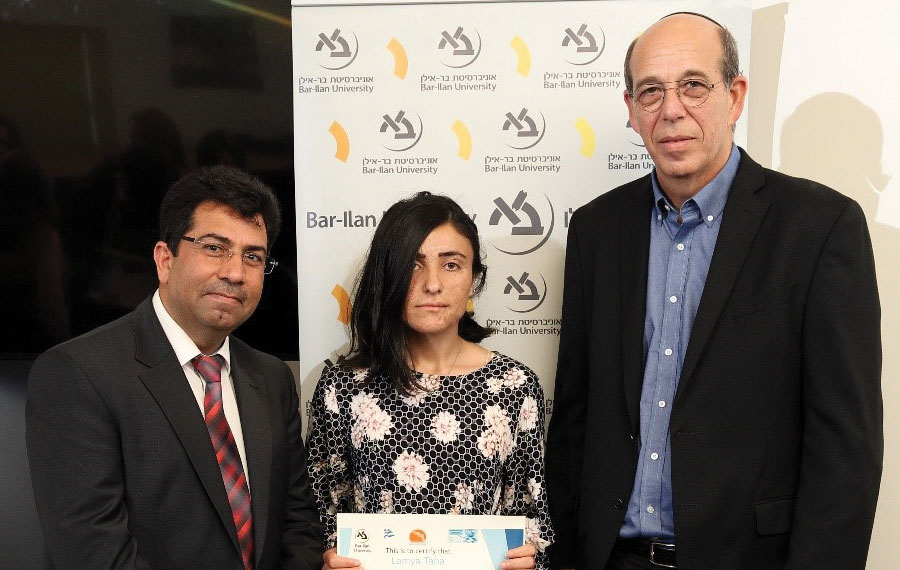
While Zivotofsky was unable to get near the camps, through a series of connections, he was able to connect with Dr. Mirza Dinnayi, a Yazidi activist and humanitarian who lives part time in Germany and who personally rescued more than 1,000 Yazidi women from ISIS and brought them to Germany — including 2016 joint Sakharov Prize winner Lamiya Aji Bashar. Aji Bashar was captured by ISIS when she was just 15. She shared the European Union Sakharov Prize for Freedom of Thought with another Yazidi woman, Nadia Murad. Murad subsequently went on to win the Nobel Peace Prize in 2018.
With Dinnayi’s help, and a grant from the Research Center for the Middle East and Islam, Hoffman and Zivotofsky spent four years studying women who had been held by ISIS. The results of that paper were published in February 2018, and revealed that 50% of the women were suffering from CPTSD while 23% were suffering from standard PTSD.
“Complex PTSD is relatively new,” Hoffman explained. “It only came out as a formal diagnosis in 2011 so a lot of clinical psychologists don’t yet know about it enough.” At its most basic, Hoffman said, CPTSD occurs when the trauma is very prolonged. “And it’s characterized by a second type of feature that is fascinating because it’s never really been investigated — where one’s destiny is under another’s control.”
But even though Hoffman is a clinical psychologist who researches PTSD, what drew him to want to work and study with the Yazidi women in particular?
“There is one country – Israel – that has never forgotten.“
“Those pictures coming out of Iraq [at the time]. This was reallyechoing things from our[Jewish] past,” he said. “Some of those pictures were horrifying. I’m not just talking about the executions. These female ISIS captives, kept in captivity for two or three years witnessed tremendous horrors.” The basic motivation, Hoffman said, was not just to give voice to their plight but also because most of the nongovernmental organizations (NGOs) on the ground don’t have the research or expertise to help these women. That’s why, he said, it was important to bring mental health workers from Iraq to Israel to give them the best training possible.
Aside from the logistical issues that prevent Israelis from entering Iraq (Iraq is officially at war with Israel), “We also couldn’t just go into some place that had a genocide and say, ‘We’ll do some games, empower them, and in the best case scenario, we’ll give them an intervention for PTSD, without checking if they’re suffering from PTSD or complex PTSD or depression or insomnia,’” Hoffman said.
With standard PTSD, Hoffman explained, you expose people to things they are afraid of. “Exposure is a common therapy,” he said. “But if you take someone with complex PTSD, it has all the symptoms of PTSD but goes far deeper — including a disrupted self-organization where their whole self is actually uprooted. And if you give them exposure therapy before they’re strong enough, you might actually be doing more damage.”
And so, in creating the program, Hoffman and Zivotofsky reached out to world-renowned expert on CPTSD, Marylene Cloitre, clinical professor of psychiatry at Stanford University and associate director of research at the National Center for PTSD Dissemination at the Veterans Affairs Palo Alto Health Care System. Cloitre, together with the World Health Organization (WHO) had recently developed the diagnosis for CPTSD.
“We contacted her because we wanted her to address the women,” Hoffman said. “And the story of how we got [Cloitre] here is beshert,” he said. “Did she tell you the story?”
She did.
Speaking with Cloitre in Northern California, she explained how she had never been to Israel. After completing her latest project with the WHO, she was trying to figure out what to do next.
“I thought, what I’d really like to do next is go to Israel. It’s a country that has experienced so much trauma and has persevered, it just felt like I should know more,” she said. A week later, she received an email from Hoffman asking her to come to teach the Yazidi women at Bar-Ilan. “It didn’t take me long to say ‘yes,’ ” Cloitre said.
“I work with women. I recalled the attacks on the Yazidi women and I was really shocked by how little the U.S. did and I felt very bad about it. Those things were on my mind when I got the email from Yaakov.”
Hoffman said it was clear his and Cloitre’s goals were aligned. “Our goal wasn’t just to train the women,” he said. “We also wanted to raise the plight of the Yazidis because, to some extent, it’s not being acknowledged enough by the world. Even Israel hasn’t yet acknowledged there was a Yazidi genocide. That’s why it meant a lot to bring someone like Lamiya [Aji Bashar], who could be interviewed and raise awareness. She’s also someone whose face can be shown. She’s a spokeswoman for Yazidi suffering.”
From left, Dr. Mirza Dinnayi, Lamiya Aji Bashar and Arie Zaban
That Aji Bashar came to Israel at all is thanks to the work of Dinnayi, Zivotofsky added. “While ISIS was massacring people, Mirza was going to Israel and Germany looking for help. Unfortunately, most of the Western world doesn’t seem to be interested except for Germany. [Germany] is doing teshuvah. They understand what genocide is and they want to repent. It’s putting their money where their mouth is and they have given a lot of money to help these people in both Kurdistan and Germany.”
But the Bar-Ilan program could not have happened without funding, which was coordinated by Ron Solomon, the executive vice president of AFBIU in Los Angeles. Speaking over lunch in Los Angeles with Solomon, one of those donors, local Los Angeles philanthropist Alan Gindi, spoke about how he was quick to come on board, as was his mother, Rachel Gindi.
“Often, the kinds of events that lead to complex PTSD are violent and are repeated. People’s bodies just take a big hit and they’re not comfortable in their own bodies and we work on that first.”
— Marylene Cloitre
“Bar-Ilan University and IsraAID are two organizations I respect very much and I know them both pretty well,” Gindi said. “I told Ron, ‘If my mother’s interested in doing this, so am I.’ ”
“I was under a lot of pressure to get this program funded,” Solomon said, “and I thought it was a fantastic program and [Rachel Gindi] is the champion of the underdog.”
Gindi revealed how he’d met some Yazidi survivors who had come to Los Angeles a couple of years ago. “I remember them sitting in my living room and telling their terrible stories. They desperately needed help. [Doing this project] is a Kiddush HaShem at the highest level.”
It was the Gindis — Rachel, Alan (and his wife, Barbara) — the Hitter Family Foundation and Alan Zekelman who footed the majority of the bill. All of the Bar-Ilan faculty volunteered their time and their expertise for the workshops.
“We had a video conference call with the attendees and Mirza, Zivotofsky and Hoffman. It was really something very special,” Gindi said.
“Over the years, [AFBIU] has raised funds for 12 buildings on the campus but I consider this one of the most meaningful donations because of what this is going to,” Solomon said.
With funding in place, Cloitre prepared for the program by reading about the Yazidis and their experiences and also spoke with a Yazidi psychiatrist via Skype about her proposed training. “He said my plan was fine but I didn’t know what to expect,” Cloitre said, adding she wasn’t even sure what the women’s religion was. And while there were four Muslim and two Christian women in the group, everyone else was Yazidi. “I had to get an education,” Cloitre said. “The Yazidi are their own people, their own religion. I was prepared to be very conservative in my dress but I saw they don’t dress very differently than the way we do. The weren’t wearing burqas.”
It was Hoffman’s idea, Cloitre said, to train lay people to understand more about trauma and CPTSD, including how to talk to people with PTSD and provide simple intervention that might help resolve some of the most impairing symptoms.
It was necessity, though, that dictated that the women selected were lay people. That’s because there are so few professional mental health workers in Iraq. It was Dinnayi and his organization Air Bridge Iraq, together with IsraAID — which has been working in refugee camps in northern Iraq for many years — that found the women. Dinnayi accompanied the women, including Aji Bashar, on their circuitous journey to Israel via Turkey.
A week after the program ended, Dinnayi suffered a heart attack. He spoke with the Journal three weeks later from a rehabilitation hospital in Germany where he was recuperating and said he was on the road to recovery.
In the period leading up to the project, Dinnayi said, “I explained to Ari and Yaakov about the situation in Kurdistan and how there are very few people who know how to treat PTSD. There is one psychotherapist for every 250,000 people in Iraq.” However, the women he selected had mostly worked in refugee camps.
Air Bridge Iraq, Dinnayi’s charity that assists trauma victims, has implemented several training programs, worked with many Yazidi women, and has helped resettle many victims in Germany. “I found [the 16] women who were willing to make the journey [to Israel] because they trust me,” he said. “If Bar-Ilan could offer a course of treatment for these women to work with victims of PTSD, that’s [a good thing],” he said, because “the whole Iraqi community is traumatized.”
Dinnayi, who has done humanitarian work with Israel for almost 15 years, said, “I think it’s very important to start some kind of relationship with [Iraq and Israel]. I’m not speaking about the politics,” he explained. “I’m speaking about the social relationships. I have many Jewish friends. They are like my family. Especially the Iraqi Jews in Israel. My life is about making peace and, if you want to have peace in the Middle East, it’s crucial to break stereotypes and you have to bring everyone together.”
And it’s stereotypes, he said, that have much to do with the fact that there are so few psychologists and psychotherapists in Iraq. “Even though Iraq has had many wars, people are ashamed to seek mental health treatment because of the stigma associated with it,” he said, adding that if someone were to seek mental health treatment, they would be called “mad” or “crazy.”
“That’s because there’s very bad education about psychological diseases,” he explained. “They don’t know it’s the same as any [physical] disease and should be treated the same way.” As a result, he said, few doctors study psychotherapy or psychiatry lest they, too, be called crazy. “The stigma is very bad,” he said. “And we have no special department for trauma.”
From left, Co-CEO-IsraAID Yotam Polizer, Dr. Mirza Dinnayi, Natan Sharansky, Bar-Ilan University president Arie Zaban, Arie Zaban, Yaakov Hoffman and Ari Zivotofsky.
Which is why, Hoffman said, bringing in these lay, Iraqi women was crucial. And that required a massive coordination effort with the Israeli Foreign Ministry and Dinnayi to bring the women into Israel via Turkey with special visas. The whole project almost didn’t happen. Two women received threats from the Iraqi government and pulled out. One woman got stuck in Turkey after having problems with her visa and eventually arrived a few days into the program. There was a glitch with the visas that saw the majority of the women having to receive them at the eleventh hour at the airport in Turkey. “We were on shpilkes up until the last minute,” Hoffman said. “We had no idea if they were coming.”
“It took a huge amount of work,” Zivotofsky added. “And beyond the treatment we also wanted to do PR. We wanted to not only help [the Yazidi women] but also bring to the world’s attention the plight of the Yazidis.”
That PR exercise — which brought CNN to cover the program — was thanks to Dinnaye bringing Aji Bashar. Zivotofsky reached out to Jewish Agency Chairman and former Soviet prisoner Natan Sharansky, who was imprisoned with Soviet dissident and activist Andrei Sakharov. As a result, Sharansky participated in the workshop’s closing event, where Aji Bashar spoke.
“If it wasn’t for IsraAID, their work in the camps and Mirza we wouldn’t have been able to get Lamiya,” Zivotofsky said. IsraAID also brought Murad to Israel two years ago. “And,” he added, “We really wanted Sharansky to be part of this. Twenty years ago, we would have brought Elie Wiesel — someone who represents an apolitical moral compass. Sharansky is viewed by many today as a neutral, moral voice.”
Also crucial, Hoffman said, was getting Cloitre for the first week of the two-week program to implement a treatment she had created called STAIR (Skills Training in Affective and Interpersonal Regulation). “It focuses on helping people reduce the intensity of their emotional reactions post trauma,” Cloitre said, “and also, very importantly, helps people reconnect to their social networks.”
“[Germany] is doing teshuvah. They understand what genocide is and they want to repent. It’s putting their money where their mouth is and they have given a lot of money to help these people in both Kurdistan and Germany.” — Ari Zivotofsky
Expanding on how PTSD differs from CPTSD, Cloitre said PTSD is viewed around having symptoms of the event in the here and now; nightmares, avoidance of things that remind you of the event; certain sounds. The treatment includes confronting the trauma and talking about it; telling a narrative of what happened.
However, in CPTSD, Cloitre said, people have those symptoms, along with difficulty regulating their emotions and managing their feelings; a really negative sense of self-worth that comes from being tortured or being held captive for a long time; and very negative or challenging relationships. “There’s an interpersonal dimension, which is difficulty maintaining relationships — tending to avoid them,” she said. “Often, the kinds of events that lead to complex PTSD are violent and are repeated. People’s bodies just take a big hit and they’re not comfortable in their own bodies and we work on that first.”
Cloitre spent six days teaching her workshop. “We worked collaboratively to adapt the interventions to their populations so that they would be comfortable delivering it,” she said. “It was really inspiring to work with people who had been exposed to such intense trauma [and to be able to] work on a recovery plan.”
It wasn’t all smooth sailing, though. As both Cloitre and Hoffman noted, they had to adapt some of the treatment on the fly. Cloitre’s short interventions consisted of six sessions — one per day. But first, she said, “I had to make sure that each basic principle made sense in their culture.”
One example Cloitre gave was that a key intervention for reducing intense emotional reactivity and regulating your emotions is to find self-soothing. “What soothes you to get you back down to a place where you can function?” she said. And while everyone was on board with soothing the senses, “some of the things we use in Western culture weren’t appropriate. In this case, we spoke about the idea of using lavender but that wasn’t appropriate. Rather, they talked about the scent of soil after rain.”
Hoffman offered another example, citing that one way to regulate your emotions is to imagine a wave, and to let the wave roll over you. “Except it doesn’t work for [these women] because there’s no ocean where they live. They don’t know what a wave is. For many of them, the first time they visited a beach was in Israel.”
One of the greatest concerns, Cloitre said, was the high incidence of suicidal ideation in the population. “A lot of intervention for suicidality is cognitive,” she said. “It’s a reappraisal of values and identifying a reason to go on.”
In speaking with the women, Cloitre learned that in Yazidiism, you don’t have the right to kill yourself — only God can make that decision — and so there’s a reason you’re still alive. She also learned that there’s a very strong emphasis on the need to persevere for your people and your family.
“I found that very interesting, and they brought up some role model women— including Lamiya and Nadia Murad — who had been tortured but had escaped and were now being represented and sending a message through the U.N.”
Bringing Aji Bashar to participate in the program, “she became the voice of the voiceless women,” Dinnaye said.
The entire two-week program was a learning period with many challenges for everyone, Hoffman said. “There’s a lot of nuance to be aware of when working with these women,” he said. “For example, a woman who was raped as a prisoner won’t say ‘I was raped.’ She’ll say ‘my stomach hurts.’ ”
Another problem they encountered, Hoffman said was that the plan was for all participants to be able to speak English. “That didn’t happen. We had four women who didn’t speak English but Mirza translated for us.”
The women also came from diverse backgrounds, including one who was an engineer who planned the infrastructure for the post-ISIS camps and gradually started talking to the women. “They became mental health professionals because their people were suffering,” he said. “They felt this moral obligation to go out there and help.
“However, the diversity of the women who shared different stories from the field allowed the team to build a fictitious case study out of all their vignettes,” Hoffman said. “The plan is to create a manual from these stories so that when this fictional woman who came back from ISIS says this and she feels this, we, in response, can say this or that and offer her intervention.”
Along with Cloitre’s STAIR therapy, participants also studied how to deal with sleep issues, nightmares and insomnia, “which can be dangerous because if you leave them untreated, it can cause physical problems — metabolic syndrome and other nasty stuff,” Hoffman said. “So we want to get them back sleeping.”
On the plus side, Cloitre said she was surprised to learn that almost everyone has Androids or iPhones. “So ironically, what was shared across the two cultures was a technology-supported intervention, such as looking at photos of loved ones on their phones. I didn’t expect that.”
Zivotofsky said while the women traveled around Israel, they also took lots of photos of everything. “I was surprised by how enthusiastic they were about everything,” he said. “All the women were going around snapping pictures of everything with their phones: the flowers, the trees.”
The women did indeed go on tours around the country. Hoffman and Zivotofsky made sure they weren’t stuck in the classroom for the entire two weeks. “They had tiyulim (tours), they went to the shuk in Jerusalem and even to Friday night Shabbat meals hosted by residents in the Old City of Jerusalem,” Hoffman said. Zivotofsky was in charge of coordinating the trips around the country, which also included a visit to Haifa in the north of the country, where they visited the Baha’i temple.
The two Christians in the group, Zivotofsky said, knew about the holy sites in Jerusalem. “Most of the others knew very little about Jews. One of the speakers [in class] used the word Auschwitz. We think everyone knows what Auschwitz means. They had no idea.” He added that they knew a little bit about Jews because of the once sizable Jewish community and there are still echoes of it.
“One of the women said her mother’s best friend growing up had been Jewish,” Zivotofsky said, “and another told us there are Jews living in the village married to non-Jews. But they had positive feelings about Israel. They loved that they could go into a café and speak Arabic. They met the Baha’is and the Druze — and they were impressed about how we have these minorities living freely in the country.”
The highlight for many, though, Zivotofsky said, was having Shabbat dinner with Jewish families in the Old City. “They were intrigued by the fact that Jews opened their houses and were willing to share their family, food and beliefs with Iraqi non-Jews.”
The evening was not without incident, though, Hoffman said. “They were stoned in the Old City by people who thought they were Jews. But then Mirza walked up to one of the guys, took a photo of him, and started talking to him in Arabic. When I asked what he said to the man, Mirza said, ‘I know who you are and I’m going to find you.’ Suddenly, the place emptied out,” Hoffman said, laughing.
One of the most intriguing decisions made by Zivotofsky was to take the women to Israel’s Holocaust memorial — Yad Vashem. Hoffman said he thought Zivotofsky was crazy. “I thought he’d fallen on his head,” he said, laughing. “I said to him, ‘What do they need to see Yad Vashem for?’ But then I realized it was the most amazing thing, because first of all, it validated them. They saw they’re not the only ones who have suffered. And the way Yad Vashem is documented and archived, they were in total awe of how you can rebuild and get hope and can resume life afterward.”
That, said Hoffman, became the program’s mantra: “Visiting Yad Vashem wasn’t just an extracurricular activity. It tied into the whole theme of empowerment, rebuilding; of post-traumatic growth, which is something we were trying to imbue.”
The visit, Zivotofsky added, helped the women look up to Israel and the Jewish people. “We are a people who have been where they have been, just 75 years ago. They wanted to understand how we have commemorated our Holocaust and they wanted to understand how we have built ourselves up.”
“There’s a lot of nuance to be aware of when working with these women. For example, a woman who was raped as a prisoner won’t say ‘I was raped.’ She’ll say ‘my stomach hurts.’ ” — Yaakov Hoffman
However, Zivotofksy was quick to point out, “We’re not comparing tragedies or genocides. We have our story and they have their story. Once they understood that, it was important for them to see how they can rebuild.”
It was also Dinnayi, Zivotofsky said, who pointed out to the women how every building has a donor’s name on it. “He said to them, ‘Look, this is how a nation builds themselves up. They don’t rely on the government.’ [Dinnayi] viewed it as something that can be a lesson to the Yazidi people.”
Beyond the Jewish and Yazidi people’s shared tragedies, Cloitre also spoke about how Israel also can speak to intergenerational trauma, something the Bar-Ilan program is hoping to halt, by sending home these women with tools to help their traumatized population.
“It’s very different from the U.S.,” Cloitre said. “In Israel and in other older countries, there is a feeling and awareness of intergenerational transmission of trauma. In the U.S., the Civil War doesn’t weigh too heavy on most of us. That’s very different in Israel and it’s a very salient part of understanding trauma — of what’s happened in the past and how it’s transmitted through stories by grandparents and parents.”
To that end, Hoffman and Zivotofsky hope to be able to raise more funds to continue the program. The women returned to northern Iraq just a few weeks ago, so there is still a waiting period before there can be any clinical follow up. In addition, Dinnayi’s recent heart attack has delayed his return to Iraq although he says he plans to return in early September, funds permitting. He added that online supervision and training of the women is already underway, “and we will try to establish something sustainable.”
“Two weeks of training doesn’t make one an expert,” Zivotofsky said. “If we can get funding and continue the training, that would be fantastic.”
“Our goal together is to continue the work and we do have a plan for having monthly supervision with the women who were trained on how it’s going and trying to document with them how often they give the treatment and what their perception of its benefits are,” Hoffman said. “If that works, then I think the next step is to try and get more money to do a more systematic assessment of the benefits.”
Beyond the ongoing training and treatment for these women, Dinnayi said he hopes this work might lead to coexistence between Israel and Iraq.
“I encourage all Iraqis and Israelis to have good relationships with each other,” he said. “There is no ground for hatred. Especially in Iraq. It’s so stupid to have hatred based on nothing. This Islamic fundamentalism and this pan-Arabic Nazi ideology — we don’t need that. The Jews have the right to be peaceful in their own country.”
Unfortunately, he added, the Iraqi people “have been brainwashed for 40 years by the Ba’ath party, the Ba’ath regime and Saddam Hussein. The whole era of Saddam was hatred. We have to work for peace; for coexistence among communities — and the political disputes can be solved later.”