fbpx

July 31, 2019

Middle East the Subject of Many Teaching Approaches

Imagine you are standing in the front of a classroom — not at Hebrew Union College-Jewish Institute of Religion or American Jewish University, but a classroom whose students come from different countries, religions and cultures — and it is your job to teach your students about the modern Middle East. What words do you use when each one is loaded? “Teaching the Arab-Israel Conflict,” edited by Rachel S. Harris (Wayne State University Press), a collection of three dozen essays by educators who have been there and done that, offers some highly practical and often equally provocative answers to that question.

Harris, associate professor of Israeli literature and culture at the University of Illinois, Urbana-Champaign, opens the book with an authoritative essay that surveys the long and complex history of the encounter between Arabs and Jews in the place that both of them called Palestine until 1948. She confronts us with the fact that makes it so damnably hard to teach it or even talk about it — the problem to be solved is not one conflict but many, not merely a regional conflict but a global one, not only a matter of rival Arab and Jewish nationalisms but also the tectonics of war, religion and geopolitics. “Hence, the Arab-Israeli conflict should not be regarded as an inevitable, long-standing and unresolvable historical conflict but a dynamic, complex, constantly changing engagement whose parameters are dictated by issues of the day,” Harris insists.

Indeed, Harris herself — and many of the contributors to the book — have adopted a multidisciplinary approach in their own teaching. “That is to say that there are a wide number of ways to approach the study of the conflict and the region,” she explains. “There are courses in many fields including religion, conflict resolution, demography, economics, comparative literature, Jewish studies, film studies, gender studies, security studies, geography, tourism, education, peace studies, food studies, Mediterranean studies, international relations, urban planning, dance, music, and law.” Virtually all of these points of entry into the Arab-Israeli conflict are mentioned, sometimes in passing and sometimes in depth, in her important and enlightening anthology.

Virtually all aspects of the Arab-Israel conflict are subject to misunderstandings and false assumptions among students. “For example, until someone gives a presentation on Christian Palestinians, many students are not aware that there are substantial Palestinian and Arab populations who are not Muslim,” explains Janice W. Fernheimer in the essay “Comics and Conflict.” “Until someone gives a presentation on Ethiopian Jews and the Israeli Black Panthers, some students may not know that all Jewish Israelis are neither phenotypically ‘white’ nor culturally Ashkenazi.”

The sheer complexity of the curriculum, in fact, is the primary challenge to the instructor. “Teaching the conflict immediately brings to the forefront one problem students often have with needing absolutes,” writes Caitlin Carenen in the essay “Why Can’t We Just Create New Sacred Holy Sites?” “They crave universal truth, absolutes, and clear ‘good guys’ and ‘bad guys.’ Throughout the semester, I witness students struggling to determine ‘whose side they are on.’ ” Carenen’s measure of success, as she describes it, is “the students’ improved sense of perspective and appreciation of the conflict’s complexity.”

And yet, even if instructors aspire to an evenhanded approach to the subject, they remain at risk of provoking the students who bring their own points of view into the classroom. That’s why Donna Robinson Divine issues a warning that appears in the title of her essay, “Teaching Students How to Think, Not What to Think, About the Middle East Conflict.” She goes on to explain that “[t]he initial readings, including excerpts from books or articles by Edward Said, Fawaz Turki, Hillel Halkin, Amos Oz, and Aaron Soloveichik, encourage students to confront the fact that this conflict is not only about a piece of real estate; it is also about different and competing conceptions of national identity. And on that topic, Zionists and Palestinians disagree as much within their own communities as across the national divide.”

Some of the contributors bring wit and wry humor to their pedagogy. Ari Ariel, for example, uses hummus as the focus of his classes on the Arab-Israel conflict precisely because both Arabs and Israelis claim it as a national dish. “Food is among the best tools for unsettling static notions of identity and for humanizing others,” he explains in “Feeding Minds.” “Ironically, this is because we tend to think about food in fixed ethnic terms. The more we study food ways, however, the clearer it becomes that they are among the most hybrid of practices. This realization then helps us to question other ways we categorize foods and the peoples who eat them.”

One principle, above all, serves as the guiding light for the three dozen contributors, including scholars from various religious and national backgrounds who teach in the United States, Israel and the West Bank, Jordan, Turkey, Egypt and elsewhere in the world. “Though one may make pretensions to study Israel without Palestine or Palestine without Israel,” writes Liora R. Halperin in an essay titled “Teaching Israel/Palestine Studies,” “the practice of scholarship requires facing both Israel and Palestine.” Anyone who enters the conversation, no matter where it takes place, overlooks Halperin’s healthy caution at his or her own peril.


Jonathan Kirsch, author and publishing attorney, is the book editor of the Jewish Journal.

Middle East the Subject of Many Teaching Approaches Read More »

U.S. Sanctions Iranian Foreign Minister

The Trump administration sanctioned Iranian Foreign Minister Mohammad Javad Zarif on July 31, according to a statement from the Treasury Department.

Treasury Secretary Mnuchin said in the statement, “Javad Zarif implements the reckless agenda of Iran’s Supreme Leader, and is the regime’s primary spokesperson around the world. The United States is sending a clear message to the Iranian regime that its recent behavior is completely unacceptable.”

Secretary of State Mike Pompeo issued a similar statement:

Axios reports that a senior official for the administration told reporters that Zarif “has been indulged as the reasonable and credible face of Iran and today President [Donald] Trump decided enough is enough.”

In June, when the Trump administration was considering sanctioning Zarif, Foundation for Defense of Democracies Chief Executive Mark Dubowitz tweeted, “If administration does sanction Zarif, they should make it clear that he’s responsible & accountable for decisions made by regime to conduct malign & destructive activities. No more mendaciously denying responsibility. He is part of regime in Iran & core regime decision-making.”

According to Bloomberg, Zarif told The New York Times in July that any U.S. sanctions would have little effect since he doesn’t “have a bank account outside Iran.”

Earlier in July, Israeli Prime Minister Benjamin Netanyahu tweeted a thank-you to Trump “for his intention to increase sanctions against Iran.” Netanyahu and Zarif exchanged barbs in June, as Netanyahu called Zarif a liar for saying that Israel was aiming to destroy Iran.

“Iran is the one openly threatening destruction,” Netanyahu said at the time. “The regime’s officials threaten the destruction of Israel on a daily basis.”

Zarif was Iran’s lead negotiator in forging the 2015 Iran nuclear deal. He was also educated in the United States, graduating from San Francisco State University (SFSU) in 1981 and earning his master’s and doctorate at the University of Denver in 1984 and 1988, respectively. During his time in SFSU, Zarif was among the students who overtook the Iranian consulate in San Francisco during the 1979 Iranian revolution.

U.S. Sanctions Iranian Foreign Minister Read More »

‘Max Says Yes!’ Tells Woodstock Story to Children

Woodstock would not have been possible were it not for Max Yasgur, the dairy farmer who leased his land in Bethel, N.Y., for the festival when the previously secured site fell through. The son of Russian-Jewish immigrants, Yasgur was a conservative Republican but he believed in the message of Woodstock, and told the crowd, “I think you people have proven something to the world.”

Max’s cousin Abigail Yasgur (they share a paternal great-grandfather) and her husband, Joseph Lipner, published the children’s book “Max Said Yes! The Woodstock Story” in 2009 for the event’s 40th anniversary, and it has been reissued for the 50th. With a square format designed to evoke a vintage album cover, its colorful illustrations are by Jewish artist Barbara Mendes.

Yasgur, who was 15 during Woodstock and living in Pennsylvania, never met Max, who died in 1973 at 53. But she obtained his widow Miriam’s blessing to write the book. She felt that Max’s story held a great message for children about generosity and openness. “Max felt strongly about the First Amendment and free expression. I don’t know if he shared [festival attendees’] vision but he liked their energy, and desire to make the world a better place. He wanted these kids to have a concert,” she said. 

Modern Orthodox Jews and members of the B’nai David-Judea congregation, Yasgur and Lipner draw a parallel between Max’s story and the biblical Abraham opening his tent to strangers. “These are incredibly Jewish values — opening up your land and giving hospitality to everyone,” Lipner said. 

The two met at Harvard, where Yasgur got her master’s degree in library science, and Lipner was enrolled at the law school. They married in 1990 and have three children, Emma and Max, who live in New York, and Rose, an NYU student. Lipner is a judge who writes on the side, and Yasgur, the former director of the now-shuttered Jewish Library of Los Angeles, is an artist and does nonprofit work. 

“Max Said Yes!” is their first collaboration, and the couple plans to make several appearances on behalf of the book to coincide with the anniversary. “Woodstock brought almost half a million people together, living with music in peace,” Yasgur said. “The message is still relevant, and we want people to learn that from the book.”

“Max Said Yes!” is available online.

‘Max Says Yes!’ Tells Woodstock Story to Children Read More »

Documentary Celebrates Woodstock’s 50th Anniversary

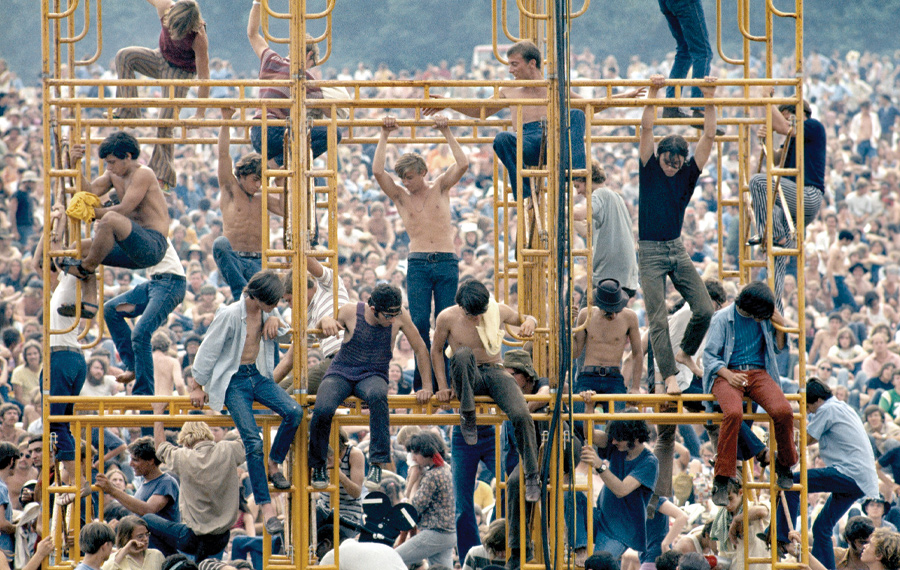
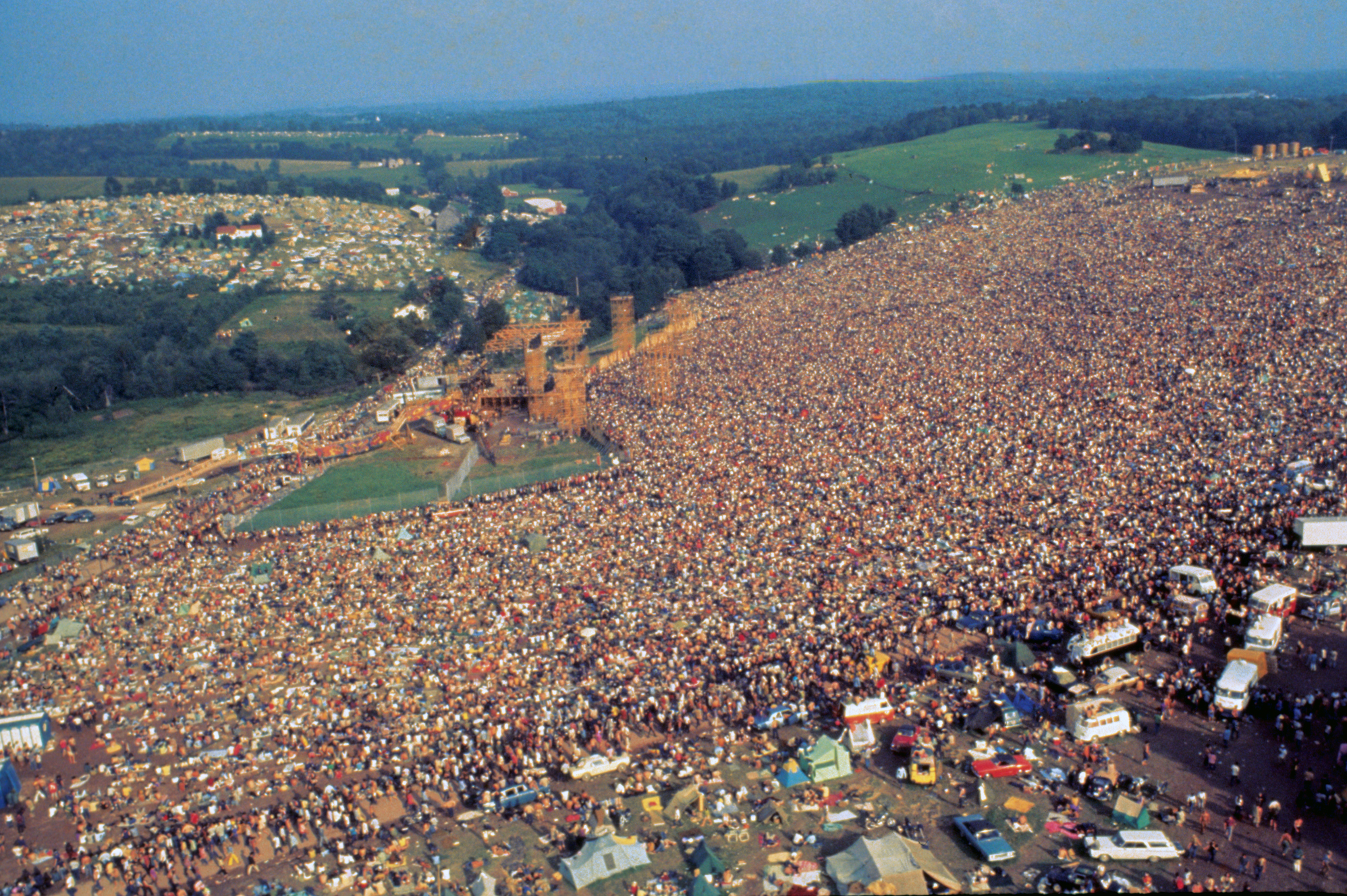
In the summer of 1969, a little music festival drew nearly half a million people to a dairy farm in Sullivan County, N.Y. The conditions at Woodstock were miserable: rain turned the site into a mud pit, and food and water ran out. But billed as “3 days of Peace & Music,” the festival lived up to its name. There were no riots and everyone got to experience iconic performances by artists such as Jimi Hendrix, the Who, the Grateful Dead, Janis Joplin, Jefferson Airplane and Sly and the Family Stone. 

Michael Wadleigh showcased those performances in the documentary “Woodstock” the following year. But in his new film “Woodstock: Three Days That Defined a Generation,” director, producer and co-writer Barak Goodman takes a different approach, focusing on the experience from the point of view of those who were there through video and photographic images and audio testimonies of organizers, workers and attendees. 

“We like to look for small stories that tell big events,” Goodman told the Journal. “We were looking to understand and illuminate what the counterculture movement in the 1960s and ’70s was really about. We did that by turning the cameras around to understand what happened in the crowd.” 

Just 5 years old in ’69, Goodman wasn’t very familiar with Woodstock. He spent two years gathering his sources and assembling footage, including footage from the Warner Bros. vault, NBC News and Super 8 home movies. “The original movie took liberties with moving performances around,” he said. “We wanted our film to be absolutely accurate and a record of what took place.”

Going into it, Goodman “assumed the crowd were a bunch of hippies, steeped in the drug culture, very political. But most were young college kids, not particularly political or dyed-in-the-wool revolutionaries or hippies. At Woodstock, they realized there were others like them. “There was a feeling of ‘we can change the world, we can achieve these goals.’ People felt that for the first time at Woodstock,” Goodman said.

Aerial shot of Woodstock crowd.

In the film, Goodman chronicles how Woodstock came together — and almost didn’t when the original location fell through, necessitating eleventh-hour scrambling. “The circumstances could have brought out the worst in people but it brought out the best in them,” he said. “[Woodstock] tapped into the collective feeling of peace and love. It really did change the world, just like they said it would. It was a peaceful, positive, loving experience that shows people that that’s possible, especially right now when everything is so dark and divided.”

A Washington, D.C., native who was raised in Berkeley and now lives in Brooklyn, N.Y., Goodman is descended from Russian Jews on his father’s side and German
Jews on his mother’s. “I was raised in a strong tradition of social justice and pacifism, marching for peace and civil rights. My parents were professors at (UC) Berkeley and all that mixed in with being Jewish and the
way Jews behave in the world,” he said.

A love of writing led him to pursue a career in newspaper journalism before he segued into documentary filmmaking and a longtime association with PBS’ “American Experience.” His next film, “Slay the Dragon,” about gerrymandering and voter suppression, will premiere next year to time with the presidential primaries. 

Asked if he thought Woodstock could be held today, he was of two minds. 

“What made Woodstock happen in the way it did was its isolation,” he said. “Today it would be live-streamed and mediated by the media. In some ways, Woodstock is unique and won’t happen again. But the message that we’re in this together and can change the world if we work together is very much alive and well today.” 

Goodman hopes that audiences come away with “a belief in the possibility of the best of us, that we are fundamentally decent and good, and when push comes to shove, those qualities will prevail,” he said. “Mass collective action is the best way of change. I want people to be inspired by that example from Woodstock.”

Woodstock: Three Days That Defined a Generation” premieres Aug. 6 on PBS, PBS.org, and Amazon.com and the PBS video app. 

Documentary Celebrates Woodstock’s 50th Anniversary Read More »

Satirical ‘Tel Aviv on Fire’ Mines Israeli-Palestinian Conflict for Comedy

Its title may evoke incendiary images of war, but “Tel Aviv on Fire” takes a different approach to the Israeli-Palestinian conflict, using humor to deftly send up both the titular soap opera at its center and the futility of the conflict itself. 

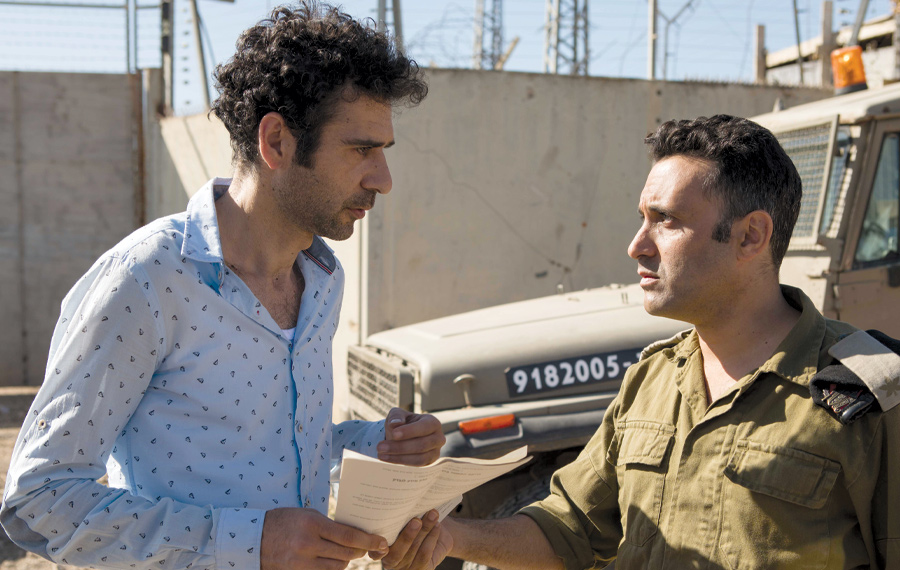
Set in Ramallah in the West Bank, it follows Salam (Kais Nashif), whose TV producer uncle hires him to help the cast with Hebrew pronunciation and then promotes him to writer. He gets in over his head when an Israeli border security officer named Assi (Yaniv Biton) demands that he change the direction of the plot to favor the Israeli in the spy-love triangle plot. Wanting to appease his boss and Assi, who has the power to deny him passage at the border checkpoint, Salam is caught in the middle.

Writer-director Sameh Zoabi, a Palestinian Israeli citizen, has faced a similar dilemma in needing to accommodate the separate agendas of Israeli and European film funders and the Palestinian community. “I realized this is my reality and I should make a movie about it,” he told the Journal. “The comedy is true to my voice and came as a natural extension of the reality I grew up with. People are so polarized and jaded now that if you make a drama [about the conflict] people are not interested in watching. Comedy is a way to liberate people to think about politics in a different way.”

His main character, Salam, is “not a victim or terrorist or soldier. He’s a common man trapped in a political reality,” Zoabi said. “People on the West Bank never meet [civilian] Israelis. They only meet soldiers. My Israeli crew had never been to Ramallah or the West Bank because of the checkpoints and barriers separating Israelis and Palestinians. If they were allowed to meet, they would find out they have more in common than they thought. Making the movie, I wanted to take a more optimistic approach and remind people about the need to reconnect and see each other as human beings. How can you bring trust and connection between people if they don’t have the chance to share?”

“People are so polarized and jaded now that if you make a drama [about the conflict] people are not interested in watching. Comedy is a way to liberate people to think about politics in a different way.” 

Mirroring the film in a way, Zoabi wrote the script with Dan Kleinman, a Jewish writer-producer originally from Louisville, Ky. They met when Zoabi was studying film at Columbia University and Kleinman was his teacher. “Most of my contribution was about the comedy,” Kleinman said. Both New York residents, they collaborated in person and then sent drafts back and forth. “We didn’t discuss politics while writing the script,” Zoabi said. 

Yaniv Biton and Kais Nashif in “Tel Aviv on Fire.” Courtesy of Cohen Media Group

The film has been a crowd pleaser on the film festival circuit and embraced in Israel by Palestinians and Israelis. “I think people are tired of this disconnect and this ‘us against them.’ There’s a hunger for the end of the occupation and finding a solution,” Zoabi said. “People are ready for it. I think the film can speak to people and engage a new generation in talking about a conflict that nobody wants to talk about anymore. I have high hopes that this will make a difference somehow.”

Zoabi, best known for his Cannes award-winning short “Be Quiet” and features “Man Without a Cell Phone” and “Under the Same Sun,” was planning to be an engineer before he saw his first movie in a theater at 20. “We didn’t have movie theaters in Nazareth,” he said. He received his bachelor’s degree at Tel Aviv University in film studies and English literature and was awarded a Fulbright Scholarship from Columbia. Currently, he’s teaching at New York University and working on new projects: his first English-language film and a movie set in Gaza called “Catch the Moon.”

Kleinman, who is descended from Jewish immigrants from Austria, planned to be a mathematician until he caught the film bug as a college senior. “Two films that made an enormous impact on me were Buster Keaton’s ‘The General’ and ‘A Hard Day’s Night,’ ” Kleinman said. “I decided to go to film school.”

He and Zoabi continue to collaborate. “We had a lovely time together. It’s rare to find a collegial, congenial writing partner and we both feel really good about continuing to develop new projects,” Kleinman said.

Zoabi hopes that American audiences will leave the theater smiling but with a greater understanding of the film’s underlying message. “It’s a very painful situation masked with humor, but I hope people see both,” he said.  “I hope that people see it and take something with them. I think films can bring a perspective to a conflict that has been going on for a long time. It almost feels like a soap opera that will never end. It’s time to end it.”

“Tel Aviv on Fire” opens Aug. 2 at the Laemmle Royal Playhouse 7 and Town Center 5.

Satirical ‘Tel Aviv on Fire’ Mines Israeli-Palestinian Conflict for Comedy Read More »

Honoring Julian Katz, Cycling King of Hermosa Beach

You usually need to be famous to get a street named after you. Really famous. Consider the recent renaming of Los Angeles’ Rodeo Road in the Crenshaw neighborhood as Obama Boulevard. 

Julian Katz’s name recognition doesn’t come close to that of former President Barack Obama, but in his longtime hometown of Hermosa Beach, Katz was something of a celebrity and, by all accounts, a universally beloved one. So earlier this summer — on the one-year anniversary of his death at the age of 88 — the South Bay city honored Katz by naming a 1.3-mile sharrow the Julian Katz Bike Lane.

Dozens of friends, acquaintances and fellow cycling enthusiasts came out for the official unveiling of street signs for the shared lane markings along Hermosa Avenue. Royal blue was Katz’s favorite color, thus the signs’ bright blue background. The color also was chosen as a nod to his love of sailing, while the curlicue design at the top is evocative of his trademark mustache.

It’s a fitting honor for the late aerospace engineer who traveled everywhere and anywhere he could by bicycle, and did volunteer work for many years to make Hermosa Beach and the surrounding communities more bicycle and pedestrian friendly. He did so motivated by concern for the environment, his commitment to a healthy lifestyle, and wanting to get others out of their cars, off their screens, and exercising and engaging with the world.

“He could be incredibly persistent about the things he believed in. But he was never self-righteous.” — Jeff Duclos

“This idea of making our city more bike friendly, adding dedicated bike lanes, it’s not easy,” said city councilman and former mayor Jeff Duclos. “He was the voice. That’s a really difficult position to be in, going against the status quo, trying to bring about a change but you don’t have a position of authority. He was the first person to get the city to dedicate a street as a shared roadway.” 

Katz’s efforts included having boldly painted bicycle symbols and arrows on the street. “[This] was important because, just that marker on the roadway, we have learned over the years, changes the behavior of people driving their cars,” Duclos said.

Katz also was instrumental in the creation and implementation of the South Bay Bikeway Master Plan, an ambitious undertaking still in the works that aims to nearly triple the network of bikeways in seven South Bay cities (the new Julian Katz Bike Lane is part of this network).

For Katz’s widow, chaplain Gila Katz, the bike lane naming and attendant fanfare have brought a lot of emotion.

“The truth of the matter is, it’s all mixed feelings,” the Israeli native said. “On the one hand, there’s tremendous happiness and pride in all that he was able to accomplish. And then it’s very painful because he’s gone. There’s tremendous appreciation for the love and care this community has shown to Julian, and the fact they are committed to continuing this work and committed to continuing to put in bike paths in Hermosa and the other cities.”

Calling her late husband a “really unusual man,” Gila added, “One of the things that was so unusual about him is that he could convince people to do things. He had a great sense of humor. He was very gentle. He didn’t quit. He had such a nice way about him.” 

Locals held Katz in such high esteem that one of the South Bay Bike Coalition leaders, Jim Hannon, adopted a well-known acronym and attributed it to Katz.

“WWJD,” Duclos said. “What Would Julian Do? I think he had that impact on people. He did it the right way. He could be incredibly persistent about the things he believed in. But he was never self-righteous. He was never preachy. He lived his life in a way that was not just admirable but to be emulated.”

Honoring Julian Katz, Cycling King of Hermosa Beach Read More »

Persian Senior Supports LGBTQ Jewish Community

Editor’s note: Nora Rakow was nominated for our seniors’ edition. However, the person who nominated her didn’t realize Rakow was too young to make our 80-plus cut. Nevertheless, her story is so inspiring, we decided to devote a page to her in our regular community section.

Married at 16 in Tehran, Nora Rakow moved to Los Angeles in 1986 to start a new life. Today, she continues to be successful through her passion for volunteer work with UCLA, Sinai Temple, Hadassah and JNF at “78 years young.”

In 1958, two months after their wedding, Rakow and her husband moved from Tehran to Hamburg, Germany, where their three children were born and raised. Rakow later followed her daughters to Los Angeles, where she received a green card and became a real estate agent.

Ever since her granddaughter Amanda became heavily involved with JQ International, a nonprofit that works to create community and advance greater inclusion of LGBTQ Jews and allies, Rakow has become a proud supporter of the LGBTQ community and has attended multiple events with her granddaughter.

“I admire this young, vibrant group because of the tremendous job they have done when bringing Persian-Jewish families together,” Rakow said. “Many parents don’t initially accept their children coming out as LGBTQ+ and families start to fall apart. [JQ International] has found a way to bring parents and children together and has taught parents how to accept their children, be proud of them and help them to prosper. I think that is a very powerful step they have made in the Persian-Jewish community. Instead of families falling apart, they have bound families together, who are now happy families.”

“Many parents don’t initially accept their children coming out as LGBTQ+ and families start to fall apart. [JQ International] has found a way to bring parents and children together.” — Nora Rakow

After retiring, Rakow realized that aside from spending time with her children, grandchildren and great-grandchildren, she “[gets] the most enjoyment out of giving back to my community and giving back to Israel,” she said. “I inherited my charitable heart and my love for Israel from both my beloved parents.”

As a volunteer on the executive board at Hadassah Women’s Zionist Organization of America, Rakow works to raise funds for Hadassah hospital in Jerusalem. At Sinai Temple, she is an executive board member of the Sisterhood, where she raises funds to support conservative rabbinical students. She also volunteers at the main information desk at UCLA and collaborates with the rabbi in the Spiritual Care unit at UCLA’s health center.

Rakow always has been involved in Hadassah and JNF. When Israel planned to develop the Negev desert, Rakow envisioned “the Persian-Jewish community in Los Angeles could be helpful in this development. I started a new movement in the Persian-Jewish community that if [someone’s] loved one passed away, instead of sending flowers to their grave, they could plant a tree [in Israel] in the memory of [their] loved one. They can also send a tree certificate in honor of someone as a gift for a special occasion.” To date, enough money has been collected to develop almost four forests on the outskirts of Beersheba.

Rakow said her goal for the future is to continue to expand the forests in the Negev. “My slogan is ‘Together, we make the desert bloom,’ ” she said.  

Rakow advises others to follow their hearts. “Be passionate about your dreams and beliefs, and do your best to make them happen,” she said. “Don’t let anyone stop you.”


Melissa Simon is a senior studying journalism at University of Wisconsin-Madison and a Jewish Journal summer intern.  

Persian Senior Supports LGBTQ Jewish Community Read More »

Khashoggi Murder Informs Daniel Silva’s Latest Spy Novel ‘The New Girl’

“Those who are familiar with Daniel Silva’s books understand that they are even deeper than a spy thriller. They are about men and women, the choices that they make and foibles of the organizations they work for.”

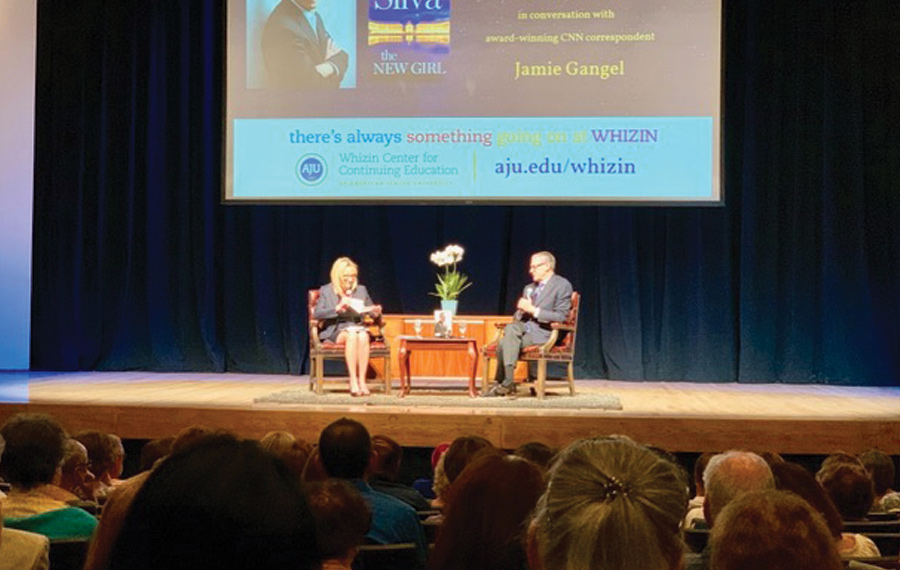
This is how American Jewish University (AJU) President Jeffrey Herbst introduced the renowned American spy novelist to more than 400 people at AJU’s Gindi Auditorium on July 24. 

Best  known for his long-running thriller series featuring the complex character of Mossad agent Gabriel Allon, the art restorer, assassin and spy, Silva spoke about his writing process and the story behind his recently released thriller, “The New Girl,” which hit No. 1 on the New York Times bestseller list that same day. Silva also was joined in conversation with his wife, CNN Special Correspondent Jamie Gangel. 

Throughout the evening, Silva endured light-hearted ribbing and a gentle grilling from Gangel. One of her first questions was how does he feel, after 22 books, to have his 11th or 12th No. 1 N.Y. Times bestseller? 

“It feels better than a sharp stick in the eye,” Silva replied. “Joking aside, I sit here tonight pleasantly surprised. It never gets old. I always knew that I wanted to be a writer and that I could be a writer. I never imagined that I would actually earn a living as a writer or that I would write more than four books and I would never dare to have imagined a No. 1 bestselling book.”

“I took 250 pages and dropped them in the trash can. I could not have such a flattering portrait of the Saudi prince after what happened, because the most interesting man in the world had become the vilest man in the world.” — Daniel Silva

“The New Girl” begins with a young girl, who is a new student at a prestigious school in Geneva that caters to the children of diplomats. Her classmates and teachers have been told she is the daughter of a wealthy Egyptian businessman but her father is really Khaled bin Mohammed, crown prince of Saudi Arabia, and when she is kidnapped, the crown prince turns to Gabriel Allon for help.

The world of “The New Girl” parallels closely the murder of Saudi dissident and journalist Jamal Khashoggi, Silva said. “I had been watching Mohammed bin Salman (MBS) for a number of years,” he explained. “The Saudi crown prince was saying some incredibly remarkable things. He expanded women’s rights and wanted to normalize life in Saudi Arabia. He spoke openly about recognizing the right of Israel to exist and that was the idea that rose up in demand to be written.” 

Silva started working on “The New Girl” in August 2018. “What really attracted me to it was to explore this very profound, real-world secret relationship that had developed between Israel and Saudi Arabia. I also wanted to cast a member of the Saudi family in a positive light. I used to call MBS ‘the most interesting man in the world.’ ”

However, all that changed in early October after Silva said he learned MBS was behind the brutal murder of Khashoggi at the Saudi consulate in Istanbul. “I took 250 pages and dropped them in the trash can because what I had written simply did not match up to the environment in which it was going to be published,” he said. “I could not have such a flattering portrait of the Saudi prince after what happened, because the most interesting man in the world had become the vilest man in the world.”

Gangel went on to ask the burning question frequently on the minds of Silva’s fans: Is he the real Gabriel Allon? 

“Are you joking?” Silva quipped. “Maybe if he wanted to disguise himself as a bookish nerd. I spend a lot of time with him. I dream about him. I do not fantasize about that kind of life. He is not my alter ego. I don’t have a violent bone in my body. Gabriel and his team are jetting around the world, scrambling and chasing the bad guys and I can barely make it through a book tour.”

As good as Allon is with a paintbrush, Silva is even better with a pencil and legal pad, which he famously uses to write the first drafts of his novels. “I like to lie on the floor when I work. I keep the room dark and as cold as possible and I write in long hand with pencils on legal pads. I thought I was alone in this but if you Google [the late Scottish writer] Muriel Spark, one of my favorite writers, you will see a beautiful picture of her lying with her manuscripts on the floor.”

When asked by an audience member whether the series might someday make the leap to film or TV, Silva said he had been in negotiations but that he was concerned about keeping control of the end product. “The material is complicated. Having an Israeli character is complicated. An Israeli product in the rest of the world is a problem.” 

He added that several respected actors had approached him over the years, trying to get the rights to the role. “I always wanted Daniel Day-Lewis to play the part,” Silva said. “Unfortunately he retired. So that leaves me with my second choice, at least this one is a good consolation prize because I think if anyone could capture the spirit of Gabriel Allon it’s him. It just has to be Will Ferrell,” he joked. 

When it came to signing his books, Silva thanked the audience members for their support. “I never want to disappoint my fans,” he said. “I hear from you how much you love the characters; how much you love Gabriel, and that does put pressure on me that each book if it’s not better than the last, it at least has its place in the series. So I put everything I have into every book I write. I leave nothing of myself behind.”

Khashoggi Murder Informs Daniel Silva’s Latest Spy Novel ‘The New Girl’ Read More »

Chabad Couple Runs the Kosher Farm on Maui

Each day, after Rabbi Mendel and Rebbetzin Chani Zirkind wake up, they say their prayers, learn some Torah, meet with members of their community, and tend to the chickens, goats, ducks, sheep and geese on their farm — in Maui.

Mendel and Chani, who grew up in Israel and Southern California respectively, married two-and-a-half years ago. Five months after their wedding, they moved to Hawaii to fulfill Mendel’s lifelong goal to work on a farm.

“Since I was a kid, I always wanted to raise the food I was cooking,” he said. “I had this dream of living on a farm and raising my own chickens and sheep.”

Through some connections in the Chabad world, the Zirkinds temporarily replaced the former Chabad emissaries living in Maui and took over the farm, simply called the Kosher Farm on Maui. Today, they have 1.5 acres of land filled with animals, mango groves, papaya and avocado trees, and banana plants. They provide private catering — Mendel is a shochet — and sell homemade apple and banana chips. 

They offer tours of the farm and cottages for visitors to stay in. Although they aren’t the official Chabad emissaries on Maui, they provide Shabbat meals to tourists and the 4,000 to 5,000 Jews they estimate live on the island. Guests can sample goat’s cheese, yogurt or ice cream, and eat freshly slaughtered chicken or lamb from the farm. Chani runs a weekly Hebrew class for kids, and the couple hosts an annual fair, complete with a petting zoo, bake sale and Jewish artist vendor booths.

Although there aren’t too many observant Jews in Maui, Chani said she is used to living in a smaller community. Her parents are emissaries in Los Alamitos, where they were the only Orthodox family in the area.

“There is something really special about keeping the Torah so close to the land, and learning the lessons of farming and keeping them. The Torah comes to life in a farm setting. — Chani Zirkind

“Chabadniks make a community wherever they are,” she said. “Judaism lives within you. There are also hard things about living in a big Jewish community in a city. You can’t get fresh goat’s milk in the morning or pick bananas or hatch your own chicks. There are always struggles. It’s a tradeoff.”

Artist Sheri Levin McNerthney is one of the Jews living on Maui and is president of the Jewish Congregation of Maui synagogue. She studies the weekly Torah portion every week with Chani. “As soon as I met [the Zirkinds], we immediately became fast friends,” McNerthney said. “Learning with Chani is the center of my week. [She and Mendel] are an incredibly positive influence on me.”

Chani said one of the reasons local Jews enjoy the farm is because it’s not a traditional religious setting. “People who are fearful of organized religion and don’t like the structure of the synagogue or something too religious are coming here,” she said.

Through working the land, Chani said she’s forged an even closer bond with her Torah-observant lifestyle. She’s learned about the laws of planting and cutting trees; when you’re allowed to collect eggs from animals; and why certain foods require certain blessings.  

“There is something really special about keeping the Torah so close to the land, and learning the lessons of farming and keeping them,” she said. “The Torah comes to life in a farm setting. It’s really unique to be able to share that with other families or couples.” 

“I feel like I’m very connected to God and nature,” Mendel added. “You wouldn’t expect people to embrace a Jewish farmer, but they see me as someone who is very connected to the land, and it’s inspiring. The Jewish community is responding in a way I never could have imagined.”

Chabad Couple Runs the Kosher Farm on Maui Read More »

Fermenting Revolution: Why You Should Be Making Sauerkraut

What do you know about your gut microbiome — the little world that lives in each of our guts? If you answered, “Not much,” you’re not alone.

But according to research, our gut health determines a lot about how our bodies break down food, and our ability to absorb nutrients from what we eat. These microbes may play a critical role in determining our appetite, allergies, metabolism and even brain function. Study of the vast community of microorganisms inside humans have found that gut bacteria even produce key mood neurotransmitters in the form of increased serotonin, dopamine and GABA, and lack of good bacteria could play a role in hiking risk factors for developing a neurological disorders, including ADHD. In other words, if you are in a bad mood a lot of the time, your gut bacteria might be to blame.

Research into the effects of nurturing good gut bacteria is so well documented, it’s common practice after a dose of antibiotics for doctors to recommend eating fermented products such as yogurt in order to restore balance to the gut and prevent yeast infections.

But our high sugar, highly processed, fast-food culture may create a situation in which gut microbiomes are perpetually altered. Overconsumption of sugar, in all its forms, doesn’t help matters. Fortunately, a routine dose of fermented foods with live active cultures, such as yogurt, kefir, miso, kombucha and kimchi can help correct microbial imbalances and may even fight cancer, obesity, brain deterioration and boost the immune system. Fermentation helps preserve food and in doing so creates beneficial digestive enzymes, B vitamins and various strains of probiotics.

One of my favorite ways to feed good gut bacteria is a food that many of us already know and love: sauerkraut. Although sauerkraut (“sour cabbage” in German) is widely thought to be a German invention, it was likely brought to Europe by Genghis Khan in the 13th century, who encountered shredded cabbage cured in rice wine in China. Dutch traders, whose long sea journeys relied on food that could last without refrigeration, also ate sauerkraut, as did Chinese laborers building the Great Wall. 

Sauerkraut is made by a process called lacto-fermentation; beneficial bacteria present on the surface of the cabbage (and all vegetables) called lactobacillus, when submerged in a saltwater brine, converts the sugars in the vegetable to lactic acid. This acts as a natural preservative and prevents the growth of harmful bacteria. Although commercially prepared sauerkraut is available in almost every grocery store in the West, I began making my own in Uganda after having a hard time finding any and realized how simple, crunchier and fresher the homemade version is.

A routine dose of fermented foods with live active cultures can help correct microbial imbalances.

It’s so easy to make and it’s immensely addictive. After you start to make your own, you’ll realize how well sauerkraut goes with foods ranging from steak, eggs, avocados, hummus, salads to, of course, kosher hot dogs. 

Making sauerkraut or any fermented veggie is simple but there are a few rules to follow to ensure fermented vegetables don’t become spoiled.

First, sterilize all the equipment, including mixing bowls, Mason jars, knives, lids, food processor and vegetables. Pour boiling water over everything and let it sit for a few minutes. Skipping this step increases the risk the lactic acid bacteria that ferments the food (good bacteria) will compete and lose to the multitude of other (not-so-good) bacteria that rots food. So sterilize and wash your hands with soap and rinse in vinegar.

Next, grate the vegetables. I had red and daikon radishes from the garden, and a head of purple cabbage and a carrot from the market. Sometimes I vary the ingredients but I always use cabbage. My go-to sauerkraut is made out of a big head of green cabbage. 

Sometimes, I used a food processor to slice my vegetables because it makes short work of chopping in our embassy kitchen when I’m making large quantities of pickled vegetables but, more often at home, I like to slice by hand with a sharp knife or grate on a standard cheese grater.

After the vegetables are cut, weigh a bowl of them on a scale to determine how much salt to add. A good rule of thumb is to add salt that is 2% of the vegetables weight. I don’t measure anymore because I’ve been making this for so long that I can guesstimate the salt but novices should measure so they don’t under or over salt (equally disastrous). 

I use a good quality sea salt or kosher salt for this and all other pickling because it has great flavor but feel free to use table salt. For about 9 cups (1 kg) of shredded vegetables, add 1 tablespoon plus 1 1/4 teaspoon (20 grams) of salt or 2% salt by weight. This is a standard pickling ratio of vegetables to salt.

After weighing, mix in the salt with a sterilized spatula or tongs and then walk away for 20 minutes. Why? Because it gives the salt time to start doing its magic in drawing out the liquids before the next step.

Wash your hands again (or don gloves) and then massage the vegetables aggressively, almost brutally, until they give up their juices. When I set a timer to this task, it takes five minutes to massage a medium head of cabbage (1 kg). Of course, you can add peppercorns, pickling spices, chile flakes or coriander seeds but I rarely add flavorings to sauerkraut because I like to eat it with eggs in the morning and I’m not always in the mood for assertive spices at that time of day.

After massaging the vegetables, stuff them into sterilized jars (sterilized lids also), making sure to push them into the jar leaving no air bubbles. Using a small sterilized spatula will enable you to push everything down into the liquid. Try to leave at least an inch of air at the top of the jar and make sure that every bit of cabbage is under liquid. Some people like to use ceramic weights to make sure the vegetables stay submerged but I like to use a thick cabbage leaf that I have reserved. I find that if I put it in the neck of the jar, it will stay submerged and keep all the vegetables under the liquid. 

Finally, set the kraut jars on the counter or in a dry cabinet for five to seven days with no direct light at about 60 to 80 F room temp and start tasting on day five. It might be a bit stinky in a sulfuric acid way. That’s good — that’s the byproduct of fermentation (think kimchi or pickles).

However, if it stinks in a rotting way then throw it out and remember how I warned you to sterilize. Bummer — bet you won’t do that again. Start eating your kraut when it is sour enough for you and tastes great. After you start to eat it, keep it in the fridge. It keeps for ages but it might not last long because you may become a kraut junkie — an enjoyable and effortless way to keep your very important gut bacteria in check.


Yamit Behar Wood, an Israeli-American food and travel writer, is the executive chef at the U.S. Embassy in Kampala, Uganda, and founder of the New York Kitchen Catering Co. 

Fermenting Revolution: Why You Should Be Making Sauerkraut Read More »