fbpx

May 29, 2019

Sammy Shore, Comedy Store Co-Founder, 92

Sammy Shore, whose 70-year career took him from the Catskills to Las Vegas and Hollywood but who made his biggest impact as a co-founder of the Comedy Store, died May 18 in Las Vegas. He was 92.

Shore was born Feb. 7, 1927. His career started in New York’s Catskills Borscht Belt, where he teamed with comedian Shecky Greene. The act was a big enough hit that Shore began to show up in movies and TV shows, including Jerry Lewis’ “The Bellboy” in 1960, and episodes of “Route 66,” “McHale’s Navy,” “Bewitched” and “The Ed Sullivan Show.” His big break came in 1969 when he was booked to open for Elvis Presley at the International Hotel in Las Vegas. He remained Presley’s opening act until 1972. 

By then, Shore’s star was on the rise and he became a Vegas headliner. He still holds the record for most appearances by any act at Harrah’s Las Vegas. He recorded albums (“Brother Sam, Come Heal With Me” and “70 Sucks, but 80 Is Worse”) and wrote books (“The Warm-Up,” “70 Sucks!” and “The Man Who Made Elvis Laugh”), but by far, his most enduring success is the Comedy Store.

Along with his then-wife, Mitzi, and writing partner, Rudy DeLuca, Shore opened the Comedy Store in April 1972. It quickly became a launching pad for young comedians. On its Facebook page, the Comedy Store posted, “Thank you for our home Sammy. We love you and miss you forever.” 

Shore relinquished his share in the club as part of a divorce settlement in 1974. (Mitzi Shore died in April 2018.) Shore returned to the stage, continuing to headline and open for superstars including Barbra Streisand, Tony Bennett, Sammy Davis Jr., Tom Jones, Ann-Margret, Connie Stevens, Bobby Darin and Glen Campbell.

On Twitter, his son Pauly, paid tribute to his father, posting, “Dad, you lived an amazing life and I’m so proud to say that you are my father. When you’re in heaven, I’ll be killing the crowds night after night and carrying on your legacy.”

Shore is also survived by his wife of 29 years, Suzanne, and children Scott, Sandi and Peter.

Sammy Shore, Comedy Store Co-Founder, 92 Read More »

Honoring the Zaglembie Memorial in Mevo Modi’im

The Talmud asks: When does fire break out? Only when thorns are found nearby (when there is evil in the world) but it always begins with the righteous.

The media widely reported the deadly fire last week in the Ben Shemen Forest in central Israel that destroyed Mevo Modi’im, the village founded by the late Jewish folk singer Rabbi Shlomo Carlebach (1925-94). 

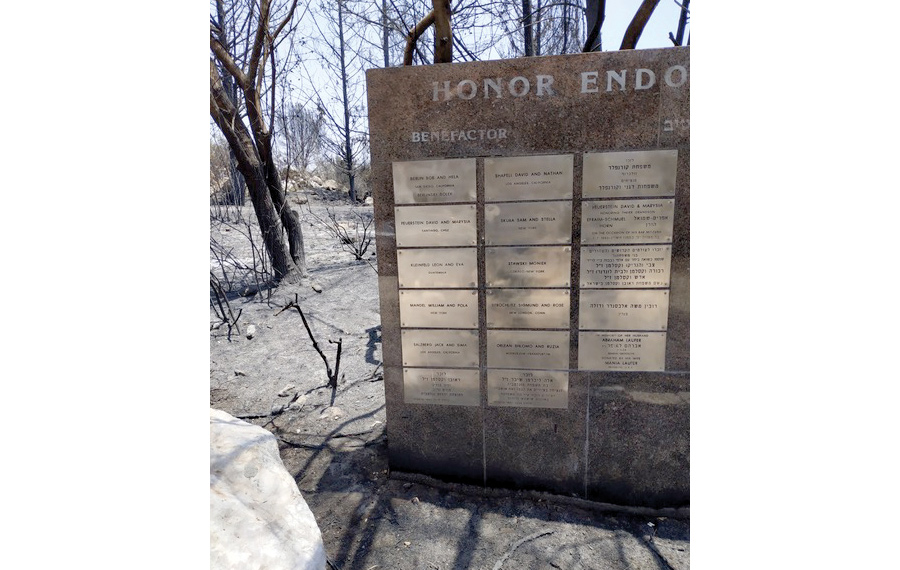
However, many people don’t know that the fire also destroyed the nearby memorial to the Zaglembie martyrs, erected 20 years ago by Holocaust survivors from — among other places —  Los Angeles and New York. 

It was poignant and ironic to feel the pain when we walked through the ashes of the once beautiful and serene forest and surrounding landscape. We read the inscription carved into the blackened marble monument dedicated to the Jews who once lived in Zaglembie:

“In Zaglembie, a region of southwest Poland, dozens of Jewish communities flourished for over seven centuries. All were destroyed by Nazi Germany in the Holocaust. The Jews of Zaglembie — about 100,000 souls —  maintained their dignity with courage in the face of the German Nazi barbarity until they perished in the nearby Auschwitz crematoriums.”

A small marble plaque embedded in stone had the names of soldiers — sons of the survivors from Zaglembie — who died fighting for Israel. The Jews of Zaglembie — about 100,000 souls —  maintained their dignity with courage in the face of the German Nazi barbarity until they perished in the nearby Auschwitz crematoriums.

Some of the trees on the site and in the valley and hills around Mevo Modi’im were still smoldering after the fire when we were allowed into the area. The silver plaques dedicated to those who helped build the Zaglembie memorial were burned and twisted. The black, granite stone walls inscribed with the names of the Jews who died were covered with soot. The large, steel sign that once read “Yizkor” (they should remember) in Hebrew, and six stone candleholders — lighted on each Holocaust Remembrance Day in Israel — were scarred and missing the letter yud. 

One of the monuments to survive.

But perhaps more moving was what did survive: The white stone slabs, engraved with the name of each village destroyed by the Nazis. A small marble plaque embedded in stone had the names of soldiers — sons of the survivors from Zaglembie — who died fighting for Israel. Then there was a letter penned by one of the last Jews of the town of Bezdin, who wrote, “7,000 Jews have already been murdered and by the time you receive this letter, there will be no Jews left alive in the town.”  

Yet amid the destruction and the odor of a dead forest was a single area of trees, bushes and landscaping that somehow survived, just like those few survivors of Zaglembie, who came to Israel to erect the memorial. 

The Jewish determination is strong and we know that this memorial will be rebuilt and those who perished will not be forgotten.


Rabbis Avraham and Chaim Braverman made aliyah from Los Angeles 27 years ago.

Honoring the Zaglembie Memorial in Mevo Modi’im Read More »

Jewish Directors Part of Hola Mexico Film Festival

Opening on May 31 and running through June 8 in Los Angeles, the 11th annual Hola Mexico Film Festival will have a prominent Jewish presence, and not simply because festival founder Samuel Douek is Jewish. 

Three of the films are by Mexican Jewish writer-directors. Douek told the Journal that the number of Mexican Jewish filmmakers at this year’s Hola is higher than usual but hardly a jaw-dropper. In a country with a population of around 60,000 Jews, there are bound to be artists whose work garners attention, he said.  

“Jewish people always gravitate toward story-making and I guess it’s no different in Mexico,” he said. “We chose 20 of the most amazing films that came out of Mexico and we really think that the general market and, of course, the Jewish audience will really enjoy the films at our festival.”

The three films by Jewish directors are of different genres. “Si Yo Fuera Tú” (“If I Were You”) is Alejandro Lubezki’s slight twist on a body-swapping comedy. Sergio Umansky’s “Ocho de Cada Diez” (“Eight Out of Ten”) takes a searing look at revenge and justice in present-day Mexico City, and the coming-of-age drama “Leona” (“Lioness”) was partially developed out of director Isaac Cherem’s desire to see attitudes change about women in Mexico. 

The Journal spoke to the three filmmakers, each of whom will accompany his film to Los Angeles.   

Alejandro Lubezki, “Si Yo Fuera Tú”

For his first full-length feature film, Lubezki rewrote a script that had made the rounds among several previous writers. He brought in his partner, Amaranta Arguelles, to co-write and the producers liked Lubezki’s version so much that they also asked him to direct the film. 

“It was a remake of a Brazilian movie, and I found a way to rewrite it to make it Mexican without it being folkloric because I don’t like to think of Mexico as only folkloric,” Lubezki said. “We don’t have a lot of body-exchanging comedies here, and I thought this was an opportunity to talk about important things like life and death, love and family while making a comedy.”

In the film, husband and wife Antonio and Claudia switch bodies, a situation that forces the two to reconsider elements of their lives and communicate on a different level. “Si Yo Fuera Tú” premiered in Mexico in October 2018. 

Lubezki is the grandson of Eastern European Jews. Characterizing himself as more culturally observant than religious, he calls his parents “free thinkers who are also outsiders in the Jewish community.” The filmmaker’s brother is three-time Oscar-winning cinematographer Emmanuel “Chivo” Lubezki. 

“Coming to Hola Mexico is important because maybe this festival is going to help me find someone who wants to distribute the movie in the United States,” Lubezki said. “That would be amazing.” 

“Si Yo Fuera Tú” plays at 6:30 p.m. June 6 at the Montalban Theater, 1615 Vine St., Hollywood. 

Sergio Umansky, “Ocho de Cada Diez”

During the opening credits of “Ocho de Cada Diez,” viewers are informed that 24,000 people were murdered each year under former Mexican President Enrique Peña Nieto’s administration. At that rate, six people would be killed during the time it takes to watch this film. The title, “Eight out of Ten,” refers to the ratio of murders that are never investigated in Mexico. 

In the film, Aurelio, a poor textile worker, is determined to bring his son’s killers to justice by any means possible. Citlali, a prostitute who is a victim of domestic abuse, helps him.  

Umansky interviewed hundreds of drug dealers, sex workers, abuse victims and even a couple of killers for the film. He found the concept of a father seeking justice for his murdered son intriguing. 

“But I had seen that movie before,” Umansky said. “I thought this movie was so dark and it needs some light. So I began writing a love story. When I read the statistic about 8 out of 10 murders, I changed the title and decided that this would be a love story within a very dark context. And that’s when the idea of putting 10 murders in the movie came about.”

In addition to the murders that are part of the fictionalized story, Umansky obtained security camera footage — not always legally — of actual homicides in Mexico City. 

“Ocho de Cada Diez” is slated for release in Mexico around Mexican Independence Day, Sept. 16. “With our new president [Andrés Manuel López Obrador] now, the violence is getting worse,” Umansky said. “So we are tapping into a need to shout for justice from our represented officials.”

Umansky acknowledges his heritage but does not characterize himself as a religious person and says he hasn’t been to a synagogue in 30 years. Being Jewish informs his life “every second of every day. We experience it in the details of kissing the mezuzah or saying, ‘Laila tov’ (good night) before we go to bed,” he said. “My next project is called ‘Fault Lines’ and I’m working more and more with the Jewish part to make sure we don’t lose the little things that make this family different.” 

“Ocho de Cada Diez” plays at 4 p.m. June 1 and 7 p.m. June 2 at Regal Cinemas L.A. Live, 1000 Olympic Blvd. 

Isaac Cherem, “Leona” 

Mexican Jews traditionally do not leave their parents’ homes until they are married, said Cherem, who chafed at that idea when, still unwed, he was preparing to leave the nest. He ended up moving in with a friend who was dating a non-Jewish girl. 

Using his own experience as the seed of his story, Cherem made the protagonist female and sought out actress Naian González Norvind. They ended up writing “Leona” together. 

Norvind plays a mural painter named Ariela who is ostracized from her family and her community when she begins dating Ivan, who is not of her faith. 

In addition to his own experience, Cherem saw the fallout over one sister marrying a European Jew and another leaving the country to live with an Italian boyfriend in Australia. “I just left the neighborhood and made my own life,” Cherem said. “But I think for women, it’s even harder. They have more pressure on them.” 

When the film screened in Jewish neighborhoods in Mexico, Cherem recalled, “Some people said, ‘My family’s not like that!’ ”

“I’m not trying to make a film about all of the Mexican Jews,” Cherem said. “When I started writing the screenplay, I was angry at what was going on. I wanted to scream. I wanted to say, ‘This is not OK and we need to change this.’ Now I don’t think that. I still feel they need feminism, and they need a lot of things, but who am I to say? I can only make a film.”

“Leona” will play at 7:30 p.m. June 3 and 9:30 p.m. June 4 at Regal L.A. Live.  

Jewish Directors Part of Hola Mexico Film Festival Read More »

Israeli Army Says It Found ‘Most Significant’ Hezbollah Attack Tunnel

The Israeli military said it uncovered the “longest” and “most significant” Hezbollah attack tunnel on the border with Lebanon.

The discovery of the nearly mile-long tunnel was made in the winter during Operation Northern Shield, which aimed to expose and neutralize cross-border attack tunnels, but was announced Wednesday.

The tunnel is 22 stories deep, or 260 feet, and stretches more than 250 feet into Israel, the Israel Defense Forces said, calling it Hezbollah’s “flagship” tunnel. Inside was infrastructure for lights, a public address system and stairs made of concrete.

The IDF said the tunnel took years to build and would be destroyed in the coming days.

The Israeli army has found and destroyed six Hezbollah cross-border tunnels.

Israeli Army Says It Found ‘Most Significant’ Hezbollah Attack Tunnel Read More »

Mike Burstyn: From Yiddish Theater to a Vampire’s Rabbi

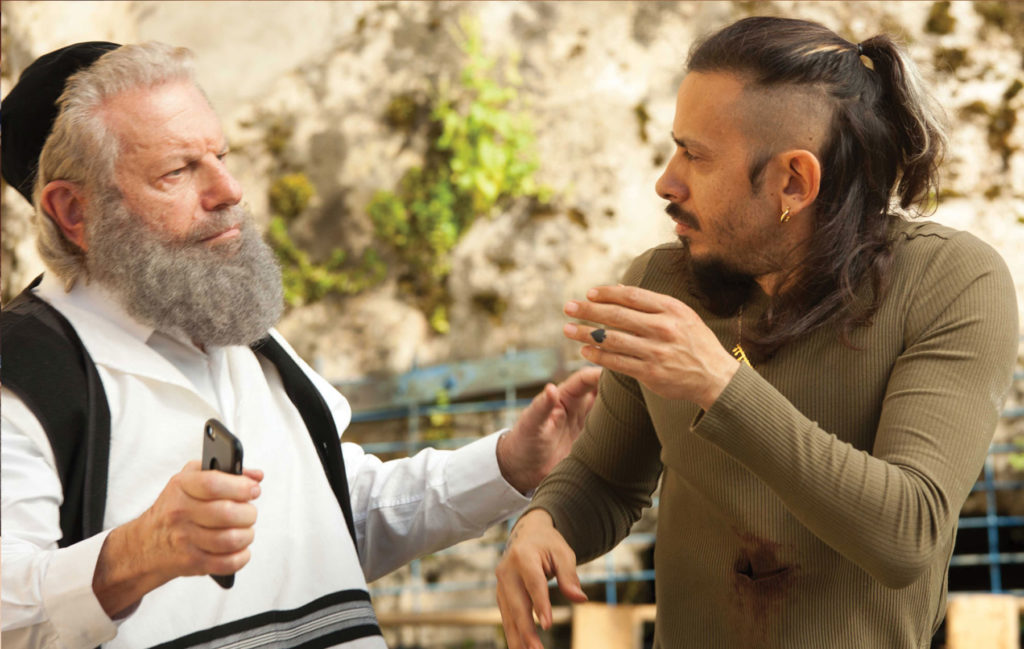
To older Israelis, Mike Burstyn is Kuni Leml, the character that made him a star in a series of comedies in the 1960s and ’70s. But to the current generation, he’s the rabbi in “Juda,” the hit series now streaming on Hulu, in which he plays the spiritual adviser to a Jewish vampire. 

Creator Zion Baruch wrote the role with Burstyn in mind, and the 73-year-old actor didn’t hesitate to accept after reading the script. “I’m always looking for a challenge,” Burstyn told the Journal. He recently returned from Israel, where he shot Season 2 of the series, and he hopes there will be a third. Surprisingly, considering that he grew up in the Yiddish theater, he had never played a rabbi before.

Burstyn’s father, Pesach Burstein, was a matinee idol in Poland when Yiddish theater impresario Boris Tomashefsky brought him to America in 1923. Burstyn’s mother, Brooklyn-born Lillian Lux, was a child star on the Second Avenue scene. They had Burstyn and his twin sister, Susan, who joined the act when they were 7 as “The Wunderkinder.” “I took to it right from the start. I really loved it,” Burstyn said.

But as Yiddish theater declined in popularity in the United States after World War II, the family had to tour elsewhere to find an audience and moved to Israel in 1954. Susan, seeking a more stable life, left showbiz behind when she was 18 and returned to the States. Burstyn continued in the family’s show. He became a breakout star after being cast in “Two Kuni Lemls” (aka “The Flying Matchmaker”) in 1966. “It changed my life,” he said.

Another milestone moment came in 1981. Burstyn had been hosting his own variety show on Dutch TV for three years when guest Chita Rivera recommended him to the composer of “Barnum” as a replacement for star Jim Dale. Burstyn became the first Israeli to star on Broadway and went on to appear in “The Rothschilds,” “On Second Avenue” and “Inquest,” where he played lawyer Roy Cohn. 

“Every once in a while, I love to do a Yiddish concert because I love the language and I don’t want to see it die. I want to make sure that it doesn’t become like Latin, where people study it but nobody speaks it.” — Mike Burstyn

Most of his characters have been Jewish, Al Jolson, Mike Todd and Meyer Lansky among them. He even played the title role in “Oh, God” for the West Coast Jewish Theatre. Coming up, he’ll play another rabbi in the comedy-horror movie “Happy Times.”

“I’m very attached to my Judaism,” said Burstyn, who frequently attends Chabad of Bel Air on Friday nights. “[The Chabad] is around the corner from my house and I like the traditional service.” He has officiated as a cantor twice at the Synagogue for the Performing Arts in Sherman Oaks during the High Holy Days, in 1973 and again in 2000. 

Burstyn has been a Los Angeles resident for 20 years “because my children and grandchildren are here.” After his wife died from ovarian cancer in 1995, he was performing at an Israel Bonds event when he met his second wife, Cyona, who was born in Israel. They soon will celebrate their 21st wedding anniversary.

Burstyn and his wife travel to Israel several times a year. He plans to tour there in the fall with his one-man show, “a retrospective of my career, from my childhood till the present day in song and story,” he said. His next film, the diamond heist caper “Catch as Catch Can,” will be shot in Israel in the fall or early next year.

Two years ago, Burstyn made his directorial debut with “Azimuth” to commemorate the 50th anniversary of the Six-Day War. Set in the Sinai desert after the cease-fire, it’s a tense drama about an Israeli soldier and an Egyptian counterpart who at first try to kill each other but ultimately forge their own peace. Burstyn heard about the story while he was serving in the Israeli army during the conflict and years later turned it into a script. 

“We couldn’t go to Sinai [to make the film] so we went to the Ramon Crater near Sde Boker and shot it in 15 days,” he said. “The message is that there has to be some other way to compromise and cooperate because up until now, nothing has worked.” He hopes the film will get an American release on DVD.

Burstyn loved being behind the camera and is developing other projects to write and direct, including two for television that he will produce if he can close a deal with a streaming service. He currently works for Netflix, putting his fluency in eight languages to use in dubbing foreign series into English. These have included Israel’s “Fauda” and the Spanish series “Money Heist.”

Also on his to-do list is a return of sorts to his roots. “Every once in a while, I love to do a Yiddish concert because I love the language and I don’t want to see it die,” he said. “There’s an academic resurgence where Yiddish is being taught at universities and schools and there are Yiddish clubs, but I want to make sure that it doesn’t become like Latin, where people study it but nobody speaks it.”

He loves that his grandchildren, a 12-year-old girl and 7-year-old twins, “have the bug and the talent” for showbiz. “But I would not encourage them unless they really loved it,” he said. “It’s 70 percent rejection. If you can live without it, do something else.” 

Burstyn could not. “I knew right from the start. I never wanted to do anything else,” he said. “It hasn’t always been easy. There have been ups and downs and frustrations. But this is my life, this is my love, this is my home.”

“Juda” is streaming now on Hulu.

Mike Burstyn: From Yiddish Theater to a Vampire’s Rabbi Read More »

Election Handbook Return: The Winner of Israel’s Next Election

We call this format a Timesaver Guide to Israel’s Coming Elections. This will be a regular feature on Rosner’s Domain until the next election day, Sept. 17. We hope to make it short, factual, devoid of election hype and of he-said, she-said no-news and  unimportant “inside baseball” gossip.

Bottom line

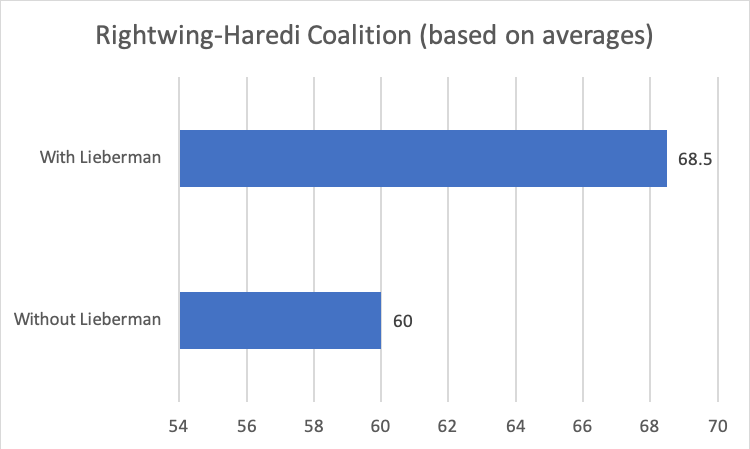
Israeli politics weren’t expecting to see this development so quickly, but history is being made: a second election being called for less than six months after an election never has happened in Israel, which prompts another forecast. For now, the prediction is for another victory for the right-wing bloc.

Note: If you want to know how we got here and what’s at stake policy-wise, click here.

Main News

Israel’s next election is slated for Sept. 17.

Yisrael Beiteinu and the Charedi parties couldn’t agree on a Charedi draft law. Prime Minister Benjamin Netanyahu failed to form a coalition, and in voting for a new election, the Knesset, in essence, dismantled itself.

Fewer parties are expected to run in September: Kulanu merged with Likud, The New Right might be gone.

Parties soon must determine if they want to hold a new primary election. Likud is going to skip it; Labor must decide who’s going to be its leader for the coming election.


Developments to Watch 

Themes: Likud’s campaign has an obvious theme: If you want us to be in power, vote for us. Other parties make trouble.

Themes: Avigdor Lieberman’s campaign has an obvious theme: If you want right, and not ultra-Orthodox, vote for me.

Themes: Blue and White will say: Netanyahu failed and dragged Israel down the rabbit hole of another election — maybe give us a chance.

Legal: Remember thinking that Netanyahu’s indictment on corruption charges would be the crucial moment of the last election? Netanyahu is facing a pre-trial hearing, although Israel’s attorney general extended the deadline until October .

Personal: Is anyone coming back? Ayelet Shaked (formerly of The New Right)? Tzipi Livni?

Political: The Arab parties get a chance to remerge and possibly retake 13 seats rather than the 10 they held after splitting.

Social: What did voters learn from the last failed round of elections? Will it make them more or less prone to vote for small parties? Will it make them inclined to vote?


The Blocs and Their Meaning

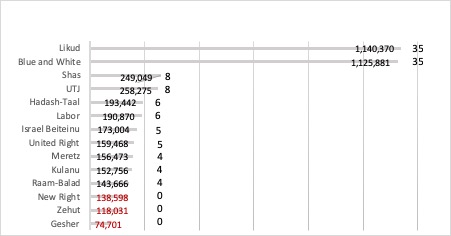
Old polls mean little when realities change. So what remains are the results and their meaning. The basic fact is this: The right got more votes than seats. In other words: Because of votes wasted on parties that didn’t cross the electoral threshold, the right got less than its realistic share of Knesset seats. If fewer votes are wasted in the next election — and if the voters stick with their camps — the right is supposed to get stronger come September. This will give Netanyahu more leeway as he builds his coalition. Then again, the entire campaign season lies ahead.

The graph below shows the number of seats in the last election vs. the number of votes. As you can see, the Netanyahu bloc lost close to 300,000 votes on parties that didn’t make it into the Knesset. This could translate into an additional four to eight seats.


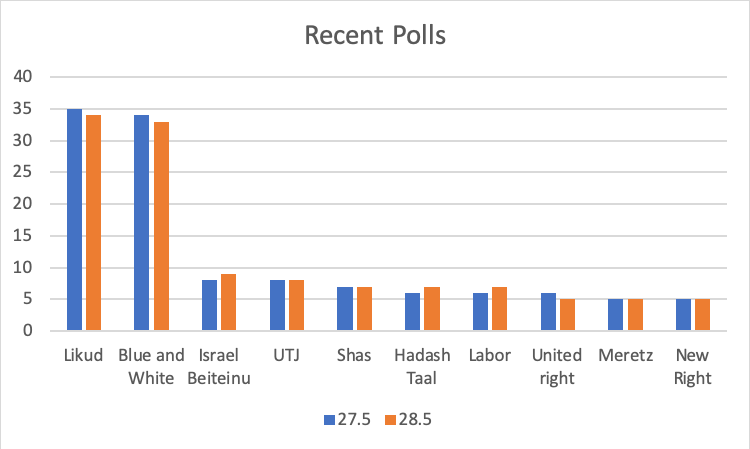
Now take a look at two polls taken earlier this week, and what they mean for a future right-religious coalition:


A Party to Watch

A Party to Watch

Yisrael Beiteinu is the most interesting party to watch, because the stakes for this party are high. On the one hand, right-wingers might blame Lieberman for Netanyahu’s failure to form a solid right-wing coalition. On the other hand, voters are not sympathetic to the ultra-Orthodox and might decide to reward Lieberman for holding his ground.

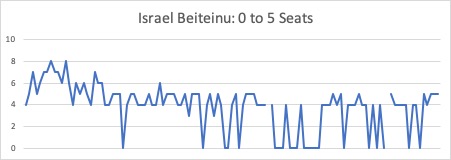
What you see in the following graph is simple: Polls were quite accurate about Yisrael Beiteinu. Their prediction was zero seats — namely, below the electoral threshold, or four to five seats, just above the threshold. The party ended up having five (the numbers below represent all polls published in media outlets from January 2018 until election day, April 9).

What happens next? There isn’t much room for Lieberman to go down and survive, so my guess would be it’s either up or nothing. A few fresh polls give him eight or more seats.


Election Handbook Return: The Winner of Israel’s Next Election Read More »

‘Poppy Man’ Raises Funds for Jewish Vets

In the weeks leading up to Memorial Day and Veterans Day, you’ll find 94-year-old World War II veteran Harvey Krasner handing out red paper remembrance poppies at the Vons supermarket on Mission Oaks Road in Camarillo in exchange for a donation to the Jewish War Veterans of the USA (JWV).

Until recently, Krasner was the vice commander of the San Fernando Valley post of JWV, and he’s been selling the poppies for 60 years. Although something of a local celebrity, Krasner told the Journal that the money he raises is more important than the recognition. He estimates he raises approximately $2,000 each week, with “every penny of it going to hospitalized and homeless veterans.” 

Krasner doesn’t need to do this work. He and his wife live in a retirement village. They have active social lives and visit with their children and 11 grandchildren. Krasner said he sells the poppies because it’s important that people remember.

Poppies have been a symbol of remembrance for those killed in combat since World War I, when the poem “In Flanders Field” by Lt. Col. John McCrae, a Canadian doctor who fought in the Battle of Ypres, was published in 1915. The poem’s most well-known line is: “In Flanders fields the poppies blow/ Between the crosses, row on row.”

Krasner said his fundraising success is because of the cause he supports, but he’s also a savvy salesman  — a talent he picked up working as a buyer and later sales rep for handbags and leather goods. 

Location also is very important, he said. “Don’t get a location that has two entrances, because you can lose 50 percent of the potential donors.” Equally important, he added, is having a donation box. “That’s a big thing. You can’t put the money in your pocket. [The box] lets people know they’re not giving the money to you, but to the organization. I never touch their money.”

Krasner has no set price for the poppies; people can give what they wish. He figures on average, people pay around $3 a poppy, and he sells approximately 90 per day. Most of the people who donate, he said, are in their 50s and 60s.

He wears a military hat and his commendations when selling the poppies, and he has a second chair at his table so if anyone wants to sit and kibitz, they can. His wife and children sometimes come by and join him for an hour or so, but it’s often other vets who take a seat and want to trade war stories.

Born in Brooklyn, N.Y., and raised in California, Krasner enlisted at 18, right out of high school, and was sent to Europe, where he joined the 756th Tank Battalion. He landed in southern France and fought in the Battle of the Bulge, earning a Purple Heart and a Bronze Star. He also saw the Dachau concentration camp a few days after it was liberated. “It was horrible,” he said. “Thousands of people, just lying there, dying.” He joined the JWV almost immediately after his discharge.

While not observant, calling himself a “Jew by culture and tradition,” Krasner takes great pride in his membership in the JWV, rattling off the organization’s bona fides: It was started in 1896 by Jewish Civil War veterans; it’s the oldest veterans group in the United States; it was founded to combat the perception that Jews did not fight in wars.

“It’s important,” Krasner said, “that people remember that Jews fought in World War II,”  adding that Jews “made up 2 percent of the [United States] population in World War II, yet we were 5 percent of the service and we were 10 percent of the officer corps.”

While Krasner will not be selling the remembrance poppies again until the week before Veterans Day in November, donations to the JWV can be mailed to Jewish War Veterans Post 603, 4218 Village 4, Camarillo, CA 93012.

‘Poppy Man’ Raises Funds for Jewish Vets Read More »

Poway Torah Dedicated in Gilbert-Kaye’s Honor

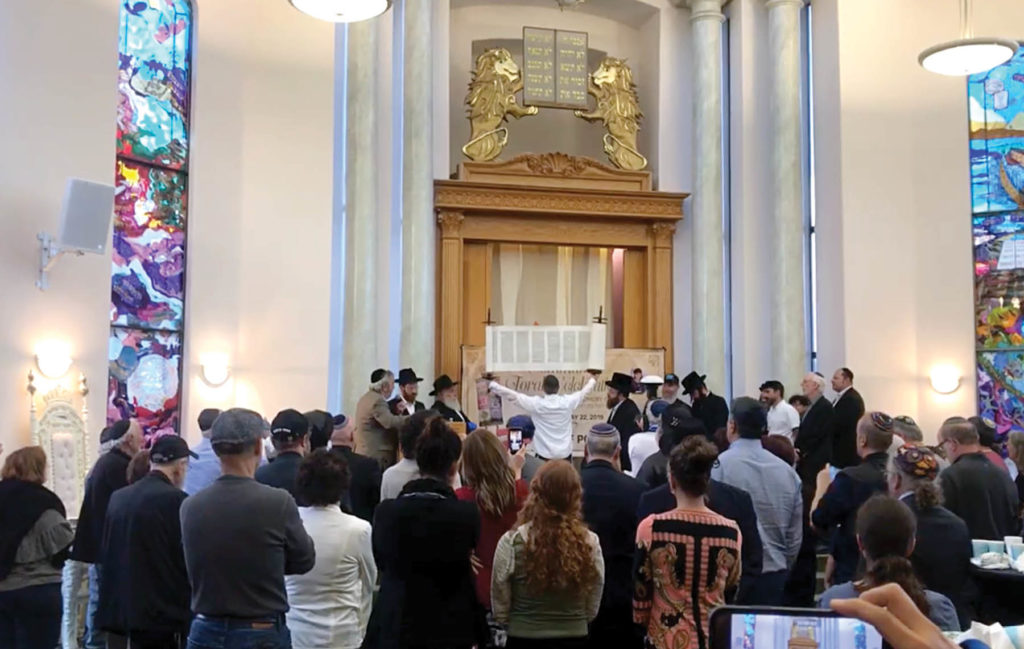
Following the 30-day mourning period of Lori Gilbert-Kaye’s death and the Jewish holiday of Lag b’Omer, the Poway Chabad community gathered May 22 to honor Gilbert-Kaye’s life and memory and to dedicate a Torah scroll in her honor.

Gilbert-Kaye, 60, was killed on April 27, the last day of Passover, during a shooting attack at Chabad of Poway.

“It has been a difficult past couple of weeks for our community, and especially for the Kaye family,” Chabad of Poway Senior Rabbi Yisroel Goldstein said in a statement. Goldstein, who was also wounded in the attack, said, “Lori was such a kind, loving soul, and she knew everyone here, so this is really an opportunity for the community to come together and heal, and celebrate the life of a very special person who was brutally taken from us.”

Goldstein’s son Rabbi Mendel Goldstein told the Journal around 300 people attended the emotional celebration.

The scroll, sponsored by the Jaffa Family Foundation of New York, Cleveland and Minneapolis, was left with the last paragraph unwritten so members of the community could write a letter on the scroll. Gilbert-Kaye’s husband, Dr. Howard Kaye, signed the last letter, a lamed, the Hebrew letter for L, which coincidentally is the first letter of Lori’s name. 

“Lori was such a kind, loving soul, and she knew everyone here, so this is really an opportunity for the community to come together and heal, and celebrate the life of a very special person who was brutally taken from us.” — Rabbi Yisroel Goldstein

“On the one hand, we do miss Lori, but on the other, we are celebrating life,” Mendel Goldstein said. “We are celebrating an evening where we are still here and still strong. There is no better way to honor Lori than by honoring her with a Torah and staying connected with a Torah and to say nothing will stop us from being [Jewish].”

Howard Kaye said that before his wife’s death, she purchased a yad, the pointer used to read the Torah. He felt it should be donated alongside the Torah scroll in Gilbert-Kaye’s honor. 

Following the dedication, the rabbis took the scroll and marched with it in the streets under a chuppah. “The dancing reminded us that though we are in hard times now, there are better things to come,” Mendel said. “We will never give up. We will stay strong [and] continue being committed to Torah and mitzvahs.”

Seventy-one-year-old Ray Poliakoff attended the dedication. “I have been involved with the congregation for years and years, and Lori was a very close friend of my family,” he told the Journal. “It’s very bittersweet. It was nice to honor Lori but there was a lot of darkness that happened. It’s difficult to get past it. But we all come together and try to be there for each other as best we can.”

Poway Torah Dedicated in Gilbert-Kaye’s Honor Read More »

Sinai Students and Holocaust Survivors Celebrate Yearlong Project


Last week, Sinai Akiba Academy held a ceremony celebrating the end of a yearlong project between Holocaust survivors and the school’s seventh-grade students.

“It wasn’t as much about the work project as it is the encounter,” Holocaust educator Samara Hutman told the Journal at the May 22 event. Hutman, the director of Remember Us: The Holocaust B’nai Mitzvah Project, worked with Sinai Akiba Academy Judaic Studies Director Irit Eliyahu, and Jewish history and rabbinic teacher at Sinai Akiba’s middle school, Rebecca Berger, on the project’s curriculum.

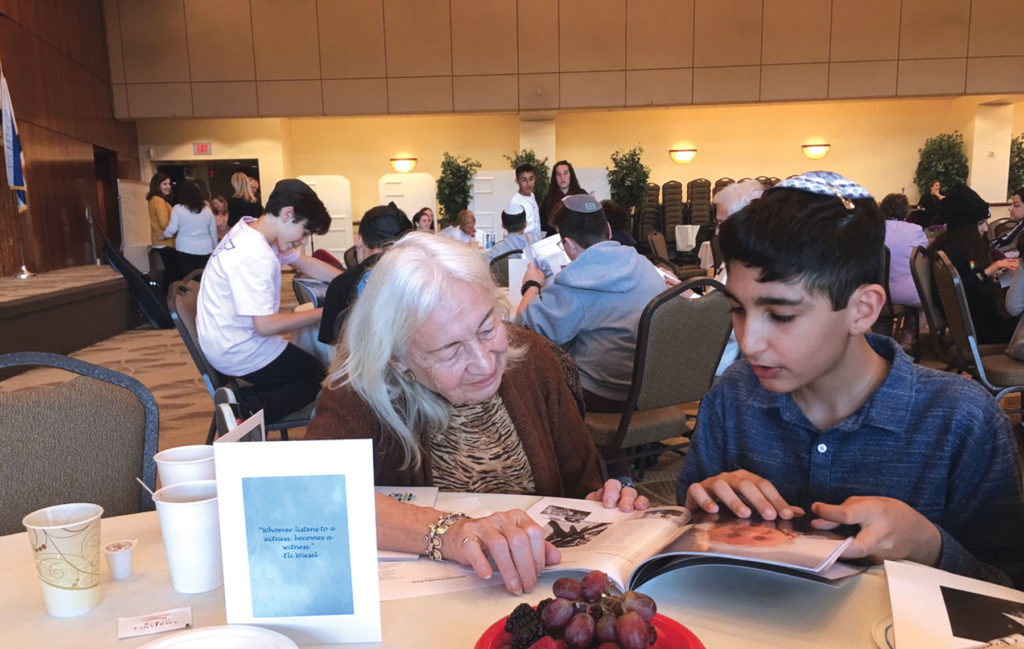
Each seventh grader was paired with a survivor and over the course of the year, the students met with the survivors multiple times. The children listened to their stories, then created artwork, including photographs and poetry reflecting the survivors’ experiences. The work was compiled into a book titled “Moments of Goodness,” featuring professional photos of the 23 participating survivors, student photos and brief text about the survivors’ harrowing experiences.

The artwork illuminated moments of goodness the survivors experienced during the Holocaust, whether it was a gentile unexpectedly offering shelter that consequently saved their lives, or fellow Jewish prisoners carrying them on a death march when they otherwise would have been left for dead.

“We have had Holocaust survivors share their story with us but when you’re speaking to them, you also get to ask questions, and you can ask whatever you want.”
— Joshua Soroudi, 13

The books were handed out at last week’s event and survivors signed copies for the students and posed for pictures with them.

Lillian Trilling, who was born in Lodz, briefly lived in the Warsaw Ghetto and lost her parents during the Shoah. She said of the poem student Jordan Lari wrote about her story, “I shall really treasure it.” The poem recounted, from Trilling’s point of view, how a Nazi saved her by telling her to hide in a bush. “It is unusual for a young boy to have a sense of another human being,” she said.

Joshua Soroudi, 13, who was paired with survivor William Harvey for the program, said he had heard survivors speak about their stories before but had never had the chance to interact with them on such personal levels. “We have had Holocaust survivors share their story with us,” he said, “but when you’re speaking to them, you also get to ask questions, and you can ask whatever you want.”

Liora Ginzburg, 13, said after hearing about the many challenges her survivor endured, she was inspired to take a photo of a paper boat seated on a bed of rocks — a metaphor, she said, for a delicate object in an unmanageable situation. The black-and-white photo, which she took with her cell phone on the school’s playground, appears in the book alongside a professional shot of her survivor and a description of their story.

“It’s fragile,” Ginzburg said of the paper boat. “Kind of like life.”

Sinai Students and Holocaust Survivors Celebrate Yearlong Project Read More »

Palestinian Uber Driver Refuses Ride to Jewish Women

A Palestinian Uber driver kicked two Jewish women out of his car on May 19 after he learned they were leaving the Israeli-American Council (IAC)’s Celebrate Israel Festival at nearby Rancho Park. 

In a phone interview with the Journal, Dayna, (who requested only her first name be used for fear of retaliation), 33, and Rachel (a pseudonym; she requested that no part of her name be used for fear of retaliation) said they were in the back seat of the driver’s car across the street from Rancho Park at Fox Studios when he asked them, “What event were you coming from?” The women responded, “Just an event.” After the driver — who according to his Uber profile is named Mustafa — asked them again where they had come from, and after noticing that the car had not yet moved, Dayna said, “An Israeli Independence Day event.”

The driver then told them to get out of his car. 

“He started laughing and he looked us dead in the eye and he said, ‘You need to get out of my car. I’m Palestinian,’ ” Dayna said. “The only reason I can think of that he would ask us which event we were coming from is he clearly wanted to make a statement. It was clear by the families crossing the street and the security that it was an Israel Independence event.”

“I could see his eyes in the wing mirror and he just spun around … his eyes were wild … raged … and that’s what frightened me,” Rachel added.

The women got out of the Uber. “We were pretty freaked,” Dayna said. 

“His rage was so great that he couldn’t handle anyone associated with Israel, and that’s a hate crime, that’s prejudice,” Rachel said. “As females, it’s very intimidating to be in a situation with a male driver. He overpowered us.”

“We definitely felt threatened,” Dayna said. “I take Ubers twice a day to and from work and I’ve never been told to get out of someone’s car because I’m Jewish.” 

As soon as Dayna arrived home, she emailed Uber and received an automatic reply saying, “Sorry you had that experience. You won’t be charged for the ride.” 

“No human reached out — no options, no recourse,” she said. “Uber should fire that person. Uber should have called me and expressed a sincere apology.”

A similar incident occurred on May 4, 2018, when an Uber driver demanded that an Israeli diplomat get out of his car in the middle of Chicago traffic because he answered a phone call in Hebrew. Immediately after Uber received the complaint, they banned the driver from the app.

“He started laughing and he looked us dead in the eye and he said, ‘You need to get out of my car. I’m Palestinian.’ ” — Dayna

In a statement to the Journal, StandWithUS CEO Roz Rothstein said, “Unfortunately, anti-Semitism is rearing its ugly head in far too many venues, including, regrettably, from Uber drivers. It’s sad that an Uber driver (or a person in any vocation) would be so out of control and risk their livelihood and reputation because of their intolerance and bigotry. We commend Uber for taking immediate disciplinary action against other drivers in the past who were unable to control their racism, by suspending and/or firing them, and we trust they will do the same in this case.”

According to the Anti-Defamation League (ADL), there were 1,879 recorded attacks against Jews and Jewish institutions across the United States in 2018, “the third-highest year on record since ADL started tracking such data in the 1970s,” according to the ADL’s 2018 Audit of Anti-Semitic Incidents. In addition, there has been a 27% overall increase in anti-Semitic incidents from 2017 to 2018 in California, according to the audit. 

In an email to the Journal, ADL Senior Associate Regional Director Natan Pakman said until the women file an incident report, the ADL cannot take any action. “We would rather speak to the victim(s) before weighing in, so we will hold off on a statement at this point.” 

Rachel told the Journal she planned to file an incident report after the Memorial Day weekend. 

IAC CEO Shoham Nicolet said in a statement, “This is yet another red flag demonstrating the growing hate directed toward Jews and supporters of the Jewish State, and it is a direct result of ongoing incitement. The IAC was proud to host a celebration that radiated pride and unity for all Israel and U.S. lovers. We will continue to stand up to anti-Semitism as we celebrate Israel from coast-to-coast.”

The Journal reached out to Uber’s communications department a week after the incident and a company representative said he would look into the complaint and respond by the end of the day. Several hours later, a spokesperson sent an email stating, “Uber does not tolerate any form of discrimination. What’s been described is horrible and the driver no longer has access to the app.” 

The spokesperson also directed the Journal to “additional background” from Uber, noting that rider and driver safety is a top priority for the company, which investigates any reported incidents and has a clear non-discrimination policy. 

Following Uber’s response, the Journal spoke again with the two women who were denied a ride. Rachel said while she was glad that Mustafa had been banned from Uber, “I want to make sure [he] is banned from Lyft, too.”

Dayna said, “Hearing that the guy was banned is huge. The only issue is that they only handled it when a newspaper reached out. There’s really no recourse for a user in this situation, other than a generic dropdown menu and a complaint of a driver acting unprofessionally.”

She added, “I think it is very important that we document and speak out about even small acts of anti-Semitism because if we don’t, then it will only get worse. My bubbe, who passed recently, was an avid reader of the Jewish Journal and instilled its importance in me to this day, which is why I reached out. She would be very happy to know that it was the Jewish Journal that came through for me. Thank you for supporting the Jewish American community like you do. You are so invaluable to so many families.”


Melissa Simon is a senior studying journalism at University of Wisconsin-Madison and a Jewish Journal summer intern. 

Palestinian Uber Driver Refuses Ride to Jewish Women Read More »