fbpx

May 29, 2019

A Challenge to Lethal Rejection

Rejection. It is a strong action that elicits even stronger emotions. The most common reactions are bitterness, depression and anxiety but even worse, rejection destabilizes our innate need to belong. Rejection follows the same pathways in the brain as physical pain and, in extreme cases, feels akin to an emotional and/or social death.

Many families’ initial foray into Jewish community and synagogue life occurs with the acceptance to the early childhood program at their local synagogue or Jewish Community Center. Yet, it is often tougher to get into the preschool they want than it is to get into an Ivy League school, and parents feel pressured to make the cut. Parents are requesting letters of recommendation, calling in favors, touring the temple two or three times so that the administration will get to know them, donating more money, joining several synagogues, and more to secure coveted spots at Jewish preschools. Seriously? It’s just preschool.

In many cities, getting into a preschool has become tantamount to applying to Harvard. Preschool has become big business for synagogues, which often survive off the revenue of their early childhood programs.

Once upon a time, a couple would move into a neighborhood and join the local synagogue of an affiliation that resonated with them. Easy. What changed? Why does it have to be so difficult to enter Jewish communities?  

The rationale that synagogues use for the admission process is often valid on face value:

Yes, preschools must limit the number of students.

Yes, it is important to ensure families remain members into old age so that our communities are self-sustaining and robust.

Yes, some families can be tough to deal with.

Yes, we have lots of diversity now, especially in cities such as Los Angeles.

Yes, some children have identified special needs.

Yes, some families need financial assistance.

These arguments and more could be made for the right to accept or reject students. However, isn’t it time that we all started to practice what we read and teach? Lessons such as:

We are all created b’tzelem elokim, in God’s image. If so, aren’t all applicants worthy? Even the ones with special needs?

Al tifrosh min haztzibur, don’t separate yourself from the community. Unless the synagogue rejects you?

Havei dan kola dam becaph zechut, judge each man favorably. Only if they pay in full?

And who should be choosing whom? Should a preschool director, rabbi or board member choose who gets to enter our communities after a five- or 10-minute interview? Or should our community members, who after much searching and touring, questioning and working, choose us?

There is a famous midrash that says that God didn’t actually choose the Jewish people. That instead, we chose God. We should be allowing our families to choose God as well, and to choose to worship and belong to God within the communities that they feel most connected to. If we don’t, I fear that these same families, stinging with the pain, humiliation, fear and depression of rejection, may end up choosing something else entirely.

Imagine a Jewish community in which no one gets rejected. The only words that families would hear would be “acceptance,” “love” and “welcome!”

“Our school is full but we will call you if a space opens up.” This would no longer be a personal rejection. Instead, they are messages of acceptance and inclusion, with the hope that a space will open up in one of the schools. The synagogue would be welcoming, regardless of admission into the school.

Instead of a lethal rejection, it just might be the other door they enter the synagogue through. 

Oh, what a world it could be!


Tamar Andrews, director of Temple Isaiah preschool, is an early childhood education professor.

A Challenge to Lethal Rejection Read More »
How to Accomplish Getting Nothing Done

“Procrastination always gives you something to look forward to.”

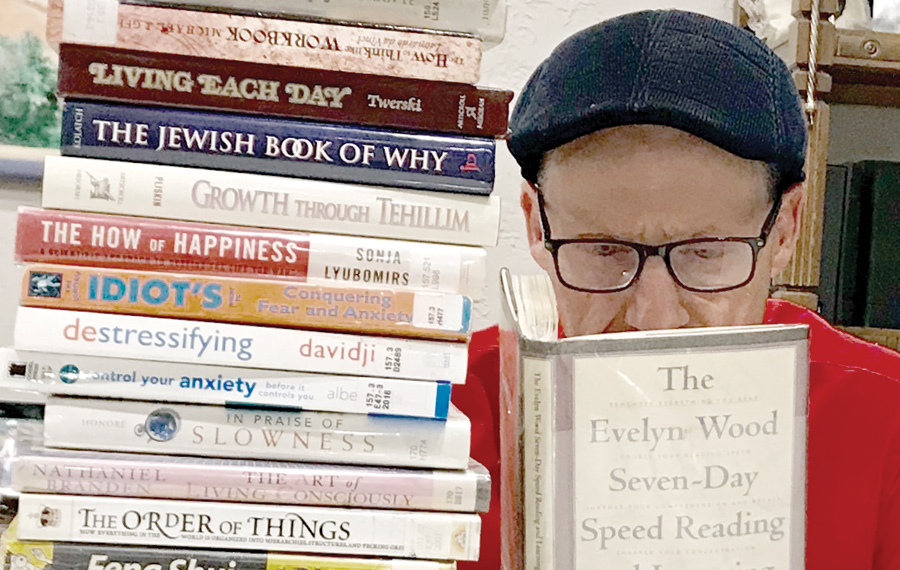
I’ve always bought self-help books, or should I say “shelf-help” books. The first self-help book I remember buying was about speed reading, by Evelyn Wood. The book teaches you how to read a novel as long as “Moby-Dick” in an hour. I bought Wood’s book in 1970 and I’ve yet to finish it. In fact, trying to read the speed-reading book kept me from reading other books I wanted to read. Plus, it made me aware of what a slow reader I am. Buying the book and not finishing it, I believe, lowered my self-esteem. 

I also bought “Feel the Fear and Do It Anyway.” Reading that book took me over a year because I was afraid to feel the fear. Eventually, I finished it and it’s an excellent book. Author Susan Jeffers said that, with a few exceptions, most people are capable of breaking through their fears. I was afraid I was one of those exceptions. I’ve been afraid to reread it. 

A few years ago, I purchased “The Memory Book” by Harry Lorayne and Jerry Lucas. If my memory serves me, I think Lucas was a basketball player. My entire life, people have questioned my memory. My mother said, “I must have told you 10 times to get your feet off the chair.” “Do you not remember that I asked you to clean up your room and take out the garbage?” “When was the last time you did what I asked you to do?” I never had an answer for that one. 

My teachers also questioned my memory: “How can someone forget to bring in their homework three days in a row?” 

“When my wife threw Munoz’s book into the barbecue pit, I knew it wasn’t the right one for us.”

My wife says I’m a procrastinator, so I bought Steve Scott’s “How to Stop Procrastinating.” But I found, rather than reading the book, I was wasting a lot of time doing other things. When my wife saw the book just sitting unopened for weeks, we’d fight about it. So, I bought Alicia Munoz’s “No More Fighting,” a self-help book for married couples to learn to stop fighting. But when my wife threw Munoz’s book into the barbecue pit, I knew it wasn’t the right one for us. 

One of my wife’s biggest complaints is that I’m messy and my stuff is strewn all over the place. So I got “How to Be Organized in Spite of Yourself.” You guessed it; I can’t seem to find the book. 

The book that changed my life and did help me organize is “The Life-Changing Magic of Tidying Up” by Marie Kondo. Her thesis is — and it works — if you don’t love it, give it away or throw it away. Do this by taking whatever objects are causing you clutter and getting in your way and gathering them in one area. You then pick up each item individually, look at it and if you don’t feel the love for it, you toss it. (Don’t try this with your in-laws.)

So, I gathered every self-help book I owned. I put them all on my dining room table. There were 158 of them. I then picked up each book, one at a time, looked at them and if I didn’t feel the love for them, I got rid of them.

I ended up tossing every one of them except for Evelyn Wood’s speed reading book. The only reason I kept good, old Wood was because, if one day I learn to speed read and by chance I buy another self-help book, I can read it then get rid of it an hour after I buy it.

I have yet to read a single word of Evelyn Wood’s book. But it’s not a total loss. It’s an old, hardbound book that holds a cup of hot coffee on top of it very nicely. 

By the way, I’m thinking of writing a book called “How to Not Buy Self Help Books.” I hope to see you at my book signing.


Mark Schiff is a comedian, actor and writer.

How to Accomplish Getting Nothing Done Read More »

Some Thoughts on Trusting HaShem

As a millennial Orthodox Jewish female writer living in Los Angeles, I often have struggles with money. My generation earns less money than our baby boomer parents did at our age (adjusted for inflation). It’s expensive to be Orthodox. Women earn less than men. Writing is not a lucrative career, and Los Angeles is unaffordable.  

Since moving to L.A., my husband, Daniel, and I have had our share of financial struggles. It can seem impossible to get ahead here. When will we ever be able to afford a modest, $1.1 million home in Pico? How will we pay for our future children’s annual $20,000 day school tuition? Why is the electric bill $350 per month?

This financial pressure led me to become a workaholic. I thought that if I took on more jobs and worked harder, I would be OK. I worked more than 60 hours per week at one point. My only day off was Shabbat.  

I was heading for serious burnout, and I was only 29 years old. I knew I had to make a change, and quickly. But how would we survive? My husband and I were working as hard as we could. 

I knew I had to try a different tactic. I cut back on work and created space for myself throughout the day, whether that meant praying, going on walks with my dogs, saying Shema before bedtime, taking more time to bless my food, and going on dates with my husband. I realized I wasn’t going to get anywhere if I constantly was running around, never having time for myself or time with HaShem. After all, the best ideas I’ve ever had came to me when I was in a calm and relaxed state.

I also decided to completely trust HaShem that my new plan of action would work. I wouldn’t be spending all my time making money, so it was a risky choice. But I had to try it. 

That was six months ago. Since then, my life has completely transformed. I no longer worry constantly about money or work. I am much more focused and mindful, and I feel centered instead of anxious. I have shifted my thinking from negative to positive.

It can be really difficult to trust that HaShem is going to protect you when you’re late paying the bills, you can’t pay your credit card debt and your income is stagnant. 

I used to see my friends buying houses and think, “When will it be our turn?” Now I think, “If it’s meant for us, it will happen.” I would get upset when I heard that people were completely supported by their parents and didn’t have to work. Then I realized that that was their journey; I was not born into the same circumstances. When I saw Facebook friends going on fancy vacations, I would get jealous and want the same for myself. Now I know that if I want to visit some fancy destination, I will save up for it and go there one day. 

I have discovered that disappointment comes when we set up unrealistic expectations for ourselves that we cannot fulfill. We begin to feel guilty and depressed that we can’t afford something or accomplish a goal — but it was simply not meant to be in the first place. 

Since I decided to stop worrying, we have received many blessings. My husband and I unexpectedly have gotten jobs and discovered answers to questions we had been pondering for years. It seems as if the universe has opened up for us, and things are going our way.

It can be really difficult to trust that HaShem is going to protect you when you’re late paying the bills, you can’t pay your credit card debt and your income is stagnant. I’ve been there, and I know how scary it is.  

What helped me was doing a metaphorical trust exercise where you fall backward. Stop worrying. Trust that things will be fine, and just let yourself go. I promise: HaShem will be there to catch you.


Kylie Ora Lobell is a Journal contributing writer.

Some Thoughts on Trusting HaShem Read More »

‘Game of Thrones’ and Sefirat Ha-Omer’s End

Classic storytelling often begins with “Once upon a time” and concludes with “The End.” Over the past two decades, Hollywood has serialized and franchised movies and television shows with cliffhangers and teasers, keeping viewers hooked for the next installment. This unwittingly has created an audience desperate for stories to end.

I recently was counting sefirat ha-Omer when it hit me: We’re in the endgame now. The final season of “Game of Thrones” on HBO was the most popular ever of the award-winning show. Similarly, “Avengers: Endgame” is the finale of a 21-film Marvel Cinematic Universe cycle and the movie fastest to exceed $2 billion in ticket sales. It likely will overtake “Avatar” as the highest-grossing film of all time. Everyone wants to see how it ends. 

But what does this have to do with sefirat ha-Omer?

Hollywood is concerned with developing the next gateway drug into a new endless entertainment universe. It has audiences addicted to anticipation. Viewers never want a story to end; whenever it feels like it has ended, we want a taste of the next thing. Anticipation generates billions of entertainment dollars. But the incredible reaction to the final season of “Game of Thrones” and “Avengers: Endgame” conveys an important message: Fans are grateful when their favorite shows and movies end gracefully.

It turns out everyone — especially millennials who came of age in the era of serialized entertainment — needs things to end. Thanks to technology, the professional 9-to-5 workday and five-day workweek are quaint relics of a not-so-distant past. Our workday never ends. Our workweek never ends. The 24-hour cable news cycle and its evil sibling, Twitter, create a false sense of urgency to make sure there is no “end of the day.” The news is always on, always breaking. There is no time for anything to end.

This frantic 21st-century life has made us desperate for a breath of fresh air without teasers, notifications and breaking-news alerts. We need things to end.

Seven is a meaningful number in “Game of Thrones.” There are seven kingdoms, but more importantly, the primary practiced religion is the “Faith of the Seven” — a single deity with seven faces or aspects.

Shabbat reminds us to end our week and breathe. Celebrating Shabbat means the week actually ends on the weekend.

In Judaism, the number seven also is significant. In the creation story, the physical world was made in six days; on the seventh day, God rested. This is what Shabbat is about. We live in the physical world for six days and on the seventh day, we take a break from the physical world. We rest. Shabbat reminds us to end our week and breathe. Celebrating Shabbat means the week ends on the weekend.

Sefirat ha-Omer is the lesson of seven squared. We count seven days for seven weeks because a one-week cycle with a beginning and an end is part of another, even bigger cycle with a beginning and an end. The Jewish calendar is a never-ending cycle of beginnings and endings because it is so important for people to have endings. We are meant to use these ending moments for reflection and meditation on the times and experiences that brought us to these moments. This is the secret of Shabbat and sefirat ha-Omer.

Our world needs more endings. Life in 2019 is relentless. We need more opportunities to breathe, more moments to reflect. Hollywood had been working under the assumption that things always begin with excitement. However, enthusiasm tapers off as time passes. Hollywood solved this “problem” with intoxicating anticipation. But now there seems to be a shift.

The end of things is even more popular than the beginning and those tantalizing teasers that follow. “Game of Thrones” has never been more popular. “Avengers: Endgame” already is one of the most popular movies of all time. Hopefully, this is the beginning of a societal correction that makes time for things to end, so we can breathe.


Eli Fink is a rabbi and writer.

‘Game of Thrones’ and Sefirat Ha-Omer’s End Read More »

British University Fires Lecturer Over Holocaust Denial Social Media Posts

(JTA) — A British university has fired a lecturer who condemned the formation of a campus Jewish society and shared Holocaust denial material on social media.

Maaruf Ali, a lecturer in computers and electronics at the University of Essex, wrote in February on Facebook that “the Zionists next want to create a society here at our university.” Students at the time were voting online on whether to approve a campus Jewish organization, but the student union canceled the vote and approved the creation of the Jewish society. Among the some 600 students who had already voted, 64 percent approved the society.

In a statement, the university told the London-based Jewish Chronicle that its investigation “into the serious allegations made against a member of staff” was completed.

“Following a tribunal hearing which considered all the evidence, the member of staff has been dismissed,” a spokesperson said.

The university is located in southeast England, between London and the North Sea.

Among the Holocaust denial and anti-Semitic posts Ali shared on social media was one from Edgar J. Steele, a lawyer known for defending white supremacists. It said: “In all of German Occupied Europe, there resided 2.4 million Jews before the war, according to the world Jewish encyclopedia. After the war, 3.8 million Jewish ‘Holocaust survivors’ were receiving pensions from the German government … Tragically, the remaining 6 million were lost.”

Ali told a university tribunal hearing that he objects to the current climate in Israel and his vote against the society had been because of the ideology of Zionism, the BBC reported.

“I am not against Jews, I don’t hate their religion, their people or their culture,” he said, according to the BBC. “I believe that everyone should be allowed to form any society. This is what I’m thinking now — which is what I didn’t think at the time.”

British University Fires Lecturer Over Holocaust Denial Social Media Posts Read More »

Labour Anti-Semitism Probe is Punishment for Party’s Pro-Palestinian Stance, UK Ex-Minister Says

(JTA) — A former Cabinet minister for Labour suggested that a British government watchdog’s inquiry into anti-Semitism in her party is meant to punish supporters of the Palestinian struggle.

Clare Short, who served under former prime minister Tony Blair, said Tuesday on the BBC that the inquiry by the Equality and Human Rights Commission, or EHRC, owes to how “anyone who is sympathetic to the plight of the Palestinians is called anti-Semitic” and “a widening of the definition of antisemitism to include criticism of Israel.”

Marie van der Zyl, the president of the Board of Deputies of British Jews, responded to Short’s comments in a statement Wednesday saying the “staggeringly ignorant comments amply illustrate why the EHRC feels the need to open a full investigation into anti-Jewish racism in the Labour Party.”

Anti-Semitic rhetoric has proliferated through Labour’s ranks following the 2015 election of Jeremy Corbyn as party leader. Corbyn, a far-left politician, has called Hamas and Hezbollah his friends. Much of the  rhetoric, which Jewish community leaders say means Labour has become institutionally anti-Semitic, revolves around Israel.

But many of the thousands of incidents documented by independent watchdog groups, including from within Labour, do not concern Israel.

Corbyn unsuccessfully fought the adoption by Labour of a definition of anti-Semitism that includes some forms of demonization of Jews over Israel.

In March, Siobhain McDonagh, a Labour lawmaker and key Corbyn ally, said of some party members: “It’s very much part of their politics, of hard left politics, to be against capitalists and to see Jewish people as the financiers of capital. Ergo, you are anti-Jewish people.”

Asked whether she meant to say that “to be anti-capitalist you have to be anti-Semitic,” McDonagh replied “Yes.”

Labour Anti-Semitism Probe is Punishment for Party’s Pro-Palestinian Stance, UK Ex-Minister Says Read More »

Why Anti-Zionism Is More Lethal than Anti-Semitism: It Carries the Virus of Elimination

I always get suspicious when I hear someone flaunt their pro-Israel credentials by saying, “I firmly believe in Israel’s right to exist.” Gee, thanks. I firmly believe in your right to exist, too.

The real question is: How did Israel’s “right to exist” ever become an issue in the first place?

After all, we never hear about Syria’s right to exist or Libya’s right to exist or Sudan’s right to exist or Yemen’s right to exist. A country can commit genocide against its people and inflict the worst humanitarian disaster and no one will ever bring up its “right to exist.”

So, why is it OK to single out Israel?

Here’s my theory: If you hate Jews so much that you want to challenge their very presence, your best bet is to go after Israel. Jew haters know they can’t start a movement to eliminate the Jews, so they do the next best thing: They work to eliminate, in sneaky ways, the world’s only Jewish state.

Anti-Semitism revolves around an emotion — hate. Anti-Zionism revolves around an action — destruction.

A stark example is the boycott, divestment and sanctions (BDS) movement, the leading global force against Israel. Its very name is misleading. Words like “boycott” “divestment” and “sanctions,” which are taken straight from the social justice manual, create a façade of genuine protest to hide a purely destructive agenda.

This charade shouldn’t shock anyone who’s been paying attention. In recent years, it has become more and more evident that the BDS agenda is not to criticize Israel but to crush it.

Even prominent BDS activists, like Ahmed Moor, have come clean: “OK, fine. So BDS does mean the end of the Jewish state.” Or university professor As’ad
Abu Khalil, another BDS activist: “The real aim of BDS is to bring down the State of Israel.”

Omar Barghouti, the founder of BDS himself, has said on the record: “Definitely most definitely we oppose a Jewish state in any part of Palestine.”

To undermine the 3,000-year Jewish connection to the land, Barghouti uses language like “acquired rights” and “indigenized.” His vision includes “de-Zionization” of Israel and the return of up to 5 million Palestinian “refugees” to flood the Jewish state.

Had BDS called itself the WIN movement — Wipeout Israel Now — no one would have taken them seriously. Instead, it uses the messaging of protest and intersectionality to attract well-meaning activists who don’t want to see Israel wiped out. This subterfuge is their strategy, and for the gullible crowd, it’s working.

BDS’s core success is sucking in much of the mainstream media and others who believe in “two states for two people” and assume that BDS is a way of pressuring Israel to get there.

It’s far from that. The BDS mission originates straight from the founding mission of the PLO in 1964, before any Jewish settlements existed, which was to eliminate what is still seen as the unacceptable and humiliating sovereign Jewish-Zionist presence in Arab-Muslim lands.

Jew hatred may fuel the Israel hatred behind BDS and other anti-Israel forces, but after that, Israel-hatred wreaks havoc on its own. This is why, in my eyes, anti-Zionism is more lethal than anti-Semitism: It carries the virus of elimination.

As my friend author Gil Troy writes in an email from Jerusalem, “Thousands have been killed and maimed by modern anti-Zionism, which requires the ideological and rhetorical inflammation to get people to blow themselves up and kill innocents. As a result, not only have we absorbed the notion that Israel’s existence should be up for grabs, but our outrage has been dulled –— we accept attacks on Israel as normal.”

Demonizing Israel and singling it out for special condemnation is immoral and discriminatory regardless of any claims of anti-Semitism.

Underlying the whole assault on Israel, he adds, “is the rejection of us as a people — we are just supposed to be a ‘nice’ religion confined to our synagogues and JCC’s, not a people taking up real space in the international arena.”

In sum, it is hardly enough to argue that anti-Zionism is anti-Semitism. In at least one crucial way it’s worse than that. Anti-Semitism revolves around an emotion — hate. Anti-Zionism revolves around an action — destruction.

Anti-Zionism must be fought on its own terms. Demonizing Israel and singling it out for special condemnation is immoral and discriminatory regardless of any claims of anti-Semitism.

Israel doesn’t just have a right to exist. Like any other imperfect state, it has a right to thrive, whether you hate Jews or love Jews.

Why Anti-Zionism Is More Lethal than Anti-Semitism: It Carries the Virus of Elimination Read More »

May 31, 2019


Also, check out our Summer Sneaks Arts and Entertainment Section!


For more online archives of the paper, click here.

May 31, 2019 Read More »