fbpx

May 22, 2019

Jonathan Medved on the Secret of OurCrowd’s Success

Serial entrepreneur Jonathan Medved, 63, is the founder and CEO of OurCrowd, the world’s largest equity crowdfunding platform. Since its launch in February 2013, OurCrowd has reached committed funds of over $1 billion and allows accredited investors (under U.S. law, those with an annual income of $200,000 or assets of $1 million outside of their primary dwelling) to invest in startups. To date, OurCrowd has raised funds for more than 170 companies. In May alone, OurCrowd portfolio company Beyond Meat became the first venture-backed “meat alternative” company to launch an initial public offering (IPO) and Zebra Medical’s artificial intelligence-based, chest X-ray triage product was approved by the U.S. Food and Drug Administration. The Journal spoke with Medved about the role of investors in today’s Israeli startup scene.  

Jewish Journal: How is OurCrowd different from traditional venture funds?

Jonathan Medved: In the old days, if you bought Apple or Amazon at IPO and sold it, you could make a thousand times your money. Today, it’s when you invest at an early stage. But it’s controlled by a small group of venture capital funds and investors and the average person is left out. … unless you use a solution like OurCrowd you can’t [invest in these companies]. OurCrowd is a larger and more innovative structure. Other VC (venture capital) firms take[only] minimum checks of several million dollars; in a venture fund, you don’t pick the deals — venture managers find companies and negotiate terms and deploy your money. We let the individual build his own portfolio: Zebra Medical doing AI (artificial intelligence) driven analysis of radiological images; Skytran developing a next-generation flying car system; a Tevel [Aerobotics Technologies] automated fruit-picker. For a $10,000 check, [accredited investors] get the ability to invest in the same deals alongside Bill Gates and others. 

JJ: Why should people invest in Israeli startups? 

JM: Because you can make money. And today it’s important for everyone who has funds to have exposure to private startup companies. But to do so in Israel [means] participating in the most important part of Israel’s economy, tackling global challenges — water, energy, air, health, education, financial inclusion — and that’s a good thing. It’s building Israel’s ties with the rest of the world, and making the world interdependent on Israel. That’s what the Jewish state was set up to do: not just to serve as a safe home for Jews but as a place where Jewish civilization could take a leadership role based on our courage, our daring, our chutzpah and our brains. That’s really what the whole Startup Nation is about.

JJ: How does the Israeli-Palestinian conflict impact Israeli startups or other investments in Israel? 

JM: Not in the least and it never has had an impact. There’s no market in the Palestinian Authority and there is great interest in Israeli tech from the Arab world. The boycott has been a total failure. There are sad people like (rock musician) Roger Waters who need to get a life. But among business people, it’s not an issue. [The conflict is] not on the radar of companies that count. It’s simply impossible to boycott Israel, considering the almost 500 multinationals that operate in Israel. While it’s important to seek peace — and sometime in the future we will get peace — the situation for Israel and its position in the world has never been better. 

JJ: Are there startups that are working on products or solutions that could pave the road for peace? And if so, how does OurCrowd support them? 

JM: Some of our companies are employing people in the Palestinian Territories; some companies are looking to employ Israeli Arabs. We need to hire more Arab engineers, Charedim, more women. That’s a worldwide problem. Peace will come when people want to make money and work together rather than kill each other. So almost every Israeli company is part of the peace process. … Israel has lots of issues, whether it’s with the Palestinians or with Jews of different religious beliefs; we have lots to work on, but bottom line: what a success. 

JJ: According to the OurCrowd website, the 2019 OurCrowd Summit in Tel Aviv had more than 18,000 attendees. Could you share some highlights from those events?

JM: Just seeing masses of investors from the entire world flock to Israel was a blessing. Thousands of people came, especially from overseas, to share in the Startup Nation, especially in today’s world with tragedies like Poway and Pittsburgh (shootings). … We live with BDS [boycott, divestment and sanctions] and hate: To see that it’s not the whole story, that there are many places in the world where Israel is admired, and many people who admire Jews, it’s pretty exciting to be part of that. They come because they want to change the world for the better: To support UPnRIDE, helping to get disabled people upright, to enable a disabled person to stand under the chuppah; to back Climacell (weather forecasting technology) and help provide for the first time cutting-edge weather data to Africa, to fund Sense Education (an artificial intelligence solution for student submissions and automated testing) enabling countless students to learn and get ahead. So many of our companies will really make an impact on the world. To see them and the reaction of the mostly non-Jewish crowd from abroad was a wonderful thing. 

JJ: What trends are you seeing in the Israeli startup scene today? 

JM: Artificial Intelligence is clearly the center of what’s going on now. Every industry will be disrupted. If you look at data from Forbes as to how many startups [there are] per country, it’s the United States,
China and Israel. (A 2018 Forbes article said Israel has the “largest number of startups per capita in the world, around one startup for every 1,400 people.”) When people look at that, it’s just bizarre how Israel with our small size has not just startups, but that we go to the moon, even if we didn’t land there softly. The fact is that we have an extraordinarily good defense system, like Iron Dome to protect us. We rank high in happiness. (In the 2019 U.N. World Happiness Report, Israel ranked 13th on the list of happiest countries.) This country of ours is a crazy, rough-and-tumble, wonderful democracy where people argue freely and then vote … we have a huge amount to be proud of.

Jonathan Medved on the Secret of OurCrowd’s Success Read More »

Candy Leis for Graduation

Graduation season is upon us, and everyone from kindergartners to Ph.D.s are putting on their caps and gowns. One graduation tradition that has become very popular is presenting the student with a floral lei. A lei made with orchids or carnations is lovely, but how about a lei made from candy? Oh, yes, please. Bring on the pomp, circumstance and sugar.


What you’ll need:
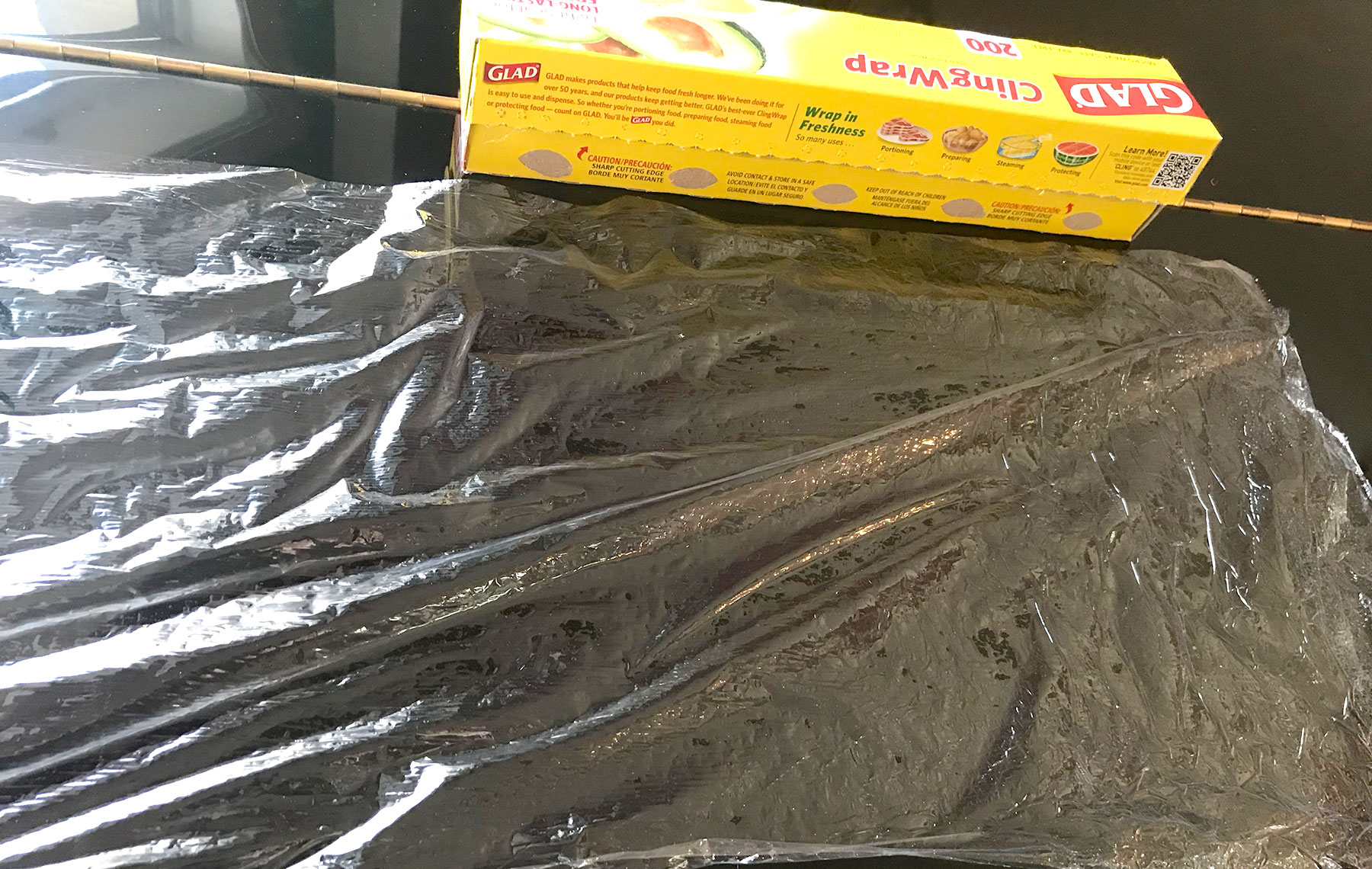
Clear plastic wrap
Miniature candies
Curling ribbon

1. Lay a 40-inch length of clear plastic wrap on the table. Try not to get it tangled up.


2. Arrange miniature candies in a straight line along the length of plastic wrap. Fortunately, there are many miniatures that are certified kosher. Leave about two inches between each candy.


3. Roll the candies securely in the plastic wrap.


4. Tie a knot with the curling ribbon between each candy, and tie the two ends together. Curl the ribbons for a finishing touch.


Jonathan Fong is the author of “Flowers That Wow” and “Parties That Wow,” and host of “Style With a Smile” on YouTube. You can see more of his do-it-yourself projects at jonathanfongstyle.com.

Candy Leis for Graduation Read More »

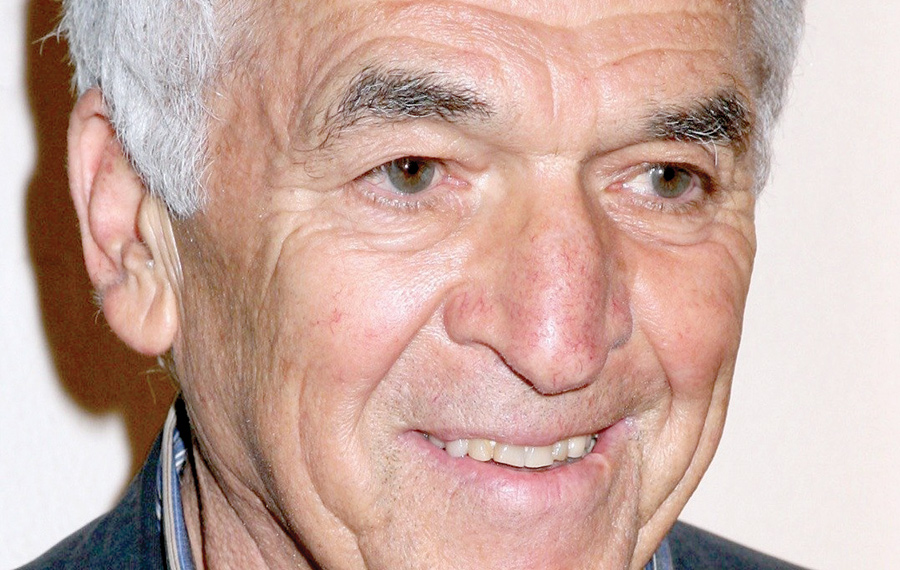
Screenwriter Alvin Sargent, 92

 Alvin Sargent, whose deft hand at adapting books and plays into smart, subtly characterized scripts earned him two Oscars for best screenplay, died May 9 at age 92.

Born to Isaac and Esther Supowitz on April 12, 1927, in Philadelphia, Alvin changed his surname to Sargent — as did his older brother, Herb. “It’s an easier name to sell in Hollywood,” Alvin once told The New York Times.

Known as one of Hollywood’s most versatile writers, his credits include the college romance “The Sterile Cuckoo,” the heist comedy “Gambit,” the Great Depression drama “Paper Moon,” the financial satire “Other People’s Money” and three “Spider-Man” movies. Many of the biggest directors of his time directed Sargent’s scripts, including Alan J. Pakula, John Frankenheimer, Paul Newman, Peter Bogdanovich, Sydney Pollack, Fred Zinnemann, Robert Redford, Martin Ritt, Norman Jewison and Wayne Wang.

After graduating from high school, Sargent enlisted in the Navy. After the war, he moved to Los Angeles, where he worked a series of odd jobs, including selling ad space for Variety, and tried his hand at acting. He claimed never to have seen a screenplay until he was cast in a small role in 1953’s “From Here to Eternity.” The script impressed him, and he began to write in his spare time. By the early 1960s, Sargent was writing for numerous TV shows, including “Ben Casey,” “Naked City” and “Route 66.”

His first produced screenplay was 1966’s “Gambit.” He quickly became known for his ability to adapt books and plays to the big screen and his light hand with dialogue. One studio executive called him “the prince of gentle writing.” This assured him steady work.

His Oscar nomination for “Paper Moon,” the story of a father-daughter pair of con artists starring real-life father and daughter Ryan and Tatum O’Neal, made Sargent a hot property. His scripts attracted top actors including Dustin Hoffman (“Straight Time”), Al Pacino (“Bobby Deerfield”), and Jane Fonda and Vanessa Redgrave (“Julia”) — for which he took home one of his two Oscars for best adapted screenplay. The other was for 1980’s “Ordinary People.”

His 22-year marriage to actress Joan Camden ended in divorce in 1975; they had two daughters, Amanda and Jennifer, who both survive him. He began a relationship with producer Laura Ziskin in 1987 and they married in 2010, one year before her death.

With Ziskin as producer, he wrote the scripts for “Hero,” “What About Bob?,” “Spider-Man 2,” “Spider-Man 3” and “The Amazing Spider-Man” reboot in 2012. Critic Roger Ebert called “Spider-Man 2” “what a superhero movie should be. … It’s simply and poignantly a realization that being Spider-Man is a burden that Peter Parker is not entirely willing to bear.”

Sargent was more modest about his ability. He often joked that when he
died, he wanted his tombstone to read: “Finally, a plot!”

Screenwriter Alvin Sargent, 92 Read More »

Herman Wouk, Pulitzer Prize-Winning Author Who Brought Judaism Into the Mainstream, 103

Herman Wouk, the best-selling Orthodox Jewish author whose literary career spanned nearly seven decades and who helped usher Judaism into the American mainstream, died May 17 at the age of 103.

Wouk was the author of two dozen novels and works of nonfiction, including the Pulitzer Prize-winning “The Caine Mutiny” from 1951, which was a fixture on best-seller lists for two years, and the best-selling “Marjorie Morningstar” from 1955. Both books were later adapted for the screen.

His novels “The Winds of War” and “War and Remembrance” both became successful television miniseries. By the mid-’50s, Wouk’s popular and financial success as an American Jewish novelist was unmatched.

Even more unusual for a writer of Wouk’s celebrity was his Orthodox observance and treatment of Jewish religious practice in his writing. Wouk embodied the new postwar possibilities for American Jews, and his writing was both cause and effect of the normalization of Judaism within the larger American Judeo-Christian tradition.

When he appeared on the cover of Time in 1955, the magazine described Wouk’s blend of worldly success and Jewish religious observance as paradoxical.

“He is a devout Orthodox Jew who had achieved worldly success in worldly-wise Manhattan while adhering to dietary prohibitions and traditional rituals which many of his fellow Jews find embarrassing,” the article said.

At the time, Wouk’s fame seemed like an incredible feat for an Orthodox Jew. Unlike other Jewish novelists, who had focused on Jewish immigrant culture and tended to portray religious Judaism as foreign and exotic, Wouk made Jewish religious observance appear mainstream in his books. Scenes of a Passover seder and a bar mitzvah service became scenes of middle-class American life in “Marjorie Morningstar.”

None of this escaped criticism. With the exception of “The Caine Mutiny,” reviews of Wouk’s works were typically mixed. Both Jewish and mainstream reviewers expressed dissatisfaction with the quality of his writing, his conservative outlook on politics and sex, and his treatment of Judaism. Some rabbis even criticized Wouk for mocking Jewish observance — though in the coming decade, Philip Roth’s fiction would radically change their perspective on what counted as literary denigration of Judaism.

Meanwhile, fellow Jewish novelists like Roth, Saul Bellow and Norman Mailer viewed Wouk as conforming to middle-class American values that prioritized marriage, family, religion and service to country. Not only did he stay married to the same woman for more than six decades, but Wouk expressed pride in his military service, for which he received a U.S. Navy Lone Sailor Award. He in turn saw the other authors as bowing to fashionable literary trends of rebellion and shocking readers.

From his debut novel, “Aurora Dawn,” in 1947, to his last book, “Sailor and Fiddler: Reflections of a 100-Year-Old Author” — published in 2015 when he had become a centenarian — Wouk wove themes central to the American Jewish experience throughout his work. Even “The Caine Mutiny,” a less Jewish novel than later works, included Lt. Barney Greenwald, who gives a moving speech in defense of a lieutenant who helped keep Greenwald’s Jewish mother from being “melted down into a bar of soap” by the Nazis.

Set in the 1930s and ’40s, Wouk’s fourth book, “Marjorie Morningstar,” heralded a new era for American Jews. The novel followed the journey of a New York Jewish protagonist no different from any other bright and beautiful young woman of the era, an image further cemented by Natalie Wood’s portrayal of Marjorie in the 1958 film version.

Not since the 1927 film “The Jazz Singer,” starring Al Jolson, had a movie shown Jewish religious scenes. But unlike with Jolson’s screen character, Marjorie and her religion were not exoticized — Jewishness was portrayed as middle-class and American. With Marjorie, Wouk had succeeded in making a story about Jews into an American story.

“Marjorie Morningstar” also marked a turning point in his writing career. With confidence that he had readers who would follow him to less popular subjects, Wouk’s fourth book, his first work of nonfiction, took on the subject of Orthodox Judaism. Published in 1959, “This Is My God” was a primer about the Jewish religion intended for both Jewish and non-Jewish readers.

As other American celebrities would do, Wouk used his fame to draw attention to his little-understood religion. Serialized in the Los Angeles Times, “This Is My God” introduced readers to such Jewish particulars as the laws of kashrut and family purity, and the holidays of Sukkot and Shavuot. The book showed, through anecdotes from Wouk’s glamorous Manhattan life, that it was possible to be both a modern American and Orthodox.

At a time when Jews still encountered quotas at universities and discrimination in hiring and housing, Wouk’s example provided inspiration. “This Is My God” became a popular bar mitzvah and confirmation gift for young Jews of all movements.

Born in the Bronx, N.Y., on May 27, 1915, Wouk was the second of three children of Esther and Abraham Wouk, both immigrants from Belarus. Abraham Wouk began work as a laundry laborer and found financial success in the laundry business. Herman spent his early years in the Bronx receiving basic Hebrew training from his grandfather. His childhood included the teasing and bullying that was common for bookish boys in rough neighborhoods.

From an early age, Wouk found a haven in reading, family and Judaism. After graduating from the public Townsend Harris High School, he entered Columbia University, where he served as editor of its humor magazine. He also took courses at Yeshiva University.

Upon graduating, Wouk briefly abandoned his religious lifestyle when he became a radio dramatist, writing for comedian Fred Allen starting in 1936. Although the work was lucrative, Wouk felt a void in a life without Jewish learning and religion, and he eventually returned to his previous level of observance.

In the coming years, he would reside in the Virgin Islands, New York’s Fire Island, Washington, D.C., Manhattan and Palm Springs, Calif., and in all those locales he was involved in setting up Jewish study and prayer groups.

Following the attack on Pearl Harbor, Wouk joined the Navy and served in the Pacific, where he was an officer aboard two destroyers, participated in eight invasions and won several battle stars. Wouk also started to write “Aurora Dawn” while aboard ship. After he sent part of a draft to one of his former teachers at Columbia, the professor connected Wouk with an editor, and a contract followed.

While his ship was being repaired in California, Wouk met Betty Sarah Brown, a graduate of USC and a civilian Navy employee. After her conversion to Judaism, the couple married in 1945 and had three sons. Betty, who died in 2011, would eventually become her husband’s literary agent.

Wouk is survived by two sons, Nathaniel and Joseph, and three grandchildren. His oldest son, Abraham, died in a 1951 swimming pool accident.


Rachel Gordan teaches American Jewish studies at Boston University and Brandeis University. She interviewed Herman Wouk at his home in Palm Springs in February 2011.

Herman Wouk, Pulitzer Prize-Winning Author Who Brought Judaism Into the Mainstream, 103 Read More »

Falk Marries Her Poetry With Her Artwork

Marcia Falk is best known as a modern maker of richly innovative Jewish prayers as collected in “The Book of Blessings,” which was described by poet Adrienne Rich as the meeting of “the scholar’s mind and the poet’s soul.” But Falk’s work is not confined to a single category — she is a translator of Hebrew and Yiddish texts (including the biblical Song of Songs), a teacher of English and Hebrew literature, and a revered figure in Jewish feminist circles. Falk herself characterizes “The Book of Blessings” as an “inclusive, nonpatriarchal” alternative to the traditional siddur.

That’s why her latest book, “Inner East: Illuminated Poems and Blessings” (Oak and Acorn Books), is marked by its publisher in three different categories: Poetry, Judaism and Art. Indeed, it is nothing less than a tour de force that showcases Falk’s mastery of Jewish texts and traditions, her gifts as a poet and her lifelong passion for the visual arts.

“As a child, I loved to draw pictures and write stories and poems, and I imagined one day writing and illustrating my own books,” she explains in a preface to “Inner East.” “But as I grew older, the exigencies of life led me to choose one of these creative paths — writing — professionally, while maintaining the other, visual art, as a private passion.”

She devoted 13 years to “The Book of Blessings.” On its publication in 1996, which happened to coincide with her 50th birthday, she took what she accurately describes as a leap of faith. “At that watershed moment,” Falk writes, “I decided to return to painting with all the dedication and commitment I had devoted to writing.” And now she has gathered the fruits of her new endeavor in “Inner East.”

“Like all poetry, Falk’s verses invite us to read them aloud, but I found myself wanting to gaze at the artwork while someone else did the reading.”

Of course, image-making is a fraught subject in Jewish religious tradition, but Falk insists that it can be “a quintessentially Jewish aesthetic genre.” Her inspiration was the decorative plaque called a mizrach, which is hung on the eastern wall of synagogues and Jewish homes to identify the direction that one should face while praying. Mindful of these associations, Falk once again reinvents an artifact of Jewish ritual observance as a tool for discovery and fulfillment: “My mizrachs are meant to serve as guides toward an inner east — indeed, to the heart — providing a focus for meditation, contemplation, and prayerful silence.”

The book consists of 36 “two-page offerings,” each one consisting of a painting on one page and a poem or blessing on the facing page. Falk’s imagery is drawn from nature — “landscapes, seascapes, skyscapes, and still lifes,” most of them rendered in oil pastel on museum board — and her words are always written in English but sometimes also in Hebrew. The very first such offering, titled “Awakening,” shows us a tree rising against rolling hills and a cloud-washed blue sky, and a poem of 12 short lines.

High wind
and a blackbird
push the sky across the hills.
The windows shake. You pull
yourself out of the blankets,
a flash strikes the eastern walls
of houses.

Morning —
the city a cup full
of light, a bright
flask of wind
to rise to.

The first section of “Inner East” consists of artwork and English poems. The second section is bilingual, Hebrew and English, and the text is rendered as a series of blessings — a genre in itself, and one on which Falk’s reputation has long rested. Her latest set of blessings can be used for both aesthetic and utilitarian purposes: “Morning Blessing,” “Blessing Before Sleep,” “Blessing Before the Meal,” “Blessing After the Meal,” and so on. Her blessings echo but never copy the traditional blessings and prayers in which Falk finds her inspiration and aspiration.

We see the egalitarianism that is one of Falk’s core values in both the Hebrew and English versions of the blessings. For example, the “Blessing Before the Meal” includes the familiar Hebrew phrase that means “bread from the earth” — Lechem min ha’aretz — but replaces “the King of the Universe” with the pointedly genderless phrase “source of life.” Similarly, the “Blessing for the Child” is offered in different versions for a girl and for a boy, but only the word forms are gendered in Hebrew; both blessings omit the traditional biblical names and exhort the child to find her or his own path in life:

Be who you are,
and may you be blessed
in all that you are.

Like all poetry, Falk’s verses invite us to read them aloud, but I found myself wanting to gaze at the artwork while someone else did the reading. In that way, we can fully enter both the words and the images in the kind of meditative experience that Falk surely intended. And I am confident that I am not the only appreciative reader who will use “Inner East” in precisely that way.

Falk Marries Her Poetry With Her Artwork Read More »

New Chamber Group Performs Piece Influenced by Shoah Experience

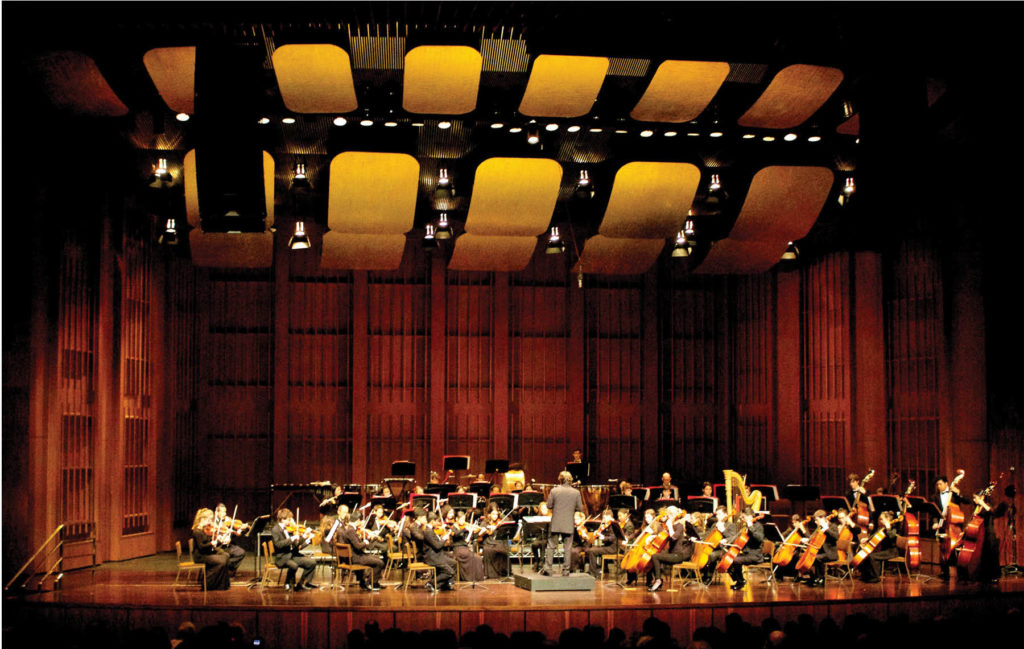
The Los Angeles Youth Orchestra (LAYO) has announced the creation of a new musical group, the Contemporary Adventure Ensemble (CAE), which brings some of L.A.’s seasoned professional musicians together with several LAYO alumni and advanced students. 

LAYO, which was founded 20 years ago by conductor and artistic director Russell Steinberg, is composed of 120 student musicians between the ages of 8 and 18 from 60 schools throughout the Greater Los Angeles area.

CAE’s debut concert will take place May 30 at First Presbyterian Church of Santa Monica and will include pieces by illustrious 20th-century composers Aaron Copland, Heitor Villa-Lobos and Dmitri Shostakovich. The concert also will feature two 21st-century chamber pieces by contemporary L.A. composers: “Scale 9” by pianist-composer Sean Friar and the chamber orchestra premiere of Steinberg’s “Rucksack.”

Steinberg — who lives in the San Fernando Valley and studied music at UCLA before getting a doctorate in musicology from Harvard — composed “Rucksack” in 2015 for Holocaust survivor Juliane Heyman’s 90th birthday. A 14-minute dramatic piece for chamber orchestra, spoken word and mezzo-soprano, “Rucksack” is based on Heyman’s 2001 memoir, “From Rucksack to Backpack.” 

The musical “Rucksack” intertwines two sections from Heyman’s memoir: her harrowing escape from the Nazis while a teenager during World War II and a misadventure she had soon after arriving as an immigrant to the U.S. The stories are connected by the rucksack she carried across Europe as she and her family fled the Nazis and the rucksack she was wearing when police detained her as she was hiking in the Poconos in Pennsylvania. 

“Rucksack” intertwines two sections from Juliane Heyman’s memoir: her harrowing escape from the Nazis while a teenager during World War II and a misadventure she had soon after arriving as an immigrant to the U.S.

Over lunch at a café in Encino, Steinberg told the Journal his inspiration for the piece came while he was reading Heyman’s memoir and was “taken by the neutral way she wrote about her escape from the Nazis. She had this very objective way of framing [these emotional and terrifying events]. It said something about her ability to survive.”

His “Rucksack” goes back and forth between the Shoah and the Poconos sections. “In the Holocaust part, there’s a snare drum, a military aspect, a sense that she’s fleeing the Nazis,” Steinberg said. “The music tries to express some of the emotional things she’s talking about. … That’s why I want the instruments to play in a precise militaristic style during the European part. And then during the Americana part, I want it to be freer, looser, warmer.”

Russell Steinberg; Photos courtesy of Los Angeles Youth Orchestra.

In her memoir, Heyman writes about how she and her family arrived at the Statue of Liberty while World War II was still raging. As a teenager at Barnard College, she went hiking with a friend in the Poconos, unaware that for police in a small 1940s town their rucksacks signaled that they could be runaways heading for a life of prostitution. 

“[Heyman] is just mildly amused by being stopped by the police,” Steinberg said, “and I thought the pairing was interesting. … I tried to merge these two stories together so that you don’t know whether it’s the Nazis arresting her or the police in Pennsylvania. That was my vision, to try to disturb the listener into a little bit of confusion.” 

But only a little confusion. Steinberg said he wanted the piece to be easy to follow. “So when she tells the Nazi story, I have the singer speak, sometimes rhythmic speech, and let the instruments tell the emotions of the story. When she tells the story of hiking in America, that’s in bel canto, normal operatic singing.”

The mezzo-soprano performing his work is Geeta Novotny. “Geeta is a remarkable singer — she can do anything,” Steinberg said. “Here is a piece with singing and speech and rhythmic speech, and she’s able to modulate her voice. It’s a joy to do it with her. When I wrote the piece, it was just piano and voice, but I always envisioned it with more instruments. I envisioned it having more color.” 

He added that “Rucksack” is not the only piece in the concert that has a “humanistic” aspect. “If I had to have a theme for the concert,” he said, “it would be resistance to tyranny. This incredible piece by Shostakovich, [String] Quartet No. 8, was mentioned in his autobiography.” 

Steinberg said that the humanistic label also applies to Aaron Copland’s “Appalachian Spring,” which ends the concert. “When I thought of pairing my piece with ‘Appalachian Spring,’ it seemed the most natural thing because Copland himself represents all those things, all the ‘hated’ groups: immigrant parents, Jewish, homosexual, socialist, the list goes on,” he said. “And somehow in his music, Copland melded all that together into a style that is quintessentially American.”

Steinberg said he understands that the United States has had a complicated history when it comes to accepting immigrants and defining what is American, which is one of the reasons he chose Heyman’s memoir as a source for the chamber piece he composed. 

He pointed out that America’s history with immigration — with “the other” — “has always been a jumble. … That mixed feeling about immigrants is part of our DNA, and I’m hoping that the audience will take away that what has made us great is our openness to immigration, and that if we continue to have xenophobic thoughts, we will no longer be a great country.”


The CAE concert is May 30 at 7:30 p.m. at First Presbyterian Church of Santa Monica, 1220 2nd St. For tickets and more information, visit the website

New Chamber Group Performs Piece Influenced by Shoah Experience Read More »

Felder Channels Debussy in New One-Man Show

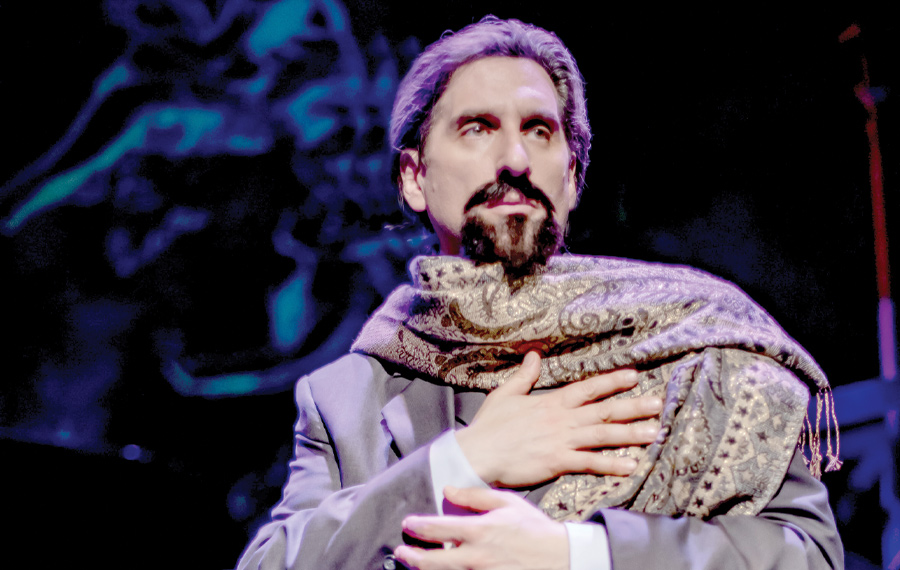
Hershey Felder, Canada’s gift to the world’s stage as actor, musician and playwright, returns to Los Angeles this month with his one-man show, “A Paris Love Story.” The piece celebrates the life, music and numerous romantic liaisons of French composer Claude Debussy.

Growing up in Montreal’s tightly knit Jewish community, Felder told the Journal, “Debussy was my first childhood love, but I never thought I would tell his story.”

Debussy, who lived from 1862 to 1918, “painted his music in colors … somehow it showed me how to get through hard times and deal with the difficulties of the world,” Felder said.

That is high praise from a man who, beginning with his portrayal of George Gershwin at the old Tiffany Theatre on the Sunset Strip some 21 years ago, has since re-created the likes of Ludwig van Beethoven, Franz Liszt, Frederic Chopin and Pyotr Tchaikovsky, as well as Irving Berlin, Leonard Bernstein and Abraham Lincoln.

Felder, 50, fell in love with Debussy’s music as a young man, after listening to the composer’s sweeping “La Mer,” the evocative “Prelude a l’apres-midi d’un faune” and the mystical “Clair de Lune.”

Debussy needed all the consolation he could draw from music because “his parents didn’t think much of him and hardly paid him any attention. They thought of their son as a loser,” Felder said.

For the “crime” of marrying a Jewish woman, the Nazi regime banned Debussy’s compositions from being performed. 

Even in an era when extramarital relations were commonplace, Debussy was a womanizer of considerable proportions. “Womanizing was a psychological aspect of the man and also a sign of the times,” Felder said. “Debussy was a complicated person.”

The composer’s most lasting liaison was with Emma Bardac, born Emma Moyse. She was a talented singer and initially Debussy’s mistress before becoming his wife and the mother of his adored daughter.

For the “crime” of marrying a Jewish woman, the Nazi regime banned Debussy’s compositions from being performed. Although France was notorious for its anti-Semitism during Debussy’s lifetime (during which the notorious Dreyfus affair occurred), the composer remained unaffected by the oldest hatred, Felder said. “His God was embodied in his art. What he hated was the dilettante. He readily took other composers to task, and he was thoroughly anti-establishment.”

Composer David Cox noted in 1974 that Debussy “created a new, instinctive, dreamlike world of music, lyrical and pantheistic, contemplative and objective … a kind of art, in fact, which seemed to reach out into all aspects of experience.”

After Felder finished his run of “Beethoven” in Los Angeles last year, he told the Journal it was his last one-man show on famous musicians, but he obviously relented.

After “A Paris Love Letter,” he again announced his retirement from his unique art form. However, playing off the overworked cliché “Back by popular demand,” Felder noted that “the theaters come after me. … their audiences were panicking.”

And so, Felder will celebrate Russian composer Sergei Rachmaninoff next year as his ninth — and supposedly final — composer, debuting at the Laguna Playhouse.


“Hershey Felder: A Paris Love Story” opens May 24 and runs through June 9 at the Bram Goldsmith Theater of the Wallis Annenberg Center for the Performing Arts in Beverly Hills. For tickets visit theWallis.org/Debussy or call (310) 746-4000.

Felder Channels Debussy in New One-Man Show Read More »

Stephen Schwartz Is Still ‘Defying Gravity’

What does it mean to be a parent, a good friend, or to stand up for what’s right? 

For more than four decades, award-winning musical theater composer Stephen Schwartz has been asking and answering these questions. 

From “The Prince of Egypt” and “The Hunchback of Notre Dame” to “Pippin,” “Children of Eden” and “Wicked,” Schwartz’s work transcends time because it remains relevant.

“I think that I care, not so much about religion as I do morality and ethics and what is our responsibility as human beings to each other and to our world,” Schwartz, 71, told the Journal. “These are things I’m not alone in being concerned with and thinking about, and I do deal with that in a lot of my work. Some of it is more overtly based on religious stories like ‘Godspell,’ ‘Children of Eden’ and ‘The Prince of Egypt’ and that sort of thing. But if you look at ‘Wicked’ and you look at ‘Hunchback,’ you know these themes go throughout those stories, as well.”

He added that his songs continue to resonate with him, too, as time goes on. “I feel that [with] the final song from ‘Children of Eden’ called ‘In the Beginning,’ which is basically about that every day we can wake up and change how we are living our lives. The thing that resonates with me also, particularly now, is in ‘Godspell,’ —maybe the most famous biblical precept: Always treat others the way you’d want them to treat you, and I see very little of that happening these days. I think if everybody really did nothing but that in terms of how they behaved, just treat others the way they want to be treated, I think we would have a better world.”

Over the course of 40 years, the multiple Grammy, Oscar and Golden Globe winner’s compositions have had a profound impact on people. Many write to Schwartz and tell him so. 

 “I think that I care, not so much about religion as I do morality and ethics and what is our responsibility as human beings to each other and to our world. I do deal with that in a lot of my work.”

— Stephen Schwartz

“I save all of these, of course,” Schwartz said. “When one knows that some of one’s work has resonated with other people and continues to do so, that’s the most gratifying feeling there can be.” 

He cited one example from the 1970s. After a couple saw “Pippin,” they wrote and thanked him, saying the show saved their marriage. Schwartz also recalled the time a woman told him that she had been in an abusive marriage for several years and was afraid to leave.

“Then she heard the song ‘Defying Gravity’ [from ‘Wicked’] and that triggered something for her and she took her kids and left. [She] moved to another state and lived with her cousin for a while, got a job and changed her life.” 

Stephen Schwartz; Photo courtesy of The Wallis.

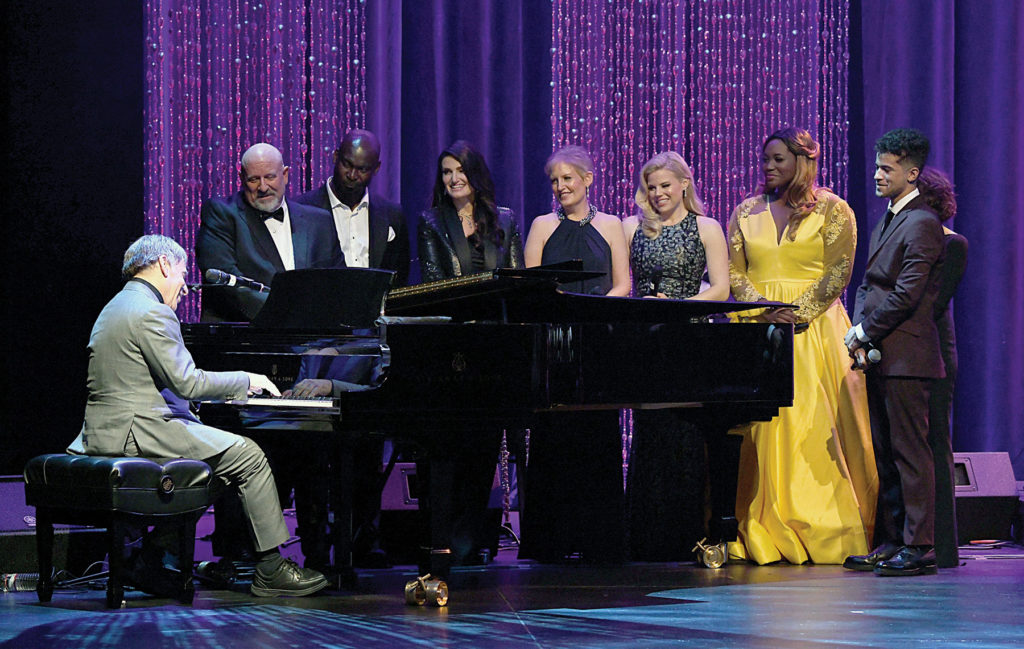
The Wallis Annenberg Center for the Performing Arts in Beverly Hills celebrated Schwartz, his work and his impact on May 16 when his musical theater family highlighted some of his achievements. Idina Menzel (“Wicked”), Liz Callaway (“Anastasia”), Benj Pasek and Justin Paul (“Dear Evan Hansen”) were just some of the stars who paid tribute to their mentor.

Rachel Fine, the Wallis’ executive director, said choosing Schwartz as this year’s honoree was easy. “He has mentored dozens of emerging musical theater artists, and every year he and ASCAP (the American Society of Composers, Authors and Publishers) do a musical theater workshop in our space,” she said. “The Wallis feels deeply indebted to him. These workshops are free and open to the public. [He’s] someone who has an incredible heart and is deeply dedicated to building the next generation of musical theater artists. He is a rare human being. He is a true mensch.” 

Not one to rest on his laurels, Schwartz is busy adapting three of his projects into different mediums. He is preparing “Hunchback” with his friend and colleague Alan Menken for a Disney live-action film, re-creating “The Prince of Egypt” for the stage and developing “Wicked” into a live-action film.

Schwartz said he’s eager to jump back into the Middle Eastern musical genre for “The Prince of Egypt” and ready to reformat a 90-piece orchestra so it can fit in the pit. He’s creating 10 new songs and adding new characters, which he said will retain the same framework as the original DreamWorks film, but he is excited to “give it a lot more depth.”

When it comes to adapting “Wicked,” he said, “We can make a really good and exciting movie that people who have never seen the show or [don’t] know anything about it can enjoy. [With] every new project, you never know whether you’re going to succeed or not; you just do the best you can. I think if one feels a lot of pressure undertaking these sorts of things, this isn’t the business to be in.”

Stephen Schwartz Is Still ‘Defying Gravity’ Read More »

UCLA Panel Examines Fake News in U.S.,Israel

During a May 19 lecture at UCLA, four journalism experts examined the importance of media in a world where the term “fake news” is now part of the daily lexicon.

“Without media, some of democracy cannot function properly, and if you have mistrust in the media then the media cannot fulfill its societal roles,” said professor Eytan Gilboa, founder and director of the Center for International Communications at Bar-Ilan University in Israel. 

Gilboa made his statement as part of a panel titled, “ ‘Fake News’: New Media and the Changing Political Culture in the U.S. and Israel.” He spoke alongside Jane Elizabeth, managing editor of The News & Observer of Raleigh, N.C., and the Durham Herald-Sun; Anat Balint, a media scholar and lecturer at Tel Aviv University; and UCLA Department of Communication professor Tim Groeling. Around 40 people attended the event organized by the Y&S Nazarian Center for Israel Studies.

During his presentation, Gilboa displayed a graph showing that the media is one of the least trusted institutions in the United States, especially among Republicans. “Democrats are much more trusting of the media than Republicans by huge gaps,” Gilboa said.

He added that both Israeli Prime Minister Benjamin Netanyahu and President Donald Trump have “observed these mistrusts of the media and capitalized on them, used them, exploited them for election and other purposes and gained from those accusations.”

Elizabeth spoke about the role social media has played in disseminating false stories, noting that fact-checking on Facebook is the “biggest game of whack-a-mole you’ve ever seen.” 

She also spoke about “deep fakes,” which she described as the manipulation of video to make a person say something they never said. “This will be a problem in the 2020 election,” she added. 

“When you attach the word ‘fake’ to news, you also aim at the work of journalists.”— Anat Balint

Balint spoke about slanted coverage in Israel, laying much of the blame on Netanyahu. She called the Israeli daily newspaper Israel Hayom, which is supported by pro-Israel philanthropist Sheldon Adelson, as a “propaganda platform personally oriented toward Netanyahu. It is a façade of a newspaper that doesn’t hold any journalistic value,” she said.

The news, Balint said, should be a conduit for honest public discourse. “When you attach the word ‘fake’ to news,” she said, “you also aim at the work of journalists.”

During her presentation, Balint showed an image of a huge Netanyahu campaign billboard for the April 9 Israeli elections showing Netanyahu and Trump shaking hands. She described both leaders as “disruptors of public discourse because of their attacks on the media,” adding that with the rise of social media and its increasing role in the news landscape, individual leaders have greater platforms than media outlets. 

Groeling said some fake news sites exploit credible news sources, citing a website that intentionally resembled ABC News, which published a false story that there would be a do-over of the 2016 presidential election.

While there are fact checks to make up for erroneous reporting, they are not distributed as widely as the underlying stories, he said, adding that part of the problem for real journalists is that most people are not media experts and don’t enjoy spending time rigorously exploring the news.


UCLA Panel Examines Fake News in U.S.,Israel Read More »

The Wow of Cacao: Guilt-Free Black Bean Brownies

It’s been well documented that guilt is a word often associated with food in American culture. In his book “In Defense of Food: An Eater’s Manifesto,” New York Times best-selling author Michael Pollan writes, “We showed the words ‘chocolate cake’ to a group of Americans and recorded their word associations. ‘Guilt’ was the top response. If that strikes you as unexceptional, consider the response of French eaters to the same prompt: ‘celebration.’ ” 

As a chef serving primarily American customers, I can second that sentiment. My customers generally alternate between “I love you” and “I hate you” in response to a dessert I bring out, and when they indulge too frequently, of course, who do they blame for their weight gain? Because I work in an American embassy, security clearance is a barrier to entry for customers who aren’t employed by the U.S. government. Therefore, as much as I jokingly tell diners not to blame me if their bathroom scales don’t tip in a favorable direction, I’m still acutely aware that I need to balance the apple fritter doughnuts and triple-chocolate mousse cakes with healthier options. 

I do this by providing plenty of fresh vegetable dishes, the Mediterranean fare of my Israeli upbringing and composed salads on the menu, but I also have a secret-weapon dessert that is so virtuous yet so seemingly decadent that I’ve been called a liar on more than one occasion. As a chef, this is when you know you’ve hit the culinary jackpot with a recipe: When the feedback alternates between “this cannot be made of X” and “I like this better than a real Y,” that’s when you know you have a keeper. 

Although I don’t obsess over chocolate, I know it’s the common denominator for “swoon factor” on a restaurant or café menu. There could be a biological cause for that. People crave chocolate for several reasons, some of which are cultural, but chocolate contains some healthful properties including flavonoids, antioxidants and solid doses of magnesium, iron and calcium.

The health benefits of chocolate are usually outweighed by the addition of sugar  — a substance that wreaks havoc on blood sugar levels and is associated with premature aging and chronic inflammation. But cacao in its natural form is considered by many to be a superfood. 

Cacao beans, which come from the cacao pod, the fruit of a tree cultivated by the ancient Mayans in Mexico over 1,500 years ago, have been used medicinally for centuries. In Africa, where over 70% of the world’s cacao is grown, chocolate bars and sweets are rarely eaten; farmers use the fruit as a cash crop to be exported to the West to make into a variety of confections ranging from M&Ms to high-end, hand-crafted boutique bonbons.  

The cacao beans are removed from the pod, dried and fermented, and then roasted and cracked. These cracked pieces of cacao are referred to as cacao nibs and are ground into a paste called a chocolate liquor. This liquor is then processed and transformed into chocolate bars or cocoa powder, but the nibs can also be eaten roasted or raw and are considered a powerhouse of nutrients.

Incredibly, cacao nibs contain more iron than beef, making them a great source of iron for vegetarians. Further, the bioactive compound known as epicatechin can boost blood flow and oxygen to the brain, making cacao nibs a powerful antioxidant that can protect skin health as well as cognitive function. They are also full of calcium, fiber and micronutrients that may reduce risk of diabetes, inflammation and even improve memory function. 

Cacao nibs contain more iron than beef, making them a great source of iron for vegetarians.

Before you cover yourself head to toe in Hershey’s kisses and call yourself a health nut, remember that Hershey’s and most milk chocolate brands contain only about 11% cacao. The level of cacao content of chocolate (above 70% is good, 80% to 100% is better) determines the health benefits to your body. Although portion control is crucial, the good news is that one small square of pleasantly bitter dark chocolate will satisfy most sweet cravings.

These brownies are hands down my most requested dessert recipe and, although I didn’t come up with the concept of brownies made from black beans, I’ve added seemingly incongruous ingredients such as balsamic vinegar and coffee grounds to fine tune what I think is a healthy adaptation of a favorite.

Don’t expect it to be chewy; it has more of a cake-like texture. You can omit the walnuts and the cacao nibs or even the ganache icing, but be aware that not only do these ingredients add texture, they may be the key to better heart health, lower cholesterol and improved blood sugar levels. At roughly only a tablespoon of sugar per brownie — less if you use a sugar substitute — I think you’ll be very excited about this guilt-free delicacy. But only if you don’t mind being called a liar every time you serve them.  You might not even believe it yourself.

YAMIT’S GLUTEN-FREE BLACK BEAN BROWNIES

14 ounces cooked black beans (canned is fine but weigh out 14 ounces)
3/4 cup sugar (or a sugar substitute like erythritol or xylitol)
2 large eggs
1/2 cup dark Dutch process cocoa powder
1 teaspoon olive oil (or any vegetable oil)
1 tablespoon milk (or almond milk for dairy free)
1 teaspoon balsamic vinegar
1/2 teaspoon salt
1/2 teaspoon baking powder
1/2 teaspoon baking soda
1/2 teaspoon coffee grounds
1 teaspoon vanilla
1/2 cup roasted walnuts, crushed (optional)
3 tablespoons roasted cacao nibs (optional)

Ganache icing:

2 cups dark chocolate (at least 70% cocoa solids)
1/2 cup boiling water
Preheat oven to 350 F degrees.

Line an 8-by-8-inch brownie pan with 2 sheets of baking paper so that they overlap, leaving extra paper on the sides for pulling out the brownies easily. Carefully weigh out 14 ounces of drained black beans and put in a high-speed blender with sugar. Blend well until beans are completely mashed.

Add the remaining ingredients, except walnuts and cacao nibs, and blend until thoroughly mixed. Batter will be thick. Stir in walnuts if using, and spoon mixture into prepared pan.

Bake for approximately 25-30 minutes or until a toothpick stuck into the center of the brownies comes out clean. Remove from oven and cool to room temperature in the pan. Transfer to the freezer while you make the ganache.

For the ganache, chop chocolate, place in a glass bowl and melt in microwave at 30- second increments, stirring between heating until chocolate is melted.

Whisk in half the boiling water. Chocolate will seize at first but keep stirring and it will come together. Whisk in remaining water and stir until ganache is shiny and all lumps have melted. Ganache will thicken upon cooling, so cool to desired consistency.

Remove brownies from freezer and, lifting the exposed parchment paper on the side of the pan, place onto flat surface or plate. Using a knife or an offset spatula, ice the brownies and sprinkle on the cacao nibs.

Keep in freezer or fridge until ready to serve. Cut with a sharp knife into 16 equal squares.


Yamit Behar Wood, an Israeli American food and travel writer, is the executive chef at the U.S. Embassy in Kampala, Uganda, and founder of the New York Kitchen Catering Co.

The Wow of Cacao: Guilt-Free Black Bean Brownies Read More »