Yohanan Plesner: Is Israeli Democracy Under Siege?
In the midst of crucial elections, Yohanan Plesner, head of the Israel Democracy Institute, discusses the state of Israel’s democracy.
Yohanan Plesner: Is Israeli Democracy Under Siege? Read More »
In the midst of crucial elections, Yohanan Plesner, head of the Israel Democracy Institute, discusses the state of Israel’s democracy.
Yohanan Plesner: Is Israeli Democracy Under Siege? Read More »
Dr. Reza Parchizadeh is an Iranian-born political theorist and anti-Iranian regime activist based in Pennsylvania who in recent years has been among the vocal voices of young Iranian Americans exposing the corruption, incompetence, unhinged cruelty and sponsorship of terrorism by the current Iranian regime. Last year, Parchizadeh, who is also director of an online think tank promoting regime change in Iran, circulated a letter of appreciation to President Trump thanking him for his powerful No Ruz message to the people of Iran. The letter was signed by 120 Iranian and non-Iranian American journalists, scholars, political activists and others who oppose the current Iranian regime and submitted to the White House.
In recent weeks horrendous storms and floods striking many cities and villages through Iran have killed hundreds, injured hundreds, left thousands homeless and without the basic necessities of survival. This horrific natural disaster and the Iranian regime’s total failure to help the victims of the flood has received little to no press in western media outlets. I recently sat down with Parchizadeh to discuss the impact of the floods in Iran as well as the incompetence and the neglect of the regime in helping the people suffering after this disaster. He also shed light on other pressing issues related to the Iran Deal and other Middle East policy issues. The following is a portion of my conversation with him…
Can you please share with us the nature of this disastrous flood that has stricken the Iranian city of Shiraz recent and extent of damages as well as loss of life as of today?
Devastating floods have overwhelmed vast regions in various provinces across Iran such as Golestan, Mazandaran and Semnan to the north, Khuzestan and Fars to the south, Kermanshah, Ilam, Lorestan and Kohkilouyeh and Boyer-Ahmad to the west, as well as the capital city of Tehran. According to the official Iranian sources, so far many places, including historical and cultural sites, have been either damaged or destroyed, and over 60 people and close to 5,000 heads of cattle have lost their lives. However, given the fact that the regime’s sources never announce the real figures due to political reasons, we can’t know for sure whether these numbers are correct or not. Unofficial accounts talk of thousands of casualties so far. The case of Lorestan, where complete towns and villages were wiped out by the floods, has proved to be the most tragic so far.
Why hasn’t the regime’s authorities done anything to help the victims in what looks to be a humanitarian crisis?
The authorities put most of the military and the civil sector on the alert. The regime particularly exploited the occasion to showcase the Revolutionary Guards as the saviors of the people. The Guards blew up a couple of locations across the country to divert the flow of the flood, which only aggravated the situation. In that regard, there can be seen a strange pattern of behavior. It looks like the regime not only does not try to rectify the situation, but also takes measures to actively exacerbate it. Like, they opened the floodgates on major dams across the country, and they did not call out for international humanitarian aid. This can have political purposes. On the one hand, the regime breaks the back of the already-stricken and discontented populace so that they won’t be able to rise against it; on the other, it will blame the humanitarian disaster on the West, especially the United States, for the sanctions.
In your opinion how could have the regime’s authorities have prevented such a horrific loss of life and property as a result of the floods in Iran?
The present disaster is a manifest outcome of forty years of the Islamist regime’s misrule and mismanagement of Iran. For instance, the regime would only green-light projects that were meant to fill the coffers of the regime’s elites and affiliates across Iran instead of developing the country and contributing to public welfare. Add to that the capital that the regime spends overseas on war, sectarianism, terrorism, and export of ideology and revolution. As I have said elsewhere, “Rather than being a form of national government in a traditional sense, the Islamic Republic is a religious-military cult that regards Iran only as a source of capital and occasionally manpower to advance its goal of an Islamist global revolution.” Simply put, in the span of four decades the regime has been continuously depleting Iran as a non-renewable resource. We are clearly witnessing the cataclysmic outcome now.
How are average Iranians in other parts of Iran stepping up to help their countrymen in the flood areas during this crisis despite the Iranian regime’s lack of support for the people suffering?
Unfortunately, as the floods coincided with Nowruz – the Persian New Year, popular help was at its lowest. That is because people usually go on a vacation during Nowruz. As such, many of those who could have helped were themselves caught in the floods. Nevertheless, according to the Red Crescent of Iran, the popular donations have exceeded that of the government budget with regard to flood relief: people across the country donated nearly 4 million dollars while the government only allocated 3 million dollars. Iranians abroad also eagerly want to help, but they are concerned they might inadvertently violate the sanctions on the regime. As such, they have been calling to the Red Cross and the Red Crescent to come up with viable ways to convey aid to the afflicted people in Iran.
As you know the Iranian regime has been calling for Israel’s destruction for 40 years and supporting terrorist who wish to destroy Israel for 40 years. To what extent do you believe Israel would be able to help average Iranians during this natural disaster if a democratic and free government were in power in Iran today?
Israel has one of the most efficient water management systems in the world. In an article I wrote for The Times of Israel last year, whose English version later appeared in Kayhan London, I explained how far back the cooperation between the two nations on the issue of water management goes. Before the Islamists took over in Iran in 1979, Israelis had long been helping Iranians with regard to water management and water distribution. I am sure if there were friendly relationships between the two countries now, Israel could help a great deal with preventing the flood in Iran in the first place.
John Kerry and members of Obama’s administration in 2015 were saying that the Iran Deal would help “open up” Iran to the world and give the Iranian regime money to re-build their country and infrastructure, schools. hospitals, etc. Has this really happened or was this just the Obama administration selling the America public lies about the regime in Tehran?
Israel has one of the most efficient water management systems in the world. In an article I wrote for The Times of Israel last year, whose English version later appeared in Kayhan London, I explained how far back the cooperation between the two nations on the issue of water management goes. Before the Islamists took over in Iran in 1979, Israelis had long been helping Iranians with regard to water management and water distribution. I am sure if there were friendly relationships between the two countries now, Israel could help a great deal with preventing the flood in Iran in the first place.
Aside from U.S. Secretary of State Pompeo and President Trump who have directly addressed the people of Iran, Israeli Prime Minister Netanyahu has been the only other world leader directly speaking to the people of Iran and offering a hand in friendship. In your opinion how effective has his direct online video statements to the people of Iran been and what response have you heard from average folks in Iran who have seen the videos?
Bibi’s messages have indeed had a wonderful effect. Average Iranian’s don’t share the Islamist regime’s anti-Semitism and ideological antipathy towards Israel. The deep historical and cultural ties between the two nations are still there. However, patriotic Iranians have always been concerned about the fact that in the clash between Israel and the Islamist regime, the territorial integrity of their beloved homeland might be threatened by Israel. That has made it extremely difficult for Iranian dissidents to support Israel in her fight against the regime in Tehran. However, Bibi has greatly managed to dispel that concern through his direct messages of goodwill to the people of Iran. As such, I will say Bibi has been able to effect a major coup in public relations between Israel and Iran. My only concern is that his messages have become less frequent recently. Iranian people would like to hear more from him.
You are not Jewish, so what response as an Iranian do you offer the vast majority of America’s Jews who were supportive of the Obama administration’s 2015 Iran Deal and even today still continue to support Democratic presidential candidates who want America to re-join the Iran Deal if President Trump is not re-elected? Why was the deal a mistake?
My message to them is that if they are concerned about peace, democracy, human rights and the Iranian people, they must be extremely wary of any deals with the regime, as it will only utilize the deal to augment violence and destruction. The apocalyptic Islamist regime in Iran will never become normalized, as its normalization will seal its fate and prove its doom. If American Jews are sympathetic towards the afflicted people of Iran, they need to consider supporting regime change and installing democracy in Iran. President Trump looks like he wants that, and that is why most Iranians are fond of him and support him. The Islamist regime is falling in any case. If anyone wants the gratefulness, appreciation and friendship of the future Iran, now is the time for them to support the people’s cause by loudly calling for regime change in Iran.
In your honest opinion do you foresee the people of Iran rising up anytime soon to overthrow this regime in Iran which has been brutalizing them?
The people of Iran have been protesting against the regime since day one. I myself participated in two major uprisings in 1999 and 2009 when I was still in Iran. For the first I was arrested, beaten up and expelled from university; for the second I was banned from perusing my doctoral studies at University of Tehran. As I have said somewhere else, the security apparatus of the regime is tightly monitoring all the movements inside the country. Any movement with the intention of regime change, or even making any kind of meaningful change, will be harshly crushed. Honestly, the beleaguered people of Iran are in desperate need of international intervention. We would not want to repeat the disastrous experience of Syria by pushing the people towards blind uprisings while there is no solid international support. As I have always said, the most certain and viable form of intervention is that a US-led military coalition topples the regime and helps the people to install a democracy in Iran.
How receptive do you think younger average Iranians will be in the future when it comes to Iran having relations or trade with Israel if there is regime change in Iran? Or will there still be hesitancy on their part to interact with Israelis?
The majority of the people will be absolutely positive. They love Israel. Remember the deep historical and biblical ties, like Cyrus the Great liberating the exiled Jews from the Babylonian captivity and helping them to rebuild their community and holy places. Before Israel was founded, Iran housed the largest Jewish population in the Middle East. And even after many Jews immigrated to Israel, Iran still houses the second largest Jewish community in the region. I would very much like to conclude our conversation with an anecdote. The other day I was watching a video clip of an Iranian-Israeli restaurant owner in Tel Aviv who had meticulously reconstructed everything in his restaurant to look like Iran. He had immigrated to Israel when he was a teen. And he was proud of being an Israeli citizen and happy to have a prosperous life and business there. However, he said he always felt a void somewhere deep in his heart, which he thought should someday be filled with the smell and taste of Iran. I can tell you many Iranians in and out of Iran share that feeling. And that is what will eventually bring them together again, no matter where they are in the world.
Q&A: Iranian Activist Parchizadeh discusses political fallout from floods in Iran Read More »
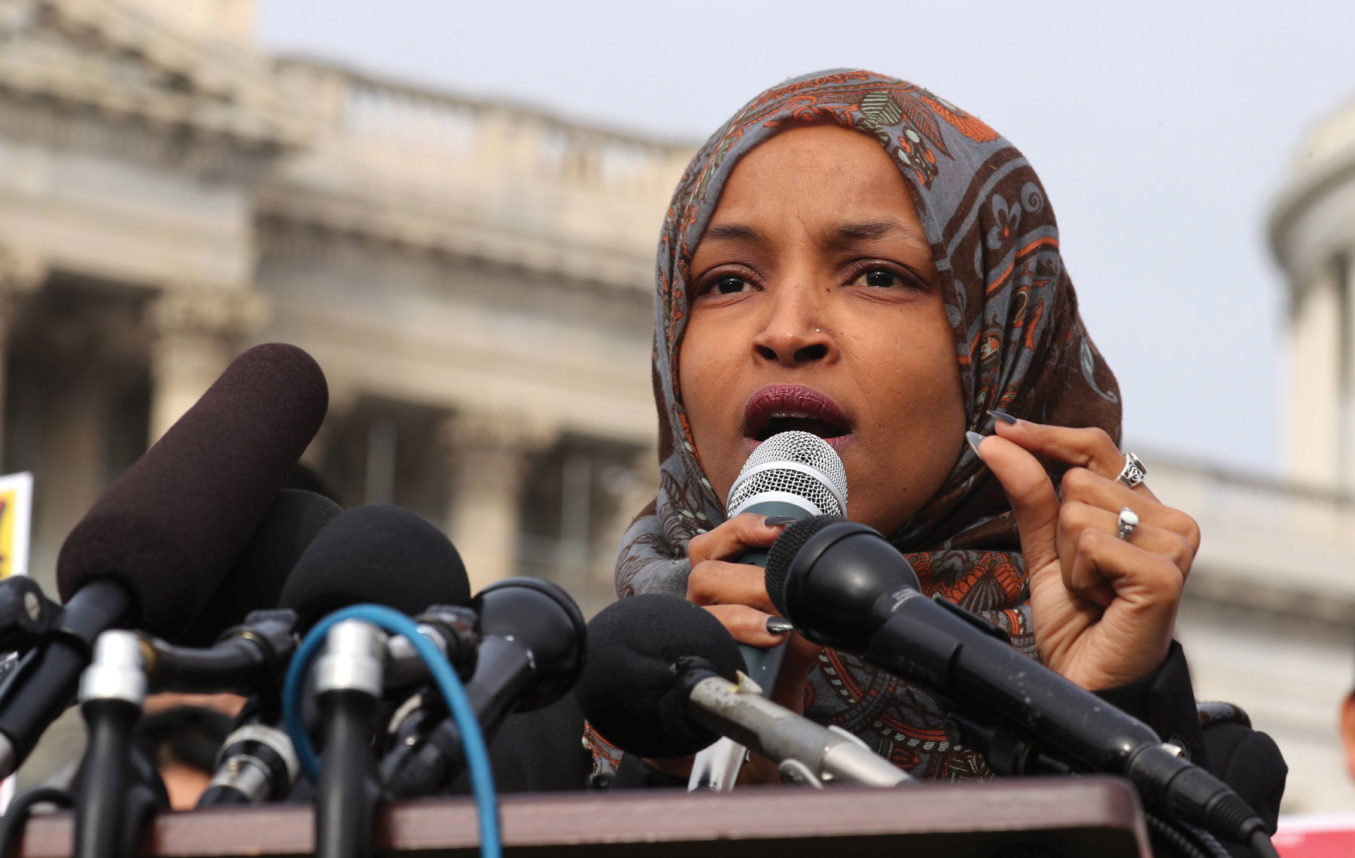
(JTA) — Right-wing critics railed against Rep. Ilhan Omar for calling White House senior policy adviser Stephen Miller a “white nationalist” amid a string of tweets decrying the Trump administration’s hard-line immigration reform policies.
The detractors accused the Minnesota Democrat of targeting Jews — a claim she has heard several times since joining the Congress in January.
Omar targeted Miller, who is Jewish, just days after President Donald Trump said that the country could not take in any more refugees. “Our country is full, can’t come, I’m sorry,” Trump said during a speech Saturday in Las Vegas at the Republican Jewish Coalition’s annual meeting. Also in recent days, video from May 2018 resurfaced in which Trump described people trying to come into the country as “animals.”
Omar has had a strained relationship with the Jewish community since taking office after employing anti-Semitic tropes about dual loyalty and Jews and money, and the resurfacing of past tweets considered anti-Semitic.
“Stephen Miller is a white nationalist,” her tweet Tuesday read. “The fact that he still has influence on policy and political appointments is an outrage.”
Stephen Miller is a white nationalist. The fact that he still has influence on policy and political appointments is an outrage. https://t.co/7NyMDgojd7
— Ilhan Omar (@IlhanMN) April 8, 2019
The tweet was accompanied by an article indicating that Miller convinced Trump to appoint a tougher candidate to lead the Immigration and Customs Enforcement office. Miller was behind Trump administration policies that included separation of immigrant families, and has advocated for closing the U.S.-Mexico border.
President Donald Trump, on Twitter, quoted a Republican consultant, Jeff Ballabon, who said on Fox News Channel, ““What’s completely unacceptable is for Congesswoman Omar to target Jews, in this case Stephen Miller.”
Rep. Lee Zeldin, R-N.Y., blamed Omar for targeting Jews.
“During my time in Congress before @IlhanOmar got here, I didn’t once witness another Member target Jewish people like this with the name calling & other personal attacks. In 2019 though, for @IlhanOmar, this is just called Monday,” his tweet said.
Others, including those who have been sharply critical of Omar for her past statements, ridiculed the notion that her attack on Miller was anti-Semitic, or that Miller could not be a white nationaist because he is Jewish.
“Lee, you’re a disgrace,” Josh Marshall, the founder of the liberal Talking Points Memo news website, replied to Zeldin on Twitter.”Miller is a white nationalist. Trying to rope in Judaism as a heat shield like this is both comical and frankly disgusting.”
Seth Mandel, the editor of the conservative Washington Examiner magazine, said Miller’s Jewishness did not exempt him from being called a white nationalist.
“I don’t begrudge Miller and his defenders taking offense at being called ‘white nationalist,’ but the idea that a Jewish person *can’t* be a white nationalist is ahistorical,” Mandel said on Twitter. “There are Jewish anti-Semites, and there have been Jewish white nationalists.”
Miller, who is descended from immigrants who came through Ellis Island, is seen as one of the architects of the Trump administration’s initial travel ban on seven Muslim countries.
Miller has denounced white nationalists in the past; in the late 2000s at Duke University, however, he reportedly worked with Richard Spencer, who would become a prominent white nationalist, to bring to Duke a speaker, Peter Brimelow, who has been identified as a white nationalist.
Earlier, Omar in two tweets criticized the outgoing head of the Department of Homeland Security, Kirstjen Nielsen, for working to enforce such policies. Nielsen submitted her resignation on Sunday.
On Monday, a photo of Miller briefly illustrated the Wikipedia page for Kapos, Jewish prisoners who collaborated with the Nazis during the Holocaust.
Rep. Omar Calls Trump Adviser Stephen Miller ‘White Nationalist’ Read More »
Theodor Herzl: The Zionist Dream of a Jewish State
Theodor Herzl: The Zionist Dream of a Jewish State Read More »
If you were a big fan of Disney-Pixar’s “Monsters Inc.” and its prequel “Monsters University” — Disney has some scare-iffic news: The Monstropolis gang is coming back to the screen in a new series that will air on Disney+, the new Disney streaming service, in 2020. Billy Crystal and John Goodman will be reprising their roles as Mike Wazowski and James P. “Sulley” Sullivan, respectively.
The series, “Monsters at Work,” picks up six months after the events on “Monsters Inc.,” where it was revealed that laughter was more powerful than screams — so now, instead of hiding in closets to scare children, the Monsters Inc. team is all about jokes. The new approach gives the humorous Mike a chance to shine (one of his tricks is swallowing a microphone and burping it up to get kids to laugh).
The Wrap reports that the show will introduce a new characters, Tylor Tuskmon (Ben Feldman), a young mechanic on the Monsters, Inc. Facilities Team, who one day hopes to work alongside his idols Mike and Sulley.
No word yet if “Boo” will be back for a cameo.
Billy Crystal Back in ‘Monsters Inc.’ Series for Disney+ Read More »
JERUSALEM (JTA) — Tens of thousands of Israelis visited national parks or were abroad on Election Day.
Election Day in Israel is a national holiday, and a rare Sunday-like day for Israelis.
The Nature and Parks Authority announced later on Tuesday afternoon, Election Day in Israel, that more than 150,000 people were visiting the country’s extensive network of national parks.
The most-visited sites are national parks at Caesarea, Masada and Tel Aviv, and nature reserves at Banias in the Golan Heights, Ein Gedi in southern Israel, Ayoun in the Galilee and Tel Dan in northern Israel.
Israelis also visited the beach in large numbers on the exceptionally warm day.
Interurban public transportation was free for the public for Election Day.
Meanwhile, some 60,000 Israelis were out of the country on Election Day. Ynet reported from Ben Gurion Airport on Tuesday that some of the Israelis leaving the country had scheduled their trips before new elections were called at the end of last year. Others said they used the opportunity of a free day off to plan a vacation. Still others said they had business meetings they could not reschedule.
Israel does not have the option of absentee voting except for diplomats and emissaries serving abroad.
More Than 150,000 Israelis Visit National Parks on Election Day Read More »
When I was 31, I may have subconsciously predicted this moment: I am pregnant, as a future single mom by choice, via a sperm donation.
At that time, I was a single’s columnist for the Jewish Journal of Los Angeles, kind of like a Jewish “Carrie Bradshaw.” I wrote a piece entitled “I’m Not a Fixer-Upper,” chastising people who were desperate to set me up on the assumption that I couldn’t be happy single. But I was.
I had written: “Women are living longer these days; technology has improved fertility. We can wait until the mid-30s before our biological alarm clock starts ringing. In the meantime, thank God for ‘snooze’!”
One reader, a fertility specialist, wrote in and said not to count on technology. There is no guarantee.
Nevertheless, I kept hitting snooze, until exactly ten years later.
Interestingly enough, in the last few years, I would never reveal my age in public, especially because so many tell me how young I look (it must be genetic), and also because I wanted to attract more mates, and younger women are by and large more attractive to men.
But since undergoing IVF in Israel last year (very luckily, successful on the first time), I care less to attract a mate—at least not for his sperm. A transformation has occurred within me. My future daughter has already changed me, for the better.
Since my Jewish “Carrie Bradshaw” days, I haven’t written much about my personal life. I reasoned that writing about men as a singles columnist turned them into commodities. I didn’t want to see my dates as fodder to turn into a buck. Instead, I wanted to see them as people, as lovers, as potential fathers.
I’ve had some serious relationships since I stopped writing about them but never felt I met the eternal “one.” And, deep down, I still liked being single. I could travel on a whim. I could go out and party and feel endless possibilities about whom I could meet. I could easily move cities, which I did in 2008, when I moved from Israel to L.A., then back to Tel Aviv in 2013—then to Berlin in 2016 where I wrote a steamy Israeli-German love story and developed a journalistic voice in the former Nazi country.
In Berlin, I became, sadly to some, happier than I was in Tel Aviv. Life was easier, not a constant struggle, not a constant war, although I still fight for the Jewish people in my own way. I didn’t face the subtle social judgment I felt in Israel as a single woman in her late 30s. I dated, researched my novel, wrote fascinating stories, traveled and thanked God that I froze my eggs before moving to Berlin so that I could reduce the biological pressure to procreate.
Then…I hit 41. I no longer dated “men,” but “sperm,” remembering the warning of the fertility specialist, and I didn’t want to rely on my as-of-yet unredeemed frozen batch. I needed to date for tachlis—purpose. I met a wonderful man who wasn’t ready yet to get married, but I found myself, out of character, pressuring him to consider raising a family sooner rather than later—with me, even though, ultimately, we were a mismatch.
Finally, I realized that for now, I wanted a child more than a man, and time really was running out. I turned to technology to realize my dream of motherhood. But this time: I was ready. I’ve always prided myself on my creativity: novels, paintings, videos, songs. But while I hope those creations are eternal, they are not things of flesh and blood that I could hold, mold, and shape in my image, who would give my values a life of their own.

And while some women see this path as a default, it started to make sense to me, even as a first choice. Being a single mom suits my personality as a free spirit. Maybe some psychological issues were behind my resistance to marriage (which I guess therapy couldn’t straighten out), but I’m not the type to easily bend my values for another. I wouldn’t want to risk a divorce, which could entangle my child in a custody battle and dual loyalties. This path seemed to me…whole.
Some friends and family gently encourage me to move back to Los Angeles to be with my family, or to Israel, where family is more central to the culture. About a half a dozen Israeli friends are single moms by choice, or on that path.
But I think I was able to come to this decision because I want to raise my daughter where I’m the happiest. The fact that I can raise a child in Berlin is a testament of faith that I have in Europe, led by Germany, to eventually do what’s right and take the steps and policies to ensure the safety of its Jews of all ages. Truth be told, I didn’t feel any safer in Israel, with rocket wars and intifadas breaking out every year or so, taking lives for no good reason. But it’s much harder to criticize Israel than it is Germany.
My unborn daughter has already given me many gifts. Honesty, for one. For a long time, I haven’t written about my personal life, partly out of respect for my own privacy and partly for fear that it might scare men away. But I’m not scared anymore. I don’t desperately need a man for sperm or co-parenting. I need a man because he sees me and I see him. Because we have common values. Because we are good to each other, as independent people, unbound by biological constraints. She might have cured my commitment-phobia!
That’s not to say I recommend this path. It is a highly individual choice, and I believe the loving nuclear family is still the ideal form of parenting. But not everyone has the good fortune of meeting or being ready for their forever soulmates when they are still fertile.
I’ve thought long and hard about whether or not I wanted to write about this journey as a single mom. I don’t want my child to become fodder to make a buck, either (this isn’t a paid entry). Would I’d want her to Google me one day and know all this about her–and me?
But I hope that my love for her and the good care I intend to give her will inspire her to forgive any of my missteps, and to discover that she had a wise, brave mom, a pioneer who sought to change the world for the better, in her own way–and to live a great life because it will be like her mother’s: authentic.
Orit Arfa is an American-Israeli journalist and author based in Berlin.
Everything You Wanted to Know About My Berlin Baby Read More »