fbpx

February 6, 2019

New Age Band Opium Moon Scores Grammy Nomination

Los Angeles-based Opium Moon had just finished an all-day video shoot for BBC Persian service when three-quarters of the band — violinist Lili Haydn, her husband, bassist Itai Disraeli, and percussionist MB Gordy (Hamid Saeidi, who plays the santoor, had another gig) — met with the Journal at a local restaurant to discuss their work and their Grammy Award nomination for Best New Age Album for their self-titled debut record. 

The Dec. 5 announcement was something of a surprise for the band. Haydn was up early and ran into their bedroom screaming, “We got nominated!” Gordy had no idea the nominations had been announced and was initially puzzled when congratulatory texts popped up on his phone. Two days before the nomination, Saeidi told Disraeli he was experiencing a crisis of confidence. After the nomination, “he realized that what we’re doing is right. The universe was telling him to go on,” Disraeli said, adding that a band of Americans and Iranians, gentiles and Jews being nominated for a Grammy shows “that music done in freedom and peace has value and is recognized.” 

Opium Moon’s music sounds very much in the moment. It’s hypnotic but alert. Touches of jazz, rock, Middle Eastern and African sounds flit about, but it never settles on a specific sound.

Haydn, 43, said the band, which formed about three years ago, “came together to create something that had no form, that had no particular destination. It was very important to all of us that it feels like we’re discovering something in the process.” 

It’s a sound she called “world music from another world,” but it has found some high-profile fans on this planet. Bob Boilen of NPR called their album “a rare pleasure,” while Tom Schnabel, host of KCRW’s “Rhythm Planet,” described it as “enchanting music that sounds contemporary but has ancient roots.” 

Opium Moon’s distinctive sound is a melding of the members’ diverse backgrounds. Haydn, who has been performing since she was a child, is the Canadian-born daughter of Lotus Weinstock, a comedian and singer who wrote a best-selling memoir, “The Lotus Position.” An in-demand session player, Haydn has collaborated or toured with, among others, P-Funk, Pink Floyd’s Roger Waters, Cyndi Lauper, Herbie Hancock and the Los Angeles Philharmonic. She has released five solo albums and also scores for films. She turned her recovery from neurological damage after being exposed to the pesticide Chlordane into a popular TED Talk.

“For a band of Americans and Iranians, gentiles and Jews to be nominated for a Grammy sends a message that music done in freedom and peace has value and is recognized.” 

— Itai Disraeli

Disraeli, 58, was born on Kibbutz Mishmar HaEmek in Israel, where music was a family affair. He played traditional songs but was influenced by the blues and Indian music. Since moving to the United States in the late 1990s, he’s played in many projects, most notably with his brothers in the trio Maetar. 

Sixty-something percussionist Gordy is not Jewish but considers himself a “Jew by osmosis.” He is married to a Jewish woman and estimates he’s played “every temple in town.” His wife, he said, jokingly calls him “the drummer to the Jews.” 

Iranian-born Saeidi is considered a master of the santoor. He has composed scores for over 30 films and has toured the world leading his own ensemble.  

Haydn said what makes Opium Moon special “is that we all listen. There’s no map or destination. Rather, it’s like a magic potion. It just comes together. You let it go anywhere it needs to go.” 

Gordy concurred, adding, “Everybody in the band is a producer, a composer — we know how to do that other stuff.” Disraeli finished the thought, calling Opium Moon “a conversation between four people talking and listening at the same time.”  

Disraeli said the first time the band played together, “we didn’t even have to talk to each other. We don’t tell each other what we’re going to play, we just feel it. If it goes somewhere, it’s just natural. When we listen, we become the center of the universe. When we listen, everything comes to us.” 

The band members admit they sound as though they’re speaking about a religious experience and that they also connect with spiritual elements and the Jewish concept of tikkun olam. However, Haydn said she didn’t really connect with her Jewish background until she was an adult caring for her dying mother. She said she fell in love with “the process of inquiry and wrestling with God.” 

Disraeli said he grew up in area of Israel that is “all about peace. As children, we learned how to speak Arabic, we’d visit Arab villages, Arab kids would come visit us. It’s a whole, idealistic view of how the country could be. We came here to live in peace. You don’t really hear a lot about that in America.”

Gordy, who usually can be found Friday nights playing at Shabbat services, has come to appreciate the tradition of Shabbat. “It’s about taking the week and putting everything aside and honoring the day,” he said.

Disraeli believes Opium Moon’s music can serve a similar function. “We’re so scheduled and tied to technology,” he said. “Our music gives you a chance to catch your breath and be with each other.”  


The Grammy Awards will take place Feb. 10 at Staples Center and will air on CBS at 5 p.m.

New Age Band Opium Moon Scores Grammy Nomination Read More »
Iranian-Israeli Singer Carves Her Own Path

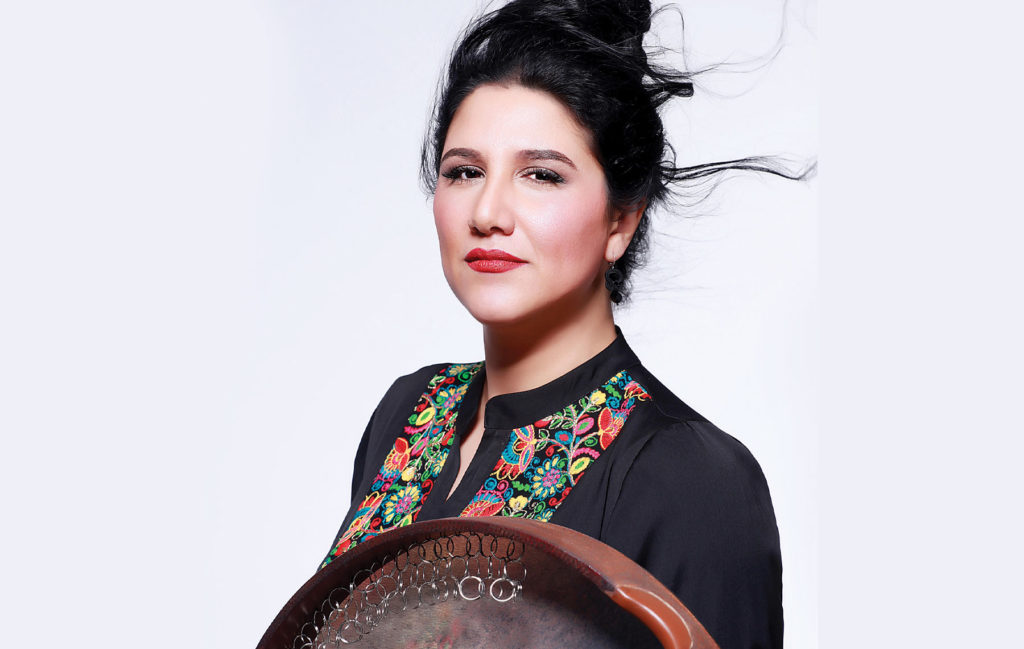
Iranian-Israeli singer and songwriter Maureen Nehedar recently made her solo debut in New York at Temple Israel of Great Neck. It was an unadorned yet extraordinary performance. Given her authentic voice and her impact on the audience, she seems poised for global acclaim.

Sitting on the center platform of the synagogue, Nehedar, 41, embraced the maxim “less is more.” There were no electric instruments. It was just Nehedar, modestly dressed in a long, floral tunic, with an acoustic guitar and a stringed instrument called a cümbüs.  

Performing solo (her accompanist reportedly was refused a visa), Nehedar had no problems enthralling the crowd. Her voice was delicate and pure and showed off her tremendous range, honed from years of rigorous training with revered musical masters. She opened her performance with an original composition called “A Prayer for Peace,” a meditative song in Hebrew, and followed up with well-known Iranian folk songs. 

Nehedar has dedicated herself to preserving Iranian folk music and its rapidly disappearing Judeo-Persian variant. Her authenticity is powerful and was beautifully showcased in an introduction she gave to a traditional Iranian lullaby. These lullabies (or lalaee) are among the saddest in Persian tradition. Many depict lonesome mothers lamenting their traveling or working spouses and babies who refuse to give their mothers respite. 

Nehedar spoke of these tragic figures as young mothers, perhaps 12 or 13 years of age, raising children. She characterized lullabies as possible moments of solace and self-expression, when these adolescent mothers could grieve their vanished hopes and interrupted lives. 

“Nehedar’s music is more about introspection than entertainment. Its message is a reminder that our cultural heritage is not a thing of the past but a timeless treasure to inspire the future.”

The crowd listened with silent reverence. Nehedar continued, talking about her beloved grandmother, Homayoon, a quiet and traditional lady who had been taught never to sing in public despite her beautiful voice. She talked about how she recorded her grandmother’s voice on one of her albums and then delivered her own rendition of the lullaby, in what she described as “the soundtrack of our lives.” It was emotional, powerful and profoundly tragic. As she sang, Nehedar unlocked coffers of emotions that had been lodged in the subconscious of so many in the room. Tears streamed down faces of women and men. And yet, it wasn’t all nostalgia, but rather a cathartic release of pent-up sorrow that had been held in the hearts of mothers and their sons and daughters for generations. 

Despite her love of Persian music, Nehedar did not spend her formative years in Iran. The descendant of Iranian-Jews from Esfahan, she discovered Persian music as an immigrant child living in Israel. Her path has not been easy. At a private gathering of local women the day following the concert, Nehedar opened up about her struggles with infertility. Raised by a single mother and now a mother herself, Nehedar spoke of her strong belief in a woman’s financial independence and path for self-determination. 

In her journey to discovering and reinterpreting Iranian folk music, Nehedar said she increasingly scrutinized the lyrics. She recited the lyrics of a wedding song: the bride’s neck is white as crystal, the groom wants to visit her, 40 camels are carrying her dowry, she’s walking delicately. Nehedar said underneath these beautiful words lies a “cruel culture. Everyone sings about how beautiful the bride is, but has “anyone sung about her soul? How old is this bride?” Nehedar asked.

It’s personal with her, because, Nehedar revealed, her own mother was married off at 15 and her grandmother at 9. These revelations unleashed a wave of confessions from women at the gathering. 

Nehedar’s powerful message of advocacy for women is one she has applied to her own career. She spoke of how she embarked on field research, going door-to-door, asking older Iranian Jews to sing her old songs. She also refused to sign contracts with several recording companies because, she said, she had her own standards about how her music should sound. Instead, she saved her own money to pay for the recording of her three albums. And it’s paying off. 

Nehedar’s music is more about introspection than entertainment. It’s music that reminds us who we are and where we come from. Its message is a reminder that our cultural heritage is not a thing of the past but a timeless treasure to inspire the future.


Marjan Keypour Greenblatt, who was born and raised in Iran, is a human rights advocate and an amateur musician.

Iranian-Israeli Singer Carves Her Own Path Read More »

Jewish Artists Live On in Holocaust-Era Work

Eliad Moreh-Rosenberg clicked to the first photograph of her presentation, and on a large screen at the Skirball Cultural Center displayed a picture of her nondescript workplace at Yad Vashem’s art museum.

“In general, when I say that I work in the art museum at Yad Vashem, people reply, ‘Is there an art museum? I didn’t know,’” Moreh-Rosenberg said.

Murmurs of agreement quietly rippled through the audience of nearly 100 people who had braved a rainstorm to hear Moreh-Rosenberg speak at the Skirball on Jan 31. Since 2014, she has been curator and director of the Holocaust remembrance center’s art division, which houses the world’s largest collection of Holocaust-related art, with more than 12,000 items.

“I think most people don’t know about this — that during this time of complete horror there were sparks of light,” she said. “These Jewish artists fought and struggled in order to create art. Thanks to these artworks, we’re able to learn about life during the time of the Holocaust.”

Moreh-Rosenberg’s presentation at the Skirball, titled, “Art From the Holocaust: Faith and Defiance,” was sponsored by the American Society for Yad Vashem. Founded in 1981 by a small group of Holocaust survivors, ASYV is the American arm of Yad Vashem, Israel’s official Holocaust remembrance site in Jerusalem that draws about one million visitors a year. Moreh-Rosenberg’s talk was part of a weeklong trip to Los Angeles. She also delivered presentations at the Los Angeles Museum of the Holocaust and at several local synagogues and schools. 

During her presentation, Moreh-Rosenberg explained that many European Jewish artists risked their lives to scrounge for materials, such as burnt branches to produce charcoal pieces. Many artworks that depicted the reality of life inside the ghettos and labor camps were antithetical to the messaging of the Nazi propaganda machine. Without them, she said, the world would only have had one side of the story.

Eliad Moreh-Rosenberg Photo by Eryn Brydon

Nearly a quarter of the items in the museum’s collection are portraits. 

“And that’s no coincidence,” she said. “Today, we’re able to look at faces. We’re able to, in a way, restore identities. The artist looked at these people who were treated as animals, reduced to numbers by the Nazis. Then, all of a sudden, when the artists looked at them as human beings, and restored them their individual features, they, the subjects, felt like human beings. In this way, the artists were fighting against the dehumanization and were also fighting against the process of annihilation. Because they left these traces, they showed the power of spiritual resistance through art.” 

Moreh-Rosenberg highlighted a collection of Holocaust-era artists — some who survived and some who didn’t. Some were trained artists, while others used art simply as a means of personal expression. Among the works she highlighted were those of Petr Ginz, a Czechoslovakian boy who was gassed in Auschwitz in 1944 at the age of 16. 

“By bringing the messages of Yad Vashem to the American community, we can help to reinforce the notion that we must stay extraordinarily vigilant in monitoring acts of anti-Semitism.
— Bill Bernstein

A great admirer of the French novelist Jules Verne, Ginz wrote short stories, published a newspaper with other young boys and drew incessantly. “He used his imagination to think about another reality,” Moreh-Rosenberg said. “He loved science fiction. He was a very gifted child.” 

Ginz’s drawing, “Moon Landscape,” which depicts a view of the Earth from a jagged lunar surface, garnered acclaim after the war. Ilan Ramon, the first and only Israeli astronaut deployed by NASA, carried a copy of Ginz’s drawing — the original is housed at Yad Vashem — on the fatal mission of the Space Shuttle Columbia in 2003. 

At the end of her presentation, Moreh-Rosenberg showed a YouTube video shot by U.S. Astronaut Andrew Feustel, who commemorated Israel’s Holocaust Martyrs’ and Heroes’ Remembrance Day in April 2018 with a video message sent from the International Space Station. Feustel flew to space last March with another copy of Ginz’s “Moon Landscape.” 

“May the memories of Petr Ginz, Ilan Ramon and the 6 million lost in the Holocaust always remain in our thoughts,” Feustel said.

“That was particularly moving,” audience member Susan Shapiro, 77, said afterwards. “I didn’t realize that [Ramon] had that picture with him when he went on that Columbia mission.” 

Julia Coburn, 17, a high school senior and burgeoning photographer, came to the event with her mother and grandmother. Coburn has taken photo portraits of more than 30 Holocaust survivors for projects at the Los Angeles Museum of the Holocaust. She marveled at the talent of the teenage Ginz. 

“I was thinking about how much promise he showed,” Julie said. “And all his work was done at such a young age, at my age.” She paused. “We don’t know how talented he really could’ve been.”

Jewish Artists Live On in Holocaust-Era Work Read More »

Celebrity Chefs Get a Taste of Israel

Nancy Silverton, one of America’s top chefs, hadn’t given Israeli cuisine much thought until four years ago when her friend Steven Rothfeld asked her to write the introduction to “Israel Eats,” the cookbook he was planning to write and photograph.  

Rothfeld had photographed Silverton’s cookbook and told her at the time, “You’re not going to believe this, but the food [in Israel] is magical.” To which she responded, “I can’t believe the food in Israel is any good.”  

Silverton, co-founder of Los Angeles’s Osteria Mozza restaurant and recipient of the 2014 James Beard Foundation’s Outstanding Chef Award, agreed to accompany Rothfeld on one of his research trips to Israel, where they ate their way through the country.  

“I was just blown away,” Silverton told the Journal last week during her latest visit to Israel. Silverton was a participant in what has been dubbed the Celebrity Chef Birthright. The Los Angeles Times called the Jan 27-Feb. 3 visit (which has no connection to the Birthright youth tours) “a sumptuous six-day excursion.” 

Twelve celebrity chefs took part in the tour. Organized by food event influencer Herb Karlitz, the tour was designed to put Israeli food and wine on the international food map. 

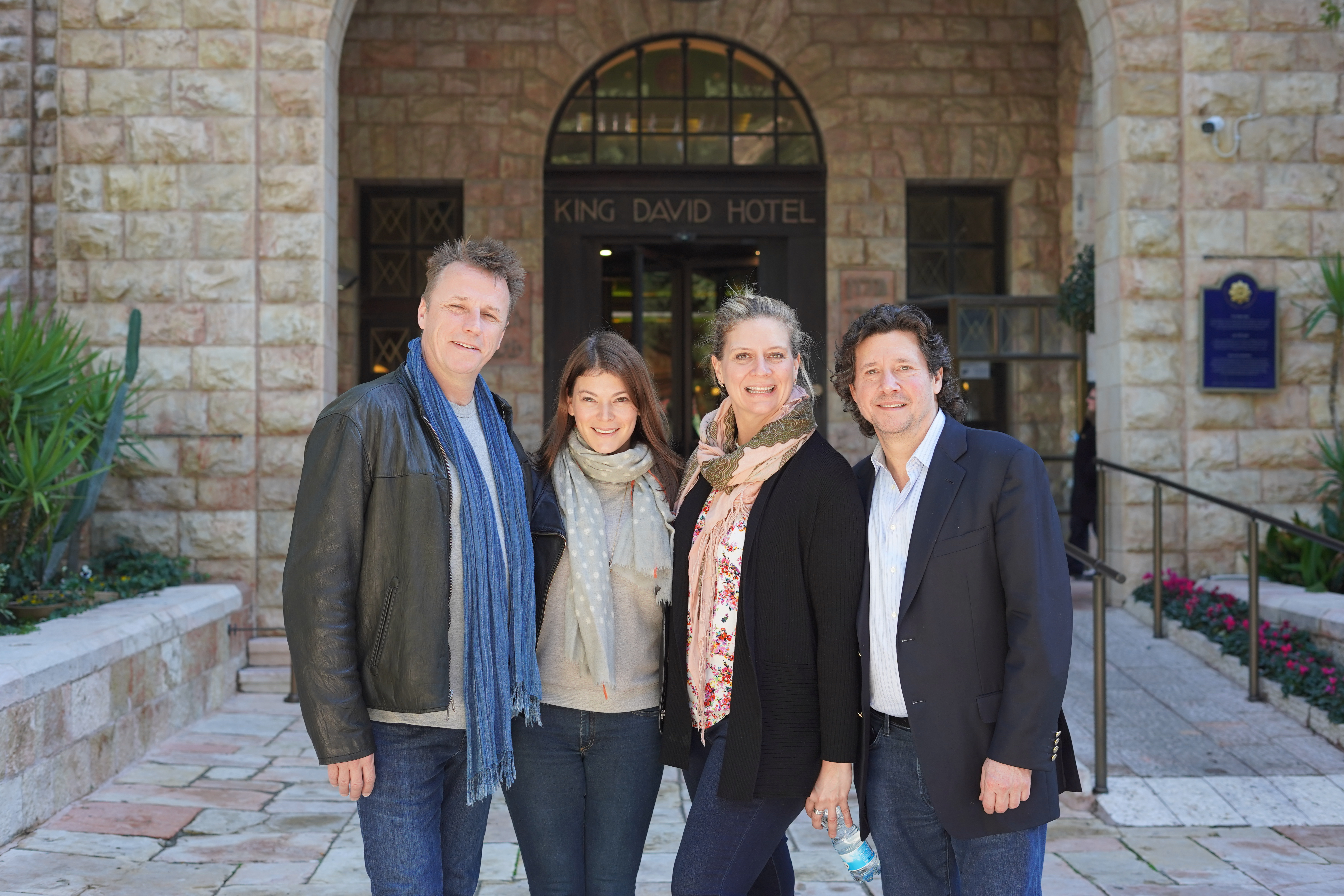
Chef Marc Murphy, Gail Simmons, Amanda Freitag, Herb Karlitz. Photos courtesy of Jackie Gebel @No Leftovers

“My goal is that a Nancy Silverton or Marc Murphy (Food Network chef and owner of the New York event space Landmarc) will consider putting Israeli wines on their wine list,” Karlitz said. “Why are they any less valid than other wines?” 

“These chefs have seen it all, done it all,” he added, “so to see the smiles on their faces while exploring the Carmel food market in Tel Aviv and eating a boreka that tastes like an old-fashioned calzone is gratifying.” 

In addition to receiving personalized guided tours of Israel’s best open-air food and produce markets, the chefs dined at top restaurants, visited wineries and met with farmers and agricultural innovators. They also visited child burn victims and met at-risk youth. 

The chefs’ dinner at Claro, a hot Tel Aviv restaurant in the trendy Sarona district, was one of the gastronomic highlights. Seated family-style in a sunroom at long wooden tables groaning under the weight of platters of antipasti, salads, breads and meat dishes, the chefs were relaxed and in a festive mood. 

Jonathan Waxman, named Best Chef in New York City in 2016 by the James Beard Foundation, said the food scene at Claro and in Israel as a whole reflects the market-fresh/field-to-table culture espoused by chef and food activist Alice Waters. Waxman said he decided to take this, his first visit to Israel, to see to what extent the field-to-table movement is embraced in the country. 

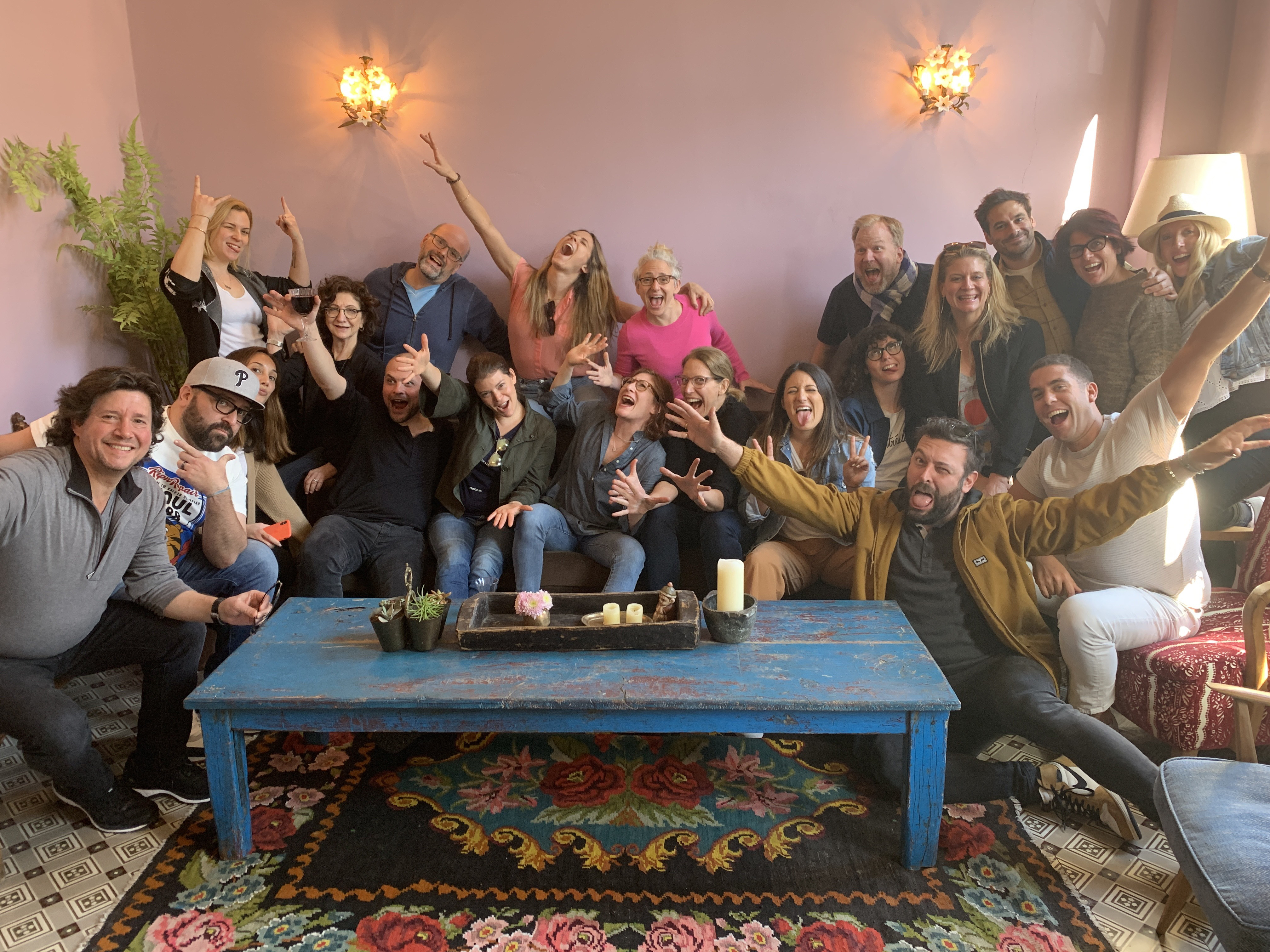
The Celebrity Chef Birthright team

“I’ve been happy to see that wherever we’ve gone, the whole kibbutz lifestyle of harvesting, working together, cooking and breaking bread together is alive and well,” he said. “We’ve seen this with the farmers, the winemakers, the bread bakers.”

Waxman said he especially enjoyed a meal prepared by a farmer and his wife. “He produces cheese from his goats, vegetables from produce he’s grown himself, olive oil from his own trees and he’s a really good chef. This guy epitomized farm-to-table. He harvested in the morning and either cooked what he harvested or prepared it raw, with love and joy and without pretense.”

Murphy, too, said he was excited by the earthy goodness of Israeli food. “The markets, the fresh food — the food is so beautiful. The amount of parsley being sold in the markets.” he said. “There’s a longstanding tradition of using spices like za’atar and herbs. I love it, I love it. The way it’s all used, it wakes up the food.” 

Murphy said he enjoyed Israel’s street food almost as much as the carefully prepared meals the chefs were served by top Israeli chefs. “We stopped by a falafel place … and we had warm chickpeas, tahini, lemon juice and herbs dipped in pita. The flavors were so real,” he said. 

Silverton said Israeli food reflects the fact that Israel is a society of immigrants. “You just taste the culture. The mix of all the cultures,” she said. “Plus, Israelis eat family-style. They’re engaged with their food but don’t overanalyze it. This is so contrary to food today in the U.S and Europe, where food is so manipulated it feels like you’re at a shrine and not a table.”

She added, “Israelis eat from their hearts, and everyone is welcome.” 

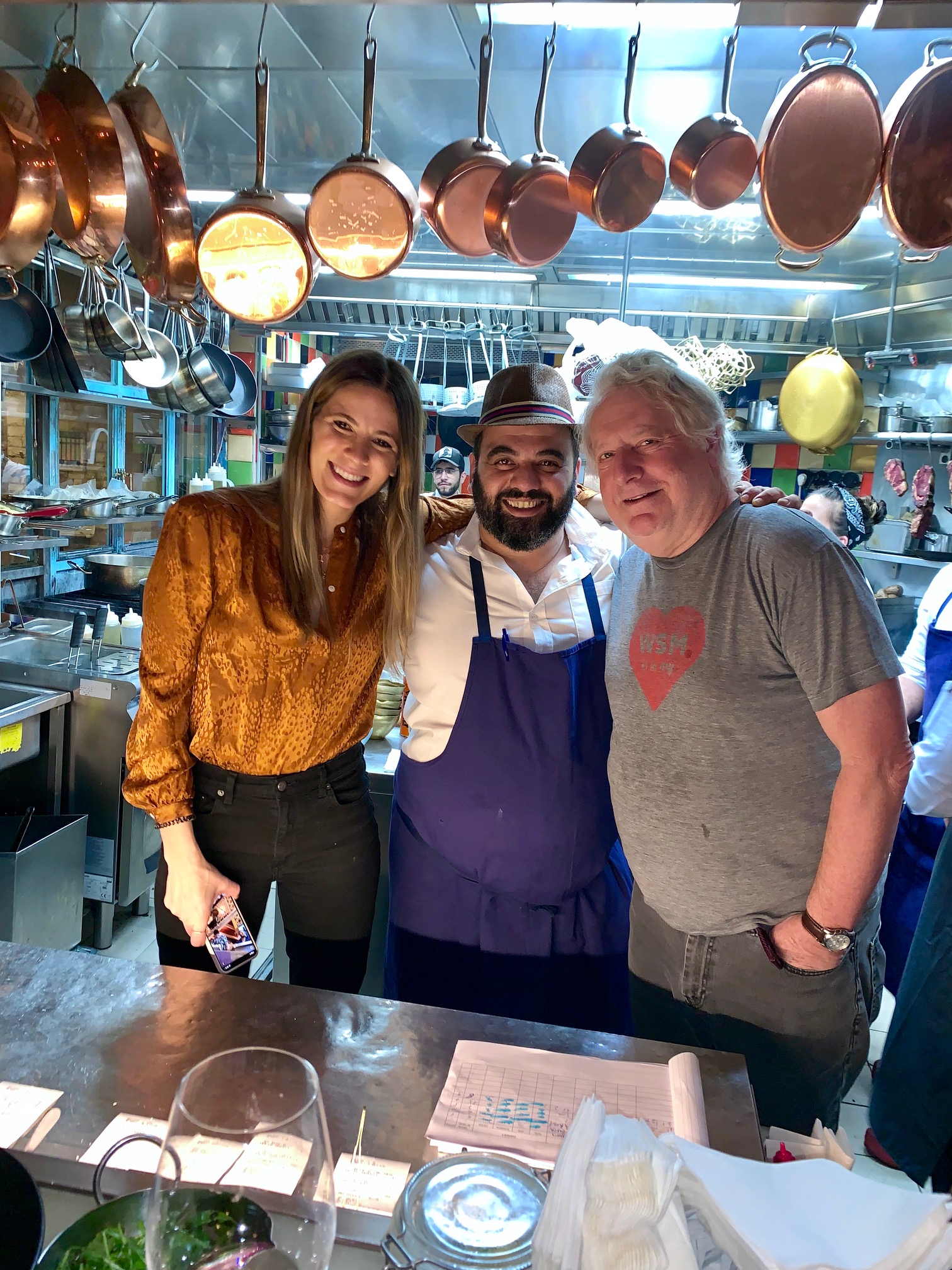
Eden Grinsphan, Uri Navon (Machneyuda) Jonathan Waxman

For Silverton, a high point of the trip was visiting the cacophonous Carmel market, where stalls brimming with just-harvested fruits and vegetables (she couldn’t believe the size and color of the pomegranates) coexist alongside bakeries, restaurants and shops selling wine, cheese and spices.

At the market, the group divided into smaller groups, and each had a different itinerary. “When we came back, we all said, ‘My tour was better than your tour,’ ” Silverton said. 

While the chefs said they loved meeting Israeli experts in a variety of fields, Yaacov Oryah, the winemaker at the Psagot winery, called the opportunity to present his wine during the dinner at Claro “not just an opportunity but an obligation.” 

During the past two decades, Oryah said, Israeli wine has transformed itself into a product “that stands on its own merit. We’ve worked so hard to improve our quality, and we want the world to know about us.”


Michele Chabin is an award-winning journalist who reports from Jerusalem.

Celebrity Chefs Get a Taste of Israel Read More »

Bat Mitzvah Helps Israeli Special-Needs Center

When 12-year-old Tomomi Shaw was trying to come up with a mitzvah project for her bat mitzvah, her father suggested she consider ALEH Negev-Nahalat Eran. 

After watching a video about the state-of-the-art rehabilitative village in Southern Israel that serves disabled and special needs children and adults, Tomomi knew she’d found her project. She then went about raising $10,058 for the organization.

“I thought it was really cool what they did and how they started,” Tomomi said in an interview at her home in the Pico-Robertson area. She said she especially liked the fact that there were “people of different ages hanging out” at ALEH Negev.

Her project connected with donors, too.

“It was amazing to see how many people came together to help donate and support the organization,” she said. “I feel like it’s a big accomplishment for me to achieve. I wanted to do something for my bat mitzvah to help people. It was really nice seeing what happened, seeing that I could do this even though I’m really young.”

And even though she has an additional challenge: Tomomi has unilateral deafness, meaning she is deaf in one ear. 

“Tomomi has an affinity for and likes to speak for those who have more difficulty in life,” said her father, Dr. Robin Shaw, a cardiologist.

“Tomomi has an affinity for and likes to speak for those who have more difficulty in life.”

– Dr. Robin Shaw

“That’s her orientation,” added her mother, Dr. Julie Higashi, a public health physician. “She knows what it’s like to live with a disability and be different. She wears a hearing aid.”

To kick off her fundraising, Tomomi baked cookies and sold them at her school, Harkham Hillel Hebrew Academy, once a week for several weeks. She also worked closely with the Jewish National Fund, a partner of ALEH Negev, which helped set up a fundraising page on Facebook. The page features a photo of Tomomi holding a drawing she made, as well as a brief note she penned, which reads, in part, “When I see people struggle with daily activities such as eating breakfast, brushing their teeth and hair, or picking up a pencil, it helps me understand the power of healing and also makes me appreciate how much I take for granted.” 

A link to the Facebook page was sent along with the Paperless Post evite to her 2018 bat mitzvah at B’nai David-Judea.

Tomomi said she enjoyed checking the page every night, seeing that day’s donations, and watching the notch on the progress thermometer gradually rise to and surpass her goal of $10,000. She hopes one day to visit ALEH Negev, which opened its doors in 2006. Major General Doron Almog, whose son Eran was born with severe autism and developmental disabilities, founded the village. Eran lived at the village for several years until he died at the age of 23.

Today, more than 150 people live at ALEH Negev. The center also provides close to 20,000 outpatient treatments each year to children and young adults at no charge. Currently, the ALEH Negev has an ambitious building project underway, adding a rehabilitative hospital to its 25-acre site, which is slated to be completed by 2021.

“Tomomi is supporting the first and only world-class rehabilitative village in the Negev that is a major part of JNF’s vision to bring 500,000 people to live in the Negev, the future of Israel,” said Neuriel Shore, JNF’s associate director for West Los Angeles. “Through her bat mitzvah, Tomomi has become a true champion for Israel.”

Bat Mitzvah Helps Israeli Special-Needs Center Read More »

Fighting to Remove Women’s Oppression in Iran

A New York Post columnist called Masih Alinejad, the Iranian-born journalist, author and women’s rights activist, “the woman whose hair frightens Iran.”

That’s because she has garnered millions of followers thanks to a campaign she started on Facebook and Instagram called “My Stealthy Freedom,” which encourages Iranian women to defy the country’s compulsory hijab law.

The law was passed after the 1979 Islamic Revolution and forces all females to cover their hair from the age of seven, or face imprisonment, lashings or even death.

Alinejad, 42, launched her campaign in 2014 from New York, where she now lives in self-imposed exile (she previously lived in Europe), and today “My Stealthy Freedom” has more than 2 million Instagram followers and 1.2 million followers on Facebook, where Alinejad posts images and videos sent to her by Iranian women, showing them removing their hijabs. 

Her memoir, “The Wind in My Hair: My Fight for Freedom in Modern Iran,” was published last year. 

Alinejad, a Muslim who left Iran in 2009 and was granted asylum here in 2014, has been an activist since her youth. As a high school student, she was expelled for asking the “wrong” kinds of questions. At 19, she was beaten and arrested for distributing anti-government pamphlets. As a journalist reporting on the Iranian parliament, she was chased out of rooms by government officials for not covering her hair properly, and eventually lost her job. As a columnist for a popular magazine, she came under fire for criticizing then-president Mahmoud Ahmadinejad and his hardline followers. 

In May 2017, after President Hassan Rouhani’s re-election, she organized an initiative called “White Wednesdays,” in which thousands of Iranian women tied white headscarves to sticks and waved them in the streets as a form of protest. During the post-election turmoil, a photo of a young Iranian woman waving a white headscarf became an iconic image of anti-government protests and women’s oppression in Iran. The woman was sentenced to 20 years in prison before being released in early 2018.

Alinejad also organized an initiative called “My Camera Is My Weapon,” which asked Iranian women to film themselves being harassed on the street by the country’s “morality police.”

On Jan. 29, Alinejad spoke at the sixth annual Persian American Women’s Conference in Los Angeles, where she was interviewed by the Journal. 

“As a child, I used to watch the clerics on television with such fear. Now, it is they who watch me on their TVs or devices, because from my pain I found my power.” — Masih Alinejad

Asked how she reconciled her campaigns with putting Iranian women at risk, Alinejad recounted the story of a 24-year-old woman in Iran who sent her a message saying she had been arrested for removing her hijab in public during a “White Wednesdays” protest.

“I was crying a lot because I knew that she was engaged to be married,” Alinejad said, “but as soon as she was freed, she published a video of herself in which she held up her arrest warrant, condemned compulsory hijab, and took off her headscarf again.”

According to Alinejad, the woman then posted on Instagram that while that protester was in jail, her interrogator tried to get a false confession out of her, accusing her of “working for Masih Alinejad.” The woman turned to her interrogator and said, “I’m not working for Masih Alinejad. She is working for me. I don’t have a voice inside Iran.”

Despite her massive following, Alinejad said she does not believe she is leading a movement. “Women like that 24-year-old [woman] are the most prominent members of this civil disobedience movement,” she said. “They are leading from within. These are brave, mature women who know the risks they’re taking and, to me, they’re like suffragists. They’re not waiting for the compulsory hijab law to be removed. They remove it themselves because they strongly believe that through civil disobedience, change will come to Iran.”

Nonetheless, Alinejad also has been making inroads in the United States, having met with Secretary of State Mike Pompeo on Feb. 4 to discuss Iran’s human rights violations.
“I want human rights to be the main pillar of negotiation between the U.S. and the Islamic Republic,” she told the Journal. 

Alinejad continues to make her voice heard on the Voice of America Persian News television program called “Tablet,” despite the fact that the Iranian regime has called her names ranging from an MI6 agent to a whore. 

“When I look at my life, I cannot believe it,” she said. “As a child, I used to watch the clerics on television with such fear. Now, it is they who watch me on their TVs or devices, because from my pain I found my power.”


Tabby Refael is a Los Angeles-based writer and the former executive director of 30 Years After.

Fighting to Remove Women’s Oppression in Iran Read More »

Rep. Tulsi Gabbard Disavows David Duke Endorsement

Rep. Tulsi Gabbard (D-Hawaii) disavowed the endorsement of former Ku Klux Klan grand wizard  and white supremacist David Duke on Feb. 5, calling his views “hateful.”

Duke tweeted out his support for Gabbard’s presidential bid on Feb. 4, calling her “a candidate for President who will really put America First.” He also tweeted that Gabbard is “the only presidential candidate who doesn’t want to send White children to die for Israel.” Duke’s Twitter banner reads, “Finally a candidate who will actually put America First rather than Israel First.”

Gabbard condemned Duke in a statement to The Hill.

“I have strongly denounced David Duke’s hateful views and his so-called ‘support’ multiple times in the past, and reject his support,” Gabbard said. “Publicizing Duke’s so-called ‘endorsement’ is meant to distract from my message: that I will end regime-change wars, work to end the new cold war and take us away from the precipice of a nuclear war, which is a greater danger now than ever before.”

In 2016, Duke had advocated for Gabbard to be President Trump’s secretary of state, prompting Gabbard to rebuke him by calling him “pure evil.”

“Our movement is one of love/aloha, inclusivity,” Gabbard tweeted at the time. “Duke represents hatred, racism, anti-Semitism, fear. We don’t want his ‘support.’ Period.”

Gabbard announced that she was running for president on Jan. 11. She has been representing Hawaii’s second congressional district since 2013.

Rep. Tulsi Gabbard Disavows David Duke Endorsement Read More »

Less Politics, More Dumplings

As I bit into the soup dumpling, warm stock shot out of it and onto the face of the stern-looking older woman across from me. The liquid dribbled a tear down her cheek, leaving a trail across her makeup.

Oops!

I quickly grabbed a tissue and dabbed her face, as if I were her mother, which prompted us both to burst out laughing.

This funny, life-affirming moment occurred in a midtown Manhattan restaurant where I was taking a soup-dumpling workshop with other devotees of the famous Shanghai Xiao Long Bao.

One of the great joys I find in traveling is learning about a culture through its cuisine. I like to take as many cooking classes as possible while on a sojourn. I often know how to make the dish being taught, but I still learn something.

I’ve learned how to make risotto in Milan — stirring only clockwise to evenly cook the grains; pommes frites in France — always double-fry; croissants in London — they take more patience than skill; pad thai in Bangkok — don’t cook the noodles first; and perogies on Manhattan’s Lower East Side — don’t overfill them. 

Why would a professional chef want to take a class alongside home cooks? First, it’s extremely difficult to find a professional-level course while traveling that I don’t have to commit to for days or even months. Second, in each of my workshops around the world I’ve been in the delightful company of men and women who like to be around food, who like to learn new things, and who just want to learn to make their favorite dish. Some, like me, just want to absorb the delights of a kitchen that’s not theirs. Food is fun and engrossing, and even if you don’t cook in your day-to-day life, cooking classes are are a pressure-free zone where you can learn some words in another language, use your hands, eat tasty morsels and then leave without having to do the dishes.

The soup-dumpling class where I made my big splash was given by the China Institute, a cultural center in New York that was founded in 1926, and whose mission is, according to its website, “to advance a deeper understanding of China through programs in education, culture, art, and business.” The China Institute is the go-to resource on China — it offers films, language and art classes, and classes about the rapidly shifting Chinese business culture. I must have been looking into a film at the institute because I received an email asking if I wanted to participate in its first cooking workshop. 

Xiao Long Bao has long been considered by dumpling aficionados to be the king of dumplings. A xiao long is a bamboo steamer and a bao is a steamed bun. I fell in love with them while eating plenty in Hong Kong and all over Asia. The filling is made of minced beef or chicken (generally pork and crab roe in China) that is seasoned with scallions, ginger, soy sauce and a touch of sesame oil. But what makes them legendary are the gelatinized broth cubes that are mixed with the filling so that when the dumplings are steamed, the rich stock melts and creates a soup inside the bun. Although I had made them many times at home, I had never seen them made by a Chinese master chef — as promised in the course description.

I was intrigued. 

I signed up for the class, but as the date got closer I wondered what I had gotten myself into. Oddly, I’d never taken a cooking class in the United States and didn’t know what to expect of fellow enrollees. In the current political climate, where vitriol plays such a large part in our day-to-day reality, I began to worry that I would have to listen to politically correct banter or politically incorrect bravado from a bunch of strangers. I worried about this a lot in the days leading up to the class.

Amid the chaotic, ratings-driven greed of many media corporations and the fearmongering coming out of our nation’s’ capital, it seems our relationships and conversations are getting more strained. And our friendships — the ultimate gift to the soul — can be impacted. I’ve had more than one uncomfortable conversation with friends about politics, and watching television in the U.S. (I don’t have a TV in my home in Uganda) feels like being stuck in a minefield of annoyance. 

But I needn’t have worried. It was a snowy day when I stepped into the warmth of that midtown Chinese restaurant with at least 50 other soup-dumpling fans. About five people were seated at each table, which was decked out with small dough balls (the dumpling wrapper), a few long and thin Chinese rolling pins, a bowl of filling and, of course, the requisite pot of Jasmine tea and miniature cups.

As I initially took a seat at a table, alone, I was immediately and enthusiastically greeted by the guests at an adjacent table — a banker, an advertising executive and an interior designer. My table quickly filled up with a Chinese-speaking American graduate student; his pretty friend, herself a student; and a Chinese woman who spoke very little English.

We introduced ourselves, but rather than talking about my least favorite and dreaded subject, we started to talk about dumplings — where we had eaten them, which NYC restaurants had the best ones, what we did for a living, where we had recently traveled and where we lived. All the while, an old dumpling master, Chef Wu, and a female sous chef — neither of whom spoke English — demonstrated the signature bao rolling and pleating technique. 

As we lightly floured our work surfaces, rolled the wrappers with the pins, filled them and pleated them, not one negative word was spoken — not about anything going on in the nation’s capital, not about Cheetos or the state of Sarah Huckabee Sanders’ wardrobe, nothing about anti-Semitism or women’s marches or any of the hundred other topics we expect to hear about at every social occasion or family get-together.

It was blissful.

For over two hours, life was like it was before, when we were unaware of strangers’ (and many friends’) political affiliations. Other than snapping pictures of our slightly misshapen, sticky, round balls of dough, perfecting pleats was the only thing on our minds. We all watched in rapt attention as the dumpling master chef pleated baos with two hands and then, mind-bendingly, with only one hand. We were not Republicans or Democrats or even Independents. For that afternoon, in that cozy, fragrant, midtown Chinese restaurant, we were all just foodies, united in our love of a good Shanghai-style soup dumpling.

To my friends, many of whom are regular readers of this column, you are on notice. I’m not going to let a lifetime of memories get chipped away by a difference of opinion about a political candidate or about something as important as national security or climate change. Fundamentally, without the support and love that are part and parcel of life-sustaining friendships, the environment is not worth saving anyway. We may not always agree, but luckily for you, I’m now quite a master soup-dumpling maker.


Yamit Behar Wood, an Israeli-American food and travel writer, is the executive chef at the U.S. Embassy in Kampala, Uganda, and founder of the New York Kitchen Catering Co.

Less Politics, More Dumplings Read More »

Weekly Parsha: Terumah

One verse, five voices. Edited by Salvador Litvak, Accidental Talmudist

“From every person whose heart inspires him to generosity, you shall take My offering.” –Exodus 25:2


Rabbi and Cantor Eva Robbins
expandedspirit.org and N’vay Shalom

The biblical understanding of the words yidvenu libo is a willing heart, to give voluntarily. The question for me is why does G-d open the sentence with “let them take for Me a portion,” making a clear statement and then couching it with a qualifier— “those who are willing,” or want to volunteer. S/He makes a statement, then turns it into an invitation. 

We must remember, two portions prior, the people meet G-d at Sinai for the first time. In Egypt, they experienced some of the wonders of the Holy One, but Sinai is truly their first date. It doesn’t go so well, for they basically reject G-d, telling Moses: “You speak to us, let not G-d speak to us or we will die.” The sounds, the flames and the shuddering mountain terrify them. They reject G-d and stand back. This is now a test. G-d fears they may not want to come back or truly give from their heart. This project, the Mishkan, is an opportunity for G-d to receive and for the people to wholeheartedly give. In G-d’s tzim tzum, S/He contracts from the overpowering presence at Sinai to a more welcoming sanctuary, a container for giving and receiving. The people’s hearts expand and flow with generosity, till Moses says we have enough. 

This is a healing moment both for G-d and for the people, and a great reminder for all of us that giving wholeheartedly nourishes both the one who receives and the one who gives.


Miriam Yerushalmi
CEO SANE

It is interesting that the verse first says, “From every person whose heart inspires him to generosity,” and then states, “you shall take My offering.” Couldn’t it just say, “Every person should give their offering?” Of the many deep lessons here, one stands out for me. There’s a saying, “Give with your heart.” That’s a good way to give. Yet, “Good is good but better is better!” With this verse, HaShem is teaching us the best way to give. 

Our heart, our soul, is made up of two parts: the animal soul and the G-dly soul. The “inspired heart” can refer to the animal soul, which on its own desires to give for self-serving purposes, such as for honor or gratification. “My offering” then refers to how HaShem gives: altruistically. HaShem wants our G-dly soul, the piece of HaShem within us that is not subject to mundane influences, to inspire our animal soul to follow HaShem’s lead. 

This verse is emphasizing that each of us has been gifted with the ability to emulate G-d. When we give to others with true humility and a pure, whole heart, whether it be tzedakah, a helping hand, or even a kind word, we display our ability to be more G-d-like. By taking to heart G-d’s offering, the true sparks of the animal soul are ignited and through us G-d’s light is revealed in the world. So the next time you give, remember it is best, indeed, to give purely with a united heart. 


Adam Kligfeld
Senior Rabbi/Temple Beth Am

Generosity. Of spirit. The first word connotes something financial. The addition of the other two enters into the realm of the emotional. To build a building one might need only the former. To build a community, one needs even more of the latter. 

Is that awareness what drove the Or HaChaim (Rabbi Chaim ibn Attar, 18th century, Morocco/Jerusalem) to read our verse against the grain? Asher yidvenu libo translates as “whose heart inspires him to generosity.” Indeed, its plain meaning suggests largesse, or at least potential largesse. The lev, heart, is the subject of the verb, nudging the individual toward n’davah, generosity. Give as much as you can. Stretch your heart, because the needs are large. 

The Or HaChaim reads this not as a plea for more giving, but rather a command not to give unless one’s heart is open to it. In his words, “God wants that every donation be from the heart, and the giving should not take place until the generosity of the heart is manifest.” The amount matters less than the attitude. Rather than setting up ancient Israelite society, during this first great Jewish building project of the Tabernacle/Mishkan as a financial meritocracy, he reads the verse as obligating everyone to give what is possible to give — with a full heart, which should always be possible. 

Our communities must still be built this way. With the necessary funds, yes, but also with the indispensable generosity of the heart and soul.


Rabbi Mendel Schwartz
The Chai Center

What if Moses or King Solomon said, “Thanks for your monthly credit card contributions, but I decided to spend your tzedakah in Vegas.” (Sadly, this happened many times throughout our Jewish history.) 

The act of giving charity is the mitzvah, according to the Torah. 

We’ve all debated whether to give that homeless man on the corner a dollar bill, wondering if it’s going for food or cigarettes. Well, there’s another difference between philanthropy and charity.

The highlight of the Tabernacle in the desert, and the Temple in Jerusalem, was the ark in the Holy of Holies that housed the Torah scroll and tablets. There were two staves that were inserted into two rings on each side of the ark, enabling the Levites to carry the ark from place to place. Even after Solomon stationed the ark into the permanent Temple, he made sure the staves were slightly extended so that they gently pushed against the curtain that partitioned the holy of holies from the main sanctuary. This way, everyone outside the Holy of Holies was able to see the staves protruding against the curtain. 

Why the protrusion? The sages teach us that the ark represents the Torah and its institutions. The staves that carry the ark represent the donors. It is you the people who give tzedaka to all the wonderful Jewish causes that allow the Torah to exist. I am a rabbi who gets paid to be Jewish. It is the people’s contributions, however, that allow Judaism and G-d to flourish in this world.


Ido Kedar
Author, Autism Blogger and Advocate

The first Mishkan (Tabernacle) was a precisely designed structure, with exact measurements, described in detail in ornamentation and jewels, a suitable place to honor God. After the mistake of the golden calf it was important to leave no room for error. But why does God even need a Mishkan? After all, many of us have our deepest spiritual moments in nature, marveling at the magnificence of God’s creation. The answer is that the Mishkan was built for the people. It had a specific purpose for them. The labor of creating something magnificent to honor God was a reminder to humans to be grateful for their blessings in a way they could fathom. After all, these are the same people who were so overwhelmed by God’s presence and Moses’ absence that they resorted to building an idol. But here, in the Mishkan, they could worship in the proper environment for honoring and giving thanks.

God gives the Israelites a gift as they build the Mishkan because the act of generously giving elevates the giver. When we give thanks, charity or our time to help others, we ourselves are elevated. Through building the Mishkan, the builders of the golden calf are transformed because this time their hearts move them to generosity. This is significantly different than building a calf out of panic and superstition. The Israelites, as a people, grow from this act of giving and thus redeem themselves and become better through the act.


During Jewish Disability Awareness and Inclusion Month, Table for Five includes young voices from Vista Del Mar’s Moses-Aaron Cooperative Program. 

Weekly Parsha: Terumah Read More »

Poem: Love, Technically

Now that life’s all 1’s and 0’s,
our separate snowflake selves
reduced to helixed A, T, G and C,
where’s the romance
that once sweltered under lifeguard towers,
salty kisses doo-wopped sweet by gulls?

Where’s the Motown lilt
now Tinder’s tasked with tenderness
and smartphones flick emojis
with impatient thumbs?

Where’s the fire
that warmed dark basements with its crackle pop
now chats are frozen
into cool blue YouTube light?

Where’s Coppertone-stiff towels,
long hot summers sealed with a kiss?

What happened to forever-after
on a bended knee?

Where’s love?


Paula Rudnick is a former television writer and producer who has spent the past 30 years as a volunteer for nonprofit organizations.

Poem: Love, Technically Read More »