fbpx

January 9, 2019

AJC Hosts Meeting Between L.A. Women’s March Leaders, Jewish Groups

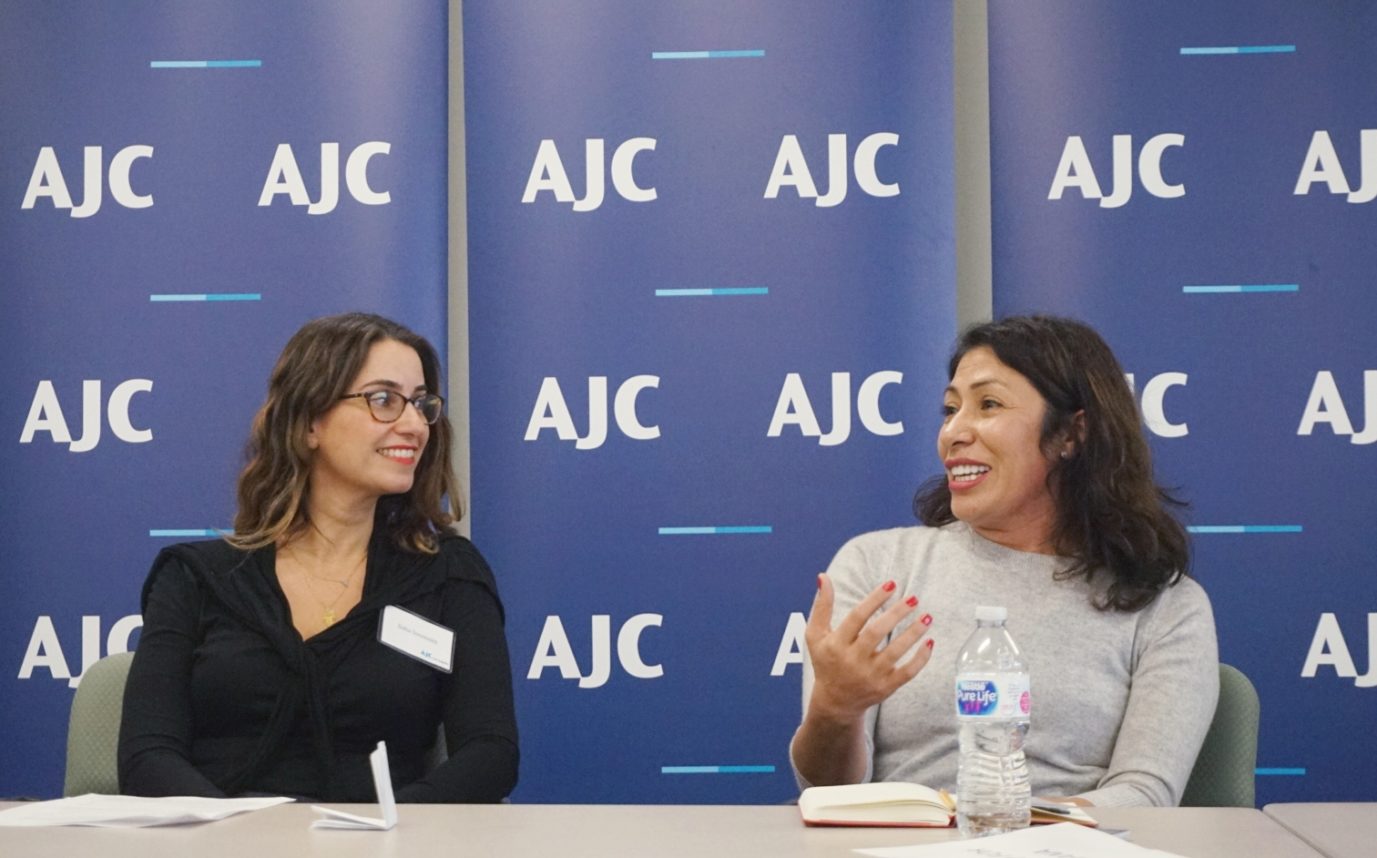
Emiliana Guereca, executive director of Women’s March Los Angeles (WMLA) met with several large Los Angeles Jewish organizations Jan. 9 at a meeting hosted by the American Jewish Committee (AJC) to discuss the Anti-Semitism taking place surrounding the National Women’s March.

Sinai Temple, Temple Emanuel of Beverly Hills, Leo Baeck Temple, Valley Beth Shalom, Stephen Wise Temple, Congregation Kol Ami, Zioness, Jewish Federation of Greater Los Angeles, Jewish Public Affairs Committee of California (JPAC), JQ International, 30 Years After and Jumpstart were among the many in attendance.

Guereca stressed that WMLA does not share leadership, structure or funding with the national Women’s March (Women’s March Inc.) and does not have any input on the makeup of their leadership or decision-making. She also noted that the national Women’s March had taken too long –and did not go far enough — to reject Louis Farrakhan’s anti-Semitism and homophobia. Guereca called for “a new and expanded leadership to form a true national organization.”  

“We commend Emiliana Guereca for standing with the Jewish and LGBTQ communities,” Saba Soomekh, AJC Los Angeles Assistant Director, said. “Jewish women should not be expected to check their identities and values at the door to join a national women’s rights movement. That same demand is not made of any other minority. Further, Jewish women can be proudly Zionist and feminist at the same time.”

The controversy surrounding the national Women’s March comes from its leaders’ ties to Farrakhan and statements made by Linda Sarsour and Tamika Mallory that have alienated the Jewish community.

Jewish social rights organization Zioness has condemned the leaders and Zioness founder Amanda Berman has formed the progressive platform for the L.A. march for those who are Jewish and wish to fight for social causes such as women’s and LGBTQ rights.

In December 2018, Zioness released a statement regarding anti-semitism at the march and condemned the Women’s March alongside other progressive California Democrats.

“We learned that a deep-seated, conspiratorial hatred of the Jewish people was an often unspoken, yet ever-present, fundamental and unifying principle driving the co-chairs’ organizing,” the statement read. “This knowledge makes it impossible for any sincere progressive to march alongside these women.”

Guereca will be speaking at a Los Angeles Zioness chapter event Sunday, Jan. 13 at University Synagogue.

AJC Hosts Meeting Between L.A. Women’s March Leaders, Jewish Groups Read More »

New Pay Model, New Leader at Kadima Day School

Kadima Day School, an independent, nonaffiliated prekindergarten-to-eighth-grade Jewish school in West Hills, is seeking to bolster enrollment by offering a reduced tuition model. 

“Kadima is a jewel of a school, but because of its [enrollment] numbers, a well-kept secret,” new Head of School Steven Lorch told the Journal.

Local real estate developer Shawn Evenhaim, the namesake of Kadima’s Evenhaim Family Campus, has provided the funds to create this new tuition model, now in its second year. The annual fees at Kadima are as follows: early childhood education, $11,600; elementary school, $13,900; and middle school, $14,900. 

Kadima’s lower tuition fees come at a time when non-Orthodox Jewish day schools across the country are grappling with how to attract families that view Jewish education as a luxury, not a necessity.

With a student enrollment of around 200, the school has an annual budget between $4 million and $5 million, Kadima also is a beneficiary of the Jim Joseph Foundation and The Jewish Federation of Greater Los Angeles. 

Among Lorch’s goals for the school are boosting enrollment to around 280-300 and growing current class sizes of around 14 students per class to 18. The new financial model may well be the way to achieve that. Lorch said he already has seen a substantial number of families seeking more information about the school. 

However, he isn’t just focusing on the numbers. In their general studies classes, Kadima students are learning critical thinking, communication, collaboration and creativity – the “Four Cs” of 21st-century learning, according to the National Education Association — while the school’s Judaic studies program is not as far along its in incorporation of these skill sets, said Lorch, who would like to change that. 

“Our teaching of literacy — reading and writing — our teaching of social studies, science, math, that’s the [current] emphasis,” he said. “And so, my goal for Judaic studies is to match that — [for students] to become the same kind of engaged, motivated, independent and collaborative learners that they are in the other academic areas.”

While the Judaic studies program may need an overhaul, Lorch said he is very proud of the Hebrew language skills among the non-Israeli students.

“Without trying to overstate the case,” he said, “their proficiency in Hebrew and the types of texts with which they interact and the types of learning activities in which they engage are more advanced than any school I have been in or any school I have seen or heard of this side of Israel.”

Lorch also touts the relationships between staff and students. Many of the school’s students are Israeli, and while this has the potential to present challenges for non-Israeli families — at another day school in Los Angeles, the disproportionate number of Persian to Ashkenazi students led to tensions among students’ parents — Lorch said the atmosphere at Kadima is one of inclusivity and warmth.

Credit, he said, goes to the Parent Teacher Organization heads, U.S. native Margaret Sinai and Israeli native Dganit Simantov.

“They work hard together to create an atmosphere that is present at every community event that I’ve attended so far, and there have been quite a few,” Lorch said. “And that’s the [feeling] among the students within the school every day, every hour of the day.” 

Further illustrating his point, Lorch recalled his first day on the job. He was standing in the drop-off area watching the students greeting their teachers with hugs. Lorch admits he was shocked. A self-described uptight East Coaster with “hang-ups,” he was accustomed to sexual harassment training forbidding anything but a handshake between a teacher and students over the age of 9 or 10. 

“I’d like to say it was a phenomenon on the first day of school after a couple of months of summer, but it continues every day not only at drop-off but throughout the school,” he said. 

While he may be the new head of Kadima, Lorch comes to the position with a plethora of experience. He was the founding head of the Solomon Schechter School of Manhattan and previously served as the director of professional learning at the Orthodox Shulamith School for Girls in Brooklyn, New York, and as interim head of school at Ben Porat Yosef, a Modern Orthodox yeshiva in New Jersey. He earned his master’s degree in education from Harvard University’s Graduate School of Education and his doctorate in religion and education from Columbia University. He also received rabbinic ordination from Yeshiva University’s Rabbi Isaac Elchanan Theological Seminary.

Bringing all that experience to Kadima, and working with the new tuition model, Lorch is optimistic about the school’s future, especially given the increased interest from families who now may be able to afford to send their children to a Jewish day school. 

“It’s early days yet,” Lorch said. “We don’t want to report on outcomes until we have seen how it actually plays out, but the early indicators are strong.”

New Pay Model, New Leader at Kadima Day School Read More »

Persian Woman Develops a Code for Student Success

When the movie “Big” was released in 1988, grade-school student Shirin Laor-Raz Salemnia knew what she wanted to do: test toys, just like Tom Hanks’ character in the movie. Her computer science teacher at Fairburn Elementary in Westwood taught her how to code, and Salemnia believed anything was possible. 

Born in Tehran, Salemnia’s family moved to Israel when she was 18 months old. Six months later, the family decided to come to Los Angeles. Despite her techie dreams, Salemnia’s family wanted her to pursue a more traditional career, perhaps in law or medicine, but Salemnia remained true to her calling. 

In the early 2000s, armed with a bachelor’s degree in child psychology from Cal State Northridge, and through a combination of networking, research and sheer determination, Salemnia began her professional career at Mattel working on Barbie. She went on to work at MGA Entertainment as the brand manager for the billion-dollar Bratz dolls brand and created MGA’s in-house research center, Play Lab. 

Eventually, Salemnia decided to branch out on her own, founding PlayWerks, an interactive media company that creates multiplatform immersive games and experiences. 

“For me it’s all about tikkun olam, living on purpose, knowing what my mission is on this planet, and making a difference,” Salemnia told the Journal. “My quest for giving back comes from learning about the history of the Jews in Hebrew school and from my bat mitzvah portion, which was Bereshit (Creation). Then, when I was searching for meaning and purpose, learning Kabbalah gave me a lot of insight on creation and opened the door to the Jewish way of giving back to others.”

“Everyone has a purpose and mission on this planet. When you find out what that is, let it guide you.” ­ — Shirin Laor-Raz Salemnia

Through WhizGirls, Salemnia goes into schools to lead hackathons, which focus on project-based learning and entrepreneurship. In 2013, she hosted the first Hackathon for Women and Girls with the White House Council on Women and Girls. In May 2014, Salemnia hosted the Kids Hack for LA in collaboration with Mayor Eric Garcetti, the White House and will.i.am’s i.am.angel Foundation.

Since August 2013, 3,700 children have participated in her Academy, which, she said is “girl focused, boy inclusive.” 

At each hackathon, a tech founder speaks with attendees about how they established their careers. “Our last keynote person was from NASA/JPL,” Salemnia said. “There’s always healthy food, coding and learning about how to be an entrepreneur.”

During the coding sessions, Salemnia helps the students generate ideas by asking them, “What can you do to make your life easier? Or how can you make your school better? Or what do you want to do to make a difference in the world?” Students have come up with ideas to help the homeless, for beach cleanup and fixing the drought. Once they’ve honed in on their ideas, they pitch them “Shark-Tank”-style and win prizes.

“In the end, if they want to continue, we connect them with people who can help their more advanced vision come to life,” Salemnia said. “And some of them have continued and done some really
cool things.” 

Salemnia believes it’s invaluable for students to be open to new careers in technology. “Everyone has a purpose and mission on this planet,” she said. “When you find out what that is, let it guide you. Don’t listen to the naysayers. You will feel fulfilled to live a purpose-driven life.”

Persian Woman Develops a Code for Student Success Read More »

JVP Posts, Deletes Tweets Defending Palestinians’ ‘Right to Resist Military Occupation’

Jewish Voice for Peace (JVP) tweeted out a defense of Palestinians’ “right to resist military occupation” and then proceeded to delete those tweets.

On Wednesday morning, JVP shared a piece of art from 1978 that showed a Jewish woman shaking hands with an armed Palestinian woman with text that read, “Being Jewish is not the same as being a Zionist!”

https://twitter.com/jvplive/status/1082997223200358400

Several people pointed out that the fact there is an armed Palestinian woman in the picture, which does not promote peace, prompting JVP to respond numerous times that they support “the right to resist military occupation”:

The aforementioned tweets from JVP were later deleted without an explanation given on their Twitter page. JVP did not respond to the Journal’s request for comment as of publication time.

Roz Rothstein, co-founder and CEO StandWithUs, told the Journal in a statement via email, “Most Jews believe in Zionism and a better future for all people in the region – there is no contradiction.”

“JVP’s manipulative propaganda aside, one can support the rights of both Jews and Palestinians at the same time,” Rothstein said. “Furthermore, this is yet another example how JVP is not a voice for peace or the well-being of Jews. It is particularly outrageous that they would share an image supporting the PLO [Palestine Liberation Organization] in 1978 – the same year as the Coastal Road Massacre. 38 Israeli civilians, including 13 children, were murdered in that attack by the terrorists JVP is glorifying.”

Similarly, Rabbi Marvin Hier, founder and dean of the Simon Wiesenthal Center, told the Journal in an emailed statement, “Of the 14 million Jews in the world, the majority of them are Zionists.”

“In 1938, no country in the world, including Western democracies, were willing to save Europe’s Jews,” Hier said. “The State of Israel and Zionism are the only guarantee that that will never, ever happen again.”

For more on JVP’s anti-Zionism, read the Anti-Defamation League’s profile on them here.

JVP Posts, Deletes Tweets Defending Palestinians’ ‘Right to Resist Military Occupation’ Read More »

Soy Vay: Teriyaki and the Magic of the Unexpected

Like almost every Jew I know, I seem to have a microchip installed somewhere in my body that is programmed to a default factory setting that considers fatty fish, beef, chicken or tofu covered with a heavy shellac of salt and sugar and served over rice or noodles to be, for lack of a better term, the bomb.

Just the word “teriyaki,” for example, conjures up fond memories of Chun King mini egg rolls that are still sold in the frozen food section (but rarely seen at parties anymore) and the packets of sweet chili sauce or Chinese mustard “included” in the box. If you grew up a Jewish kid in the suburbs, eating in restaurants close to your cul-de-sac that served pupu platters with flaming blue gel in the center and Mai Tais (with orange slices, maraschino cherries and paper umbrellas), or if your Christmas tradition involves Chinese food and a movie, this is your soul food!

Teriyaki is a simple Japanese technique for meat that’s been around since the 17th century and produces a gorgeous piece of protein. In Japanese, “teri” means “to glaze” and “yaki” translates to “grill”; but in America, teriyaki is a flavor profile borne out of decades of immigrants adapting to cheap and plentiful local ingredients. Although the Japanese developed the concept of umami (the savory fifth taste), Asian cooks tend to let the freshness of the ingredients shine through and use sugar, salt, soy sauce and spices to their advantage, not to overpower a food. But American teriyaki is defined by excess — overly sweet, overly salty, boldly flavored. It’s an overt and direct attack on the taste buds, and we’ve come to really like it that way.

Modern Japanese, Chinese, Vietnamese and Korean food in the U.S. has come a long way from the days when fried rice and orange-colored sweet-and-sour pineapple chicken were the go-to orders for restaurant patrons. But there is something remarkable and nostalgic about a flavor profile like teriyaki, and it has little to do with its origins. Certain foods have infiltrated Americana through chain restaurants and fast-food establishments to become part of our national taste memory. Like lasagna and tacos, these American staples bear just enough resemblance to their origins to make them recognizable; but they are, first and foremost, a perfect example of an adaptation of immigrants to their environment. Teriyaki, for example, was brought to Hawaii by Japanese sugar cane workers in the mid-1800s, but ingredients for the simple-to-prepare sauce — soy sauce and mirin (a sweet rice wine) — were quickly modified to save money. Soon, the sweet mirin was replaced entirely by cane sugar (which makes sense on a sugar plantation), and by the 1920s ginger, garlic and green onion were added — most likely an influence brought by the influx of Chinese immigrants to Hawaii. 

Teriyaki really got interesting after World War II. American GI’s serving overseas became obsessed with all things Polynesian.

But teriyaki really got interesting after World War II. American GI’s serving overseas became obsessed with all things Polynesian. By the 1960s, cheap wheat to make soy sauce and mega sugar cane production created a perfect storm in which the flavors of the East slowly infiltrated restaurant menus, home décor and party food. Egg rolls, rumaki and crab rangoon became all the rage, but teriyaki sauce was the gateway drug — salty, sweet, sticky, simple to prepare and not too exotic as to intimidate. We knew these flavors and they became part of us. 

Today, most American households have a bottle of teriyaki sauce in the fridge, and what’s more incredible is that teriyaki has completely changed from a description of a Japanese cooking technique to a pourable sauce, marinade and food category. Kikkoman’s original teriyaki sauce is the best-seller on the market today and is considered “best in its class,” boasting the sugary, pineapple flavors of Hawaii and the salty authenticity of a Japanese brand. But it shouldn’t surprise you to know that Soy Vay’s Veri Veri Teriyaki, the brainchild of a Jewish and Chinese-American couple, comes in a solid second. Soy Vay adds more Chinese ingredients to the sauce: ginger, garlic, onion, sesame seeds and sesame oil. Soy Vay managed to produce an entirely new (and kosher) teriyaki by building on the suburban Jews’ Chinese restaurant flavor profile in an authenticity-obsessed foodie landscape. And Soy Vay did this unashamedly by moving further away from the original Japanese soy sauce and mirin formula, and without being “authentic” about it in any way.

The result — one of the many ironies of modern-day cooking — is that now when I make teriyaki chicken, salmon or meatballs in my café, I have to adapt the original technique and recipe to the American palate, which unexpectedly merged to form a whole other thing. We’ve distilled the abundance of flavors, methods and ingredients from centuries of other cultures into some of our own, and what we’ve come up with is magically delicious and quintessentially American. 

Here is my version of Soy Vay, just in case you don’t like soy as the first ingredient in your food and sugar as the second. But don’t worry. It still tastes like what you remember from your teenage years — that favorite strip-mall Chinese restaurant with tiki torches lighting up the corners.

YAMIT’S “AMERICAN” TERIYAKI GLAZE
2 parts tamari (tamari is gluten-free, but low-sodium soy sauce is fine)
2 parts sake (Japanese rice wine)
2 parts mirin (Japanese cooking win similar to sake but with a higher sugar content)
1 part rice vinegar or white vinegar
1 part white or brown sugar or sugar substitute (I use an erythritol-based sugar substitute called Sukrin)
1 part juice of freshly grated ginger (grate and then squeeze out the juice)
1 part juice of freshly grated garlic (optional but I use it)
1/4 teaspoon toasted sesame oil (optional)
1/4 teaspoon white pepper (optional)

Ingredients are listed as a ratio so cooks can scale up or down accordingly. It keeps in the fridge in a clean glass jar for at least a month. Use in the last moments of cooking to glaze fish, poultry, steaks, tofu or vegetables. You can also use it as a dipping sauce or add it to hamburger meat to create a fantastic teriyaki burger. 

Note: Don’t marinate food in teriyaki; it pulls the juices out of the meat and you don’t want to start caramelizing the sugar in the sauce until you have crisped up its exterior.

Combine all ingredients (except for sesame oil) in a saucepan and cook over medium heat until a drizzle of sauce is thin enough to run down a plate but thick enough to stick.

The sauce thickens upon cooling. After it thickens, whisk in a drop or two of sesame oil and store the glaze in a jar until you want to use it.

You can use any unit of measurement, from tablespoons to cups. The only exception is sesame oil. Sesame oil needs to be subtle or it overpowers.  Its taste should barely be discernible here. I never use more than a teaspoon even for a big quantity of sauce. 

Trust me, make extra.


Yamit Behar Wood, an Israeli-American food and travel writer, is the executive chef at the U.S. Embassy in Kampala, Uganda, and founder of the New York Kitchen Catering Co. 

Soy Vay: Teriyaki and the Magic of the Unexpected Read More »

Weekly Parsha: Bo

One verse, five voices. Edited by Salvador Litvak, Accidental Talmudist

The Lord said to Moses, “Stretch forth your hand toward the heavens, and there will be darkness over the land of Egypt, and the darkness will become darker.”    Exodus 10:21


Rabbi Shlomo Seidenfeld
Scholar in Residence JMI Aish Hatorah, COO Harkham GAON

A close family friend recently told me that she was in a “dark place,” demoralized by the suffering and slow deterioration of old friends. Her phrasing was honest and poetic. Darkness is a fitting metaphor for people who have lost their inner light. In the context of our verse, it also compellingly describes societies whose values have become unenlightened. 

An aggadic midrash describes hoshekh, the ninth plague, as a darkness that was palpable and suffocating, a darkness that immobilized everyone who was enveloped in it. It was not a natural darkness. This was something else. This was more sinister. This was Egypt. Like every empire, Egypt violently and arrogantly imposed its power. It worshipped gods out of fear rather than love, awe and aspiration. It devolved into a dark society where goodness and light were extinguished. It was a culture with no sun, no moon, no stars. A society with no compassion, no generosity, no illumination. The plague of darkness was not merely a punishment, it was an indictment. It was a natural cosmic response to the darkening of Man’s divine light. 

The mission of the Jew coalesced in Egypt. It exhorted Jews to become beacons of light. To inspire, not impose. To radiate, not stifle. To shine, not shun. To illuminate the dark places. May we all attach ourselves to this legacy and may we continue to bring light into all the spheres that we inhabit! Shabbat Shalom. 

Nina Litvak
AccidentalTalmudist.org

The darkness of the ninth plague is darker, a new level of darkness, tangible. It lasts for three days, although the Egyptians lose all sense of time. It feels like the primordial universe before God created light and life. There is no human interaction. People are terrified to even move. Ibn Ezra compared the darkness to sea fog and our sages said it was as thick as a dinar (coin). If you’re afraid to move, the very air becomes oppressive. Devoid of light, movement, human connection and consumed with fear, the Egyptians experience a kind of death.

Moses asked Pharaoh to let his people go worship their God — Creator of light and life — in the desert for three days. The Children of Israel wanted to praise God and sacrifice to God, they wanted to tap into Divine light. Even in their bondage, they maintained their devotion to their Creator, and their respect for life. Pharaoh wouldn’t let them spend three days celebrating the Creator of light and Giver of life. Now he and his people are suffering three days of the complete absence of light and life. Denying the Creator means losing the benefit of His creations. 

While the Israelites are scurrying around excitedly, packing and helping others get ready for the great escape, racing to beat the clock, each Egyptian is sitting completely still and utterly alone in oppressive, timeless darkness. What a stark contrast between a life spent worshipping God and a life spent worshipping man.

Professor Tova Hartman
Ono Academic College, Israel 

Darkness does not suddenly descend upon Egypt; first, Moses must “hold out [his] arm toward the sky.” This is the typical pattern of the previous plagues, which are initiated by Moses or Aaron. It is a pattern that is new to the Book of Exodus. In Genesis, God destroys the builders of the Tower of Babel or overturns the cities of Sodom and Gomorrah without any human initiation. This pattern is very persistent in Exodus, culminating in the declaration that after crossing the Red Sea, “They had faith in the LORD and his servant Moses” (Exodus 14:31). 

It is not realistic to expect slaves who had been completely intimidated by the brute force of the Egyptians and the magical powers of their priests to suddenly believe in the promise God gave to Abraham. Their mindset and beliefs cannot be changed immediately. They must see Moses and Aaron over and over again beating the Egyptians at their game, teaching the Israelites that we are stronger than the Egyptian people who enslaved us. 

Leaders must meet people where they are, but leaders fail if that is all they do. They also must bring a vision of transformation and the means to accomplish it. The result of Moses’s leadership style in Egypt is successful because he brings God’s vision to the people where they are. That is what transforms palpable darkness into light and leads to a much larger goal: a newfound faith in God that culminates in the covenant at Sinai.

David Brandes
Writer-producer best known for “The Quarrel”

Consider the prizefighter as he decks his opponent. Immediately, he raises his hands to the heavens in victory. Now consider the captured prisoner of war. He too raises his hands to the heavens, but in defeat. Curious, isn’t it, that the gestures for triumph and submission are exactly the same all over the world? 

In this week’s parsha, Moses is instructed by God to raise his hands to the heavens and a thick darkness is brought down on the Egyptian people. The Israelites, however, were spared. Their homes were filled with light. This raises the question: Did Moses lift his hands in triumph or in defeat? No simple answer here; I suppose it depends on whose side you are on. 

For Moses and the Israelite slaves, it was another step in removing from their backs the oppression of the Egyptians as well as a further sign of God’s commitment and the breathtaking scope of His powers. For the Egyptians, it was sheer misery, brought on by their Pharaoh and by themselves. 

From God’s perspective, it was both. God is the creator of the universe and all of the inhabitants are His. God does not play the game of moral equivalence, to be sure, but as we learn later at the Red Sea, God is saddened by the suffering of all. 

It is important for us to keep in mind that a shadow accompanies virtually every triumph. 

Rabbi Gabriel Botnick
Mishkon Tephilo, Venice

Although commonly translated as “toward the heavens,” the Hebrew actually states “upon the heavens.” What strange language! How could Moses, an Earth-bound human, stretch forth his hand upon the heavens? 

From this single word, the Midrash extrapolates that God lifted Moses up to the heavens so he could stretch out his hand and darken everything below. The rabbis explain that, having initially created the heavens and Earth as mutually exclusive realms, God came to realize the necessity of enabling beings to traverse between the two. In this instance, humankind is permitted to ascend to the heavens. On other occasions, God utilizes this bridge to descend to Earth. 

This blurring of boundaries between the heavens and Earth is an incredible gift not only for Moses but for all of humankind. The Midrash teaches that the heavens are far closer than we think and that we can engage with them whenever we want — like Moses, we simply need to direct our attention toward the will of God. 

This is precisely the goal of living a spiritual life. When we bless over food, acknowledge the beauty of nature or marvel at the miracles of life, we are fulfilling God’s will and bringing ourselves closer to the Divine. When we engage in acts of kindness and charity, our souls are joined with the heavens above. If we allow the Divine to guide our actions here on Earth, every moment — whether significant or mundane — is an opportunity for us to encounter the heavens.

Weekly Parsha: Bo Read More »

The 2019 Mensch List

For our 14th annual mensch list, we asked readers to nominate people they know who are doing extraordinary work without receiving deserving credit for it.

We couldn’t publish every submission, but the 12 stories that follow, including the husband and wife who throw birthday parties for homeless children on Skid Row, the retired educator who continues to teach as if working full time, and the high school class president who volunteers with special needs children, are inspiring examples of what it means to be animated by action, not accolades. 

Happy 2019.

Click on the mensch names below to read about what they are doing around the community. 


1.Heather Wilk


2.Jake Schochet


3.Ari Kadin and Mary Davis


4.Meryl Kern


5.Michele Rodri


6.Naomi Goldman


7.Dennis Poncher


8.The Schenkman Family


9.Luisa Latham


10.Ray Mallel


11.Phyllis Folb


12.Cantor David Shukiar

Photos by Cyndi Bemel

The 2019 Mensch List Read More »

Women’s March Cleveland Condemns Anti-Semitism

Women’s March Cleveland released a statement condemning anti-Semitism on Monday, an apparent indirect reference at the anti-Semitism allegations dogging the national Women’s March leaders.

Kathy Wray Coleman, an organizer for Women’s March Cleveland, said in a statement, “Women’s March Cleveland does not condone anti-Semitism, racism, bigotry, sexism, Islamophobia or any other forms of discrimination, and we urge our Jewish sisters in greater Cleveland and elsewhere to march with us.”

She added, “Jewish women are our sisters, and we have to work through this because… there’s a larger issue at stake in terms of what’s happening in D.C., and what’s happening in terms of policies with respect to the president.”

The National Council on Jewish Women Cleveland is among the groups that have been invited to speak at the Jan. 19 march in Cleveland.

Other Women’s Marches around the country have been canceled, including those in New Orleans, Chicago and Humboldt in Northern California, although not all of them have been the result of the anti-Semitism controversy with the national leaders. In the case of Humboldt, the organizers were concerned that the participants were too white.

Women’s March Cleveland Condemns Anti-Semitism Read More »

Hulu Axes Silverman’s ‘I Love You America’

Hulu has no more love for “I Love You America.” The streaming service has canceled Sarah Silverman’s variety-talk series after one 21-episode season.

“Well, Hulu canceled ‘I LOVE YOU AMERICA’ and we’re all pretty damn heartbroken. … So in traditional twitter funeral style, I’ll be RTing the love,” Silverman tweeted the news.

The comedian co-produced the series with Adam McKay, Amy Zvi and Gavin Purcell, for Funny or Die, which released a statement in reaction.

“We are so proud of ‘I Love You, America’ and congratulate Sarah, the producers and the entire team for engaging thoughtful conversation and showcasing such diverse points of view every week,” it read. “Whether it was connecting with firemen in Mineola, Texas, over ‘pooping their pants’ stories, or going on a blind date with a conservative lobbyist in D.C., Sarah’s commitment was boundless and there is nothing more to say.”

Hulu Axes Silverman’s ‘I Love You America’ Read More »