fbpx

January 3, 2019

Rosner’s Torah Talk: Parshat Vaeira With Rabbi Jenny Solomon


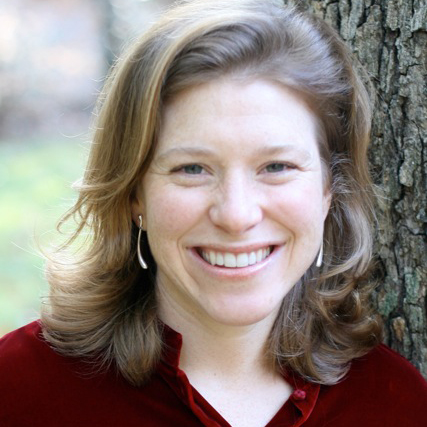
Our guest is Rabbi Dr. Jenny Solomon from Beth Meyer Synagogue in Raleigh, NC. Rabbi Solomon received her undergraduate degree from Brown University, was ordained from Hebrew Union College-Jewish Institute of Religion, and completed a doctorate in counseling from the Postgraduate Center for Mental Health. Solomon spent extensive time studying in Israel and was awarded a Wexner Fellowship. She currently chairs the Wexner Alumni Coordinating Committee and remains active in the larger Wexner community. Rabbi Solomon is also active in the Institute for Jewish Spirituality community (known as Hevraya). As an alumna of their clergy cohort program and a participant in their Jewish Mindfulness Meditation Teacher Training program, Rabbi Solomon considers contemplative practices to be at the center of her rabbinate.

In parshat Vaeira, Moses and Aaron repeatedly come before Pharaoh to demand “Let My people go”. Pharaoh repeatedly refuses And God then sends a series of plagues upon the Egyptians.The waters of the Nile turn to blood; frogs overrun the land; lice infest people and beasts. wild animals invade the cities; a pestilence kills domestic animals; boils afflict the Egyptians. Fire and ice descend from the skies as a devastating hail.


https://www.youtube.com/watch?v=-TT8OQHMCCI&feature=youtu.be


Previous Torah Talks on Vaeira

Rabbi Daniel Brenner

Rabbi Edwin Goldberg

Rabbi Adam Kligfeld

Rabbi William Cutter

Rabbi Craig Marantz

Rosner’s Torah Talk: Parshat Vaeira With Rabbi Jenny Solomon Read More »

ADL: ‘Chilling’ That Ojai Students Formed Swastika on Campus

The Anti-Defamation League told the Journal in an email that the fact that nine students at an Ojai, California, middle school joined together to form a swastika on campus in December was chilling.

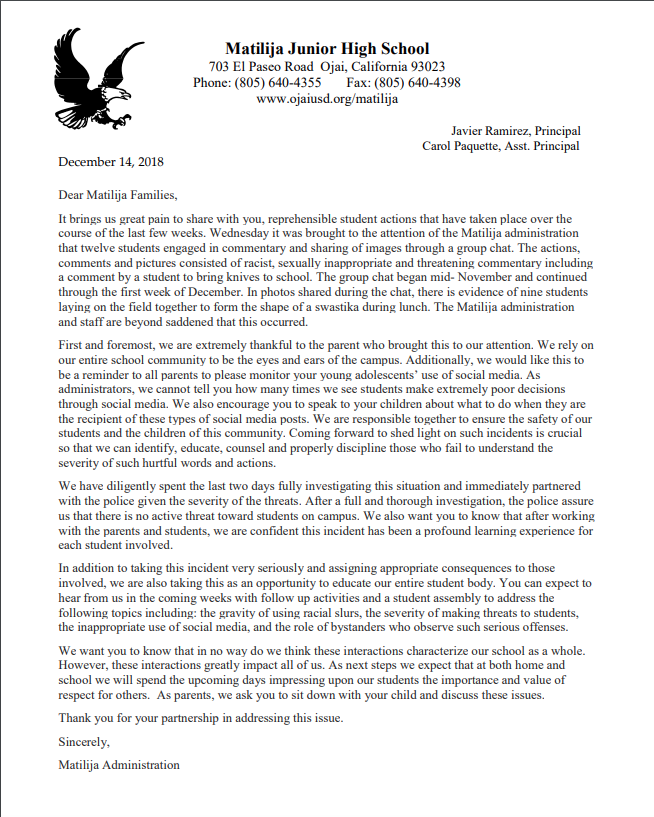
The Los Angeles Times reported that Matilija Junior High School sent a letter on Dec. 14 to parents explaining that the nine students laid down together on a field to create a human swastika. The letter also noted that there were 12 students who were part of a group chat that contained “racist, sexually inappropriate and threatening commentary, including a comment about bringing knives to school,” per the Times.

Sgt. Shane Matthews from the Ventura County Sheriff’s Office told the Times that one of the posts in the chat featured a student who shared a photo of a sword, although the police determined that none of the students posed a threat to the school. The school is disciplining the students though, according to Matthews.

Ojai Unified School District Superintendent Andy Cantwell told the Times that the district is looking into ways to provide “sensitivity” education to the school and the district.

“It does not represent the character of our school. … It also doesn’t represent the character of these students,” Cantwell said. “They made very poor choices, not understanding the gravity of these symbols.”

Cyndi Silverman, director of the Anti-Defamation League’s (ADL) Santa Barbara and Tri-Counties Region, told the Journal in an emailed statement that the students forming a human swastika was “chilling.”

“We’re glad the school is taking steps to address the issue, and plan to offer our anti-bias education programs to the district,” Silverman said. “In 2017, we saw a 94% increase in hate incidents in K-12 schools, and, unfortunately, this is yet another example of this disturbing trend. This is reminder of the ongoing need for Holocaust and anti-bias education in our schools.”

Simon Wiesenthal Center Associate Dean Rabbi Abraham Cooper similarly suggested in a statement sent to the Journal via email, “The entire middle school students and adults need to spend time at the Museum of Tolerance.”

“This isn’t just about a school,” Cooper added. “How we treat the other is one of the key lessons learned or unlearned in school. It’s a matter of accountability and an opportunity for the school and the community.”

Roz Rothstein, daughter of Holocaust Survivors and CEO of StandWithUs, an international Israel education organization, told the Journal in an email, “The school has a responsibility to teach, and this is clearly a profound teaching moment.  Unfortunately, some students may think it is ‘cool’ to invoke images of swastikas without realizing what it really symbolizes and how many people died as a result of that deadly symbol and the dangerous racists who promoted it.”

“School administration, teachers and parents must educate students about the terrible consequences of hatred and racism,” Rothstein added. “This is a perfect time for sensitivity training and to bring in a Holocaust survivor who can tell their own story. There can be no room for racism of this, or any nature, and when things like this come up it must be treated seriously.”

The full letter, which was obtained by the Journal, can be seen below:

ADL: ‘Chilling’ That Ojai Students Formed Swastika on Campus Read More »

Iran Meets with Palestinian Islamic Jihad Leaders

The Iranian regime met with leaders of the Palestinian Islamic Jihad (PIJ) terrorist organization in Tehran on Monday, where the PIJ terrorists reportedly bragged about their ability to unleash “thousands of missiles” against Israel.

Iran’s Press TV reported that the meeting included Iranian Supreme Leader Ayatollah Ali Khamenei and PIJ Secretary General Ziad al-Nakhala. Islamic Jihad reportedly told the Iranian leaders that they and Hamas were in a prime position to launch attacks against Israel.

Iran also reportedly signaled that they and Hezbollah “will support the Palestinians in the next conflict,” indicating “a threat of launching a multi-front war against Israel,” according to the Jerusalem Post.

Khamenei also praised PIJ for what he saw as the weakening of Israel.

“During the previous two wars, the Zionist regime called for truce after 22 days on one occasion and eight days on another, but in the latest confrontation it requested a ceasefire after only 48 hours,” Khamenei said. “This means the Zionist regime has been brought to its knees.”

A senior congressional official told the Washington Free Beacon, “Iran is finding every new way to attack Israel and interfere with America’s efforts to bolster our Israeli allies.”

“One day it’s Hezbollah attack tunnels. Another day it’s drones from Syria,” the official said. “Today it’s apparently Palestinian attack tunnels. The only way this stops is if the U.S. Treasury Department and Congress finally drain them of resources.”

Sen. Ted Cruz (R-Tex.) tweeted in response that he is leading an effort to crack down on Iran’s finances:

The meeting came after President Trump announced that the United States will be completely withdrawing its forces from Syria.

Iran Meets with Palestinian Islamic Jihad Leaders Read More »

God and Moses are Keeping Secrets – A poem for Parsha Vaera (Aliyah 1)

I appeared to Abraham, to Isaac, and to Jacob with [the name]
Almighty God, but [with] My name YHWH, I did not become known to them.

If God walked amongst us,
what would we call him or her?
What name would we use if God
was sitting two bar stools away?

Who’s your friend? they’d ask
and we’d stutter like Moses
realizing we never knew.
What have we been calling

God this whole time
when we cry out, when we
ask for things? Who are
you talking to we deserve

to be asked and, I think we
deserve to know the answer too.
I’m not a big fan of labels, but
I do like names.

I think it’s time we learned Yours.

How then will Pharaoh hearken to me,
seeing that I am of closed lips?

You have to wonder with
God’s hidden name as his example
if Moses’ closed lips are just him
keeping secrets and not

a stutter after all? What isn’t Moses
prepared to tell the Pharaoh?
He smells like the Nile or the
details of future plagues have

already been written down.
I’d keep my lips closed too if
I had infinite frogs ready to go.
The best negotiators use their

words sparingly. Any deal a
gamble with what is truly available.
I say keep your lips closed and
your frogs close to your chest.

Your people will be crossing the sea
in no time.


God Wrestler: a poem for every Torah Portion by Rick LupertLos Angeles poet Rick Lupert created the Poetry Super Highway (an online publication and resource for poets), and hosted the Cobalt Cafe weekly poetry reading for almost 21 years. He’s authored 21 collections of poetry, including “God Wrestler: A Poem for Every Torah Portion“, “I’m a Jew, Are You” (Jewish themed poems) and “Feeding Holy Cats” (Poetry written while a staff member on the first Birthright Israel trip), and most recently “Donut Famine” (Rothco Press, December 2016) and edited the anthologies “Ekphrastia Gone Wild”, “A Poet’s Haggadah”, and “The Night Goes on All Night.” He writes the daily web comic “Cat and Banana” with fellow Los Angeles poet Brendan Constantine. He’s widely published and reads his poetry wherever they let him.

God and Moses are Keeping Secrets – A poem for Parsha Vaera (Aliyah 1) Read More »

Rep. Tlaib’s D.C. Office Map Has ‘Palestine’ Sticky Note Over Israel

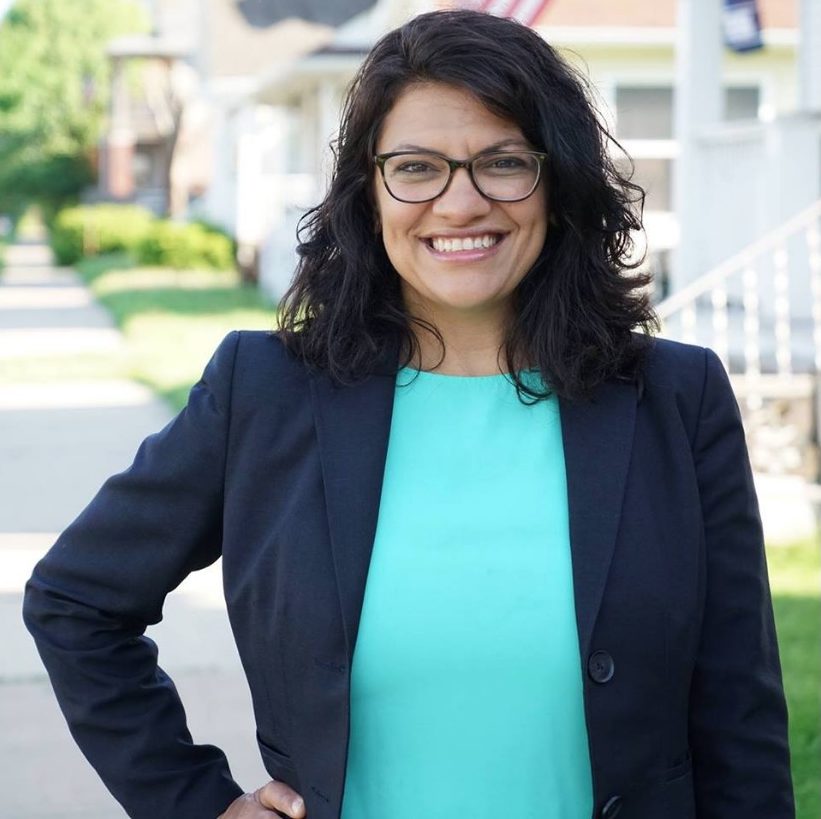
A map in newly sworn-in Rep. Rashida Tlaib’s (D-Mich.) office has a “Palestine” sticky note where Israel should be.


Here is the photo of the map:

The note was roundly mocked and condemned on Twitter:

https://twitter.com/JordanSchachtel/status/1080890014861586433

https://twitter.com/NoahPollak/status/1080898906412613632

Simon Wiesenthal Center Associate Dean Rabbi Abraham Cooper told the Journal in an email, “There is no country called Palestine.”

“The territory upon which the word ‘Palestine’ is affixed on this map is called the Palestinian territories,” Cooper added. “Palestinian statehood will be achieved, if and when, the Palestinian leaders are prepared to recognize the validity of the Jewish State as their neighbor.”

Tlaib was sworn into Congress on Thursday, with Women’s March leader Linda Sarsour attending. Tlaib supports a one-state solution and is a supporter of the Boycott, Divestment and Sanctions (BDS) movement.

Rep. Tlaib’s D.C. Office Map Has ‘Palestine’ Sticky Note Over Israel Read More »

Your Turn: Persians Under Pressure, More Steps to Walk Safe, Bloch Says It Right

Persians Under Pressure
We need to see our children as individuals, not as an extension of our needs and pride (“Silent Pain,” Dec. 14). When you are an alcoholic the first thing you are told to do is say that you are. Persian families need to be able to say: “My child is an addict.” “My child is suffering from depression.” “My child is not doing that great in school.” “My child was molested.” The second sentence should then be, “But I love my child, I am not ashamed of my child, and I will do everything it takes to get my child help.” Only then will their children feel comfortable and free to go to their parents for help.

Like the article says, what good is getting help when their child comes home and is then shunned or made to feel like a failure? What do these parents want? A child who will get help and move on to a successful life or a child who might be lost forever or live forever in torment? I would be just as proud of a child of mine who was a professional or a blue-collar worker that was an asset to society and living a healthy, productive life. We give birth to children, not professionals, whose lives revolve around making our dreams come true.
Miriam Fiber, Los Angeles 

More Steps to Walk Safe
I am compelled to add to Sherri Ziff’s list of how to avoid being hit by a car as a pedestrian (“How My Hit-and-Run Could Save Your Life,” Dec. 14).

As a person who walks miles every day, by myself or strolling with my grandchildren, I realize I take my life in my hands with each outing. Cars have come out of nowhere, swerving to within an inch of mowing me down. And all too often, the young drivers behind the wheel either laugh or just stare with no apology. For several years in the classes I teach at USC, I have invited two women to speak to this new generation. One woman was texting and killed an elderly man. The other woman lost her 16-year-old son to a young female driver who was talking and texting on her cellphone. So here are my additional rules to add to Sherri’s:
1. When you are driving, get off your phone — completely.
2. When you are walking, know that many drivers are on their phones, either talking or clicking. They are not seeing you.
3. Never step off a curb without catching the eyes of all the drivers who are at stop signs or about to come to a stop sign. Then, cross.
4. When crossing in a crosswalk that goes across a freeway exit, make sure you are aware of all the drivers flying off the freeway who are ready to make a right-hand turn but aren’t thinking a pedestrian might be in the crosswalk.
5. Use the flashlight on your cellphone when you are walking at night. Wave your phone back and forth so drivers in both directions see you, even when you are on a quiet side street.
6. When crossing an alley, driveway or underground parking lot exit, stop and stay aware. People zoom out of these locations onto the streets never thinking a pedestrian is coming.
Gary Wexler, Via email

Bloch Says It Right
Karen Lehrman Bloch expressed very clearly why anti-Zionism is the new, 21st-century mask for anti-Semitism (“A Missed Virtue Signal,” Dec. 21). But she misses the real danger from Michelle Goldberg’s piece: that it threatens to establish “Anti-Zionism Is Not Anti-Semitism” as a valid point of view among various perspectives. That idea is not a valid point of view because it’s thoroughly false.

Zionism — the striving of the Jewish nation for our own sovereignty and for our continued flourishing in Israel — has always been a central aspect of Judaism. It’s inseparable from Judaism because it partly defines Judaism. That’s one reason anti-Zionism is inherently anti-Semitic.

Also, Israel is where Jews suffering persecution (such as in today’s Europe) can go to live in freedom. Anti-Zionism lends a hand to anti-Semitic persecution by attacking the safety net, trying to cut off escape. As such, it’s an attack on all Jews, everywhere. Anti-Zionism is a required tool of those who would aspire to genocide, heaven forbid.
If someone wants to claim “Anti-Zionism is one point of view,” that’s fine, but they can’t avoid the fact that it’s serious anti-Semitism.
David Ruhm, Via email

Sephardic Spain Still Worth a Visit
Thank you for publishing Roberto Loiderman’s recent article about Toledo, Spain (“Toledo’s Ancient Jewish Quarter Stirs Old Anxieties,” Dec. 21). As a Sephardic rabbi and a descendant of Jews who left Spain in 1492, I am always pleased to see stories about our ignored community and history. While I agree with much of what Loiderman had to say, including the errors and omissions at the historic synagogue sites, El Transito and Santa Maria La Blanca, I believe there is much more to the story that needs to be told.

During my tenure as rabbi at Sephardic Temple Tifereth Israel, I developed a relationship with the consulate of Spain, and as a result was introduced to a remarkable woman, Vivianne Schael. Through her company, Exclusively Spain USA, Schael has devoted herself to exposing Jews and non-Jews to the real history of Sephardic Jewry, and has worked tirelessly with the government and other agencies to improve and enrich the experience of those wishing to explore Sephardic Spain while at the same time building bridges between the Jewish and Christian communities. My first trips to Spain were arranged by Schael and the consulate and were very different than the typical tourist experience.

I recently returned from a trip to Spain arranged by Schael, where in addition to visiting Toledo and meeting with it’s archbishop, I led a group through Extremadura and explored seldom-visited cities that offer a unique window into the Sephardic past. Accompanied by Marciano Martin Manuela, pre-eminent historian of Sephardic Extremadura, we explored Placencia, Caceres, Trujillo and Hervas. In Hervas I had a reunion with my friend Abigail Cohen, a Sephardic Israeli who returned to Spain more than three decades ago to become a celebrity chef whose Sephardic pastries are sold throughout the country. They are sold in almost every museum and former synagogue, including El Transito and Santa Maria La Blanca. Despite the flaws (and there are many) in those institutions, it warmed my heart to see Sephardic delicacies my grandmother would have been proud of, lovingly baked by a Sephardic returnee.

Walking in the streets of Toledo at night, one cannot help but notice the laser light displays projecting menorahs and Jewish symbols on the streets as well as paying tribute to the people who were such an important part of Spanish history.

Working with the Spanish government, I have been proud to help many people on their path to receiving dual citizenship, something both Spain and Portugal are offering to Jews of Sephardic ancestry.

So yes, while there are certainly things that need to be improved, I am more heartened with every trip I take that there is truly a sense of regret and atonement in addition to the commerce behind the Spanish government’s outreach to Jewish travelers. Yes, the Catholic Church of Spain is very conservative and slow to change, but I truly believe that through dialogue and good faith, change can and will come.
Rabbi Jay Shasho Levy, Sherman Oaks

CORRECTIONS
The age of Bat-El Borenstein and the name of her one-woman show were incorrect in a story in the Dec. 21 edition (“The Pint-Sized Star”). She is 30. The name of her show is “I Am Bat-el.”


Don’t be shy. Send your letters to letters@jewishjournal.com Letters should be no more than 200 words and must include a valid name and city. The Journal reserves the right to edit all letters.

Your Turn: Persians Under Pressure, More Steps to Walk Safe, Bloch Says It Right Read More »

Report: PA to Extradite Jailed Palestinian-American to U.S.

The Palestinian Authority (PA) is planning on extraditing the Palestinian-American who was jailed for selling land to Jews, to the United States, according to a report from the Israeli television network Kan.

The report quotes an anonymous official from the PA stating that the jailed Palestinian-American, 57-year-old Issam Akel, “has become a burden on us.” The United States had been putting heavy pressure on the PA to release Akel.

When the Times of Israel asked the U.S. embassy in Jerusalem  about the report, they were directed to a prior statement that “when a U.S. citizen is incarcerated abroad, the U.S. government works to provide all appropriate consular assistance.”

On Monday, it was reported that Akel had been sentenced to life in prison for allegedly selling land in Jerusalem’s Muslim Quarter to the Israeli Jewish organization Ateret Cohanim; under PA law, selling land to Jews is a crime that can be punishable by death. Each death penalty sentence has to be approved by PA President Mahmoud Abbas.

Akel is a resident of East Jerusalem and was arrested in Ramallah in October; it is still not known how exactly he wound up in Ramallah.

Report: PA to Extradite Jailed Palestinian-American to U.S. Read More »

The Bookends of Life by Jean B. Berman

The call came from a woman I liked and had learned from: would I consider participating in a Taharah – a what? Someone had died and she was spearheading a new initiative to offer the traditional Jewish ceremony of purification. I was hesitant but open, and after more conversation decided I would give it a try. I felt unsure – what would it be like to cleanse a dead body? Would there be a smell? Could I handle it or would I want to leave?

The woman who had called me led the team as we met together in a room of a local funeral home. She asked for questions and feelings, which we discussed. When we were ready, our leader set a sacred tone into which I relaxed. Praying to the soul of the deceased woman, we let her know our intention of offering honor, respect and comfort, and asking forgiveness in advance for anything we did or didn’t do that missed the mark. That was reassuring.

The sights and smells of the funeral home were unfamiliar and felt challenging. What was I doing there? As one woman was directed to begin reading the prayers for the ceremony, the rest of us gently, and with reverence began to prepare the body of the deceased. The liturgy was mostly unfamiliar to me. We were all learning. We debriefed afterward, talking about and giving thanks for the opportunity. I left with deep gratitude for the sacredness of the experience.

During my second Taharah, I found myself feeling how much this was like welcoming a newborn baby with tenderness and care. I imagined and wished that all those in the process of dying and everyone on Earth could have this experience. I sent wishes of peace and blessing out to those in the dying process everywhere, that they might feel held, comforted and honored. I had a deep sense within that I was born to do this work.

Over time the spiritual experience of Taharah and Shmirah have deepened for me. I have immersed myself in learning and sharing aspects of these sacred traditions with others.


Jean Berman speaks and leads workshops on Honor and Comfort: The Jewish Way of Death and Mourning, Care of the Newly Dead – An Inquiry into Intuition and Tradition, and How Death Enhances Life: Heightening our Awareness. She enjoys walks in nature, kayaking and playing ukulele, and lives on Peaks Island, Maine. She is a graduate of the Gamliel Institute, and has served as an Instructor. She is a Board member of Karvo v’Nichum. 

_____________________

Kavod v’Nichum 17th Annual Chevrah Kadisha Conference

Watch for information on the 17th Annual Kavod v’Nichum Conference, to be held June 2-5, 2019 in Fort Collins, CO. Early Registration will open in January. Hold those dates.

Gamliel Students are encouraged to plan to attend the Gamliel Day of Learning that will immediately follow the Conference, running until June 6 mid-day. Again, watch for information on how to register to appear soon.

_____________________

Gamliel Courses

The next course in the cycle of core courses offered by the Gamliel Institute will be Course 2 – Chevrah Kadisha: Taharah & Shmirah. It will be offered live online during the Winter from January 8 – March 26 on Tuesday evenings, for 90 minutes each week for 12 weeks. The classes will begin at 5 p.m. PT/8 p.m. ET. Primary instructors will be Rick Light, assisted by Holly Blue Hawkins, with guest instructors.

Registration is now open – click here.

___________

Gamliel Café

Gamliel Students are invited to a free informal online session, held monthly. On the third (3rd) THURSDAY of each month, different person(s) will offer a short teaching or share some thoughts on a topic of interest to them, and those who are online will have a chance to respond, share their own stories and information, and build our Gamliel Institute community connections. This initiative is being headed up by Rena Boroditsky and Rick Light. You should receive email reminders monthly. The next scheduled session of the Gamliel Café is January 17, topic to be announced. Details will be sent out soon.

If you miss a Gamliel Café and wish access to the recording (if one is made) please send a request to receive it after the date of the session to j.blair@jewish-funerals.org.

If you are interested in teaching a session, you can contact rboroditsky@jewisgh-funerals.org, rlight@jewish-funerals.org, or info@jewish-funerals.org.

_______________

Gamliel Continuing Education Courses

Gamliel Continuing Education  Courses, advanced sessions focusing in on different topics. These will usually be in groups of three ninety minute sessions (three consecutive Wednesdays) offered roughly twice yearly, with different topics addressed in each series. The goal is to look at these topics in more depth than possible during the core courses. The first course took place in fall 2017, focusing on Psalms, and the second was on The World to Come and the Zohar. The third course was November 28, December 5, and December 12, 2018, with Beth Huppin focusing on the Idra Rabbah section of the Zohar. If you wish to secure access to any of these courses, register and a link to the recordings will be provided.

The next series will be in the winter of 2019. Information will be sent out as available. Registration is required for the Continuing Education programs, and there is a tuition charge of $72 for each series. Contact us for information, by email info@jewish-funerals.org, or call 410-733-3700, or simply register online at www.jewish-funerals.org/gamreg/.

____________________

Taste of Gamliel Series

The prior Taste of Gamliel series have each concluded, but it is not too late if you want to access the recordings. You can Register for any of the prior series, and view them via recordings. There are usually five sessions in a series, and each session is approximately 90 minutes.

The 2019 series is being planned now. It will run on dates spanning the period from January 27 to a date in June.

Registration for Taste of Gamliel is mandatory to access the sessions. The Registration fee of $36 for each series helps us defray the out of pocket costs.

Those registered will be sent the information on how to connect to the sessions close to the time for each. To register, click register.

_____________________

DONATIONS

Donations are always needed and most welcome to support the work of Kavod v’Nichum and the Gamliel Institute, helping us to bring you the annual conference, offer community trainings, provide scholarships to students, refurbish and update course materials, expand our teaching, support programs such as Taste of Gamliel, the Gamliel Café, and the Gamliel Continuing Education courses, provide and add to online resources, encourage and support communities in establishing, training, and improving their Chevrah Kadisha, and assist with many other programs and activities. At this time there is also a fundraising effort to support the Chevrot Kadisha in Pittsburgh – look for that on the website at www.jewish-funerals.org.

You can donate online at http://jewish-funerals.org/gamliel-institute-financial-support or by snail mail to:

Kavod v’Nichum, c/o David Zinner, Executive Director, Kavod v’Nichum, 8112 Sea Water Path, Columbia, MD  21045.  Please note how you would prefer your donation to be used on the memo line.

Kavod v’Nichum and the Gamliel Institute] are a recognized and registered 501(c)(3) organization, and donations may be tax-deductible to the full extent provided by law. Call 410-733-3700 if you have any questions or want to know more about supporting Kavod v’Nichum or the Gamliel Institute.

You can also become a member (Individual or Group) of Kavod v’Nichum to help support our work. Click here (http://www.jewish-funerals.org/money/).

___________

SUBMISSIONS WELCOME

Please note: this blog depends on you for content. Without you it cannot publish new material. If you have an idea for an entry you would like to submit to this blog, please be in touch. Email J.blair@jewish-funerals.org. We are always interested in original unpublished materials that would be of interest to our readers, relating to the broad topics surrounding the continuum of Jewish preparation, planning, rituals, rites, customs, practices, activities, and celebrations approaching the end of life, at the time of death, during the funeral, in the grief and mourning process, and in comforting those dying and those mourning, as well as the actions and work of those who address those needs, including those serving in Bikkur Cholim, Caring Committees, the Chevrah Kadisha, as Shomrim, funeral providers, in funeral homes and mortuaries, and operators and maintainers of cemeteries.

_____________________

The Bookends of Life by Jean B. Berman Read More »