fbpx

November 20, 2018

Three Swastikas Found on Cornell in Nine Days

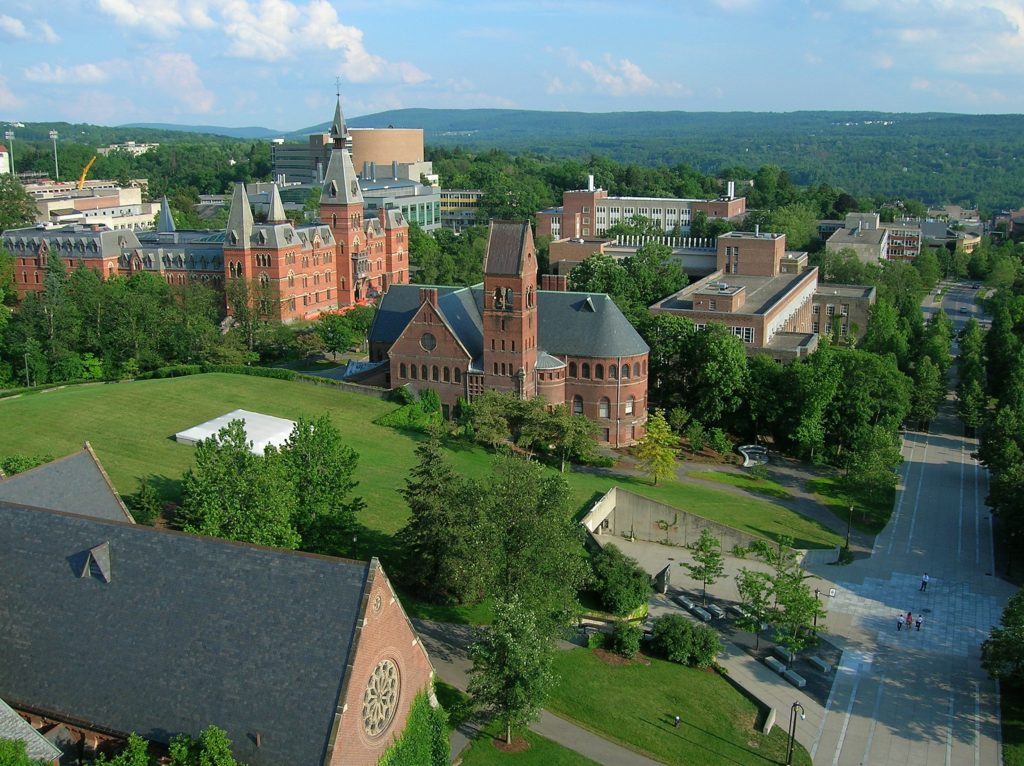
A total of three swastikas have been found on Cornell University’s campus in a span of nine days, according to the Cornell Daily Sun.

The first swastika was found on a whiteboard at Court-Kay-Bauer Hall on Nov. 10; the second was found at Clara Dickson Hall on Nov. 14.

On Monday, the third swastika was found in the snow in front of Mews Hall, close to Appel Commons.

Avi Simon, a Jewish student who first noticed the swastika in the snow, told the Sun, “These are the symbols they [the alt-right] use in my experience, and it means a target toward all people of color, towards Jews, toward members of the LGBTQ community.”

Ryan Lombardi, the vice president for student and campus life at Cornell, expressed “revulsion” at the swastikas in a Tuesday statement.

“I vehemently denounce such acts, which are clearly intended to intimidate members of our community,” Lombardi said. “The swastika has historically been – and continues to be – used as a symbol of intolerance, terror and repression against vulnerable communities.”

Lombardi added that a “support gathering” would be held after Thanksgiving for community members to address the issue.

“I specifically want to acknowledge and affirm our support for the Jewish members of our community who have faced the impact of anti-Semitism nationally and, unfortunately, now locally as well,” Lombardi said. “It is our shared responsibility to denounce such cowardly acts.”

However, the university has been criticized over its response to the swastikas. The Sun argued in a Tuesday editorial that the university’s response to the swastika was too slow, prompting “an increase in confusion and worry among students.”

“While we appreciate the sentiment in VP Ryan Lombardi’s statement that was eventually emailed to students shortly before noon today, Cornell must understand that in this fast-paced world, it must move more quickly and assertively,” the editorial read. “It took five days and a third swastika for a statement to be released. Were the first two swastikas not worthy enough of recognition?”

The editorial added that Lombardi’s statement “said next to nothing about finding those responsible and holding them to account.”

“There was not even a sentence asking anyone with relevant information to come forward to help in the investigation,” the editorial concluded. “Denouncements are fine and good, but unless they are followed by action, they are not worth the digital ink in which they are printed.”

When asked by the Journal about the editorial, a university spokesperson simply pointed to Lombardi’s statement from earlier in the day.

Three Swastikas Found on Cornell in Nine Days Read More »
It’s Getting Personal

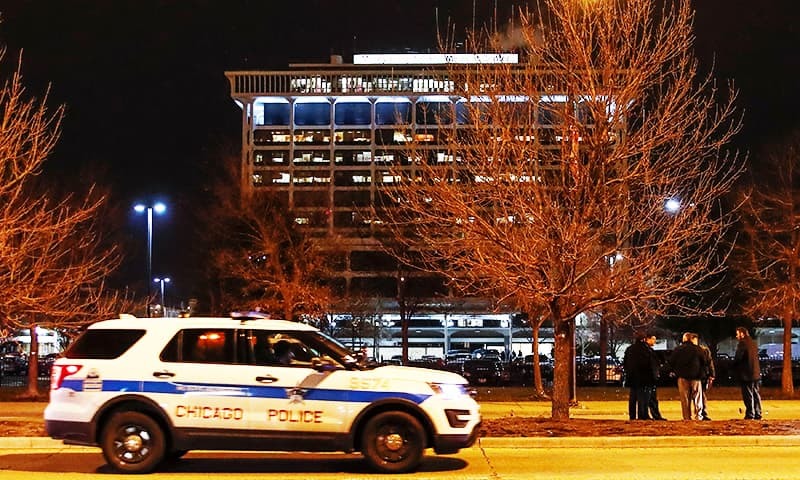
Just moments before I started writing this, I saw a post on Twitter about a shooting at a Chicago hospital with multiple people wounded. Immediately, my mind went to two doctors I know who work in Chicago, a husband and wife, one of whom is an emergency room physician. Both are Jewish.

It’s not surprising that the “Jewish doctor” is a bit of a cliché. Of course, most human cultures hold human life in high esteem; it’s a survival instinct for the species. Jewish tradition, however, makes it abundantly clear how important it is to save a life. Not only are we allowed to break almost any Jewish law in order to save a life, we are often commanded to do so. For instance, if a person’s health would be put in danger by fasting, they are not allowed to fast, even on Yom Kippur.

In addition, we are told that when we save one human life, it is as if we saved an entire world, presumably because one person, such as Adam or Eve, could be the ancestor of an entire world full of people. So no, it is not surprising that many Jews would become a doctor, a profession in which they would expect to be able to save precious lives.

As far as I know, and at this point I know very little, this shooting had nothing to do with anti-Semitism. I suspect that any Jewish people who were harmed in this particular shooting were just in the proverbial wrong place at the wrong time, even though the chances that at least one of them was Jewish is probably higher than the approximately 2 percent of the nation who identify as Jewish. My two friends are fine. The friends and relatives of many others are not.

Just a couple of weeks ago the largest anti-Semitic attack on a synagogue in this country was carried out. Many people were commenting about how small the Jewish community is. Many of the Jews here in California know or are related to at least someone associated with the shooting in Pittsburgh.

And while the Jewish community may be small, the chevra kadisha community – the volunteers within the Jewish community that take care of the dead and their mourners – is even smaller. So I, here in California, know at least one person who travelled to Pennsylvania to help respond to the tragedy in the way that only we know how. And one of the two doctors I know in Chicago was quoted in the Jewish media in regard to the chevra kadisha response in Pittsburgh.

Now here I am, breathing in the smoke from the wildfires still burning north of me, knowing several Jewish institutions have burned down in California wildfires in the last couple of years, wondering when tragedy will strike next in the Jewish community. Will it be a wildfire, perhaps caused by humans, on purpose or inadvertently; or will it be another mass shooting, which seem to be happening with ever-increasing frequency?

When will I be the one called to support a chevra kadisha in my area as they struggle to cope with a mass tragedy in their community, or will they, perhaps, be the ones helping my community to ritually wash and bury me? It seems it will only be a matter of time, so yes, it’s beginning to feel very personal.


Susan Esther Barnes writes about Jewish life from her perspective as a religious Reform Jew in Northern California. Follow her on Twitter at @SusanBarnesRnR.

It’s Getting Personal Read More »

Swastika Found on Duke Mural for Pittsburgh Shooting Victims

Screenshot from Twitter.

A swastika was found on Sunday on a mural at Duke University commemorating the victims of the Tree of Life synagogue in Pittsburgh.

According to the Duke Chronicle, the mural had been painted by students in October at East Campus Bridge shortly after the shooting and featured a Star of David, the Pittsburgh Steelers emblem, and the names of the 11 victims of the shooting. The swastika was drawn over the Star of David in bright red marker.

The swastika was eventually covered with a trash bag.

Duke President Vincent Price condemned the swastikas as “a craven and cowardly act of vandalism” that is “a matter of grave concern.”

“To our Jewish students, faculty, staff and neighbors—and indeed every member of our university community—I pledge that Duke will do whatever we can to protect your safety,” Price said. “As an immediate response, we will continue to provide additional security at the Freeman Center for Jewish Life and other locations on campus. In addition, we will be installing security cameras in the vicinity of the East Campus Bridge, which has unfortunately become a focus of attention for those who seek to promote hatred and intimidation.”

Price added that the mural’s desecration was part of an increased trend of anti-Semitism worldwide.

“We have an urgent obligation to confront anti-Semitism and other forms of hate on campus,” Price said.

First-year student Olivia Levine, who was among the students who helped paint the mural, wrote on Facebook that she “was speechless when I saw this photo.”

“It feels like there is no safe space from anti-Semitism,” Levine wrote.

StandWithUs Co-Founder and CEO Roz Rothstein, whose parents are Holocaust survivors, said in a statement to the Journal, “It is outrageous that someone vandalized a mural to the Pittsburgh victims using a hideous symbol of the hate that inspired their murderer.”

“This is yet another reminder that anti-Semitism on campus is alive and well, and that we must all do more to fight it,” Rothstein added.

It’s the third swastika to be found at Duke in the fall; the two other ones included a swastika on a bathroom door and another carved into a pumpkin.

Swastika Found on Duke Mural for Pittsburgh Shooting Victims Read More »

Netanyahu Steers Clear of Special Elections

Israeli Prime Minister Benjamin Netanyahu speaks during a bilateral meeting with U.S. President Donald Trump on the sidelines of the 73rd session of the United Nations General Assembly at U.N. headquarters in New York, U.S., September 26, 2018. REUTERS/Carlos Barria

Israeli Prime Minister Benjamin Netanyahu was able to narrowly maintain his coalition and avoid early special elections after Avigdor Liberman resigned from his position as defense minister last week.

Liberman’s resignation threw Netanyahu’s coalition into jeopardy, especially with pundits thinking that Education Minister Naftali Bennett would follow suit after Netanyahu rebuffed his efforts to succeed Bennett.

But Bennett didn’t step down, announcing on Nov. 19 that he has decided to “stand by the prime minister’s side” for the time being. While he was critical of Netanyahu’s handling of Hamas, he declared that he would help steer Netanyahu in the right direction.

“We think that there is no answer to terror, to rockets and mortars, but there is an answer — we can get back to winning,” Bennett said.

Netanyahu’s coalition currently hangs on by one vote. If Bennett resigned, Netanyahu’s coalition would have been in a minority, thus triggering early elections. Israel’s elections are currently set for November 2019.

Liberman’s resignation was sparked by the Israeli government’s most recent ceasefire agreement with Hamas after the Islamic terrorist group launched more than 460 rockets toward southern Israel; Liberman argued that the ceasefire amounted to surrender.

Netanyahu Steers Clear of Special Elections Read More »

Sci-Fi Romance, Graham Nolan, Jewish Journal, Darren Paltrowitz, Celeb, music, art

Sci-Fi Romance’s Jody Stark ‘Dreamers & Runaways’ Album and Growing Up Jewish in Texas

An independent folk band from Los Angeles that blends unique arrangements and a dark, percussive take on acoustic music, Sci-Fi Romance has interestingly been described as “steamfolk.” Founded by singer-songwriter Vance Kotrla, Sci-Fi Romance released its debut album— titled “…and surrender my body to the flames” — in 2010. Its most recent full-length is 2018’s Dreamers & Runaways, which came paired with a special edition comic book.

The band – which also includes drummer Mr. Mike and cellist Jody Stark – recently helmed a thought-provoking song and accompanying music video for “Voices,” the first single off “Dreamers & Runaways.”

Jewish Journal: “Dreamers & Runaways” is Sci-Fi Romance’s new album. How long did you spend recording it?

Jody Stark: We recorded a few songs at a time over the course of a year. I think Vance had all the songs already written the year before and was very anxious to get in the studio. Schedules and life were a bit crazy for everyone, so I suggested spreading it out and recording one or two  songs at a time. I think it turned out even better!

JJ: Do you have a favorite song on the album?

JS: I like “Beautiful Prison.” I think of it as kind of a bittersweet song about change and isolation that really underscores our need for connection.

JJ: “Voices” is a song from your new release that has people talking. What does the song mean to you personally?

JS: We live in such divisive times. I see people unfriending, or unfollowing, friends and family on Facebook or other social media. Some are deciding not to have Thanksgiving dinner with their families. It seems we are unable to come to the table and have a civil discussion about what is going on around us. The culprit is that so many of us get our source of news from a limited number of social media or news outlets that may not offer a balanced view or even vetted facts.  As a result, so many only end up reinforcing their current world view rather than expose themselves to a different point of view. This is so dangerous when the chosen source of news chooses to infuse a message of fear. For me, this song is about combating that fear and never giving up on each other. As humans, we aren’t all so different. At the core, we want the same things, but we stopped listening to each other. That’s what fear does. It stops you from seeing things from other points of view and drowns out the compassion that is within all of us.

JJ: When and where did the concept of including a digital comic as part of the album’s creation come from?

JS: This would be a question for Vance. The digital comic was entirely Vance’s creation.

JJ: Was cello your first instrument?

JS: Does the recorder in fourth grade music class count? Anyhow, I was very good at playing that recorder and was encouraged to pick an instrument and join the string program in school. My first choice was bass to which my mom responded “We can’t fit that in the car!” Cello was the next best thing and turned out to be a great fit for me.

JJ: As I am speaking to you for the Jewish Journal, I must ask: What do you remember about your bat mitzvah?

JS: Although a bat mitzvah is an important rite of passage, my family did not have the financial means for me to take that journey. I grew up in Carrollton, Texas. Although it is a suburb of Dallas, it seemed so far away from Dallas. That said, Carrollton did not have much of a Jewish population. I knew of one other Jewish girl. Since I did not grow up around a Jewish community, my family was it. When I think of the high holidays, for me it is all about the family coming together with all the food and traditions.

When I left for college, I wanted to learn more about Judaism but felt very out of place at Hillel. It became harder to identify as Jewish in the same way others did. Then I had an opportunity to take a free organized trip to Israel with Birthright Israel. This helped me tremendously with my doubts and questions about Jewish identity. Now I feel comfortable identifying as Jewish even though I’m not religious.  

JJ: Judaism aside, what do the next few months look like for you and SciFi Romance

JS: I think we’re gearing up to shoot another music video in the next few weeks.  

JJ: Finally, Jody, any last words for the kids?

JS: It might seem a bit cliché, but never let anyone discourage you from doing what you love.


More on Sci-Fi Romance can be found online at www.scifiromance.net.

Sci-Fi Romance’s Jody Stark ‘Dreamers & Runaways’ Album and Growing Up Jewish in Texas Read More »

For your Thanksgiving tables this year

Ever since Governor Bradford of Plymouth Colony initiated the festival of Thanksgiving in 1621, it has been part of the American experience, belonging to this nation and to all “The inhabitants thereof.” It is envied by cultures around the globe, many who do not have as much to be thankful for as do we. While President Washington declared a national holiday on Thursday, November 26, 1789, the holiday was observed intermittently. Finally, President Lincoln made it an annual event on the last Thursday of November, and then President Roosevelt put it on the fourth Thursday, as an American holiday for people of all faiths or of no faith, and the property of none of them.

“Only the sensitive, the civilized give thanks. The brutish, the barbarous, take for granted. They take. They take from God. They take from nature. They take from humankind. They give nothing. There are people slightly less sensitive who give token thanks, verbal begrudging. There are people half-sensitive who give formal thanks, lest others doubt their breeding. And there are people, the sensitive, the civilized, who give whole thanks: with tongue, with mind, with heart, and with hand.” (Rabbi Ely Pilchik)

When Mark Twain was at the height of his career, he was paid five dollars a word for his essays. An admirer wrote a letter explaining his career plans and requested that Twain share with him his choicest word, and of course included five dollars with the note. Twain responded, “Thanks.”

Tradition teaches that we are obligated to say the word: “Thank you!” (Talmud, Berachot 54b)

An old Jewish proverb teaches “K’she-yehudi shover regel, hu modeh L’Adonai…When a Jew breaks a leg, he should thank God that he did not break both; and when he breaks both legs, he should thank, God that he didn’t break his neck.”

In the time to come all prayers of petition will be annulled, but the prayer of gratitude will not be annulled. (Midrash Rabbah Vayikra 9:7)

A chasid once was asked: “What is stealing?” He thought for a moment and then replied, “A person steals when s/he enjoys the benefits of the earth without giving thanks to God.” (Bechol Levavcha by Rabbi Harvey Fields, p. 94)

“How strange we are in the world, and how presumptuous our doings! Only one response can maintain us: gratefulness for witnessing the wonder, for the gift of unearned right to serve, to adore, and to fulfill. It is gratefulness which makes the soul great.” (Rabbi Abraham Joshua Heschel)

“Ingratitude to a human being is ingratitude to God.” (Rabbi Samuel Hanagid, Ben Mishle)

When you arise in the morning give thanks for the morning light, for your life and strength. Give thanks for your food and the joy of living. If you see no reason for giving thanks, the fault lies in yourself. (Native American Prayer – Techumseh Tribe)

“I offer thanks to You, Sovereign Source and Sustain of life, Who returns to me my soul each morning faithfully and with gracious love.” (The daily morning service )

For your Thanksgiving tables this year Read More »