fbpx

November 20, 2018

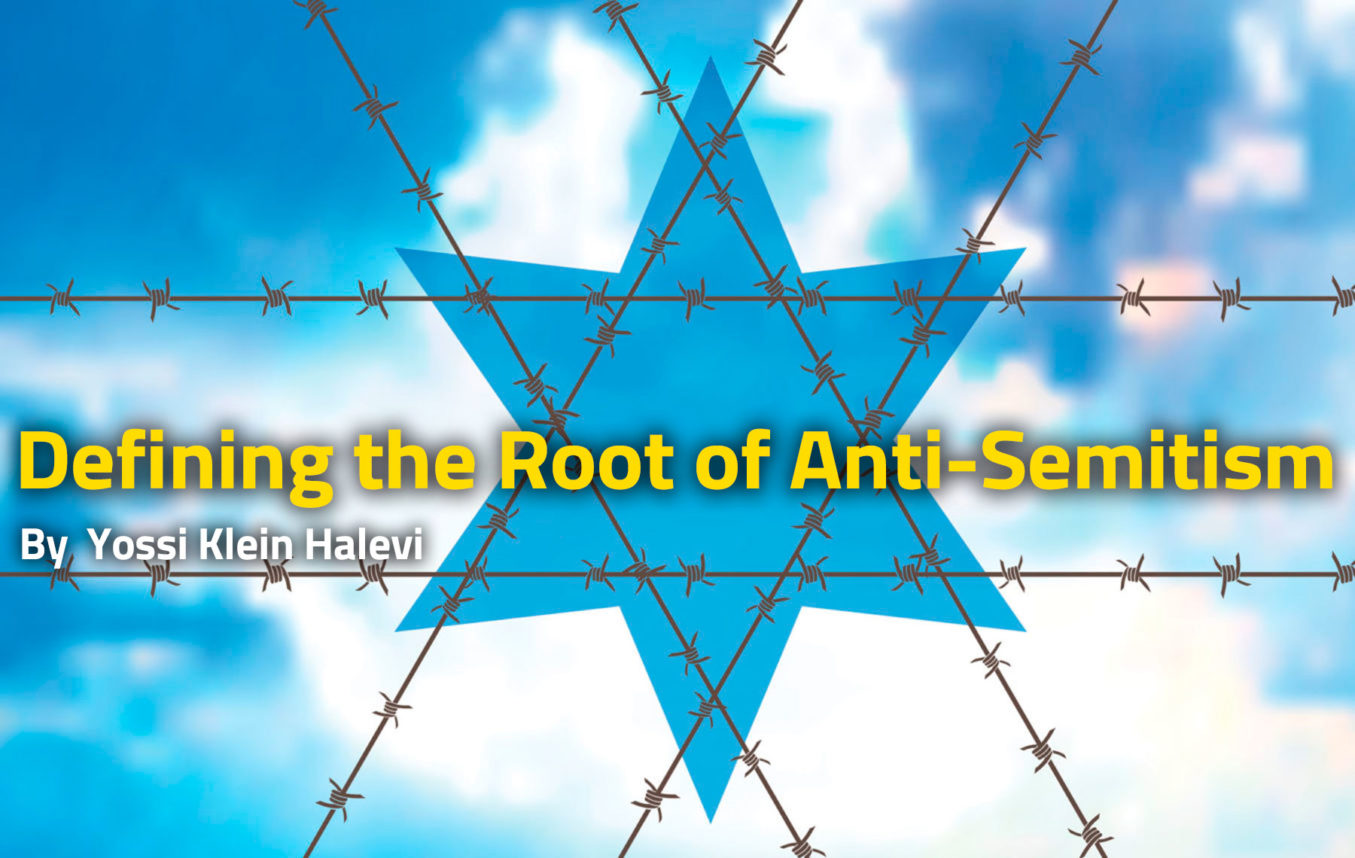
Defining the Root of Anti-Semitism

Editor’s note: The following is a transcription of Yossi Klein Halevi’s response to a student’s question at DePaul University on Nov. 14 in Chicago. According to an online post by Halevi, the student asked whether “humanizing” Zionists was comparable to asking African Americans to “humanize members of the KKK.” Halevi was on a speaking tour with Walid Issa, executive director of the American Palestinian Hope Project.


My understanding of anti-Semitism is the following: Anti-Semitism is not simply hating the other — the Jew as other. Anti-Semitism works a little bit differently. What anti-Semitism does is turn the Jews — “the Jew” — into the symbol of whatever it is that a given civilization defines as its most loathsome qualities. And so, under Christianity, — before the Holocaust and Vatican II — the Jew was the Christ-killer (“His blood be upon our heads and upon our children” [Matthew 27:25] ). That’s forever. Under Communism, the Jew was the capitalist. Under Nazism, the Jew was the race polluter, the ultimate race polluter.

Now we live in a different civilization, where the most loathsome qualities are racism, colonialism, apartheid. And lo and behold, the greatest offender in the world today, with all the beautiful countries of the world, is the Jewish state. The Jewish state is the symbol of the genocidal, racist, apartheid state. That’s Israel. That’s the Jewish state. An Israeli political philosopher named Yakov Talmon once put it this way: “The state of the Jews has become the Jew of the states.” What that means to me is, criticism of Israel is not anti-Semitism. Criticism of Israel’s existence — denying Israel the right to exist, calling Israel the Zionist entity — that is anti-Semitism. That is a classical continuity of thousands of years of symbolizing the Jew. So, using that kind of language places you in very uncomfortable company. That kind of language can come today from the far left. It can come from white supremacists. It can come from Islamist extremists. It can come from many sources, but all of those groups converge on one idea: The Jew remains humanity’s great problem.


Yossi Klein Halevi is an American-born Israeli author and journalist. His most recent book is “Letters to My Palestinian Neighbor.”

Defining the Root of Anti-Semitism Read More »

Germany’s Lesson for America

Twelve years ago, a young German Christian woman sought my assistance in converting to Judaism. As I listened to her reasons for wishing to become Jewish — her marriage to a Jewish man, her partnership in raising a Jewish daughter, her affection for the customs and traditions of Judaism — I could see tears welling in her eyes.

When I inquired about those tears, the dam burst, and she began to weep openly.

“My marriage and family are inspiring me to convert,” she told me, “but my history stands in my way. How can I ever become a Jew, after the horrors my people brought upon the Jews? How can I ever be forgiven? I can’t even forgive myself.”

“But you weren’t even born until two decades after World War II had ended. You hold no guilt for the Nazi atrocities,” I countered.

“But I feel such terrible guilt,” she lamented. “So many young Germans do. We carry the shame of being descendants of those crimes.”

I found her suffering to be at once heartbreaking and puzzling — until earlier this month, when I visited Berlin and Dresden with the North American Board of Rabbis at the invitation of the German government. We were welcomed for Germany’s national observance of the 80th anniversary of Kristallnacht, the state-sponsored “Night of Broken Glass,” which ultimately led to the murders of 6 million Jews.

Days before the commemoration, we paid a visit to the Evangelisches Kreuzgymnasium in Dresden, where hundreds of Christian high schoolers packed an auditorium to hear our stories and share their statements of commitment to combat anti-Semitism. The sincerity in their presentations and the heart-heavy sense of duty in their questions moved us deeply. Clearly, these teenagers carry their own shame from being descendants of Nazi crimes — but also a robust resolve to write a different story for Germany’s future.

Their determination is going to be sorely needed as the incitement to violence against Jews, both among German nationalists and some segments of Germany’s Arab immigrant population, continues to ritse. German Chancellor Angela Merkel soberly noted in her remarks at Berlin’s beautiful Rykestrasse Synagogue, “There are two urgent questions that we need to answer. First, what did we really learn from the Shoah, this rupture of civilization? And second, to the first question: Are our democratic institutions sufficiently strong so that amid an increase of anti-Semitism, or even if a majority presents anti-Semitism, it can be prevented in the future?”

To be sure, Germany faces a daunting challenge, as the right-wing nationalist Alternative for Germany (AfD) Party continues its political ascent, fomenting hatred directed at Jews and other minorities. Surely, however, Germany’s leaders and citizens will be strengthened in their effort to repel this darkness by their unequivocal national reckoning with their past. A nation that names and acknowledges its greatest moral failures must certainly be less likely to repeat them. When the seedlings of those same evil impulses are replanted generations later, a people guided by responsibility for its history is best poised to deny those seedlings any water or sunlight.

As a Jewish American blessed with freedoms and opportunities my family first discovered as Eastern European immigrants generations ago, I find myself wondering about the implications of what I observed in Germany for my own country. After all, Kristallnacht happened 80 years ago, and yet it remains a persistent subject in German schools, as well as a cause for national events of accountability, long after the perpetrators of its crimes have died.

How might the United States meet its moment of moral challenge today if our nation were to engage habitually in acts of collective responsibility for our past, as Germany does?

How might our national soul be impacted if our country’s brutal dispossession of Native Americans was regularly and solemnly commemorated?

How might our treatment of endangered immigrant populations be altered if we were consistently reminded of the moral degradation of the Japanese-American internment camps during World War II?

How might the plight of African-Americans on our streets and in our courts be aided by a sincere acknowledgment of accountability for the slave ships that brought the ancestors of many millions of our modern-day citizens to the United States in chains?

The still-piercing shame from the Holocaust felt by many in Germany today should be seen as neither heartbreaking nor puzzling. Rather, it is a badge of enduring conscience that just may save today’s German Jews from the same hatred that engulfed the Jews 80 years ago. Might we, as Americans, draw upon our shared history to steer clear of repeating our collective past sins?

The great 20th-century rabbi Abraham Joshua Heschel famously taught: “Some are guilty. All are responsible.” There is nothing wrong with feeling the weight of responsibility for our national past. It is noble and just to feel responsible. It’s what enables us to become the best people we can be. It is also what enables us to become the best nation we can be.


Rabbi Ken Chasen is Senior Rabbi of Leo Baeck Temple and vice chair of T’ruah: The Rabbinic Call for Human Rights.

Germany’s Lesson for America Read More »

Summer Camps After Woolsey: What Is This Place?

I am the grandchild of Shoah survivors. Until my bar mitzvah, I did not have the faintest understanding of what that truly meant. Around that time, I began to understand the gravity of the Shoah, but prior to that, my experience and understanding of being Jewish had only the vaguest notion of tragedy.

For me, however, defining Jewish identity in response to the Shoah would never work. I formed my Jewish identity at 9 years old when I began to attend summer camp in Malibu — Camp Sholom (later Camp JCA Shalom, and now part of the Shalom Institute). Because of summer camp, I rooted my Jewish identity in positive experiences. Rooting Judaism in Maccabiah, and mud gaga, and song sessions, and the ropes course, and arts and crafts — summer camp’s immersive Jewish experience — made and makes Judaism positive first and entirely about experiences in community. After years as a camper, I worked as a counselor and spent one summer as the counselor-in-training director.

Summer camp has always allowed me to put my grandmother’s survival in perspective. Instead of informing my life and my Judaism, I see her survival in the context of the entire history of the Jewish people. This requires me to join in the building and sustaining of our Jewish community, not as a response to the Shoah, but as something transcendent and positive.

“Summer camp has always allowed me to put my grandmother’s survival in perspective.”

About 12 years ago, I joined the Shalom Institute’s board of directors. Within three years (at 33 or 34), I started a two-year term as the president of the board, overseeing a $3 million annual budget and a staff of over 20.

When I got married at 38, I convinced my now wife and her children (my stepsons) that our wedding should be a family-camp weekend at my childhood camp, my treasured JCA Shalom. In 2016, we hosted 150 friends and family (including two cabins of kids, with counselors, of course) for a weekend and an additional 250 for our wedding itself. Rabbi Bill Kaplan, executive director of the Shalom Institute, performed our ceremony.

Over the last 12 years, I have been involved in almost every major decision related to our campus and our institute. I have recruited board members, raised untold sums of money and, along with my wife, personally donated to projects throughout the camp. One such project was a cabin in memory of my grandmother in which each of her grandchildren participated.

Because of this gift, the Shalom Institute became more than a camp and philanthropy. After that gift, the Shalom Institute became the place where I honored my grandmother’s memory, not as a survivor but as a part of the Jewish people. Camp became a place where my grandmother’s survival would forever be about sustaining and growing the Jewish people through making Judaism positive.

So when the Woolsey fire ravaged Southern California and burned the camp, including my grandmother’s cabin, one would think I would be more devastated, more heartbroken than I am. Again, my grandmother guides me.

In 1995, my grandparents took our family to what is now Uzhgorod, Ukraine (formerly Ungvar, Hungary). This is the town where my grandmother grew up, and where, after World War II, she decided to marry my grandfather. We went to my grandmother’s childhood home on a scorching August afternoon. The house still stood, now behind a locked gate. Hot and sweaty, we rang the bell and rattled the gate but no one came. Standing outside in the sun, we could not see anything but a few branches of the tree on which her father once put a swing. Through the space between the gate and the wall, we caught the smallest glimpse of the garden where she and her entire family spent Shabbat afternoons. Though visibly upset that we could not get in, Grandma looked at me and said something like, “It is just a house.”

The structure of a few walls, a roof, windows and trees was just a house. The people who lived there were not her parents. Her childhood bedroom, though likely still there, did not hold her childhood, the kitchen where her mother made dinner no longer carried the scent of her mother’s cooking. The den where her father would read the paper no longer had her father’s heavy coat slung over a chair, or her father’s newspaper on the table. It was just a house. The memories of her parents, of her siblings and her entire family were with her, in the stories she told us, and the way she loved us, tucked us in and cooked for us.

“Camp has never been about the cabin, the bunk bed or the ropes course. For each of us, camp is about the people, the feelings and the memorable moments that change lives forever.”

This past week, as I saw the first photos from the devastating fire that leveled my camp — the fire that took out the dining hall, the amphitheater and my grandmother’s cabin — I recalled my grandmother standing outside her childhood home: “It is just a house.”

The remaining piles of rubble where the dining hall once stood, where my grandma’s cabin once housed children, is not camp. The ash heaps where buildings once stood hold no stories of the people who fell in love there, or got married there, or had their first kiss while their counselors were not looking. The buildings never held the Jewish future, or even the Jewish past.

Whatever decisions the Shalom Institute’s board and executive team make about the physical place will be guided, I am certain, by the truth that these buildings are just walls and wood, and pipes and plaster and windows — they are not “camp.” For every one of us involved with camp, we know the truth: Camp has never been about the cabin, the bunk bed or the ropes course. For each of us, camp is about the people, the feelings and the memorable moments, whether a Shabbat song session or a lazy Saturday afternoon hanging out, waiting for Havdalah and the weekly all-camp dance, or any of the seemingly innocent moments that change lives forever. This is the secret to the past, present and future of the Jewish people.

Ours is a history of dislocation. While wandering in the desert, we became a people. The desert mountain, at which revelation occurred, is no more or less sacred than a Shabbat table, or a summer camp dining hall. We lost our home and our Temple (twice) and still were able to remain Jewish for close to 2,000 years. What keeps us this way? Not places, but our ability to build, in time, moments where with our community we can experience something sacred, something transcendent, something positive and life-affirming.

Now, as the Shalom Institute looks toward the future, we are mindful of who we Jews have been and will always be — a people not fixed to location but to one another and infused with the ability to make any moment holy and any place sacred.


Ari Moss is on the board of directors and is a past president of the Shalom Institute.

Summer Camps After Woolsey: What Is This Place? Read More »

The Nearness of You

“It isn’t your sweet conversation
That brings this sensation, oh no
It’s just the nearness of you”  — Hoagy Carmichael

A few weeks ago I was at the  funeral of a good friend. His wife and three children got up and spoke about their husband and father. It was a truly beautiful and moving event. They spoke of how much he meant to them and how he was a friend to all who met him. They spoke of his unwavering support for them and their dreams in life. They spoke of how they would not be who they are today without him. They spoke about how much they loved him and how much they missed him just one day after he was gone. They already missed not being near him. Almost everyone was crying.

My father died when I was 36 years old. He died before he met my future wife. He died before I got married. He died before he got to see his grandchildren. He died before he got to really see the type of husband and father I was to become. He died not really knowing who I was or what I was capable of.

Did I really get to know him? No. I had only a few facts about his childhood and adolescence. My father was a quiet man with a quiet soul. He didn’t say much and he didn’t get involved in any big events. He worked, came home, ate dinner, watched a little TV and then went to sleep. He did that five days a week, 50 weeks a year until he died.

“The main reason I go to the cemetery to visit my parents is to try one more time to be near them. Try all you want, it’s not the same. Do it now while you can.”

When I was a kid, I saw him only for about 1 1/2 hours a day. Sometimes we’d both sit in bed in our boxers and polish off a pint of ice cream while watching some TV. I felt so protected. Any time spent with him was very valuable to me. We really didn’t need to talk. He was Dad and I was Mark. That’s it. We just needed to be together. We needed to be near each other. My leg over his leg watching the tube.

And that’s what my friend’s wife and kids were saying at the funeral. That’s what I’m saying. The bottom line is sometimes you just need to be near the people you love. When one of my kids calls and asks me to go for a ride with him to get a haircut, I go. When the other kid asks me to go to a ballgame, I go. When my wife asks if I want to go to Ralphs with her, I go. Not because I think any huge event is going to happen or I’m going to get an answer to one of life’s problems that’s been plaguing me for years. Not because I need to find out anything new or different about them. I go for one reason and one reason only: I go just so I can be near them. I go so I can be the first to see the new haircut. I go to share a bag of peanuts at the ballgame. I go so I can hear a question like, “Do we need pickles?” I go because one day I won’t be able to go anymore. I know it and they know it. We don’t talk about it, but we know it.

The main reason I go to the cemetery to visit my parents is to try one more time to be near them. Try all you want, it’s not the same. Do it now while you can.


Mark Schiff is a comedian, actor and writer.

The Nearness of You Read More »

Diaspora Jews’ Role in Shaping Israel’s Future

When many of us enter our synagogues, we see two flags framing the Aron Kodesh: the flag of the United States and the flag of Israel. 

Looking at the American flag, we may think about how much this country has changed over the past two years and how deeply concerned we are about its direction. Nevertheless, as disheartened as we may feel, we are empowered by the knowledge that we have the right, responsibility and ability to fight for what we believe.

Our thoughts about the Israeli flag are more complicated. Many of us think about how much Israel has changed and how concerned we are about some of its policies, whether they relate to the coercive role of state religion or to the expansion of settlements in the West Bank.

We know that the Star of David at the center of the Israeli flag is a Jewish star. What Israel does helps define us; what we do helps define Israel. Yet many American Jews still believe we must constrain our words and actions when it comes to the policies that are shaping the very future of the Jewish state.

To be sure, there is a growing recognition of Israel-Diaspora interdependency, as Dennis Ross wrote in The New Republic: “The Israeli government must pay more attention to the sensitivities in the outside Jewish world, particularly when the state declares itself to be the nation-state of the Jewish people. That requires its leaders to see themselves as representing the Jewish communities outside of Israel as well.”

At the same time, Ross continues, “Diaspora Jewry should also acknowledge a basic reality: When it comes to security, it is Israelis who live in a region where threats are commonplace and peace is not. … When it comes to security issues, the Diaspora’s considerations must be secondary to Israel’s.”

Ross’ distinction may be familiar but it is no longer functional. The conventional wisdom, that American Jews can be involved in “who is a Jew” or helping victims of terror, but not in matters related to West Bank settlements or attacks on Israel’s democratic institutions, is outdated.

Indeed, perhaps the most generous American donor to Israeli causes, Sheldon Adelson, doesn’t abide by this distinction. Yes, he supports Israelis who are researching how to cure cancer and strengthening Jewish identity. And, although he is not an Israeli citizen and cannot vote in an Israeli election, Adelson also gives tens of millions of dollars to Israeli institutions that advocate foreign and defense policies reflecting his own perspective on what is best for Israel. Indeed, his funding also enables these same organizations to thwart the efforts of Israelis who think differently.

“We know that the Star of David at the center of the Israeli flag is a Jewish star. What Israel does helps define us; what we do helps define Israel. “

I believe that Adelson, who certainly sees the Jewish star at the center of the Israeli flag, presents us with a challenge: Will those of us who are troubled by policies we believe put the future of a Jewish, democratic state at risk, embrace our right and the responsibility as Jews to support the causes, organizations, and policies that reflect our values and our convictions?

I hope we will. I hope we will assert the right and duty of all American Jews to do the same:

Whether they are bat mitzvah girls denied an aliyah at the Kotel …

or college students who feel isolated on campus — attacked for their support of Israel but ostracized for speaking out against Israeli settlements …

or community leaders concerned about the rise on anti-Semitism …

or pro-Israel activists who, like hundreds of Israeli generals, believe that annexing the West Bank would weaken Israel’s security and eventually jeopardize American support for Israel …

We must do so, for the sake of Israel, for the sake of what we hold dear at home, and for the sake of our children, many of whom are turning away from Israel because they don’t hear us sharing their concerns about the direction the country is heading.

If we believe the Jewish star to be ours, each one of us must live by our values, and thereby help shape the future of the Jewish state.


Jonathan Jacoby is the recipient of this year’s Career Achievement Award from the Jewish Communal Professionals of Southern California.

Diaspora Jews’ Role in Shaping Israel’s Future Read More »

Giving Thanks for Relationships

Amid the tragedies of the past few weeks that have engulfed us materially and spiritually, I remain amazed at the saving grace of human relationships. The heroism of the first responders to save the lives of complete strangers, even as they risk — and sometimes sacrifice — their own lives. The extraordinary outpouring of support for the Jewish people from other faith communities in the face of deadly anti-Semitism.

At the heart of these inspiring responses is the power of one-to-one relationships, what Jewish tradition calls bein adam l’chaveiro — the relationship between a person and a friend — the bedrock of community.

As we gather with family and friends to celebrate Thanksgiving this year, it is worth pausing from the feasting and the football to reinforce the essential value of personal relationships and to celebrate the clarion call of our nation’s Founding Fathers: E pluribus unum — “from the many, one.” We Jews know the importance of “one.” Echad (“One”) is often the first Hebrew word we learn — and it is the last word of our most important prayer. More on that in a moment.

We are a people who love to talk. You know the old jokes. Two Jews, three opinions. Schwartz goes to synagogue to talk with God; Greenberg goes to synagogue to talk to Schwartz. My worry is that there is so much divisiveness in our discourse that, in fact, people are not talking to one another — in our shuls, in our organizations, in our friendship groups, even, I fear, in our families. Some of us have decided to ban any talk of politics when we gather together. That’s one solution, I suppose. But isn’t there a way to disagree without being disagreeable? I believe there is, and it is to remember that most important prayer, the Shema.

“Shema, Yisra- El! Adonai Eloheinu? Adonai Echad!”

A loose translation: “Listen, you God-wrestlers! Our God? Our God is One!”

“As we gather with family and friends to celebrate Thanksgiving this year, it is worth pausing from the feasting and the football to reinforce the essential value of personal relationships.”

The key words are shema and echad — “listen” and “oneness.” May I suggest we use these imperatives as the ground rules for our family conversations. Stop talking and listen. Listen to the other, especially those who hold opposite views. Don’t interrupt. Don’t be aggressive or defensive. Just listen. When the other has said her/his piece, say your piece and insist on the same ground rules. Have a peace-full conversation. That’s the meaning of shema.

Then, remember echad. Not only is God One, we are One. That’s not just on old fundraising slogan; it is the fundamental value of monotheism, democracy and community. We need to protect our relationships with one another. There are far too many who would love to see us tear ourselves apart. Let’s not do it to one another.

We have so many blessings to be thankful for this Thanksgiving weekend — our loving families, our communities of belonging, our laden tables, our magnificent country. You can celebrate our gifts of freedom by checking out the “American Thanksgiving Seder” family celebration ritual the late Larry Neinstein and I initiated back in the ’90s, which was then fully realized by Lee Meyerhoff Hendler at freedomsfeast.us.

Here’s a radical idea: Share this column with those relatives and friends you find difficult to talk to these days, along with a sincere personal note giving thanks for your relationship with them, no matter what. Relationships are that precious.

Thanksgiving is a wonderful opportunity to reach across the table — and the aisle — to preserve the essence of our families, our friendships and our society committed to civility, the sacred relationships we share with one another.


Ron Wolfson is Fingerhut Professor of Education at American Jewish University and the author of “Relational Judaism.” 

Giving Thanks for Relationships Read More »

Rosner’s Torah Talk: Parshat Vayishlach with Rabbi Katie Mizrahi

Rabbi Katie Mizrahi is the spiritual leader of Or Shalom in san Francisco. Rabbi Mizrahi  was ordained through the Reconstructionist Rabbinical College in 2005. Previously, she studied for several years in Jerusalem, while devoting herself to human rights projects and peace education. Rabbi Katie grew up in Boulder, Colorado. She came to the Bay Area as a undergraduate at Stanford, where she majored in philosophy and religious studies, and first felt the call of the rabbinate.

This week’s Torah portion — Parashat Vayishlach (Genesis 32:3-36:43) — features Jacob’s meeting with Esau, his wrestling with an angel, the defiling of Dinah, the death of Isaac and Rachel, and the renaming of Jacob. We begin our conversation in trying to understand what’s wrong with the name Jacob – and why was a need for change.


Previous Torah Talks on Vayishlach

Rabbi Pam Frydman

Rabbi Gideon Sylvester

Rabbi Robin Nafshi

Rabbi Susan Leider

Rabbi Mimi Feigelson


Rosner’s Torah Talk: Parshat Vayishlach with Rabbi Katie Mizrahi Read More »

The Forecast for L.A.? Lots of Clouds

For the past three years, LinkedIn has identified cloud computing as the No. 1 in-demand global skill. Now, in a first-of-its-kind program, 19 community colleges in the Los Angeles area are offering a regionally recognized curriculum and certificate in the high-wage career. And they are doing it with one of the leaders in the field: Amazon Web Services (AWS).

Jobs requiring training in AWS cloud computing have increased by 177 percent in the past four years. There are now about 2,000 annual job openings in the L.A. area, and that number is expected to grow each year, according to the California Cloud Workforce Project (CA Cloud), as the coalition of the 19 community colleges and their partner high schools are known. This high demand for skilled workers led to this new approach. It’s the first time AWS has collaborated with a group of community colleges to offer training and a certificate in the field.

Working closely with AWS over four years, Santa Monica College (SMC), part of the CA Cloud, created the curriculum. In just 15 units, the program provides industry-standard skills, including application development, database management, cloud security, and hardware and software system requirements. SMC rolled out the first class this summer at its Center for Media and Design and it sold out overnight. The program is now being taught at all of the 19 CA Cloud schools in the area.

Just as one single school couldn’t fill the need for training new workers, one single stakeholder couldn’t fund it. Many parts of the community joined together to bring this certification program to life — academia, government and business. While Santa Monica College developed and offered the first classes, funding from a state grant and those other partners enabled the program to be expanded.

“Jobs requiring training in AWS cloud computing have increased by 177 percent in the past four years.”

“Our talent development systems were configured for an industrial-age economy. As we transition to an economy where IP (intellectual property) and knowledge are now the primary factors that means that we have to recalibrate our systems to support where this economy is going,” said David Flaks, the chief operating officer for Los Angeles County Economic Development Corporation (LAEDC). “It’s becoming a lifeblood issue — not only for the community college system but also industries as skills get more specialized — for them to effectuate these types of partnerships.”

The Center for a Competitive Workforce, whose mission is to support industry-informed education and workforce programs and curricula across Los Angeles and Orange counties, is one of those many collaborators on this particular program. “The Center will serve as that regional clearinghouse, if you will, almost a center of innovation for all our different talent development systems. It shows they can create the requisite programs curricula, stackable certificates, etc., that will be reflective of what industry actually demands from our talent development pipelines,” Flaks said.

For the students, after they complete the certification process, they also get a leg up looking for work. They’re given access to the AWS Educate Job Board, created to match people who have graduated with the needed cloud computing skills with companies, including Amazon, that are looking for workers. They also get access to additional training and other micro-certifications through AWS Educate.

“We’re excited to see this level of collaboration at a regional level, bringing essential IT education and skills to a growing workforce to meet the demand for tech-focused jobs in L.A.,” said Andrew Ko, director of Global Education at AWS. AWS Educate is also sharing the CA Cloud curriculum as a model for other institutions, educators and workforce development groups around the world who are interested in growing the number of people with much-needed cloud computing skills in their own communities. n

Ramona Schindelheim is the senior business correspondent and executive producer for WorkingNation.

The Forecast for L.A.? Lots of Clouds Read More »

love heart meant2be marriage

The Blessing of Friends

It’s been a tough few years for friends. Friendships used to be about, well, friendship. But in the past few years, friends have been required to take a political test, just like everything else. And it’s pass or fail, no gray areas.

Like most people, the politicization of friendship has left me hurt, angry and ultimately baffled. My initial foray into this realm was over publicly defending Israel in its ongoing war with Hamas. For this crime, friends of 25 years stopped talking to me. Others were so fearful that associating with me would affect their status that they would only meet me on the sly.

Ultimately, I got to the point of believing, as I still do, that Israel is a mirror to one’s soul. If someone is willing to destroy a great friendship over my support of Israel — if someone could choose status in increasingly Stalinistic social circles over me — then he or she was never who I thought they were, and neither was our friendship.

My ability to let it go was aided to a large degree by the fact that these faux friends were fairly quickly replaced. I began to call my new friends “souls of beauty” because, truly, that’s what they were. United by a love for our heritage and homeland, our friendships became mirrors of our love for Israel. We could disagree about this or that, but our friendships would always spring back to the place where they had begun — in the heart.

My outlook changed this year, though, when I entered probably the most difficult period of my life. From my old friends — who I had helped through adultery, cancer and loss — I received nothing, not even a phone call. They were aware of what I was going through, but it seemingly meant little to them, or at least maintaining their status meant more.

As my new friends saw this, they stepped up even more. They were amazing, truly angels of the heart. But given the depth of what I was going through, it still hurt.

Ironically, my 9-year-old son, Alexander, known more for alpha traits than empathy, has helped me put it all in perspective. He, too, has been having issues with some of his friends. When I learned what was going on — at school every day an entire lunch table was bad-mouthing him, and his good friends weren’t standing up for him — I was livid.

He shrugged. Thinking maybe I wasn’t seeing the whole picture, I tried casually asking him, “So, when they all said this about you, and X and Y said nothing, that didn’t bother you?” He shrugged again.

“Some people stand up for you; most people don’t,” he said, suddenly sounding like Freud. “That’s not who they are.”

“I do hope this politicization of friendship passes, that my old friends eventually understand that the bonds we had are far more important than status or politics.”

I was speechless. He’s never sounded this mature about, well, anything. Moreover, he was displaying more maturity than me. The first buds of responsible, emotionally intelligent manhood were right there before me. Even though some of his friends took their cues from what others were doing, not what was right, he would continue to stand up for them, no matter what.

In the days that followed, I thought about this as it related to my longtime friends who had chosen status over friendship. Yes, I guess I could see this as a weakness on their part. I took it one step further: if any of them needed me — called me from a hospital bed or some other desperate situation — would I be there for them? Of course. In a heartbeat. With all else forgotten.

I do hope this politicization of friendship passes, that my old friends eventually understand that the bonds we had are far more important than status or politics. But do I regret for a second standing up for Israel when she needs us the most? Not in the least. And I will continue to do so because my bond with Israel — with God — is only matched by my bond with my son.

Someday I’ll tell Alexander what happened during this difficult period in my life. I feel blessed to know that he will most certainly understand.

Happy Thanksgiving.


Karen Lehrman Bloch is an author and cultural critic living in New York City.

The Blessing of Friends Read More »

Thankful for Life Beyond Politics

Why are we so obsessed with politics? I’ve heard several explanations. One is that politics has become one of the few things we all have left in common. Because technology allows us to pick and choose our interests like never before, politics, by its pervasive nature, remains the one thing that permeates virtually everything.

Another reason is that politics has become a form of entertainment. No one understands this better than the profit-driven media that know they’ll get a lot more eyeballs if they push the fight and the drama inherent in politics.

When is the last time your eyes were riveted to a two-hour discussion on C-SPAN of the pluses and minuses of fiscal reform?

On a more serious note, politics seems especially prevalent in Jewish circles, since Jewish values such as “caring for the stranger” are so inter-connected with the policies of the government. That’s why politics regularly pops up in rabbi sermons, if for no other reason than that repairing the world is a Jewish imperative.

There’s also an intimate aspect to politics — something that reaches deep inside of us. Politics can be a form of tribal connection, a crucial part of how we find meaning and sustenance in life.

As psychiatrist Karin Tamerius writes in The New York Times, “Our political attitudes and beliefs are intertwined with our most basic human needs – needs for safety, belonging, identity, self-esteem and purpose — and when they’re threatened, we’re biologically wired to respond as if we’re in physical peril.” All of these factors have been magnified in the era of Trump.

“Politics has become a form of entertainment. No one understands this better than the profit-driven media that know they’ll get a lot more eyeballs if they push the fight and the drama.”

We shouldn’t be surprised, then, that politics has become the conversational subject par excellence, the reflexive topic that comes up in social gatherings. But there’s a catch. As Tamerius writes, “Many of us aren’t accustomed to socializing with people who think differently from us, especially about politics.”

In other words, our political conversations are usually with people who agree with us, which, for me, means one thing above all.

Very boring.

In fact, the more I agree with you, the more boring it’s likely to get. Of course, there’s another problem — if we don’t agree, there’s a good chance the conversation may get emotional and even acrimonious. I’ve rarely seen a political conversation at a Shabbat table lead to anything interesting. Either we all confirm what we already think, or we argue and dig in our heels. On the other hand, I’ve had some stimulating political conversations in cafes, in my office, on my podcast, and so on.

I can’t explain exactly why, but politics and food just don’t mix well for me. When I’m savoring a dish, especially at a Shabbat table, I’m thinking more about culture and life in general — about music, film, literature, spirituality, family, life events. I’m not thinking about immigration and tax reform, however important those are.

It’s worth keeping all this in mind as we gather this week for the annual American version of Shabbat — the great American meal of Thanksgiving.

Because politics is so ingrained in us, it will be tempting for many of us to just jump into it as soon as we take our seats: Will Nancy Pelosi keep her leadership role in the House? Will Democrats field a winning candidate in 2020? Can Trump go any lower? Will there be early elections in Israel?

“I’ve rarely seen a political conversation at a Shabbat table lead to anything interesting. Either we all confirm what we already think, or we argue and dig in our heels.”

I will resist that temptation.

For now, I can think of at least two things that I can’t wait to share: An amazing performance by my friend and singer Lesley Wolman at the Pico Playhouse on Sunday, “The Great Canadian Songbook,” that brought back memories of growing up in Montreal; and an extraordinary film that explored the modern disease of urban loneliness, “Can You Ever Forgive Me?” that I saw recently at the Museum of Tolerance. (And I have no doubt I’ll bring up my daughter’s impressive SAT scores.)

If politics comes up, I will try to steer the conversation in another direction. And if I’m really inspired, I may even open up our Thanksgiving haggadah and go through the four questions and blessings.

God knows there will be plenty of other times to discuss Bibi and Pelosi.

Happy Thanksgiving.

Thankful for Life Beyond Politics Read More »