fbpx

October 31, 2018

Cauliflower Cake and the Magic of Kindness

To say that the shooting at the Pittsburgh synagogue on Oct. 27 was heartbreaking and frightening is a great understatement. Almost as scary were the myriad rage-filled reactions on Facebook and Twitter. In between heinous accusations and politically charged vitriol, the fear and outrage that played out over that weekend on social media were a sad reflection on the poor state of our societal discourse. Our new cultural norm of interaction: petty recriminations, needless blame, explosive anger, and extreme and unkind rhetoric. 

Our rage is understandable — our sanctuaries have been made to feel like danger zones. It’s no coincidence that in Israel, where citizens have no choice but to live with the constant stress of war, with rockets and suicide bombings in the background, there is an undeniable pressure-cooker intensity that imbues Israelis with a rather short fuse in their everyday interactions. It is when we are shaken to our core and feeling vulnerable that panic and hysteria take hold — a downward spiraling cycle of outrage that may feel cathartic at the time but inevitably does more harm than good.

How do we transform our rage and anger when we are faced with such a senseless act of depravity? When I was a teenager, my father came up with some ground rules for our family by instituting a policy that he called “our new family creed.” He named it the “make people happy” religion and if one of us was being unkind or discourteous to the other, my father would look at us and say, “Make people happy.” As incredibly annoying as it was at the time when we wanted to just get in a good zinger, only a few years later I realized that, in essence, this philosophy was a simple, almost magical path to greater happiness and contentment. At the core, it’s the basic tenants of courtesy and kindness that are at the very heart of the world’s great religions. In the Torah, chesed — the act of loving-kindness — is thought to be Judaism’s primary ethical virtue. 

In addition to acting out of love and kindness, in stressful times, I’m reminded of the healing powers of the Jewish ritual of shivah, when mourners are surrounded by family and friends, sharing stories and being fed meals of condolence by neighbors and relatives. This has a powerful healing effect on the mourners but also on the caregivers. Though it may seem simple, perhaps even to the point of insignificance, lighting a candle, cooking a meal for someone or simply being there to listen — these small acts embody humanity’s grandest and highest ideals. 

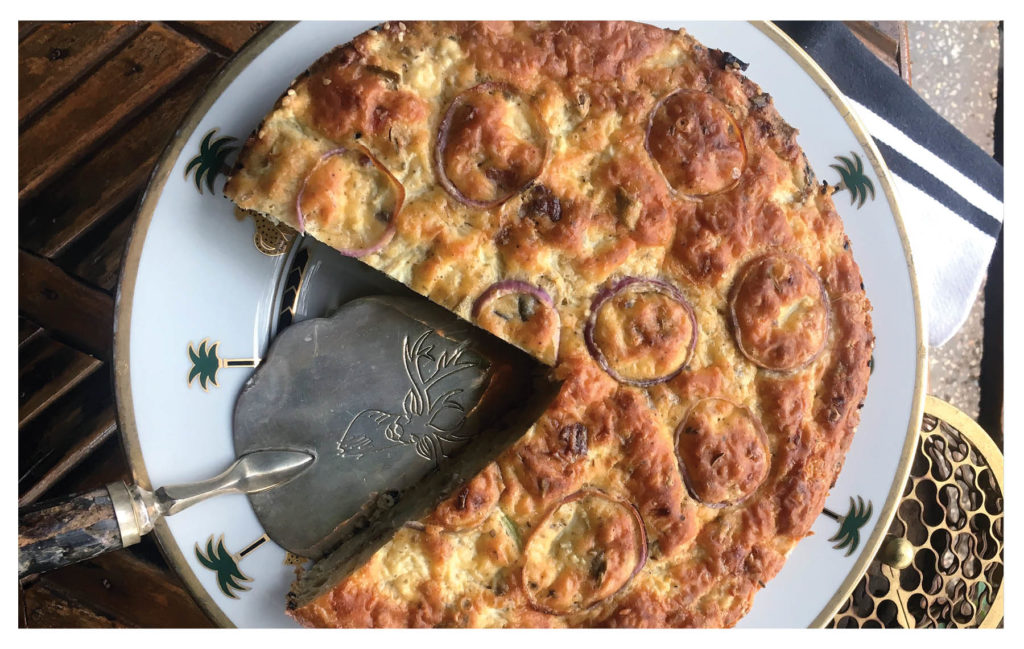
If you feel moved in the wake of the Pittsburgh shootings, as tempting as it may be to get on your social media platform of choice and shout your outrage from the rooftops of the virtual world, I have a suggestion that may make you feel better. What follows is a recipe for a cauliflower cake from the shining star of the Israeli culinary world, Yotam Ottolenghi. In keeping with the tradition of serving eggs and vegetables when sitting shivah, this quick casserole is soul-satisfying sustenance for anyone you make it for. It won’t take you but an hour to prepare, the ingredients are simple and straightforward, and it’s flavored not bold or sharp but just savory enough to be comforting. 

I made it after I lit a candle for the Pittsburgh victims and their families whose lives were shattered just by being at the right place at a very wrong time. I let it cool and brought a few pieces of it wrapped in a pretty box to my new next-door neighbors to welcome them to the neighborhood. I was received with such surprise and warmth that even now the thought of it brings a smile to my face. 

“In keeping with the tradition of serving eggs and vegetables when sitting shivah, this quick casserole is soul-satisfying sustenance for anyone you make it for.”

It prompted me to remember a quote from one of my favorite people who once remarked to me, “There is still beauty amidst the rubble here.” How fortunate we are that even the smallest gesture of kindness offered to a stranger, many miles away from where the families of this tragedy are sitting shivah, can remind us of that.

The recipe below is from Yotam Ottolenghi’s “Plenty More” cookbook.

Cauliflower Cake
1 lb. cauliflower, outer leaves removed, broken into small florets
1 medium red onion, peeled (6 ounces)
5 tablespoons olive oil
1/2 teaspoon finely chopped rosemary
7 Large eggs
1/2 cup basil leaves, chopped
1 cup all-purpose flour, sifted
1 1/2 teaspoons baking powder
1/3 teaspoons ground turmeric
5 oz. coarsely grated Parmesan cheese (or other mature hard cheese)
1 teaspoon melted butter, for brushing
1 tablespoon white sesame seeds
1 teaspoon nigella seeds (optional)
2 teaspoons sea salt
Black pepper (to taste)

Preheat oven to 400 degrees. Place cauliflower in a saucepan with 1 teaspoon salt, cover with water and simmer for 15 minutes or until florets are soft enough to break when pressed with a spoon. Drain and set aside in a colander to dry.

Cut 4 round slices, each 1/4-inch thick, off one end of the peeled onion and set aside for garnish. Coarsely chop the rest of the onion and place in a small pan with the oil and rosemary. Cook for 10 minutes over medium heat, stirring from time to time, until soft. Remove from heat and set aside to cool. 

Whisk the eggs and basil together. Add the flour, baking powder, turmeric, cheese, 1 teaspoon of salt and black pepper and whisk gently until no lumps of flour remain. Add the cooled onions and the cauliflower and mix without breaking the florets.

Line the base of a 9 1/2-inch cake pan (springform if you have it) with parchment paper and brush the sides with melted butter. Mix together the sesame and nigella seeds and toss them around inside the pan so they adhere to the sides. 

Pour the cauliflower–egg mixture into the pan, spreading it evenly, and then arrange the reserved onion rings on top. Place in the center of the preheated oven and bake for approximately 45 minutes, just until golden brown on top, and set. To test for doneness, insert a knife into the center of the cake; if it comes out clean, the cake is ready. Remove from oven and set aside for at least 20 minutes before serving. The cake is best served warm or even at room temperature. Serves 10

Cauliflower Cake and the Magic of Kindness Read More »

A Prayer for the Victims

We are devastated, God,

Our hearts are breaking

In this time of shock and mourning.

The loss is overwhelming.
Send comfort and strength, God, 

To grieving family members.

Send healing to the injured,

Send strength and wisdom to their doctors and nurses.

Bless the courageous police officers who risked their lives

To protect innocent lives.

Shield us from despair, God,
Ease our pain.
Let our fears give way to hope.

Lead us to join together as a nation

To put an end to anti-Semitism, 

An end to hatred,

An end to gun violence.

Teach us, God, to honor the souls we have lost

By raising our hands and voices together

In the cause of peace.

Because Torah is a Tree of Life

And all its paths are peaceful.

Work through us, God.
Turn our helplessness into action.
Teach us to believe that we can rise up from this tragedy

And banish the hate that is tearing our world apart.

We must never be indifferent to the plight of any who suffer.

We must learn to care,

To open our hearts and open our hands.
Innocent blood is calling out to us.

God of the brokenhearted,
God of the living, God of the dead,
Gather the souls of the victims
Into Your eternal shelter.
Let them find peace in Your presence, God.
Their lives have ended
But their lights can never be extinguished.
May they shine on us always
And illuminate our way.
Amen.


Rabbi Naomi Levy is the spiritual leader of Nashuva in Los Angeles.

A Prayer for the Victims Read More »

Gal Niv: The Star Behind the Rock Stars

Gal Niv can solve any problem. She’s just the type of person you know can handle it — whatever “it” is.

A missing cable connector a half-hour before showtime? No problem. Coordinating a sound check in the middle of a festival in the summer desert heat? Don’t sweat it. Missing merchandise? Moody door team? Overlooked journalist? Niv’s got it. And that’s why she’s the rock star behind the rock stars, the fixer, the handler, the master of the moment — the show manager for one of Israel’s most dynamic bands, Full Trunk.

Niv, a tall and striking 30-year-old with boundless energy, whose first name means ‘wave’ in Hebrew, was born and raised in Kibbutz Rosh Hanikra. “You know Lebanon? We’re just below it,” Niv says of her hometown on the far-too-active northern coastal border of Israel. A true kibbutznik, Niv grew up on this breathtaking pastoral mountainside overlooking the Mediterranean, in a tight-knit group of girls, roaming barefoot from house to house in the extended family of the 1990s kibbutz. Her father, Shimon, is an archetypical old-school kibbutznik. He spent his career doing artificial inseminations of dairy cows throughout the western Galilee, traveling Europe in an Israeli dance troupe and, after his mandatory military reserve duty was finished, volunteering for the municipal police force. 

Her mother, Cookie, a retired emergency room nurse, made aliyah to Israel from Montreal at the age of 18. “A typical Polish mother,” as Niv says, “she makes enough food for the whole army and worries like crazy.” 

Shimon and Cookie started taking Niv to concerts when she was 3.  These days the roles are reversed, with Niv bringing them to shows — but as VIPs.

Niv lives in Tel Aviv suburb of Ramat Gan with her boyfriend Hani and rescue dog Russell. “I was never one of those people who couldn’t wait to get to the big city,” she said. “I love where I grew up. I love the North.”

But, alas, Tel Aviv is where the music industry is, and the industry, it seems, has long been calling.

It’s hard to imagine Niv not being fully immersed in the world of rock ‘n’ roll.  Niv’s day job is working for a boutique booking agency for established Israeli bands. Like many in the small Israeli music industry, she has a side hustle — traveling around the country as Full Trunk’s show manager.

Niv took her time finding her way, as only an Israeli could be allowed to do. She went into the army. She worked abroad selling beauty products in Edmonton, Alberta. She followed a boy to a remote island in Thailand. She worked in a tattoo parlor, a record store and a plant nursery. She milked cows. But as much as she might have thought she was lost and lacking direction, Niv had a constant North Star guiding her way: music. 

Niv met Ofer Vayner, the bassist of Full Trunk, in 2009 when she was bartending at a local bar named, fittingly, Hendrix — as in Jimi. They became best friends. In 2014, Full Trunk released their first studio album. Niv was, perhaps, their first groupie. She hung out at practice, she was in the front of the audience at every one of their tiny first shows. She toured with them throughout England. She worked the door at their first show at the Barby, the legendary Tel Aviv Israeli music venue.  After their last album exploded on the Israeli music scene, they begged her to join the team for their fast-paced tour. 

If you’re ever in Israel and make it to a Full Trunk show, you’re in for a treat. The band members have a playfulness among themselves that they generously share with their audience. They get you on your feet from the first chord. They make you smile and dance with wild abandon. They give 110 percent to the music and to the fans.  And they can do all of this because they have the rock star behind the scenes making sure they can just play. They have what it takes to make it in the competitive Israeli music scene.

They have a ton of talent, and they have Gal Niv.

Gal Niv: The Star Behind the Rock Stars Read More »

National SJP to Use UCLA Bruin Playing With Palestinian Kite As Conference Logo

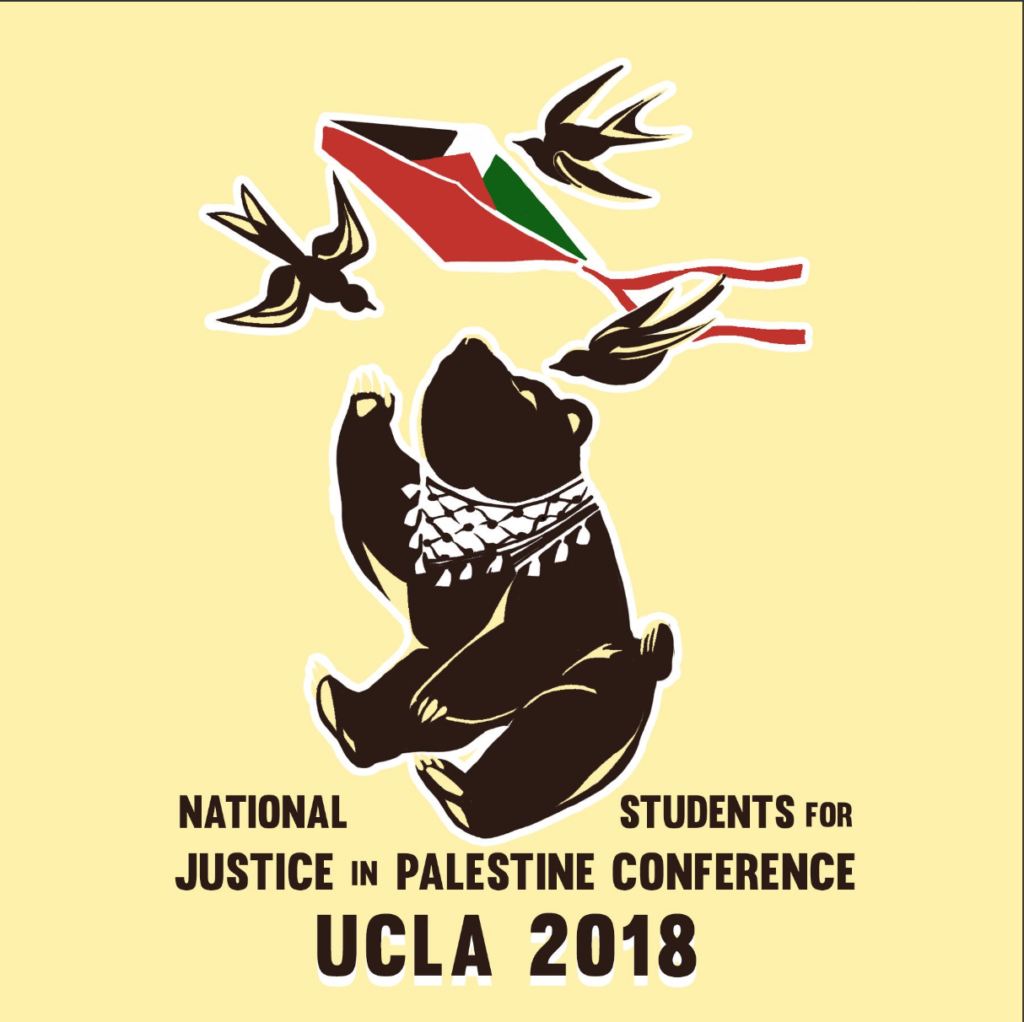
National Students for Justice Palestine (NSJP) unveiled their logo on Oct. 27 for their upcoming conference at UCLA: the UCLA Bruin playing with a Palestinian kite.

Below is the logo, which can be seen on NSJP’s website:


Simon Wiesenthal Center Associate Dean Rabbi Abraham Cooper told the Journal in a phone interview that the logo is “poking their finger at the eye of the UCLA administration and the UCLA community” by “co-opting the UCLA Bruin icon.”

“What does the Palestinian kite stand for today?” Cooper said. “It’s not going out with peace kites from Japan. It’s setting aloft arson terrorist kites to burn down crops and forests as they’ve done in southern Israel.”

Cooper added that Palestinian terrorists have been using explosives disguised as children’s toys in order to lure Israeli children into touching it and having it blow up in their faces.

“If this doesn’t wake up the UCLA administration to cancel the event at UCLA, then they’re going to have to deal with the consequences that the UCLA Bruin has now been hijacked by people who want to destroy Israel and are pro-terrorist,” Cooper said.

The university and NSJP have not responded to the Journal’s request for comment.

The conference is scheduled to take place on Nov. 16-18.

National SJP to Use UCLA Bruin Playing With Palestinian Kite As Conference Logo Read More »

Tel Aviv GA Sought to Bridge Israeli-Diaspora Gap

Jay Sanderson has attended many a General Assembly of the Jewish Federations of North America, but the president and CEO of the Jewish Federation of Greater Los Angeles said this year’s gathering in Tel Aviv was different.  

“In previous GAs we talked about a lot of different issues,” Sanderson said during an interview with the Journal at the Oct. 22-24 conference, which attracted more than 2,000 North American and Israeli participants. 

“What was unprecedented about this GA was that we focused on one thing: How to build a new kind of bridge between Israel and the Diaspora that enables as many people as possible to cross from both sides.”

The theme for this year’s event, “Let’s Talk,” was a recognition that Israeli-Diaspora ties are strained, and that both communities need to come together and heal the rift before it becomes unbridgeable. 

Held in Tel Aviv for the first time, the annual conference acknowledged that Israelis and North American Jews have different priorities and agendas because they have fundamentally different life experiences.

“We’re like two ships passing in the night,” Sanderson said. “Israelis don’t have a full understanding of what’s important to North American Jewry,” including religious pluralism, assimilation, anti-Semitism and the treatment of Palestinians in the West Bank.  

In Israel, he continued, “Pluralism isn’t high on the list.” Security is, and the fact that most Jewish Israeli 18-year-olds are drafted when they’re 18.  

“A rocket fell on a house in Beersheva and a mother heroically saved her three children. We don’t have rockets on our borders,” Sanderson said. 

Richard Sandler, who is concluding his term as chairman of the Jewish Federations of North America, said that despite these differing priorities, “we share common traditions and a common value system. We need to focus on the things we have in common, which far exceed the things that divide us.” 

“A rocket fell on a house in Beersheva and a mother heroically saved her three children. We don’t have rockets on our borders.” — Jay Sanderson 

During and between sessions, some of the North Americans expressed their concerns about Israel’s new Nation-State Law, which codifies Israel as the national homeland of the Jewish people but does not mention the rights of the country’s minority groups. They also expressed hope that Israel will do much more to ensure the equal treatment of non-Orthodox denominations of Judaism. 

Sandler said the North American-Israel relationship has shifted over the years, to the point where Israel — which once struggled to feed and house its citizens — now offers educational and logistical assistance to Diaspora communities and is seeking to expand that role. 

During the GA, Israeli leaders floated the idea of creating a “Reverse Birthright” that would bring young Israelis to Diaspora Jewish communities, and setting up programs to teach Hebrew to North American Jews.    

“When I grew up you had two things you don’t have going on today,” Sandler said. “Back then, Israel needed a large infusion of philanthropic dollars from the U.S. Israel didn’t have the strong economy it has now. Today, Israel doesn’t need our dollars to the same extent, though of course there are people still in need.” 

At a time when Israel still relies heavily on the federations’ help to fund numerous programs for the most disadvantaged sectors of Israeli society, Israeli officials are concerned about Jewish identity among North American Jews and are seeking ways to strengthen it. 

Sandler said this change in the Israel-Diaspora power dynamic has taken many Diaspora Jews by surprise. 

Referring to a presentation by the organization Israel Flying Aid, which is providing vital assistance to people in Syria, Iraq and elsewhere, Sandler said, “I don’t think American Jews think of Israeli NGOs reaching out beyond their border and making a difference in the world, just as we try to make a difference in the world. It makes us proud.” 

Helene Siegel, a federation delegate from Orange County, said she was impressed by the strides Israeli nonprofits have been making in addressing coexistence. 

During a GA session, two organizations that bring Jewish- and Arab-Israeli children together presented their work. One of them, Kids 4 Peace, brings Arab and Jewish teens together to work on joint projects and celebrate each other’s holidays. Their parents also meet on an ongoing basis. The program is considered a major success. 

“For me, this was a highlight of the GA because I really believe that kids are our future,” Siegel said. “These kids make connections with one another and then bring those connections back to their parents and ultimately to their communities. Instead of seeing them as ‘the other,’ they learn that ultimately most people want peace.” 

Blossom Siegel, Helene’s mother and a former head of the Orange County federation, said the GA always provides something new and innovative. The Tel Aviv GA marked her 40th visit to Israel. 

“This year, it was all about bridging differences,” she said. “The Israelis are more openly protective of their children while we Americans take our safety, our standard of living, our ability to get jobs somewhat more for granted.” 

Blossom Siegel said she felt gratified that so many of the sessions focused on the integration of Israel’s Arab community and on programs “that help children from different backgrounds become more tolerant of one another.” 

“It won’t happen overnight,” she added, “but it will happen.” 

Tel Aviv GA Sought to Bridge Israeli-Diaspora Gap Read More »

After Pittsburgh: Reclaiming the Jewish Contract With America

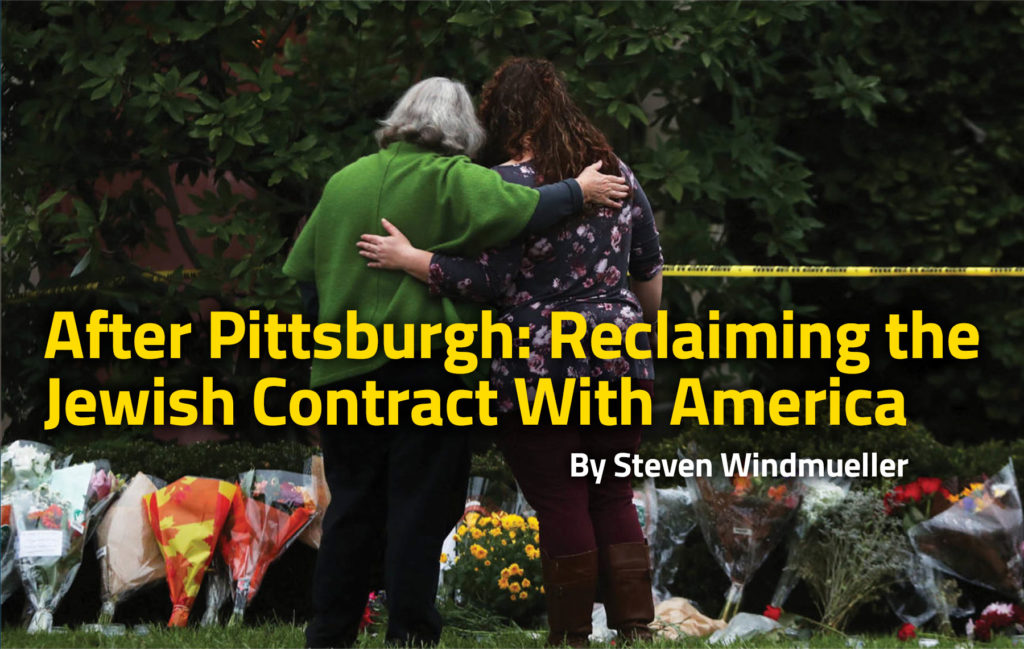
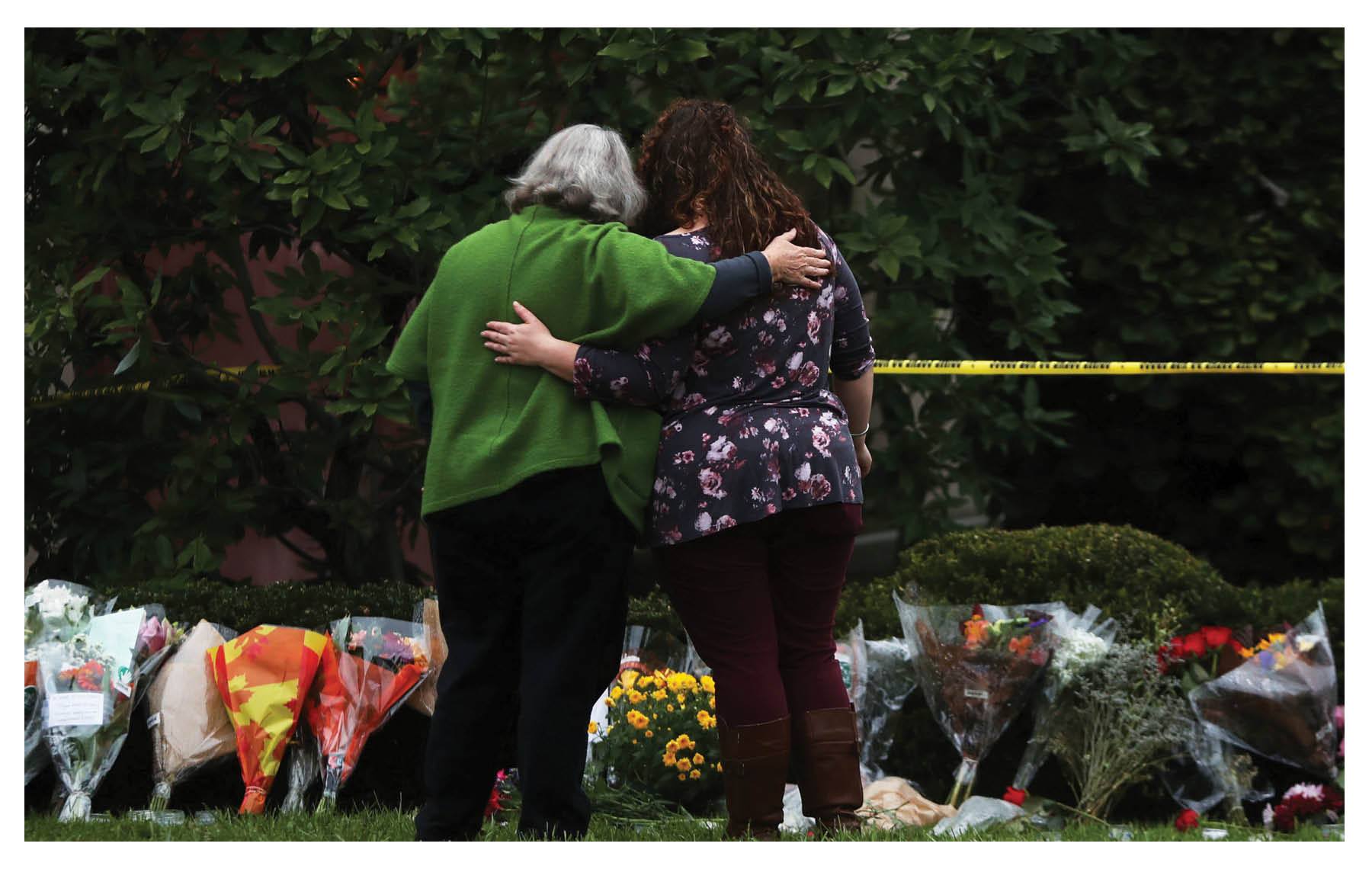
People visit an impromptu memorial at the Tree of Life synagogue. Photo by Cathal McNaughton/Reuters.

The gunman who struck Pittsburgh’s Tree of Life Synagogue on Shabbat indicated online that he wanted to “Kill all Jews.” During prior events — whether at our country’s southern border, on the streets of Charlottesville, or at political rallies sponsored by our president — Jews have been mostly passive observers to this nation’s changing political scenarios. However, the assault on worshippers that took place on that Shabbat morning in Squirrel Hill was a direct attack on Judaism and America’s Jews. It was the single most violent incident against Jewish Americans in the history of the United States. 

In a society already under assault by the politics of hate, the mass murder in Pittsburgh is but one more indication that a war is underway for America’s soul. Where America and Americans once celebrated differences, today there is a conscious and deliberate effort to intimidate and seek to silence those who represent different religious, sexual and political beliefs and practices. Violence is replacing civil discourse. As a result, anti-Semitism has become a manifestation of a fundamental disregard for the respect for diversity. In this new and uncertain political environment, Jews have become political targets. 

It is cynical for politicians to offer words of comfort in the aftermath of violence when their own rhetoric, framed in nationalistic imagery, seeks to question the loyalty of certain Americans; and when their political operatives single out individuals, suggesting that they are the cause of America’s troubles. In this type of political culture, sadly, violence and hate will be manifested on our streets.

“The synagogue attack has introduced a number of challenging issues involving, in particular, gun violence, the discourse of politicians who need to be held accountable for the words they employ, and the use of social media to convey hate messaging.”

A year ago, I offered the following perspective: 

“A fundamental political sea change appears to be underway. As America’s social fabric is being tested, new strains of anti-Semitism and anti-Zionism have emerged globally and at home. … There is a heightened awareness among Jews of extremist expressions challenging not only the existing democratic norms of the nation but also reflective of how minority communities, including Jewish Americans, are being categorized and threatened.”

The Jewish Contract With America
The American Jewish story is unique in the annals of our historic journey and is worth revisiting. While today’s social and political environment is not the first time in American Jewish history that we have experienced a sense of discomfort and political uncertainty, we should remind ourselves that Jews have been a part of the American experiment in democracy since this nation’s founding. We have come to understand that America is a fundamentally different type of society. “American exceptionalism” was built around the symbolic idea of a “Jewish contract” that ensured religious freedom and promoted political security. Unlike many other societies in which Jews have resided, the United States has been the only nation without a history of state-sponsored anti-Semitism. 

The constitutional principles of American democracy have clearly enabled and shaped Jewish political engagement. Among the underpinnings basic to this nation’s creation was the commitment of its Founding Fathers to ensure religious liberty, nurture political discourse and promote church-state separation, as referenced in the First Amendment.  Similarly, Article Six of the Constitution contains a further political safeguard, as it prohibits any form of a “religious test” as a qualification to holding public office.

Over time, historical events created a type of mythology concerning Jewish participation in American society, suggesting a special connection between America and its Jewish citizens. This is no better affirmed than with the presidency of George Washington. In tribute to his election, the Jewish congregations of the new republic issued a series of congratulatory letters. In response, Washington wrote this defining message to the Jewish community of Newport, Rhode Island:

“For happily the Government of the United States, which gives to bigotry no sanction, to persecution no assistance, requires only that they who live under its protection, should demean themselves as good citizens.”

And Washington’s concluding paragraph then perfectly expresses the ideal relationship between the government, its individual citizens and this nation’s religious communities:

“May the children of the stock of Abraham, who dwell in this land, continue to merit and enjoy the good will of the other Inhabitants; while every one shall sit under his own vine and fig tree, and there shall be none to make him afraid.”

Washington’s letter represents one of the most extraordinary statements defining the ideals associated with American society and serves as an important element of this symbolic notion of a “contract” between the Jewish community and this nation.

Over time, other statements and defining actions would add to this contractual understanding. During the Civil War, Lincoln’s decision to order the rescinding of General Grant’s Order Number 11 represented another such example. Grant’s directive would have required Jews living in the Tennessee River Valley to leave their homes and sacrifice their livelihoods. It marked the only time in American history in which Jews would be singled out for political retribution by the government.

American Jewry has so identified with the key social norms and political symbols of this society that, from the outset, Jewish institutions reflected not only the core terminology of American society but also the structural characteristics of the federal government system itself. For example, various organizations have taken on names with symbolic references to the political ideals of this country: United Jewish Communities, American Jewish Congress, United Synagogue of America (USA), and the Union for Reform Judaism.

Similarly, the governance and structural functions of Jewish institutions reflect two core elements central to American democracy: the introduction of a federalist system involving national, regional, state and local levels of governance and the presence of a separation of powers arrangement involving the distribution of roles and responsibilities.

“This is a time to reassert the civic principles that convey the American story. We owe it to Pittsburgh’s victims of anti-Semitism and to ourselves.”

The Rise of External Threats
Over the course of American history, Jews have faced various challenges to their political status and well-being. With the rise of the Ku Klux Klan in the second half of the 19th century and the emergence of overt anti-Semitism in the early decades of the 20th century —  in part promoted by the publications of Henry Ford and the radio messages of Father Charles Coughlin — an era of political and social upheaval left many Jews feeling uncertain and insecure. University quotas, discriminatory hiring practices and restrictions on selling homes to Jews reflected the tenor of the times.

The years following World War II redefined some of the challenges facing American Jewry in shaping their role as a minority community within a larger culture. The new realities of the presence of a Jewish State, along with the heightened visibility of Jews within American society, challenged Jewish Americans to reaffirm their loyalty to this nation. In 1950, Ethel and Julius Rosenberg were found guilty of conspiracy to commit espionage. The charges related to the passing of information about the atomic bomb to the Soviet Union. The political witch-hunts for communist sympathizers conducted by Senator Joseph McCarthy and the activities of the House Committee on Un-American Activities during the 1950s raised concerns about an increase in anti-Semitism.

If the 1950s can be perceived as a decade marked by a level of fear, then the 1960s witnessed the emergence of a heightened sense of political engagement and activism. Jews played key roles in the liberal, progressive agenda of the civil rights struggle and as activists within the Vietnam anti-war movement. With this increased participation came new questions regarding how far Jews could publicly embrace controversial policies without endangering their self-interests and the community’s well-being. Even the divisions within the community over specific domestic and foreign policy matters were perceived as testimony to their greater sense of civic assuredness and security.

Moving Forward
Indeed, in the context of the recent bloodshed and horror of violence directed against Jewish Americans, and in light of the data showing a significant rise in hate crimes and social media threats, many issues are emerging. A different political reality faces this nation in the aftermath of Pittsburgh, as hate has gone mainstream. The bottom line remains: Will Jews and others feel safe in this country? 

The synagogue attack has introduced a number of challenging issues involving, in particular, gun violence, the discourse of politicians who need to be held accountable for the words they employ, and the use of social media to convey hate messaging. These and other policies and practices define who we are and what it may mean to be an American. 

Fear and intimidation must not be allowed to silence Jews or others. In connection with American Jewish experience, Jews have become an essential and highly visible element within the structure and culture of this society, deeply embedded in its body politic. Jewish Americans express themselves through competing political lenses, embracing liberal ideology as framing Jewish and universal values and also by defining political engagement through interest-group politics, specifically defending and embracing Jewish self-interests. In the aftermath of Pittsburgh, Jews will need to assert a shared response.

This is a moment that demands a serious conversation among Americans about the state of our nation and the collective interests and common values that bind us together. This is a time to reassert the civic principles that convey the American story. We owe it to Pittsburgh’s victims of anti-Semitism and to ourselves.

Sadly, bigotry and hate have always been present within American culture. The political genius that shaped this society has enabled responsible voices to step forward to manage the nation’s political messiness, fix its failures as a democracy, and respond to periods of hate rhetoric and social violence. At each turn, these individuals from within our government, our press or our religious establishments, in association with the collective conscience of our society, have stepped forward to recalibrate both the messages and the practices that define what it means to be an American and to be part of this nation.

The task of reframing the American story must happen yet again, for the sake of the Tree of Life victims and for the sake of our great nation.


Steven Windmueller is the Rabbi Alfred Gottschalk Emeritus Professor of Jewish Communal Service at HUC-JIR, Los Angeles. 

After Pittsburgh: Reclaiming the Jewish Contract With America Read More »

Why Judaism Matters

The following is excerpted text of the speech delivered by Richard Sandler, outgoing chairman of the Jewish Federations of North America, at the Knesset on Oct. 23 during the JFNA’s General Assembly in Tel Aviv. 

During these past three years, I have had the opportunity to study our community and the important issues that inspire us, concern us and often divide us, and I keep coming back to the same three questions: Why does Judaism matter? Why does how we treat one another matter? Why does Israel matter? And tonight I will ask you to please consider three imperatives that relate to these questions, for it is important to talk but it is also important to then take positive action.

Why does Judaism matter? We all know that we are a small people, less than 0.2 percent of the world’s population with many adversaries and enemies throughout our history; and yet, we have survived against incredible odds, while making a positive difference in the world exponentially disproportionate to our numbers. How could this be? It is because of a tradition rooted in the values in our Torah, which is over 3,000 years old. Times may change, but these values do not. 

The Torah is about who we are, where we come from and what is expected of each of us. It is so much more than a slogan or a verse that may support a point of view. 

We can only understand our tradition and its importance to our lives by going back to the basics, by learning the depth, richness and complexity of that tradition. We cannot live Jewish values if we do not understand what they are. 

So the first imperative is a collective communal commitment to studying Torah and the writings of our tradition. This commitment must not be driven by politics or religious philosophy, but by the earnest search for true meaning. I commit to you that I will study Torah this year, and I ask you, the leaders of our community, to do the same.

We need to take advantage of this remarkable time in our history, by learning our history and our tradition so that we can determine a future course in which we strengthen ourselves and our people according to Torah values. It is time we learn what made the Jewish people the Jewish people. 

Which leads me to the second imperative: No matter where we live; no matter whether we are Orthodox, Conservative, Reform or secular Jews; no matter what political or philosophical position we hold; all of us must end the divisiveness that exists between us. We are a small people who have enough enemies outside of our community. We do not need to do their work for them by being so divisive.

“We can only understand our tradition and its importance to our lives … by learning the depth, richness and complexity of that tradition.”

We will agree. We will disagree. Our tradition is about debate and disagreement, but where people listen to each other, learn from each other and respect each other.

The most repeated prayer in our tradition, one of the only two prayers that the Torah commands us to say each day is the Shema. Shema means “hear” or “to listen.” We need to study together as we debate important issues and listen to different points of view. We do matter to one another. We’re too small a people to be like the rest of society where people of different points of view refuse to listen to one another and instead engage in Lashon Hora — negative or derogatory speech, or even worse, engage in sinat chinam, senseless hatred. And let us not forget that it was sinat chinam among the Jewish people that resulted in the destruction of the Second Temple.

Let’s leave this GA committed to being better informed to lead our communities from Lashon Hora to Shema — not as Israelis or Diaspora Jews, not as secular or religious Jews, and not as Jews from the left or from the right but as Jews who share a remarkable tradition and a common destiny. Our children are waiting for spiritual wisdom, for heroic ideals and for heroic vision. They want to stand for something and something important. Let’s dedicate ourselves to learning, to respecting each other and to protecting what is sacred so we ensure a Jewish future for our children in this remarkable time when we again have a Jewish homeland for the first time in 2,000 years and feel so comfortable and at home here in the United States.

And that leads to our third imperative. Being at home gives us new security and new responsibilities. Let’s never forget that the reason we feel at home in America is because there is this remarkable country called Israel. 

Our homeland is a small country the size of New Jersey. It has been in constant conflict for all of its 70 years. Today, there are countless thousands of missiles on Israel’s border aimed at Israeli citizens, in the hands of terrorists who call for the total destruction of Israel and the Jewish people. Those of us in the Diaspora can’t even begin to understand or appreciate the challenges and pressures the Israeli people endure daily. 

This does not mean that as committed and caring Jews we do not have the right to expect more from Israel. Israel is far from perfect. And Israel also has a right to expect more from us. But first, all of us must listen to one another to truly appreciate and understand our different concerns and the different lives we lead, yet never forgetting Kol Y’Israel Arevim Zeh La Zeh. All Jews are responsible for one another. We have many differences, but so much more in common.

To my fellow Jews in Israel, I say we are all better off with thriving Jewish communities well beyond your borders. No people on this planet will ever care as much about a strong Jewish state as we do. 

And to those in the Diaspora, I say never take the miracle of Israel for granted. Israel gives us a seat at the world table — a seat we did not have in the 1930s and 1940s. It provides a shield for all of us we never had before. 

Let not any of us ever forget that because there is an Israel, and a strong Israel, there is an army that protects each and every one of us each and every day. Every young man and woman who serves in the IDF risks his and her life to protect us — all of us.

So as I close, I repeat the three imperatives:

Learn and encourage those in your community to learn Torah, learn the beauty and depth of our tradition; 

Listen to each other with respect and understanding. None of us has all the answers, but by listening we will gain a new knowledge of how to answer the important questions;

Never forget the blessing that Israel is to us — she protects us and connects us to the Torah.

Maimonides refers to Moses as the most perfect human being. At the end of his life, near the end of the Book of Deuteronomy, Moses set out a choice for the Jewish people which the Torah certainly sets out for us today: “I call heaven and earth to witness against you today that I have set before you life and death, the blessing and the curse, therefore choose life so that you and your children may live.”

Why Judaism Matters Read More »

Fighting Anti-Semitism Should Be Bipartisan

This week, The Jewish world mourned the brutal slaughter of 11 Jews at a Pittsburgh synagogue — the deadliest anti-Semitic shooting attack in American history. Americans of good heart universally grieved and condemned the evil. And then politics broke out. As always, it broke out thanks to our nation’s obsession with President Trump and his mouth.
The media immediately leaped to the conclusion that the shooter at the Tree of Life Synagogue — a virulently anti-Semitic white supremacist with a particular dislike for President Trump and his “globalist” policies, a man who decried the “kike infestation” supposedly forwarded by Trump — was somehow brought about by Trump.

Two pieces of evidence have been presented to support this contention. The first is Trump’s untoward rhetoric concerning the migrant caravan headed north from Honduras toward the United States border. Trump believes the caravan is directed for political purposes. The shooter in Pittsburgh specifically decried the Hebrew Immigrant Aid Society (HIAS), stating on the social media website Gab: “HIAS likes to bring in invaders that kill our people. I can’t sit by and watch my people get slaughtered. Screw your optics, I’m going in.”

Suffice it to say that millions of Americans agree with President Trump regarding the caravan, and that none of them but one felt it necessary to go shoot Jews. Attempts to link opposition to George Soros to anti-Semitism lack evidence at best. Those who despise the Jews don’t need an excuse to kill us. The long history of anti-Semitism shows it to be a uniquely chameleonic conspiracy theory, crediting the Jews for communist uprisings and capitalist machinations, secularizing tendencies and religious separatism, ethnic solidarity and ethnic diffusion.

“If we wish to be accurate, we shouldn’t link normal but heated political rhetoric with anti-Semitic violence.”

The only common strain: the Jews must be eradicated. To credit President Trump’s feelings about a migrant caravan with this shooting would be to grant him Rasputin-like powers far beyond the evidence.

Then there’s the second piece of evidence: Trump’s horrifying blitheness about alt-right groups in 2016 and 2017. There’s no question that Trump’s treatment of the alt-right during the 2016 campaign and in Charlottesville was despicable. I wrote about it repeatedly and incessantly. But it’s worth noting here that the alt-right has been wildly disappointed with President Trump, who has turned out to be the most pro-Israel president in the history of the United States.

Trump’s words on the Tree of Life Synagogue shooting themselves are far stronger than any words we’ve ever heard from a president before: “If you seek the destruction of Jews, we will seek your destruction.” Furthermore, we must distinguish between the alt-right, a relatively new phenomenon, and the persistent white supremacist movement, which has routinely attacked Jews; Trump wasn’t a gleam in the political eye when a white supremacist shot up the West Valley Jewish Community Center in Woodland Hills in 1999.

All of this suggests a certain gross partisanship on the part of people who, without sufficient evidence, blame Trump for the Tree of Life Synagogue murders. That’s particularly true of people who seem fully complacent with the Democratic Party’s open embrace of Keith Ellison, Linda Sarsour and Louis Farrakhan; people who brushed off President Obama labeling an anti-Semitic terror attack in France as “random”; people who shrugged away Obama’s statements about Iranian anti-Semitism (he said that they would only act in anti-Semitic fashion “at the margins”); people who pooh-pooh the boycott, divestment, sanctions movement and Hamas.

Here’s the reality: If we wish to be accurate, we shouldn’t link normal but heated political rhetoric with anti-Semitic violence. If we wish to fight anti-Semitism, we should label all anti-Semitic rhetoric and anti-Semitism-enabling rhetoric for what it is, regardless of partisan persuasion. And if we wish to have a country, we ought to stop conflating politics we dislike with incitement to violence. 


 Ben Shapiro is a best-selling author, editor-in-chief at The Daily Wire and host of the conservative podcast “The Ben Shapiro Show.”

Fighting Anti-Semitism Should Be Bipartisan Read More »

#WeAreAllJews: The Jewish Media Stand With Pittsburgh

Earlier this year, our colleagues at the three leading Jewish newspapers in the United Kingdom published the same front-page headline and joint editorial voicing concern over rising anti-Semitism in Britain’s Labour Party.

Today we have found a mournful occasion to follow in their footsteps.

For many Jews, the United States has long held a unique role in our collective imagination. It has been an unprecedented land of promise, of refuge, of freedom, of opportunity and of safety.

But after the horrific attack last Shabbat at the Tree of Life Congregation in Pittsburgh, in which 11 of our brothers and sisters were brutally murdered, we can’t help but be shaken and concerned for the America we have come to know and love.

We therefore join together to unequivocally condemn this brutal act of anti-Semitism and all deadly acts of hate. We also condemn the climate of hate that has been building for some time now, especially on college campuses and on social media, where the veneer of anonymity has allowed anti-Semitic cesspools to flourish, and from irresponsible political leaders who engage in hateful speech and are abetted by the silence of others.

As journalists, we hold a variety of opinions about politics in this country and in Israel. The American Jewish community is diverse, and those differences are reflected on the pages of its media.

In coming together now, we are not erasing those differences, but rising above them to issue a call for solidarity and respect, and asking our political and communal leaders to do the same.

The gunman who invaded a sanctuary on Shabbat did not distinguish among his victims. To him, they were all Jews.

We are all Jews. Let this horrific massacre be a moment of redemption as well as grieving. Let us argue with each other as Hillel argued with Shammai — with civility. Let us acknowledge our common humanity with other Americans who have been subject to unconscionable violence, too.

Jewish media has a long and proud history in America, and we pledge to continue our mission to inform, reflect and bind our communities — even more necessary in this painful time.

Jane Eisner, Editor-in-Chief, The Forward

Dovid Efune, Editor-in-Chief and CEO, The Algemeiner

Ami Eden, CEO and Executive Editor, 70 Faces Media (JTA, Kveller, Alma, My Jewish Learning, Nosher, Jewniverse)

Nadine Epstein, Editor-in-Chief and CEO, Moment Magazine

Sue Fishkoff, Editor, J. The Jewish News of Northern California

Jerry Greenwald, Managing Editor, The Jewish Press

Lisa Hostein, Executive Editor, Hadassah Magazine

Gabe Kahn, Editor, New Jersey Jewish News

Janet Perez, Managing Editor, Jewish News of Greater Phoenix

Brett R. Rhyne, Editor, The Jewish Advocate, Boston

Gary Rosenblatt, Editor and Publisher, Jewish Week of New York

Joshua Runyan, Senior Editorial Director, Washington Jewish Wee

Liz Spikol, Editorial Director, Baltimore Jewish Times

David Suissa, Publisher and Editor-in-Chief, Tribe Media/Jewish Journal

Jonathan S. Tobin, Editor-in-Chief, Jewish News Syndicate


The post #WeAreAllJews: The Jewish media stand with Pittsburgh appeared first on Jewish Telegraphic Agency.

#WeAreAllJews: The Jewish Media Stand With Pittsburgh Read More »

Finding Light Through the Darkness After Pittsburgh

On a picture-perfect Sunday afternoon, the waitstaff were proffering trays of vegetarian egg rolls, mini hamburgers and other hors-d’oeuvres. The wedding guests were sipping flutes of champagne, served with a split strawberry nestled on the glass. It was exactly 24 hours after I had learned, late Shabbat afternoon, of the horrific massacre in Pittsburgh. I had to park my grief to the side. I was there to celebrate the wedding of my nephew Josh to his beautiful bride, Sammie. 

I had been jittery all day. I was reeling from the news of the slaughter, unable to absorb its horror. I thought about how exposed we Jews are in most shuls and schools, including the shuls I attend, and wondered what added security measures would be taken. And that morning my husband woke up feeling suddenly quite ill, and I was worried. I tended to him as I rethought our plans for the day. Someone in the family would need to stay home with him, for my own sense of reassurance, while the rest of us went to the wedding. With all that, I also tried to hold on to the focus of the day — the joy of a family wedding.   

The rustic beauty of the wedding venue and the lively spirits of the 150 guests worked its magic. Secure in the knowledge that my husband was feeling better and was tended to by our daughter-in-law (a registered nurse), and cheered up by the company of our 4-year-old granddaughter, who is a never-ending fount of hilarious observations about life, I was able to feel present in the simcha. I felt so grateful to be with three of our children and two children-in-law, and I happily socialized with my sister’s lifelong friends, some of whom I had not seen since we were young. Now, some of us were grandparents. 

Against the musical backdrop of the song “Perfect,” I watched Josh walk down the aisle holding my sister’s hand, his other hand resting on the arm of his father in his wheelchair. At that moment, my emotional bank overflowed. During this precious moment, I felt the weight of history behind it, both on a personal and on a larger, macro level.   

“Against the backdrop of violent anti-Semitism, thousands of couples had stood under thousands of chuppahs in every country where the scourge had festered.”

I felt the presence of my parents and grandparents, whom I imagined shepping nachas from Heaven from seeing their grandson and great-grandson marry a lovely Jewish woman under a chuppah. I felt the years of struggle, of raw emotional upheavals, that Josh had endured due to his parents’ divorce, and felt a surge of pride at the hard work he had done to find himself and to thrive in every way. I felt the joy of my sister, Sharon, whose own life has been so difficult in many ways, now enjoying one of the happiest days of her life. My tears flowed freely.   

I also felt the sweeping arc of Jewish history, where, against the backdrop of violent anti-Semitism, thousands of couples had stood under thousands of chuppahs in every country where the scourge had festered. This, I thought, is what a Jewish wedding always is: a symbol of our people’s irrepressible, unquenchable commitment to life; of our belief that the light of our hope and the strength of our faith will always somehow overpower the darkness of hatred. 

When Josh stomped on the glass at the end of the ceremony, symbolizing our awareness of the tragedies of our past, I was thinking of Pittsburgh. 

The Gemara says that a wedding represents the rebuilding (binyan) of the destruction  (churban) of Jerusalem. In other words, the only answer to churban is binyan. Our answer to darkness is to bring the light. 

May Josh and Sammie, through their new marriage, help rebuild what has been lost. May their love, self-sacrifice, acts of kindness and giving help extinguish the darkness with their light.


Judy Gruen is the author of “The Skeptic and the Rabbi: Falling in Love with Faith.”

Finding Light Through the Darkness After Pittsburgh Read More »