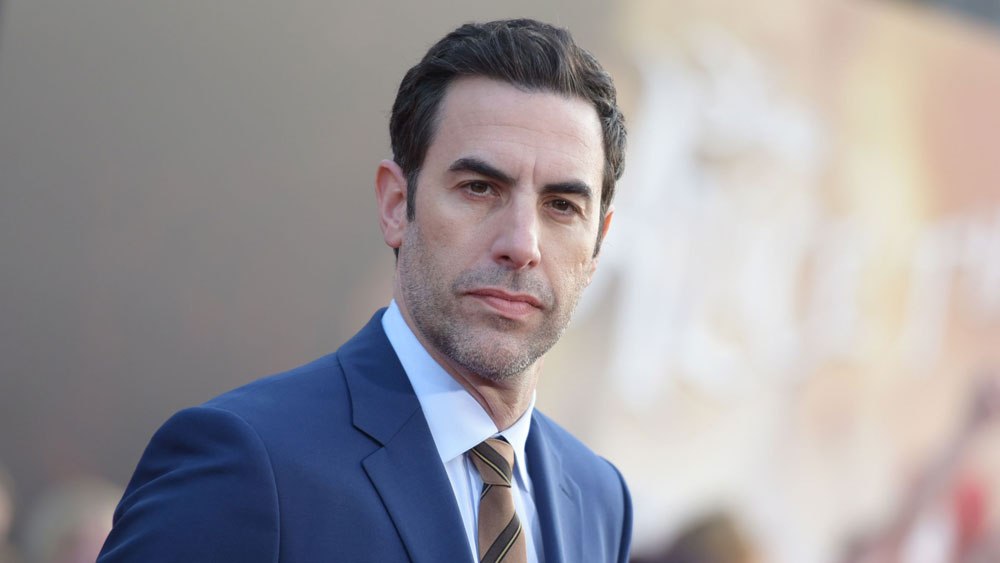
Sacha Baron Cohen is in talks to play Abbie Hoffman in “The Trial of the Chicago 7,” a long-gestating project that Aaron Sorkin (“Molly’s Game”) will direct from his own screenplay. Hoffman and six other defendants were charged with conspiracy and inciting to riot at the 1968 Democratic National Convention.
In the decade-plus since Sorkin wrote the script, Steven Spielberg and Paul Greengrass were planning to direct at various points. Baron Cohen was in the mix to play Hoffman in Spielberg’s proposed version, which was canceled due to the 2007-2008 Writers Guild strike.
On TV, Baron Cohen will play Israeli Mossad agent Eli Cohen in “The Spy” for Netflix and do a second season of his Showtime spoof-interview series “Who Is America?”
Jesse Eisenberg will star in “Resistance” as French mime Marcel Marceau. An Orthodox Jew whose father died in Auschwitz, Marceau worked with the French Resistance during World War II to save the lives of ten of thousands or children whose parents were murdered by the Nazis. Writer-director Jonathan Jakubowicz, a Venezuelan Jew of Polish descent, also lost family during the Holocaust.
Eisenberg, whose mother once worked as a clown at children’s parties, studied mime technique for a year to prepare for the role before production began in Prague, Czech Republic.
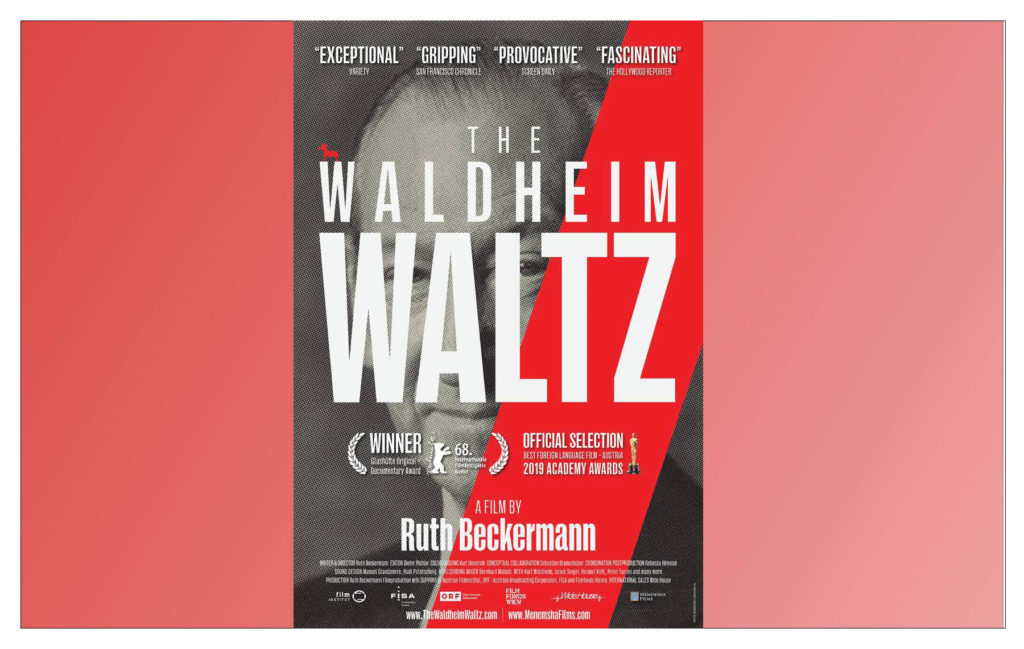
“The Waldheim Waltz” choreographs the agile steps of one of the more strange actors in recent world history, a man whose career nevertheless still holds warning signs for current political swings in Europe and the United States.
Kurt Waldheim was an Austrian, raised in a pious Catholic family, who served as a Nazi soldier and intelligence officer. He was elected to the United Nations’ secretary-general — twice — before becoming the president of Austria in 1986.
Waldheim managed to land these high-profile positions largely by massaging his biography to convince the world that he had just been a soldier following orders in World War II.
He argued that Austria was the first victim of Nazi aggression when Adolf Hitler annexed the country in 1938. A popular joke at the time praised the skill of Austrian diplomacy in convincing the public that Hitler was a native German and Beethoven was an Austrian even though the opposite was true.
In the early 1980s, between Waldheim’s terms as U.N. secretary-general and his Austrian presidency, the World Jewish Congress and Eli Rosenbaum, director of the U.S. Office of Special Investigations, began examining his background.
Waldheim’s wartime record revealed that after his service on the Russian front, he became an intelligence officer with the German army staff in the Balkans, where he played a key role in the brutal reprisals against the civilian populations in Yugoslavia and Greece, and, in particular, in the deportation of most of the large Jewish population in Salonika to Nazi death camps.
The charges and denials by the Waldheim camp became a focus of the heated Austrian presidential campaign in 1986. Protesters hoisted slogans including, “No to anti-Semitism, No to Waldheim,” while his supporters countered with, “We Austrians elect who we want” and “Waldheim, an Austrian who the world trusts.”
Among the protesters was Ruth Beckermann, a young Jewish Viennese woman and budding filmmaker, who photographed large segments of the demonstrations and counter-rallies. Twenty-seven years later, Beckermann, a successful documentary filmmaker, decided to take another look at the earlier footage. Adding material from archival and current news reports in “The Waldheim Waltz,” Beckermann draws a historical line between the events of the 1980s and current political developments, particularly in Europe but also in the United States.
“Adding material from archival and current news reports, filmmaker Ruth Beckermann draws a historical line between the events of the 1980s and current political developments, particularly in Europe but also in the United States.”
Describing herself in a phone interview as “half demonstrator, half documentarian” (as well as director, producer, scriptwriter and narrator), Beckermann said she discerned in the 1986 Austrian election the emergence of a new political force. She noted that Waldheim’s election as president represented one of the first victories of the “black-and-blue” coalition between traditional conservative ideologies and the populist, nativist appeal of vigorous right-wing activists.
She sees this new political force emerging today. Beckermann cited the current rise of populist anti-immigrant leaders in Austria, Poland and Hungary, the Brexit movement in Great Britain, reinforced right-wing constituencies in Israel and France, as well as the election of President Donald Trump.
Nevertheless, Beckermann said she detects a glimmer of hope “that the good people will rally — though I don’t know just when — and that mankind will survive.”
“The Waldheim Waltz,” opens Nov. 16 at Laemmle’s Royal Theatre in West Los Angeles and the Town Center in Encino.
N.Y. Democratic congressional candidate Alexandria Ocasio-Cortez used Saturday’s shooting at Tree of Life synagogue in Pittsburgh in a get-out-the-vote email on Wednesday.
The email, which was from the progressive group MoveOn.org and Ocasio-Cortez signed onto it, begins by stating that voters have a chance to “defeat the brutal white supremacist voices of anti-Semitism, anti-immigrant nativism and racism.”
“A Democratic majority will not bring back the eleven Jewish people in Pittsburgh, massacred while they prayed,” the email reads. “Or the two Black people gunned down before a Kroger grocery store in Kentucky. It won’t fully stop the relentless attacks against immigrants in America.”
“But on Sunday evening, Pittsburgh mourners – angry and heart-broken like us – chanted ‘Vote! Vote!’” the email continued. “They understand the magnitude of the midterm election six days from today: that it affords us the chance to forge a powerful bulwark against Donald Trump’s hate and hold accountable the Republicans who have been complicit in every step of his toxic, self-serving, and destructive agenda.”
The email added that the aforementioned grassroots effort is analogous to Ocasio-Cortez’s campaign.
“From the first day of our campaign, I walked and walked and walked. I walked until I wore holes through my shoes and my feet were soaked,” the email states. Hundreds of people from my community joined me, and together we knocked on over 120,000 doors.”
“And then something extraordinary happened: We won. Campaigns like ours aren’t supposed to win. But we did. And we can win again on Tuesday.”
Ocasio-Cortez came under criticism from both sides of the aisle over the email:
This is cynical and repugnant. @Ocasio2018, whose record on issues related to Jews is awful, blaming all Republicans for a white supremacist anti-Semitic massacre to raise cash for herself. pic.twitter.com/u5M2UJNVFK
Would be great if politicians on the left and the right could refrain from trying to turn martyred Jews into political capital, at least until they are buried. This email from @Ocasio2018's campaign is just as bad as @realDonaldTrump's insensitive tweet. pic.twitter.com/93SbBPYrht
Corbin Trent, Ocasio-Cortez’s communications director, told the Journal in a phone interview that they “100 percent stand behind” the email.
“We have a moment in history right now where we, I think, have a choice on the nation we’re going to be, and we can decide what the soul of this nation is and the spirit of this nation,” Trent said, “and too often what we’re seeing is that the Republican Party – and certainly the White House – are dealing in hate and vitriol. They’re trying to divide Americans instead of bring us together, and we’re absolutely committed to ending that, and we think winning in November will go a long way to start that process.”
“So yes, we’re going to bring up some of the terrible tragedies that are occurring and I think some of them are a direct result of the vitriol being spewed from the White House,” Trent added.
Trent also said that while the Pittsburgh shooting was “fresh,” it’s important to view it as well as the recent bomb threats and other tragedies as “learning opportunities and organizing opportunities to start preventing them, then we’re going to be damned to repeat it.”
However, Simon Wiesenthal Center Associate Dean Rabbi Abraham Cooper told the Journal in a phone interview that the email was a “disgrace” because Ocasio-Cortez essentially “buried all of the 11 [shooting victims] before all of them actually came to a Jewish burial in order to erase the uniqueness of anti-Semitism. Because people in that camp don’t want to deal with the implications and consequences of anti-Semitism because a good piece of that is also linked to Israel.”
“It’s a shonda, it’s a disgrace, but no one should be surprised that they would rush to bury the Jewish victims, the Jewish aspects of it before they even came to a proper burial,” Cooper said.
Acclaimed for such films as “The Troupe,” “Rage and Glory,” “Past Life” and“Dizengoff 99,” Israeli film director Avi Nesher is headed to Los Angeles for the 32nd Israel Film Festival, where he will receive the Cinematic Achievement Award and present his latest work, “The Other Story,” at the opening night gala on Nov. 6.
“Being honored is always nice,” Nesher told the Journal via Skype. “I spent many years in L.A. It will be interesting to see Hollywood meet this side of Israel,” he said about the festival, which also will present his 2004 film “Turn Left at the End of the World” on Nov. 8 as part of a tribute to classic Israeli movies.
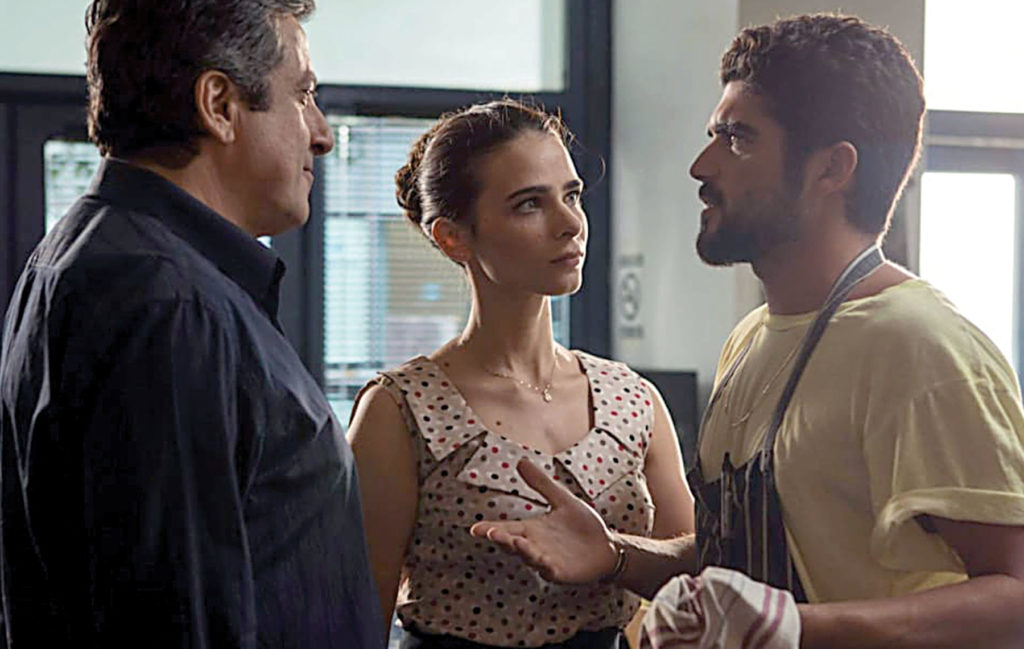
“The Other Story” is about secular Jewish parents on a mission to stop the marriage of their daughter and her ex-rocker boyfriend who have traded the wildlife for ultra-Orthodoxy. Inspired by his co-writer Noam Shpancer’s experience, the dramedy “sounds like a romantic comedy, but real life takes it in interesting directions,” Nesher said. Sasson Gabai (“The Band’s Visit”) plays the psychologist father.
“People in Israel are really identifying with this crisis of faith. Israeli society is very torn right now between the secular and the religious. It’s become the No. 1 topic of contention in Israel,” Nesher said. “Does Israel stay a secular democracy or turn more to the right and to the religious? The film tries to see both sides, understand the dichotomy of two entities that are totally convinced that they are right. It’s the thing that is tearing at the very heart of Israeli society.”
Nesher, who hired a mix of Orthodox and secular Jewish crewmembers “to make sure both sides were represented,” is secular himself, raised in Ramat Gan by socialist parents from Romania and Moldova, both Holocaust survivors. His father survived a labor camp; his mother’s father “put her on a wagon with two Russian young men and he stayed behind with the rest of the family,” Nesher said. “She’s the only one who survived.”
He credits his mother with inspiring his “love affair with cinema. She took me to movies when I was 3,” he said. His father’s job as a diplomat took the family to New York for several years, and Nesher returned there to attend Columbia University after his army service.
“Israeli society is very torn right now between the secular and the religious. It’s become the No. 1 topic of contention in Israel” — Avi Nesher
He started out as a film critic but segued to writing screenplays in 1978 with “The Troupe,” about an army entertainment unit. “Much to my surprise, I became a film director,” he said. “I always write screenplays that try to decipher the Israeli spirit. Intercultural dialogue interests me a lot and cinema is a great way to get people thinking.”
Nesher is proud that “The Troupe” and his other films like “The Matchmaker,” which is now part of the curriculum in Israeli high schools, enjoy enduring popularity. “With film, the trick is to be not just successful in your time but to survive time,” he said.
Currently, he’s negotiating with several distributors to secure a U.S. theatrical release for “The Other Story” and gearing up for his next project, a television series about the Protocols of the Elders of Zion. “It tracks the sources of anti-Semitism in a dramatic way. It’s a project that is dear to my heart,” he said.
Taking a break between projects never seems to be in the cards for the 64-year-old filmmaker. “When you finish a movie, you think you’re going to rest for a few years, take a vacation before you start a new one, but when it’s successful, you find this new energy and find all these new ideas. Before I know it, I’m writing again,” Nesher said. “We haven’t been on vacation for a long time.”
The Israel Film Festival will screen “The Other Story” on Nov. 6 at the Saban Theater, Nov. 10 at the Ahrya Fine Arts and Nov. 13 at the Skirball Center.
A diverse lineup of features, documentaries and short films will be presented at the 32nd Israel Film Festival in Los Angeles, kicking off Nov. 6 with an opening night gala at the Saban Theatre in Beverly Hills that will honor Israeli filmmaker Avi Nesher and “Halloween” producer, Jason Blum.
More than 40 films and television series will screen at the Laemmle Ahrya Fine Arts and Town Center 5 theaters over a two-week period ending Nov. 20.
“We have close to 30 guests coming — Israeli stars, directors and producers” who will participate in Q&A discussions following their films, IFF founder and executive director Meir Fenigstein told the Journal.
In addition to new films, including many award winners and nominees, the festival will pay tribute to six Israeli filmmakers with screenings of their classic movies, including Moshe Mizrahi and Menahem Golan’s “I Love You Rosa”, Uri Barbash’s “One of Us” and Assi Dayan’s “Halfon Hill Doesn’t Answer.”
On Nov. 13, four family-friendly films will be shown at the Skirball Cultural Center in a program called “Jewish Identity Through Israeli Films,” starting with the TV comedy “The New Black,” about four rather un-Orthodox Yeshiva students.
Other selections also deal with religion, including Nesher’s opening night film “The Other Story” and Eliran Malka’s “The Unorthodox.” The Israeli-Palestinian conflict is the subject of the documentaries “Foreign Land,” “A Land Without Borders,” and “The Oslo Diaries,” which premiered on HBO in September and whose directors will attend its screening. “It’s an important film because we need to look back to look to the future,” Fenigstein said.
There are films about musicians (“Redemption,” “Here and Now’), people with special needs (“Shoelaces,” “On the Spectrum”), transgender issues (“Family in Transition”) and sexual politics (“Working Woman,” “Fractures”).
Documentaries include “Touching the Sky,” about female Israeli Air Force pilot trainees; “To Err is Human,” about medical mistakes and how doctors are endeavoring to prevent them; and a revealing look “Inside the Mossad,” with former spies from the Israeli intelligence agency.
“The Cakemaker,” which played at the IFF last year, is making a return appearance. “We want to help it go to the Academy Awards and the Golden Globes,” Fenigstein said.
He noted that the Annenberg Foundation joined this year’s group of sponsors, which will fund a prize to the IFF winners. “We’re going to give almost $100,000 in post-production funding to the winner of best feature and best documentary audience choice awards,” he said.
“Working Woman” A dream job turns into a nightmare for Orna (Liron Ben-Shlush) in Michal Aviad’s timely “Working Woman.” Seemingly inspired by #MeToo, its screenplay actually dates back to 2012. It’s about a married woman who endures sexual advances from her boss (Menashe Noy) because her family needs the money, but suffice it to say that she becomes empowered in the end.
“All my films are about women’s issues, from a woman’s point of view — issues that concern society,” Aviad said. In this film, “I really wanted to understand why women don’t leave or complain. What makes men continue this kind of behavior? What makes women put up with it? Can women and men work together? All this has been going on forever. Women need to work to provide for our families and we want to have a career but we can’t pay this kind of price. It’s time we tell this to everybody and to ourselves.”
Aviad, who studied literature and philosophy in Israel before getting her graduate degree in the United States, lived in San Francisco for 10 years before returning to Israel, where she’s now on the film department faculty at Tel Aviv University. Having specialized in documentaries like “Dimona Twist” and “Jenny and Jenny,” “Working Woman” is her second scripted feature.
A secular Jew of Sephardic-Italian heritage on her mother’s side and of Ashkenazi-Hungarian ancestry on her father’s, Aviad documented her parents’ experiences during the Holocaust in “For My Children.” “My father got out before the war and went back to fight with the British army, and my mother and her family went into hiding,” she said.
Aviad is troubled by the Israeli Culture Ministry’s new edicts that deny funding to artists who criticize the government. “I’m worried that democracy is losing its ground, step by step,” she said. On the other hand, recent steps toward progress in the women’s movement encourage her. “Maybe there’s a beginning of a change,” she said.
A Still from “Fractures”
“Fractures” Arik Lubetzky’s “Fractures” has a different take on sexual misconduct, focusing on a renowned professor (Shmuel Vilozni) who faces public shaming and marital implosion when he’s accused of coercing a graduate student into an intimate relationship. No one escapes unscathed.
“These situations are very complicated,” Lubetzky said, noting that in this case, “Everybody is a victim, including the children. These things can destroy a family. We have to look very carefully about these cases and not be so judgmental because we don’t know all the details of what happened. I want the audience to understand that and dig deeper and see it from a different perspective.”
Lubetzky said that he is drawn to stories “about the nature of the human being [whether it’s] a police drama, a Holocaust drama, or a situation like [‘Fractures’].” He may be best known for his film “Apples From the Desert,” which won the IFF audience award in 2015. “I’m not religious at all but I made a film about a religious girl who ran away from her Orthodox family and has a clash with her father,” he said.
His next project has conflict as well: it’s about two couples, immigrants from Russia, whose lives cross and clash.
“Shoelaces” A heartwarming story about the complicated relationship between an aging, ailing father (Doval’e Glickman) and his adult son (Nevo Kimchi) who has special needs, “Shoelaces” is particularly personal for director Jacob Goldwasser. “I have a son with special needs. The story is not our story, but it’s very personal to me because I identify with the characters very deeply,” he told the Journal.He confided that he’d avoided the topic for many years “because I was afraid to be so close to my pain,” but he reconsidered with encouragement from actor Kimchi.
Goldwasser realized that he could use the film to promote awareness of special needs people, “that I could change attitudes in the public and increase understanding,” he said. His efforts resonated with Israeli audiences and critics, earning seven Ophir (Israeli Film Academy) Award nominations, including best film and best director, and a best-supporting actor win for Glickman
“Rescue Bus 300” What starts out as a tense hostage drama about a bus hijacking turns into a shocking cover-up in Rotem Shamir’s “Rescue Bus 300,” a true story that the director calls “a scar on our history.” It chronicles an April 1987 incident in which four armed terrorists commandeered a bus en route from Tel Aviv to Ashkelon, and it combines re-enactments and interviews with the hostages, reporters and military officials.
“It was an opportunity to dive into a very dire and tense character-driven situation. I love portraying characters in high-octane situations because they bring out the best and worst in people,” Shamir said.
He had to research the details of the takeover and takedown, but he knew the infamous story about its aftermath. The Israeli public was told that all four terrorists died in a shootout, “But photographs reveled the truth,” Shamir said. “There was a direct order from the Shin Bet to kill the two terrorists who had survived. It was just the beginning of a cover-up that went all the way to the Prime Minister. It took two or three years for the whole thing to come out of the woodwork. Nobody went to jail for this. But the public’s perception changed a lot from that point on.”
Shot over four cold days in February 2017 for the reenactment and one more day for the interviews, “Rescue Bus 300” aired on Israeli TV in May, but Shamir is hoping for a theatrical or streaming release here. Meanwhile, he’s gearing up to shoot the third season of the acclaimed drama “Fauda,” which streams on Netflix.
“We have a great story that’s different from the first two seasons that takes it to the next level. It’s more complicated in the sense that it’s not just about two men going head-to-head, which was the case of both seasons of the show,” he said. “It’s more of an ensemble season. Doron (Lior Raz) is still leading the group, but not everything revolves completely around him. There are new female characters on the Israeli side and the Palestinian side is completely new.”
Shamir, who has been making movies since he took a filmmaking class in high school at 14, has his next project lined up: a sci-fi series set in a dystopian future, shot in Hebrew and Arabic. “I hope we can get some international support distribution-wise and take it to the next level,” he said.
The Israel Film Festival runs Nov. 6–20. Visit Israelfilmfestival.com for schedules and information.
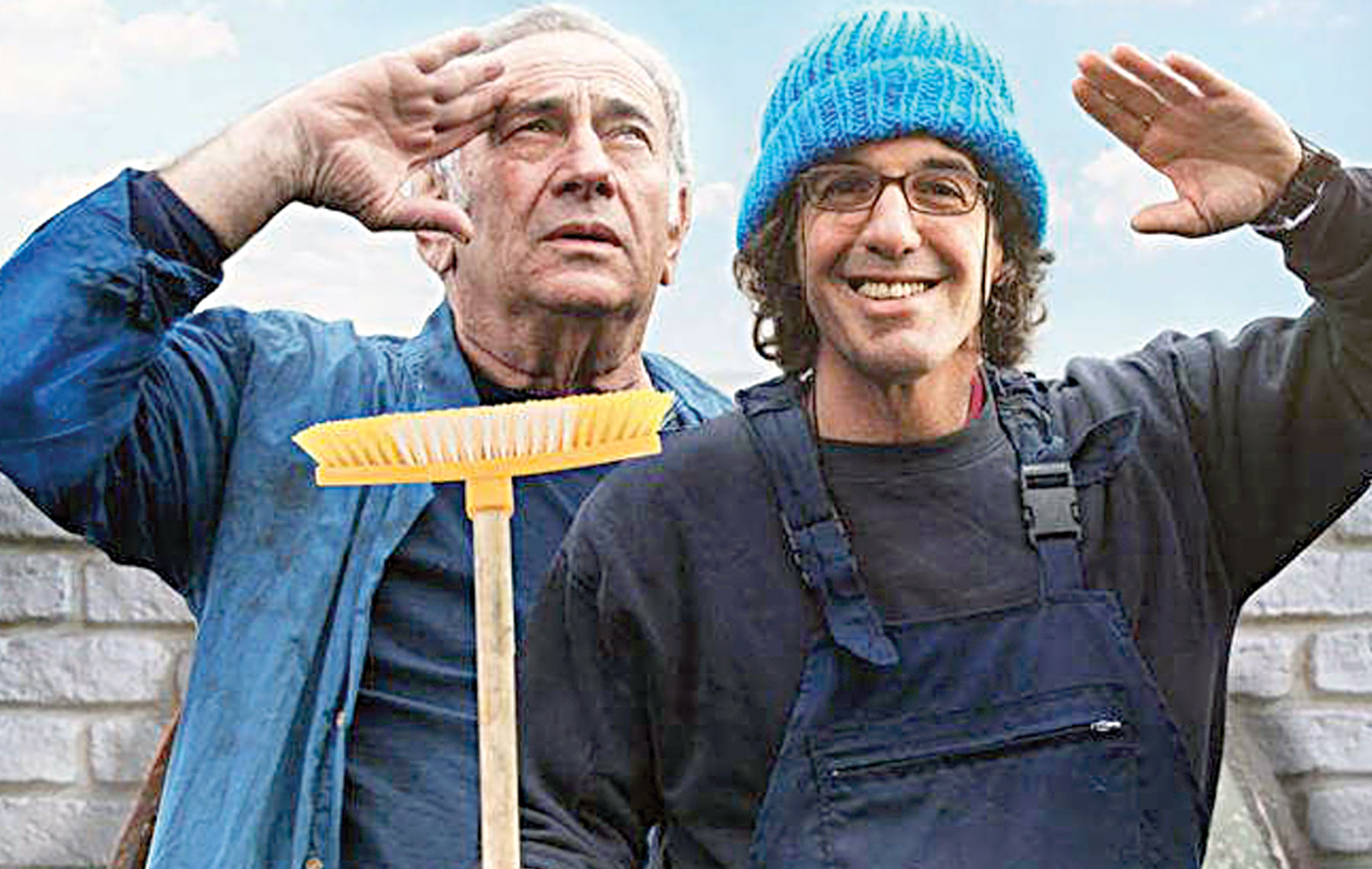
Longtime friends Shlomi Eldar, an Iraqi Jew, and Gassan Abbas, an Arab, were both born in Israel but feel like strangers in their country. They express their reasons why in Eldar’s documentary “Foreign Land,” a very personal examination of the Israeli-Palestinian conflict.
Abbas, a sitcom star in Israel in the 1990s, was once so popular he feared being mobbed by fans. Now, denied roles, he’s afraid because he’s Arab-Israeli and he fled Tel Aviv for the Arab border town of Umm al-Fahm near Haifa. “I don’t belong,” he says in the film.
Eldar, a TV journalist covering Arab Affairs — a subject that fell on increasingly deaf ears at both his television channel and with the public — left Israel for the United States in 2013. The author of the 2012 book “Getting to Know Hamas,” who also speaks fluent Arabic, he put his expertise to work at the Wilson Center, a global affairs think tank in Washington, D.C.
“I’m not Arab like Gassan, but we are in the same position,” Eldar told the Journal. “We have the feeling of being a stranger.”
Eldar and Abbas met when Abbas was cast in a play based on the book “I Shall Not Hate” by peace advocate Dr. Izzeldin Abuelaish, a Palestinian whose three daughters and niece were killed by Israeli army shells that hit their home at the end of the 2008-09 Gaza War. Abuelaish appears in the film, as do scenes from the play mixed with news footage and interviews with Abbas, his son Nadim and testimony from Eldar.
“Israel has become a divided society. I wanted to [hold] a mirror [up] to the Israeli public and show what’s going on,” Eldar said. He originally intended to cover the subject as a documentary series for Israel’s Channel 10, “but no one wanted to hear about the Israeli-Palestinian conflict, especially a story that shows a Palestinian as a human being, and [talks about] the possibility of peace with a two-state solution. Since 2013, especially, anyone who opposes [Prime Minister Benjamin] Netanyahu and his policies and wants to talk about the peace process is [seen as] a traitor.”
When “Foreign Land” was released in Israel, Culture Minister Mimi Regev denounced it as anti-Israel, but it nevertheless won the Ophir for best documentary this year, Eldar’s second in the category. He previously won for his first film, “Precious Life,” about an Israeli doctor who saved the life of a Palestinian baby. That film’s hopeful ending is absent from “Foreign Land.”
“I’ve covered wars in Gaza and Lebanon but never felt a danger more than now,” Eldar said.“The greater war is inside the society because of the government. The right wing convinced the Israeli public that there is no possibility of peace. And we can do nothing because there are now 400,000 settlers in the West Bank and it would be almost impossible to remove them. Also, the Palestinians are more extreme than they were five, 10 years ago.”
Eldar said he’s not surprised that American Jews are conflicted about Israel. “Many American Jews think Israel is going in the wrong direction, especially younger people. They worry about the future of Israel. I want them to be aware of the dangers of the situation. You need to be aware of the situation so you can solve it.”
Now living in the U.S., Eldar said he has gone from one divided society to another.
“What’s going on with the Supreme Court, the media and [President Donald] Trump’s government frightens me just as much as in Israel,” he said. “You can hear a lot of familiar phrases from Netanyahu’s speeches in Trump’s speeches. [They have] a lot in common.”
Eldar’s next project is a series about the American Jewish community, “historically and how it is today,” for Israeli TV. Expected to take several years, it will keep him in New York for now, but he hopes to return home one day. “I don’t want to die in America,” he said. “Israel is my country.”
“Foreign Land” opens Nov. 2 at Laemmle’s Town Center 5 in Encino and will screen at the Israel Film Festival on Nov. 18 at the Ahrya Fine Arts Theater in Beverly Hills.
Bringing Water to the World I have recently read your article on “How Israel Is Helping the Worldwide Water Shortage” and I would like to give my opinion on it. First off: the statement you quoted by Micah Smith that “In order to solve the crisis, the people of the world need to work together, and a country like Israel needs to be brought into that discussion more and more because of Israel’s vast experience.” I agree with that statement because Israel has learned to maintain a steady water system throughout the years, despite being through their troubles. They learned to become a water-surplus nation while states like California were still in droughts. Israel knows how to manage and keep their water supply steady and healthy. They teach their youth from a young age so when they grow up, they know how to use it properly. I completely agree with this article because it has shown and proven many good reasons why Israel is smart with their water source and can be a big factor moving on by helping other countries. Daniel Nikravesh, Via Email
In the Words of George Washington In the aftermath of the massacre in Pittsburgh, the words of our first president, George Washington have never been more salient. Last Sunday, we heard his poignant letter to the Hebrew Congregation of Rhode Island performed live at a private home for Jewish Women’s Theatre’s Fall show, Jews in America. It seems we all need reminding how a country should treat its minorities. Washington begins by stating that the Government of the United States “gives to bigotry no sanction, to persecution no assistance.” He then concludes with this powerful prayer. “May the Children of the Stock of Abraham, who dwell in this land, continue to merit and enjoy the good will of the other Inhabitants; while everyone shall sit in safety under his own vine and fig tree, and there shall be none to make him afraid.” From 1790, words to live by in 2018. Ronda Spinak, Artistic Director, Jewish Women’s Theatre, Cambria Gordon, Honorary Board Member, Jewish Women’s Theatre
Two Takes on Democrats Gil Troy (“Will a Leader Soon ‘Corbyn’ the Democrats?”, JJ Oct 26-Nov 1) lifted the curtain, looked out, didn’t like what he saw and lowered the curtain again, lamenting, Why can’t we be less like us? What he saw is that is that Democrats really are not our friends and Republicans really are not our enemies.
The Communist brand of socialism is called “left wing.” The Nazi brand of socialism is called “right wing”. (Nazi is the National Socialist Party) Right-wing socialism, as portrayed by Nazism, has never been a friend of the Jews, and by logical extension, never a friend of Israel. Left-wing socialism, as portrayed by Josef Stalin, has never been a friend of the Jews, and by logical extension, never a friend of Israel.
The political turmoil in the United States today is not a result of Democrat versus Republican. It is a matter of socialism versus non-socialism. Do we want to be like Nazi Germany or Communist Russia, or do we want to live in a state where we are not slaves to the government but free and independent people?
Socialism, both left-wing and right-wing, has always gained power in the same way: it befriends the people it will later enslave or destroy. These people look to their socialist party for salvation and give it their support, money and votes. But when that party comes to full power, it is too late. Jerald Brown, Via Email
Mr. Troy cites a few examples of Democratic candidates who, at best, espouse a cool view towards Israel and, at worst, a hostile view towards Israel. Mr. Troy then extrapolates the view that the Democratic Party is on the verge of following in the footsteps of the British Labour Party. He does, however, concede that “most Democratic leaders remain pro-Israel . . .” So, where does the Democratic Party stand?
I would argue that the Democratic Party is still staunchly pro-Israel. I can almost hear the snickering from some of the readers. I believe the facts support me. There are a record number of Jews running as Democrats in this election cycle who have a good chance of defeating their GOP opponents. All of these candidates are pro-Israel. The Democratic candidates for the Senate are pro-Israel Jews or pro-Israel. Each of the potential 2020 Democratic candidates for president are staunchly pro-Israel. Should the Democrats retake one or both Houses of Congress this year and/or retake the White House in 2020, Israel will be well served.
The Congressional candidates Mr. Troy identifies as being anti-Israel each won the nomination by appealing to the Democratic voters in their respective districts. Since I do not live in their respective districts I am unable to comment on how they won. That being said, I can posit that they appealed to enough Democratic primary voters in their respective districts to win the nomination.
If I were Mr. Troy, I would be more concerned about the growth of anti-Semitism in the GOP. Trump has given the green light for these people to crawl out from under their rocks. It was Trump who said that there were “good people” on both sides [the neo-Nazis, White Supremacists on one side and the opponents of the neo-Nazis, White Supremacists on the other side] of the demonstrations in Charlottesville. If one is a neo-Nazi or a White Supremacist, then, by definition, one is not a good person. Until Trump issues a proclamation saying that these bigots are not welcome in the GOP and he did not want their support, Senator Dole did in 1996, then he will allow the anti-Semites a platform from which they can spew their hate. Andrew C. Sigal, Esq.
Looking at Both Sides Loved how the Journal for the past several weeks has been presenting several sides of the debate on issues ranging from Trump on Israel; partitioning Israel real estate for “Peace”; Table for Five, “Who Owns the Truth,” et. al. That’s what journalism should be, and that is what makes the Journal different from the major mainstream media. Enriqué Gascon, Westside Village
Los Angeles needs a lot more people to give like Jack Nagel. If everyone in our community followed his inspirational lead and thought like Tabby Refael, Los Angeles would have the greatest Jewish institutions in the world and there wouldn’t be any tuition crisis or stress on families to afford a traditional Jewish lifestyle. Hopefully, our next generation of leaders will strive “to be like Nagel” and make lots of money so they “can give it away.” Marc Gelman, Los Angeles
Don’t be shy, send your letters to letters@jewishjournal.com. Letters should be no more than 200 words and must include a valid name and city. The Journal reserves the right to edit all letters.
A 17-year-old who came up with an innovative way to connect teenagers with Holocaust survivors has received a $1,500 grant for his project from The Jewish Federation of Greater Los Angeles.
Rex Evans, a junior at Santa Monica High School, was one of several recipients of a Julie Beren Platt Teen Innovation Grant for his project, Teen-Survivor Connections.
Evans interned at the Los Angeles Museum of the Holocaust (LAMOTH) over the summer, which inspired him to join its 2018-2019 teen board. But it was through volunteering at the Museum of Tolerance (MOT) with his 15-year-old sister, Gracie, and listening to survivors’ testimonies that sparked the idea for his project: Find ways for teenagers and Holocaust survivors to bond.
“With the testimonies, you’re just sitting there in an audience,” Evans told the Journal. “The survivor is telling you their story, and it’s not really reciprocal. [Holocaust survivors] have a ton to teach you, and I learn a lot every time I talk to them.”
Being able to have teens interact with survivors is “a once-in-a-lifetime opportunity,” he added. “It’s sad to say, but [survivors] are getting older and there aren’t going to be too many opportunities left. [And] for older generations, it’s great to interact with younger generations, especially if they’re lonely and don’t really have a ton of fun activities to do.”
In formulating his project, Evans approached his supervisor at MOT and put together an event in March, which brought teen volunteers and survivors together. This fall, wanting to expand his project, Evans applied for the grant.
“The students have to fill out an application, which describes their project, why they think the community needs this and also their strategic plan,” explained Jordanna Gessler, LAMOTH director of education.
As Evans’ mentor for the grant, Gessler said, “I think it’s exciting to have intergenerational dialogue. It’s quite remarkable to have Rex stand up and say, ‘I recognize that there’s an opportunity here that’s not being created.’ ”
Evans’ first event, since receiving the grant at the end of September will take place at MOT on Nov. 11. His sister came up with the theme of finding ways for teens and survivors to bond through music. They will begin with asking questions of survivors, including what sort of music they listened to as children and how important music was in their families growing up. Then, teens will perform. Rex plans to use some of the grant money to buy a portable keyboard. He also hopes to upload Yiddish songs on YouTube with lyrics so everyone can sing along.
Evans has ideas for additional events, including one at LAMOTH that is still in the planning stages. He is toying with the idea of having survivors showcase their art and then working on an art project with teenagers. Other ideas include intergenerational games and puzzles.
“Music night, puzzle night, doing board games [and] art. I think it shows young people that their interests and passions can be reflected in someone who is four times their age,” Gessler said. “One of the beautiful things about history and also passing down tradition is you see that, at the end of the day, we’re all very much the same in what we’re passionate and excited about.”
Gessler added that she hopes that Evans’ project will surprise both the teens and the survivors by showing “how much fun they had or how much they learned, or really drawing connections with one another that go across age, years, countries, [origins], gender and identity.”
Milken Community Schools middle and high school students recently gathered under a large canopy in the rear of the middle school campus and created community and challah magic.
About 500 people turned out and baked the traditional braided bread customarily enjoyed during Shabbat and other Jewish holidays.
Milken Community Schools held the Oct. 25 challah bake as part of the Shabbat Project, a global grass-roots movement that began in 2013 in Johannesburg, South Africa, and encourages Jewish communities worldwide to keep a single Shabbat transcending religious, political and other arbitrary divisions.
This year’s programs took place in 101 countries in more than 1,500 cities — up from approximately 1,400 cities in 2017 — and drew more than 1 million participants. Reform Jews came together with Orthodox Jews, and young Jews turned out with elder members of their communities.
In addition to the Milken schoolwide challah bake, Shabbat Project events in Los Angeles this year included an Oct. 25 challah bake for breast cancer awareness at Shalhevet High School and an Oct. 26 Jewish unity concert in Pico-Robertson.
The evening’s emcee, Rivkah Eisenberg, called out instructions for how to bake the bread. Standing at long tables, people followed her orders, mixing together their ingredients to make dough, breaking their balls of dough into three long, skinny strands and braiding the challahs.
“People really love community. Boys, girls, men and women — people love that making challah together is such a communal family experience.” — Sheila Goldman
Sheila Goldman, director of community engagement at Milken, said the goal of the event, which was organized with the help of Chareen Kossoff, a Milken mother who is originally from South Africa, was building community among Milken families. On Oct. 26, the day following the bake, 190 Milken families — about 700 people — hosted Shabbat dinners, where people enjoyed the challah they had prepared the evening before.
“People really love community,” Goldman said. “Boys, girls, men and women — people love that it is such a communal family experience.”
Kids did more than bake. The youngest filled their baking gloves with flour and slapped one another around with them, making a mess, while some of the older students enjoyed Israeli-style dancing.
While challah dough is supposed to have around one hour to rise, folks at Milken allotted about 20 minutes for their dough to rise, which no doubt would have made the Israelites fleeing Egypt proud.
Ultimately, each attendee appeared to take away something different from the experience.
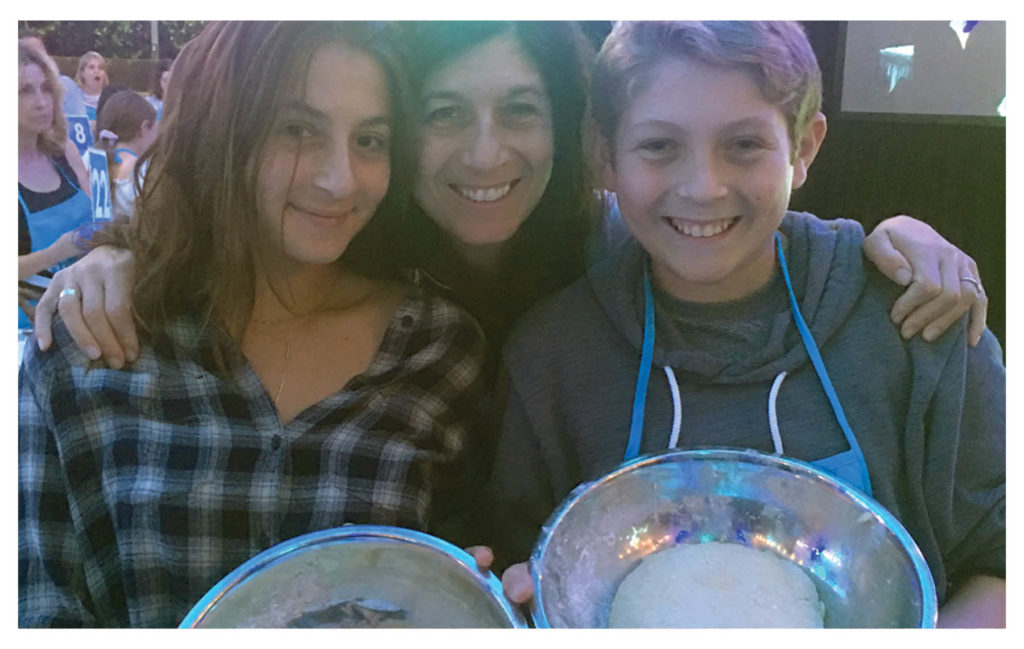
Milken eighth-grader Benny Lande, who turned out with his sister, Sarah, a 10th-grader, and their mother, Mandy, said braiding the dough was difficult, but he liked the challenge of it and the opportunity to enjoy the timeless Jewish tradition with people he loved.
“I like how it’s a lot of work that goes into it,” he said, wearing an apron. “I like that we do it all together.”
Sarah Lande, 15, said the pleasure was in discovering the symbolism behind each of the ingredients in challah. (According to an article published on the website of the Shabbat Project, “The Symbolism of Challah,” the water used for challah is symbolic of Torah; yeast represents growth and expansion; eggs, renewal of the life cycle; oil, anointing; sugar, sweetness; salt, discipline; and flour, sustenance.)
Their mother said attending the challah bake at Milken was a recipe for building friendships with other families in the school.
“We’re not as connected as the other families,” Mandy said. “So this is a way for me to meet the other moms.”
At the outbreak of the Second Lebanon War in 2006, Noam Gershony was serving in the Israel Defense Forces as an Apache helicopter pilot when his aircraft crashed, killing his co-pilot and leaving him severely injured.
“I stopped having big plans because I had a pretty good idea of what my life was going to look like when I was serving,” Gershony, 35, told the Journal in a phone interview during a recent visit to Los Angeles. “I was supposed to serve five or 10 more years, and all of a sudden, things changed.“
During his rehabilitation, Gershony started playing wheelchair tennis. He also tried wheelchair basketball, swimming and the shooting range before settling on tennis. Six years later, he went on to win the gold medal in tennis at the 2012 London Paralympics.
Although he retired from wheelchair tennis after the Paralympics, Gershony continues to work out regularly. “Walking is still a challenge,” he said, “so it’s important to keep in good shape.”
He also continues the work he started during his rehab, which includes volunteering for organizations that help individuals with special needs, children with disabilities and at-risk youth. “I like it better than tennis, actually,” he said.
Gershony, who regularly travels the world to share his inspiring story, was in Beverly Hills last month to speak with Jewish National Fund (JNF) donors. JNF has partnered with the Israeli organization LOTEM, which provides 30,000 children and adults with special needs access to outdoor educational activities.
LOTEM operates two centers, an ecological farm in Emek HaShalom Nature Park near Yokneam and a space in Jerusalem. Its programs help a variety of people, including individuals with visual and hearing impairments, physical, intellectual and emotional challenges, and children on the autism spectrum, as well as at-risk youth and mothers and children residing in shelters for victims of domestic violence.
Gershony began volunteering two years after his accident because he wanted to do something with more meaning, rather than just concentrating on himself and his condition. He began teaching mathematics to at-risk youth.
“[Volunteering] gives you something that no other thing in life can give you,” he said. “Giving something without asking for something in return puts [things] in perspective.”
“People approach me after hearing my story and they say big words like ‘inspiration’ and ‘hope.’ I try to remind people of how good their life is and put things in perspective.” — Noam Gershony
Born and raised in Kfar Saba, Gershony said he was “born into your average Israeli family” and had the “perfect” childhood and a supportive family, both growing up and after his injury.
“When you are young, you don’t really know how to appreciate it because you are surrounded by kids who basically come from the same background,”“ he said. “I had everything. I served in the military. I was accepted to flight school and graduated as a pilot. Then I became a guy with a disability. Then, a few years later, I became an athlete and won a medal in the [Paralympics], and a few years after that I became a speaker.”
Gershony speaks about being able to appreciate what you have and focusing on the positive.
“People approach me after hearing my story and they say big words like ‘inspiration’ and ‘hope.’ I try to remind people of how good their life is and put things in perspective,” he said. “Other people are struggling with crises, so maybe my story and my decisions [can] enlighten the path they need to [take].”