fbpx

October 10, 2018

A Midrash on the Rainbow

    

God looked upon creation and saw violence, chaos and mean-spirited self-centeredness engulfing every heart. There was neither kindness nor justice in the world. Empathy had ceased. Fear and hatred had replaced peace and love. In an instant God determined to destroy the world and return existence to primordial darkness.

The Eternal God mourned and recalled how great was the effort to create the heavens and earth, give life to growing things, design and fashion the birds, sea creatures and animals in their variety, shape, color, function, and form. That thought grew within the Divine mind. The Creator hesitated and thought thinking how great the tragedy to destroy that which God had called “good.”

God wondered ‘Is there one human on earth, different from the rest, who fathoms Me, who hasn’t been consumed by the sitra achra, the evil that brought darkness to My creation.’

In a blink of the Divine eye, God peered into every human soul seeking that one, better than the rest, who though not yet a complete tzadik might be good enough and able to hear  the Divine voice and save what could be saved.

God found Noah and plucked him out and instructed him to build an ark, to save his family and two of every creature that all might not be lost and the world might begin anew.

As God contemplated the potential devastation Divine tears fell heavily to earth in a torrential downpour that lasted forty days and nights.

When finally God’s tear ducts were dry the waters receded, dry land appeared, and the ark docked. The Eternal God spoke to Noah:

“I am God, Noah, Who created you and brought you into this new land. Look around you and see the cleansed earth. The world is once again new. There is no longer rage nor hatred, violence nor hubris in the human heart. I will make with you a covenant marked by a sign that will remind us both how I created the world in peace, then destroyed it allowing it to begin anew that it should be a place of peace for all time.

And the sign of this covenant will be a radiant smile stretching across the heavens and filling the sky, an arc of light shining through the flood waters, a vision of loveliness inspiring love for and awe of Me. 

This promise, Noah, shall be called the ‘rainbow,’ and this bow in the sky will remind you, your progeny and Me that I will never again bring such devastation to the earth. 

Your duty and the duty of your children and children’s children must be to protect My creation, to preserve and nurture it, for there will come no one after you to set it right if you destroy it.”

God bent towards the earth and stretched the Divine arm across the sky and created an arc. Where God’s hand had been appeared a sheltering bow of every color spread across the blue canvas of sky.

And God spoke of the colors and the rainbow sign:

“First comes red to stand for the blood pulsing through human veins that carries My Godly soul and makes all things live; orange is for the comforting warmth of fire and its potential to create, build and improve upon what I created; yellow is for the glory of the sun that lights the earth and gives vision to earthly souls that they might see Me in all things and live; green is for the grass and the leaves of trees and their fruit, that all creatures might be sustained in life; blue is for the sky, sea and rivers that joins air and ground and makes clear that all is One, divinely linked and a reflection of Me; indigo appears each day at dusk and dawn to signal evening and morning, the passage of time and the seasons, the ever renewing life force that is intrinsic to all things; violet is for the coming of night when the world rests and is renewed, and it carries the hope that all might awake in the morning and utter words of thanksgiving and praise.”

God explained to Noah that the rainbow appears to the human eye as a half circle:

“Do not be fooled, my most righteous one! There is more to life than what the eye can see. There is both the revealed and the hidden, and the hidden half of the bow reaches deep into earth that you and those who yearn after Me might come and discover Truth, and reveal and make whole the revealed and the hidden in My world.”

Remember this blessing, My child, and you will remember My promise – Baruch Atah Adonai Eloheinu Melech ha-olam, zocheir habrit v’neeman biv’rito v’kayam b’maamaro – Praised are You, Eternal God, Sovereign of the revealed and the hidden, Who remembers, is faithful to and fulfills the Divine covenant and promise.”

Written by Rabbi John Rosove and inspired by classic Midrashim

A Midrash on the Rainbow Read More »

UNESCO Exec Committee Passes Resolution Calling Jewish Holy Sites Part of ‘Occupied Palestine’

The United Nations Educational, Scientific and Cultural Organization’s (UNESCO) Executive Committee passed a resolution on Wednesday that labeled two Jewish holy sites – the Tomb of the Patriarchs and Rachel’s Tomb – as part of “Occupied Palestine.”

Section 3 of the resolution, Decision 28, first refers to the aforementioned holy sites as “Palestinian sites”; listed below it is a statement that says that the sites “are an integral part of the Occupied Palestinian Territory.”

Another UNESCO resolution was passed that accused Israel for censoring and destroying Palestinian schools.

The resolutions were voted on and approved of as a non-binding annex, but Israeli Ambassador Danny Danon lambasted the resolutions.

“This is further evidence, for anyone who did not understand why the United States and Israel withdrew from UNESCO, that again proves that UNESCO is a body based on lies and biases, and is deliberately acting against,” Danon said in a statement. “The State of Israel will not be a member of an organization that is trying to rewrite history and willing to be manipulated by our enemies.”

On Sept. 27, Israeli Prime Minister Benjamin Netanyahu declined UNESCO’s invitation for Israel to partake in an event on anti-Semitism, calling out UNESCO’s “persistent and egregious bias against Israel.” Israel and the United States both left UNESCO in 2017.

The Tomb of the Patriarchs, which is located in Hebron, are where the patriarchs and matriarchs of Judaism –– Abraham, Sarah, Isaac, Rebecca, Jacob and Leah – are buried. Rachel’s Tomb, located in Bethlehem, is where Rachel, another matriarch is buried, since she died there during childbirth.

UNESCO Exec Committee Passes Resolution Calling Jewish Holy Sites Part of ‘Occupied Palestine’ Read More »

Oscar-Winning ‘Platoon’ Producer Arnold Kopelson Dies at 83

Movie producer Arnold Kopelson, whose films include “The Fugitive,” “Se7en,” and the Oscar-winning Vietnam War drama “Platoon,” died of natural causes at his home in Beverly Hills on Oct 8. He was 83.

Born in Brooklyn, N.Y., Kopelson was an entertainment and banking lawyer before he began his show business career in 1972, founding Ocean Film Sales to distribute American independent films internationally. He later became a producer with over 100 films to his credit, including “Falling Down,” “Eraser,” and “U.S. Marshalls.”

His movies range from the raucous comedy “Porky’s” to the Holocaust drama “Triumph of the Spirit,” about an imprisoned boxer (Willem Dafoe) forced to fight for his life in the ring that was set in and filmed entirely on location in Auschwitz.

Kopelson, a member of the Board of Directors of the CBS Corporation from 2007-2018, served on the Executive Committee of the Producer’s

Branch of the Academy of Motion Picture Arts and Sciences. He was a member of the Board of Mentors of the Peter Stark Motion Picture Producer’s Program at the University of Southern California.

Sharing his expertise and experience, he lectured at Harvard Business School, American Film Institute, Tisch School of the Arts at New York University, New York Law School, The Writer’s Guild of America, The Independent Feature Project West, The Kagan Seminar, USC and UCLA.

In 1998, Kopelson Received the New York Law School Distinguished Alumnus Award for Lifetime Achievement.

He is survived by Anne Kopelson, his wife and business partner of 42 years, and three children, Peter, Evan and Stephanie.

Oscar-Winning ‘Platoon’ Producer Arnold Kopelson Dies at 83 Read More »

N.Y. Dem Assemblyman Criticizes Gillibrand for Sarsour Association

Dov Hikind, a Democrat assemblyman in New York who is retiring after this year, released a video on Twitter criticizing Sen. Kirsten Gillibrand (D-N.Y.) for appearing onstage with Linda Sarsour at a rally protesting Supreme Court Justice Brett Kavanaugh.

Hikind began the video by listing out some of Sarsour’s past statements, including her showing support for Rasmea Odeh, who was convicted by an Israeli court of a 1969 Jerusalem supermarket bombing that killed two college students, and saying that “nothing is creepier than Zionism.”

“Sen. Gillibrand, I know you,” Hikind said. “I know you stand for the principles that make America great. I know that you are a person who does not accept any kind of racism and anti-Semitism. But senator, you cannot sell out the principles that you have always lived by simply because you want to be president and you have to appeal to people on the extreme left.”

Hikind added, “When it comes to racism and anti-Semitism, there is no compromising.”

The outgoing assemblyman then gave a pointed message to the media, stating that the media is responsible for helping create “a new generation of anti-Semites and racists” on both sides of the aisle when they fail to expose and shame racism and anti-Semitism.

“A racist, an anti-Semite, needs to be ostracized, condemned,” Hikind said. “Period.”

Sarsour introduced Gillibrand at an Oct. 6 rally during Kavanaugh’s confirmation vote. Sarsour called Gillibrand “another champion, another one of our people who works for us on the inside.”

Gillibrand previously praised Sarsour and the other Women’s March leaders – Tamika Mallory, Carmen Perez and Bob Bland – in a 2017 piece in Time. Gillibrand called them “extraordinary women” who “are the suffragists of our time.”

Anti-Defamation League (ADL) CEO Jonathan Greenblatt criticized Sarsour, Mallory and Perez for their associations with Louis Farrakhan in March 2018.

Gillibrand’s office did not immediately respond to a request for comment.

H/T: Daily Wire

N.Y. Dem Assemblyman Criticizes Gillibrand for Sarsour Association Read More »

Still from NOAH, when God initiated big climate change

Can Noah’s Saga Help us Avoid a Climate Apocalypse?

In order to avoid widespread climate catastrophe we must influence human behavior — hopefully with better results than Noah.


The future of life on Earth is in peril, as in the days of Noah. A report issued by the Intergovernmental Panel on Climate Change warns that by 2040 extreme climate changes will be underway. Surface and ocean temperatures, extremes in precipitation, drought, rising sea-levels, mass species loss and other alterations will have far-reaching negative impacts on human health, livelihood, food security, water supply, national security, and economic growth. The ninety-one scientists who authored the report warn that immediate and drastic action is required to save the planet from irreversible catastrophe. 

This dire report on climate change was released the same week that we read Parshat Noah, the Torah’s account of how God sent an apocalyptic flood to punish humanity. While Noah saved himself, his family and a sampling of Earth’s creatures on an ark, the rest of terrestrial life was destroyed. No matter if you believe or not in the veracity of the story of Noah and the flood, the IPCG forecast is not so different than the dangers that faced Earth in Noah’s story. The world as we know is in serious danger. There isn’t even time to build an ark big enough to save us all.


Noah’s Story of Climate Change has Lessons for Today

The story of Noah can teach us some important lessons about our reactions to the news of climate change today. Noah knew that humanity could be saved if they changed their behavior. However, Noah wasn’t able to influence the people of the day to change their ways. The life-boat that Noah built over a period of 120 years was meant as a warning for people but ended up becoming something that people ignored.

According to Midrash, Noah didn’t enter the ark right away but waited until the water reached his knees. It wasn’t that Noah lacked faith in God. Noah thought that God was loving and merciful and wouldn’t follow through and destroy everything. He didn’t think his contemporaries would be so stubborn. He was sure that people would repent at the last moment and avoid disaster. To their own peril, they ignored Noah even after the waters began to rise.

How important is the 120-year gap between Noah starting the ark and the eventual flood? Perhaps it’s just an arbitrary number of years that the Midrash choose to demonstrate the people’s obstinance? It turns out that 120 is significant, as it was just over 120 years ago that modern scientists discovered human-induced climate change. The Swedish scientist, Svante Arrhenius, published a study in 1896 which was the first to calculate human-induced climate change. In 1899 Thomas Chrowder Chamberlin wrote that changes in the concentration of atmospheric carbon dioxide could cause a change in climate. This means we knew 122 years ago that industrialization and environmental alterations will have an impact on our climate. 

Didn’t God Promise to Never Destroy the World?

After the flood, when Noah and his family are on dry land and replanting, God makes a promise to Noah. Some Christians and Jews believe this promise means climate change will never destroy life because God won’t let it happen. However, a careful reading reveals the possibility exists for humanity to destroy itself and the Earth. Rabbi Aryeh Kaplan’s translation of the promise in Genesis 8:21-22 reads, “I will never again strike down all life as I have just done. As long as the earth lasts, seedtime and harvest, cold and heat, summer and winter, and day and night, shall never again cease.”  This promise from God clearly leaves open the possibility that our own actions can bring about an end to life on Earth. 

Great climate changes have happened before in Earth’s history. There have been ice-ages that transformed the planet. Tectonic movements separated the continents and pushed around land and seas. A massive meteor wiped out land-dwelling dinosaurs. But all those occurrences were unavoidable, part of God’s plan for this rare and unique blue planet. 

Unlike previous climate changes, we have ample warning, the technological means, and the prosperity to stop the process. 

However, like Noah, in order to avoid widespread catastrophe, we must influence human behavior and change our society for the better.  


Rabbi Yonah Bookstein is co-founder of Pico Shul, the Deanna and Allen Alevy Rabbi in Community Outreach and director of Shabbat Tent.

Can Noah’s Saga Help us Avoid a Climate Apocalypse? Read More »

Anne Frank’s Spirit Portrayed in Graphic Art ‘Diary’

Since the 1991 publication of Art Spiegelman’s groundbreaking “Maus,” to put a new spin on Theodor Adorno’s cautionary aphorism, it is no longer barbaric to write about the Holocaust in a comic book. The latest example of the genre is “Anne Frank’s Diary: The Graphic Adaptation,” adapted from the original text by Ari Folman and illustrated by David Polonsky (Pantheon). Not unlike “Maus,” the graphic version of “The Diary of a Young Girl” is both a challenge and a wonderment. 

Indeed, I picked up the book with some trepidation. How could Anne Frank’s firsthand testimony be rendered in drawings and dialogue balloons without cheapening and distorting the work she created as a doomed youngster in hiding? But by the time I put it down, I was filled with admiration for what Folman and Polonsky have accomplished. Their “graphic edition” serves as a companion volume to — and, really, a midrash on — Anne Frank’s immortal memoir, and the book stands on its own as a work of art, sometimes disturbing but always illuminating.

Ari Folman is the director of the Oscar-nominated animated documentary film “Waltz With Bashir” and a screenwriter for the Israeli TV series called “Be Tipul” (“In Therapy”), which served as the basis for the HBO series “In Treatment.” David Polonsky, an award-winning illustrator of children’s books and a member of the faculty of Bezalel Academy of Arts and Design in Israel, was the art director and lead artist for “Waltz With Bashir.” Significantly, and despite the audacity of their undertaking, “Anne Frank’s Diary” is authorized by the Anne Frank Foundation in Basel, which gave its official blessing to this audacious re-imagination. 

The project actually originated with the Anne Frank Foundation, which approached Folman with the proposal for an animated feature film based on Anne’s diary. The book, in a sense, is a preview of the feature film, which is scheduled for completion in 2020. Both projects, Folman reveals, were daunting: “It was astounding to me that a thirteen-year-old girl had been able to take such a mature, lyrical look at the world and translate that into concise, probing entries brimming with compassion and humor, and with a degree of self-awareness that I have rarely encountered in the adult world, much less among children,” he writes in an “Adapter’s Note.” “How could I ‘edit’ the book?” Page by page, his graphic edition shows us exactly how the adapter and the illustrator approached and mastered the challenge.

“Folman and Polonsky have reclaimed Anne Frank in all of her humanity, and they allow us to witness for ourselves her beauty, courage, vision and imagination.”

Quite unlike “Maus,” Polonsky’s drawings are literal rather than fanciful. To be sure, they recall the classic era of the American comic book, when artists simplified and stylized their images in order to heighten the tension, drama and action but also sought to depict people and events as somehow hyper-realistic. The eye-stopping two-page spread that shows the downing of an Allied warplane over a public square in Amsterdam is a tribute to the World War II-themed comic books that I favored in my own adolescence. (“Brrr, I hate the sound of gunfire,” Anne writes.) At times, I was reminded of the rich illustration style that the Belgian illustrator known as Hergé brought to his the Tintin series.

The text itself is drawn mostly from the original diary, some passages of which may come as a surprise for readers who first encountered the book many years ago. Only rarely does Folman invent the words that appear in a dialogue balloon into Polonsky’s illustrations. To illustrate what Anne may have been thinking the memorable night when she and Peter shared their first kiss, for example, he inserts a joke: “So, is he going to make a move before the war ends … ?” A moment later, drawing on a passage in the diary, we see Anne and Peter embracing after their first kiss, and Folman includes two figures of Anne, one silencing the other with an outstretched hand. 

“I realized, for the first time, that there is not only one Anne Frank, but, surprisingly, two Anne Franks,” she muses.
“[S]uddenly the everyday Anne slipped away and the second Anne took her place. The second Anne, who’s never overconfident or amusing, but wants only to love and be loved.”

One example of the interplay between Anne’s private thoughts and the soaring imagination of Folman and Polonsky is the page based on her diary entry for Wednesday, Feb. 23, 1944. “This morning, when I was sitting on front of the window and taking a long, deep look outside at God and nature, I was happy, just plain happy,” she wrote in an entry addressed to Peter, the boy who sheltered with the Frank family and her first (and only) love. “Riches, prestige, everything can be lost. But the happiness in our own heart can be dimmed: it will always be there, as long as you live, to make you happy again.” To illustrate these deeply ironic sentiments, we are shown what Anne sees through the window — a pair of seagulls in flight — and what Anne surely imagined and hoped for, the two of them, Anne and Peter, soaring aloft with outstretched arms, a scene so poignant that it brings a lump to the throat. 

At certain moments, the imagination of the adapter and the illustrator supply images to accompany the more abstract musings that we find in the diary itself. She is depicted as the figure in Munch’s “The Scream” or as “The Lady in Gold” in Klimt’s famous painting of Adele Bloch-Bauer. When Anne writes about her bouts of depression and despair, “we chose to depict them as either fantastical scenes … or as dreams,” Folman writes. Thus, for example, her worst fears of what would happen if they fell into German hands is depicted as a detailed Egyptian hieroglyphic with an SS guard overseeing the labor of Jews in concentration-camp uniforms as they erect a pyramid-sized ziggurat topped with a Nazi eagle.

Since the discovery and publication of “The Diary of Anne Frank,” the young girl who wrote the diary has been transformed from a flesh-and-blood victim of Nazi brutality into a shimmering icon. Famously, she was even turned into an object of veneration by a cult in Japan. To their credit, Folman and Polonsky have reclaimed Anne Frank in all of her humanity, and they allow us to witness for ourselves her beauty, courage, vision and imagination, all of the qualities that make her life and early death so heartbreaking. And, in doing so, they have elevated the tools of the comic book to create an astonishing work of art.


Jonathan Kirsch, author and publishing attorney, is the book editor of the Jewish
Journal.

Anne Frank’s Spirit Portrayed in Graphic Art ‘Diary’ Read More »

New Album Brings Reggae to Jewish Songs and Prayers

How about something different this year for Hanukkah? How about some reggae?

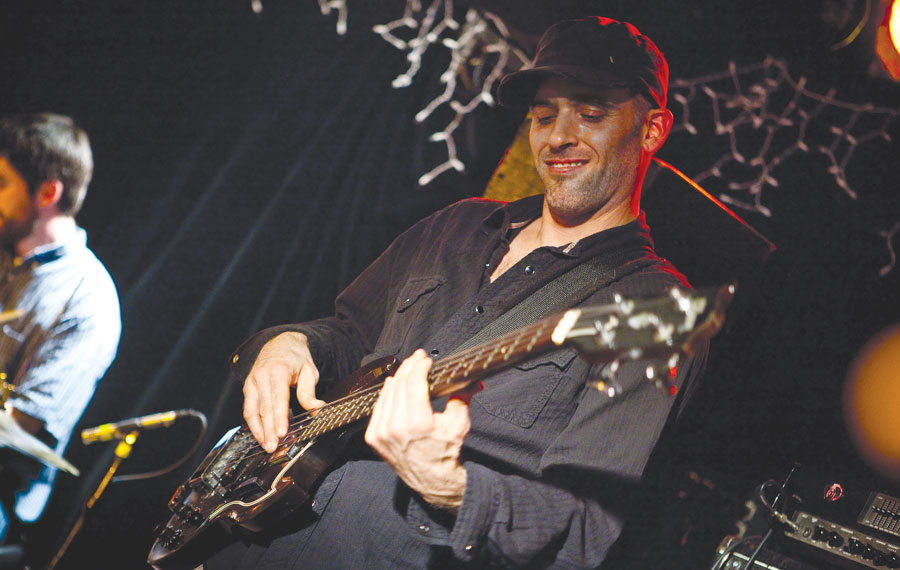
That’s what you’ll get with “Festival of Lights,” the creation of David Solid Gould, a Jewish bassist who recorded it with his own group, The Temple Rockers, as well as with three veteran Jamaican performers who sing in Hebrew and English. 

Gould, 48, told the Journal via telephone from his home near Ithaca, N.Y., that he has spent more than 20 years working on the musical fusion between Jewish and Jamaican music, and that this resolve grew out of two musical epiphanies. When he was 25 and already a professional musician, he saw a live performance of Jamaica-born singer Burning Spear.

“That’s when I first heard reggae,” Gould said. “Feeling the bass in the sound system. The groove feeding back into itself. It was like a spiritual rebirth for me. It really flipped my world.” 

Hooked on the tantalizing sounds of Jamaica, Gould became bassist for John Brown’s Body, a reggae band whose musicians dubbed him “Solid,” as much for what Gould calls his “low-end grooves” on bass as for the wordplay on his last name. 

Gould’s other musical epiphany came a couple of years later when he was touring in California with John Brown’s Body in the late 1990s. Suddenly, he sensed that the reggae music he was playing could be merged with songs and prayers he recalled from childhood. He rushed to a synagogue where he heard “Sim Shalom” chanted by a cantor and congregation. 

“I realized that I could use reggae to play the songs I’d sung at Hebrew school, at shul, at my bar mitzvah, during holidays like Passover and Hanukkah,” he said. 

This second epiphany led directly to his forming The Temple Rockers, a musical group that fuses reggae with Jewish musical traditions. In 2001 they recorded an album called “Adonai and I” — reggae versions of traditional prayers such as “Leha Dodi” and “Adon Olam.” This was followed in 2009 by the “Feast of the Passover,” seder songs and melodies, also in reggae style. 

“I realized that I could use reggae to play the songs I’d sung at Hebrew school, at shul, at my bar mitzvah, during holidays like Passover and Hanukkah.”  

— David Gould

On Oct. 19, the third album of this melding of Jewish and Jamaican musical traditions will be released: “Festival of Lights,” Gould’s reggae versions of Hanukkah songs. Gould said he found the project challenging. “For Hanukkah, I had to do research and seek out music and learn about music that was new to me and choose songs that suited the theme of the collection and also suited reggae music. So it was a fun project for me because I got to learn new music.” 

During the last 20 years, Gould has made several trips to Jamaica, where he’s stayed with reggae musicians who have helped him learn about Rastafarianism, a Jamaican religion. “They taught me about its origins, about their beliefs,” Gould said, “and I saw lots of connection to Judaism. Many of the lyrics in reggae songs refer to stories in the Bible.” 

Indeed they do. Babylon, Exodus, Zion, Egypt, and especially Jah (God). 

In Rasta belief, the late Ethiopian leader, Haile Selassie, was descended from the union between King Solomon and the Queen of Sheba, which is why the fence at the Kingston, Jamaica house of the late Bob Marley — a sainted figure in the reggae world — is studded with Stars of David. 

For “Festival of Lights,” Gould felt it was vital for the Jamaican singers to explore the Jewish origins of Rasta traditions, and he made sure they learned some Hebrew, at least enough to sing in the language. “Every Jamaican singer that I worked with on this has loved the music, and they love the connection between Jewish music and Jamaican music,” Gould said. 

When he first started planning “Festival of Lights,” Gould made a list of the Jamaican singers he wanted, and he snagged three who were on his wish list: Linval Thompson, Wayne Jarrett and Ansel Meditations, three singers who have been performing and recording since the 1970s. During that time Bob Marley was an international superstar, and the soundtrack of the Jamaican movie “The Harder They Come” — featuring Jimmy Cliff as well as Toots and the Maytals — became the background music of daily life, not just in Jamaica but in other places, including Israel. 

On “Festival of Lights,” as is usual in record production, the instrumentals were recorded first (at Solid Studios, near Ithaca, where Gould lives); but what is very unusual is that Gould recorded every bit of this record, vocals and instrumentals, on two-inch reel-to-reel tape.

“It’s very rare these days that people record on tape because it’s so expensive. It’s so much easier and cheaper and convenient to record on digital,” Gould said. “But there is a warmth and richness when you record on analog tape. Digital strips away that warmth and richness. It makes everything harsh.”

Having first taped the instrumentals with The Temple Rockers — a large group that includes keyboards, strings, horns, and percussion — Gould traveled to Miami to record Wayne Jarrett.

“I brought my reels with me and they’re heavy,” Gould said. “I had two reels in a bag and it was like a 40-pound bag I was lugging around.” It was the same when Gould went to Kingston to record Thompson. In Jamaica, he had to hunt around for a studio that could handle reel-to-reel tape. Fortunately he didn’t have to travel far to record Ansel Meditations, who lives in New York and recorded his songs at Gould’s house. 

From the way that Gould describes all the hoops he’s jumped through to record this music, it’s clear that it’s a labor of love: for the Jewish and Jamaican parts of his musical soul. 

Maybe because the music is often in a minor key, or maybe because it uses traditional Hanukkah and Biblical tropes, or maybe because of the high quality and professionalism of the musicians, or maybe because of all of the above, the result is an album that grows on you stealthily with each hearing, touching some deep core. Listening to “Days Long Ago” and other songs from the record, you feel you’re listening to a dreadlocked Rasta group from the ’70s and ’80s. It’s easy to get carried away by the soulful Jamaican vocalists whose voices — like Hanukkah itself — embody the unquenchable hope of a miracle in a time of darkness.


For more information on obtaining “Festival of Lights,” visit www.templerockers.com.

New Album Brings Reggae to Jewish Songs and Prayers Read More »

LA Exhibition Spotlights the ‘Notorious RBG’

Creating a museum exhibition around a living subject can be challenging, even more so when your subject is routinely involved in shaping the course of the law. And what if the nation also happens to be laser-focused on your subject’s place of employment just as your exhibition is about to open? How do you handle that? 

It’s not such a bad problem to face, according to the curators at the Skirball Cultural Center. As the remarkable life and career of Supreme Court Justice Ruth Bader Ginsburg continues to unfold, the creators of the first exhibition celebrating Ginsburg happily grapple with the prospect of “curating in real time.” 

“Without a doubt, it’s both exciting and challenging,” said Cate Thurston, associate curator for the Skirball Cultural Center, where the exhibition “Notorious RBG: The Life and Times of Ruth Bader Ginsburg” opens Oct. 19. “This is an ongoing story and you’re weighing, ‘How do I think this will be relevant when it opens? Does it fit in with the larger narrative that we’re telling?’ ”

Where Ginsburg is concerned, relevance has rarely been an issue. Indeed, for a couple of years, it felt like the petite, Brooklyn-born Justice with the oversized glasses had penetrated every segment of the cultural landscape. 

A Tumblr created by then-law student Shana Knizhnik as a digital tribute to Ginsburg, created the “Notorious RBG” persona. Knizhnik and journalist Irin Carmon wrote the 2015 coffee table biography “Notorious RBG,” which was followed by the successful 2018 documentary “RBG.” Since 2015, Kate McKinnon’s frisky, dancing Ginsburg regularly shows up on the Weekend Update section of “Saturday Night Live” to deliver withering “Gins-burns.”

The Gins-burns will keep coming. Around Christmas, “On the Basis of Sex,” a feature film based on Ginsburg’s life, is due in theaters. The film was written by Daniel Stiepleman, the nephew of Ginsburg’s late husband, Marty Ginsburg; Oscar nominee Felicity Jones will play the young Ginsburg. 

Carmon and Knizhnik have been consultants on both films as well as on the Skirball exhibition, which will be structured in the same way as their book, with sections devoted to the judge’s early life and education, her activism, her ascension through the judicial ranks and her tenure on the Supreme Court. The exhibition will also highlight the parallels between Ginsburg and the late rapper, The Notorious B.I.G. In addition to their shared geographical roots (both are from Brooklyn), RBG and the late B.I.G. had a flair for being outspoken agitators. 

Ginsburg has spent her entire life agitating on behalf of women and members of disenfranchised populations as both an attorney in front of the Supreme Court and later as a Justice. While on the bench, she wrote the majority opinion for the United States v. Virginia, which ordered the Virginia Military Institute to admit women. She famously dissented on the abortion case Gonzales v. Carhart. It was her 2013 dissent in a case gutting the Voting Rights Act that drove Knizhnik to create the Tumblr blog. That same year, Ginsburg became the first Supreme Court Justice to officiate at a same-sex wedding. 

“There is no more sterling example of someone who has helped shape our understanding of the Constitution and expand the notion of women’s roles than Justice Ginsburg,” Carmon said. “We don’t have a lot of women in positions of power who come from a place of representing the women that are not in the room,” she said.

The Skirball has obtained extensive writings and memorabilia — personal and professional — from Ginsburg’s archives. Interactive portions of the exhibit re-create Ginsburg’s Brooklyn apartment and the Supreme Court bench. Visitors can try on her robe and conjure up the feeling of being part of the highest court in the land. 

“We have tried to marry design with content in a really unique way,” Thurston said. “When you go throughout the exhibition, there are places you can touch and feel and explore. It’s almost like you are in this hyper real environment where the artifacts and the images and the AV elements are married within. We have always been very open to having playful elements in exhibitions, but that has really taken on a much more front-and-center role with this exhibition.”  

Ginsburg’s cultural background will also have a role in the exhibition. Ruth Bader (nicknamed Kiki), grew up in a conservative Jewish household in Brooklyn, the daughter of an immigrant father and a first-generation mother. She was confirmed at the East Midwood Jewish Center and served as a rabbi at her summer camp in the Adirondack Mountains. Her experiences — including not being counted among the minyan at her mother’s funeral when Ruth was 13 — have helped shape her views on discrimination, according to exhibition organizers. 

At her Supreme Court confirmation hearing in 1993, Ginsburg pointedly told Sen. Edward Kennedy (D-Mass), “I have memories as a child, even before the war, of being in a car with my parents and passing … a resort with a sign out in front that read: “No dogs or Jews allowed.”

“I don’t believe she is very observantly Jewish, but she has identified very strongly with the Jewish tradition of justice and of learning,” Carmon said. 

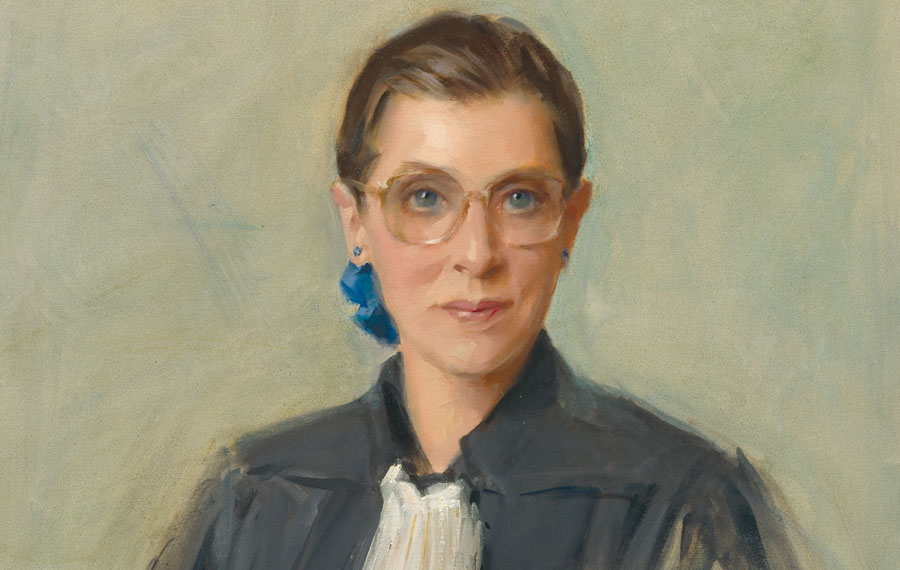
Carmon first interviewed Ginsburg when she was covering women’s rights and the law as a reporter for MSNBC. The two women have been in regular contact through the publication of the book and as the exhibition came together. Ginsburg officiated at Carmon’s wedding and a portrait of the justice by Carmon’s husband, Ari Richter, will be on display at the Skirball. 

Carmon had long known about the impassioned, crusading Ginsburg. As their relationship developed, she said she discovered the justice’s lighter side.

“I never would have thought about or realized her sense of humor because she comes across, if you don’t know her very well, as someone who is very serious,” Carmon said. “In fact, her sense of humor is really dry and wry and subtle, but very present. I was also really surprised by her physical robustness because we tend to think of her as this tiny, elfin, weak lady.” 

However, Ginsburg has boasted of her ability to do 10 pushups at the age of 84.

“I asked her about that in my first interview,” Carmon said. “She said, ‘Yes, but we do 10. Then I take a breath and I do 10 more.’”


“Notorious RBG: The Life and Times of Ruth Bader Ginsburg” opens at the Skirball on Oct. 19 and runs through March 10. For tickets and information, visit www.skirball.org

LA Exhibition Spotlights the ‘Notorious RBG’ Read More »

Jewish Themes Explored in ‘Man in the High Castle’

Set in a chilling alternate reality in which the Nazis and the Japanese won World War II and have conquered and divided the United States, “The Man in the High Castle” is now streaming its third season on Amazon. The series, based on Philip K. Dick’s 1962 novel, continues to explore multiple storylines, traveling to the Nazi-occupied East, the Japanese-ruled West and a Neutral Zone in Colorado.

“Season 3 embraces a deeper dive into our core characters. The season as a whole is a lot more character-centric than our past seasons,” writer and executive producer Kalen Egan told the Journal. He has been with the show since its inception, working with Dick’s daughter Isa Hackett Dick on the show’s development. “We’ve added new elements, including some ideas Dick came up with for a sequel that he never got around to writing,” Egan said. “He had some chapters that we pulled from. The beginning of that book would have gone into the Nazis developing a [dimension-travel] portal.”

There are new characters, including an Irish former resistance fighter-turned-smuggler named Wyatt, played by Jason O’Mara, who joins forces with Juliana (Alexa Davalos). “He’s been through it all,” Egan said, adding that he represents “what was going on in Europe during World War II, something we haven’t seen.” 

Spoiler alert: There is also the surprising return of another key character. Frank Frink (Rupert Evans), last seen in the penultimate episode of Season 2 setting a car bomb and being caught in its explosion, reappears in the fourth episode, limping and scarred, but resolute in his commitment to the resistance — and to Judaism.

An artist whose grandfather was Jewish, Frank wanted nothing to do with the Jewish faith and the dangers it posed, and kept his bloodline secret. But this season, while living in Sabra, a secret community of Jews posing as Christians, he comes to embrace the religion, with his Jewish friend Mark Sampson (Michael Gaston) as his spiritual guide. 

Mark “articulates what Frank is running from and what he believes is the only way to survive, and guides him toward faith and the meaning of that faith,” Egan said. “We saw Frank step into some of that in Season 1 but it goes further this year.” It culminates in a bar mitzvah ceremony in the sixth episode.

A lot of preparation went into it, Egan said. “We have some writers on the staff who are Jewish and [executive producer] David Zucker is Jewish. But to build that bar mitzvah scene properly, we depended on independent researchers.” he said. 

“If we can tell a story about a character like Frank and his exposure to a faith that he thought was dangerous or couldn’t identify with, but then finding the value in it, I think that becomes a lesson for everybody.”
— Kalen Egan

“We brought in a rabbi, and she was instrumental in making sure that it rang true and served the story. Members of the prop crew brought in their personal prayer books. During the prep process, we broke challah bread, [said] prayers, and got a very intimate exposure to that ritual,” he added. “It was a powerful way to immerse ourselves, and it really served the scene. I wasn’t there for the actual shoot, but everybody said it was emotionally overwhelming.”

The bar mitzvah scene is intercut with another scene of a Nazi celebration: One scene shows the value of tradition and history, and the other shows the Nazis hellbent on eradicating the past. 

Something occurs at the end of Episode 9 regarding Frank’s character, which we won’t give away here. “It came about organically following the narrative we were trying to tell between [Frank] and the Japanese police inspector, Kido,” Egan said. “Frank becomes a powerful symbol of the life he’s led and the things he’s learned, imbued with spirituality and self-reckoning and force.”

Shaping Frank’s storyline gave Egan the chance to present very specific circumstances in a way that feels universal for the audience. “If we can tell a story about a character like Frank and his exposure to a faith that he thought was dangerous or couldn’t identify with, but then finding the value in it, I think that becomes a lesson for everybody,” he said

“The Man in the High Castle” has been renewed for a fourth season, which will expand the show’s world with new locations and some new characters. “We’re still concentrating the story in America but get glimpses of new places,” Egan said.
“We’re sticking with the characters that remain in the main story but much like we introduced the secret Jewish community this season, we’re also introducing new communities in Season 4. We’ll see new parts of San Francisco,” he said. 

The Jewish storyline and Sabra will continue, “in a way that isn’t exactly expected. We’re still piecing it together and things change every day,” he added. “But some of the characters from Sabra become essential pieces of the next season.” 

According to Egan, the show’s mission is to provocatively raises moral and ethical questions without providing clear answers. “As long as we keep asking those lingering questions in new and intriguing and powerful ways, it’s up to people to consider them on their own,” he said. “Every year we think the world can’t possibly get any closer to the alt-reality that we’re depicting, and every year it does.”


“The Man in the High Castle” is currently streaming on Amazon Prime video.

Jewish Themes Explored in ‘Man in the High Castle’ Read More »

Surviving the College Application Process

The prevailing wisdom is that junior year of high school is the toughest. However, Ross Mankuta, director of college counseling and academic planning at Milken Community Schools, disagrees.

“We’re firm believers that senior year is the hardest year,” he told the Journal. “They are taking their hardest curriculum in high school while simultaneously applying to college.” And right now, high school seniors are in the thick of it, with the University of California and California State University applications due in November and most others due in January.

Making things even tougher, “admission rates are plummeting everywhere,” Mankuta said, because more people are applying to college than ever before. 

“The best role a parent can have for senior year is really to be a consultant,” said Aviva Walls, dean of academic affairs and director of college counseling at Shalhevet High School. 

That role, she said, involves checking in with your child once or twice a week to ask where they are in the process and where they might need help. “Students should really be the driver of the process,” Walls said, adding that there are benefits to parents stepping back, including giving students the experience of doing paperwork, a skill they are going to need for the rest of their lives.

For students who are still figuring out where to apply, Sue DeRuyter, director of college counseling and dean of academic advisement at de Toledo High School, recommends they first take some time “to get to know themselves, to start to understand how they learn best … and what excites them about learning. It’s an internal search more than an external search,” she said, noting that once they do this, they will be better positioned to start considering schools. 

DeRuyter also recommended visiting a few local schools. “Even if they aren’t considering the campus,” she said, it’s worth doing, as it will help a student begin to determine what they want and don’t want in a school. “It’s really hard to decide what you want to eat if the menu is blank,” she noted.

“Jewish parents want the best for their children and [they feel] the best college is best for their children. But that creates a lot of stress on students.”

— Aviva Walls

Many Jewish students are also looking for a school  with a vibrant Jewish community. Walls shared several resources that are helpful in making that determination. One is the Orthodox Union’s Jewish Learning Initiative on Campus (oujlic.org), in partnership with Hillel. The site offers information on both the number and percentage of Jewish students on a campus, the number of Orthodox students, whether there is a Hillel or Chabad, as well as detailed information about kosher food options. Hillel also has its own college guide (hillel.org/college-guide). Then there is Heart to Heart (theheart2heartproject.org), which describes itself as “a grass-roots movement of Jewish college students sharing Jewish life with their peers.” 

As for how many schools to apply to, there is no hard and fast rule and, of course, every student is different. But at Shalhevet, for example, the general recommendation is eight to 12, Walls said, with the University of California schools counting as one, since they are covered by a single application. And while it’s fine for students to have so-called reach schools on their list, Mankuta said they should have some “viable” schools as well. (The common term for such schools used to be “safety” schools).

“Shoot for the stars but have a plan here on Earth,” Walls likes to say.

“Too many of our students are close-minded about where they can and should go, and where they deserve to go and what options are out there,” Mankuta added.

Parents, too, sometimes get fixated on a particular school. “What I often say to families is, ‘If you really have your heart set on putting that sticker on the back of your car, do your child and yourself a favor and buy the sticker and put it on your car,’ ” DeRuyter said. “But that doesn’t have to be where your child has to go to college. It’s less expensive, and you will all have a much better year.”

Throughout the process, it’s important to keep in mind a couple of big-picture points: “Where your son or daughter goes to college is not a reflection on your parenting achievement,” DeRuyter said. “Also, where you go to college does not dictate your future success or happiness.” 

Few people would argue these points on paper, but they can be hard for parents to accept. 

“Jewish parents express love through education from what I have seen,” Walls said. “So they want the best for their children and [they feel] the best college is best for their children. But that creates a lot of stress on students. It isn’t always helpful.”

Ultimately, Walls said, “College is an amazing time in your life no matter where you go.” It’s also not forever. “It’s a winter coat and not a soul mate,” she added. “It’s not who you are married to for the rest of your life.”

Surviving the College Application Process Read More »