Saudi Minister of Islamic Affairs Abdullatif Bin Abdulaziz Al-Sheikh praised Israel on August 23 for allowing Muslims to go on their Hajj pilgrimage, stating that it makes the Jewish state better than other Muslim countries.
In a Saudi television clip, Al-Sheikh says, “What has surprised us is that the state of Israel has, from what we know of it, has not banned Muslim pilgrims from coming to the [Saudi] Kingdom to take part in their religious obligation, however, one of the countries, as we know or have been told, has banned pilgrims from visiting the House of Allah.”
“This is a catastrophic fail for anyone who has done this, for no one can be banned from Hajj and no one can be banned for worshipping Allah,” Al-Sheikh continued.
Israel has facilitated #Hajj pilgrimage for 4,000 of its Muslim citizens in honor of #EidAlAdha. The Saudi minister of Islamic affairs, Abdullatif Bin Abdulaziz Al-Sheikh, praised Israel for, unlike other Muslim states, not preventing Muslim believers from performing their Hajj pic.twitter.com/62hhVn1Lbd
In July 2017, Israel sought to establish direct flights for Israeli Muslims to take from Israel to Saudi Arabia in order to help them with their Hajj pilgrimage, as otherwise they would have had to take a bus for 1,000 miles to make the pilgrimage.
Iran, an enemy of both Saudi Arabia and Israel, is one Muslim country that bans its Muslim citizens of making Hajj. Qatar has reportedly banned Muslims from making Hajj recently, however Qatar disputes that report, claiming that Saudi Arabia is preventing Qataris from the making the pilgrimage. The Saudis responded by accusing Qatar of politicizing the Hajj.
The Hajj is a pilgrimage to Mecca, a religious obligation for Muslims to make at least once in their lives.
You know the feeling of cracking open a fortune cookie to find the perfect message? Sometimes the result is a sigh of relief, as we can sit back and let the future unfold. The onus of responsibility is lifted.
There is saying from our Mishna: “All is foreseen, yet free will is given” (Pirkei Avot 3:19). While this certainly presents a paradox, it also reveals an important truth: we can’t just wait for stuff to happen. We were created with free will, and we therefore have the privilege (and obligation) to use our minds!
Sure, we might get a lucky break once in a while. But you can only win the lottery if you buy a ticket. And you can only harness the future – if you take a moment in time to set your mind to it.
With love and shalom!
Rabbi Zach Shapiro
Rabbi Zach Shapiro
A change in perspective can shift the focus of our day – and even our lives. We have an opportunity to harness “a moment in time,” allowing our souls to be both grounded and lifted. This blog shows how the simplest of daily experiences can become the most meaningful of life’s blessings. All it takes is a moment in time.
Rabbi Zach Shapiro is the Spiritual Leader of Temple Akiba of Culver City, a Reform Jewish Congregation in California. He earned his B.A. in Spanish from Colby College in 1992, and his M.A.H.L. from HUC-JIR in 1996. He was ordained from HUC-JIR – Cincinnati, in 1997. He was appointed to the HUC-JIR Board of Governors in 2018.
Los Angeles County Supervisors Sheila Kuehl and Mark Ridley-Thomas (seventh and eighth from left, respectively) and JVS SoCal CEO Alan Levey (far right) were among those that celebrated the grand opening of the West Los Angles America’s Job Center of California, in Culver City. Photo courtesy of JVS SoCal
Los Angeles County Supervisors Sheila Kuehl and Mark Ridley-Thomas and JVS SoCal CEO Alan Levey were among the community leaders celebrating the grand opening of the West Los Angeles America’s Job Center of California (AJCC) in Culver City on Aug. 10.
Katherine Moore, senior vice president of communications at JVS SoCal, formerly known as Jewish Vocational Services, said her organization was awarded the contract to operate the center through a competitive bidding process. The center is funded by Culver City and L.A. County with money they receive from the federal government. The center will serve Culver City, Marina Del Rey, Playa Del Rey, Westchester, Ladera Heights and the West L.A. area.
The AJCC “is a one-stop shop for workforce services, providing a comprehensive range of no-cost employment and training services for employers and job seekers,” according to a press release for the event.
Additional attendees at the ribbon-cutting ceremony included Jan Perry, general manager of the Economic and Workforce Development Department for the city of Los Angeles; Cynthia Banks, director of the L.A. County Workforce Development Department, and Carolyn Anderson, regional deputy division chief of the California Employment Development Department.
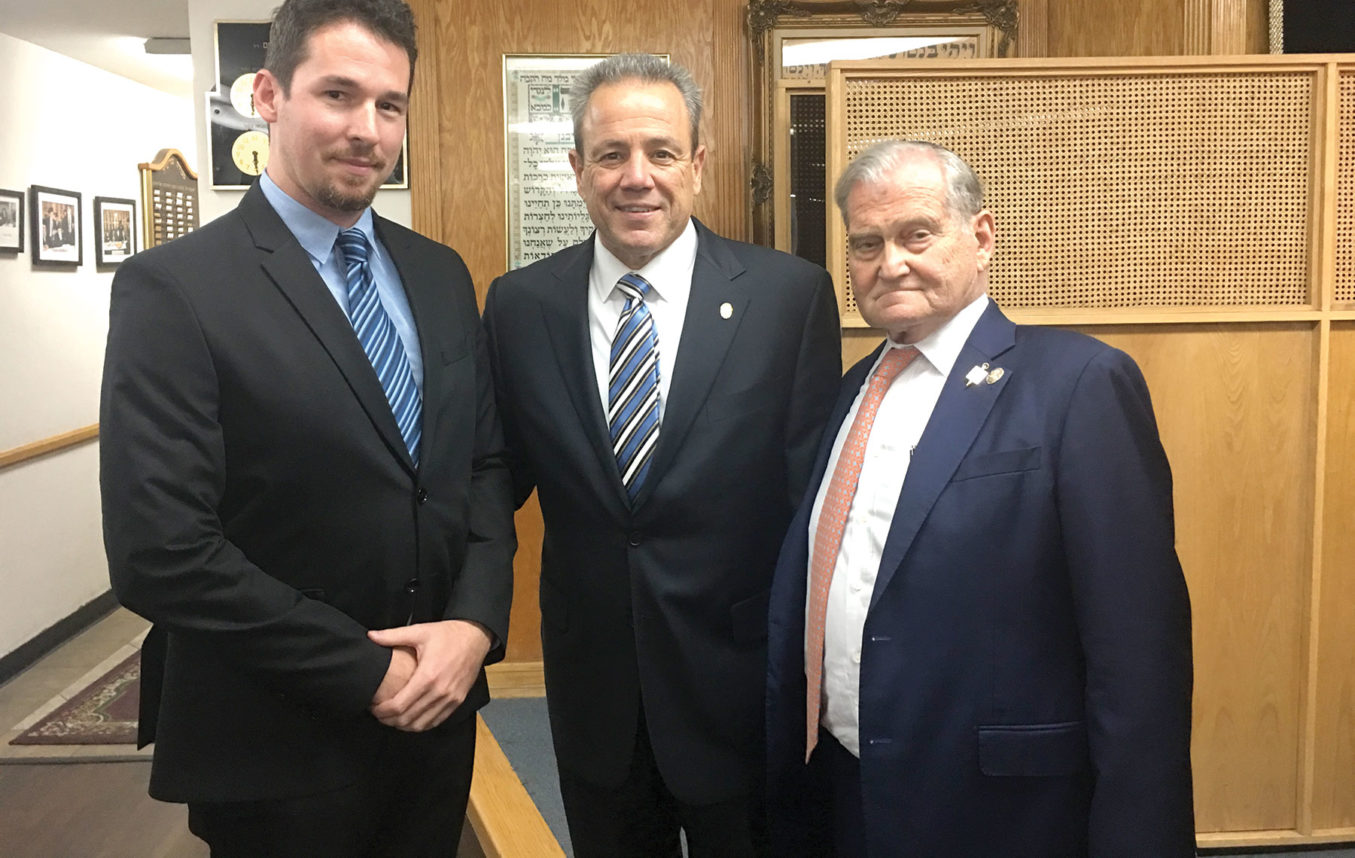
From left: Hungarian Deputy Consul General Istvan Grof, LAPD Chief Michel Moore and Congregation Bais Naftoli President Andrew Friedman at a Bais Naftoli event that welcomed Moore as the new head of the LAPD. In his remarks, Moore addressed the congregation’s security concerns. Photo by Ryan Torok
Recently appointed Los Angeles Police Department Chief Michel Moore appeared at Orthodox community Congregation Bais Naftoli on Aug. 15 to discuss security concerns facing the Jewish community in Los Angeles.
Addressing about 60 people at the shul on La Brea Boulevard in the Mid-Wilshire neighborhood, Moore said religious individuals and families in the area face “unique risks” on Shabbat when they walk to synagogue.
Moore, appointed to head the police department this past June, spoke of his commitment to ensuring the safety and security of the community, adding that he also expects people to take responsibility for their own safety.
“Your safety is not my sole charge,” he said. “Your safety is our shared responsibility.”
Moore also addressed the homelessness crisis in this city, with an estimated 28,000 people living without shelter on any given night. He said the solution is not for police to arrest homeless people who may be in violation of the law but for there to be more housing.
“The solution today is not trying to enforce your way out of it,” he said.
Attendees at the event included L.A. City Councilman Paul Koretz; L.A. City Controller Ron Galperin; Bais Naftoli President Andrew Friedman; Rabbi Zvi Boyarsky, director of constitutional advocacy at the Aleph Institute; L.A. County Assessor Jeffrey Prang and Hungarian Deputy Consul General Istvan Grof.
Many of Bais Naftoli’s congregants are from Hungary.
Cantorial student Kate Feld, a recipient of a JVS scholarship, performed at the JVS Scholarship Program awards ceremony at Sinai Temple. Photo courtesy of JVS SoCal
The JVS Scholarship Program awards ceremony on July 26 celebrated the 243 Jewish students who received scholarships this year. JVS SoCal CEO Alan Levey and JVS Scholarship Committee Co-Chairman Mathew Paul opened the ceremony at Sinai Temple.
“Awarding scholarships to such accomplished students is tremendously inspiring,” Paul said. “I look forward to their future success and contributions as representatives of the JVS Scholarship Program to their schools and communities.”
The celebration enabled recipients of scholarships to recognize and thank the JVS Scholarship Program donors, who contributed some of the $744,650 raised for the needs-based scholarships for college students.
Established in 1972, the program has awarded more than $9 million to nearly 5,000 students from Los Angeles County, helping them on the path toward academic success.
The program is “the largest need-based scholarship program serving Jewish students within the Los Angeles community” stated a press release for the event.
Before selecting the scholarship recipients, the JVS Scholarship Committee interviewed more than 150 students about their involvement in community service, academic performance, financial needs and family history. Schools the recipients are attending include Harvard University, Stanford University, the Sackler Faculty of Medicine at Tel Aviv University, USC and Cal-State University, Northridge. Some of the degrees they are pursuing include medicine, law and the arts. Among the scholarship recipients are immigrants and students with learning disabilities.
The event included a performance by 2018-2019 scholarship recipient Kate Feld, a cantorial student at the Academy of Jewish Religion, California, who showed off her operatic vocals.
Another highlight was a surprise marriage proposal of a couple — scholarship alumnus Ashkan Morim to scholarship alumna Morin Zaray — who had met at the 2017 awards ceremony.
— Charlotte Kramon, Contributing Writer
From left: Jocelyn Tetel, vice president of advancement at the Skirball Cultural Center; Mia Carino, vice president of communications at the Skirball; Scott Goldman, artistic director for the Grammy Museum; Stacie Takaoka-Fidler, director of special projects for the Grammy Museum; L.A. City Councilmember Paul Koretz; Rita George, COO of the Grammy Museum; and Samuel Paul, media consultant to the Leonard Bernstein Office. Photo by Betsy Annas
Los Angeles City Councilman Paul Koretz led an Aug. 21 city council presentation in honor of the late American composer Leonard Bernstein, who would have turned 100 years old on Aug. 25.
During the presentation in the City Hall council chambers, Koretz called Bernstein “a beloved contributor to the artistic soul of Los Angeles” and the council approved a resolution declaring Aug. 25 “Leonard Bernstein Day in L.A.”
Samuel Paul, media consultant to the Leonard Bernstein Office, accepted the resolution.
Scott Goldman, artistic director at the Grammy Museum, spoke on behalf of the museum and the Skirball Cultural Center, where the two institutions’ exhibition “Leonard Bernstein at 100” is on display through Sept. 2 .
The exhibit at the Skirball is one of dozens of local programs that in the past year have been celebrating Bernstein’s centennial, including performances at the Los Angeles Philharmonic, the L.A. Opera and elsewhere.
From left: Rick Krim, co-president of Sony/ATV Music Publishing; David Renzer, chairman and CEO of Spirit Music Group and producer Howard Rosenman attended the third annual Creative Community for Peace summer reception. Photo courtesy of Creative Community for Peace
Approximately 150 people attended the third annual Creative Community for Peace (CCFP) summer reception on July 18.
CCFP is an organization that brings together prominent entertainers to celebrate expression through art and to oppose the cultural boycott of Israel.
Held at the Skirball Cultural Center in Los Angeles in partnership with the Grammy Museum’s “Leonard Bernstein at 100” exhibit, the event featured appearances by Oscar-winning producer Howard Rosenman (“Call Me By Your Name”) and Oscar and Grammy-nominated composer Stephan Moccio.
Rosenman shared his thoughts on Bernstein’s musical legacy, and Moccio collaborated with vocalist Maty Noyes to perform fan favorites from “West Side Story.”
Rosenmen, who was a close friend of Bernstein, also praised CCFP’s work in using art to generate peace and counteract the cultural boycott of Israel.
“This work is so important because it emphasizes the bonds of creativity — and music especially demonstrates that brotherhood and unity can be achieved for all nations because music is one of the great arts that binds us all together,” he said.
David Renzer, co-founder of CCFP and chairman and CEO of Spirit Music Group, emphasized Bernstein’s support of the State of Israel. He spoke of Bernstein’s role as the conductor of the Palestine Philharmonic Orchestra, which became the Israeli Philharmonic Orchestra, for 25 seasons.
If you want to better understand why peace between Israel and the Palestinians is a hopeless illusion, read Raja Shehadeh’s response in The New York Times this week to Yossi Klein Halevi’s soulful and conciliatory “Letters to My Palestinian Neighbor.”
Instead of responding in kind, Shehadeh falls back on the tired trope of chronic victimhood that has served only to perpetuate Palestinian misery. In this narrow view, every Palestinian woe is Israel’s fault; and Palestinians are a weak people with no agency just waiting for big, bad Israel to “withdraw from the territories it has occupied and leave us to go on with our lives.”
Shehadeh, who’s an author and an intellectual, knows better than to simplify such a bedeviling conflict whose complexity Halevi tried to honor. He knows, for example, that on the very day the IDF would abandon the territories, terror groups like Hamas and ISIS would jump to try to fill the vacuum and massacre Palestinians, just like Hamas did in Gaza.
But such complexity plays no role in Shehadeh’s takedown of Halevi’s offer to embark “on a journey of listening to each other.”
Shehadeh acknowledges that Halevi recognizes the importance of a Palestinian “counterstory,” one of “invasion, occupation and expulsion,” a history of “dislocation” and “humiliating defeats.” But how does he respond to such humility and contrition? By blasting Halevi for being “condescending” and for focusing so much of his book on trying to help Palestinians understand the Zionist story that is ingrained in Halevi’s soul.
Shehadeh also knows better than to casually dismiss Israeli offers of peace rejected by Palestinians as “old and discredited narratives.” He can’t even bring himself to admit that Palestinians are partly responsible for the absence of peace. The furthest he will go is to say, “I was involved in the Oslo negotiations and I can tell you that Israel shares plenty of responsibility for their failure.”
Everything else in his piece is a hodgepodge of polite aggression disguised as sophisticated lamentations. He claims that, “To make peace possible the Palestinians are not required to become Zionists,” as if Halevi ever asked for that. Betraying his intent to undermine Halevi’s book, he twists a plea to “understand us” into a demand to “become Zionist.”
Perhaps the deepest sign of his bad faith is when he admits to having zero interest in Israelis understanding his narrative: “Unlike you,” he writes triumphantly, “I will not demand that you see the Nakba, the catastrophe that Israel’s founding caused for my people, in the same way as I see it.”
Why? Because “You couldn’t.” Shehadeh is so drenched in smug victimhood that he can’t possibly imagine a Jewish neighbor being able to understand his narrative—not even a neighbor who has already made a genuine effort to do precisely that.
What he wants is that Israel recognizes its responsibility and “put a recognition of that culpability on the agenda for negotiations when the time comes for arriving at a settlement between us.”
But that time will never come if the Shehadehs of the Palestinian world continue to treat Palestinians as hopeless victims who are too weak to ever understand the authentic longings of their Jewish neighbors.
UPDATE: Leo Baeck Temple’s attorney, Josh Haffner, told the Journal in a phone interview that the Los Angeles city and county faces allegations “associated with negligence.”
“They were aware of a dangerous condition – in this case the fire hazard – and they failed to do anything to remedy it,” Haffner said. “They let it exist until it actually caused this massive wildfire and a lot of damage.”
Haffner added that Leo Baeck suffered “extensive” damage, although the temple is currently functioning.
“Leo Baeck Temple has always supported and done a great deal to combat homelessness and eradicate it,” Haffner said. “This case is about a government allowing a dangerous condition and neglect of a dangerous condition, and it’s fully consistent with that deep commitment the temple has to assisting the cause of homelessness by shining a further light on it and the need to do something about the homeless and their plight.”
“This is a danger not just for the community, but for the homeless themselves.”
ORIGINAL:
Bel Air synagogue Leo Baeck Temple filed a lawsuit against the city and county of Los Angeles on August 23, alleging that the city and county could have helped prevent the fire had they not ignored the complaints of residents.
According to The Los Angeles Times, the court documents state that residents frequently complained about a homeless encampment located in a canyon around Sepulveda Boulevard and the 405 Freeway. The encampment was located in an area that was already “prone to wildfires because of the trees, bushes and other vegetation and foliage,” so the synagogue argues that the city and county should have surveyed the area and removed the encampment, or at least provided the public with a warning about it.
The Skirball Fire was ignited by a cooking fire at the encampment, destroying six homes and damaging several others in its wake; Leo Baeck stated in the lawsuit that the temple suffered damage from the fire as well.
Nickie Miner, vice president of the Bel Air-Beverly Crest Neighborhood Council, told The Los Angeles Times at the time of the fire, “We knew it was only going to be a matter of time before something horrible happened.” Miner called for regulatory reform that featured the elimination of homeless encampments along the hillsides.
UCLA’s Alpha Rho chapter of Jewish fraternity Zeta Beta Tau (ZBT) is currently facing a lawsuit by a female student who claims that one of its members sexually assaulted her and the fraternity did nothing about it.
According to the lawsuit, filed by the Foundation for Accountability in Higher Education and Keith A. Fink & Associates on August 10, the student – who wanted to keep her name anonymous – was at a party hosted by Sigma Alpha Epsilon (SAE) on August 12, 2016. The defendant, Blake Lobato of ZBT, allegedly pressured her to consume voluminous amounts of alcohol at the party. Eventually, the student became too exhausted and left the party with a group of friends.
However, according to the lawsuit, as the student left the party, she noticed she was too intoxicated to walk properly, so she went back to the party, which she hoped “would end soon.” She encountered Lobato again on her way back to the party, who encouraged her to spend the night at the ZBT house, where he provided her with a bed to sleep alone.
The student alleges that while she was sleeping inebriated and drifting “in and out of consciousness,” Lobato “forcefully removed her shirt and pushed her body down to unfasten her shorts.” The student protested and attempted to resist Lobato’s actions to no avail, and she says Lobato forcefully penetrated her without her consent – twice.
The student says that she felt “excruciating physical pain” for days after the alleged assault happened, and that she had to see a therapist in order to deal with post-traumatic stress disorder, anxiety and depression.
She went to ZBT’s president at the time, who is not named in the court documents, and described to him what Lobato allegedly did to her. The president responded by saying he believed her, but the fraternity did not investigate or reprimand Lobato. The student kept pressing the issue, resulting in Irving Chase, a lawyer and board member of ZBT, to handle the matter.
Chase allegedly disbelieved the student’s allegations against Lobato, insisting that no ZBT member would engage in such actions and he urged her not to bring the matter to UCLA. Chase eventually told the student the fraternity would investigate the matter.
The student later learned after telling her friends about Lobato’s alleged assault that he had allegedly raped another female student in 2015, who is also not identified in the court documents.
“Both women are members of the same sorority; both women were drinking at fraternity parties prior to the assaults; Lobato offered to walk both women home prior to the assaults but instead took them to his room; both assaults occurred in Lobato’s room, and in his bed; Lobato ignored them telling him ‘no’ and making comments like, ‘you know you want this’; LOBATO attempted to or did orally copulate them, without their consent, prior to penetrating them; LOBATO first penetrated them while positioned above them and then physically turned them over and penetrated them from behind, without their consent; LOBATO’s conduct was aggressive and forceful; and both women were unable to find their underwear after the encounter,” the lawsuit states.
Both women confronted ZBT’s president, but he reportedly gave them “the runaround.” The student then confronted Chase about the investigation, but he replied that he was unable to render a verdict on the matter. When ZBT installed a new president, the student told him about Lobato’s actions against them, and the president pledged to remove Lobato as a member. The fraternity never reported the assault to UCLA’s Title IX office, the lawsuit alleges.
After taking a class on Title IX, the student decided to report the alleged rape to the university’s Title IX office. The student claims that Lobato threatened to kill her and that he was frequently “lingering outside her sorority house window.”
Lobato was eventually expelled from the fraternity in January 2017 after the student filed the report, but “he continued to affiliate himself with ZBT to no objection from ZBT or its members.” He was expelled from UCLA in November 2017 and currently resides in Ohio.
In sum, ZBT faces allegations of negligence, and Lobato faces allegations of assault, battery and intentional infliction of emotional distress in the lawsuit. SAE and UCLA’s Interfraternity Council (IFC) also face allegations of negligence, as the lawsuit argues that they’re liable for serving alcohol to minors and failing to establish proper safety measures.
UCLA’s ZBT chapter has not responded to the Journal’s request for comment. ZBT and SAE told The Daily Bruin that it was not their policy to comment on “pending or threatening litigation.”
Aaron Shub is the rabbi of Congregation Shaarey Tphiloh and Director of Jewish Life and Learning at Levey Day School, Portland, Maine: Shub is originally from Los Angeles. While he received a BA in Theater Arts from the University of California, Santa Cruz, and an MAEd from the American Jewish University in Los Angeles, he has spent much of his life living and working abroad. Aaron began his rabbinic training at the Ziegler School of Rabbinic Studies before enrolling at YCT. He is a trained and experienced chaplain, having served in trauma, behavioral health, oncology, and cardiac care units at major hospitals around the US, as well as in hospice, home care and assisted living settings. His spouse, Dr. Abbie Yamamoto, is a translator, US-Japan cultural consultant, and independent scholar of Japanese literature. They are raising their two children, Aryeh and Mina, in both Hebrew and Japanese. In addition to his love of languages and cooking, Aaron is a dedicated martial artist.
This Week’s Torah Portion – Parashat Ki Tetize (Deuteronomy 21:10-25:19) – features a vast number of laws and commandments, including inheritance laws; judicial procedures and penalties for adultery, rape, and for husbands who falsely accuses their wives of infidelity; laws concerning credit and debt; rules on the treatment of escaped slaves; and Divorce laws. Overall, this week’s portion contains 74 of the Torah’s 613 commandments. Our discussion focuses on the command to remember Amalek and on the role of remembrance in the Torah in general.