fbpx

August 22, 2018

Massachusetts School Board Avoids Lawsuit Over Anti-Israel Curriculum Info — For Now

A school board in Newton, Mass. has temporarily avoided a lawsuit over obstructing matters related to the anti-Israel material being disseminated in Newton school classrooms.

The August 9 lawsuit, filed by Education Without Indoctrination (EWI) alleges that students in Newton Public Schools (NPS) are being taught “materials that slander Israel and the Jewish people, and that falsify history to promote the Islamic religion.” The lawsuit alleged that the Newton School Committee and NPS Superintendent David Fleishman have allegedly been “stonewalling” parent efforts to learn more about what is being taught about Israel and Islam in Newton classrooms as well as written evaluations of Fleishman’s performance as superintendent.

As part of the alleged stonewalling, the lawsuit argued that the committee would remove comments from parents criticizing the curriculum as being biased against Israel from their meetings minutes, which EWI argued is in violation of Massachusetts’ Open Meeting law.

“There was not one mention of any person who had spoken in opposition…which was astounding,” EWI member and counsel Karen Hurvitz told the Newton TAB.

Hurvitz also told The Jewish Advocate that the committee showed “no concern” over the parents’ criticisms of the curriculum.

On August 21, the school committee agreed to put those comments into the meeting minutes as well as made the evaluations of Fleischman publicly available. Committee chair Ruth Goldman told the TAB that the committee is still “very new” and that all meetings have been televised, which is why they didn’t have any complaints about the meeting minutes until the EWI lawsuit.

EWI will be reviewing the documents. Hurvitz told The Jewish Advocate that they’re going to ask for a court hearing on Sept. 12 to decide if what the committee has released fully meets the requirements of the Open Meeting law.

“They can’t whitewash the record, which is what they’ve been doing,” Hurvitz told the TAB. “It’s like cooking the books. They can’t cook the books any more. They have to be honest.”

Assistant City Solicitor Jill Murray, who is representing the committee, told the Journal in a phone interview that the lawsuit will have no impact on the curriculum itself. When asked by the Journal why the documents in question were not released to the public prior to the lawsuit, Murray responded that she was not interested in a “back-and-forth.”

According to a book by Steven Stotsky of the Committee for Accuracy in Middle East Reporting in America (CAMERA) titled “Indoctrinating Our Youth: How a U.S. Public School Curriculum Skews the Arab-Israeli Conflict and Islam,” in 2011 it was revealed that Newton was teaching students material from a book titled “Arab World Studies Notebook” alleging that hundreds of Palestinian women “have been imprisoned, tortured, and killed by Israeli occupation forces.” The book also stated that there is a “Hollywood Jewish conspiracy” to portray Arabs unfavorably in movies.

Despite criticism from parents over the book, the school district refused to pull it from their curriculum for more than a year; when they did revoke it they claimed it was because the book was “outdated.” However, one Newton high school is still using the book in lesson plans.

Stotsky also notes that Newton’s curriculum teaches that Jerusalem is “Palestine’s capital” and that Israel refused Arab offers of land-for-peace following the Six Day War – all part of a pattern of false anti-Israel bias being promulgated by the district’s curriculum, Strotsky argues.

The books are also reportedly funded by Saudi Aramco, Saudi Arabia’s major oil company that has defended the Arabs’ desire to attack Israel in the Six-Day-War, as well as the Qatari government, which has warm ties with the Iranian regime and funds Islamic terror groups like Hamas and al-Qaeda.

Massachusetts School Board Avoids Lawsuit Over Anti-Israel Curriculum Info — For Now Read More »

Israel Is a Country, Not a Cause

If you’re like a lot of American Jews, you’ve gotten pretty worked up lately about the Nation- State Law, the questioning of Peter Beinart at Ben Gurion Airport or the LGBT protests about surrogacy. Before that, there was the Kotel controversy, and the Jerusalem embassy, and before that the Iran deal—and so on.

There is no country on earth whose domestic and foreign policy grips American Jewish attention like Israel. Because it’s the “Jewish state,” and American Jews care.

But there’s something wrong with all this caring.

In America, where many Jews don’t know Hebrew, arguments about Israel tend to be shallow and shrill mirrors of debates in Israel—after all, what do people use to interpret the news other than what Israeli right-wingers and left-wingers are telling them?

This kind of second-level arguing, however, is usually a waste of breath.

Why? In part, because it’s stripped of context. Israelis shout when they argue, even when they write. A writer from Haaretz can declare the rise of Israeli fascism, and another one from Israel Hayom can scream about treason against the nation, yet it’s a small Middle-Eastern country—when they’re done shouting, they still go to the same bars, the same family meals, listen to the same radio news, or run into each other at the gym or the boardroom.

A columnist for Haaretz once told me: “Of course I overstate the threats to Israeli democracy. If I don’t scream, nobody will hear me.”

Another reason American Jews are so breathless is that they feel powerless to affect the country they care about. They don’t vote in Israel, they don’t participate in the Hebrew-language policy debates, and no matter how much they feel Israeli decisions might affect them, they really don’t, at least not in the way they affect Israeli voters and taxpayers.

In fact, the disconnect between American-Jewish adrenaline about Israel and the actual, objective success and stability of the country is so enormous that it forces us to ask: What are you really worried about, American Jews?

The short answer, the only one that makes any sense, is this: It’s about you.

American Jews want desperately to care about something Jewish, but don’t really want to face the fact that their kids aren’t continuing the identity, that they have lost a sense of belonging, that their synagogue-based communities are dissolving into infinite WhatsApp groups and Facebook groups and political action committees, that their kids are, in some cases, getting blamed on campus for things that Israel is accused of doing.

Meanwhile, over here in Israel, something totally different is happening. Under the radar, Israel has turned itself from a cultural backwater into something vibrant, edgy, and increasingly influential. Remember Start-Up Nation? Now it’s happening with culture: Israelis are changing the face not just of hi-tech but of music, architecture, film and TV, of design and art and dance.

When will American Jews notice? When will they tell their kids: Go to Israel because something amazing is happening there. Forget Left and Right—it’s not important. Forget BDS—it doesn’t matter. A nation’s creative spirit, its deep Jewish soul, its language and culture—all these are much bigger and more important for you than anything you read in the news.

This is not about Whataboutism or going “Beyond the Conflict.” Israelis don’t live in the conflict and don’t need to go beyond it. Israeli reality is mainly about what everybody else’s reality is about: Work, family, vacation, entertainment. In short, life.

But it’s also a different reality—an incredible life, full of creative energy, new thoughts, big gambles and brass tacks. This can be a lot more interesting to young American Jews looking for something to anchor their identity in than all the endless political sword-fighting.

The point is: A government is not its people. For Americans to get worked up about Israel based on who is in power makes no more sense than for Israelis to decide whether to visit or do business with the United States based on the latest tweets coming out of the White House.

Instead of showing your caring by reacting to headlines, there’s a different way to care—a much healthier way, one that will take you farther and bring your kids closer: Find the Israel that adds value to your life.

Visit. Learn the language. Meet the people. Listen to the music. Drink the wine. Enjoy the country. Treat it like an exotic foreign land, not a rotting shack in your backyard that used to be pretty but now is full of dung. Israel is not rotting, it has only gotten more beautiful, and it’s frankly not your backyard.

In an important essay last year, David Hazony made this point about “Israeliness” as a key to the Jewish future in America. He ended by saying that the path to Israel means “rediscovering Israel as a country, not just a cause, and yourself as someone searching rather than acting out of certainty…  to see the Israeli other not as a threat but as a resource for your own journey.”

Bring to Israel your sense of exploration and wonder rather than anxiety and anger, and you’ll be shocked how much more it has to offer. Your kids will be grateful, too.


Adam Bellos is the founder of The Israel Innovation Fund, whose goal is to create culturally relevant initiatives that showcase Israel’s diverse culture. Its flagship program, Wine on the Vine, enables people to support Israel’s wine industry by planting grapevines and supporting charities. 

Israel Is a Country, Not a Cause Read More »

Kindertransport Exhibit Displays ‘Childhood Left at the Station’

Would you send your children away to save their lives? 

Jews who were desperate to get out of Nazi-occupied Europe before the war but were unable to secure exit visas made that agonizing choice, sending their sons and daughters to safety in Great Britain on Kindertransports, while the adults stayed behind. Between 1938 and 1940, these rescue efforts saved nearly 10,000 children —most of whom never saw their parents again.  

Commemorating the 80th anniversary of the first Kindertransport, the Los Angeles Museum of the Holocaust has collected more than two dozen artifacts, letters and photographs from 10 Kindertransport refugees in an exhibit called “Childhood Left at the Station.” The items were donated or loaned by the individuals or their families, or borrowed from the United States Holocaust Memorial Museum. They’re showcased alongside panels displaying photographs and information about each person’s story, highlighting what they accomplished in life.

The 10 participants came from Slovakia, Austria, Germany and Poland, and settled in the U.K, Israel and the U.S. Among them are the late Israeli sculptor Frank Meisler, noted sex therapist Dr. Ruth Westheimer and Northridge resident Dave Lux. The artifacts include Charles Susskind’s sticker-covered suitcase; a pen-and-pencil set in a red leather case, the last gift Sylvia Oppenheimer received from her parents; and letters Rita Berwald wrote, seeking information about her parents. She eventually learned they both perished.

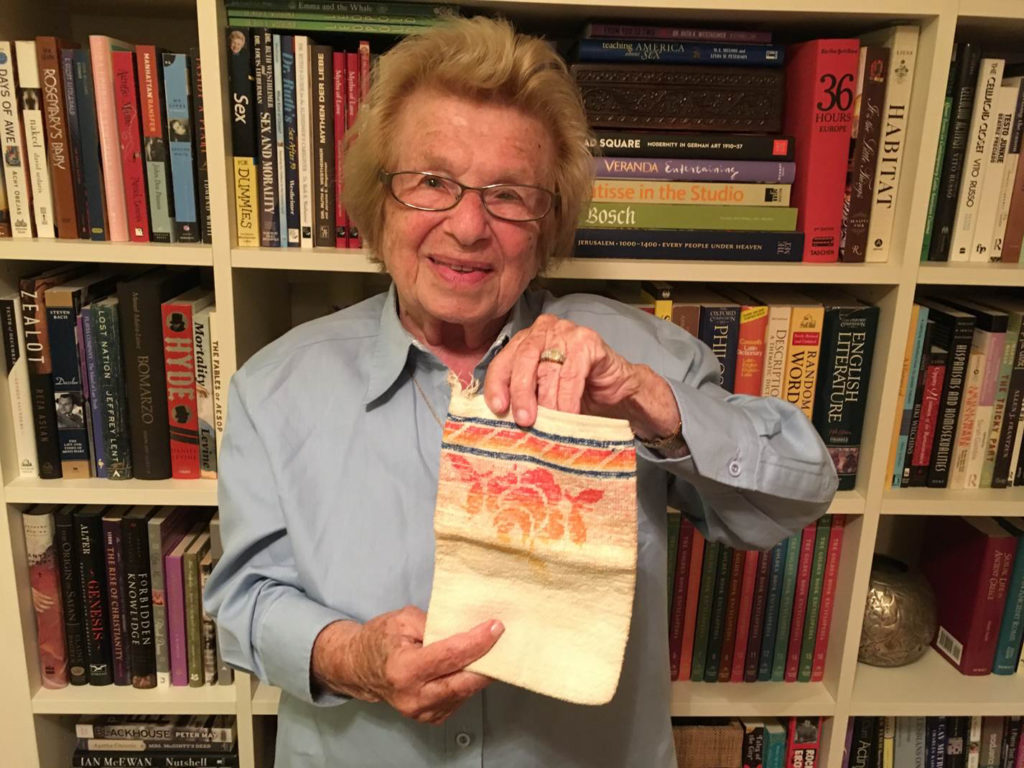
There is a photo of Westheimer holding the washcloth she carried as reminder of her father, a washcloth wholesaler who was arrested after Kristallnacht. He was taken to Buchenwald and, in his last letter home, told her to try to get on a Kindertransport, and that saved her life. Her parents and grandmother were murdered.

Photo Montage: Gerri Miller

“There’s so much meaning to these artifacts,” exhibit curator Jordanna Gessler said, giving the Journal a preview of some of the items. “They tell the desperate story of this attempt to get out and these parents wanting their kids to be safe. I think about the trauma and separation anxiety [these families] went through for no other reason except being Jewish. I also think this is such a timely exhibition,” she said, referencing the undocumented migrant children separated from their parents at the United States’ southern border. “When I started working on this a year and a half ago, I never thought it would be so relevant to what’s going on today.”

Lux, born Isidor Pinkasovic in Slovakia, was nearly 6 when he and his brother became two of the 669 children whose passage British philanthropist Nicholas Winton secured in 1939. “I had no idea what was happening,” he told the Journal. “We thought we were going on an outing. I was screaming, ‘Where are my parents?’ Eventually we realized they weren’t coming with us.”

“There’s so much meaning to these artifacts. They tell the desperate story of this attempt to get out and these parents wanting their kids to be safe.” — Jordanna Gessler

The brothers spent seven years at a Jewish home for boys in England, where they were regularly “slapped around” by the rabbi who ran it, Lux said, and another three years in London before they sailed to Israel. Lux made his way to New York, where he became a graphic artist and photographer, and then lived in Cleveland, where he met his wife of 56 years before they settled in the Los Angeles area. 

Now 85 and the father of three grown children and grandfather of five, he’s grateful to his parents — who were murdered along with his baby brother — for making the decision to send him on the Kindertransport. He often speaks to groups about his experiences during the Holocaust. “It’s important to me because we have to continue to tell these stories to prevent this from happening again,” he said. “That’s why I do it.”

Along with children of other Kindertransport survivors, Lux will be on hand for the exhibit’s 3 p.m. opening ceremony on Aug. 26, honoring the British Consul General in Los Angeles. The exhibit also honors Winton and features a film clip, playing on a loop, in which he explains why he fought to save the children.

Pointing out that the English word “kind” is the same as the German word for child, Gessler said she wanted to celebrate the people who showed kindness to the kinder, “whether they took in one child or like Winton, saved many.” She added, “If you look at the ripple effects of those acts of kindness, they had a huge impact. In this day and age when everybody is disconnected from one another or connected by electronics, [we’re providing a] space to discuss acts of kindness and [show] what effects they can have on the community.”

Stressing the importance of reaching youth, Gessler has produced a teacher’s guide to the Kindertransport exhibit, including photocopies of the included artifacts. She also plans a traveling version of the exhibit in the future. 

Gessler hopes visitors “walk away thinking about how they can pass it forward, how they can engage in acts of kindness that will have a larger ripple effect on their community, their town, even one individual,” she said. “The effects of kindness don’t have to be immediate. You can do something for someone that impacts them in a good way 50 years down the road.

“We live in a world that needs more kindness,” Gessler said. “If even one person leaves here and says. ‘I’m going to do tikkun olam, give to charity, do a mitzvah,’ then we’ve made a difference.”

“Childhood Left at the Station” will be on display Aug. 26-Dec. 31 at Los Angeles Museum of the Holocaust. The opening day event with Lux is free but reservations are required. 

Kindertransport Exhibit Displays ‘Childhood Left at the Station’ Read More »

Scope of Nazi Barbarity Explored in ‘Memoir of War’

Adapted from Marguerite Duras’ autobiographical novel “La Douleur,” the new film “Memoir of War” is not about the Jewish experience during the Holocaust but a postwar story about a French woman (Mélanie Thierry) who fears that her deported Resistance-member husband met his end in Dachau. It shows the depth and breadth of the misery the Nazis unleashed. 

The story resonated with French-Jewish writer-director Emmanuel Finkiel, who was attracted to its setting in the immediate postwar period, and to the “discovery of the scope of Nazi barbarity in the heart of Europe, seen from the rather original perspective of the woman who waits,” he told the Journal. 

“Duras’ book is testimony, the counterpoint to books dealing with concentration camps and the final solution, as seen from the perspective of those who await the return,” he said.

Finkiel, best known for his Holocaust-themed drama “Voyages,” connected with Duras’ story on a personal level. “My father saw his parents and his 10-year-old brother arrested during the roundup in Paris known as the Vel d’Hiv, which took place on July 16, 1942,” he said. “After having received confirmation of their deaths at Auschwitz, he gave up any hope of seeing them again but I think he waited for them all his life.” 

When Finkiel learned what had happened to his family, it affected him deeply. “It certainly determined who I am today,” he said. “I did not grow up a practicing Jew. It was cultural. My connection with Jewish identity is very deep and very present. It is in all that I am — sometimes quietly, but it’s always there.”

Finkiel, now 56, decided to be a filmmaker when he was 14, finding it to be “a discipline that makes it possible to make people feel what you yourself are feeling.” His first films “were all about the identity of where I came from, the Yiddish world of my grandparents, which was disappearing. I always return to this thing that is the Shoah,” he said. “It is not a source of inspiration for me but rather of contamination.”

Mélanie Thierry as Marguerite Duras
Credit: Music Box Films

In her book, “Duras speaks little of the Jews, but the pages that she devotes to the discovery of the Final Solution and the contempt of the French authorities at the time with regard to the return of the deportees are exemplary,” Finkiel said. “Marguerite’s waiting is that of thousands of Jews who waited for their families to return, like my father. In the second part of the film I reinforced the evocation of the fate of the Jews. You can even hear a few snatches of Yiddish.”

“In the climate we are experiencing today in Europe and the direction that it seems to be taking, I think it is important to remember very recent history, to remember that hatred and bestiality are never far removed.” — Emmanuel Finkiel

Transforming a book that is very subjective and focused on interior dialogue was a challenge for Finkiel. So was displaying the depth and complexity of Duras’ feelings while conveying her point of view on the war and its outcome. In terms of the production, recreating postwar Paris on a budget and making it recognizable and true to the period was another hurdle.

“I wanted Paris to be as it is in the book: a completely separate character,” he said. “I wanted to show it in its true colors at the time, which were gray, charcoal and dark. However, each square centimeter of today’s Paris has changed. It was necessary to battle on several fronts in order to manage the setting, the decor and a few special effects, while at the same time attempting to maintain a lively manner of filming, a kind of freedom, as if it were today.”

Finkiel also wanted to portray Duras’ missing husband, Robert Antelme, by “the omnipresent presence of his absence — how, in the absence of a loved one, the imagination does its work and we become attached to an idea more than to a person.” 

He believes the subject of the film is timely and relevant “in the climate we are experiencing today in Europe and the direction that it seems to be taking. I think it is important to remember very recent history, to remember that hatred and bestiality are never far removed,” he said. “It’s frightening when you measure the speed at which the pages of history turn, and how amnesia spreads to succeeding generations.”  

Finkiel believes that “a film like ‘Memoir of War’ can provide the opportunity to open discussions, areas of reflection, on our history but also on our present-day society,” he said. “It is important to remember the historical reality, still and always, that is at the heart of Duras’ book. [Although] the period of ‘never again’ that reigned for a long time after the war now seems past, we are not sheltered from anything, from any type of barbarity, anywhere.”


“Memoir of War” opens Aug. 24 at Laemmle’s Royal Theatre.

Scope of Nazi Barbarity Explored in ‘Memoir of War’ Read More »

In the Shadow of Big Tech

‘World Without Mind’ lays out the inherent dangers in corporations wielding so much control, and offers solutions, too.

Read an excerpt from “World Without Mind”


If you have been so overwhelmed by the sheer volume of emails and social media postings that you fall hopelessly behind in reading them, much less answering them; if you have been haunted everywhere you go on the internet by targeted ads because you once ran a Google search for “remedies for leg cramps”; and if you have received “Friend” requests on Facebook from attractive young women in exotic foreign countries who appear to have no other Facebook friends and are interested in you alone — well, then, you already know what Franklin Foer is so worried about in his revelatory and even revolutionary book, “World Without Mind: The Existential Threat of Big Tech” (Penguin Books), which has been recently released in paperback.

Foer does not merely wring his hands over the hyper-technologized world in which we find ourselves. Rather, he describes the danger of high technology in the hands of a few corporate behemoths as something out of a dystopian science fiction novel.

“More than any previous coterie of corporations, the tech monopolies aspire to mold humanity into their desired image of it,” Foer writes in “World Without Mind.” “They believe they have the opportunity to complete the long merger between man and machine — to redirect the trajectory of human evolution.”

Foer’s target is the four-headed monster that “the Europeans have charmingly, and correctly, lumped together as GAFA (Google, Apple, Facebook, Amazon). Not only do these corporations invade our privacy, disregard the rights of authorship, manipulate the markets, and operate as monopolies, as Foer sees it, but they willfully seek to redefine how we experience life itself. “They hope to automate the choices, both large and small, that we make as we float through the day,” he writes. “It’s their algorithms that suggest the news we read, the goods we buy, the path we travel, the friends we invite into our circle.” Such cosmic ambitions make the hacking of the Democratic National Committee server by Russian trolls during the 2016 presidential campaign seem almost quaint, but Foer is just as worried about the way in which the internet can be weaponized when it comes to politics and public discourse.

Foer started his journalism career at Slate, an early experiment in online journalism that was conceived by Bill Gates and launched by Microsoft. Today, Foer is the national correspondent for The Atlantic magazine and a fellow at the New America foundation, and his CV includes “Jewish Jocks: An Unorthodox Hall of Fame” (co-edited with Marc Tracy), which won a National Jewish Book Award in 2012, and “How Soccer Explains the World,” a book with such global appeal that it has been translated into 27 languages. But the episode that reveals the most about Foer’s vexed relationship with Big Tech took place at The New Republic, where he served as editor of the magazine during two stints from 2006 to 2014.

Foer insists that what’s at risk in the era of Big Tech is not his job or anyone else’s job but nothing less than the vitality and longevity of American civilization.

The New Republic, founded in 1914, is one of America’s legacy publications, a journal of politics, arts and letters that used to advertise itself as “The In-Flight Magazine of Air Force One.” Like many of America’s most important newspapers and magazines, The New Republic relied on the philanthropy of a few wealthy and well-intentioned benefactors for its continued existence. “The one year we turned a profit,” recalls Foer, “we celebrated with a pizza party that pushed us back into the red.”

In 2012, The New Republic was acquired by Chris Hughes, then 28 years old, who had the epochal good luck to room with Mark Zuckerberg at Harvard and ended up a Facebook billionaire. Unlike the previous owners, Hughes was not willing to spend a tiny fraction of his fortune on preserving a crown jewel of American journalism. “Chris wasn’t just a savior,” Foer recalls. “He was the face of the zeitgeist.” Two and a half years into his make-over of The New Republic into a “vertically integrated digital-media company,” Hughes fired Foer and thereby provoked a mass walk-out of the editorial staff — “a bust-up interpreted widely as a parable of Silicon Valley’s failure to understand the journalistic world over which it now exerted so much influence.” 

Foer expresses his hope that “this book doesn’t come across as fueled by anger,” but neither does he deny his anger. Indeed, he insists that what’s at risk in the era of Big Tech is not his job or anyone else’s job but nothing less than the vitality and longevity of American civilization. “The tech companies are destroying something precious,” he argues. “They have created a world in which we’re constantly watched and always distracted. … Their most precious asset is our most precious asset, our attention, and they have abused it.”

“The tech companies are destroying something precious. They have created a world in which we’re constantly watched and always distracted…. Their most precious asset is our most precious asset, our attention, and they have abused it.” —  Franklin Foer

Ironies abound in “World Without Mind.” Foer credits Stewart Brand, author of the “Whole Earth Catalog” and a guru of the counterculture of the 1960s, as “one who would shape the future of technology” precisely because he “inspire[d] a revolution in computing.” Steve Jobs, for example, described the “Whole Earth Catalog” as “a ‘Bible’ to his generation,” by which he meant the “techies and hackers” who were the pioneers of Silicon Valley. And yet, even though faceless corporate behemoths like IBM were the bogeymen of the counterculture, the techies and hackers were long ago replaced by some of the greatest monopolies the world has ever known.

“Big tech considers the concentration of power in its companies — the networks they control — an urgent social good,” Foer explains, “the precursor to global harmony, a necessary condition for undoing the alienation of mankind.” What they have actually accomplished, as Foer sees it, is “the catastrophic collapse of the news business and the degradation of American civic culture.” 

The saga of Silicon Valley, as retold by Foer, includes both the sweep of history and a provocative collection of vignettes about its founders. Larry Page, one of the co-founders of Google, was given an Exidy Sorcerer computer (“a cult favorite of European programmers,” writes Foer) by his father and boasts that “I was the first kid in my elementary school to turn in a word-processed document.” Zuckerberg “is a good boy, but he wanted to be bad, or maybe just a little bit naughty,” which explains why, as a high school student, he hacked into AOL under “the nom de hack Zuck Fader” and “added his own improvements to its instant messaging program.” And he points out that success has only stoked the imaginations of the newly minted moguls. “If Jeff Bezos wants to launch rockets into space,” Foer observes, “then Elon Musk will do him one better and colonize Mars.” 

A poignant clue to Foer’s approach to solving the problem of Big Tech appears in the dedication of his new book: “To Bert Foer, Ardent Trustbuster, Gentle Father.” The paterfamilias, whose sons include not only Franklin Foer but also Jonathan Safran Foer (“Everything Is Illuminated”) and Joshua Foer (“Moonwalking With Einstein”), is the founder of the American Antitrust Institute and formerly served in the Bureau of Competition in the Federal Trade Commission. 

For the younger Foer, too, the trust-busting tradition in American history — the same era when The New Republic was founded — is the weapon that may constrain or even reverse the decline and fall of American civilization.

“To manage the threat, government needs a dramatic updating, a bolder program for regulating the Internet, a whole new apparatus for protecting privacy and the competitive marketplace,” Foer declares. “What we need is a Data Protection Authority to protect privacy as the government protects the environment.” And he is daring when he imagines what a new wave of antitrust litigation might accomplish: “The health of our democracy demands that we consider treating Facebook, Google, and Amazon with the same firm hand that led government to wage war on AT&T, IBM and Microsoft.”

Of course, it is hard to imagine how the current president could be convinced to regulate Big Tech even as he is rolling back environmental regulation. And here, too, is a painful irony. The internet demonstrated the crucial importance of “click-bait” — the eye-catching morsel, whether true or false, that drives traffic to a website. “This is the definition of pandering,” Foer points out, “and it has horrific consequences,” one of which is Donald Trump himself.

Foer is worried about the way in which the internet can be weaponized when it comes to politics and public discourse.

“He understood how, more than at any moment in recent history, media need to give the public what it wants, a circus that exploits subconscious tendencies and biases,” Foer explains. “Even if media disdained Trump’s outrages, they built him up as a character and a plausible candidate.” And they did so, as Trump himself likes to point out, because coverage of Trump was good for ratings. “Stories about Trump yielded the sort of traffic that pleased the Gods of Data and benefited the bottom line.” 

Recalling the media sensation over a Minnesota hunter who killed a lion called Cecil, Foer admonishes us all when he concludes: “Trump began as Cecil the Lion, and then ended up president of the United States.”


Jonathan Kirsch, author and publishing attorney, is the book editor of the Jewish Journal. 

In the Shadow of Big Tech Read More »

The Paper Rebellion: An Excerpt

The Internet is an unending conversation; every argument is rebutted, shared, revised, and extended. It is a real-time extension of happenings in the world, exhilarating and exhausting.

I suppose my abandonment of the Kindle is a response to this exhaustion. It’s not that the Kindle is a terrible device. In fact, it’s downright placid compared to the horns and jackhammers blaring on social media. But after so many hours on the Web, I crave escaping the screen, retreating to paper.

It was predicted that e-books would overtake the paper book, that they would become the totality of publishing. Well, doomsday has come and gone. Paper books have held their ground, and e-book sales have failed to accumulate at their predicted pace. Actually, they have plummeted.

My hunch is that a good portion of the reading public wants an escape from the intense flow of the Internet; they want silent reading, private contemplation — and there’s a nagging sense that paper, and only paper, can induce such a state. The popular gravitation back to the page — not the metaphorical page, but the fibrous thing you can rub between your fingers — is a gravitation back to fundamental lessons from the history of reading.

I apologize for the following disclosure, which isn’t intended to implant any insoluble images: My favorite place to read is the tub. A warm soak, the platonic state of mental openness and relaxation but for the possibility of water damage to the page. If the tub is occupied by another member of my brood, I will tolerate the bed. Obese pillows behind the back, a strong lamp spotlighting the text.

It’s a banal disclosure, really. These are quite common locales for reading, perhaps the most common. Indeed, the entire history of the printed word points toward consuming books in such intimate settings, toward reading alone in our place of refuge. We choose to read in private to escape, but also because of the intellectual possibilities that this escape creates.

My hunch is that a good portion of the reading public wants an escape from the intense flow of the Internet; they want silent reading, private contemplation — and there’s a nagging sense that paper, and only paper, can induce such a state. 

During the early Middle Ages, the book was quite literally a miracle. It was the means by which the priest conveyed the word of God. Literacy was sparse. In Europe, maybe one in one hundred people could read. As the historian Steven Roger Fischer puts it, “to read” was to read aloud. Silent reading was a highly unusual practice. There are only a handful of recorded instances of it, worthy of note because they so shocked observers. Reading was perhaps the ultimate social activity. Storytellers read to the market, priests read to their congregations, lecturers read to university students, the literate read aloud to themselves. Medieval texts commonly asked audiences to “lend ears.”

Despite the relative intellectual bleakness of the era, literacy slowly crept beyond a small elite. The growth of commerce created the glimmerings of a new merchant class, along with professional texts that catered to its needs. Texts — once imposing blocks of letters, with one word jammed into the next, no white spaces separating them — were tamed by new syntactical rules. There were increasingly breaks between words, punctuation even. Reading grew less strenuous, more accessible. It took several hundred years for the changes to fully register, for public reading to give way to silent reading.

It was one of the most profound transformations in human history. Reading ceased to be a passive, collective experience. It became active and private. Silent reading changed thinking; it brought the individual to the fore. The act of private reading — in beds, in libraries — provided the space for heretical thought.

If the tech companies hope to absorb the totality of human existence into their corporate fold, then reading on paper is one of the few slivers of life that they can’t fully integrate. The tech companies will consider this an engineering challenge waiting to be solved. Everyone else should take regular refuge in the sanctuary of paper.


From “World Without Mind” by Franklin Foer, published by Penguin Press, an imprint of Penguin Publishing Group, a division of Penguin Random House LLC. Copyright © 2017 by Franklin Foer.

The Paper Rebellion: An Excerpt Read More »

Where ‘Social Justice’ and #MeToo Fall Short

We live in an era of “social justice.”

By “social justice,” people typically mean a panoply of left-leaning policy priorities. But the phrase itself is pernicious and anti-morality — justice requires no modifier. Justice is by nature individual — we punish those who are guilty, not those who are innocent; we don’t punish children for the sins of their parents. But social justice suggests that we should allow societal context to inform whether a result is just. Thus, a guilty man from a historically victimized group ought to be let off the hook; an innocent from a historically powerful group ought to be punished in order to provide restitution for historical injustices. 

Judaism fundamentally rejects this notion. In Leviticus, the Torah states, “Do not pervert justice; do not show partiality to the poor or favoritism to the great, but judge your neighbor fairly.” We naturally assume that the rich are more likely to get away with perverting justice, but the Torah reminds us that our natural sympathies may be just as likely to pervert justice on behalf of someone unfortunate. As the old legal aphorism goes, hard cases make bad law — if we follow our hearts, we almost invariably pursue injustice.

All of this comes up this week thanks to the controversy surrounding Asia Argento, one of the leading #MeToo icons. Argento publicly accused megaproducer Harvey Weinstein of rape just a few months ago; now it turns out that Argento, who touted “women everywhere” having the “courage to share their most painful private traumas in public,” allegedly sexually assaulted a 17-year-old boy back in 2013. According to The New York Times, former child actor Jimmy Bennett alleges that Argento invited him to a hotel room and sexually assaulted him when he was 17 and she was 37. The age of consent in California is 18. The documents reviewed by the Times included a selfie of the two in bed together dated May 9, 2013. 

Argento’s alleged gross misconduct doesn’t undermine her claims against Weinstein, of course. As it turns out in Hollywood, more than one person can be disgusting at one time. But it’s the reaction that’s been telling. Rose McGowan, another face of the #MeToo movement, tweeted, “None of us know the truth of the situation and I’m sure more will be revealed. Be gentle.” All of which would be fine, except that McGowan, along with many others in the #MeToo movement, have suggested that an allegation is tantamount to a conviction. Back in January, she tweeted, “Believe women,” and in November, she tweeted, “It’s quite simple, all who have worked with known predators should do 3 simple things. 1) Believe survivors 2) Apologize for putting your careers and wallets before what was right. 3) Grab a spine and denounce. If you do not do these things you are still moral cowards. #ROSEARMY.”

We all tend to lend credibility to those we like and to disparage the credibility of those we don’t. In reality, we ought to hold the same standards for everyone.

Now, this is a problem. There must be one standard by which we can adjudicate public accusations of sexual abuse. That standard should require some evidence, regardless of the alleged victim; it should at least require a careful weighing of the allegations themselves. Instead, we’ve been told for nearly a year that we must believe all allegations at face value, mainly because so many women have been wrongly ignored in the past. But past sins do not excuse current ones, nor do current virtues absolve past sins. McGowan should be holding Argento to the same standard she’d hold others, whether or not Argento is a woman or a #MeToo icon.

Unfortunately, we tend not to do this. We all tend to lend credibility to those we like and to disparage the credibility of those we don’t. If we’re Donald Trump fans, we defend him against allegations of abuse of women; if we’re Democrats, we defend Keith Ellison against the same. In reality, we ought to hold the same standards for everyone. That’s what morality demands. And it’s what justice demands, even if social justice suggests otherwise.


Ben Shapiro is editor-in-chief at The Daily Wire, host of the podcast “The Ben Shapiro Show” and author of The New York Times best-seller “Bullies: How the Left’s Culture of Fear Silences Americans.”

Where ‘Social Justice’ and #MeToo Fall Short Read More »

Tufts University to Offer Course Taught by Pro-BDS Professor

Tufts University is going to be offering a course this fall called “Colonizing Palestine” that will be taught by a pro-Boycott, Divestment and Sanctions (BDS) professor and teaches that Israel “illegally occupies Palestine.”

Under Tufts’ Colonial Studies program, the course description for “Colonizing Palestine” states that the class “will explore the history and culture of modern Palestine and the centrality of colonialism in the making of this contested and symbolically potent territory” and will familiarize themselves with the likes of the late professor Edward Said, who once referred to Yasser Arafat as “a much misunderstood and maligned political personality” and poet Suheir Hammad, who wrote in a poem following the 9/11 terror attacks, “if there are any people on earth who understand how new york is feeling right now, they are in the west bank and the gaza strip.”

“Students will address crucial questions relating to this embattled nation, the Israeli state which illegally occupies Palestine, and the broader global forces that impinge on Palestinians and Israelis,” the course description states. “Themes covered include notions of nationalism and national identity, settler-colonialism, gender and sexuality, refugee politics, cultural hybridity, class politics, violence, and memory.”

The professor teaching the course, Thomas Abowd, is an avid supporter of the BDS movement and has accused Israel of implementing “apartheid-like” policies against Palestinians and that Israel supporters use the Old Testament as a “real estate guide.”

Additionally, in a 2015 thread on Tufts’ Students for Justice in Palestine (SJP) Facebook page, Abowd wrote, “I missed all the ‘so much anti-Semitic hate here’ – sounds quite delusional to me.” The thread he commented on featured comments that accused Israel being “a state built by White Jewish men for White Jewish men” and that Israel engages in “ethno-religious oppression.”

Anti-Defamation League CEO Jonathan Greenblatt condemned the course in a statement sent to the Journal.

“We support academic freedom but Tufts University must ensure that classes examining the complex Israeli-Palestinian conflict are not one-sided platforms for propaganda that demonize Israel and empower anti-Israel activists,” Greenblatt said. “Political bias is best left out of the classroom.”

In a phone interview with the Journal, Simon Wiesenthal Center Associate Dean Rabbi Abraham Cooper called the course “indoctrination” said the fact that “a leading American university” is offering such a course is “shocking” and “deeply disturbing.”

“If this is the trend of where this school is going, I wouldn’t give them five cents,” Cooper said.

Tufts Hillel called the “Colonizing Palestine” course “prejudicial and unnecessarily provocative” in a statement sent to the Journal.

“We continue to work actively with university leaders and colleagues across Tufts to create a setting where opposing views on contentious issues can be shared in dignified and constructive dialogue,” Tufts Hillel said.

Patrick Collins, Tufts’ executive director of public relations, said in a statement to The College Fix, “As an institution of higher education, Tufts is committed to the free exchange of ideas. The university’s courses represent a broad spectrum of ideas and topics that enable students to become familiar with a variety of perspectives on important and complex issues facing our global society.”

Collins also pointed to a class called “Negotiation and Mediation in the Israeli-Palestinian Conflict: Past Lessons and Future Opportunities” as an example of a differing perspective of the Israel-Palestinian conflict provided by the university.

When the Fix confronted Abowd on if he would ensure that his class wouldn’t turn into “a one-sided, anti-Israel screed,” Abowd replied, “Do not contact me again or I will call the police.”

Other instances of hostility to Israel on Tufts includes a September 2017 “disorientation” guide created by students that called Israel a “white supremacy state”; in April 2017 the university’s student senate passed a resolution on the day before Passover calling for Tufts to divest from companies that conduct business with Israel.

H/T: Campus Reform

Tufts University to Offer Course Taught by Pro-BDS Professor Read More »

Between My Self and My Group

My synagogue seems to be making a bigger deal about Elul this year. The rabbis are sending out daily emails reminding us that during this month of introspection, we’re supposed to delve deeply into our individual souls and, well, fix them.

“We all have a ‘best self’ who has become unfamiliar to us in the year gone by,” writes Rabbi Elliot Cosgrove of Park Avenue Synagogue. “These holy days call on us to identify that person whom we seek to be but are not, and then close the gap.”

Maybe I’m just noticing the Elul attention more this year because the underlying assumption — that we are unique individuals who can remake ourselves — is now nearly entirely lost from the prevailing culture. Indeed, the subtext of identity politics is: Individuals have no power. Groups have all the power. We are nothing compared with the group. We must submit to the will of the group.

By contrast, Judaism, as my Journal colleague Rabbi Eli Fink puts it, offers a healthy balance between individuality and group identity: “Judaism balances individualism and group identity so that they are both prominent. When balanced, they are beneficial; when one dominates, it can be detrimental.”

Although our identity as Jews is profoundly significant, our primary relationship is still our relationship with God, as individuals. We pray as a community; we speak to God directly from our hearts.

The delicate balance between individuality and group identity can, of course, be found throughout nature. Like the leaves on a tree, we are part of the larger species of humanity and also part of the smaller groups that have become so hyper-magnified today: race, ethnicity, gender. But if you remove every leaf from a tree, you will find that no leaf is the same: from far away, they look like leaves; up close, you can see every unique idiosyncrasy. 

The loss of individuality from our culture is ironically counterproductive to both the advancement of the various groups and the betterment of humanity as a whole. In most cases, the personal is not political. The personal is personal. And what we can’t change about ourselves, we have to learn to accept. We are not perfect; we are human.

And when we accept that we are not perfect, we can accept that others are not perfect, either. Acceptance breeds compassion, tolerance … and bravery.

Why should we ever be told not to think for ourselves?

 “I believe I can fly … I believe I can touch the sky,” my 9-year-old son sings offhandedly. I have always felt that the three greatest lessons I can teach him are: 1) We are the artists of our lives. We are unique and can shape our individual destinies. 2) Resist conformity of all kinds. Look deep inside: Find your soul and never let it go. 3) Seek truth and beauty, not what’s popular.

But there is a fourth lesson that follows the others more than I’ve realized. Find your inner, unique strength to be brave. As Professor Dumbledore puts it in Harry Potter: “We must all face the choice between what is right and what is easy.”

It is a gift to us, as Jews, that our religion, our ethnicity, represents this exquisite balance between individualism and group identity. In the Talmud it is written that all of Israel is responsible for one another, but however important that responsibility is, it in no way undermines our individuality.

In this time of great disunity in the Diaspora, perhaps we should use this month of Elul to reflect on both this shared responsibility and this shared freedom to be ourselves. Perhaps we need to relearn to respect and tolerate our differences; to show more compassion for our imperfections. The truth is, we’ve always argued. But we did so respectfully. 

We are Jews, yes. But it is our Judaism that teaches us never to prioritize groupthink over individuality. Why should we ever be confined by any other group’s orthodoxy? Why should we ever be told not to think for ourselves?

The irony is that to become our best selves, we must marry that self to the soul of our people. Elul is as good a time as any to work on that marriage.


Karen Lehrman Bloch is an author and cultural critic living in New York. 

Between My Self and My Group Read More »

Week of August 24, 2018

Week of August 24, 2018 Read More »