UPDATE: Brian Clark, Brown University’s director of news and editorial development, told the Journal in an email that they “have no mechanism to independently verify the identities of the individuals with certainty.”
ORIGINAL:
Brown University issued a statement on August 3 condemning an anti-Semitic incident that took place on campus on July 31.
According to a notice from Brown University Vice President for Institutional Equity and Diversity Shontay Delalue, the incident involved two people who were not affiliated with the university “displaying a vulgar and highly offensive anti-Semitic sign, and attempting to engage members of our community in discussion.”
“While we welcome free expression, behavior that creates a hostile environment on campus is not tolerated,” Delalue wrote. “This includes expressions of hatred based on race, religion, gender, sexual orientation and any other protected classes. I and other members of Brown’s senior leadership — including the offices of the President, Provost and Campus Life — have been in close discussion to learn as much information as possible about this incident. We are saddened that some Brown community members and campus visitors had to witness such abhorrent behavior. “
Delalue added that the two individuals involved in the incident were told that they had to move their actions from campus – which is privately owned – to public property.
“The unfortunate reality is that hate speech activities that occur on the public city sidewalks and streets that intersect campus are beyond Brown’s control, but we will continue to offer resources and support to members of our campus community who are directly impacted as a result of hate speech,” Delalue wrote.
Delalue concluded her notice by announcing that the university will be establishing a call-in line to report bias incidents.
The university’s handling of the matter was praised by Jewish organizations.
TY @brownuniversity for taking this incident seriously and for your clear message condemning anti-semitism and all forms of hate on campus. https://t.co/DmnLqI5X4D
According to the Anti-Defamation League (ADL), Patrick Little, the neo-Nazi who ran for Senate in California and failed, is currently on a “Name the Jew” tour where he holds signs like “Jews Rape Kids” and attempts to spread anti-Semitic propaganda. One of the stops on his tour was Providence, RI – where Brown University is located – and he came on July 31, the same day as the incident occurred. It is not yet known if the incident that Delalue condemned involved Little.
As of publication time, Brown University has not responded to the Journal’s request for comment.
Gal Gadot is gearing up to play another glamorous Jewish actress, Old Hollywood legend Hedy Lamarr. The Israeli “Wonder Woman” star is close to signing a deal for a Showtime limited series in which she would portray the Austrian-born beauty, as well as executive produce with writer Sarah Treem (“The Affair”) and Warren Littlefield (“The Handmaid’s Tale”).
As the 2017 documentary “Bombshell,” now on Netflix, depicts, Lamarr had a brilliant mind and invented a radio guidance system based on frequency-hopping technology that led to Wifi and GPS. It also reveals her Jewish identity, something Lamarr kept hidden from her own children.
Hamzeh Daoud, the third-year Stanford student who threatened to “physically fight” Zionists in a Facebook post, announced that he would be stepping down from his position as Resident Assistant (RA) to a Stanford dormitory in the fall.
In an August 3 op-ed in The Stanford Daily, Daoud described himself as “a third-generation Palestinian refugee” and called his Facebook post “an emotion filled moment” in response to the recently passed nation-state law.
“After spending a few hours away from Facebook, I read over my post again and realized how infused it was with the same hatred that has caused my own family so much suffering,” Daoud wrote. “It was the antithesis of why I chose this path in life. A sloppy comment made during an emotion-filled reaction to yet another layer of trauma, the comment did not convey my values, who I am currently, or who I hope to become.”
Daoud went onto explain that he later revised his post to read “intellectually fight Zionists on campuses” while acknowledging that he had originally written “physically fight” because he didn’t want to “be misrepresented and misunderstand.”
“Although I was accused of horrible things and began to receive graphic death threats and messages filled with Islamophobia and xenophobia, I acknowledge the language in my first post had a strong negative effect on many in our Stanford community,” Daoud wrote. “I apologize from the bottom of my heart to everyone who was triggered by it. I recognize that I was projecting my own trauma onto others in a way that is never acceptable.”
Daoud added that he would begin undergoing “trauma-based therapy” at the university so he cann better manage his emotions.
“I am hopeful that I can continue to grow and become a person I can be proud of; someone whose actions aligns with their values,” Daoud wrote. “I am incredibly grateful to everyone who has helped me through this, including the Stanford administration.”
He then concluded his op-ed by announcing his resignation as a Stanford RA so he “can focus on my studies and on processing the repercussions of my post.”
In an August 3 statement, Stanford University said on their website that they determined that Daoud “does not pose a physical threat to other members of the community.”
“At the time of the original Facebook posting, the author rapidly amended it to make clear that he does not support physical violence, and he apologized for the original post in a letter to members of the Jewish community at Stanford,” the statement read. “In addition, in a new statement he has made, the student acknowledges the adverse effects this episode has had in our community. His decision to step down as an RA puts the interests of the broader community first.”
However, some Jewish groups think that Stanford needs to do more to address the issue.
“It is important that Stanford rightly recognizes that ‘threats of physical violence have absolutely no place in the Stanford community’ and commits to meeting with affected students to find ways to address issues of intolerance and create a safe learning environment for all,” Anti-Defamation League Central Pacific Regional Director Seth Brysk said in a statement. “This incident requires proactive measures by the Stanford administration to enforce established community norms and expectations as enumerated in the university’s Fundamental Standard. Jewish students must feel safe on campus, and threats of physical violence against Jews, or anyone, cannot be tolerated.”
Simon Wiesenthal Center Associate Dean Rabbi Abraham Cooper said in a statement sent to the Journal that even though Daoud has stepped down from his RA positions, “the issue for the Jewish community is not closed.”
“So-called ‘activists’ like him act with impunity against Jewish students and other supporters of Israel at many major universities,” Cooper said. “The reaction of the Administrations are tepid or non-existent. People like Hamzeh Daoud and the groups they are involved must be held fully culpable for such bullying, hate and intimidation. We will continue to pursue this goal with Stanford and other schools as well as push for the passage of the Anti-Semitism Act in Congress that would pave the way for the US Department of education to protect Jewish students from such campaigns.”
Lawfare Project Executive Director Brooke Goldstein said in a statement sent to the Journal:
“We are proud of how the Jewish community came together to make clear that these blatant threats are absolutely unacceptable. When we are united, we can stop discrimination.
“There is no world in which a student who threatens other students should be in position of authority on campus. Even though the student at issue resigned from his position, Stanford is still in a position to take disciplinary action. Further, we hope the DA’s office will look into whether there was a violation of the California criminal code which specifically outlaws the making of willful threats to harm another. This is a necessary step to prevent this kind of behavior from being repeated.
“For too long, Jewish students have faced bigotry and discrimination under the guise of anti-Zionism. There is no excuse for this. Our community must continue to work together to ensure that pro-Israel and Jewish students are not victimized on college campuses.”
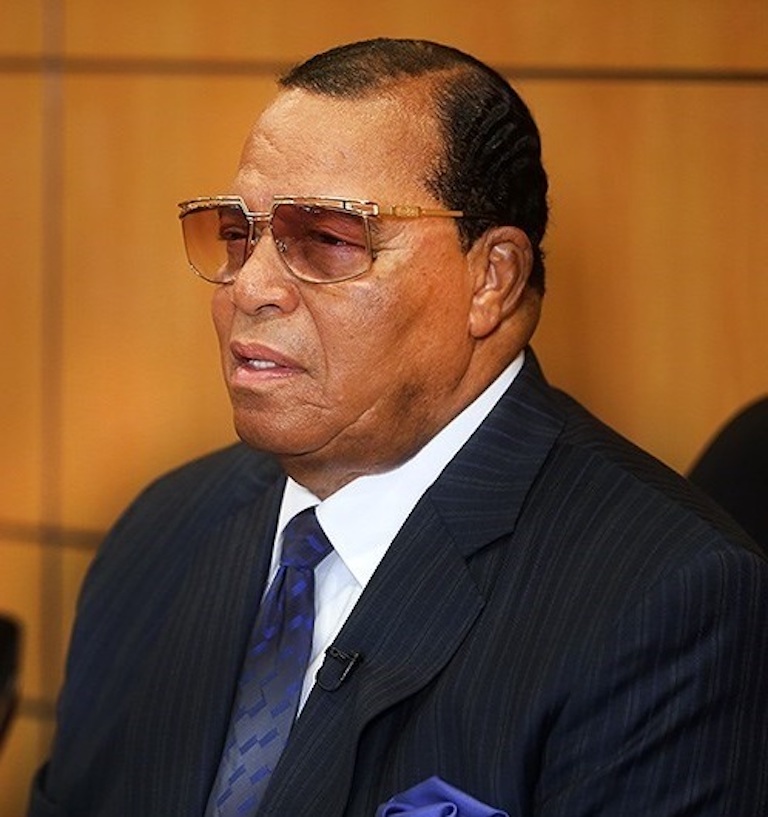
Those who create the magic that is Hollywood are currently confronting a multitude of challenges, from new technologies to mega-mergers to working with partners from cultures far different than our own. Another challenge facing studios, content creators and social media companies is how to navigate the sometimes thin line between freedom of speech and dangerous hate that should not be tolerated. For that reason, some were concerned this week by Netflix’s eleventh-hour decision not to stream a 2013 film about Louis Farrakhan that was produced by his son. That wasn’t the case, however, for us at the Simon Wiesenthal Center.
We are convinced that Netflix did the right thing, and we thank them for doing it. Here’s why.
In 1997, Simon Wiesenthal, the late heroic Nazi hunter, agreed to bestow his name on our new institution with one caveat: You must fight the new haters with the same vigor that I pursue the old ones. For 40 years, we have strived to live up to our end of the deal, as haters have come in and out of the picture. There were aging Nazi criminals and, since the 1978 Skokie March, young (neo) Nazis. There was state-sponsored anti-Semitism from the now-defunct Soviet Union, and genocidal anti-Semitism from today’s Ayatollahs in Iran. And, in the 1980s, bigots spread their message by putting flyers under windshield wipers, while bigots today do so via social media.
Over the years, one man, the “honorable” Rev. Farrakhan, has never deviated from his hate. In 1985, his full-blown demagogic attack at the Forum, before a roaring crowd of 14,000, led Hollywood icon and founding Simon Wiesenthal Center Board member, Frank Sinatra, to express his concerns to us about Farrakhan’s bigotry and urge us to “keep fighting!”
Throughout the decades, the Center protested Farrakhan’s attacks against Jews, Judaism, gays and immigrants. We also placed him on our Top 10 Anti-Semites List and released a study that debunked his Big-Lie that Jews played a central role in slave trade in the 19th century. But Rev. Farrakhan’s charisma and message of Black empowerment has caused some to overlook his decades-long anti-Semitic and homophobic demagoguery.
Here, in his own words from 1984 to 2018, is the real Louis Farrakhan.
In 1984, Farrakhan labeled Judaism a “gutter religion,” later insisting that he meant to say “dirty religion.” That same year, Farrakhan repeatedly called Hitler “a great man”: “[T]he Jews don’t like Farrakhan, so they call me Hitler. Well, that’s a good name. Hitler was a very great man. He wasn’t a great man for me as a black person, but he was a great German. Now, I’m not proud of Hitler’s evils against Jewish people, but that’s a matter of record. He raised Germany up from nothing. Well, in a sense you could say there’s a similarity in that we are raising our people up from nothing.” (Source: Southern Poverty Law Center)
In 1985, before a crowd of 20,000 people at Madison Square Garden, Farrakhan threatened Jews, stating that if any harm befell him, “All of you will be killed outright!,” and adding, “You cannot say ‘Never again’ to God because when he puts you in the oven, never again don’t mean a damn thing.’’
That same year, while speaking at the Los Angeles Forum before 14,000 people, Farrakhan denounced Israel as a “wicked hypocrisy” and then taunted, “Don’t push your six million down our throats when we lost 100 million (to slavery).” In his divisive speech, he also mocked and derided Los Angeles’ first African American mayor, Tom Bradley, a moderate political leader and a symbol of tolerance and inclusion.
In 1996, in a Saviours’ Day speech in Chicago, Farrakhan addressed Jews: “You are wicked deceivers of the American people. You have sucked their blood. You are not real Jews, those of you that are not real Jews. You are the synagogue of Satan, and you have wrapped your tentacles around the U.S. government, and you are deceiving and sending this nation to hell.”
A decade later, at the same gathering, he said: “These false Jews promote the filth of Hollywood that is seeding the American people and the people of the world and bringing you down in moral strength. … It’s the wicked Jews, the false Jews, that are promoting lesbianism, homosexuality. It’s the wicked Jews, false Jews, that make it a crime for you to preach the word of God, then they call you homophobic!”
And six years later, once again in Chicago on Saviours’ Day, he asserted: “In 100 years, they control movies, television, recording, publishing, commerce, radio, they own it all. Magazines. Why do you want all, everything?”
That same year, as part of his Holy Day of Atonement Keynote Address in Chicago, he spewed, “Now, you know I’m going to be lambasted and called anti-Semitic… They’ll say Farrakhan was up to his old canards; he said Jews control Hollywood. Well, they said it themselves! Jews control the media. They said it themselves! Jews and some gentiles control the banking industry, international banks. They do! In Washington, right next to the Holocaust Museum, is the Federal Reserve, where they print the money. Is that an accident?”
A year later, he was at it again, stating, as part of his lecture series The Time and What Must Be Done, Part 20: Making Satan Known, “The Jewish media has normalized sexual degeneracy, profanity and all kinds of sin.”
This year, Twitter temporarily removed Farrakhan from its platform after a speech in which he claimed, the Jerusalem Postreported, that Hollywood’s Jews have forced aspiring actors into anal sex to get parts, and that former president Barack Obama was under “under Jewish influence” when he advocated for same-sex marriage, something which he deemed “Satanic.” The 85-year-old asked a cheering audience, “I wonder, will you recognize Satan? I wonder if you will see the satanic Jew and the synagogue of Satan… because Satan has deceived the whole world.”
Also this year, he launched a new anti-Semitic attack in Chicago: “Jews were responsible for all of this filth and degenerate behavior that Hollywood is putting out, turning men into women and women into men… White folks are going down. And Satan is going down. And Farrakhan, by God’s grace, has pulled a cover off of that Satanic Jew, and I’m here to say your time is up, your world is through.”
Anti-Semitism and bigotry are more widespread today than they have been at any time since the Holocaust some 75 years ago. This is in large part thanks to demagogues like Louis Farrakhan. Netflix should be applauded for not availing its immense platform to America’s foremost merchant of hate.
Rabbi Marvin Hier is the founder and dean of the Simon Wiesenthal Center, a two-time Academy Award winner and the only Rabbi who is a member of the Academy of Motion Pictures Arts & Sciences. Rabbi Abraham Cooper is the associate dean of the Simon Wiesenthal Center.
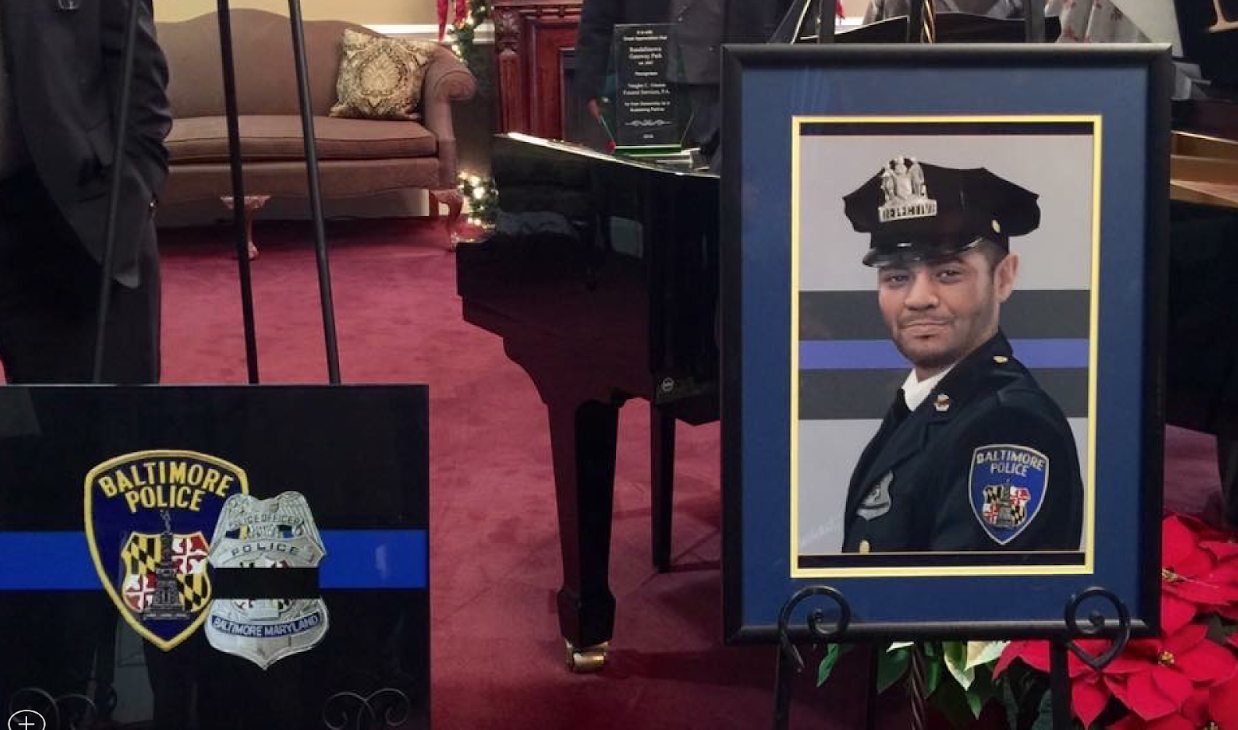
This multi-article series revisits the available evidence and reporting around the shooting death of Homicide Detective Sean Suiter on November 15, 2017, adding analysis and some new information to the conversation so far. This information is provided in advance of the findings of an independent panel, commissioned by the department, that has promised insights and recommendations.
This first article looks at the trajectory of Commissioner Kevin Davis in his handling of this case in media and similar cases in the past. Part 2 deconstructs the reported timeline of events, comparing it to police audio records. Part 3 considers the ballistics discoveries and evidence. Part 4 looks at the emergence of the suicide and other theories, as well as the role of the federal government. The Addendum looks at the video evidence, released with the findings from an Independent Review Board. The Conclusion enhances the audio and video further and arrives at a homicide conclusion.
Theories as Evidence
In recent months, conversations among people in Baltimore who are interested in policing usually include the question, “How do you think Sean Suiter died?” The options are typically homicide or suicide – and, if homicide, then either by stranger or by fellow police officer. Differences in opinion have been somewhat divided by individual histories with the Baltimore Police Department (BPD) and/or Detective Suiter himself.
With some exceptions, by March, most people have been drawing conclusions based on the same small, fragmented set of second-hand information. As noted in previous articles in this series, that information has some gaps and inconsistencies and might not always come from the most reliable narrators. Still, opinions on this case are often deeply held. This article will examine the prominent theories of Suiter’s death as evidence themselves. One goal will be to show that when and how a theory was shared can be as helpful in evaluating it as the reported evidence to support it.
“All of the pieces”
On November 22nd, Commissioner Kevin Davis laid out his full theory of Suiter’s shooting death – by a stranger in a spontaneous interaction, he believed. He introduced for the first time a pile of new evidence to support it, including Suiter’s radio transmission, the security camera footage, body worn camera footage, ballistics findings, and more.
Davis also had something else to share that day, the news that Suiter was scheduled to testify in a Gun Trace Task Force (GTTF) grand jury the day after he was shot, which the commissioner said was unrelated to the detective’s death. That pile of new evidence, it seems, served another purpose than just transparency. It helped to minimize the importance of the grand jury information.
Davis shared his theory on the 22nd with a high degree of rhetorical confidence. “We now know,” he repeated. “We know this,” he declared. “Every information we do have makes it clear,” he insisted about his theory, dismissing alternatives. One week later, the commissioner struck a different tone. On December 1st, he requested the FBI to take over the case, repeating that he was “uncomfortable” not “having all of the pieces to the puzzle.” He now suggested that any theory was “possible” and the entire case needed a reset.
What happened in just one week to weaken Davis’ confidence so dramatically? He pointed to the news of the day before: on November 30th, the U.S. Attorney’s Office (USAO) filed an indictment against GTTF Sergeant Wayne Jenkins for the case in which Suiter was scheduled to testify. The commissioner said repeatedly that the GTTF case was irrelevant to Suiter’s death. But as soon as the relevant GTTF indictment was filed, his tone shifted 180 degrees, and he tried to get the Suiter case out of his hands. Before anyone had a chance to analyze what was going on with Davis, another theory was making headlines.
“A great personal tragedy”
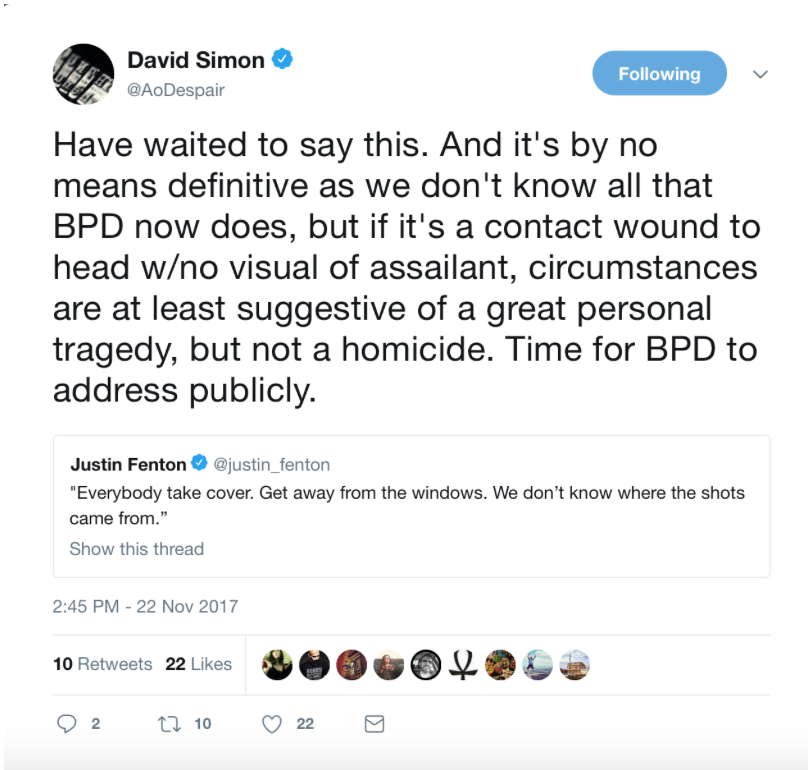
The first prominent public suggestion that Suiter took his own life actually came from David Simon, of “The Wire” fame:
Some of Simon’s followers expressed doubts: What about the fact that a witness reported hearing several gunshots in a row? “About 20-30 percent of gunshot suicides have multiple shots,” he responded, a result of “test fires” and “getting-up-nerve rounds.” The suicide discussion continued on social media before it broke into mainstream news. It was prominent among a group of retired cops and other Baltimore insiders, who dub themselves the “peanut gallery.”
This discussion emerged online just as it became publicly known that Suiter was scheduled to speak to the federal government, which some took as a motive for suicide. Any cover-up could have been an effort to protect the integrity and family benefits of a husband and father of five. The news also provided fuel for the theory that another cop killed him. Suiter’s shooting took place in a vacant lot on a two-block street with many vacant homes and no CCTV cameras. It was an ideal location to get away with something.
Some suicide theorists cited the story of Joe Gliniewicz, an Illinois officer, who police determined had staged his suicide to look like a homicide in 2015. Unlike Suiter, Gliniewicz was alone at the time. Gliniewicz had radioed that he was pursuing three suspects before he killed himself. It turned out that he had been embezzling money from a youth mentorship program.
Seth Stoughton, law professor at the University of South Carolina, policing expert, and former police officer, says that police suicides are “not uncommon,” but “very, very few of them happen on duty.” He discusses how the comparison of Suiter to Gliniewicz may be a result of the “availability heuristic”: “We estimate the frequency of something based on our awareness of it. If we have a recent example, we say it must have matched that pattern. When it’s not actually a pattern.”
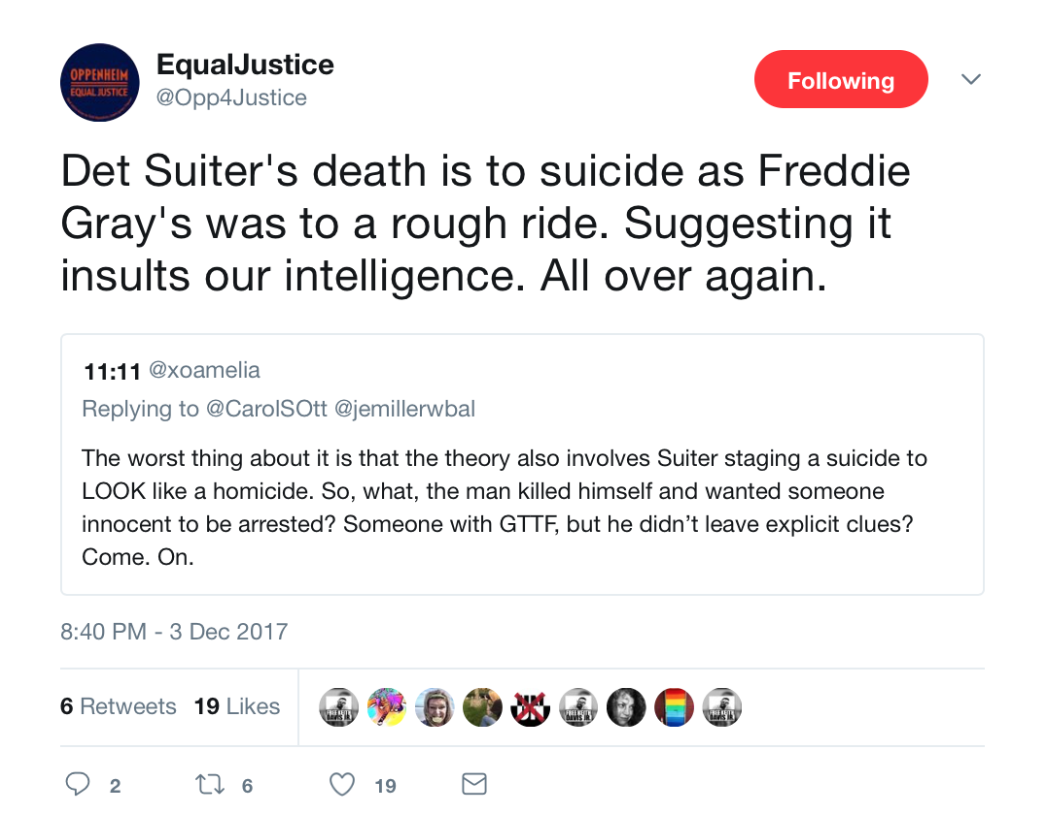
For many observers, the suicide theory seemed to emerge out of nowhere, with not much to support it beyond the certainty of insiders. It reminded some of a similar BPD story that also once came out of nowhere as a handy explainer:
To others, the suicide theory blew the whistle on the BPD establishment and its fairytale about the stranger assassin. It was their “Occam’s Razor,” or most obvious conclusion, and it was supported by some key evidence: ballistics determined Suiter was shot by his own gun; the gunshot wound was “close contact,” which is far more common in suicide; and there was no forensic evidence of another person at the scene, beyond other officers.
The truth is that the suicide theory came from within BPD ranks from very early on, was leaked in part by high-ranking officials, became mainstream headline news, and has greatly impacted the investigation. Plausible or not, the suicide theory was never an anti-establishment position.
“Two competing theories”
The Associated Press was the first to publish an article on the suicide theory, on November 29th, in the context of “armchair speculation” in Baltimore. The article discussed the possibility of a suicide staged as a murder.
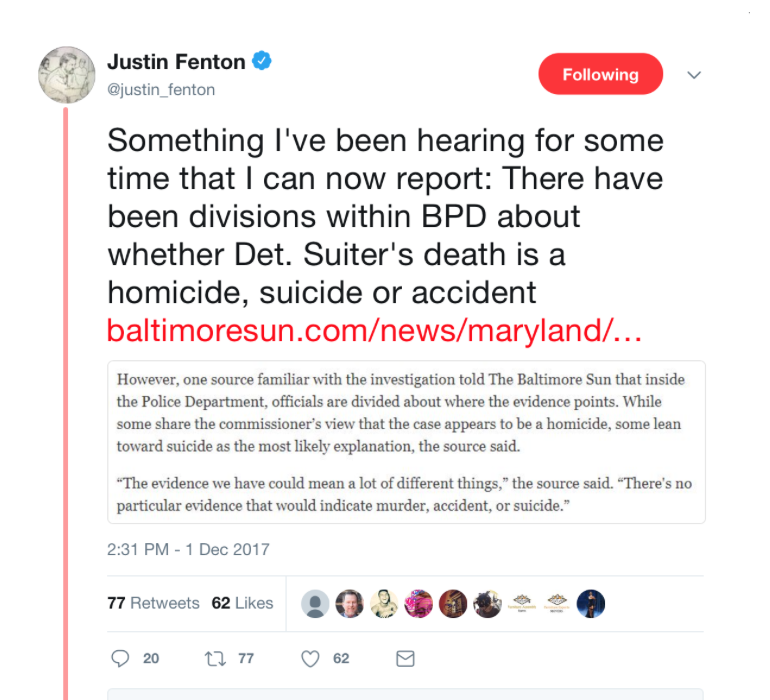
Soon after, the theory was pushed into the center by a few local crime reporters. On December 1st, the Baltimore Sun’s Justin Fenton expressed that he could finally discuss this topic:
The “accident” theory did not become a discussion point outside of this tweet. Fenton’s article here refers to the December 1st press conference, during which Davis was pressed to discuss suicide:
Jayne Miller (WBAL): We’re all aware that there are elements of this investigation that, as you said, you used the word “complicated.” There is some physical evidence in this case that obviously would suggest the possibility of a self-inflicted wound. Can you comment on that angle and element of this investigation?
Davis: Well, Jayne, I’ve said from the very, very beginning that we will follow the evidence wherever the evidence goes. As we continue to examine the evidence, we come up against probabilities and possibilities. We are not going to discount any possibility whatsoever. I would add to that that we have physical evidence that suggests a struggle… So the possibility of what you spoke of, Jayne, is something that we’re not discounting. If the evidence leads us in that direction, we’ll go there.
Reporter (unidentified): I think this a yes or no question but you might find it otherwise: Is suicide a theory that your detectives are pursuing? Is that one of the theories that you are pursuing?
Davis: So I appreciate you giving me an out to not answer that yes or no. The evidence suggests where we go. So there are probabilities and possibilities. Anytime we have an investigation like this we have to examine every possibility, and we go down that road. But based on our evidence and based on the investigation that pursues that particular possibility, there is no evidence that that was probable…There is no evidence whatsoever right now that leads us to suspect that that is something that we have…
Miller: Some would say that one theory that out of due diligence you were pursuing but it’s not your lead theory.
Davis: It’s not the lead theory, but we’re pursuing it.
From “no evidence whatsoever” to “we’re pursuing it” is quite a journey. Taken out of context, “we’re pursuing it” made it sound like suicide was a leading BPD theory. It was enough for Fenton to tweet “I can now report” on this theory and for every BaltimoreSun article that followed about Suiter to mention suicide as a BPD investigative priority. As Fenton’s colleague Kevin Rector wrote a few days later, “More recently, police revealed that they also have been investigating a theory that Suiter’s death was the result of a suicide. The department’s investigators are divided over the two theories.” The BaltimoreSun also did an entire article on what Suiter’s family stood to lose if his case was proven to be a suicide.
Davis never said anything like “we’re pursuing it” about suicide again. He had held a hero’s funeral for Suiter and locked down a neighborhood on a manhunt, after all. Still, he made very little effort to shut down the conversation.
“From the very moment this happened”
Like Fenton and Rector, WBAL’s Jayne Miller brought the “split theories between homicide and suicide” to the center in headlines, stories, and several podcast and radio appearances. She focused on the “physical evidence” to support it. In a conversation with The Real News, on December 11th, she said,
I do know that from the very moment this happened, there was evidence and features of [suicide] – a gunshot wound to the head, at close range, the gun right there. And now we know there were no fingerprints or DNA to indicate a second person on the gun.
WBAL’s Jayne Miller, speaking with the Real News
Miller describes a scenario that looks like a suicide from the “very moment” it happened. Contacted for this article, Miller explained one reason why:
His gun was under his body. He collapsed on his own gun. Just based on my own experience, I was asking about self-inflicted very early on, because anytime you have a shooting scene and the gun is arm’s length, then you ask that question. That is often the case of someone who [has committed] suicide. Does that rule out anything else? Absolutely not.
According to Carl Leisinger III, fourteen-year ballistics expert, “A gun under a body really is not indicative of anything.” Former NYPD ballistics trainer James Gannola agreed: “In my experience, both as a police officer and an examiner,” Gannola said, “it makes little sense as to where the firearm ends up.” Suicides are especially hard to judge by gun location, he noted:
A person committing suicide has no control over their hands once the act is performed. Usually the grip on an item is lost, arms can flail, bodies can land randomly and the gun’s location can be unexplained. It’s not unusual.
Stephen Betzer, PhD. forensic scientist, also confirmed this opinion: “A gun being underneath his body doesn’t necessarily tell me anything. He could fall on it, it could be placed under him.” A murderer could also have dropped the gun under Suiter before he fell.
Some officers perceived the crime scene to look like a suicide prematurely, before the autopsy, crime scene investigation, ballistics examinations, witness interviews, or video and dispatch analysis were completed. If Suiter was staging his suicide to look like a homicide, then, for a long-time homicide detective, he failed. His theoretical suicide looked to many like a suicide, from the “very moment” he was found. The reverse has not been discussed – a homicide staged to look like a suicide – even though that is both more common and commonly under-investigated.
Then again, not every report has provided the same description of the crime scene. The BaltimoreSun stated that, according to suicide theorists, “the circumstances don’t look like a suicide because it needed to appear that he was killed in the line of duty.” So the crime scene either looked like a suicide or a homicide but both could indicate a suicide?
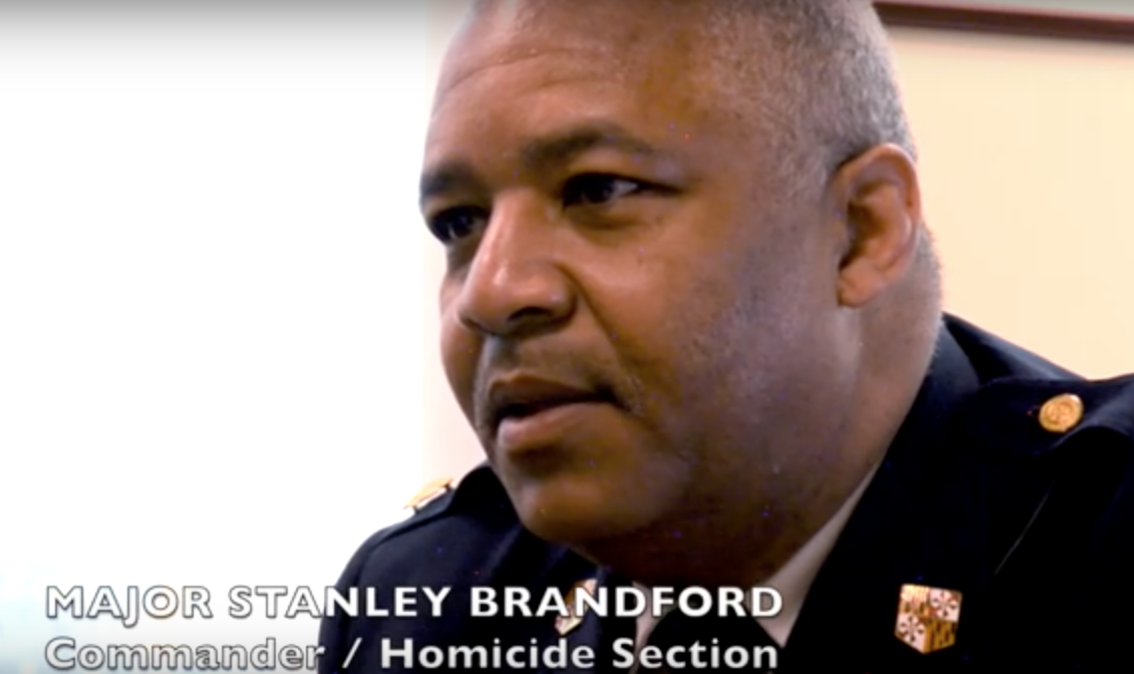
One of the leading proponents of the suicide theory was Stanley Brandford, then-Chief of the Criminal Investigations Division, a number three position in BPD. In 2015, he headed up the Freddie Gray task force, discussed earlier in this series. He was given a glowing profile by the Baltimore Sun in that role.
That Brandford was promoting the suicide theory has been confirmed by several sources, including current and former BPD detectives and criminal justice professionals. Some of them described conversations in which the chief told them that the gun found under Suiter’s body was suggestive of suicide, which experts dispute. Brandford was previously BPD’s Chief of Homicide. Just before Suiter’s death, Brandford launched a campaign for for Baltimore City Sheriff. He went on leave in mid-December to focus on the election. (Brandford could not be reached for comment.)
One voice came out early on against the suicide theory. Sherman Basil was Suiter’s uncle and raised him as a father figure. He gave an interview with the Daily Mail on December 12th saying that Suiter “would never have committed suicide, absolutely not,” citing his happy disposition, loving family, and bravery. He also gave the first indication of the bullet’s trajectory, before it was made public in March: “How would he have shot himself in the back of the head? He would have had to have had one hell of an arm to do that.”
The next day, WBAL’s Miller reported, “Suiter was shot once in the head, at close range, with his own gun. Sources describe a mostly side-to-side trajectory.” A side-to-side gunshot wound is much more common in suicide than homicide. This was the first and only time Miller reported what her sources said about trajectory, so it seemed like a direct response to Suiter’s uncle’s claims. (The trajectory was later reported as diagonal.)
Miller was also the only journalist to suggest anything negative about Suiter’s disposition. In February, she reported, “Police sources told the 11 News I-Team that shortly before Suiter’s death, there was concern that he seemed distraught about his pending appearance before the grand jury.” No other reporting indicated that anyone knew about the testimony. U.S. Attorney Stephen Schenning said his office hadn’t spoken to Suiter yet and that he was not a target of the investigation. Davis mentioned that nothing concerning was found on his “devices” to suggest a suicidal mindset.
I asked Miller if she had also heard reports that Suiter was not distraught. “I talked to many different people about that case,” she said. “I was getting many different opinions about his demeanor.” In terms of her choice to not report that other view, she responded,
I think that’s implicit. Commissioner Davis had said on repeated occasions publicly that there was no indication that he was contemplating suicide. This was not the leading theory. That was already in the public realm.
Miller has continued to report in a manner that is more supportive of suicide over other theories. On July 31st, she reported, “To date, physical evidence in the case leans to the theory that Suiter killed himself, according to information released and from sources familiar with the case.” Like Fenton and Rector, Miller has provided no description of her sources’ department, rank, or proximity to the case, making it impossible for the public to judge their access or motivation.
“Linked in federal case with indicted officers”
Two pieces of information came out about Suiter that gave mileage to the suicide theory. On December 18th, Umar Burley – a victim of the 2010 case involving Jenkins planting drugs – was finally exonerated after serving seven years in prison. In the indictment, a witness described Suiter as “clueless,” an unwitting stooge to Jenkins’ orchestrations.
After he was exonerated, Burley told a different story. His attorney said that Suiter was “driving the car that hit him and coming out of the car in a mask.” If true, Burley’s statement suggests that the federal indictment was false, and vice versa. The federal indictment was apparently sourced by two officers that were a part of that operation, including Jenkins.
After this, media reports began hinting at Suiter having a dark side. Articles emphasized his history working with GTTF officers during 2008-9, before he transferred out of their unit. WBFF reported a story headlined, “Detective Suiter and drug kingpin linked in federal case with indicted officers.” The story makes insinuations about Suiter’s guilt, but the actual content of the story is about how Suiter once arrested a drug dealer and nothing more.
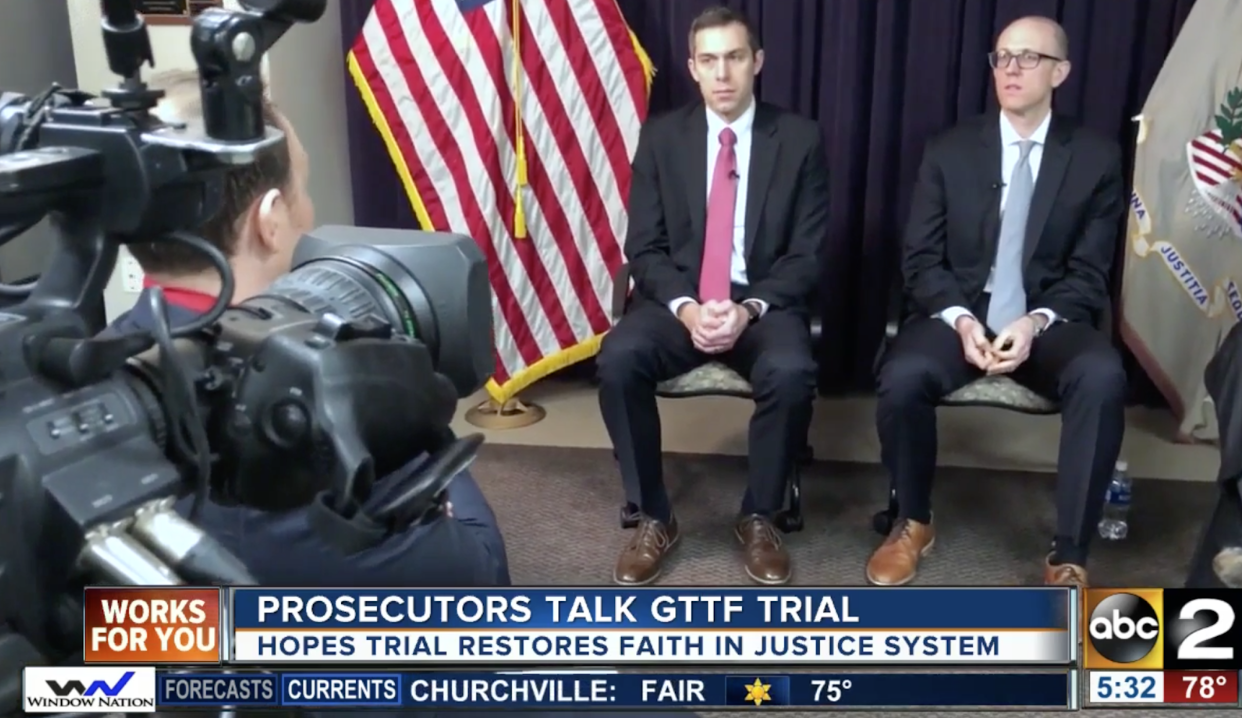
Then, in February, Momodu Gondo, a GTTF officer who pleaded guilty, named Suiter among many other officers as guilty in the department. He said that Suiter had split stolen money in 2008. Assistant U.S. Attorneys Derek Hines and Leo Wise gave an interview with WMAR after the trial. They were asked about Gondo’s testimony. Wise took a long pause, then answered, “Sometimes there’s a misunderstanding… that we vouch for witnesses. We don’t vouch for witnesses. Witnesses testify under oath and it’s ultimately up to the jury to determine what they believe or not.”
These two GTTF stories provided suicide theorists with possible motive, a guilty conscience and/or fear of being exposed.
Some of the reported forensic evidence in Suiter’s case is statistically more consistent with suicide, such as a close contact wound. But the theory was largely shared via anonymous sources, assumptions, and insinuation. Meanwhile, there were no related media pieces taking the issue of suicide and mental health among police officers seriously.
“Largely dismissed”
That Detective Suiter took his own life is some people’s Occam’s Razor, but so is the idea that he was killed by someone concerned about his testimony the next day. Statistically, these “conspiracy theorists” may have a point. Only five other police officers have been shot dead in Baltimore in the last twenty years – one accidentally by another officer and none with their own weapons. Over one hundred officers kill themselves annually in the U.S., but almost never on duty.
On the other hand, the killing or harming of witnesses happens in Baltimore frequently. It is such an aspect of city crime that it was included in the pilot episode of “The Wire.” It even happened to a Baltimore police officer, in retaliation for his testimony.
The conspiracy, or targeted hit, theory received almost no consideration by officials or mainstream news. The Baltimore Sun’s Rector referred to the idea as “another theory, largely dismissed internally but repeated often by police reform activists.” Rector and Fenton wrote that investigators had “dismissed the idea,” because it “clashe[d] with the evidence.” Around half of their sources believed that Suiter was killed by a stranger that surprised him. That wouldn’t rule out a plan to have him killed at that moment.
Davis said that Suiter “didn’t telegraph his presence on Bennett Place” to a would-be assassin, but Fenton brought up evidence to the contrary. He asked Davis, “I understand it was planned a week earlier, that he entered into Lotus Notes that he was planning to go out there.” Either way, Suiter and Bomenka were at Bennett Place for at least twenty minutes, we were told, so someone could have known.
The resistance among local reporters to even asking questions about a possible hit is more striking given what emerged about GTTF during the trial in February – what Fenton called “the biggest corruption scandal to hit the department.” Several officers, victims, and others testified in detail about the squad members’ history of criminal and sociopathic behavior, including a cavalier attitude towards human life, some of it caught on tape. Sergeant Jenkins was shown to be especially paranoid, intimidating cops, witnesses, and even a prosecutor. The trials revealed the squad’s network of criminal associates outside of the force and crossing state lines. Also, squad members got in, and caused, a lot of car accidents.
Sergeant Wayne Jenkins, conducting an arrest in plainclothes
Jenkins was in prison when Suiter died, but he had not yet accepted any kind of a plea deal. Others were named in the 2010 case that could’ve been affected by Suiter’s testimony, and others might have been affected by him talking to the FBI at all. There is no evidence at all to support these hypotheses, but, according to Davis, no evidence was pursued by BPD. Suiter’s witness status was not an official consideration, even though his death was ruled a homicide.
“Additional targets”
There was one prominent group that did seem to be concerned about a possible police-related hit on Suiter: the federal government. In early January, federal prosecutors filed a motion requesting limits on information shared with incarcerated GTTF defendants to protect the safety of “witnesses and their families,” including police. As reported in the Batlimore Sun, U.S. Attorney Derek Hines wrote,
The Government believes that the defendants in this case are capable of committing acts of violence and may retaliate against witnesses after learning their identities, or provide documents to non-incarcerated individuals who will commit acts of violence on their behalf… Disclosure of this information will thwart the investigation because it could tip off additional targets of the investigation, lead to the destruction of evidence, and cause safety issues for multiple law enforcement and non-law enforcement witnesses.
In the same January filing, Hines explained that their GTTF investigation “includes an investigation of corruption in the Baltimore Police Department,” with “additional targets,” and that “multiple law enforcement officers and former law enforcement officers” had shared information with them.
We don’t know how far and wide the FBI’s investigation into BPD corruption has gone. Several BPD officers were named in court, including then-Deputy Dean Palmere, Davis’ number two, who had overseen GTTF and and had a longtime friendship with Jenkins. Palmere retired the same day he was mentioned as a conspirator. The former head of Internal Affairs, Ian Dombrowski, was also named. Under their watch, complaints against GTTF officers had routinely been dismissed.
It’s not outrageous to assume that federal agents were also paying attention to Davis and perhaps his handling of Suiter. The next commissioner to take over, Darryl DeSousa, was indicted by the same federal team three months into his tenure.
When Davis asked the FBI to take over the investigation, he focused on the “perception or reality” that BPD didn’t have all of the information about the case. He did not mention the conflict of interest inherent in a department under federal investigation overseeing a case involving that investigation’s dead witness.
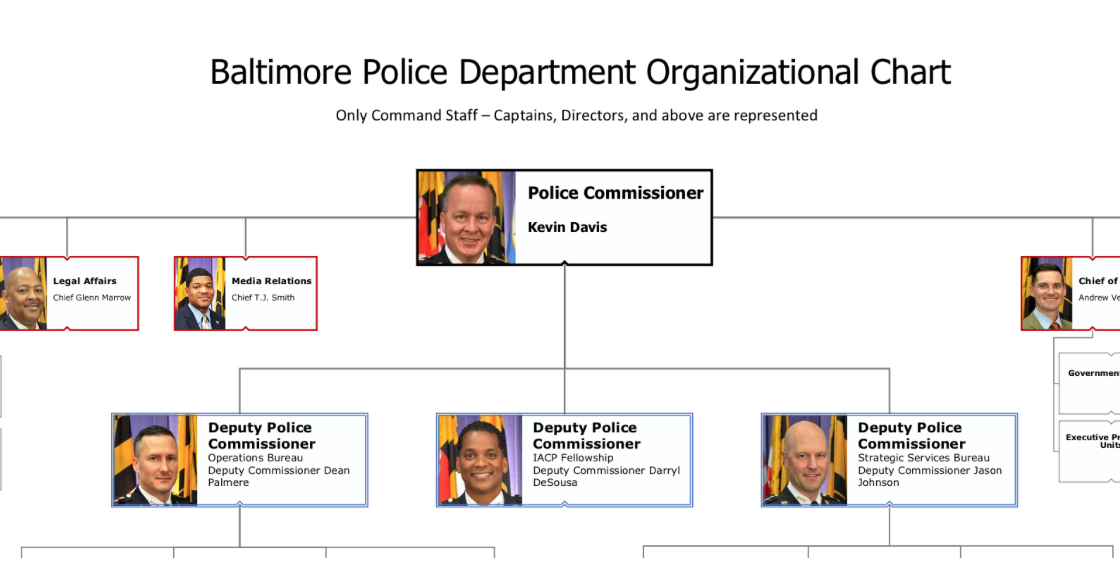
BPD command, 2017. None of the top four leaders are still with the agency.
The FBI took almost a month to answer Davis’ request to take over the Suiter investigation, during which time almost every local and state official and the entire Maryland Congressional Delegation publicly begged them to take the lead. They only issued one statement during this time about the request: “We are aware” of it.
To be sure, the FBI and USAO’s terse statements and decisions around this case are challenging to interpret.
Davis took advantage of that. On December 27th, the commissioner read aloud the letter he received from the FBI denying his request. It said: “As stated in your letter, to date, no information has been developed to indicate Suiter’s death was directly connected to an FBI investigation.” Davis interpreted that statement as proof that the FBI didn’t find the targeted hit theory plausible:
I suspected all along that if the FBI thought the death of Sean Suiter was related to an ongoing corruption investigation that they would not only take on this case in a heartbeat but they would come to Baltimore with unprecedented resources to get to the bottom of a murder of a cop, particularly if the murder of a cop had to do with pending witness testimony. They again don’t feel right now that it has anything to do with that pending testimony… I feel better about that aspect of the case… I know more now than I did before I got this letter.
Yet, the FBI’s letter didn’t actually say that they had made any determination about Suiter’s death. How could they? They only parroted back what Davis had said about there not being any evidence of it “to date.” Still, some reporters followed Davis’ interpretation. WBAL’s Miller said, “That means at this time, the FBI does not see any link between his role as a federal witness and his death.”
Davis used the FBI’s statement to aggressively divert public attention away from Suiter’s death being a possible police-related hit, as he had several times before. Those choices could be considered evidence. It was Davis’ last media campaign in Baltimore, and it succeeded. Most reporters did not ask any questions about Suiter’s death outside of the framework of the “two competing theories.”
“Fresh set of eyes”
In April, Baltimore’s then-commissioner, Darryl De Sousa, announced an Independent Review Board (IRB) panel to take over the Sean Suiter case, stating that BPD Homicide should never have been given it in the first place. De Sousa promised a “fresh set of eyes,” “closure,” and “findings” from the panel. “Those two theories out there,” he said, “I hope it dispels one or the other.”
In July, the IRB announced that they would have findings soon but stated that only the Medical Examiner has the authority to issue an official manner of death. For their own report, the IRB announced it would hold a vote to determine which of four theories they believed was true.
There may be no more emblematic culmination to this investigation. The future of a widow and her five children – and the status of another one of Baltimore’s open wounds – will be subject to a majority opinion. In the meantime, the IRB report should be able to give some more information about what actually happened on the afternoon of November 15th, 2017. Currently, there are between two to four theories and very few independently verified facts.
Science and Religion. The ultimate standoff. It’s hard to imagine two more dichotomous extremes, right? Well, maybe not. Maybe these age old rivals have much more in common than we have been led to believe. Maybe the mythologies that make up religion have nestled in them some deeper truths. Maybe science is a mythology of its own.
Do the two not ultimately attempt to answer the same underlying questions: How was the universe created? How did life on earth begin? How does our consciousness work? What is morality?
Regardless of your personal beliefs, it’s hard to deny that both Science and Religion are extremely captivating.
But whereas the mythologies of religion have been refined to perfection, its stories inducted into sacred canons, crafted into bestsellers, science has been left to the scientists. The mythologies of science have been and are still being written in dry, technical, unapproachable language bereft of any poetic prose that will both enchant the reader and do justice to the vast knowledge scientists possess in 2018.
This ambitious mission is exactly what it seems Dr. Oren Harman took upon himself to accomplish in his new book, “Evolutions: 15 Myths that Explain our World” .
Dr. Harman is a professor in Bar Ilan University, where he’s the Chair of the Graduate Program in Science, Technology and Society. He studied in Harvard and received his PhD with distinction from Oxford University. His fields of expertise include the history and philosophy of biology, the theory of evolution, the evolution of altruism, the cultural history of science and more.
Harman’s work featured in Science, Nature, the New York Times, The Economist and many other honorable platforms.
Prof. Oren Harman joins 2NJB today to talk about his very own mythology of science.