fbpx

August 3, 2018

Teens Portray Survivors in ‘Voices of History’

Admittedly nervous, 16-year-old Eli Susman sat on the steps outside the Wallis Annenberg Center for the Performing Arts in Beverly Hills and ate shawarma — his preshow dinner. With minimal acting experience, Susman was tasked with portraying local 91-year-old Holocaust survivor Phil Raucher. 

When the stage lights shone down on Susman, stoic and dressed in all black, he pantomimed the digging of a grave inside a German labor camp. “I had to bury my own father,” he cried out to the dark abyss of seats. Even though he couldn’t see him, Susman knew the real-life Raucher, who actually had to bury his own father while detained at a German labor camp over 75 years ago, was watching him.  

Susman, together with seven other teens ranging in age from 13 to 18, took the stage on July 25 in the culminating performance of the Los Angeles Museum of the Holocaust (LAMOTH) “Voices of History” program. During the two-week theater workshop, participants wrote and starred in a pair of plays based on the wartime experiences of Raucher and a fellow survivor, 79-year-old Lea Radziner. 

“At first, the idea of playing [Raucher] with him sitting there [in the audience] was intimidating,” Susman said. “But once I started getting into it, I was really able to embrace the role and look past that.” 

During the workshop, the teens took part in acting exercises, played improv games, listened to the stories of the two survivors and then crafted a two-act play under the guidance of their director, Anne Noble, a professional playwright, actor and arts educator hired by LAMOTH. 

Chloe Victoria, 18, is a trained actor who will be studying theater in college this fall and was one of the program’s non-Jewish participants. She has long been interested in Holocaust education and was eager to combine it with her love of performing. 

“It was amazing to get to work with people who are as passionate about listening to survivors’ stories as I am,” she said. “I felt a strong connection with them. Together, we felt it was an honor to stage a play and bring the stories to life.”

Radziner also was in the front row at the Wallis to watch her story unfold. She said when LAMOTH asked her to participate in the project, she was reminded of feelings of insecurity about not being perceived as a “real survivor.” As a young child in the early 1940s, Radziner’s parents had her smuggled via the Dutch underground to an adoptive Christian family in the southern part of the Netherlands. She avoided deportation to a concentration camp, a distinction that she said made her story feel “not needed” and “unimportant” for many years. 

“We have a kid playing the 91-year-old survivor at 16. There’s something special about hearing that story come out of the mouth of a 16-year-old.” — Anne Noble

But after seeing the performance with three generations of family by her side, Radziner was overcome with emotion. “I don’t know if I have words to thank the children and to say how much I admire what they did,” she said. “It helps me see the importance of stories like mine continuing to be told in new ways.”

Wallis Director of Education Mark Slavkin told the Journal, “Sharing the stories of these survivors and empowering youth to share these stories is what we’re all about. It has been a terrific collaboration. It has been nothing short of inspiring.”

For her part, Noble found inspiration in seeing a group of young actors of varying performance backgrounds lean on and learn from one another in forming “a true ensemble. I found that it didn’t matter what experience they had because they were telling the stories from their hearts,” she said. “We have a kid playing the 91-year-old survivor at 16. There’s something special about hearing that story come out of the mouth of a 16-year-old.”

Raucher agreed. “I was emotional,” he said. “He [Susman] is the age I was. I’m sure he was able to identify, to think about what he would’ve done in that situation. I think he did a very good job. They all did.”

Teens Portray Survivors in ‘Voices of History’ Read More »

Penka Kouneva Scores With Video Games

Penka Kouneva came to Los Angeles from Bulgaria in 1999 to follow her dream of becoming a film composer. She began her career as the orchestrator for Emmy Award-winning composer Patrick Williams. Later that year, she received her first scoring break with the American Film Institute (AFI) thesis short “Shadows,” a Holocaust-themed film directed by Mitch Levine. 

Today, though, the 51-year-old is best known for scoring video games and virtual reality (VR) films, including  “Prince of Persia” and “The Mummy,” and she is considered a pioneer in those fields by others in the industry.

“I have scored AAA games (an industry term for games with the highest development budgets and levels of promotion), and dozens of mobile and online games,” Kouneva told the Journal via email. 

She’s also been the lead arranger on all Blizzard games, including “World of WarCraft” since 2006, which have grossed billions of dollars worldwide. “I’m the only woman with such credits,” she said.

But her work isn’t just restricted to games. Kouneva also composes for film. Her recent scores have included “Aga” (a Special Selection winner at this year’s Berlin International Film Festival) and Paul Salamoff’s “Encounter,” plus “Midnight Movie” and “Devil’s Whisper.” She also scored the NASA multimedia exhibition “Heroes and Legends” at the Kennedy Space Center in Florida, which was unveiled in 2016. 

“Film is more about storytelling and the music supports the narrative and the emotional arc of a scene,” Kouneva said. “Game scoring is more about creating a world, a colorful, immersive environment where the gamer will transport themselves in a fantasy world for hours.”

In July 2015, Kouneva released her breakthrough orchestral album, “The Woman Astronaut,” inspired by her interest in space. She said that only 11 percent of astronauts are women and just 1 percent of the top 250 feature films made annually are scored by women composers. “Space and astronauts symbolized freedom for me since childhood,” she said.

Born in 1967 in Sofia while Bulgaria was still under Communist rule, Kouneva said, “I did not grow up with bona fide religious tradition but I always gravitated to amazing Jews,” she said. “I found the deepest connections with both men and women who gave me inspiration that influenced my philosophy and values, which helped me reclaim my lost ancestry. Jewish values have always been an instinctual pull for me.”

“The poetic text from the Neilah service touched me so deeply that I immediately decided to incorporate the idea of the closing of the gates into my next album.”  — Penka Kouneva

She discovered her talent for composition at the age of 12, when she had the opportunity to write music for children’s theater. 

“Music spoke to me in images, stories and emotions,” she said. When she was 17, one of her songs won the Grand Prix in Tokyo in a competition for young songwriters. “At that moment. I decided that music [was] my destiny,” she said.

After graduating from the Bulgarian Music Academy, Kouneva attended Duke University in North Carolina on a composition fellowship. In 1997, she made history as Duke’s first ever-recipient of a doctorate in composition. 

In 2003, Kouneva met her husband, Daniel Schweiger, a music editor, and she attended her first Yom Kippur service with him at Steven S. Wise Temple. 

“That service used a poetic text for [the] Neilah [service], which touched me so deeply that I immediately decided to incorporate the idea of the closing of the gates into my next [album],” she said. It also helped her reclaim her Jewish roots, which were stifled under a Communist regime. 

“I see that my entire life journey was driven by longing,” she said. “Longing to uncover what was lost, to learn and embrace it.”

Penka Kouneva Scores With Video Games Read More »

IKAR Becomes ‘Safe Parking’ Partner

Every Angeleno has seen the “tent cities”: homeless encampments under bridges, near parks and freeway entrances, and in long stretches of downtown streets. But what we may not have seen are the more than 15,000 people in Los Angeles who are dangerously close to becoming homeless. 

According to the 2018 Greater Los Angeles Homeless Count, 15,888 people spend nights in their cars, vans or RVs. Now, Safe Parking LA aims to work with community partners to provide a sense of safety for that vulnerable population. 

Last week, the South Robertson neighborhood council approved a bid by Westside spiritual community IKAR to become a Safe Parking LA partner. IKAR will allocate up to 10 spaces for vehicle dwellers in the lot of the property it recently purchased, on La Cienega Boulevard.

“IKAR is committed to living out the core values of our faith, including the belief that all people are created in God’s image, are deserving of dignity and worthy of love,” IKAR Senior Rabbi Sharon Brous said in a statement. The offer of a safe place to park is “a small but meaningful way for us to help our most vulnerable neighbors achieve a more dignified existence,” she added.

Safe Parking LA provides a port-a-potty and arranges for an overnight security guard. Host sites provide parking spaces, electricity, water and Wi-Fi. According to Safe Parking LA founder Dr. Scott Sale, “We welcome everyone.”

Sale started Safe Parking LA as a pilot program at Leo Baeck Temple in West Los Angeles, where he is a member, in April 2017. “Leo Baeck is the founding Jewish institution of Safe Parking,” Sale said.

IKAR will be Safe Parking’s fourth L.A. location. The other locations all opened this year, in Koreatown, at the Department of Veterans Affairs Campus in Westwood and in Hollywood. 

Some potential partners have expressed concern about community safety. But Sale said that participants are carefully vetted over the phone and in person before they are allowed access to a lot. He also invoked Safe Parking’s history in Santa Barbara and San Diego to allay concerns. 

“For the last 15 years, there have been 750,000 nights of safe parking between those two programs without one incident of vandalism,” Sale said. According to the Safe Parking LA website, San Diego had two instances of vandalism, but they were from people outside of the program. 

Sale is speaking with two Valley synagogues and a Hollywood synagogue as potential partners. And the Los Angeles Unified School District and Los Angeles Valley College have approached Sale to talk about the program.

“Offering a safe place to park is a small but meaningful way for us to help our most vulnerable neighbors achieve a more dignified existence.”  — Rabbi Sharon Brous

Before IKAR’s program can start, the requested funding of $100,000 needs to be approved by 5th District L.A. City Council Member Paul Koretz. Safe Parking is listed under Koretz’s homelessness initiatives on his website. Sale said Safe Parking is always working on other sources of funding.

“We’re ready to go,” said Brooke Wirtschafter, IKAR’s director of community organizing. Wirtschafter also spoke about IKAR’s intention “to find connections and build community with the people who take advantage of the program, to find ways to build relationships and engage.”

IKAR Becomes ‘Safe Parking’ Partner Read More »

Remembering a Forgotten Comic Who Died Young

San Francisco. 1966. I’m in the audience watching The Committee, a cutting-edge improv group known for its stinging social and political satire.

The emcee introduces “young rabbinical student, Lawrence P’nay du Cohen.” The audience titters as a skinny, doe-eyed yeshiva bocher walks center stage in frock coat, black hat, payot. The lone discordant note in his outfit are his large cowboy boots, which he nearly trips over. He grabs the mic and squeaks, “Hello, hello” in a nasal whine: “Yoo-hoo, hello-o-o …” It’s hilarious, and he hasn’t even begun his act. 

A guitar and drum play the intro to “These Boots Are Made for Walkin’ ” and “Lawrence” croons in a heavy Yiddish accent: “You keep zayin’ you got zompin for me…” 

“Lawrence” is shy at first, but the spotlight loosens him up. When he gets to the refrain, he’s flailing his skinny arms and stomping his boots. The audience roars its approval. Some are choking with laughter. When he reaches the ending — “Are you ready, boots? Shtart valking!” — we’re standing, clapping, demanding more. So he does the song again. Feeding off our frenzy, “Lawrence” turns sideways so we see his profile. He windmills his arms and goose-steps his long legs. The Yiddishisms -— guttural r’s, eye rolls, feline smiles — become even more pronounced. We’re on the floor, laughing helplessly. He’s done what every comic aspires to do but very rarely does: killed the audience. 

“Lawrence” was actually Christopher (Chris) Ross, a 21-year-old comic actor who was new to The Committee. I was certain I’d witnessed the birth of a star. But I was wrong. Four years later, he was dead. 

Unlike Jim Morrison or Janis Joplin — who also died young — Ross received no posthumous adulation, no biopic, no documentary. From 1966 until his death in 1970, he performed on stage, TV and in movies, but there are scant references to him in showbiz databases and no Wikipedia entry. When he died, no newspaper marked his passing.

But his performance had lodged itself in my mind. So, 48 years after his death, I wanted to find out who Chris Ross was and why he had died so young. My first stop was at the Los Angeles County Registrar-Recorder office in Norwalk, where his  death certificate is on file. The official document says that on May 5, 1970, Ross’ body was found in an apartment in West L.A. Cause of death: “Occlusive coronary artery disease, arteriosclerosis.” A heart attack. 

Unlike Jim Morrison or Janis Joplin — who also died young — Ross received no posthumous adulation, no biopic, no documentary.

I contacted Larry Hankin, Ross’ colleague at The Committee and on a short-lived ABC-TV show called “The Music Scene,” which presented the week’s top songs in a hip manner. At a coffee shop in Marina del Rey, Hankin told me that Ross moved to L.A. to perform on “The Music Scene,” which featured some of The Committee troupe doing sketch comedy. 

“[Ross] was incredibly talented and had a unique take on the world,” Hankin said. “He was smart, had perfect comic timing and he crossed boundaries, personal boundaries. He was always curious.”

“Where [Ross] might have gone, if he had lived, is quite amazing,” said Alan Myerson, who founded and directed The Committee. “Besides worming his way into our hearts, he was also just brilliant. He was complicated, sweet, and had something of a dark side. ‘These Boots Are Made for Walkin’ ’ is an indication of that. [Ross also] did Danny D’Marko, an Italian-American lounge crooner. It was an extraordinary invention. Chris’ choice of material was unique. He did The Beatles’ “I Am the Walrus.”  He’d croon ‘custard running from a dead dog’s eye’ as a love song. This was part of the darkness that Chris had.” 

I sensed that Ross could have been another Robin Williams, someone whose bust-out comedy had no physical or emotional restraints; and also someone who could have been a great actor, thoroughly immersing himself in a character.

The picture, however, was still not clear. So I went to the Bay Area, where his younger brother, Fred, lives. I asked him why his brother was named “Christopher.”

“It’s not a name Jewish parents give their kids,” Fred said. “But my mom loved the [A.A. Milne] character Christopher Robin, who had the qualities she wanted her son to have.”

Fred also revealed that his parents were descended from San Francisco’s earliest Jewish settlers. “Our father, Herb Ross, changed the name from Rosenbaum,” Fred said. “The Rosenbaums came to San Francisco in the 1850s on the SS Tennessee, which ran aground in the fog north of the city, in Marin. All 500 passengers disembarked safely.”

Via public records, Ancestry.com and interviews, Fred discovered that “on my mother’s side, our great-great-great-grandfather was Elkan Cohn, who came out west in 1860 and became rabbi of Temple Emanu-El. He was the first Reform rabbi in San Francisco.”

So Chris Ross, in a sense, really was the yeshiva bocher he portrayed. 

“I was a complete mess after Chris died,” Fred said. “For a year or two I could barely walk out on the street. He was my main teacher and closest friend.” 

What did Fred know about his brother’s death?

“The death certificate was wrong,” he said. “Chris died of a heroin overdose, While he was in L.A. working on ‘The Music Scene,’ he got hepatitis — probably from needle use. So he came up to San Francisco and lived with me for weeks, trying to kick his heroin addiction. I thought it would help him if he did something with his hands, so I had him paint my apartment. But he was too messed up, so he did a terrible job.” 

After Chris died, Fred went to Los Angeles to clear out his brother’s things. There, on the coffee table in plain view, was a small envelope with heroin. “The police hadn’t taken it,” he said.

I thought of the lyrics to “These Boots Are Made for Walkin’ ”:

You keep playin’ where you shouldn’t be playin’,

And you keep thinkin’ that you’ll never get burned …

I also recalled Larry Hankin saying Ross’ curiosity was his strength as a comic actor but it might also have been what led to his early death. 

Myerson had a different view.

“All of us are driven by curiosity,” he said, “but I think Chris was a young, middle-class Jewish kid who wanted to be hipper than he was. Who knows, had he not grown up in San Francisco in the 1960s, he might well have been a yeshiva boy. But he grew up in the 1960s in San Francisco. It was a wonderful but, in certain cases, a dangerous time to grow up.”

Remembering a Forgotten Comic Who Died Young Read More »

Celebrating Tu b’Av With a ‘Potlove’ Dinner

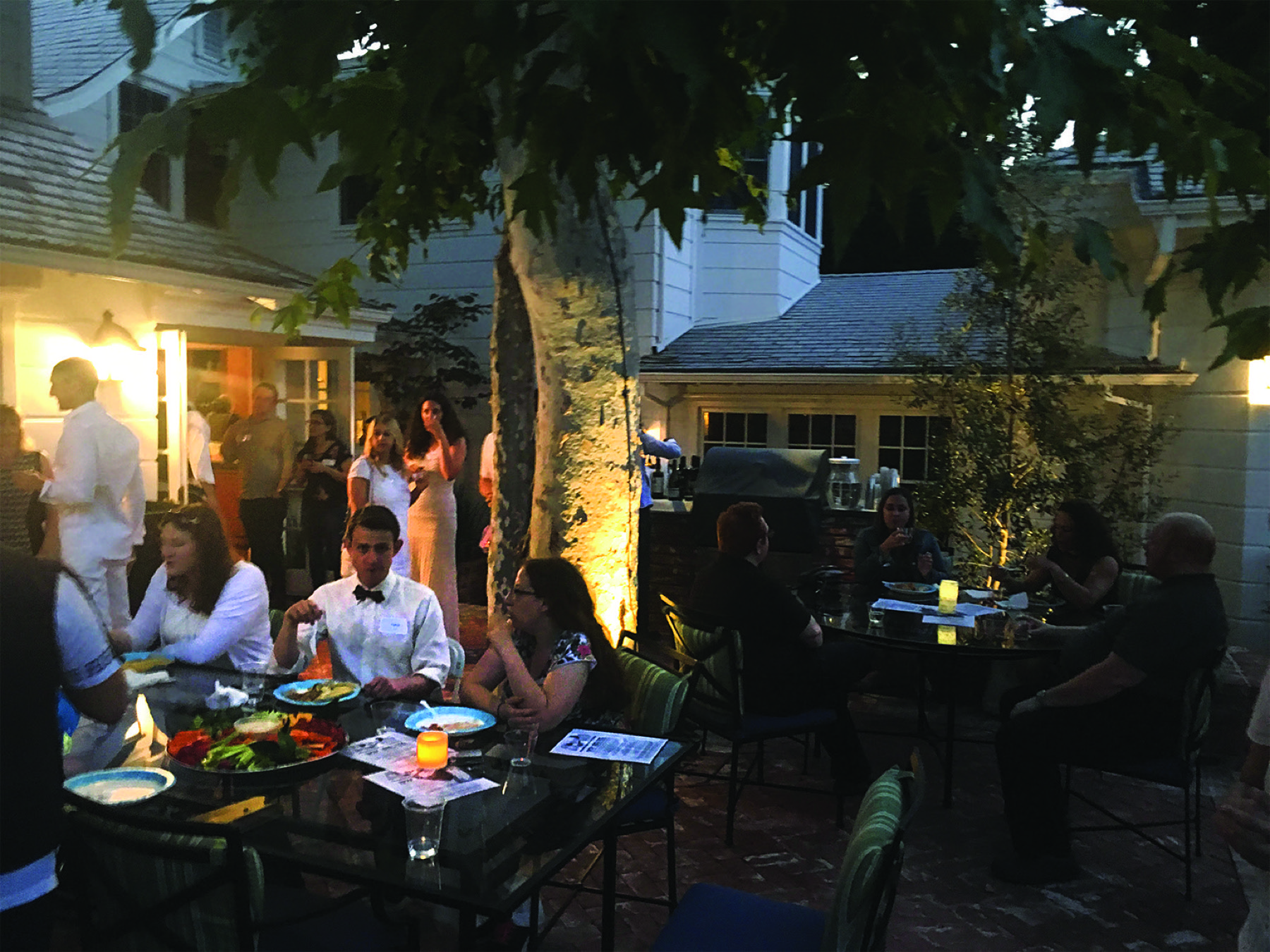
Attendees of Potlove, a Tu b’Av potluck, enjoyed dairy and vegetarian food and wine at a Beverly Hills home. Photo by Ryan Torok

Mindy Bacola is a 33-year-old flight attendant from Hollywood. Always on the go (literally), she rarely has the time to date, let alone have a serious romantic relationship. So last Friday night, she turned out for Potlove, a singles potluck for Jews in their 20s and 30s that took place on Tu b’Av, a minor Jewish holiday akin to Valentine’s Day.

“It’s not just my job. We’re all busy people,” she said, explaining why events like the potluck were necessary. “If I was an attorney, I’d still be busy, wouldn’t I? I think no matter what, it is hard to meet people.”

Bacola was one of approximately 100 young professionals who attended the event held in the backyard of the Beverly Hills home of Sinai Temple Sisterhood Co-President Leslie Wachtel. Atid, the young professionals arm of Sinai Temple, organized the gathering, one of the group’s most popular annual events.

The full moon shone above Wachtel’s pool as many people kicked off their heels and dress shoes and dipped their toes in the heated water. Attendees lined up for dairy dishes and sipped red and white wines and beer. The free event asked for people to bring either an entrée, an appetizer, a dessert or a wine. 

Many dressed in white, which is a tradition on Tu b’Av dating back to the talmudic period, when single women wore white as they ventured into the fields to meet their beshert (soulmate) on Tu b’Av. Women, regardless of their socio-economic background, dressed in simple clothing so that the men would not know what kind of family they came from. 

At the Potlove event, Sinai Temple Millennial Director Matt Baram said that obscuring who comes from wealth and who does not is an idea that resonates in today’s dating scene, which often sees people getting together for the wrong reasons.

The Potlove was just one of several Tu b’Av events that took place over the past week.

On July 26, Pico Shul, an Orthodox congregation for 20- and 30-somethings, held Lovefest, an evening garden party with music and cocktails.

“Everyone is suffering from PTSD from dating by the time they are in their late 20s, and I think that creates a lot of trust issues.” — Matt Baram

Two days later, Young Jewish Professionals held a Saturday night Summer White Party. Rabbi Yigal Rosenberg of Santa Clara brought 50 young Jews from the Bay Area and Silicon Valley to the party. He exposed them to the diversity of the local Jewish community in the hope they would meet eligible bachelors and bachelorettes.

“The Bay Area is very man-heavy, very secular,” Rosenberg said. “There is a lot of intermarriage and a big element of what we want to do is ‘Operation Jewish Babies.’ That’s the name of our game.”

Baram noted the shift in views on marriage these days, which sees people getting married later than ever. He said that by the time many singles reach age 30, they have experienced so many failed relationships that they’re scared of taking the risk of becoming serious with another person. 

“Everyone is suffering from PTSD from dating by the time they are in their late 20s, and I think that creates a lot of trust issues and a lot of different issues that we’re just as a society starting to grapple with and figure out how to deal with,” he said. 

He hoped the Potlove helped singles to break down those barriers and find a way to connect with each other. “That’s really the idea of what we’re trying to do tonight,” he said. “One, create this elevated feeling of people wearing white; and two, a reminder of this idea that when you’re single and meeting people, it is about more than just any one thing — that people are complex and nuanced.”

Celebrating Tu b’Av With a ‘Potlove’ Dinner Read More »

Friend Organizes Talk in Memory of Suicide Victim

By all accounts, Benjamin Beezy was an outstanding and accomplished man. The Los Angeles native attended Emek Hebrew Academy, Milken Community High School, graduated summa cum laude from the University of Southern California, completed law school at the University of California, Irvine, and landed a job with a respected local law firm. 

Beezy was active in the Jewish community, especially Chabad. Along the way, he made lots of friends. One of them was Jonah Sanderson, now a second-year rabbinical student at the Academy for Jewish Religion California.

Two months ago, Sanderson, 29, heard that Beezy had taken his own life at the age of 31. 

Sanderson was shocked. It was hard to wrap his head around the fact that this seemingly healthy friend with two loving parents could do this. He felt compelled to do something in Beezy’s honor.

Sanderson asked Beezy’s parents, Tarzana residents Dr. Joseph Beezy, an emergency physician, and Miriam Beezy, an attorney, if they would approve of him organizing an event, in their son’s name, where people could talk about mental health and suicide. They said yes. And despite their overwhelming loss, they were intent on speaking at the event about Ben and his suicide, in hopes that they might help prevent others from a similar fate.

Sanderson then reached out to Rabbi Richard Camras of Shomrei Torah Synagogue, whom he considers a mentor, to see if he could host the event at the West Hills temple. 

“He loved the idea,” Sanderson said. And so, on the evening of July 25, in front of about 200 people, some affiliated with Shomrei Torah and some not, the Beezys spoke briefly but compellingly about Ben.

“I almost took my own life a little less than two years ago. Raising awareness is, I think, the most important thing in making a change.” — Miriam Berman, 18

“If we can help save someone else, it would be so comforting,” Miriam Beezy said.

In addition to the Beezys, Sanderson arranged for seven speakers to share their perspectives on mental health and suicide, including Alyssa Berlin, a perinatal psychologist who called postpartum depression — which can lead to suicide — the “number one complication of pregnancy.” 

Berlin cheered the fact that “a growing subset of the ob-gyn community is seeing the importance of screening for PMADs [perinatal mood and anxiety disorders].” However, she said, “there is still a lot of stigma about it, so we don’t talk about it.”

Rabbi Michael Silonius, founder of The Sparta Project, which takes veterans experiencing post-traumatic stress disorder on six-day retreats that its website says are designed to “detoxify the warrior of moral injury,” talked about the cumulative effects of daily stress and the importance of spiritual care.

Bamby Salcedo, a transgender Latina and the head of the Los Angeles-based TransLatin@ Coalition, said the transgender community is about 50 years behind the lesbian, gay and bisexual communities in terms of finding acceptance. “We are at the bottom of the totem pole,” she said. She underscored the prevalence of mental health issues among her transgender peers and the importance of “connecting heart to heart” with others.

One of the most compelling panelists was Miriam Berman, 18, a recent high school graduate who shared her struggles with depression, anxiety, Obsessive Compulsive Disorder. and the fact that mental health issues run in her family. Her mother, Rabbi Sara Berman, another panelist, wrote a book about her own struggle that came out last year: “Ben’oni L’Benyamin: From Sorrow to Strength: My Journey With Depression.”  

“I almost took my own life a little less than two years ago,” Miriam said. Fortunately, she was immediately hospitalized. Although the ensuing hospital stay felt like a punishment at the time, she said, she credited it with saving her life. She also acknowledged that setbacks do happen. But today, she said, she feels certain of her calling: mental health advocacy and suicide prevention.

“I have been through it, so I know what it’s like,” she said. “Raising awareness is, I think, the most important thing in making a change.”

Friend Organizes Talk in Memory of Suicide Victim Read More »

Schuldenfrei Begins as Head of School at VBS

For the past five years, Rabbi Deborah Bock Schuldenfrei has been the director of education at Hebrew Union College-Jewish Institute of Religion’s (HUC-JIR) DeLeT program, teaching students to be teachers. On July 1, she began a new and ambitious adventure, as head of school at Valley Beth Shalom’s Harold M. Schulweis Day School in Encino. 

Schuldenfrei said she is deeply committed to what she calls “soul-centered education,” a social-emotional learning approach inspired by the teaching of the school’s namesake. 

“Rabbi Schulweis was a master teacher because he listened intently,” Schuldenfrei wrote in a statement of educational philosophy she shared with the Journal. “He heard each voice, created connections, and opened hearts to godliness. Rabbi Schulweis gifted our community with his deep understanding of how to recognize and engage individual souls through tender conversation, poetry, and inquiry. I am both excited and humbled to put Rabbi Schulweis’s teaching into action at the school dedicated to his memory.”

Schuldenfrei was ordained in 2006 and served as assistant rabbi at Congregation Shir Hamaalot in Irvine, the first assistant rabbi at the 600-family synagogue. She became DeLeT’s coordinator of Jewish life in 2014, associate education director in 2015, and in 2017 was promoted to education director. 

DeLeT, a program of the HUC-JIR Rhea Hirsch School of Education, is dedicated to fostering teaching excellence in Jewish day schools in North America.

“My job [at DeLeT] was to help [prospective teachers] reflect on what they’re learning about themselves as students to enhance their identities as teachers, and to nurture their souls as future Jewish educators,” she said.

Her goal is to give parents a reason to believe in Jewish day school. 

Eden Lavy, a recent DeLeT graduate who will teach kindergarten at Kadima Day School in the fall, describesd Schuldenfrei as “approachable and friendly, yet professional, which is really want you want in a leader.” 

Schuldenfrei is married to Rabbi Brian Schuldenfrei of Congregation Ner Tamid of South Bay in Rancho Palos Verdes. They have three sons, ages 9, 7 and 5, who will attend the VBS day school in the fall. Brian is staying with his congregation, so their family is adopting an unusual living situation: Schuldenfrei and sons will be living in Tarzana for the school year, while her husband visits from the South Bay as often as possible. She said a benefit of this new arrangement is that she will finally be on the same schedule as her children.

“The schedule-juggling was time-consuming even when we lived in the same house,” she said. “I’m hoping that with the new opportunity we’ll still be able to create family time together that’s extraordinarily special.”

Her goal is to give parents a reason to believe in Jewish day school. 

“I believe the Jewish day school is a way to give a child full immersion into Jewish life in an integrated fashion,” she said. “We are not living in two worlds. Regardless of [denominational] orientation, the goal is to have excellence in general studies and to prepare a young person to live a Jewish life.”

After the Parkland, Fla., school shooting, some of Schuldenfrei’s DeLeT students told her that their schools weren’t talking about the incident. The 2016 presidential election also proved to be a polarizing event at some schools. Schuldenfrei believes these events can be addressed “despite diverse political views, with integrity.” 

“I believe the administrator’s goal is to help teachers have a safe place where they can be part of the real world and engage in a way that’s age-appropriate for children without traumatizing them,” she said.

Schuldenfrei Begins as Head of School at VBS Read More »

Adam Sandler Reunites With Jennifer Aniston in Netflix Comedy

Adam Sandler and Jennifer Aniston posed as husband and wife in the 2011 rom-com “Just Go With It,” and they’ll play a married couple again in “Murder Mystery,” the latest comedy under Sandler’s movie deal with Netflix.

Now shooting in the Genoa and Lake Como areas of Italy, the movie casts Sandler as a New York City cop who takes his wife on a trip to Europe that takes a turn when a man they meet on a plane (Luke Evans) invites them to a party on a yacht. When the billionaire owner (Terence Stamp) is found dead, they become the prime suspects in the murder.

For Sandler, the location is a definite perk. “I love Italy,” he said in a statement. “I was here with my wife a year ago and loved it so much I brought the kids with me this time and an entire movie crew… great food, great people, great family life.”

The movie, directed by Kyle Newacheck, will premiere on Netflix in 2019. Sandler, meanwhile, is scheduled to shoot the crime dramedy “Uncut Gems” with writer-directors Benny and Josh Safdie this fall.

Adam Sandler Reunites With Jennifer Aniston in Netflix Comedy Read More »

French Synagogue Vandalized With Anti-Israel Graffiti: ‘No to Zionists, No to Israel’

A French synagogue was vandalized with anti-Israel graffiti as well as stickers of Palestinian, Lebanese and French flags on the shul’s entrance.

Here is a picture of the graffiti on the main Shul in Le Havre:

The graffiti, written in French, translates to: “No to Zionists, No to Israel.”

The National Bureau for Vigilance Against Anti-Semitism (BVNCA) said in a statement that a mailbox at the Shul had bullet holes in it in 2016.

“Anti-Zionist rhetoric targeting Israel that is placed on a synagogue confirms that anti-Zionists are notorious anti-Semites,” the BVNCA said.

Anti-Defamation League (ADL) CEO Jonathan Greenblatt also denounced the vandalism, tweeting, “Vandalizing synagogues with anti-Zionist or anti-Israel messages is anti-Semitism, plain and simple. They are deliberately targeting French Jews.”

Rabbi Dov Lewin, the shul’s rabbi, wrote on Facebook that while he was shocked at the vandalism, “the community remains strong.”

An investigation is still underway, but police believe that the vandalism was committed by a novice given Israel was misspelled as “Isrrael.”

On July 27, Vice President Mike Pence highlighted the rising anti-Semitism in France.

“It is remarkable to think that within the very lifetimes of some French Jews — the same French Jews that were forced by the Nazis to wear identifiable Jewish clothing — that some of those same people are now being warned by their democratic leaders not to wear identifiable Jewish clothing,” Pence said. “These acts of violence and hatred and anti-Semitism must end.”

French Synagogue Vandalized With Anti-Israel Graffiti: ‘No to Zionists, No to Israel’ Read More »

‘Jewish House’ Helps Reconnect Men With Sobriety and Judaism

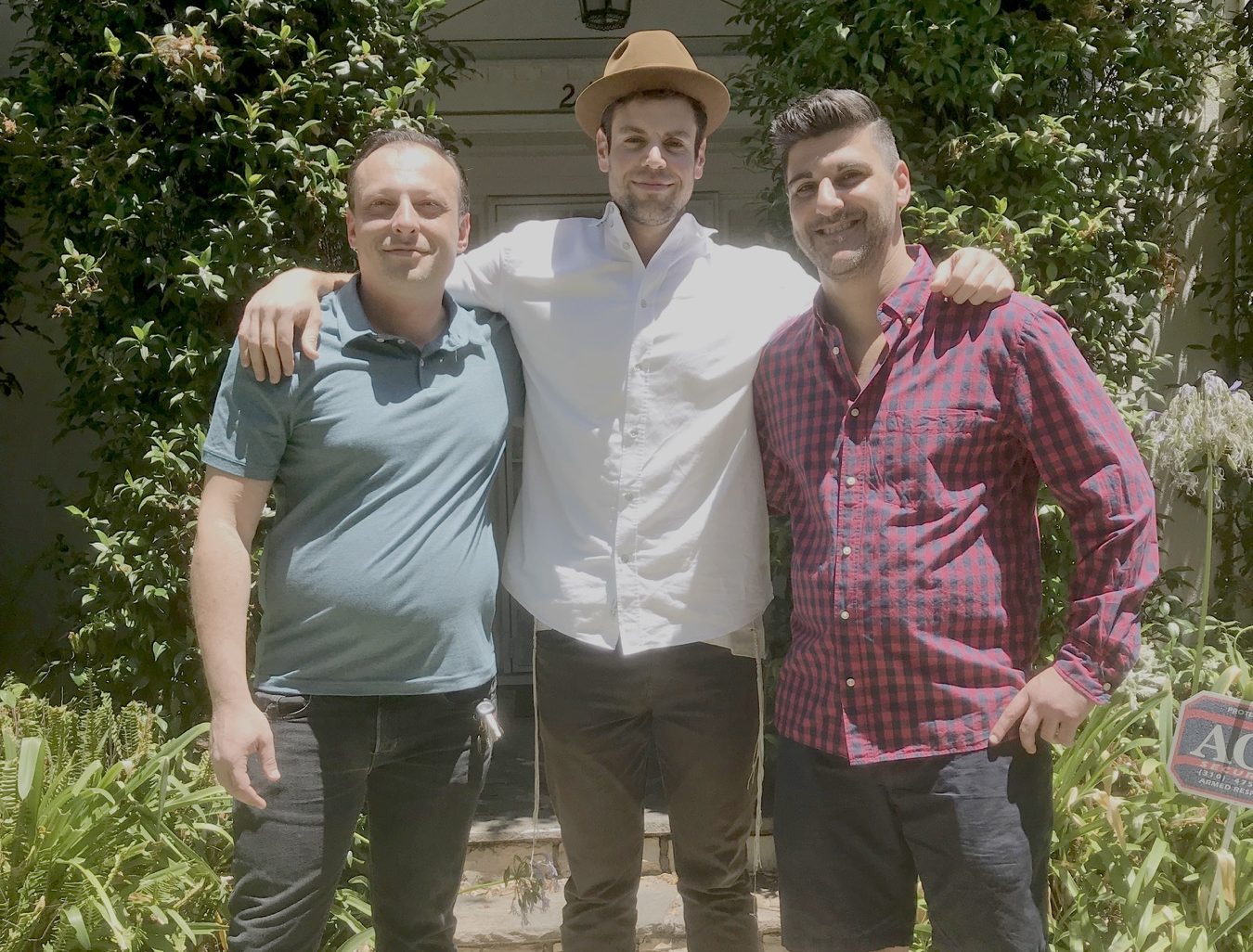
From left: Michael Stanislavsky, manager of Jewish House; Sammy Clifford, whose father founded the facility; and Jewish House resident David N.

Isaac didn’t have a bar mitzvah when he turned 13. But last April, at the age of 39, he went through the rite of passage at Jewish House Recovery Center, a sober-living home for men, located in West Los Angeles. The ceremony was led by Sammy Clifford, who operates the house with his father, David Clifford.

Isaac arrived at Jewish House four months ago, after spending six months in the Los Angeles County Jail and 18 months at a firefighting camp run by the state Department of Corrections and Rehabilitation. Charged with “drug-related things,” which he declined to elaborate on, Isaac told the Journal: “Everything stemmed from poverty and drugs.”

Isaac (whose last name has not been included to protect his identity, as with other Jewish House residents mentioned in this story) said he has been sober for six weeks. “I am slowly having time to heal here and I am having some serenity here and I am getting into Torah here and it’s healing my past,” he said. 

Isaac is one of 12 residents currently living at Jewish House. All the men here have struggled with drug and alcohol abuse, have already participated in some form of rehabilitation program and are transitioning back to their everyday lives. 

Residents usually stay for six to nine months, or until “they feel confident both emotionally and financially to make the move to complete independence,” Sammy Clifford said. “No one is pushed out.”

Sammy and David Clifford founded the center, originally called Jewish House Sober Living, in 2016. (More than 30 years ago, David Clifford, a native of Australia, co-founded a similar facility in Sydney.) In January, when they applied for nonprofit status for their L.A. facility, the Cliffords changed the name to Jewish House Recovery Center, now casually known as Jewish House.

“My mission is to help people maintain their sobriety,” said David Clifford, who is 66-years-old and an Orthodox Jew.

 “I am slowly having time to heal here and I am having some serenity here and I am getting into Torah here and it’s healing my past.” — Isaac

David Clifford runs the facility largely on his own. He rents the house from his daughter. And Sammy helps with fundraising. Jewish House is still in the process of obtaining nonprofit status, and the Cliffords hope to attract community support for their efforts. 

Los Angeles has two comprehensive Jewish rehabilitation centers: Chabad Treatment Center in Mid-City and Beit T’Shuvah in Culver City. For people who have completed those programs, Jewish House provides a place of transition where its residents receive support in living sober before they return to life on their own. Most of the 12 residents currently staying at Jewish House underwent treatment at the Chabad Treatment Center.

Statistics point to a real need for facilities such as Jewish House. According to the Centers for Disease Prevention and Control (CDC), more than 63,000 people in the U.S. died from drug overdoses in 2016. The CDC also reported that, on average, 115 Americans die every day from opioid overdoses.

“It’s today’s Holocaust,” David Clifford said.

Jewish House is a second act for David Clifford, who earned his living in the clothing business before opening the facility in Los Angeles. His desire to make the facility affordable for residents, however, makes it  unsustainable without private donations and financial support. While many sober-living homes charge more than $2,000 per month and show little compassion for residents if they relapse, he said, Jewish House charges $750 per month and doesn’t automatically kick out residents if they fall back into addiction. Michael Stanislavsky, the house manager, said only two or three residents have relapsed in the past six months. 

Stanislavsky, 40, knows how challenging it is to maintain sobriety. He grew up in New York in a Russian-Jewish family, attending birthday parties at Russian restaurants with easy access to alcohol. He was a teenager in the nightclub scene when the drugs ecstasy and ketamine, also known as Special-K, were popular. 

By the time he was 16, Stanislavsky was a high school dropout with a drinking problem. In his mid-20s, he discovered the prescription pain medication Oxycodone. After five years of taking Oxycodone, he began experiencing panic attacks. A doctor prescribed him the anti-anxiety drug Xanax. At age 30, while driving in New York at 70 mph, he fell asleep at the wheel and his car collided with the back of a dump truck parked on the side of the road. The crash fractured his back and neck and nearly killed him.

But even that near-death experience was not enough to put him on a path toward recovery. He spent several more years using drugs and became homeless before finally moving to Los Angeles in 2016, where he checked into the Chabad Treatment Center.

“I am extremely grateful to Chabad,” Stanislavsky said. “I wish I had a picture of what I looked like when I did my intake at Chabad compared to now. You would not recognize me.” 

While Jewish House does not turn away non-Jews, David Clifford prefers an environment where everyone is Jewish. He believes that approach helps build a familial bond among the residents that helps them maintain their sobriety.

“It’s a good family here,” he said. “A fellowship is an important part of recovery.” 

Stanislavsky agreed. “By being here, being in a smaller atmosphere, we all kind of help each other,” he said. “We go to meetings together, we eat together, we have house meetings all the time.”

The house has five bedrooms, three upstairs and two in a converted pool house. The master bedroom accommodates four residents.

Isaac, who shares one of the pool-house bedrooms, said that after his release from prison he bounced around different sober-living homes until a representative of the Aleph Institute, which supports at-risk youth, referred him to David Clifford. Since coming to Jewish House, Clifford has helped him get a job at a kosher restaurant. 

“It’s exactly what I need right now,” Isaac said, “and it’s working out great.”

His left forearm displays a Star of David tattoo he got when he was 18. He said it was a way for him to express his Jewish heritage, even though Judaism played only a small role in his upbringing. But at Jewish House, he said, he has discovered how Judaism can help him maintain his sobriety. Every morning, he studies Torah with Sammy Clifford.

“It’s opened me up,” Isaac said, “and I have hope again.”

Another resident, 36-year-old David N., started smoking marijuana when he was 15. As he got older, be began taking the pain medication Percocet. After he broke his foot, he got a prescription for more than he needed and soon became addicted.

“I took advantage,” he said. “They didn’t catch on until it was a problem.” 

Like Stanislavsky, David sought treatment at the Chabad Treatment Center. He has been living at Jewish House now for eight months. He works on a laptop on the first floor of the house, selling electronics over the internet. His two children, ages 11 and 6, live on the East Coast with his ex-wife, but he said the guys in the house with him are like a second family. “It’s nice to be with people who know your roots,” he said.

Isaac concurred. “It’s like going from no home to being home, having loss of freedom to freedom again, having no family to having family again,” he said. “It’s been amazing, and it’s saved my life.”

‘Jewish House’ Helps Reconnect Men With Sobriety and Judaism Read More »