

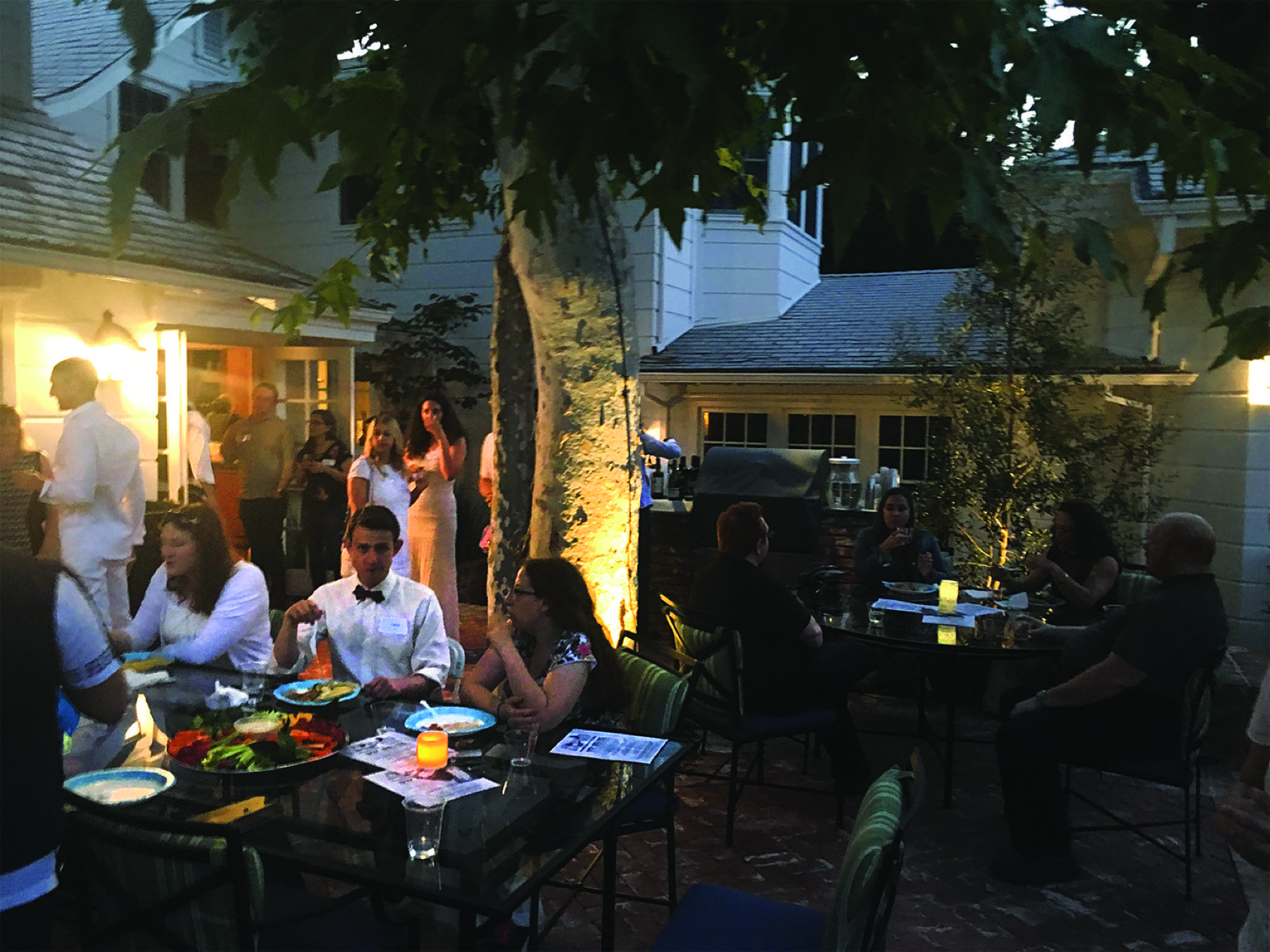
Mindy Bacola is a 33-year-old flight attendant from Hollywood. Always on the go (literally), she rarely has the time to date, let alone have a serious romantic relationship. So last Friday night, she turned out for Potlove, a singles potluck for Jews in their 20s and 30s that took place on Tu b’Av, a minor Jewish holiday akin to Valentine’s Day.
“It’s not just my job. We’re all busy people,” she said, explaining why events like the potluck were necessary. “If I was an attorney, I’d still be busy, wouldn’t I? I think no matter what, it is hard to meet people.”
Bacola was one of approximately 100 young professionals who attended the event held in the backyard of the Beverly Hills home of Sinai Temple Sisterhood Co-President Leslie Wachtel. Atid, the young professionals arm of Sinai Temple, organized the gathering, one of the group’s most popular annual events.
The full moon shone above Wachtel’s pool as many people kicked off their heels and dress shoes and dipped their toes in the heated water. Attendees lined up for dairy dishes and sipped red and white wines and beer. The free event asked for people to bring either an entrée, an appetizer, a dessert or a wine.
Many dressed in white, which is a tradition on Tu b’Av dating back to the talmudic period, when single women wore white as they ventured into the fields to meet their beshert (soulmate) on Tu b’Av. Women, regardless of their socio-economic background, dressed in simple clothing so that the men would not know what kind of family they came from.
At the Potlove event, Sinai Temple Millennial Director Matt Baram said that obscuring who comes from wealth and who does not is an idea that resonates in today’s dating scene, which often sees people getting together for the wrong reasons.
The Potlove was just one of several Tu b’Av events that took place over the past week.
On July 26, Pico Shul, an Orthodox congregation for 20- and 30-somethings, held Lovefest, an evening garden party with music and cocktails.
“Everyone is suffering from PTSD from dating by the time they are in their late 20s, and I think that creates a lot of trust issues.” — Matt Baram
Two days later, Young Jewish Professionals held a Saturday night Summer White Party. Rabbi Yigal Rosenberg of Santa Clara brought 50 young Jews from the Bay Area and Silicon Valley to the party. He exposed them to the diversity of the local Jewish community in the hope they would meet eligible bachelors and bachelorettes.
“The Bay Area is very man-heavy, very secular,” Rosenberg said. “There is a lot of intermarriage and a big element of what we want to do is ‘Operation Jewish Babies.’ That’s the name of our game.”
Baram noted the shift in views on marriage these days, which sees people getting married later than ever. He said that by the time many singles reach age 30, they have experienced so many failed relationships that they’re scared of taking the risk of becoming serious with another person.
“Everyone is suffering from PTSD from dating by the time they are in their late 20s, and I think that creates a lot of trust issues and a lot of different issues that we’re just as a society starting to grapple with and figure out how to deal with,” he said.
He hoped the Potlove helped singles to break down those barriers and find a way to connect with each other. “That’s really the idea of what we’re trying to do tonight,” he said. “One, create this elevated feeling of people wearing white; and two, a reminder of this idea that when you’re single and meeting people, it is about more than just any one thing — that people are complex and nuanced.”

































