The Simon Wiesenthal Center announced in a July 25 press release that they have filed an amicus curiae brief to a Washington, D.C. court calling on Russia to release the historic Schneerson Library to Chabad.
The library was initially seized from Chabad by the Soviet Union shortly after the Bolshevik Revolution; the library’s archives were then stolen by the Nazis before being reclaimed by the Soviet Union in the aftermath of World War II.
Chabad first filed a lawsuit to reclaim the library in 2004. In 2009, Russia backed out of the lawsuit, alleging that Chabad didn’t have any right to the library. All 100 senators and the Department of Justice have sided with Chabad, although the State Department in 2016 filed a “Statement of Interest” that Chabad’s claim to the library goes against international law. That State Department has yet to nix that statement.
“The Schneerson Library, made of thousands of books and archives, is a source of inspiration to hundreds of thousands of followers of the Lubavitcher Rebbes, and to millions of others deserves more respect than to be lying in a basement or warehouse somewhere in Moscow for 73 years,” Simon Wiesenthal Center Founder and Dean Rabbi Marvin Hier and legal counsel Martin Mendelsohn said in a statement.
The Schneerson Library was named after Rabbi Sholom Dovber Schneerson, who collected 12,000 books and 25,000 religious documents that contain the thoughts and teachings of various rabbis.
Labour Party Leader Jeremy Corbyn skipped a party meeting on July 23 about adopting an anti-Semitism code, but did meet with a Qatari emir that has expressed support for terror groups on the same day.
Corbyn and Qatari Emir Tamim Bin Hamad Al Thani reportedly discussed the 2022 World Cup and the conflicts in Syria and Yemen.
Al Thani has previously provided millions of dollars in “humanitarian aid” to the Gaza Strip, which prompted a thank-you from Hamas leader Ismail Haniyeh. Al Thani has also reportedly defended Hamas and Hezbollah, both of which have been described by Corbyn as “friends,” although Al Thani has denied that report.
Additionally, Doha – Qatar’s capital – has recently become warm with the Iranian regime and its terror proxies, resulting in diplomatic isolation from the United States and Qatar’s Arab Gulf neighbors. Qatar has since joined in on sanctions on Hezbollah.
Doha also has a history of providing aid to terror groups like Hamas, al-Qaeda and ISIS.
Labour Party members were irked that Corbyn did not attend the anti-Semitism meeting for the second week in a row and reportedly left the meeting feeling “gloomy.”
Anti-Semitism has plagued the party since Corbyn took the reins, and has become even more of an issue after Corbyn and the party leadership implemented watered-down anti-Semitism guidelines. Corbyn was even confronted by longtime Labour Party MP Margaret Hodge on the matter. The three leading Jewish newspapers in the United Kingdom penned a July 25 editorial warning that a Prime Minister Jeremy Corbyn would pose “an existential threat to Jewish life in this country.”
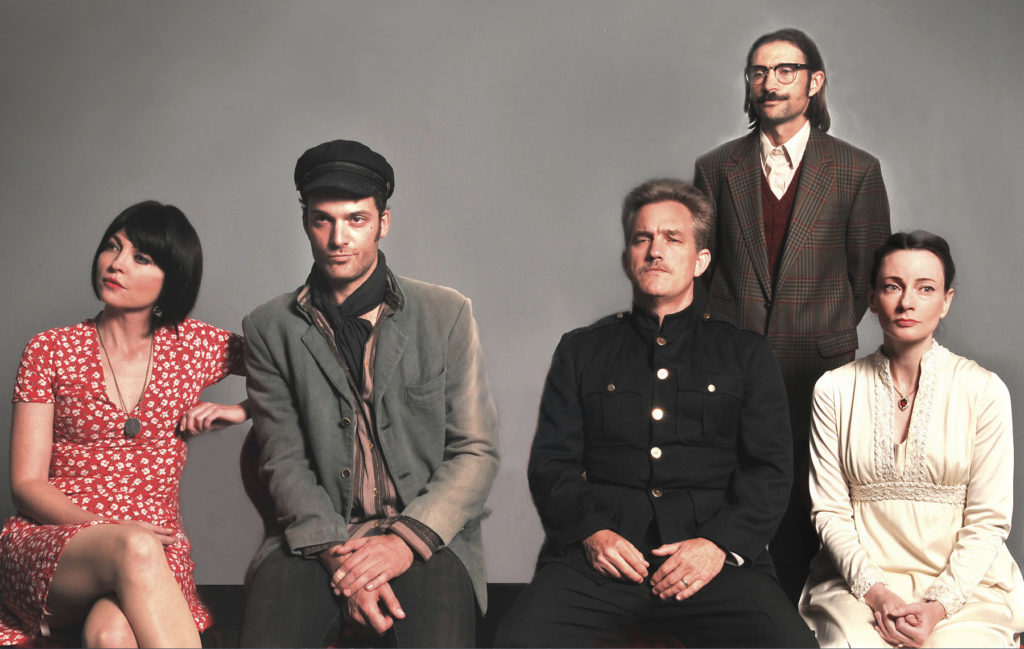
While most people are familiar with Soviet dictator Josef Stalin, the Russian poet Vladimir Mayakovsky is considerably less well known. Poet and playwright Murray Mednick delves into the lives and loves of the two Russian Revolution figures in parallel stories in his latest work, “Mayakovsky and Stalin,” a world premiere production now running at the Lounge Theatre in Hollywood.
In the play, the title characters never meet, but these complicated men have personal demons, ideological crises and romantic relationship troubles in common, and lives that are touched — or ended — by suicide.
Through conversations and vignettes, Mednick dramatizes Stalin’s marriage to his unstable, unhappy wife, Nadya, who shot and killed herself in 1932. The play also explores Mayakovsky’s relationship with his muse and lover, Lilya Brik, a married Jewish actress. The poet, who smoked, drank and womanized to excess and increasingly disagreed with the policies and ideals of the Soviet state, committed suicide in 1930 at the age of 36.
Mednick, who also directs the production, employs minimal staging and an unconventional structure, using photo projections to set the scenes. “It’s lyrical. It’s nonlinear. It goes back and forth in time. It’s impressionistic in that scenes follow one another in nontraditional ways,” he said, speaking to the Journal after a dress rehearsal.
He remembered first learning about Stalin in high school and did research about him over the years. As for the poet, “[I] was aware of Mayakovsky but I wasn’t as knowledgeable.” Mednick said. With the play, he hopes to educate audiences about them and the early days of the Soviet Union.
Another theme of the play is the plight of Jews under the Soviet regime, with the fear of pogroms and Stalin’s frequent purges a very real threat. Mednick wanted to convey “the horror that mankind is capable of. It’s been going on since the beginning of time — that’s what I’m trying to say.” He added that Jewish themes are prominent in most of his plays. “I’m a Jew. It comes out.”
Born in Brooklyn, N.Y., Mednick grew up nonreligious but strongly identifies as Jewish. “It’s very important to me,” he said. “When I was 5, I saw a Holocaust film and I have never forgotten it. I’ve written several Holocaust plays.” They include “Fedunn,” “The Destruction of the Fourth World” and “Mrs. Feuerstein.”
Several of the “Mayakovsky and Stalin” cast members are also Jewish, including Laura Ligouri, who playsLilya Birk. She had worked with Mednick before on his “The Gary Plays” and he wrote the role with her in mind.
“I definitely had to research. It’s important when you’re playing a real person,” she said, noting that reading letters between Mayakovsky, Lilya and her husband, Osip, the poet’s publisher, were immensely helpful in her preparation.
Lilya is not Ligouri’s first Jewish character, having “stood up to the Nazis” onstage in “The Red Dress.” She also loves the challenge of playing a real person, which she does in the title role of the Amazon film “Hollywood Girl: The Peg Entwistle Story,” a bio of the actress who committed suicide by leaping from the Hollywood sign in 1932.
Daniel Dorr, who most recently played Romeo in “Romeo and Juliet” at the Hollywood Fringe Festival, eagerly took on the challenge of playing Mayakovsky. The German-born son of an Israeli father and mother of Polish-Jewish heritage, he grew up “pretty Reform” in Israel before he and his parents, an actor and an opera singer, moved to Los Angeles in 1996.
“[Mayakovsky was] a very conflicted man and had two sides to his personality. He had this soft, vulnerable, artistic side that he didn’t know how to express except with force. It was like he needed to escape from his own body,” Dorr said. “The rhythm of his poetry is very much how I imagine he felt as a person: very suffocated and stifled by what was going on.” Without much film or audio to help him prepare for his role, “I found his voice in the poetry,” Dorr said.
Serving as an omniscient Greek chorus that comments on the action and provides a vehicle for Mednick’s voice in the play, Max Faugno also portrays Jewish Soviets in conversations with Stalin. As a Jew, he also found the Jewish themes in the play particularly resonant.
“In this case, we’re dealing with pogroms and the thousands of Jews Stalin murdered along with everyone else he didn’t like,” Faugno said. “If it happened once, it will happen again unless some consciousness exists.”
Maury Sterling, who worked with Mednick previously in “Fedunn,” said he “couldn’t pass up the challenge” of playing all the complexities of Stalin.
“There’s so much information, you’re playing not only with your own ideas but the ideas other people have and things from books and movies,” he said. “But it boils down to the play we’re doing: Which Stalin is that? Putting all the elements together was a little tricky.”
Sterling’s research revealed that the dictator could be charming and was beloved by children, but his behavior was wild and psychotic. “He ordered his bodyguards not to disturb him in his private chambers, faked screaming in pain and when they entered, he killed them,” he said. “He murdered his friends.”
Not surprisingly, “with a guy like that, there’s not much you want to identify with,” Sterling said. “And if there was, I wouldn’t want to admit it in public.”
“Mayakovsky and Stalin” runs at the Lounge Theatre, 6201 Santa Monica Blvd., through Aug. 19. For information, visit plays411.com/stalin.
Two weeks ago, I was having lunch witha prominent Hollywood writer in Santa Monica (to be more accurate, I was having a glass of water and he was having lunch). Politics came up; he happens to be a Trump supporter. We discussed the various permutations of the policies pursued by President Donald Trump, as well as Trump’s unfortunate lack of character. The sun was shining cheerily through the windows; the atmosphere was light and airy. All around us, wealthy people deliberately dressed down in California casual sipped their $40 glasses of chardonnay while playing with their $300 sunglasses and tapping their $400 loafers and $700 high heels.
Which is when it occurred to me that if we had taken a poll of the room, we’d surely have found that nearly everyone there thinks that we’re living in the middle of an existential crisis in the United States. This, of course, was Santa Monica, which means that virtually everyone in the room voted for Hillary Clinton; most of those people probably feel that Trump colluded with Russia to undermine our democracy. Most of them probably also believe that we are living on the verge of a fascist dictatorship, and that only wearing pussy hats and shouting about #Resistance will prevent the emergence of this fascist dictatorship.
Yet everyone was spending the afternoon supping on the finest America has to offer, while complaining that the sparkling water was just a tad flat.
All of which isn’t unique to Americans on the left. When Barack Obama was president, the economy was pretty good, even though I disagreed with his policies; his foreign policy, I thought, was far more disastrous, but America wasn’t involved in any earth-shattering wars. Yes, I thought Obamacare was awful, invasive policy, but I still had my insurance through my employer. Overall, American lives didn’t change all that much under Obama. Nor did they under Bush. Or Clinton. Or Bush I.
We’re so convinced that crisis will be immediate and triggered by circumstance that we refuse to talk about serious issues with those on the other side.
Politics, in fact, infuses us with a sense of urgency that is sometimes useful. Those who are obsessed with politics worry deeply — and correctly — about preventing black swan incidents, outstanding episodes with world-changing impact. We can’t predict them, which is why so many people are worried about them — and they do, in fact, occur. We have to guess what actions reduce the probability of serious black swans. Is it minimization of conflict with foreign actors, or a policy of peace through strength? Is it less government regulation or more?
But sometimes our worries about the future prevent us from recognizing that everything doesn’t actually seem to exist on a knife’s edge — that perhaps the black swan is further away than we think. Perhaps our worries ought to be not about the latest headline, but about deeper systemic change. And examining what systemic change is necessary isn’t a question of daily controversies, but of deep ideas that require deep examination. Trump’s latest tweet might bring about the apocalypse, but it’s almost certain it won’t. But deeper crises of character and direction could.
Those conversations, however, are foreclosed by the crisis nature of our politics. We’re so convinced that crisis will be immediate and triggered by circumstance that we refuse to talk about serious issues with those on the other side. That means that the chances of a black swan event are actually heightened, not reduced, by a mentality of panic. The longer we focus on the supposedly urgent (which won’t turn out to be urgent) at the expense of the important, the greater the chances we screw up the important.
So, no, we’re not facing a crisis. Which is why we should stop with the crisis talk and start actually talking with one another. If we don’t, we’re closer to the apocalypse than we think.
Ben Shapiro is an author, podcast host and editor-in-chief at The Daily Wire.
Growing up, I never fully understoodthe idea of whiteness. My family is olive-skinned and hazel-eyed; the summer sun would awaken our souls and deeply brown our skin. I always felt far closer to Egyptian princesses than European royals, but it was not something I ever really questioned until I came to New York City after college. Here, every cabdriver thinks I am from wherever he is from. “You’re Turkish, right?” “Persian?” “From Syria?”
No, I’m from Philadelphia. Pause. “That’s it?” Well, my family is from Russia. “No, no, no …. ” Um, I’m Jewish? “Ah, that’s it!”
What the cabdrivers have known instinctively has taken years for the Ashkenazi community to even begin to discuss. But the discussion finally has begun, and the data are fairly conclusive: Like our Sephardic, Mizrahi and African brethren, we, too, are not “white.” We hail from the Middle East, the Levant, the Kingdom of Israel. We are Jewish by religion but Israelite — Judean — by ethnicity. The Romans and other assorted colonizers kicked many of us out of our homeland, but they couldn’t change our DNA, which shows our lineage as distinctly as the latest archeological find.
I expected pushback to the idea that Jews aren’t white. Jews of a certain age feel an understandable insecurity in giving up this notion in a country that has only recently fully accepted us. While Jews here have been legally “free,” discrimination in terms of quotas, housing, jobs and clubs persisted well into the 1970s.
But the loudest pushback I’m seeing is coming from a place I would least expect: the left. You would think leftists would be saying things like: “See, the Palestinians are our genetic brothers!” (Which is actually only marginally true.) Instead, they are so caught up with the words “power” and “privilege,” that they are demanding that Jews stay in their place: at the top of the privilege hierarchy and the bottom of the victim hierarchy.
Leftist Jews argue that they don’t want to belittle “real racism.” But the ferociousness with which they cling to their whiteness belies an inconvenient truth: leftist Jews seem to like their “white privilege” as much as they like to decry it. They have become invested in being colonized.
Whiteness, of course, is a cultural construct. It has little to do with skin color — fair-skinned Jews (who became fair-skinned because of years of exile in Europe) have the same genetic makeup as those with darker skin. But whiteness is also not based on “privilege.” In pretending that all descendants of Europeans are “privileged,” leftist ideology erases entire swaths of humanity. I can hear Irish and Polish immigrants say, “If only.”
Jews have a special relationship with whiteness. After centuries of persecution culminating in genocide, all based on our “otherness,” we now get to be told by leftists that, for the sake of kowtowing to “real victims,” we again need to be demonized — but this time as white.
Like our Sephardic, Mizrahi and African brethren, we, too, are not “white.”
Meanwhile, in a historic ruling, a federal judge has found that Jews are finally entitled to protection from race-based discrimination under the Civil Rights Act of 1964. The ruling is based on a Louisiana College president’s refusal to hire a young football coach because he had “Jewish blood.” Will leftist Jews fight the ruling, insisting that Jews are white and anti-Semitism is not “systemic”?
I think it’s well past time to embrace our ethnicity — as descendants of the Tribes of Israel. And to counter centuries of being told how we fit (or don’t) into artificial Western categories, we should re-appropriate the term Israelite. We are Jews yes, but we are also Israelites, a distinct identity with a distinct heritage and culture. This would nicely follow the new Israeli law declaring Israel as the nation-state of the Jewish people. Those of us who don’t live in Israel are not Israelis, but we are still Israelites.
Imagine the bridges of light we could build if we fully embraced our distinct identities. We, the Israelites, could offer a more nuanced view of immigration. We, the Israelites, could help other minorities with their unique struggles to thrive. We, the Israelites, can do tikkun olam without erasing either our religion or ethnicity.
We, the Israelites, can be that light unto the nations.
Karen Lehrman Bloch is an author and cultural critic living in New York.
The Lawfare Project was able to leverage Facebook into removing anti-Semitic content from their platform through legal action following Facebook CEO Mark Zuckerberg’s recent comments on Holocaust deniers.
According to a press release, The Lawfare Project issued several take-down notices of anti-Semitic and Holocaust-denying Facebook posts over the past couple of days, and Facebook took those posts down. One example that was shared with the Journal was a post in Spanish that roughly translates to:
“I do not know more than three kinds of Jews and none is good. Orthodox or believers who are crazy fanatics who are governed by their invented law of God with which there are words for more that say they are against the illegitimate state of Israel are psychopaths. The Jewish assassins who are ruled by Zionism and the holocity. And the secular Jews or atheists who in their great majority are governed by Zionism or the Holocaust; among which a small minority will undoubtedly be good people, but these are so scarce that it is as if they would not even exist; and as when one speaks, one speaks in general, because the more I know about the Jews, the more they disgust me; and I am not anti-Semitic, but a bit anti-Jewish enough that it is always good to take off the guilt saying that not all Jews are bad; it will not be all, but if the great majority.”
On July 18, Zuckerberg told ReCode that Facebook wouldn’t take down Holocaust-denying content but would bury it on people’s feeds through its algorithm.
“I don’t believe that our platform should take that down because I think there are things that different people get wrong,” Zuckerberg said. “I don’t think that they’re intentionally getting it wrong.”
Lawfare Project Spanish Counsel Ignacio Wenley Palacios said in the press release, “Whenever we find blatant Holocaust denial that Facebook refuses to remove, we will file legal proceedings to ensure that Facebook does not follow Mr. Zuckerberg’s stated approach.”
Lawfare Project Executive Director Brooke Goldstein stated that Zuckerberg’s comments “contradicts the findings of historians, sociologists and mainstream political figures, who categorize Holocaust denial as a form of anti-Semitism.”
“Facebook bans hate speech that attacks groups based on ethnicity or religious affiliation, so statements should be removed if they attack the Jewish people, an ethno-religious group,” Goldstein said. “In countries such as Spain, where Holocaust denial violates civil and criminal law, we will continue taking action to get it removed.”
On July 25, it was reported by CNBC that Facebook’s shares declined by 20% and they fell below this quarter’s revenue projection.
As one of today’s most celebrated millennial designers, Ryan Saghian has built an extensive portfolio of work covering all aspects of design in high-end residential, hospitality, and specialty commercial interiors.
At just 26, Ryan represents a new emersion of millennial designers enjoying recognition for accomplishments far beyond his years. With a storefront in the famed West Hollywood Design District, a hand crafted furniture collection, new wallpaper collection, and tastemaker status; Ryan has now become a staple in the LA design community.
A native Angeleno, Ryan continually incorporates elements of Hollywood opulence into his spaces, which he finds to be a defining aspect of what shapes Los Angeles design.
The reason his company stands out? His story and his bold look. “I think I inspire younger generations being that I am only 26, but I have also been successful at branding my look,” he tells the Jewish Journal. “You definitely know it’s my work when you see it!”
But there have been some challenges along his path to success. Keeping up was one of them. “This is an industry where my stock and trade is my time,” he admits. “The busier I get, the harder it is to juggle!” He often reminds himself to relax and take time off.
The biggest highlight for Ryan is the appreciation others have for his work. “As an artist there is truly no better feeling than when someone enjoys the final product.”
An avid reader, Ryan recommends to us “The Untethered Soul” by Michael Singer, which he says was a life-changing book. His current favorite? “A Return to Love” by Marianne Williamson.
Ironically enough, people also look to Ryan for inspiration in addition to interior design help.
“In an industry that is mostly based on external factors, I like to promote internal growth and beauty. I do this by posting motivational, in-depth quotes and novelties on my social media platforms for my followers to be inspired by,” he says.
But who inspired him?
“My parents,” he says. “My father converted the garage into a design studio for me to start my own firm after I graduated college. I grew my business out of that garage.”
Ryan also acknowledges the power of his Iranian-Jewish community. “I really admire my community here in Los Angeles. To have experienced [the Iranian] revolution and start all over in a foreign country to then become one of the most successful immigration stories in U.S. history is not only admirable but also honorable.”
To aspiring designers, he gives honest advice:
Mistakes are expensive in this industry! Always cross your T’s and dot your I’s.
The biggest hurdle he’s had to face, though, are the long timelines with vendors “I ALWAYS have a backup option with shorter lead times,” Ryan tells us.
No matter what comes his way, Ryan is determined to move forward. “I want to take over the interior design world!” And he just might. With his own wallpaper collection, furniture collection, and candle collection, he continues to expand, and eventually, would like to have more product lines.
Ryan, who received his Bachelors of Science degree in Interior Design from the Art Institute of California’s CIDA design school, was recently dubbed “the go-to designer for creating homes that feel invitingly luxurious.”
Three women, three Sabbaths and one tiny kitten that saves the day
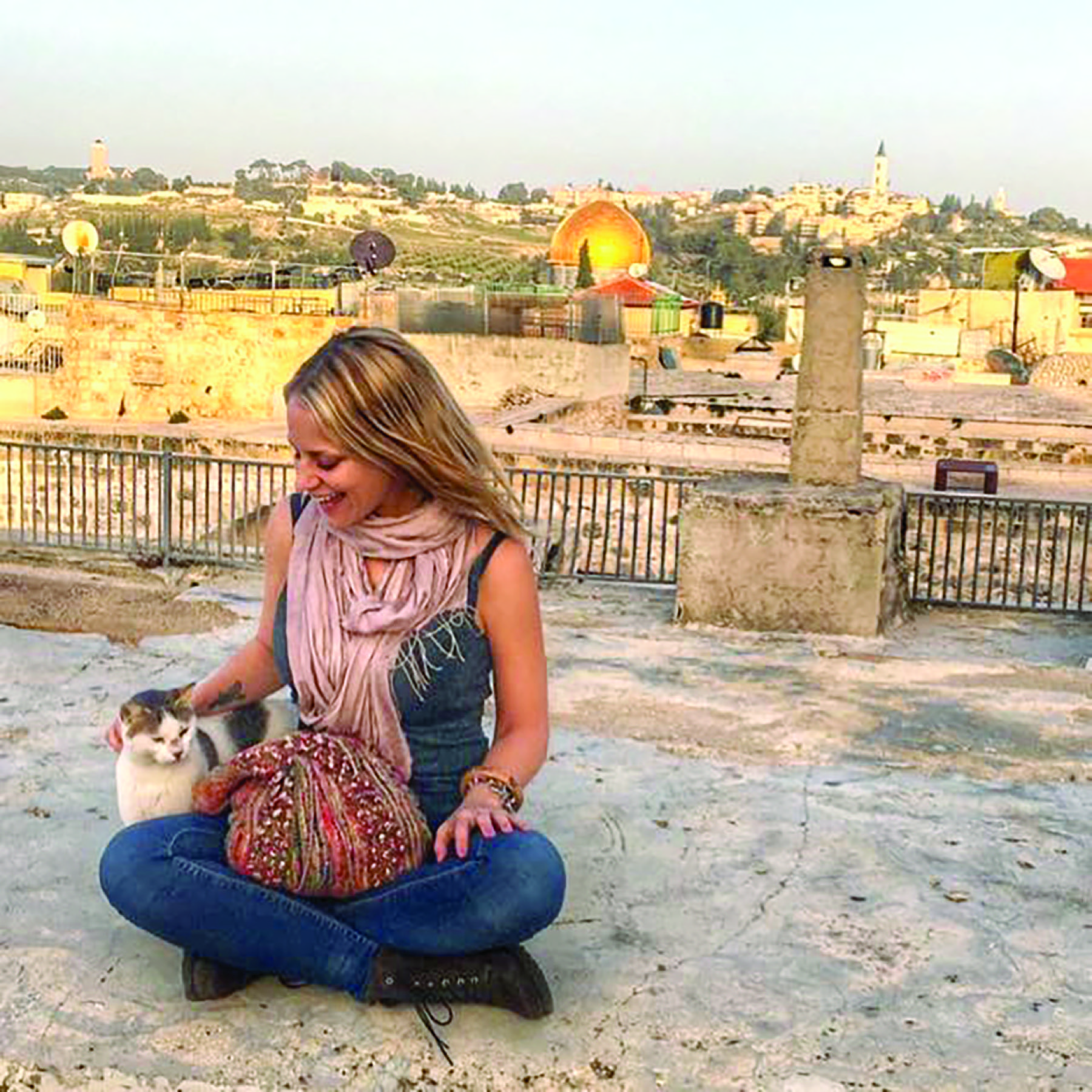
The first time I fell in love with Jerusalem was on a rooftop overlooking the Old City.
A cliché, right?
Whatever. I was 16 and awestruck, and I just stood there in the fading light, the sky the color of a dusty ripe peach, while below me the Old City glowed like seashells washed up on the shore.
In the last rays of light, The Dome of the Rock shone molten golden, the Western Wall turned all pearly and the domes of the Church of the Holy Sepulchre took on a deep silver against the sky. Little green lights flickered from various mosques as the sky darkened, but you could still see church spires reaching toward the sky and Israeli flags’ Star of David moving in the breeze.
It was drop-dead gorgeous, this mosaic of faith, peoplehood, different ways of loving God and living on the land. And this was when I fell in love.
It’s a love that’s stayed with me, that inspires me every day to live in the Old City — inside the mosaic — and explore what it’s really like.
Atop that little roof all the little pieces seemed to fit together, but the reality on the ground is much different. When it comes to actually living within the Old City’s walls, where time is marked by the muezzin’s call to prayer, the pealing of church bells and the Sabbath siren, the pieces often don’t come together. We who live here are like rocks in a rock tumbler. Sometimes our edges are jagged and rough and hurt one another. Other times we can come out shining.
I want to take you on a three-day trip I spent with the three faiths that left me bruised, baffled and heartbroken one moment, and reeling with joy and possibility the next.
I love faith, and I have a lot of it. I am the kind of Jew who gets that sweet and tingly feeling from my head to my toes when I sing “Shalom Alechem” on Friday nights. I love the words “And you shall love the Lord your God with all your heart, with all your soul, and with all your might.” I’m also the kind of Jew who believes that the things we have in common far outweigh the differences that divide us —which is also why, even though living in the Old City is at times complicated, I still want to be here to see where there are ways to smooth the jagged edges.
But it isn’t all about the spiritual. Residing in the Old City means really and truly living in it, and getting to know my neighbors. We all buy eggs from Ahmed, bread from George and halva from Simcha; celebrating the good moments, mourning the difficult ones and worshipping side by side.
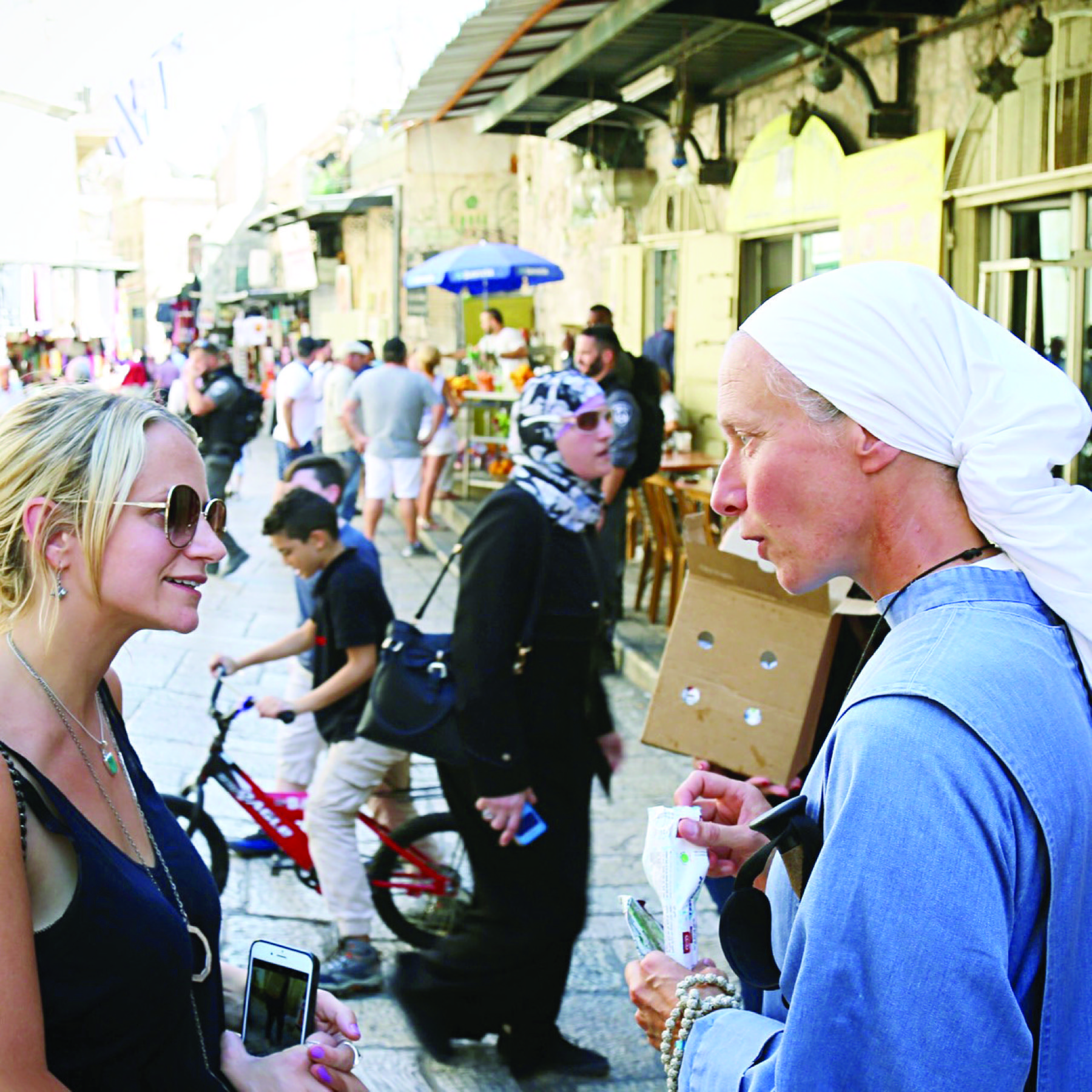
Sarah Speaking with a Nun | Photo by David Abitboul/Jewlicious
Weekends are especially interesting because we have three holy days, one after the other: Friday for Muslims, Saturday for Jews and Sunday for Christians. When I think about sharing a story of what that experience is like, I worry it could be too simple — like just pulling three distinctive rocks out of the tumbler and describing each one. While each one is special and beautiful, I don’t want to do that.
Instead, I want to take you on a three-day trip I spent with the three faiths that left me bruised, baffled and heartbroken one moment, and reeling with joy and possibility the next. It was during the Temple Mount riots in July 2017.
FRIDAY Jerusalem is seething. It’s a white-hot day and the air is thick and dusty. My friend Fadi and I are following the crowds of Muslim worshippers to Lion’s Gate, where thousands are praying outside the Temple Mount in an act of protest against the Israeli government for installing metal detectors and security cameras there after a terror attack a week earlier. Guns had been stashed on the Temple Mount and used by Palestinian terrorists to murder two Israeli police officers.
Fadi is a Muslim and Palestinian, and for him those are one and the same. He’s from Hebron, in the dusty hills southeast of Jerusalem. Walk out of Jaffa Gate, hook a left, keep walking and you’ll reach Hebron. That’s why in Arabic, Jaffa Gate is actually called “Bab Al Halil” — the Gate of Hebron.
Fadi’s family lives in Hebron. He has a wife and three kids, but sees them only on his days off — Tuesdays and Wednesdays. The rest of the time he stays in Jerusalem because, he tells me, getting through the checkpoints is difficult, even with his work permit.
Fadi is angry and resolute about The Temple Mount closure. His fists are clenched. His eyes are fixed and determined.
“But,” I try to tell him, “every time I go to the Western Wall I have to walk through a metal detector. So what’s the problem?”
“It’s just one more humiliation we Palestinians have to endure,” he says. “That’s the problem.”
He stops and faces me.
Jaffa Gate/Hebron Gate | Photo by Sarah Tuttle-Singer
“Do you know what happened the last time I left Jerusalem? I rode with Tawfik — you know, my uncle. He’s an old man. He walks with a cane. He’s half blind. A woman soldier younger than his granddaughter came up to him and asked to see his permit. She looked at it, threw it back to him and said, ‘You have a curfew. You need to be back by 10 at night.’ My uncle! My respected uncle! And this is how Israel treats him. You can go through your little metal detectors at the Western Wall because you have all the power. Even our old men are treated like children — or worse, like animals.”
Our talk is interrupted. The call to prayer is coming from several minarets,echoing off the walls of the Muslim Quarter. Each muezzin has a distinctive voice, and each one starts a few seconds before or after the other. One guy sounds like he may be from New Jersey, although he probably isn’t. Another sounds like he studied opera with Pavarotti. At times the sound is dissonant; at others, it is the most harmonious thing I have ever heard.
We get to Lions Gate in a throng of people. I’m wearing a long, black dress with a shirt over it. My hair is pulled back and wrapped with a black hijab. I’m wearing dark glasses. I’m not trying to “look Muslim,” I just want to blend in — to see, but not be seen.
What I see are three old women dressed in long, black Palestinian dresses embroidered with red thread. They’re yelling at the border police who stand looking grim and restless.
I see Muslim people handing out water bottles to Muslims; the Israeli soldiers and police pass water bottles among themselves. But again, like rocks in a rock tumbler, jagged edges grating against each other, no one really interacts. They just exchange wary glances.
Suddenly, I see a flurry of activity. The head of the Waqf (the Islamic religious trust that controls the Temple Mount) arrives. All around him men are chanting, “With fire and blood, we will liberate Aqsa!”
I see a guy I know shouting with them — he’s Fadi’s friend from the Muslim Quarter. How can he say these things? We’ve sat together. We’ve eaten hummus off the same plate. Fadi once told me that when you share hummus it means you can’t be enemies, but here we are.
We pretend not to see each other.
“Don’t worry,” an old man with a long, white robe and an even whiter beard says to me. “One day, Inshallah, everyone will accept the truth of Islam and then we can live in peace.”
The crowd quiets and the worshipers spread their prayer mats. Facing east toward Mecca, they kneel and pray. Then they rise, hands in supplication, eyes toward the heavens, lips moving.
“Allahu akbar” — God is great.
We walk up the stairs together, one by one — two lone soldiers, a yeshiva student, and a guy from Toronto who met another guy at the Western Wall who is cousins with the best friend of the hosts’ second-oldest son.
That’s how it works in the Old City.
I don’t pray with them. I’m not a Muslim, and it feels like it would be an invasion, especially now when tensions are high. I stay in the back while they pray. A young man with gelled black hair weeps. The sun beats down on us, and the air is thick with dust and sweat. In the silent spaces between each prayer utterance, there is only the buzzing of flies and the sound of traffic from down in the valley of Hinnom,where the kings of Judah once sacrificed children — the Valley of Slaughter, the Valley of Hell.
After prayers are finished, Fadi and I walk together for a while, saying nothing. It’s way too hot to speak. In the distance, we can hear the protesters shouting again: “With blood, with fire, we will liberate Aqsa!” and “Death to the Jews.”
The sound swells around us and then — BANG! — a stun grenade explodes and sends hundreds of people running toward me. The same people who were chanting “Death to the Jews” only moments ago. The same people who were so angry. But now their faces are stricken with terror — eyes bulging, mouths pulled back into a rictus.
I have never seen such a thing and I am afraid too. I run with them, and in that moment alongside Fadi I am just as Palestinian as they are, or at least appear to be. I’m not, of course. I’m Jewish, and whoever fired that stun grenade did so with thoughts of protecting people like me. But now I am in this terrified mass of people, shaking with fear. If someone shoots us with rubber bullets, I, too, would be hit. We are all here, sweat dripping, fingers splayed, and I can smell my fear — like that of a wild animal: rotten and feral.
Oh God, we are so human, with our blood and our sweat and our stench from fear and yearning. We are so easily torn apart and broken, like corn husks left to dry in the wind.
Fadi and I lose each other in the river of people, and his phone is off when I call. So I circle back around the walls of the Old City, shivering outside the Valley of Hell.
FRIDAY NIGHT-SATURDAY My little room has these big purple windows that look out onto the rooftops of the Old City. After my day at Lion’s Gate, I just want to hide and let the whip-whip-whip of the fan lull me to sleep. But I have Shabbat plans, and Shabbat is sacrosanct.
As I walk through Zion Gate on my way to the place where I’m staying, I see beautiful families, pink-cheeked and dressed in their Sabbath finest, heading toward the Western Wall. The whole world smells like chicken soup and challah, and I feel a little better.
I’m still shaky from running from the stun grenade, and even though the incident happened just a 20-minute walk from where I am right now, it feels like it happened in another world. That’s what the Old City is like sometimes. We have our little communities behind the ancient stone walls and guilded doors. Only the cats seem to move smoothly between the worlds as they leap from windowsill to windowsill.
I want a Shabbat Shalom more than anything else — a Sabbath of total and complete peace — although I don’t know how to feel whole right now in the middle of this brokenness all around me.
I get back to my little room with the purple windows and take a shower. The dust from Lion’s Gate runs off my feet in muddy rivulets.I stand there for a very long time.
I know the way to the house where I’ll be welcoming Shabbat. It’s right in the middle of the Jewish Quarter, near the playground. The courtyard is quiet, except for the birds, and the front door is open.
The host family is a special family that opens its home every week to anyone who requests a space at their table — travelers from far-flung places, seminary girls and yeshiva boys (maybe there will be a match!), and lone soldiers from all over the world. The hosts are strangers until you step into their glowing, little world. Suddenly you’re home and they’re your beloved aunt and uncle. The only caveat? You’d better be prepared to talk about the week’s Torah portion.
“There’s a kitten trapped in the pipe,” he tells me. “Just a baby. We can hear him meowing.” He puts his hand on the guy hammering the pipe. “Stop. Let’s see if it’s still alive.”
There are a few of us who were invited. We walk up the stairs together, one by one — two lone soldiers, a yeshiva student, and a guy from Toronto who met another guy at the Western Wall who is cousins with the best friend of the hosts’ second-oldest son.
That’s how it works in the Old City.
Up three flights of gleaming marble stairs, we enter a room with huge windows overlooking the Old City. The table is covered with a white, hand-stitched tablecloth and laden with the best silver settings and china. The hostess wears all white with what appear to be real diamonds sewn onto her dress and turban.
She looks like a queen.
About a hundred candles already have been lit on a table near the window. It’s after sundown,already well into Shabbat. In my head I hear my mother’s voice, saying as she did on every Friday night: “We welcome and honor Shabbat. May the warmth and calm of these flames bring us love, joy and happiness as individuals and as a family. We say the same words now the Jewish people have said for thousands of years and say tonight wherever they may live: Blessed are you, Eternal One, Ruler of the Universe, who commands us to light these Sabbath Lights.…”
Around the table the singing is joyful and rousing. The wine is dusky and the challah sweet. I ease into the night softly, buoyed by the joy around me — until I remember, with a prickle of fear down my back, how it felt to run with Fadi and the others from the stun grenade. I think about their nights over in the Muslim Quarter and in East Jerusalem while their community seethes, and how it must feel to be them right now.
And then the host — distinguished with his natty beard and black yarmulke — offers a prayer for the brave sons and daughters of Israel defending us in Jerusalem and throughout the land.
Everyone says “Amen” and takes a moment of silence to think about what is happening outside this room. I think about the border police and soldiers I saw today, how grim they were and how young they are. I think about the Muslim worshipers too — the old man with the long, white beard; Fadi’s angry friend; the young guy with the gelled hair who wept as he faced Mecca and prayed.
I think about Fadi too.
And then I think about how frightened I was running from the stun grenade. I feel my heart racing.
Shabbat-observant families don’t use electricity from sundown Friday until three stars shine in the new week’s sky on Saturday night, but I’m still a journalist, and I still work for a newspaper that publishes around the clock, and there are still riots throughout East Jerusalem, so I slip into the kitchen where four women from the Philippines who aren’t Jewish are serving the meal. This is allowed in Judaism. “I’m sorry,” I say, embarrassed, pointing to my phone.
One of the women smiles and shows me where I can use my phone in the bathroom. I turn on my phone and one breaking news alert after another fires across the screen. The news is grim.
I recall a family story that has been passed down from generation to generation — to my mother from her mother who got it from her mother:
There was a family — a father, mother and two children — and when the father was learning with the rabbi, the two children died. This was before the Sabbath, the Jewish holy day, when time slows and the world all around rests. The mother put her two children’s bodies in one of the back rooms, and when her husband came home and asked where the kids were, she said, “I’ll tell you about it when the Sabbath ends.”
The parents lit the candles and ate the festive meal. They prayed and sang and talked and laughed. And the following evening, when Shabbat had ended, only then did she tell him the truth about their children.
“Why didn’t she tell him sooner?” I asked my mother.
“She wanted to give her husband one last joyful Sabbath before he found out the terrible truth,” she told me. “There would be time enough for them to grieve.”
I’m thinking about this story as I’m crouching in the bathroom of this magnificent home in the Jewish Quarter, checking my phone. Because, while we were eating and drinking and singing and arguing about the Torah portion, there was a terrible news alert: A Palestinian terrorist burst into a family home during the Sabbath meal just an hour ago and butchered several people — how many isn’t yet known. At least one is dead.
That’s all I know. In Halamish — not far from this very house where people are celebrating and praying for the children of Israel — a family has been ripped apart and their blood is all over the kitchen floor.
I think about my mom and my family, and my children with their father, and I think about that story my great-grandmother passed to her daughter and to her daughter and to me.
So I turn off the phone and say nothing to diminish the Shabbat joy in the room.
As I walk home that night in the moonlight, through the streets steeped in Shabbat Shalom, I cry.
Saturday morning, I wake up angry. I’m angry at the Sheikh of the Waqf. I’m angry at the men I saw protesting in front of Lion’s Gate. I’m angry at Fadi. I’m angry at the whole stupid, rotten world.
I read more about the murdered family. I picture them minutes before the attack, gathered around the table as we all were last night — singing, laughing, joking, trying to focus on the good.
In my little room with the purple windows, I can’t think about anything else. It’s eating at me like a nasty little worm. I can feel my anger atrophying into hate. And then I am afraid.
Without me thinking, my feet take me out of my room, down the stairs, past the spice market and through the shuk until I’m standing in front of the place where Fadi works in the Muslim Quarter.
I don’t say anything. I am too angry. I stare at him. He stares at me. Finally, he speaks.
“Tea?”
“Fine.”
We sit down at a rickety table and just stare at each other, daring the other to speak first. Why is he angry? I ask myself. How dare he be angry.
“Do you know there was a massacre in Halamish last night?” I ask him, practically spitting.
“And do you know that three boys were murdered protesting in East Jerusalem?” he asks me, his jaw clenched.
Again we say nothing. The air is dense like water. I want to hit him. I want to cry. His eyes are black pools.
“Why don’t you say you’re sorry?” I ask him.
“Why don’t you?” he asks me.
He pushes the glass of tea toward me. It smells like sweet rain.
And then I soften. I’m not sure why. Maybe because I know and trust Fadi, and I remember what he told me about his uncle. I remember, also, what it was like to run from the blast of the stun grenade, the sound echoing in my brain as I coughed from the smoke all around me. Maybe it’s because yesterday, on the Muslim holy day, I saw my fear reflected in his face and in the faces of his friends.
Maybe it’s because it’s Shabbat, when we are supposed to let go of our grudges and move into the new week with our arms and hearts wide open.
“Tell me about the boys who died,” I say.
He does, and it’s unbearable to hear.
When Fadi finishes, he wipes the sweat and tears from his face and looks at me.
“Now you tell me about the family who died,” he says.
And so I do.
It isn’t a Shabbat Shalom that Saturday in the Old City, but we’ve looked each other in the eye and told the truth about who we are and how we feel, and that feels one step closer to wholeness in the middle of all this brokenness.
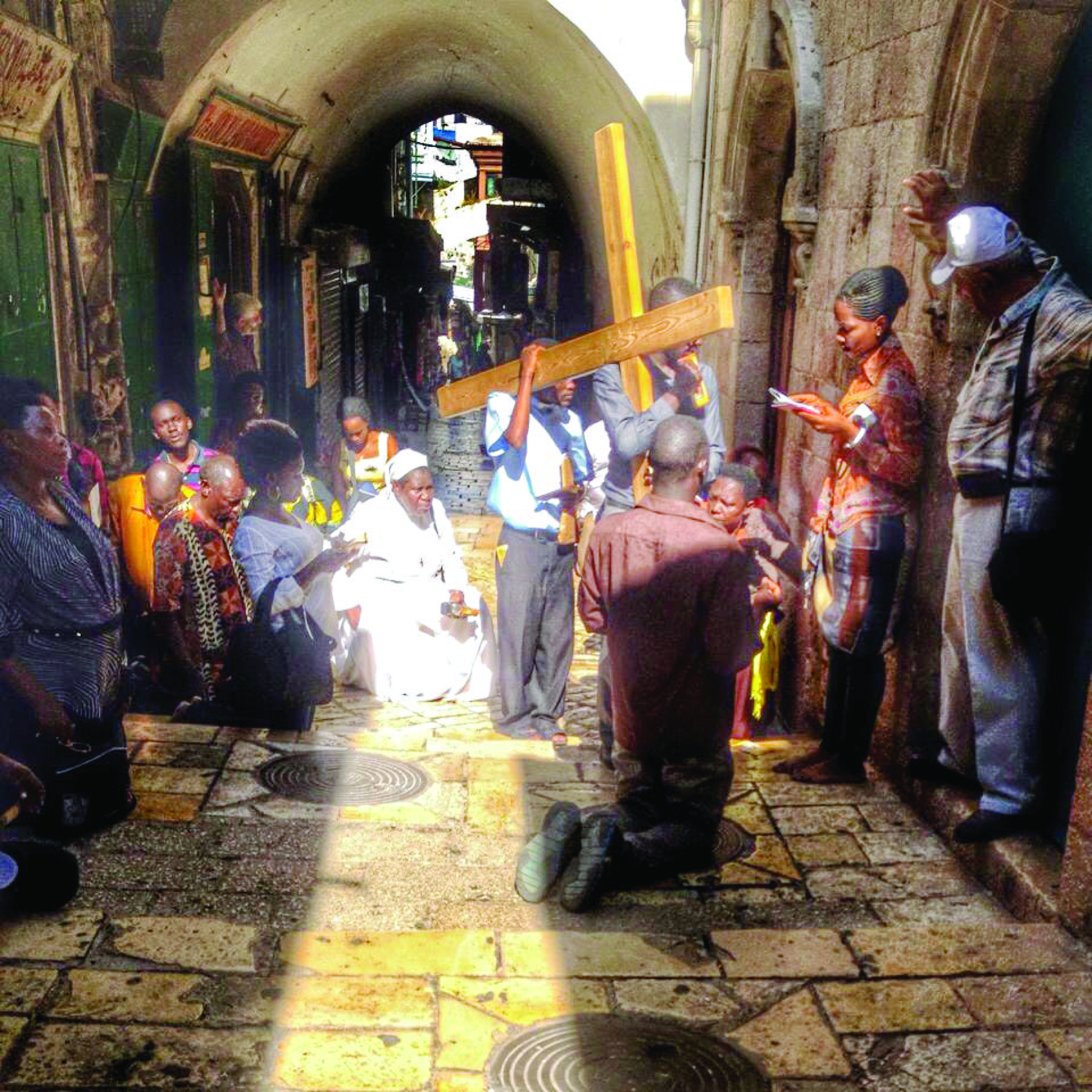
Pilgrims in the Christian Quarter | Photo by Sarah Tuttle-Singer
SUNDAY I’m walking with a group of pilgrims on the way to the Church of the Holy Sepulchre. A guy from Guatemala is strumming a guitar and singing with full-throated gusto. Another is waving a tambourine. The Old City isn’t as crowded as usual because of the protests around the Temple Mount, but there are still the streams of the faithful, carrying the cross, measuring each step that they say Jesus took along the Via Dolorosa — sorrow by sorrow — on his way to being crucified.
I love the Church of the Holy Sepulchre, how it smells, the flicker of the candles that the faithful light inside, the crosses carved on the walls made by the hands of pilgrims and crusaders. I like going there alone, even though it isn’t my sacred place, but it’s wonderful to be heading there with people really excited about going. Their eyes are shining with faith as they sing and pray and stop by each of the Stations of the Cross.
On this Sunday, this tiny kitten has been a bridge between those worlds — the guys from the Muslim Quarter, the Yeshiva students, the praying pilgrims.
Everyone seems most excited about the fifth station, where some believe an indentation in one of the walls was left by Jesus when he stumbled on his way to being crucified. Although, maybe the indentation is merely there because so many thousands — maybe millions — believe that was the spot; and so, day by day, year by year, they’ve helped make that indentation by placing their faithful hands against the stone.
I touch it. The stone feels warm.
As we keep walking up Via Dolorosa, the heat of the day around us, I hum along with the pilgrims’ hymns because I don’t know the words.
Between the sixth and seventh stations of the cross, there’s banging and clanging. It’s loud. Cacophonous. I remember the stun grenade and begin to shake.
But then I look around and see what’s happening. A group of Palestinian men, sweating and smoking, is huddled around a drainpipe. One has a hammer. There’s a nun too — one of the Little Sisters of Jesus — and she’s praying. A Muslim cleric, who I recognize from Lion’s Gate, stands to the side, his face is stricken.
There’s a guy waving his arms, directing traffic and yelling at the guy with the hammer.
“A little harder! No, not there! Hit the part that’s lower! Yes, that’s right! Give the man some space!”
He’s sucking on a cigarette, and the whole street is full of smoke — not just from him but from five other guys standing there too. Fadi is one of them.
“What’s going on?” I ask him.
“There’s a kitten trapped in the pipe,” he tells me. “Just a baby. We can hear him meowing.” He puts his hand on the guy hammering the pipe. “Stop. Let’s see if it’s still alive.”
Three big men with their shirt collars unbuttoned, hair poking through and gold chains around their necks, put their ears against the pipe. One of them is the same guy who shouted at Lion’s Gate: “We will liberate Aqsa with blood and fire!”
This time, his tone is different. “The kitten is alive,” he says. “Praise God!”
“Praise the Lord!” one of the pilgrims replies.
A group of Russian pilgrims stops and begins to sing. The nun crosses herself again. The guy from Guatemala with the guitar plays something loud and festive. The screw on the pipe comes loose and Fadi unfastens it. The man who’d been shouting about blood and fire cups his hands gently underneath the space in the pipe and takes out the tiny kitten. It’s gray like soot and not much bigger than a chicken egg. Its eyes are closed, not because of dust or dirt or out of fear, but because it’s only a few days old. It sneezes.
“We can’t just leave him,” someone says. “He’ll die.”
“I can take him for a little while,” Fadi says, “but I have to go to Hebron next week, so someone will need to be with him then.”
“May I hold him?” I ask.
The man I saw yelling at the riots places him softly, almost reverently, in my arms. “Be careful,” he tells me in Hebrew. “Watch his neck.”
I cuddle it.
“I have an idea,” I say.As I caress this tiny little creature, I call a friend in Jerusalem who has about a million cats.
“Hey, what do I do with a newborn kitten with no mom?”
“Are you in the Old City?”
“Yeah, Muslim Quarter.” (In an area where most of my Jewish friends have never walked.)
“Call the Cat Lady in the Jewish Quarter. She rescues cats.”
I know about the Cat Lady. She’s a hero. When the British first brought cats to Jerusalem during the Mandate years, the cats took the whole “be fruitful and multiply” thing very seriously. Jerusalem is now overrun with cats. Many are hungry and most have no home. Bracha — the Cat Lady — wants to change that, so she sets traps for cats all over the Old City and takes them to be fixed. Then she releases them where she found them. She cares for the sick ones until they’re healthy.
Sarah on the roof where the four quarters of the Old City come together | Photo by Sarah Tuttle-Singer
My friend gives me the Cat Lady’s number, and I call her.
“Hello?”
“Hi, are you the woman who rescues cats?” I ask, while the tiny ball of fur snuggles against my chest.
“Who wants to know?”
She sounds wary. I don’t blame her. She’s encountered problems with people in the Old City, and even with the police.
“I have this kitten that I found in the Muslim Quarter. He’s a newborn. Eyes are still closed. I don’t know what to do with him.”
“Well, you can feed him,” she says — like, duh, it’s the most obvious thing in the world.
“I can’t,” I repy. “He’s too young.”
“It isn’t rocket science,” she insists. “Get an eye dropper.”
“I can’t keep a kitten this young,” I tell her. “My life is too unpredictable.”
She heaves a long sigh that sounds like it comes all the way from Brooklyn.
“Fine, fine, I’ll take him,” she says. “Bring him to the main square in the Jewish Quarter and I’ll meet you there.”
She hangs up before I can thank her.
“Well?” one of the men asks.
“I know a woman who can take him,” I tell him. “She’s in the Jewish Quarter.”
“Oh, the Cat Lady? We know about her.”
The sweating, smoking men line up one by one to pet the kitten. The pilgrims too. The nun says a prayer. A few kids from the Muslim Quarter have come, too, and everyone wants to touch the tiny creature.
Cradling the fragile little survivor, I hurry down Via Dolorosa and turn right onto Al-Wad / Ha-Guy Street — the street that connects Damascus Gate to the Western Wall, the street where Via Dolorosa intersects, the street where everything comes together.
The Old City is densely packed. People live right on top of one another and, yes, they often buy their milk and eggs and bread from the same places. But the worlds of the Old City are divided too.
On this Sunday, this tiny kitten has been a bridge between those worlds — between the blonde Swedish tourists, the guys from the Muslim Quarter, the yeshiva students, the border police, the Waqf guard, the praying pilgrims, the dude with the guitar, the laughing children, the priest, the imam, the rabbi … .
First, people see the kitten. Then, they see one another.
That thought hits me in a flash, and I feel warm all over.
The kitten purrs and nuzzles against me.
I stop hurrying. As I walk more slowly down the street, people from all faiths and walks of life approach me to touch the gentle, innocent creature in my arms. Only minutes before, its situation was dark and uncertain, with apparently no way out.
“Where did you find the kitten?” a border policeman asks.
“He was rescued by some guys in the Muslim Quarter,” I tell him.
“Where are you taking him?” a Muslim-Palestinian kid asks.
“I’m taking him to the Jewish Quarter.”
As I reach my destination, tears are streaming down my face. In the epicenter of everything that makes up the Old City -— where tension thrums, where the pieces all seem broken, where we lose perspective on how life could and should be, and where we tumble against one another without ever really connecting — some days we need a miracle to keep us going.
And some days we just get really, really lucky — and we get one.
Sarah Tuttle-Singer is the author of “Jerusalem, Drawn and Quartered: One Woman’s Year in the Heart of the Christian, Muslim, Armenian, and Jewish Quarters of Old Jerusalem.”
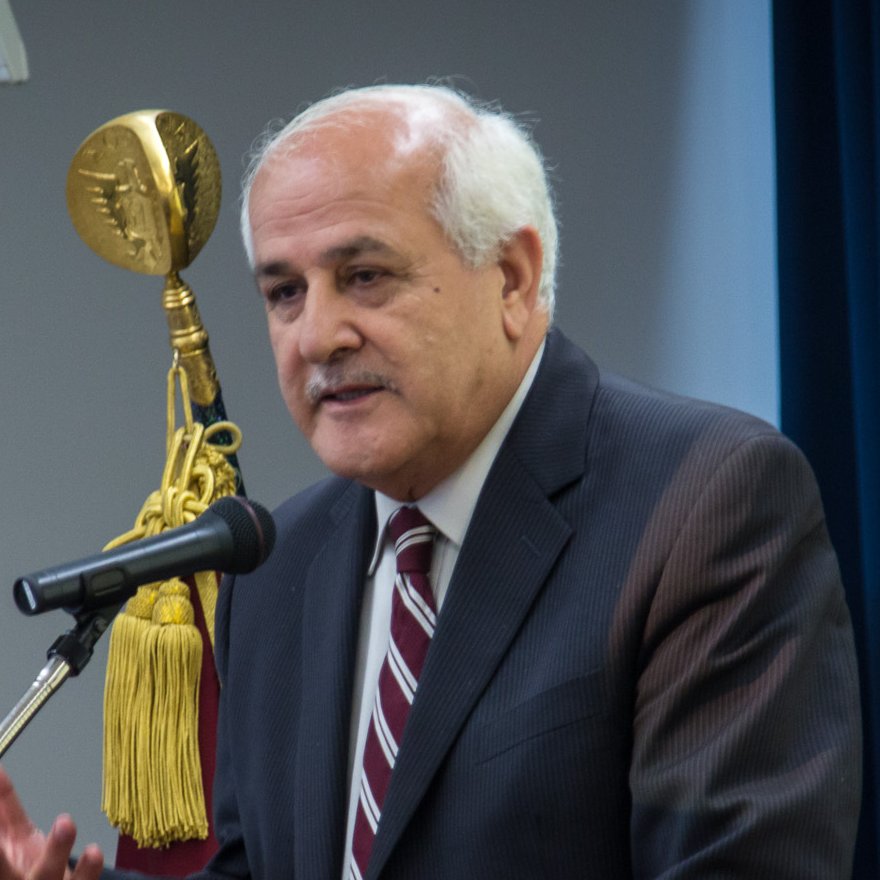
Riyad Mansour, the Palestinian ambassador to the United Nations, lashed out at United States U.N. Ambassador Nikki Haley on Wednesday by accusing her of being “more Israeli than the Israelis themselves.”
Mansour was irked that Haley chided Arab nations of political grandstanding with their speeches against Israel, yet do little to actually help the Palestinian people. Mansour claimed that Haley’s speech was nothing more than “an unconditional defense Israel” and criticized her for the Trump administration’s decision to drastically cut funding to the United Nations Relief and Works Agency (UNRWA).
Additionally, Mansour declared that the Trump administration’s peace proposal would not be considered by the Palestinian Authority.
As the Journal reported on July 24, Haley challenged Arab nations to take steps to help the Palestinian people instead of simply giving speeches that criticize Israel.
“If those words were useful in the schools, the hospitals and the streets of their communities, the Palestinian people would not be facing the desperate conditions we are discussing here today,” Haley said. “Talk is cheap.”
Some teachers at UNRWA schools have reportedly issued anti-Semitic Facebook posts. Richard Goldberg, a senior adviser to the Foundation of Defense Democracies, has argued that the UNRWA keeps Palestinians “in a permanent state of dependency and poverty.”
Pulitzer Prize-winning food critic Jonathan Gold of the Los Angeles Times died July 21 at St. Vincent Medical Center in L.A. He was 57 and had been diagnosed with pancreatic cancer in early July, the Times reported.
While most food critics tethered their careers to upscale, Michelin-starred restaurants, Gold was just as likely to be found in small, ethnic mom-and-pop eateries and strip-mall joints or at the order windows of the city’s ubiquitous taco stands and food trucks.
“If I’m doing anything that’s beyond writing about food, I guess, it’s to get people in Los Angeles to be a little less afraid of their neighbors,” Gold told then-Journal Editor-in-Chief Rob Eshman during an onstage discussion at the Westside Pavilion Landmark Theatre in 2016.
His “Counter Intelligence” column first appeared in the LA Weekly in 1986, and when he began to write for the Times (his first stint was from about 1990-96), he brought that column and his unique food aesthetic with him.
He peppered his reviews with pop culture references about music, TV, art and more. In a review for Vespertine in Culver City, Gold mentioned “The Handmaid’s Tale,” jazz composer Sun Ra, architect Frank Gehry and contemporary American artist James Turrell, the Times reported.
Gold’s cultivated yet accessible writing was lauded not only by fellow writers but food aficionados and chefs.
“He, more than any chef, changed the dining scene in Los Angeles,” chef and Mozza owner Nancy Silverton told the Times.
The only restaurant critic to date to win journalism’s most prestigious award, Gold was writing for the LA Weekly in 2007 when he won the Pulitzer. The Pulitzer committee cited “his zestful, wide-ranging restaurant reviews, expressing the delight of an erudite reader.”
He returned to the Times in 2012 and became one of the newspaper’s most visible journalists. He headlined events; guested weekly on KCRW-FM’s “Good Food,” hosted by Evan Kleiman; and was the subject of a 2015 documentary, “City of Gold,” directed by Laura Gabbert, in which he said, “The idea of celebrating the glorious mosaic of this city on somebody else’s dime — I kept feeling I was getting away with something.”
Gold, who posted more than 1,550 bylines in the Times, also won James Beard Awards for both magazine and newspaper restaurant reviews.
Gold was born in 1960, the oldest of three sons in a Reform Jewish home. His mother, Judith, worked in the library at L.A.’s Dorsey High School; his father, Irwin, was a probation officer. He studied art and music at UCLA, and was a classically trained musician. He played cello in a couple of punk rock bands, the Times said.
He became the LA Weekly’s music editor, covering hip-hop, grunge and the rise of gangsta rap in the 1980s, the Times reported. He also wrote about music and popular culture for Spin, Rolling Stone, Details and Vanity Fair.
Gold met his wife, Times arts and entertainment editor Laurie Ochoa, in 1984 while he was a proofreader and she was an intern at the LA Weekly. The two were married in 1990 at the now-closed Campanile restaurant, the Times reported.
Gold left the Weekly in 1999 for New York-based Gourmet magazine, where he worked under former L.A. Times critic Ruth Reichl, the Times reported, but he and his wife missed Los Angeles and they returned a few years later.
Gold is survived by his wife and two children, Isabel, 23, and Leon, 15, and brothers Josh and Mark, who is the associate vice chancellor for environment sustainability at UCLA.