fbpx

June 20, 2018

Report: Western-Backed Islamic Relief Charity Has Ties to Terror

The Islamic Relief charity bills itself as a humanitarian organization, winning praise and backing from governments and media outlets across the world. However, a new report suggests that Islamic Relief is tied to several Islamic terror organizations.

According to a 36-page report from the Middle East Forum, the founder of Islamic Relief, Hany El-Banna, has been involved with several organizations with ties to the Muslim Brotherhood and Hamas, including once serving as the trustee of the Muslim Aid charity that has funneled money to Hamas. As a student, El-Banna was a member of the Muslim Brotherhood organization Federation of Student Islamic Societies. El-Banna has also praised the founder of the Muslim Brotherhood, Hassan Al Bana for being “held in so much awe and respect.”

The co-founder of Islamic Relief, Essam El-Haddad, was sentenced to life in prison in Egypt for being a Muslim Brotherhood leader who collaborated with Hamas and Hezbollah and provided intelligence to the Iranian Revolutionary Guard Corps.. Egyptian media also reported that Haddad used Islamic Relief to funnel money to the Muslim Brotherhood.

Current high-ranking officials in Islamic Relief have expressed support for Islamic terror groups. Khaled Lamada, who heads Islamic Relief USA, proudly wears his Muslim Brotherhood insignia. On social media, Lamada has praised Hamas and engaged in anti-Semitic conspiracy theories that Egyptian President Abdel Fattah el-Sisi cracked down on the Muslim Brotherhood because he’s a Jewish puppet. Lamada is also the founder of Egyptian Americans for Democracy and Human Rights, a lobbying arm of the Muslim Brotherhood.

Officials in other Islamic Relief branches have similar backgrounds. Maali Turk, an official for Islamic Relief Palestine, openly called for genocide against Jews on social media: “I ask god to paralyze the pillars of the Jews and cut their legs and paralyze their hands.” Abdallah Salah, the director of Islamic Relief Sweden, has engaged in anti-Semitic conspiracy theories that include accusing Jews of being behind the Holocaust in order to establish the state of Israel.

Islamic Relief has also partnered with organizations with ties to Hamas, including the Humanitarian Relief Foundation (HRF) and the Islamic University of Gaza.

And yet, Islamic Relief still receives support from Western governments. The organization has received a total of $704,662 in grants from the U.S. government.  Islamic Relief USA President Anwar Khan became an advisor to the federal government in October 2016 and continues to serve in the U.S. Agency for International Development.

Additionally, in September 2017, Islamic Relief lobbied Rep. Keith Ellison (D-MN) to advocate against an amendment that would have prevented Hurricane Irma funding from going to Islamic Relief. Ellison did their bidding, and the amendment failed.

In total, Islamic Relief has received at least $80 million from Western governments –including Britain, Canada, and Germany – and the United Nations.

Read the full report here.

Report: Western-Backed Islamic Relief Charity Has Ties to Terror Read More »

Israeli Strategic Affairs Ministry Identifies 42 Anti-Israel Organizations With Terror Ties

The Israeli Strategic Affairs Ministry has identified 42 anti-Israel organizations that have ties to Islamic terror groups.

Israel Hayom reports that the Strategic Affairs Ministry has spent two years determining the Boycott, Divestment and Sanctions’ (BDS) “network of hatred” that features operatives from Hamas and the Popular Front for the Liberation of Palestine (PFLP) taking active roles in BDS organizations.

For instance, Al Haq, which bills itself as a human rights organization, is run by Shawan Jabarin, who was imprisoned in Israel for serving as a PFLP terrorist. The Palestinian Return Center, Palestine Solidarity Campaign and Friends of Al-Aqsa all have members that participated in the 2010 Gaza flotilla.

The 42 organizations are all under the umbrella of the BDS National Committee.

This comes on the heels of an exposé from Tablet explaining that The U.S. Campaign for Palestinian Rights, the umbrella of the American BDS movement, donates money to the BDS National Committee, which has financial ties to Hamas, PFLP and Islamic Jihad.

“Terrorist organizations and the BDS movement have never been ‎closer, ideologically and operationally,” Israeli Strategic Affairs Minister Gilad Erdan said at a recent conference. “I will continue to lead a ‎counterattack against the perpetrators of the anti-Semitic hate ‎campaign emanating from Gaza and Ramallah.”

Israeli Strategic Affairs Ministry Identifies 42 Anti-Israel Organizations With Terror Ties Read More »

Jewish Groups Praise Bill Protecting Businesses from BDS

A coalition of Jewish organizations has praised a bill put forward by a couple of Republican congressman that would protect businesses from the Boycott, Divestment and Sanctions (BDS) movement.

The bill, titled The Export Administration Anti-Discrimination Act (EAADA), updates the 1979 Export Administration Act, which outlaws boycotts of countries and businesses “friendly” to the U.S. The EAADA amends the EAA so boycotts that affect a country that is not subjected to United States sanctions are outlawed. The EAADA also allows private organizations harmed by such boycotts to take legal action.

Rep. Ron DeSantis (R-FL), who introduced the EAADA, said in a statement: “The Boycott, Divestment, and Sanctions movement has weaponized economic activity to purposefully inflict financial harm on Israel. Americans and our allies alike deserve the freedom to conduct business without the perpetual threat of discriminatory boycotts.”

“U.S. policy should reflect strong opposition to those who seek to isolate our allies and cause economic damage to countries such as Israel. The Export Administration Anti-Discrimination Act will strengthen current law and modernize important anti-boycott protections.”

Supporters of the EAADA include the World Jewish Congress (WJC), The Lawfare Project, the Israeli-American Coalition for Action and the Rabbinical Council of America.

“I would like to thank Congressmen Ron DeSantis and Chairman Bob Goodlatte for putting forward this important legislation that will combat the BDS movement, which is rearing its ugly head all over the world,” WJC President Ronald Lauder said in a statement. “The legislation being advanced does not in any way infringe one’s right to free speech, but it does ensure that those who engage in commercial discrimination on the basis of someone’s national origin will face consequences for that repugnant behavior. I urge members of both parties to sign onto this bill to assure its passage and enactment into law.”

Brooke Goldstein, executive director of The Lawfare Project, said in a statement that the bill was “a commonsense way of improving and better enforcing current laws.”

“The EAA was passed nearly 40 years ago,” Goldstein said. “This bill updates that important legislation to provide clarity and close loopholes that prevent discriminatory boycotts targeting American allies like Israel.”

Meanwhile, the United Nations Human Rights Council is considering an expansion of its blacklist of companies that do business with Israel.

Jewish Groups Praise Bill Protecting Businesses from BDS Read More »

The Secret Life of Jewish Baseball Player Moe Berg

Morris “Moe” Berg’s 15-season career as a baseball catcher in the 1920s and ’30s was not exactly stellar, certainly nothing to write home -— or make a movie — about. But as Nicholas Dawidoff’s 1994 biography, “The Catcher Was a Spy,” revealed, Berg had a post-major league career in espionage, and his story gets the cinematic treatment in a movie of the same name starring Paul Rudd. 

Berg, who was a brilliant Princeton University and Columbia law school graduate, was recruited by the pre-CIA Office of Strategic Services in 1938 and went on espionage missions all over the world. The film dramatizes his most dangerous assignment: Determine if physicist Werner Heisenberg is building a bomb for the Nazis, and shoot him if the answer is yes.

“We wanted to tell the story of an unsung hero. He definitely put his life on the line even though that was not in his nature,” director Ben Lewin told the Journal. “He was a scholar and a humanist and there he was, a gun in his hand, possibly having to kill somebody. It’s also a story about the birth of the atom bomb, and it began to take on a spooky relevance, [considering] what we’re dealing with today.”

Lewin added that as a baby boomer “my youth was clouded by the Cold War, so it was all pretty meaningful to me, and it’s meaningful to today’s generation, as well.”

Born in Poland in 1947 to Jewish parents who had survived the war by escaping to Russia, Lewin has “always been fascinated by WWII stories that no one has ever heard about, unusual individuals that made a difference.” 

“I don’t think Moe pursued a Jewish way of life, but he was an American patriot committed to winning the war against the Nazis and his Jewishness added another level of commitment.” — Ben Lewin

Having grown up in Australia, he was not at all familiar with Berg or baseball. “But this was a man that no one really knew or understood,” he said. “I’m honored to be one of the people to make Moe Berg a better-known name.”

The son of Russian-Jewish immigrants, Berg was a secular Jew, “but he was a Jew at Princeton and in baseball when that was a novelty, and there was no escaping [being Jewish],” Lewin said. “I don’t think Moe pursued a Jewish way of life, but he was an American patriot committed to winning the war against the Nazis and his Jewishness added another level of commitment.”

Focusing on eight years in Berg’s life, Robert Rodat’s screenplay combined reliable accounts with what Lewin called “informed speculation” about what was said in Berg’s meeting with Heisenberg,
for example. Although Berg states in the film that he is not a practicing Jew, he
goes to a synagogue before the climactic encounter.

“We don’t know if he actually visited a synagogue before he went to meet Heisenberg, but I think it’s fair to say that he had a moment of very serious reflection,” Lewin said. “I’m not a religious man, either. When push comes to shove, I’m probably an atheist, but I go to synagogue to reflect. There are days when you need to step back and look at the meaning of your life and who you are. If I were in Moe’s position, I would do that.”

For Lewin, telling a story with “a contradictory ending that’s such a departure from the classic spy drama” was a challenge. So was figuring out how to make the Czech Republic look like Zurich, Rome and the American locations where the film is set. But scenes in Boston’s Fenway Park were actually shot there, and even non-fan Lewin was impressed. “It opened my eyes to how important baseball is to so many Americans,” he said.

While filming there, Paul Rudd suffered a tendonitis injury that put him in a cast for two months. “He had to wear baseball mitts from the 1930s and they were not ergonomically designed,” Lewin said. “He took the role very seriously and insisted on using the correct period equipment. He was coached and he practiced and he did whatever he had to do whatever was necessary for the camera.”

That also applied to playing a man who spoke seven languages. Rudd “worked hard to get that right,” Lewin said. “I don’t think he knew more than a smattering of those languages before the movie. He certainly convinced me. He was passionate about doing [the role] and he brought a lot of relatability to a character that was very remote. That was very important, because otherwise Moe is a mystery on a page.”

Lewin (“The Sessions,” “Please Stand By”) put his childhood interest in writing and photography aside to become a lawyer, but he quit to go to film school in 1971 and subsequently worked for the BBC in England. His 1985 film, “The Dunera Boys,” told the story of 2,000 English Jews who were falsely suspected of being Nazi spies and sent to Australia in 1940. Lewin came to Los Angeles 24 years ago and lives in Santa Monica with his wife of 35 years, Judi, and their three children. 

He hopes that moviegoers are as enthralled by the mysterious Moe Berg as he was and appreciate the part Berg played in history. “I want the audience to identify with a character they’ve never met before and follow his journey, and take away a sense of an incident that could have affected the future of mankind,” he said. “I’m shining a light on a piece of history that people ought to know about. I hope people find it as interesting as I found it.”

“The Catcher Was a Spy” opens in theaters and VOD platforms on June 22.

The Secret Life of Jewish Baseball Player Moe Berg Read More »

Tracking the Resurgence of French Anti-Semitism

There are a half million Jews in France, the world’s third largest Jewish population after Israel and the United States. But in the wake of the Charlie Hebdo massacre and the murders of four Jews at the Hypercacher kosher supermarket in Paris in January 2015, thousands of French Jews have left for Israel and the U.S. The climate of hatred, fear and resurgent anti-Semitism that has led to the exodus is the subject of filmmaker Laura Fairrie’s documentary “Spiral.”

In the summer of 2014, London-based Fairrie became aware of the increase in anti-Semitic incidents in Europe, including personal attacks and synagogue vandalism, and the attacks in Paris compelled her to make the film. 

Initially, she cast a wide net and considered several places in Europe but ultimately decided to concentrate on France because it was “the epicenter of the problem. I wanted to convey the urgency of the situation, the emotion, how this is affecting different people’s lives, what it’s like to feel suddenly unsafe and distrust your neighbors and to capture a sense of how the world was changing,” she said in a telephone interview from her home in London.

However, the undertaking often made her think she’d taken on too much. “This is an incredibly difficult subject,” she said. “I tried to shed a light on anti-Semitism as it’s happening now and look at it from different perspectives, not make it a one-sided story. And that definitely made my job harder.” 

Her subjects include French Jews who are staying in France and others who have fled to Israel, disenfranchised Black and Muslim Frenchmen, the mayor of a Palestinian town, young Palestinians who want their land back, French-African Holocaust denier and rabid anti-Semite Dieudonné M’Balla M’Balla, and the prosecutor trying to put him behind bars for hate crimes. 

“You have to show where the poison is coming from,” Fairrie said of her decision to include M’Balla M’Balla in the documentary. “Dealing with Dieudonné and the people around him was especially difficult, but that was one of many challenges, starting with the language barrier.” 

“You have to show where the poison is coming from. Dealing with Dieudonné and the people around him was especially difficult, but that was one of many challenges, starting with the language barrier.”  — Laura Fairrie

Securing participation of so many people in different countries speaking different languages was also a hurdle Fairrie had to overcome. “When you make a documentary, it’s about building trust and connections with the people you want to film and persuading them to tell their stories,” she said.

Over a period of almost two years, she went back and forth to France and traveled to Israel several times. “You can’t make a film about contemporary anti-Semitism without including Israel,” she said. Armed with a list of possible contacts, she “went twice to cast [the subjects] and find people to look after us, and went back on three or four trips” to film in the West Bank. “It’s amazing we got the access that we did,” she said.

The daughter of a Jewish mother and a Catholic father, Fairrie went to Israel when her husband, who is Jewish, was making a drama series there. “I wasn’t brought up Jewish,” she said. “My [paternal] grandmother whisked me off to have me christened without my mother knowing about it. But I have a very strong sense of my Jewish history. My husband’s maternal grandmother, who was from Hungary, got out of Europe on the last boat from France to Brazil, but several family members were lost. I understand what it’s like to live in fear.”

Fairrie, who began her career in television news, said she “wanted something more creative and more long-form” and found that making documentaries like “The Battle for Barking,” about British politics, and “Taking on the Tabloids,” about actor Hugh Grant’s fight with the press. She considers “Spiral” to be her most “urgent and important” film to date.

“I think the problem has gotten worse since I made the film,” she said. “This rising atmosphere of hatred and intolerance, people feeling they can be openly hateful toward each other, started with the bubbling up of anti-Semitism. I see it as the canary in the coal mine. What used to be unacceptable now seems to be acceptable. It’s like a lid coming off Pandora’s box.” 

The overall message of the film, Fairrie said, “is to check our fears and make sure we’re not distrusting other people unnecessarily. Another point I wanted to make was how lives are disconnected yet interconnected, the idea that people who don’t know each other and live in different places have an impact on each other’s lives through their thoughts and actions. I think the film provokes debate about really important and complex issues, and that’s a good thing.”

 “Spiral” opens in theaters June 22.

Tracking the Resurgence of French Anti-Semitism Read More »

A Recipe for Dealing With a Balabusta

My mother, a career woman with perfectly blunt-cut, jet-black hair, flawless skin and Cyd Charisse legs teetering on high heels, never quite had the look of your typical suburban American housewife. With her thickly accented English and her European chic, she was the epitome of the put-together working woman, sure of herself and totally in control.

Still, when she came home at night, she became a completely committed wife and mother. She was so good at the art of running a home that sometimes it felt as though she didn’t have an outside job at all. It was only later that I realized my parents struggled financially in my youth. Every apartment we lived in, however small or dank to begin with, became an immaculate, well-organized sanctuary full of warmth and good vibes.

In the kitchen, my mother’s preparations were straightforward but soul-stirring. Even though I’m a chef and an avid home cook, I can’t always replicate certain dishes my mother makes, no matter how many times she’s taught me. 

While in my Aunt Arletta’s kitchen in Israel last month, I realized that an inordinately high proportion of the ladies in my family are the very definition of what in Yiddish is called a balabusta — a domestic goddess and ruler of all things pertaining to the home. Although the advent of modernity with all its overwhelming conveniences has removed some of the need for these power players of the soul’s haute cuisine, it’s important to note that their influence in the home, and the kitchen specifically, has created generations of well-adjusted men and women.

But sometimes, even women who profess adulation for all aspects of the divine feminine find themselves threatened by the balabusta’s mastery. The balabusta is a force of nature who at times can seem difficult if not handled with the right degree of sensitivity. Although the tense dynamic between a balabusta and her daughter-in-law — stemming from their love for the same man — is a cliché, this complex relationship often requires understanding. With rare exception, balabustas create loving men incredibly in tune with a woman’s needs.

If as a wife you are fortunate to enjoy the benefits of a balabusta’s hard work on your husband, at the very least you can pay it forward by letting her deploy nostalgia as a weapon to her heart’s content. The cost-to-benefit of putting your husband in the middle of your relationship with the balabusta is a foolish game with no winners.

For those of you not fortunate enough to have been raised in a house in which a balabusta reigned supreme, I’ve put together some rules of engagement. Ignore them at your peril.

First, don’t believe the balabusta. She may pretend to bristle at your diving with a spoon into the pot of soup on her stove. She may immediately pull out a bowl and curse your double-dipping in her mother tongue. But know that, on the inside, she is melting over your enthusiasm. 

Put your hair up when you enter her kitchen. Even in an extreme case of a balabusta who cooks with a cigarette dangling precariously from the corner of her mouth, if an errant strand of your locks should contaminate her food, you would best be advised to start running and not look back. In her kitchen, privileges she allows herself are not necessarily afforded to you.

You’d better be fast. A balabusta is quick on her feet and doesn’t suffer fools lightly. If you are going to don an apron around her, you better know how to hustle. 

Remember that balabustas kill the messenger. A secret panel in the balabusta’s mind makes her unable to forgive herself for kitchen failures or mistakes. So, you should fully embrace the aphorism “silence is golden.” Let someone else, anyone else — your husband, his sibling or even your child — take the fall. 

Don’t waste any part of an animal, vegetable, mineral or otherwise edible object in her presence. “Waste not, want not” is the motto of every balabusta. Even if there is a jar of an unknown substance in her fridge that you remember from 10 years ago, leave it be! She is sure she will need it one day. The trespass of throwing something away, in combination with her long memory, will not earn you a Get Out of Jail Free card — ever.

Don’t buy her gadgets or tell her your kitchen hacks. Don’t bring her your fancy knives, your Danish dough hooks or your slick new peelers. She’s old school, and her way usually is better anyway. Even if it isn’t, be wise and err on the side of caution. (You might be a professional chef and have a new way to make matzo balls that will shave off hours of work, but no, no, no — hard no.)

You’d better be fast. A balabusta is quick on her feet and doesn’t suffer fools lightly. If you are going to don an apron around her, you better know how to hustle. Study up if you have to, otherwise, just get out of her way and watch from a safe distance.

Do not, under any circumstances, add salt, pepper or chili powder to her food in front of her. A balabusta makes it her business to know how each member of her family likes their food, ranked in order of allergies, medical conditions and contraindications with prescription drugs. Better to eat underseasoned soup than to rock the delicate balance of her world with the saltshaker.

If you shop for her — wait, scratch that — don’t shop for her. She knows her suppliers and gets the best quality goods for a fraction of the price anyway. She has relationships and she’s proud of them. She’s spent decades charming her butcher and cultivating her green-grocer connections. She would rather not cook than to use your ridiculously expensive, fancy dwarf peppers. You’d be well served, instead, to go with her and let her make the introductions.

If you’ve suddenly become a vegan or vegetarian, gone gluten-free or given up dairy, please don’t tell her. You will be scrutinized immediately as a candidate for future starvation. But more to the point, she has no use for change and will perceive you as unstable. You will eat what she cooks, and you will love it. Start the diet tomorrow, or at least have the good sense to position yourself near a pet and practice an Academy Award-winning chewing performance.

Don’t turn down her leftovers, no matter how impossible it may seem to finish them before Shabbat rolls around. Accept them gratefully and ask for more. A balabusta gets no greater joy than the thought of her cooking nourishing her family all week long. That said, you’d better return her Tupperware containers to her. They are a key component of her life. How else will she know you want her to fill them up again if you don’t return them?

If you mention to a balabusta that you love one of her dishes — and you should — she will want to cook it for you again and again. Don’t fear that you are burdening her. Even if she is not up to the task, the fact that you think fondly of her cooking will give her newfound energy and will cement her respect for you. Think of this as laying down crumbs of love on the path to a balabusta’s raison d’etre — her very real need to be needed.

Ask her to teach you how to make her specialties. The balabusta knows she won’t be around forever, but her cooking relies on muscle memory. She cannot give you measurements — that is not her forte. Instead, watch her make it, even if you must watch her again and again. 

Most important, write down her recipes, commit them to memory and treat them as one of life’s greatest treasures in the form of a culinary history lesson. Even if you consider yourself a giver, learn how to be a conscientious taker in her company. The balabusta is a boss, a queen, a mover and a shaker, and she will spin your world on its axis with her wisdom and insight if you let her. So do yourself a favor — let her!

Maybe years from now, if you are fortunate to have a son and become a mother-in-law yourself, you can pass down this recipe to his new wife — like the true balabusta that you are.

Yamit Behar Wood, an Israeli-American food and travel writer, is the executive chef at the U.S. Embassy in Kampala, Uganda, and founder of the New York Kitchen Catering Co. 

A Recipe for Dealing With a Balabusta Read More »

From Pacific Palisades to IDF Officer

Something of a chameleon, Moti White, or Matthew, as he was always known at home, fits in anywhere and nowhere. He certainly doesn’t fit the bill of LA’s Pacific Palisades white, Jewish Ashkenazi demographic, despite being a white Ashkenazi Jew from the Pacific Palisades.

Moti immediately strikes you as a walking contradiction. He’s the sort of person that demands you get to know him on a deeper level – if only because there is simply no way to sum him up on first impressions alone. His nose ring bespeaks hippy, the diamond stud in his ear, gangsta. The sometimes-yarmulke signifies his religiosity, and Moti is profoundly religious, if not in the conventional sense. The double hamsa bling hanging from his neck speaks volumes about his spiritual grounding.

Moti speaks fluent Spanish, courtesy of LA’s University High School, and you’d be forgiven for mistaking him for a regular Latino esse (homeboy), ginger locks and freckles notwithstanding.

The IDF apparently thought the same. Not long after making aliya in 2013, he joined the army and the fresh-faced 25-year-old American oleh was placed in charge of the Latin America and Africa desk in a foreign relations unit. There he was tasked with everything from escorting South American attachés on tours of the Gaza tunnels, to becoming an expert on the military industrial complex of countries such as Tanzania and Angola.

The occasional yarmulke signifies his religiosity, and the double hamsa bling hanging from his neck reflects his spiritual grounding. 

His first trip to Israel with the Nesiya Summer Program, coincided with the 2006 Lebanon War. The trip matches up North American teens with their Israeli peers, which is how Moti met Gideon, whom he calls his adoptive brother.

“I came home from that trip knowing three new things,” he said. “One, I began to define myself as bisexual. Two, I became religiously observant and three, I left knowing there was no other place I could call home.”

His moment of revelation came three weeks into the six-week trip when he broke down in front of the Western Wall. Up until that point, Moti said, he had barely allowed himself to cry. Throughout middle school, Moti suffered from depression and came close to suicide.

“Letting go of emotions and expressing myself was monumental,” he said of that transformative day in Jerusalem, adding that the experience made him realize how much there was to live for. “It was a visceral reaction. I felt something, a higher connection. I didn’t know what it was but I knew I wanted to feel it more.”

Returning home, his mother was far more distraught by her son’s newly acquired belief in God than his sexuality. “Me keeping Shabbat was a very, very big deal,” he said.

It would be another seven years before Moti finally made aliyah. When he returned to California, he studied history at UC Berkeley. He describes his alma mater as a toxic cesspit of anti-Semitism and anti-Israel sentiment.

“It was a topsy-turvy [expletive] world,” he said. “We were called kikes, baby-killers, accomplices to genocide. Even professors would flat out justify suicide bombings.”

Moti became a figurehead of staunchly pro-Israel activism on campus, co-founding a Zionist student group called Tikvah. His stance eventually led him to taking a job as a campus coordinator with the pro-Israel advocacy organization StandWithUs. Yet he maintains that his views back then were devoid of nuance and were little more than a knee-jerk reaction to the vociferously anti-Israel voices on campus. He donned what he calls “hasbara (PR) Kool-Aid wings” and said he regrets viewing Palestinians as part of a “monolith” and not as individuals.

After moving to Israel, Moti made a concerted effort to see the country for what it was – beautiful and bold and, at times, bad.

“I tried to see the struggles and not just see Israel through a rosy-eyed, Birthright [prism.],” he said.

Moti picked up Hebrew in record time, possibly because he already spoke nine other languages with varying levels of fluency. He volunteered for the army and was assigned a jobnik role – a derogatory term for noncombatant recruits. Moti doggedly fought the system until he was given a more respectable role in foreign relations. Within three months – an almost unheard period of time – he was sent to officer’s course. “They sent me before I would get too old and die,” he quipped.

His parents and only brother made their first trip to Israel to witness Moti receive his rank as officer. With trembling cadence and audible pride, Moti recounts seeing his biological family alongside his adopted family on the sidelines.

“It was an incredible moment,” he said, “seeing those two worlds be bridged and having my parents see that I’m OK and that I have people who love me and take care of me here.”

From Pacific Palisades to IDF Officer Read More »

Judaism and Mental Illness

This sermon was delivered at Sinai Temple on June 16. 

There is a ritual that occurs during the Torah service, usually in between the third and fourth Aliyah. You might notice that the rabbis recite a misheberach, a special prayer for those in need of healing. The list contains many names, adults and children, those terminally ill, others facing surgery. Sometimes the names are in Hebrew and sometimes in English.

And each week, we pray the following words: May God bring blessing and healing to all who suffer illness within our congregational family. May God restore them to health and vigor, granting them physical and spiritual well-being. So here’s the question: How does a name get on the list?

You might think that’s a simple question, but in reality, the process of getting on that list is deeper and more impactful than you might realize. When someone is hospitalized or homebound or recently diagnosed with an illness, whatever it might be, a friend or family member calls the rabbis and cantors to say, “I want you to know that someone I love, someone I care about is suffering or in trouble. Will you please pray for them? And when that happens, I certainly keep that person in my prayers, but there is also a sense of relief, because I know the person calling me will check in, keep tabs on the person who is ill and continue to give me updates on their well-being.

But it is pretty rare when a person calls and asks to include someone on that list who has depression or mental illness. When a mother goes through postpartum depression after childbirth, or when someone is diagnosed as bipolar, I don’t get many calls or requests to visit or reach out to that person who is desperately in need. I would safely bet that the long list we read on Shabbat contains very few souls affected by mental illness — there may not even be one.

So why is that? Why do we feel so comfortable praying for and reaching out to someone who is diagnosed with a disease that affects the body, but when it comes to mental illness, alcoholism, depression — ailments that are scientifically proven to be diseases, illnesses that are no one’s fault, there is stigma, there is embarrassment, there is shame.

But as one of your faith leaders, I am asking that we train ourselves to think and behave differently. Jessica Evans, a blogger for the Jerusalem Post, writes, “Regarding those with mental illness — there are no cards or brisket or challah sent over. No phone calls just checking in or encouraging one to keep going.”

To sit by someone’s side, hold their hand and assure them that they are not alone nor forgotten — it might be just enough to get that person through to see another day.

And I am just as guilty as anyone else. Why am I speaking about mental illness this Shabbat? It’s no secret: Two major celebrities took their lives allegedly because they suffered from demons within. And because of their status — one a fashion icon and the other a celebrity chef-TV personality — we are rattled. The media say what we are thinking: But they looked happy; they must have been incredibly wealthy; they own empires; they have families.

But none of those bandages matters when someone is sick within their core. When someone is truly ill, money, fame, success — none of that matters when because of your illness, you can’t get out of bed in the morning. When you look in a mirror seeing defeat, a withering star, a spark consumed by the darkness because you have a disease.

I shouldn’t speak about mental illness only during a week in which celebrities adorn the news and social media. But their stature brings a gift to the world and sheds light on this topic that seems so taboo within our surrounding culture and certainly our faith. It is my responsibility and our responsibility to remember that depression is something rampant throughout the Tanakh. Yes, our biblical and prophetic leaders — the characters in whom we seek guidance and counsel — they, too, suffered with chronic loneliness, grief and isolation, and stumbled through life because of their condition.

Think of Hannah: She’s unable to have a child. Year after year, she struggles with infertility, and falls into a deep depression. Her husband looks at her lament and says to her, “Hannah, why are you crying? Why aren’t you eating? Why are you so sad?” She would think about other women bearing children and would weep and would not eat.

And do you know when we read these verses about Hannah? About her struggles, her inability to engage with the world because she is so sick with pain? On Rosh Hashanah. On a day which we hear the broken notes of the shofar. In sounding that ram’s horn, we vow to look for the shattered, to hear their cries and bring them close. A day on which we read a story about a woman who begins to feel better after a priest, after a member of the clergy listens to her cries. We may not be able to prevent mental illness or cure it; but to sit by someone’s side, hold their hand and assure them that they are not alone or forgotten — it might be just enough to get that person through to see another day. Or it might be the conversation that alerts a friend or family member that this person needs help and the ill person can’t make the journey alone.

There’s the prophet Elijah. The Israelites worship a forbidden idol, and Elijah causes all of the prophets of that idol to be killed by God. Queen Jezebel gets angry and threatens to come after Elijah. This is what the book of Kings says about our famous prophet: He sat down under a solitary broom tree and prayed that he might die. “I have had enough, Lord,” he said. “Take my life, for I am no better than my ancestors who have already died.” Then he laid down and slept under the broom tree. But as he was sleeping, an angel touched him and told him, “Get up and eat!” All Elijah wanted to do was succumb to his depression, his fear, live alone, stop eating, and go to sleep … perhaps, forever. To sleep it all away. But an angel of God wouldn’t allow it — and told him to get back up.

When do we speak about Elijah? At every brit milah, when a baby boy is eight days old, it is Elijah who is welcomed in to remind us that this is the child who might bring the coming of the Messiah. Elijah — a broken soul — returns to us every Passover seder to declare that one day we will all experience redemption together. The lesson: Even the broken among us can pray for and experience hope, but here’s the catch: They need an angel urging them to experience life yet again.

We speak about Hannah, a depressed woman, on our Jewish New Year. We usher in Elijah to our most celebrated moments, a man who asked God to take his life. Our faith is urging us to stop hiding the names of those we love, the people in our lives suffering every day. We must be their angels, lifting them over and over again, reminding them there is much to live for. That they are not alone when the journey feels impossible.

Rabbi Nachman of Breslov, a rabbinic figure known for both his wisdom and depression, said, “Struggle with your sadness. Struggle with your soul … the point is not to rid oneself of struggle, but to accept it as a condition of being human” — meaning that we might not be able to lift someone else entirely out of their sorrow or cure them of their disease. But to let someone know that we see their struggle, that their pain is valid and real, and that mental illness belongs on that misheberach list, it is then, perhaps, that we fulfill the words of the Psalmist, “The Lord hears when I call to him.” Our loved ones are calling out, and God is asking us to listen.

Let those suffering within this congregation and beyond hear my prayer:

Ribono shel Olam, Master of the Universe, may those paralyzed with mental illness know they are not alone. There is no shame in being diagnosed with a disease. God, remind us that as we pray for healing, we pray for body, spirit and mind. Let those whose minds give them trouble and pain understand that their faith has not abandoned them. May we be continuous beacons of hope, comfort and light to those who feel trapped within the darkness. Amen.

Shabbat Shalom.

Rabbi Nicole Guzik is a rabbi at Sinai Temple.

Judaism and Mental Illness Read More »

Revolutionary Thriller Puts Washington on Trial

Here’s a shocking historical “what if” — an American president on trial for treason.

No, it’s not what you think.

As richly imagined by Charles Rosenberg in “The Trial and Execution of the Traitor George Washington” (Hanover Square Press), the president is none other than the father of our country, and the country that regards him as a traitor is Great Britain under King George III. Starting with a kernel of historical fact — the British sought to assassinate Washington when he was a general during the War of Independence — Rosenberg plays out a great game of historical speculation.

Rosenberg, a Los Angeles lawyer himself, brought verisimilitude as a technical consultant for “L.A. Law” and other television shows set in the legal world. He has demonstrated his own chops as a storyteller in a series of legal thrillers that started with “Death on a High Floor.” His latest book is a legal thriller, too, although it is firmly rooted in the Colonial era.

The unlikely hero of the tale, set in1780, is a British special agent named Jeremiah Black, who is assigned to carry out the surreptitious extradition of Washington, the commander in chief of the Continental Army and the man whom King George regards as the “supreme traitor.” Black is a soldier with a steely sense of duty, and when a Loyalist in America insists that  “[a] trial in London of Washington will do us no good here,” Black stands up for due process of law: “[The] King wants to see him tried — and watch him suffer a traitor’s death.”

Then, too, Rosenberg gives us a mirror image of American history as seen through the eyes of Americans who remain loyal to the British crown. “[While] this Revolution was once about liberty, and garnered my support, it no longer is,” says another supporter of the British cause. “It has become instead a Revolution for merchants, bankers and planters. Not to mention France. We who love liberty will in the long run be better off staying with our king.”

Rosenberg shows us that Americans were hardly of one mind when it came to the American Revolution. “There are spies everywhere in this war,” says Mary Stevens, an activist among the Loyalists. “On both sides, and sometimes on both sides at the same time.”

The moment when Black finally comes face to face with Washington is a shocker, if only because Washington is so rarely depicted as a flesh-and-blood human being rather than a bronze statue. “I am sent by your king, with a warrant for your arrest on a charge of high treason,” declares Black. “He is not my king,” retorts Washington. “Sir, if I must die in the defence of my country, my life will be forfeit in a noble cause, for this great nation will be independent of England, with or without me.” And then the kidnappers put an end to his speech by gagging George Washington and marching “the most famous man in the world out the back door and into the night.”

Black and his prisoner embark on the voyage back to England, which is the occasion for danger and derring-do, but also an opportunity for Washington and his British captors to take the measure of one another. The captain of the ship boldly proposes a toast “To the King!” Washington demurs with a humorous toast of his own: “To our wives and sweethearts, may they never meet!” But Rosenberg is quick to acquit Washington of moral failings: “I have a most loyal and wonderful wife,” Washington is made to say, “and no sweetheart at all.”  

When Washington finally arrives in London and finds himself a prisoner in the Tower of London, Rosenberg’s novel is transformed into a legal thriller. The king wants to know only “how long it will take before we can watch him swing.” Or, the king proposes, shall we send him to the block and display his severed head on a spike on London Bridge? But Lord North, the First Minister, shares Black’s preference for the workings of justice. “Sire, it will take some time,” he says to the king. “It is important to make the process look fair. All the world will be watching.” And North goes so far as to point out that Washington might be acquitted.

Then, too, the trial of George Washington is seen by some of the characters as a mere ploy, one designed to compel the American rebels to surrender in exchange for the life of the Founding Father. But if the ploy fails and Washington is convicted of treason, the mandatory sentence is death by hanging. As Rosenberg points out, the prisoner is “cut down and disemboweled before [he] is actually dead. And then the body is quartered, and the head removed.” These body parts, we are told, are distributed at the king’s whim.

“He will likely give one to the French king,” says Edmund Burke, another historical figure who shows up in the book as Washington’s defense counsel, “[and] save one each for Dr. Franklin and Mr. Adams.”  

The inevitable issue in any historical novel is the fact that we already know how things really turned out. Still, Rosenberg succeeds in rewriting the history of the American Revolution with great flair, conviction and plausibility. For exactly that reason, I cannot reveal how the imaginary trial ends and what fate befalls the alternate version of Washington and the country he serves.  That is the greatest praise I can bestow on “The Trial and Execution of the Traitor George Washington” — it’s a work of historical speculation so ingenious and so surprising that it requires a spoiler alert.

Jonathan Kirsch, attorney and author, is the book editor of the Jewish Journal.

Revolutionary Thriller Puts Washington on Trial Read More »

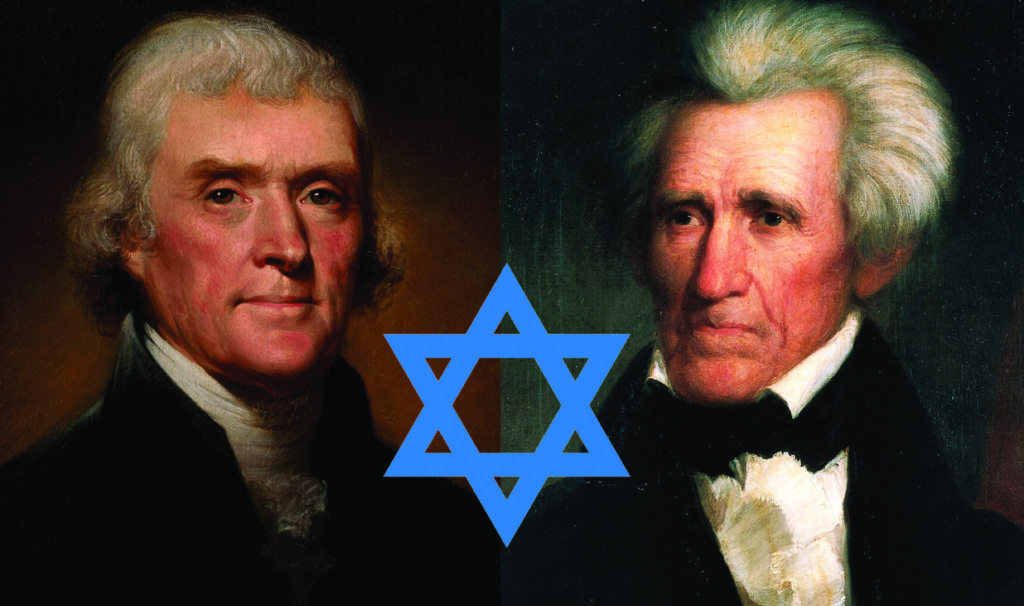
Jeffersonian vs. Jacksonian Jews: Revisiting Jewish Political Behavior in the 21st Century

The 19th-century contest between Thomas Jefferson’s prescription for America and that of Andrew Jackson’s populist ideas are being played out today in this nation’s politics. In some measure, Donald Trump’s rise to political prominence can be tied to the populism identified with Andrew Jackson’s vision for America. By contrast, Barack Obama’s presidency symbolized a globalist perspective, one that more appropriately could be aligned with aspects of Jefferson’s view of what America ought to become.

Americans in general find themselves living in very different political worlds, and so it is with America’s Jews. These generic divisions can be demonstrated for example by Rust Belt Americans, whose ideas radically disagree with the views of those individuals who might be described as “liberal universalists.” By every standard, class, economics, religion, geography and culture, these distinctive groups of Americans have differing ideas about what it means to “be an American.”

Indeed, we find today among some of our citizens an “America First” orientation, with its emphasis on nationalistic policies concerning this country’s direction and destiny. Lacking trust in government and other civic institutions and questioning political leaders’ ability to deliver on their messages, these populist voters in the fall of 2016 embraced the counter-establishment message of Donald Trump, helping to elect him the 45th president.

By contrast, the urban-oriented, big-city voters, comprising this second voter cohort, embraced the liberal, globalist policies of Hilary Clinton. Drawing on David Goodhart’s analysis of the American political scene, “The Road to Somewhere,” we find two totally divergent worldviews emerging among this nation’s electorate. Those folks who relish the return to “the good old days” when people felt rooted in their communities, jobs and lives (i.e., somewhere) are seen as embattled against globalists who focus on the future with its emphasis on “anywhere,” affording them the opportunity to reimagine the world, and more directly, this nation.

We are reminded that the Jeffersonian camp’s liberalism is aligned with a fundamental belief in a commitment to social progress and global engagement, as reflected in our third president’s views on commerce and a commitment to international agreements. A significant cohort of Jewish voters in this country embrace these ideas, as do Jefferson’s philosophical orientation about the rights of the individual. In drafting the Declaration of Independence, he acclaimed, “all men are created equal.” Later, he expressed these ideas in his inaugural address:

“Though the will of the majority is in all cases to prevail, that will, to be rightful, must be reasonable; that the minority possess their equal rights, which equal laws must protect, and to violate would be oppression.” 

Just as Americans in general appear to have limited points of connection and shared agreement with their fellow citizens who hold contrary political views, the Jewish political divisions reflect a similar disconnect. Aspects of these competing ideologies have attracted specific Jewish constituencies. Jewish Republicans today include a significant number of Orthodox voters, while also enjoying a growing commitment from newer American-Jewish constituencies, including Iranian, Russian and Israeli citizens. Correspondingly, secular and Reform Jews, along with a majority of Conservative (religious) Jews, identify as Democrats.

The Jeffersonian camp’s liberalism is aligned with a fundamental belief in a commitment to social progress and global engagement.

American-Jewish Voters
Jews often see their politics through four lenses. One’s worldview provides insights into what America’s role ought to be in the world. Identity politics defines how Jews understand and pursue their specific self-interests. A third criteria involve the differing perspectives on the role of government in society. Finally, where does religion fit into the social construct (religion and society)? 

 The liberal “worldview” perspective desires that this nation employ the resources of the international community in promoting our strategic interests. A contrasting outlook contends that America has core interests that can be defended only by the United States. Jacksonian Jews have become increasingly distrustful of the United Nations and other global bodies in advancing this nation’s policies and in protecting Israel’s well-being.

Identity politics can be addressed from a distinctive Jewish focus. “Is it good for the Jews?” may serve as the essential question, as many Republican Jews embrace Donald Trump as being “good for America and the Jewish community,” citing his pro-Israel actions as emblematic of why this president ought to be seen as favorable to the interests of American Jewry. By contrast, when viewing this administration, many liberal Jews see this president as problematic, even dangerous. Israel’s welfare, they would argue, must be seen in the context of America’s larger interests on the international stage. The Jacksonian camp endorses Trump’s positions on Israel, Iran, the Palestinians and the U.N. In contrast, Jeffersonian Jews oppose the president’s policies in connection with the U.N. and international cooperation, the Middle East and an array of domestic issues.

With reference to the role of government, the Jeffersonian camp sees society as open to celebrating alternative ideas and divergent cultural expressions. It views the role of government as enhancing and promoting social change. Jeffersonian Jews believe that a vital, just society is dependent on the political and social inclusion of all Americans, as they push back against efforts to marginalize minorities and women. Jacksonian Jews, on the other hand, believe that government, as an institution, ought to have a more focused, limited role. Behaviors and practices that violate the social norms of the culture should be rejected. In the mindset of a political conservative, “Constitutionalism” ought to define the limits of government activism.

The fourth criteria focus on religion and society. In the mindset of Jewish liberals, the “wall” of separation between church and state protects this democracy from any one religion or religious ideas from dominating and influencing the political culture. By contrast, Jewish conservatives see religion as a core asset and value of the society. They believe that religious ideas and practices ought to be encouraged and celebrated within the public square, while rejecting the separationist position as not reflective of the intent of this nation’s founders.

In some measure, each camp has a fundamentally different outlook on the contemporary political environment. Jacksonian Jews see the world as a dangerous place for Jews in general and Israel in particular. Having a proven friend in the White House is an essential ingredient in fighting anti-Semitism. A Jeffersonian Jewish perspective might see some of the president’s actions as providing short-term victories without fundamentally changing the basic condition or his policies contributing to the rise in religious violence and social tensions.

Managing Threats to Jews
Jewish political conservatives worry about left-wing, anti-Israel political activities while being less concerned about the alt-right and other right-of-center political expressions, in light of the support that Israel enjoys within the conservative camp. Jewish progressives, on the other hand, appear to have concerns about extremist positions on the far left and right within American politics. A particular worry for this constituency centers on the alt-right and extremist groups’ ties to the current president and his agenda.

The liberal “worldview” perspective desires that this nation employ the resources of the international community in promoting our strategic interests. A contrasting outlook contends that America has core interests that can be defended only by the United States.

How We See Israel
The internal Jewish divide around Israel is a central element in this larger battle over the Jewish future. As American Jews, what should our relationship be with the Jewish state? Two perspectives are driving this debate as well. Israel defenders would argue on what basis should Diaspora communities have the right to publicly critique Israel over its policies and actions? Ought that “right” be left to the citizens of the Jewish nation? Responders from the Diaspora push back, challenging that assumption, noting that Israel was created as the collective expression of the Jewish people, and as such, all Jews not only have the right to express their views but have an obligation to assert their ideas.

Each camp offers a set of complaints about the other. For example, Republicans see liberal Jews as undermining the core interests of Israel. They identify J Street and New Israel Fund, among other institutions, as offering messages and providing support to causes and policies that Jewish conservatives view as problematic. Trump Jews are accused by progressives of focusing only on narrow Jewish interests, demonstrating minimal support for broader social and humanitarian concerns. Liberal Jews worry that the Jewish political right does not appreciate the more subtle interests, core values and agendas that define evangelical Christianity.

Allies in the Battle for America
Each of these constituencies has identified political allies that embrace some, if not all, of their policy positions. Liberal Jews see many of their positions championed by Latino and African-American organizations, specific Protestant and civil liberty interest groups. By contrast, fundamental religious constituencies and an array of conservative political organizations embrace the Israel-U.S. relationship. Certainly, this president’s actions must be seen as reflecting the values and interests of many Jewish Republicans. In turn, Jewish progressives do not find either the messages or actions of this White House to be appealing to their sensibilities or civic priorities.

The political behaviors and beliefs associated with these two definitions of American democracy may provide some clearer insights into the competing viewpoints found among American Jews. As Jews move into the fifth generation of their Americanism, they are increasingly taking on the characteristics and values that more appropriately reflect the mainstream ideas associated with these different definitions on American political identity. If, in the past, Jewish voters were committed to a more consensus-based political orientation, then today as part of their acculturation into 21st-century culture, Jews are rapidly taking on the attributes of the larger social order.

We therefore ought not to be surprised by a growing divergence of Jewish political practice that reflects less on the shared interests that once defined the “Jewish vote” and that currently promotes a more generic view of this nation’s diverse and changing political dynamics. Today, little binds together America’s Jews. At this point, can we even be defined as a community? That term implies a set of shared values and common goals. As part of our divergent American journeys, there is little that appears to bind together Jacksonian and Jeffersonian Jews.

Steven Windmueller is the Rabbi Alfred Gottschalk Emeritus Professor of Jewish Communal Studies at the Jack H. Skirball Campus, Hebrew Union College-Jewish Institute of Religion, Los Angeles. A different version of this article appeared at an earlier date on eJewishphilanthropy. His writing can be found on his website, thewindreport.com. 

Jeffersonian vs. Jacksonian Jews: Revisiting Jewish Political Behavior in the 21st Century Read More »