fbpx

June 14, 2018

UCLA Students File Criminal Complaints Against Anti-Israel Disruptors

Criminal complaints are now being filed by students following the belligerent disruption of a May 17, 2018 Students Supporting Israel [SSI] event at University of California Los Angeles. At least a half-dozen students announced they would visit the UCLA police department to file formal complaints reporting criminal disruption of a meeting, as well as disturbing the peace and conspiracy.

The move follows media disclosures that the UCLA was reneging on the public pledge by two chancellors in the Daily Bruin —bolstered by a statement for the record by a university spokesman — to refer the belligerent May 17 incident to prosecutors.

The disruption and nose-to-nose intimidation of the students attending the May 17 SSI event at UCLA was documented in a video, beginning at minute 41. Disruptors suddenly and loudly stormed into the room mid-session. One person tore down a flag, demonstratively pulled away a desk placard, and cursed threateningly close to the face of a panelist. With bullhorns, whistles, staged dancing, and slogan shouting, the event was shut down.

The Louis Brandeis D. Center, led by attorney Alyza Lewin, along with Director of Legal Initiatives Aviva Vogelstein and three law students in the UCLA Brandeis chapter, dispatched a letter to the university asserting that the disruption crossed the line into misdemeanor violations of the California criminal code. They cited Title 11, section 403 (which covers deliberate disruption of a public meeting —successfully used to convict the so-called Irvine 11), section 415 (which covers malicious disturbance of the peace), and section 182 (which forbids any conspiracy to violate the other sections).

At the same time, two UCLA chancellors, Jerry Kang and Monroe Gorden, penned an official denunciation of the incident that was published in the Daily Bruin campus newspaper. Their statement promised, “For those outsiders who disrupted the event, we will refer all evidence of wrongdoing to local prosecutors to determine whether they have broken the law.”  Bolstering the chancellors, university spokesman Tad Tamberg confirmed, “the off-campus people who have been identified … have been arrested previously and are known to the police here and have been referred to the prosecutor’s office.” He added, that a proper police investigation had already been done. “You don’t send something to the prosecutor’s office without first investigating it,” he stated. The involved UCLA students were to be referred to university discipline rather than prosecutors, the university stated.

It was not clear why UCLA students, who potentially broke the law, would not receive the same referral to prosecutors as outsiders for the same conduct.

The case then took a strange and unexplained twist. Three weeks after the event, in an email, Tamberg clarified, “There were no arrests, nor did anyone file a police report or complaint regarding the May 17 disruption, hence there was no police investigation.” Tamberg explained his prior assurance about a referral to prosecutors actually involved the disruption of an earlier, completely unrelated February 26, 2018 event with Treasury Secretary Steve Mnuchin.

Prosecutors and police assert that without the filing of actual police complaints, no investigation or referral to the prosecutor can take place. None of the disrupted students contacted said they had filed a report, with two saying they did not even know they had the right to file such a complaint. Hence, no action could be taken.

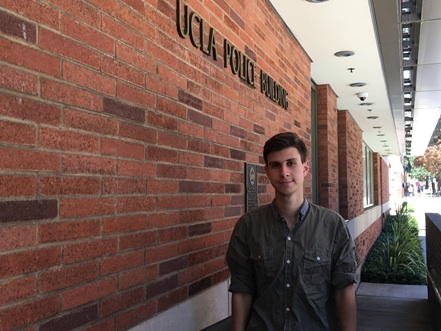
After the media disclosure, numerous students stepped forward to file complaints. The first was Justin Feldman, president of the SSI chapter at Santa Monica College, enrolled at UCLA for the fall semester. Feldman stated he feared for his personal safety during the incident. On June 11, Feldman, who had previously completed a StandWithUs [SWU] high school training program, appeared at the UCLA police department accompanied by Yael Lerman, SWU legal director, to formally file his complaint.

More than a few of the students harassed during the May 17 event were trepidatious about filing a police report. But, according to Lerman, the police made the whole process “comfortable,” acting “helpful and respectful.” After a short wait at the station, officers Robert Chavez and Lowell Rose escorted Feldman into a small room where his report was taken during an hour-long interview in what Lerman described as an “unrushed” session.

Lerman credited Feldman for his actions. “What Justin did in filing was critical in moving the process forward. The [UCLA] administration has known about this for weeks and has chosen not to move this forward. So now the students have to.”

After emerging from the police station, Feldman stated, “I feel empowered.” He added, “I feel it is so important for students to take matters into our own hands, and not leave them to bureaucratic measures.” Feldman stated that “most students simply do not know about the process and what measures can be taken to hold people accountable.” “Justin’s courage will serve to empower other students at universities across the country who will realize that students can help move justice forward when administrations can’t or won’t,” added Roz Rothstein, cofounder and CEO of StandWithUs.

A campus police spokesperson assured that the department would investigate all complaints in the matter. Feldman’s complaint is just the beginning. At press time, Alyza Lewin, COO of Louis D. Brandeis Center in Washington, D.C., had dispatched its director of legal initiatives, Aviva Vogelstein, and a law clerk to fly to Los Angeles to meet with numerous other students who are scheduled to file complaints. Law students in the UCLA Brandeis chapter will observe the process. The police currently are reviewing a list of 10 individuals who allegedly perpetrated the disruption, along with screen captures of their text messages and social media statements. One such message urged disruptors “to shut it down.”

Within 24 hours of Feldman’s complaint, UCLA confirmed that the matter would indeed be referred to prosecutors. “UCPD has reviewed the video of the May 17 disruption, and is investigating the information in the incident report for any new evidence about the disruption that it may contain,” stated university spokesman Tamberg. He added, “UCPD will forward the incident report to the Los Angeles City Attorney’s Office.” A prosecutor has already been assigned. Tamberg stated UCPD “will discuss both the report and the video with the prosecuting attorney in July, when that person returns from leave.”

“This case is a turning point for all students across the country,” asserts SWU’s Rothstein. Lewin of the Brandeis Center agreed stating, “Students across the country now recognize the importance of promptly reporting incidents like these to the police.”


Edwin Black is the New York Times bestselling author of IBM and the Holocaust and Financing the Flames.

UCLA Students File Criminal Complaints Against Anti-Israel Disruptors Read More »

UN General Assembly Censures Israel’s Actions Against Gaza

The United Nations General Assembly voted in favor of a draft resolution censuring Israel on Wednesday.

The 193-member body adopted “Protection of the Palestinian Civilian Population,” following heated debate. The resolution, which censured Israel’s recent actions in Gaza, passed with a vote of 120-8, with 45 abstentions, the Jerusalem Post reported.

Prior to the vote, Danny Danon, Israel’s permanent representative to the United Nations, told the General Assembly support for the resolution amounted to support for Hamas, which controls the Gaza Strip.

“By supporting this resolution, you are a supporting a terrorist organization,” Danon said. “You are empowering Hamas.”

Over the last two months, Palestinians living in the Gaza Strip have held weekly demonstrations at the Israel-Gaza border. Israel has responded to the often-violent protests with military force, resulting in the death of more than 120 Palestinians.

Many of the Palestinians who have been killed in the protests are involved with Hamas, a terrorist organization. Hamas has resorted to unconventional tactics in its latest flare-ups with Israel. The organization has flown kites, set ablaze, into Israel, resulting in agricultural damage inside of Israel.

Many of the protests at the Israel-Gaza border coincided with the U.S. relocation of its embassy in Tel Aviv to Jerusalem last month.

On Wednesday, Danon lambasted the General Assembly for putting forth the resolution, which makes no mention of Hamas.

“I have a simple message for those who support this resolution today: You are the ammunition for Hamas’ guns,” he said. “You are the warheads for Hamas’ missiles.”

Opposed to the resolution’s omission of Hamas, U.S. ambassador to the U.N. Nikki Haley proposed an amendment to the resolution, one condemning Hamas. Haley’s amendment garnered a simple majority—62-58, with 42 abstentions—but needed a two-thirds majority to pass.

Prior to the vote on the amendment, Algeria’s representative to the U.N. called the amendment irrelevant to the goal of the resolution and called for a no-action motion on the U.S.’s amendment.

Encouraging member states of the General Assembly to support her amendment, Haley called Hamas’ actions against Israel “counterproductive to peace.”

Joanne Adamson, deputy head of the European Union delegation to the United Nations, called on Israel to use more proportional measures when responding to violence at its border.

“Israel must respect the rights to peaceful protests and ensure the use of proportional measures when protecting its legitimate security interests,” Adamson said. “We urge all parties to take immediate steps to deescalate the situation and to act with utmost restraint to avoid further loss of life.”

“We condemn the firing of rockets from Gaza into Israel,” Adamson added.

Algeria and Turkey, on behalf of the Arab League and the Organization of Islamic Cooperation, put forward the text of the resolution, which condemns Israel’s “excessive use of force” in Gaza.

UN General Assembly Censures Israel’s Actions Against Gaza Read More »

Korach then and now

Korach is one of Biblical tradition’s greatest villains, and when comparing him to today’s national leadership one wonders if the writers of the Biblical tale didn’t have a crystal ball that projected them into this era.

This week’s Torah portion Korach (Numbers 16:1-18:32) tells the story of a major rebellion led by Korach and 250 Israelite leaders.

Korach was the first cousin of Moses and Aaron (Exodus 6:18-21), a member of the priestly class and part of the ruling elite. The leaders around him are described as “Princes of the congregation, the elect men of the assembly, men of renown.” (Numbers 16:2) The Talmud says of them “that they had a name recognized in the whole world.” (Sanhedrin 110a).

Despite his elevated status Korach wasn’t satisfied. He challenged Aaron’s exclusive right to the priesthood, and his cohorts Dathan and Abiram questioned Moses’ leadership. Korach’s goal was to unseat the divinely chosen leaders. He appealed to the people to overthrow them using religious language and espousing the importance of rotating leaders in office, all of whom were equally worthy.

“And they assembled themselves together against Moses and … Aaron, and said [to them], ‘You take too much upon yourself, seeing that all the congregation are holy, every one of them, and the Lord is among them.’”

Though they spoke the language of “democrats,” Korach and his minions weren’t democrats at all; they were demagogues who manipulated and incited the masses for their narrow self-interests.

Rabbi Moshe Weiler, the founder of liberal Judaism in South Africa, wrote that “Theirs [i.e. Korach and his cohorts] was the pursuit of kavod, honor and power, in the guise of sanctity and love of the masses.”

Onkolos (2nd century C.E.), in his Aramaic translation of the two opening words of the portion, Vayikach Korach (“And Korach took”) wrote It’peleg Korach (“And Korach separated himself”) suggesting that he didn’t consider himself to be one with the people nor was he interested in serving their interests. To use a modern analogue, he saw himself as above the law and wanted to have the power of a king.

Korach sought power for power’s sake and he ignited a controversy based on ignoble motivations and nefarious goals leading to the devastation of the community. In the end, the earth swallowed the rebels alive and sent them to Sheol (the netherworld) in a spectacular inferno. (Numbers 16:31-35)

Korach’s eish ha-mach’loket (“fire of controversy”) became an eish o-che-lah (“a devouring fire”) that augured doom.

“The Sayings of the Sages” (Pirkei Avot 5:21) reflects upon Korach’s rebellion and distinguishes between two very different kinds of controversy. The first is healthy and useful and is pursued for the sake of heaven (l’shem shamayim). This kind of an argument brings about blessing and a stronger community. The second is the opposite. It represents a pernicious fight not based on lasting values. Rather, it brings disunity and destruction. In Judaism, Hillel and Shammai (1st century BCE) embodied the former, and Korach and his legions the latter.

Korach was a cynic. Moses was the opposite, the humble servant-leader.

Who are we? Do we resonate with the voice of Korach or the spirit of Moses?

Who are our leaders? Are they interested in power or the common good?

Turning inward for a moment, Rabbi Rachel Cowan opines that though all of us may aspire to be like Moses, Korach lives within each of our hearts too.

In thinking about ourselves and our leaders, the words of Maimonides remind us of the importance of pursuing higher virtue:

“The ideal public leader is one who holds seven attributes: wisdom, humility, reverence, loathing of money, love of truth, love of humanity, and a good name.” (Hilchot Sanhedrin 2:7)

In our elections, Judaism teaches that we ought to be voting for servant-leaders and not self-centered aspirers to power for power’s sake.


Korach then and now Read More »