fbpx

May 10, 2018

Moving & Shaking: Film Fest Finale, Holocaust Education

The Israel Bonds Los Angeles’ Women’s Division Council held its 2018 Golda Meir Luncheon on May 1 at the Four Seasons Hotel.

Husband-and-wife Talie and Danny Danon, Israel’s permanent representative to the United Nations, served as the event’s guest speakers. Talie discussed “The United Nations: A Women’s Perspective.”

Gina Raphael, the Los Angeles co-chair on the Israel Bonds L.A. Women’s Division Council, led an awards presentation honoring Abigail Kedem Goldberg; Georgette Joffe; Vera Liebenthal; Jennifer Meyers; Sharona Nazarian; Hannah Niman; and Ghazal Rokhsar.

Additional speakers included Karin Eliyahu-Pery, the consul for public diplomacy and culture at the Consulate General of Israel in Los Angeles; Mark Goldenberg served as master of ceremonies; Jean Friedman, women’s division council chair, delivered welcoming remarks; Sinai Temple Cantor Marcus Feldman sang the national anthems; and Jerry Friedman led the invocation and hamotzi.

The event acknowledged Israel’s 70th anniversary since its founding in 1948.

Israel Bonds is a broker dealer that underwrites securities issued by the State of Israel. It ranks among Israel’s most valued economic and strategic resources.

Producer and talent manager George Shapiro (left) and film composer Alan Bergman attended the screening of “If You’re Not in the Obit, Eat Breakfast” on the closing night of the L.A. Jewish Film Festival. Photo courtesy of RozWolfPR.

“We were focusing on what the spirit of life is and what makes them live,” Gold said.

The work features more than showbiz folks. Ida Keeling, one of the individuals profiled in the film, is a 100-year-old woman who, after losing two of her sons while in her late 60s, takes up running.

Classic film and music expert Michael Schlesinger moderated the discussion, which also featured film composer Alan Bergman (“Yentl,” “Toostie”).

LAJFF Director Hilary Helstein introduced the film in front of a nearly sold-out audience. She expressed gratitude to those who had turned up throughout the week to the various films screening around the city.
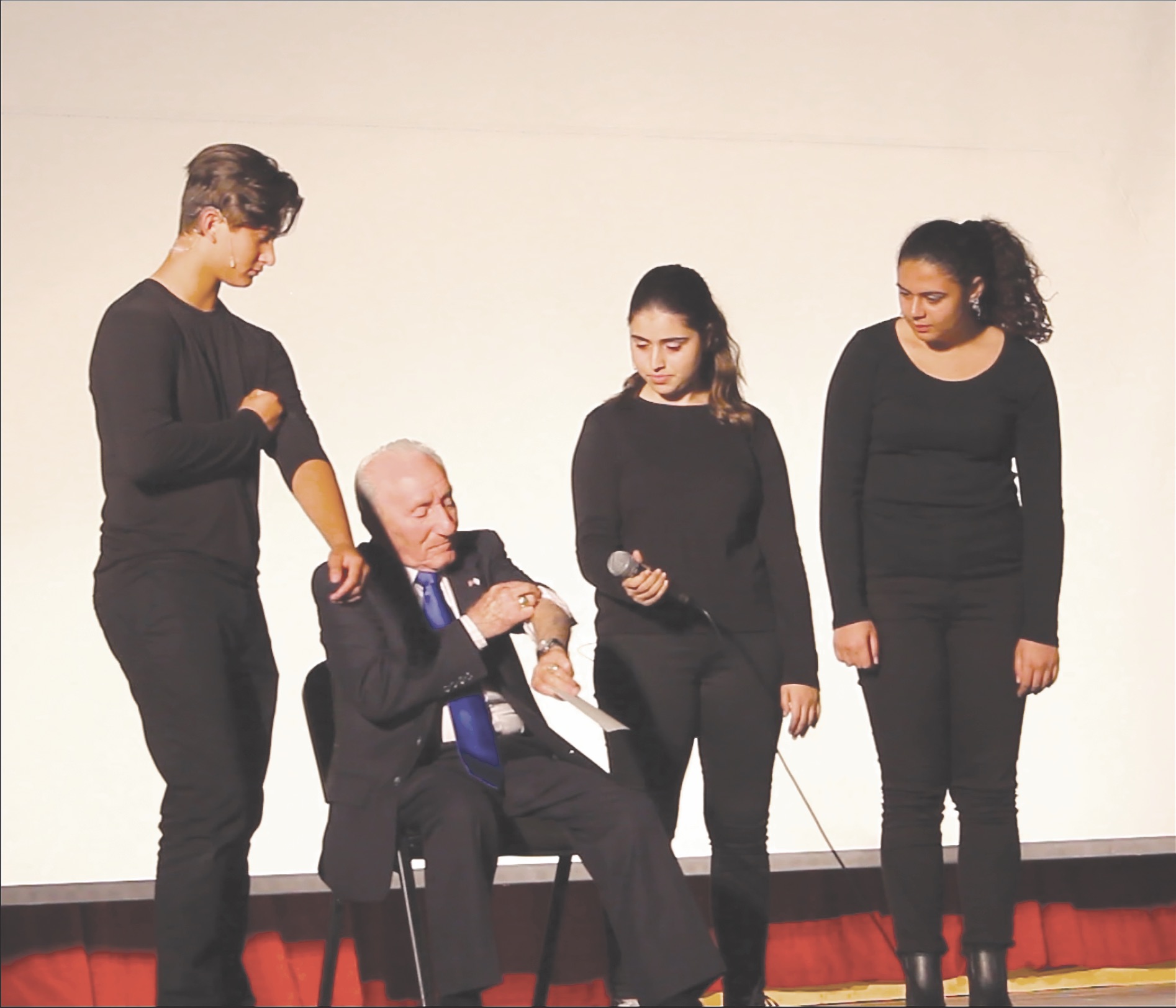
Holocaust survivor Joe Alexander showed his tattoo from Auschwitz to high school students Eli Sitzman, Sara Schechter and Adora Dayani during a Witness Theater: Voices of History production. Photo by Michael Canon.

Holocaust education program Witness Theater: Voices of History staged a student-led Holocaust remembrance program on April 16 at the Norman Pattiz Concert Hall at Hamilton High School.

More than 30 students from 11 local high schools wrote, directed and acted in dramatic vignettes inspired by the stories of Holocaust survivors Mary Bauer, Eva Wartnik, Tomas Kovar and Joe Alexander. Alexander, born in Poland, survived 12 camps during the war.

Ann Noble and Talya Waldman directed the performance, which culminated with the students and survivors appearing together onstage in front of an audience of more than 500 people.

This marked the first year that Witness Theater has staged a production in Los Angeles.

The Los Angeles Museum of the Holocaust and Beth Jacob Congregation served as partners on the production.

From left: Friends of Sheba Medical Center supporter Marilyn Ziering and 2018 Marjorie Pressman Legacy Award recipient Dvorah Colker attend the Friends of Sheba Women of Achievement luncheon. Photo courtesy of Friends of Sheba Medical Center.

Friends of Sheba Medical Center held its annual Women of Achievement Luncheon at the Beverly Wilshire Hotel on April 26, raising more than $350,000 to benefit Sheba Medical Center, Tel HaShomer.

Drawing 450 attendeees, the event honored Judy Flesh Rosenberg with the Women of Achievement Award and Dvorah Colker with the Marjorie Pressman Legacy Award. Helene Boston and Parvin Djavaheri co-chaired. Lynn Ziman served as the honorary chair and Beverly Cohen the vice chair.

Serving as the emcee, Israeli-American actress Moran Atias (“Tyrant”) highlighted Sheba Medical Center’s position at the forefront of the fight against cancer. Sheba patient Tamir Gilat discussed his battle against an aggressive form of cancer under the care of Sheba Medical Center, thanking Sheba’s remarkable staff for providing world-class treatment, hope, and support to him and his entire family.

“We were very happy to welcome so many new friends to our community and together make a direct impact on cancer treatment worldwide,” Friends of Sheba Medical Center President Parham Zar aid after the event.

Sheba Medical Center, Tel HaShomer is the largest and most comprehensive medical center in the Middle East. It combines an acute care hospital and a rehabilitation hospital on one campus, and it is at the forefront of medical treatments, patient care, cutting-edge research and education. As a university teaching hospital affiliated with the Sackler School of Medicine at Tel-Aviv University, it welcomes people from all over the world. ”

Esther Kustanowitz, Contributing Writer
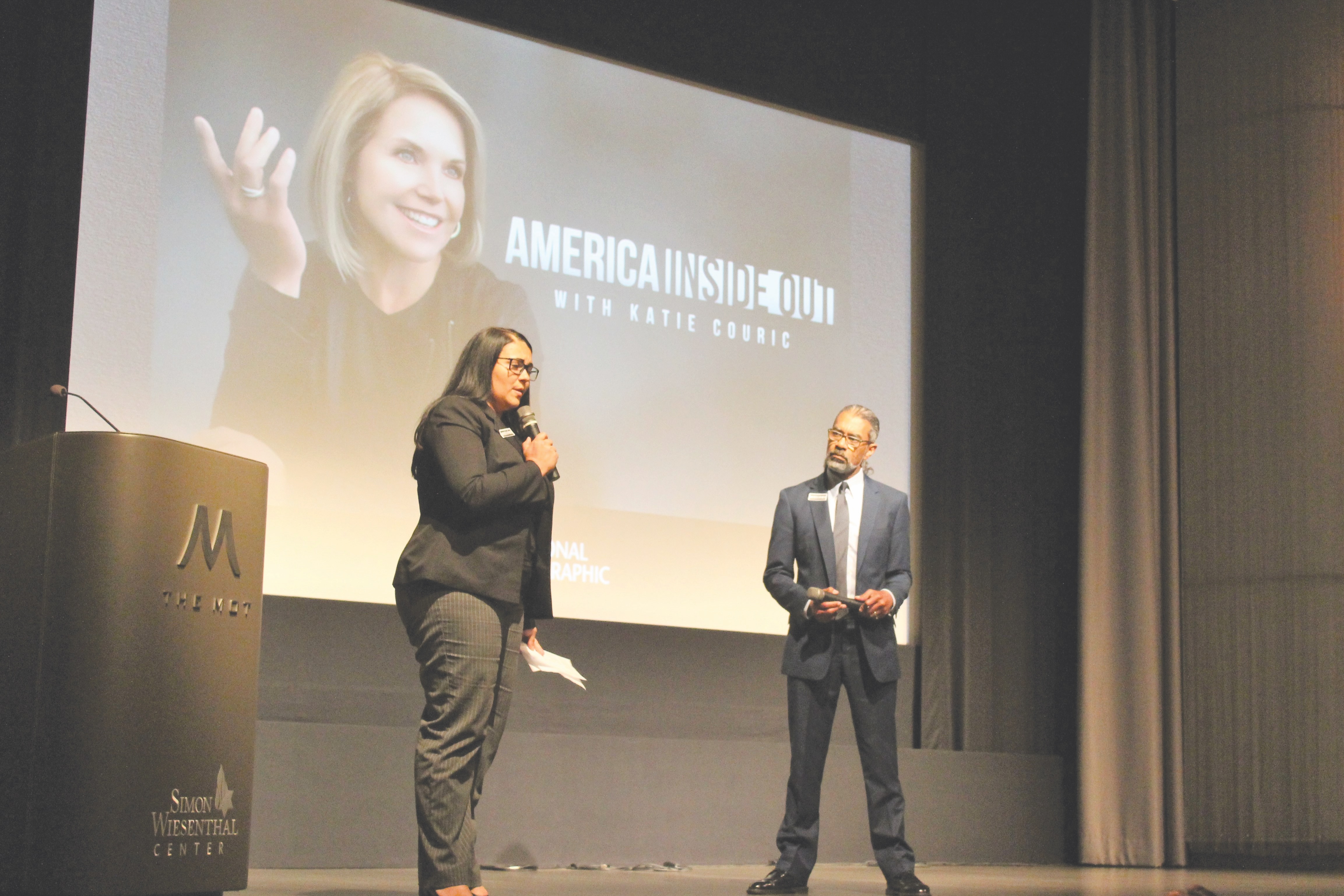
Aziza Hasan, executive director of NewGround: A Muslim-Jewish Partnership for Change, and human relations consultant Lloyd Wilkey speak at the Museum of Tolerance screening of Katie Couric’s new National Geographic series. Photo courtesy of Museum of Tolerance.

The Museum of Tolerance on April 25 screened “White Anxiety,” the fourth episode of Katie Couric’s new documentary series, “America Inside Out,” which is airing on the National Geographic Channel this month.

Couric’s six-part series is about social upheaval across the United States, which is why the Museum of Tolerance was interested in screening the film for the Jewish community of Los Angeles, Museum of Tolerance communications director Michele Alkin told the Journal.

“The Museum of Tolerance plays a crucial role in bringing people together for solutions-oriented community dialogue that has a call to positive action,” Alkin said. “We are working with people with whom we have worked many times in the past on films with a social action message.”

The audience of 300 at the Museum of Tolerance enthusiastically  embraced the theme of Couric’s series.

Speakers included human relations consultant Lloyd Wilkey and Aziza Hasan, executive director of NewGround: A Muslim-Jewish Partnership for Change.

“White Anxiety,” which premiered on May 2, is about large numbers of immigrants pouring into small, insular communities often dominated by a single industry, and about technology taking over traditional working-class jobs. Both developments ignite social and labor upheaval.

The Couric series carries titles including “Re-Righting History” and “The Muslim Next Door.” The series’ finale, “The Age of Outrage,” will air May 16 on the National Geographic Channel.

Ari Noonan, Contributing Writer

Moving & Shaking: Film Fest Finale, Holocaust Education Read More »
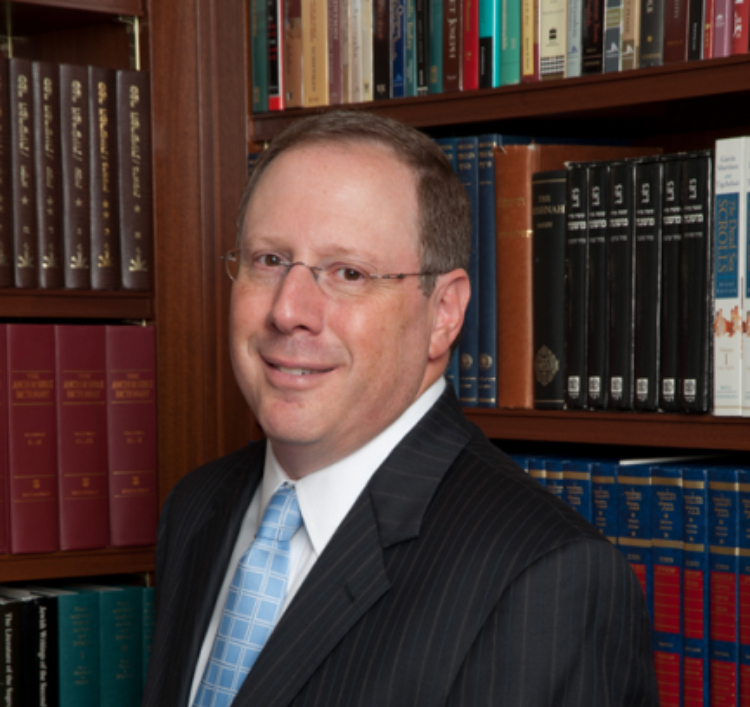
Remembering Rabbi Aaron Panken

Rabbi Aaron Panken, president of Hebrew Union College-Jewish Institute of Religion (HUC-JIR), died in a plane crash on May 5. He was 53.

At around 9 a.m. that day, the New York State Police responded to a report of an airplane crash about 70 miles northwest of Manhattan in Orange County, N.Y. Panken, a certified commercial pilot, was piloting the Aeronca 7AC aircraft, which took off from Randall Airport in Orange County.

His only passenger, flight instructor Frank Reiss, suffered a non-life-threatening injury. A Federal Aviation Administration and National Transportation Safety Board investigation is ongoing.

Panken led HUC-JIR’s four campuses, in Cincinnati, Jerusalem, Los Angeles and New York. He was elected in 2013 as the 12th president in the Reform seminary’s 143-year-history.

HUC-JIR released a statement on May 5 saying Panken was a distinguished rabbi, scholar and Reform leader. “Rabbi Panken strove for ongoing innovation and creativity in strengthening HUC-JIR as the intellectual center of Progressive Judaism worldwide,” the statement read.

“When piloting, he felt great awe and unique closeness to God. The only solace in this tragedy is he died doing something for which he had great passion.” — Rabbi Robert Levine

The release also included a prior statement from Panken himself saying, “For me, Reform Judaism has always symbolized what I consider to be the best of Judaism — firmly rooted in our tradition, yet egalitarian, inclusive of patrilineal Jews and intermarried families, welcoming to the LGBT community, politically active, and respectful of other faiths and ideologies.”

Panken was born in Manhattan on May 19, 1964, to Beverly and Peter Panken. He grew up in the Stephen Wise Free Synagogue in New York City, where he headed the synagogue’s youth group.

He graduated from Johns Hopkins University’s electrical engineering program and earned his doctorate in Hebrew and Judaic studies at New York University.

In 1991, he received ordination at HUC-JIR in New York. That year, he became an assistant rabbi at Congregation Rodeph Sholom in Manhattan. He also took up flying lessons.

“He came back excited every time,” Rabbi Robert Levine of Rodeph Sholom said in a statement on the synagogue’s website. “There was a strong spiritual component to this activity. When piloting, he felt great awe and unique closeness to God. The only solace in this tragedy is he died doing something for which he had great passion.”

In 1995, Panken joined the HUC-JIR faculty, serving as dean of students from 1996-1998; dean of the New York campus from 1998-2007; and vice president of strategic initiatives from 2007-201

He also became acquainted with HUC-JIR faculty and students in Los Angeles, said Rabbi Sarah Benor, a professor of contemporary Jewish studies at HUC-JIR.

Benor was among the more than 70 HUC-JIR faculty members, students and others who attended HUC-JIR’s Los Angeles campus at USC for a minyan in Panken’s memory on May 7.

Panken knew everyone’s names as well as those of their spouses, children and pets, Benor said. He had a talent for “making them feel like they’re important.” She added his death was “such a loss for the HUC community, for the Jewish community and the whole world.”

Madelyn Katz, associate dean at the Los Angeles campus at HUC-JIR, knew Panken for 36 years. Speaking at the memorial, she revealed a different side of Panken. She said they met in the summer of 1982 at the Joseph Eisner Camp Institute for Living Judaism. The then-18-year-old audiovisual worker had “bright red curly hair, red cheeks and was full of life.”

Katz remembered how one day Panken dressed up as E.T. and led 600 kids at camp to the movie theater on a hay wagon to see the blockbuster film.

“He made things light and fun and kept you in that moment,” she told the Journal.

Joshua Holo, dean of the HUC-JIR L.A. campus, told the Journal at the event, “[Panken] had an amazing mind and raw intelligence for grasping problems.”

Wilshire Boulevard Temple Rabbi Emerita Karen Fox, an instructor in practical rabbinics at HUC-JIR L.A. said she met Panken when he was a “NFTY kid,” referring to the North American Federation of Temple Youth, the Reform movement’s youth arm. He was “bright, inquisitive and incredibly funny,” she said.

Fox said she would remember Shabbat dinners with Panken in New York arguing about “politics, Jewish life and what the rabbinate might be. He had a lot of hope.”

Rabbi Ruth Sohn, director of the rabbinic mentoring program at HUC-JIR, met Panken in 1982. She was in her final year of rabbinical school and Panken was a senior in high school. At that time, he was running the Stephen Wise Free Synagogue youth group.

“What I’ll remember is his leadership, his terrific sense of humor. He was such a sweet kid. He would always ask about the family. He was so devoted to what we were doing, with such deep-seated optimism,” Sohn said.

On May 6, one day after Panken’s death, HUC-JIR New York held its 2018 ordination ceremony at Temple Emanu-El. Los Angeles native Tarlan Rabizadeh was among the graduates. She told the Journal that when she heard of Panken’s death, she thought the ceremony should be postponed. However, she said, “The faculty’s response was, ‘We don’t put off simchas.’ Many times you have a wedding in Judaism and someone has died; you can’t put off the wedding. But how can you make the wedding [or ordination] a way that respects these feelings?”

On May 8, Rabizadeh, 32, drove to Panken’s funeral at Westchester Reform Temple in Scarsdale, N.Y. She said continuing on her path toward the rabbinate fulfilled Panken’s legacy.

“The way we [can] honor him is to continue to follow through with what we want to do, and become strong Reform leaders in the world,” she said.

At the time of his death, Panken had nearly 25 years of flying experience under his belt. In a video released by the Central Conference of American Rabbis, the rabbinic arm of the Reform movement, Panken said he flew both powered aircrafts and gliders.

In the series, “One Minute of Wonder,” featuring Jewish leaders providing anecdotes of wisdom, Panken said his experiences with flying had heightened his faith in God.

“What I’ve realized in this is the extraordinary beauty of the world God has created,” Panken said. “When we read the creation story and we learn the sense behind what it means to have the world be created by God, we realize just what an extraordinary gift it is for human beings to exist on this earth and the incredible gift we have to be able to fly like birds.”

Panken is survived by his wife, Lisa Messinger; his children, Eli and Samantha; his parents, Beverly and Peter; and his sister, Rabbi Melinda Panken of Congregation Shaari Emeth in Manalapan, N.J.

This article was edited to correct the date of the ordination ceremony in New York. It originally said the ceremony was held May 7, two days after Panken’s death. In fact, the ceremony was held on May 6, one day after his death. 

Remembering Rabbi Aaron Panken Read More »

Letters to the Editor: Iran Deal, North Korea and Natalie Portman

U.S. Scraps Iran Nuclear Agreement

Let’s start with the proposition that Iran is a very bad actor. Let us also agree that without vigorous monitoring, Iran will not strictly adhere to any agreement. That being said, it is a terrible mistake for President Donald Trump not to recertify the Iran nuclear accord.

Israeli Prime Minister Benjamin Netanyahu’s recent dog-and-pony show was long on accusations but short on specific evidence. The binders and computer discs onstage with him aren’t proof that Iran is failing to honor its responsibilities under the nuclear deal. What Netanyahu and the various authors of the commentaries and articles that support scrapping the accord conveniently overlook is that there is a large element in the Israeli intelligence/military establishment that while acknowledging it’s not a perfect accord, it is working and is good for Israel.

It is also interesting to note the other signatories to the Iran nuclear accord say Iran is honoring its obligations. The only naysayers are Netanyahu and Trump.

Andrew C. Sigal, Valley Village

Kudos to the Jewish Journal for exposing the secrets and lies of the Iranian nuclear deal. The cover story would be enough to tell it all (“What Happens Now?” May 4). Dayenu. Beyond that, the articles describe in detail the lies that were foisted on Americans that were particularly painful for American Jews.

David Suissa gave some Trump haters and, in particular, Jewish Trump haters something to think about (“Why Tyrants Must Hate Trump,” May 4). Admittedly, Trump is brash and a rude tweeter. When it comes to foreign tyrants, as Suissa stated, Trump is just what the doctor ordered. As much as we all value decency, for 16 years the United States got burned by two very decent presidents — first by George W. Bush’s trillion-dollar fiasco in Iraq, and then by Barack Obama’s naïve deal with Iran that empowered the world’s biggest sponsor of terror.

We need somebody like Trump to stare them down and back out of the disastrous Iran deal if Iran does not make further concessions.

Marshall Lerner, Beverly Hills


The North Korean Dilemma

I disagree with David Suissa’s assessment in his column “Why Tyrants Must Hate Trump.” If President Donald Trump’s bluster had worked with North Korea, then it would have stopped testing its long-range ICBMs right away. Instead, despite Trump’s threats, they continued testing until they had proven to themselves that they had a missile that could reach most of the United States. The North Koreans offered to talk only after they had tested enough missiles to prove that their missile program was ready. Listen to the speech that Kim Jong Un delivered to his own country. This was his original intent.

Rabbi Ahud Sela via email


The Natalie Portman Issue

In her column (“Portman’s the Messenger, Not the Problem,” April 27), Danielle Berrin introduces the premise that the effect of Portman’s rejection of the Genesis Prize will lead to increased Jewish disunity on congregational matters, including political problems. Berrin warns that one of the problems is the collapse of peace talks and the promise of a two-state solution.

I have three questions for Berrin.

Does Fatah want a two-state solution?

Does Hamas want a two-state solution?

Does Hezbollah want a two-state solution?

Bernard Schneier, Marina del Rey


How American Jews View Israel

Danielle Berrin claims to rely on, but fundamentally misunderstands, Leon Wieseltier’s advice that the merit of a view “owes nothing to the biography of the individual who holds it” (“Should American Jews Criticize Israel?” May 4).

Wieseltier did not invent this notion. It is his way of restating the classic fallacy of the ad hominem attack: A good argument can’t be refuted because the speaker is bad. Nor can a bad argument be improved because the speaker is good. I have no doubt Berrin has deep love for Israel. But that does not mean her opinion has any merit just because it comes from a good place.

No, what Wieseltier is saying is that an argument — and criticism — must be judged solely on its own merits. What nuanced and insightful advice does Berrin offer for the complex military and diplomatic conundrum Israel is faced with? What is the “truth” that Berrin claims her “holy chutzpah” impels her to tell Israel? I honestly would like to know, but I’ll gladly take the advice of someone who may not love Israel as much as Berrin but has answers to challenges such as: the military land-bridge Iran is constructing through Iraq, Syria and Lebanon to threaten Israel; the tens of thousands of Hezbollah missiles aimed at Tel Aviv; the tunnels being burrowed under the desert to snatch Israelis in their sleep; and the diplomatic and propaganda war waged against Israel by the United Nations, the European Union and nearly every American university campus.

Perhaps Berrin’s Israeli friend really meant that Israel does not want for critics but that if you are going to criticize, don’t assume that your love substitutes for sound analysis. Contrary to Berrin’s claim, film critic Pauline Kael was not respected “because everyone knew she loved” movies. Many people love movies. Kael was respected because she was a true expert on movies.

But even Kael wasn’t good at making movies. What Israel really needs, more than well-intended critics, is smart, practical and realistic solutions to massively complicated problems.

What is the role of love in all of this? If Berrin’s love for Israel drove her to develop these kinds of solutions,

I’m sure everyone, especially her Israeli friend, would be very grateful. But love alone, Wieseltier teaches, does not a helpful opinion make.

Ben Orlanski, Beverly Hills


Leftism’s Misguided Values

Karen Lehrman Bloch’s compelling column “The Golden Calf of Leftism” (May 4) exposes a new crisis among American Jews.

We’ve all been shocked by the increase in Israel-bashing and anti-Semitism at Democratic rallies, leading to feminist organizers’ recent praise of Nation of Islam leader Louis Farrakhan. But many Jewish Democrats still support former President Barack Obama’s white-washing of Palestinian rejectionism, terrorism and contempt for Israel. Some Jewish feminists support Linda Sarsour, despite her anti-Semitism and reported endorsement of Sharia law. Wealthy Jews, many in the Hollywood community, are bankrolling Boycott, Divestment and Sanctions promotion.

It’s a cruel irony that while thousands of French Jews make aliyah to escape rising Muslim terrorism, Jewish “progressives” are abetting the terrorists and condemning Israel, the victims’ only refuge.

Rueben Gordon via email


History Lessons in the Journal

Thank you, Jewish Journal and David Suissa for your excellent publication.

I know a “lot” about Israeli and Jewish history up until about 70 B.C.E. I knew very little after that. Therefore, a few years ago, I decided to learn more about Jews and Israel today. I’d like to be as familiar with you and your culture as I am with my own English-American culture.

Recently, I discovered the Journal: It’s like Christmas, my birthday and Yom HaAtzmaut (a term I learned in the Journal) rolled up into one. Every article I read — even the advertisements — is interesting, informative and educational.

The one major problem I have with the Journal is that I’m not finished reading it before the next issue comes out. Oy vey!

Jerald Brown, Sylmar

Letters to the Editor: Iran Deal, North Korea and Natalie Portman Read More »