fbpx

February 28, 2018

Report: Polish Anti-Semitism Widely Pervasive During Holocaust

A largely unknown document reveals that anti-Semitism among Poles during World War II was on the same level as Nazi anti-Semitism.

According to the Jerusalem Post, a 1946 report from the State Department concluded that even before the war started, anti-Semitism was pervasive in Poland from “a continuation of activities by right-wing groups,” thus making them more receptive to Nazi ideology.

“In the jockeying for political preference in Poland after 1919, most of the major political parties – with the exception of leftist groups – followed an anti-Semitic line,” the report states. “Catholic Church leaders, from Cardinal Hlond down, preached antisemitism and favored an economic boycott of the Jews.”

During the war, anti-Semitism under the Polish Army caused Jewish soldiers to flee the Army and seek refuge in other Allied armies.

The anti-Semitism continued even after the collapse of the Third Reich, as Poles conducted waves of violence against Jews, resulting in Jews leaving the country for West Germany.

“There is not much that is essentially new or different in the current anti-Semitic agitation,” the document stated.

The report comes as Poland is under fire for passing a new law that punishes those who claim that Poland is in any way responsible for the atrocities committed by the Nazis during the Holocaust. The report would seem to undermine proponents of the law who seek to absolve Poland of blame from the Holocaust.

Additionally, Poland has since sought to outlaw kosher meat slaughter and halted efforts to return property to Holocaust survivors.

Israel and Poland’s diplomatic relations have been icy since the passage of law, with Israel ardently criticizing the bill.

Report: Polish Anti-Semitism Widely Pervasive During Holocaust Read More »

Moving & Shaking: NewGround Honors; Teens’ Relief Work

The nonprofit interfaith organization NewGround: A Muslim-Jewish Partnership for Change honored David Myers, Sadegh Namazikhah, Julia Meltzer and the Zeno family during its Suzy Marks and Wally Marks Jr. Trailblazer Award Dinner on Feb. 13 at the Iman Cultural Center.

The honorees represented a cross section of the Muslim and Jewish world.

Myers is the president and CEO of the Center for Jewish History in New York City and a professor of Jewish history at UCLA. He is involved with the NewGround Change-Makers fellowship and teaches about anti-Semitism to participants of the program.

Namazikhah is the founder of the Iman Cultural Center and has supported NewGround since its inception.

Meltzer is an American-Jewish film director who partnered with Mustafa Zeno, a Syrian-American Muslim, on a film about members of Zeno’s family displaced by the Syrian conflict. The film, “Dalya’s Other Country,” which premiered on PBS in June, follows a Muslim teenager and her mother as they acclimate to life in the United States.

Attendees included former L.A. County Supervisor Zev Yaroslavsky; NewGround’s Executive Director Aziza Hasan and its Program Co-Directors Andrea Hodos and Tasneem Noor; Muslim Public Affairs Council President Salam Al-Marayati and Director of Policy & Public Programming Edina Lekovic; and Rabbis Jonathan Klein and Aryeh Cohen.

NewGround was established to improve relations between Muslims and Jews through a professional fellowship, high school leadership council and public programming. The Trailblazer Award is named after Suzy Marks and her late husband, Wally Marks Jr., who provided seed funding to NewGround when the organization was in its infancy.

From left: David Lehrer, president of Community Advocates; Temple Israel of Hollywood Senior Rabbi John Rosove; former L.A. County Supervisor Zev Yaroslavsky; Washington Post columnist Jennifer Rubin; and former Congressman Mel Levine discuss “The Challenges of Trump’s America.” Photo by Robert Lurie

President Donald Trump is dangerous for American Jews, Washington Post conservative columnist Jennifer Rubin said during a Feb. 20 appearance at Temple Israel of Hollywood (TIOH).

“When I’m asked, ‘Is Trump so bad?’ Of course he is so bad,” Rubin said while participating on a panel titled “The Challenges of Trump’s America: A Conservative’s View on Trump.” “He has undermined the basis for American democracy and with that the greatest protection, the greatest support, the greatest freedom the Jewish people in the Diaspora have ever experienced.”

The panel also featured former Democratic Congressman Mel Levine and former Los Angeles County Supervisor Zev Yaroslavsky. TIOH Senior Rabbi John Rosove moderated the discussion, the third program in a series called Community Conversations.

Sponsors of the event included Community Advocates, the Jewish Journal, Jews United for Democracy and Justice, Stephen Wise Temple and Valley Beth Shalom.

Stephen Wise Temple Senior Rabbi Yoshi Zweiback was among those in the audience.

“Why is the Republican Party enabling this man to the extent they are doing it?” Levine said.

Rubin, a former TIOH member, was visiting L.A. from Washington, D.C., where she writes the Post’s “Right Turn” column. Her opinions could have come from Trump’s strongest critics on the left. She characterized the president as an authoritarian who “does not understand what America is about and what it means to be an American.”

“Without that basic understanding, without the appreciation of what America is and what defines America and what the Israel-and-America relationship is built on, we are in very, very deep trouble as Americans and as Jews,” Rubin said.

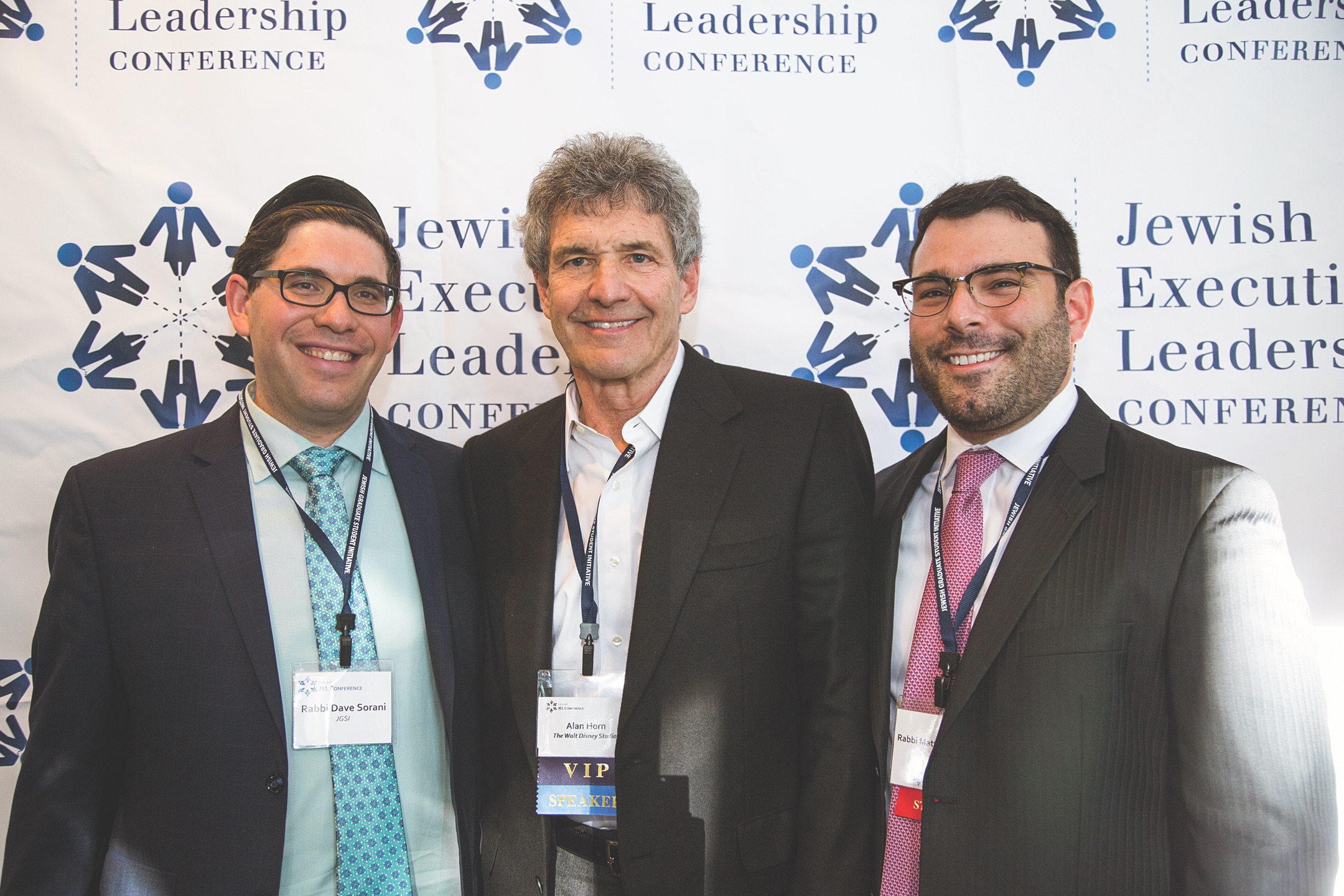
From left: Jewish Graduate Student Initiative (JGSI) CEO Rabbi Dave Sorani, Walt Disney Studios Chairman Alan Horn and JGSI COO Rabbi Matt Rosenberg attend the Jewish Executive Leadership Conference. Photo by Ari Praw

The Jewish Graduate Student Initiative (JGSI) held its seventh annual Jewish Executive Leadership Conference on Jan. 28 at the Fairmont Miramar Hotel and Bungalows in Santa Monica.

The conference, which drew more than 360 Jewish graduate students and young professionals, featured keynote speaker Alan Horn, chairman of Walt Disney Studios, along with approximately 50 other top executive panelists from various industries. During the conference, the graduate students and young professionals learned from the industry leaders and exchanged contact information in the hopes of keeping in touch to help empower their careers.

“This year’s conference was undoubtedly our best ever,” said  JGSI Chief Operating Officer Rabbi Matt Rosenberg. “Each panel room was filled to capacity with standing room only, all of the speakers were fantastic, and we had hundreds of young Jewish professionals networking with one another throughout the day.”

Additional speakers included Scott Adelson, co-president and global co-head of corporate finance at Houlihan Lokey; Michael Kohn, general counsel at Dick Clark Productions; Doug Mankoff, CEO of Echo Lake Entertainment; Jana Winograde, West Coast president of business operations at Showtime Networks; and Lee Zeidman, president of the Staples Center, Microsoft Theater and L.A. Live.
The conference also featured a networking hour showcasing nonprofits — including the Gift of Life Marrow Registry, the Anti-Defamation League, the American Jewish Committee and Moishe House — whose representatives presented volunteering and leadership opportunities to conference participants.

“We are quite excited at the fast-paced growth of this conference,” said Rabbi Dave Sorani, CEO of JGSI. “It is the only event of its kind in the country. We see it growing bigger and bigger each year. And we are extremely proud of its success.”

Mati Geula Cohen, Contributing Writer

Tzedek America’s teen disaster response team, including Avram Mandell, founding executive director of Tzedek America (back row, far left), deconstructs a house in Port Arthur, Texas. The house was flooded during Hurricane Harvey and the water rose to four feet high in the home. Photo courtesy of Tzedek America

Fifteen teenagers from Los Angeles traveled with Tzedek America to Houston and spent several days engaged in relief efforts benefiting Hurricane Harvey victims.

Tzedek America’s Teen Disaster Response Team organized the Feb. 15-19 trip.

“The trip was a huge success,” said Avram Mandell, founding executive director of Tzedek America, a Los Angeles-based Jewish gap-year and social justice program. “We gave over 350 hours of service to the cities of Port Arthur and Houston, Texas. The teenagers worked tirelessly without complaining and celebrated Shabbat with the Jewish community of Beaumont, Texas.

“At the conclusion of the five days, the teenagers said it was a great trip and they only wished they could have had more sleep,” Mandell added. “They are eager to do more service work. They feel that helping people is part of being Jewish, and being part of the Tzedek America Teen Disaster Response Team was a great way to do that.”

The teens spent two days demolishing two houses in Port Arthur and a day rebuilding a house in Houston. They represented three synagogues — Kehillat Israel, Leo Baeck Temple and Temple Israel of Hollywood — all of which are active in social justice work. Two of the teens were unaffiliated, Mandell said.

One of the partners on the project was Nechama: Jewish Response to Disaster, which in February kicked off its rebuilding project in Houston.

“Just thinking about the fact that there are still tens of thousands of houses that stand in disrepair, almost all belonging to poor and elderly people with nowhere else to go, saddens my heart,” said one of the participants, Noam Ginsburg, a 17-year-old junior at Westview Academy. “But I am so grateful that Tzedek America was able to help me help others.”

A Feb. 10 gala at Shomrei Torah Synagogue honored Shomrei Torah Rabbi Richard Camras (second from left). He is joined by his wife, Carolyn (third from left), and flanked by their children, Talya, left, and Noah. Photo courtesy of Shomrei Torah Synagogue

Conservative community Shomrei Torah Synagogue honored its Rabbi Richard Camras on Feb. 10 during a “Hamilton”-themed gala at its West Hills campus.

“It was an overwhelming experience being honored and recognized for the 18-years-plus that I have served my community,” Camras said in an email. “While I know that I am deeply valued by the members of Shomrei Torah Synagogue, and together we have accomplished so much over the years, it was incredibly meaningful to experience and comprehend the deep appreciation the membership has for their rabbi.”

More than 475 guests attended — including gala chair Judy Groner; the synagogue’s Cantor Ron Snow, Cantorial Soloist Jackie Rafii and President Rob Schreiber; and Camras’ wife, Carolyn, and their children, Talya and Noah — to celebrate Camras, who has served as Shomrei Torah’s rabbi since 1999.

“In just 18 years,” Groner said, “Rabbi Richard Camras has experienced a rabbinic evolution, from taking on his first senior pulpit rabbinic position at Shomrei Torah to becoming a passionate, wise, religious leader, both within our congregation and in the greater Jewish community.”

Moving & Shaking: NewGround Honors; Teens’ Relief Work Read More »

Letters to the Editor: Reactions to Parkland, Missile Defense

Reactions to Parkland

Maimonides (1135-1204) never heard of a school shooting, but he understood the National Rifle Association (NRA) perfectly (“When Will It End?” Feb. 23).

Torah obligation in regard to sales of weapons: Maimonides (Mishneh Torah, Laws of a Murderer 12:12, paraphrasing Babylonian Talmud Avodah Zarah 15b) declares: “It is forbidden to sell weapons of war to [those with an inclination to violence]. Nor is it permitted to sharpen their spears, or to sell them knives, manacles, iron chains, bears, lions, or any object which can endanger the public; but it is permitted to sell them shields, which are only for defense.”

Maimonides explains that in selling arms to such a person, “One strengthens the hands of an evil-doer and causes him to transgress” and “Anyone who causes one who is [morally] blind … to stumble — or one who strengthens the hand of a person who is [morally] blind and does not see the path of truth because of the desire of his heart — violates a negative precept as Torah (Leviticus 19:14) states, ‘You shall not put a stumbling block before the blind.’ ”

Mitch Paradise, Los Angeles

First of all, the Second Amendment pertaining to the militia was really replaced by our police forces and the United States military.

Secondly, it takes two-thirds of the states to change a constitutional amendment and that will never happen over this issue. We have gone 242 years without a dictator in the United States.

All semi-automatic assault rifles should be limited to a six-round clip for public use.

Anyone who has been expelled from school, fired from a job, dishonorably discharged from the military or other similar situations, should automatically be put on a no-gun purchase list for two years. After that period, when applying, that person should be on a 30-day review and, if determined not a threat to society, be allowed to buy a weapon.

Schools should have at least one qualified licensed teacher with a semi-automatic handgun and a bullet-proof vest for every 10 classrooms unless all of the above laws are put into effect.

Joseph B.D. Saraceno, Gardena

Kudos to your editorial staff for the excellent commentaries from across a wide spectrum of highly regarded intelligent members of our community. They wrote about the ongoing situation whereby children and teachers are being shot in their schools. Each commentary deserves consideration toward resolving this ongoing “violent culture,” as Rabbi Jeffrey Salkin calls it.

As I read the various comments, it seems that the main argument against the changes needed to end gun violence is the interpretation of the Second Amendment. It reads:

“A well regulated Militia, being necessary to the security of a free State, the right of the people to keep and bear Arms, shall not be infringed.”

The U.S. Congress, over time, has changed its definition of the term “militia” as related to the United States. It’s time for a definition more in line with what our nation needs today — clearly stated so as to leave no doubt.

The Second Amendment specifically limits the right to keep and bear arms to a well-regulated militia. The members of the NRA do not constitute a “well-regulated militia.”

This could well be a good start to rid our country of “the plague of gun violence,” as the Journal labels it in its cover story.

George Epstein, Los Angeles

I find little reason to think that the CIA, FBI, state and local police, psychologists and psychiatrists, family, friends, neighbors or schoolmates will ever be able to identify all among us who may, someday, perpetrate a mass shooting, and it’s clear that we’ll never have the resources to track and monitor those who are merely deemed suspicious.

The automatic rifles debate and failed regulations won’t change until our politicians climb out of the pocket of the NRA, and there’s scant likelihood of this happening anytime soon.

The 300 million-plus guns in which we’re awash won’t be confiscated and will continue to be easy to obtain, and the gun manufacturers aren’t planning to go out of business. Hunters, marksmen, hobbyists and those who own guns for self-protection shouldn’t have to fear that the government wants them.

The only solution I see for those who want to protect their loved ones is to escape.

Hal Rothberg via email

On April 20, there will be a National Action Day featuring numerous forums to protest what seems like an endless series of mass shootings.

I feel it is imperative that yeshivas reach out to their secular and religious brethren across faiths and participate in the day’s planned activities.

April 20 was selected because it is the 19th anniversary of the Columbine massacre, and thus the start of the murderous mayhem that has been continually visited upon our citizens. For Jews, April 20, 1889, has a sickening significance: It was the day Adolf Hitler was born, the genocidal maniac who was the architect of the Shoah.

We are commanded to not kill; we are obligated to perform acts of tikkun olam; and we choose as our task to be the promulgators of morals and values to the rest of the world.

What we cannot do, however, is depend on the conservative right, its white supremacist allies and the Republican lawmakers who have blocked and expunged every gun-regulation initiative unless it has the imprimatur of the NRA.

“Never again” is, unfortunately, a mantra that will be part of our political lexicon unless our vigilance is accompanied by direct and overt actions.

Marc Rogers, North Hollywood

Here’s a suggestion regarding guns from someone whose experiences make him worth listening to.

Former astronaut Capt. Mark Kelly, husband of shooting victim and former U.S. Rep. Gabrielle Giffords, is a gun owner and supporter of the Second Amendment.

He also supports the use of extreme-risk protection orders. This would have allowed law enforcement — had the FBI done its job — to remove the firearm owned by Nikolas Cruz while a determination was made regarding the likelihood that he would commit gun violence, as he expressly said he wished to do.

Julia Lutch via email

There is a very simple solution to the gun controversy as long as politics is removed from the discussion.

Stop blaming everyone except yourselves for shootings on school campuses. Take matters into your own hands and hire armed security guards responsible for school safety. Don’t expect the government or the police or laws to protect you. Do as the Israelis do. And as Ben Shapiro reminds us, “Every single government authority failed in Parkland. And they expect Americans to forfeit our self-defense rights to them?”

There can never be a guarantee that every attack can be thwarted, even if we would abolish the Second Amendment, placed by our Founding Fathers not to defend the public from burglars but to place controls on the new government. The bad guys will still get guns no matter the laws, and the good guys will be defenseless. Among the first things that a totalitarian state does is to confiscate weapons.

All the gun laws on the books would not have prevented any of the atrocities in recent years from happening. And, as is often said, the answer to a bad guy with a gun is a good guy with a gun. I’ll bet that the last words on the lips of someone about to be executed by a terrorist is, “I pray that the guy next to me has a gun!”

C.P. Lefkowitz, Rancho Palos Verdes

Danielle Berrin’s column on guns and Isaiah Berlin is a wise and passionate plea for balance and moderation (“In America, Life Should Come Before Total Liberty,” Feb. 23).

Gun fanatics are ideologues. An ideologue is a person with an agenda, and that agenda trumps everything. It trumps facts, common sense, logic, intellectual honesty and reality. None of those things matters to an ideologue.

By definition, ideologues are extremists and they are found on both the left and the right. Moderates, on the other hand, are pragmatists. Their whole approach is about compromise and finding solutions.

In “The Righteous Mind,” Jonathan Haidt writes, “When a group of people make something sacred, the members of the cult lose the ability to think clearly about it.” This is why Judaism teaches us that idolatry is wrong and dangerous. Only ideologues and extremists engage in idolatry. It’s the NRA’s idolatry of assault weapons that led to the slaughters in Las Vegas and Parkland.

The true path to healing the world is to follow the calm and measured voices of moderates, not the loud and angry voices of ideologues and extremists.

Michael Asher via email

Dear Ms. Berrin: As Benjamin Franklin noted, “Those who would give up essential Liberty, to purchase a little temporary Safety, deserve neither Liberty nor Safety,” accusations of contextomy by Benjamin Wittes and Gregory Ferenstein, notwithstanding.

Warren Scheinin, Redondo Beach


Buoyed by Missile Defense

As Larry Greenfield wrote (Blessings of Missile Defense,” Feb. 16), missile defense has detractors, like letter writer Steve Daniels, who admitted that the Iron Dome system works in Israel and that scientific advancements in the U.S. are proceeding, as well.

Recently, Israel conducted a successful flight test of its new Arrow 3 missile defense interceptor. The Israeli Defense Ministry stated the test was a full military scenario.

I choose Greenfield’s positive vision and the proven successes of missile defense over the cynicism that motivates critics to label this life-saving technology a “boondoggle” for defense contractors. Israeli children would beg to differ.

Karen Reissman via email

Letters to the Editor: Reactions to Parkland, Missile Defense Read More »

Educator Emil (Uzi) Jacoby, 94

Beloved local Jewish educator Emil (Uzi) Jacoby died on Feb. 15 in Los Angeles. He was 94.

Jacoby was born on Nov. 30, 1923, in Cop, Czechoslovakia. After his bar mitzvah, he went to study in yeshiva, first in Cop and then in Ungvar, which at the time was part of Hungary.

At 16, Jacoby left yeshiva and went to the Gymnasia in Ungvar. He graduated in 1943 and moved to Budapest, Hungary. There, he was trained to become a leader of the then-illegal Bnei Akiva religious Zionist youth movement. It was then he adopted a Hebrew nom de guerre — Menachem Uziel. From that day forward, he was known as Uzi.

During World War II, Uzi helped lead the efforts in Bucharest, Romania, and Budapest to rescue European Jews and bring them to Israel. After the war, Uzi was elected as Bnei Akiva’s director of operations in Hungary and served as the camp director at Lake Balaton’s summer camp. It was there that he met the greatest love of his life, Erika, a Holocaust survivor.

On Nov. 29, 1947, Uzi received his doctorate and also became engaged to Erika, almost a year after they met. It was also the day that the United Nations voted to partition Palestine into two states, one Jewish and the other Arab.

Shortly afterward, Uzi (now called Dr. Emil Jacoby) moved to Paris to work with Yosef Burg in the European office of the Mizrahi political movement. He visited Israel and in August 1949 traveled to New York City, where he reunited with Erika.

Settling in New York, Uzi taught at the Yeshiva University High School for Girls in Brooklyn while simultaneously completing two degrees at the Jewish Theological Seminary, as well as a master’s degree in mathematics at Columbia University’s Teachers College.

Uzi and Erika moved to Los Angeles in July 1953. From 1953 to 1956, Uzi was the director of education at Valley Jewish Community Center/Adat Ari El. From there, he went on to become the associate director, executive director and then accreditation consultant at the Bureau of Jewish Education of Greater Los Angeles (now called Builders of Jewish Education). He remained in that position until he retired in 2008.

Uzi also spent 10 summers as the education director for Camp Ramah and was an adjunct professor at the University of Judaism.

Uzi is survived by his wife, Erika, three children, 10 grandchildren and 16 great-grandchildren.

Educator Emil (Uzi) Jacoby, 94 Read More »

Looking for Hamantashen of His Youth in Jerusalem

I’m in Machane Yehuda Market — the big shuk — in Jerusalem — just as I am every week. The “oznei Haman” have arrived. In Israel, hamantashen are called “Haman’s ears” and with a bit of imagination, I can almost make sense of that. Every year, I wander from bakery to bakery during the weeks preceding Purim, and I end up carbohydratedly disappointed. The hamantashen of my youth are nowhere to be found.

The bakeries in Jerusalem, and especially in the shuk, make amazing hamantashen. You want hamantashen filled with halvah? We have that. Chocolate dough hamantashen filled with chocolate? Yeah, we have that, too. How about date filling? Poppy seed? Yup, they’re all here. But like Proust taking a bite of a madeleine, I want that hamantashen that takes me back. Way back. I want to travel back about 50 years.

When I was a child growing up on the South Shore of Long Island, all the way out in Suffolk County (yenevelt — a faraway place, as my grandfather called it) our community was a tightknit enclave of Jewish immigrants from Manhattan, Brooklyn and the Bronx, all seeking a suburban life far from the city.

My parents were deeply involved in the synagogue. My mother was Sisterhood president. My dad taught the confirmation class and was the youth group director of Temple Sinai of Bay Shore.

As youth group director, organizing the annual Purim carnival was his and the teenagers’ responsibility. Games were devised, booths were constructed, prizes were purchased, food was ordered.

To play games or obtain food, guests had to purchase tickets. “Five dollars’ worth is all you get,” my mother would tell us. But I was not going to waste my precious tickets on mundane activities like “Shave the Balloon” or a terrifying Senior Youth Group “Fun House” that would culminate in me putting my hand in a bucket of pitted olives and being told they were eyeballs. I spent my money on the hamantashen.

Without warning or advance notice, the yeast-dough hamantashen fell out of fashion.

Fresh from Stanley’s Bakery (which is still on Main Street) were platters of hamantashen that were the real deal. No halvah. No chocolate. And they were huge. The filling — cherry, prune or apricot —  oozed from the seams. And the dough? The dough was a golden yeast dough and not this crumbly cookie stuff that tries to pass for hamantashen. Like the Danish my father always brought home on Sunday morning —  only better.

Without warning or advance notice, the yeast-dough hamantashen fell out of fashion. They disappeared, never to be found again. Like those Long Island Purim carnivals, they became a distant memory.

Nonetheless, I persevere in my search. Like a relentless explorer, I wander through Jerusalem’s alleys and byways in search of a cherry-filled, yeast-dough hamantashen.

Recently, at one of my favorite bakeries in the shuk, I asked the owner (in Hebrew): “You ever make hamantashen with a yeast dough?”

With a wave of his hand, he responded, “You want a yeast dough? Buy a challah.”

This year, the search is over. I’m making them at home.

Happy Purim!


Before making aliyah, Cantor Evan Kent served Temple Isaiah in Los Angeles for 25 years. In Jerusalem, he is on the faculty of Hebrew Union College-Jewish Institute of Religion.

Looking for Hamantashen of His Youth in Jerusalem Read More »

Author Navigates the Wrinkles of Aging

A doctor of my acquaintance recently circulated a letter to announce the closing of his practice after a long, productive and distinguished career. But he did not call it retirement. Rather, he wrote that he looked forward to “the third half of my life.”

That ringing note of optimism is especially appropriate as the baby boomers, who once warned one another against trusting anyone over 30, are heading toward even scarier ages. The challenge, according to psychotherapist Marcia Nimmer in “Finding Meaning in Later Life: Gathering and Harvesting the Fruits of Women’s Experience” (Routledge Focus), is to achieve what experts in psychology and gerontology call “successful aging.”

Of course, as Nimmer points out, successful aging means different things to different people. “The medical model, for example, often focuses on the biological properties of aging, while ignoring the mind and soul,” she writes. But Nimmer emphasizes that a “purposeful and meaningful life” is just as important as a healthy one. Above all, she cites the pioneering psychologist Viktor Frankl for the proposition that “people are more than biological, social, and psychological beings” precisely because people also possess “a spiritual element that drives them to find ultimate meaning during their existence.”

By considering the “spiritual element” of human existence, Nimmer does not ignore the impact of the real world on flesh-and-blood human beings. To the contrary, she introduces us to the “terror theory,” which proposes that “unconscious concerns about death enhance the need to view the world as a meaningful place.” And she points out that Frankl was an inmate in a Nazi concentration camp: “Frankl’s experiences as an inmate led him to discover the importance of finding meaning in all forms of existence, even the most brutal ones.”

Marcia Nimmer emphasizes that a “purposeful and meaningful life” is just as important as a healthy one.

Nimmer’s book is rooted in the real-life experiences of women from ages 63 to 73 who agreed to be interviewed about their “stories and reflections, joys and tribulations about this developmental life stage.” Indeed, their musings amount to a kind of parallel narrative that fleshes out the theoretical framework of Nimmer’s book, as when a woman in her early 70s named Marion observes: “How do you find meaning? At this point in your life, you see the arc of your life. You can tell the story of your life. Whereas, the early years, you’re so busy writing it that you can’t see it.”

Nimmer insists on connecting theory with practice, and science with spirituality. As the title of her book suggests, human life can be seen as an organic process. “Just as a flower needs the proper environment in order to blossom,” she writes about theories of the psychologists she has studied, “humans need the supportive environment in order to bloom and reach their full potential.” And she always looks for the point at which a human being “feels transported to another realm,” whether by an act of personal creativity or a connection with a religious community: “Friends know that it’s not that I’m fearless,” says a woman named Ella, “but I live in faith, not fear.”

The interviews show that there is no single way to achieve “successful aging.”  One woman feels literally centered when she throws pots on a wheel, another started to take piano lessons, and a third volunteers for a dog-rescue organization. All of them are what Nimmer calls “life-affirming” endeavors, whether intellectual, creative or physical. Even a simple moment can take on a deeper meaning: “I don’t take life for granted,” Heidi says. “I don’t waste days. If I’m sitting doing nothing it’s because that’s what I’m enjoying at that moment.”

But Nimmer also confronts the ultimate issue of aging — the proximity of death. “Contemporary Western society has a collective resistance to accepting death as part of the life cycle,” she points out. “In terms of finding meaning in the second half of life, it seems self-evident that the idea of grabbing onto unlived potential only makes sense within the context of beginnings, endings, and transformations within those parameters.” Here, as elsewhere in her book, Nimmer is plainspoken: “[I]ndividuals in the second half of life may benefit from viewing death as a natural and necessary party of the life cycle.” And Nimmer finds validation in the words of her interviewees. “I’m certainly not ready to die. If something were to happen, though, I wouldn’t feel like I’ve been robbed,” says a retired educator named Rose. “I feel like I’ve had a really rich, full life.”

Nimmer shares her life story precisely because it is fully relevant to the experiences of the other women whose voices we hear in her book. “The forces that propelled me to embark upon the doctoral degree I completed at the age of 62 years are emblematic of the driving force within people that continue to grow and develop throughout the lifespan.” Facing an “empty nest” at home, she was encouraged by a friend to undertake her professional training in her 50s: “G-d willing you will turn 62 one way or another so why not with the title ‘Doctor’ attached to your name?”

Nimmer closes her book with a call for “innovations in social infrastructure and public policies,” which signals her understanding that not every man and woman will be blessed with “successful aging.” Indeed, the sheer size of the baby boom generation threatens to overwhelm the resources that are available to an aging population: “In order to avert what some call the ‘silver tsunami’ in which longevity is seen as a burden on society, we need to reimagine and support a new version of this life stage,” she writes. “In so doing, society will be able to tap into the talent, experience, and wisdom of many older adults.”

“Finding Meaning in Later Life” is a work of scholarship that is primarily addressed to the author’s colleagues in professional practice. But Nimmer writes with such clarity, grace and depth of feeling that she reaches far beyond both her generation and her profession and speaks powerfully to readers of all ages and backgrounds.


Jonathan Kirsch, author and publishing attorney, is the book editor of the Jewish Journal.

Author Navigates the Wrinkles of Aging Read More »

Chagall Comes to Life in ‘The Flying Lovers’

Marc Chagall, born Moishe Zakhavovich Shagall, was a mercurial artist whose turbulent emotions in love and on canvas are reflected in the play “The Flying Lovers of Vitebsk.”

The title’s aerial and passionate lovers are Chagall and Bella Rosenfeld, whose marriage from 1915 to 1944 spanned the violent era of World Wars I and II, the Communist revolution, the rise of Hitler and the beginning of the Holocaust.

It is well to keep in mind that personal and global turbulence when watching “The Flying Lovers” — performed at the Bram Goldsmith Theater at the Wallis Annenberg Center for the Performing Arts in Beverly Hills — for the scenes and emotions shift rapidly, demanding a viewer’s full attention.

The two-person play, augmented by two participating musicians, stars the talented and highly acrobatic actors Marc Antolin as Chagall and Daisy Maywood as Bella, who strut, fly and embrace passionately.

It is not easy to convey the feel of the “The Flying Lovers,” but one example is the sight of Chagall’s large canvas of a rabbi, which suddenly comes to life when Bella’s hands wiggle through holes in the portrait.

An illustration of the artist’s single-minded focus on his art comes through in a rare confrontation with Bella, who gives birth to their daughter while her husband disappears for four days to work on a new creation.

One of Chagall’s paintings, “The Fiddler” (Le Violoniste, 1912-13), has taken on a life of its own as the supposed inspiration for the title of the enormously successful musical “Fiddler on the Roof.”

“The play is not biographical, but it accurately reflects the relationship between Chagall and Bella.”  — Emma Rice

In any case, from Yiddish songs and dances to persecution by the czars, “The Flying Lovers” is pervaded by Jewish sounds and themes. However, both the play’s writer, Daniel Jamieson, and its director, Emma Rice, are British gentiles who “have been drawn to many things Jewish,” Rice told the Journal in a phone call from England.

In the early 1990s, the pair visited Paris and took in an exhibition of Chagall’s works. “The experience was a revelation of the magic realism of Chagall’s art,” Rice said.

Subsequently, the two not only collaborated in creating “The Flying Lovers,” but also played the two principals in the initial productions.

“The play is not biographical, but it accurately reflects the relationship between Chagall and Bella,” Rice said. “I believe the play will be around for many years.”

One hoped-for byproduct of the play, which was funded by Jewish philanthropists, will be to raise interest in Chagall’s life and works.

The artist, who lived for a turbulent 97 years, from 1887 to 1985, was born in Vitebsk, Belarus, a town of 66,000 inhabitants, where Jews made up half the population.

Throughout the artist’s life, he experimented and innovated in many styles — Naïve art, Surrealism, Cubism, Modernism, Symbolism and Fauvism. But whatever his experiments and explorations in style and material, Chagall “remained most emphatically a Jewish artist, whose work was a long dreaming reverie of life in his native village of Vitebsk,” wrote art critic Robert Hughes.

Another appraisal comes from Jackie Wullschlager, who, in her biography of Chagall, lauded him as “a pioneer of modern art and one of the greatest figurative painters … [who] invented a visual language that recorded the thrill and terror of the 20th century.”

“The Flying Lovers of Vitebsk” runs 90 minutes, without intermission, and will be on stage at the Wallis Center for the Performing Arts through March 11. For information and tickets, visit www.tickets.thewallis.org.

Chagall Comes to Life in ‘The Flying Lovers’ Read More »

Creator Shapiro Keeps ‘UnREAL’ Relevant

Now entering its third season on Lifetime, the critically acclaimed series “UnREAL” peels back the curtain on the behind-the-scenes drama at a reality dating show called “Everlasting” and the women who produce it. Sarah Gertrude Shapiro, who created it with Marti Noxon, based it on her experiences as a producer on “The Bachelor” from 2002-2004.

“It was a time in my life that was full of conflict, and that was because I was a feminist working on ‘The Bachelor.’ It was a really rich time to mine,” Shapiro told the Journal. She emphasized that the show is “100 percent fiction” in terms of story, but its characters and themes couldn’t be more relevant.

“When I pitched the show, the premise was a feminist working on a ‘Bachelor’-type show named Rachel Goldberg who has a nervous breakdown over the job she’s doing, and the battle for her soul,” she said. “We’re still tracking Rachel’s moral quandary: She’s trying not to lie but can’t do her job without lying. The idea of somebody trying to cling to honesty in this post-truth Trump era we’re in where facts don’t matter anymore was fascinating to me.”

After two seasons of male suitors, “suitress” Serena, a high-powered, successful tech mogul, is in the choosing position, which enables provocative exploration of gender politics. “The more successful you get, the harder it is to find a partner. That resonated with us and felt like an important thing to talk about,” Shapiro said. “And the idea that every smart, ambitious woman has been told at some point to dumb herself down around men and the dehumanization of that was so interesting to explore.”

Shapiro pointed out that the season was written and shot long before the sexual abuse allegations and the rise of movements such as #MeToo and Time’s Up. In fact, “We were writing the season before the [2016] election, and our assumption was that Hillary Clinton would be the next president,” Shapiro said. “We’d had some conversations with the network about whether this stuff would still be relevant after the election.”

While the world of “Everlasting” is fairly toxic, Shapiro emphasized that the working environment at “UnREAL” is “very, very different. There’s a lot of respect for each other in our creative process. It’s a show run by women, written by women who love and respect each other.”

Their own lives often inspire stories, she noted. She sees a lot of herself in Rachel.

“Rachel Goldberg’s name and having her be Jewish was important to me,” Shapiro said. “I felt that her world was a world that I understood and knew. She was raised with the same Jewish ethics that I was — it’s about being honest and being a mensch and being a hard worker, and they’re always being challenged. She feels terrible for being a liar but she’s also a hardworking overachiever, so she’s getting a gold star at a job that she hates.”

“The idea of somebody trying to cling to honesty in this post-truth Trump era where facts don’t matter anymore was fascinating to me.” — Sarah Gertrude Shapiro

A native of Santa Barbara, Shapiro, 40, describes her Jewish upbringing as “pretty secular. My mom was raised Methodist and sort of pseudo-converted. My dad remarried when I was 13, to a Jewish woman; they’re Conservative and observant. I always felt a huge connection to the Jewish side of my family and, through that marriage, I’ve had an opportunity to be more involved in their synagogue and to find one of my own here in L.A.”

In June 2017, she married writer-director Jacinto Aganza at Kehillat Israel in Pacific Palisades, and their son, Moshe Ixchel, whose names reflect Shapiro’s Jewish heritage and Aganza’s Mexican and indigenous ancestry, was born in October. They are raising him Jewish.

Shapiro, who won an Emmy for outstanding writing in a drama series in 2016 for “UnREAL,” knew early on that she wanted to be a writer. She added directing to that ambition after she took a film studies class at the local city college at age 16. She got her bachelor’s degree in fiction writing and filmmaking from Sarah Lawrence College and made her directorial debut in 2013 with the short film “Sequin Raze.”

In addition to writing, producing and showrunning “UnREAL,” Shapiro also directed one episode this season. “To be able to direct a show I created, a world that I understand and know, was like being a kid in a candy shop,” she said.

She’s currently writing a feature film script for Amazon about Yazidi women who were kidnapped by ISIS, held as sex slaves, escaped and formed a battalion to seek revenge on their rapists. She plans to direct, as well, but the project’s timing depends on whether there will be a fifth season of “UnREAL.”

The show’s fourth season already is shot and is in the editing stage. Shapiro described it as an “all-star” season with men and women from previous seasons returning.

The current season will end with “a bit of a cliffhanger” and on “an emotionally satisfying note,” she said. And the characters’ messed-up, complicated lives notwithstanding, she believes that “there are happy endings possible for these people. It’s important to give them some wins.”

“UnREAL” airs at 10 p.m. Mondays on Lifetime.

Creator Shapiro Keeps ‘UnREAL’ Relevant Read More »

Awash in Self-Obsession

There’s a new mode of transportation in Venice, Calif. It’s called a Bird Scooter. For anyone who has a 3-year-old, these are motorized, adult versions of your kid’s first Razor or Micro Mini, whipping through the streets of Venice like slim, individualized 21st-century gondolas. As whimsical and playful as their presence is in Venice, I have had more than one incident where a Bird gondolier lost in his zippy feeling of invincibility nearly crashed into my clueless perambulation, lost in my glass “Golden Calf” iPhone, almost rendering me a scooter-incident statistic.

There is a distinct tension I feel as an inhabitant of the 21st century that the Birds remind me of: It’s easy to become numb to the presence of others around us, especially those going in a different direction. As both an observer and a participant in this self-obsessed new world, I fear it is desensitizing us to the needs of others, which is one of the cornerstones for building a just society.

This is a national phenomenon. From our tribal allegiances to our cultural xenophobia, all sides are guilty and accountable for feeling that our right of way is the only right way. In our fast-paced flurry about town, our privileged and affordable access to the globe (both physical and virtual), our siloed social media universe facing inward, we have, ironically, lost a human quality — the ability to experience the Other.

In a recent University of Pennsylvania scandal, law professor Amy Wax was asked by the university to “take a sabbatical” in the wake of her publishing an unpopular op-ed in The Wall Street Journal spotlighting a return to “bourgeois values.” Wax recognized the moral decline in the United States, noting that more than half of all children in America are being raised in single-family households, a rise of opioid addiction is decaying our core, and increased tribalism is fracturing our country. Her theory of change was assailed by her colleagues and she was put in academic herem.

As a woman who loves Torah, the fallout from Wax’s editorial captures a unique form of heartbreak. Gone are the days of respectful disagreement; forgotten is the engaged discourse of our academic institutions. It seems that unpopular opinions must be reckoned with through shame, isolation and marginalization of those who generated them. Lost are the academies of Sura and Pumbedita; we have confused the messenger with the messages. Our fingers gliding upon the glass of new media has turned our touch cold to one another. Gone are the days of rigorous and respectful debate, which old-fashioned Jews called machlochet.

It’s easy to become numb to the presence of others around us, especially those going in a different direction.

Pirkei Avot 5:16, the Wisdom of our Fathers (a distinctly male-dominant claim of wisdom — should we ban it because we have yet to unearth its female corollary?) and one of our foundation texts on machlochet states: “Any dispute that is conducted for the sake of heaven, its outcome will ultimately be determined. And if not for the sake of heaven, it will not be determined.”

L’Shem Shaymayim, “For the Sake of Heaven,” hovers heavily. What does it mean to dispute “for the sake of heaven” for a 21st-century reader? The ancient idiom dominates, and our minds weigh it with authority. But what if the whisperings of those who came before us were read instead as: “Any dispute that is conducted for the sake of heaven, its outcome will ultimately be determined. And if it is not, for heaven’s sake(!), it will not be determined.”

The rabbis speak to us from the beyond both imploringly and playfully: Dispute! Debate! Disagree! For most of our musings are not in heaven’s realm. We must recapture the ancient art of machlochet, as our engagement with one another is our redemption while we are still here. Don’t zip speedily by your fellow with a false sense of invincibility because everything ever thought, written or known can be found in three seconds of a Google search. That’s for the Birds.

Let us recapture the awe of standing before the Other; fall in love with the world of ideas, not information. Not all unwanted advances — of ideas or sexual appetites — need be conflated into accusations of sexual assault or an unpopular opinion into an academic lynching. May we smash false idols of glass screens and reclaim the fine art of disagreement with an impish curiosity as we stare face to face with our opposition, as, for heaven’s sake, it is so not about you. It’s about us.


Rabbi Lori Shapiro is the founder and artistic director of The Open Temple in Venice.

Awash in Self-Obsession Read More »

Phil Rosenthal’s 3 Desires: ‘See Everything, Do Everything, Eat Everything’

Phil Rosenthal is best known as the creator, writer and executive producer of the critically acclaimed CBS sitcom “Everybody Loves Raymond,” starring Ray Romano. Rosenthal’s new show, “Somebody Feed Phil,” is now streaming on Netflix, and showcases six cities: Bangkok, Tel Aviv, Lisbon, Mexico City, Saigon and New Orleans, where he eats an assortment of food ranging from high-end restaurants to street vendors. The Tel Aviv episode will be shown on the big screen at Temple Israel of Hollywood at 6 p.m. March 11.

Jewish Journal: How has your Judaism informed your work?

Phil Rosenthal: I’ve inherited a Jewish sensibility and sense of humor from my parents and all those who came before me. All the Jewish comedians, character actors and writers I was exposed to also reminded me of my family in their sense of humor. And with regard to the Italian family we portrayed on “Everybody Loves Raymond” — Italians and Jews do share two traits: all problems are solved with food, and the mother never leaves you alone. But, then again, what culture doesn’t have that? We’d get letters from Sri Lanka saying, “That’s my mom!”

JJ: Why did you want to adapt “Everybody Loves Raymond” for Russian television, despite having little knowledge of Russian culture?

PR: They asked me, and I thought, “Here’s an adventure!” And when I asked the head of Sony if I could bring a camera crew to document the whole thing and he said yes, that’s what really sealed the deal. So we did the show and made a documentary of our experience called “Exporting Raymond.” It turned out way beyond my expectations of a cultural comedy — and it’s available on Netflix, if people want to see it.

“Italians and Jews share two traits: all problems are solved with food, and the mother never leaves you alone.”

JJ: In your two food shows, “I’ll Have What Phil’s Having” and “Somebody Feed Phil,” you travel to popular locations worldwide to sample the food. What prompted this?

PR: It stems from when we did an episode of “Everybody Loves Raymond” in Italy. Ray was not excited about going, so I thought that’s what this show should be about — his character not being excited about going, but once he’s there, he becomes very excited about everything, the food, the people, and so on. And when we filmed it, what happened to his character, I saw actually happen to the person! I thought, wouldn’t it be great to one day have a show where you could do this for other people, turn them on to the magic of traveling? It’s the greatest gift you can give yourself and your family.

JJ: You’ve been married for 28 years. What’s your secret for the longevity of the relationship?

PR: My wife is a saint. Oh, you want more? And sense of humor; I think that’s the most underrated human value. The other stuff of marriage can fade a little bit, but as long as you can laugh with your partner, that’s everything because that’s what remains at the end of the day. I think that’s how we pick our friends and that’s how we ultimately pick who we marry. The appreciation of each other’s sense of humor is everything and connects us in the deepest possible way.

JJ: Any charities close to your heart?

PR: Arts education charities. In fact, we have one run by my wife, Monica Rosenthal, called the Flourish Foundation (theflourishfoundation.org), whose mission is to support and provide opportunities for a complete education for middle school, high school and college-age students in the Los Angeles area, with a primary focus on the performing arts. We also support food banks, food charities and cancer charities.

JJ: What remains on your bucket list?

PR: The world’s pretty big. I have to see everything, do everything, eat everything. You’ll never be as young as you are right now, so while your legs still work, while you still have the breath in your lungs, go. At the end of our lives, we only regret the things we didn’t do.


Mark Miller is a humorist and journalist who has performed stand-up comedy on TV and written for a number of sitcoms.

Phil Rosenthal’s 3 Desires: ‘See Everything, Do Everything, Eat Everything’ Read More »