fbpx

January 24, 2018

Aging and the Meaning of Life

A friend of my ex-husband’s was in town for the holidays. She was someone I’d always liked, and my husband and I didn’t “divide up” our social circle when we split. Any friend of my ex’s is a potential New Best Friend of mine. I hadn’t seen her in a couple of years, and we were making plans to get together.

“We’re still on for dinner Thursday?” I asked. “I really want to catch up and hear what you’ve been doing.”

“Yes, we have so much to talk about,” she agreed. “Life. Work. Aging.”

“Wait! Did you say ‘dating’ or ‘aging’?”

“Aging.”

“You brought that up yourself? I didn’t introduce that topic?”

“I’m totally obsessed with aging these days,” she said.

I’m totally obsessed with aging, too, but I assumed it was situation-specific. I’m single. Divorced with a child. Past 45. Living in Los Angeles. This is not a life stage most of us dream of achieving. We don’t spend our 30s rifling through Solo Mom! magazine, cutting out photos of perky 40-something single mothers sitting in cardboard-box “boats” in the living room with their 10-year-old sons while sneaking peeks at OkCupid on their iPhones. Aging and dating are intertwined for me.

“Everyone our age thinks about aging,” Michelle said. “We think about aging, and you know, the meaning of our lives. Especially me, because I don’t have a child. I think if you have a child, you have more of a sense of meaning.”

I considered this. “I think you need five children for meaning,” I said. “You need to be hectored by other people’s needs at all times to feel that your life has meaning in any consistent way.”

“Well, this is where the Orthodox got it right,” she said.

I thought about my Orthodox friends, a young Chasidic couple whom my son and I have grown close to since moving to L.A. four years ago. When we met, they were in their late 20s and had four kids. I was in my mid-40s with one. Now they’ve crossed into their 30s and have six kids. I’ve turned 50; still one child.

Meeting them reminded me of my late 20s, when I’d lived with an artist boyfriend in Houston, and we both still felt full of the promise of everything. We believed our personal salvation would come — in the form of a one-man show at a New York gallery (him) and publishing a book (me) — and that reaching these goals had profound significance. We had that conviction, the clear-eyed faith that what we were doing mattered beyond ourselves, and in a big way. There was nothing tempered or hedged or particularly practical about our belief in the power of our dreams.

I was also in love for the first time, and fully captivated by the relationship, too. It felt miraculous, like a story. It didn’t occur to me to hold back, wait and see, consider all the factors. I was all in, fully committed.

I have far fewer moments of existential angst than when I was younger.

Our Chasidic friends still are, and it’s always encouraging to see. We’d just joined them for Shabbat the previous week, arriving before sundown. I’d definitely had a moment of peaceful meaning while holding their incredibly cute toddler in a towel, still warm from his bath. He lifted his knees against my stomach, trying to tuck his toes under the terry cloth to avoid the chill.

The month before, we’d helped them serve latkes to passersby at Whole Foods on Montana Avenue. The mother handed me the baby while she chased after the 2-year-old, who had taken off for the parking lot. The 6-year-old girl wrapped her arms around my legs. I stood there, pinned for a moment, looking at the sun slowly setting over the ocean, and felt a profound sense of gratitude. I live in Santa Monica, unbelievably. There are plenty of kids to go around.

Although I am not remotely Orthodox, I love this intelligent, passionate family. They invest so much thought into parenting, and they always provide opportunities to help. I think meaning patches in and out, but service to others, I have realized, is an increasingly important meaning-generator as we age. We move off the center stage in certain regards as we age — or are pushed aside — and can’t help but accumulate knowledge, whether we intended to or not. We often have more traction, more to give, by helping lift up others.

In truth, I have far fewer moments of existential angst than I did when I was younger. Part of this is the lessening of the grip of my ambition. Even when theoretically tethered to telling a story that will change people’s lives — or dripping swirls of candy-colored acrylic on canvas that challenges the current visual vocabulary — personal ambition is too singular a drive to round out the whole day, leaving you too inadequately woven into the lives of others. Lack of responsibility to real, live people can easily flip into that gut-punch of emptiness. Also, ambition requires some success. If no one reads the book, no one’s life gets changed. But there’s no bar you must reach when it comes to helping, especially when it’s physical, interactive and tangible. No critic needs to laud your latke-serving skills in order for that stranger on that corner to be fed.

The opportunity to help is one thing those of us living strictly secular lives can have trouble finding, and part of what my friend Michelle was noting. For so many of us, it takes real effort to find something to do for someone else these days, and regularly, and in a way that doesn’t detract from our other goals. To me, the hosting and needing others to pitch in is where the Orthodox got it right.

That, and the big dinner party every week.


Wendy Paris is a writer living in Los Angeles. She is the author of “Splitopia: Dispatches From Today’s Good Divorce and How to Part Well.”

Aging and the Meaning of Life Read More »

Looking a ‘Nazi in the Eye’

In 2015, Jordana Lebowitz was a 19-year-old freshman at Canada’s University of Guelph when she heard about the trial of Oskar Groening. Three weeks later, she was wearing translation headphones in a German courtroom, sneaking in forbidden paper and pens, and blogging for the Canadian Friends of the Simon Wiesenthal Center. Kathy Kacer, a well-known Canadian children’s author, heard about Lebowitz’s experience and together they wrote a highly readable and very important young-adult book that is one of the first to re-examine Holocaust education aimed at the current “third-generation.”

Kacer is the daughter of survivors; Lebowitz is the granddaughter of survivors. Who will be left to serve as witnesses after the survivors are gone? The remarkable tale recounted in the book “To Look a Nazi in the Eye: A Teen’s Account of a War Criminal Trial” answers that question and leaves readers inspired and hopeful.

When Lebowitz sat in that courtroom, 94-year-old Groening was known as the “Bookkeeper of Auschwitz,” a former SS agent on trial for aiding and abetting the murder of 300,000 Jews. In his opening statement, he expressed remorse at what he had witnessed on the concentration camp train platforms (he was responsible for removing and organizing all valuables from the belongings of new arrivals) but felt he was simply a “cog in the machine,” and because he personally didn’t kill anyone, he should not be convicted. Lebowitz knew that this was possibly the last trial of its kind in Germany, because of the advanced ages of the perpetrators. But since the time three years earlier when she had visited Poland with the March of the Living, she knew in her gut that she needed to serve as a witness for her generation.

The page-turning narrative follows Lebowitz to Germany, where she meets Canadian survivors intent on the brave act of testifying about their horrifying experiences to the packed German courtroom and a multitude of reporters in the room. She also meets a Holocaust denier and even the grandson of Rudolf Hoess. The relationships she develops with the survivors, whom she eventually views as surrogate grandparents, are quite touching. Kacer includes much of the survivors’ wrenching testimonies in alternating chapters and, because of this, the book is recommended for grades seven and up. Readers will read parts of testimonies about being separated from family members at the platform, fears of the gas chambers and experiments with twins supervised by Josef Mengele. However, to counter these difficult parts of the book, the author relates Lebowitz’s surprise and relief at meeting present-day Germans and finding out that they are actively attempting to atone for their forefathers’ sins and taking responsibility for what happened in their country.

Teens reading this account of Groening’s trial through the eyes of Lebowitz will probably identify with her very human reaction when she sees the aged and bent-over German prisoner; she feels conflicted.

“Suddenly the door at the front of the courtroom opened. Jordana sat straighter in her chair. This is it, she thought with a sudden quickening of her breath. She was about to stare into the eyes of a Nazi. … She grasped the arms of her chair and leaned forward. And then she gasped, as an elderly man shuffled in. At ninety-four, Oskar Groening was frail, small, and hunched over. He didn’t look evil. He didn’t look like the murdering Nazi that he was accused of being. With a complete exhalation of breath, Jordana thought, he looks like my grandfather.”

“This trial was not merely addressing history, it was very much applicable to the present.” — Jordana Lebowitz

An additional hero of the story is Thomas Walther, the German prosecuting attorney and Nazi hunter, who is seen as a sort of heir to Simon Wiesenthal. In his retirement, he had taken on subsequent life’s work — bringing Nazis to justice. Because Lebowitz had sent him a rather brazen email request to allow her to attend the trial, he realized the importance of her presence and facilitated the entire thing.

Although Lebowitz spent only the first week at Groening’s trial, the authors’ epilogue reveals it lasted a few months and eventually he was declared guilty and sentenced to four years in prison. When Lebowitz contacted Hedy Bohm, one of the survivors she had befriended, to ask about her thoughts on the light sentence, Bohm replied, “I’ve said all along that it’s not about the sentence. It’s about all of us speaking and being heard around the world. It’s an acknowledgement of what went on in that terrible place.”

Now Groening is 96 years old. He had appealed the verdict and requested he not serve jail time because of his deteriorating health. But a quick Google search revealed that, as of this month, he had run out of options. A CBS News headline of Jan. 17 read, “Ex-Nazi Death Camp Guard’s Final Bid to Avoid Prison Reportedly Rejected.”

An authors’ note at the end of the book explains that Lebowitz, now 22 years old, has become an advocate for Holocaust remembrance and human rights.

When asked what was the most important lesson she learned in regard to her experience at the trial, Lebowitz replied, “It’s that time exists on a continuum. That is to say that every period is connected: past, present and future. … This trial was not merely addressing history, it was very much applicable to the present and set a precedent for the future. From this trial, I gained the knowledge and sense of responsibility rooted in past tragedy to combat human rights violations in the present and help create a better future.”

Lebowitz and Kacer will appear at 3 p.m. Feb. 4 at the Los Angeles Museum of the Holocaust. They also will appear at several local private schools. Their Los Angeles authors’ tour is sponsored by the Canadian Consulate of Los Angeles. Information is available at wcce.aju.edu.


Lisa Silverman is the director of the Sperber Jewish Community Library at American Jewish University.

Looking a ‘Nazi in the Eye’ Read More »

Recalling Curt Lowens, ‘A Figure of Wonder’

At the Saban Theatre, after a Temple of the Arts Shabbat service on Jan. 19, journalist Dean Piper recalled Curt Lowens, his uncle, as a “figure of wonder” midway through a tribute concert to honor the late actor, who died last May 8.

As a child growing up in the United Kingdom during the 1980s, Piper had bragging rights. His uncle had visible roles in “Babylon 5” and “MacGyver,” as well as the movie “A Midnight Clear” with Ethan Hawke. He also recalled Lowens telling him years later that “descriptive words like ‘extraordinary’ and ‘amazing’ should be used only in the right situations and never in a daily phrasebook.”

There was no argument among tribute participants that superlatives barely scratched the surface in describing Lowens’ real-life roles, from Holocaust survivor to Dutch resistance fighter (as “Ben Joosten”), British Eighth Corps interpreter, author of wartime biography “Destination: Questionmark” and mentor to young filmmakers.

Rabbi David Baron, Temple of the Arts President Jim Blatt, journalist and founder of The Man/Kind Project Richard Stellar and others marveled about Lowens’ humility when recalling his rescue of 150 Jewish children and two American airmen during World War II while still in his teens. There also was an unspoken mutual agreement (including from Lowens himself, via the Museum of the Holocaust/Harvard-Westlake School documentary “Curt Lowens: A Life of Changes”) that his greatest role was as an educator determined to keep the memory of the Holocaust relevant among current and future generations of children.

“We are defined by how far we reach out to those in need.” — Richard Stellar

“Curt was that unique young man who only had himself to be accountable for and willing to put his life on the line to save others,” said Samara Hutman, Remember Us director and event chair. “When his family immigrated to America, he was expected to go to business school. He wanted to be an actor, and when he told his father, it was a bit of a scandal as actors in that era were regarded in a similar way to circus performers.”

Hutman said Lowens’ experiences ultimately fed the creative life he chose for himself. One of the students in a workshop he led asked him if he thought his taking on false identities during World War II fed an interest in acting. He said, “I never thought of it that way until you mentioned it, but of course.”

“There’s an old expression that it’s hard to be a Jew because of the laws and statutes required to be a good Jew,” Baron said. “In Hollywood, there’s a saying that it’s hard to be an actor making a living. One of the great ironies is that most of his early roles in Hollywood were as German officers [and other villains] because of his tall, blond bearing and good looks.”

The concert, in cinematic fashion, built up to an emotional climax with a performance of “Bestemming,” a concerto for cello based on Lowens’ experiences composed by Sharon Farber, Temple of the Arts music director and a film and television music composer. Lowens himself narrated the spoken-word portions of composition for the second performance in 2014 at the Saban Theatre.

“After the rabbi told Curt’s story, he invited the children and grandchildren of one of the rescued pilots to introduce themselves,” recalled Farber of the Yom Kippur gathering in 2013 where she first met Lowens. “Everybody was moved, but this moment changed my entire life. At the time, I was working on a commission from the Glendale Philharmonic to compose a cello concerto. I caught up with Curt and asked if I could compose a piece based on his story. He gave me a copy of ‘Destination: Questionmark’ and his blessing.”

“Curt loved young people, and he taught me was that a relationship formed between an inner-city child and a survivor of the Holocaust is one of the greatest weapons in our arsenal in the fight against anti-Semitism,” said Stellar, also a co-founder of the Bestemming Project with Farber. “He also showed that we are defined by how far we reach out to those in need, regardless of who they are or who we worship.”

Recalling Curt Lowens, ‘A Figure of Wonder’ Read More »

‘Grandpoppy’ Shares His Holocaust Story in Short and Sweet HBO Documentary

In just 20 minutes, the documentary “The Number on Great-Grandpa’s Arm” covers much of recent Jewish history, told through the loving relationship between Jack Feldman and Elliott, his great-grandson.

Although separated by some 80 years in age and vastly different experiences, the two bond as close buddies as the youngster prompts the Holocaust survivor to tell the story of his life.

Both are now New York state residents, with Elliott living with his parents in Chappaqua, about 30 miles north of New York City, and Feldman some five hours drive away in Rochester.

At Feldman’s home, and in long walks along the banks of the Canandaigua Lake, Elliott asks first about the number A17606 permanently etched into his great-grandfather’s arm.

Through a combination of vivid recollections, archival footage and superb animation by artist Jack Scher, the film reconstructs a happy childhood in the Polish city of Sosnowiec, whose 28,000 Jews made up nearly a quarter of the population. Feldman skips over some of the grimmer details of his life, but he recounts the city’s conquest by the German army, his imprisonment in a concentration camp at 14, separation from his parents (whom he never saw again), liberation by Soviet troops and eventual immigration to the United States.

The Journal talked to Feldman, Elliott and Amy Schatz, the director of the documentary, which will premiere at 6 p.m. Jan. 27 on HBO. The date marks the liberation of the Auschwitz-Birkenau death camp in 1945 and is now commemorated annually as International Holocaust Remembrance Day.

“We need to make smart films for kids, which don’t talk down to them, even on difficult subjects.”  — Amy Schatz

Feldman survived Auschwitz (partly by trading his Sunday ration of a few cigarettes for food), came to America in 1949 and changed his first name from Srulek to Jack. A few years later, he opened Jack’s Fish Market in Rochester.

The business thrived, despite one quirk. As one African-American customer testifies in the film, “Jack knew what hunger was, so he gave free fish to a customer too poor to pay.”

Schatz, a veteran documentary filmmaker, was attracted to directing the project, in collaboration with executive producer Sheila Nevins, because, she said, there isn’t enough material on the Holocaust suitable for children and their families. That means, Schatz said, that when these children become adults “they won’t be able to pass on the survivors’ stories to future generations.”

Her goal was to transmit Feldman’s experience “gently and with clarity,” and pointed notably to the love between Elliott and his “grandpoppy,” the boy’s endless curiosity, and his patience in dealing with Feldman’s hearing problems.

Animation artist Jack Scher contributed illustrated scenes for the film.

Schatz shot the film in three days, working closely with the Museum of Jewish Heritage in New York, which will include the film in its permanent collection, and drawing on the archives of the Steven Spielberg collection at the United States Holocaust Museum in Washington, D.C.

From the reactions of her own children, ages 13 and 14, Schatz concluded that “we need to make smart films for kids, which don’t talk down to them, even on difficult subjects. At the same time, I found that the Holocaust survivors themselves were delighted to talk to the youngsters.”

Elliott, now a 12-year-old sixth-grader, was 7 when his great-grandfather first took him to a Holocaust memorial event.

“At first, I didn’t understand what had happened,” Elliott said, but after five years of additional conversations with his beloved mentor, the boy realizes what he has gained through the instruction.

What he has learned and knows now, Elliott said, “makes me more appreciative of what I have in my daily life and more proud of my heritage and religion.”

‘Grandpoppy’ Shares His Holocaust Story in Short and Sweet HBO Documentary Read More »

Jewish Atheist Versus Christian Believer

Mark St. Germain’s play “Freud’s Last Session,” envisions a fictional debate over the existence of God between atheist Sigmund Freud, known as the father of psychoanalysis, and author C.S. Lewis, a former atheist who became an ardent convert to Christianity. The play enjoyed a successful two-year run off-Broadway, beginning in 2010, and is now being staged through March 4 at the Odyssey Theatre in West Los Angeles.

Although the meeting between the two men never actually took place, St. Germain was inspired to create the scenario by the book “The Question of God,” in which Harvard psychiatrist Armand Nicholi places the arguments of the two opponents side by side. St. Germain recalled seeing both men on the book’s cover. “Their contrasting views were immediately apparent for me, and I thought they would be fascinating in a dramatic situation,” St. Germain, who lives in Woodstock, N.Y., said in a telephone interview.

The beginning of the play is set on Sept. 3, 1939, a year after Freud (Martin Rayner), who was Jewish and living in Vienna, escaped the Nazis and found refuge in England. Many of his family members also fled, but his four sisters couldn’t get exit visas and died in concentration camps.

Meanwhile, Lewis (Martyn Stanbridge) has written his 1933 allegorical novel, “Pilgrim’s Regress,” in which he satirizes a character based on Freud. Freud maintains that he has never read Lewis’ book but has been told about it by colleagues.

“He says in the play that he’s invited C.S. Lewis to see him to see why someone who [once] agreed with Freud … then converted to Christianity and a belief in Christ,” director Robert Mandel said. In the play, Lewis tells Freud that his conversion was instantaneous — like being struck by lightning — as he was riding in the sidecar of his brother’s motorbike some time ago. He started the ride as an atheist and ended it as a believer.

As the discussion unfolds, we learn that both men loathed their fathers. Freud uses Lewis’ hatred to dissect the man’s need for God to exist. “There is a portion of the play where Freud, in a brief analysis of Lewis, wants Lewis to reach the conclusion that his love of God was his eternal search for a father figure.”

As the discussion unfolds, we learn that both men loathed their fathers. Freud uses Lewis’ hatred to dissect the man’s need for God to exist.

While the play is essentially a dialogue between two men bent on justifying their world views, St. Germain has added elements that infuse the proceedings with a sense of urgency. Freud has undergone several surgeries for oral cancer and wears a painful prosthesis in his mouth. In one scene, he begins choking on his prosthesis and Lewis has to pull it out of his mouth. His death, which he knows is imminent, hovers over the action, and we learn that he has made a pact with his doctor to help him die and avoid needless suffering. Freud did actually die two weeks after the date of this imaginary meeting. Sept 3, 1939 is also the date that England entered World War II; we hear a radio announcement to that effect by King George VI.

When sirens sound, in a false alarm, Lewis is reminded of his terrifying experiences in World War I and suffers a bout of post-traumatic stress disorder. Freud helps him get through the painful episode.

Mandel observed that, while the characters eventually admit that they have not solved the question of whether God exists, they have developed a deep respect for each other.

“The encounter opens them both up more as people and forces them to
think deeply about their beliefs,” St. Germain said.

He hopes the characters will prompt viewers to “take time out to think about their beliefs and their lives — questions we usually don’t ask ourselves until we find ourselves in dire situations.”

“Freud’s Last Session,” Odyssey Theatre, 2055 S. Sepulveda Blvd., Los Angeles. Through March 4. Friday and Saturday, 8 p.m.; Sunday, 2 p.m.; Feb. 21, 8 p.m.; Feb. 8 and March 1, 8 p.m. (310) 477-2055, ext. 2. OdysseyTheatre.com

Jewish Atheist Versus Christian Believer Read More »

Jewish Same-Sex Couple Sues U.S. Over Twins’ Citizenship

Same-sex couple Andrew and Elad Dvash-Banks filed a lawsuit against the State Department this week for giving United States citizenship to one of their year-old twin boys but not the other.

The suit, also filed with a female same-sex couple in a similar situation, lists both the State Department and Secretary of State Rex Tillerson as defendants.

Los Angeles-born Andrew and Tel Aviv-born Elad had hoped to marry in the U.S., but in 2010, the Defense of Marriage Act was still in existence, so the couple moved to Toronto, where Andrew also has citizenship and gay marriage was legal.

The couple married in 2011 and knew they wanted a family. After finding a surrogate, they used sperm from both men, and the Dvash-Bankses were thrilled when their sons, Aidan and Ethan, were born. Aidan is Andrew’s biological son and Ethan is Elad’s biological son.

In a video put out by Immigration Equality, Andrew said, “When the twins were born and we saw our children take their first breath, their first cry, it was just amazing.”

“How are we going to explain this to [Ethan] when he grows up? [Aidan] is a U.S. citizen at birth and you’re not?” — Elad Dvash-Banks

When same-sex marriage was finally legalized in the United States in 2015, the couple planned to move back to Los Angeles, with Andrew sponsoring Elad’s green card. They returned in August 2017 to Los Angeles, where Elad works at IKAR as the organization’s development manager.

However, immigration authorities demanded DNA testing for the twins, and determined that because Aidan was the only child biologically related to Andrew, he alone would be granted U.S. citizenship.

His twin brother, Ethan, also is a plaintiff in the lawsuit as he was allowed into the country only on a tourist visa, but that expired on Dec. 23, 2017.

The lawsuit states, “All of Andrew and Elad’s professional, personal and familial commitments are in constant jeopardy of being undone if the Department of Homeland Security deports Ethan.”

While the State Department has not officially responded to any requests to discuss the lawsuit, its website states that children born overseas via “Assisted Reproductive Technology” can be granted citizenship at birth only if they are “biologically related to a U.S. citizen parent.”

Andrew and Elad were shocked when they were asked to perform a DNA test on their children. They queried if they had been a straight couple — an American husband and an Israeli wife — would they ever have been asked to perform a DNA test or questioned if they had used a surrogate.

The lawsuit also argues, “The State Department’s policy is arbitrary and capricious and serves no rational, legitimate, or substantial governmental interest. The State Department’s policy drives families apart by treating the children of the same married parents differently depending upon which father’s sperm was used during fertilization.”

“Being a father is everything to me. It’s really important for us that our kids can fulfill their full potential,” Elad said. “All we want is a healthy, happy family. How are we going to explain this to [Ethan] when he grows up? [Aidan] is a U.S. citizen at birth and you’re not?”

“[Ethan] should be treated like any other child born to a U.S. citizen,” Andrew said. “Like his twin brother or like any other child born to a U.S. citizen abroad. None of it makes sense. It’s not right and we know it’s not right.”

Jewish Same-Sex Couple Sues U.S. Over Twins’ Citizenship Read More »

De Toledo Goes Green

At de Toledo High School in West Hills, the garden includes four raised growing beds, fruit trees, a toolshed and a new greenhouse that’s growing spirulina — a superfood — in partnership with a Tel Aviv high school. De Toledo has a recycling program and a composting program, and for Sukkot its students repurposed old soccer goalposts to fashion sukkah walls. All of the aforementioned are part of de Toledo’s commitment to sustainability and increased environmental awareness, said Becca Bodenstein, the school’s 12th grade dean and teacher of Judaism and the Environment. She’s been helming these efforts since 2007, when she joined the staff of the school’s previous iteration — the New Community Jewish High School, or “New Jew.”

“When man was put on Earth, we were given the power to rule it and the responsibility to care for and protect it,” Bodenstein said. “Everything we do addresses our responsibility toward sustainability, from the food to the compost to the recycling to the amazing experiential and academic programming.”

One example of that programming is the new Camp Eco-Botics for middle school students, which includes ecology (growing, harvesting and cooking food) and robotics. The Ecobots — as the program’s students/campers are known — built a scarecrow and planter boxes and visited the Shalom Institute’s honey farm to learn about bees’ role in the environment.

Bodenstein believes in hands-on experiential education and in connecting learning to current events. “The garden component — growing, touching, tasting, smelling and appreciating it — cultivates hard work and patience,” she said, “but our newspapers are talking about environmental issues every day.” The recent drought and the wildfires in California, she noted, are part of the state’s evolving environmental picture.

The experiential approach works. Former student Michal Anna Chetrit remembers her “Judaism and the Environment” experience at New Jew, taking care of the plants and lemon trees, and learning from Bodenstein how to connect her Jewish heritage to her responsibility to the earth. Bodenstein taught Chetrit and her peers Jewish concepts such as bal tash’hit (prohibition against wasting food/ resources), za’ar ba’aley chaim (not causing animals unnecessary suffering), pikuach nefesh (saving a life), tzedek (acts of righteousness) and environmental justice, and aspects of tikkun olam (fixing a broken world).

A personal or communal journey toward increased environmental awareness, conservation and sustainability starts with giving up or reducing use of plastic.

Now 22, Chetrit is a senior at the University of Arizona, studying the environment and Judaic studies and volunteering at an organic farm. “I’m implementing Jewish lessons from the class into my life,” she said, identifying the concept of bal tash’hit as a guiding principle, which she expands to include “also not wasting energy or time.” After graduating, she hopes to help the Jewish community of Tucson reconnect with its agrarian roots.

This kind of environmental program and its student impact are more than many schools, synagogues and community organizations have to offer, but Bodenstein sees them as only the beginning.

“The earth needs positive environmental leadership now more than ever,” she said. “It’s our responsibility as educators in all contexts. We need leadership to teach, build up a new generation of kids who can fix all the problems that we have.”

As an example, Bodenstein pointed to Netiya, a Los Angeles organization that works with faith-based communities, using their land not just to alleviate food insecurity “but teaching people about the delicacy of the earth that we live on. Synagogues and schools are the perfect places to do that learning.”

A personal or communal journey toward increased environmental awareness, conservation and sustainability starts with giving up or reducing use of plastic and finding the best recycling program for your school or institution, she said. But she also believes in the power of community to make a difference, identifying networks — including the ROI Community of Jewish Innovators, Jewish environmental organizations Mazon and Netiya, and Camps Alonim and JCA Shalom — that “shaped my education perspective and ability to have endurance and hope.”

“Find the network of people who are with you in this battle,” Bodenstein said. “You have to have hope, keep moving forward, educating and inspiring. You have to replant. You have to tend the garden. You can’t stop or nothing is going to grow. There is so much work to be done and everyone needs to dig in and do their part.”

De Toledo Goes Green Read More »

BaMidbar Launches Jewish Wilderness Therapy Program

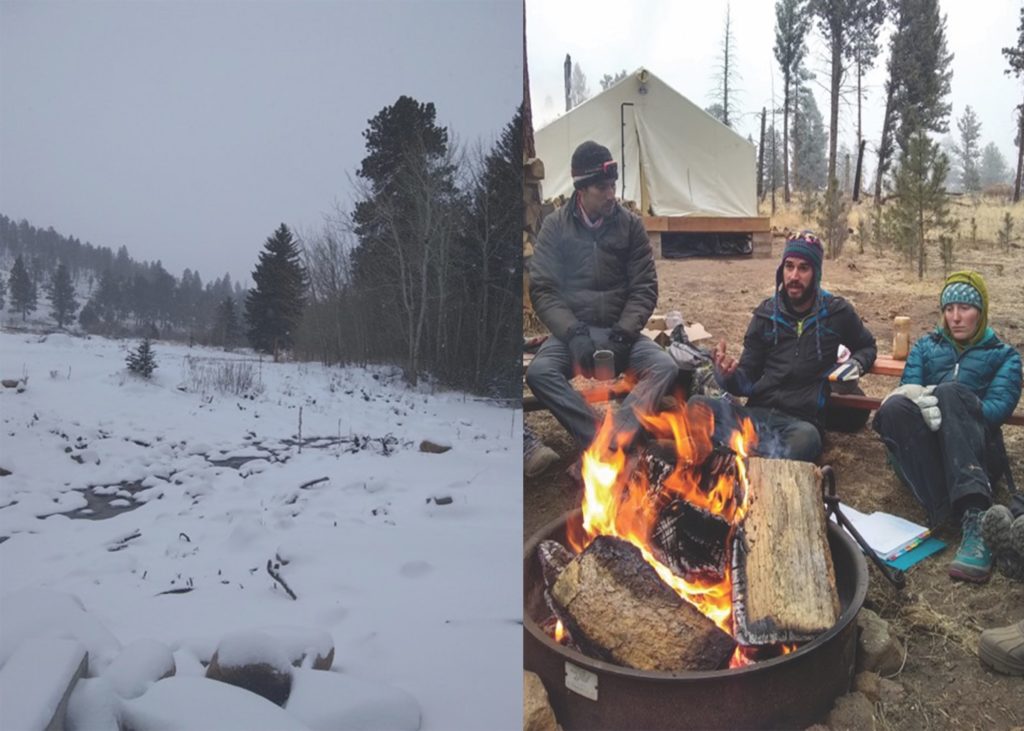
It’s mid-January, snow covers the ground and biting winds blow as a dedicated group of young men and women bundled up in winter coats, stocking caps, gloves and scarves huddle around a campfire high in Colorado’s Rocky Mountains.

They’re participating in field-team training as counselors for the launch of the BaMidbar Wilderness Therapy Program, which officially began on Jan. 24. The program focuses on the emotional, behavioral and academic challenges facing young Jewish adults between the ages of 18 and 26. Courses run for 8–12 weeks and can cater to 12–20 participants at a time.

While BaMidbar is its own nonprofit organization, it uses the camp facilities of Ramah in the Rockies, a 360-acre ranch in the Pike and San Isabel National Forests, elevation 8,000 feet. BaMidbar is also partially supported by the Charles and Lynn Schusterman Family Foundation.

“It was a simple question of how many Jews out there have been going to secular or Christian wilderness programs, and is there a need for something in the Jewish framework that we can provide?” said BaMidbar Director Jory Hanselman in a phone interview with the Journal.

Hanselman credited Ramah in the Rockies Executive Director Rabbi Eliav Bock and wilderness therapist Cliff Stockton (both of whom are also part of BaMidbar’s staff) for launching the program that has been two years in the making.

Hanselman worked at Ramah in the Rockies in 2010 and 2011 as the service learning coordinator — working with the head of Jewish education to create a program offering service-based learning and experiential learning. She jumped at the opportunity to take on the director position at BaMidbar when it became available.

On a practical level, BaMidbar is both kashrut and Shabbat observant, thereby opening up the program to many who could benefit from a wilderness therapy experience but haven’t had the opportunity to do so. Hanselman said that while she believes the Jewish community has increased awareness around addiction and mental health issues in the past 10 to 15 years, “there’s still so much more work that can be done.”

“There’s a lot of stigma about mental health issues and addiction across the board, but especially in the Jewish community,” Hanselman said. “There’s a strongly expressed sentiment of ‘Jews don’t have problems with addiction’ or ‘This isn’t a Jewish problem.’ And there’s a lot of denial, quite honestly.”

In creating the BaMidbar program, Hanselman said, “Wilderness therapy programs rely really heavily on metaphor and storytelling and rituals, and as an industry they use Native American traditions.” As such, BaMidbar saw an opportunity “to really make a difference and have the program be strongly founded in Jewish ritual, Jewish tradition and Jewish metaphor and storytelling.”

“There’s a lot of stigma about mental health issues and addiction across the board, but especially in the Jewish community.” — Jory Hanselman

BaMidbar boasts a three-person clinical team, enabling primary therapists to work one-on-one with participants. There is also a field therapist who doesn’t carry individual caseloads but plays a connecting role between the therapists and what’s happening in the field, Hanselman said.

The therapeutic program includes four-day wilderness treks, with Shabbats spent at Ramah’s base camp, where participants can have individual, group and family therapy amid a strong emphasis on the family system.

“There will be a parallel process for families to integrate them into the program and better understand how they can be supportive and create healthy relationships, and how parenting a young adult is different to parenting an adolescent,” Hanselman said.

As for the decision to open the program in January, just a week before Tu B’Shevat, Hanselman said that while the season is definitely a challenge, winter can be one of the most powerful times for participants because wilderness therapy relies heavily on the idea of natural consequences.

“Using that wilderness-based environment is critical to building self and understanding personal responsibility as well as resiliency, so winter provides a powerful tool to really bring a lot of presence in the program,” Hanselman said. “A student can’t look at it as a summer camp experience. They have to engage in the critical process.”

For more information visit www.bamidbartherapy.org

BaMidbar Launches Jewish Wilderness Therapy Program Read More »

The Saudade of Cake

Aside from the fact that my father is a remarkable storyteller, he has been swimming upstream for many of his 79 years on Earth, and I’ve been along for much of the ride and inadvertently have followed in his footsteps.

In 1966, he left the relative security of his close-knit Bulgarian family in Israel and plunged into the great abyss of New York City. He had very little money to his name and a wife and small child to support. My mother had little desire for adventures like these and was struggling enough with the responsibilities of being a new mother. She also didn’t speak more than a few words of English.

Back then, New York City was not the gentrified Disneyland of today but a rough-and-tumble town with opportunities and dangers in equal measure around every corner. My father says he was so thin then that he and his friend, another Israeli emigre, could effortlessly squeeze through the subway turnstiles together so they could ride on one fare. When he rode the subway, he carried an umbrella in case he needed to fend off would-be muggers.

My father reinvented himself again and again, always carrying us along, bolstering my mother and me with his seemingly never-ending fountain of optimism and energy. He moved us to six states before I was 11 years old, pushing forward ahead of technology until finally building a successful company. We even did a brief stint back in Israel, the intended goal from the start, before both my parents realized that they felt more comfortable in the once-foreign land of America that had accidentally become their home.

“To ground myself, I decided to use my challah dough to make a version of Kozunak.”

Because I now live in Uganda and my parents are still in the U.S., our time together when I visit is limited and can be somewhat fraught with tension. We race to tell one another stories and fill in details of conversations that shouldn’t have started on the phone in the first place. While my husband and I struggle with jet lag and the cold weather that chills our Africa-thinned blood, my parents fill the inadequate time with us by passing on their knowledge and experiences from which they think we might benefit.

During my most recent visit, I found myself marinating in stereotypical reverse culture shock. After not living in the U.S. for 15 years, I began lamenting the “old” version of America I once knew. An America where people weren’t staring at smartphones and wearing headphones in public places. I longed for the days when there wasn’t a minimum of two Starbucks on every corner, and the city still had grit and flavor. I was experiencing saudade (sow-DAH-jeh), a Portuguese word that means a constant feeling of absence or sadness for something that’s missing.

Perhaps sensing my discomfort, my father told me a story about his childhood that mirrored the saudade I was feeling. During World War II, Jewish residents of Bulgaria’s capital, Sofia, were expelled from the city and forced to move to surrounding villages. Because my grandfather was an officer in the Bulgarian army, he had the opportunity to relocate his family to the destination of his choosing. They ended up in his birthplace, Pazardzhik, a small town 70 miles southeast of Sofia. There, they were fortunate to spend the war years without experiencing much hardship. Food was plentiful, and they considered themselves among the fortunate ones, even if the austerity of the village in wartime granted them few of the luxuries they were accustomed to before the war.

My father was 9 years old when his family returned to Sofia after the war. In the summer, he and his friends would travel via electric tram to enjoy the swimming pool in a city park named after King Boris. They also were drawn to the park by a special treat sold in a stall there, a Kozunak, a sweet, cakelike bread from Eastern Europe, known as babka by American Jews. My father told me he still remembered the smell and taste of that cake, such a treat after years of wartime deprivation.

Back in Uganda, saudade struck me again, this time in reverse. After having been in the States for a month, I had become accustomed to the abundance in the grocery stores. I now felt stifled by the lack of choices. I also missed my parents, my mother’s food and my friends. I realized I was, indeed, stuck — not feeling at home anywhere.

Because I cook for a living, I had no choice but to go back to work and immerse myself in the bakery. To ground myself, I decided to use my challah dough to make a version of Kozunak, perhaps to indulge myself in the sweet memories of my father.

I cut 40 ounces of the dough in half, rolled each half out into a rectangle and smeared each with pastry cream. In honor of Tu B’Shevat, I then layered each half with fig jam, chopped dates, raisins, cinnamon, nutmeg, slivered almonds and a sprinkling of brown sugar.

I rolled up each half jellyroll-style. Then, with a sharp knife, I cut each roll through the middle horizontally to expose the layers. I braided the four, layered strands and placed them in a large loaf tin to double in size.

After the loaf had risen, I brushed it with butter, sprinkled almonds all over it and baked it into a puffed bronze braid. I then doused the hot pastry liberally in a simple syrup made with honey for added moisture.

Standing in my kitchen at work, inhaling the scent of still warm challah with sweet fruit, I suddenly understood how the intoxicating aroma of this sweet cake could make my father’s childhood memory — even 70 years later — feel like it came from yesterday.


Yamit Behar Wood, an Israeli-American food and travel writer, is the executive chef at the U.S. Embassy in Kampala, Uganda, and founder of the New York Kitchen Catering Co.

The Saudade of Cake Read More »

Enjoying Our Trump Card

As a rule, men worry more about what they can’t see than about what they can.” —  Julius Caesar

The list of worries never shortens, and an updated version of it will probably include some of the following items: Does Vice President Mike Pence help us or hurt us by moving the U.S. embassy to Jerusalem? Is the two-state solution mediated by the U.S. dead? Are we on the way to a one-state solution?

This evangelical politician — does he want us all to become devout Christians? Is he looking to ignite Armageddon? And what about the rift with Americans Jews — will it not grow even wider as Israel embraces Pence, whom they, the Jews, dislike?

And what happens to Israel if the Democrats take over the House and the Senate next year? Will they take revenge because of Israel’s approval of President Donald Trump (see graphic at right)? And when the embassy moves, will there be violence? And when the deal with Iran is canceled, will Iran rush to get the bomb?

Israel appreciates the Trump administration because it reshuffled the cards of worry.

There is so much to worry about that we can barely enjoy a moment. A vice president of the United States visited Israel this week. He praised Israel for its achievements. He vowed to move the U.S. embassy to Israel’s capital. And he made another promise: “Today, I have a solemn promise to Israel, to all the Middle East and to the world: The United States of America will never allow Iran to acquire a nuclear weapon. Beyond the nuclear deal, we will also no longer tolerate Iran’s support of terrorism, or its brutal attempts to suppress its own people.”

Oh, you’d say, these are just words, and we heard them before. We heard them from President Barack Obama. Yes, we did. But now we hear these words from a president who already disappointed all cynics and wiseacres by deciding to move the embassy to Jerusalem. Now we hear them from an administration whose main focus in this region is not to criticize Israel but rather to cooperate with it.

Still, we worry. Do they have a plan of what to do the day after they cancel the nuclear agreement? It is a valid worry. Because it doesn’t seem as if they have a plan. Still, we worry. Do they have a plan for advancing a peace deal when the Palestinians will not even talk to them? Also, a valid worry. If they ever had a plan, it is probably no longer practicable. Still, we worry. Is it healthy for Israel in the long run to become the one country in the world that warmly embraces the Trump administration? Again, a valid worry. Trump will not be in the White House forever. And the American public — a majority of which is critical of him — might develop a growing suspicion toward this Trump-adoring little enclave.

We worry for good reasons. And as we do, we neglect to appreciate the fact that things are going in Israel’s direction.

Jerusalem is Israel’s capital. The deed is done, the fact was established. The world grumbles, but with the backing of America, it will get used to this new reality. In Washington, the administration no longer goes behind Israel’s back. Yes, Trump will not be there forever, but another three (or seven) years of cooperative relations is a long time. The Palestinians must face a new paradigm. Their current leader, Mahmoud Abbas, once complained that Obama convinced him to “go up a tree” but then “he came down with a ladder and he removed the ladder and said to me, jump.” With Trump there is no tree and no ladder. There also is no validity to the old Palestinian conviction that time is on their side.

The United Nations Relief and Works Agency for Palestinian Refugees (UNRWA) — an agency whose main achievement is to prolong Palestinian suffering and false hope — was put on notice. Iran — a country whose bad behavior was ignored by the Obama administration, as not to ruin the prospects for “historic agreement” — was also put on notice.

Do you worry about where it all leads? I worry, too. But I still draw some satisfaction from the fact that the Iranians must worry, too, and the Palestinians must worry, and so must the UNRWA hacks and the blame-Israel hacks.

Here is one way to explain why Israel appreciates the Trump administration: It reshuffled the cards of worry.

Enjoying Our Trump Card Read More »