fbpx

November 13, 2017

Elevate Addiction Services Echos Jewish Voices of the Past

The scourge of the opioid crisis in the United States has touched communities from coast to coast. The American Jewish community hasn’t been an exception. As more individuals are swept up into the throes of addiction, it falls to the community to provide support and help for those that need it. The question is, what kind of treatment provides the best hope for addicted persons to reclaim their lives? The answer may sound familiar to Jewish scholars and anyone steeped in the history of psychotherapy.

Tragedy Breeds Hope


Late in 1942, Austrian psychiatrist Viktor Frankl and his family were swept up into the Nazi concentration camp system. By the time he was liberated by advancing American forces in 1945, his sister Stella was the only surviving member of his immediate family. Throughout his captivity, he worked as a physician and therapist at several camps. He strived to be a beacon of hope for others that were also forced to endure the horrors of the Holocaust.

Frankl went on to develop a psychiatric theory called Logotherapy, which he based upon his experiences while in captivity. The theory holds that a key aspect of human nature is the search for meaning in one’s life; a purpose that helps to carry us through suffering and tragedy. Frankl believed that this was the key to human happiness and the method through which anyone might harness their internal resources to achieve true fulfillment. It is precisely this line of thinking that animates the latest in addiction recovery treatment.

A Holistic Approach to Recovery


Dan Manson, CEO of Elevate Addiction Services advocates a similar approach to Frankl’s when providing help to the addicted. He and his team have developed a holistic approach to drug rehabilitation. It seeks to uncover the true reasons that their patients turned to drugs. Manson believes that simply treating the symptoms is short-sighted and won’t lead to permanent recovery. To end an addiction requires a meaningful change in the patient’s life, and it’s Elevate’s goal to facilitate that change.

Manson says that “We treat people in a way that brings the power back to themselves.” That’s how he encapsulates the treatment procedure employed at Elevate. By empowering patients to deal with the underlying issues that caused their addiction, they can find meaning in their lives. Manson sees that as the key to long-lasting success, saying “You can be sober and miserable. What we do is help people find their passion for life, so they want to be sober.” This is the very same thing that Viktor Frankl believed as well.

Help for Those Suffering Among Us


As the drug crisis reaches further and further into our community, it’s helpful to look to voices from our collective past, as well as to pioneers in the present. While the genesis of Frankl’s theory and that of Elevate’s treatment approach is quite different, they both depend on inspiring people to better themselves in order to find happiness. It’s in this way that today’s sad wave of drug addiction will end for good. If you or someone you love is suffering from this affliction, please guide them to the kind of help that will really give them the power to change their lives for the better.

Elevate Addiction Services Echos Jewish Voices of the Past Read More »

President Rivlin found a Fifth Tribe: Diaspora Jews

1.

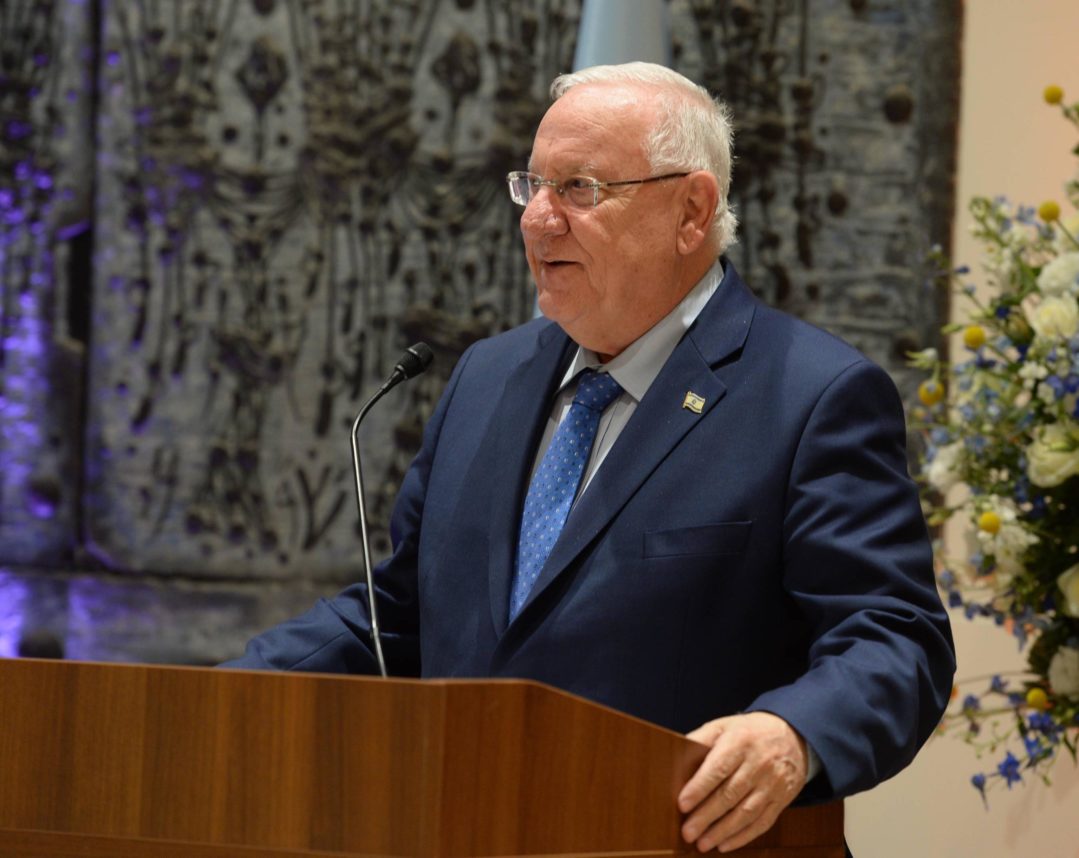
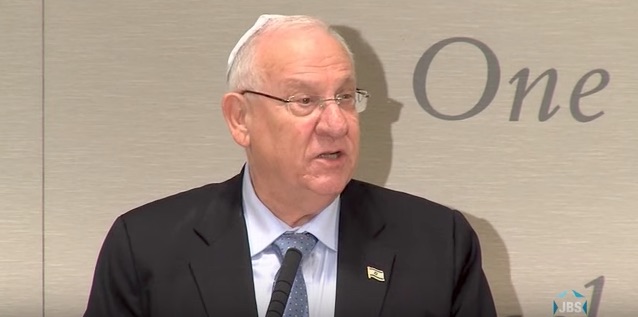
President of Israel Reuven Rivlin is this year’s senior Israeli speaker at the GA, the annual gathering of the North American Jewish federations. And this is not an easy job: Los Angeles is sunny, and visiting the city is surely enjoyable, but Rivlin came here as the representative of an establishment that is not highly popular with the leadership of US Jewry. Some call it a “crisis” in Israel-Diaspora relations, some deliberately want to avoid the C word. Terminology aside, the Jews of America – well, many of them – are angry with Israel’s government, and feel betrayed, neglected, disrespected. They want to see change.

President Rivlin cannot give them what they want. Moreover, his speech in Los Angeles today reminded North America Jews that “we must all respect Israel’s democratic process. The decision-making process”. American Jews must respect it, and hence accept that their ability to pressure Israel into doing something that its leadership is reluctant to do it limited. President Rivlin himself respect it, and hence is reluctant to express his support for a specific position in the great debate about – well, what is it about?

2.

In a nutshell, Rivlin’s speech included 5 main messages:

  1. Israel is wonderful, and don’t you forget that.
  2. We Jews are partners in good times and bad times.
  3. Religion and State issues are highly politicized in Israel – and this ought to be taken into account.
  4. The Jewish world and Israel are changing, and we must understand and adapt to change.
  5. While we deal with secondary issues, let us not forget the important ones: Iran, anti-Semitism and other serious threats to Jewish existence.

3.

Refereeing to the “crisis” Rivlin used his vast experience as an Israeli politician – one of the most experienced and most successful politicians we have. He used it to remind his North American listeners that “Whether we like it or not, in the only Jewish-democratic state, Religion and State is a political issue”. Obviously, most Jews in the hall do not like it, but Rivlin insisted on reminding them what this reality means: “Around five Israeli governments have fallen on questions like: ‘Can combat aircraft (not on mission) land in Israel on Shabbat?’ Or on the question of ‘Who is a Jew?’ that is Democracy”.

Was he defending the decision by Prime Minister Netanyahu to renegade on the Kotel compromise? I would not go that far. Still, he was clearly at least somewhat sympathetic to Netanyahu’s political calculations. This isn’t some joke, he reminded the room, this is serious business of having to run a complicated coalition by delicately balancing conflicting outlooks and interests.

And as for the Kotel: “I hope that in the future we can return to the table together, and reach an understanding on this important issue”. Note what Rivlin did not say: he did not say that there is need to go back to the deal that the government decided to scrap.

4.

The most interesting part of Rivlin’s speech was dedicated to his theme of “tribes” – a theme that Israelis are already familiar with. Israel is no longer a coherent society. It evolved and now has four main tribes battling for space, influence, resources, ideas – while also having to maintain a certain sense of partnership, because they are all partners who have a stake in the success of Israel. “from a society made up of a clear Zionist majority, to a society made up of four clear sectors or ‘tribes’, which are getting closer in size: The secular Jews, the National Religious Jews, the Haredim and the Arabs”.

Not everybody is happy with Rivlin’s formulation, and with the action he advocates based on it. But that’s not the issue for today. What was noteworthy about his speech today was Rivlin’s attempt at counting non-Israeli Jews as a fifth tribe. “we need the partnership with you, the fifth tribe, (and very important one), the Jews of the Diaspora”.

5.

To be a fifth tribe is an honor – you are one of us – and a burden – you are one of us. It means that Rivlin just complicated the choreography of the already complicated dance of having to make four tribes get along with one another. In his speech, he did not much elaborate on this idea, but make no mistake, he probably thought about it, and already has some ideas as to how such formulation can serve us in the field of Israel-Diaspora action.

Is the Jewish Diaspora a fifth tribe? Does it want to be a fifth tribe? This can be an interesting discussion – but a fifth tribe is surely better than a second people.

Still, there are complications. World Jews are no more a coherent group that Israeli Jews are – so maybe they should not be counted as a fifth tribe but rather be added to the four other tribes (three really: secular, Zionist religious and Haredi). Or maybe to include world Jews in this formulation of tribes there is a need to add more than a fifth tribe – maybe a fifth and a sixth and a seventh.

Also: to have world Jews counted as a tribe we must assume a partnership in something. This might be easier for the Jews, but can we add them to a partnership that includes Israeli Arabs? (it is of course possible: because world Jews and Arab Israelis share an interest in the success of Israel).

And there is the numerical issue to consider. There are eight million Israelis and about the same number of Jews in the rest of the world. Is it fair to count Israelis as four tribes – about two million strong each – and then count all other Jews as just one tribe – eight million strong?

One way or the other, a fifth tribe concept is something fresh to ponder, maybe as a little respite from endlessly talking about the unresolved issue of the Kotel.

6.

As for Iran, note that Rivlin agrees with Netanyahu – and he agrees with President Trump.

President Rivlin found a Fifth Tribe: Diaspora Jews Read More »

Excerpts from the President’s Speech at the GA

Dear friends, I remember the first and only time that my father slapped me.

It was just after my Bar-Mitzvah. Some relatives from the United States came to visit us.

I asked them: “Why don’t you make Aliyah?”

I told them: “Israel is the only place for Jews!”

And then my father slapped me.

He said: “Jews need  to take care of each other, not threaten each other.”

That slap made me realize that the relationship between us, the Jewish People, must be based on one simple demand: mutual responsibility.

A commitment to the security and the wellbeing of all our People.

This commitment, must be stronger than any disagreements. We have the challenge of establishing our relationship as a value. a value that is above any argument.

As for the Kotel agreement. The development of the agreement was a sensitive process, led by our government, in order to try and bridge the gap. I hope that in the future we can return to the table together, and reach an understanding on this important issue. It is our mutual responsibility, and a common interest. At the same time,we must all respect Israel’s democratic process. The decision-making process. Whether we like it or not, in the only Jewish-democratic state, Religion and State is a political issue. Maybe the most explosive one.

Around five Israeli governments have fallen on questions like: “Can combat aircraft (not on mission) land in Israel on Shabbat?” Or on the question of “Who is a Jew?” That is Democracy.

My friends, You have real, positive and effective impact on the Israeli system and society. We have built strong channels of cooperation on strategic issues. You have great impact on the Israeli agenda. I ask you, don’t stop.

As part of the challenge of building the relationship between us, We need to create an honest and open dialogue between the sides, this is our only way to move forward.

Today, Iran is establishing its control through Iraq, Syria and Lebanon and up to the Mediterranean. This is not just a threat to Israel – It is a threat to the entire world. Iran is the number one exporter of international terrorism. It is a country whose leaders call openly for the destruction of the state of Israel.

We cannot allow Iran to have a nuclear capability. That is madness.

We must work together to prevent that.

The current agreement puts both Israel and the united states in danger, and shakes the stability of the entire region.

It is not enough to enforce all parts of this agreement. It has to be improved, so that we will be prepared for the day after it expires.

This is the Jewish and democratic state that we all dreamed of for two thousand years.

A state based on the vision of the prophets of Israel. A state that respects the unique identity of each sector in Israeli society, and in the Jewish people. A state that regards equality and fairness as its guiding light. A state that demands shared responsibility from all. A state that does not compromise on it’s Jewish identity or it’s vision of Jewish people-hood, while also having a vision of a shared Israeli-identity, for all its citizens. Jews and non-Jews alike.

Excerpts from the President’s Speech at the GA Read More »

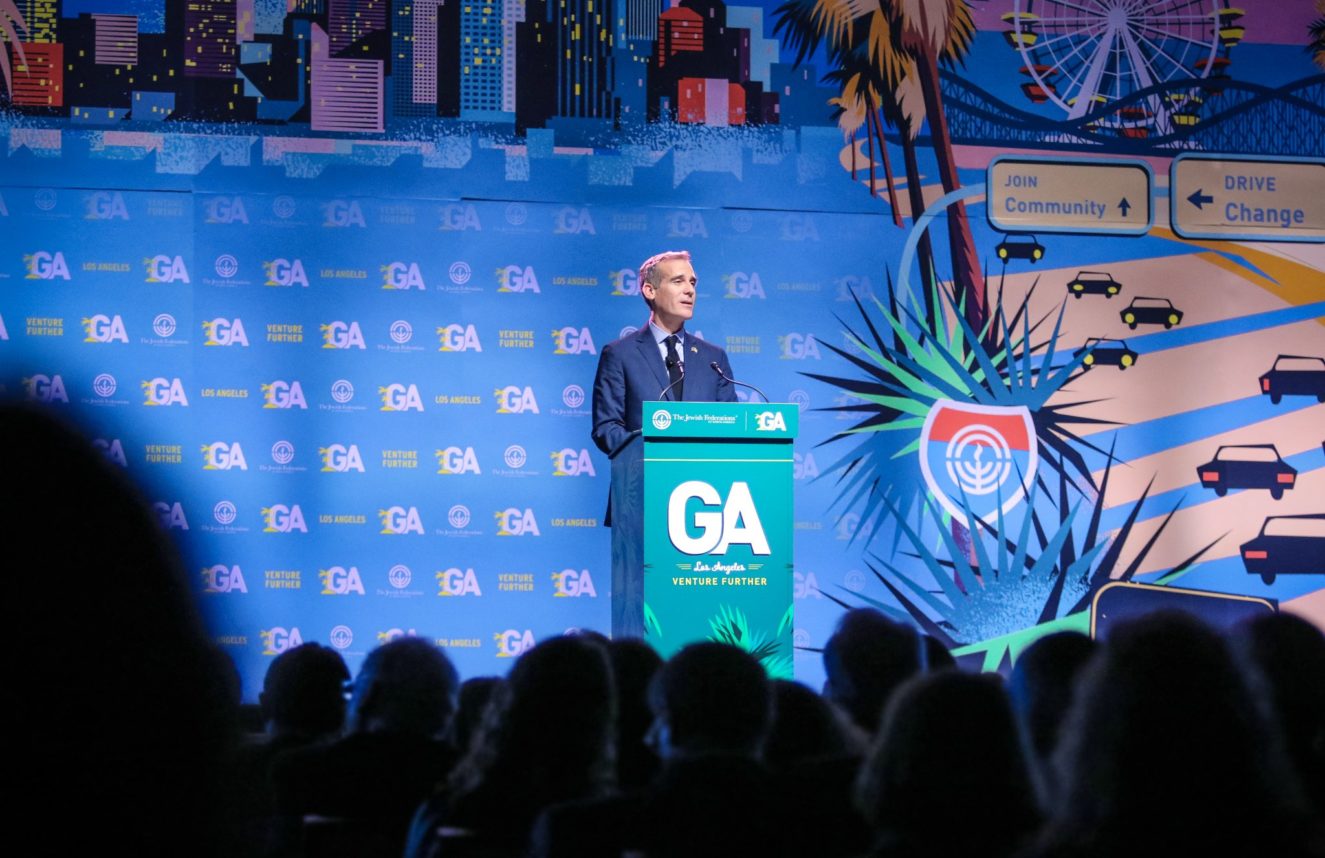
Originally posted to Mayor Garcetti's Twitter

The 2017 GA: Day One Wrap-Up

The Jewish Federations of North America General Assembly (GA) is made up of so many things: sessions and plenaries, lines at the restrooms, chance encounters in hallways, glances at badges to help you identify people you may not remember but who seem to know a lot about you. It’s happy reunions of camp friends and co-workers as well as awkward encounters with ex-significant others and ex-bosses.

In a gathering of thousands of Jews from all over the country, the GA is #FOMO Central, as attendees fear whatever offering they choose to attend will be the wrong choice. I was there opening day, and will be joined by several Jewish Journal colleagues Monday and Tuesday to bring you photos, videos, tidbits and local flavor to help you curb your FOMO and give you an inside scoop of what it’s like to be in the embrace the annual event.

Entering the hotel, I ran into person after person: Hillel professionals, foundation professionals, family members (true story), former colleagues, people I know from New York, colleagues from Los Angeles, and people who have been following me on social media but whom I had never before met. Now, here they were, right in front of me and blocking me from registration. It took 20 minutes to get up to the press counter to register.

Trading bon mots with a staffer about how my name reminded him of Estelle Costanza (something I’ve heard once or twice before), I ran into a friend and went through security. Arriving in the exhibition hall, I talked with some local people about their plans for the next three days, talked with members of the new class of NLP, the Federation’s program to train new civic leaders, and had my picture taken with cardboard cutouts of David Ben-Gurion and Golda Meir.

I watched as folks streamed into the ballroom, finding spaces in sections designated by reserved signs on seats and flags waving overhead. The plenary began with four Houstonians talking about the devastation of Hurricane Harvey and how the community stepped up in the aftermath. Some of them were close to tears as they remembered the trauma. Some audience members noted the importance of having these people tell their stories but also noted that future support would also be important.

Rabbi David Wolpe of Sinai Temple in Westwood spoke on the importance of Jewish literacy: “If you believe that the Jewish tradition has something to give to the world, then you have to know what that thing is. … We need to keep learning (about Judaism) not because of the way our ancestors died, but because of the way they lived.”

Los Angeles Mayor Eric Garcetti talked about his mixed heritage — “bagels on Saturday and Menudo on Sunday” — and about the integral role that Jews played in shaping Los Angeles. He mentioned having studied with his rabbi and one person in the back of the ballroom yelled, “Wooo!” (It was not Sharon Brous, but likely was an IKAR member, gone rogue with enthusiasm.) He also noted that while we were in the windowless conference room, we’d missed a beautiful sunset, but that we could check out his Instagram to see it.

What’s the swag scene on the floor at the GA? An initial walkthrough revealed candy, chip clips and pens aplenty. Who has the best swag? The jury is still out, but Hillel International is reportedly leading:

https://twitter.com/Jac05f/status/929890169964044290

On my way out, I ran into two of my friends who work at Federation, who decided to prove how happy they were to see me by freestyle rapping about me. Toward the end of that, I saw Jonathan Ornstein, the executive director of the JCC in Krakow, Poland, where I’d visited in July. We talked a bit about the nationalist march in Warsaw, and he noted that there had been rallies like that one in the past, but this time, it was much bigger and more widely publicized.

I capped the evening with the Covenant Awards dinner, honoring three exceptional Jewish educators, including my cousin, who founded MATAN, an organization devoted to finding ways to connect and include children with special needs in Jewish life and ritual.

And that was only the first day!

The 2017 GA: Day One Wrap-Up Read More »

An Israeli Ethiopian family turns to L.A. Jewry to help free their son from Gaza

Agarnesh Mengistu is an unlikely addition to the influx of Jewish dignitaries converging on Los Angeles for the Jewish Federations of North America General Assembly (GA), which takes place from Nov. 12 to 14. The Ethiopian-born Mengistu, a mother of 10, speaks little Hebrew and next to no English, instead communicating only in her native Amharic.

She travelled to Los Angeles this month with a small entourage and a single purpose: to convince Jewish leaders to help bring home her son, or at least word of his condition and whereabouts.

In September 2014, Avera Megistu, a 31-year-old diagnosed with schizophrenia, wandered away from his family’s home in Ashkelon and crossed a border fence into Gaza, located just to the south. He is presumed by the Israeli government to have been captured by Hamas.

In the ensuring years, Agarnesh Mengistu’s life has been a series of sleepless nights and fruitless meetings with powerful people such as United Nations Secretary General António Guterres in search of help.

“All these three years, we’ve met with so many people it’s hard to remember who is who,” she said. “They tell me things: ‘We’ll look for an opening; we’ll go into Gaza; we’ll try.’ So many meetings — and no news.”

Mengistu, 67, sat in a conference room 16 floors above Wilshire Boulevard at the Israeli Consulate on Nov. 10 next to Yonit Tlayenesh Fenta, 34, a relative who coordinates the campaign to secure Avera’s release, and her son Ilan, 35, the family’s de facto spokesperson, who wore a black “Free Avera Mengistu” T-shirt over a collared blue shirt.

Agarnesh let Ilan and Fenta do most of the talking, in Hebrew and English; when she spoke, Fenta, who refers to her as dodah, or aunt, translated from Amharic into Hebrew.

Flanking the family members were two women tasked with guiding them through the world of Jewish lay leaders and international dignitaries, Ilana Mushkin, an American-born Israeli representing the well-connected alumni network of the Wexner Graduate Fellowship, and Orly Cohen Geffen, a consultant to the Israeli defense minister on missing civilians. The Defense Ministry is funding the Mengistus’ trip to America.

Left to right, Yonit Tlayenesh Fenta, Agarnesh Mengistu and her son Ilan at the Israeli Consulate in Los Angeles on Nov. 10. Photo by Eitan Arom.

In addition to attending the GA, Mushkin said a second purpose of the trip was for the family to feel the “warm embrace” of the local Jewish community. She said they received an outpouring of support from the four local synagogues they visited on Nov. 11 for Shabbat, Beth Jacob, B’nai David-Judea Congregation, Pico Shul and Young Israel of Century City.

In a joint interview, the family stressed that unlike Gilad Shalit, an Israeli soldier who was captured by Hamas and freed in 2011 in exchange for 1,027 Palestinian prisoners, Avera never served in the military, having been exempted from mandatory service. “Let’s be honest, the public has some trauma from the Shalit situation, so they’re afraid of another deal,” Ilan said. “They don’t understand this is a humanitarian case.”

At the beginning, I was angry at Avera. I said to myself, ‘Of all the places you had to go off to, Gaza?” Ilan Mengistu

For 10 months after Avera crossed the border, the family cooperated with an Israeli government gag order preventing the local press from discussing his disappearance, giving the government time to work quietly towards his release. The United States tour — they plan to visit Washington and New York before heading back to Israel on Nov. 23 — represents something of a change in strategy.

“We understood that being quiet won’t bring a solution to this case,” Ilan said. “Without the will and the power of the Israeli public and the Jewish communities, I don’t believe he will return to us any time soon.”

At first, the family had been inclined to trust international aid organizations that promised to do their best to bring him home. In Ethiopia, before they immigrated to Israel in 1991 as part of Operation Solomon, the International Committee of the Red Cross (ICRC) was revered. And in September, during a trip to Israel, ICRC President Peter Maurer said the group was working towards the release of captured Israeli civilians — including Mengistu.

“We are doing all we can to relentlessly push Hamas to account for them, treat them as provided under international law and spare their families the unbearable uncertainty,” he said, according to i24NEWS.

With no news since then, the Mengistu family is losing patience.

“We’re hoping the Jewish community will step up and put as much pressure as possible on these organizations to do more,” Ilan said. “There are many human rights organizations that support Gaza every day. Where are they now?”

For now, all the family seems able to do is tell Avera’s story to as many people as possible, including Israeli President Reuven Rivlin, whom they were scheduled to meet with on Nov. 13 in Los Angeles.

Until he fell ill, Ilan said, Avera was close with his mother, sharing his pay from odd jobs to help make ends meet. He began to deteriorate in 2012, after his older brother, Michael, with whom he was close, died of a sudden illness. Avera “refused to face the reality of it,” Ilan said, throwing tantrums and yelling that he had no reason to live. He was twice hospitalized but continued to deteriorate and refused his medication.

Soon, Ilan said, “he started wandering off. It was very difficult to see him like that. We were used to seeing him at the Shabbat table and over the holidays, happy and laughing, and all of a sudden — to arrive at a situation like this…” Ilan trailed off.

Agarnesh sat with her arms crossed and hair tied back in a red headscarf, occasionally passing a white handkerchief over her face as if to revive herself from slumber. At one point, she turned to Fenta, with whom she shared a room during her trip to Los Angeles.

“You saw me yesterday at night. I couldn’t sleep — bichlal,” she said interjecting the Hebrew word for ‘at all.’ “That’s what it’s been like for more than three years already.”

“She’s at the point where she would even prefer to hear that he is dead than have this complete unknown situation,” Ilan said. “At night, she goes and looksat his bed — still empty.”

As for Ilan, his attitude has gone from anger to something approaching acceptance.

“At the beginning, I was angry at Avera,” he said. “I said to myself, ‘Of all the places you had to go off to, Gaza? You couldn’t find somewhere else?’ I know now, after time has passed, we can’t blame him.”

“Ma ani yakhol la’asot?” he added, using a common Hebrew refrain. “What can I do?”

An Israeli Ethiopian family turns to L.A. Jewry to help free their son from Gaza Read More »

Saudi Arabia to Abbas: Take Trump’s Peace Plan or Resign

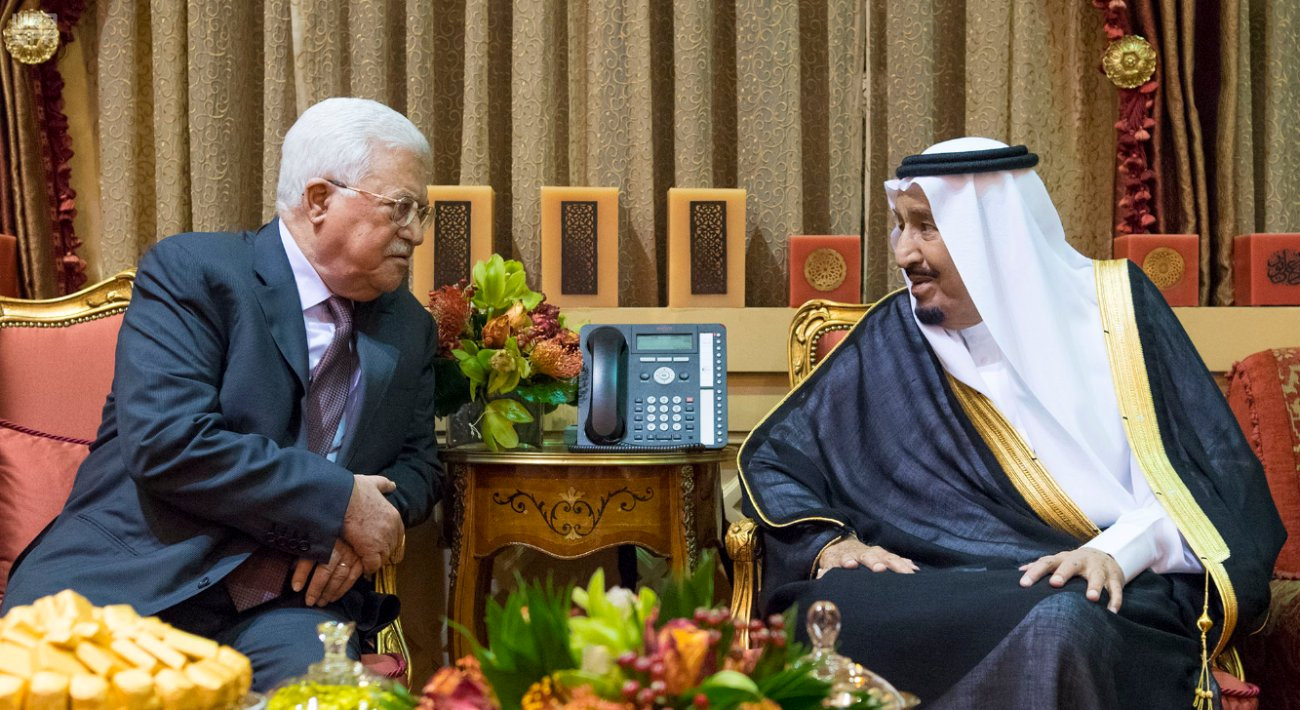
Saudi Arabia has issued an ultimatum to Palestinian Authority (PA) President Mahmoud Abbas: take up the Trump administration’s Israel-Palestine peace plan or step down from your position.

The Times of Israel reports that Saudi King Salman Abdulaziz Al Saud and Crown Prince Mohammad bin Salman brought Abbas in for a meeting and told him to “accept Trump’s peace plan or quit” as well as to rebuff any Iranian efforts to influence the PA.

The Saudi monarchy also reportedly demanded any cooperation between members of Fatah and Hezbollah, the Iranian proxy terror group, cease immediately.

However, a Palestinian Authority official pushed back on the notion that Saudi Arabia issued any sort of threat toward Abbas.

“The talk was about coordination, and it focused on three points,” the official told Haaretz. “One, supporting reconciliation and the president’s position on the arms issue; two, economic assistance; and three, that any diplomatic and regional settlement will be based on the Arab peace initiative, without any change.”

Political analyst Mazen Safi told the Jerusalem Post that the Saudis’ meeting with Abbas was meant to establish himself as “a power broker” in light of the Gulf Kingdom’s escalating tensions with Iran.

“Support from Arab countries is crucial and Abbas’ trip reinforces the need to assist the Palestinians against all obstacles,” said Safi. “Palestinian reconciliation requires the efforts of all Arab countries—and not just the Palestinians—since it will positively affect the region.”

The Trump peace plan that Salman referred to reportedly features some type of two-state solution that attempts to make all parties happy.

“For Israel, those could include limiting settlement construction to current blocs without taking new land, recommitting to a two-state solution and redesignating a small part of the West Bank to give Palestinians more control,” Jewish Telegraphic Agency (JTA) reports. “The Palestinians could be asked to resume full security cooperation with Israel, hold off seeking further international recognition and end payments to families of Palestinians imprisoned for terrorist attacks.”

Saudi Arabia has long provided aid to the PA under the pretext that the PA provides political support to the Gulf Kingdom.

Saudi Arabia to Abbas: Take Trump’s Peace Plan or Resign Read More »

Museum Removes Hitler Statue Due to Complaints

An Indonesian museum has decided to remove a statue of Adolf Hitler after they received numerous complaints from people online.

The De MATA Trick Eye 3D museum in Yogyakarta featured the Hitler statue with a picture of Auschwitz in the background. The statue was a hub for selfies, including these children giving the Nazi salute in front of the statue:

“Everything about it is wrong,” Rabbi Abraham Cooper, associate dean of the Simon Wiesenthal Center, told the Associated Press. “It’s hard to find words for how contemptible it is. The background is disgusting. It mocks the victims who went in and never came out.”

Others on social media expressed their outrage at the statue:

https://twitter.com/MrRAnderson78/status/929723285381832704

https://twitter.com/burgundy50/status/929503062678437888

De MATA Marketing Officer Warli initially defended the statue, telling the Associated Press that the statue had been featured in the museum since 2014 and that the museum visitors were simply having fun because De MATA “is just an entertainment museum.” However, the museum did eventually take down the statue.

“We don’t want to attract outrage,” Jamie Misbah, De MATA’s operations manager, told the New York Daily News.

Andreas Harsono of Human Rights Watch (HRW) told Deutsche Welle that HRW “welcomes the decision.”

“Regardless of the intention, depicting Hitler as if he were a respected figure is in bad taste,” said Harsono.

Some on social media didn’t agree with museum’s decision:

https://twitter.com/LordJack69/status/929851931719331840

The De MATA museum currently has a four-star rating on Trip Advisor, touting itself as a 3D art museum where people can take goofy photos of themselves.

Museum Removes Hitler Statue Due to Complaints Read More »

Gal Gadot is GQ’s Woman of the Year

IsraelI actress and all-around badass Jewess role model Gal Gadot has been named GQ’s Woman of the Year. Gadot joins GQ Men of the Year Colin Kaepernick, Stephen Colbert, and Kevin Durant. GQ has been doling out this honor for 22 years and Gadot is only the fourth Woman of the Year.

Gadot is also in the news this week because according to a Page Six report, she will not sign on for a Wonder Woman sequel unless Warner Brothers dumps disgraced producer Brett Ratner. Warner Brothers denies the story.

https://twitter.com/BrowncoatAuror/status/929484423510212608

https://twitter.com/RealLyndaCarter/status/930042802658009088


Gal Gadot is GQ’s Woman of the Year Read More »

MURDER ON THE ORIENT EXPRESS *Movie Review*

Kenneth Branagh stars in and directs the latest adaptation of Agatha Christie’s “Murder on the Orient Express”.  It evokes the period setting while allowing for more modern cinematic moments.

Murder on the Orient Express” also stars Michelle Pfeiffer, Judi Dench, Johnny Depp, Daisy Ridley, Penelope Cruz and Josh Gad.

For more about the film, including the significance of 3s, take a look below:

https://youtu.be/U0VjcLTrX7c

–>Keep in touch with the author on Twitter and Instagram @realZoeHewitt.  Looking for the direct link to the video?  Click here.

All film photos are courtesy of 20th Century Fox.

MURDER ON THE ORIENT EXPRESS *Movie Review* Read More »

Episode 64 – The Man who Discovers Planets

For thousands of years astronomers have been looking up to the sky, trying to understand what the hell’s going on up there. In the last 50 years technology has led to tremendous breakthroughs, and yet, we are still very far from solving the most essential of questions: how was all this created?

Prof. Tzevi Mazeh from Tel Aviv University has been trying to find answers to these questions for over 40 years. He was a guest researcher in Harvard, and as an astronomer, Prof. Mazeh took part in many important discoveries of stars, planets and other space phenomena.

Prof. Mazeh published the book “introduction to the Theory of Relativity”, and co-edited the book “Drishat Shalom”, a collection of articles about peace and justice from a biblical perspective.

Prof. Mazeh was also the chair of the political jewish-left-wing movement “Netivot Shalom”.

Prof. Mazeh is one of the most popular lecturers in Tel Aviv University, and apart from being a leading astrophysicist, he is also an expert in the history of Astronomy. And apart from that, he has also been teaching Talmud for many years.

Prof. Mazeh joins 2NJB today to talk about his out-of-this-world career.

RSS Subscribe

Direct Download

Episode 64 – The Man who Discovers Planets Read More »