fbpx

November 9, 2017

Louis C.K. Accused of Sexual Misconduct

Comedian and actor Louis C.K. has been accused by multiple women of engaging in sexual misconduct, mainly involving him pleasuring himself in front of these women.

Five women spoke to the New York Times about Louis C.K.’s alleged misconduct. Comedians Dana Min Goodman and Julia Wolov recalled how they were visiting Louis C.K. in his hotel room in Aspen, CO in 2002 during the U.S. Arts Comedy Festival. They said that the famed comedian had asked if he could expose his genitalia. Goodman and Wolov initially thought he was kidding, but he ended up completely disrobing himself and proceeded to pleasure himself in front of them. When Louis C.K. was finished, he allegedly asked, “Which one is Dana and which one is Julia?”

“We were paralyzed,” Goodman told the Times.

Goodman and Wolov began spreading their story to others at the festival, only to approached by Louis C.K.’s manager, Dave Becky, who asked them not to tell anyone about what had happened. Becky told the Times that he didn’t threaten anyone.

“I don’t recall the exact specifics of the conversation, but know I never threatened anyone,” Becky told the Times in an email.

Another woman, Abby Schachner, claimed that in a 2003 phone call she could hear Louis C.K. masturbating on their call as he panted about his various sexual fantasies. Schachner said she “felt very ashamed” and that while Louis C.K. apologized to her years later, the incident deterred her from pursuing a career in comedy.

Rebecca Corry, an actress and comedian, is claiming that in 2005, Louis C.K. appeared as a guest star on a television pilot she was working on. Louis C.K. asked “if we could go to my dressing room so he could masturbate in front of me.” Corry angrily rejected Louis C.K.’s request, highlighting the fact that he already had a pregnant wife and a daughter. Louis C.K. responding by admitting “he had issues.”

Corry said that Louis C.K. apologized to her years later, but he apologized “for shoving her in a bathroom,” which Corry said never happened. Louis C.K. simply told her that he “used to misread people.”

Another woman, who remained anonymous, told the Times that Louis C.K., who she was working with on “The Chris Rock Show,” had asked her several times if he could pleasure himself in front of her, and she eventually acquiesced and watched Louis C.K. do so at his desk.

“The big piece of why I said yes was because of the culture,” the woman told the Times. “He abused his power.”

In light of the accusations, HBO announced in a statement that it was severing ties with Louis C.K.

“Louis C.K. will no longer be participating in the Night of Too Many Stars: America Unites for Autism Programs, which will be presented live on HBO on November 18,” said HBO. “In addition, HBO is removing Louis C.K.’s past projects from its On Demand services.” C.K.’s other HBO projects include the short-lived 2006 comedy series Lucky Louie, along with comedy specials One Night Stand, Shameless and Oh My God.”

The premiere of Louis C.K.’s upcoming movie “I Love You Daddy” has been canceled as well. The comedian declined to comment to the Times on the allegations.

Louis C.K. Accused of Sexual Misconduct Read More »

Say “Thanks” This Thanksgiving!

For our Thanksgiving issue, the Journal is collecting stories of gratitude. Tell us about someone who did something that changed your life for the better — maybe without even realizing it. Perhaps it was an elementary-school teacher who recognized something in you, or a friend who was there in a time of need. Maybe it was a stranger who helped when you were lost, or that guy in the Tesla who let you switch lanes on the 405.

Tell us in 100 words or less about how someone did something you’re thankful for (you don’t have to share the person’s name). What did they do and why are you grateful? We’ll include the best of these in our Thanksgiving issue. Remember: no longer than 100 words.

Please send your 100-word story to editor@jewishjournal.com or click on this link to submit directly.

Say “Thanks” This Thanksgiving! Read More »

Slept Like a Baby? Nanit Monitor Would Know

While working on Israel’s Arrow anti-ballistic missile defense system, Assaf Glazer could not imagine that one day he would be developing a high-tech baby monitor.

But that’s what he’s doing now with his company, Nanit, which was launched while he was a post-doctoral fellow at the Jacobs Technion-Cornell Institute in New York.

After growing up in Rehovot and serving in the Israel Defense Forces, Glazer earned a doctorate in computer vision and machine learning at Technion-Israel Institute of Technology. Then he went to work for semiconductor giant Applied Technologies, developing an image classification platform for categorizing defects on silicon wafers.

Glazer was putting cameras above silicon wafers to examine them.  Then when his oldest son, Udi, was born six years ago, he thought about using similar methods to watch babies.

“I put a camera above his crib to analyze his movement and sleep,” he said. “It really helped me as a parent make better decisions.”

When he went to Jacobs, he brought the idea with him. Six months in, he brought aboard his old friend Tor Ivry, with whom he had worked at Applied Technologies. Glazer stayed at Jacobs for two years and left in January 2016 as Nanit’s CEO.

To launch Nanit, Glazer raised millions from venture capital investors, however he won’t disclose just how much. Nanit has sold thousands of units, Glazer says — but won’t disclose specific numbers.

“We want to be the Google Maps of
parenting navigation.” — Assaf Glazer

Today, Nanit has 30 employees. Half are in Ramat Gan and half in New York, in a WeWork space near Penn Station. Ivry leads Nanit’s Israel team of engineers focused on research and development. Sales and design are handled in New York.

“We are trying to make the most of the two worlds and connect them,” said Glazer, who with his wife has three sons, ages 1, 3 and 6.

Priced at $514 — but selling at a promotion price that starts at $279 — Nanit is at the high end of the smart baby monitor market.

To be sure, it is no ordinary baby monitor. It’s a smart camera that not only watches your baby sleep but analyzes sleep patterns and distinguishes between movement while sleeping and awake. How does the Nanit, which has the sleek lines of an Apple product, tell exactly when the baby falls asleep?

“This is our secret sauce. I could tell you but then I may have to kill you,” Glazer said with a laugh.

Nanit also has built-in temperature and humidity sensors, plus a nightlight aimed at the ceiling. It sends parents daily and weekly briefings and recommendations right to their smartphones.

“We designed this with parents in mind,” said Glazer, who used his son Udi to test how high to position the camera to be out of reach of a curious toddler.

Nanit’s blog (called “Nightlight”) is full of articles about sleep training and when (and when not to) change diapers, making it seem like a virtual Mary Poppins.

The product’s buyers give it mixed reviews, with many of the complaints focused on kinks that can come with a tech startup.

But Glazer is forging ahead.

Up next is applying the concept to elder care. Nanit’s technology is a potential boon to those caring for the elderly, particularly if they have dementia, which can come with sleep disturbances and wandering. Glazer is also thinking about how to use the technology for people with autism.

“Our vision is looking at people from birth to death,” Glazer says. “We want to be the Google Maps of parenting navigation.”

Slept Like a Baby? Nanit Monitor Would Know Read More »

Me Too and Us

On the anniversary of that election which made a proud sexual predator the President of the United States, a furious chorus of me-too continues to rise. Names are being named and stories are being told, and people in power (usually men) who claim access to the bodies of those who work for or depend on them are being made to face consequences. Following the carnage in Los Vegas and Texas, the correlation between mass shootings and domestic abuse is being named in public. Can it be that “the way things have always been” could really become the way things used to be?

I’m afraid to hope, because we’ve been here before. Just last year, actually.

When the story about Trump’s admitted sexual assaults broke, I had hopes that history would not repeat itself. I was working for the State of California when Arnold Schwarzenegger was elected governor…twice. Even though the L.A. Times, after weeks of investigation, made it clear to us all that the man who wanted to be our chief executive had demeaned, bullied, and physically assaulted several women, some of whom depended for their livelihoods on his good will.

At the time, there were those who scorned the Times’ courageous reporting as an act of liberal media bias. We were reminded that President Clinton had used his office as cover for predations of his own. (Which proves…what? My parents told me something when I was very small about two wrongs not making a right, and I have never found cause to doubt their reasoning. But yes, I would like for us to be sure we can elect pro-equality and pro-choice candidates from the Left without having to sacrifice a virgin or two—or sexually mature women–in exchange.) Anyway, in 2003, I first learned to hate the word “pecadillo.”  And the Gropenfuhrer became California’s chief executive.

But, last year, lots of us believed that things would go differently. Surely, an admitted pussy-grabber could not become President of the United States. The cascade of denunciation after Trump was caught on tape boasting of his behavior, the stories spoken aloud by abused women (and men); surely these were proof that times had changed. And then came November 8, 2016.

Can it be different this time? And what does this have to do with us, specifically, as Jews?

Well, for one thing, as exasperating as it was to link the observation with deeply uncool Holocaust jokes, Larry David made one a valid point. When a prominent Jew like Harvey Weinstein commits sexual predation, he disgraces all of us—and he provides fodder for our enemies. Most important of all though, going beyond David’s point, Jewish predators betray a key Jewish value—cavod ha’briot, human dignity—and they profane the God we serve. It is time for liberal Jews to recall the severity of Hillul HaShem– associating the name of God with bad behavior—and to stop tolerating it. Rather than aping the extreme reactionary masculinism projected by some purveyors of popular culture, Jewish men could learn much from particularly Jewish models of manhood that celebrate scholarly sweetness and empathy with the subjugated who will be, our daily liturgy teaches, lifted up by HaShem.

No matter what somebody wears, no matter how naïve they are or how pliable or how desperate to please, human beings are not objects for use. If we believe truly that people are created b’tzelem Elohim, that each person bears a trace of her Creator, then…it’s wearisome to have to keep saying it…well, then, we don’t instrumentalize them. We don’t wield workplace power or physical strength or social standing to extract what we want.

We are not Puritans. We don’t have to be furtive about the intricacies of desire, about the element of the lewd and titillating, about the play of power and risk that abounds in consensual sex. We just have to embrace a fundamental respect for the right of everyone to dispose of their own person as they see fit, a right to be superseded only by the claim of the One who gave us bodies in the first place. And we need to keep the chorus going, to be pushy Jews about it until a real change comes.

Me Too and Us Read More »

Reform. Orthodox. Let’s Talk: A conversation between — and about — denominations

Rabbi Sarah Bassin

Ari, we separate our movements based on our philosophical approaches to Judaism. Yet I feel that there is a disconnect between what movements purport and what we actually do.

Reform Jews are supposed to have a deep education in Jewish text and tradition in order to make an informed “choice through knowledge.” Because we believe our Torah was shaped by imperfect humans striving to understand the Divine, we have flexibility in approaching tradition in ways that your community — with its view that God dictated Torah through the hand of Moses — doesn’t.

Unfortunately, Reform Jews often exchange flexibility with non-engagement. Shabbat attendance and ongoing learning aren’t nearly as central to Reform communities as the clergy would like.

“Despite our deficiencies, my movement does an extraordinary job of moral education.”— Rabbi Sarah Bassin

Why would I still choose Reform Judaism? Because I think your community, too, struggles with a disconnect between purported and lived values. I choose the flaws of my community over those I perceive in yours.

Despite our deficiencies, my movement does an extraordinary job of moral education — conveying core values about what it means to be Jewish in the world. Some say we overemphasize universalism, but the Torah, our prophets and our most-respected modern philosophers all seem obsessed with the central core value of human dignity. I take pride that Reform Judaism has been at the forefront of each era’s fight for human dignity.

The Orthodox community will nearly always beat us on fidelity to learning, Shabbat practice and kashrut. But I fear that focusing on these values comes at the expense of the our tradition’s moral core, which demands that we transform our faith into social action.

Rabbi Ari Schwarzberg

Sarah, first, I don’t claim to be the representative of the Orthodox community. But I’ll do my best to present a fair and constructive perspective on it.

I think you’re right: A major tenet of Jewish thought and tradition is social action and, generally speaking, the Orthodox community does not make it as central as it ought to be. But some contextualization is also necessary. To claim that social action alone is the “moral core” of our tradition ignores the binding nature of mitzvot as they appear in the Torah and rabbinic literature.

Regardless of how you define revelation, a Judaism that doesn’t place ritual, God and some form of halachah (Jewish law), on similar footing to social action feels a bit Jewishly vacant to me. I don’t mean to downplay the value of social justice and tikkun olam, but our tradition perceives Torah and mitzvot as axiomatic to our Jewish identity.

Also, many Orthodox Jews carry a significant burden of historical oppression, so they fear what the Jewish future holds. Given those concerns, a serious commitment to social justice unfortunately takes a backseat to internal Jewish causes. Many would applaud others’ activism and philanthropic work while claiming that our resources must be allocated to the sustainability and future of our own community.

Rabbi Bassin

At our origin, the Reform movement clearly distinguished between ritual and ethical commandments. We’ve walked back that language in recent decades, but there’s a truth to that distinction that I refuse to relinquish. My intellectual predecessors gave birth to the Reform movement as a corrective for a tradition that had lost sight of ethical monotheism in focusing on the details of legal minutiae.

You may find this heretical, but I don’t believe that Judaism is an end in and of itself. I see it — and all religion — as a tool for human flourishing. I don’t believe in a deity that cares whether I light Shabbat candles. I have trouble with the idea of worshipping a god that demands such acts of reverence. I do believe that the act reminds me of the moral importance of setting aside time to remember that we are not only what we do.

Spiritual discipline, channeled to an end beyond itself, can help us tap into our core purpose. Yet our inherited mitzvot are not my only — or even my primary — source of commandment. I have always been drawn to the philosophy of Emanuel Levinas, who posits that our greatest access to the Divine is through other people, who reflect the image of God more strongly than any law.

When religion becomes its own end, I fear that we unleash dangerous impulses. We find ways to overlook bad behavior, tolerate scandals and disregard the humanity of others under the guise of protecting our community — and keeping our dirty laundry indoors. That tendency isn’t isolated to the Orthodox community, or even the Jewish community, but I fear that the danger increases with greater particularism.

I take joy in witnessing elements of Orthodoxy that have reclaimed a more universal outlook and ethical imperative, and I hope the Reform movement helped pave that path. I also hope to draw from your community to address the shortcomings of my own — particularly in the form of spiritual discipline and commitment to community as a foundation for faith in action.

Rabbi Schwarzberg

Your clarity of purpose and responsibility is inspiring. I agree that when religion becomes an end unto itself, it has the potential to become idolatrous. There’s a fine line between serving God and serving ourselves in the name of God. But I think that’s the precarious nature of all religious institutions.

Similarly, your comment about scandals and overlooking bad behavior feels like an unfair critique of some of the Orthodox community’s lowest-hanging fruit. I am the first to criticize scandals, fraud or abuse under the banner of frumkeit. But, as you said, those issues are neither endemic nor exclusive to the Orthodox community.

“I don’t mean to downplay the value of social justice and tikkun olam, but our tradition perceives Torah and mitzvot as axiomatic to our Jewish identity.”— Rabbi Ari Schwarzberg

That said, we’re not immune from the traps of tribalism, halachic territorialism, or authoritarian rabbinic leadership. And we should ensure that our most sacred values are not compromised in their name. My work with The Shalhevet Institute is predicated on the belief that pluralism and Orthodoxy are not oil and water.

Perhaps what we’re really talking about is methodology. If religion is to be transformative, how do we best achieve that result? I take my cues from Rambam here: The frame of our commandedness must be “to know God.” But it’s through mitzvot, prayer and learning that our religious consciousness is best activated. I don’t think of lighting Shabbat candles as merely a way to serve a demanding God. The meaning you’ve attached to it is wonderful, but it’s also part of an evolving system that aspires to foster a community of empathic humans and deep Jews. If anything, it’s our particularistic identity that obligates our universal mission.


Rabbi Sarah Bassin is an associate rabbi at Temple Emanuel of Beverly Hills.

Rabbi Ari Schwarzberg is the director of The Shalhevet Institute.

Reform. Orthodox. Let’s Talk: A conversation between — and about — denominations Read More »

TABLE FOR FIVE: Five Takes on the Weekly Parsha

PARSHA: CHAYEI SARA, Genesis 24:63-65

“And Isaac went out walking in the field toward evening and, looking up, he saw camels approaching. Raising her eyes, Rebecca saw Isaac. She alighted from the camel and said to the servant, ‘Who is that man walking in the field toward us?’ And the servant said, ‘That is my master.’ So she took her veil and covered herself.”

Rabbi Richard Camras 
Shomrei Torah Synagogue, West Hills

“Isaac went out walking in the field.” According to Rashi, the word “walking,” lasuach, is translated as supplication or prayer. Tradition holds that Isaac went out to meditate and pray for the success of Abraham’s servant, who had been sent to find a wife for Isaac. From the verse that follows, we infer that his prayer immediately was answered with the appearance of Rebecca.

If only prayer had such immediate efficacy. Our own experience with prayer is vastly different. Even with the greatest of kavannah, or intention, we often find that our prayers feel futile — haltingly and stutteringly difficult. It is not for words that we are wanting — our liturgy is filled with voluminous ways to express what we desire our hearts should feel. How can we bring those words to move us, so that our prayer experiences are not empty, squandered moments deficient of meaning and gratification?

Perhaps like Isaac, who our sages explain established the afternoon Mincha service, we need to establish regular moments of reflection. As Abraham Joshua Heschel reminds us, “Prayer is not a stratagem for occasional use, a refuge to resort to now and then. It is rather an established residence for the innermost self…. [A] soul without prayer is a soul without a home.” Prayer, for Heschel, “serves to save the inward life from oblivion … to alleviate anguish … to partake of God’s mysterious grace and guidance.” May we have the wisdom to find a heart and soul open to such prayer.

Rabbi Heather Miller 
Congregation Beth Chayim Chadashim, Los Angeles
Rebecca is a woman of action. She is introduced as a bearer of water in the ancient world. A servant tells her that he was sent to find a wife for his master’s son, and she decides to meet him. In this selection of text, she raises her eyes, she alights from her camel, and she inquires as to the identity of the man in the field.

Her final action here is to take her veil to cover herself. At first, it may appear that she has become uncharacteristically submissive, as if to shy away from her intended. But midrash suggests that in that field Isaac is praying.

Rebecca, in turn, makes the conscious decision to cover herself so that when Isaac first sees her, she has the appearance of a veiled Torah. In this way, she avoids a male gaze that might otherwise objectify her, and instead becomes sacred, holy and full of allure. So, he relates to her this way, taking her into his mother Sarah’s tent — a Tent of Meeting of sorts, not unlike the tabernacle — to commune with her. There, his prayers are answered. He is comforted after the death of his mother, he finds the woman his father prayed he would find, and he is no longer lonely.

This is the story of an independent woman who asserts her agency and answers many prayers.

Rabbi Shmuel Herzfeld
Ohev Sholom–The National Synagogue, Washington, D.C.

When Rebecca sees Isaac, she commits to marriage and covers herself out of modesty. It is axiomatic to marriage that intimacy be associated with privacy. For much of Jewish history, this was also the principal approach to women’s participation in public religious leadership roles.

This is no longer a tenable position. Recently the Orthodox Union (OU) argued that every synagogue should have on staff women who are religious teachers. But the OU has not endorsed the notion of women clergy. Thus, it is not exactly where our shul is right now, but it is getting much closer (despite the fact it may toss us from its organization for being out of compliance).

Having had the privilege of working with a maharat — a female clergy person — for several amazing years, I am convinced that it is essential that every synagogue (that can afford to) have male and female professional clergy. Just as a congregation would not hire a rabbi who does not have formal training, so too a synagogue should seek to hire a female spiritual leader with advanced, formal training. It is clear that it is just a matter of time before the OU champions our shul’s position that a woman can serve as a full member of clergy in an Orthodox shul. Maybe not tomorrow, but someday soon.

Rabbi Cheryl Peretz
Ziegler School of Rabbinic Studies at American Jewish University
In life, there are moments of great significance so extraordinary that we are forever changed. So, what’s so important about this one? Isaac goes lasuach (to walk?) in the fields, looks up and sees Rebecca on the camel. Rebecca looks at Isaac, and literally falls off the animal. Finding out that the man she sees is Isaac, she covers herself in a veil.

According to the rabbinic midrash on the tale, lasuach — a verb that appears just this one time in the entire Bible — means “meditate” or “talk.” In other words, the first moment Rebecca sees Isaac, he is praying. As a result, Rebecca loses it. She’s so caught up in the moment of their eyes meeting that she literally falls for him. Perhaps this is the origin of the idea of love at first sight.

I like to think that Rebecca was so taken with what she witnessed in Isaac, based on another rabbinic interpretation of the same word to mean “walk among shrubs.” In the words of songwriter Naomi Shemer’s “Song of the Grasses”:

Know that each and every shepherd has his own tune.

Know that each and every grass has its own song.

And from the song of the grasses the tune of the shepherd is made …

And from the song of the grasses, the tune of the heart is made.

In that moment, Rebecca and Isaac understood that nature inspires prayer. And that prayer inspires connection. In that one, extraordinary, shared experience, they saw and knew that their destinies were forever linked.

Rabbi Yael Ridberg
Congregation Dor Hadash, San Diego

Rebecca is the most three-dimensionally drawn of the matriarchs. She is kind, generous and beautiful, as well as independent, driven and creative. The story that precedes these verses showcases all of those attributes, as Rebecca exceeded Abraham’s servant Eliezer’s criteria and expectations for a wife for Isaac. While we don’t know anything about Rebecca before this encounter at the well, her confidence and compassion were evident from the moment she entered the story.

As Rebecca approached Sarah’s tent, she saw Isaac, literally, with her eyes, but also in a deeply emotional way. She lifted her eyes, indicating that she saw beyond what was directly in front of her. She inquired as to the identity of the man walking toward her, giving attention to detail and revealing her interest beyond herself. And her instinct to cover herself reflected her choice in Isaac, and secured the power of her emotion for herself as a woman in the world.

Later Torah texts will recount Rebecca’s despair over her infertility, her appeal to God for help and her determination to fulfill a divine promise. But these two verses invite us to understand that beauty and desire are born on the inside, and are sacred to human growth and development. Rebecca was not self-absorbed or in a hurry when she offered assistance to the stranger at the well — she already knew the importance of hospitality and generosity. It is no wonder we invoke her example as a role model for our children.
TABLE FOR FIVE: Five Takes on the Weekly Parsha Read More »

Make Your Own Star of David Card

In this age of email, texts and Facebook messages, I always am touched by anyone who sends me a physical letter or greeting card in the mail. Likewise, it gives me great joy to send someone a card for special occasions, and even thank yous. While it’s perfectly fine to buy a card at the store, I like to create handmade cards because the extra effort is always appreciated — and it’s cheaper, given that the price of a decent card is typically more than $5.

Here’s a do-it-yourself card that will definitely make your friends and family smile — a card that folds into a Star of David. Sure, it’s perfect for bar mitzvahs and holidays, but it really works for any occasion.

What you’ll need:
1 piece of paper, at least 12-inches square
Some coordinating paper
Ruler
Scissors or hobby knife
Pencil
Glue stick or double sided tape

1.

1. Cut a triangle that is 12 inches on all sides. You can use any paper you have, but cardstock is best. I like to use scrapbook paper from the craft store, as the sheets come in myriad colors and designs. And because they’re already sized to a 12-inch square, it’s easy to cut them down to a 12-inch triangle.

2.

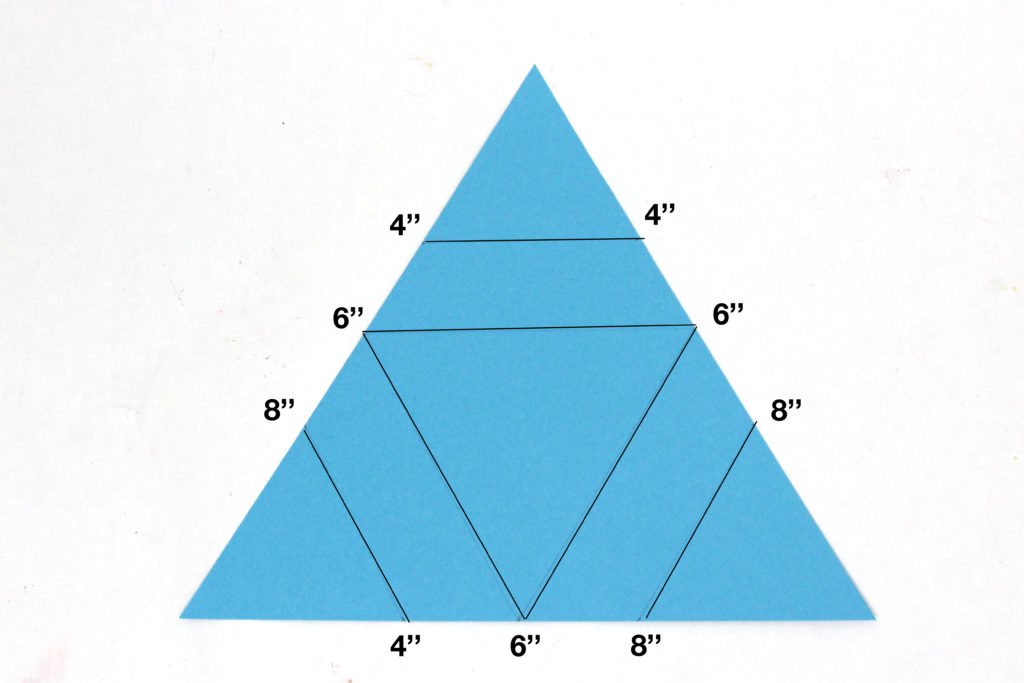
2.  On each side of the triangle, mark the 4-inch, 6-inch and 8-inch points, as noted in the image above. Then connect the points across each side with a pencil. These lines will show you where to make folds.

3.

3. Your large triangle has two sets of lines — three inner lines and three outer lines. Fold the innermost lines inward.

4.

4. Fold the outer lines outward. You now will see a large triangle in the middle surrounded by a trapezoid and then a smaller triangle at each corner.

5.

5. If you’d like, you can cover the smaller triangles at the corners with a different color or design of paper using a glue stick or double-sided tape.

6.

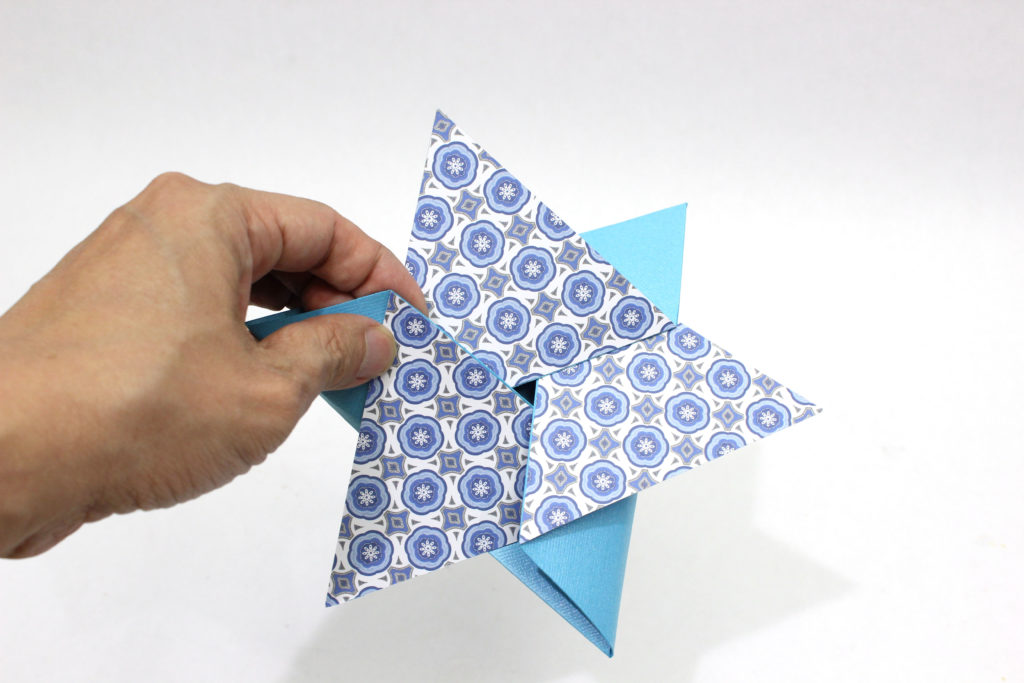
6. Bring the folds of the triangle inward to create a Star of David. The small triangles that used to be on the outer corners now form the top triangle of the star. Overlap them to lock the star in place.


Jonathan Fong is the author of “Walls That Wow,” “Flowers That Wow” and “Parties That Wow,” and host of “Style With a Smile” on YouTube. You can see more of his do-it-yourself projects at jonathanfongstyle.com.

Make Your Own Star of David Card Read More »

Obituaries: Week of November 10

Eugene Alpern died Oct. 18 at 87. Survived by daughters Nancy (David) Staffieri, Annette; 3 grandchildren. Hillside

Pearl Applebaum died Oct. 29 at 91. Survived by daughter Donna (Richard) Chinery; 1 grandchild; 2 great-grandchildren. Hillside

Ruth Bennett died July 24 at 103. Survived by son Jack (Emily); 2 grandchildren; 2 great grandchildren. Hillside

Eugene Chernoy died Oct. 19 at 97. Hillside

Edward Davis died Oct. 26 at 87. Survived by wife Paula. Hillside

Lillian Diamond died Oct. 22 at 102. Survived by sons Larry (Barbara), Roger (Fran); 5 grandchildren; 7 great-grandchildren. Mount Sinai

Harriet Feldman died Oct. 16 at 90. Survived by daughters Carol (David) Lehrman, Suzanne, Arlene. Hillside

Sara Freed died Oct. 19 at 96. Survived by daughters Sylvia (Michael Bassichis), Nancy (Stephen Smith); son Jerrold; 3 grandchildren; 1 great-grandchild. Hillside

Benjamin Herson died Oct. 24 at 94. Survived by daughter Ilana; sons Adam (Sarah), Johanan; 3 grandchildren; 9 great-grandchildren. Mount Sinai

Leonard Hess died Oct. 19 at 96. Survived by wife Muriel; daughters Wendy (Stan) Lefton, Bobbi (Ivan) Bennett; son Steven (Josette); 6 grandchildren; 6 great-grandchildren. Hillside

Richard Jolson died Oct. 22 at 77. Survived by wife Susan; sons Brian (Brandi), David (Heidi); 3 grandchildren; 1 great-grandchild. Hillside

Peter Kastoff died Oct. 26 at 68. Survived by brother Stephen Kastoff. Hillside

Shoshanah Kaufman died Oct. 17 at 27. Survived by mother Hiromi; father Phred; brother Jonah. Mount Sinai

Jill Kohl died Oct. 24 at 52. Survived by father Ramon; brother Jeffrey (Michele). Mount Sinai

Eunice “Eni” Kessler died Oct. 21 at 87. Survived by husband Allen; daughter Penny (Glenn) Klein; sons Gary (Jill), Barry (Debra), Kenneth (Becky); 6 grandchildren; brother Ronald Light. Mount Sinai

Ira S. Langbaum died Oct. 25 at 90. Survived by wife Lillian; daughters Janet (Joseph) Statman, Hope Kirsch; 6 grandchildren; 8 great-grandchildren. Mount Sinai

Joseph Levitt died Oct. 8 at 92. Survived by wife Mina; son, Sol (Maria) Levitt; 4 grandchildren. Mount Sinai

Eunice Markman died Oct. 28 at 96. Survived by daughters Elizabeth Medway, Susannah Susman-Barrett, Jennifer (John) Isaacson; sons Randall (Beth) Susman, Joshua (Janice) Susman; 11 grandchildren; 4 great-grandchildren. Hillside

Norman Reicher died Oct. 14 at 96. Survived by wife Frances; daughters Shelley (Greg) Reicher-Lawrence, Lauren (Rick) Reicher-Gordon, Joanne (Michael) Reicher-Carro; 5 grandchildren. Hillside

Howard Rothman died Oct. 22 at the age of 86. Survived by brother Stanley (Audrey). Chevra Kadisha

Betti Saslow died Oct. 19 at 88. Survived by daughter Jan (Richard) Stephenson; son Michael (Sharon) Brown; 5 grandchildren; 3 great-grandchildren. Hillside

Alex Satmary died Oct. 25 at 97. Survived by daughters Shirley (Neil) Jasper, Susan (Rick) Hirschhaut; 4 grandchildren; 4 great-grandchildren. Mount Sinai

Martha Sattler died Oct. 27 at 91. Survived by daughters Nancy Peardon, Carol (John) Simpson, Laura (Amir) Beso; 4 grandchildren. Hillside

Jack Smolens died Oct. 22 at 88. Survived by wife Natalie; daughter Beth; 1 grandchild. Hillside

Jack Sodikoff died Oct. 22 at 78. Survived by wife Gail; sons Spencer Alan, Mitchell Jay (Jeannine); 3 grandchildren. Mount Sinai

Robert Stambor died Oct. 24 at 89. Survived by niece Marla Waldman. Mount Sinai

Regina Steiner died Oct. 17 at 96. Survived by daughter Ellen Frankel; sons Richard (Becky) Koskoff, Billy Koskoff; 5 grandchildren; 7 great-grandchildren. Hillside

Irene Stern died Oct. 24 at 81. Survived by husband Mark; son Mitch (Sandi); 1 grandchild; brother Aaron (Felice) Greenberg. Hillside

Alice Stone died Oct. 27 at 88. Survived by daughters Sandra, Evelyn (Ronald) Stein, Solange Ohana; sons Mark Lewis, Steve; 11 grandchildren; 20 great-grandchildren. Mount Sinai

Samuel Taub died Oct. 25 at 94. Survived by daughters Lynne (Stewart) Brookman, Gayle Schreiber; 4 grandchildren; 2 great-grandchildren. Hillside

Phyllis Taylor died Oct. 23 at 88. Survived by daughter Susan (Thomas) Klein-Golden; sons David (Bac Le) Klein, Richard (Katherine); 8 grandchildren; brother Frank (Nonna) Fleischer. Hillside

Eugen Valenta died Oct. 23 at 99. Survived by daughters Judy (Fred) Grund, Ruth Johnson; 5 grandchildren; 6 great-grandchildren. Mount Sinai

Mark Weinberg died Oct. 28 at 64. Survived by wife Luz Eastman; daughter Dawn; 3 grandchildren; sister Sherry (Mark) Austin; brother Steven. Mount Sinai

Obituaries: Week of November 10 Read More »

The Family Man Behind the Cranky Voice

Editor’s note: Gilbert Gottfried has died after battling a long illness. He was 67. Below is an article we published about him in the Journal in 2017.

Even if you can’t place the face behind it, you will probably recognize that voice.

Cranky and abrasive, a Brooklyn bray perfectly pitched to heckle or lob vulgarities, the voice of actor-comedian Gilbert Gottfried is unmistakable, whether he’s behind the microphone at a comedy club (where he performs regularly) or he is waxing philosophical during an interview.

Gottfried, 62, is the voice of scores of animated characters, most notably Iago, the parrot sidekick of the evil Jaffar in Disney’s “Aladdin” franchise. He squawked famously as the exasperated spokes-duck for Aflac before a series of his tweeted jokes at the expense of victims of the 2011 Japanese tsunamis prompted the insurance giant to sever ties with him.

The tsunami-tweet dust-up was hardly the first time the comedian raised hackles. Employing that voice to its greatest foul-mouthed comic effect, Gottfried has never met a sacred cow he didn’t attempt to slaughter. Shortly after the Sept. 11 terrorist attacks, he showed up at a roast for Hugh Hefner, saying he couldn’t get a direct flight because “they had to make a stop at the Empire State Building.”

Gottfried has never met a sacred cow he wouldn’t slaughter.

But in a new documentary, “Gilbert,” which opens in Los Angeles on Nov. 10, Gottfried emerges as a private and shy guy, a quirky artist and family man who offstage leads what most would consider a fairly conventional life.

Dara Kravitz, his wife of 10 years, noted in an interview with the Journal at a Pasadena diner that for several years while she and Gottfried were dating, he never told his closest friends about her existence. Gottfried, who was low-key but laughed plenty during the interview, had a theory as to why that was the case.

“I always think of that scene in ‘The Wizard of Oz’ — ‘pay no attention to that man behind the curtain,’ ” he said as he sat alongside his wife and the documentary’s writer-director, Neil Berkeley. “Just watch me onstage or in a movie. What I’m doing up there, I don’t want anybody to think about, I guess.”

Berkeley concurred: “There’s this uncomfortable thing with Gilbert where he doesn’t want his personal life to collide through the other life he has, his life in entertainment.”

For the documentary, Berkeley tracked Gottfried across the country and internationally, and he also had his camera rolling during times Gottfried spent with his older sisters in his native Brooklyn and with his children, Lily, 10, and Max, 8. The film shows that while Gottfried may try to keep his worlds separate, he is still a comedian and, yes, his family  also  can be grist for the joke mill.

An off-color riff on actress Mackenzie Phillips made it into the film, to Kravitz’s initial displeasure.

“Now I can never show this movie to the kids,” Kravitz said. “But I guess it drives the point: It’s a joke.”

“I can kind of go into the lowest depths of hell and still be a human being, which a lot of people don’t see,” Gottfried said. “When I got in trouble with the whole tsunami thing, I did a TV interview and the interviewer was confronting me like I was the biggest criminal on the planet, like I blew up an orphanage or something. Later in the interview, I said to her, ‘You know, there are certain jokes that are in bad taste, but people tell them,’ and I told her this joke and she started laughing and covering her face.”

Gottfried’s religious background is part of the documentary as well, although not explicitly. He was raised in a Jewish home, although he never became a bar mitzvah and has never been particularly observant. But, “If the Nazis were to come back,” he said, “I’d be on the train car with everybody else.

“What’s interesting to me, ‘Jew’ is the only actual real word that’s considered a curse word in an ethnic group,” Gottfried said. “On my podcast, I’m always revealing what famous person is a Jew. That’s one of the things I remember when I was watching TV with my father. At the end of the TV show or movie, he would point out people and say, ‘So-and-so is a Jew. Jew, Jew.”

The Family Man Behind the Cranky Voice Read More »

Avraham Infeld Makes His Case for a Passionate Judaism

A story is told of a visitor to The Hebrew University of Jerusalem who is taken on a tour of the buildings named after famous Jewish writers. But the name on one building is unfamiliar to the visitor.

“What did he write?” asks the visitor, to which the guide answers: “A check.”

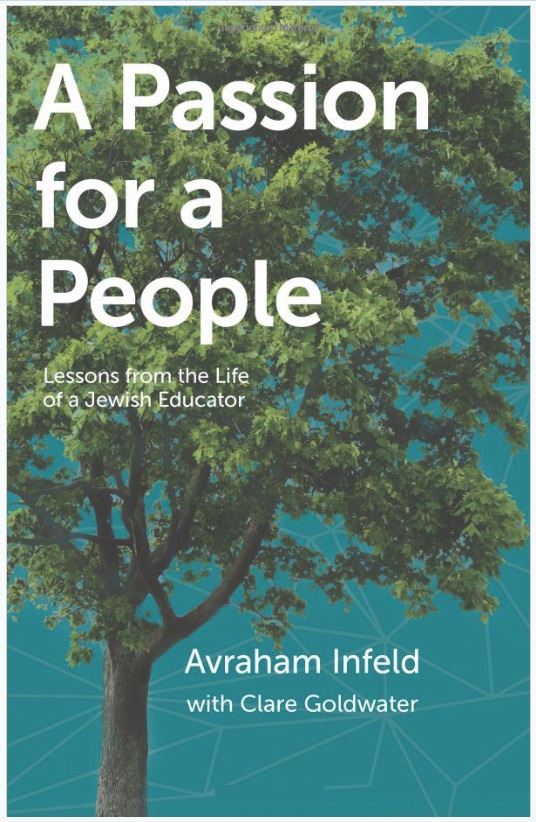
I was reminded of this story in the opening pages of “A Passion for a People: Lessons From the Life of a Jewish Educator” by Avraham Infeld with Clare Goldwater (YouCaxton Publications). It’s the memoir of a man who has written his name into our history — not with a book, not with a check, but with his life’s work, both in Israel and throughout the Diaspora.

Over the years, he has served as president of Hillel International, CEO of the Melitz Center for Jewish Zionist Education, director of English-speaking youth programs for the Jewish Agency and planning director of Birthright Israel, among other posts.

“I am a builder — not of buildings but families,” Infeld explains. “I start with my own family … [a]nd then I expanded my perspective, yielding to the eternal pull that I feel toward the extended Jewish family to those I don’t know personally but love anyway and to the relatives across time and space that Jewish history has bequeathed me.”

Born in South Africa in the 1950s, Infeld was raised in what he calls a “secular, ethnic, Zionist form of Judaism,” and only later found his way into observant Judaism.

“For our family, Shavuot was an agricultural festival that had been revitalized by the Zionist movement,” he recalls. “I had no idea that Jews around the world celebrate Shavuot as the day on which the Torah was given.”

Even so, he insists that describing Judaism as a religion “is a distortion of what we are.” He says: “One cannot practice the Jewish religion without a sense of belonging to the People.”

His devoted work for a diverse and distinguished list of Jewish communal organizations was in service of the overriding goal of reminding Jews that they belonged to a people rather than a faith. According to Gideon Shimoni, a professor at Hebrew University, “peoplehood” is “a concept which became the hallmark of his famed educational enterprise.

Intriguingly, he does not identify anti-Semitism as the greatest challenge to the integrity and vigor of the Jewish people.  Rather, he reaches back to the Emancipation of the 19th century, which enabled Jews to escape the ghetto and enter the secular world, an event that shattered the Jewish people into what he calls “subtribes,” including “the Zionist, the Haredi, the assimilated Jew, and the denominational Jew — each with its own definition of what it means to be a Jew.”

Yet he regards the diversity of Judaism as the source of its richness, strength and vitality, if not also some of its greatest challenges.

A book about the Jewish religion that even a wholly non-observant Jew will find endearing and enriching.

“[M]y understanding of being Jewish today has been continually enriched by the multiplicity of modern Jewish identities that I have encountered. … And the assumption behind it is very important — namely, there cannot be a single way or truth for what it means to be Jewish, there are only multiple perspectives on the same truth,” he said.

Early in his career, Infeld spent time at what is now the Brandeis-Bardin Campus of American Jewish University in Simi Valley, and he singles out its founder, Shlomo Bardin, as one of his teachers and mentors. But Infeld also confesses that America causes him to feel both “love and fear” precisely because “you can be Jewish and American at the same time.”

The reason for his trepidation is found in the fact that Judaism is regarded as a religion in America: “[If] Judaism is a religion, like Christianity, then there is no national identity to express and no contradiction between being American and being Jewish.”

Exactly here we find the cutting edge of Infeld’s candor. Since the United States and Israel, at least during the pioneering era of secular Zionism, sought to achieve “freedom from religion,” the goal of both countries seemed to provide “an ability to be Jewish without religion.”

For Infeld, then, we must recognize our membership in the Jewish people before (and whether or not) we participate in the religious practices of Judaism.

“After all, a religion is understood as the truth of all truths, and religions want others to accept those truths,” he explains. “If we had that approach, we would actively look for those non-Jews who wanted to try on tefilin and perform other mitzvot. … But we are not a religion, we are a people, and our rituals and values apply only to those who are members of our People.”

Infeld sums up his own prescription for the health of the Jewish people with the metaphor of “the five-legged table,” that is, “Memory, family, Mount Sinai, Israel and Hebrew.”  Notably, only one leg of the table is explicitly religious: “Mount Sinai signifies the earliest recognition of a transcendent power and the ensuing realization that if there is already a God, then human beings are not God,” he writes. “From here we learn the values and rituals that are our particular inheritance and that govern our behaviors, our role in the world, and our contribution to humanity.”

Even when it comes to the miraculous account of Mount Sinai that we find in the Torah, Infeld keeps an open mind: “Whether or not it really happened, this event changed us forever.”

“A Passion for a People” is a book about the Jewish religion that even a wholly non-observant Jew will find endearing and enriching.  It is beautifully written, full of resonant stories and recollections, gentle instruction and both courage and candor. “I live in perpetual tension between my universal and particular tendencies,” he writes. “I am both Avraham Infeld the Jew and Avraham Infeld the human being.”

And so, Infeld has given us a book that  is intended to open both doors and
conversations.


Jonathan Kirsch, author and publishing attorney, is the book editor of the Jewish Journal.

Avraham Infeld Makes His Case for a Passionate Judaism Read More »