fbpx

November 9, 2017

NO-STRESS THANKSGIVING PREP PLAN

Every year I teach a sold out Thanksgiving Class with waitlisters begging to be admitted. Why? Because this is THE American food holiday, and this holiday causes lots of stress to hosts and hostesses.

The number one question my students come to class with is: What can I do in advance?

Since we are making all the recipes right then and there together as a group, it is actually easy for  me to explain and for everyone to understand what can be done in the days prior and what needs to be done last minute. You, however, presumably, have not been to my class and haven’t made all these recipes with me.

So let me break it down for you.

Basically, you can do all this on Thanksgiving Day, but that’s a looong day.  I broke it down into 4 days, but these are just a few leisurely hours a day. Leisure cooking is good. Want to speed up the process? Do it it all in two days. No problem.

Here’s the overarching theme, if you will:

You are going to be making a broth and that broth is going to be a part of multiple recipes, including a soup. These recipes all taste better when made in advance so that’s good news for us! You will make stuffing, but all the components of the stuffing are fine to be made in advance. The desserts are great done in advance too, even the pumpkin bread because it’s so moist. Only the turkey and the roasted veggies should be done right before the meal. Everything else can be assembled or reheated on game day. Make sense?

Don’t worry, I stepped it out for you. You’re gonna be just fine. Just cook with your heart. That adds the best flavor that will be unmistakably appreciated!

P.S. If you are making the stuffing in advance I suggest making a little extra roasted mushrooms and sausage cuz you won’t keep your fingers off of them! It’s my downfall every year. xo

On the menu:

The Easiest Turkey Ever
Tuscan Garden Grove Brussels Sprouts
Nobel Prize Winning Multi-Grain Portobello Stuffing
Root Vegetable Soup with Crisped Sage
Celery Root Mashed Potatoes
Sunshine Pumpkin Pie with a Date Pecan Crust
Pumpkin Bread (Wheat-Free, plus Gluten-Free Option)


4 Days Prior: Grocery Shopping

#1. Print out all the recipes.

Don’t expect your grocery shopping for Thanksgiving to just take an hour. It will take longer, but that’s ok. Think of yourself as an artist who is setting up the studio. Take your time to procure all the right ingredients so you can begin to paint your culinary canvas, step by step over the next few days.

You will find the most delicious vegetables at the farmer’s market, but if there isn’t one convenient go get the best, preferably organic, produce you can find. (My favorite is the Santa Monica Coop – now in Culver City too – and then I get everything else I need at Whole Foods.) The flavors start with the quality of the ingredients.


3 Days Prior: Make Broth as your Base

Make the Batch of Broth that keeps Giving and Giving as this will provide you with foundation for the Root Vegetable Soup, the Celery Root Puree, and the Nobel Peace Prize Winning Stuffing!  Because you’re making the broth ahead of time, you can cook it for hours. Let it cook all day long if you can. You honestly can’t cook a broth too long. The longer it cooks, the better it tastes, AND it tastes even better the next day, and better the day after that! So get it started early.

Note: You’re going to make a lot of broth, but if it doesn’t fit in the fridge you can keep it on stove overnight and bring to a boil the next day to purify it before making your soup and celery root puree the following day!


2 Days Prior: Soup and Sides

  • Make Celery Root Puree – except for final step, which is baking it.
  • Make Root Vegetable Soup and store in fridge.
  • Crisp sage leaves, steps 8 and 9 in Root Vegetable Soup recipe, and store in airtight container. Don’t put in fridge or humidity will soften them. Step
  • Prep the Stuffing:
    • Complete sections 1-3, which includes roasting the mushrooms and fennel, stale-ing of the bread, and the sautéing and the sausage. Refrigerate the goods.


1 Day Prior: Desserts!

  • Make your Pumpkin Pie.  If you’d like, you can prep the crust and inside separately. In this case, you would make crust 2-3 days in advance, and the inside 1 day in advance. You can also bake it 1 day ahead. Pumpkin pie is good served cold!
  • Make Cranberry Sauce.
  • Bake Pumpkin Bread. If you like it warm, do this on the day of instead. It will stay moist though, just cover it and try not to eat it!


Day of!!! – Putting it all together

5 hours before game time:

  • Turkey: Wash and dry turkey. Stuff with vegetables. Season and let turkey come to room temperature. Steps 1-6, except the preheating of the oven, which you can do later.
  • Brussel Sprouts: Do steps 1-7, which is the prep minus baking them. If you want one less thing to do later, bake them now and just serve at room temp. They will still be totally delicious.
  • Do all the steps in “Assemble the Stuffing” on the stuffing recipe.


2 ½ -3 hours before:

Get your turkey in the oven! Once it’s done, let it rest so it tenderizes. Carve it up last minute.

1+ hour before:

  • Put the Stuffing in the oven, covered for 30 minutes. .
  • Put Brussel Sprouts in the oven. (Note: If you have doubled your recipe, it could take up to 90 minutes to cook, so leave yourself time. If you are just seeing this note now, cook them the last 10-15 minutes at 500 degrees and you’ll be fine. Don’t let them burn!)
  • Bake your Celery Root Puree, covered, Step 6, until hot. (Recipe calls for 30 minutes, but since it’s been in fridge, will take longer. You want it really hot!)
  • Heat up the Soup!
  • Remove Cranberry Sauce from fridge to come to room temp.
  • I like the Pumpkin Pie cold, but if you want it at room temp, take it out now.


30 minutes before:

  • Remove cover from Stuffing and finish baking.
  • Check your Turkey.
  • Chill out and have a sip of wine. The part is more fun when YOU are relaxed. Don’t be timid to ask friends and family to help in the kitchen. There are always a handful who LOVE to help. It helps to break the ice.


Go Time:

Start with the Soup, top if with grated pecorino romano and the sage leaves and just let it flow from there!

NO-STRESS THANKSGIVING PREP PLAN Read More »

Survivors Open Up in ‘Destination Unknown’

In the opening sequence of the acclaimed documentary “Destination Unknown,” Ed Mosberg dons a blue-and-gray-striped jacket emblazoned with the number 85454 and a matching hat. It’s a replica of the uniform he was forced to wear 70 years ago as a slave laborer in concentration camps such as Mauthausen and Plaszow, some of whose inmates were famously saved by factory owner Oskar Schindler.

Mosberg wears the uniform whenever he has a speaking engagement or visits camps-turned-memorials. He had it with him when he attended a September showing of the film at the University of Southern California, sponsored by the USC Shoah Foundation.

Mosberg, 91, was the only member of his Polish family to survive the Holocaust, and he’s one of 12 survivors in the film who relate their harrowing experiences during World War II. He wears the uniform “so that people never forget that [the Shoah] did exist,” he told the Journal. “My whole family was murdered. I have to talk because they can’t. This is my duty and obligation. As long as I live, I will be talking.”

The film, 14 years in the making, blends archival footage with testimonies from Jews who survived concentration camps, were in hiding, fought with partisans, or were fortunate to have been chosen for Schindler’s famous list. Many had never spoken on the record before. And half of the participants died either during the film’s production or after its completion in 2016.

“Now there’s the recognition of mortality,” said Llion Roberts, the film’s producer. “They don’t want to take this to the grave.”

In the film, survivors vividly recall incidents of brutal treatment, the last time they saw their families, the kindness of random strangers that allowed them to live another day and, for some, the post-liberation reunions with parents and siblings they had assumed were dead.

Listening to Mosberg and the other documentary subjects tell their traumatic tales took a toll on Roberts. “I found it so intense that I had a nervous breakdown in 2004,” he said. “I had panic attacks in 2015. It cost me too much in time, stress and funding. But I’m glad I met the people I met. It’s been an incredible journey.”

Roberts, who is not Jewish, was deeply affected by a visit to Auschwitz-Birkenau in 2001. He couldn’t forget seeing a photo of a 13-year-old girl who resembled his daughter, who was the same age at the time. He started doing research and in 2003 began finding subjects and conducting interviews.

“I was doing 14-hour days of listening to them take me through from childhood to liberation,” he said. “I didn’t ask questions. I just let them talk. Some of these interviews would last five hours. This is why I got such intimacy.”

Roberts ended up with 400 hours of footage, and in 2014 brought in director Claire Ferguson to help him finish the film, with “no narration and primary sources only. No experts or historians.”

“As long as I live, I will be talking.” — Ed Mosberg

Roberts believes what sets “Destination Unknown” apart from other Holocaust survivor documentaries is his use of primary sources. “It keeps it authentic,” he said.”

Stephen Smith, executive director of the USC Shoah Foundation, saw the film in 2016 and came aboard as an executive producer.

“The way the film is woven together, with many stories making up a larger one, will appeal to young people because it brings the testimony alive,” said Smith, who plans to build lessons around the film.

With the alarming rise in anti-Semitism and hate groups around the world, Roberts believes the film’s message couldn’t be more timely.

“History is repeating itself,” he said. “You have another generation coming in, making the same mistakes as the previous ones. There’s a correlation between the mortality of survivors and apathy. Once they’re gone, there’s no obligation to talk about them anymore.”

But Roberts emphasizes that his documentary “is not a history lesson. It is about the resilience of the human spirit, and hope,” he said. “Even for people who have experienced the worst kind of trauma, there is light at the end of the tunnel.”

“Destination Unknown” opens Nov. 10 at Laemmle’s Music Hall in Beverly Hills.

Survivors Open Up in ‘Destination Unknown’ Read More »

Letters to the Editor: Harvey Weinstein, IDF Destroys Hamas Tunnel, Pickles

Harvey Weinstein: Disgrace to Judaism

I picked up a recent copy of the Journal, which I always look forward to reading. However, when I saw the photo of Harvey Weinstein on the cover, I was stunned. His picture, if in the Journal at all, should be small and on the last page of the paper, declaring that he shamed himself, his family, and that he is a disgrace to everything Jewish. The cover of the Journal should have someone we respect and emulate, who lives an exemplary life and makes this world a better place. I am sure you can choose more wisely the next time you prepare the paper.

Marion Lienhard, Thousand Oaks


A New Look, New Direction for the Journal

Congratulations on the new format, type, layout and the change in focus.

The new parsha commentaries show the variety of possibilities in interpretation.

The political differences are best shown when focused side by side on a single topic. The expansion of writers gives voice to many other topics of interest.

Mazel tov!

Enriqué Gascon, Los Angeles

When I lived in Baltimore I told people I read their Jewish News and they responded by saying, “Honey, no one reads it, we just look through it.”

One cannot say that about our Jewish Journal.  Its content is rich, diverse, readable and good enough to be savored.  All of that in addition to learning new things, human interest stories, and opinions that do not require you to want to tear your hair out.  OK maybe a little hair-tearing.

Don’t you just love change?

Sherri W. Morr via email

The Journal’s profound new tone and writers continue to amaze. In “A Deeper Feminism (Oct. 27),” Karen Lehrman Bloch’s assertion that freedom requires “thoughtfulness, a need to recognize reality and human nature” is a breath of fresh air. Although Bloch considers herself politically neutral, the media are so predominantly leftist that she seems to speak for the right. Her observation that “Women are equal to men but … different,” and “We should take pleasure in the differences,” is a mature, common-sense response to the growing, misguided progressive dogma that there’s no difference between the sexes or that it’s all cultural indoctrination. She’s a real delight!

I’ve even started reading Marty Kaplan’s column again. For a while, he was just trashing President Donald Trump every week, but his fascinating Oct. 27 rumination, “When Bad People Happen to Good Art,” explores the age-old enigma of profound art created by immoral, self-indulgent people. I wonder if it struck Kaplan that all the abusive artists he cited are likely Trump-haters, and that every Weinstein associate and political crony is a Democrat. Is the contempt some leftists have for Christianity and traditional Judaism eroding their consciences? I’m not suggesting Republicans aren’t sinners, but unlike secularists they don’t just rationalize bad behavior away. I’d love to hear Kaplan’s thoughts on this.

Rueben Gordon via email

What a great editor’s note: “Can Jewish Journalism Aim to Please?” (Oct. 27)! Note, that reveals a great journalist’s mind! Mr. Suissa, you have found that “sweet spot” already. By asking questions, you provoke thought, and by remaining true to yourself, you avoid triggering anger. The three insights you write about are excellent ways to reach out to as many readers as possible.

I am not a Jew, but I really enjoy the Journal, now more than before, finding those insights applied on all the pages. In my opinion, it is impossible to please each and every reader, but it is fully possible and necessary for journalists to be true to themselves when reporting the facts. Then let the readers be the judge! That’s how we, the readers, will be challenged to open our minds to new ideas and to “look beyond our own customs and traditions.”

Svetlozar Garmidolov, Los Angeles


Put the Brakes on Those GPS Satellites

Your interview with Barry Barish (“Barry Barish on His Nobel Prize — and Why He Never Wrote That Novel,” Oct. 27) contains an egregious error. He is quoted as saying that the GPS satellites travel at 1/4th of the speed of light. They actually travel at 14,000 kilometers per hour (kph) relative to Earth, which is 0.001 percent of the speed of light. The relativistic offset of the space-borne clocks is 38 microseconds/day relative to a stationary clock on Earth, which would cause an Earth-bound user to make a 14-centimeter position error.

As a mere PhD in engineering I hesitate to correct a Nobel Prize winner. I suspect the interviewer misunderstood him.

Myron Kayton via email


Israel’s Destruction of Hamas Tunnel

I would like to thank Aaron Bandler for the story he wrote on the Israeli Defense Force (IDF) destroying a tunnel built by Hamas (“IDF Destroys Hamas Tunnel,” Oct. 30). I 100 percent agree with what Bandler wrote about what the IDF did. Not only did I agree with it but I also completely [endorse what] the IDF is doing. In this story, I discovered that the IDF destroyed a tunnel made by Hamas. The tunnel spanned from Khan Younis in Gaza toward Kibbutz Kissufim in Israel. The reason I agree with this is because Israel warned that Hamas digs over six miles of tunnel a month toward Israel and that members of Hamas can travel through the entirety of the Gaza Strip underground through their network of tunnels. So if Israel lets this continue to happen, then many will probably die.

Nathan Tabibi via email


Israel and the Politics of Pickles

In the column “We, the Pickles,” Shmuel Rosner discusses many things. For the most part, I agree with his statements, although he wrote that Israeli President Reuven Rivlin meant that we all no longer care about the country or the people, but rather maintaining the government. But isn’t that what Israeli Prime Minister Benjamin Netanyahu is doing? No matter what Netanyahu does, the critics grumble. He does well and he gets no credit, but as soon as something bad happens, he is to blame. As I see it, if Netanyahu is just thinking about the government, he is doing the right thing to please the critics and the country.

Avner Shamtoub via email


The Cause and Cure for Terrorism

When terrorists attack, they tell us very clearly why they are killing (“8 Dead, 12 Injured in Manhattan Attack,” Nov. 3). They yell, “Allahu Akbar” (Allah is the greatest) — a jihadi battle cry. Yet we ignore it. We wring our hands and lament. We send teddy bears to the victims. That will not stop the next attack.

What will stop Islamic terror is simple but not easy. Imams, Muslims — all who practice Islam — must begin citing the many specific passages of the Quran, the Hadiths of Muhammad and sharia law that tell their flock that jihad, killing infidels and Jews are holy acts, and then denounce these passages as wrong, despite their appearance in holy texts. Unless and until this happens, we will continue to have more deaths. This is not bias. This is common sense.

Not all who practice Islam will commit jihad but some are doing so. We see their bloody work on an almost weekly basis.

Islamic and all religious leaders should stand together and denounce these passages.

Some examples: A command in the Quran: “Fight against those to whom the Scriptures were given [i.e. Jews and Christians] … until they pay tribute out of hand and are utterly subdued.”

Ginette Weiner, Scottsdale, Ariz.

Letters to the Editor: Harvey Weinstein, IDF Destroys Hamas Tunnel, Pickles Read More »

Moving & Shaking: Seinfeld Headlines Ball, Iranian-American Jewish panel and Israeli American Council National Conference

Leave it to Jerry Seinfeld to transform a Beverly Hilton ballroom into an intimate comedy club.

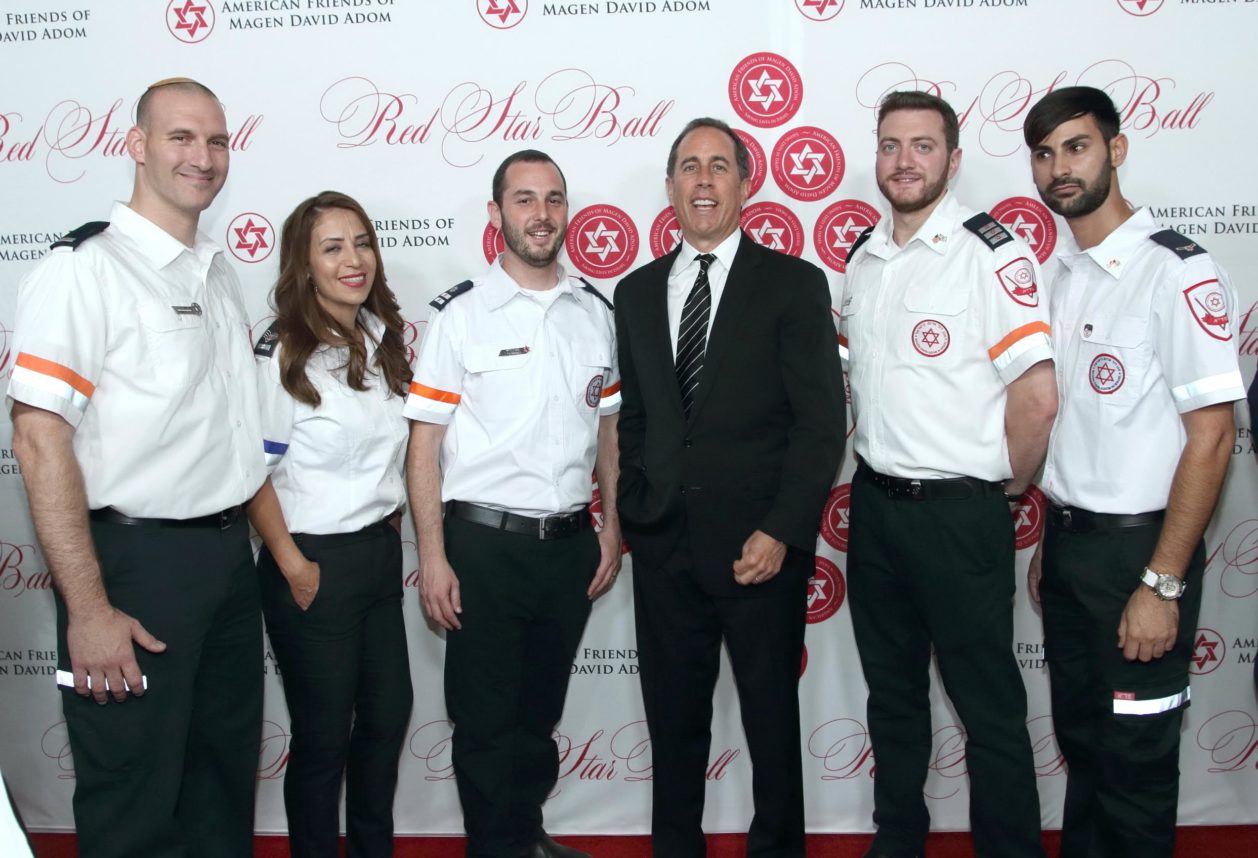
Performing a half-hour set to conclude the American Friends of Magen David Adom (AFMDA) Red Star Ball on the evening of Oct. 30, the comedic legend commanded the large, candlelit room like he was headlining the Improv.

Seinfeld opened the evening with a few minutes of material — joking about how Gentiles attend events for the alcohol, Jews for the rolls — but he promised he would return at the end of the night. When he came back onstage after 10 p.m., the funnyman captured both the mood of the fundraiser and the comic sensibility he is famous for.

“It’s been a beautiful night of generosity …,” he said. “Now, let’s get back to complaining.”

The gala raised pledges of more than $18 million, a record for an AFMDA event anywhere in the country, according to an event spokesperson. It also spotlighted the life-saving work of Magen David Adom (MDA), Israel’s ambulance, blood-services and disaster-relief organization that serves as emergency medical first-responders for the state’s more than 8 million people. MDA is mandated by the Israeli government to serve in this role, but it is not a government agency.

Of those in attendance, Humanitarian of the Year Honorees Sheldon and Miriam Adelson pledged $12 million to the organization, and Maurice Kanbar, creator of SKYY Vodka, pledged $5 million.

“My heart is in Israel,” Sheldon Adelson said. “And Israel is in my heart.”

Renee and Meyer Luskin received a Lifetime Achievement Award in recognition of their support for the arts and education in Greater Los Angeles.

Next Generation Award winner Nikita Kahn — an actress, model and animal rights advocate — credited gala co-chair Dina Leeds with instilling in her the importance of supporting Israel.

“Her passion for Israel is contagious,” Kahn said of Leeds, who co-chaired the evening with her husband, Fred.

Additional speakers included Consul General of Israel in Los Angeles Sam Grundwerg and the Leeds’ daughter, Alisa. The latter highlighted the contributions of MDA to Israel. She has volunteered with the organization and called it a model for peace as it treats patients regardless of religion or ethnicity.

A number of MDA medics attended the gala, including Rivka Or, a senior emergency medical technician; and Mohammed “Chamudi” Arrabi, a gay, Muslim medic.

“It makes me happy when I help somebody,” Or said.

Also in attendance were comedian Elon Gold; Rabbi Zvi Boyarsky, of the faith-based rehabilitation organization Aleph Institute; USC Hillel Executive Director Bailey London; Jewish Journal Publisher and Editor-in-Chief David Suissa; and Israeli reality TV star Yossi Dina.

From left: Jesse Sharf, Kam Babaoff, Aliza Karney Guren, John Ghermezian and Kamyar Shabani participate in 30 Years After’s “The Builders of Los Angeles.” Photo by Jasmine Foroutan

30 Years After, the Iranian-American Jewish civic engagement organization, held its first in a series of events celebrating its 10th anniversary. The event, titled “The Builders of Los Angeles,” took place on Oct. 24 at the PH Day Club – Luxury Penthouse in West Hollywood and brought together a panel of prominent real estate developers and philanthropists.

The panel included Kam Babaoff, managing director of Ensemble Investments; Aliza Karney Guren, CEO of Karney Properties; John Ghermezian, chief business officer of Mall of America; and Kamyar Shabani, principal of Optimus Properties and a member of the 30 Years After advisory board. Jesse Sharf, partner at Gibson, Dunn & Crutcher, moderated.

The panelists discussed their careers, the real estate industry, their passion for philanthropy and the Jewish community, and how their Jewish identities influence their philanthropy and businesses.

“People think that bad people get ahead in business, but people actually like doing business with good and philanthropic people,” Sharf said in response to an audience question. “It gets you further.”

When the panelists were asked what compelled them to be philanthropic, Babaoff responded: “My mom and dad were my role models. Growing up in Iran, our house was like Grand Central Station. People who needed help were always coming through, whether for money or dispute resolution. It is our duty and responsibility to give back, and giving back isn’t just giving money.”

“Money isn’t satisfying, but philanthropy is,” Ghermezian added. “A cause gives you a reason to continue working hard.”

About 250 people attended the event, including former Beverly Hills Mayor Jimmy Delshad; Los Angeles County Assessor Jeffrey Prang, and 30 Years After co-founder Sam Yebri.

In an interview, 30 Years After Executive Director Shanel Melamed said she was proud of how the program has helped provide a space for Persian Jews.

“This decade of engagement and leadership training has led to a comprehensive, emerging generation of Iranian-Jewish leaders who are equipped and motivated to contribute to, and lead, Los Angeles,” Melamed said. “We’re proud to be the central organization empowering Iranian-American Jews to be impactful members of society, and we have even greater goals for the next 10 years. We welcome everyone to join our exciting and growing movement.”

Mati Geula Cohen, Contributing Writer

Diego Cartagena, vice president of legal programs at Bet Tzedek. Photo courtesy of Bet Tzedek

Bet Tzedek, a pro bono legal aid agency, has named Diego Cartagena as its next vice president of legal programs.

Cartagena succeeds Gus May, who became a Los Angeles Superior Court judge in August, and will report directly to Bet Tzedek CEO Jessie Kornberg.

“This is a good day for Bet Tzedek and a great day for the thousands of clients that depend on us for a fair chance and a better life,” Kornberg said in a statement announcing Cartagena’s appointment.  Diego exemplifies what is best about our mission: an audacious commitment to push the bounds of what seems possible and deliver on our pledge to deliver equal justice for all.”

Cartagena’s responsibilities will include managing “the continued growth of Bet Tzedek’s community services,” according to the announcement. He has worked at Bet Tzedek since 2012, serving as the organization’s pro bono director.

“I look forward to working with longstanding and new community partners, pro bono supporters, and sister legal services agencies to continue to build on Bet Tzedek’s incredible history of protecting the rights of those most vulnerable by building innovative programs and coalitions that are responsive to the evolving community landscape,” Cartagena said.

Israel’s Education Minister Naftali Bennett speaks to the Jewish Journal’s David Suissa at the Israeli American Council National Conference. Photo by FPerry Bindelglass

The Israeli American Council (IAC) National Conference attracted a record number of attendees this year — about 2,500 — when it was held from Nov. 3-6 at the Walter E. Washington Convention Center in Washington, D.C.

“We have to make sure that America is pro-Israel regardless of who is in Congress and who is in the White House,” Congressman Brad Sherman (D-Sherman Oaks) said at the event, which examined Jewish and Israeli identity, Israel as a nation-state of the Jewish people and cutting-edge innovative ideas in education, technology and community building.

Israel Ambassador to the U.S. Ron Dermer also appeared and described President Donald Trump’s recent speech criticizing the Iran deal as “the second-best day since I have been ambassador.”

Additional speakers included U.S. Ambassador to the United Nations Nikki Haley; Jewish Home leader Naftali Bennett, who participated in an interview with Jewish Journal Editor-in-Chief David Suissa; diplomat and author Dennis Ross; IAC Chairman Adam Milstein; and Miriam Shepher, an IAC national council member from Los Angeles. Las Vegas casino magnate Sheldon Adelson and his wife, Miriam, sat for a conversation with IAC board member and chairman emeritus Shawn Evenhaim.

The IAC is an umbrella organization with 16 chapters across the country, including in Los Angeles. Since 2007, the organization has prided itself on investing in programs that assist the Israeli-American community.

From left: Imam Abdullah Antepli, Jewish Journal Editor-in-Chief David Suissa and Yossi Klein Halevi participate in a discussion titled “Enemies, A Love Story.” Photo courtesy of Beth Jacob Congregation

An Oct. 29 discussion at Beth Jacob Congregation, titled “Enemies, A Love Story: A New Way Forward for Jewish-Muslim Relations,” featured a formerly self-proclaimed extremist Jew and a formerly anti-Semitic Muslim discussing Muslim-Jewish relations. The Shalom Hartman Institute, a pluralistic research and leadership institute for Jewish thought, organized the discussion.

Jewish Journal Publisher and Editor-in-Chief David Suissa moderated the discussion between Yossi Klein Halevi and Imam Abdullah Antepli, co-directors of the Shalom Hartman Institute’s Muslim Leadership Initiative, which, according to Hartman.org, “invites North American Muslims to explore how Jews understand Judaism, Israel and Jewish peoplehood.”

Halevi and Antepli spoke with compassion and conviction about how they want to see the program work now and in the future. Their remarks often drew applause from the approximately 250 people who attended, including Beth Jacob Rabbi Kalman Topp.

Ginger Vick contributed to this report

Larger Than Life children and volunteers attend the 14th annual Larger Than Life gala dinner at the JW Marriott L.A Live. Photo by Abraham Joseph Pal

Larger Than Life–L.A. Family, a nonprofit affiliated with the Israel-based Larger Than Life organization, in October brought to Los Angeles from Israel 38 youths with cancer for a 10-day dream vacation.

The youths, ages 10-18, enjoyed Southern California theme parks, rode ATVs, sailed on a yacht and partied at a gala dinner downtown at the JW Marriott hotel at L.A Live on Oct. 29. It was the 14th annual trip organized by Larger Than Life.

At the gala, approximately 750 guests watched a video about two friends, May Gurfinkel and Noa Tzemach, who both died months ago after battling cancer for two years. The two became close after visiting Los Angeles in 2015 on a Larger Than Life vacation.

“Noa started as a mentor to May, and they became one soul. They went together to the very end, talking about things that we will never, ever be able to understand,” said Gurfinkel’s father, Golan, who traveled from Israel for the event. May Gurfinkel died in July.

“I used to be the one who gave others money and a helping hand, and I thought I could handle this by myself, but it simply wasn’t possible,” he said. “We needed all the help we could get. Without Larger Than Life, your generosity and help, we wouldn’t be able to make it. The Larger Than Life dream trip gave May hope and the best friends ever.”

The event raised more than $1 million, including $2,000 raised by the youths themselves.

Ayala Or-El, Contributing Writer

Moving & Shaking: Seinfeld Headlines Ball, Iranian-American Jewish panel and Israeli American Council National Conference Read More »

Rapper Drake Throws a Re-Bar Mitzvah Party on His 31st Birthday

Could the world’s hottest  rapper be any more of a nice Jewish boy?

According to the New York Post, Drake’s 31st birthday party on Oct. 23 was themed “Aubrey’s re-bar mitzvah.” The Jewish rapper’s real name is Aubrey Drake Graham — and 31, in case you didn’t realize, is the reverse of 13, the age at which Jewish law says boys become men.

Drake did have a bar mitzvah at the age of a 13, telling Digital Spy in 2012, “We kinda just did it in the basement of an Italian restaurant, which I guess is kinda like a faux pas.”

“I told myself that if I ever got rich, I’d throw myself a re-bar mitzvah,” Drake continued.

After an intimate rooftop dinner with friends and family at Catch LA, Drake relocated to the nightclub Poppy in West Hollywood, which was re-named as Papi for the night as a reference to Drake’s “Champagne Papi” moniker. There he was feted by a who’s who of celebrity friends, including actors Leonardo DiCaprio, Jamie Foxx and Tobey Maguire, as well as football star Odell Beckham Jr.

“I told myself that if I ever got rich, I’d throw myself a re-bar mitzvah.” — Drake

The party was thoroughly bar mitzvah-themed, from the photo booth to the Dippin’ Dots ice cream pellets for guests to enjoy. Pizza also was served in boxes that read “Papi’s Pizzeria.”

To underscore the theme, Drake posted an image of his “bar mitzvah board” — seemingly original from 1999 —  to Instagram. It featured a collage of Drake baby pictures.

Drake’s bar mitzvah board on Instagram

Adding to the glitz and glamour of the party were a marching band, sparklers and fine wine, according to “Entertainment Tonight.” Attendees, dressed in semi-formal attire, toasted Drake with red Solo cups with his name on them and sang “Happy Birthday.” Drake’s father, Dennis Graham, gave a speech on how proud he was of his son and performed numerous songs for him, according to eonline.com.

Throughout the party, Drake acted as a bartender, disc jockey and master of ceremonies.

Drake has an African-American father and Jewish mother. He attended a Jewish day school in Toronto and parodied his bar mitzvah while hosting “Saturday Night Live” in 2014.

The rapper has a song titled “Bar Mitzvah in 1999,” which has lyrics that include “I’m Black and Jewish / Don’t be so foolish / I’m Black and Jewish / It’s a mitzvah.”

The rapper’s 2016 album “Views” and his 2017 follow-up “More Life” both broke Spotify streaming records and sold millions of copies around the world.

Rapper Drake Throws a Re-Bar Mitzvah Party on His 31st Birthday Read More »