fbpx

September 17, 2017

St. Louis synagogue opens doors to protesters, leads to Twitter hashtag #GasTheSynagogue

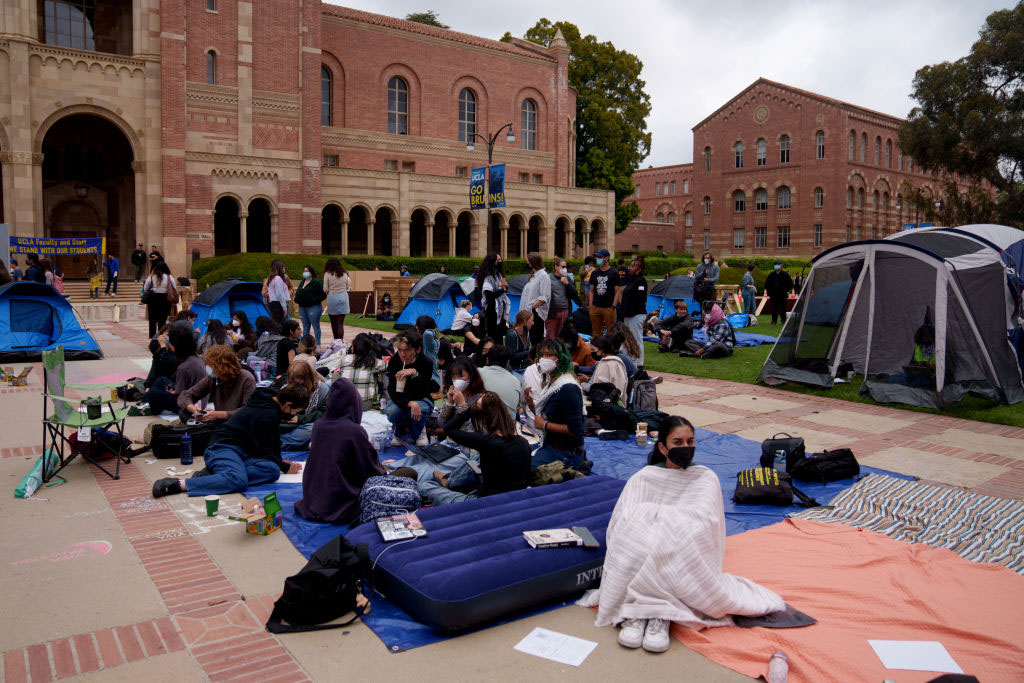
A synagogue in St. Louis opened its doors to provide sanctuary for protesters demonstrating against the acquittal of a white policeman for the killing of a black suspect after police efforts to control the protesters led to violence.

After St. Louis Metropolitan Police officers reportedly surrounded the Central Reform Congregation on Friday night and threatened to fire tear gas at the protesters inside, a trending Twitter hashtag called on the police to #GasTheSynagogue.

The St. Louis Circuit court on Friday acquitted former police officer Jason Stockley of first-degree murder in the 2011 death Anthony Lamar Smith, 24. Stockley, who is white, shot Smith, who was black, five times after a high-speed chase.

On Friday night following the verdict, some 1,000 protesters marched through the streets of downtown St. Louis in protest of the verdict. Riot police pushed at protesters and used tear gas.

Some of the protesters given sanctuary in the synagogue took to social media to say that they were safe in the synagogue and grateful for the hospitality, which led others on social media to use the hashtag evoking Nazi atrocities.

Protesters thanked the synagogue via social media as well. “Thank you so much for opening up your sanctuary to us all. I was with two of my teens and we were gassed and hit with rubber bullets trying to flee the police. I don’t know what would’ve happened had you not thrown open your doors! Much love to you all!!” wrote one woman in a Facebook post under the hashtag “radicalhospitality.”

https://www.facebook.com/brandi.hillhuffman/posts/10212500847088856:0

In 2014 the synagogue, led by Rabbi Susan Talve, served as a sanctuary space for protesters after a grand jury decided not to indict Ferguson, Missouri police officer Darren Wilson in the August shooting death of 18-year-old Michael Brown.

St. Louis synagogue opens doors to protesters, leads to Twitter hashtag #GasTheSynagogue Read More »

The Vengeful Gods of Purity

The Vengeful Gods of Purity
By David A. Lehrer
It’s all too predictable, a religious/ethnic/political leader dares to deviate from the orthodoxy of the day and the vengeful ideological gods seek to exact a price.
Over the past few weeks, the Jewish right has become animated over the appointment of Professor David Myers of UCLA—a distinguished scholar of modern Jewish History—to head the Center for National Jewish History in New York. His credentials are impeccable—not only does he hold an endowed chair at UCLA, he headed its history department and has been actively involved in Los Angeles’ Jewish community as a leader and public intellectual.
His critics attack him for “radical viewpoints” and even worse, having a “moderate façade” that masks a “radical core.”
Myers’ views on Israel and the Middle East are more complex than Hadassah’s or the Jewish National Fund’s, but that does not make him treif. Virtually all the insidious allegations are either inaccurate or McCarthyite attacks imputing to Myers positions that have been taken by organizations that he wrote for or spoke before. The allegations and the rebuttals to them can be read here.
500 Jewish Studies professors have decried the attacks as “scurrilous” and the “worst kind of MCarthyism….calls for his ouster based on ad hominem charges on purely political grounds must be rejected.”
Despite the pushback the onslaught has continued to this day, he is “an enemy of Israel.”
His credentials for his new position and his political bona fides are really not the issue—-the Center for Jewish History is “standing by their man.” The real question is how self-appointed guardians of Jewish ideological purity have the chutzpah to seek to impose their political viewpoint as a litmus test for leadership of a national Jewish academic institution. They see their views as the only proper path for leaders.
They attack and condemn and threaten with impunity knowing that there are sectors of the community they can animate by simply asserting that Myers “is a fierce critic of Israel” and others who will be intimidated into silence for fear of also being targeted and impugned. That’s how McCarthyites work.
The transcendent question is whether the institutions involved with the Center will have the spine to continue to resist the pressure to acquiesce to threats and intimidation. So far, so good.
Having served for twenty seven years with the Anti-Defamation League, I have some familiarity with those who threaten the Jewish community—David Myers is not among them. Failing to distinguish between dissenting viewpoints and real threats is failing to understand nuance and complexity and the bounty of free speech in a democracy.
It always amazed me in my years at ADL to watch those within the Jewish community who spent their energy railing against fellow Jews for not toeing a particular ideological line—they were in pursuit of an elusive “unity” of thought which they seemed to believe would insulate Israel and Jews from the political realities of the world. Such unanimity never existed and would offer no shield against pernicious external forces if it did.
They create illusory threats to puff up and demonstrate their own bona fides.as the guardians of rectitude. Whom they harm, malign, or sacrifice, is irrelevant to them—they are in pursuit of a more noble “good.”
In 1852 Nathaniel Hawthorne warned in The Blithdale Romance of true believers who “have an idol, to which they consecrate themselves high-priest, and deem it holy work to offer sacrifices of whatever is most precious…”
They have no heart, no sympathy, no reason, no conscience. They will keep no friend, unless he make himself the mirror of their purpose; they will smite and slay you, and trample your dead corpse under foot, all the more readily, if you take the first step with them and cannot take the second, and the third, and every other step of their terribly strait path.
The Jewish community does not need Grand Inquisitors to impose ideological homogeneity on our institutions, those “guardians” simply seek mirrors of themselves, not a “greater good.”

The Vengeful Gods of Purity Read More »

This is the midnight hour

At the midnight hour after Shabbat that precedes Rosh Hashanah, the Jewish community gathers as the Gates of Heaven begin to open to receive the petitions of forgiveness of the community.

Each year we change our Torah mantles to white symbolically revealing the deepest purpose of these High Holidays, to do Teshuvah, to turn away from an alienated life and to return to our loved ones, community, Torah, one’s own soul, and to God.

The moment is pregnant with possibility, as these verses suggest:

This is the midnight hour. / The Psalmist said: “At midnight I rose to acclaim you” (116:62). / We, who are his descendants, would follow this tradition. / For midnight belongs neither to today nor to tomorrow.

It is a moment alone in time. / It is an interval with a magic all its own. / As we grow weary with the weight of the late hour, / We become introspective, / Concerned with the nature of life; / Especially our own.

Time is fleeting. / Midnight becomes tomorrow. / A day is behind us / And the New Year beckons. / How shall we use our days? / What is the meaning of our lives, our goodness, our power? / Shall we use them only for ourselves / Or for the good of others? / This midnight service summons us / to the true purpose of life.  

Summer is passing. / The days grow shorter. / The sounds and colors of nature, / The stirring of the wind, / Speak to us of changes in the world, in life, / And in a human being’s course on earth.

Now is the time for turning. / The leaves are beginning to turn / From green to red and orange. 

The birds are beginning to turn / And are heading once more towards the south. / The animals are beginning to turn / To storing their food for the winter.

For leaves, birds, and animals / Turning comes instinctively. / But for us turning does not come so easily. 

It takes an act of will for us to make a turn. / It means breaking with old habits. / It means admitting that we have been wrong; / And this is never easy.

It means losing face; / It means starting all over again; / And this is always painful.

It means saying: I am sorry. / It means recognizing that we have the ability to change. / These things are terribly difficult to do.

But unless we turn, / We will be trapped forever in yesterday’s ways.

Author of above poem unknown.


Photographs by Rabbi Michelle Missaghieh

This is the midnight hour Read More »

Sunday Reads: Rembrandt’s Jewish vision, What anti-Semitism in America looks like from Israel

U.S.

Uri Friedman writes about how Trump has been systematically alienating traditional American allies:

Whether or not Trump’s criticisms are justified, however, the manner in which they’ve been aired risks placing significant strains on America’s friendships around the world. Alliances aren’t built in a day, and they can’t be destroyed in one either. But they’re vulnerable to death by a thousand cuts.

David Ignatius discusses the Iran deal decision facing President Trump:

The right question to ask is the same one as when the deal was being negotiated: Does this agreement, with all its flaws, make the United States and its allies safer than they would be with no agreement? This security metric, it seems to me, still favors keeping the deal.

Israel

Long-time military correspondent Ron Ben Yishai explains Israel’s current position, strategy and spins on the Iran deal:

From conversations with state officials, it’s quite possible Israel is stepping up its demand that Trump withdraw from the nuclear agreement as a leverage for pressuring him to accept Israel’s other, more important, demands in the Iranian context, which have to do with Iranian deployment of forces and presence in Syria. Israel is trying to pressure the American administration to boost its intelligence supervision of Iran and devise a military and diplomatic plan together with Israel for the day the nuclear agreement expires.

And here is a Shmuel Rosner piece on what U.S. anti-Semitism looks like from Israel:

There is a sense of disappointment among many Jews in America at what they perceive as Israeli indifference to anti-Semitism in the United States, whether it appears at neo-Nazi demonstrations or in memes on Twitter. But in fact, this is just another case of Jews talking past one another. Israelis see frightened American Jews rejecting what they consider the only solution for anti-Semitism. American Jews see cocky Israelis clinging to a solution that doesn’t address what they consider most important: an America free of anti-Semitism.

Middle East

Eric Trager believes that Washington should reject any connection with the Muslim Brotherhood:

These bigotries reflect the Brotherhood’s long-term political agenda: It seeks to achieve power in countries across the Middle East, after which it will unify those countries under its control and declare a “global Islamic state,” or neo-caliphate. In reality, this is a very far-fetched vision. The Brotherhood was unable to control Egypt for more than a year, and has little shot of dominating the region. 

But this isn’t how Muslim Brothers see it – they are indoctrinated to believe that their organization will achieve regional control, which they equate with the victory of Islam.

Amir Taheri explains why he thinks Iran is bound to fail in Syria:

Tehran’s attempts to cast Syrian Alawites as “almost Shiites”, thus deserving” protection” as Lebanese Shiites do, have failed. Not a single Ayatollah has agreed to cancel the countless historic fatwas that castigate Alawites as “heretics” or even crypto-Zoroastrians. This means that, unlike Lebanon where at least part of the Shiite community is sympathetic to Iran under any regime, in Syria today Iran lacks a local popular base.

Jewish World

Laura Adkins describes how difficult it is to be an unmarried Orthodox Jewish woman:

I did not grow up a religious Jew, but for my entire adult life, I’ve been a member of the Orthodox world. As a result, I’ve spent a lot of time in other people’s homes, with other people’s families; Orthodox life is built around the family, and Shabbat and holidays are desolate affairs if you’re by yourself

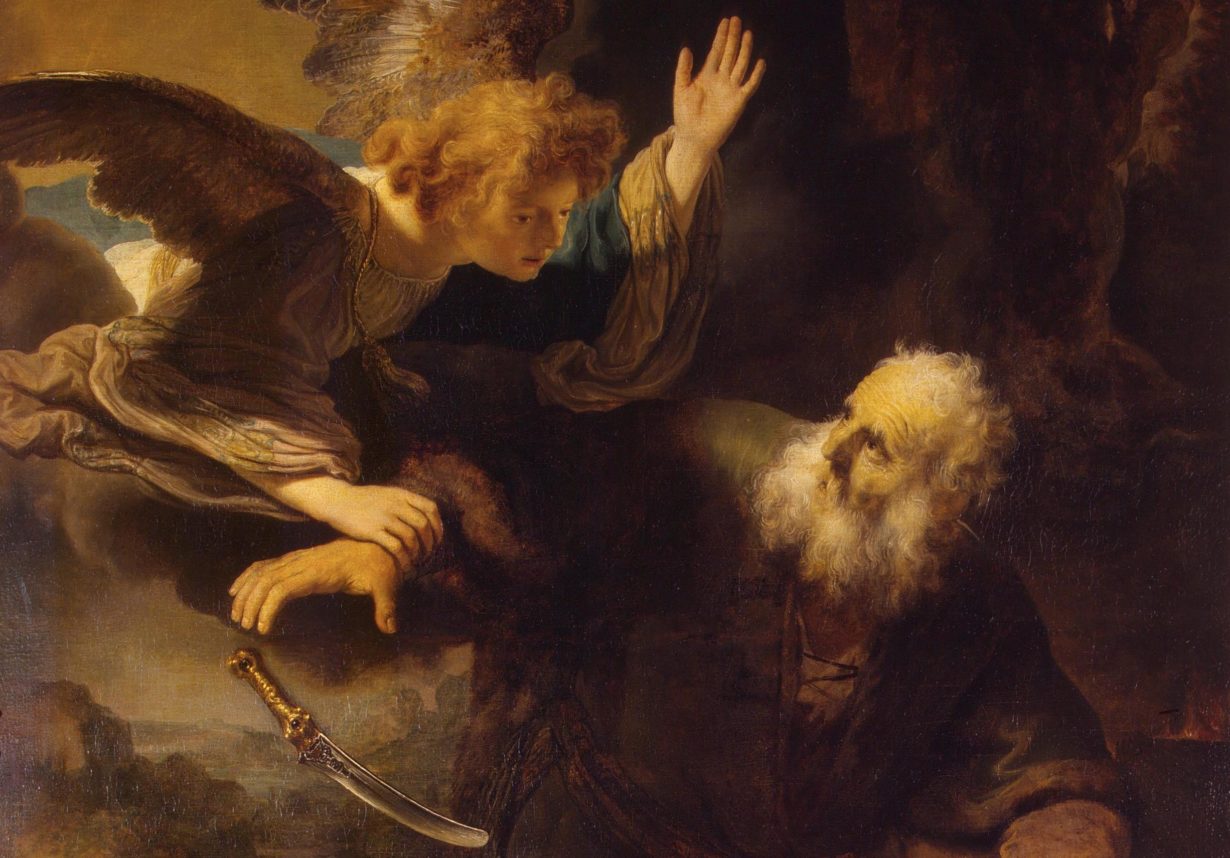
Rabbi Meir Soloveichik writes about why Rembrandt’s depiction of human frailty is especially appealing from a Jewish perspective:

For Judaism, humans cannot, must not, be divinized; indeed, to deny their fragility, their finitude—their mortality—is to lose sight of their true moral grandeur. That grandeur, the source of the beauty of human life, lies precisely in its imperfections, its struggles and strivings, its potential for failure and even for decay: the same inescapable attributes that also give rise to human courage, fortitude, and fidelity. Resisting the temptation of idolatry, the ideal Jewish art captures the human sublime in flawed and imperfect human reality. 

In this perspective, Rabbi Kook’s attraction to Rembrandt is completely intelligible. In referring to the “light” in his pictures, the rabbi had in mind, as Rabbi Jonathan Sacks has suggested, the light the artist saw in the faces of the ordinary people whom he painted and whose essence he captured “without any attempt to beautify them.”

Sunday Reads: Rembrandt’s Jewish vision, What anti-Semitism in America looks like from Israel Read More »