A Moment in Time: Standing Up For the Foreigner
Here is a sample of those 36.
A Moment in Time: Standing Up For the Foreigner Read More »
Here is a sample of those 36.
A Moment in Time: Standing Up For the Foreigner Read More »
At 15, Elias Rosenfeld became a “Dreamer.”
At the time, the Venezuela native was attending Dr. Michael M. Krop Senior High School in Miami, where he had lived since he was 6 years old, when his Jewish family moved to South Florida from Caracas. His mother was a media executive and they traveled to the United States on an L1 visa, which allows specialized, managerial employees to work for the U.S. office of a parent company.
But tragedy struck the family: When Rosenfeld was in the fifth grade, his mother was diagnosed with kidney cancer. She died two years later.
In high school, Rosenfeld applied for a driver’s permit, only to find out that he lacked the required legal papers. He discovered that his mother’s death voided her visa. He and his older sister were undocumented.
“It was an embarrassing moment for me,” Rosenfeld recalled more than five years later.
Within five months, in June 2012, President Barack Obama signed an executive order, the Deferred Action for Childhood Arrivals, granting temporary, renewable legal status to young unauthorized immigrants who had been brought to America by their parents as children.
Known as DACA, the order opened up a world of opportunities for some 800,000 young people who were now able to apply for driver’s licenses, temporary work permits and college. “Dreamers” refers to a bipartisan bill, known as the Dream Act, that would have offered them a path to legal residency.
“It was the power of one order that can so directly change one’s life,” Rosenfeld said. “That launched me. I became an advocate.”
He launched United Student Immigrants, a nonprofit to assist undocumented students that has been credited with raising tens of thousands of dollars for help with scholarships and applications.
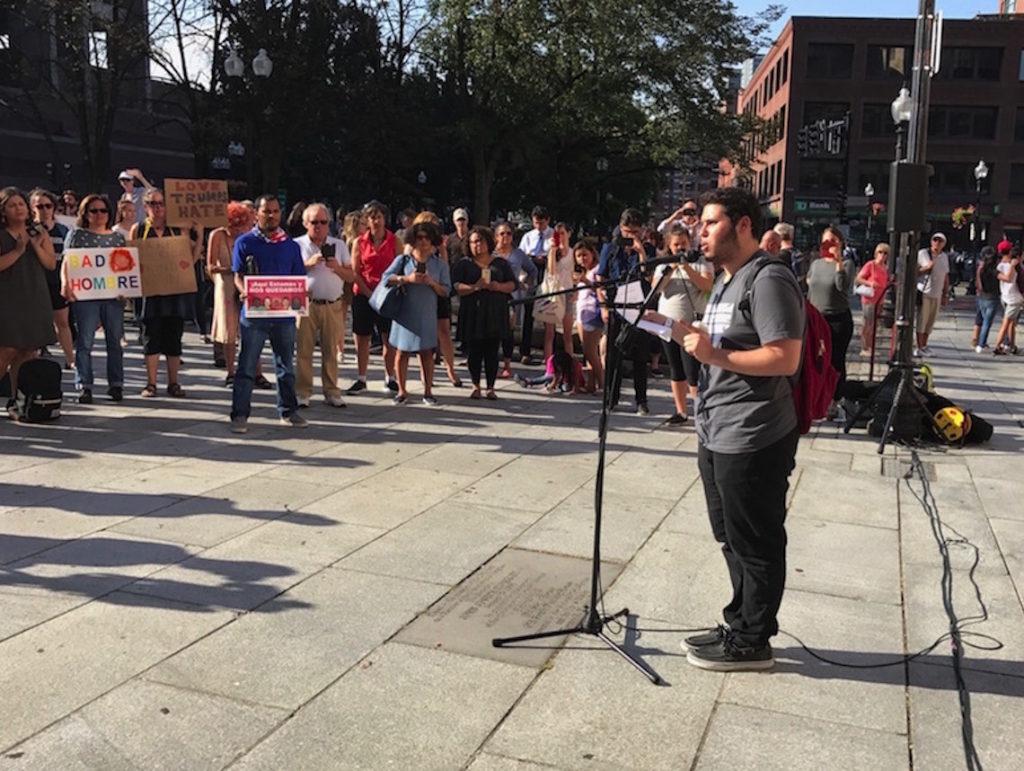
Rosenfeld, now a 20-year-old sophomore at Brandeis University on a full scholarship, spoke with JTA at a rally Tuesday outside of this city’s Faneuil Hall, just hours after President Donald Trump and Attorney General Jeff Sessions announced they would rescind DACA. The president gave Congress a six-month window to preserve the program through legislation. Or not.
The Boston protest was organized by the Massachusetts Immigrant and Refugee Advocacy Coalition, where Rosenfeld is an intern. He shared his story with several hundred people at the quickly organized rally.
He explained that DACA enabled him to drive, buy his first car, and apply for internships, jobs and scholarships.
“Today’s news was cruel and devastating. Now is not the time of despair, however, but to put our energy towards effective action,” he said, urging the crowd to work for protective legislation at the federal and state levels. There are some 8,000 DACA residents in Massachusetts.
Several Jewish communal leaders attended the rally, including Jeremy Burton, executive director of the Jewish Community Relations Council of Greater Boston, and Jerry Rubin, president of Jewish Vocational Services. Representatives from the New England Jewish Labor Committee, which helped spread the word of the rally, held signs in the crowd.
Another Dreamer, Filipe Zamborlini, who came to the U.S. from Brazil when he was 12 and now works as a career coach at Jewish Vocational Services, also spoke.
“We’re going to mourn today,” Zamborlini, 28, told the assembly.
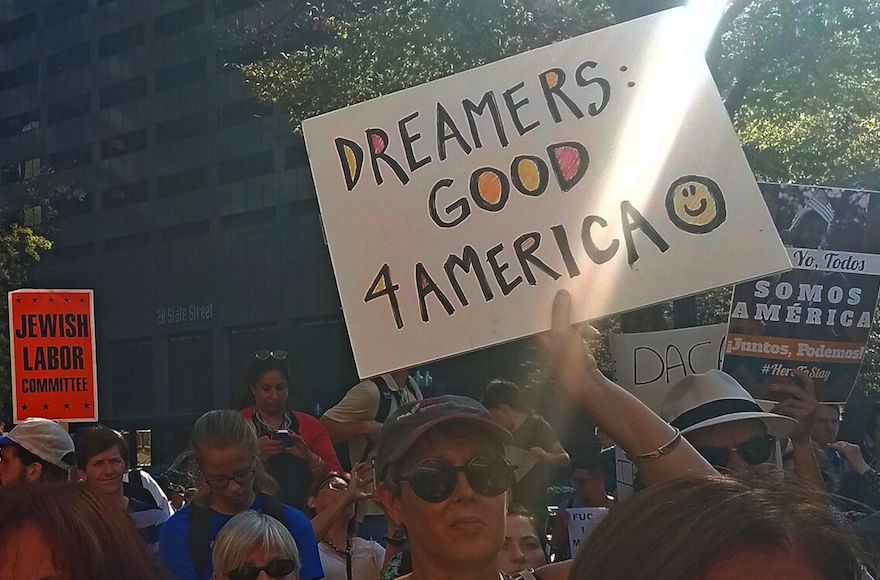
The New England Jewish Labor Committee helped spread the word about a rally in Boston in support of DACA, Sept. 5, 2017. (Marion Davis/Massachusetts Immigrant & Refugee Advocacy Coalition)
Rosenfeld said the Trump administration’s decision was disturbing and unsettling.
“There’s a high level of fear and anxiety in DACA communities,” he told JTA.
Rosenfeld recalls too well the sting and uncertainty of being undocumented.
“It means you can’t do everything your peers and your friends are doing. You feel American, but you are suffering these consequences from choices you didn’t make,” he said.
But he also sounded a note of optimism, pointing out that Trump called on Congress to act.
“We hope Congress follows their president’s word now and does the job of passing one of the many pieces of legislation” before them, Rosenfeld said.
He readily admits to feeling scared and anxious.
“But I’m also feeling empowered and motivated from seeing the outpouring of support,” locally and across the country, he said.
To DACA opponents, including Jewish supporters of Trump, Rosenfeld asks them to look at the facts and the stories of people like himself.
“I don’t think it aligns with our values, with Jewish values and the Jewish community,” he said of a policy that would essentially strip a generation of people raised here of official recognition.
Rosenfeld cited the activism of a group called Torah Trumps Hate, which opposes policies that it considers anathema to values contained in Jewish teachings.
Growing up, his family attended synagogue often and celebrated Shabbat and Jewish holidays.
Despite the hardships he faced following his mother’s death, Rosenfeld excelled in high school. He completed 13 Advanced Placement courses and ranked among the top 10 percent of his graduating class, according to a Miami-Dade County school bulletin. Rosenfeld was widely recognized as a student leader, receiving several awards and honors. During the presidential campaign, he volunteered for the Hillary Clinton campaign.
Many students who were undocumented live in constant fear, even after receiving temporary legal status under DACA, Rosenfeld said.
“There is fear behind the shadows,” he said. “We are always behind the shadows.”
Earlier in the day, before the president’s announcement, Brandeis President Ron Liebowitz sent a letter to Trump urging him not to undo DACA.
“Here at Brandeis University, we value our DACA students, who enrich our campus in many ways and are integral to our community,” the letter said. “Reversing DACA inflicts harsh punishment on the innocent. As a nation founded by immigrants, we can, should, and must do better.”
Rosenfeld was attracted to Brandeis both for its academics and its commitment to social justice. He is studying political science, sociology and law, with plans to continue his advocacy work on behalf of immigrants. He hopes one day to attend law school and work in politics or practice law.
With a full schedule of courses and volunteer work, Rosenfeld gets by without much sleep, he acknowledged with an easy laugh.
The Brandeis administration has been supportive, he said, and there is a meeting later this week on campus to discuss school policy on the issue.
Asked what America means to him, Rosenfeld does not hesitate.
“It means my country. It’s my home. There’s a connection. I want to contribute,” he said. “I just don’t think it’s valuable to want to kick out people that want to contribute to this country.”
A Jewish ‘Dreamer’ is scared, but refuses to despair Read More »
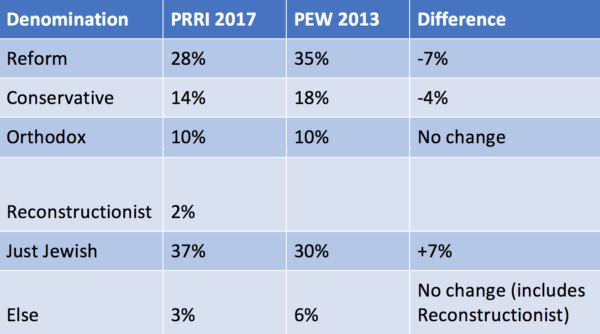
A new survey examining the religion of Americans shows an apparent shift in the way many Jews identify themselves, with the numbers of those claiming to be Reform and Conservative representing a decline while those who identify with no denomination on the rise.
The changes are reflected in a comparison of a Public Religion Research Institute (PRRI) study, “America’s Changing Religious Identity,” released Sept. 6, with a 2013 survey by Pew Research Center, which examined the same issue.
The comparison suggests the number of Orthodox remained the same.
The PRRI survey found that among the 2.3 percent of Americans who identify as Jews, about a third said they were “cultural Jews.” The others identified as “religious Jews.”
Asking Jews if they were “religious” Jews or “cultural” Jews, the study found that among those under age 30, fewer than half, 47 percent, identified as religiously Jewish while 53 percent identified as culturally Jewish. In contrast, more than three-quarters, 78 percent, of Jews 65 and older said they were religiously Jewish while 22 percent identified as culturally Jewish.
The study also reveals that among all Jews, a plurality, 28 percent, identify as Reform, compared with 14 percent Conservative, 10 percent Orthodox and 2 percent Reconstructionist. More than one-third, 37 percent, claimed to be “just Jewish.”
Only a few decades ago, Conservative was the largest denomination.
In each of four age groups among respondents who identified a specific denomination, a plurality answered Reform.
New survey shows erosion among American ‘religious’ Jews Read More »
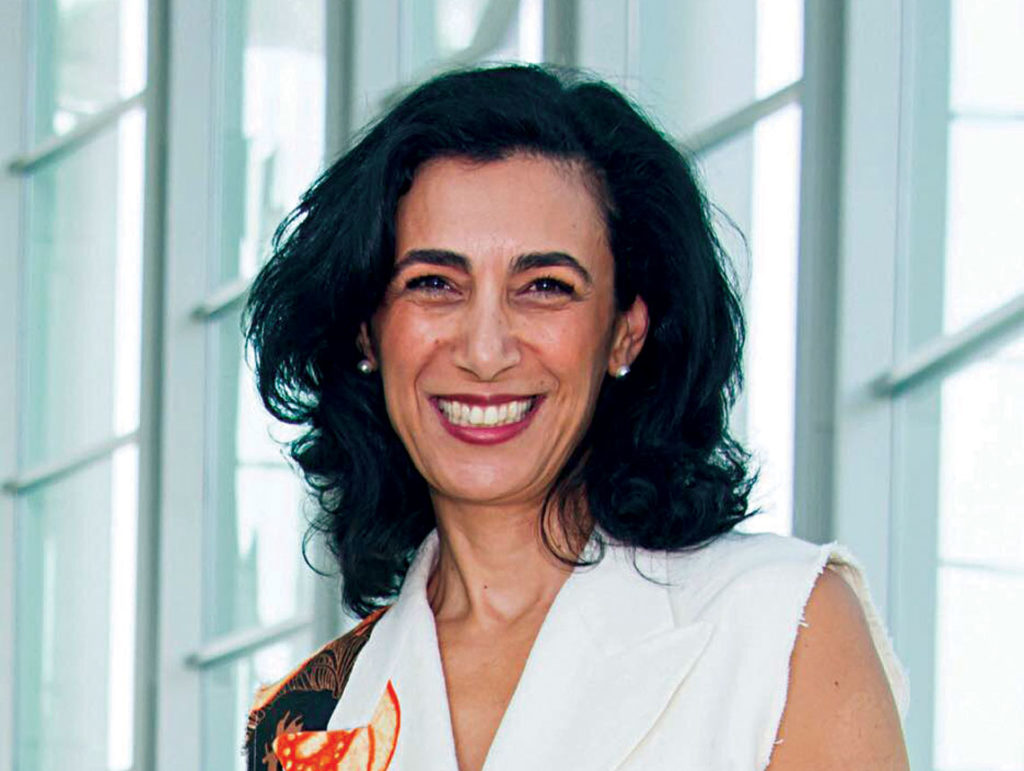
Sharon Nazarian, the founder of the UCLA Younes and Soraya Nazarian Center for Israel Studies, will lead the Anti-Defamation League’s (ADL) fight against anti-Semitism abroad as the head of its International Affairs Division.
The ADL announced Sept. 6 that it had hired Nazarian as its senior vice president for international affairs.
“Sharon’s depth and breadth of experience in academia, philanthropy, policy and international affairs makes her the perfect fit to lead ADL’s international efforts,” ADL CEO Jonathan Greenblatt said in an emailed statement. “She brings a level of expertise and perspective that is extraordinary.”
A member of the Council on Foreign Relations, Nazarian holds a doctorate in political science from USC. She is the daughter of Younes Nazarian, who built the family’s fortune as an early investor in the telecommunications company Qualcomm and is president of the family’s charitable foundation.
The appointment comes as ADL has reported an increase in anti-Semitism in the United States but simultaneously has seen a fundraising surge.
“Today, it’s clear that ADL is needed more than ever — both in the United States and abroad — to stand up against hate and bigotry, and to lead efforts that strengthen collaboration and inclusion worldwide,” Nazarian said in the emailed statement. “I’m thrilled to join ADL and help build on the great work that has been accomplished so far.”
Gene Block, chancellor of UCLA, where Nazarian holds an appointment as an adjunct professor of political science, also lauded the ADL’s choice, saying, “She is a smart, energetic and compassionate person, and I am very pleased that she will now be sharing her talents with ADL.”
Working from the ADL’s Century City office, Nazarian will oversee a staff spread across Washington, D.C., New York and Israel
Sharon Nazarian tapped to lead international affairs for ADL Read More »
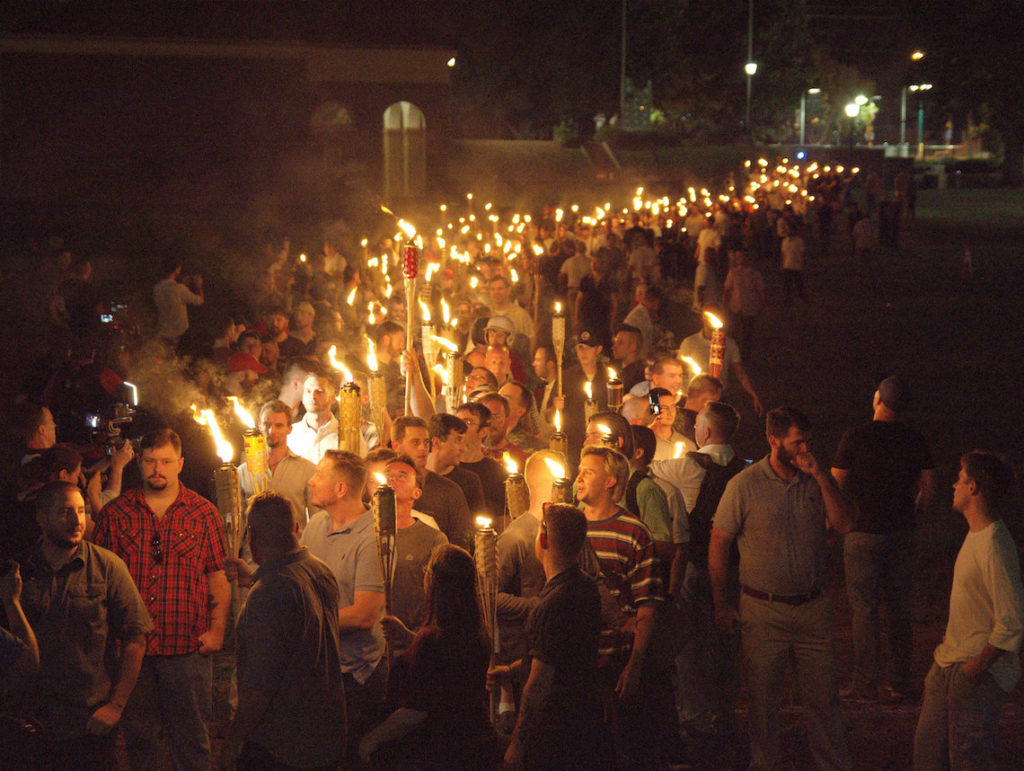
Can neo-Nazis marching in Charlottesville, Va., be fodder for a meaningful conversation with a 10-year-old? Can an 8-year-old really think about anti-Semitism in contemporary America? The answer, quite simply, is yes.
With recent white supremacist rallies in Charlottesville, Boston and Laguna Beach, the chances are pretty good that your children already know about troubling current events.
As director of the Children’s Learning About Israel Project, I’ve spent the past five years studying how elementary school children process the world around them. As we’ve followed a group of Los Angeles children from ages 5 to 10, we’ve learned quite a lot about how children make sense of current events that happen removed from their own homes yet still impact their communities.
Here are three important lessons we’ve learned from the children we’ve been following:
• Kids will learn about difficult current events whether you want them to or not.
Childhood can be a wondrous, magical time. In an effort to help protect the sanctity of childhood, adults often want to shield children from controversial or complex current events. But in this era of easily accessible information, even if adults want to shield children from the harsh realities of the world, it isn’t likely that they can.
The children we’ve been following didn’t need to sit in a classroom lesson or read a newspaper to learn about the most contentious or the most tragic moments happening in the world around them. They looked over a mother’s shoulder as she scrolled through Facebook, or they caught glimpses of a television newscast — sometimes in a public place, sometimes in their own homes — that replayed violent images. They overheard conversations between adults, or they searched for information online. The information often came in bits and pieces, and — like a giant puzzle — the children began to piece together stories whether or not they had all the pieces. For most children in our study, this puzzle-piecing started as early as second grade.
Given the pervasiveness of the 24-hour news cycle and the prevalence of screens big and small, even if your children do not yet know about the rise of white supremacy in 2017 America, it will be difficult to shield them from this news for much longer. This means you have two options: let them work on the puzzle alone, or help frame it for them.
• Kids need adult guidance to help them understand the context and causes of current events.
Seeing images on a screen or overhearing conversations among adults is all it takes for kids to know what is going on. It isn’t enough, however, to help them understand why events happen or who participates in their occurrence. To understand this, kids need help from the trusted adults in their lives.
As we have watched the kids in our study watch the world around them, we’ve noticed that many children express a profound frustration that they are missing pieces of the puzzle because adults — who often have chosen to shield them from difficult or troubling news — have not sufficiently explained the context that would allow them to understand current events.
It is not enough for contemporary American-Jewish children to know that white supremacy and neo-Nazism are gaining traction in the United States, yet these are the very bits of information that kids are most likely to pick up on their own. Kids will need help to understand the context around this information: Who are white supremacists? How and why are racial minorities, Jews and others their targets? Most important, kids need to understand what is being done to counter hateful speech and actions, and who is and can be involved in this work, including the children themselves.
• In spite of it all, kids are optimists.
In part because adults understand so much more historical context than children, adults tend to look at troubling current events with fear and trepidation. But children are able to view the same events as their parents and grandparents and maintain hope that, in the end, all will be well and good in the world. As Anne Frank famously wrote, “In spite of everything I still believe that people are really good at heart.”
From the children in our study, we have learned that what may look to adults like disaster is, for children, an opportunity to remake the world. Even in the worst of times — as we watched the children’s reactions to the 2014 war in Israel, as rockets were raining on Israel and the children were coping with the deaths of Jewish youth — they remained hopeful optimists. For them, war was a chance to re-envision and pursue peace. So, too, can the rise of hatred, racism and anti-Semitism be, for children, an opportunity to rearticulate and embody principles of equality, inclusion and pluralism.
When talking to children about current events, adults have two jobs: to help children fill in the missing puzzle pieces, and to help them maintain the beautiful images they would like to create of the world. Children should be given an opportunity to learn about the world as it exists, and to become partners in creating the world as it should be. n
Why Jewish parents should talk about neo-Nazis with their children Read More »
British actress Felicity Jones will portray Jewish Supreme Court Justice Ruth Bader Ginsburg in a biopic after Natalie Portman dropped out.
Shooting of “On the Basis of Sex” was slated to begin this month in Montreal, according to Variety.
Portman, who is Jewish, had been attached to play Ginsburg for at least four years while the film project was stuck in development.
Jones starred as Jyn Erso in “Rogue One: A Star Wars Story” and in “Inferno” with Tom Hanks. She received a best actress Oscar nomination for her role in “The Theory of Everything.”
Ginsburg was the second woman to be appointed to the Supreme Court.
The film, which is being directed by Mimi Leder from a script by Daniel Stiepleman, deals with Ginsburg’s struggles for equal rights and what she had to overcome in order to become a U.S. Supreme Court justice, according to IMDB.
Ginsburg, 84, was appointed in 1993 by President Bill Clinton and remains one of the court’s most liberal voices. During the past election campaign, in a move rare for justices on the high court, Ginsburg said in several public comments that Donald Trump was unfit for office. Trump called for Ginsburg to resign and questioned her mental acquity. Ginsburg later apologized, calling her remarks “ill advised.”
Felicity Jones replaces Natalie Portman as Ruth Bader Ginsburg in biopic Read More »
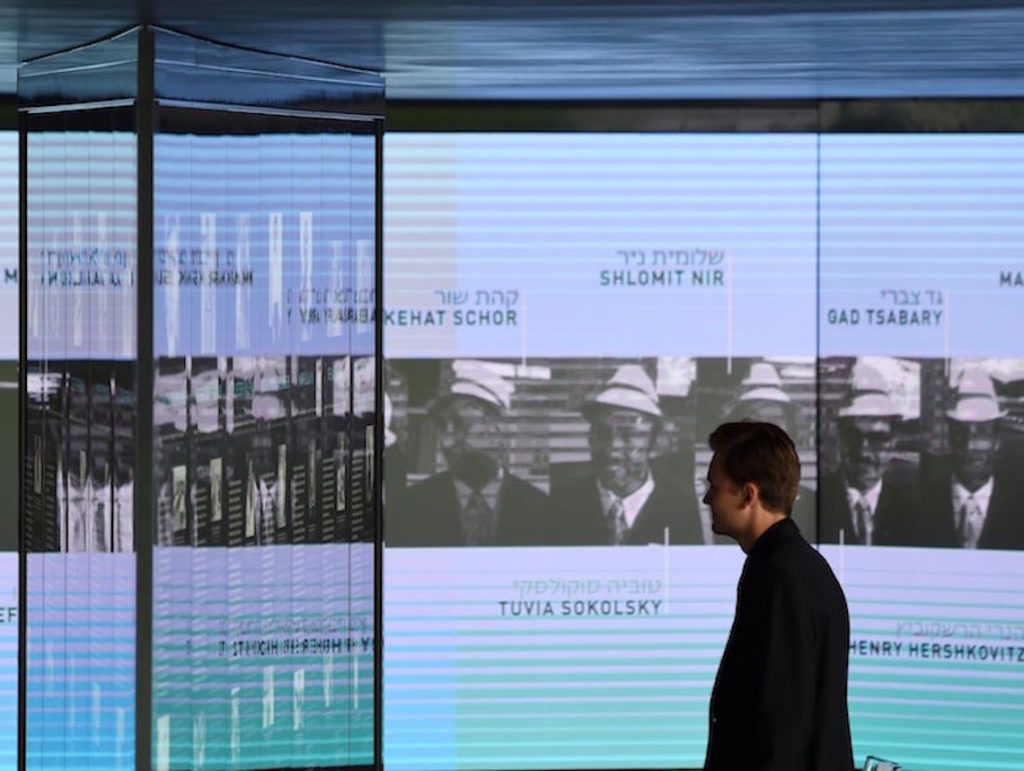
Forty-five years after the murderous PLO attack on Israeli Olympic team members at the 1972 games, a memorial dedicated to the victims is to open in Munich on Wednesday.
The memorial features the biographies of the 11 Israelis — athletes and coaches — and a German police officer killed in the attack on panels with texts in German, Hebrew and English.
“We wanted to give the victims their identity back in the eyes of the public,” Bavarian Minister of Culture Ludwig Spaenle told the media on Monday during a preview of the site, which is cut into a hillside in the former Olympic park.
The memorial cost 2.35 million euros, or about $2.8 million. The funding came primarily from the State of Bavaria, the German federal government, the City of Munich and the International Olympic Committee.
Until now, the main memorials have been a sculpture and plaque. Plans for the memorial were announced in 2013.
Finally, the human stories are being told and the lessons of history underscored, Jewish leaders said ahead of the opening ceremonies this week.
The new memorial attests “to the bloodshed that soaked what should have been a joyous celebration of sport” and camaraderie, Ronald Lauder, head of the World Jewish Congress, said Tuesday in an email to JTA.
Lauder, who will address the opening ceremony along with German President Frank-Walter Steinmeier and Israeli President Reuven Rivlin, said it was “regrettable that it took nearly half a century after the saddest moment in Olympic history” to reach this point, but lauded the German government for its “role in this significant tribute.”
He also said that life for Jews has changed for the better in Europe over the past 80 years, despite a recent increase in anti-Semitism and anti-Zionism.
“We should also be encouraged by the fact that so many European governments are vigilant in their defense of Israel and of all of their citizens, Jews and non-Jews alike,” Lauder added.
Charlotte Knobloch, head of the Jewish Community of Upper Bavaria and Munich, and former president of the Central Council of Jews in Germany, said in a statement released Tuesday, “The [1972] attack was not just against Israel, not just against Jews. It was an attack on all of us, on the Olympic idea, the vision of freedom and peace for all humans.”
She applauded an additional as yet incomplete element of the memorial — a “school of democracy” to be located in the tower at the Fürstenfeldbruck airport, site of the botched rescue attempt.
Knobloch thanked Spaenle for his “outstanding commitment” to realizing a memorial “that gives the victims a face, tells of their lives, remembers them — and warns us never to take life, freedom or democracy for granted.”
The memorial was designed by a team under the auspices of the Bavarian Ministry of Culture in consultation with family members of victims, the consul general of Israel, experts from the concentration camp memorial at Flossenburg, the Jewish Museum in Munich and the Bavarian State Ministry for Political Education.
Ahead of Wednesday’s ceremony, the German news media featured interviews with family members, several of whom are expected to attend.
Among them will be Ankie Spitzer, who was 26 years old when she lost her husband, the coach and fencing master Andre Spitzer, in the attack. She told Deutschlandfunk radio that she could not deal with the fact that her loving husband had been brutally murdered and “no one regretted it.”
“It took 45 years, but I don’t regret the long and lonely journey that brought us to this day,” she said. “This is what I wanted.”
Toby Axelrod is JTA’s correspondent for Germany, Switzerland and Austria. A former assistant director of the American Jewish Committee’s Berlin office, she has also worked as staff writer and editor at the New York Jewish Week. She has won numerous awards from the New York Press Association and the American Jewish Press Association. She has published books on Holocaust history for teen-agers.
45 years after the Munich Massacre, murdered Israeli Olympians get a memorial Read More »
Two Jews, Three Opinions by Rabbi Karen B. Kaplan
There’s an old joke that underscores our almost impish impulse for our streams of Judaism to deviate no matter what: One pious Jew was stranded on a desert island and built two synagogues. When rescued, the crew members asked, “There was only you and your limited resources, so why two places to worship?” The Jew answered, “One was for me to pray in. The other one I wouldn’t be caught dead in.” Hmm, maybe the “other congregation” had a different way of handling the Mourner’s Kaddish. I have been reciting it for my father who died last December. In some synagogues, only the mourners rise to recite it, while in others everyone stands and says it to support the mourners or to say it for those who passed but have no survivors to say it for them.
I have said this prayer in both kinds of congregations, and I have mixed feelings about each procedure. On the one hand, if a few other people and I rise to say it, I feel acknowledged that yes, I am stepping through the peculiar passage of my first year without my father. Anyone who still does not know I had lost an immediate family member can later ask who I am mourning for and potentially become an additional source of support. On the other hand, I feel self-conscious drawing such attention to myself, like a scarlet “M” has sprouted on my forehead.
In the “other” synagogue, I feel more protected and less vulnerable as mourners and non-mourners alike participate in this ritual. But I feel that this dilutes my feelings or minimizes them as they are “distributed” across the group. What do you non-mourners know about my feelings and those of the others grieving? The intention, of course, is fine, but it reduces the significance of the ritual for me. If everyone is carrying it out, then I am not doing anything special to mark my relationship with the deceased or to drive home yet again to myself the reality of the loss. I feel deprived of the power of this ritual.
If I and some other hapless survivors of another ship wreck had joined the Jew stranded on that desert isle, as a rabbi I would have instituted the following compromise: Everyone rises but only the mourners actually say the prayer.
But wait, I hear an objection from the Chair of the Board of Trustees: “That’s not the way to do it! Everyone recites, but only the mourners rise.” Alas, we will need two synagogues after all.

Rabbi and board certified Chaplain Karen B. Kaplan is author of Encountering the Edge: What People Told Me Before They Died (Pen-L Publishing, 2014) a series of true anecdotes capped with the deeper reasons she chose her vocation. For more details including reviews, you can go to the publisher’s page or to amazon.com. There is also an audio version of Encountering the Edge: the Audiobook. Comments to the author are welcome by email or via her blog, Offbeat Compassion. She has recently authored a second book, Curiosity Seekers which is gentle science fiction about an endearing couple in the near future (Paperback or Kindle).
___________
LOOKING FORWARD: UPCOMING COURSE
The Gamliel Institute will be offering course 5, Chevrah Kadisha: Ritual, Liturgy, & Practice (Other than Taharah & Shmirah), online, afternoons/evenings, in the Winter semester, starting January, 2018. This is the core course focusing on ritual, liturgy, practical matters, how-to, and what it means (for everything other than Taharah and Shmirah, which are covered in course 2).
CLASS SESSIONS
The course will meet online for twelve Tuesdays (the day will be adjusted in any weeks with Jewish holidays during this course).
Information on attending the course preview, the online orientation, and the course will be announced and sent to those registered. Register or contact us for more information.
REGISTRATION
You can register for any Gamliel Institute course online at jewish-funerals.org/gamreg. A full description of all of the courses is found there.
For more information, visit the Gamliel Institute website, or at the Kavod v’Nichum website. Please contact us for information or assistance by email info@jewish-funerals.org, or phone at 410-733-3700.
____________________
Gamliel Students are invited to an informal online monthly session on the 3rd Wednedsays of most months. Each month, a different person will offer a short teaching or share some thoughts on a topic of interest to them, and those who are online will have a chance to respond, share their own stories and information, and build our Gamliel Institute community connections. This initiative is being headed up by Rena Boroditsky and Rick Light. You should receive email reminders monthly. The next scheduled session of the Gamliel Café is October 18th.
If you are interested in teaching for a session, you can contact us at j.blair@jewish-funerals.org, or info@jewish-funerals.org.
____________________
Graduates of the Gamliel Institute, and Gamliel students who have completed three or more Gamliel Institute courses should be on the lookout for information on a series of “Gamliel Graduate’ Courses, advanced sessions focusing in on different topics. These will be in groups of three sessions each quarter (three consecutive weeks), with different topics addressed in each series. The goal is to look at these topics in more depth than possible during the core courses. We plan to begin this Fall, in October and November. The first series will be on Psalms. Registration will be required, and there will be a tuition charge of $72 for the three sessions. Heading this intiative is the dynamic duo of Rena Boroditsky and Rick Light. Contact us – register at www.jewish-funerals.org/gamreg/, or email info@jewish-funerals.org.
_____________________
Donations are always needed and most welcome to support the work of Kavod v’Nichum and the Gamliel Institute, helping us to bring you the conference, offer community trainings, provide scholarships to students, refurbish and update course materials, expand our teaching, support programs such as Taste of Gamliel, the Gamliel Café, and the Gamliel Gracuates courses, provide and add to online resources, encourage and support communities in establishing, training, and improving their Chevrah Kadisha, and assist with many other programs and activities.
You can donate online at http://jewish-funerals.org/gamliel-institute-financial-support or by snail mail to: either Kavod v’Nichum, or to The Gamliel Institute, both c/o David Zinner, Executive Director, Kavod v’Nichum, 8112 Sea Water Path, Columbia, MD 21045. Kavod v’Nichum [and the Gamliel Institute] is a recognized and registered 501(c)(3) organization, and donations may be tax-deductible to the full extent provided by law. Call 410-733-3700 if you have any questions or want to know more about supporting Kavod v’Nichum or the Gamliel Institute.
You can also become a member (Individual or Group) of Kavod v’Nichum to help support our work. Click here (http://www.jewish-funerals.org/money/).
___________
If you would like to receive the periodic Kavod v’Nichum Newsletter by email, or be added to the Kavod v’Nichum Chevrah Kadisha & Jewish Cemetery email discussion list, please be in touch and let us know at info@jewish-funerals.org.
You can also be sent a regular email link to the Expired And Inspired blog by sending a message requesting to be added to the distribution list to j.blair@jewish-funerals.org.
Be sure to check out the Kavod V’Nichum website at www.jewish-funerals.org, and for information on the Gamliel Institute, courses planned, and student work in this field also visit the Gamliel.Institute website.
RECEIVE NOTICES WHEN THIS BLOG IS UPDATED!
Sign up on our Facebook Group page: just search for and LIKE Chevra Kadisha sponsored by Kavod vNichum, or follow our Twitter feed @chevra_kadisha.
____________________
If you have an idea for an entry you would like to submit to this blog, please be in touch. Email J.blair@jewish-funerals.org. We are always interested in original unpublished materials that would be of interest to our readers, relating to the broad topics surrounding the continuum of Jewish preparation, planning, rituals, rites, customs, practices, activities, and celebrations approaching the end of life, at the time of death, during the funeral, in the grief and mourning process, and in comforting those dying and those mourning, as well as the actions and work of those who address those needs, including those serving in Bikkur Cholim, Caring Committees, the Chevrah Kadisha, as Shomrim, funeral providers, in funeral homes and mortuaries, and operators and maintainers of cemeteries.
_____________________
Two Jews, Three Opinions by Rabbi Karen B. Kaplan Read More »
A new survey examining the religion of Americans shows a growth in the number of Jews of no religion, compared to findings of the PEW survey of American Jews from four years ago. It also shows that the numbers of Jews claiming to be Reform and Conservative are declining while the number of those who identify with no denomination is on the rise.
The PRRI survey found that among the 2.3 percent of Americans who identify as Jews, about a third are “cultural Jews.” The study found that among those under age 30, fewer than half, 47 percent, identified as religiously Jewish while 53 percent are Jews of no religion (which this study calls “cultural Jews”).
The main part of the study deals with the general state of religion in America, naturally focusing on changes concerning Christian America. White Christians, once the dominant religious group in the U.S., the study tells us, “now account for fewer than half of all adults living in the country.” Moreover, “fewer than half of all states are majority white Christian.”
What follows is an attempt to explain some of the data concerning the Jewish community and the possible implications of it.
1.
The most dramatic finding of this study concerns the “Jews of no religion,” as PEW’s study, Portrait of Jewish Americans, referred to them in 2013.
PEW reported that 22 percent of all Jews are such people of “no religion.” Namely, Jews who do not respond to the question — What is your religion? — by saying Jewish, but do indicate in a follow-up question that they are Jewish in some other way.
The PRRI study indicates that the number of such Jews is rapidly growing. It calls these Jews “cultural Jews” and explains that 1.5 percent of Americans “identify as Jewish when responding to a question about their religious affiliation.” An additional 0.8 percent of Americans “identify as culturally but not religiously Jewish.” So about a third of all Jews are cultural Jews.
“Cultural Jews” are the PRRI study’s version of “Jews by no religion” from the PEW study. “To identify culturally affiliated Jews,” the PRRI study explains, “we asked all respondents who claimed no formal religious affiliation the following question: ‘Do you consider yourself to be Jewish for any reason?’ Any respondent who said ‘yes’ or ‘half’ was classified as culturally Jewish.” This methodology is practically identical to the one used by PEW to identify “Jews by no religion.”
So according to PRRI, about a third of all American Jews are people who have no specific answer when asked about their religion. What does this mean? A paper I wrote for JPPI a while ago argued that calling these Jews “cultural Jews” would be a wrong choice: “Jews ‘not by religion’ are not ‘cultural’ Jews, they are disconnected Jews,” I wrote, based on the clear-cut data from PEW.
Here is more from what I wrote three years ago:
There can be no doubt that the data point to the possibility that about a quarter of American Jews will find it much harder to pass on their Jewishness to the next generation (and the one after that). Those who reacted to the Pew survey have taken care — and rightly so — to emphasize that there are many exceptions in the Jewish story and that among “Jews not by religion,” too, there are those strongly committed to the Jewish people. The statistical picture, though, does not change because of anecdotal exceptions. The value of a comprehensive quantitative study is precisely that it allows us to adapt policy to large groups.
What changed from PEW to PRRI? I assume nothing much, except that now it is not “a quarter” of all American Jews — it is a third.
1a.
Or maybe something else changed.
Prof. Uzi Rebhun noted that according to PRRI the share of Jews in the U.S. slightly increased, from 2.2 percent (PEW) to 2.3 percent. So it is true that the share of Jews not by religion among the total Jewish population increased, according to PRRI, but so did the total number of (adult) Jews in the country (a 0.1 percent increase is equivalent to an absolute growth of some 250,000 people over a period of only three years).
Hence, we can make another assumption by way of interpreting the data: some Jews are, indeed, becoming less connected (cultural Jews), but at the same time there are also people who avoided identifying themselves as Jews in the past and now feel a need to identify as such and connect themselves, albeit weakly, to the Jewish people.
2.
The change is clear when PRRI examines the differences between age groups. “Among Jews under the age of 30, fewer than half (47 percent) identify as religiously Jewish, while a majority (53 percent) identify as culturally Jewish. In sharp contrast, more than three-quarters (78 percent) of Jewish seniors (age 65 or older) are religiously Jewish, while 22 percent identify as culturally Jewish.”
To understand what this means, I will refer you to another JPPI study, by my colleague Shlomo Fischer. When we spoke yesterday, Fischer reargued his case: this change reflects a change in what Jewishness means in America. For many Americans, it is no longer a defining feature of identity — it is an anecdotal fact of which they are proud (as the PEW study proved), but not much more than that.
“Jews of no religion,” he wrote, “accept their Jewishness as a matter of fact, like having blue eyes. It does not enjoin much of a sense of solidarity or any normative commitment to the welfare or continuity of the Jewish people or to Jewish culture.”
What changed? In the PEW study, Millennial Jews (born after 1980) of no religion were 32 percent. In the PRRI study, Jews of no religion under 30 are 53 percent. So nothing changed, except the even higher numbers. These numbers present the organized Jewish community with a challenge of abandonment that is not even close to being resolved.
3.
Denominational belonging of the Jews is always a topic of discussion, and the new study presents us with a question. Its denominational portrait is significantly different from the one presented four years ago by the PEW Research Center. The main question we need to ask as we look at the numbers is as follows: is this a result of a different survey methodology and articulation of questions — or the result of rapid changes in the community (of course, the same question should also be asked about Jews of no religion).
If the latter is the correct answer — if what we see here is rapid change — there are more worrying signs in this study for the two main Jewish progressive movements, Reform and Conservative. Reform Judaism still tops all other denominations in numbers, but the gap is shrinking. Seven points down in four years is significant. Conservative Judaism is also continuing to shrink. It is now not much larger than Orthodox Judaism.

4.
When we look at denominational questions, age is again the key to understanding the trends. To make it easy, here is a table of how Jews older than 65 define themselves and how Jews aged 18 to 29 define themselves. Note how among young Jews the Orthodox group has already surpassed the Conservative group and is getting close to the Reform group. Also note that close to half of all younger Jews do not belong to any denomination.
“Jewish seniors are about 10 times as likely to identify as Reform as they are to identify as Orthodox (35 percent vs. 3 percent, respectively).” Among Jewish youngsters, the difference is just 5 percent. Three Orthodox for every four Reform.

Where is this going? Easy: “More than six in ten (62 percent) Orthodox Jewish parents say they have at least three children living in their household, compared to 17 percent of Jewish parents who identify as Reform who say the same.”
5.
The study is based on interviews with more than 100,000 Americans. Most of them are not Jewish. But changes among them will have a huge impact on America, and hence on Jewish America — and also on Israel. One such important change is the decline of white evangelist America. “Fewer than one in five (17 percent) Americans are white evangelical Protestant, but they accounted for nearly one-quarter (23 percent) in 2006.”
This group is one of the most supportive of Israel in the U.S. and is considered by some right-wing Israelis to be even more important than the Jews of America when it comes to backing its security and strategic needs.
But as Israel ponders its future relations with America, as it worries about trends concerning American Jews, and about trends concerning the American left, it ought to also consider these larger changes that could reduce the influence of evangelical whites (in the shorter term: 35% of all Republicans, more than a third, identify as white evangelical Protestants).
Study finds more than half of young Jews have ‘no religion’ Read More »