fbpx

August 22, 2017

Elul 1: Esther Netter

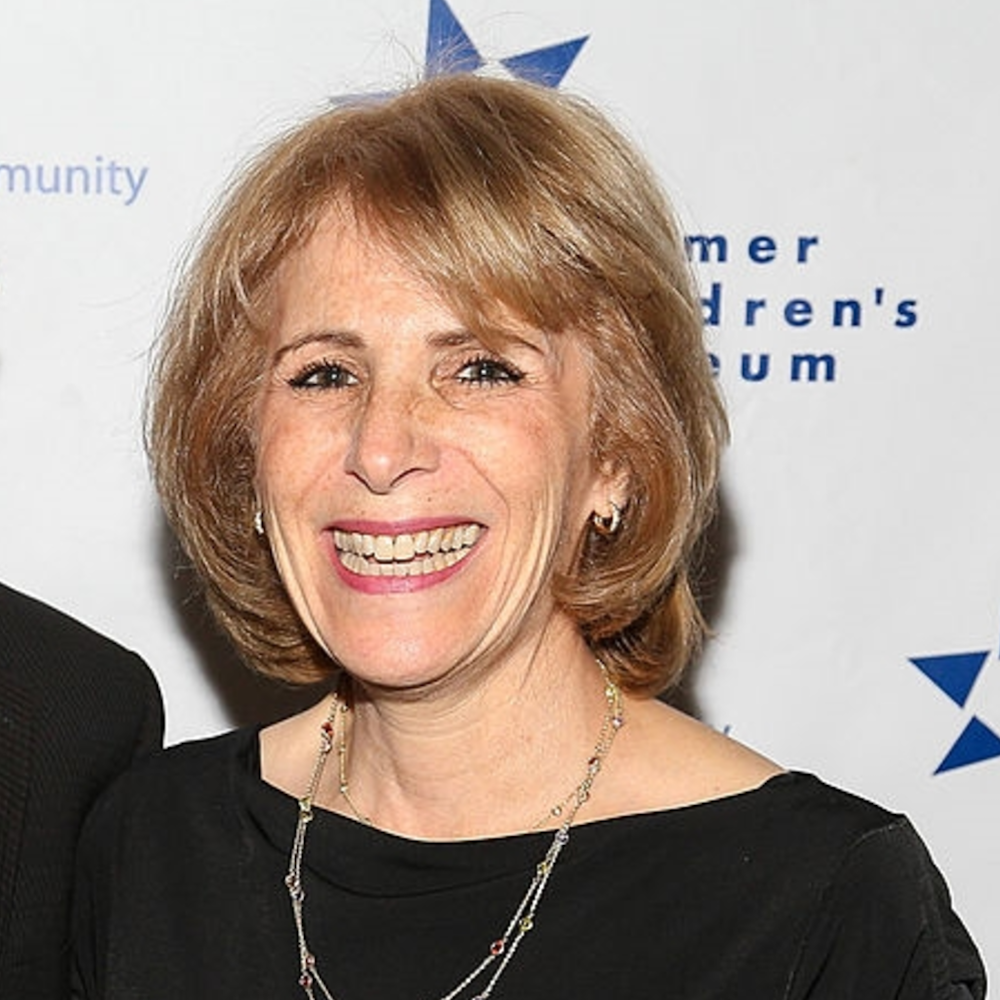
Esther Netter

When is the right moment to sit and contemplate the difficult times we encounter? Why don’t I just get in touch with those things that are painful to think about, very real, hard to stay focused on?   How do I set aside time for inner reflection, slowing down enough to notice those thoughts and feelings that cause discomfort and even agitation.

Elul is a time for thinking about the “whens” the “whys” and the “hows.” It is the new year that affords us this opportunity, even demands it of us. To move forward, to heal, to forgive, to grow so that we are the most and the best we can be for the new year.

A friend, gently encouraging me to ask the “whens, whys and hows”, shared a favorite quote from lyricist Leonard Cohen’s song Anthem:

Ring the bells that still can ring
Forget your perfect offering
There is a crack, a crack in everything
That’s how the light gets in.

When do we focus on the cracks? How do we heal those cracks in our lives and hearts? Why do we leave those cracks unattended only to grow and deepen? We all have cracks in our live. Take the time to recognize them and remember, it is through the cracks that the light shines through. May this month bring each of us more light and illumination.


Esther Netter is the executive director of the Zimmer Children’s Museum in Los Angeles.
www.zimmermuseum.org

Elul 1: Esther Netter Read More »

Paul Ryan rejects constituent rabbi’s plea to censure Trump

Responding to a local rabbi at a town hall, Sen. Paul Ryan said Donald Trump “messed up” in his Charlottesville comments but dismissed a bid by Democrats to censure the president as a “partisan hack-fest.”

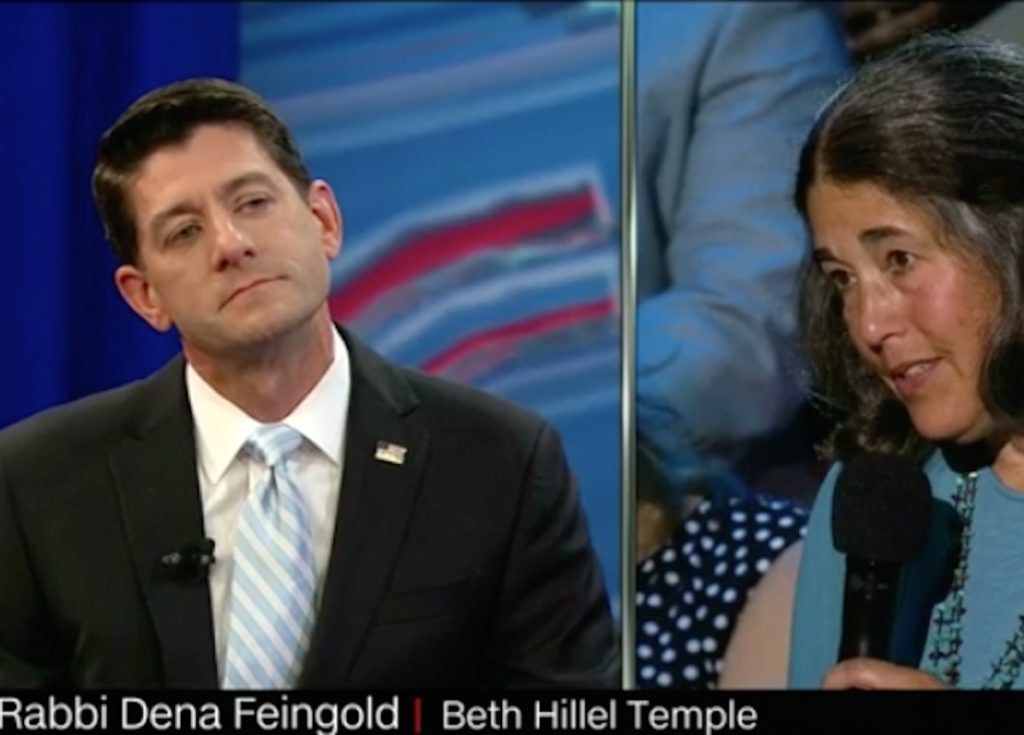
Ryan, the Republican speaker of the U.S. House of Representatives, fielded the question by Rabbi Dena Feingold at a town hall in Racine televised on CNN on Monday.

Feingold, of Beth Hillel Temple in Kenosha, began by noting that her family and Ryan’s had been friendly for decades. (Feingold’s brother Russ is a former Democratic senator from the state.)

“Given our shared upbringing, I’m sure that you are as shocked as I am at the brazen expressions, public expressions of white supremacy and anti-Semitism that our country has seen since the November election,” Feingold said.

“And our synagogue in Kenosha has had to have extra security hired and we’ve asked the Kenosha Police Department to help us out so that people can feel comfortable coming to our synagogue to gather,” she said. “And so following up on what’s been asked already, Speaker Ryan, as the leader of the congressional Republicans, I’d like to ask you what concrete steps that you will take to hold the president accountable when his words and executive actions either implicitly or explicitly condone, if not champion, racism and xenophobia. For example, will you support the resolution for censure?”

She was referring to a motion introduced last week by 75 House Democrats — led by Rep. Jerrold Nadler, D-N.Y., who is Jewish — that censures Trump for his “inadequate” response to the deadly violence in Charlottesville, Virginia, at a far-right rally earlier this month. Neo-Nazi, Ku Klux Klan and white supremacist protesters clashed there with counterprotesters, and a counterprotester was killed when an alleged white supremacist rammed a crowd with his car.

Trump said afterward that “many sides” were to blame for the violence, and that there were some “very fine people” on both sides.

Ryan said at the town hall that Trump had “messed up” in his responses, but the congressman also praised the president for a separate address delivered just before the town hall started in which he called for unity. His reply to Feingold was acerbic.

“I just disagree with you,” Ryan said. “I will not support that. I think that would be — that would be so counterproductive. If we descend this issue into some partisan hack-fest, into some bickering against each other, and demean it down to some political food fight, what good does that do to unify this country?”

The moderator, Jake Tapper, pursued the issue, noting the fears in the district among Jews and among Sikhs, who were the targets of a lethal 2010 racist attack. The CNN newsman argued that the concerns about heightened racial tensions were not necessarily partisan.

“Forget his party for a second,” Tapper said. Trump is “giving aid and comfort to people who are fans of losing, discredited, hateful ideologies. ”

Ryan hesitated in his reply, but ultimately stood his ground.

“It is very, very important that we not make this a partisan food fight,” he said. “It is very important that we unify in condemning this kind of violence, in condemning this kind of hatred. And to make this us against them, Republicans against Democrats, pro-Trump, anti-Trump, that is a big mistake for our country, and that will demean the value of this important issue.”

Of Trump, Ryan said, “He needs to do better.”

The authors of the censure motion pushed back on Tuesday, saying in a statement that Ryan was shying away from moral accountability.

“In the wake of Charlottesville, Democrats and Republicans alike have been moved to reject the president’s ambivalent and wholly inadequate response to acts of domestic terrorism.” said a statement from Nadler’s office. “Many have gone so far as to condemn any attempt to project a moral equivalency between white supremacists, the KKK and neo-Nazis, and those who gathered to protest against the ‘Unite the Right’ rally and the racist ideals it represents. Yet Speaker Ryan remains silent, and continues to omit calling out the President directly for his morally repugnant statements.”

Paul Ryan rejects constituent rabbi’s plea to censure Trump Read More »

Iran could make weapons-grade uranium within five days, its nuclear chief claims

Iran can begin enriching weapons-grade uranium within five days if the nuclear deal with the world powers is canceled, its atomic chief said.

“If we want, we can start the 20 percent enrichment in Fordo in maximum five days and this has a lot of meaning,” Ali Akbar Salehi, who heads the Atomic Energy Organization of Iran, said Tuesday on national television, the semiofficial Fars News Agency reported on its English-language website. “This measure has different messages technically and professionally, and the other side understands its message.”

Fordo is a uranium enrichment facility located 20 miles northeast of the Iranian city of Qom.

Salehi said that keeping Fordo’s facilities intact is one of the strengths of the nuclear deal.

“This is why they didn’t want Fordo to exist and were saying that it should be closed,” he said, according to the Iran Student News Agency, or ISNA.

He also said that Iran remains committed to the deal.

The Iran nuclear deal signed in 2015, known as the Joint Comprehensive Plan of Action, trades sanctions relief for a rollback of Iran’s nuclear program. President Donald Trump has threatened to renegotiate or cancel the agreement negotiated by six world powers, led by the United States, and Iran.

Trump has said that Iran is violating the “spirit” of the agreement by engaging in activities, including testing missiles and military adventurism in the region, that are not covered.

Last month, the president recertified Iran’s adherence to the deal brokered by President Barack Obama, but reluctantly at the behest of his national security adviser, H.R. McMaster; his defense secretary, James Mattis; and his secretary of state, Rex Tillerson. They argued that decertification would alienate U.S. allies because Iran is indeed complying with the deal’s strictures.

However, within days of giving the go-ahead to recertify, Trump reportedly tasked a separate team, led by his then-top strategic adviser, Stephen Bannon, to come up with a reason to decertify Iran the next time the 90-day assessment rolls around, in October. Bannon has since left the White House.

Iran could make weapons-grade uranium within five days, its nuclear chief claims Read More »

Billy-Joel

I applaud Billy Joel for wearing the yellow Star of David

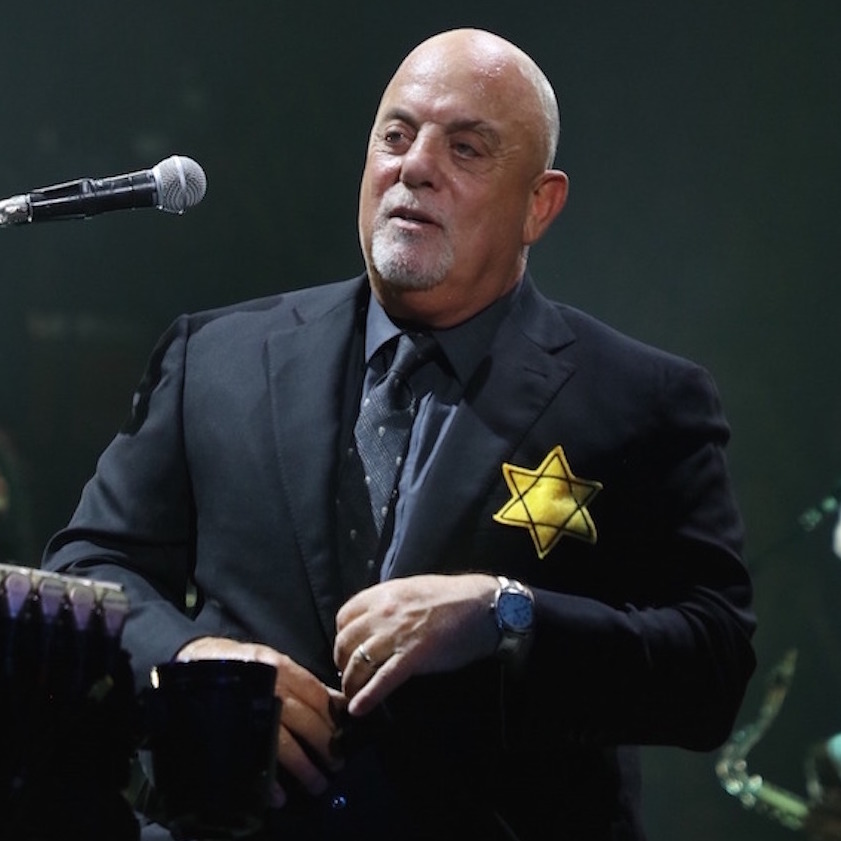
Billy Joel wearing a yellow Star of David on Aug. 21. Photo by Myrna M. Suarez/Getty Images

Jewish fans of Billy Joel took to social media today to share photos of him wearing yellow Star of David patches on his shirt at his Madison Square Garden concert last night.  It was an obvious protest against the neo-Nazis and white supremacists who’ve been defiling America’s streets of late.  But it also was a not-so-obvious full embrace of his heritage as the son and grandson of German Jews who barely escaped the Holocaust.

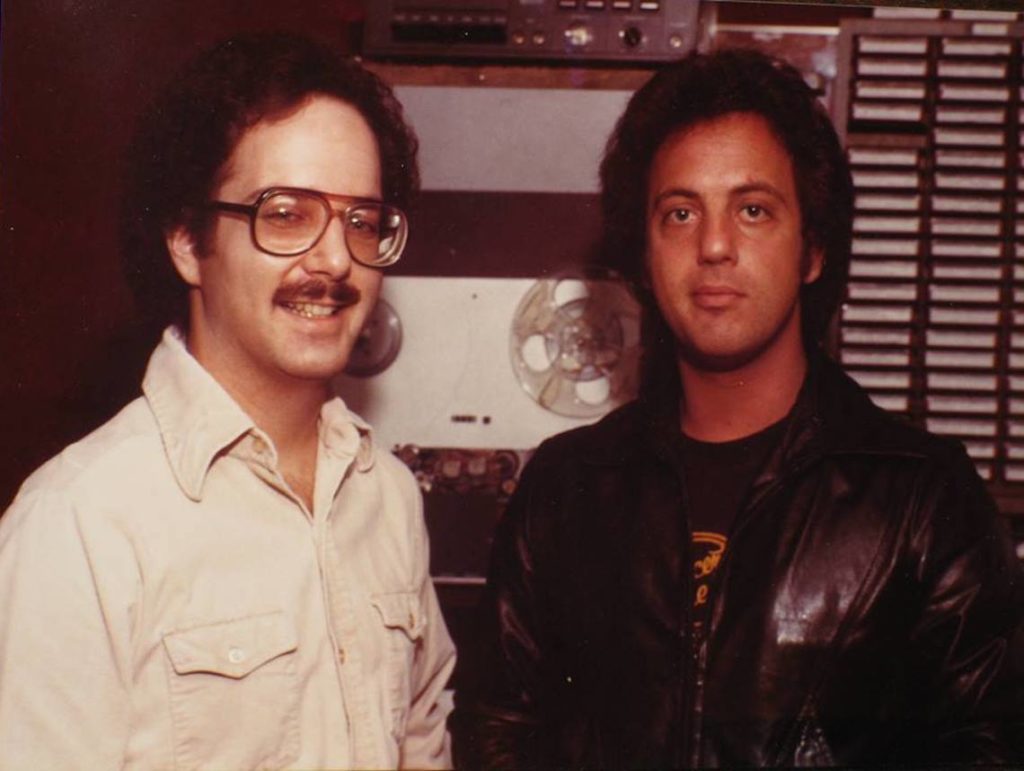
For me, it was a particularly heart-warming and emotional moment. I got to know Billy in 1979 when I became news director of WLIR, a highly popular and influential Long Island radio station that had been among the first to play his music.  The singer was a fixture at our studios, he played on our baseball team, he took us out to an Italian restaurant and I did several memorable interviews with him.  He once publicly thanked me for helping him with a charity with which he was involved, and privately told a colleague of mine that he really liked my work.

Given that background, when I heard he was planning to perform in the Soviet Union in 1987, this longtime member of the “Student Struggle for Soviet Jewry” had to speak up.  Although I’d never discussed it with him, I knew that Billy’s father Helmut (later Howard) had escaped Nazi Germany with Billy’s grandparents, making their way from Switzerland to Cuba and eventually, the United States.  Billy’s mother was also Jewish, although his upbringing on Long Island had little Jewish content.

I contacted a mutual friend and asked if he’d get a message to Billy.  I remember the friend asking if I wanted to speak with him on the phone.  I said I preferred to put it down on paper.

I wrote a long, impassioned plea, asking Billy to not tour Russia without speaking about the plight of Soviet Jews, who were just then breaking the chains of their long oppression by the Communist regime.  I reminded him that we both were sons of German Jews who had been fortunate enough to escape the Nazis, and that very few people had spoken up for our families during that dark time.

The mutual friend promised to hand the typed letter to Billy.  There was no response.  A couple of weeks later, just before the tour began, I called to check, and was told that Billy had read it.  He proceeded with the tour, and never said a word about his fellow Jews.

I only spoke to Billy once after that, several years later, and didn’t bring it up. In 2001, I was surprised and pleased to see that he’d participated in a fascinating documentary called “The Joel Files.”  The film depicted the Nazi theft of Billy’s grandfather’s thriving business in Berlin, and showed the musician contemplating the names of his close relatives who were murdered in the Holocaust.

I was impressed and moved that Billy agreed to be part of that project.  And today, 38 years after I first met him, I actually gasped when I saw those photos online, of Billy wearing the yellow star that his relatives were forced to display before being dragged to their tragic deaths.  His ex-wife Christie Brinkley and their daughter Alexa both tweeted their support, with Brinkley writing “Thank you, Billy, for reminding people what was, so it may never be again”. 

I’m sure that seeing thugs marching through the streets of an American city, carrying Nazi-like torches and flags adorned with swastikas, must have infuriated him.  Perhaps being a father of two has affected Billy’s evolving relationship with his family’s history.  Whatever the reasons, I have the utmost respect and admiration for the Piano Man, now that he’s hit exactly the right note.

I applaud Billy Joel for wearing the yellow Star of David Read More »

Should New York City remove statues of its anti-Semitic Dutch governor?

Robert E. Lee, Jefferson Davis, Stonewall Jackson … and Peter Stuyvesant?

One of these things is not like the others.

Amid the impassioned debate over whether, when and how to remove statues memorializing the Confederacy, an Israeli nonprofit is seeking a piece of the action. On Tuesday, Shurat HaDin, which represents terror victims in court, called on New York City Mayor Bill de Blasio to remove all memorials to Stuyvesant, the last Dutch director-general of New Amsterdam (now New York), who was an anti-Semite.

“Peter Stuyvesant was an extreme racist who targeted Jews and other minorities including Catholics and energetically tried to prohibit them from settling in then New Amsterdam,” read a statement by Nitsana Darshan-Leitner, Shurat HaDin’s president. “New York, of all American cities, which boasts such important Jewish history and claims such a present day vibrant Jewish community, should take the lead in denouncing Stuyvesant’s bigotry.”

The group’s complaint affects a range of locations and institutions around the city — from the elite Stuyvesant High School to Bedford-Stuyvesant, a Brooklyn neighborhood. The Dutchman also has a statue in Manhattan’s Stuyvesant Square.

It’s true that Stuyvesant hated the Jews — to put it lightly. He didn’t want them to stay in his colony when they arrived in 1654 from the Netherlands via Brazil. When that didn’t work (because — awkward! — some of the colony’s owners were Jewish), Stuyvesant settled for prohibiting them from building a synagogue and serving in the militia. And he slapped them with a special tax.

He also called them “the deceitful race, such hateful enemies and blasphemers of the name of Christ.” So, yeah, not a fan.

But does that put him on par with the leaders of the Confederacy? Not so much.

The statues of Lee, Davis and Jackson aren’t being taken down only because they were racist, though they certainly were. It’s because they led an armed rebellion against the United States so they could form a country built on the principle of enslaving an entire race.

If activists were calling for the removal of any monument to any racist (or anti-Semite), municipal workers would have their hands full taking down monuments to everyone from George Washington (he owned slaves) to Franklin Delano Roosevelt (who interned Japanese Americans en masse) to Edith Wharton (who has been described as “vehemently anti-Semitic, even by the standards of her milieu and her era”). Despite the protestations of President Donald Trump, no one is demanding these actions.

And in the generations following the Civil War, Lee and crew became symbols not just of military honor but of institutionalized racism. Most of the Confederate memorials went up during the imposition of Jim Crow and the resurgence of the Ku Klux Klan in the 1920s, and there was another burst of defiant statues during the civil rights era. The statues celebrated segregation, and worse.

Stuyvesant is no such symbol. Though he institutionalized anti-Semitism for a brief period, his likeness isn’t viewed as a call to Jew-hatred. It’s likely most Jews in New York City don’t even know he was anti-Semitic (I didn’t before today).

Shurat HaDin is calling for all of Stuyvesant’s memorials to be renamed for Asser Levy, a prominent member of the first New York Jewish community who campaigned for equal rights. Levy already has two city parks and a school to his name — and he’s unlikely to get all of Stuyvesant’s real estate. Notably, Shearith Israel, the still-running congregation founded by the original New York Jews, has not joined Shurat HaDin’s campaign.

Plus, Bed-Levy just doesn’t have the same ring to it.

Should New York City remove statues of its anti-Semitic Dutch governor? Read More »

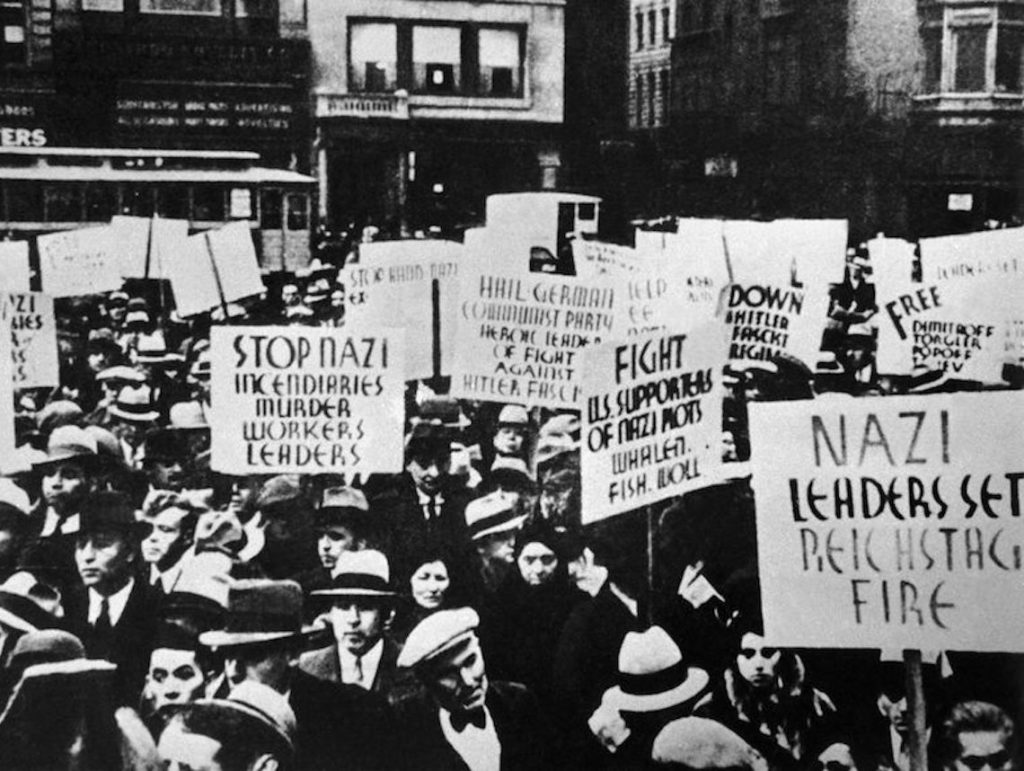
When American Jews fought Nazis — in New Jersey

The Nazi punching debate (is it OK to punch a Nazi?) went viral in January after a liberal protester slugged white supremacist Richard Spencer in the face during President Donald Trump’s inauguration. It was reignited this month following brawls between far-right nationalists gathered in Charlottesville, Virginia, and counterprotesters, including some associated with the combative antifa movement.

Although most eyewitness accounts of the events in Charlottesville pin much of the blame for the violence on the far-right marchers, and a counterprotester was killed by a car driven by a suspected white supremacist, critics like attorney Alan Dershowitz disapproved of the “anti-fascists” who showed up at the rallies.

“They use violence, and just because they’re opposed to fascism and to some of these [Confederate] monuments shouldn’t make them heroes of the liberals,” he said on “Fox & Friends.”

But whether it’s OK to confront hatred with violence is not a new topic of conversation. The question was debated in the 1930s among American Jews, who were faced with both the rise of Adolf Hitler in Germany and Nazi sympathizers at home.

One hotbed for the debate was Newark, New Jersey, home to a large German-American population and a fair share of supporters of the Nazi cause. Though only around 5 percent of the city’s German-American population of some 45,000 sympathized with the Nazis, they made it known, said Warren Grover, a historian and the author of the 2003 book “Nazis in Newark.”

Following Hitler’s rise to power in 1933, Jews in Newark saw Nazi-sympathizers marching down their city’s streets.

“The threats they faced were physical because the Nazis were marching in uniform. Many of them were armed. They broke windows, and they attacked merchants, but never with fatal consequences,” Grover said of residents of the city’s Third Ward neighborhood, where many Jews and Nazi supporters lived side by side.

Nazis also screened movies with anti-Semitic messages and hung anti-Jewish posters in the city, Grover told JTA. At a local election in bordering Irvington, they plastered posters across the city urging residents not to vote for Jewish candidates.

In response, Jews started organizing to defend themselves. Across the country, Jews would fight Nazis on an ad hoc basis. But in Newark, a more organized group emerged: the Minutemen. Jewish mobster Meyer Lansky had started the group in New York, but the Minutemen were shut down there by the authorities after some Jews reported them, fearing the use of violence would lead to an increase in anti-Semitism.

In Newark, however, the Minutemen took hold, aided by another Jewish gangster, Abner “Longy” Zwillman, and led by former professional boxer Nat Arno. On Oct. 18, 1933, JTA reported on a typical clash, outside a Nazi meeting at a German auditorium: “The meeting, at the Schwabenhalle, under the auspices of the Friends of the New Germany … was the target for stones and stench bombs thrown by the anti-Nazis in the crowd of about one thousand who waited outside the hall.”

The following May, JTA reported on a melee in Irvington: A “Nazi meeting terminated in fisticuffs, a miniature riot, arrests and injury to many persons.”

Though the Minutemen were “cheered and accepted by the majority of the Newark Jewish population,” Grover said, not everyone was enthusiastic.

Some Jews, especially those affiliated with Reform synagogues, “felt it gave Jews a bad name to be engaged in brawling, and they felt the government would take care of it,” he said. Those who opposed the group tended not to live in the Third Ward.

Yet the mostly Jewish group, which also had a few Irish and Italian members, became a powerful tool to fight Hitler sympathizers..

“The Minutemen were ready for them. The Minutemen had clubs and stink bombs, and they attacked the participants of the event,” Grover said of one Nazi mass demonstration in 1933. “Police came, and there were some arrests, and people said later that the Jews, the Minutemen, had no right to attack a peaceful gathering in a Newark hall.”

The Minutemen boosted Jewish morale.

“Physical prowess as exhibited against the Newark Nazis, Irvington Nazis, was a matter of pride for the Eastern European Jews who came because of the pogroms in Russia in the 1880s,” Grover said. “They took pride in it because they saw the newsreels coming from Germany [showing] how the Jews in Germany were being treated and all the different anti-Jewish legislation.”

Ultimately, Grover said, the group served its purpose: deterring Nazis from organizing in Newark.

“Just the thought of having Minutemen present at any of their meetings discouraged a lot of the Nazis from holding public meetings,” he said. “They were successful because a lot less propaganda was brought out by the Nazis because of fear of the Minutemen.”

When American Jews fought Nazis — in New Jersey Read More »

Trump and Charlottesville – Why the meltdown?

In the aftermath of Trump’s Tuesday press conference at Trump Tower, there have been countless analyses of why he chose to undo his conciliatory condemnation of haters on Monday that sought to ameliorate his bungled statement of Saturday.

Did he calculate that his hard core base wanted him to come out swinging, to endorse Confederate monuments and thumb his nose at mainstream voters and the “mainstream media”? Was he just seeking to offer an unorthodox, revelatory and counter-intuitive take on events that was “ignored” by the media for their malevolent reasons? Or was he channeling the Fox News feed of that morning which had made virtually all of his talking points?

There was endless speculation as to what animated Trump to have a national, live TV meltdown.

The reality that he revealed in his off-script remarks is far more troubling than most of the conjecture—his Tuesday presser confirmed what should have been apparent from the outset of his candidacy—he is incapable of discerning what makes extremists and bigots different from mainstream politicians and most of civil society.

He won’t relegate extremists to the periphery of American politics—as all his predecessors of the past century have done—because he reasons and thinks as extremists do. Their tools are his tools, their warped reasoning is his warped reasoning, their obliviousness to facts, data and truth is mirrored in our commander-in-chief.

As one who has monitored, listened to, had surreptitious contacts with extremists for over four decades, it is clear that Trump’s thought processes are an awful lot like theirs. He may not be animated at base by hate and venom, but how he reasons is chillingly similar to the policy arguments of bigots.

They believe in conspiracies, they are convinced a hidden hand works against them, they ignore and have a contempt for data, truth and civil dialogue and they always blame someone or some group for what ails them or society.

For most of the last half century plus, American presidents, electeds at all levels, opinion molders, and good citizens have intuitively realized that political extremists were different than mainstream politicians on both the left and the right. Civil rights organizations and good people have endeavored to ostracize and relegate to the fringes of society extremists who violate a set of unwritten rules on public conduct and decency.

From the John Birchers and their flirting with anti-Semitism in the 60s to George Wallace in the 70s to Louis Farrakhan more recently (see my op/ed of  9/17/1985 in the Times) to David Duke and Louisiana politic—-policies or comments that flirted with bigotry and stereotypes, even if made in passing, were enough to derail careers, elicit presidential condemnations and generate near universal abhorrence. It was clear to most leaders that overt expressions of bigotry and stereotypes were not acceptable vocabulary of late 20th century America.

Political correctness, with all its frailties, prevailed and there was a perceptible decline in hate crimes, the diversification of corporate boards and of elected officials, the election of an African American by significant electoral majorities and the virtual elimination in public discourse of racial, religious and homophobic epithets and expressions.

This is not to suggest that dog whistle politics with covert appeals to bias and intolerance didn’t happen—indeed they did (e.g. Willie Horton ads); but they were different than vulgar, overt expressions of hostility.

They can be offensive, but they indirectly acknowledge what the ground rules of civility are—no blatant bigotry. There have been occasional accusations made against fervent advocates on the left and the right of being extremists where the label was sloppily and unfairly applied—passion is not same as unreason. Mercifully, those instances have been few and far between.

Into that environment, comes a candidate who has flaunted all the norms of political discourse and debate and who utilizes the very cognitive tools of extremists (Klansmen, neo-Nazis and far left extremists share the methodologies): he traffics in bizarre conspiracy theories, he blithely ignores data, he bullies, attacks and demeans, he threatens, he blatantly lies with demonstrably false assertions on numerous issues, he perpetually claims to be the victim with a designated culprit[s] (other than himself) who is/are always to blame.

Why would he find extremists deserving of condemnation or isolation? He managed to become president despite all those traits— it has all worked for him.

For traditional politicians, individuals or groups that exhibit these characteristics represent flashing red lights—“stay away, extremists, bigots, crazies at work.” For Trump, they are a mirror of his modus operandi—just bit more extreme in policy.

He simply doesn’t see them as qualitatively different than himself—if he’s mainstream then they likely are too. It is not a basic instinct of his to ostracize and reject them. In fact, if they like him (and David Duke and Robert Spencer do) he may just like them back, or at a minimum, he won’t call them out.

The decades-long work of civil rights advocates and good people in society to relegate bigots and extremists to the fringes of our political system is being undone before our eyes. Trump is normalizing and mainstreaming bigots as we have never seen before—he is, once again, unprecedented in his actions.

As Edmund Burke noted, “All that is needed for evil to triumph, is for good men to remain silent” – if we care at all, that’s simply not an option.

Trump and Charlottesville – Why the meltdown? Read More »

Hackers portray Jewish Republican Senate candidate as David Duke supporter

The Twitter account of a Jewish Republican candidate for the U.S. Senate was discovered to have been hacked after it showed that she liked several posts by white supremacist leader David Duke.

Lena Epstein, who is running for the nomination in Michigan and was a co-chair of the Donald Trump presidential campaign there in 2016, disavowed any support of or connection to Duke, the one-time Ku Klux Klan head.

“As a Jewish woman with deep roots in the Jewish faith, a proud lineage of Jewish leaders, and relatives who were killed in the Holocaust because of blind hatred and prejudice, there is little that could be more offensive to me than the suggestion that I support, ‘like,’ or condone David Duke, neo-Nazis, or any group that promotes hatred and prejudice,” Epstein said in a statement issued Friday.

The tweets with her likes gained traction after the state’s Democratic Party chairman, Brandon Dillon, began sharing screenshots of them, the MLive news website reported.

Epstein shared a screenshot of a message from Twitter asking her to confirm her email address attached to her Twitter account, indicating that the account had been hacked. She also shared the link to a report by a private investigative agency which determined that an “illegal intrusion” of her Twitter account had occurred.

Epstein in a tweet called on Dillon to apologize for spreading the screenshots and to delete his tweets. Dillon responded in a tweet by calling on Epstein to “apologizing (sic) for liking David Duke.” He also called on the Michigan GOP to apologize for Epstein’s Senate candidacy.

In a recent appearance on Fox News, Epstein praised Trump for his response to racism and violence and reiterated white supremacists and neo-Nazis are not representative of the Republican Party, according to MLive.

Her campaign website describes her as “a millennial who has spent the last decade as a savvy automotive-industry businesswoman, community leader and nationally recognized conservative.”

Hackers portray Jewish Republican Senate candidate as David Duke supporter Read More »

Why some Jews are paying $500 for an Italian etrog

Fifty years ago, leaders of the Chabad movement tasked Rabbi Moshe Lazar of Milan with supervising the local production and export of the Calabria etrog, the citrus fruit used by Jews during the harvest festival of Sukkot.

Lazar’s job is to make sure the fruit is kosher for the festival, and that local farmers aren’t cutting corners or using unkosher techniques to boost the yield and their profits for what already is Italy’s most lucrative citrus product.

This year Lazar, now 83, has to be particularly vigilant. A winter frost destroyed 90 percent of this year’s crop, creating the worst shortage he has seen in Calabria etrogs, which are named for the southern region where they are grown. Italy is one of only three major exporters of the fruit along with Israel and Morocco.

Prices for the kosher fruits, which in normal years can easily fetch $200 ahead of Sukkot, have doubled and tripled, making Chabad communities around the world – who strongly favor the Calabria variety – fear that they will not be able to afford or obtain a specimen to call their own.

The shortage could also tempt unscrupulous or careless farmers.

“The frost just burned the fruit-producing branches,” Lazar said.

Due to the shortage, Lazar this year is picking fruit he would have deemed too homely for export in normal years, just as long as the fruit is technically kosher. To be considered as such, an etrog must at least be egg-sized, yellow, elliptical, intact (including its woody stem, or pitom) and possess a tough peel.

But even using the grade B produce, “there are not going to be enough Calabria etrogim to go around this year,” Lazar said.

That’s bad news for Chabad communities all over the world ahead of Sukkot, which this year begins on Oct. 4. Etrogs are among four species of plants that Jews purchase for the holiday, which is also known as the Feast of Tabernacles.

In the Ukrainian city of Odessa,  Rabbi Avraham Wolff’s congregants are trying to buy a single Calabria etrog for $500 via a Judaica shop in the United States.

“We’re worried that even at this high price we won’t be able to get one this holiday,” Wolff told JTA. “So a few of the patrons of the community got together and decided to open a fund to make sure we have enough money, cost what it may, for at least one Calabria.”

In previous years, the community bought five Calabria etrogs for Sukkot to be shared by Chabad institutions in Odessa, where some 50,000 Jews live. (Under Jewish law, Jews must “possess” an etrog during the festival, but a loophole allows them to be shared as “gifts” among several people. The fruits aren’t eaten, but carried and held at various points during worship.)

Other communities are able to cut out middlemen by buying the fruit directly from the farmers for about $50 apiece in normal years. But this year, farmers hiked their prices, starting at $150 apiece and all the way up to $350, according to Lazar’s son, Berel, who is a chief rabbi of Russia. Berel Lazar travels to Calabria each year to pick etrogs from orchards and bring them back to Russia for distribution to communities across the former Soviet Union. The younger Lazar charges congregants only what he pays the farmers.

The day after Sukkot, the price of etrogs drops to $1 a pound, Berel Lazar said. Locals use the fruit to make jam and in the soap industry.

The yield on Calabria etrogs, which are also called yanover etrogim because they used to be shipped from the Italian coastal city of Genoa, makes the fruit an irresistible target for manipulation, Berel Lazar said.

Some growers attempt to increase their margins at the expense of the strict kosher standards that Moshe Lazar has enforced for 50 years. One trick is to secretly graft the relativity vulnerable etrog tree onto the trunk of a hardier citrus tree, rendering it more robust but non-kosher. A cruder ruse involves gluing fruits and branches from a non-kosher tree onto a kosher one.

And while there is an atmosphere of “friendship and mutual respect” between the local farmers and the small team of supervisors working with Moshe Lazar, “sadly there is not a relationship of trust,” Berel Lazar said. He noted that the lucrative etrog trade has not escaped the attention of the Italian mafia, which he suggested may be pressuring farmers to try to pass off non-kosher etrogs as kosher to increase profits.

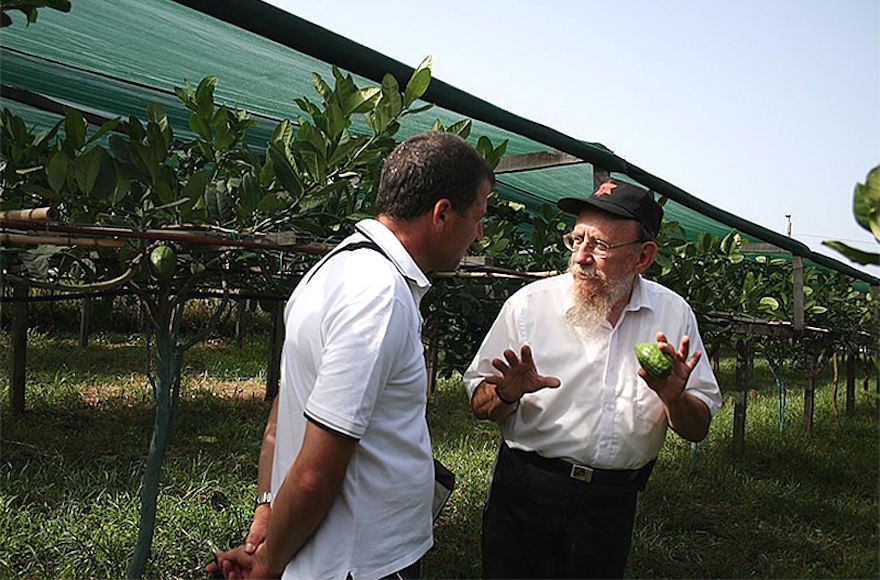
Moshe Lazar, right, explaining to a visitor at an etrog orchard in Calabria in 2015 about how to pick kosher fruit. (Esrogim.info)

Although etrogs are grown in Israel, Morocco and even the United States, Berel Lazar says that the Calabria etrog is “clearly and visibly superior” to those strands – including fruits that grow in Israel on trees descended from Calabria groves. But to Chabadniks, the preference for Calabria etrogs is also based in scripture.

According to Chabad traditions, the Talmud, a central text of Judaism, suggests that God bequeathed southern Italy to Esau, Isaac’s firstborn and inheritor of “earth’s richness,” as he is designated in the book of Genesis.

“This means Calabria etrogim come from the richest soil, making them the best,” Berel Lazar said.

The shortage has Berel Lazar this year is sticking to a quota of 300-500 fruits for Russian communities — a mere fraction of the yield in normal years, when tens of thousands of etrogs leave the orchards of Calabria’s approximately 100 etrog farmers ahead of the Sukkot holiday.

“I can’t pick as many as I want and send them all to Russia when the rest of the world is left without,” he said.

Virtually all Chabad communities eagerly await the Calabria etrogs, and demand is especially high where the movement has many followers — primarily in Israel, France, the United States and the former Soviet Union.

Moshe Lazar said he predicts the Calabria orchards will recover fully within a year or two, making the shortage a very “temporary difficulty.”

But not a new one, his son noted.

“Hasidic tradition has many stories of Russian cities where Jews struggled to find an etrog for Sukkot,” Berel Lazar said. “This year we are reliving also this tradition.”

Why some Jews are paying $500 for an Italian etrog Read More »

Daily Kickoff: Ahead of Kushner’s visit, Bibi goes to Moscow; “The Russians set the facts on the ground in Syria” | Abbas’ 45 day ultimatum for talks

Have our people email your people. Share this sign up link with your friends 

JI INTERVIEW — Rep. Lloyd Smucker (R-PA) discussed the Israeli-Palestinian peace process and President Trump’s response to the Charlottesville protests in an interview with JI’s Aaron Magid: Fresh off a trip to Israel, Smucker slammed Palestinian Prime Minister Rami Hamdallah for justifying payments to families of terrorists in a meeting with the Republican Congressional delegation. “It was absolutely amazing when asked about the payments to families of terrorists, that were either imprisoned or killed, [Hamdallah] tried to justify it. We were very disappointed in his approach and explanations with that particular issue,” Smucker said. He expressed strong backing for the Taylor Force Act. “It’s very clear that those payments are being made. For the PA to incentivize terrorism, essentially, is completely unacceptable.”

Smucker on Charlottesville: “What we saw in Charlottesville was particularly horrifying after just coming from Israel and visiting the Holocaust museum (Yad Vashem). We should be absolutely unequivocal in our denunciation of these groups: they are simply not acceptable. It is unbelievable that there are still groups in our country today that believe they are better than others based on the color of their skin or religion. The President will speak for himself. I obviously cannot tell you what he was thinking when he said [there were fine people on both sides], but I think it’s important for the American people to hear from its leaders that we will not stand for this type of activity.” Read the full interview here [JewishInsider

DRIVING THE CONVO — President Trump used his primetime address to the nation last night to clean up his “both sides” comments in response to the Charlottesville protests: “Loyalty to our nation demands loyalty to one another. Love for America requires love for all of its people. When we open our hearts to patriotism, there is no room for prejudice, no place for bigotry, and no tolerance for hate. The young men and women we sent to fight our wars abroad deserve to return to a country that is not at war with itself at home. We cannot remain a force for peace in the world if we are not at peace with each other.” [CSPAN]

HEARD YESTERDAY — House Speaker Paul Ryan during a CNN Town Hall: “I do believe that [Trump] messed up in his comments on Tuesday, when it sounded like a moral equivocation, or at the very least moral ambiguity, when we need extreme moral clarity… And I’m pleased with the things he just said tonight to add clarity to the confusion that I think he gave us on Tuesday.”

CNN host Jake Tapper: “I think the issue.. is the reluctance to criticize President Trump for specifically saying things like ‘very fine people were marching in that rally’ that had swastikas and anti-Semitic signs and there were not any ‘very fine people’ in that rally… It wasn’t morally ambiguous. It was morally wrong.”

Ryan: “I have a hard time believing, if you’re standing in a crowd to protest something and you see, you know, all these anti-Semitic slogans… that you’re good with that and you’re a good person… You’re not a good person if you’re there… And that’s why I think it was not only morally ambiguous, it was equivocating. And that was wrong.  That’s why I think it was very, very important that he has since then cleared that up.” [CNN

“Ryan says Trump messed up but opposes censure” by Scott Bauer: “Ryan was asked at a town hall organized by CNN in his Wisconsin congressional district whether he would back the resolution that comes following Trump’s comments about the Charlottesville, Virginia, rally. The question came from Rabbi Dena Feingold, the sister of former Democratic Sen. Russ Feingold of Wisconsin, who grew up in the same city as Ryan. Ryan said censuring Trump would be “counterproductive.” “If we descend this issue into some partisan hack-fest, bickering between one another … what good does that do to unify this country?” Ryan said, adding that it would be the “worst thing we could do.”” [AP

TRUMP EFFECT: “Donations to Anti-Defamation League surge in US” by AFP: “ADL spokeswoman Betsaida Alcantara said donations like the one from James Murdoch — head of Fox News, who last week announced a million-dollar donation — as well as those from corporations like Apple, Uber and MGM Resorts yielded a rise of “1,000%” last week, compared to the weekly average donations since the beginning of the year… On Monday, the big bank J.P. Morgan also joined the ranks of the donors, Alcantara said. The bank announced a million dollar-gift to be shared by the ADL and the Southern Poverty Law Center.” [Yahoo

Rep. Jerry Nadler on race and anti-Semitism in the age of Trump — Off Message with Edward-Isaac Dovere: “As for the Jewish aides to the administration who defend Trump, including his daughter and son-in-law Jared Kushner… Nadler says they need to get real. “I don’t care what Jared Kushner said about the fact that Donald Trump loves, loves him and Ivanka and other people,” Nadler said. “He was willing to traffic in anti-Semitism. He was willing to use anti-Semitic imagery. And then, when caught up in it, refused to repudiate it, and denied that it was what it clearly was.”” [Politico]

“President Trump Maintains Support in New York City’s Religious Communities” by Stephen Nessen: “Members of New York City’s Evangelical and Hasidic communities turned out to vote for Donald Trump for president, and they continue to support him, despite his tepid and mixed responses to white supremacists who rally in his name… In Borough Park, Brooklyn, which gave Trump 68 percent of the vote, many in the ultra-orthodox community also said the president had done enough to condemn hate groups. “He said KKK is not good, whatever, he did what he has to do,” Chaim Shmedra, 24, said. “He could criticize more, but he’s doing a great job.””[WNYC] • Orthodox Resistance to Trump Grows — In Secret Social Media Groups [Forward]

INSIDE THE ADMIN: “Is It Time for Trump Aides to Resign?” by Eliot A. Cohen: “Gary Cohn is a Jewish philanthropist: He paid a price, not in emotional discomfort but in his integrity, in staying silent while the president made excuses for anti-Semites shouting slogans that hark back to Hitler’s brown shirts. One’s country can ask those who volunteer to serve it in uniform to put their lives on the line… But the hazards of battle do not require surrendering your soul: just the reverse, risking it all can mean reaffirming your highest values. The country does not, however, have the right to ask you to sacrifice your moral core, what makes you who you are.” [TheAtlantic] • Gary Cohn, Trump Agoniste, Contemplates the End [VanityFair]

“Trump Official Once Praised a Defender of Holocaust Deniers; Now she’s in charge of family planning policy” by David Corn: “Earlier this year, President Donald Trump appointed Teresa Manning, a leading anti-abortion activist, to be a deputy assistant secretary at the Department of Health and Human Services… But there was one item in her résumé that did not receive attention: She had once praised a defender of Holocaust deniers… In the preface to Back to the Drawing Board, Manning… called contributors to the book “statesmen, scholars, doctors, lawyers, judges, activists, and mothers.” And at [a 2003] conference, she remarked that they included “people that I have respected and admired my entire professional life.” Presumably, her accolades applied to [Joe] Sobran, whose controversial association with Holocaust deniers and whose “contextually anti-Semitic” writings were publicly known within conservative circles at the time.” [MotherJones]

“Why the White House Needs Another Bannon” by Tevi Troy: “Trump likes to think of himself as the whole show—his own strategist, his own communications guru, his own political whisperer… But this is one area in which Trump really does need the help: He doesn’t have the patience, the background, or the interest to be able to articulate a consistent conservative-friendly vision and to get other conservatives on board. Bannon’s absence means the White House lacks someone who can attempt to create a coherent narrative for the administration’s efforts… Not filling the role would be a self-inflicted wound, while filling the role with the wrong person would be a missed opportunity.” [PoliticoMag

DRIVING THE WEEK: “Kushner in Middle East for peace talks” by Annie Karni: “While everyone was busy gazing into the solar eclipse on Monday, White House adviser Jared Kushner had quietly snuck away to the Middle East… Accompanying Kushner on Tuesday in the Gulf states were deputy National Security Adviser Dina Powell, and Middle East envoy Jason Greenblatt… A White House aide and an outside adviser familiar with the trip planning said Kushner departed on Sunday and is set to arrive in Israel Wednesday night for meetings on Thursday. The traveling American delegation was meeting with leaders from the United Arab Emirates, Jordan, Qatar and Saudi Arabia in the days before. It was not clear why the White House would announce the trip but then keep the details of Kushner’s departure under wraps.” [Politico]

“PA to give Trump team ultimatum on peace plan” by Shlomi Eldar: “A senior Palestinian source… said a decision had been reached after lengthy negotiations at top PA levels… to present Kushner and Greenblatt with a clear ultimatum: Unless progress is made within 45 days on launching talks with the Israelis, the Palestinians will consider themselves no longer committed to the US channel and will turn to an alternative plan on which they have been working for the past two years… The Palestinians understand that the current occupant of the Oval Office tends to act impulsively, and such a move could prompt him to take out his anger on Abbas — but “we have no choice,” said the source.” [Al-Monitor

KAFE KNESSET — Dasvidaniya, Bibi — by Tal Shalev and JPost’s Lahav Harkov: Netanyahu is preparing for a day trip to Sochi, Russia. There, he will be meeting President Putin tomorrow for the sixth time in the past two years, and the second meeting in 2017. Iran, of course, will top the agenda for the meeting. President Putin will hear about Jerusalem’s concerns arising out of the diplomatic attempts to end the fighting in Syria. These diplomatic efforts are creating, according to Israeli officials, an Iranian territorial contiguity between Tehran and the Mediterranean.

The meeting with Putin comes against the backdrop of a clear disappointment in Jerusalem with the Trump administration and its level of attention to Israeli interests. “The Americans are sympathetic, but they are not willing to back words with deeds. We are not in the administration’s priorities. They are preoccupied with other issues, and there is a feeling that they have very limited attention span,” a senior Israeli Minister told Kafe Knesset. The Minister explained that the American vacuum over Syria – which was created in the Obama administration but has also been transformed into a Trump government policy – “has given increased importance to the strategic dialogue with the Kremlin, especially after Russia increased its military involvement in Syria. This has required close military coordination with the Russians to prevent friction. The Russians fill the American void and they are the ones who determine the facts on the ground. We want to make sure that the facts on the ground do not hurt us.” Read today’s entire Kafe Knesset — featuring Bibi’s privacy and the latest with the Kotel — here[JewishInsider]

“U.S. pushing to quash U.N. ‘blacklist’ of firms doing business in Israeli settlements” by Anne Gearan: “The Trump administration is urging the United Nations not to publish what it calls a “blacklist” of international firms that do business in Israeli settlements… “The United States has been adamantly opposed to this resolution from the start” and has fought against it before several U.N. bodies, State Department spokeswoman Heather Nauert said… “We have made clear our opposition regarding the creation of a database of businesses operating in Israeli settlements in the occupied territories, and we have not participated and will not participate in its creation or contribute to its content,” she said. In a statement Monday, Israel’s U.N. ambassador, Danny Danon, called the [U.N. Human Rights Council] moves toward publication of the list “an expression of modern anti-Semitism.”” [WashPost

IRAN DEAL: “Iran Says Can Produce Highly Enriched Uranium in Days if U.S. Quits Deal” by Bozorgmehr Sharafedin: “Iran can resume production of highly enriched uranium within five days if the nuclear deal it struck with world powers in 2015 is revoked, Iran’s atomic chief was quoted by state media as saying on Tuesday… “The president’s warning was not baseless,” Head of Atomic Energy Organization of Iran, Ali Akbar Salehi said…  “If we decide, we can reach 20 percent (uranium) enrichment within five days in Fordow (underground nuclear plant),” he added.” [Reuters]

2018 WATCH: Police Investigate Alleged Twitter Hack of Senate Candidate: “The Michigan State Police is investigating after Republican U.S. Senate candidate Lena Epstein said someone hacked her campaign’s Twitter account last week and “liked” posts from former Ku Klux Klan leader David Duke. Epstein, who is Jewish, has said any suggestion that she supports “this type of hateful ideology is extremely disturbing.”” [USNews

2020 WATCH: “How potential 2020 Democrats are honing their foreign policy chops” by Jeremy Herb: “[Cory] Booker’s seat on the Senate Foreign Relations Committee is another path for senators harboring presidential ambitions — it’s the committee Obama served on ahead of his 2008 run. In the early months of the Trump administration, the panel gave Booker a seat at the table for some of the most contentious confirmation hearings, including those of Secretary of State Rex Tillerson… and US Ambassador to Israel David Friedman… When Friedman testified, Booker elicited an apology for the nominee’s comments suggesting Obama was anti-Semitic and that Kaine was an Israel basher.” [CNN

“Nikki Haley says she had ‘personal’ talk with Trump about Charlottesville” by Diamond Naga: “Well, I had a personal conversation with the president about Charlottesville, and I will leave it at that,” Haley said on CNN… But when asked afterward, she would not confirm or deny whether Trump understood he made a mistake with his racially charged comments. “The president clarified so that no one can question that he’s opposed to bigotry and hate in this country.” [Politico]

** Good Tuesday Morning! Enjoying the Daily Kickoff? Please share us with your friends & tell them to sign up at [JI]. Have a tip, scoop, or op-ed? We’d love to hear from you. Anything from hard news and punditry to the lighter stuff, including event coverage, job transitions, or even special birthdays, is much appreciated. Email Editor@JewishInsider.com **

BUSINESS BRIEF: Jim Crown’s Aspen Skiing, KSL Capital venture adds Utah’s Deer Valley to growing resort portfolio [DenverPost] • Ghermezian’s Meadowlands ‘American Dream’ Project To Be Complete By 2019[CBS; NorthJersey] • Gary Barnett’s luxury condo tower rises on ‘gritty’ South Street [NYPost] • ASRR to buy out partner in Surfside condo project[TRD] • Israel’s TowerJazz to set up China chip plant with Tacoma Semi[Reuters] • Paul Singer’s Black Knight Unhorses Warren Buffett [DealBreaker]

“Billionaire Moguls Join Musk, Bezos in Race to Outer Space” by Tom Metcalf: “While technology tycoons dominate, the list also includes casino magnate Sheldon Adelson, who’s backing SpaceIL — a lunar mission.”[Bloomberg]

STARTUP NATION: “After Imperva And Mobileye, Here’s What’s Next For Israeli Startups” by Peter Cohan: “What’s most interesting to me is that at least one company — run by Israel’s most prolific info sec company founder, Shlomo Kramer, is that Israel is beginning to develop enough talent in marketing and sales that his latest company is able to operate out of Israel instead of being run from Silicon Valley. Tel Aviv is the center of Israel’s startup scene even though its top talent is educated 52 miles away at Haifa’s Technion. As Edouard Cukierman, Managing Partner and Founder of Catalyst Funds, said in an August 10 interview, “When I was at the Technion, the joke was ‘What is the nicest place in Haifa? The highway to Tel Aviv.’ Entrepreneurs want to be in Tel Aviv — it’s a place of fun; whereas Haifa is a serious place for studying.””[Forbes]

MEDIA WATCH: “Digital media veteran Ross Levinsohn takes over the LA Times as it fires top editors” by Peter Kafka: “Ross Levinsohn has worked at all kinds of media companies, but he’s never managed a newspaper before. Now he’ll run a big one: He’s the new publisher and CEO of the Los Angeles Times. Levinsohn made his digital reputation by helping News Corp acquire Myspace way back in 2005, a move that kicked off a wave of digital M&A. And he tried to buy Hulu multiple times, while working for multiple organizations. In 2013, he went to work for Guggenheim Partners, which owned several media trade publications, and planned on writing big checks to bulk that group up.” [ReCode]

TOP TALKER: “Louise Linton’s Couture Draws Ire on Instagram, and She Lashes Back” by Maggie Haberman and Mikayla Bouchard: “The wife of the Treasury secretary on Monday night took a page from President Trump’s social media playbook for punching down. Louise Linton, the labels-loving wife of Steven Mnuchin, replied condescendingly to an Instagram poster about her lifestyle and belittled the woman, Jenni Miller, a mother of three from Portland, Ore., for having less money than she does. The brouhaha began when Ms. Linton posted a photograph of herself disembarking a military jet emblazoned with official government markings. She had joined her husband on a quick trip to Kentucky with the Senate majority leader, Mitch McConnell.” [NYTimes; NYPost]

TALK OF THE TOWN: Jewish congregation reflects on letter by George Washington: “An annual letter reading at the nation’s oldest synagogue in Newport took on new relevance in the aftermath of the recent violence in Charlottesville, Virginia. The letter was written nearly 230 years ago by George Washington and addressed to Newport’s Jewish community. It promised that the country would give “bigotry no sanction, no persecution no assistance.” … Former Harvard University Dean Martha Minow asked members of the congregation to stand up for their beliefs.” [AP

“Asian American doctor: White nationalist patients refused my care over race” by Kristine Phillips: “John Henning Schumann, a Jewish doctor, said he’s had encounters with patients that sometimes result in awkward conversations. “I’ve been asked point-blank by patients if I’m Jewish,” Schumann wrote last week in a column published by NPR…  Sometimes, after saying that he is Jewish, patients surprise him with their response: “Good. I always like Jewish doctors, because they’re the smart ones.” Schumann said that “positive prejudice” is better than the alternative, and he often takes the compliment.” [WashPost

BIRTHDAYS: Philanthropist and hedge fund manager, specializing in acquiring distressed debt, Paul Elliott Singer turns 73… Chairwoman of Israel’s Strauss Group, a large dairy and food company, Ofra Strauss turns 57… Emmy Award winning television news journalist, formerly the weekend anchor of CBS Evening News, Morton Dean (born Morton Dubitsky) turns 82… Former Chief of Staff to the Vice President Dick Cheney, Scooter Libbyturns 67… Portland, Oregon’s Marque Lampert Scherer turns 67… Chairman of Israel Military Industries (now know as IMI Systems), he was a member of the Knesset for the Yisrael Beiteinu party (2006-2015) and served in multiple cabinet posts, Yitzhak Aharonovich turns 67… Encino, California’s Robin Elcott turns 61… Former MLB outfielder, then investment banker, fundraiser for both Obama presidential campaigns, more recently he was the US Ambassador to New Zealand and Samoa (2015-2017), Ambassador Mark Gilbert turns 61… Former investment banker who left his job to run a Los Angeles-based homeless service provider, he is now a professor at USC and a trustee of Jewish Community Foundation of Los Angeles, Adlai W. Wertman turns 58…  Director of Strategic Partnerships at the Paul E. Singer Foundation, Deborah Hochberg… Deputy mayor of Lawrence, NY, political consultant and investor, Michael Fragin turns 44… Project coordinator for “The Conversation: Jewish In America,” an annual invitation-only gathering sponsored by The Jewish Week, Rachel Saifer Goldman… Associate Director in the Atlanta regional office of Christians United for Israel, Shari Dollinger Magnus turns 40… Joyce Fox… Margie Berkowitz

Gratuity not included. We love receiving news tips but we also gladly accept tax deductible tips. 100% of your donation will go directly towards improving Jewish Insider. Thanks! [PayPal]

Daily Kickoff: Ahead of Kushner’s visit, Bibi goes to Moscow; “The Russians set the facts on the ground in Syria” | Abbas’ 45 day ultimatum for talks Read More »