fbpx

August 21, 2017

HINDSIGHT – The Art of Looking Back

In the spring of 2005, Eva Robbins commissioned me to write a setting for Psalm 27. At the time, I had no idea why she chose this text nor where her ask might lead me. Eva explained that the text was recited each of the 29 days of Elul – to prepare for the high holy days.

Intrigued, I wrote this song (download here) and thought it might be interesting to ask 29 friends to write short introspections on how the prepare for the holy days. Jewels of Elul was born.  I wrote the following as the introduction to the first volume of Jewels of Elul, released on Monday September 5th 2005.

Tradition suggests that we use this month to prepare for the high holy days. Easier said than done. Well, this year we have an idea that just might work! In this very spot, on each of the 29 days of Elul, 5765, we will post a “Jewel” of an idea from some wonderful national community leaders, teachers, artists and thinkers. Looking to lead a more fulfilling life? We just may have a few great ideas!

So began a tradition that spanned 10 years, featuring 290 Jewels for the month of Elul, concluding in 2014.   Every year since, our office has received hundreds of request for more Jewels.   Not one to disappoint, we selected 29 Jewels that we thought might resonate in 2017.

Beginning this Monday, we invite you to join us for HINDSIGHT – The Art of Looking Back. The contributions follow no set rules themes or patterns. What they do offer is a reflection of the deep diversity of our community and the hope that each of us has the gift to offer insight into life’s journey.

We begin the month of Elul with the very first Jewel of Elul first published on Monday September 5th, 2005 by one of my oldest friends – Esther Netter.

We hope you enjoy this trip down memory lane, and look forward to hearing back from you.

To a sweet new year.

Craig

HINDSIGHT – The Art of Looking Back Read More »

Following attack, French Jewish leader calls for ‘immediate eradication’ of terrorism

Following the death of a pedestrian in what appeared to be a vehicular terrorist attack in Marseille, a leader of the local Jewish community called for the “immediate eradication” of terrorism.

Bruno Benjamin, the president of the local branch of the CRIF umbrella of Jewish communities, wrote the message Monday on Twitter shortly after police arrested a man they suspect is connected to the slaying of one woman and the serious injury of another in a car-ramming attack that morning.

Police cannot confirm that the incident was a terrorist attack, a police source told the Le Soir daily.

“#Marseille, terrorism knows no borders, terrorists have no limits and no humanity. Today, a total eradication is necessary,” Benjamin wrote in the unusually harshly worded message. “We cannot comprehend these levels of hatred and capacity” for terrorism, he added.

A prosecutor in Marseille said the incident appeared to be the work of a mentally ill person, the La Chaîne Info news channel reported.

The incident comes on the heels of deadly terrorist attacks in and around Barcelona on Thursday and Friday, where 14 people were killed and more than 100 wounded when a van plowed through a crowd. The Islamic State terrorist group claimed responsibility for the attack and for the actions of five suspected terrorists who were killed Friday during a police raid in a resort city south of Barcelona. The driver of the van in the attack is the subject of an ongoing manhunt.

On Friday, an 18-year-old man of Moroccan descent killed two women and wounded eight others in a stabbing attack in the city of Turku, Finland. Police arrested the suspect, whom they are calling a terrorist.

Following attack, French Jewish leader calls for ‘immediate eradication’ of terrorism Read More »

Australian broadcaster explains why it left Israel off the map

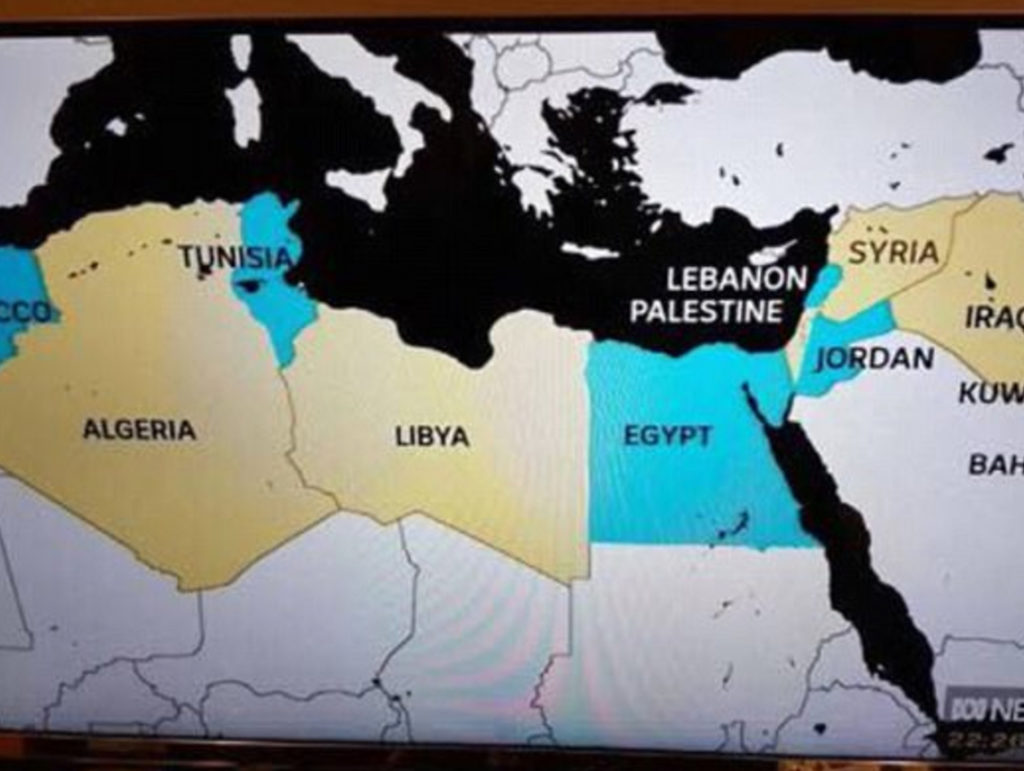
Australia’s national news service defended its decision to broadcast a graphic showing a map of the Middle East that included Palestine but not Israel.

Shown during an Aug. 17 segment on ABC News Australia, the map illustrated a story about how laws in 11 Muslim-majority countries and the Palestinian territories treat rape victims.

“The story was about the repealing of a law in Lebanon that allowed rapists to escape punishment if they married their victims,” a senior executive for the Australian Broadcasting Corp. told JTA. “The map showed other countries where this law had already been repealed (in the blue) and countries where campaigners are actively trying to have it repealed (in the yellow).”

Israel, the executive explained, never had the law to begin with, so it was not included. Had it been included, the spokesman suggested, the criticism might have been even more intense.

“In context, I wonder if including Israel in the map might have attracted more warranted criticism … The story had nothing at all to do with it,” the spokesman said. “We have commented on the story to the Daily Mail and they’ve amended the story.”

The graphic made news after a pro-Israel, anti-Islamist activist, Avi Yemini, posted it on his Facebook page.

“Last night ABC News wiped Israel off their map,” Yemini wrote. “They’re literally doing the Islamists’ dirty work for them. We must DEFUND these traitors immediately.”

Yemini was not satisfied with the public broadcaster’s explanation.

“They’ve hit back with an excuse that could almost work,” he wrote on Facebook. “Except for one ‘minor’ detail: PALESTINE IS NOT A COUNTRY!”

The Lebanese parliament voted last week to abolish a law allowing rapists to escape punishment if they marry their victims.

The clause remains on the books in the Palestinian territories, according to ABC News Australia.

Australian broadcaster explains why it left Israel off the map Read More »

Health apps appeal to a variety of Jewish needs

Whether you are interested in bringing more Judaism into your daily yoga practice or you are concerned about the halachic acceptability of tattooing for cancer radiation therapy, a number of Jewish-minded smartphone apps are available to help you on your journey toward better health.

Kabbalah Yoga: Ambitious Beginner

If you’ve heard about the health benefits of yoga but aren’t sure where to begin, this app is for you. With easy-to-follow videos that incorporate kabbalah and meditation into introductory yogic practices, it brings the physical and emotional benefits of yoga within reach. The app ($4.99) also includes a workout journal so you can mark your physical and spiritual progress. Those who practice yoga regularly report lower levels of stress and better sleep. And for people with thinning bones, even introductory-level yoga is considered a weight-bearing activity that can help build bone density.

Nishmat: Jewish Women’s Health

The intersection of women’s health and halachic law sometimes can be a tricky and potentially embarrassing topic to broach with medical professionals outside the religious community. With this free, easy-to-navigate app, women of all ages can find answers to even the most difficult personal health questions. The app clarifies Jewish law on topics like contraception, gynecological exams, infertility, lactation, obstetrics and oncology, without belittling or ignoring the most complicated issues a woman might face, including the use of medical tattooing for radiation treatment. While the app was created to help health professionals understand how best to treat their patients, it also has been a useful tool for women seeking to understand how their medical treatment can affect their body, and how they can engage with their partner during and after treatment.

Gene Screen

With a focus on Diaspora Ashkenazi Jews, Gene Screen is a free interactive app that allows users to understand the basics of population genetics, as well as the most common genetic diseases they might be susceptible to. Learn about recessive and dominant genes, play with drag-and-drop Punnett squares, and compare the prevalence of specific genetic diseases between the Ashkenazic population of the United States and the general U.S. population. The iOS-only app also links to a variety of websites that delve into details about genetics and offer genetic testing, including sites such as the Victor Center for the Prevention of Jewish Genetic Diseases.

NutriGuide

This app allows the user to personalize a kosher meal and grocery plan that can be of assistance in reaching health goals while also allowing the user to remain religiously observant. First, users set up a personal profile with their current height, weight, activity level and desired weight. They then can create a tailor-made diet framework to help them pursue a specific dietary goal, whether it be lowering sugar or salt intake, becoming vegetarian or avoiding food allergens. The free app also has a feature that allows users to scan bar codes on items at the grocery store, which delivers nutrition information about the products and whether they contain ingredients the user should be avoiding.

Health apps appeal to a variety of Jewish needs Read More »

Throw a stellar solar eclipse party

With the solar eclipse coming up on Aug. 21, people are absolutely geeking out over this rare phenomenon. If you’re unable to travel to a spot within the path of totality, you still can participate in the fun by hosting your own solar eclipse party. Try these ideas for a party that’s so dazzling, you’ll have to wear shades.

Party Playlist

Crank up the music with these awesome tunes that will get the party started. And don’t forget “You’re So Vain,” in which Carly Simon sings about taking “your Learjet up to Nova Scotia to see the total eclipse of the sun.”

“Total Eclipse of the Heart” — Bonnie Tyler
“Don’t Let the Sun Go Down on Me” — Elton John
“Fly Me to the Moon” — Frank Sinatra
“Ain’t No Sunshine” — Bill Withers
“Bad Moon Rising” — Creedence Clearwater Revival
“Can’t Fight the Moonlight” — LeAnn Rimes
“Here Comes the Sun” — The Beatles
“New Moon on Monday” — Duran Duran
“Mr. Blue Sky” — Electric Light Orchestra
“Moondance” — Van Morrison
“Walkin’ on the Sun” — Smash Mouth
“Blinded by the Light” — Manfred Mann’s Earth Band
“Dancing in the Dark” — Bruce Springsteen
“Ray of Light” — Madonna
“Wheel in the Sky” — Journey
“Blue Moon” — Elvis Presley
“Steal My Sunshine” — Len

Eclipse Tea Lights

Place a battery-operated tea light in a glass votive holder. Cut out a circle from black paper and tape it to the votive holder in front of the artificial flame of the tea light. The “moon” is now blocking the sun.

Eclipse Snacks

You’ll want tasty bites waiting for the eclipse, so have plenty of celestially themed candy on hand such as Milky Way bars, Starburst candies, Orbit gum and, of course, Eclipse gum. If you prefer savories to sweets, stock up on sunflower seeds or SunChips.

Pinhole Projector

Most people will see only a partial eclipse. But don’t be tempted to look directly at the sun — even with sunglasses — as you will damage your eyes. Instead, make a pinhole projector that will enable you to view the eclipse indirectly. Cut a hole at one end of a shoebox, tape aluminum foil over the hole and poke a hole through the foil with a nail. At the other end of the shoebox, on the inside, tape a piece of white paper. Hold the shoebox up to the sun, and an image of the eclipse will be projected onto the white paper.

Eclipse Banner

For an easy party decoration, make this banner depicting the stages of a total eclipse. Cut circles out of yellow paper, and fill these circles in with gradually larger sections of black until the black completely covers the yellow in the middle of the banner. Then fill the yellow circles with gradually smaller sections of black, showing the moon again revealing the sun. Connect the circles with a string and hang the banner on the wall.

Throw a stellar solar eclipse party Read More »

Jewish Dems launch new national group

Jewish Democrats are set to launch a new political organization, expanding their political activities to focus on the national conversation and ramp up Jewish outreach efforts for the upcoming 2018 elections.

[This story originally appeared on jewishinsider.com]

The new group, The Jewish Democratic Council of America, was originally set to launch in October in place of the present National Jewish Democratic Council (NJDC) and the Jews for Progress PAC. However, President Donald Trump’s response to the Charlottesville protests compelled the founders of the JDCA to accelerate the timeline, the organization said in a news release on Sunday.

“Clearly today, there seems to be a calling for a rebuilding of Jewish Democrats’ vision in politics – to elect people that will support local and state national policies that are supportive of the Jewish community’s values,” Former Congressman Ron Klein, Acting Chairman of the new organization, explained to Jewish Insider in a phone interview on Sunday. “We also believe there’s a role for our organization to make sure that Democrats understand the importance of Israel and strategic U.S. relationship with Israel.”

According to Klein, the role of the organization will be to identify specific campaigns “where we believe that our Jewish community’s interests are at stake, and to support Democrats that will support our issues.” JDCA will also be involved in educating candidates and incumbents “on a full-time basis, not just during campaigns” and provide media responses on a daily basis.

The NJDC limited its activities after the 2014 midterm elections, outsourcing day-to-day operations and media response to Bluelight Strategies, a Washington, DC public relations firm. In 2012, the NJDC launched a model called “The Hub” after they had determined that the Obama campaign and the Democratic National Committee was being too slow in responding to attacks on President Obama’s record on Israel.

In a 2015 interview with Jewish Insider, former NJDC’s Chairman Greg Rosenbaum boasted that Florida ended up in the Obama column due to a concentrated effort to mobilize Jewish voters in the Sunshine State in the last weeks leading to Election Day. Ahead of the 2016 general elections, Marc Stanley, the past chair of the National Jewish Democratic Council (NJDC), announced the formation of ‘Jews for Progress’ aimed to fight back against the RJC’s campaign against Clinton in several battleground states. That effort was less successful, as Trump managed to win all battleground states by a slim margin.

Members of the JDCA Board of Directors include Marc R. Stanley, Michael Adler, Daniel Berger, Diane (Dede) Feinberg, Peter Gillon, Barbara Goldberg Goldman, Benjamin Gordon, Steve Grossman, Ada Horwich, Beth Kieffer Leonard, Israel “Izzy” Klein, Marcia Riklis, Joel Rubin, Jeffrey Solomon, and Susie Stern.

Jewish Dems launch new national group Read More »

Lipnicki delights as Birthright’s 600,000 participant

In its first year, 2000, Birthright-Israel provided almost 9,000 Jews ages 18 to 26 free 10-day tours of Israel’s cultural and religious sites.

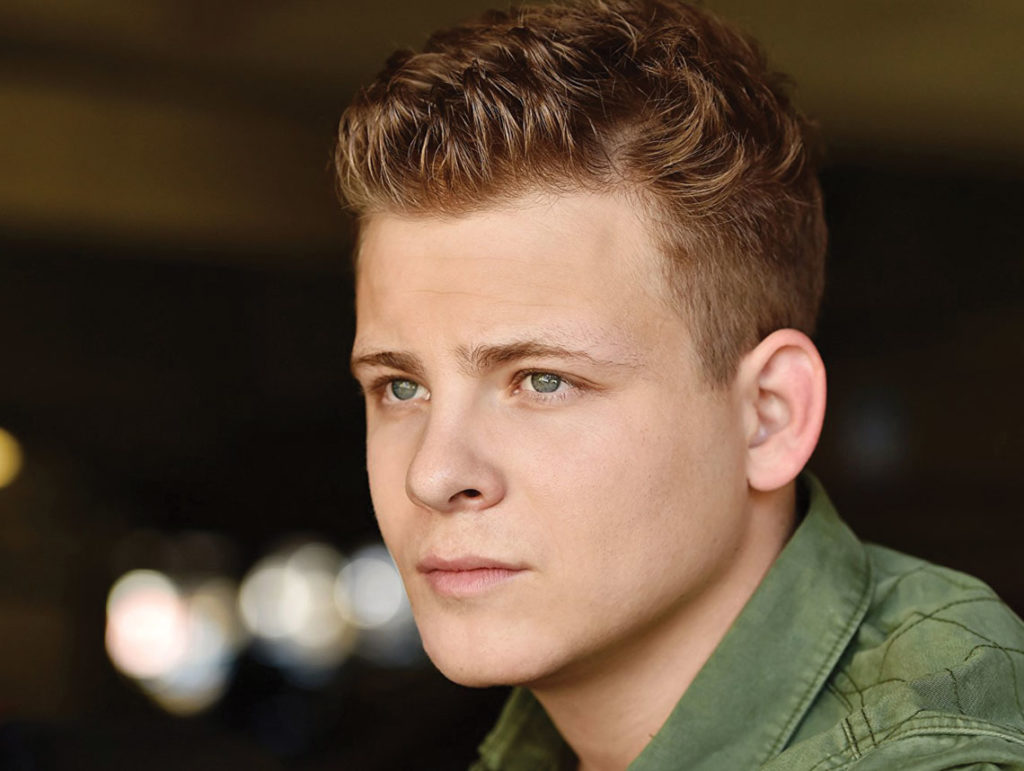
Now, with nearly 50,000 young people from 67 countries visiting each year, the organization just sent its 600,000th participant around Israel, and it’s a familiar face — actor Jonathan Lipnicki.

“I feel Birthright is a really positive organization, and knowing that my community backs me like this is a special feeling,” Lipnicki said. “I feel pretty honored with that distinction.”

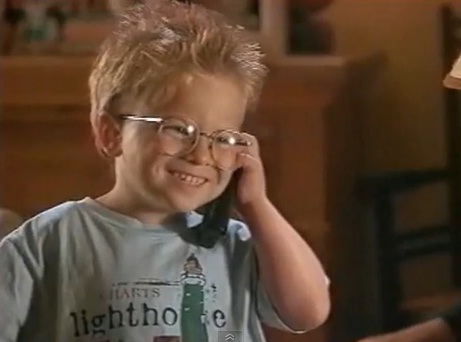
As a 5-year-old, a bespectacled Lipnicki stoles scenes acting alongside Tom Cruise and Renee Zellweger in the 1996 film “Jerry Maguire.” As a preteen, he starred in a pair of “Stuart Little” films, “Like Mike” and “The Little Vampire.” They made him one of the most recognizable child stars on the planet.

Lipnicki, 26, grew up in Westlake Village, attending the Reform congregation Temple Adat Elohim. In synagogue, he remembers hearing about Israel but the words rang hollow. With his Birthright trip still fresh in his mind after returning to the United States in early August, Lipnicki said he now sees what all the fuss was about.

“I think you can’t help but forge a new connection with the country, just seeing the sites and being present,” he said. “It’s this far-off thing they talk about in temple when they say you must visit Israel. It’s not tangible until you visit it and you see why they talk about it so much. I forged a new relationship with my Judaism but also expanded the one I have currently. I’ve always been proud to be Jewish, but that was reaffirmed. I’m going to remember this for the rest of my life.”

For years, Lipnicki knew about the trip. Many of his friends and even his sister had gone before him. They all raved about it to him, so expectations before his July departure from Newark, N.J., were sky-high.

Jonathan Lipnicki

“And they were exceeded by far,” he said. “It’s an amazing place. I loved the country. I had such an amazing time in Tel Aviv, which reminded me of Miami. I loved the beach there. The water there was like bathwater and it was so clear.”

Lipnicki cited floating in the Dead Sea and Israeli food as other highlights. However, there was one stop on the trip that left an indelible impression.

“The Western Wall was one of the most emotional experiences I’ve ever had,” he said. “There was this sense of community I felt there. It felt like I was home. It was pretty incredible.”

As is standard on Birthright trips, a group of eight Israelis, usually a collection of soldiers and college students, accompanied Lipnicki’s group. The actor said he clicked with them instantly.

“There were so many similarities between us, particularly our sense of humor,” he said. “That’s where I really connected with the Israelis, just with having a good time.”

Lipnicki also observed what he deemed a stark difference between young Americans and Israelis.

“Their level of maturity is pretty astounding,” he said. “They have a different perspective on life, growing up in different circumstances. To see their different perspective on life and how they’ve grown up out there is enlightening. They are a product of their circumstances, theirs being more grave than mine. They’re definitely more mature at a younger age.”

Lipnicki, a working actor living in the Studio City area, said he feels inspired to re-engage with his Jewish community now that he has returned home. He hasn’t been a member of a synagogue in a long time but would like to change that, and he also spoke about enrolling in a kabbalah class, thanks to an impactful visit to Safed, a city regarded as mystical for its historical connections to kabbalah.

“We saw an artist there named Avraham from Michigan who moved to Israel,” Lipnicki said. “He made these paintings that were kabbalah-themed. I’m a very spiritual person and it definitely got to me. I would like to read up on it more and maybe take a class.”

Would he go back to Israel?

“Definitely,” he said. “One hundred percent. I hope to go back soon.”

Lipnicki delights as Birthright’s 600,000 participant Read More »

Rabbi David Wolpe calls on President Trump to repent

In a powerful sermon delivered from his pulpit on Sat., Aug. 19, Rabbi David Wolpe, one of America’s leading rabbis, called on President Donald J. Trump to repent for his remarks following the neo-Nazi march in Charlottesville on Aug 12.

“I never thought I would have to speak these words to a congregation but here they are: These are Nazis!” said Wolpe. “These are the people who rounded up our people all over Europe and put them in gas chambers. And they marched in the streets of an American city. And people defended the silence of the leader of our country for a full day.”

Wolpe is the Max Webb Senior Rabbi of Sinai Temple, a Conservative congregation in West Los Angeles.  A prolific author and sought-after speaker, he is generally considered a centrist, anchoring a congregation that holds strong opinions across the political spectrum. Newsweek magazine named Wolpe, “the most influential rabbi in America.”

The Charlottesville march brought together an array of far-right, openly anti-Semitic groups. Though they gathered in Charlottesville ostensibly to protest the city-approved relocation of a statue of Confederate Gen. Robert E. Lee, Wolpe pointed out that they chanted, “Jews will not replace us!” and marched under banners decorated with swastikas.

A Charlottesville rabbi took online threats to burn his synagogue down so seriously, Wolpe said, that he removed the Torahs from the ark and took them to another building for safekeeping.

In the course of the march, a white supremacist drove his car into a group of peaceful counter-protestors, killing 32 year-old Heather Heyer.

Wolpe took issue with President Trump’s response to the violence.  Instead of singling out and denouncing the neo-Nazis, Trump blamed “many sides.” After backtracking slightly in response to public outcry, Trump, in a followup press conference, said “there were some good people” on the side of the neo-Nazis.

“He said, ‘Some people on both sides were very fine people,'” Wolpe said of President Trump’s remarks. “Well, there were very fine people marching on the Left along with some people who were not at all fine … But nobody marching on the right is a very fine person, because a very fine person does not march under a Nazi flag, no matter what they think or what they feel.”

The rabbi’s congregation applauded spontaneously, something that breaks with synagogue decorum during services.

Wolpe has generally refrained from bringing politics to the pulpit. In a June 11 op-ed for the Jewish Journal entitled, “Why I keep Politics Off the Pulpit,” he bemoaned the fact that, “The litmus test for religious legitimacy has become political opinion.”

But Wolpe was clearly moved to speak out by Trump’s reaction to the Charlottesville protest, which also brought condemnations from the Republican Jewish Coalition, the Orthodox Rabbinical Council of America, and the right-wing rabbinic leadership of Lakewood, NJ.

The rabbi framed his sermon around three mitzvot, or commandments, that the Torah passage read in synagogues this week teach.

“The first is to judge [people] favorably, the second is to rebuke,” said Wolpe at the conclusion of his sermon.  “The third mitzvah is teshuva — repentance. The President of the United States needs to repent. Shabbat shalom.”

On those words the rabbi took his seat.

You can hear the entire 16-minute sermon here.

Rabbi David Wolpe calls on President Trump to repent Read More »

Hispanic Jewish Women’s Alliance celebrates 20 years of friendship

The Hispanic Jewish Women’s Alliance (HJWA) celebrated its 20th anniversary on Aug. 4 with an all-day gathering at the Holy Spirit Retreat Center in Encino. The event drew more than 30 women, about two-thirds of them Jewish and the rest Hispanic.

Barbara Creme, one of the Alliance founders, told the gathering that 20 years earlier, at the first exploratory meeting between Jewish and Hispanic women, when they were considering projects to undertake, one of the Jewish women suggested that they could “mentor” young Latinas. At that moment, Creme recalled, a Hispanic woman angrily pointed out that there already were a number of programs where Hispanic women mentored young Latinas and there was no need for Jewish women to be mentors.

Creme told her current audience that the woman’s objection was a wake-up moment: She realized that the aim of the alliance should be for Hispanic and Jewish women to learn from one another.

And it was not the only wake-up call on Jewish-Latino relations, Creme said. Around the same time, in 1998, the San Fernando Valley was roiled by a contentious California Senate primary race between Democrats Richard Katz, an established Jewish candidate, and Richard Alarcon, an underdog Latino politician, who were competing for a seat to represent much of the Valley. The campaign degenerated into nasty racial divisiveness, with not-so-subtle appeals to the electorate to vote based on ethnic identity.

When Alarcon eked out a 29-vote victory from nearly 100,000 votes cast, charges of voter intimidation and demands for a recount erupted. A Los Angeles Times story after the election said, “there was little sign that the bad feelings [between Jews and Latinos] had abated.”

Given the toxic atmosphere, Creme, then director of the Valley Jewish Community Relations Committee, met with two Hispanic women: Margaret Pontius, community services coordinator of the Guadalupe Center in Canoga Park, a Catholic Charities nonprofit; and Virginia Rafelson, a former Mexico cultural attaché to L.A. who  launched a program to increase literacy among Latinos known as BASE, for Basic Adult Spanish Education.

Creme, Pontius and Rafelson forged a strong bond, decided to see what they could do to improve relations among Jews and Hispanics, and founded the Hispanic Jewish Women’s Alliance.

Much of the overt strife between Jewish and Latino politicians is in the past, but the Alliance is still around, and on its 20th anniversary, as at all its gatherings, there were talks and activities meant to inform Hispanic and Jewish women about each other’s culture and history.

Alliance member Betty Rodriguez Goldstein, a Hispanic woman married to a Jewish man, told the Journal that she grew up in Monterey Park and Montebello, which was “totally middle class but ethnically diverse. On our block were professors, a Jewish doctor … I went to bar mitzvahs when I was in junior high.” She later attended Cal State Los Angeles, where she met her husband when both were undergrads.

Although Goldstein is Hispanic, she admitted that before she became part of the Alliance she had little awareness of Hispanic culture. And since her husband is a non-practicing Jew, she did not have much knowledge of Jewish culture, either.

“I’ve learned so much,” she said. “For me, this group has been a portal into both worlds.”

“In this group,” Creme said, “we exchange info on all levels: what our holidays are like, what they mean, what the rituals are about. Over the years, we’ve realized that there are more similarities than differences, and we’ve integrated into each other’s activities, attending bar mitzvahs or Communions.”

Creme said the Alliance might have started with the noble ideal of changing L.A., but what the members have done is change themselves by becoming close friends with people from different backgrounds. Sometimes what they’ve learned has been comical, life-changing or both.

At one of the group’s first holiday gatherings, when members brought objects that were part of Christmas or Chanukah celebrations, Pontius brought a crèche — and a dreidel, which came with an interesting story.

Pontius was born in Silver City, N.M. After college and graduate school, she and her husband, an engineer, moved to L.A.

“After my dad died,” she said, “my mother came from New Mexico to live with us, and she brought some of her stuff with her, including a wooden dreidel, not with Hebrew letters, but with Roman numerals.”

Pontius said she is Catholic and traces her roots to French and Spanish forebears, but she wonders if her mother was descended from Conversos, Spanish Jews who hid their Judaism but continued to practice it secretly.

“I know that a lot of [Conversos] escaped the Inquisition and came to New Mexico,” Pontius said. “My mother’s family comes from Spain and were staunch, staunch Catholics … so, really, I don’t know what it means that my mother had a dreidel.”

Pontius said that when she, Creme and Rafelson started the group, it was because the three of them “had seen what was happening in the community and didn’t like it.

“So when that election between Katz and Alarcon took place 20 years ago, there was anger between Jews and Hispanics, and it gave us an opportunity to do some work to try to heal that rift.

“What the three of us did, and when the others joined us, is we talked about what we share, what we have in common. … I’ve been to Jewish weddings and bar mitzvahs, and some of the prayers are the same, so why should there be strife?”

How does Pontius envision the Alliance’s future?

“I’d like to see this group grow,” she said, “and I would like to see us widen our scope, because since we started the ground has widened. We now have the Arabic world, so I’d like to see Muslims folded into this group as well, so we can understand even more deeply how we can work and live together.” 
Hispanic Jewish Women’s Alliance celebrates 20 years of friendship Read More »

Neighbors fight to preserve sculpture by Israeli artist in Beverlywood Park

Some Beverlywood residents are trying to prevent the proposed redesign of a neighborhood greenspace known as Circle Park that could result in the removal of a sculpture by the late Israeli artist Kosso Eloul, saying the sculpture has artistic and monetary value.

Melinda Smith Altshuler, a contemporary artist who lives in Beverlywood, is among a group of neighbors who want to preserve Eloul’s work, “Morningnight,” which was built in 1967 and sits to one side of the
grass-covered space located in the center of a roundabout where South Beverly Drive, Sawyer Street and Bolton Road meet.

The Michael Hittleman Gallery on Third Street appraised the sculpture and said it could be worth as much as $50,000, Smith Altshuler said.

Smith Altshuler and her husband, Bruce Altshuler, a lawyer, live near the park on Bolton Road. She is working with Beverlywood resident Abigail Yasgur and her husband, lawyer Joseph Lipner, to preserve the Eloul piece.

Smith Altshuler and Yasgur said few of their neighbors had ever heard of the sculptor, who was affiliated with the Israeli New Horizons movement.

“If people only knew what they have here, they wouldn’t want to take it away,” said Yasgur, a Jewish Free Loan Association employee.

The two couples, who live two doors from each other, are planning to deliver a presentation about the sculpture at the Beverlywood Homes Association meeting on Aug. 21.

Debbie Shipman, general manager of FirstService Residential, the association’s property managment  company, said whether to redesign the park was still to be determined, and the issues regarding the sculpture and the sentiments of neighbors opposed to its removal would be considered at the upcoming meeting.

“We’re taking into account all the people that have had any kind of input on it,” Shipman said, noting that the fountain sculpture has been inoperable for years.

“Whatever [Eloul] designed way back when isn’t even there anymore,” she said. “That’s just the base of it. The fountain parts aren’t there anymore. They deteriorated.”

Smith Altshuler claimed that the association intentionally allowed the artwork to fall into disrepair. “They did their best to let it look ugly so people would complain about it,”she said.

Eloul’s piece is made of gunite, a concrete mixture, and is encircled by a fence that was added sometime after it was installed. There is no plaque or sign with the name of the piece or its creator.

About 1,350 families live in Beverlywood. The affluent neighborhood is heavily Jewish, with Orthodox families living within walking distance to synagogues in the Pico-Robertson neighborhood.

Eloul, born in 1920 in Russia, was educated in Israel. He designed the sculpture around the time he served as an artist-in-residence at Cal State Long Beach, from 1965 to 1966. He died in 1995 in Canada.

Eloul’s work has been exhibited around the world, and one of his sculptures sits on the Los Angeles campus of Hebrew Union College-Jewish Institute of Religion.

The two couples fighting to keep the Beverlywood sculpture have kept Eloul’s widow, Rita Letendre, an artist in Canada, abreast of the situation, hoping for an outcome that honors her late husband’s artistic legacy.

“He’s not quite as well known,” Yasgur said, “but he has a place in art history.”n

Neighbors fight to preserve sculpture by Israeli artist in Beverlywood Park Read More »