fbpx

August 10, 2017

Rosner’s Torah-Talk: Parashat Ekev with Rabbi Philip Scheim

Out guest this week is Rabbi Philip Scheim of Toronto’s Beth David congregation. Rabbi Scheim is also the president of the Rabbinical Assembly. His career in the rabbinate began in 1981, when he was appointed Assistant Rabbi at Beth David B’nai Israel Beth Am. In August of 1984, Rabbi Scheim was officially designated Senior Rabbi of the congregation, and has continued to serve in that capacity ever since.

In this Week’s Torah Portion – Parashat Ekev (Deuteronomy 7:12-11:25) – Moses continues his address to the people of Israel, promising them that they will prosper in the land of Israel if they obey God’s commandments. He reminds them of their sins, but stresses God’s forgiveness. Moses describes the land of Israel to the people, demands that they destroy the idols of its former dwellers, and warns them of thinking that their power and might, rather than the lord, have gotten them their wealth. Our discussion focuses on Moses’ retelling of the Golden Calf story and on the reasons behind God’s forgivness toward the people of Israel.

https://www.youtube.com/watch?v=YAT1LdgzqIE&feature=youtu.be


Our Past discussions of Parashat Ekev:

Rabbi William Hamilton on the differences between the two versions of the story about the Golden Calf.

Rabbi Robert Dobrusin on the importance of allowing our faith to grow with us and adapt to different circumstances in our lives

Rabbi Brad Hirschfield on the conditional and unconditional aspects of God’s covenant with Israel

Rosner’s Torah-Talk: Parashat Ekev with Rabbi Philip Scheim Read More »

My Top Ten Recommended Jewish Books

When people ask me what books I think offer the best understanding about what Jews believe and care most about, I’m often stymied because there are so many.

Nevertheless, as an exercise, I tried this week to make a list of my top ten. All of these have moved me, informed me, changed me, and taught me wisdom, inspired me, and given me insight not only into the Jewish heart, mind and soul, but into what it means to be a human being and a mensch.

Here are my top ten:

  • The Five Books of Moses – The Hebrew Bible is the foundational text in Judaism. Among the best modern commentaries that I’ve found is Etz Hayim: Torah and Commentary, edited by Rabbi David L. Lieber and published by the Conservative movement.
  • Covenant & Conversation – Numbers: The Wilderness Years by Rabbi Jonathan Sacks is a brilliant commentary and exploration into the fourth of the five books of Moses. Rabbi Sacks brings the Biblical past into the present and shows how the Book of Numbers is among the world’s most important literary works.
  • A History of the Jews by Paul Johnson – There are many fine Jewish histories. I chose Johnson’s because it is both descriptive and inspirational. For example, he wrote: “No people has ever insisted more firmly than the Jews that history has a purpose and humanity a destiny … The Jews, therefore, stand right at the center of the perennial attempt to give human life the dignity of a purpose.”
  • Pirkei Avot – Sayings of the Sages – An ethical tractate stuck in the middle of a 2nd century legal code, this series of teachings and maxims is a guide to behavior, attitudes, civility, honor, integrity, faith, aspiration, kindness, peace, humility, generosity, patience, fairness, and the proper use of speech. Of the many commentaries, my favorite is one that comes out of the orthodox world – Pirkei Avot: Ethics of the Fathers – The Sages’ Guide to Living published by Artscroll.
  • Sefer Ha-Hinukh Book of Education is attributed to the 13th century Rabbi Aaron ha-Levi of Barcelona (in 5 volumes). This work explains each of the Torah’s 613 commandments in its order of appearance. Intended most likely as a text for students to learn the purpose of the commandments and how to live in line with the spirit and values of Torah, it is a superb introduction to Biblical law.
  • Opening The Tanya, Learning the Tanya, and Understanding the Tanya (3 volumes) was written by Rabbi Shneur Zalman of Liadi, the founder of Chabad Lubavitch Chassidism. This three volume text with commentary by Rabbi Adin Steinsaltz explores the complexities, doubts, and drives at the core of the struggle between the Godly and animal souls. Though more than two centuries old, the teachings here are as relevant today as they were when they were written at the end of the eighteenth century.
  • Between God and Man – An Interpretation of Judaism is a selection of writings by Rabbi Abraham Joshua Heschel, among the greatest Jewish scholars, thinkers, theologians, social activists, teachers, and leaders of the 20th century. Rabbi Heschel is a poet of the soul and this work opens the heart, mind, and soul to the relationship between humankind and God as few great thinkers can do.
  • One People, Two Worlds: A Reform Rabbi and an Orthodox Rabbi Explore the Issues That Divide Them is by Rabbi Ammiel Hirsch (Reform) and Rabbi Yosef Reinman (Hareidi Orthodox). These two rabbis entered into an 18-month email correspondence after being introduced by a mutual friend on the fundamental principles of Jewish faith and practice. What resulted is “an honest, intelligent, no-holds-barred discussion of virtually every hot-button issue on which Reform and Orthodox Jews differ, among them the existence of a Supreme Being, the origins and authenticity of the Bible and the Oral Law, the role of women, assimilation, the value of secular culture, and Israel.” (the publisher) This dialogue is unprecedented. In the end these two rabbis from very different religious streams found that they not only liked each other but respected each other as well.
  • Not in God’s Name – Confronting Religious Violence by Rabbi Jonathan Sacks explores how religious extremism and violence in Jewish, Christian, and Muslim communities worldwide are corruptions of our respective religious texts and our shared monotheistic tradition.
  • Fragile Dialogue: The New Voices of Liberal Zionism, edited by Rabbis Stanley Davids, Larry Englander, and Hara Person and published by the Central Conference of American Rabbis, includes the reflections of close to forty teachers and thinkers who struggle with a variety of approaches to liberal Zionism that are emerging in the 21st century. Israel has become one of the most polarizing forces in the North American Jewish community resulting in a serious challenge to Jewish unity and the alienation of many Jews from the State of Israel and the Jewish people. This work is an attempt to address those tensions within modern Jewish life and bring clarity to the conversation (to be published in early Fall, 2017).

People often ask me where to begin. It really doesn’t matter. Just begin where you are most interested and allow your heart, mind and soul to carry you forward.


My Top Ten Recommended Jewish Books Read More »

New group for progressive Zionists to march in Chicago SlutWalk

Calling themselves progressive and Zionist, about a dozen activists plan on marching in a Chicago demonstration against sexual violence to promote the idea thaZionism and liberal values are compatible.

Members of the Zioness initiative, which launched Tuesday, will march together on Saturday at SlutWalk Chicago, a women’s rights demonstration against sexual violence. Zioness members will be marching with banners and T-shirts featuring a design of a woman wearing a Star of David necklace.

Organizers of the SlutWalk initially said that they would ban Stars of David from the event, but later altered their policy to allow religious symbols but not national flags.

The SlutWalk policy came in the wake of a controversy over the Chicago Dyke March in June, when three Jewish participants at the LGBTQ demonstration were ejected for carrying LGBTQ Pride flags adorned with the Star of David. Dyke March organizers said the women were advocating for Israel at an anti-Zionist event.

The Dyke March incident served as “a watershed moment,” said Zioness organizer Amanda Berman.

“It was really a moment where everyone in the community said, ‘This is unacceptable, the line has been crossed, and there’s no way we can walk back from it now because no one can claim this is just opposition to a political party or a policy 10,000 miles away. It’s now about Jews,’” she told JTA.

The Dyke March incident was widely condemned by the Jewish community, and Jews who are pro-Israel have complained that they often do not feel comfortable expressing their religious identity openly at LGBTQ events and settings.

Berman, the New York-based director of legal affairs at The Lawfare Project — which calls itself the “legal arm of the pro-Israel community” — will travel to Chicago for Saturday’s march. She formed Zioness with around a dozen friends from across the country.

“When SlutWalk said, ‘We stand in solidarity with the organizers of the Chicago Dyke March,’ and said ‘We will also ban Zionist symbols, including Jewish stars,’ it became an opportunity to challenge the narrative that Jews and Zionists can’t participate in progressive movements,” she added.

Although SlutWalk Chicago said it would welcome religious symbols, on Thursday it denounced the Zioness initiative for using the march to promote a “nationalist agenda.”

“SlutWalk Chicago does not support the ‘Zioness progressives’ planning on coming to the walk Saturday. We at SlutWalk Chicago stand with Jewish people, just as we stand for Palestinian human rights. Those two ideologies can exist in the same realm, and taking a stance against anti-Semitism is not an affirmation of support for the state of Israel and its occupation of Palestine,” the group wrote on its Facebook page.

“We oppose all oppressive governments whether they be the United States or Israel, as we recognize these regimes often disproportionately oppress women and femmes. We find it disgusting that any group would appropriate a day dedicated to survivors fighting rape culture in order to promote their own nationalist agenda,” SlutWalk Chicago continued.

Demonstrators at a Slutwalk march through downtown Chicago, Sept. 7, 2013. Photo by Scott Olson/Getty Images.

Meanwhile, Berman said the response from the Jewish community has been positive. Though the group was presently focused on Saturday’s march, organizers also have larger aspirations, Berman said.

“We do have broader goals in terms of how to turn this into something that can empower Jewish activists in the future in every variety of social justice movement, that’s certainly the goal,” she said. “Right now we’re very focused on Saturday — that’s the way that this group came to be, to challenge this narrative on Saturday by establishing a new movement and creating the opportunity for people to come and stand in solidarity.”

New group for progressive Zionists to march in Chicago SlutWalk Read More »

These Jewish women are running for office because of Donald Trump

Emily’s List, the organization that encourages women to run for office, reported in April that inquiries from women about running for office on the local, state and national level have skyrocketed — from 900 during the 2016 election cycle to 11,000 since Donald Trump’s election as president.

How many of these would-be lawmakers are Jewish is not known, but a few minutes with a search engine turned up seven who were all eager to talk. And when you ask them what propelled them to the churning uncertainty of seeking election, many of them circle back to two things: family and Donald Trump.

“I joined a synagogue, got involved with early childhood learning, I sat on my temple board,” said Lisa Mandelblatt, describing her life in Westfield, New Jersey, a New York City bedroom community, after she gave up her law practice. “I became a substitute elementary schoolteacher, that was all fine, I liked what was doing. Then there was the election and I was horrified about Trump being elected. I thought about the qualities I had instilled in my children, fairness.” And now she has her sights on a U.S. House seat in New Jersey.

Below are the stories of Mandelblatt and other political newbies like her.

Lisa Mandelblatt, from the blue box to the Women’s March
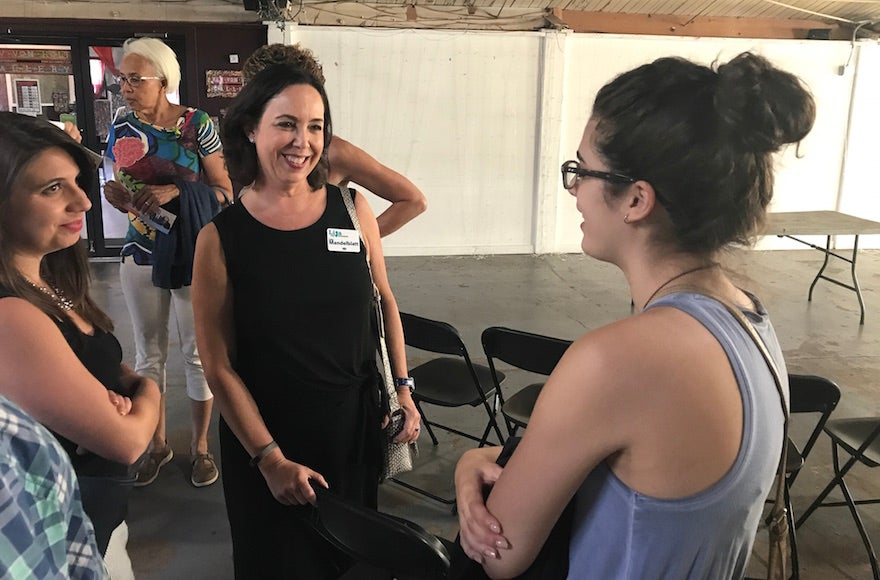
Lisa Mandelblatt, center, campaigning in New Jersey’s 7th district. (Courtesy of Mandelblatt)

Lisa Mandelblatt recalls coming to Hebrew school on an October Sunday in 1973, when she was nine years old, and learning that Israel was at war. School was suspended; instead, the pupils were instructed to go door to door and raise money for Israel.

She had just started Hebrew school. She had begged her parents to send her — she can’t remember why — and she remembered thinking that day as she knocked on doors, “This is what we do.”

Forty-some years later, she felt a calling to knock on doors again. It was a slow recovery from her feelings of despair the night of the election.

“I started to get involved in resistance groups, I went to the Women’s March” in Washington, said Mandelblatt, 53. Her breakthrough moment was President Barack Obama’s farewell speech on Jan. 10. Watching him on TV, she heard him say, “Grab a clipboard, get some signatures, and run for office yourself,” and she took the leap.

She’s one of four Democrats, so far, running in the primary for the U.S. House seat in New Jersey’s 7th District. But she saves her barbs for the incumbent, a Republican, Lenaord Lance, who was elected in 2008 and is known as a moderate. Democrats see what was once a safe GOP district as competitive, and although Lance was among a minority in his party who voted against repealing the Affordable Care Act in May, he allowed it to advance in committee, which Mandelblatt said belies his moderate reputation.

“There’s a movement in this district,” said Mandelblatt, who is maintaining a heavy campaign schedule (she quit her job as a substitute teacher). “Healthcare has been at the forefront of everyone’s discussion.”

She’s also focusing on transportation — commuting to New York City has gone from grueling to excruciating — but also familiarizing herself with the more rural western part of the district, and the difficulty there of getting reliable Internet.

She’s raised $260,000, she said, mostly from small donations. She doesn’t often hear about Israel while stumping, she said, but when she does, she assures her listeners she supports the country, and pivots to the threat she says Trump poses to Jews.

“Trump is pro-Israel but he’s allowed a lot of anti-Semitism,” she said. “I don’t remember this in my lifetime the way I’m seeing it now.”

Elissa Slotkin, hot dog heiress turned spy turned candidate
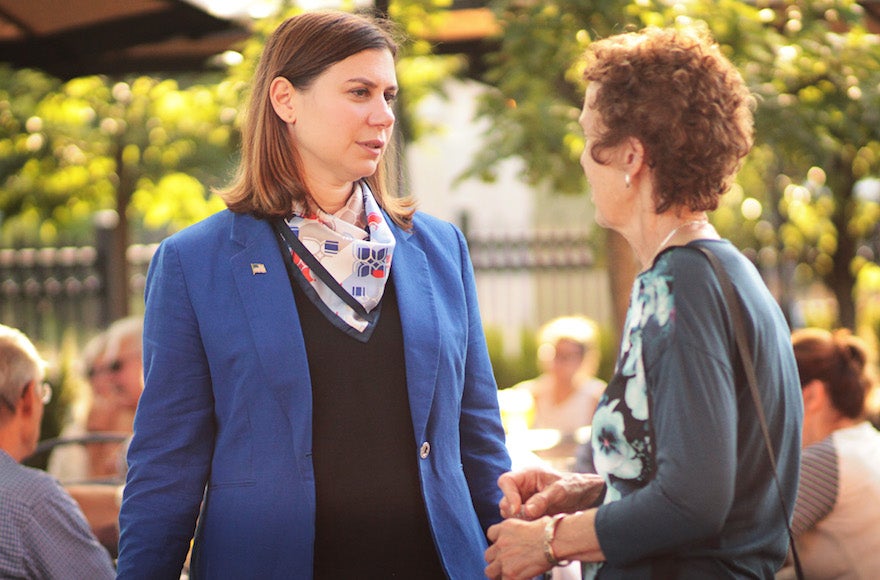
Elissa Slotkin campaigning recently in Michigan’s 8th Congressional district. (Courtesy of Slotkin)

Elissa Slotkin says what seems to intrigue Jews when they get to know her is less her background in the CIA and at the Defense Department, and more that she lives on the family farm in rural Michigan.

“I keep hearing, ‘The only Jewish farmers I know are on kibbutzim,’” she said, speaking from her farmhouse office overlooking a soybean field (leased, she adds, to another farmer, an old family friend).

Her great-grandfather, Sam Slotkin, an immigrant, founded Hygrade, the company that originated Ball Park Franks for the Detroit Tigers in the 1950s. (The franchise has long since moved to corporate hands.) Sam’s son, Hugo, while building up the meat processing business, fell in love with the idea of owning a farm. “He had seen a few farms in New Jersey” while working for his father, “and it was the most American thing he could do.”

Elissa attended agricultural school at Cornell, developed an interest in international development, and signed on for a second degree at Columbia. Her second day at the Manhattan school was Sept. 11, 2001.

“When the dust settled, I really knew then that my interest in public service would be more focused on national service,” she said. Within a year, the CIA had recruited her as an analyst. She did three tours in Iraq and then worked for the Bush and Obama administrations, ending her career in January as acting assistant secretary of defense, where she says one of her responsibilities was ensuring Israel’s qualitative military edge.

Just 41 and married to Dave Moore, a helicopter pilot she met in Baghdad, she contemplated a run for Congress after the election — and quickly discarded the idea. “We looked at how much money you have to raise,” she said.

Then the incumbent in Michigan’s southeastern 8th District, Mike Bishop, a Republican, voted on May 4 for the bill that would repeal and replace the Affordable Care Act. That outraged Slotkin, who said Bishop did not hold any town halls on the issue. She is currently the sole Democrat running against him.

The impetus, she said, was the memory of her late mother, who found out she had ovarian cancer in 2009 — and that her insurance had lapsed. Until Slotkin was able to get her mother back on a plan, she and her brother shelled out tens of thousands of dollars.

“They won’t put your mother into the MRI machine until you write a check for $6,000,” she said. “She’s on the little table and they will not wheel her in.”

Trump won the district 51-44 in November, and while his election helped propel her to run, she’s careful not to target him, instead focusing her ire on Bishop and the state GOP machine. She said she raised $100,000 in small donations 72 hours after announcing. Political assessors still rate the district as “likely Republican,” although the Cook Political Report recently said it was also competitive.

“We need the return of the Midwestern Democrat,” Slotkin said. “That practical reasonable middle-of-the-road Democrat who cares about jobs and the economy and is willing to work across the aisle when it helps.”

Debra Kerner, running in a Texas district that “looks like me”
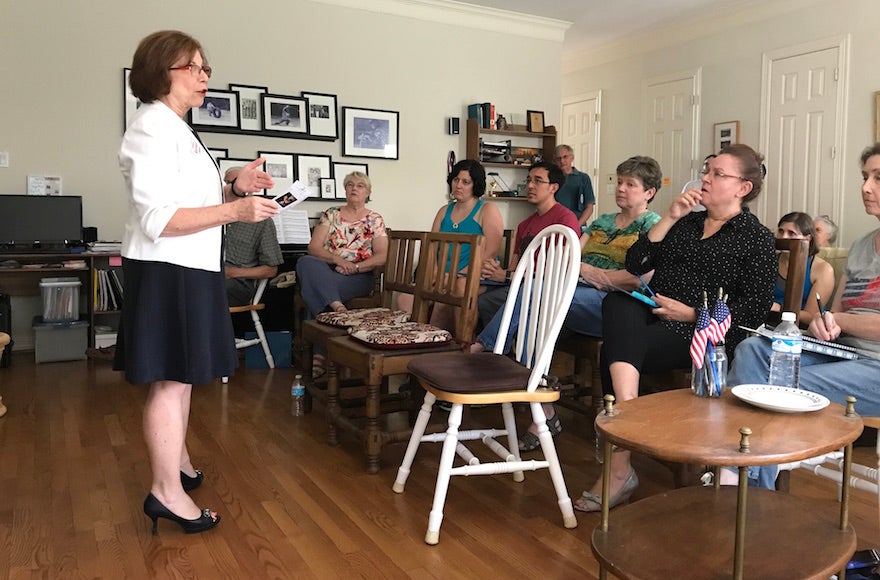
Debra Kerner campaigning in Houston. (Courtesy of Kerner)

Democrats sensed an opportunity in November when Hillary Clinton won the traditionally Republican Texas 7th, comprising parts of Houston and its suburbs.

Now there are two Jewish women among the seven Democrats ready to challenge Republican John Culberson, the incumbent since 2001: Debra Kerner and Laura Moser.

Kerner, since 2008 a member of the Harris County Department of Education board, said she sees the county is looking more and more like her: well educated, affluent, professional — and female.

“There’s a lot of women who are like me,” Kerner, 68, said she’s learning as she campaigns. “A little bit older, not a millennial, with a lot of experience,” she said.

Kerner was one of two Democrats who broke a long Republican monopoly on the board of education when they were elected in 2008. The Cook Report is keeping the district in its “likely Republican” column but is also listing it as competitive.

Kerner confronted Culberson at a town hall in March, getting up into his face as she made a point about education cuts in the state. The photo went viral. She said she’s running for Congress in part because she would be better positioned in the U.S. House of Representatives to push back against cuts to public schools.

“I’m concerned about Betsy DeVos as secretary of education,” she said. “She wants to promote charter schools and vouchers and I’m concerned about that.”

Kerner has been involved in Hadassah and the National Council of Jewish Women and the local Anti-Defamation league office, where her focus has been civil rights.

“I am very concerned about the current administration,” she said. “I see an increase in civil rights issues, in hate crimes against Jewish people, against blacks, Hispanics and Muslims.” She cited an arson attack earlier this year on a mosque in suburban Houston. “We’ve been trying to do more things with the Muslim community, to be supportive of them.”

Chrissy Houlahan, running for her father and her daughter
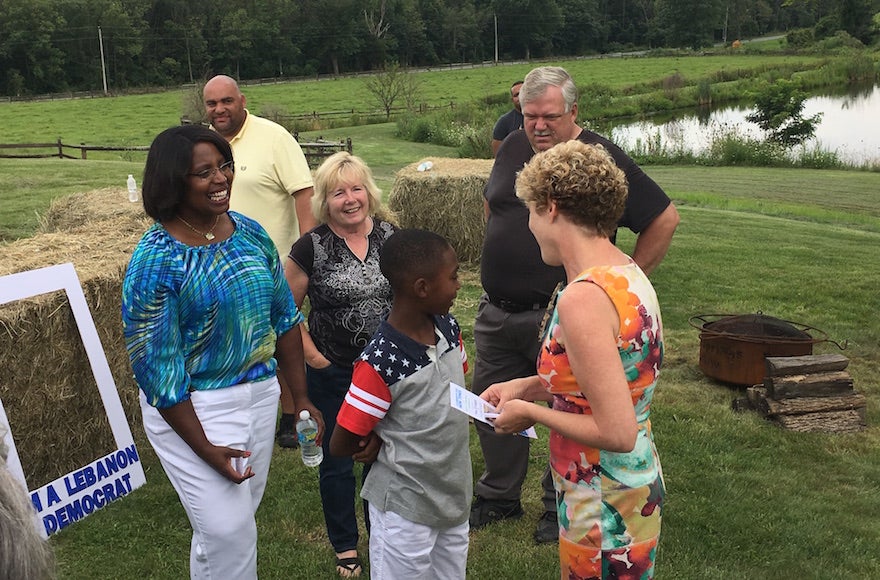
Chrissy Houlahan, right, campaigning at a picnic in Pennsylvania’s 6th Congressional District, Aug. 6, 2017. (Courtesy of Houlahan)

On Nov. 8, Chrissy Houlahan and her daughter wrapped up a day of canvassing in suburban Philadelphia for Hillary Clinton. The Air Force veteran changed into a pantsuit to welcome in what she thought would be Clinton’s presidency; her daughter dressed in white in a nod to the suffragettes.

That night she wept with her daughter, who is a member of the LGBTQ community, and several nights later she had a lachrymose relapse when her father, a Holocaust survivor, came to visit. “A grown and very strong man was in tears about the opportunities that might be denied the next generation, and outsiders,” she said.

Her father had arrived in the United States at age 5 after the war, with his mother and grandmother, the only survivors in their family. He became a career Navy officer, in part, Houlahan said, “in appreciation for the gift he had been given by this country.” (Houlahan does not herself identify as Jewish.)

The 6th District is one of a couple of dozen in the United States that voted for Clinton and returned a Republican to Congress. Houlahan, 50, decided to run after participating in the Women’s March in Washington, saying her experience as a military veteran and businesswoman will help her unseat GOP incumbent Ryan Costello. (The Cook Report lists the district as leaning Republican.) She’s secured a number of endorsements, including from Emily’s List.

She said her major issue is health care, “making sure people have what I believe is access to a human right.” She raised $460,000 in the last quarter.

Laura Moser, keeping Democrats on track through social media
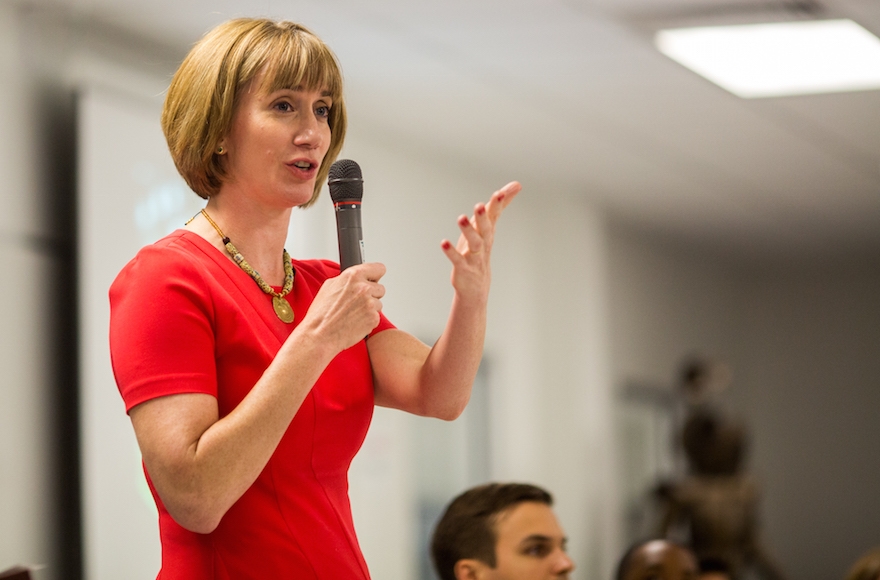
Laura Moser (Courtesy of Moser)

Laura Moser twice despaired after the election: Trump was president, and Democrats seemed in disarray.

So Moser, 39, an author who is married to Arun Chaudhary, a videographer who worked for the Obama White House, set up a 21st-century phone tree to fill in what she saw as an activism gap. Each morning, at 10 a.m., hundreds of thousands of people get texts from Daily Action, tailored to their zip codes, recommending what action they can take that day to hamper the Trump agenda.

“One quick action a day, like a phone call to Congress,” she said. There’s always what to do. “Every time I leave the room, there’s an another scandal, another bill being pushed through.” She said her group helped keep Congress from gutting its independent ethics office.

When she learned that her home district, Texas’ 7th — the Houston area district where Kerner is also running — had voted for Clinton but re-elected the Republican Culberson to Congress, she decided to return home. Her roots in the city go back to her grandfather’s arrival from Germany in 1942 as a refugee from Nazi Germany.

“It seemed like I’m in this weird position where I have proven organizational abilities, I am a woman, and it really is offensive to me that a man who has no respect for women was elected,” she said.

She’s running as a progressive in a district leaning Republican, in part because Jon Ossoff failed in June to win a similar district in suburban Atlanta by hewing to a vague and fuzzy middle.

“You’re not going to win by not talking about the issues,” she said. “The Jon Ossoff thing is one reason I’m in this race. As a party I felt like this is your base, these are the people who stood with you and always show up, and we’re not talking to their needs.”

She’s furious that the Democratic Congressional Campaign Committee has agreed to back candidates who oppose abortion rights. “We compromise our values and we repel people and Republicans do everything for their base and it works,” she said.

She hopes to win by bringing out minority women, but also by appealing to Republicans who are unhappy with Trump for moral and economic reasons, citing the tens of thousands of people in the district projected for removal from the insurance rolls should Republicans make good on their promise to repeal and replace the Affordable Care Act. She’s also focusing on infrastructure, saying Culberson has neglected a district that has suffered in recent years from frequent flooding.

She’s capitalized on her media savvy; she wrote a first-person essay for Vogue about the fraught transition from yoga mom to polished pol. (“No more work-at-home Fridays in Outdoor Voices leggings: From now on, it will be nothing but red nails and high heels,” she warned other women contemplating a run for office.) Her closest brush with fame until now was when she got to attend the 2015 White House seder and her daughter had a meltdown captured by the White House photographer.

The exposure in Vogue got her a lot of attention — “I’ve had a lot of good press this month” — and donations from around the country. “I have donations from 48 states, and today I got a $10 donation from someone in Hawaii — that makes it 49,” she said. She’s raised $250,000 so far. “You don’t need $20 million to win,” she said, referring once again to Ossoff’s unsuccessful race.

Hannah Risheq — fearing anti-Semitism and Islamophobia
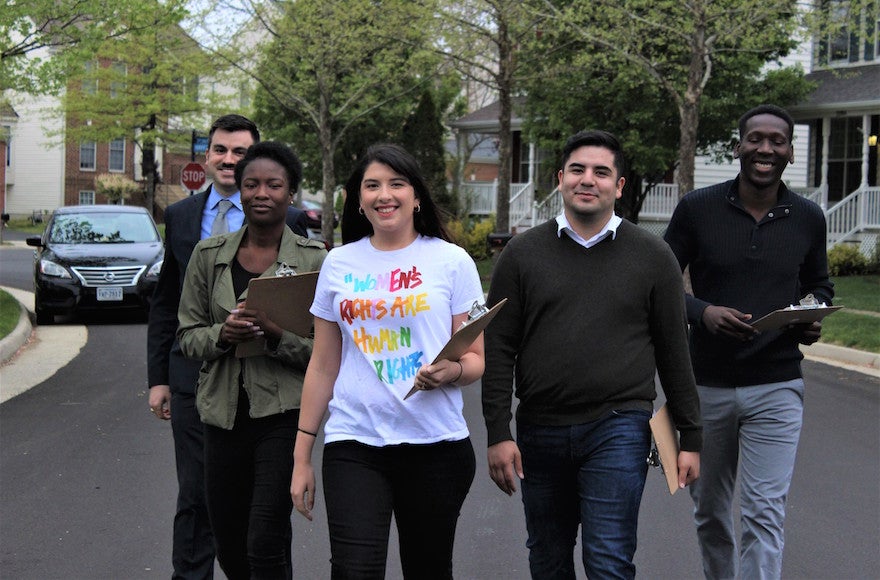
Hannah Risheq

Hannah Risheq, center, campaigning in northern Virginia in June 2017 for a seat in the Virginia House of Delegates. (Courtesy of Risheq)

Hannah Risheq, then a student at Columbia University, had secured a spot at the election night party at the Javits Center in New York, hoping to cheer Clinton in as president. Instead she watched news break of Trump’s victory.

“I was devastated,” said Risheq, 26, who said she felt the loss not only as a Clinton supporter but as a woman. “I remember talking to my brother that night, asking, what are we physically going to do to fight back?”

Hannah and her brother, Waleed, are the politically involved members of the family. “I was at the end of my second master’s, he was in law school, and we realized it should be me,” she said.

“It was important to me because of all the hateful rhetoric. The anti-Islamic rhetoric was really bad for me because my dad’s Muslim and my mom’s Jewish,” Risheq said. “Knowing my mom’s family dealt with anti-Semitism, and my fiancee’s Jewish and he lost family in the Holocaust — knowing that and seeing the parallels with hate rhetoric to Muslims, it inspired me to get involved.”

She decided to run in the district where she grew up, in the northern Virginia suburbs of Washington, D.C., for a seat in the House of Delegates, the oldest legislative body in the New World, saying she understood the problems in her region.

“I didn’t want to go too far from my community,” she said. Among the district’s neglected constituencies, she said, were college graduates who could not find work and had moved back in with their parents.

She lost in the June 13 primary, in part, she said, because she came in too late to raise substantial amounts of money. “I learned that money does matter, I started really late, we raised $30,000 in 3 months — $10,000 a month is pretty normal” for a state race, she said. She benefited in part because of national media drawn to her youth and her unusual background. (Risheq calls herself both Muslim and Jewish.)

Will she run again? “I wouldn’t say absolutely no,” she said.

Dori Fenenbock — moving Democrats to the pro-Israel center
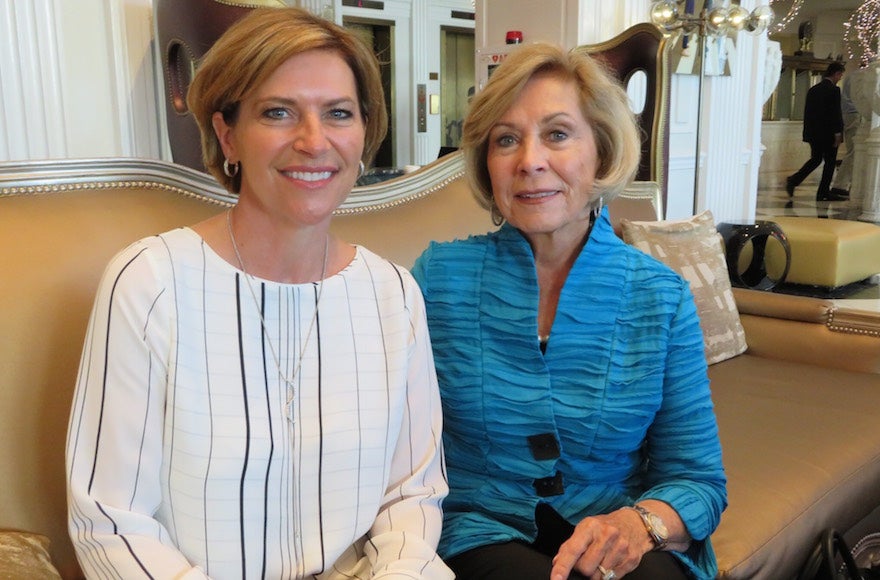
Dori Fenenbonk, left, running for Congress in Texas’ 16th District in the El Paso area, poses in Washington with her mother, Pat Lama, on July 27. (Ron Kampeas)

Dori Fenenbock is in the running to replace Beto O’Rourke, the tyro progressive in Texas’ 16th District, who has declared his bid to unseat Sen. Ted Cruz.

The district, encompassing El Paso, is a safe one for Democrats. Fenenbock, 49, has name recognition as the president of the El Paso Board of Trustees, the equivalent of the school board.

How safe? O’Rourke didn’t even face a Republican in the most recent election. Fenenbock raised $350,000 in the month after she filed papers for an exploratory committee in May.

Fenenbock, 49, nonetheless said Trump’s election factored into her decision to run in this district on the border with Mexico. “There are some parallels in the past that begin with a populist movement and become dangerous,” she said in a recent interview in Washington. In a border town with a substantial Latino population, “we’re all concerned about the implications of this presidency.”

She has another reason for running: She admires O’Rourke and wants him to oust Cruz, but she’s worried that he is a sign of a party that has strayed from the pro-Israel center. (O’Rourke this week picked up the endorsement of J Street, the liberal Jewish Middle East policy group.) She faults him for not voting for a bipartisan non-binding resolution that condemned the U.N. Security Council for its vote in December condemning Israeli settlements.

“He continues to waffle, even though we got him to travel to Israel,” she said, putting on her hat as a lay leader with the local Jewish federation and a longtime activist with the American Israel Public Affairs Committee.

“We’ve lost our way in the Democratic Party when it comes to Israel,” said Fenenbock. “It’s easy to legislate from here. I see my job as helping our party understand the complexity of these issues.”

These Jewish women are running for office because of Donald Trump Read More »

Jewish groups spar over Trump National Security Advisor McMaster’s Israel record

Jewish organizations sparred over the views of H.R. McMaster, the national security advisor, with the Zionist Organization of America attacking him as anti-Israel and the American Jewish Committee defending him.

ZOA, one of the few Jewish organizations to consistently defend President Donald Trump, issued a report on Thursday sharply critical of McMaster.

In the report, ZOA claims that McMaster is undermining Trump’s Middle East agenda and the relationship between the United States and Israel by firing officials supportive of the Jewish state and critical of the Iran nuclear deal, including Ezra Cohen-Watnick, the hawkish former senior director for intelligence on the National Security Council.

It also asserts that McMaster hired people ZOA claims have negative views on Israel, naming Kris Bauman, who will serve as point man on the Israeli-Palestinian conflict, and Dina Powell, the deputy national security advisor.

The report calls on Trump “to remove General McMaster from his current position and reassign him to another position where he can do no further harm on these critical national security issues.”

Dan Shapiro, who served as ambassador to Israel under President Barack Obama, and the American Jewish Committee criticized the ZOA report.

“ZOA claims, on the flimsiest of pretexts that McMaster has ‘animus toward Israel’ and ‘opposes Trump’s pro-Israel policies’,” Shapiro tweeted. “Nonsense. Every Israeli official who met McMaster has found him to be deeply sympathetic, friendly, consistent with longstanding U.S. support for Israel.”

The centrist American Jewish Committee shared one of Shapiro’s tweets, adding: “Agreed. We were honored to host Gen. McMaster at AJC Global Forum and chatted with him before. His admiration for Israel was crystal-clear.”

On Friday, Trump called his national security adviser “very pro-Israel,” an apparent bid to end a barrage of attacks from the right that have depicted McMaster as hostile to Israel.

“General McMaster and I are working very well together. He is a good man and very pro-Israel. I am grateful for the work he continues to do serving our country,” Trump said.

Within the White House, McMaster is seen at odds with Trump’s top strategist Steve Bannon, whom McMaster had removed from the NSC’s principals committee. The ZOA in its statement on McMaster lamented his removal, calling Bannon “a strong opponent of the Iran deal, and a staunch supporter of Israel.”

ZOA first shared its negative assessment of McMaster with Breitbart News, the right-wing web site Bannon headed before joining the Trump campaign, according to a report on the site.

Jewish groups spar over Trump National Security Advisor McMaster’s Israel record Read More »

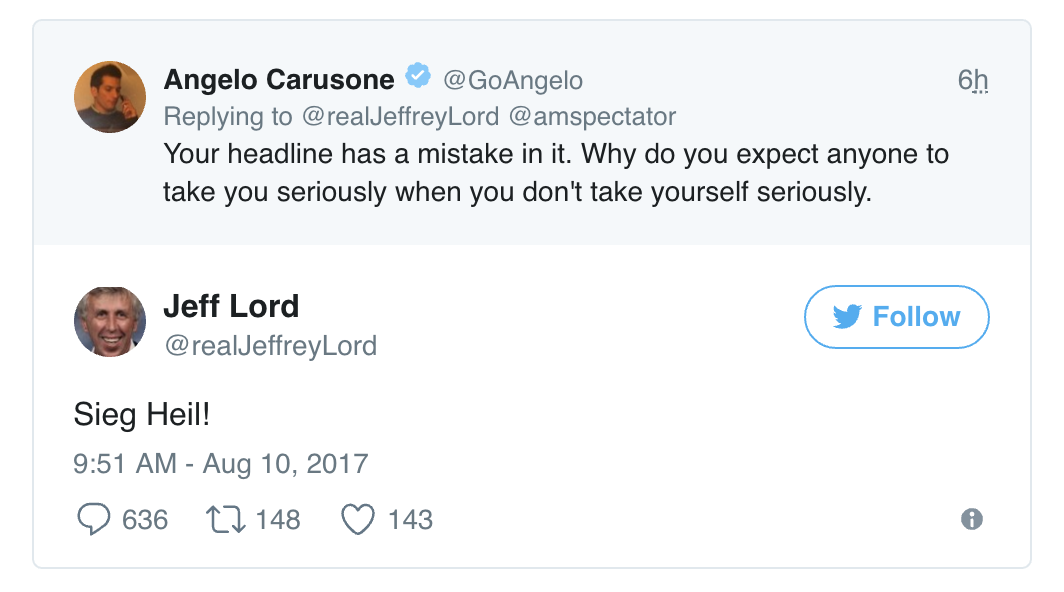
CNN fires Trump advocate Jeffrey Lord for ‘Sieg Heil!’ tweet

CNN severed ties with a prominent Donald Trump defender after he tweeted the words “Sieg Heil!” at a liberal activist.

CNN announced Thursday that Jeffrey Lord, a former Reagan administration staffer who often appeared on the network to defend the administration, was no longer with the network.

“Nazi salutes are indefensible,” a CNN spokesperson said in a statement, according to CNN.

Earlier this week, Lord engaged in a heated argument on Twitter with Angelo Carusone, the president of the liberal group  Media Matters for America. Lord wrote a column for The American Spectator published Thursday morning calling Carusone’s group, which had been promoting an ad boycott against Fox News host Sean Hannity, as the “Media Matters Fascists.”

The article, titled “Fascist Media Matters Moves to Silence Hannity,” described Carusone’s group as “anti-free speech bigots who, in typical fascist style, make it their mission to shut down speech they don’t like.”

Lord shared the column with Carusone on Twitter Thursday. “Your headline has a mistake in it,” Carusone responded. “Why do you expect anyone to take you seriously when you don’t take yourself seriously.”

Lord’s response on Thursday afternoon was “Sieg Heil!”

Responding to a storm of criticism, Lord defended his tweet by saying he was “mocking a fascist.”

CNN fires Trump advocate Jeffrey Lord for ‘Sieg Heil!’ tweet Read More »

Confessions of a Day Trader

I write this because, as one young lady who took my course in American Studies at CalState  Fullerton, back in the 1970s,  told me without too much exaggeration: “You are the honest-est person I have ever met.” She was not BS-ing me because I was a permissive grader, and her grade was already in.  “Crazy-honest”—and given to excessive  self-revelation—I still am.

Financially, the most foolish day of my life was in early 2000 when I decided to “invest” in the stock market. I never had much cared about money—in this way only, I was like the (mythical?) Love Children of the 1960s. But I had some money, really for the first time, and it seemed like a good idea to “invest.” I really wanted to turn my money over to an investment counselor and leave the worries to him. I had one, a friend-of-a-friend,  lined up, but for convoluted (mostly personal) reasons, it did not turn out. I decided to do it myself.

I became a day trader—a very bad idea for a smart but impulsive person like me. I’ve seen statistics that 80-90 percent of day traders belly up in a year or two. Not me. I just lost 80-90 percent of my money.

I’ve made some back since, and continue to dabble. My experience this summer, however, should be a cautionary tale for any novice out there unless you’re moral constitution is lots steelier than mine. My problem was—and is—not that I cannot discern trends. I can. The problem is the lack of resolve to act on them, patiently but decisively, in the right way.

I’ve known for at least a month that the market was headed for, as they say on the Street, “a correction” of at least 5-10 percent down. Many talking heads on cable finance news shows said so, but I knew it in my gut.

So I  bought a 3-X  Short ETF, which means that it goes up three times when the S&P Average goes down.  For a while, I waited patiently—and lost money, as the market continued to go up.

Then came August,. I still lost money for a few days, but began to recoup. Yesterday was the moment of truth. As I expected, the terrible news about the North Korean nuclear crisis, and the war of bombastic words on both sides, initially depressed the market in the morning. But then it began to rally around 11:00 Am Pacific Time. I sensed an inflection point—and sold out to take my profit. 

By day’s end, I felt cautiously vindicated because the market had continued to rally until the close, and—if I had not liquidated my position—I would have lost almost all my profit.

I should have known better: in my gut—which told me to stay short until this October—I did indeed know better. Today, the market really tanked. If I had stayed the course—stayed short—I would have made quintuple what I made yesterday. I guess I deserve such frustrating humiliation for sins I committed in a earlier life. That’s Jewish Karma—but that’s NOT Entertainment!

Be forewarned by this fool’s experience.

Yet I also assure you that—when I write about history and politics—you can trust my judgment, within limits. I’m not a sucker across-the-board, just on Wall Street. I wish you better luck.

Harold Brackman is a historian in Los Angeles.

Confessions of a Day Trader Read More »

Transgender Jewish Educator Shares Her Rebirth in Torah

Chana Rosenson first saw Yiscah Smith from across the room at the Conservative Yeshiva in Jerusalem, where Smith was teaching and Rosenson was spending a year visiting as a rabbinical student.

Something about Smith struck Rosenson. She turned to a friend and said, “I don’t know who she is, but whatever she’s got I need to get for my soul.”

Smith soon became Rosenson’s teacher and mentor, and on a recent late-June evening she sat in Rosenson’s living room in Calabasas to lead a class on Chasidic wisdom and Jewish text. There was no institutional sponsor or promotional message for the event. Instead, Rosenson explained to her guests, “I just wanted to share her with as many people as I possibly could.”

Just over 25 years ago, when Yiscah Smith was still Jeffrey “Yaakov” Smith, with a long beard and six children, she left a life as a Chabad educator in Jerusalem. After 10 years living a secular life in the United States, Smith returned to religious life as an observant transgender woman and a nondenominational Jewish educator.

At the recent gathering at Rosenson’s home, Smith sat in front of a semicircle of about a dozen people from various L.A.-area neighborhoods and congregations, wearing an ankle-length blue dress that matched her eyes, her dark hair falling to her shoulders. For two hours, she wove together Torah passages, Chasidic teachings and her own personal journey in a lesson that was part Torah study and part self-help seminar.

“Authenticity is a process,” she said. “Trust the process — that God does not want you to live anybody else’s life.”

Underscoring her sermon was the idea that making peace with oneself is a prerequisite for fully understanding Jewish wisdom.

“God, Torah and the truth are aligned only when one is honest with oneself,” she said.

Smith came by that lesson the hard way. In an interview shortly before her lecture, she spoke with the Journal about her personal journey.

Jeffrey Smith grew up in a nonobservant Jewish household in New York. After visiting Israel for the first time as a college student in 1971, Smith became inexorably attracted to Jewish spirituality.

“I began to encounter my soul, and I really, passionately wanted to inquire more and practice more,” she told the Journal.

But she had known from early childhood that she identified more as a female than as a male. Delving deeper into traditional Judaism, she faced a spiritual paradox, trapped between her gender identity and her religious one.

“The more I started to access that place of inner truth, the more I felt like a fraud,” she said.

Back in the United States and studying toward a master’s degree in Jewish education at the Jewish Theological Seminary in Manhattan, Smith soon discovered the Chabad Lubavitch movement and became a regular at its headquarters in Crown Heights, Brooklyn. Smith recoiled from the movement’s strict gender roles but was attracted to the community it provided.

“The day I put on a black fedora and long black coat, the day I stopped shaving my facial hair to grow out a beard was one of the saddest days I can remember,” Smith wrote in her 2014 book, “Forty Years in the Wilderness: My Journey to Authentic Living.” “I looked in the mirror and all I could think was, ‘What have I become?’ ”

Still living as a married man, Smith moved to Jerusalem but soon found she no longer could keep up the charade. She built a home “that outwardly looked like the model Orthodox Chasidic family,” regularly hosting dozens for Shabbat dinner. Meanwhile, Smith said she felt increasingly isolated and alienated as a woman living inside a man’s body.

“There was no place for a transgender,” she said. “There was no place for me to go to the rabbis and engage them in the narrative of, Where do I fit in as a woman who senses I’m in someone else’s body? Where does Jewish law identify me? Where do I sit — what side of the mechitzah? Who do I study with? Who do I dance with?”

Smith went through a divorce in 1991m moved to the United States, and spent a decade living a secular life, languishing without community or direction.

“I felt I had the key out of the prison, but I did not yet have the wherewithal to actually put it in the door and let myself out,” she said.

She was working as a barista at a Starbucks in Colorado Springs, Colo., in 2001 when her 50th birthday came around and she decided she’d hit her “spiritual rock bottom.”

“That was the day that I decided, ‘I can no longer breathe any more breath into someone else’s body,” she said. “I had no more energy left to live a lie.”

Smith resolved to live as the woman she’d always known she was. One of her first acts after beginning her transition was to light the Shabbat candles, an act traditionally reserved for women. Though Smith’s childhood home had been mostly secular, both her mother and grandmother had lit Shabbat candles.

“I didn’t even have to really think about it — where else do I begin but light the Shabbat lights?” she said.

After that, “it just all came back,” she said. “That’s the road I’ve been on since.”

For the past 16 years, Smith, 66, has made “a daily commitment” to “becoming faithful to my inner core, my inner self, the image of God.”

These days, Smith teaches Chasidic texts at the Pardes Institute of Jewish Studies and the Conservative Yeshiva in Jerusalem and lives in Nachlaot, a warren of cobblestone alleys with a large population of American expatriates.

Though she no longer defines as Orthodox, she observes Jewish law as best she can. She hopes to carve out a new understanding in halachah that will account for a transgender woman living a Torah lifestyle. Despite the challenge, she’s confident that hers is a winning battle.

“The halachah has a flexibility to it,” she said. “It’s like a rubber band. It stretches, it contracts, it expands, with time it moves. And I didn’t trust that process because I myself was so insecure. Now, I’m able to say, ‘The rabbis need to address what’s really going on.’ And if it means a different interpretation, if it means an addendum, then that’s what we do. The halachah is strong enough. It has weathered 3,400 years of changes.” 

Transgender Jewish Educator Shares Her Rebirth in Torah Read More »

The Trumpification of Bibi

It appears that Netanyahu is more emboldened in the Trump era. He seems to be asking himself, ‘If Trump can get away with these things, why can’t I?’ Last night’s rally of thousands of Likudniks in support of Netanyahu, who is facing multiple corruption probes, was peak Trumpification. The Kafe Knesset team hasn’t been to any Trump rallies, but from our observation from afar, this seemed a lot like one.

This originally appeared as part of Kafe Knesset on JewishInsider.com

Enemy number one for Netanyahu and his supporters, was, of course, none other than the fake news media. “The Left and the media — which are one and the same — are on an obsessive, unprecedented witch hunt against me and my family,” Netanyahu said, calling the media the “thought police.” Sound familiar, American readers? “And the ‘fake news media’ doesn’t talk about all the charity work Sarah does all the time for Holocaust survivors and kids with cancer,” Bibi lamented.

The crowd booed whenever Netanyahu mentioned the media, and a name-check of Ha’aretz warranted the loudest jeers. Someone held a large sign saying “It’s not fake news, it’s f***ing news” (which probably doesn’t mean what he thinks it means) and a Netanyahu supporter was spotted in a “CNN is fake news” t-shirt. Likudniks shouted in the faces of some of the more famous reporters present. Of course Netanyahu has long blamed the media for his problems. He didn’t need POTUS to get that idea. But the style seems to be imported from Trump Tower.

The putsch: There was also a lot of emphasis in the speeches of Bibi and coalition chairman, and rally organizer, David Bitan, as well as the signs held up by attendees, of the Left attempting a “putsch.” They accused the Left of portraying Netanyahu as being “guilty until proven innocent,” rather than the other way around, and trying to unfairly influence law enforcement authorities. They said that the Left couldn’t win an election, so now they’re trying to take over the country in other, less-than-democratic ways.

Old man, new beard: Bibi also used his speech at the rally to burnish his right-wing bona fides, making sure to call out a trifecta of targets of right-wing ire: Oslo, the Palestinians and former Prime Minister Ehud Barak.

Netanyahu cited reports that the Palestinians don’t want to negotiate in hopes that he will be ousted over the investigations, saying that of course they don’t want him out because he will not retreat to pre-1967 lines like the Palestinians want. He said that the last time the press ousted a Likud prime minister – Yitzhak Shamir – by claiming he was corrupt, Israel ended up with “Oslo and exploding buses.” And he mocked Barak as “an old man with a new beard” who speaks “nonsense.” (Barak, by the way, responded with another Facebook video slamming Bibi).

King Bibi: The Bibi cult of personality was in full force as well. “Bibi King of Israel” was a song chanted over and over by demonstrators, and many held signs of his face with the words “My prime minister.” These are actually pretty typical for Likud rallies, but take on a somewhat different meaning considering the context of this one.

“We got 30 seats in the last election – in the next one we’ll get 40,” was Netanyahu’s rallying cry.

There’s no denying that Likud knows how to party. There’s always good dance music playing at Likud events – some Sarit Hadad and some Static and Ben-El, “Whoever believes is not afraid” by Eyal Golan is a perennial Likud event favorite. The Likud members tend to be very chatty, and there are plenty of colorful personalities around, making it a fun night for reporters who are willing to mingle and get creative – as long as they stay clear of some of the angrier types.

Spotted at the Likud rally: It’s August, so people like Knesset Speaker Yuli Edelstein and Public Security Minister Gilad Erdan were out of the country but Tourism Minister Yariv Levin went straight from the airport to Tel Aviv’s Fairgrounds in order to make it to the rally; firebrand MK Oren Hazan taking selfie after selfie after selfie, swarmed by Likudniks; Jerusalem Mayor Nir Barkat, who recently joined the party and is trying to curry favor with the grassroots; Bayit Yehudi MK Motti Yogev, who said that he thinks Netanyahu is being treated unfairly. Bayit Yehudi sources told Kafe Knesset that the party is not happy with Yogev’s stunt; former MK Shmuel Flatto-Sharon, builder of Dizengoff Center, who ran for Knesset even though he barely spoke any Hebrew, in order to get parliamentary immunity so he wouldn’t be extradited to France.

Kim Jong-Bibi? Meanwhile, the opposition expressed outrage at the show of support for Netanyahu. Yesh Atid chairman Yair Lapid accused the Likud of rallying in support of corruption. Meretz leader Zehava Gal-On said it reminded her of North Korea, where people are forced to express support for the dear leader. Zionist Union chairman Avi Gabbay said it showed Bibi is insecure, and accused him of trying to distract from the fact that Israeli citizens are paying the price of his corruption. “Netanyahu keeps saying the nation is with him. I call on him to check that in a national election as soon as possible,” Gabbay said.

The Trumpification of Bibi Read More »

[WATCH] When a former Nazi met a Holocaust survivor

Ursula Martens agrees to meet a Holocaust survivor. I feel like her fairy godmother. I will play village matchmaker and find her one.

I’m playing divine intervention, forcing chance encounters. Get a Hitler Youth leader and a Holocaust survivor in the same room and film it? It’s totally absurd. What’s my business meddling with the Holocaust?


Jane Ulman, who writes survivor testimonies for the Journal, recommends Erika Jacoby. “She is very interested in the project,” Ulman says after speaking with Jacoby. I don’t reach out. I second-guess the whole situation. It’s too forced and manicured. Ulman reaches out again a week later with the same message: Erika wants to meet Ursula.

I learned about the Holocaust in middle school, through PowerPoint tutorials and assemblies with audio-visual presentations. Every year, a different survivor was invited to speak; each answered questions from the students and revealed the number tattooed to their arms. This was my Holocaust education.

Years later, I backpacked through Europe, spending part of the time in Berlin. “This is the location of Hitler’s bunker,” a tour guide said, stopping at an empty parking lot. There was no plaque, no sign to mark the spot. A seafoam green hatchback was parked there. This is what I remember.

I’m fascinated by memory, how someone can remember specific details of events long ago. Martens remembers the way a floral lampshade filtered light into her family’s living room, the night the radio announced Hitler was chancellor. Jacoby remembers the gleam of Dr. Josef Mengele’s boots, how shiny and bright they were, as she was sorted into a line at Auschwitz on the day of her arrival.

There is no logical reason why these women would ever meet. They do not have the same circle of friends. They do not live in the same area of Los Angeles. There is nothing connecting these two people, except maybe for me.

At 88 years old, Martens is a property manager for apartment buildings. This is how I know her. She manages the building where my parents live. She operates out of her house in Baldwin Hills and drives a 2004 Mitsubishi Lancer bearing several bumper stickers, including those that say, “War Is STILL Not The Answer” and “Yes. I Voted Obama.” She climbs ladders, has a bob, and watches a lot of CNN. She retains a faint German accent but even that would not suggest a past life as a Hitler Youth leader.

And then there’s Jacoby, a retired social worker. She was born in Hungary and now lives in North Hollywood with her husband, Uzi, and two caretakers. She exercises every morning and gets around with a walker or a cane. Seven years ago, she was diagnosed with Parkinson’s disease.

When I first meet Jacoby to discuss meeting Martens, she has cousins visiting from out of town. One of them isn’t happy with the idea. “I don’t get it,” he says, while I’m setting up equipment, but Jacoby already has made up her mind.

The two women agree to meet the following week. They do not talk on the phone. They do not correspond beforehand. There is no fancy algorithm behind this concept. Jacoby invites Martens to her house. Martens accepts. I am the “middleman.”

Jacoby has visited Auschwitz three times since the war. “I went to feel anger,” she said. For her entire life, Jacoby has been searching for a vent, a way to express her rage. It’s been bottled up for so long, she doesn’t know how to release it. “My theory is I’m still too scared to express anger.” This is part of the reason why she agreed to meet Martens.

“I like to challenge myself,” she said, “and this is a challenge.”

“I’m a little bit leery about how she feels about me,” Jacoby says, a week before meeting Martens. “I want to be able to meet her and say, ‘I met her and she’s a human being.’ ”

It happens on a Wednesday morning when Martens arrives at Jacoby’s house. The first thing Martens sees is a plaque that reads in Hebrew, “Blessed be those who enter.”

“Is that Hebrew?” she asks before ringing the doorbell.

As planned, a film crew is there to capture the moment — two videographers, three cameras, three lights and two microphones. I want them to feel comfortable. Martens will maneuver around wires, cords and cables, a whole maze of equipment to get to Jacoby, sitting tall on the couch, propped by a pillow.

And so they met.

[WATCH] When a former Nazi met a Holocaust survivor Read More »