fbpx

August 9, 2017

The corruption scandals plaguing Benjamin Netanyahu and his family, explained

He has a firm grip on the government, but a mounting political scandal might bring him down. Officials from his own party have begun to distance themselves from him, but he remains defiant.

Oh, and his son is in trouble, too.

Just one more thing Benjamin Netanyahu has in common with President Donald Trump.

Except there’s a difference: While Trump faces one sprawling scandal, the Russia affair, Israel’s prime minister is embroiled in at least two. Police are conducting two additional corruption investigations that indirectly involve him. His wife, Sara, will probably be indicted soon in a separate case. And a left-wing NGO just sued his son, Yair.

Netanyahu appeared to be in increasing peril as of last week, when Ari Harow, his American-born former chief of staff, became a state witness. Despite it all, Netanyahu has remained confident. He has accused the Israeli media of peddling “fake news” about the scandals. On Monday, responding to an article predicting his ouster, Netanyahu tweeted two words: “Won’t happen.”

But will it happen? After winning four Israeli elections, will Netanyahu be done in by his own misdeeds (or is it prosecutorial overreach)? Here’s a primer on the string of scandals and what they mean for the prime minister.

Netanyahu is under investigation for receiving gifts and taking bribes.

The two main corruption scandals involving Netanyahu both concern allegations of illicit dealings with rich and powerful men. In the first, called “Case 1000,” Netanyahu is accused of receiving expensive gifts from billionaires and then taking action on their behalf. In the second, called “Case 2000,” he is accused of striking an illicit deal with a newspaper publisher.

In Case 1000, Netanyahu is alleged to have received tens of thousands of dollars’ worth of gifts from Arnon Milchan, an Israeli Hollywood producer, and James Packer, an Australian casino mogul. The gifts include champagne, cigars, flights and hotel rooms.

In return, Netanyahu supposedly helped Milchan obtain a U.S. visa and Packer secure a residency permit in Israel. Netanyahu has acknowledged receiving the gifts but denies they were illegal or constituted bribes.

In Case 2000, Netanyahu is accused of conspiring with Arnon Mozes, the owner of the Israeli daily Yediot Acharonot, to advance legislation hobbling  the free and pro-Netanyahu tabloid Israel Hayom bankrolled by American billionaire Sheldon Adelson. Yediot, which has historically criticized Netanyahu, was to cover him more favorably in return. Although recordings of the conversations exist, Netanyahu denies any wrongdoing.

He’s mixed up in two other corruption scandals — and his wife and son are in trouble, too.

Now you know about Cases 1000 and 2000. Here’s some info on Cases 3000 and 4000, targeting Netanyahu’s associates, plus another scandal involving his wife and another his son.

Here’s a rundown:

“Case 3000” involves alleged corruption in the sale of German submarines to Israel. Police have accused businessman Michael Ganor of bribing government officials to become the negotiating agent for ThyssenKrupp, the German company that built the subs. In addition, Netanyahu’s personal lawyer, David Shimron, was simultaneously acting as Ganor’s representative during the negotiations over the sale.

In “Case 4000,” the director-general of Israel’s Communications Ministry, Shlomo Filber, is accused of illicitly allowing Bezeq, the national telephone company, to buy shares of YES, a satellite cable provider. Filber was appointed by Netanyahu, who also serves as communications minister.

Meanwhile, Sara Netanyahu is likely to be indicted for misusing public funds at the couple’s official residences. The Israeli first lady is accused of using government money to pay for private chefs at family events, a caregiver for her father and weekend electrical work at the couple’s home in the tony coastal town of Caesarea. The allegations have long dogged Sara Netanyahu, who sometimes comes off in the Israeli media as the country’s Marie Antoinette.

Finally Molad, a left-wing Israeli think tank, has sued Yair Netanyahu for libel. Yair, the eldest son of the Netanyahus at 26, wrote a Facebook post last week calling the group a “radical, anti-Zionist organization funded by the Fund for Israel’s Destruction” (a reference to the New Israel Fund, a left-wing NGO and bête noire of the Israeli right). Earlier that day, Molad had posted a listicle criticizing Yair Netanyahu’s political views and use of public funds.

Netanyahu could be nearing indictment — but might still stay in office.

So what does this all mean for the prime minister, who has governed Israel since the beginning of the Obama administration in his second go-round as prime minister? It depends on two factors: Whether he is indicted, and whether that creates enough pressure to force him to resign.

The fact that police are now working with Ari Harow, a confidant of the prime minister’s, means that he may provide information leading to an indictment. The recordings of Netanyahu’s conversations with Mozes, for example, were found on Harow’s phone.

Harow served two terms as Netanyahu’s chief of staff, and founded a consulting company between the two stints. Police have accused him of using his government position to advance his business interests. In return for becoming a state witness, Harow agreed to a plea deal in which he will perform community service and pay a fine rather than serve prison time.

But even with Harow’s testimony, the going will still be slow. According to a handy explainer in Haaretz, police are not expected to issue their recommendation until after the High Holidays late next month. If police recommend an indictment, it could still take several months until the attorney general formally indicts Netanyahu. Even then, he isn’t legally required to resign.

Which is why the prime minister’s fate may come down to pressure from fellow politicians and the public. A poll by Israel’s Channel 10 found that 66 percent of Israelis believe Netanyahu should resign if indicted. There is intrigue within Netanyahu’s Likud party as well, with some ministers openly backing him while another, speaking anonymously, said he should resign if indicted.

(Un)fortunately, there’s a precedent for this decision: Nine years ago, facing multiple corruption scandals, centrist Prime Minister Ehud Olmert resigned even before police recommended an indictment. But stepping down didn’t help him, as Olmert was sentenced to prison in 2015 and served 16 months before going free in July.

Nor did resigning help Olmert’s Kadima party. His successor, Tzipi Livni, lost the subsequent election in 2009 — to Benjamin Netanyahu.

The corruption scandals plaguing Benjamin Netanyahu and his family, explained Read More »

A solar eclipse deserves a blessing

We are on a fantastic journey, over which we have precious little control. As our universe expands, we are pushed deeper and deeper into space. We travel along, like some pebble carried with the tide. Our own galaxy, like hundreds of millions of others, rotates, and it does so at about 168 miles per second. On one of the spiral arms of our galaxy, our solar system has its own rhythms. Within the solar system, our home planet goes around our local star, the Sun, and our moon orbits around our home planet, even as the Earth and the Moon spin too.

Once in a while, in the midst of all this motion, the Moon travels between the Earth and the Sun in such a way as to block the light of the Sun from reaching us. It casts a shadow on our planet. The blockage may be partial or complete. We call this event a solar eclipse. In a total eclipse, when the Moon obscures the entire solar disk, the fullest form of the Moon’s shadow, the umbra, lasts no more than a few minutes in any one spot, but the effects are stark as darkness literally covers the Earth and the temperature drops.

We will ooh and ah as the eclipse begins, but we know that this too shall pass. All that was will be again and soon. Normalcy will return. One might think that it would be an occasion for a blessing, a b’rakha. After all, Jews seemingly have blessings, or b’rakhot, for every event and circumstance, from the sublime to the mundane, and from the time they arise to the time they go to sleep. And there are well recognized blessings for similar occurrences. For instance, when one sees a comet or lightening, there is Barukh atah Adonai, Eloheynu melekh ha’olam, oseh ma’aseh v’reyshit (Blessed is the Eternal One, Sovereign of the universe, maker of the works of creation). When one sees something beautiful like a tree or an animal, one might say Barukh atah Adonai, Eloheynu melekh ha’olam, she’kakha lo b’olamo (Blessed is the Source of wonder, Ruler of the cosmos, that such things are in the world). There are blessings on reaching the ocean, on smelling fragrant grasses and spices, even on witnessing an earthquake. But traditionally, there is no blessing for an eclipse. Why? To answer that question, we need to understand some science and some Judaism.

An eclipse is, of course, a phenomenon entirely the product of natural forces. It depends primarily on a few basic facts. First, at present and on average, the Sun is about 400 times farther from the Earth than is the Moon and, in a grand coincidence, the Sun’s diameter is about 400 times larger than that of the Moon. So, in general, the Moon now is just the right size at just the right distance to be able to block light from the disk of the Sun. Second, the orbit of the Moon is tilted slightly to that of the Earth’s orbit around the Sun. For there to be an eclipse, the Moon’s path must intersect with the Earth’s orbital (ecliptic) plane. Third, neither the orbit of the Earth around the Sun nor that of the Moon around the Earth is circular. Rather, both are elliptical. This means that one satellite or the other is sometimes closer and sometimes farther from the object around which it rotates.

Knowing the orbits of the Earth and Moon, astronomers can calculate when solar eclipses have occurred in the past and can predict when they will occur in the future. The National Aeronautics and Space Administration (“NASA”) has created a catalog of solar eclipses of all varieties reaching back four thousand years and looking ahead another millennia.

Though solar eclipses may be visible up to five times a year somewhere on Earth, they are still a relatively rare event at any particular place on the planet. The last total solar eclipse to be seen in the lower forty-eight states of the United States cast its shadow over several states in the northwest part of the country on February 26, 1979. The next one will be on August 21, 2017. It will be observable as a total eclipse in a path extending east and south from Salem, Oregon to Charleston, South Carolina. We won’t have to wait as long for the total solar eclipse that will follow. It will be visible from Texas to New England on April 8, 2024. The paths and dates for future total eclipses in the U.S. can be seen here.

Mentions of eclipses appear long ago in the early annals of human records. From Mesopotamia, for instance, we have references to the Ugarit Eclipse dated to 1375 BCE and the Assyrian Eclipse of 899 BCE.  In the East, in China, eclipses were described in writings from the Shang Dynasty and the Bamboo Annals regarding events in the fourteenth and ninth centuries BCE, respectively. Further west, in Greece, the epic poem Odyssey credited to Homer refers to the obliteration of the Sun and unlucky darkness, perhaps inspired by an actual eclipse in 1178 BCE. Later in the sixth and fifth centuries, BCE, the historians Herodotus and Thucydides and the poet Xenophon spoke of eclipses, generally in connection with military engagements. Indeed, the interval between lunar eclipses, known as the Saros cycle, was apparently recognized by astronomers in Chaldea (now southern Iraq) as far back as 800 BCE.

So, it is quite surprising that eclipses are not mentioned directly either in the Torah or the Tanakh, the Hebrew Bible, which were written, edited and canonized in the first millennia BCE. Are eclipses not mentioned because they were unknown to the authors and editors or were they simply understood to be natural and not supernatural phenomena and, therefore, not worthy of mention?

The curious absence of any mention is highlighted, perhaps paradoxically, by two passages, in the Tanakh, one in the book of Joshua and the other in the book of Amos. According to the book of Joshua, during a battle between the Israelites and five Amorite kings at Gibeon, the Sun stood still for twenty-four hours, presumably to allow the Israelites to win. (See Josh. 10:1-15.) Recently, some Israeli scientists have advanced the idea that the author of Joshua was really referencing an eclipse on October 30, 1207 BCE. This seems more than a plausible stretch, though. Putting aside whatever evidence may or may not exist concerning the historicity of the battle itself, to sustain their argument, the scientists must first translate the Hebrew word “dom” not as it has traditionally been understood as describing the Sun becoming  still or stopping, but as the Sun having been merely clouded over or darkened. True, translations are often, subjective, but then the scientists must also essentially disregard the biblical claim that the event lasted an entire day, not the very few minutes that would mark the duration of a total solar eclipse. (See Josh. 10:12-15.) If the author of Joshua was trying to describe a rare solar eclipse, the author could easily enough have noted the growing darkness and the re-emergent light and cast the scene as an omen for Israelite victory. But the author made no mention of an eclipse’s effects or progression, and claimed an entire day of shining sun to be unique – which indeed it would have been.

In the book of Amos, the prophet was railing against those who would defraud consumers. (See Amos 8:4-10.) He said that God would not forget the miscreants’ misdeeds and that punishment would come by making the Sun set at noon and darkening the Earth on a sunny day. Again, some might argue this is a reference to an eclipse, but, here, too, the description is wrong and the rhetorical point seems to echo an earlier message about the “day of the Lord,” a time when Israel would be saved. (See Amos 5:18-20.)

The earliest clear references to eclipses from Jewish sources appear to be the philosopher Philo and the historian Josephus, both of whom lived in the first century of the Common Era. In one work, Philo recognized eclipses as the “natural consequence” of rules governing the Sun and Moon, but also stated that they were “indications” of doom, such as the death of a king or destruction of a city. (See here.) In his treatise on the history of the Jews, Josephus mentioned an eclipse and did so as part of a story about Herod’s treatment of the high priest Matthias and Herod’s death. A reader could infer that the eclipse was an omen of Herod’s demise, but it was clear from Josephus’s account that Herod was quite sick anyway and had prepared his will in anticipation of his death. (See Antiquities 17, Ch. 6, Sec. 4.)

By the time the main text of the Babylonian Talmud was completed around the end of the fifth century of the Common Era, a negative view of a solar eclipse had clearly crystalized. In connection with a discussion of the view that rain on the festival holiday of Sukkot suggests heavenly displeasure, the rabbis engage in a series of analogies, including a discussion of eclipses. That discussion begins with the following proposition attributed to the Sages:  “When the sun is eclipsed, it is a bad omen for the entire world.” (See BT Sukkah 29a.)

For those involved in this discussion, that idea only raises other questions.

  • Why is it a bad omen for the world? According to the Talmud, because the Jewish people calculate their calendar primarily based on lunar cycles and other nations base theirs on the solar cycle.
  • Can we be more specific about those at risk? The Talmud states that when the eclipse is in the eastern or the western sky, it is a bad omen for the residents of that area. When the Sun is eclipsed in the middle of the sky, the entire world is in danger.
  • And what is the signal that the eclipse is giving? The answer found in the Talmud is colorful, literally: “If during an eclipse, the visage of the Sun is red like blood, it is an omen that war is coming to the world. If the Sun is black like sackcloth made of dark goat hair, then arrows of hunger are coming, because hunger darkens peoples’ faces.”
  • But why would the Sun be eclipsed at any time? The Sages have answers here, too, in fact, multiple sets of them. In one view, the Sun is eclipsed on account of (1) a president of the court who dies and is not eulogized properly, (2) a betrothed young woman who screamed in the city that she was being raped and no one was available to rescue her, (3) homosexuality, and (4) two brothers whose blood was spilled as one. Alternatively, the sun is eclipsed on account of (1) forgers of a fraudulent document intended to discredit others, (2) those who provide false testimony, (3) those who raise small domesticated animals in Eretz Yisrael in a settled area, and (4) those who chop down good fruit producing trees.

As the recognition grew that solar eclipses were predictable events, part of the natural order, traditionalists tried to square the philosophical circle and reconcile the regularity of such events with presumably irregular eruptions of bad times and occasions of sins requiring divine intervention and punishment. (See, e.g., here and here.) According to one of his followers, because he understood an eclipse as a warning, as a time to take care, the Lubavitcher Rebbe Menachem M. Schneerson (1902-1904) explained that eclipses were “meant to be opportunities for increasing prayer and introspection – as opposed to prompting joyous blessings, [and so] we do not recite a blessing when witnessing one.”

This approach, however, is insufficient and unconvincing, regardless of the value of prayer and introspection. It fails to acknowledge the reality that science confirms about the regular order of local orbits. It fails to dispel expressly and strongly the general – but totally false -notion of a causal connection between natural events in the sky and human behavior on Earth. It fails to reject specifically the unsustainable rationales in the Talmudic passages cited above speculating why eclipses occur, and it fails to refute the false equivalencies among the various circumstances noted there.

This approach is also inconsistent with the traditional practice of offering blessings, as noted above, for more frequent, often more terrifying and clearly more dangerous events. After all, a total eclipse of the Sun is no less impressive than is lightening or an earthquake. And, further, this approach runs counter to the long standing tradition expressed in the Talmud (Menachot 43b) which calls on us to recite b’rakhot frequently during our waking hours, even to the extent of one-hundred a day. On the day of a solar eclipse, we should focus on ninety-nine other things and not note that the disk of the Sun is being obscured?

Even more importantly, the preclusion of a b’rakha regarding an eclipse undermines the emotional and intellectual benefit of a blessing, a principal purpose of which is to raise the level of consciousness of the person saying it. The words give literal expression to the remarkable thing or event which the individual’s senses have encountered or soon will. A blessing, then, is an empowering act, and to deny an individual, any individual, the opportunity to acknowledge, realize, concentrate, appreciate and grow can only limit a person’s mind and spirit, stunting his or her humanity.

With an orientation of modern, reality based Judaism, we can and should appreciate the order in the cosmos, especially the regularity of orbits. We can and should recognize the total dependence of all life as we know it on the energy that we receive from our local star. As the umbra approaches and recedes in a total solar eclipse, we can see the light change, sense the drop in temperature. Even as it compels us to look to the sky, that sight, that feeling should unite us, and draw our attention away, if just momentarily, from the troubles on Earth.

All of this elicits awe and gratitude, two primary bases for blessings. How appropriate then, as one looks (very carefully and with appropriate equipment) upward during a solar eclipse to acknowledge one’s awe and express one’s gratitude for having reached this season and being able to observe and to feel the works of creation. Here is one way:

     As the eclipse nears . . . Barukh Atah – Blessed is the Source of Life that fashioned the stars, that sends forth heat from the Sun to warm us and light from the Sun to nourish the food we eat and provide the wonderful colors that so enrich our lives.

     When standing in the shadow . . . Modim Anakhnu Lakh – We are thankful for the opportunity to be reminded how fleeting and precious our time here is, how bound we are, one to the other, how much we should treasure the moments we have and the people with whom we share this most amazing planet.

      As light reemerges . . . Barukh Atah – Blessed is the Sustainer of Life. May we be refreshed and renewed by the harmony of the spheres, and may our lives be worthy of the gift we have received and continue to receive through the arrangement of the cosmos.

     Your words may well be different. Write them. Share them. We do need blessings now.

  A version of this essay was published previously at www.judaismandscience.com.

A solar eclipse deserves a blessing Read More »

Ghosts, guilt and a Jewish lawyer collide in ‘Rainbow Bridge’

A nice Jewish lawyer contends with the spirits of his late mother and sister, who awaken his lifelong feelings of guilt, in the farcical play “The Rainbow Bridge,” now running at the Ruskin Group Theatre in Santa Monica.

“When you come from a family with many issues, and you go on to lead kind of a normal life, and you know a lot of people go through a lot of suffering, it’s kind of hard to move on,” said the  playwright, Ron Nelson. “Sometimes there’s guilt involved, and I wanted to sort of work through all those issues. I wanted to work through all of them in the guise of writing a farce.”

The action begins as Jerry (Paul Schackman), a criminal defense attorney, has just had his sick dog euthanized by an oversexed veterinarian, Miss Stein (Jaimi Paige). During a moment alone with his dead dog, Jerry reads a poem on the vet’s wall called “The Rainbow Bridge,” about how pets cross over that bridge after death, but one day, in the afterlife, they will be reunited with their owners.

As he reads, a rainbow appears and the ghosts of his mother, Lois (Lynne Marie Stewart), and sister, Amanda (Mary Carrig), emerge. They upbraid him for having the dog they left to him killed, and Amanda insists that if he had helped her care for their mother, she (Amanda) probably never would have shot herself. Lois chimes in, saying that if Amanda hadn’t shot herself, she (Lois) wouldn’t have slipped in all the blood and fallen to her death trying to save her daughter.

Nelson said the characters and events were inspired by real life, then broadened and fictionalized. His sister and mother actually did die five years ago, in ways analogous to the deaths of the two ghosts. “In the play, one is a suicide, and in real life, one was as well. And the other was in an accident — not the same way,” he said. “Quite frankly, I made it different to make it more comedic, which may seem odd to people, but I wanted to make sure it wasn’t just awful and oppressive. I wanted to somehow make this fun, and that was part of the challenge of it.

“The thing that’s real are the feelings. Other than that, everything’s made up.”

He added that he prefers to keep the details of the actual deaths vague, out of respect for his relatives. “I’m happy to talk about the emotional effect on me, which has a lot in common with the issues Jerry goes through in the play. And a lot of that had to do with survivor’s guilt.”

Nelson has created Amanda and Lois to be outrageous characters. Both are depicted as having been alcoholics who attended AA meetings only to meet potential drinking buddies. They were also promiscuous.

Amanda isn’t certain about who was the father of her baby, and Lois had an affair with a fellow school board member in her house while young Jerry was at home. In fact, she is so resentful of that man’s wife, who is still alive, that she insists Jerry kill the woman as the price of freeing himself of the two ghosts. When the two threaten to ruin every aspect of his life, Jerry finally agrees, enlisting the help of Theodore (Emille Thomas), a lovable arsonist whom Jerry once successfully defended. It is at the scene of the intended murder that Jerry’s issues are finally resolved.

Nelson, an occasionally practicing defense attorney, said he didn’t want the play to be merely about a wonderful guy and his miserable family, so he gave the main characters a chance to defend their positions and explain why they feel hurt.

In fact, Nelson feels the theme of unresolved family issues is a universal one. “I can’t tell you how many people have actually come up to me and said, ‘I have unresolved issues with my father, who passed away,’ or ‘my mother, who passed away,’ or ‘my brother,’ or ‘my sister,’ whatever. And they were really able to relate to the journey of the main character.”

The main character and his family are Jewish, partly for cultural reasons, according to Nelson. “There is kind of an interesting thing that is more of a subtext than a text,” he said. “Almost in a wonderful way, there are certain Jewish families I’ve known, including mine, that can be messy and loud and full of angst.”

As for his family members’ level of observance, the playwright referred to them as “Rosh Hashanah, Yom Kippur, Passover Jews,” and to himself as very, very secular. “On the other hand,” he continued, “not a day passes by when I don’t self-identify as a Jew.”

He said that he sends his daughter to an excellent private Catholic school. However, “Although I never go to temple, the week before we started sending her to that school I went out and bought myself a chai that I wear on a chain around my neck, so anyone could see it whenever I dropped her off or picked her up. I wanted everybody at that school to know that there was one Jew who was paying them a significant amount of money every year for his daughter to get an education.”

Nelson concluded with the hope that his play will help audiences feel a little less isolated. “I hope people are able to relate to the journey of the lead character and feel that, if he was able to find his way through this, then maybe we can, too.” he said. “I hope people feel better when they leave, rather than worse. I know — not having anything to do with my script, but having to do with the production — I know they’ll have a good time. I hope they’ll feel a little less alone, too.”

“The Rainbow Bridge” is playing at Ruskin Group Theatre, 3000 Airport Ave., Santa Monica, through Sept. 17. 8 p.m. Fridays and Saturdays; 2 p.m. Sundays. Tickets: (310) 397-3244. 8 p.m. Fridays and Saturdays; 2 p.m. Sundays. Tickets: (310) 397-3244 or visit www.ruskingrouptheatre.com.

Ghosts, guilt and a Jewish lawyer collide in ‘Rainbow Bridge’ Read More »

Documentary filmmaker takes a look at the Pulitzer Prize at 100

Does the Pulitzer Prize truly represent the best in writing, photography and music composition? Or is it an arbitrary reward based on politics and whoever happens to be on the jury that year?

The independently produced documentary film “The Pulitzer at 100” strikes a reverent tone in discussing the prize’s centenary. Director Kirk Simon says he has “great respect” for those who have won the Pulitzer. “It clearly is writing that excels, or photographs or music,” he said.

The film, which premieres on Aug. 11 at Laemmle Music Hall in Beverly Hills, weaves together several narratives: a coterie of recipients reflecting on the prize and what it meant for their careers; selections from award-winning pieces of journalism or fiction, read by A-list actors; and details about the life of Joseph Pulitzer, the prize’s eponymous publishing magnate.

Born in Hungary in 1847 to a Jewish family, Pulitzer came to the United States in 1864 to join the Union Army in the final months of the Civil War. He then moved to St. Louis, where he worked first as a reporter. In 1878, after making some profitable business deals, he bought the bankrupt St. Louis Dispatch at public auction, and merged it with the St. Louis Evening Post, into the St. Louis Post and Dispatch (now the Post-Dispatch), still the city’s daily newspaper. He developed a style of journalism that mixed investigative reporting with sensational coverage of sex and crime that appealed to the growing ranks of mass transit commuters.

His move to New York City and purchase of the New York World newspaper led to a circulation war with William Randolph Hearst’s New York Journal. While both men engaged in scandal-mongering “yellow journalism,” Pulitzer later decided to establish his namesake prize to elevate the public’s respect for the profession and recognize excellence in journalism.

Director Kirk Simon. Photo from Twitter

Pulitzer donated $2 million to establish Columbia University’s journalism school, which opened in 1912. The university at first refused the gift because at the time, journalism was considered an unsuitable field for educated students. Columbia has administered the prizes since they were first handed out in 1917.

The film focuses on the past half-century of award-winning coverage, including stories written about the Vietnam War, the Watergate scandal, the Sept. 11 terrorist attacks, Hurricane Katrina and the West Africa Ebola crisis.

“It’s the top honor. But this is a show-me business. And if you think you can put your feet up and say, ‘OK, I’ve got this award, I’m fine now,’ you can’t,” New York Times columnist Thomas Friedman says in the film. “Every day you’ve got to go out, and you’ve got to beat the competition.”

Friedman, who won the prize in 1983, 1988 and 2002, won an international reporting prize for his coverage of the 1982 Israeli invasion of Lebanon and its aftermath, including the Sabra and Shatila massacre of Palestinian refugees.

New York Times columnist Nicholas Kristof (a winner in 1990 and 2006), who reports regularly from war zones, is one of several speakers in the film who questions the prize’s merit.

New York Times reporter Nicholas Kristof. Photo from Facebook

“The Pulitzer is the standard metric of success, and everybody knows it’s a little bit misleading, that in some ways it’s a prize for the event, not for the people who cover it,” Kristof said. He won the 1990 prize for international reporting for his coverage of 1989’s Tiananmen Square massacre, in which Chinese soldiers fired on pro-democracy demonstrators, sharing the prize with his wife, Sheryl WuDunn.

Kristof was then the Times’ Beijing bureau chief and said that people who had helped him cover the crackdown were put in jail or fled the country.

“It felt kind of unfair that they had taken all the risk, got none of the credit, and here I was, being heaped on with prizes,” he said. “And there is a certain irony in gaining from a surge in human misery.”

Similarly, editors and reporters of The Times-Picayune in New Orleans recount the challenges of covering Hurricane Katrina. While winning the Pulitzer was “great recognition for that commitment,” James O’Byrne said, the staff gladly would give back the award, Manuel Torres said, “if we can have our city without the destruction, without the death, without the suffering that we went through.”

Fiction writers strike dual tones of reverence and skepticism. Writer Michael Chabon says winning the prize in 2001 for his novel “The Amazing Adventures of Kavalier & Clay” was “truly one of the absolute greatest days in my entire life.” The story follows two teenage boys enthralled by comic books in 1940s New York, and Chabon says the award emboldened him to take more stylistic and narrative risks.

Writer Junot Diaz refers to his fellow jurors as “slightly evolved monkeys” who are simply doing their best. Novelist Michael Cunningham thinks different jurors would not have awarded his book “The Hours” the prize for fiction in 1999, joking that it’s “another reason the prize goes into the sock drawer.”

Writers are eager to criticize the Pulitzer for its sins of omissions (“A Farewell to Arms,” “The Catcher in the Rye,” “Invisible Man” and “The Great Gatsby” all failed to win). Critics also point out that jurors historically have lauded privileged white men, although great strides are being made toward inclusivity. Not explored in the film is the bias that jurors have typically shown toward liberal writers or writers who advocate against conservative causes.

The film also pays homage to the enormous work that goes into the creation of such exemplary writing, and it serves as a meditation on the transformative power of creativity.

Pulitzer-winning dramatists discuss the joys and challenges of their craft, including Paula Vogel, whose play “How I Learned to Drive” examines issues of pedophilia, incest and misogyny; Ayad Akhtar, whose play “Disgraced” looks at identity politics and Islamophobia; and Tony Kushner, whose landmark opus “Angels in America” about the AIDS crisis has been staged countless times.

Interspersed with the interviews are dramatic readings from Pulitzer-winning novels, poems and plays by such actors as John Lithgow, Natalie Portman, Helen Mirren and Liev Schreiber.

Simon has been nominated for an Academy Award four times, winning once. One nomination was given for producing “Isaac in America: A Journey With Isaac Bashevis Singer,” and he won in 2011 for the HBO short documentary “Strangers No More,” about a school in Tel Aviv that educates the children of immigrant workers.

The Pulitzer recipients Simon reached out to “were very receptive to my requests. I would say the only person who was not was Philip Roth,” who won the fiction prize for his 1997 novel “American Pastoral.” The famously elusive writer, Simon decided, turned down the request because “he wants his work to be judged by his work.”

While the bulk of the film is devoted to the written word, it also profiles award-winning photographers and composers, such as Nick Ut, whose photograph of a naked girl fleeing a napalm bombing helped cement Western public opinion against the Vietnam War; composer John Adams, whose haunting piece “On the Transmigration of Souls” remembers the victims of Sept. 11; and jazz composer Wynton Marsalis, whose jazz oratorio “Blood on the Fields” concerns a couple moving from slavery to freedom.

But most of the prizes are for journalism, and just as Joseph Pulitzer intended, his prize shines a spotlight on the hard work of investigative reporters.

“I don’t think that the American public, the general public, has a full sense of what’s involved in investigative reporting,” Washington Post executive editor Martin Baron says in the film. “Many times they think it’s just a matter of having a source. And it’s a lot more than that. It’s hugely challenging. It’s hugely difficult. It’s a lot of tedious work that takes place over a long period of time.”

Simon hopes his documentary also contributes to a greater respect for the work of quality journalism.

“We have to question and show how hard it is to present the truth, and these days in the world of [President Donald] Trump, you have a government standing between you and reporting the truth,” he said. “So it’s never been easy, it always changes, and that’s what journalists are up against.”

“The Pulitzer at 100” premieres Aug. 11 at Laemmle Music Hall, 9036 Wilshire Blvd., Beverly Hills, with director Kirk Simon in attendance. For more information, visit www.laemmle.com.


Documentary filmmaker takes a look at the Pulitzer Prize at 100 Read More »

French Jewish group ties car ramming near Paris to its complaint about hate crime

French Jewish leaders seized on a suspected terrorist attack against police officers to again criticize authorities for not labeling the murder of a Jewish woman as a hate crime.

On Wednesday, the CRIF umbrella group of French Jews posted a sarcastic statement on Facebook about the car-ramming Wednesday morning in the Paris suburb of Levallois-Perret. Six police officers were injured in the attack, two of them seriously and the rest moderately.  The suspect fled.

The CRIF post asks whether authorities would place the suspect under psychiatric evaluation, as they did the Muslim man charged in the slaying of a Jewish woman, Sarah Halimi, in April.

“What do you think, should this insane person be put in a psych ward while we contemplate the reasons for his actions?” CRIF posted in French.

It was a provocative reference to the handling by authorities and the media of the slaying of Halimi. Many in the Jewish community were outraged that her killer, Kobili Traore, wasn’t charged with a hate crime, and was instead sent for observation following his insanity plea even though he has no record of mental illness. According to witnesses, Traore shouted about Allah while killing Halimi, his neighbor, and previously called her daughter a “dirty Jewess.”

CRIF has campaigned vigorously for the hate crime charge, calling its omission a “cover up” of the anti-Semitic character of the crime, CRIF President Francis Kalifat has said.

Mainstream French media began covering the controversy surrounding Halimi’s killing more than two months after it happened.

Referring to the Levallois-Perret attack, Mayor Patrick Balkany told French radio the incident appears to be a “deliberate attack” and that French security forces are conducting a massive manhunt for the suspect.

French Jewish group ties car ramming near Paris to its complaint about hate crime Read More »

More than 200 liberal U.S. rabbis want Israel to lift travel ban on BDS leaders

More than 200 rabbis from the liberal movements of American Judaism signed a letter opposing Israel’s travel ban on leaders of the boycott movement against Israel.

The rabbis signing Wednesday’s letter were responding to an incident last month in which Rabbi Alissa Wise of Jewish Voice for Peace, which supports the Boycott, Divestment and Sanctions movement, was prevented from boarding an Israel-bound airplane leaving Dulles Airport in Washington, D.C.

Four other people traveling to Israel as part of an interfaith delegation, including two other Jews, a Christian and a Muslim, were also prevented from boarding the flight at the request of the Israeli government.

“We hold diverse opinions on BDS. Even though many of us have substantive differences with Rabbi Wise and other rabbinic colleagues who support the BDS movement in some or all of its forms, we believe that the decision to bar Rabbi Wise from visiting Israel is anti-democratic and desecrates our vision of a diverse Jewish community that holds multiple perspectives,” read the letter, which had been signed by 212 rabbis as of late Wednesday morning.

“Boycotts are a legitimate nonviolent tactic that have been used both in our own country and around the world in order to create justice for marginalized and oppressed communities. Whether we support boycott is a controversy for the sake of heaven. It endures because we struggle together and debate how we can create peace, justice, and equality for Israelis and Palestinians alike,” the letter said.

The signers included Rabbi Sharon Brous, of the independent IKAR congregation in  Los Angeles; Rabbi Amy Eilberg of Los Altos, California, the first women ordained by the Conservative movement; and Rabbi Jill Jacobs, executive director of T’ruah: The Rabbinic Call for Human Rights.

In March, the Israeli parliament, or Knesset, amended the Law of Entry to prevent leaders of the BDS movement from being allowed into Israel. The amendment applies to organizations, as well as the leadership and senior activists of those groups, that take consistent and significant action against Israel through BDS and threaten it with material harm.

JVP said at the time of the incident that it was the first time the amendment had been enforced before passengers boarded their flights to Israel and the first time that Israel has denied entry to Jews, including a rabbi, for their support of BDS.

An anti-BDS bill making its way through Congress would expand existing law that bans boycotts imposed by foreign governments to include those imposed by international organizations like the European Union and the United Nations.

More than 200 liberal U.S. rabbis want Israel to lift travel ban on BDS leaders Read More »

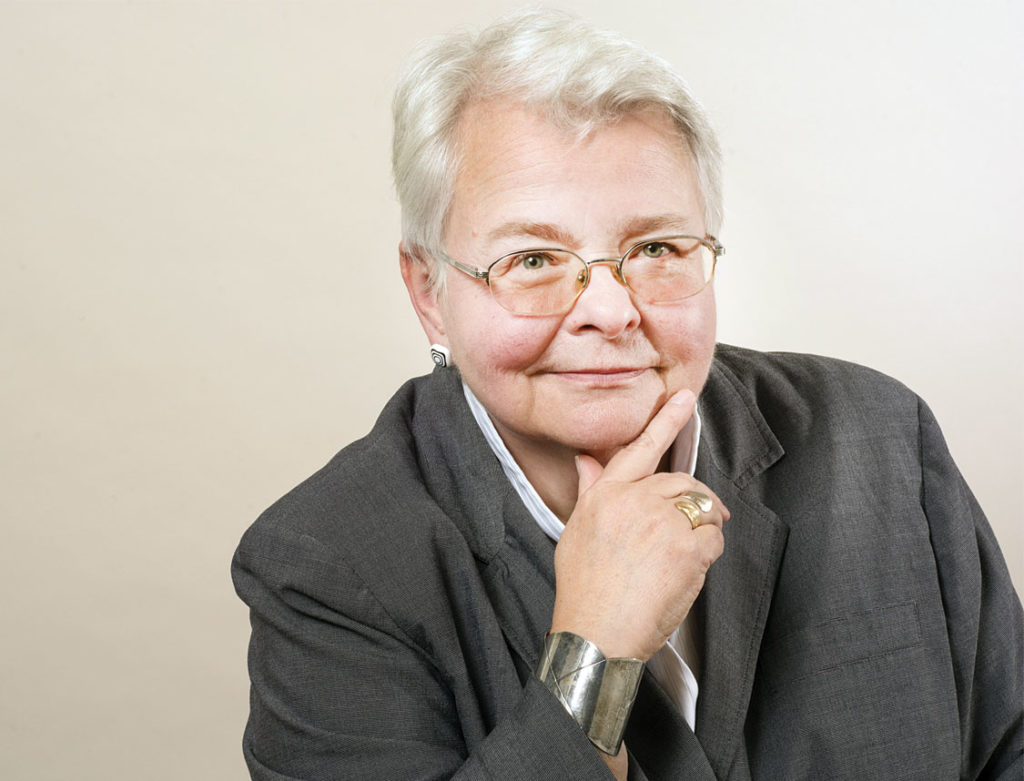
Playwright Paula Vogel Talks About Otherness, Anti-Semitism and Indecency

NAME: Paula Vogel
AGE: 65
BEST KNOWN FOR: She received the 1998 Pulitzer Prize for drama for her play “How I Learned to Drive.”
LITTLE-KNOWN FACT: Throughout the now nearly four-month run of “Indecent,” not one cast or crew member has left the production.


In the current social landscape that, thanks to the internet, allows everyone the sense of being heard, we seem to have forgotten basic listening skills and too often fail to validate each other’s perspectives. How can we engage in meaningful conversations if we don’t choose to hear one another? How can we work together if we don’t know who we are in relation to one another?

In her Tony Award-winning play, “Indecent,” Pulitzer Prize-winning author Paula Vogel tackles this challenge through the lens of the experiences of playwright Sholem Asch — my great-great-great-uncle — and his daring drama of the human condition, “God of Vengeance.”

“Indecent” captures the events surrounding Asch’s play, its people and the environment in which it was produced. Written in Yiddish in 1906 and performed throughout Europe, a 1923 English translation of “God of Vengeance” became known for its staging of the first lesbian kiss on Broadway, which caused such a stir in Jewish and theatrical communities that its entire cast was prosecuted for obscenity.

Vogel, a gay Jewish woman, makes sense of the cross-sections recognized in Asch’s original story, and now asks her audiences if, “almost a century later, is it now time to address our own obscenities?”

Jewish Journal: What made you want to tackle “God of Vengeance” in a contemporary play?

Paula Vogel: For a lot of us, this show is a signature play. It’s so unique for its time. I was 22 years old when I first read the play. I was floored that a young man wrote it. It has such an understanding and empathy for women.

And the love scene between his two women floored me. I literally stood while I read it. I couldn’t sit. I felt like I stopped breathing. It’s sort of a meta-expression of the desires that are growing in Americans today. “I can’t breathe” captures both the desire and the sense of a body being policed.

JJ: How did a college student in the 1970s connect so deeply with a play from 1906? 

PV: There was nothing old about it for me, except that the pages were yellow and it had been out of print. I was reading Henrik Ibsen and August Strindberg and George Bernard Shaw, so I didn’t feel any obstruction or resistance to Sholem Asch. There is a strange sense of time for anyone who practices theater. Nothing is an old play. We’re always rewriting what’s already been told.

JJ: “Indecent” is only partially a story of Asch. It’s a story about two women, born out of Asch’s mind, with the main character being Asch’s play itself. What choices did you make to tell this unique story?

PV: I wanted “Indecent” to be about the journey of the play, and about the dead troupe that comes back to life with every performance to tell the story that was so deeply entrenched in their hearts and minds. It was a desire and challenge to emphasize the women of the play, because there was no historical context for them. But by creating the actresses who in my mind would dare to perform Rifkele and Manka in that period of time, I could bring them to life.

JJ: The play explores Jewish taboo. What else is still taboo in the Jewish community? And what does that reflect about society as a whole?

PV: Anti-Semitism is a worldwide toxic air that we breathe. Anti-Semites are alive and well, and some are in the White House. This play documents a point in time in America when we turned our immigration laws against Jews and Italians. Today, it’s Muslims, but it’s the same toxin in our country.

What is taboo about Jewish families within that, is that we no longer question whether Jews are Americans. It’s this notion of outsiderness. We are still outsiders, but I feel that there has been an assimilation in Jewish communities. Yet, I don’t know if outsiderness ever goes away.

JJ: What are the risks with such inherently Jewish-specific material as Asch’s, especially in light of the recent rise in anti-Semitism across our country?

PV: I think it’s always tricky when you represent the Holocaust. One of the great concerns for me is that there are generations of people for whom the Holocaust is a historical footnote. Today, it’s not resonating in their bodies as it did for me. I was born in 1951, and all the adults who reared me bear witness to it. How do you present the ultimate obscenity and indecency in a way that respects those who have lived through it and survived it, and those who didn’t survive it? How do you then implant a knowledge of what this obscenity really is into the bodies of young people?

JJ: Does “Indecent” speak differently to Jewish audiences?

 PV: I have watched audiences [respond to] four different productions. The core is definitely Jewish audiences and older audiences. When people in the audience know Yiddish, they’re laughing at the inside jokes, and I can feel that rapport. We project the stage directions on the troupe’s bodies as they turn into dust, and audiences feel that.

But I don’t ever want to write a play with one story and one viewpoint. There’s also a resonance expressed to me by people of color, by immigrants. People responded from the Latino communities and Asian communities in La Jolla, telling me, “This is the story of my family.” I get to talk to gay couples who feel that the show is about their journeys and their adversities.

JJ: Your play is quite powerful, and so many people are affected by it. Did working on “Indecent” change you in any way? 

PV: It’s led to a rich journey that continues for me wherever the play goes. I’m going into adult education. I’m trying to find time to learn Yiddish. I’ve rediscovered the power of music. I’m trying to learn about my Russian family and the family that emigrated in 1905. It’s been an exploration of legacy and how it works. It’s been the challenge of starting and continuing conversations.

JJ: In this age of alternative facts and divided worlds, do you feel that the conversation you’ve created in “Indecent” is a part of your legacy?

PV: It’s a starting point. It’s what your uncle’s novels did in his time. Sholem was talking about the multiple realities in “Uptown,” but he was able to present those multiple realities for the world to accept.

I think that the dissonance that I’m feeling in America as a gay woman is because there’s been no forum for a rational discourse. So, I formed my identity as a playwright with that tension in my mind and that forum in sight. “Indecent” fulfills that desire: Rifkele and Manka and Sholem talk to you and, for two hours, there is a beautiful acceptance of the human experience. Maybe I’m forming a new sort of rational discourse.

Playwright Paula Vogel Talks About Otherness, Anti-Semitism and Indecency Read More »

Jewish UCLA quarterback Josh Rosen takes heat for saying ‘football and school don’t go together’

Josh Rosen, UCLA’s starting quarterback and a highly touted NFL prospect, has taken flak before for being outspoken about his views. Last year, he said that college football should be considered a professional sport and wore a hat that said “F— Trump” while golfing on one of Trump’s golf courses.

In an interview with Bleacher Report on Tuesday, Rosen doubled down on his criticism of the college football model, which he believes leaves no time for academic coursework.

“Look, football and school don’t go together,” he said. “They just don’t. Trying to do both is like trying to do two full-time jobs. There are guys who have no business being in school, but they’re here because this is the path to the NFL. There’s no other way. Then there’s the other side that says raise the SAT eligibility requirements. OK, raise the SAT requirement at Alabama and see what kind of team they have. You lose athletes and then the product on the field suffers.”

(For context, the University of Alabama has won the college football championship four times in the past eight years.)

“It’s not that they shouldn’t be in school,” he continued. “Human beings don’t belong in school with our schedules. No one in their right mind should have a football player’s schedule, and go to school. It’s not that some players shouldn’t be in school; it’s just that universities should help them more — instead of just finding ways to keep them eligible.”

Rosen, 20, an economics major entering his junior year, went on to explain that he wants to get an MBA and create his own business after playing in the NFL.

“When I’m finished with football, I want a seamless transition to life and work and what I’ve dreamed about doing all my life. I want to own the world. Every young person should be able to have that dream and the ability to access it. I don’t think that’s too much to ask,” he said.

Rosen’s comments drew scrutiny from some fellow players, but also praise from sports writers. The NCAA has been harshly criticized for its financial and academic system, which generates billions of dollars of revenue. College athletes are not allowed to make any money from their sports through endorsements or advertisements.

The 6-foot-4 gunslinger is the son of Charles Rosen, a noted Jewish orthopedic surgeon, and Liz Lippincott, who is Quaker (she is the great-great-granddaughter of Joseph Wharton, who founded the Wharton business school at the University of Pennsylvania).

Despite having only played in 20 collegiate games and missing about half of last season with a shoulder injury, Rosen was recently ranked the number seven college prospect by ESPN. In 2015, his freshman year, he threw for 3,670 yards and 23 touchdowns.

Jewish UCLA quarterback Josh Rosen takes heat for saying ‘football and school don’t go together’ Read More »

A Poet’s Passionate Reflection in Prayer

Prayers are a particularly usable form of literature. And because they are composed by human beings to answer our most intimate needs, the stock of prayers always grows and changes. One scholar, for example, claims to count only 85 prayers in the Hebrew Bible, but the accumulation of Jewish prayer is now far beyond numbering and continues to grow ever richer and more plentiful.

Marcia Falk, author of “The Book of Blessings: New Jewish Prayers for Daily Life, the Sabbath and the New Moon Festival” (Reform Jewish Publishing/CCAR Press), is among the most prolific and influential of our contemporary prayer-makers. I first encountered her work when I reviewed her provocative and illuminating translation of “The Song of Songs,” and I admired “The Book of Blessings” when it was first published two decades ago. Now her classic book of prayer has been issued in a 20th-anniversary edition, which provides us with the occasion to reconsider the vitality and longevity of what she has contributed to Judaism.

Falk is not a rabbi. Rather, she is a poet and a painter, a scholar of biblical and Hebrew literature and a translator of Hebrew and Yiddish texts, all of which serve to inform her work as a modern maker of prayers. She declares that she stands in the tradition of Hannah, mother of the prophet Samuel, whose heartfelt prayer was misapprehended by Eli the priest but not by God. “ ‘The Book of Blessings’ is a branch of a tree whose seeds were planted three millennia ago by a woman who prayed from her heart,” says Falk, whose poems occasionally appear in the Journal.

Yet she sees it as her obligation to find new ways of praying, precisely because traditional prayer is not accessible or meaningful to every Jew.  “ ‘The Book of Blessings’ is for those immersed in Judaism, and for those standing at its gates, looking for a way in,” she writes. “It is, especially, for those of us who have, at some time in our lives, stood like Hannah outside the sanctuary’s walls, suffused with longing, or anger, or pain.”

It is significant that “The Book of Blessings” is published under the auspices of the Central Conference of American Rabbis, a branch of Judaism that shares the egalitarian values that are so deeply embodied in her prayers — “the forging of fully inclusive and embracing communities,” as she puts it.

Falk derives many of her newly minted prayers from ancient biblical texts, and she honors the oldest traditions of Judaism by, for example, providing all of the prayers in Hebrew. At the same time, she seeks to make the prayer book fully accessible by including both the English translation and the transliteration of the Hebrew text. And she pointedly insists on replacing the patriarchal deity who is invoked in traditional Hebrew blessings — “Lord Our God, King of the Universe” — with a wholly gender-free phrase: “the source of life.”

To be sure, Falk’s prayer book will strike some readers as a step away from Jewish tradition.  The fundamental prayer of Judaism, as it is rendered in “The Book of Blessings,” starts with a familiar phrase — “Sh’ma yisra’eyl” (Hear O Israel) — but continues with words and phrases that amount to something far more elusive than the original text: “The divine abounds everywhere and dwells in everything; the many are One.” And, strikingly, she omits the traditional mourner’s prayer, the Kaddish, and offers a meditation based on a contemporary poem, “Each of Us Has a Name.” For many Jews, I suspect, that’s a step too far.

If Falk’s exquisite and evocative prayers are the heart of “The Book of Blessings,” the brain is to be found in the commentary that she provides at the end of her book. Here we find a frank explanation of her approach to prayer, a sophisticated discourse on Jewish theology and an eloquent justification of the courageous changes she proposes to make in the trappings of Jewish observance. Significantly, she quotes Ira Eisenstein, a student of Mordecai Kaplan and a leading figure in the Reconstructionist movement, for the notion that Jewish values can and should become “the central theme of passionate reflection,” which is exactly how I would describe Falk’s enduring classic.

“Hebrew is my s’fat dam — the language of my blood,” Falk writes. Like her biblical exemplar, Hannah, Falk has poured out her heart to God, and we are privileged to not only witness but to participate in that “passionate reflection.”


JONATHAN KIRSCH, author and publishing attorney, is the book editor of the Jewish Journal.

A Poet’s Passionate Reflection in Prayer Read More »

Best in Class: Teacher Appreciation Gifts

How can it be back-to-school time already? Amid the hustle and bustle of buying classroom supplies and clothing, parents should be thinking about teacher appreciation gifts. After all, it’s a good idea to get on the teacher’s good side right away. Here’s a super easy gift idea that will let you suck up with succulents.

These pots, decorated like a chalkboard and ruler and holding a succulent plant, will be year-round reminders of how much your child deserves straight A’s. You can buy all the supplies (except the plants) at a crafts store, and you need very little artistic ability. n

Chalkboard pot

What you’ll need:
4-inch clay pot
Chalkboard acrylic paint
Foam brush
White paint marker
Succulent plant

1.


1. Paint the clay pot with chalkboard paint using a foam brush. You will need about two coats of paint to get full coverage on the pot. Let dry for at least two hours.

2.


2. Write out alphabet letters on the rim of the pot with a white paint marker. Be careful not to smudge the letters as you go around the rim. When the letters are dry, you can write a message such as “Thank you” on the main part of the pot with chalk. Finish by placing a succulent plant in the pot.

Ruler pot

What you’ll need:
4-inch clay pot
Yellow acrylic paint
Foam brush
Black paint marker
Succulent plant

3.


1. Paint tomee clay pot with yellow paint using a foam brush. Because the yellow paint is light in color, it can take four or five coats to get full coverage. Let dry for at least two hours.

4.


2. Draw thick vertical lines about one inch apart around the rim of the pot with a black paint marker. Then draw slightly shorter, thinner vertical lines midway between the longer lines. Write in numbers for the ruler to the immediate left of the longer lines. Then place a succulent plant in the pot.


Jonathan Fong is the author of “Walls That Wow,” “Flowers That Wow” and “Parties That Wow,” and host of “Style With a Smile” on YouTube. You can see more of his do-it-yourself projects at jonathanfongstyle.com.

Best in Class: Teacher Appreciation Gifts Read More »