fbpx

August 4, 2017

Rosner’s Torah Talk: Parashat Va’etchanan with Rabbi Dresdner

Our guest this week is Rabbi Sruli Dresdner. Rabbi Dresdner received Rabbinic Ordination
from Dean Rabbi Yitzchak Wasserman, as well as a Bachelor’s degree in Judaic Studies
from the Denver Talmudic Seminary in 1982. He graduated from Fordham Law School. He
clerked for The Honorable Howard Buschman III, and spent the next few years at the
prestigious Wall Street firm, Dewey Ballantine, before opening his own practice.
Over fifteen years ago, Dresdner returned to Jewish life full time as a Klezmer musician and
Jewish educator, in addition to serving as High-Holiday Cantor and substitute Rabbi at the
West Clarkstown Jewish Center in New City, NY.  Today he is the rabbi of Temple Shalom Synagogue Center in Auburn, Maine.

This Week’s Torah Portion – Parashat Va’etchanan (Deuteronomy 3:23-7:11) – continues to
present Moses’ review of the Torah. Moses tells how he implored God to let him into the
Promised Land and how God refused. He recounts the story of the Exodus from Egypt,
declaring it an unprecedented event in human history. He predicts how in the future the
people of Israel will sin, worship other gods, get exiled, and return to obey the lord outside
the Promised Land. The portion also includes a repetition of the Ten Commandments and of  the verses of the Shema.


Previous Talks about Va’etchanan:
– with Rabbi Gary Pokras
– with Rabbi Terry Bookman
– with Rabbi Julie Schonfeld

Rosner’s Torah Talk: Parashat Va’etchanan with Rabbi Dresdner Read More »

A Moment in Time: Everything We Do Makes a Difference

Dear all,

I was walking by the back door of the Temple the other day when I noticed this vine of tomatoes growing along the path. “Who planted a tomato here?” I asked.

It then occurred to me that so often people carrying food for our programs use this path. A tomato must have fallen at one point, rooting itself in the ground. Add a little sun ….

In our lives, we leave a little of our selves all the time. Though we hardly realize it, everything we do makes a difference. Our words, our gestures, our voices, and our silences… they all leave an impression. They shape the future.

We have opportunities each day. What garden are we sowing? What future are we cultivating?

The seeds of eternity begin with each moment in time.


With love and Shalom,

Rabbi Zach Shapiro


Rabbi Zach Shapiro

A change in perspective can shift the focus of our day – and even our lives. We have an opportunity to harness “a moment in time,” allowing our souls to be both grounded and lifted. This blog shows how the simplest of daily experiences can become the most meaningful of life’s blessings. All it takes is a moment in time.

Rabbi Zach Shapiro is the Spiritual Leader of Temple Akiba, a Reform Jewish Congregation in Culver City, CA. He earned his B.A. in Spanish from Colby College in 1992, and his M.A.H.L. from HUC-JIR in 1996. He was ordained from HUC-JIR – Cincinnati, in 1997.


A Moment in Time: Everything We Do Makes a Difference Read More »

When a childhood home is demolished

Eighty-three years ago, in 1934, in the midst of the Great Depression, my childhood home in west Los Angeles was built.

It is a charming California ranch-style home of no more than 2100 square feet. According to neighborhood code, every home was set back 100 feet from the street.

When I was growing up, 15 mature trees populated the grounds. In the back yard, there were willow, palm, avocado, guava, kumquat, peach, plum, laurel, and lemon. In the front yard grew magnolia, jacaranda, paper birch, oak, pine, and maple. Alas, all are gone now except the maple.

As a kid, I loved climbing the tall oak or magnolia whenever I needed to be alone. I also loved to climb onto our tile roof being careful not to break the tiles, which I did from time to time.

My parents bought the home in 1949 just before I was born. My brother Michael left for college in 1966, and after I left in 1968, my mother sold the property. The family that bought it lived there for the next 49 years until this past year.

Last week the developers who bought it put up a green fabric fence signaling that demolition is imminent.

I loved that house. My very first memories are from the age of two. I played baseball with my dad and brother in the back yard. Michael and I dug holes lined with tin cans in the front yard so we could putt golf balls. In the back was a built-in red brick distressed barbecue. In the service yard behind the garage we inherited an incinerator from the 1940s and used it until the LA City Council banned them in 1957.

My dad played the violin and painted still life casein in the sunny lanai, a room he named for his pleasant experiences serving in the Hawaiian islands during World War II as a physician and lieutenant colonel in the US Navy. Our parents entertained with scotch and martinis before sit-down dinners. They drank their coffee black and hot!

My dad bought Michael and me our first bicycles. Mine was a red 24-inch Schwinn I called “Betsy.” His was black. We rode the neighborhood with gusto. I walked to the bus stop or the mile through back streets to school from the age of 6 without my parents expressing, to my knowledge, any worry.

Our house doors were never locked. Milk was delivered in bottles and placed in a small niche near the back door. The Good Humor ice cream truck drove our streets in the afternoon. I played outside until dark and came home filthy. I knew my neighborhood like the back of my hand and knew most of the neighbors. Dogs roamed the streets unleashed.

As a little boy, I remember following my dad (who I called “Daddy” and still do) like a puppy in the back yard picking up the clippings he pruned. I can still remember the smell of wet cut grass and eucalyptus from the adjacent property. We fed California jays (now called scrub jays) and had names for all of them according to their markings. We collected butterflies.

In 1953, my parents bought our first television set, a 24-inch black-and-white console. They put it in my dad’s study with his book shelves, medical journals, desk and two red leather chairs and ottoman on which my brother and I watched cartoons on weekend mornings, westerns in the afternoons, I Love Lucy when we were sick, the Friday night fights with my dad, The Wonderful World of Disney and The Ed Sullivan Show on Sunday nights.

In 1956, I remember the interview with Adlai Stevenson when the camera caught the hole in the bottom of his shoe. I recall also seeing Fidel Castro on Face the Nation in 1959 just after the Cuban revolution, JFK delivering his inaugural address in 1961, his Cuban Missile Crisis speech in 1962, Dr. King’s “I have a dream” speech on the Washington Mall in 1963, the entire weekend after Kennedy’s assassination in November 1963 including live the murder of Lee Harvey Oswald, LBJ signing the 1964 Civil Rights Act and the 1965 Voting Rights Act in the White House, and footage of the fighting during the 1967 Six-Day War between Israel and the combined armies of eight Arab nations who promised to “push the Jews into the sea.”

I emerged into political and historical consciousness in that house.

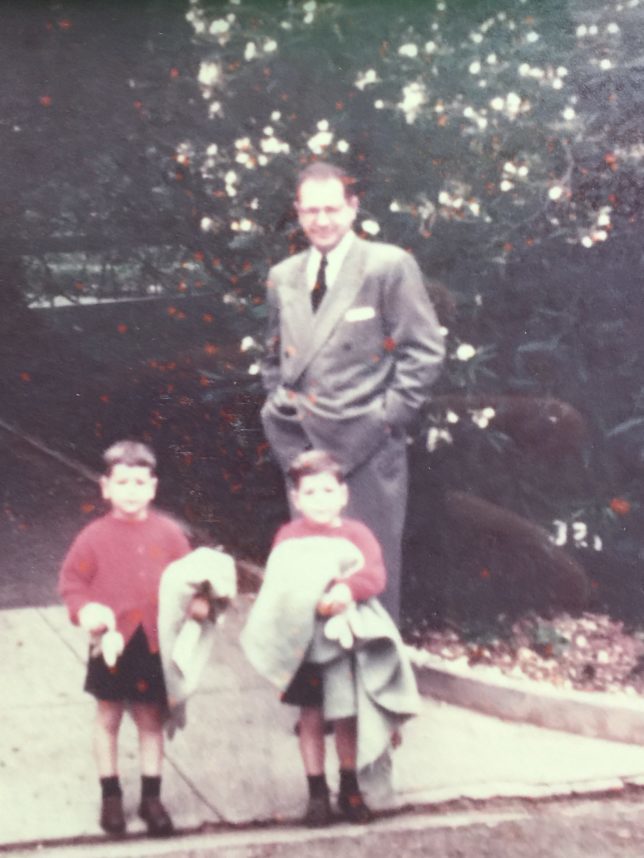
On August 10, 1959, my world changed irrevocably. Michael (a year older than me) and I saw our father for the last time that evening as he stood in the doorway of our small bedroom to say goodnight. He hadn’t been feeling well and while we slept an ambulance came to the house and took him at 2 a.m. to the hospital where he died 23 hours later from his second heart attack. He was only 53 years old.

My brother and I call that house “321.” It has been our link to our childhoods and father throughout our lives. I visited it from time to time and even knocked on the door 25 years ago and asked to walk through. The owners remembered my family and were gracious. Though it has been owned by others, Michael and I still feel that it belongs to us. I fantasized that maybe either of us would be able and want to buy it this past year when it was put up for sale.

One doesn’t say Kaddish over a house, but its demolition is a death for both of us. We’re left now only with, as Jim Croce poignantly said, “photographs and memories.”

Thanks to Michael for sharing his memories with me as I wrote this.

When a childhood home is demolished Read More »

A well-dressed dinner table

Your dinner table can be well-dressed and eco-friendly when you transform an old shirt into a stack of napkins, complete with the original collar to hold the set together. I also like to keep a lot of the shirt details such as the pocket and buttons intact to give the napkins more charm. The napkin with the pocket can even hold silverware — or hide a piece of tough brisket you couldn’t chew.

Every year, millions of paper napkins end up in landfills, and new cloth napkins require a huge amount of resources and chemicals in their manufacturing, so these upcycled shirt napkins are a more sustainable choice that also make great gifts.

What you need:

  • Men’s shirt, size large or extra large
  • Pen
  • Ruler
  • Scissors
  • Iron
  • Sewing machine or no-sew tape
  • Safety pin


1.


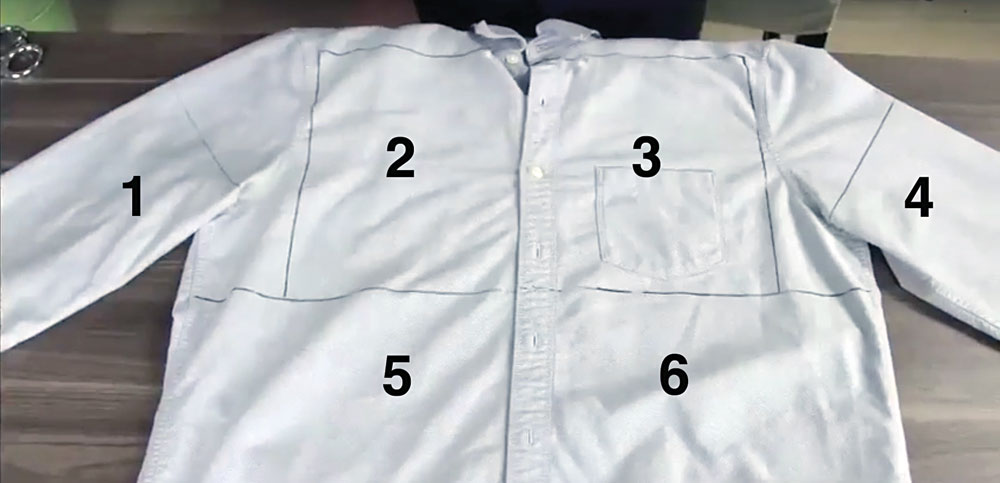
A large men’s shirt can yield 10 napkins. Lay the shirt flat on a table. Use a pen and ruler to divide the shirt into rectangular sections — four on the front, four on the back and two from the sleeves. Use the photo above as a guide. Notice that the divider lines do not cut across the front pocket, as you will want to keep that in one piece.

2.


Cut the shirt into sections with sharp scissors. There will be very little waste, as almost the entire shirt is utilized. On the front and back sides, only the armpit area is excluded  — which works out fine because no one really wants to wipe their mouth on a napkin made from a shirt’s armpit.

3.


Cut a rectangular section from the middle of each sleeve. Then, cut that section lengthwise so the rectangle lies flat. Save the unused parts of the sleeve for rags or to make cocktail napkins in the future. Oh, and save the collar. You will need that later.

4.


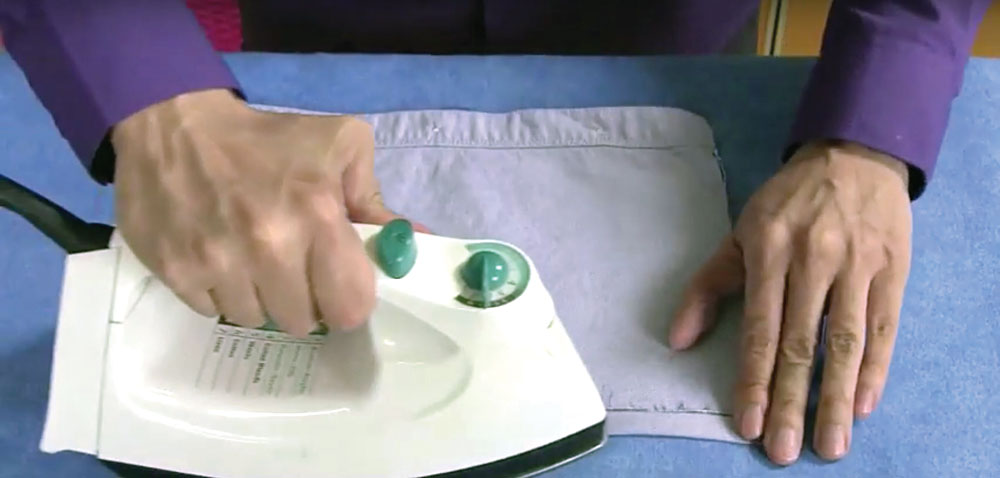
You can leave the edges of each napkin unfinished, but I like to hem them. (Some edges, like the sides with the buttonholes, do not need to be hemmed because they were not cut.) Start by folding over each unfinished edge and ironing it flat.

5.


With a sewing machine, sew the edges that you just ironed. If you do not sew, try a no-sew alternative such as fabric tape, a double-sided adhesive for fabric that is machine washable. You can also use iron-on fusible web, which looks like a roll of tape — place a piece of it in the seam, and when you iron it the seam becomes fused.

6.


All 10 napkins will be slightly different in size. To stack them neatly in a set, fold them so the sizes are uniform. Finally, take the shirt collar, button it, and wrap it around the stack of napkins. The collar will be wider than the napkins, so adjust the collar with a safety pin in the back for a snug fit.


Jonathan Fong is the author of “Walls That Wow,” “Flowers That Wow” and “Parties That Wow,” and host of “Style With a Smile” on YouTube. You can see more of his do-it-yourself projects at jonathanfongstyle.com.

A well-dressed dinner table Read More »

Bringin’ Tu b’Av back — Maybe on the 405?

No days were as good for Israel as the 15th of Av and the Day of Atonement, on which the sons of Jerusalem would go out in borrowed white clothes … and the girls of Jerusalem would go out and dance in the vineyards.

— Ta’anit 10

Wait a minute! The 15th of Av, aka Tu b’Av, was once considered as good for Israel as Yom Kippur?

Huh?

Then how is it possible that everyone I mentioned this holiday to in the past week, whether American or Israeli, was similarly dismissive?  The Israelis all said, “This is a minor holiday,” and the American Jews said, “What?”

Oh, Tu b’Av, where art thou?

Curious about why Tu b’Av has been demoted to minor league status, I started snooping around for clues. More than one source referred to Tu b’Av as the “forgotten holiday.” Bummer, I thought, of all the holidays to forget, why the one that celebrates romantic love? Why not Tzom Gedaliah? I don’t mean to belittle the death of Gedaliah, but maybe one fewer day of fasting and one more day of dancing would be good for the Jews.

I continued my search.

Ritualwell, a Reconstructionist website, gave me a big clue: “Tu b’Av, the fifteenth of the month of Av, is an ancient Jewish holiday when women would go out to the fields in borrowed white clothing and dance. They would choose spouses from among the men who came to dance with them.”

Clearly, I was born in the wrong era, because dancing in the fields in search of a man has Dani written all over it. I can’t think of a better way to find a spouse. For the record, if I had the chance to do it over, I’d still dance off the field with my husband, Tod. Then we’d go home and he’d probably read to me from the Talmud. In fact, Tod is the person who first told me about Tu b’Av. For him, there are no minor Jewish holidays. The first year we were married, he built a sukkah. From real wood planks. With a hammer and nails. Very romantic. In truth, I was a little afraid.

But back to Tu b’Av and it’s relegation to a holiday where people eat excessive amounts of chocolate and hold synthetic teddy bears. If it all started as a mating dance, one answer as to why no one cares about it anymore may be the proliferation of dating apps. With apps like JSwipe, a woman no longer needs to dance in the fields to meet the perfect Jewish mate. She just needs Wi-Fi. Then, after you’re married, you don’t don white and dance around in a forest to get some action. It’s more like: Are the kids asleep? Am I awake? Have I showered recently? Good, let’s go.

Here’s some not fresh insight: We Jews are opinionated people. But Tu b’Av, a holiday that celebrates finding love, even if you’ve already found it, is something we can all agree on.

So, how about we make Tu b’Av great again? How about we don’t let it be forgotten? Millennials, I’m mostly talking to you because the rest of us are very tired.

Young women, get your faces out of your apps, put on a see-through white blouse with a black bra, or some combination thereof, shoot a selfie with the hashtag #TubAv4evah, and head out to the dance floor where you can celebrate your freedom and then find someone to tie you down (I mean marry) and make little Jews with ASAP.

As for the more mature among us, let the non-Jews celebrate love with boxes of chocolate and overpriced prix fixe meals that come with a wilting red rose. I say we honor our ancient tradition of dancing in public beginning the evening of Aug. 6. Let’s do a whole “Fiddler on the Roof”-meets-“La La Land” scene. Only, instead of dancing on the 105-110 interchange, let’s stage it on the 405 — it’s wider and closer to the Westside, which, let’s face it, is more convenient to where a lot of L.A. Jews live. Unfortunately, Aug. 6 falls on a Sunday, so this gesture of joy and love will not reach as many of the angry L.A. masses as we would want it to, but it’s still a great way to do our part to bring Tu b’Av back.

To be clear, I’m not saying we shouldn’t also eat a lot of chocolate. (In my case, Tod, if you are reading this, I like 85 percent cocoa, single source. But you know that, since I keep bars of it right by the vitamins where they belong. So, yes, honey, I would love my supply replenished as an expression of your love for me.)

In terms of expressing my love for you and all of Jewishkind, don’t be surprised to find me dancing in a white bikini on the 405 from sunrise to sunset, a little sunburned but happy.

Chag Tu b’Av sameach, my friends.


Dani Klein Modisett is a comic and writer, most recently of the book “Take My Spouse, Please.”

Bringin’ Tu b’Av back — Maybe on the 405? Read More »

A Video Message to Roger Waters

Pink Floyd co-founder Roger Waters, one of the most prominent anti-Israel musicians in the United States, is due to perform in Washington, D.C. this Friday and Saturday (Aug. 4 and 5).

In response, the Jewish Community Relations Council of Greater Washington (JCRC) is sending him a message in a five-figure media campaign in the form of a social media video.

According to its producers, the video is an effort to educate local Washingtonians on the ways Waters “uses music to divide people, rather than bring them together.”

For years the aging rock star has been an outspoken member of the BDS movement, which seeks to boycott the country, and sanction and divest from companies who do business there.

Waters doesn’t just refuse to perform in Israel, he criticizes and trolls other musicians who chose to perform on tour there.  On a recent Facebook Q & A, Waters has compared Israel to Nazi Germany.  

You can watch the video here:

https://www.facebook.com/jcrc.gw/videos/1379613965493558/

A Video Message to Roger Waters Read More »

Raising a Palestinian flag is not the best welcome sign

It’s a mark of how argumentative Jews can be that we can even argue the merits of raising a Jew-hating flag in a Jewish summer camp.

The side that thinks it’s a good idea appeals to our sense of welcoming strangers and making them feel at home. The importance of being kind to the stranger is a major Jewish value.

So, when Palestinian kids showed up at a Jewish summer camp in Washington state a few weeks ago, under an initiative from the Israeli NGO Kids4Peace, they were greeted with their own flag. The leaders at Camp Solomon Schechter felt it would be a warm gesture of hospitality to greet them with something familiar.

The side that thinks it’s a bad idea complained vehemently, and the camp eventually took down the flag and apologized.

I’m in the camp that thought it was a bad idea. I’m not against being welcoming to strangers, I’m just against using a Jew-hating symbol to provide that welcome.

Few things are more divisive in the Middle East than power symbols. Palestinian society is littered with them— the ubiquitous maps of Palestine that eliminate Israel, the posters of martyrs who murder Jews, the cartoons that demonize Jews, the schoolbooks that teach Jew-hatred, the public squares that honor terrorists, and so on. In all of those places, the Palestinian flag is right there.

When Palestinian preachers deny any Jewish connection to Jerusalem, the Palestinian flag is there. When Palestinian leader Mahmoud Abbas says our Jewish “filthy feet” desecrate the holiest site in Judaism, the Palestinian flag is next to him. When Palestinian leaders inaugurate a stadium named after a terrorist who murdered Jews, hundreds of Palestinian flags fly proudly.

So yes, the flag that was raised at the Jewish summer camp is associated with Jew-hatred and violence against Jews.

But there’s a more relevant and simpler point to be made: Why do we even need a flag to make people feel welcome?

If I ever visited a Palestinian summer camp, I wouldnt expect to be greeted by an Israeli flag that I know would rub them the wrong way. Their hospitality would impress me, not their forced use of a divisive symbol.

If you want to make Palestinian kids feel at home, you can have Jewish kids greet them by singing a song in Arabic, or serve them food from their tradition, or have a Sephardic cantor sing Jewish liturgies that sound just like the melodies in a mosque.

The point is, you make people feel welcome not with symbols but with real stuff– with great food, great music, great bonding activities and plenty of love. If I ever visited a Palestinian summer camp, I wouldnt expect to be greeted by an Israeli flag that I know would rub them the wrong way. Their hospitality would impress me, not their forced use of a divisive symbol.

Did the Jewish camp leaders show daring when they first raised that Palestinian flag? Was it courageous of them to challenge the status quo? Of course. In the Jewish tradition, challenging the status quo has a long and noble pedigree. The rebels are the heroes.

But being courageous doesnt mean youre right. Elevating a symbol of division and hate, even with the best of intentions, does not mitigate that hate. There is no need to patronize Palestinians and pretend that we can honor a flag that has been so drenched with Jewish blood and Jew-hatred. To honor such an icon so we can feel courageous and hospitable is to invert morality for the sake of self.

More importantly, its not necessary. There are plenty of decent ways a Jewish camp can welcome Palestinian kids without having to resort to a radioactive symbol.

And if you ask me, thats a fact, not an argument.


David Suissa is president of TRIBE Media Corp./Jewish Journal and can be reached at davids@jewishjournal.com.

Raising a Palestinian flag is not the best welcome sign Read More »

Sen. Kirsten Gillibrand withdraws support for anti-BDS bill

In a rare move and after facing criticism at town hall meetings, Sen. Kirsten Gillibrand, a New York Democrat, withdrew her sponsorship of an anti-BDS bill.

A search of the congressional website on Wednesday showed that Gillibrand withdrew her sponsorship. Asked for comment, her spokesman, Glen Caplin, said Gillibrand remains opposed to the movement to boycott, divest from and sanction Israel, and supported the bill’s intentions, but is concerned that its critics are concluding that the bill would impinge on civil liberties.

She wants the bill to remove those ambiguities, Caplin said.

“She wants to see the bill rewritten to see those concerns addressed,” he told JTA in an interview.

He referred to her comments earlier this week at a town hall meeting in Queens in which she said she was withdrawing support for the measure and seeking a modification of the bill to address civil liberties concerns.

“I’m going to urge them to rewrite it to make sure it says specifically this does not apply to individuals,” Gillibrand said at the time, describing her reactions after a meeting with the American Civil Liberties Union, which had objected to the bill.

She did not agree with the ACLU’s reading of the bill, but believed the group had come by it honestly, and was concerned that others would draw the same conclusion.

Gillibrand said her principal concern was that the bill could be read as targeting individuals who participate in the BDS movement.

“This is only applying to companies,” she said. “This applies to those working to undermine foreign policy. It has to be very specific that someone who is in favor of BDS can speak their mind and somebody who is against BDS can speak their mind, but you are always allowed to speak your mind. So I’m going to try and get the bill revised so there’s no ambiguity, that it’s just an extension of this foreign policy, which I think does make sense.”

Activists at multiple town halls had confronted Gillibrand over her support for the bill. Some of the questions were organized by Jewish Voice for Peace, which backs BDS, and the U.S. Campaign for Palestinian Rights, among other groups.

Critics, including the ACLU, say the bill, which expands 1970s era laws targeting the Arab League boycott to include boycotts initiated by international organizations, would inhibit free speech. Another objection from the left is that the bill encompasses boycotts of settlement goods.

Defenders of the bill say its ambit is narrow, and that it only addresses active cooperation with boycotts initiated by foreign governments and international organizations, and would not extend to general declarations of intent to boycott Israel or its settlements.

Most recently, Amnesty International has come out against the bill.

The bill, introduced by Sen. Ben Cardin, D-Md., is co-sponsored by nearly half the Senate. A similar bill is under consideration in the U.S. House of Representatives.

Sen. Kirsten Gillibrand withdraws support for anti-BDS bill Read More »

Jeff Brotman, Costco founder, is dead at 74

Jeff Brotman, who co-founded the members-only retail giant Costco and was the chairman of its board of directors, died at his home outside Seattle.

Costco Wholesale Corp. said Brotman died early Tuesday at 74. The cause of death was not immediately known.

Raised in Tacoma, Washington, Brotman formed Costco in 1982 with partner James Sinegal. By 2016 Costco had 85 million members and $9 billion in annual sales, making it the country’s third largest retail chain after Amazon and Walmart.

Brotman was an active philanthropist, donating to the arts and health-related causes, and to Democratic political candidates. He also supported Jewish causes, and frequently cited the influence of his childhood rabbi, the late Richard Rosenthal of Temple Beth Israel in Tacoma.

In 2014 he donated nearly $1 million to Temple Beth El in Tacoma to build a preschool and day care. The synagogue was formed with the merger of his childhood congregation and another local synagogue.

“The congregation launched me into being a responsible adult,” Brotman told The News Tribune of Tacoma at the time. “I was interested in doing something for them where I thought it would have a major impact.”

Brotman’s grandparents emigrated from Romania to Saskatchewan, Canada. His father, Bernie, operated a chain of retail stores in Washington state and Oregon.

Brotman earned a degree in political science from the University of Washington and attended its law school. He and his brother, Michael, started Bottoms, a jeans store for young women, and Jeffrey Michael, a chain of men’s stores.

He was an early investor in Howard Schultz’s Starbucks coffee empire and was involved in several other retail ventures.

Brotman and Sinegal opened their first Costco warehouse in 1983 in Seattle. The company now operates 736 warehouses around the world.

He was married to the former Nordstrom executive Susan Thrailkill. The couple had two children. Other survivors include two grandchildren.

Brotman was a supporter of the Jewish Federation of Greater Seattle.

“Helping the disadvantaged, encouraging diversity, fostering a community that treats its people well — these were values I learned from my parents as well as in Sunday school, values from Rabbi Richard Rosenthal, my rabbi at Temple Beth El, and my grandfather, who helped with the movement to plant trees in Israel,” Brotman said in a statement that appears on the federation’s website. “When I see some of the fundamental unfairness built into the system for people who are less fortunate, and couple that with my family’s tradition of helping others, I am compelled to act, compelled to give what I can to help.”

Jeff Brotman, Costco founder, is dead at 74 Read More »