fbpx

July 19, 2017

Jewish Emmy nominees

On July 13, the Television Academy announced the nominees for the coveted Primetime Emmy Awards. Here are the candidates with Jewish ancestry. The awards for TV excellence will be presented Sept. 17 on CBS.

Lead actress, drama series: Evan Rachel Wood was nominated for her portrayal of Dolores Abernathy, an android character in the sci-fi series “Westworld” who discovers that what she thought was her life is a lie.

Lead actor, drama series: In the crime-drama series “Ray Donovan,” Liev Schreiber portrays the title character, a fixer at a powerful Los Angeles law firm.

Lead actress, comedy series: Pamela Adlon stars as a divorced actress raising three children by herself in “Better Things.” Tracee Ellis Ross plays a biracial anesthesiologist who is the matriarch of an upper-middle-class African-American family in “black-ish.”

Lead actor, comedy series: Jeffrey Tambor was nominated for his role as the transgender matriarch of a Jewish California family in “Transparent.”

Supporting actress, comedy series: Vanessa Bayer earned a nomination for her work on “Saturday Night Live.” In “Transparent,” Judith Light plays the former wife of a Jewish transgender woman.

Supporting actor, drama series: Mandy Patinkin was tapped for his performance as Saul Berenson, the Jewish Middle East Division chief and later acting director of the CIA in “Homeland.”

Supporting actress, limited series or movie: Jackie Hoffman portrays Joan Crawford’s housekeeper in “Feud,” which centers on the rivalry between Crawford and fellow actress Bette Davis.

Guest actor, drama series: In the drama “Bloodline,” Ben Mendelsohn plays the black sheep brother whose return home leads to family drama. Hank Azaria portrays a corrupt former FBI agent who clashes with a professional fixer in “Ray Donovan.”

Guest actress, comedy series: The late Carrie Fisher was nominated for her performance in “Catastrophe,” as the mother of a man expecting a child as a result of a short affair.

Voice-over: Kevin Kline lent his voice to play the landlord of a hamburger shop owner in the animated sitcom “Bob’s Burgers.”

Jewish Emmy nominees Read More »

Bios of disparate Jewish figures Einstein, Madoff earn Emmy nominations

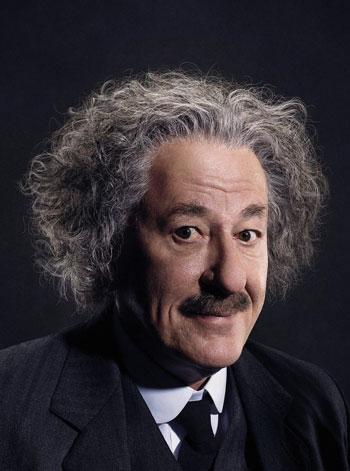
Geoffrey Rush as Albert Einstein in “Genius.” Photo by Marco Grob/National Geographic

It has been 25 years since two biographies about Jews were nominated for an Emmy Award in the same year. In 1982, “Oppenheimer,” about nuclear physicist J. Robert Oppenheimer, competed in the limited series category, and “A Woman Called Golda,” about former Israeli Prime Minister Golda Meir, won for Outstanding Television Movie.

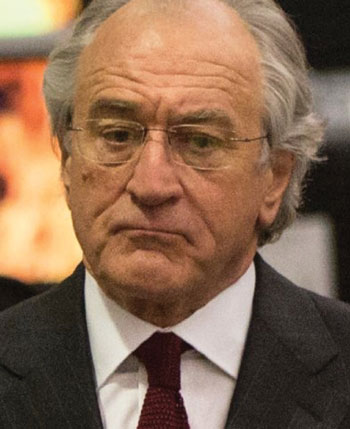
This year, “Genius,” the National Geographic Channel miniseries about physicist Albert Einstein, and the HBO’s movie “The Wizard of Lies,” about Ponzi scheme mastermind Bernie Madoff, are in contention in separate categories. Geoffrey Rush and Robert De Niro, the non-Jewish actors who play them, were nominated for Outstanding Actor in a Limited Series or Movie.

These Jewish subjects are on opposite ends of the angel-devil spectrum, although much of “Genius” depicts Einstein’s failings as a husband and father, skewing the halo a bit. Given its historical context, Jewish themes of anti-Semitism and the rise of Nazism are prevalent throughout the miniseries.

“The Wizard of Lies” does not portray Madoff’s Jewish side at all, unlike the 2016 two-part miniseries “Madoff,” which starred Richard Dreyfuss and left no doubt about his religion. There was a Jewish wedding, and points were made about Madoff defrauding Jewish individuals and organizations, including Hadassah and the Elie Wiesel Foundation.

Vincent Brook, an author and lecturer in the UCLA School of Theater, Film and Television, and an expert on film and television history and Jewish history in Hollywood, watched both Madoff bios.

“I thought it was significant that they didn’t play up the Jewishness at all in ‘Wizard of Lies.’ The word ‘Jewish’ was mentioned maybe once,” said Brook, who is Jewish. “It wasn’t, ‘Here’s this money-grubbing Jew.’ In the Dreyfuss version, it played a bigger role.” He found Dreyfuss’ portrayal more convincing, “not that a non-Jew can’t play a Jew, but Dreyfuss is Jewish and looks Jewish,” he said.

“We were very careful not to portray this as an anti-Semitic story. It’s a global story … a much bigger story,” “Madoff” executive producer Linda Berman told the Journal in January 2016.

But just the idea of showcasing a “bad Jew” gives anxiety to many members of the tribe. (Imagine how Muslims and Arabs must feel, given the number of times they are portrayed on screen as terrorists or sinister characters.)


Robert De Niro plays Bernie Madoff in “The Wizard of Lies.” Photo courtesy of HBO

Although “Wizard of Lies” “didn’t play the J card,” as Brook put it, depicting Madoff at all raises the larger issue of anti-Semitism and how it’s handled in Hollywood.

“Anti-Semitism still exists, but it’s taboo to be open about it,” Brook said. “Hollywood is cognizant of being politically correct. In movies and TV now, if you show a minority character in a negative light, you can be assured that there will be a good character from that minority for balance. It’s good that there’s sensitivity about it. It makes up for a long history of the opposite being the case.”

There’s another element at play that affects how Jews are portrayed, if they’re portrayed at all. While Jews may not “control the media,” as the oft-repeated fallacy goes, Jews do fill production and executive ranks in Hollywood, particularly in television.

“They don’t want to rub Jewishness in the face of the non-Jewish majority,” Brook said. “There’s still that sensitivity among Jewish producers about being ‘too Jewish,’ and it’s often expressed in casting and subject matter.”

He shared an enlightening anecdote. “Fairly recently, I heard a Jewish TV producer talking about casting calls and ‘He’s too J,’ meaning he looks too Jewish,” Brook said. ‘You’d think that these days it wouldn’t be a big deal, but it is.”

The Emmys have recognized movies and miniseries with Jewish themes and protagonists over the years. But almost all of them have starred non-Jews in their leading roles.

In the 1982 TV productions, Ingrid Bergman played Meir and Sam Waterston played Oppenheimer. Ben Kingsley has portrayed both Moses and Nazi hunter Simon Wiesenthal. Ian McShane played British statesman Benjamin Disraeli. And most controversially, pro-Palestinian actress Vanessa Redgrave was cast as Jewish Auschwitz prisoner Fania Fenelon in the Emmy winner “Playing for Time.”

More rarely, there have been Jews playing Jewish heroes: Peter Strauss as Eleazar Ben Yair in the Emmy-nominated “Masada” and Alan Arkin as the leader of a concentration camp breakout in “Escape From Sobibor.”

The Primetime Emmy Awards will be broadcast on CBS at 5 p.m. Sept.17.  

Bios of disparate Jewish figures Einstein, Madoff earn Emmy nominations Read More »

Confident Villaraigosa eyes governor’s office: ‘I was everybody’s mayor’

Though he’s not Jewish, former Los Angeles Mayor Antonio Villaraigosa might be the most Jewish candidate in the 2018 election for California governor.

In a recent visit to the Journal’s office, he sold his long connection with L.A.’s Jewish community — as well as its other ethnic communities — as a winning attribute for the state’s next chief executive.

“I was the Jewish mayor, I was the Muslim mayor, I was the Korean mayor,” Villaraigosa said. “I was everybody’s mayor. I was in every community. I think that counts for something.”

Villaraigosa is one of several Democrats running to succeed Gov. Jerry Brown in next year’s gubernatorial election. The others are Lt. Gov. Gavin Newsom, California Treasurer John Chiang and Delaine Eastin, the former state schools superintendent. Among Republicans running are Travis Allen, a state assemblyman from Huntington Beach, and David Hadley, a former assemblyman from the South Bay. The Journal has extended invitations for interviews to leading candidates for governor.

Villaraigosa’s back-to-basics campaign is aimed at asking voters to let him do for California what he did as Los Angeles mayor from 2005 to 2013.

Asked about education, he cited a turnaround in the high school dropout rate in L.A. during his term as mayor. Asked about California’s role as a climate leader, he cited a decline in the city’s emissions during his tenure. On transportation, he cited the rail lines and busways his administration either built or initiated.

Villaraigosa sought to paint himself as a veteran legislator and administrator who would get the state’s trains running on time — literally, with long-awaited high-speed rail.

But moreover, he sold himself as the only major candidate in the race who would lead with experience and solid ethics. Asked about how he differed from Newsom and Chiang, he quickly shot back, “The courage of my convictions. Demonstrated leadership.”

Although Newsom is seen as the frontrunner, a June poll from UC Berkeley put Newsom and Villaraigosa near a tie, at 22 and 17 percent of the vote, respectively, with almost 40 percent undecided.

Making his gubernatorial pitch, Villaraigosa turned first to education and job training.

A former speaker of the California State Assembly, he lobbied to bring Los Angeles public schools under mayoral control. While that effort failed, he led a group that took over 16 of the L.A. Unified School District’s lowest-performing schools, and their graduation rate improved more than 40 percent between 2008 and 2015. Among the schools he helped rehabilitate was his alma mater, Roosevelt High School in Boyle Heights, which had a significant Jewish population when he attended.

“I ran on that,” he said of school improvements. “I’m going to run on that this time around.”

Villaraigosa’s vision for education in California includes more per-pupil spending, technical education at the high school level and greater connectivity between high schools and community colleges.

“Everybody’s got to graduate from high school with either a skill or college-ready,” he said.

On infrastructure, the former mayor touted his help in winning voter approval for Measure R, a county sales tax that raised billions of dollars for transportation projects such as the Purple Line train down Wilshire Boulevard. But L.A. projects like the that subway line also are funded partly by federal dollars.

“It wasn’t just Measure R money,” Villaraigosa said. “We went to the federal government. I went to [former President Barack] Obama. At first, they laughed me out.”

He said the president told him, “ ‘You’re asking for an earmark for L.A.’ I said, ‘No, I’m not. I’m asking you to reward cities and counties that are putting [up] our own money.’ ”

Villaraigosa promised California would use the same tactics under his leadership.

He said he supports a high-speed rail project in the works between Los Angeles and San Francisco, saying it would help connect the economically challenged Central Valley with the wealthy metropolitan centers.

“At what point are we going to get into the 21st century?” he said.

While he said he would lobby the federal government in funding California’s public works and work to protect health care funds, he promised to take on President Donald Trump’s administration when it comes to immigration and the environment.

“We’re actually going to take a page out of Texas’ book,” he said, promising to fight the president in court as Texas did repeatedly under Obama.

Villaraigosa is a liberal Democrat, but he set himself apart from the more liberal elements of his party at several points in the two-hour interview.

He pushed back against the idea of a single-payer health care system for California in the near term, an idea California’s legislature considered this year.

“I philosophically support single-payer, and I have since 1994,” he said. But he estimated it would cost more than California’s annual budget to achieve — an impossible benchmark for now.

“I think one day we’re going to get there,” he said. “We should build toward that, but today’s not that day.”

He suggested environmental reviews could be expedited or loosened for projects with significant public benefit, such as affordable housing, and said, “fixing the broken regulatory environment so you can do it quicker and cheaper” could help speed up infrastructure works.

He promised to confront anti-Semitism from both political extremes, saying that discriminatory incidents against Jews on liberal California college campuses was “the left meeting the right.”

Moreover, Villaraigosa said he would make the governor’s office a platform to speak out against bigotry in all its forms.

“Eight years as mayor, I never shrunk from using my bully pulpit against anti-Semitism,” he said.

The former mayor didn’t miss the opportunity to tout his long relationship with the city’s Jewish community.

Villaraigosa, 64, grew up in Boyle Heights in East L.A. at a time when the neighborhood’s status as a bastion of Jewish life was fading but still apparent. Last year, he was the keynote speaker at Fiesta Shalom, an annual gathering of Latino and Jewish community leaders hosted by Israel’s consulate in Los Angeles.

He described multiple trips to Israel and said he’s visited the home of every consul general the Jewish state has sent to Los Angeles since 1994.

He sees his connection to L.A.’s ethnic and racial communities as an asset.

“We need a governor that’s comfortable in every community. That’s why I criticize the Davos Democrats,” he said, referring to the Swiss city that hosts an annual gathering of the global elites.

“It’s real nice driving your Tesla,” he said. “But people drive Toyota pickups too. My mother rode a bus. The Democratic Party in this state has got to be for those people, too.” 

Confident Villaraigosa eyes governor’s office: ‘I was everybody’s mayor’ Read More »

Congressman’s impeachment resolution spurs Valley rallies, pro and con

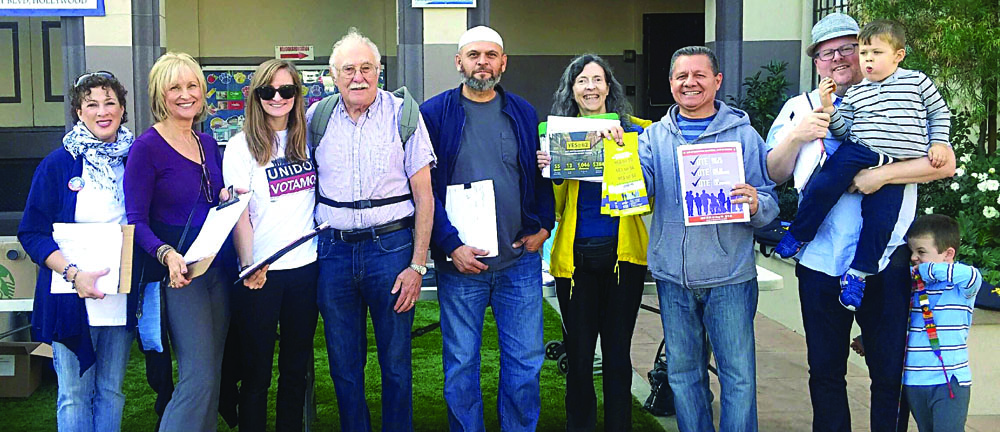
day after Rep. Brad Sherman (D-Sherman Oaks) became the first member of Congress to file formal articles of impeachment against President Donald Trump for obstruction of justice, around 40 demonstrators gathered in support on the sidewalk outside his Sherman Oaks office.

The July 13 rally was the fifth in a series of pro-impeachment demonstrations at Sherman’s office organized by Rachel Rosen, a health educator and San Fernando Valley resident who is the daughter of the local Anti-Defamation League’s senior associate director Alison Mayersohn.

Participants blasted rock music, waved handmade signs with slogans such as “Nyet Normal” and chanted, “He lies, he cheats, Donald Trump must be impeached!” One demonstrator dressed as the Statue of Liberty, and another wore a Russian general’s costume and mimicked Russian President Vladimir Putin, whose nation is suspected of meddling in the 2016 U.S. election.

Several police officers stood on the sidelines, while a group of about 20 Trump supporters gathered for a counterprotest across the street.

Sherman is the first member of Congress to file formal articles of impeachment against the president. He and co-sponsor Rep. Al Green (D-Texas) introduced the measure, HR 438, on the House floor July 12. It points to the president’s firing of former FBI Director James Comey, suggesting it was an attempt to influence investigations into former national security adviser Michael Flynn and of possible collusion between the Trump campaign and Russia during the presidential campaign.

“There are often demonstrations outside my office, but one thing’s unusual here — rarely are they ‘Thank You, Brad’ demonstrations,” Sherman said in a statement about the rally. “Usually there’s ‘Blank You, Brad” demonstrations. It’s nice to know that people are turning out.”

Sherman encouraged the rally’s participants to contribute their energy and passion to a voter drive currently underway in the 25th congressional district in northern Los Angeles.

“I need the support of more Democratic colleagues — especially pro-Israel ones,” said Sherman, who is Jewish.

Rosen said the goal of the protests is to express gratitude for Sherman’s efforts and to pressure members of Congress from both sides of the aisle to join his call for impeachment.

The working mother of two said she got involved in activism after Trump’s inauguration on Jan. 20. She attended the Women’s March in downtown Los Angeles and the protests of Trump’s travel ban at Los Angeles International Airport but was looking for demonstrations closer to home.

“There are a lot of [anti-Trump] resistance groups in the Valley,” Rosen said. “I thought, ‘Why are we driving all the way to downtown L.A.?’ ”

Rosen said she chose Sherman’s district office as the location for her rallies after Sherman announced at a June 7 press conference his intention to draft articles of impeachment. She said about 20 people showed up to the first rally on June 15, which she promoted primarily through the Facebook pages of local resistance groups such as West Valley Resistance and Indivisible.

Rosen also spoke at the July 2 Impeachment March in downtown L.A. about the power of grass-roots activists to make a difference.

Alison Davies, a West Hills resident who donned the Lady Liberty costume, said she focuses on positive reinforcement for California legislators because, like Sherman, many of them are progressive and already are doing what she hopes elected officials would do.

“There is a vocal few out there who are giving Brad Sherman a lot of hate,” Davies said. “We want to show that the majority of us support what he’s doing.”

Arianna Villavicencio, an 11-year-old participant in the rally, said she thinks protesting is important because it helps people realize something must change.

“My dad didn’t make me come here. I chose to be here,” Villavicencio said. “Even though I’m only 11, I believe I should stand up for my rights.”

Across the street, Torrance resident Arthur Schaper brought a megaphone and a Make America Great Again cap to the counterprotest. He said Sherman is a disgrace to the district and called HR 438 a treasonous attempt to undermine the president.

“How can [Sherman] represent people when he spends most of his time pushing ridiculous resolutions?” Schaper said.

In a letter to fellow congressmembers circulated in early June, Sherman said the national interest requires Congress to call for Trump’s impeachment and asked for his colleagues’ “counsel, input and support,” the Los Angeles Times reported.

“Articles of Impeachment will not pass the House in the near future,” Sherman said in a recent statement to the Times. “But given the risk posed to the Republic, we should move things forward as quickly as possible.”

Rosen said she is unfazed by the long road ahead for Sherman’s impeachment attempt, adding that people once thought civil rights or women’s suffrage were impossible goals.

“I think [calling for impeachment] is the right thing to do,” Rosen said. “If other people don’t want to do the right thing — which is the majority of Congress — then they’ll be on the wrong side of history. I’m going to be on the side that did something about it.”

Congressman’s impeachment resolution spurs Valley rallies, pro and con Read More »

Moving & Shaking: Waldorf Astoria ribbon-cutting; new JFS director; social justice awards

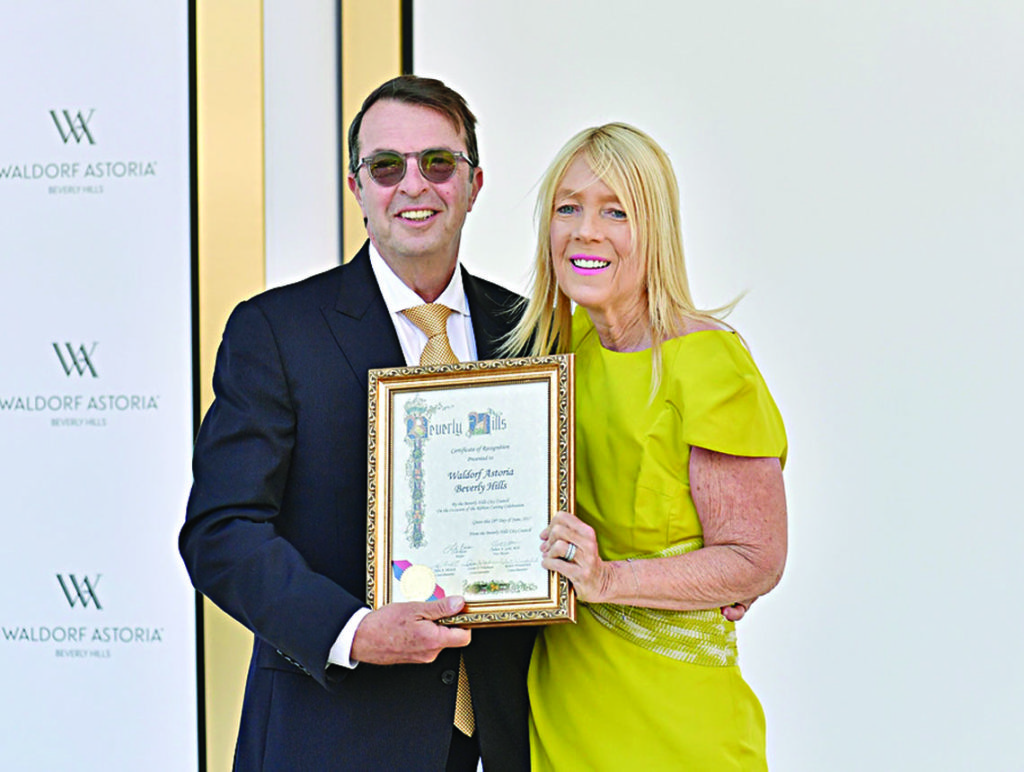
Israeli-American hotel owner Beny Alagem celebrated the opening of his new Waldorf Astoria hotel in Beverly Hills at a June 28 ribbon-cutting ceremony.

The guest list for the Champagne and hors d’oeuvres event included Alagem’s wife, Adele, Beverly Hills Mayor Lili Bosse and Hilton CEO Christopher Nassetta.

Alagem thanked all of the partners at the hotel, including Andy Cohen of the Gensler design firm.

Bosse told those gathered that the hotel is a great addition to the Beverly Hills community. Ted Kahan, president of Alagem Capital, introduced the speakers and Christina Vu, the hotel marketing manager, said in an interview that the Waldorf is “the new luxury for the city of Beverly Hills.”

The 12-story hotel has 170 rooms and cost $200 million to build. A 6,300-square-foot ballroom is available for events.

Alagem, who was born in Israel, served as a tank driver in the Israeli army. He was the founder of computer parts manufacturer Packard Bell. In 2003, he purchased the Beverly Hilton from Merv Griffin. He has contributed to many organizations, including the Israeli American Council, an umbrella organization for the Israeli-American community; Friends of the Israel Defense Forces; and Cedars-Sinai Medical Center.

— Clara Sandler, Contributing Writer


Eli Veitzer has been named the new president and CEO of Jewish Family Service of Los Angeles. Photo courtesy of JFSLA

Jewish Family Service of Los Angeles (JFS) has named Eli Veitzer, CEO of Prototypes, as its incoming president and CEO. He succeeds JFS President and CEO Paul Castro, who is retiring at the end of the year after 35 years at the organization.

“We are extremely confident that Eli has the leadership skills, professional background and commitment to our mission to lead JFS into the future, as we continue to provide our wide array of social services and be a vital safety net for the greater Los Angeles community,” Shana Passman, chair of the JFS board of directors, which worked with Castro in conducting a national search for his successor, said in a July 11 statement.

At Prototypes, a Southern California social service organization, Veitzer led an organization that provides substance abuse prevention and treatment programs to 10,000 men, women and children annually, according to the group’s website. It calls itself one of the “nation’s leading behavioral health care organizations.”

He has served as Prototypes’ CEO since 2015. During the 15 years before that, he held leadership positions at JFS, including serving as director of administration at the organization from 2000 to 2010, and later director of strategic initiative and business development. He received his bachelor’s degree in development studies from Brown University.

“It is a tremendous honor to follow Paul Castro in leading Jewish Family Service,” Veitzer said in a statement. “He has cemented JFS as a vital, vibrant and caring organization, and I am excited to build on that foundation.”

His hiring becomes effective Sept. 5, and he will work closely with Castro to ensure a smooth transition, according to the organization.


Rabbi Leah Lewis is the new senior rabbi of Temple Menorah in Redondo Beach. Photo courtesy of Temple Menorah

During a July 1 Shabbat service, Temple Menorah in Redondo Beach welcomed Rabbi Leah Lewis into its congregation of 250 families. The weekly Shabbat service was Lewis’ first as senior rabbi. She succeeds Rabbi Steven Silver, who was the temple’s head rabbi for 30 years and will continue as rabbi emeritus.

In a statement, Barry Deutsch, the synagogue president, expressed excitement about the leadership transition.

“We’ve only changed rabbis a handful of times in our history as a congregation. That’s a historic milestone in anyone’s book.” Deutsch said. “Rabbi Silver has laid a strong foundation for our future evolution, growth and transformation over the last 30 years.”

During the service, cantorial soloist Stacey Morse joined Lewis on the bimah. About 120 people were in attendance to welcome the rabbi into the community. After the service, a celebratory lunch was held in Lewis’ honor in the temple’s social hall.

Lewis previously served six years on the clergy team of Congregation Shir-Ha-Ma’alot in Irvine. For the previous seven years, she served as the associate rabbi of Leo Baeck Temple in Los Angeles. She was ordained in 2002 at Hebrew Union College-Jewish Institute of Religion’s New York campus.

Lewis said she is excited to join this “incredibly welcoming community.” She said she hopes to learn from what Rabbi Silver brought and carry on Temple Menorah traditions, with her own spin.

  Isabella Beristain, Contributing Writer


Rebecca Schusterman, a 2017 graduate of Valley Torah High School in Valley Village, has been named a recipient of a Milken Scholars Program $10,000 scholarship. Photo by Paul Takizawa

Rebecca Schusterman, a 2017 graduate of Valley Torah High School in Valley Village, is one of 13 students from Los Angeles, Washington, D.C., and New York to receive a college scholarship from the 2017 Milken Scholars program, according to a July 11 announcement.

The Milken Scholars program, a joint initiative of the Milken Institute and the Milken Family Foundation, was founded in 1989 by Michael and Lori Milken to honor exceptional young men and women based on scholarship, leadership, service, character and triumphs over obstacles. The Milken Scholars Program awards a $10,000 scholarship as well as lifelong mentorship and support to help recipients pursue a path of professional and life success.

Schusterman was valedictorian at her school and has volunteered at Providence Saint Joseph Medical Center, where she “experienced both the joy and the heartbreak of health care,” according to the announcement.

She plans to spend a gap year in Israel before attending Harvard University, where she plans to study human developmental and regenerative biology.

She is involved in many Jewish organizations, including Builders of Jewish Education and Friendship Circle, where she worked with a young boy who has a learning disability. She also started a recycling club at school that donates all proceeds to Chai Lifeline.

— Jakob Marcus, Contributing Writer


Members of Leo Baeck Temple participate in the synagogue’s social justice initiative, Community Organizing: Connecting L.A. Face to Face, Not Bumper to Bumper. Photo courtesy of the Religious Action Center of Reform Judaism

Leo Baeck Temple and Temple Israel of Hollywood, along with 15 other congregations across the country, were awarded the Irving J. Fain Award, which recognizes the work of Reform Jewish congregations that create a culture of social justice advocacy.

The award is named for Fain, who was chairman of the Commission on Social Action of Reform Judaism. For more than 30 years, the award has recognized social action programs in Reform Jewish communities.

Diane Baer, chair of the Fain Award Selection Committee for the Commission on Social Action of Reform Judaism, said that winning congregations “took meaningful action on local and global social justice issues.”

Barbara Weinstein, director of the commission, said the winners “provide vibrant examples of ways congregations can engage in critical issues that confront us as Jews and as engaged members of our communities.”

Leo Baeck Temple was recognized for Community Organizing: Connecting L.A. Face to Face, Not Bumper to Bumper, a program run by a team of approximately 20 people, including co-chairs Eric Stockel, the temple’s vice president of social justice, and Bea Richman. With this program, the temple aims to support efforts to build mass transit along the 405 freeway corridor and create jobs, reduce carbon emissions and connect Los Angeles residents to their jobs, friends, family and communities.

Temple Israel was recognized for 3×3 Social Justice, which addresses three major issues: bias and criminal justice reform; hunger and homelessness; and gun violence prevention. 3×3 Social Justice responds to these issues using education, advocacy and action. The program is run by temple Vice President of Social Action Heidi Segal and Rabbi Jocee Hudson, along with the temple’s social justice task force, which is composed of congregation members.

The congregations will be honored at the Union for Reform Judaism’s Biennial in December.

— Caitlin Cohen, Contributing Writer


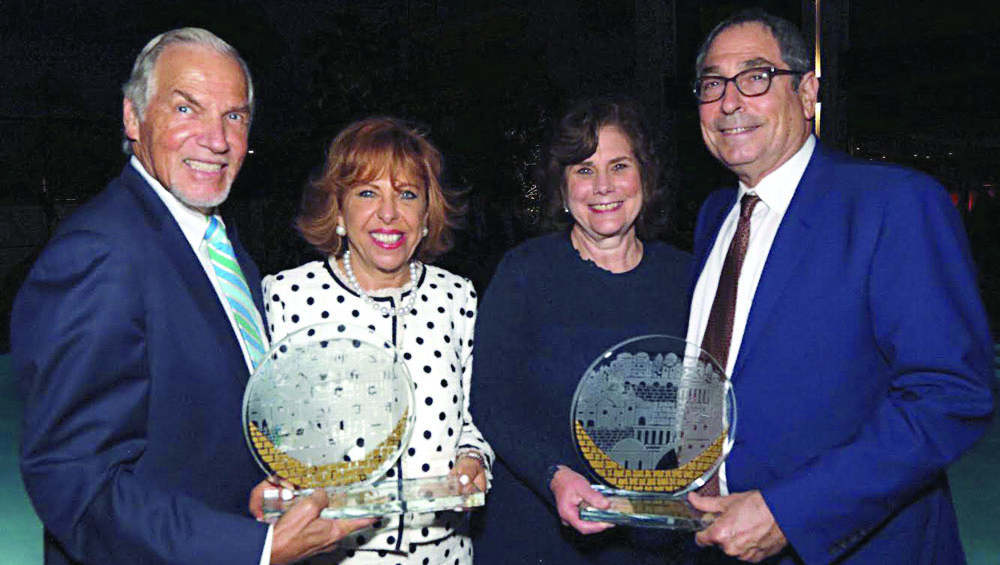
From left: The Orthodox Union honored Michael and Eva Neuman and Nadine Gerson-Zeller and Robert Zeller at their annual West Coast banquet. Photo by Lew Groner

The Orthodox Union (OU) West Coast held its annual banquet, “Under the Stars,” on June 21 at the Beverly Hills Marriott.

The event honored Eva and Michael Neuman and Nadine Gerson-Zeller and Robert Zeller with the OU Chesed Award.

The Union honored the Neumans, congregants of Beth Jacob Congregation, for their support of OU West Coast. The Neumans also support the American Israel Public Affairs Committee and West Coast Friends of Laniado Hospital in Netanya, Israel.

Additionally, the organization feted the Zellers, congregants of Beverly Hills Synagogue, also known as Young Israel of North Beverly Hills, for their support of OU West Coast.

The OU handles and organizes youth events, kashrut and Jewish advocacy for the greater Orthodox community.

OU West Coast President Scott Krieger spoke at the banquet about the programs and accomplishments of the OU over the past year. Rivki and Sam Mark were this year’s emcees.

Comedian Martin Silbermintz and a string quartet from USC entertained the guests, and an auction raised funds for the OU’s Jewish Learning Initiative on Campus.

— Clara Sandler, Contributing Writer


Moving & Shaking highlights events, honors and simchas.
Got a tip? Email ryant@jewishjournal.co
m. 

Moving & Shaking: Waldorf Astoria ribbon-cutting; new JFS director; social justice awards Read More »

Anti-Semitism, Hungary and Netanyahu: What you need to know

To critics of Benjamin Netanyahu, the Israeli prime minister’s visit to Hungary this week was a disgrace and an abandonment of local Jews in their fight against a government that is widely seen as one of Europe’s worst promoters of anti-Semitism and Holocaust revisionism.

Yet other Hungarian Jewish leaders and observers of Israel-Hungary relations viewed the visit as both vital to his country’s own interests and effective in assisting Hungarian Jews to promote theirs.

Such were the dynamics when Netanyahu held a joint news conference Tuesday with his Hungarian counterpart, Viktor Orban, during which Netanyahu devoted exactly 35 words to what he called “the concerns” of the Jewish community in Hungary. He did not specify those concerns in the statement, which kicked off the three-day visit in Hungary — the first by an Israeli prime minister since the fall of communism.

“I discussed with Prime Minister Orbán the concerns that I heard raised from the Jewish community,” Netanyahu said. “He reassured me in unequivocal terms, just as he did now, publicly. I appreciate that. These are important words.”

It was a vague and mild reference to a growing list of grievances fueling an escalating row between a significant part of Hungarian Jewry and their government. This includes alleged anti-Semitic incitement by the government in the form of attacks on the Hungarian-born Jewish philanthropist George Soros; the glorification of Nazi collaborators; crackdowns on Jewish opposition groups, and state-sponsored xenophobia against other minorities.

Zehava Gal-On, the leader of Israel’s left-wing Meretz party, wrote on Facebook ahead of Netanyahu’s visit that in view of the track record of Orban’s government, Netanyahu “has become a collaborator of anti-Semites.” Andras Heisler, president of the Mazsihisz Jewish federation of Hungary, said ahead of the visit that his community felt “left in the lurch” by Israel because of its perceived indifference to some of the issues at play.

Also prior to the visit, Heisler told JTA that he hoped Netanyahu “condemns strongly any kind of hate campaign or hate speech.”

Netanyahu’s photo op with Orban on Tuesday was not the rebuke that Mazsihisz had been seeking, the chairman of its rabbinical council, Rabbi Zoltan Radnoti, told JTA the following day.

“Bibi pushed away Hungarian Jews in favor of good relations with Orban, who can now dismiss accusations of anti-Semitism by citing Netanyahu’s support,” Radnoti said, using the Israeli prime minister’s nickname.

But to Rabbi Slomo Koves, leader of the Chabad-affiliated Unified Hungarian Jewish Congregation, or EMIH, the Netanyahu visit was instrumental in obtaining Orban’s first unequivocal rejection of Hungary’s fascist past, when Orban said the country had committed a “sin” in not protecting its Jewish citizens during World War II.

And the visit was crucial, Koves added, for strengthening Jerusalem’s alliance with one of Israel’s staunchest supporters in the European Union and the only member state with a large Jewish population that is not under threat from anti-Semitic violence.

Some prominent members of Mazsihisz share his view.

Peter Feldmajer, its previous president and now a representative in the umbrella group for the Central District, said government-led campaigns to rehabilitate collaborators with the Nazis or demonize liberal Jews like Soros are “ugly” and they “hurt the Jewish community of Hungary.” He also agreed that the anti-Soros campaign had anti-Semitic characteristics.

“But the community is threatened not by these issues,” Feldmajer said, “but by Islamic violence and bans on ritual slaughter, both of which Orban opposes. Therefore, there is nothing wrong with Netanyahu being received here.”

Koves called Orban’s remarks, delivered at a joint news conference with Netanyahu, the “most outspoken rejection of Hungary’s fascist past and admission of guilt” ever.

The government of Hungary, Orban said, “committed a sin when it did not protect the Jewish citizens of Hungary.” Hungarians, he added, decided “instead of protecting the Jewish community to collaborate with the Nazis.”

Radnoti welcomed Orban’s speech but said it omitted a direct reference to the active murder of tens of thousands of Jews by Hungarian troops.

“Orban spoke of collaboration. But Hungarians did more than help the Germans kill Jews: They killed them themselves, and in thousands,” the rabbi  said.

Still, coming from a leader whose party openly glorifies late politicians with an anti-Semitic legacy, the Orban speech was precedent setting, according to Efraim Zuroff, a hunter of Nazis and head of the Eastern Europe operations of the Simon Wiesenthal Center.

“It was very important,” Zuroff said of the prime minister’s words about the Holocaust. “I never heard this from Hungary.”

Indeed, two years ago, Orban was accused of whitewashing Hungary’s Holocaust-era record when he ignored Jewish protests about a monument built in Budapest about the Nazi occupation that featured an innocent angel being attacked by a vicious eagle. Only last month, Orban in a speech called the Nazi collaborator Miklos Horthy, Hungary’s World War II leader, an “exceptional statesman.”

Orban’s statement made it counterproductive for Netanyahu to revisit the issue, Koves argued.

“I’m no diplomat, but I think it’s common sense that such a statement is more powerful coming from Mr. Orban than from Mr. Netanyahu,” Koves said while crediting Israeli diplomacy, at least in part, for obtaining the statement.

The statement was a step further than any gesture Orban had made previously regarding Hungarian complicity in the Holocaust. He also said the Hungarian government today has a “zero tolerance” attitude to anti-Semitism.

But the “problem is,” Zuroff said, “it doesn’t represent the reality on the ground.”

He was referring to a host of government initiatives celebrating fascists and obstructing efforts to bringing Nazi-era criminals to justice, as well as the recently terminated billboard campaign against Soros, a left-leaning American billionaire who funds opposition groups and organizations assisting Muslim immigrants both in Hungary and Israel.

Mazsihisz claimed the billboards, which featured pictures of a laughing Soros and a slogan saying “don’t let him have the last laugh,” encouraged anti-Semitism. Indeed, some of the posters were defaced with anti-Semitic slogans.

 “Soros’ name has a different meaning in Hungary [than] in Israel,” Heisler, the Mazsihisz president, told JTA earlier this week. “In Hungary, Soros is the symbol of the Jewish capitalist. The campaign against Soros in Hungary incited anti-Semitic reactions.”

The Chabad-affiliated EMIH, however, disputes the assertion, viewing the campaign as criticism only of Soros’ politics and actions. Organizations belonging to both EMIH and Mazsihisz receive hundreds of thousands of dollars in government funding.

Israel’s ambassador to Hungary, Yossi Amrani, made a statement earlier this month that seconded the Mazsihisz view. But the following day, a spokesman for the Israeli foreign minister added a “clarification” to the Amrani statement saying that its “sole purpose” was to reflect that Israel rejects “any expression of anti-Semitism in any country and stands with Jewish communities everywhere in confronting this hatred.”

The clarification added that in no way was the statement “meant to delegitimize criticism of George Soros, who continuously undermines Israel’s democratically elected governments by funding organizations that defame the Jewish state and seek to deny it the right to defend itself.”

Regardless of the Israeli government’s open animosity toward Soros, Israel has good reasons to preserve its friendship with Hungary.

Netanyahu alluded to this in his statement, and later in a hot-mic incident in Budapest, where his private summit talk with Orban and three other leaders of EU member states in Central Europe was accidentally aired to journalists.

In his public address, Netanyahu thanked Orban for “standing up for Israel in international forums. You’ve done that time and again” – an apparent reference to Hungary’s public refusal to comply with European Union regulations requiring separate labeling for products from West Bank settlements and several similar cases.

Later, meeting with Orban and leaders of the Czech Republic, Poland and Slovakia, Netanyahu was heard calling the European Union “crazy” for insisting that closer trade ties with Israel will only come after the resolution of the Israeli-Palestinian conflict. He asked the leaders to help change that policy.

Insisting Israel downgrade its relations with Hungary over perceived anti-Semitism is “unrealistic,” according to Koves, who said doing so ignores Israel’s need for allies like Hungary. But it is also unjustified, he added, in light of the relatively positive situation of Hungarian Jewry.

According to TEV, a watchdog group on anti-Semitic incidents set up jointly by Mazsihisz and EMIH in 2013, there is no evidence suggesting the anti-Soros campaign is increasing anti-Semitic incidents. In its annual report for 2016, the group documented a total of 48 anti-Semitic hate crimes — a 16 percent decrease from the previous year.

The data, compiled according to international standards and without direct government funding, suggest that Hungary, which is home to 100,000 Jews, has the lowest per capita prevalence of anti-Semitic crimes of any EU state with a sizable Jewish population. This includes Britain (1,309 incidents in 2016), France (335) and Germany (461).

Hungary recently saw the opening of a major kosher slaughterhouse in its south amid vows by Orban to protect religious freedoms in his country. It came in stark contrast with steps to limit practices like kosher slaughter in Western Europe “that make life miserable for local Jews,” Koves said.

What these data and trends mean, Koves added, is that “Jewish communities are thriving and safer in Hungary, which is a reliable friend of Israel, than in many countries in Western Europe that do their best to isolate both their Jews and Israel. And the Israeli prime minister is supposed to boycott Hungary or destroy relations with it?”

Besides, Israel has leveraged its diplomacy in memory-related issues in Hungary, at times behind the scenes and at other times publicly, Koves said. He cited the 2012 withdrawal of an invitation to the Israeli Knesset extended to the Hungarian parliament’s speaker, Laszlo Kover, over his attendance at a commemoration of the anti-Semitic author Jozsef Nyiro.

Still, Zuroff said Israel can do more to counter Holocaust distortion and revisionism in Eastern and Central Europe while pursuing its strategic goals.

“Israel has abandoned ship, giving countries like Lithuania, Latvia, Hungary, Ukraine a green light to continue with the vilest forms of Holocaust revisionism that reflect local anti-Semitism,” he said.

Israel needs to forge its foreign relations according to its own strategic road map, Zuroff said, but Jerusalem can still “leverage the fact that Israel has become a powerful economic player, a hub of innovation, to achieve” additional goals.

“There’s a way to do this without harming partnerships,” he said. “But not without political will.”

Anti-Semitism, Hungary and Netanyahu: What you need to know Read More »

To thine own selfie be true: Parashat Matot-Masei

Documenting our lives has never been easier. So many of us post on Facebook and Instagram, write personal blogs, send tweets and make a point to let the world know exactly what we are doing … each minute of the day.

How different this is from the ways we used to write about ourselves. I remember keeping several diaries with locks to ensure that no other person was privy to my personal thoughts and feelings when I was growing up. Public exchanges about our lives were limited to family members and friends exchanging letters, offering annual updates about who passed away, who got married, who was starting graduate school, who had given birth. Receiving one of those handwritten cards with a photo or two was a highlight during the holiday season.

There are those who still maintain some of these old school efforts, but in a world where we can publicize every meal we make or step our children take, how do we differentiate between the mundane and holy moments in our lives? What is really worthy of a status update? And do our tweets and Instagram photos reflect the true journey of our lives?

In this week’s Torah reading, Matot-Masei, God presents a unique blog. At first, we may read the verses of Torah as merely the list of rest stops that B’nai Yisrael, the Children of Israel, visit through their wandering. However, the rabbis give us a deeper understanding of their points of destination. The midrash says, “Write down all of the places through which Israel journeyed, that they might recall the miracles I wrought for them.” The Etz Hayim Torah and Commentary reminds us that the list of places includes crossing the Sea of Reeds; finding the first manna in the wilderness; the place where Moses strikes the rock; and the time when the people demanded meat from God.

Each place represents a major turning point for B’nai Yisrael. The list includes emotional crossroads, fights and tension between the people and God. The list also presents pictures of love, compassion, miracle and blessing. The highs and lows of life. All for the world to see; all for the world to learn from.

It is a list that helps humanity re-examine the ways we choose to document life’s moments.

Recently, I asked a colleague how he was doing, and he responded, “Getting by.” But he followed with, “Nicole, I don’t have to ask you how you are. I can just look at your pictures and read your posts on Facebook.”

Slightly embarrassed, I realized how right — and how wrong — he was. Yes, I post about life’s lessons and how they relate to our Jewish tradition. I enjoy sharing anecdotes about my family and pictures of my grinning children. But do my posts really reflect the complete journey of my life? Do they really reflect how I am feeling and experiencing the everyday? Do I include the moments when I feel ashamed by actions; the occasions when I am not proud of my words or deeds; the many, many times when dinnertime dissolves into screaming and children running around the kitchen table.

Confession time: Nope, I usually do not post about all that. My colleague opened my eyes to the ways I let the world into the public documentation of my life. Similar to the lists in the Torah, my posts are deliberate and selective. Dissimilar, my posts most frequently leave out the harder, sometimes most significant points in my life. The hurt, sadness, frustration and anger that we experience as human beings often leads to the most meaningful lessons in life.

Maybe, bit by bit, this revelation will allow us to reveal a little more of our true selves: the selfie that includes some frowns, the picture of the meal that nobody ate, or the major meltdowns of our little ones. Perhaps even our own major meltdown. Or maybe it will convince us to bring back the diary and remind ourselves that even if the world doesn’t know every aspect of our lives, the private pages of a journal are there to remind us how to be humble, how to be human.

In the morning service we recite, “Praised are You, Adonai, Our God, Ruler of the Universe, who establishes the footsteps of man.” We thank God, every day, for giving us the ability to journey this beautiful world. With its ups and downs and surprising twists, it would be a shame to not write down some of the most memorable moments and transformative lessons. It is a gift to recall the majesty of our lives — and an ongoing challenge in deciding how we share these personal adventures with others.

Rabbi Yochanan in Masechet Sukkah reminds us, “The feet of a person are responsible for him; to the place where he is in demand, there they lead him.” Just like B’nai Yisrael, may our feet lead us to places of miracle and meaning.

Will your steps be Facebook worthy? That part I leave up to you. 


Rabbi Nicole Guzik is a rabbi at Sinai Temple.

To thine own selfie be true: Parashat Matot-Masei Read More »

Letters to the editor: Talking Trump, Shapiro, and worthy award winners

Talking Trump

I don’t often read Marty Kaplan’s column, but this week I did, and how glad I am to have done so (“Roget’s Trumpasaurus,” July 7). Regardless of one’s political views, it is a beautifully envisioned, constructed and written piece. Thank you, Marty, for writing it and thank you, Jewish Journal, for printing it.

Immanuel “Manny” Spira
Los Angeles

Marty Kaplan is a blessed thinker and writer. His column on Roget’s and our vocabulary was terrific. Just what I needed as I sat here wondering when Congress would impeach the man before someone took him out permanently.

Government under Donald Trump is like watching democracy die. The CNN wrestling video was the last straw from this indecent, inelegant, crude, revolting hack.  If only the GOP had the backbone to admit he is their mistake and get him out of the White House.

Rev. Emmalou Kirchmeier
Bradenton, Fla.

Shmuel Rosner uses some of the text from President Donald Trump’s speech in Poland to conclude “How Trump’s Sentiments Are Israel’s Sentiments” (July 14). I think this is a mistake. It’s a mistake to believe that Trump has any sentiments or deeply held beliefs regarding Israel, or any other group, or nation, or principle (aside from what is good for Trump’s ego is good).

Sometimes, as has now been noted on several occasions, Trump comes across as “presidential” when reading from a teleprompter, words written by someone else. Actors come across as presidential on the stage.
Sadly, the closest we can come to what is going on in the dark mind of the president is to read his tweets. And even these sentiments change frequently. To read into a prepared text read by Trump any depth of feeling or conviction is a mistake.

Coleman Colla
via email

I would like to know why Donald Trump has a favorable rating only in Russia and Israel. I’ve seen polls where Barack Obama and John Kerry rated less than 10 percent in Israel. We American Jews will always be totally supportive of Israel but, with such divergent conclusions, it really makes it harder and harder.

I’ll point to only one issue out of hundreds. When Trump gave the go-ahead for Saudi Arabia to get more than $100 billion in military aid, do people think that somehow that is good for Israel?

Mark Haskin
Marina del Rey

Based on Ben Shapiro’s assertion, as “fact,” that “Trump is the most moderate Republican president since Richard Nixon” (“How the Dems Can Lose 2018,” July 14) and that Republicans have moved to the political center while Democrats have slid to the far left, I say, for one, Nixon presided over the creation of the EPA, which Trump is tragically dismantling. Ronald Reagan, who fought for gun control laws and who granted amnesty to illegal immigrants, would be considered a liberal by today’s GOP, ever since an extremist, uncompromising group of congressmen and women known as the Tea Party gained control of the House of Representatives in 2010. Not even after 9/11 did George W. Bush react so extremely against Muslims as Trump has demonstrated.

Likewise, Shapiro’s take on Sen. Bernie Sanders (I-Vt.), who currently polls as the most popular politician in the U.S., is stereotypically reduced to the archaic notion of “socialism,” as applied to the USSR during the Cold War, which has no relation to the “democratic socialism” Sanders espouses. If anything, Sanders champions policies supportive of the working and middle class that got Franklin D. Roosevelt elected president four times, and others, such as nonprofit health care, which is the norm worldwide. 

Frederick Abrams
Los Angeles

The Lessons of Hiroshima

I share Rob Eshman’s reluctant doubt that “Never Again” is dependable. As the generation that experienced the horror passes, so, too, does the horror itself. We wanted to slam the door on it forever but slamming the door isn’t always the same as slamming it shut. Actually, our holocausts aren’t remarkably original long-term (I’m Armenian).
When I look clear-eyed toward the Jews’ current refuge in Israel, I admit to the same doubt as toward future holocausts as Eshman.
Reluctantly.

David Morgan
Los Angeles

Separation of Church, State

While the Anti-Defamation League (ADL) and Orthodox Union (OU) share common ground on many issues, we believe the OU’s position on government funding of religious institutions is shortsighted, and not in the long-term best interest of the Jewish community (“Jewish Groups Differ Over Ruling About Public Funds for Religious Institutions,” July 14). Jewish history is pretty clear on this point: With the king’s purse comes the king — and all his meddling and regulations.

For more than a century, the ADL has steadfastly promoted the idea that the separation principle has been a key to religious freedom for Jews and other religious minorities in America. It protects religion from government oversight and interference, and keeps the government from favoring or promoting certain religious faiths or doctrines. When the government provides funding to religious institutions in any capacity, it has the effect of promoting religion. 

The Trinity Lutheran decision raises more questions than answers on the scope of government funding now available to religious institutions. We are concerned it will be read as leaving the door wide open to such funding. Requiring taxpayers to fund religious institutions is not wise policy.

Amanda Susskind
Pacific Southwest Regional Director, Anti-Defamation League

What to Do About the Wall

I support Shmuel Rosner’s call that we American Jews demand that Israeli Prime Minister Benjamin Netanyahu honor the original January 2016 decision to give Conservative and Reform congregations official recognition at the Kotel (“Fight or Flee? American Jews Face Post-Kotel Dilemma,” June 30). Orthodox Judaism does not speak for me. But Judaism does. I believe in a broad construction of Jewish law and culture. For me, Judaism is a great religion because it was the first religion to center on ethics, not on ritual practices that could ensure a good harvest, etc. If Reform and Conservative Judaism have no official status in Israel, then America soon will be recognized as the true home of world Jewry.

Barbara Judson
Pasade
na

The July 7 edition of the Jewish Journal contains a remarkable story by David Benkof (“Diaspora Jews Cannot Expect Veto Power Over Jewish State”). Besides the incredibly arrogant tone, it is intellectually dishonest. To call the “Kotel architecture” issue a kerfuffle is demeaning. As is ignoring the fact that Prime Minister Benjamin Netanyahu’s government reneged on an agreed-upon compromise. Finally, while Benkof has a legitimate point in stating that Diaspora Jews cannot expect veto power over the Jewish state, then I assume that he also agrees that Israel has no legitimate case against the United States when it takes positions in the United Nations General Assembly with which Israel vehemently disagrees.

Tom Fleishman
Valley Glen

Kudos to Berrin

Lately, I’ve been thinking what a fine journalist Danielle Berrin has become, and when I read “When the Dream of Israel Clashes With Reality”  (July 7), I realized each story is better than the last. Several pages later, I learned she has been named journalist of the year by the Los Angeles Press Club. So very well deserved.

Marilyn Russell
Los Angeles

After surviving the Holocaust in Poland, I was sure that for the rest of my life, all Jews, including women, are equal. Berrin’s story, so well done, points out that I am wrong.  Women, of all places in the “free” country in Israel, are not equal to men. How can that be? The country that rose on the ashes of 6 million because of great bigotry and inequality. Wake up, Israeli leaders: All of us, we love Israel, and we want to continue to love it!

Bob Geminder
Rancho Palos Verdes

Letters to the editor: Talking Trump, Shapiro, and worthy award winners Read More »

Remembrance Wall connects B’nai Mitzvah kids to Holocaust, Israel

Myrtle G. Sitowitz always has had a special place in her heart for Israel.

She moved from England to the Holy Land in the 1960s, performed in the theater in Tel Aviv and met her Bronx-born husband there before immigrating with him to Los Angeles. When it was time for the bar mitzvah of her grandson, Emmett Sitowitz Seid, last month, she wanted to do something to keep her family connection to the Jewish state strong.

Sitowitz, who said she supports many organizations in Israel, learned about the Jewish National Fund-USA’s (JNF-USA) B’nai Mitzvah Remembrance Wall in Jerusalem’s American Independence Park. Constructed in the shape of a Torah scroll, the wall contains glass tiles of the names of bar and bat mitzvah teens from the Diaspora, the date of their celebration, their hometown and the name of a child who died in the Holocaust. Sitowitz said she wanted her grandson to have a place on the wall and help support the State of Israel.

“Not only was the bar mitzvah unbelievable,” said Sitowitz, who lives in Los Angeles, “but the B’nai Mitzvah Wall was tremendously emotional and meaningful.”

Sitowitz chose the name of a Holocaust victim, Salo Goldshtein, from Czernowitz, Romania, to be inscribed next to Emmett’s on the wall. Her mother was from Romania, and her father’s last name was Goldstein. “All those children that were killed in the Holocaust were very precious,” she said.

Emmett, who attends Windward School in Mar Vista, celebrated his bar mitzvah at the Kotel before making his way over to the JNF-USA wall on June 25. “I felt it was a great idea, and I was honored to be able to do it,” he said. “We can do something to be connected with people who were in the Holocaust and have them on live on.”

Emmett’s mom, Eve Sitowitz Seid, said the wall is a way for bar and bat mitzvah teens to understand the Holocaust on a deeper level. “The kids learn about it in more detail in sixth grade. To be able to participate and do something, anything, and remember it is pretty cool. It’s personal and allows you to get closer to it in that way.”

Max Levin, who lives in Los Angeles, came up with the idea of the wall as part of his bar mitzvah experience 12 years ago. He was visiting Israel with his parents, Judy and Bud, and they all stopped by the JNF offices in Jerusalem, where Max flipped through “Children’s Books of Honor,” listing the names of children as well as gifts given to Israel from European countries from 1901 to 1941. Most of the 300,000 boys and girls inscribed in the books were killed in the Holocaust.

“Max said, ‘I want to remember those children who never had an opportunity to be bar or bat mitzvahed,’ ” his mother said. “We put together the idea about wanting to create a permanent memorial for the lost children.”

Max, now 24, paid for the entire wall, which is about 10 feet tall and 25 feet wide, using money he received in gifts for his bar mitzvah. The plaques cost $1,800 each and money left over is used to send Israeli children to summer camps.

“The wall is a timeless opportunity for b’nai mitzvah kids to connect to Israel and the Holocaust.”

— Russell Robinson, CEO of JNF

“Max saw kids from all different parts of the spectrum of Israel going to camp,” said Russell Robinson, CEO of JNF. “We investigated and found out they were on scholarships. We decided to keep it in the story of the children.”

Since the wall was erected in 2006, teens have donated hundreds of plaques, according to Robinson. There is still room for another couple of hundred, and after it’s filled, the JNF plans to build another wall. “The wall is a timeless opportunity for b’nai mitzvah kids to connect to Israel and the Holocaust,” Robinson said.

Max certainly hasn’t forgotten. A dual citizen of Israel and the United States, he fought as a paratrooper in the Israel Defense Forces. When he isn’t visiting Israel, he attends Columbia University in New York.

“We feel so good about the project we’ve done,” his mother said. “It’s not just our project. We’ve been able to share this with everyone because everyone can participate in it.”

Although his bar mitzvah and his trip to Israel are over, Emmett wants to continue helping. He said he is going to contribute at least 10 percent of his bar mitzvah money to JNF. “I’m very happy to be able to do something to help in any way.”

For his mother, the wall is one way to commemorate the Jews who perished and pass along a legacy to the next generation.

“When you go into to the B’nai Mitzvah Wall, which is so beautiful, you’re filled with bittersweet feelings because of the great loss that these poor innocent children suffered,” she said. “The world is suffering for not having them. But now, we are filling the world with strong, youthful and prideful Jews.”

Remembrance Wall connects B’nai Mitzvah kids to Holocaust, Israel Read More »

Petal pushing at the L.A. Flower Market

One of my happy places is the Los Angeles Flower Market downtown. You frequently can find me there at 2 in the morning — that’s when they open for wholesale business — bleary-eyed but beaming, carrying armfuls of fresh blooms. While the prices are great, what brings me back again and again is the selection, as I’ll find varieties and colors far beyond what is available in grocery stores and farmers markets.

What a lot of people don’t know is the L.A. Flower Market is open to the public. In fact, it welcomes your business. So whether you just love to fill your home with flowers, or you’re assembling floral arrangements for an upcoming event, you need to plan a trip downtown. To help you get over the intimidation of visiting this massive floral institution, let me give you the inside scoop on visiting.

Get the lay of the land

What we call the L.A. Flower Market is actually two marketplaces across the street from each other: the Original Los Angeles Flower Market at 754 Wall St. and the Southern California Flower Market at 755 Wall St. They are located between Seventh and Eighth streets, and together they house about 70 vendors.

Parking

Both buildings have their own parking structures on top, but the parking entrances are in the rear rather than on Wall Street. The entrance to the Original Los Angeles Flower Market’s lot is at 717 San Julian St., between Seventh and Eighth streets, and the entrance to the Southern California Flower Market parking lot is at 742 Maple Ave., between Seventh and Eighth streets. I prefer parking in the lot off of Maple Avenue because it’s the quickest walk to the vendors.

Shop early

The hours vary depending on the day, so it can be a bit confusing. For the general public, the flower market is open from 8 a.m. to noon Mondays and Wednesdays; 6 a.m. to 11 a.m. Tuesdays and Thursdays; 8 a.m. to 2 p.m. Fridays; and 6 a.m. to 2 p.m. Saturdays. Whichever day you visit, try to arrive as early as possible for the best selection. Also, some vendors start packing up much earlier than closing time, so if you get there later, some of them may already be gone.

Pay admission

Public admission is only $2 on weekdays and $1 on Saturdays. There will be someone sitting at a table at the entrance of both buildings taking payment, and you’ll then receive a sticker to signify that you’ve paid. Be sure to place the sticker in a visible area on your clothing because they are very strict about checking for admission. The entry fee is good for both buildings.

Browse first

I recommend making the rounds of both buildings to see what’s available before you make a purchase. The first bunch of flowers you’re tempted to buy may not be the best. Take a look to see which vendors have what you’re looking for, and then go back to the ones that interest you.

Ask for prices

Many vendors do not put prices on their flower bunches, so feel free to inquire how much they are. A question I’m often asked is whether the vendors change the prices depending on if they like you or not. From my experience, that’s usually not the case. Most of the vendors have standard price lists. The prices are in the computer, so they won’t alter what’s already in the system.

Pay with cash

Although some vendors accept credit cards with a minimum purchase, the preferred method of payment is cash. Bringing cash also will help you set a spending limit.

Check how fresh the flowers are

The inventory at the flower market usually is very fresh, but always inspect the blooms to make sure. The petals should be almost closed, as they’ll open up quickly after you get them home. And the telltale sign that the flowers are past their prime is when the bottoms of the stems are split, curled or slimy, and the leaves are spotted or brown.

Pick a color scheme

It’s easy to get overwhelmed by all the flowers. What do you buy when presented with so many choices? My game plan is to start with a color scheme. That helps me focus only on the flowers that are appropriate, so I’m not tempted to impulse shop. And whichever color you choose, remember to pick up some greenery. It helps fill in your arrangements, and green goes with every color.

Place an order in advance

If you have a big event coming up, work with one of the vendors to place an advance order. Bring pictures to show what you’re planning to make in order to give them a better idea of what you’ll need, and they can help you determine the amount of your order. This is preferable to wandering around aimlessly with a wad of cash days before your event.

Buy things besides cut flowers

The flower market is a great place to get deals on potted plants and succulents. You also can pick up supplies such as vases, ribbon and floral foam.

Invest in some buckets

When you get all your flowers home, you’ll want to give them fresh cuts and put them in water immediately so they’ll have a chance to drink up before they go into arrangements. Buy some plastic buckets at Home Depot for this purpose, and let the flowers sit loosely in them so the petals can spread.

Grab a bite to eat

You can work up an appetite shopping for flowers. Fortunately, there is a restaurant connected to the Southern California Flower Market called Poppy + Rose that’s known for its waffles and sandwiches. As an added bonus, it validates for $2 parking in the Maple Avenue flower market lot.


Jonathan Fong is the author of “Walls That Wow,” “Flowers That Wow” and “Parties That Wow,” and host of “Style With a Smile” on YouTube. You can see more of his do-it-yourself projects at jonathanfongstyle.com.

Petal pushing at the L.A. Flower Market Read More »