fbpx

July 19, 2017

5 Hebron facts the UN needs to know

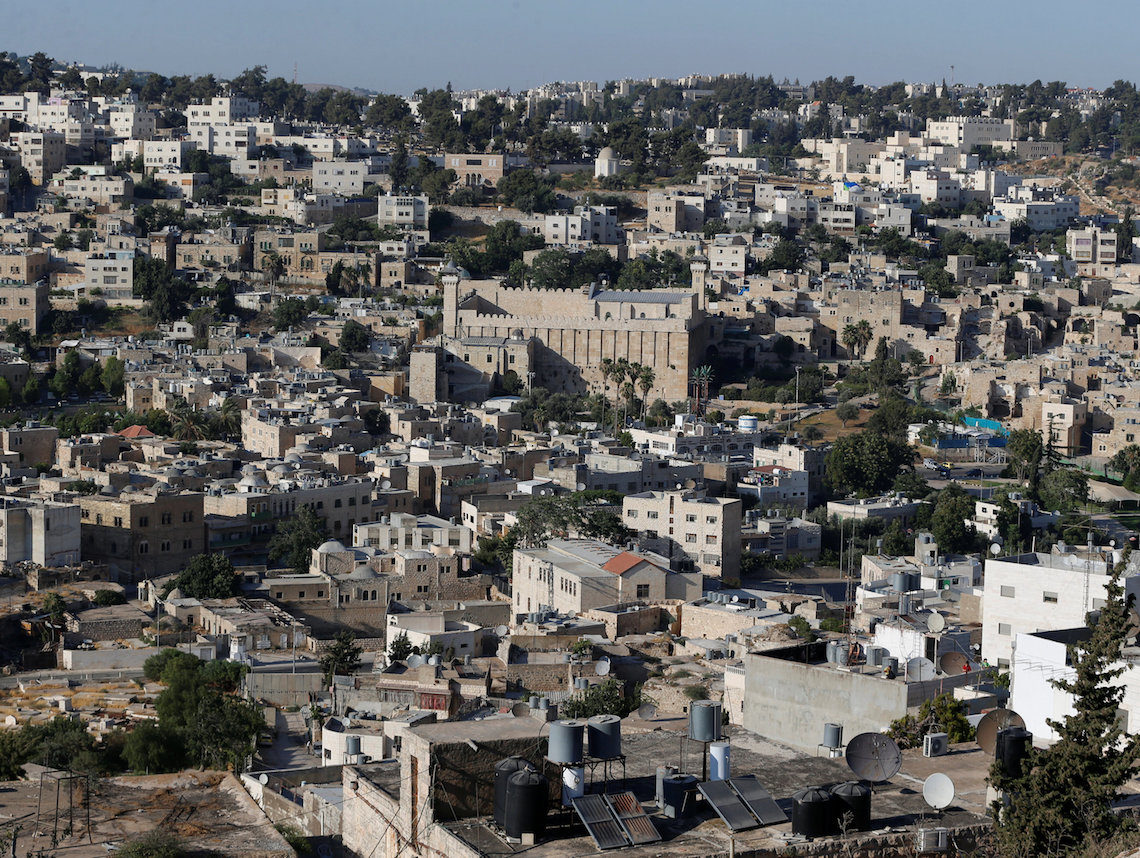
On July 12, I joined hundreds of people from around the world at the Machpelah Cave in Hebron, the sacred resting place of our patriarchs and matriarchs. We came to pray and to strengthen one another, to honor and seek blessings from our ancestors, and to express love and appreciation for the brave Israel Defense Forces soldiers who protect the site.

Six days earlierUNESCO, the United Nations’ (U.N.) world heritage body, sought to erase 3,753 years of history. In a shameless attempt to minimize the Jewish connection to this most ancient and revered Jewish site, it voted (by secret ballot, no less) — as reported by The New York Times — to declare the Machpelah Cave a “Palestinian World Heritage Site.” Jews and non-Jews from around the world, and from across the religious and political spectrum, united in expressing outrage at this latest endeavor to rewrite history. Lately, we’ve come to expect such attempts, as vilifying Israel has become the new “normal” at the United Nations.

To dispel this latest obfuscation of truth, here are five historical points ignored by the U.N. that testify to the connection between the Jewish people and this holy site:

1. As documented in the Torah and classic Jewish texts, Hebron was Abraham’s home for 75 years. He purchased the Machpelah Cave in Hebron as a family burial plot (Genesis 23:1-20) after his wife Sarah died. Thus, Hebron is the first part of the Land of Israel that officially became “Jewish property.” Ultimately, Abraham was buried there himself (Genesis 25:9-10), as were his son Isaac, Isaac’s wife, Rebecca, (Genesis 35:29, 49:31), Isaac’s son Jacob, and Jacob’s wife Leah (Genesis 49:31, 50:13). Hebron was Isaac’s home for most of his life, and Jacob lived in Hebron and inherited the Machpelah Cave.

Later, the Bible recounts how after the Jewish people left Mount Sinai, in order to enter the Land of Israel, Moses sent scouts to investigate the land prior to their entry. According to the Talmud, Caleb, one of the scouts, sensed that the other scouts were planning to dissuade the people from entering the land, so he went to the Machpelah Cave to pray that he not succumb to their scheme. When the scouts returned, only he and Joshua encouraged the people to prepare to enter the land. Subsequently, the city of Hebron was awarded to Caleb.

2. Hebron was King David’s first capital city. Archaeological evidence points to the fact that David was first crowned king in Hebron (875 B.C.E., 2 Samuel 2:1-4) over his own tribe, Judah, and then, seven years later, he was accepted in Hebron as king by the other tribes, as well (in 868 B.C.E., 2 Samuel 5:1-5). After this, he moved his capital to Jerusalem.

Let us urge the United Nations to turn its attention to where its efforts can be truly fruitful to humanity … Delegitimizing Jewish history is not an endeavor worthy of the United Nations.

3.  The Temple’s continual connection to Hebron. In 831 B.C.E., David’s son and successor, King Solomon, built the First Temple in Jerusalem. Every morning, the Temple priests did not begin the daily service until the sun rose and Hebron became visible, in order to link the merit of the patriarchs and matriarchs to the Jewish people’s daily connection to God (Tamid 3:2; Yoma 3a).

4. For millennia, Hebron has been recognized as Judaism’s second-holiest city, after Jerusalem. According to the Zohar, the second-century classic of Jewish mysticism, the cave is called Machpelah (“double”) because it is the connecting point between our physical world and the upper, spiritual worlds, and that when a person dies, his soul enters the afterlife via the Machpelah Cave. For the same reason, the city is called “Hebron” (Chevron, related to chibur), which means “connection.”

5. Jewish settlement in Hebron has been documented and uninterrupted throughout the generations, save for 20 years between 1947 and 1967, when Hebron was under Jordanian rule and Jordan banned Jews from living within its borders. In 1967, when Israel was attacked by the surrounding Arab countries in an unprovoked war, Israel reclaimed its historic heartland, including Hebron.

This year marks 50 years since the city of Hebron and the Machpelah Cave once again became accessible to Jews and to people of all faiths. For the preceding 700 years, beginning with the rule of the Mamluks (1260 C.E.), access to the cave was granted solely to Muslims.

Let us urge the United Nations to turn its attention to where its efforts can be truly fruitful to humanity — by helping to stop the massacre of innocent civilians in Syria; combating ISIS and other terrorist groups; and ending world hunger, disease, war and discrimination. Delegitimizing Jewish history is not an endeavor worthy of the United Nations.


RABBI CHAIM N. CUNIN is director and general editor of Chabad House Publications and associate rabbi at the Beverly Hills Jewish Community, which meets weekly at the Beverly Hills Hotel. This article is adapted from the newly released Kehot Chumash (Chabad House Publications).

5 Hebron facts the UN needs to know Read More »

How Radiohead got its big break in Israel

When the members of Radiohead take the stage in Israel Wednesday night, they will embark on one of the most politicized performances of their careers.

Their imminent concert in Tel Aviv’s Hayarkon Park has drawn the ire of pro-Palestinian advocates for months and reignited the debate over the BDS movement’s attempts to push a cultural boycott of Israel. In April, former Pink Floyd frontman Roger Waters and dozens of other high-profile artists signed a letter urging Radiohead not to play in the Jewish state. Radiohead’s singer Thom Yorke responded to the vocal critics last month by calling them “patronizing,” and he even got in a personal tiff with Ken Loach, a British film director he has said he admires.

Some festival attendees showed up at a recent Radiohead show in England with Palestinian flags — and earned a middle finger from Yorke.

It has been an unexpectedly taxing time for a band that just issued a celebratory re-issue of its seminal 1997 album “Ok Computer” and is touring the world on the heels of its latest critically acclaimed album, “A Moon Shaped Pool.”

But there may be an unexpected reason why Radiohead is going through all of this trouble to play in Israel — as Hardeep Phull points out in the New York Post, it’s where the band’s fortunes first changed for the better.

Exactly 25 years ago, the group put out their first EP, titled “Drill,” which received barely any attention in their native England. The British music magazine NME trashed the band in a review at the time, calling them “pitiful” (and Yorke “ugly”). They released their first album, “Pablo Honey,” in 1993 — but that didn’t make much of a splash either. Even the single “Creep” — which over the years has arguably become their most recognizable song — sold only a few thousand copies upon arrival.

In Israel, however, “Creep” was an instant hit. Thanks in part to constant play by Army Radio DJ Yoav Kutner, the song quickly climbed up Israel’s charts. So the glum band, desperate for some inspiration, decided to play a few shows there in 1993.

“While we were all down in the dumps we heard from Israel that it was high in their charts, so we went there and it proved it could be successful as long as people heard it,” guitarist Jonny Greenwood told Q Magazine in 2001.

In Tel Aviv, the band was treated like, well, rock stars. Fans mobbed them. A customs agent at the airport made Yorke hum “Creep.” Greenwood met his future wife, visual artist Sharona Katan. At the last of their three shows there, the band played “Creep” twice and gave Kutner a friendly shout-out.

Phull writes that this was the turning point that sent Radiohead to success in the U.S. and the U.K. After the shows in Israel, American and British radio stations took to playing “Creep,” and the song, re-released in the U.K., rose up the pop charts. Their next album, 1995’s “The Bends,” was given much more mainstream attention — and the rest is rock history.

This might be why Yorke, Greenwood and the gang have been willing to weather so much grating political pressure to play in Israel: It’s where they first tasted stardom and realized the power of their music — which, at the end of the day, transcends politics.

How Radiohead got its big break in Israel Read More »

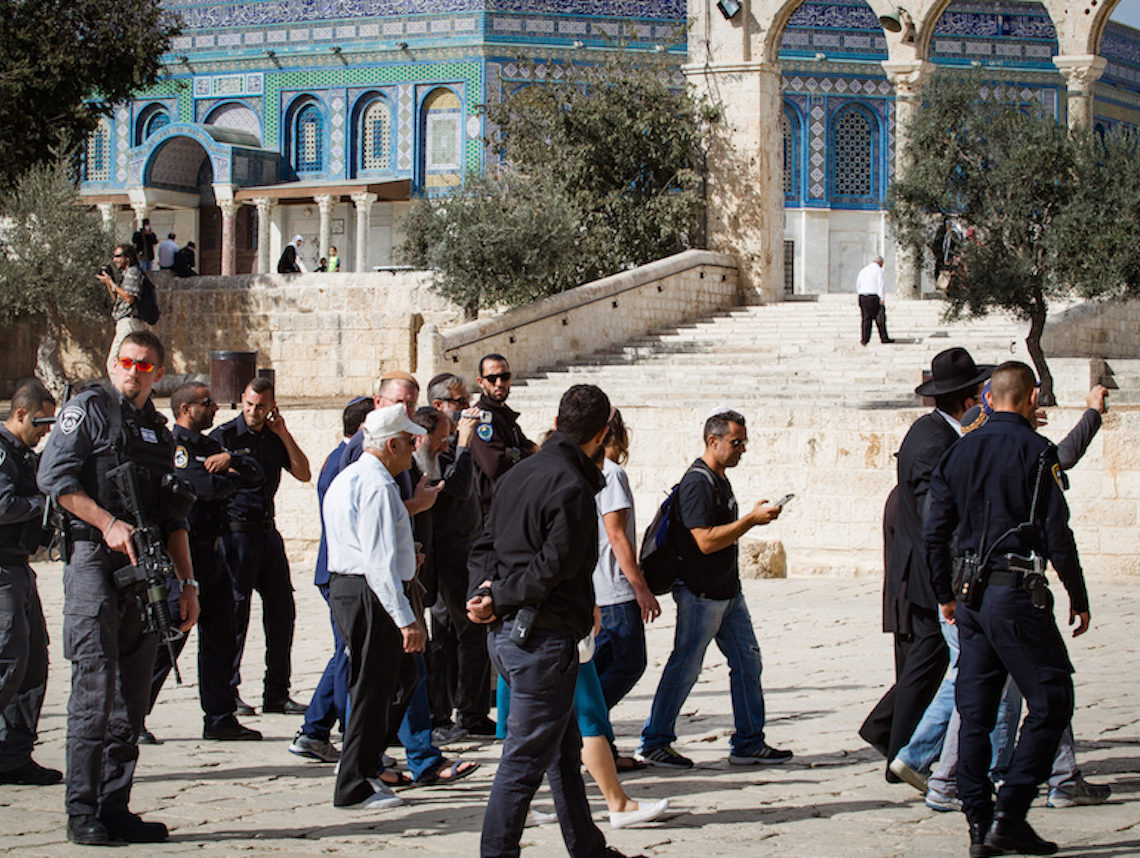
Police close Temple Mount to Jewish visitors

Police closed the Temple Mount to Jewish visitors after a group of Jews began praying at the site in violation of the rules there.

Jerusalem District Commander Yoram Halevy ordered the closure on Wednesday over the Jewish group’s “violating the rules of conduct that apply to the holy site,” according to Israel Police.

The Jewish visitors brought prayer books to the site, Haaretz reported. One was warned not to use the book, and after a second took out one, the group was expelled, according to Haaretz.

Police had closed the Temple Mount on Friday in the wake of an attack that killed two Israel Police officers.

Both Jewish visitors and tourists were allowed back on the holy site Monday, a day after two of the nine entrances reopened to Muslim worshippers with metal detectors and security cameras installed. The Mughrabi Gate entrance for Jews and tourists already had metal detectors in place.

The return to the site marks the first time that Jewish visitors to the Temple Mount are not under scrutiny by guards for the Muslim Waqf, the Islamic trust that oversees the holy site, since Muslims are boycotting the site over the presence of the metal detectors. The Waqf guards usually watch to make sure Jewish visitors do not pray or perform any religious rituals at the site, which is a violation of the so-called status quo.

Also Wednesday, the Waqf announced that all mosques in Jerusalem would be closed Friday in order to bring worshippers to pray at the gates of the Temple Mount in a protest move against the new security measures.

The announcement comes after Muslim protesters clashed with police outside of the Temple Mount for a second night in a row. The clashes Tuesday night came after the protesters held a prayer service at the gates of the site. Police responded when protesters threw rocks and bottles at the officers.

Arab-Israeli lawmakers joined the protesters and called for the metal detectors at the site to be removed. Protesters yelled “we will sacrifice our lives for Al-Aqsa,” “we’ll die as martyrs,” “there will be an intifada,” and “there’s nothing like killing soldiers,” Ynet reported.

Dozens of protesters were injured in the clashes, three seriously, the Palestinian Maan news agency reported.

Police close Temple Mount to Jewish visitors Read More »

The Mahmoud Abbas exchange, part 1: A man of peace turned autocrat

Amir Tibon is an Israeli journalist who covers Washington, D.C. for Haaretz newspaper. Prior to Haaretz, Tibon was the diplomatic correspondent for Walla News, a leading Israeli news website. His writing on Israel, the peace process and the Middle East has appeared in Foreign Affairs, Politico Magazine, The New Yorker, The Atlantic, Tablet Magazine, The New Republic, The Huffington Post, The American Interest, and The Jerusalem Report.

Grant Rumley is a research fellow at the Foundation for Defense of Democracies, where he focuses on Palestinian politics. Rumley has published in leading media outlets, including Foreign Affairs and Foreign Policy, and contributed commentary to The New York Times, Reuters, and Newsweek. Prior to joining FDD, Rumley was a visiting fellow at Mitvim, The Israeli Institute for Regional Foreign Policies. While in Jerusalem, Grant also founded and edited The Jerusalem Review of Near East Affairs. Previously, Grant served as a consultant in Washington on issues related to counter-terrorism, the Middle East, and war-gaming strategies.

The following exchange will focus on Tibon and Rumley’s new book The Last Palestinian: The Rise and Reign of Mahmoud Abbas (Prometheus Books, 2017).

***

Dear Amir and Grant,

 In the first chapter of your book, you use these frustratingly sad words to describe the hero of your book, Palestinian President Mahmoud Abbas:

 Mahmoud Abbas started his presidency as a man of peace and institutions. More than a decade into his four-year term, he will end it as just another regional autocrat…

Taken together, the arc of Mahmoud Abbas’s career bends toward that of a missed opportunity. If Israeli officials were to describe their ideal negotiating partner, they would describe someone almost identical to Abbas, with his aversion to terror and stated willingness to compromise. But the tragedy of Abbas, and of the Israeli-Palestinian conflict in general, is in what he doesn’t bring to the table. He is not a charismatic leader and thus could not convince his people to modify their version of the national narrative. Peace requires leaders who have both the courage to sign an agreement and the ability to implement it. Abbas appeared at times in his life to have the former. He was never close to having the latter.

Written “more than a decade into his four-year term,” what kind of picture does your narrative paint of Abbas? Is this the tale of a well-meaning tragic hero who couldn’t implement his noble vision, or of a tyrant who’s hold on power has been hampering progress in the region?

Yours,

Shmuel

***

Dear Shmuel,

There are two competing narratives in explaining how Mahmoud Abbas rose to power within the Palestinian national movement. One narrative is that Abbas understood better than others in the movement that almost all conflicts eventually end in negotiations, and so positioned himself as the in-house “expert on Israel” and negotiator, realizing that when the time comes, these skills will make him the best candidate to lead the movement. The other narrative is that Abbas genuinely wanted an agreement with Israel and believed that getting one was in the best interest of the Palestinian people.

Our conclusion in the book is that both are true to some extent, but the second narrative is based on stronger evidence. Abbas has advocated negotiations with Israel since the 1970s — a position he consistently held even when other members of the PLO who shared his opinions, like Issam Sartawi, were being assassinated by rivals for seeking compromise. The Palestinians are in the Oslo process largely because of Abbas’ advocacy, and he consistently stuck to non-violence in the roughest periods of the conflict, such as the Second Intifada, when he chastised the terror elements of his own party for their brutality. As president, he has upheld security coordination with Israel through three wars in Gaza and countless clashes in the West Bank.

The tragic aspect of his story is that despite – or maybe even because of – his consistent support for negotiations, his political standing was never large enough to implement a deal. In 1995, after an agreement that Abbas and Yossi Beilin had negotiated behind the scenes for two years was leaked to the press, Abbas was slammed at home for conceding on core issues. The pressure deeply affected him, and he reneged on his own agreement and denied involvement.

Once he became president, this pressure only increased. In 2008, Abbas was presented a far-reaching offer by Ehud Olmert after more than 30 meetings between the two leaders, yet he left it on the table without issuing a response. To his defense, it should be noted that Olmert’s offer came when his own political standing in Israel was in shambles, and senior officials both in the US and in Israel advised Abbas to ignore it and wait for the next Israeli Prime Minister. But by not responding to Olmert, Abbas made it much easier for Benjamin Netanyahu, who has been ruling Israel since 2009, to reject any continuity with regards to Olmert’s offer, and thus to force Abbas to re-negotiate any future deal “from scratch.”

Abbas has little trust in Netanyahu, but in March 2014 he missed a rare opportunity to put pressure on his Israeli counterpart. It was then that Barack Obama presented Abbas with a new peace proposal, one that included the partition of Jerusalem and the establishment of a Palestinian state based on the 1967 borders. Had Abbas accepted that plan, even with reservations, Netanyahu would have been put in a tough spot, having to choose between saying no to a peace offer from a sitting American president with two and a half more years in office, or going along with a plan that would have likely forced him to change his coalition, and perhaps even leave his own party.

Instead of accepting the offer, however, Abbas walked away from it without an answer. Martin Indyk, who was in charge of the American negotiations team, explained in a recent interview that “while we made a massive effort to meet the basic needs of both sides in formulas that the two sides could accept, the bottom line was when we put them to Abbas, he was not prepared to accept them. He was not prepared to answer.”

What explains this behavior? Put simply, Abbas is currently too vulnerable at home to make the type of broad concessions a final-status agreement would require. He has no democratic mandate — he’s in the 13th year of a 4-year presidential term and he lost his parliamentary majority in 2006 to Hamas — and he doesn’t even control the proto-state he claims in negotiations. Losing Gaza in 2007 to Hamas in a civil war was the death knell of the modern peace process: Abbas can’t sign an agreement because he can’t implement one, and any gap between signing a hypothetical agreement and its implementation only leaves Abbas exposed to his rivals’ criticisms, and potentially worse.

This weakness, coupled with his inability to deliver on statehood for his people, has caused Abbas to turn more and more autocratic at home. He’s silenced his rivals, consolidated his grip on power in both his party and the Palestinian Authority, and overseen the diminishing role of media and civil society. The tragedy of Abbas the leader is that the man who criticized Arafat for his iron-clad grip on power has largely replicated his predecessor’s ruthless governing style. Perhaps he wouldn’t have turned into the authoritarian he is today if he had actually produced a sovereign state for his people through negotiations, his preferred route. But in the absence of that, all he can do in order to remain in power is silence the opposition – and consolidate his control over the PA’s institutions.

The two Arab leaders who have actually signed peace agreements with Israel – King Hussein of Jordan and President Anwar Sadat of Egypt – weren’t great believers in democratic institutions, to say the least. But fairly or not, history will most likely remember them by their diplomatic achievements rather than their heavy-handed governing styles at home. Sadly, as of today, the same cannot be said about Mahmoud Abbas.


The Mahmoud Abbas exchange, part 1: A man of peace turned autocrat Read More »