fbpx

March 23, 2017

Daf Yomi, justice, and the minimum wage

Those of us participating in Daf Yomi are now four and a half years into the current cycle, with three years to go. Studying a page of Talmud a day, we are combing the broad expanse of the ancient rabbinal discussions that make up the Mishnah and the Gemara. In our recent studies of tractate Bava Metzia, we delved into concepts that are relevant for controversial policy issues in the news today—one of them being the minimum wage.

The issue of the minimum wage—sometimes referred to as a living wage or a just wage — continues to be a contentious issue. Presumably, we as a society would like to ensure that those who work earn a reasonable wage, one that is, at a minimum, sufficient to cover one’s basic human needs. Surely, the thinking goes, any compassionate society would do no less. But the issue is not so straightforward, and our Jewish tradition, including the Talmud, provides some guidance.

Insisting that employers pay their employees a minimum amount undoubtedly helps those who’s wages will be higher—which seems beneficial in and of itself. But it will inevitably have unintended consequences. For example, how will it affect other workers? If employers decide to hire fewer workers, will some workers lose their jobs, or not be hired in the first place? Is this compassionate?

Economists have looked into this question, but there is as yet no consensus. Some cite statistics that show that there is no marked decline in employment. Others have data to prove that the imposition of higher wages does reduce employment. The American Enterprise Institute just came out with a 48-page paper on the subject, concluding that the minimum wage does appear to reduce employment, but they also called for more research.

There is another potential unintended consequence. Many teenagers and young adults are often looking just to get started in the job market. Many are thrilled to have a job, any job, even if it pays only $7.50 an hour, in order to get some experience—ultimately enabling them to eventually move on to jobs requiring more skills and experience which will pay more. Imposing a higher minimum wage may deprive young people of these initial jobs. Is this compassionate?

These social science questions are important, but there’s actually a deeper question. Is legislating a higher minimum wage even just? In mandating higher minimum wages, government is requiring that employers pay their lower-skilled workers more than they might otherwise pay them—and more than workers might actually be willing to accept. Is this consistent with our traditional notions of justice? This question is not a new one. It comes up in ancient Jewish texts—related to property rights, labor law and charity law—including Bava Metzia.

Property rights are usually considered to be sacrosanct. As Joseph Isaac Lifshitz explains in Judaism, Law & the Free Market: An Analysis, there are numerous prohibitions in the Bible relating to the property of others — against, for instance, stealing land and acquiring property through fraud. The Eighth Commandment prohibits stealing. The Tenth Commandment prohibits even the coveting of one’s neighbor’s property. As evidence of the importance of private property, Lifshitz notes, “punishments … are meted out in the Bible to those who undermine the social order through their flagrant disregard for it.”

This presumably entails not just the private property of individuals but also that of companies. One would assume that, absent some extraordinary public purpose, government should not have the authority to coerce companies to expend their own resources, their own private property, in certain mandated ways—like paying their employees more than they otherwise would. This kind of government mandate would seem to be a violation of companies’ property rights.

Some might say that the needs of employees, particularly poor employees, should take precedence over the rights of employers. However, one could ask the question—in a potential dispute between employees and employers, should not justice be blind? As it says in Leviticus 19:15, “You shall not commit a perversion of justice; you shall not favor the poor and you shall not honor the great.”

What about labor law? Should there not be some requirement for companies to pay their employees a living wage? According to our Jewish tradition, this is a little more complicated, requiring inferences from other law.

Dealing fairly in business, including pricing things fairly, is one of the cornerstones of the law, again going back to the Bible. As it says in Leviticus 25:14, “When you make a sale to your fellow or when you buy from the hand of your fellow, do not victimize one another.” This is called the law of ona’ah—“overreaching”—which is prominently discussed and debated in Bava Metzia.

 In his 2008 Tradition article “The Living Wage and Jewish Law,” Rabbi Aaron Levine, the late Yeshiva University economics professor, explains that “The law of ona’ah prohibits an individual from concluding a transaction at a price that is more favorable to himself than the competitive norm.”

The Talmud does not explicitly discuss the idea of the minimum wage, but, extrapolating the law of ona’ah to wages, one would conclude that the wages that a company pays should not be substantially below the going rate for comparable jobs. As Levine notes, “A worker who cannot command a living wage in the marketplace cannot claim a living wage based on ona’ah.” As one can see, according to the law of ona’ah, wages should not be based on an employee’s needs.

There have been challenges to this perspective, however. For example, Jewish law stipulates that judges are to be paid a living wage. But can the case of a judge, who’s hired by a community to devote himself exclusively to his or her judicial job, be extended to the private sector?

Levine speculates that “if [the private sector employer] offers the head of a household a full-time job and stipulates with him that he may not take on outside employment, [the employer] must pay [the employee] a ‘living wage.’” This, however, is not common, particularly for lower-skilled workers, so this challenge is not a compelling one.

Another challenge comes from the Biblical law of lo talin—also discussed in Bava Metzia—the prohibition against withholding a worker’s wages. As it says in Deuteronomy 24:14-15, “You must not withhold the wages of a poor or destitute hired worker … You must give him his wages on the day they are due, and not let the sun set upon him, for he is poor, and he depends on it.”

These Biblical verses can be interpreted to mean that, if a worker does receive payment on time, then he will be able to provide for his family—thereby implying that employers are required to pay their workers enough to provide for their families. However, as Levine shows, “The inference is unwarranted.” The verses are not meant to suggest that a violation of lo talon will literally endanger the employee’s life. They’re intended to underscore the employer’s moral obligation to pay one’s workers on time.

This brings us to the law of charity. Is there a basis for a higher minimum wage as an act of charity? What exactly is required of employers?

Helping someone get out of poverty is one of the highest levels of charity. As it says in Deuteronomy 15:7-8, “If there will be among you a needy person … you shall not harden your heart, and you shall not close your hand to your needy brother. Rather, you shall surely open your hand to him, and you shall give him sufficient for his needs, which he is lacking.”

Providing a needy person with a job—with a competitive wage—is one of the best examples of charity. At the same time, is it the employer’s responsibility to ensure that employees have enough to provide for themselves and their families?

If a young adult is having difficulty making ends meet, we would expect that his or her family, not the employer, would be first in line to help out. But what about the case of a needy employee who has primary responsibility for his or her family?

Deuteronomy 15:7-8 has been interpreted to mean that the community as a whole, not one individual nor one employer, has the moral responsibility to help those in need. Referring to the responsibility as dei mahsoro—“give him sufficient”—Levine notes that Jewish law “has interpreted the dei mahsoro mandate as a collective responsibility, rather than a duty for individuals to shoulder alone when they personally encounter charity cases. Because the ‘living wage’ mandate saddles employers alone with the burden of relieving poverty for the working poor, it does not follow from dei mahsoro.”

The idea of the minimum wage, while seemingly reasonable and compassionate, raises several difficult issues. From an economic perspective, it may actually reduce employment, which would not be compassionate for those struggling to find a job. It also raises important issues of justice. Based on property rights, labor law and charity law, as defined by many of our sacred texts and sages, the idea of the minimum wage is problematic. We may have a moral obligation to help those in need, but we also have a moral obligation to deal with each other justly.

Daf Yomi, justice, and the minimum wage Read More »

Jewish leaders applaud arrest of Israeli-American teen in bomb threat case

The director of the Westside Jewish Community Center today welcomed the arrest of an Israeli-American teenager on suspicion of perpetrating more than 100 bomb threats against a variety of Jewish institutions in the United States, even though it remained unclear whether the individual was responsible for the recent threats against the Westside JCC and the Alpert Jewish Community Center in Long Beach.

“I’m hopeful that this brings closure to what has been a very difficult ordeal for Jews and Jewish community centers across North America,” Brian Greene said.

The Westside JCC received two threats, one on Feb. 27 over the phone and another on March 9 via email. The JCC in Long Beach received two threats as well, on Jan. 31 and Feb. 27.

FBI spokesperson Laura Eimiller said in an email to the Journal that it is too soon to say if the suspect had a role in the threats against the local JCCs.

“They [the investigators] have not yet provided a breakdown, and are presumably still working through that,” she stated.

Since Jan. 4, there have been more than 160 threats against Jewish community centers, schools and other institutions. The threats have been a mix of live and prerecorded phone calls and emails.

An FBI national spokesperson said the arrest occurred around midnight Eastern Time.

“Early this morning in Israel, the FBI and Israeli National Police worked jointly to locate and arrest the individual suspected for threats to Jewish organizations across the United States and in other parts of the world. The FBI commends the great work of the Israeli National Police in this investigation,” an FBI statement says. “Investigating hate crimes is a top priority for the FBI and we will continue to work to make sure all races and religions feel safe in their communities and in their places of worship.”

The Anti-Defamation League (ADL) provided a few details about the suspect in a statement.

“Israeli police and the FBI arrested an 18-year-old Israeli-American suspect after a months-long undercover investigation, saying the man had used advanced technologies to hide his identity. The suspect holds dual American-Israeli citizenship, according to authorities.”

According to media reports, the arrest took place at the suspect’s home in Ashkelon, and the suspect’s father, who reportedly knew of his son’s activity, was arrested as well.

While JCC Association of North America President and CEO Doron Krakow applauded law enforcement in a statement, he said there was something about the arrest that was distressing.

“We are troubled to learn that the individual suspected of making these threats against Jewish community centers, which play a central role in the Jewish community, as well as serve as inclusive and welcoming places for all — is reportedly Jewish,” he stated.

Even if the suspect is Jewish, the actions nevertheless amount to a hate crime, as they involved the intentional terrorizing of Jewish communities, according to ADL Senior Associate Director Alison Mayersohn.

“We don’t know what motivated the alleged perpetrator, but when a perpetrator targets an institution specifically because it is a Jewish institution, that’s a hate crime, and we consider the act anti-Semitic. The ADL does not believe the perpetrator’s religion or nationality is relevant,” she said.

Jewish leaders applaud arrest of Israeli-American teen in bomb threat case Read More »

Today’s arrest debunks the “Trump fosters anti-Semitism” dreck

Today’s arrest in Israel of a Jewish teenager suspected of making dozens of bomb threats to Jewish centers means neither of the only two people yet accused of perpetrating the recent anti-Semitism is a white supremacist, Trump-loving Jew-hater. Combined with the March 3 arrest of the African-American, socialist, Trump-hating Juan Thompson in some of the hoaxes, all the evidence now points the other way. The president’s detractors who have been sounding the hollow “Trump Fosters Anti-Semitism” drumbeat should just hang up their sticks.

In late February, news and social media were abuzz with a poorly sourced report claiming the president had suggested some of the incidents were “false flags” (though without evidence he used that term) in which people sympathetic to Jews are anonymously play-acting anti-Semitism to make Trump’s supporters look bad. Reports in the Washington Post, the Daily Beast, Slate, Salon, and elsewhere were aghast that the president would shift blame from the obvious culprits – anti-Semites emboldened by the way he had conducted himself in the campaign and in office.

Now we’ve found significant evidence the “it’s the reverse” claim – which the president may not have even made – reflected the truth all along. But the very idea that Trump has inculcated anti-Semitism is thinner than a matzah:

  • Trump’s “failure to denounce” anti-Semitism was an unfair insult, since the default position should have been that of course he’s against anti-Semitism. Even after he condemned it, the accusations intensified in some quarters by anti-Trump activists looking to take cheap shots.
  • Similarly, Trump is not responsible for nasty people like David Duke, Richard Spencer, and the legions of internet trolls choosing to support him. The proper response to the bile that comes from such bigots is almost always silence.
  • Trump’s evocation of “America First” in his Inaugural Address relied on a logical slogan for his policies – one that has been used by several Democrats. Nobody would know it had also been used by Charles Lindbergh and other anti-Semites if anti-Trump journalists and activists hadn’t tell them.
  • Trump almost certainly did not approve the campaign ad immediately before the election that supposedly contained coded messages suggesting a vote for Hillary would empower the Jews. The notion that the Trump campaign would spend resources on a last-minute pitch to “dog whistle” the supposed voter bloc of Hillary-leaning anti-Semites is ludicrous.
  • Similarly, the White House’s Holocaust statement that universalized the event without mentioning Jews was written by a Jewish staffer, not Trump; and the administration’s refusal to apologize for it sprang from Trump’s general aversion to apologies, not some passion for downplaying Jewish suffering.

Look, as a gay Jewish opponent of this president I would be the first to squeal if the president did something actually anti-Semitic – or anti-gay. But those accusations have consistentlyproven hollow, and today’s news should put the entire polemic to rest.

Sometimes what seems to be a wave, we are discovering, is more of a ripple. With 2017 technology, a single disturbed person can make dozens or even hundreds of very scary bomb threats. Though the teen just arrested was not behind the unsolved vandalism at the Jewish cemetery in St. Louis (where four Benkofs are buried, by the way), today’s news underscores the need for caution before assigning motives to attacks on Jews.

A great example is the widely reported swastika graffiti with inscriptions like “Make America White Again” and pictures of Trump with a Hitler mustache. While those acts of vandalism could have been perpetrated by Jew-hating fans of the president, it is just as reasonable to speculate the culprits were sarcastically expressing the very message liberal opponents of the president have been making for more than a year: that Trump is a Nazi.

President Trump doesn’t respect our democracy, our freedoms, or the very notion of truth. Hisrecklessness and ego are a constant danger. So why do his opponents harp on a trope whose evidence evaporates by the minute? Well, for decades liberals have been so enamored with “Republicans hate the following groups” that they cling to it like Velcro even when the emerging truth is far more complicated.

While Trump has expressed umbrage at the anti-Semitism charges, every moment his opponents fight against harmful things he isn’t doing, they aren’t fight against harmful things he Is doing.

Sad.

David Benkof is a columnist for the Daily Caller, where this essay first appeared. Follow him on Twitter (@DavidBenkof) and Muckrack.com/DavidBenkof, or E-mail him at DavidBenkof@gmail.com.

Today’s arrest debunks the “Trump fosters anti-Semitism” dreck Read More »

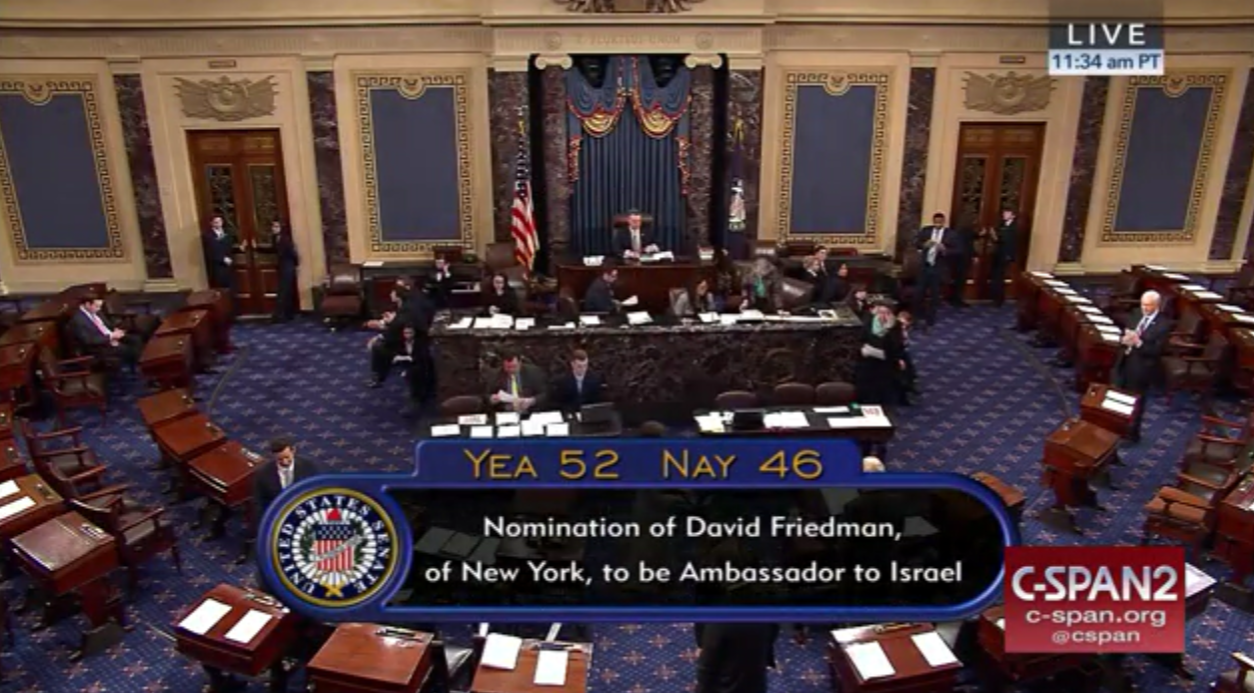
Senate confirms David Friedman by 52-46 vote

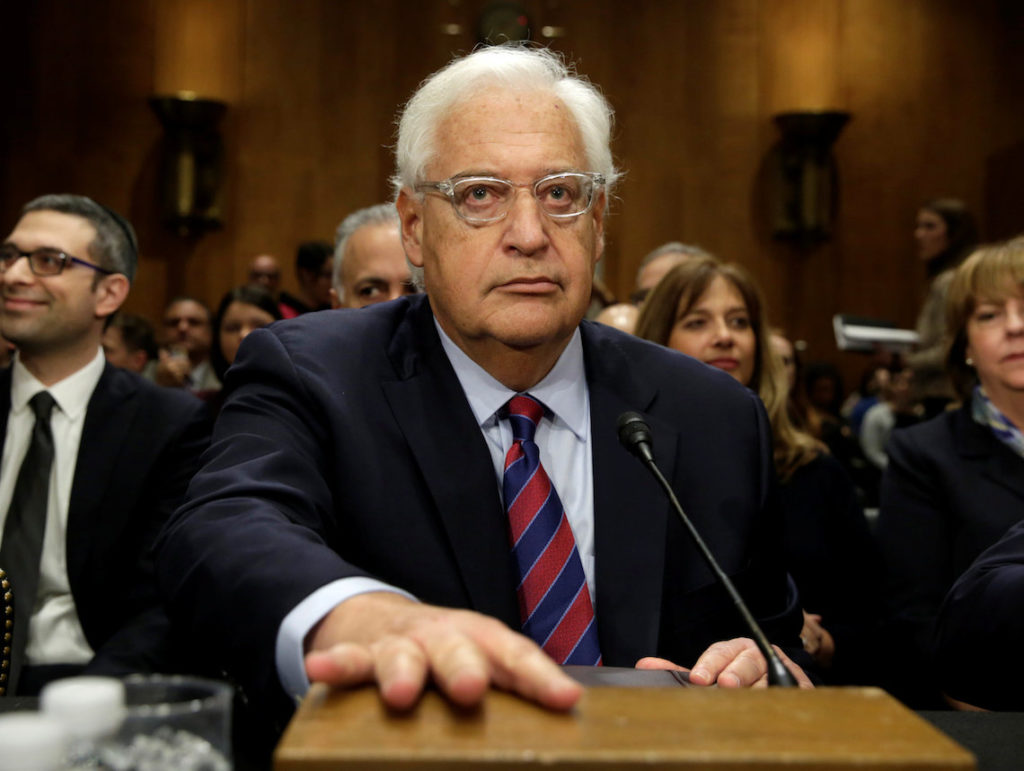
The Senate confirmed the nomination of David Friedman for U.S. Ambassador to Israel by a near party-line vote (52-46) on Thursday afternoon. Almost all Senate Democrats voted against Friedman including fellow New Yorkers, Senate Minority Leader Chuck Schumer and Senator Kirsten Gillibrand. Only two Democrats, Bob Menendez (NJ) and Joe Manchin (WV), crossed party lines and voted with the Republicans to confirm the nomination.

This post originally appeared at JewishInsider.com

“Mr. Friedman’s smearing of my fellow Jews, many of whom are members of J Street, should be a disqualifier,” Senator Al Franken from Minnesota said during a debate on the Senate floor.

Franken added that Friedman’s hardline views on the Israeli-Palestinian conflict will further complicate efforts to revive the peace process and achieve a two state solution. “Confirming David Friedman as Ambassador to Israel will only serve to make that job more difficult, if not impossible,” he asserted.

Friedman vote

During his confirmation hearing at the Senate Foreign Relations Committee last month, Friedman expressed regret for his past partisan comments and noted that he would be “delighted” if Israelis and Palestinians were able to reach a two-state agreement while expressing skepticism towards Hamas’ willingness to renounce terrorism. “I expressed skepticism about the two-state solution due to the Palestinians’ refusal to recognize Israel as a Jewish state,” he explained. “The two-state solution, if it can be achieved, will bring great benefits for Israelis and Palestinians.”

Explaining his opposition to the New York Attorney, Senator Brian Schantz (D-HI) noted, “Our Ambassador to Israel should not be more involved in Israel’s politics than our own.”

Last week, former Senator Joseph Lieberman assured Democrats that Friedman will perform his duties satisfactorily even beyond expectations. “I want to assure you that David Friedman will perform as Ambassador way above expectations,” Lieberman, who is a partner at the Kasowitz Benson Torres & Friedman law firm, said at a Yeshiva University symposium. “He will.”

According to the former Democratic nominee for Vice President, the near party-line vote on Friedman’s nomination was more about Trump, as most Democrats voted against all of the President’s cabinet picks.

Senate confirms David Friedman by 52-46 vote Read More »

At-home interview with “Major Crimes” stars Phillip P Keene, Kearran Giovanni

Phillip P Keene and Kearran Giovanni star on TNT’s top-rated drama, “Major Crimes”.  Their characters, Buzz and Amy, may be friends on screen, but once the cameras stop rolling the pair become more like family.  It was clear just how much they care for each other when I joined them recently at Phillip’s home to discuss the show as well as his former career as a Pan Am flight attendant.

‘Bad Blood’, last night’s episode of “Major Crimes”, hit home for Phillip.  One of his relatives served as the inspiration for the show’s victim, though he didn’t realize it immediately.  The close-knit cast did and were there to support him as he worked through his “funk”.

The conversation didn’t stop there.  The friends shared personal stories about when it’s like when their personal and professional lives intersect.  In fact, Phillip is married to “Major Crimes” creator and executive producer James Duff.  Kearran planned their wedding as well as a more recent 50th birthday party for Phillip.

The theme?  Phillip’s passion: Pan Am.  Phillip talks with nostalgia about the years he spent as a Pan Am flight attendant.  He owns one of the largest collections of Pan Am memorabilia in the world and looks forward to cataloguing and displaying these pieces of history for the public.

For exclusive party photos, a close look at Phillip’s Pan Am collection and more, take a look below:


—>Looking for the direct link to the video?  Click here.

At-home interview with “Major Crimes” stars Phillip P Keene, Kearran Giovanni Read More »

Israeli-American teen arrested in Israel for over 100 JCC bomb threats

JERUSALEM (JTA) — A Israeli teenager who also has American citizenship was arrested on suspicion of carrying out more than 100 bomb threats on Jewish institutions in the United States.

Israel’s anti-fraud squad arrested the 19-year-old suspect at his home in southern Israel and searched the premises on Thursday. He also is accused of a series of threats made in Europe, Australia and New Zealand in the past six months, according to reports in Israel.

Israeli police said the teen has been the subject of months-long undercover investigation by the anti-fraud unit, as well as the FBI in the United States and law enforcement in other countries. He has lived in Israel for many years, Haaretz reported.

He appeared in court in Rishon Lezion on Thursday for a remand hearing, where he was ordered held over until March 30. His motives are unknown, according to reports.

Ynet, which reports that the teen is from Ashkelon, reported that during the hearing the teens attorney requested that he be placed under supervision after raising concern for his mental status, claiming that he might try to harm himself. The attorney told the court that the teen has had a brain tumor since the age of 14, and has been homeschooled since then. The attorney said that the tumor affects his behavior, Ynet reported.

The teen reportedly used advanced technology and voice-altering equipment to call in the threats to more than 100 JCCs, Jewish day schools and other Jewish institutions in the United States, according to The Times of Israel. He also is accused of making a threatening call to Delta Airlines, leading to the emergency landing of at least one plane.

During the cyber unit’s raid on the teen’s home, police found a computer lab with sophisticated equipment, encryption and transmission systems, and a powerful antenna, according to reports.

The army refused to draft the teen after finding him unfit for service, Haaretz reported.

His father also has been detained on suspicion that he knew about his son’s activities, and ordered held in jail until March 30.

Israel’s minister of public security, Gilad Erdan, commented on the teen’s arrest.

“I congratulate the Israeli police on leading a complex international investigation, together with law enforcement agencies from around the world, which led to the arrest of the suspect,” Erdan said. “We hope that this investigation will help shed light on some of the recent threats against Jewish institutions, which have caused great concern both among Jewish communities and the Israeli government.”

Attorney General Jeff Sessions in a statement praised the work of the Israeli police and the FBI.

“The Department of Justice is committed to protecting the civil rights of all Americans, and we will not tolerate the targeting of any community in this country on the basis of their religious beliefs,” Sessions said in the statement. “I commend the FBI and Israeli National Police for their outstanding work on this case.”

Earlier this month, a St. Louis resident and former journalist, Juan Thompson, was arrested and charged for making at least eight bomb threats against Jewish community centers and the Anti-Defamation League.

Thompson, 31, made some of the threats in the name of a former romantic partner he had been cyberstalking and some in his own in an attempt to portray himself as being framed. He was charged with cyberstalking, which carries a maximum sentence of five years in prison.

Israeli-American teen arrested in Israel for over 100 JCC bomb threats Read More »

London terror: No. 30,499 in a series

Commenting on the recent London attack that killed four and injured at least 50, the acting Deputy Commissioner of the Metropolitan Police, Mark Rowley, told the BBC that it was “Islamist-related terrorism.”

A day earlier, on March 21, an Islamist suicide car bomber killed 10 people in Mogadishu, Somalia.

A day before that, two dozen people were blown up by an Islamist car bomber in a Baghdad neighborhood. 

Two days before that, a mother and her two children were among four people wiped out by three Islamist suicide bombers in Maiduguri, Nigeria.

A day before that, Islamist Shiite rebels fired two rockets into a Sunni mosque in Yemen, killing 34 people during Friday prayers.

On the same day in Paris, the throats of a father and son were slit by a family member yelling “Allah Akbar (God is great).”

A day earlier, a young child was blown to bits by an Islamist suicide bomber in Bangladesh.

On that same day, March 16, in South Ukkadam, India, an atheist was hacked to death by an angry Muslim over Facebook posts attacking his religion.

I know it’s painful to consider that 30,499 deadly attacks could be committed in the name of one religion.

That is just a little glimpse of weekly terror from the Third World and elsewhere. Worldwide, since 9/11, Islamist terrorists have carried out 30,499 deadly terror attacks, according to the independent watchdog site TheReligionOfPeace.com.

Most of these attacks never make it to CNN or The New York Times, because the victims don’t live in places like London, Brussels or San Bernardino. In the West, we see a fraction of the carnage done in the name of Islam. No matter how much media attention we give to the attacks on our soil, it doesn’t come close to capturing the scope of the global problem.

I know it’s painful to consider that 30,499 deadly attacks could be committed in the name of one religion. It challenges our narrative that all religions are pretty much the same, that there’s good and bad in all religions, and there’s no special reason to focus on one in particular. This is a comforting narrative that can lull us into complacency.

Still, there is an aspirational value to that narrative. It gives us something to look forward to. For humanity to succeed, we need it to become true. We need a reformation of Islam so that, one day, the number 30,499 will be reduced to a very low number and we can truly say that the religion is just like any other.

Because right now, it’s not. Too much killing, too much horror is done in its name.

It’s no longer enough to say, “This is not Islam.” For the killers doing the killing, it is Islam. It may be a radicalized, supremacist version of Islam, but there’s enough supporting text in the Quran to make the killers believe they’re doing God’s work.

Despite our efforts to counter this radical Islam, reform only gets more distant and the violence only gets worse. Defending the faith, accusing extremists of perverting it and engaging in interfaith projects is fine, but it’s not enough. True reform must come from the inside, not from interfaith but from innerfaith, from Muslims taking responsibility for the violence done in their name. 

It will come from Muslims who have the courage to acknowledge and confront the extremist parts of their texts and reinterpret them in a holy way that will honor their faith.

One such group is the little-known Muslim Reform Movement, a group of Muslim scholars and spiritual activists whose leaders call for “a respectful, merciful and inclusive interpretation of Islam” and reject interpretations that call for “any violence, social injustice and politicized Islam.”

For some reason, this movement has gained little traction among progressive circles, even though its founding declaration sounds like a love letter to progressive values. Going forward, we must ensure that such moderate groups are no longer marginalized by the mainstream, and are empowered to make progress in their supremely difficult mission.

We must pray that their nonviolent and tolerant interpretation of Islam will one day take hold throughout the jihadist world and win over the hearts of the killers, even if it takes a century. We must pray that the number 30,499 will eventually be reduced to zero.

Yes, that would be a miracle for humanity and for Islam, but God is great.


David Suissa is president of TRIBE Media Corp./Jewish Journal and can be reached at davids@jewishjournal.com.

London terror: No. 30,499 in a series Read More »

A correction: No American anti-Semitism, just an Israeli’s idiocy

Ten comments on the latest news: an Israeli was detained as a suspect in the phone threats aimed at American Jewish institutions in recent months.

1.

If you haven’t yet heard the news, here it is: a 19 year old Jewish Israeli was arrested as a suspect of carrying out hundreds of bomb threats called into US Jewish Community Centers. Apparently, “sources indicate that most of the cases of threats against Jewish communities and organizations, though not all, led investigators back to Israel.” If this guy, who has dual Israeli-American citizenship, is guilty – the case of the JCC threats is more or less closed.

2.

We know little about the youngster from Ashkelon and his motivation. We do not know if he is guilty. But let us assume for now that the arrest is not baseless. Let us try to understand what such an arrest means.

3.

It means that the wave of anti-Semitism in America was in many ways a creature of the imagination. America is as friendly to its Jews as it was before. Those of us who have been relatively cautious about this new “trend” should feel vindicated. Those of us who have been hysterical about it should reconsider their position.

4.

The teen from Ashkelon did not pay a visit to the St. Louis cemetery. So not all the cases of attacks against Jews were solved today. Then again, if most phone calls were his phone calls, the seismograph of anti-Semitic incidents goes back to normal.

5.

A lot of political points were scored as part of the discussion concerning anti-Semitism in America. Democratic critics of Donald Trump attempted to blame him for an atmosphere that prompted a wave of attacks against Jews. These critics should swallow their pride and apologize to the President. I know – apologizing to a leader who shows no tendency to apologize when he is mistaken will be difficult. But Jewish leaders should not succumb to the culture of Trumpism. They ought to take back their unsubstantiated criticism.

6.

If an Israeli kid with a telephone can create such a scare, maybe it is time to calmly and professionally reconsider the way Jewish institutions respond to phone threats. The phone calls were disruptive, among other things, because of the tendency of institutions to play it safe and take every call with a seriousness that it does not necessarily deserve. Of course, changing this habit carries risks. What if the one time an institutions doesn’t take a call seriously proves to be the one time that it was indeed serious? Still, a reconsideration of the procedures is necessary. Today it is an idiot from Ashkelon, tomorrow it can be an idiot – or a bigot – from someplace else. We should not let kids with landlines disrupt the routine of the Jewish community in such a way.

7.

What are the implications of this on Israel-Diaspora relations? That depends in some way on the motivation of the young attacker. If he is seen here as the representative of violent, hateful Israeliness – trouble is on the way. If he is seen here as just another idiot – which I assume he is – the relations will not suffer. In the meantime, caution is advised. Those people that were hasty in pointing a finger at Trump, should not repeat their mistake by pointing a finger at Israel, Netanyahu, Orthodox-American immigrants, or any other leader or group. It is time to wait for information before making a conclusion.

8.

Anti-Semites will surely have a field day with this news. Truth must be told: they’ll have a good talking point.

9.

One wonders how Trump will respond to this news. As a President, he should ignore it and let the authorities deal with it. As a Trump, it’s hard to believe that he’ll ignore it. Trump is not anti-Semitic, but he will also have a field day. Truth must be told: he will have a good talking point too.

10.

How does one punish such an idiot (assuming he is guilty of these phone calls)? The damage was significant. The motivation – still unknown. On the one hand, there’s a sense he needs to spend a long time in jail, reconsidering his actions and their implications. On the other hand, maybe he just needs to get smacked and sent back home. Spending time in jail for foolishly making phone calls seems severe. So it is not unlikely that within a short time many of us will move from being angry with this teen to pitying him.

(Update: According to his lawyer, the suspect has been suffering from a brain tumor since the age of 14 and ,as a result, has been homeschooled ever since.)


A correction: No American anti-Semitism, just an Israeli’s idiocy Read More »

Community Briefs 3/22

Mel Gibson’s support of Survivor Mitzvah Project revealed

Actor and director Mel Gibson, infamous for an anti-Semitic tirade he made after being stopped for DUI in 2006, has been supporting an organization that provides direct financial aid to poverty-stricken Holocaust survivors in remote areas of Eastern Europe and Ukraine, the group’s founder recently revealed.

Zane Buzby, founder of the Survivor Mitzvah Project, said she contacted Gibson after learning that he had gotten involved in philanthropic work, seeking to make amends for his past behavior.

“I read an article maybe three years ago that Mel Gibson had been actively involved in philanthropy, with children at risk, that he’d changed his life around and had been clean and sober for 10 years. I didn’t know any of that. I contacted him hoping that when I told him Holocaust survivors were in desperate need he would want to help them too, and he did,” she said.

He requested anonymity when he first became involved with Survivor Mitzvah Project, according to Buzby, who will be honored March 30 by the Anti-Defamation League (ADL) during the ADL Deborah Awards. Recently, as he has returned to the public eye — thanks in part to his 2016 film, “Hacksaw Ridge,” which follows a conscientious objector during World War II — Buzby asked Gibson if he would be OK if she publicized his contributions. He agreed; entertainment news outlet Extra reported the story on March 17.

“This is real. Gibson’s help is real,” Buzby said. “His big mistake in life was over 10 years ago. I’m not like his buddy, I don’t hang out with him, not involved in his personal life, nor do I know his family or his friends, but from where I sit, he has done a lot to help survivors and to me that’s a wonderful thing. It’s a wonderful story of redemption. It’s a mitzvah to ask for forgiveness and it’s a mitzvah to give it.”

Buzby declined to disclose how much Gibson, whose 2004 film “Passion of the Christ” drew condemnation from organizations such as the Anti-Defamation League, has given to the organization. But she did say Gibson has also helped connect her to other entertainment industry professionals.

“He knew a few and reached out to them, did that right in the office. He got it. He understood what we are trying to do. He liked that [the organization] was small, hands-on and not connected to big organizations flooded with funding. He knew every dollar he gave would count and knew he was being asked more than just to give money,” she said.

In 2016, the organization raised $700,000, the “best [fundraising] year we ever had,” Buzby said.

Federation meeting addresses security concerns in wake of bomb threats

A March 15 town hall meeting at The Jewish Federation of Greater Los Angeles’ Wilshire Boulevard headquarters attempted to assuage concerns over the increase in bomb threats targeting Jewish institutions across North America.

“In this community today we have the capacity to protect ourselves. Let’s work with those in law enforcement and others to do just that,” said Los Angeles City Attorney Mike Feuer, the former CEO of pro bono legal agency Bet Tzedek.

The event, attended by more than 100 community members, was organized by Federation’s Community Security Initiative, which trains Jewish organizations in security, and maintains a database that connects Jewish groups in the event of an emergency situation.

It featured Los Angeles Police Department Chief Charlie Beck and Federation chief operating officer and chief financial officer Ivan Wolkind. Additional speakers were FBI agent Sean Ragan; Capt. Bobby Wyche of the Los Angeles County Sheriff’s Department; assistant U.S. Attorney Mack Jenkins; Chris Grigg, chief of the terrorism and export crimes section in the U.S. attorney’s office for the Central District of California; and Beatrice Girmala, LAPD assistant chief officer of special operations.

“We are concerned, quite frankly, that a wave of threats like this, that come in by telephone, social media or some other means, may be a precursor and other people may take inspiration from it and feel they actually do have a license to engage in violence on our communities. We will act to stop it, but we can only do that if you in the community provide the information to our police officers and our sheriff deputies, because they are the first lines of contact,” Grigg said.

The more than 160 bomb threats at Jewish organizations since Jan. 4 included two such threats against the Westside Jewish Community Center among eight total threats across California. No suspects have been apprehended in connection with the local threats.

Feuer emphasized Jews are not the only community that has been a target of “acts of hate.”

Community Briefs 3/22 Read More »

Check In to Hotels, Check Out Decorating Ideas

Among my biggest design inspirations are hotels. When choosing a hotel, the first thing I consider is not the room rate or location, but how cool the décor is.

My love affair with hotel design started in the ’90s when, fresh out of college, I splurged on a New York vacation to stay at the Philippe Starck-designed Paramount Hotel on West 46th Street in Times Square. The moment I stepped into the hotel lobby, I felt the transformative power of interior design. Not only was every square inch of the hotel awesome to behold, the hip factor had rubbed off on me. Suddenly, I felt like a model in a Calvin Klein fragrance commercial — glamorous, mysterious and full of ennui. The only thing that could have made it better was a free breakfast buffet.

Now, whenever I stay at a boutique hotel, I take lots of photos that go into my inspiration file, and design elements from many of them have found their way into my own decorating.

The Paramount Hotel.

Paramount Hotel,
New York City

Design inspiration: Upholstered headboard

My favorite part of the room at the Paramount was the giant upholstered headboard featuring a Vermeer painting. I had never thought that something as utilitarian as a headboard could be art — literally. I’ve since created framed, oversized headboards for clients that have depicted goldfish swimming around orchids, an angel sunbathing by the pool, and even a photograph of the exterior of Tiffany’s in Beverly Hills. (Sadly, the Paramount was sold to a hotel conglomerate in 2011, and the Philippe Starck décor is no more.)

Hotel Zeppelin.
Hotel Zeppelin.

Hotel Zeppelin, San Francisco

Design inspiration: Typography

Perhaps because I’m both a writer and a designer, I like the idea of decorating with words. Text is used quite whimsically in the rock ’n’ roll-themed Hotel Zeppelin in the Union Square district. The graphic wallpaper in the bathroom incorporates names of singers and bands in a retro font, giving new meaning to bathroom reading. And the overhead light above the bed surprises you with a message when you turn it on. Depending on your room, the word could be “love,” “peace” or “prosper.”

Door murals at the Hotel Max.

Hotel Max, Seattle

Design inspiration: Door murals

An artist-centric hotel, Hotel Max showcases the work of a different local photographer on each floor, covering the doors to each guest room with that photographer’s work. When I saw those doors, they really got my creative juices flowing, and I could not wait to do something similar. I got the chance when designing the Jewish Journal offices, and I needed to cover the dull wood doors that came with the space. I found vintage stock photos of reporters and newsrooms, had adhesive murals made of them and applied them to the doors. Walking down the hallway, it’s like a gallery.

Hotel Le Bellechasse, Paris

Hotel Bellechasse in Paris.
Hotel Le Bellechasse in Paris.

Design inspiration: Decorating the ceiling

Designed by Christian Lacroix, Le Bellechasse is a kaleidoscope of pattern and color squeezed into tiny rooms typical of Parisian quarters. Once you get over the puzzling fact that the bathtub is in the bedroom, you can appreciate the marvelous design details, like quirky wallpaper that extends across the ceiling. Lying in the bed and looking up, I truly appreciated the attention paid to the ceiling. It is valuable decorating space that is rarely used. Now, I always consider how to design above the eye line, whether it’s as simple as painting the ceiling or hanging an interesting light fixture.

Check In to Hotels, Check Out Decorating Ideas Read More »