fbpx

March 9, 2017

NY Jewish Children’s Museum hit with bomb threat

The Jewish Children’s Museum in Brooklyn was evacuated after receiving an emailed bomb threat.

The museum was evacuated Thursday morning following a call to the police, AM New York reported.

Devorah Halberstam, the museum’s director of foundation and government services, told JTA the evacuation was still ongoing as of 11:15am.

“It’s a trying time for us as a Jewish people especially, and we need to be aware and we need to take heed, and we need to be careful,” Halberstam said.

She added: “I’m referring to all the threats that have been going on both locally and internationally — it’s something that is very frightening. Unfortunately anti-Semitism has been around for the longest time and I guess things don’t change, now it’s done by emails and phone calls. They use technology to hide behind it.”

Jewish institutions, including community centers and Anti-Defamation League offices, have been hit with more than 100 bomb threats so far this year, all of them hoaxes. Tuesday and Wednesday saw the sixth wave of threats, with 21 Jewish sites targeted in the United States and Canada.

Last week, the New York Police Department said that anti-Semitic incidents were up 94 percent in New York City over this time last year.

NY Jewish Children’s Museum hit with bomb threat Read More »

Second bomb threat in two weeks at Westside JCC is another hoax

The Westside Jewish Community Center (WJCC) received a bomb threat via email March 9 — the second time in less than two weeks that it has been targeted in a series of incidents sweeping the nation.

“Today at approximately noon we received an email with a bomb threat that resembled the ones other JCCs have been receiving over the past few weeks,” Brian Greene, executive director of the WJCC, wrote in a March 9 statement addressed to “Westside JCC Families.”

The threat, which turned out to be a hoax, prompted an evacuation of the facility.

“We contacted the Los Angeles Police Department [LAPD] and followed our emergency protocols to evacuate the building. Within an hour the police had very thoroughly checked our building and gave us the ‘all clear’ to re-enter and return to our normal day,” Greene’s statement reads. The WJCC executive director was not immediately available for an interview.

Located near Olympic Boulevard and Fairfax Avenue, the JCC previously received a threat on Feb. 27. That one was made via a phone call.

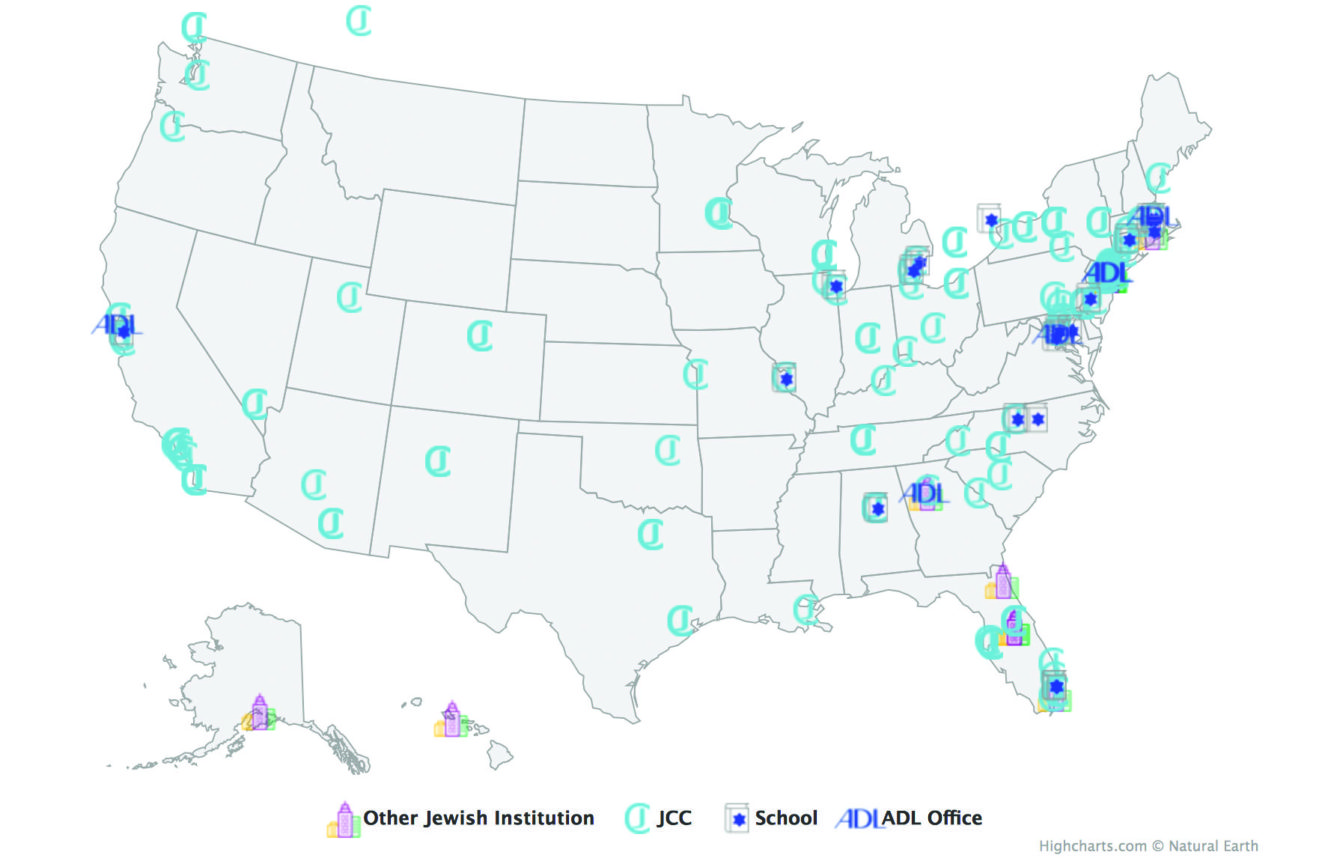
Bomb threats against Jewish institutions, 2017 through March 12. Source: Anti-Defamation League.
Bomb threats against Jewish institutions, 2017
through March 12. Source: Anti-Defamation League.

Since Jan. 4, there have been more than 160 threats against Jewish community centers, schools and other institutions in more than 30 states. The threats have been a mix of live and prerecorded phone calls and emails.

According to an email from The Jewish Federation of Greater Los Angeles Community Security Initiative and obtained by the Journal, the threat occurred at 12:15 p.m. “The email received is identical to an email bomb threat received by the Jewish Children Museum in Brooklyn NY earlier this morning,” the email says.

On the morning of March 9, the Jewish Children’s Museum was evacuated after receiving an email saying pipe bombs had been hidden in the building, according to nydailynews.com.

In a phone interview, LAPD Sgt. Matt McNulty confirmed that the email sent to the WJCC contained language about pipe bombs.

“So basically, they got an email stating there were possible pipe bombs on the property, and that generated a police response. Students were evacuated, and Los Angeles Police Department officers, along with representatives of the school, conducted a walk of the location, deemed it to be safe, found no suspicious devices,” McNulty said.

Debora Parks, principal at Harkham-GAON Academy, which rents out the third floor of the WJCC, told the Journal on the afternoon of March 9 that her school’s students were not among those evacuated as their day had been cut short in observance of a pre-Purim fasting day. School was not in session; instead, Parks said, “I was having a meeting with a mother and a potential student, because it was after school. So we had to tell them, ‘Sorry, we can’t continue the interview. We have to leave, we have to evacuate.’ ”

Parks was among those who joined LAPD officers in searching the building. The search went faster than the last time the WJCC received a threat as multiple floors were searched at once, with JCC leaders pairing with officers and guiding them to different places on the campus where the bomb or bombs could have been placed, Parks said.

McNulty said identifying the perpetrator or perpetrators won’t be easy.

“A lot of the stuff is computer-generated, and some of the times, this stuff is generated overseas, so you have a hard time pinning down where it is coming from,” he said. “We did take a criminal report for the bomb threat and that will be investigated by [the LAPD] Major Crimes Division.”

The WJCC accommodates programs for preschool children, operates a swimming pool, runs events for senior citizens, and more. Why someone would target a place like that is beyond Parks.

“I don’t know what the motivation is. It seems like the motivation is to cause disruption and they’re successful in that,” Parks said. “That’s for sure.”

Second bomb threat in two weeks at Westside JCC is another hoax Read More »

Shocker: Many Israelis object to women in the military

Six years ago or so I wrote an article under the headline A Voice of a Woman. The controversy it covered involved a few IDF cadets who left a ceremony because of their religious objection to hearing a female soldier singing. The cadets were disciplined, and the country debated their action for a day or two. Religious Israelis cried that if the IDF wants them to be a part of it – it ought to consider their religious sensitivities more seriously. Non-religious (and many religious) Israelis responded by arguing that discriminating against women to please the religiously-sensitive soldiers is something that the IDF cannot do.

The problem was never solved – as a recent controversy that has been preoccupying Israel in the last few day days proves. The IDF needs its women soldiers. It needs its religious soldiers – who have become its most ambitious group of fighters. It needs to adjust itself to the society of which it is a part. As I wrote then: “there is no simple way to balance these competing rights. Religious soldiers can’t be made to violate their faith. The military can’t be made to alienate its most motivated group of soldiers. And I can’t educate my daughter to serve in a military that would excise women from the public sphere to accommodate the radical demands of the super pious.”

Earlier this week, a rabbi came under heavy fire for bluntly speaking against women serving in the IDF. His message was not unique. Many rabbis – most rabbis – object to women serving in the IDF. His tone and style was unique. He was rude and dismissive and, frankly, quite disgusting. So it was easy for everybody to focus on his style rather than on his principled objection to a certain trend of opening IDF units to women.

This is not the first time that Rabbi Levenstein makes waves by speaking vulgarly about trends he does not approve of. A few months ago he called LGBT Israelis “perverts” – and was fed a similar dose of condemnation. The reason some Israelis – but not all of them – are so furious with Levenstein is the position this rabbi occupies. He is the head of a well-known religious academy that prepares its students to serve in elite military units. Some of Israel’s best and brightest military leaders began their military careers in his academy. Rabbi Levenstein educates these future leaders in ways that contradict the beliefs of many other Israelis, which he perceives as “too tolerant, liberal, secular and Western.”

Being repulsed by the rabbi’s choice of words is one thing. Very few Israelis defended his language this week. Being shocked by his message was less unanimous. Minister Arye Deri, of the religious party Shas, was interviewed on the radio this morning and opened his remarks by reminding the listeners that according to most rabbis women ought not serve in the military. In fact, the state of Israel recognizes this religious objection. There is a mandatory draft in Israel, but religious women are exempt from it. All they have to do is declare that their religious beliefs prevent them from being drafted – and that’s it. They are off the hook.

How does one reconcile the condemnation of Levenstein and his views with Israel’s official policy? It is possible to reconcile the two if all we have against Levenstein is a complaint against his language. It is impossible to reconcile the two if Levenstein’s views are the issue. If, as Haaretz Daily argued this morning, “an individual who holds such chauvinistic views cannot be part of a system that prepares thousands of religious youths for military service.”

Israel tolerates the views of people who object on principle to women serving in the military. It tolerates them because these are the views of many Israelis. In fact, Israel must tolerate these people and their beliefs – as much as these people must tolerate Israel and its beliefs. Because there is no “Israel” without these people. They are Israel. A part of Israel. An important, influential, at times frightening, at times awe-inspiring part of Israel.

It is easy to declare Levenstein beyond the pale and ostracize him. He makes it easy by expressing his views in a vulgar manner. But his views concerning women serving in the military – his objection to women serving, his more stringent objection to women serving with men, his even more stringent objection to women serving in combat units with men – are the views of many Israelis. The IDF cannot ignore these Israelis. Israel’s political leadership cannot ignore them. Our society cannot pretend they aren’t there. It must accept their entitlement to have their own views, it must debate them, accommodate them, find common ground with them.

It must recognize that condemnation is easy – accommodation is not.


Shocker: Many Israelis object to women in the military Read More »

How to Jew Purim

Saturday, March 11, to Sunday, March 12

BACKGROUND

Purim, celebrated every year on the 14th of Adar, commemorates how Jews living in the fourth century Persian Empire pre-empted a plot by the evil prime minister, Haman, to have them all killed. Haman — angered by the refusal of a Jew named Mordecai to bow down to him — persuaded the Persian ruler, King Ahasuerus, to issue a decree calling for the extermination of the Jews on the 13th of Adar, a date Haman had chosen in a lottery. (“Purim” is Persian for “lots.”)

Mordecai heard of the plot and appealed to his cousin, Esther, who the king had selected as his wife in a beauty contest, not knowing she was Jewish. Esther held a feast at which she revealed to Ahasuerus that she was a Jew and persuaded him to reverse the decree. The king then had Haman and his 10 sons hanged from the gallows, and named Mordecai prime minister. A new decree was then issued allowing the Jews to defend themselves against their enemies. When the 13th of Adar arrived, the Jews struck back against those enemies. They celebrated their accomplishment on the 14th of Adar.

TRADITIONS

The day before Purim is a day of fasting to commemorate the Fast of Esther — her three days of fasting before the feast. This year, because Purim is on Shabbat, the fast is observed on March 9 from dawn till dusk.

Traditionally, the Megillah (the Book of Esther) is read twice — on the night of Purim and on Purim day. During the often boisterous reading, the congregation makes noise with groggers and yells “Boo!” at every mention of Haman’s name. Purim also is a special time to dress up in costumes. Many synagogues and community centers have carnivals, parties and humorous skits or shows called Purim spiels.

Other aspects of the holiday involve giving gifts or providing acts of charity. One such tradition is to give a basket of treats, or mishloach manot, to neighbors, friends or members of the community. It’s also a custom to donate money to at least two needy people as part of a tradition called matanot l’evyonim.

SPECIAL FOODS

Jews enjoy the holiday with hamantashen — triangular pastries typically filled with fruit preserves — that, according to one legend, are symbols of Haman’s three-sided hat. Some celebrations include a special Purim challah, which is bigger than the usual bread and made with more braids to symbolize the rope with which Haman was hanged. Another holiday food is kreplach, dumplings filled with meat.

— Kylie Ora Lobell, Contributing Writer

Sources: Chabad.org, MyJewishLearning

How to Jew Purim Read More »

Seeking joy in the month of Adar

In a year when many of us are feeling varying degrees of political depression, Purim will arrive not a minute too soon.

After absorbing several stories about toppled headstones in Jewish cemeteries and waves of bomb threats at Jewish community centers across the country — including one to the Westside JCC, where my wife and I sent our kids to preschool — I needed something to change my melancholy mask to something happier. To my surprise, the month of Adar, Purim’s place on the Jewish calendar, was it.

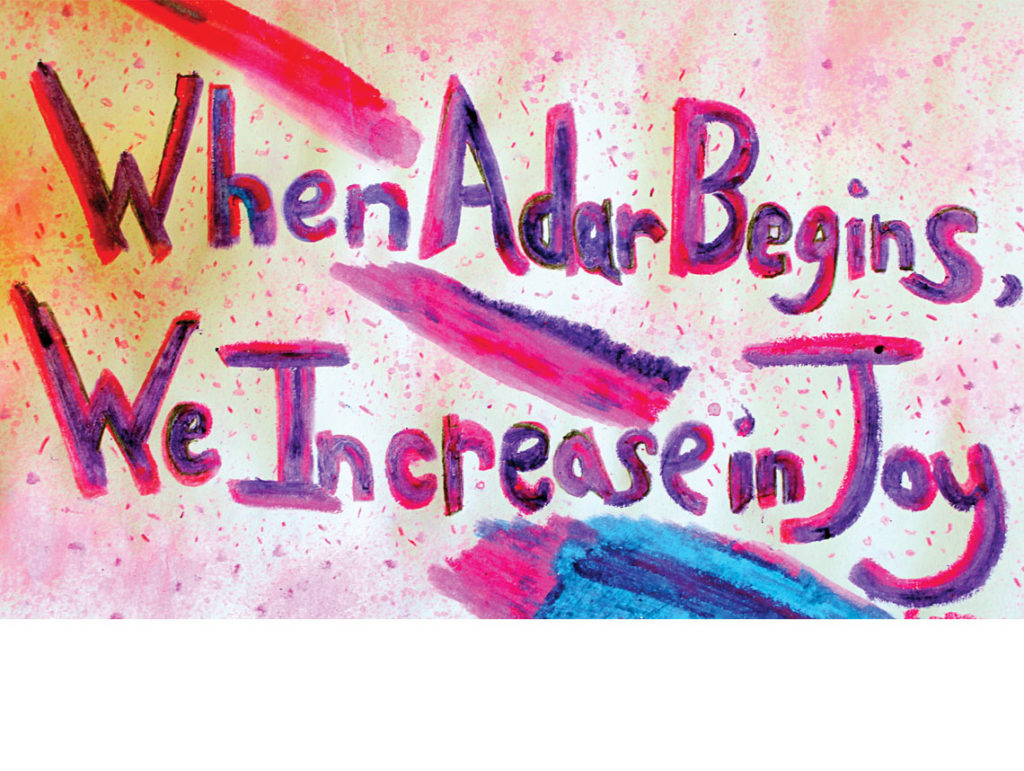
Providing reprieve from the day-to-day downer news was the serendipitous proclamation in the Talmud that “When Adar enters, we increase our joy.” To make sure the message stuck, I discovered, there is even a custom of hanging a sign in your home with the saying on it. 

But could just a few words on a piece of paper make anyone happy? Especially in times like these? If finding happiness were that easy, it seems a lot of therapists would be out of work.

However, if a simple sign actually could help move you to a moment of joy, you couldn’t beat the price. And considering that Obamacare may soon be history, I reasoned, we might all need to make something like this work, anyway.

So, a few weeks before Purim, when we read the Megillat Esther — the ancient story of how Esther and Mordecai saved the Jews of Persia from the death sentence decreed by Haman — I decided to issue my own joy decree, with a sign declaring it for all to see. Hoping to chromatically distance myself from a mood of blue, I wrote my sign, which reads “When Adar Begins, We Increase in Joy” — in violet and hot pink. Committed to my new role as joy-seeker, I posted it on the refrigerator and made it the wallpaper for my cellphone and computer. Now, I was happiness-ready.

“Let the simchas roll,” I thought.

Except they didn’t. The sign kept the idea on my mind, all right — I could picture it with my eyes closed, but the wellspring of joy that Adar supposedly promised somehow remained elusive. With every deadline and headline, my happiness goal seemed to get pushed back another day.

Still, the next evening, seeing the sign on the fridge, with it’s bright letters almost pulsing, lit a small flame, and nudged me into trying to cook, an activity that I enjoy. The resulting asparagus stir fry made me smile — and my wife, too — yet, like Chinese takeout, this appetizer of joy left me hungry for something more.

Satisfying my hunger was a passage I found in a kind of Jewish philosophical cookbook called Pirkei Avot, or “Ethics of the Fathers.” “Who is rich?” it asked. “He who is happy with his lot,” came the answer, leading me to consider that the next time I get out the wok, I should focus more on the joy of the moment: my ability to experience the sound, the smell and the taste of cooking. As Ecclesiastes suggests, “There is nothing better for a person than to rejoice in his work.”

The next day, under the influence of my sign, I tried a different tack, going out into the backyard to check out our blooming blueberry bushes. Imagining how sweet they would taste in pancakes only withered, however, into recalling that after the berries began to ripen, I would need to do battle with the birds, who were as excited about them as me.

And yet, I was reminded of the wisdom of Rav Yerucham Levovitz in his work “Sefer Chochmah uMussar,” in which he states, “A truly happy person does not allow his happiness to be dependent on any external factor over which he may not have control.” I suspect he would have told me to forget about the birds, but there they were, still fluttering up my joy.

Looking for something over which I did have control, I turned to the orderliness of my prayer book. There I found Ashrei, a prayer that I have read many times on Shabbat morning. “Happy are those who dwell in Your house,” it begins. Though this verse, taken from Psalm 84, clearly suggests that happiness comes from dwelling in God’s house, reading it during my quest for joy made me wonder how I could make myself happy in my own spiritual house, as well.

A week later, I had my chance.

The Movable Minyan, an independent congregation that we attend on Shabbat, is completely lay-led. Although Shabbat is supposedly a time of peacefulness, sometimes the minyan is everything but, with a group of busy individuals coming together to lead services, read Torah, give a drash and contribute to a potluck lunch.

Yet, the morning was a joy. Why? Examining our services through the words of my newly found sages of joy, I could see that the efforts of our instrumentalist and service leaders (of which I was one) helped to create an atmosphere of rejoicing, making the morning a real simcha, one where all present could be happy with our lot. And the delicious dairy meal that followed seemed a perfect fit for the rav’s prerequisite for happiness, as the uncoordinated menu was completely out of our control.

Bringing it all together for me, though, was my experience leading Shacharit, something I have done for years. When it came time for singing El Adon, which speaks to the grandeur of nature and its Creator, my eyes moved over to the English translation and I saw the words, “Rejoicing” and “gladly,” as if for the first time. This time, I took it as a sign.

Seeking joy in the month of Adar Read More »

Camp: With social media, campers now stay connected through an endless summer

For 12-year-old Sophie Golden, camp is “kind of like a different world,” where electronics are a no-go and her bunkmates feel more like sisters than friends. When she misses that feeling during the year, there’s an easy way to get it back, even if just for a fleeting moment — by checking her phone.

That camp feeling “is coming back a little bit, but the second I stop texting, it goes away,” said Golden, who attends Beber Camp, a Jewish summer camp in Mukwonago, Wis. She said she never worries at the end of the summers about losing touch because she and most of her camp friends stay in constant contact in group chats and on Snapchat, the photo messaging application.

Though camp has traditionally been a summer-only experience, the increased use of social media and technology by kids is changing that — and camps are catching on.

“For our campers, that camp experience of being connected to your camp friends never ends, it doesn’t just last eight weeks of the summer anymore,” said Jamie Lake, who serves as marketing manager for the Jewish Community Centers of Chicago’s two overnight camps and nine day camps.

That’s a positive as Lake sees it.

“I think it’s fantastic,” she said. “Anything that we can do to keep the positive feeling of Jewish overnight camp going longer than just the summer is a benefit, not only to our camp programs, but really to our campers and their families.”

And the JCC Chicago camps rely on social media, too, in keeping campers connected, such as using Facebook’s live streaming service in order to broadcast reunions to campers who cannot attend.

Social media also provide a way for campers to hang out — virtually, that is.

Camps Airy & Louise, Jewish brother-sister overnight camps in Thurmont and Cascade, Md., organize year-round events that campers can attend by logging onto Facebook and Instagram. During Chanukah, the camps ran a scavenger hunt in which campers were asked to photograph themselves wearing their camp shirts in various locations, and submit the pictures to the camps’ social media pages. Camps Airy & Louise also run online fantasy football leagues and NCAA men’s basketball March Madness brackets.

“If they’re going to be in a fantasy football league — some of them are probably already in three or four — why not be in a fantasy football league with camp?” said Jonathan Gerstl, the executive director at Camps Airy & Louise.

Golden’s Beber Camp organizes virtual events once a month during the year, such as “Where in the World is Beber?” when campers on winter break post photos of themselves around the world.

Brad Robinson, manager of customer experience and marketing at Beber Camp, said that anywhere from a few dozen to 200 kids — the latter representing nearly a third of all campers — participate in the events.

Although Golden communicates with her camp friends on her smartphone at least once every other day, she makes time for in-person meet-ups. Still, asked to imagine a world without cellphones, Golden said her relationships with camp friends would probably suffer.

“I think we wouldn’t be as close in the summer and have as much to connect to,” she said.

Robinson of Beber Camp echoed Golden’s experience.

“I think [social media] definitely allows for deeper relationship building, because they are just a few finger taps away from communicating with their friends,” he said. “It has allowed campers and staff to really further build those relationships, where in the past, it was only when they saw each other in person, or they were maybe writing some slower mail or emails back and forth.”

And parents are catching on too, using group chats to share letters they received from their children or to ask one another questions.

“Parents find out who’s in their child’s bunk and they exchange phone numbers and they start a group text to everybody,” Rabbi Joel Seltzer, executive director of Camp Ramah in the Poconos, a Conservative Jewish camp in Lakewood, Pa., said.

For other parents, social media provides not only a way to connect with their children’s camp experiences but also to the camps they attended in their youth.

This summer, Sophie Golden’s mother, Davina, will be attending a reunion for Herzl Camp in Webster, Wis. — her first reunion since she worked there as a counselor 25 years ago. Davina Golden said she probably would not be attending were it not for having connected with old camp friends on social media.

“I lost touch with a lot of my friends,” she said, “but then, since Facebook, we all got in touch with each other.”

Camp: With social media, campers now stay connected through an endless summer Read More »

Camp: Security first: fun and adventure in a safe setting

Chicagoan Christie Tate isn’t one to be easily cowed.

A lawyer and writer, Tate lives with her husband and two kids on the city’s South Side, which has seen a surge in violent crime over the past year. Last year, her kids got a day off from school because of an active shooter threat. Over the summer, someone was murdered in her alley.

But while Tate doesn’t want to change her lifestyle out of fear, the recent spate of bomb threats at Jewish community centers across the country gave her pause as she considered whether to send her kids back to a JCC camp this summer.

“I don’t believe that we should go running and alter our lives and our summer plans because of threats,” Tate said. “But then, when I was doing my research, I saw the pictures of the kids standing on the sidewalk during a bomb threat, having been evacuated — it just became more real. I just thought, ‘Oh my God.’ I was swayed by that, which is probably a problem.”

Despite the wave of recent threats against Jewish institutions, coupled with a surge in anti-Semitic activity in recent months, no one has been seriously injured by a security breach at an American Jewish summer camp. The worst incident many camp leaders could remember was in 2012, when a group of intruders drove through a religious camp in Pennsylvania yelling anti-Semitic slurs and damaging property.

But many Jewish camp leaders aren’t taking any chances.

“The foundation of our success is all about the sacred trust that exists between our parents, our campers and our communities and our camps,” said Paul Reichenbach, director of camping and Israel programs for the Union for Reform Judaism, which operates 16 summer camps across the country. “Parents have to have confidence that the people and place to where they’re going to send their children, in whom they’re going to entrust their children, has as their highest priority their child’s welfare.”

As with many Jewish summer camps, the Reform movement’s security efforts were beefed up significantly  after the 9/11 terrorist attacks in 2001. The movement launched a security manual for their camps, created specific job requirements for camp safety personnel and established protocols for responding to a range of threats. It also retained the services of an Israeli security firm, which recommended security improvements from entrance gates to lighting and video surveillance. The camp’s security protocols are reviewed and updated annually.

Many involved in security at Jewish camps say that training and advance preparation are key — perhaps even more important than guards or barriers, both of which are increasingly common.

Among the preparedness steps camps are taking: the development of protocols that determine who does what in the event of an emergency. Preseason security training for camp staff has become commonplace. Camp leaders also are strengthening their relationships with local law enforcement, and many law enforcement agencies conduct annual site visits to familiarize themselves with the camp environment and provide advice.

“In the end, it’s all about training,” said Jeremy Fingerman, CEO of the Foundation for Jewish Camp. “Training itself builds awareness. You can never train enough. By continuing to train, you’re building that sort of level of awareness.”

Security at summer camps presents a number of unique challenges not faced by urban Jewish institutions, which typically have a defined perimeter and controlled access points. Camps are open, their borders often marked by little more than a tree line, and everyone involved in their security acknowledges the need to strike a balance between safety and preserving the sense of freedom and openness emblematic of the camping experience.

They also have to contend with an evolving security climate. While radical Muslims presented the foremost security challenge in the wake of 9/11, that is no longer the case. Many camp leaders noted the case of Anders Breivik, who gunned down 69 Norwegians at a summer camp on the island of Utoya in 2011, as well as the Sandy Hook school shooting in Connecticut in 2012.

“My concern is not just from jihadists anymore,” said Paul Goldenberg, the director of the Secure Community Network, the organized American Jewish community’s security arm. “We’re starting to see a real uptick from the white supremacist side of the house right now. Some of these people are calling for death to the Jews. It’s pretty serious.”

Goldenberg stressed that he knows of no specific threats against Jewish camps and would not hesitate to send his own grandchildren to one, a sentiment shared by many other Jewish camp directors. And while most directors contacted for this story were hard-pressed to name a single serious security breach at a Jewish summer camp, a handful of recent incidents have raised the alarm.

In the summer of 2012, several intruders drove through Camp Bonim, a religious boys camp in rural Pennsylvania, according to local police who later arrested five suspects. In 2015, it was Camp Agudah Midwest, a religious camp in Michigan, where two vandals spray-painted a swastika and damaged a building, according to The Associated Press. That incident came two weeks after an attack at upstate New York’s Camp Karlin Stolin, in which three teenagers threw bottles and coins at campers and staff.

Officials at all three camps declined a request for comment. But security experts say the incidents only serve to highlight the dangerous level of unpreparedness at some Jewish summer camps.

“If anything, the risk has continued to rise,” said Joshua Gleis, a security consultant who works extensively with Jewish institutions. “I do think that camps certainly need to continue to button up security as you see schools, houses of worship, community centers doing right now. Many camps are not taking the actions that I think they should. While many have been improving, I know many camps that have still not changed their security structure significantly.”

Camp Seneca Lake in Honesdale, Pa., isn’t one of them. On the advice of the State Police, camp owner Irv Bader now has guards check all trucks entering the camp for deliveries. The camp has also hired 24-hour armed security — “not rent-a-cops,” Bader said — and installed a network of security cameras that are monitored around the clock. At night, the camp is illuminated with high-wattage lighting.

“It looks like daylight in the camp,” Bader said.

“I do it because it’s necessary,” he said of his security precautions. “The world is crazy today. And you’ve got too many crazies around. It’s a deterrent.”

Despite the heightened sensitivity, many camp directors say the most common threat to the well-being of campers comes not from violent attack, but from the weather.

Jamie Simon, the director of Camp Tawonga in Northern California, said she is far more concerned about an earthquake than an intruder. (In July 2013, her camp was hit by tragedy when a counselor died after a tree fell on her.) Still, the camp installed a video camera last year at its front gate so it can screen visitors remotely.

Camp Tamarack in Michigan is taking the camera tool even further. New technologies enable surveillance systems to learn about normal movement in an area and send an alert when it detects something anomalous.

For a camp like Tamarack, that sort of assistance is invaluable. The facility is among the largest Jewish residential camps in the country, covering more than 1,000 acres and 400 structures.

“It’s a force multiplier,” said Gary Sikorski, the director of communitywide security for the Jewish Federation of Metro Detroit. “You can monitor areas that would be almost impossible to monitor with an individual.

Camp: Security first: fun and adventure in a safe setting Read More »

So, you want to be a camp counselor

While some Jewish sleepaway camps start accepting staff applications as early as September for the following summer, most camps are still looking to fill at least a few spots as late as April.

So, if you’re a high school senior or older, it’s not too late to apply. Some camps also hire high school seniors-to-be.

More-established camps tend to hire their own camp graduates in high numbers, but most value new hires as well, for their fresh ideas.

The Journal contacted a handful of directors of Jewish residential camps throughout California to find out what they are looking for in camp counselors, whether bunk counselors who spend the day with a group of kids or specialists who run a specific activity. Here are five key characteristics.

You want to work with kids

Dan Baer, director of Camp Mountain Chai in Angelus Oaks, said a desire to work with kids is a must. After all, counselors are often with them all day, and many sleep in the kids’ cabin at night.

Beyond liking kids, counselor candidates with childcare experience have an advantage, and it doesn’t need to be anything formal. Maybe the candidate has baby-sat, Baer said, or taken care of nieces and nephews, worked as a day camp counselor or lifeguard. Perhaps they are involved in community theater and often work with the youngest actors.

That said, Baer and other camp directors recognize how demanding high school and college is. Taking advanced-placement classes and playing in the school jazz band or similar activities might not leave time for much else. So long as the passion for working with kids is there, that’s sufficient.

“Regardless of your specialization at a camp, your main role is to be a counselor and take care of kids,” said Mara Berde, associate director of JCC Maccabi Sports Camp outside San Francisco. “Counselors are serving as parents, older siblings, role models. They are supervising kids all day long.”

You are willing to learn

Young adults should not be discouraged if they lack expertise in a traditional camp activity such as archery or arts and crafts.

“For positions that depend on a certain skill set, applicants that have those skills have an advantage — for example, lifeguards or horse wranglers,” said Josh Levine, executive director of Camp Alonim in Simi Valley. But “for a number of positions, we can train our staff before they get to camp in the summer. If they don’t have an archery certification from a governing body, we can train them and get them certified.”

Being open to a position you hadn’t originally considered might land you a job.

You’re in it for the right

reasons

Although the idea of spending summer in the great outdoors with a bunch of other collegians might sound like terrific fun, being a camp counselor is demanding work, said Dalit Shlapobersky of Habonim Dror Camp Gilboa near Big Bear.

Ariella Moss Peterseil, associate director of Camp Ramah in California in Ojai, added, “I always say, Jewish summer camp and the Israeli army are the only two places where, as an 18-year-old, you are given the lives of people in your hands.”

Not only does camp staff need to take its responsibility seriously, members need to understand “what an amazing opportunity they have to impact, because they are 24/7 role models,” she added.

“It’s totally legit: You want to be with your friends. But be ready for the additional step. We always say it’s about creating new memories for these kids and not about reliving your memories.”

You have empathy

For their interviews, candidates should anticipate questions about various scenarios. For example, what if a camper seems withdrawn? Or maybe a kid in your cabin isn’t showering — what would you do?

“It’s less about, ‘Do they have the right or wrong answer?’ and more about their approach,” Berde said. “Are they coming to their answer from a caring place?

“A lot of kids are coming to camp for the very first time,” she added. So there might be a sixth- or seventh-grader who has never been away from home and other campers who are on their third or fourth year. Berde said she wants staff members who are “able to empathize with kids in that situation.”

You connect with kids — no matter your personality type  

Although many may hold to the image of a kooky camp counselor onstage in some ridiculous camp skit dressed in an equally ridiculous costume, all camp counselors need not be extroverts.

“We hire a wide variety of personalities to match the wide variety of our campers,” Baer said. “That includes shy and goofy and loud and quiet and all of it. It’s our job to make sure we have a balance.”

Camp directors recognize the strengths that more introverted candidates might bring to the position. Yes, they need to be able to hold a conversation. But, Berde said, sometimes the more reserved candidates are the most thoughtful and end up as “silent leaders.” Berde calls them “the glue.”

Often, she added, these are the staff members with whom campers connect on a deeper level.

So, you want to be a camp counselor Read More »

Local cemeteries refrain from security changes, despite heightened concern

Despite recent incidents of vandalism and desecration at Jewish cemeteries across the country, none has occurred in the Los Angeles area, and supervisors here have not yet taken any drastic actions to prevent trouble.

“We don’t feel we need added security measures or added personnel at this time,” Yossi Manela, a funeral director with Chevra Kadisha Mortuary, said.

Chevra Kadisha manages four Jewish cemeteries: Agudath Achim Cemetery and Beth Israel Cemetery in East Los Angeles, Mount Carmel Cemetery in Commerce and Young Israel Cemetery in Norwalk. All four have upright headstones.

Chevra Kadisha’s cemeteries are fully fenced with high gates. Mount Carmel and Beth Israel are open during the day and locked at night. Agudath Achim and Young Israel are always locked, but family members with loved ones buried there have access to the combination lock.

Manela, who has been a funeral director there for 23 years, said it would be too expensive to add measures such as round-the-clock security and cameras.

Jolene Mason, general manager of Eden Memorial Park Cemetery in Mission Hills, which has a section of upright headstones, isn’t planning big changes, either.

“We’ve always had security that’s ready for anything,” she said. “That’s not just in light of what’s happening. That’s just our security policy.”

She said she has briefed the private company that handles security measures for Eden Memorial.

“We’ve just let them know in case they weren’t aware of what’s happening around the country and in case the supervisor wants to come and check more so they’re on heightened awareness,” she said. “We’re comfortable with our current security situation.”

Noelle Berman has been director of private estates at Beth Olam Cemetery in Hollywood for 16 years. Beth Olam is the 63-acre Jewish section of the iconic Hollywood Forever Cemetery that routinely draws tourist crowds visiting celebrity graves and droves of guests in the summer for outdoor movie screenings.

Beth Olam, whose graves are marked with Stars of David and menorahs, isn’t separated from the rest of Hollywood Forever. There also are some marked Jewish graves outside of the Beth Olam section, dispersed throughout the rest of the cemetery. Berman said additional security at Beth Olam, or the cemetery at large, isn’t in the plans.

“We haven’t had even one bit of concern as of this moment,” she said.

Berman cited constant foot traffic as a form of self-policing and Hollywood Forever’s central location as a deterrent to would-be agitators.

“Hollywood Forever is a cultural center,” she said. “I think there’s such a sense of community here that’s already built in that makes it feel safe. I can’t imagine anything happening here because it’s always so populated, and it’s right in the heart of Hollywood. The incidents around the country happened in more isolated areas.”

Len Lawrence, general manager of Mount Sinai Memorial Park and Mortuaries, took a different tone than his peers.

“There has been a significant amount of internal conversation about what to do,” Lawrence said. “With what’s happening to other Jewish cemeteries, it would be foolish of us not to review our security procedures.”

Mount Sinai’s two parks, one in the Hollywood Hills and another in Simi Valley, are both owned by Sinai Temple. Lawrence has overseen both for the last 15 years. During his time there, he had never received security-related inquiries by phone or email from concerned family members of loved ones buried in his parks — until now.

“We have spoken to them and assured them we are doing all we can,” he said. “These are sacred grounds that we’ve always protected and need to continue to protect.”

Both parks are fully fenced, locked and rigged with alarm systems. Security is on-site at all times, and both parks are in constant radio communication with a central base station. Surveillance cameras in strategic locations throughout the grounds monitor the parks.

Lawrence pointed out that it has been upright headstones targeted in St. Louis, Philadelphia and Rochester, N.Y. As memorial parks, Sinai’s don’t have upright headstones. Still, Lawrence said, that doesn’t make Sinai’s parks any less vulnerable.

“Even though we don’t have upright headstones, that’s not to say we can’t be vandalized,” he said.

He said his security personnel are adopting a proactive approach, reviewing protocol in the event of telephone threats and weighing further measures to bolster nighttime security, though for security reasons he declined to provide details.

Last week, a representative from the parks’ alarm system company made an on-site evaluation, and a representative of The Jewish Federation of Greater Los Angeles’ Community Security Initiative (CSI) also came for an inspection.

Ivan Wolkind, Federation’s chief operating and finance officer, established the security initiative five years ago with the aim of helping the city’s Jewish community address its security needs in a more autonomous fashion. His team of five Federation employees, all with backgrounds in either the U.S. military or Israel Defense Forces, offers free site and vulnerability assessments as well as security training to any Jewish institution in Los Angeles. Wolkind said CSI’s city database includes 470 Jewish institutions.

“We have been reaching out, being proactive, and they have been reaching out to us, as well,” Wolkind said of the work with cemeteries and memorial parks. “We just want to make sure procedures and protocols that have been put in place are being acted on and adhered to. It’s also just checking in and making sure people are vigilant.”

Local cemeteries refrain from security changes, despite heightened concern Read More »

Orthodox rabbis urge ‘spiritual resistance’ against Trump policies

Twenty-two Modern Orthodox rabbis signed a statement last week urging their communities to commit “non-partisan acts of spiritual resistance” in order to push back against “an administration that poses a grave threat to our democracy.”

“We call upon our community to pursue righteousness and justice vigorously, challenge oppressive and dangerous policies enacted by the current administration, and to ensure that justice rolls down like a river and righteousness like a never-ending stream,” the rabbis wrote in the letter that went online March 3.

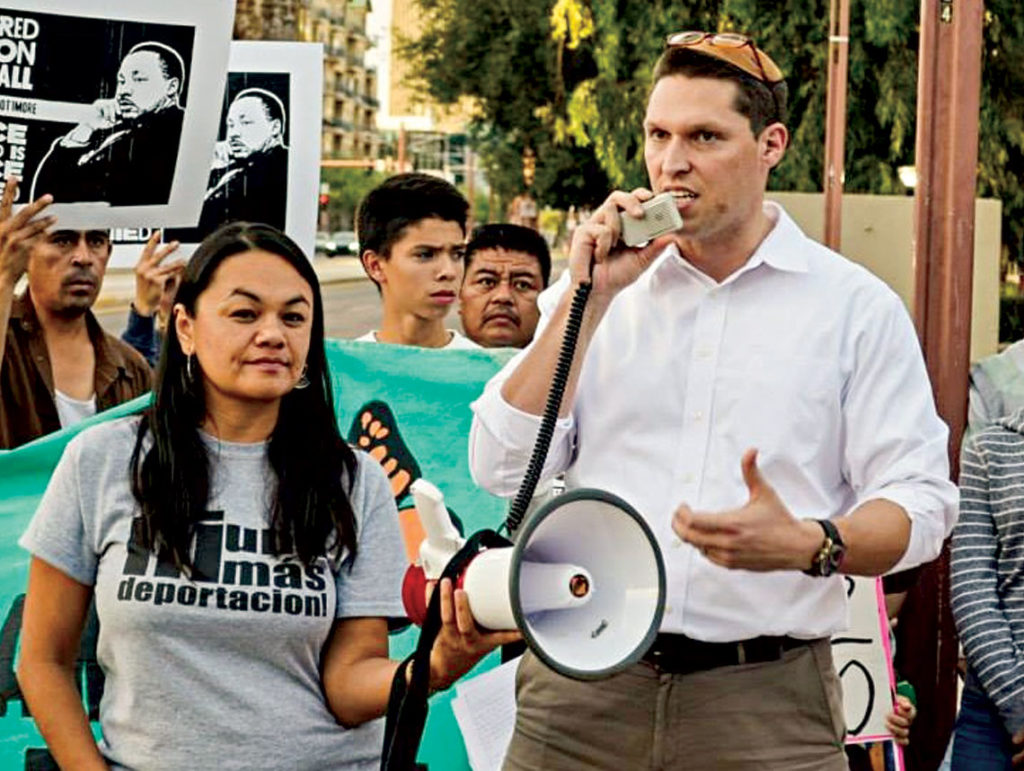
Led by Rabbi Shmuly Yanklowitz, the Scottsdale, Ariz.-based founder and president of the Orthodox social justice organization Uri L’Tzedek and a leader in the Open Orthodox movement, the signatories belong to a group of some 70 pluralistic, progressive rabbis who came together during the recent presidential campaign, he said.

While American Jews voted for Democrat Hillary Clinton at a rate of about 71 percent according to some estimates, a Pew Research Center poll in September found that 50 percent of Orthodox Jews favored then-candidate Donald Trump.

“Since the election, the Orthodox community has been silent or supportive of the new administration,” Yanklowitz told the Journal on March 5. “We felt it was time that we called upon the Orthodox community at large to join the rest of the Jewish community.”

He pointed to a long tradition of Jewish spiritual resistance, from Moses and the Exodus, to Mordecai and Esther’s struggle with Haman in the Purim story and finally to the Holocaust.

Today, he said, rabbis can demonstrate spiritual resistance through activism — what he called “the normal stuff,” such as boycotts and protests — as well as through their positions, by incorporating political consciousness into prayer spaces, for example. He noted that he fasted on Inauguration Day as an act of spiritual protest.

Yanklowitz insisted the letter was aimed not at President Donald Trump himself but rather administration policies that might target vulnerable communities.

“This is not an anti-President Trump statement, but we’re resisting any hateful policies emerging from this administration,” he said, pointing to the ban on travel to the United States from certain countries and policies targeting asylum seekers as examples.

Rabbi Chaim Seidler-Feller, director emeritus of Hillel at UCLA and one of the letter’s signatories, said his goal in signing was not to recruit more rabbis to join up but rather to push Orthodoxy to take stock of its values and how they comport with the administration.

“We’re not making a movement; that’s not what I care about,” he said.

Instead, he sees the letter as a challenge to Orthodox communities to evaluate their Torah-bound responsibility to the vulnerable and needy.

“What are we going to be able to say to the next generation of Jews that are looking at us and saying, ‘You taught us that these are the core principles of Judaism, and now you’re silent?’ ” he said.

To critics who say politics has no place in the sanctuary, Yanklowitz said Orthodox congregations often incorporate right-wing Israel politics on a daily and weekly basis. “Far right-wing politics in Orthodoxy have become as dogmatic as some theological positions,” he said.

He hopes that by activating the American Orthodox community, the letter’s signatories can bring a Torah-centered approach to resisting administration policies they see as hostile.

“This community hasn’t stepped up yet, and they should,” he said. “And there may be a unique approach that this community can offer.”

Orthodox rabbis urge ‘spiritual resistance’ against Trump policies Read More »