fbpx

February 15, 2017

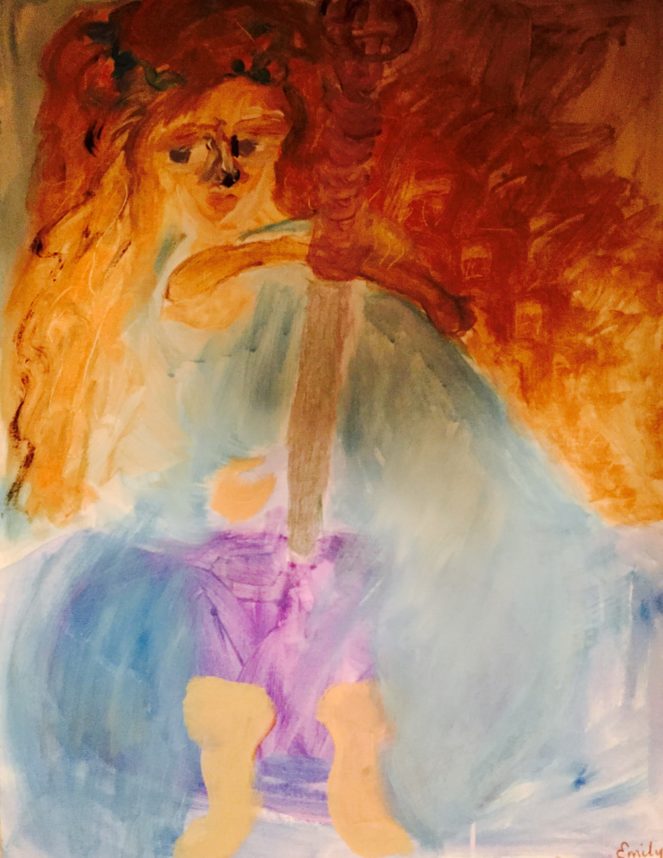
Not Just The Parts

Moses killed an Egyptian.

Seek refuge

Falsely accused ones

Unfed ones

Unclothed ones


Come, wise seer

I invite your heart

Not just the parts that

Can help me, but all.


Let me feed you and free You

a pegasus

a dream

a wish


That you will find some refuge.


Come, homely Goddess

I invite your mind

I long for the parts that

can help me and

be cradled by you

to resist


hatred

politically, universally, interpersonally, internally.


Come, Self

I invite your soul

Not just the parts that

are empty but also

the parts that are whole.


Come, World.

I invite all

not just the parts that

I’m with, but the parts

that fear our unity


All part of this God

that lives.


Egyptians and Moses, return to

safety– all favored by One God

For love touches everything

and does not just reside above.


Blind and begging, I come.

take refuge together

Come and welcome the peace

All our Selves inside here

Neighbor, friend, foe,

I insist.


Not Just The Parts Read More »

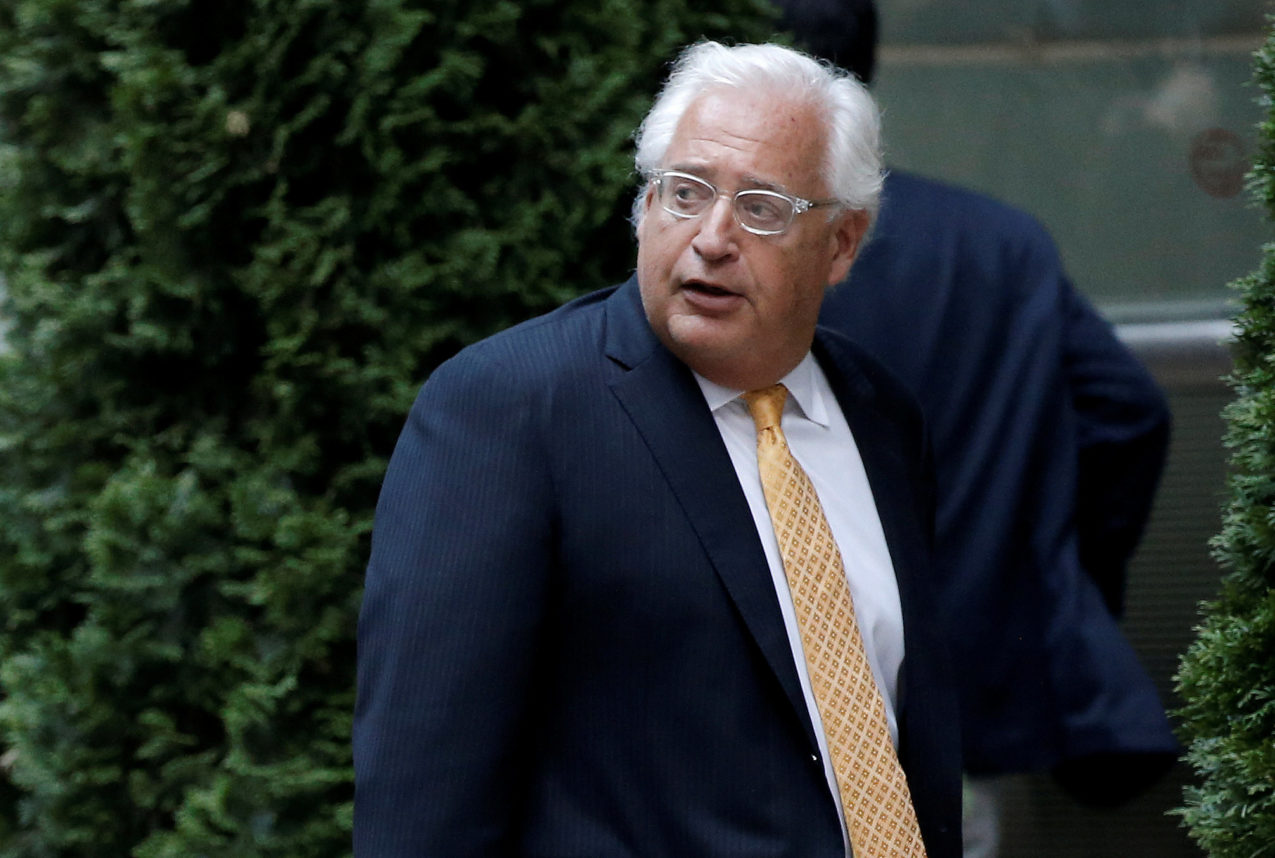
The case against David Friedman

Who ever thought that the savior of the Jews would be Rand Paul?

The libertarian Republican senator from Kentucky may just end up casting the decisive vote in the confirmation of David Friedman to be the United States ambassador to Israel. If Paul joins with the Democrats on the Senate Committee on Foreign Relations, President Donald Trump’s pick would find his ascension to the high profile and sensitive job blocked.

Senator Paul, do it.  For our sake.

Here’s my pitch: Within reason, presidents have the right to choose their representatives.  Ambassadors don’t make policy, they help communicate or enact it.  As Trump’s longtime bankruptcy lawyer, Friedman is more than qualified to do Trump’s bidding– assuming he can figure out what that is.

During his campaign, Trump came out very strongly for moving the United States Embassy from Tel Aviv to Jerusalem, for supporting the current government’s settlement policies and for ripping up the Iran nuclear deal.

Those are all positions that garnered Trump ardent support from a minority of Jews. And they are positions that Friedman, who has served Trump as his personal lawyer, holds as well. Friedman is an ardent supporter of Israel’s settlement enterprise. He has donated money to help build at least one of them. He speaks Hebrew and has a home in Jerusalem, where he said he will conduct official business. He also despises the Iran deal.

But now President Trump no longer seems as keen on any of these promises as Candidate Trump. In fact, over the past three weeks, Trump has completely walked back or broken them all. After a brief meeting with Jordan’s King Abdullah, he decided to go very, very slowly on moving the embassy. As for settlements, in a Feb. 9 interview with Israel Hayom newspaper, Trump said, “Israelis must recognize that continued settlement activity is counterproductive to the cause of peace.”

Wait, no. President Barack Obama said that in a 2013 speech. Here’s what Trump actually said to Israel Hayom: “I am not somebody that believes that going forward with these settlements is a good thing for peace.”

Anyway, same difference.

On the Iran deal, Trump ate a lavish meal of hot, roasted crow. Last week, The Wall Street Journal headlined the fact that Trump administration officials are “Committed to Keeping the Iranian Deal Alive.” Speaker Paul Ryan (R-Wis.), once among the deal’s most outspoken critics, echoed his boss, I mean, the president, saying it appears to be working.

All these reality checks will no doubt lead to some challenging questions for Friedman as he appears before the committee beginning Feb. 16.  He will have to serve up a more thoughtful, realistic and nuanced view of U.S. policy in the Middle East than the stories Trump told his eager and, alas, most gullible Jewish supporters.

But wherever Trump– or Friedman — stands on these positions isn’t why I want Sen. Paul to vote against him. The fact that he is a diplomatic neophyte in an extremely complex region might give some people pause, but not me.  He certainly won’t be the least qualified person the president has selected, and as we now know, he is far from the most compromised.

The reason I’m hoping the committee’s hawkish Democrats and Paul vote against Friedman has less to do with Israel, and more with the Jews.

During the election, Friedman referred to the pro-Israel peace organization J Street as “kapos” and the Anti-Defamation League (ADL) as “morons.” When Jewish groups expressed outrage, Friedman doubled down. On a right-wing website, he answered whether he could possibly equate Jews who support a two-state approach to the Palestinian-Israeli conflict with Jews who collaborated with Nazis to kill their fellow Jews.

“The answer,” Friedman wrote, “actually, is no. They are far worse than kapos — Jews who turned in their fellow Jews in the Nazi death camps. The kapos faced extraordinary cruelty and who knows what any of us would have done under those circumstances to save a loved one? But J Street? They are just smug advocates of Israel’s destruction delivered from the comfort of their secure American sofas — it’s hard to imagine anyone worse.”

To my ears, those sentences disqualify Friedman as U.S. ambassador to Israel.

As I’ve written before, a plurality of American Jews support a two-state approach. This doesn’t necessarily translate into support for J Street. You can support two states and still disagree with J Street’s strategy or its positions on other issues. But in any case, Friedman is drawing a battle line and damning, in the most vicious and undiplomatic way, a significant portion of American Jewry.

What Friedman said is bad for Israel, which has long depended on broad support among American Jewry to ensure bipartisan support in Congress. And it’s bad — really bad — for the American-Jewish community. As much as the ambassador represents the U.S. to Israel, he or she also serves as one of the most high-profile leaders of American Jewry.  There are not so many of us that we can afford leaders who denigrate and write off entire portions of this community, who stoke enmity and inflame hatred.

After this column went to press for the Jewish Journal print edition, various web sites reported that Friedman, in a private meeting with the New York Board of Rabbis, apologized for his “kapo” comments.  He will have to do so sincerely, and publicly, before that apology is accepted.

Israel will survive David Friedman; American Jewry, I’m not so sure. Sen. Paul, strange as it seems, we’re looking to you.

ROB ESHMAN is publisher and editor-in-chief of TRIBE Media Corp./Jewish Journal. Email him at robe@jewishjournal.com. You can follow him on Instagram and Twitter @foodaism and @RobEshman.

The case against David Friedman Read More »

A Moment in Time: Nurturing Light that is Eclipsed by Darkness

Dear all,
Last Saturday night presented us with one of the most brilliant moons I had seen in a long time.  But it was cloudy. This is the photo of that full moon eclipsed by clouds.
I happened to snap this as I was commemorating the 50th anniversary of one of the first gay rights protests in our times (Black Cats Tavern and Black Cats Protest).
I think about all the people on earth whose identities have been hidden behind darkness.  All the light, all the talent.
Each of us has a light of goodness in our souls.  And each of us has faced a time when that light was compromised.
Let this photo of the hidden moon be a reminder to us all that at even the darkest moment in time:
Our light exists.
Our light is good.
Our light can change the world.
Our light will pierce the darkness.
Our light is there, even when we can’t easily express it.
With love and shalom,
Rabbi Zach Shapiro

A Moment in Time: Nurturing Light that is Eclipsed by Darkness Read More »

Trump-Netanyahu meeting: Tell me what you heard from Trump, and I will tell you what you want

1.

Donald Trump is a political Rorschach test. His press conference with Prime Minister Netanyahu was a Rorschach test.

He killed the two-state solution and buried it, the panelist sitting next to me in a TV studio, a former Israel Knesset Member of the right, concluded.

He asked Netanyahu to restrain settlements, declared the main headline of Haaretz daily.

Trump was speaking, we were all listening, we were all hearing what we wanted to hear.

The president is personally committed to peace. He knows that both sides, Israelis and Palestinians, will have to make compromises. Sounds like Barack Obama in disguise.

The president has no special attachment to the two state solution. He is willing to consider other options. Sounds like Israeli Minister Naftali Bennet.

Tell me what you heard from Trump, and I will tell you what you want.

2.

Still, some things are worthy of attention. The first of which: Trump promised nothing. He did not promise to move an embassy to Jerusalem, nor did he promise to do something about Iran that his predecessor did not do. Yes, he said he will do whatever he can to stop Iran from having nuclear weapons. Go to the archive: there are many such statements by Obama. In fact, Obama even claimed to have achieved this goal by signing an agreement that both Trump and Netanyahu believe is far from satisfactory.

There were many platitudes in the press conference, and the leaders’ body language was relaxed. But what about substance?

The truth is simple: On substance, the dovish camp won with “hold back on settlements.” On nuance, the hawkish camp won with no mention of the two state solution.

3.

Netanyahu can now come back and tell his more hawkish coalition allies: we have to restrain settlement activity.

His coalition allies, dizzy from celebrating the unmentioned two state solution, might listen, or might realize that they were manipulated.

4.

Trump is wiser than Obama when it comes to dealing with Israel.

Obama began his relations with Israel by being critical, and by making demands. Trump is making similar demands – restrain settlements – he professes similar ambitions – bring about peace. But he manages to do all of this without alienating Israel. Count it as an achievement.

5.

I wrote an article last week about Trump, anti-Semitism in America, and Israel’s response to it. I wrote, sometimes Israel is willing to turn “a blind eye to anti-Semitism in exchange for political support. Sometimes this means ignoring the trivialization of Jewish deaths in the Holocaust… Israel sometimes agreed to help other countries and parties whitewash their images. It’s often a trade: We, Israel, will get what we need in the form of money or arms or political support. You will get the right to showcase Israel as proof that you aren’t an anti-Semite”.

I do not disagree with Netanyahu’s strong response to the question about anti-Semitism in America this evening: “There is no greater supporter for the Jewish people and the Jewish state than President Donald Trump. We should put that to rest”, he said.

I agree, and also think it proves my point.

Trump-Netanyahu meeting: Tell me what you heard from Trump, and I will tell you what you want Read More »

Netanyahu calls for regional approach to making peace during appearance with Trump

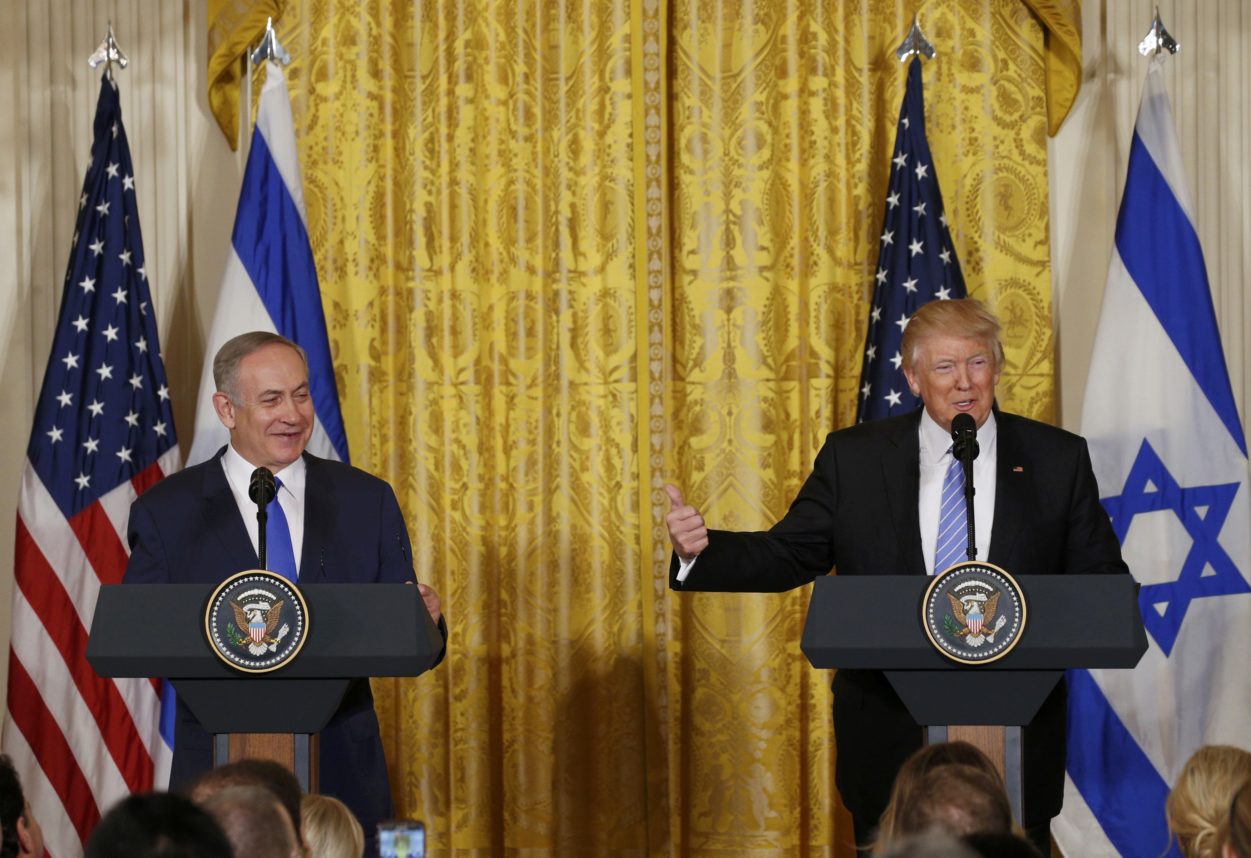
Meeting with President Donald Trump, Israeli Prime Minister Benjamin Netanyahu called for a “regional approach” to making peace with the Palestinians and other Arab countries in the Middle East.

At a White House news conference Wednesday with Trump, Netanyahu said it was one of the new approaches he was looking at to achieve peace.

“I believe the great opportunity for peace comes from a regional approach, from involving our newfound Arab partners in the pursuit of a broader peace,” Netanyahu said prior to a scheduled lunch and private meeting with the president, as as well as a meeting with their staffs.

Trump said at the beginning of his remarks that he will “do more to prevent Iran from ever developing, I mean ever, a nuclear weapon,” and lauded the United States and Israel’s shared “value of all human life.”

Netanyahu praised Trump for challenging Iran on its violations of the nuclear deal, saying the president has “shown great clarity and courage in meeting this challenge head on.” Later, he said in indirect criticism of Trump’s predecessor Barack Obama, “I think it is long overdue.”

Trump appeared taken aback by Netanyahu’s mention of the regional approach, adding that “we” had been discussing the possibility for awhile and that it would “take in many, many countries.”

“I didn’t know you were going to be mentioning it, but now that you did, it’s a terrific thing,” Trump said.

A “regional” approach posits that in place of or in addition to direct talks between the Palestinians and the Israelis, the sides would seek help from neighboring Arab states to create an opening for peace. In recent weeks the Trump administration has been suggesting it might emphasize this approach, even as it said a two-state solution was not a necessary outcome of peace talks between Israelis and Palestinians.

Trump said the Israelis and Palestinians would both have to make compromises to achieve peace, adding as an aside to the prime minister, “You know that, don’t you?”

Netanyahu responded: “Both sides, we’ll talk.”

Trump said both sides would have to “show some flexibility” and “show that they are willing to make a deal.” He also said he would like to see Israel “hold back on settlements a little bit,” but added “we’re gonna make a deal.”

Earlier this month, the White House surprised many observers by saying settlement expansion “may not be helpful” in achieving peace, tacking closer to the policies of Trump’s immediate predecessors than he indicated he would during the campaign.

Asked whether he favors a two-state solution or one state, Trump responded, “I like the one the two parties like … I can live with either one.”

Netanyahu said his views have not changed since his 2009 speech at Bar-Ilan University in which he announced his support for a Palestinian state, but that “labels” have overshadowed the “substance” of a peace between Israel and the Palestinians.

He said a peace deal must include Palestinian recognition of a Jewish state and measures to assure Israel’s security, including security control over the area west of the Jordan River.

At the beginning of his remarks, Trump called Israel “the symbol to the world of resilience in the face or oppression” and “survival in the face of genocide,” in an apparent reference to the White House statement last month for International Holocaust Remembrance Day that did not mention Jews specifically.

Asked by an Israeli reporter about the rise in anti-Semitic incidents during and after his campaign and whether his campaign bears some responsibility for a rise in “xenophobia,” Trump pivoted to say he was “honored” by his victory in the election, and that “we are going to do everything in our power to stop long-simmering racism and every other thing that is going on.”

Trump promised that “you guys are going to see a lot of love,” and acknowledged his Jewish daughter, son-in-law and three grandchildren. Ivanka Trump and Jared Kushner sat in the front row of the news conference with Trump’s wife, Melania, and Sara Netanyahu, the wife of the prime minister.

The news conference ended with Netanyahu saying of Trump “there is no greater supporter of the Jewish people and the Jewish state.”

Netanyahu calls for regional approach to making peace during appearance with Trump Read More »

New CIA head meets with Abbas in West Bank ahead of Trump-Netanyahu meeting

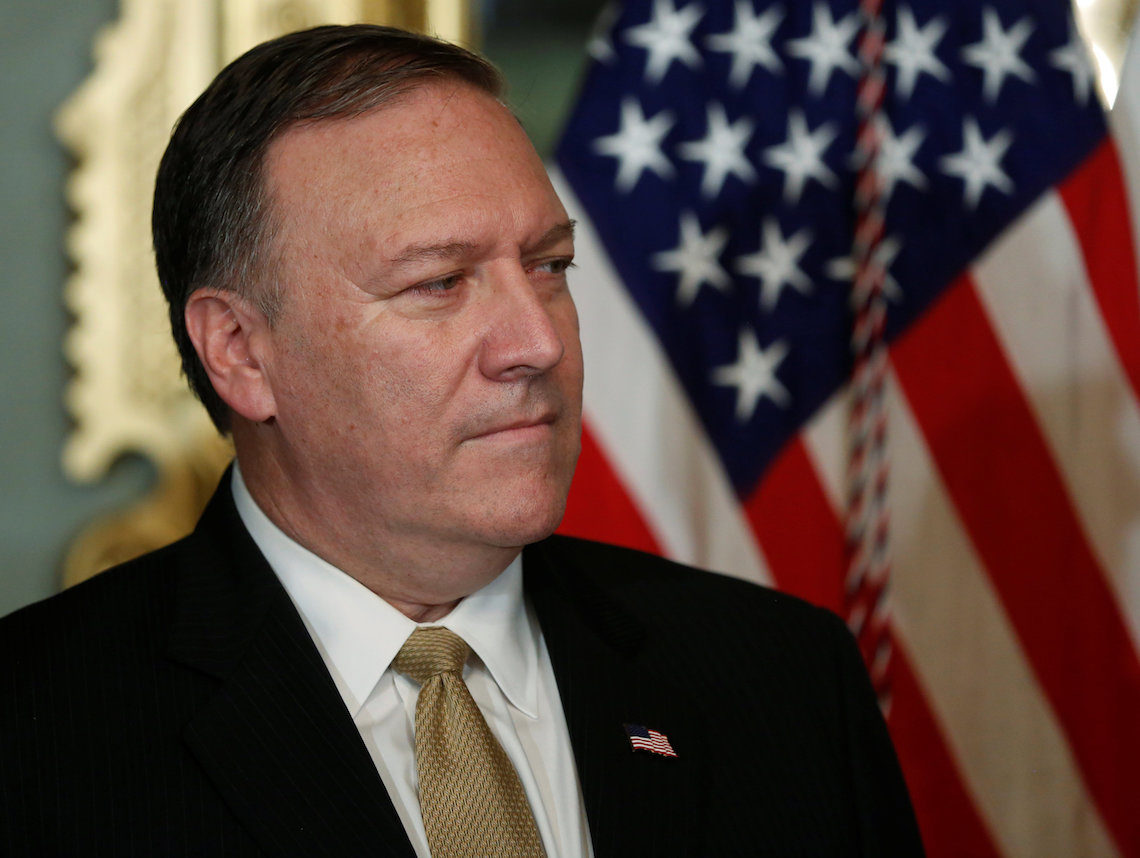
CIA director Mike Pompeo reportedly met secretly with Palestinian Authority President Mahmoud Abbas at the P.A. headquarters in the West Bank city of Ramallah.

The meeting was held Tuesday, The Associated Press reported, citing two unnamed senior officials. The White House and the CIA declined to comment to the AP.

The talks came a day before the scheduled meeting in Washington, D.C., between President Donald Trump and Israeli Prime Minister Benjamin Netanyahu.

Abbas reportedly briefed Pompeo on Palestinian positions ahead of the Trump-Netanyahu meeting. He also reportedly expressed concern about a statement made Tuesday night to reporters by a senior White House official that a two-state solution was not a necessary outcome of peace talks between Israelis and Palestinians.

New CIA head meets with Abbas in West Bank ahead of Trump-Netanyahu meeting Read More »

Pew: Jews are best-liked religious group in America

Jews are the most warmly regarded religious group in America, according to a new survey by the Pew Research Center.

The survey, which was released Wednesday, found that Americans generally express more positive feelings toward various religious groups than they did three years ago.

As they did the first time the survey was taken in 2014, Jews topped the survey, in which respondents rank various religious groups on a “feeling thermometer.” On the scale of 1 to 100, 1 is the coldest and 100 the warmest; 50 means they have neither positive nor negative feelings.

Jews were ranked at 67 degrees, up from 63 in the 2014 survey, followed by Catholics at 66, up from 62, and Mainline Protestants at 65. Evangelical Christians stayed at 61 degrees.

Buddhists rose to 60 from 53, and Hindus increased to 58 from 50. Mormons moved to 54 from 48.

Atheists and Muslims again had the lowest ratings, but both still rose on the warmth scale. Atheists ranked at 50 degrees, up from 41, and Muslims were at 48, up from 40.

The authors noted that warm feelings toward religious groups rose despite a contentious election year that deeply divided Americans. “The increase in mean ratings is broad based,” according to the authors. “Warmer feelings are expressed by people in all the major religious groups analyzed, as well as by both Democrats and Republicans, men and women, and younger and older adults.”

The random-digit-dial survey of 4,248 respondents was conducted Jan. 9-23. The margin of error is plus or minus 2.5 percentage points.

Americans tend to rate their own faith groups highest, the survey found. Jews rated themselves at 91 and rated Muslims at 51, up from 35 three years ago. Jews rated themselves the highest compared to other groups; the next highest was Catholics at 83.

The survey showed a divide between older and younger Americans. While Jews received a 74 from respondents aged 65 and up, the age group’s second-highest ranking behind Mainline Protestants, respondents aged 18-29 ranked Jews at 62 and gave their highest ranking to Buddhists at 66.

Religious groups also were rated higher by respondents who knew someone from that religion. Those who knew Jews gave them a 72, and those who do not know any Jews gave them a 58.

Pew: Jews are best-liked religious group in America Read More »

The Becoming Jewish exchange, part 2: ‘Non-Jews are already transforming the Jewish world’

Dr. Netanel Fisher is a visiting scholar at the Kohelet Forum and at the  Israel’s Open University. Dr. Fisher holds a PhD from the Hebrew University in Jerusalem. He has served as  an adjunct scholar at the University of Pennsylvania and at Hebrew University and as an Associate Researcher at the Israel Democracy Institute.

This exchange focuses on Becoming Jewish, a new book edited by Dr. Fisher and Professor Tudor Parfitt (Cambridge Scholars Publishing). In the next installments we will also be speaking to Professor Parfitt. Part 1 can be found here.

***

Dear Dr. Fisher,

In your first response, as you described the scope of the conversion phenomenon your book deals with, you seemed to bundle active, life-long Reform Jews who have non-Jewish mothers together with people who have simply “decided” that they are Jewish without any procedure or sign of commitment. You wrote that while many people declare themselves Jewish without seeking the approval of gatekeepers, “we need to carefully pay attention to this new reality: joining the Jewish people has become a vague and fluid action.”

Now, non-orthodox Jews who don’t strictly follow the halakha are not a fringe group in the Jewish world today – they have been the majority for a while. Membership in this group may indeed be fluid. Membership in the Satmar Hassidic sect is clearly less fluid.

My question: Who exactly needs to “carefully pay attention” to the phenomenon you describe? Should the so-called fluidity of joining the Jewish people be a concern for non-orthodox Jews? If so, why?

Yours,

Shmuel

***

Dear Shmuel,

Thanks again for paying attention to our study.

Let me open with the fact that the book does not just deal with conversion. Indeed many “new joiners” convert to Judaism, but most of them don’t. People join the Jewish people by simply being the  spouse or the child of a Jew; by having a long-distance connection to Judaism (such as the Anusim or the ten lost tribes decedents); or by simply identifying as Jews.

One more important preliminary point: the book is an academic effort to “connect the dots” between all the different phenomena discussed in Becoming Jewish. We are not policy makers or policy advisors. The scholars who contributed their papers to the volume did their best to delineate and describe a new reality in Jewish history. With all due respect, our personal views on “dealing with” or “solving” this new challenge have no more weight or importance than the views of others.

Having said that, let me try to address your questions:

I wrote that we need to “carefully pay attention to the phenomenon” in two senses:

First, as scholars, it’s a fascinating phenomenon. Its amazing to think of how only a few decades ago Jews were in such a terrible situation during the Holocaust and of how now it seems we are in a completely opposite era, one in which so many people want to join us. One can even see that as the fulfillment of the vision of the prophets, who talk about the gentiles coming closer to Judaism and the Jews. I think it is worth thinking of how our history is changing before running into practical dilemmas. Don’t you think so? Don’t you think we need to ask ourselves what is the meaning of this new reality before we try to come up with solutions?

Now I will get to your question directly. I can’t speak on behalf of anyone else, but I do think that the new trend should be a concern for everyone who cares about Judaism. In fact, it already is a concern  for a large part of the Jewish people. Take, for example, the current debate in the Conservative movement about whether to allow non-Jews to formally be part of the community. This discussion is a direct consequence of  a reality in which non-Jews are already becoming part of the Jewish community, in this case the Conservative movement. The Reform movement has its dilemmas too. They also have a debate about whether to marry Jews and non-Jews and, if so, under what conditions. Rabbi Dr. Dalia Marx, an Israeli Reform Rabbi,  presents in the book beautiful theological dilemmas in the Reform movement regarding how to modify the prayer book (the Sidur) and service in the face of a reality, in which so many non-Jews are part of the community.

In short, what I’m trying to say is very simple –  The changes described in Becoming Jewish are already transforming the Jewish world right now. It’s a reality that every Jewish movement is facing in its own way, and my prediction is that it is going to shake up the Jewish world more and more in the coming decades. Being Jewish is interesting, fascinating and challenging these days, isn’t it?

The Becoming Jewish exchange, part 2: ‘Non-Jews are already transforming the Jewish world’ Read More »

Cooking Moroccan Brains

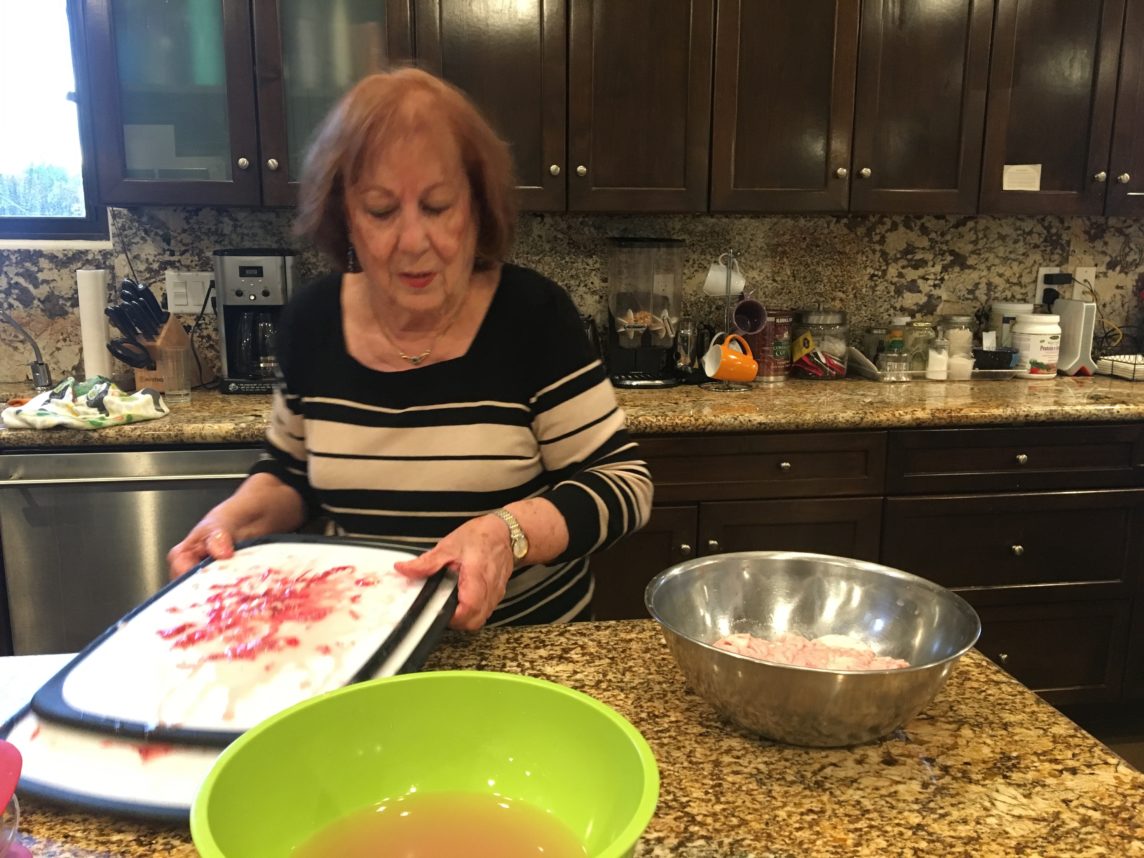
“Don’t waste a thing!” Meme Suissa declared, in French, as she swept up two errant leaves of flat leaf parsley and tossed them into the pot.

Meme, who is in her eighties, was teaching me to cook cervelle a la maroccaine, or brains, Moroccan-style, in the kitchen of her son David.

It’s a dish she learned to make from a dear neighbor back in Casablanca, where the family lived before moving first to Canada.

And cervelle is very much in keeping with Meme’s lifelong dictum against waste.  In Casablanca, she learned to use every part of the animal– so long as it was kosher.  Brains, cheeks, tail — her neighbor taught her recipes that coaxed wonderful flavors from these underused, and less expensive parts. Now “nose-to-tail” cooking is all the rage.  For Meme, it was a matter of survival, or at least economics.

Weeks ago, Meme, David and I got to talking about all these non-standard cuts and the wonderful meals she made from them. She lamented that her local kosher butcher doesn’t even carry tails, cheek, tripe and brains.  On the spot, I texted my local kosher butcher, Israel Feuerstein at Rabbi’s Daughter on Westwood Blvd.  He texted back: yes, give him a week.


When I arrived at the shop, Israel told me he could get tails, cheek and brains, but no tripe.

“It’s from the rear of the animal,” he said, pointing out that observant Ashkenazi Jews are forbidden from eating from the hindquarters of animals.

“Well what about the tail?” I asked.

Israel shrugged: Hey, I don’t make the rules.  I understood.  If it was logic I wanted, I wouldn’t be in a kosher butcher store in the first place.

A week later I showed up at David’s with two pounds of beef brain. Since I was coming from the Jewish Journal offices, I had to store it for the day in the staff refrigerator.  All day long I waited for a scream to come echoing out of the kitchen, but the brain went undiscovered.

Later, as David and I recorded, Meme set about cooking a dish that brought her back to Casablanca, to Montreal. Her hands deftly removed the bloody membrane circling the fleshy coils.  After a quick soak in salted water to remove more blood, she boiled the lobes in more salted water for about 10 minutes.

“I want to give you some soup,” Meme said.  She walked to the refrigerator and pulled out a white bean soup she had made the day before.  It was also a dish from Casablanca, similar to the harira she had taught me to make.  She heated it and served me a bowl beside a homemade whole wheat roll.  I sopped up every bit.

OK, so much for the comfort food, back to the discomfort food.  Meme drained the brains and cut them into bite-sized pieces.  Then she sauteed them with just a few ingredients, including saffron, lemon,garlic and that parsley.

At some point, cooked meat can cease looking anything like an animal part.  But brain never stops looking like brain.  I decided you either had to cook it superbly, or be very, very hungry.

Not 20 minutes after I arrived the brain was finished.  Meme plated some for me, steaming chunks of pale organ bathed in a thin saffron yellow sauce. The scent was heavenly: all that garlic and lemon and parsley.  The flavor?  Every bite reminded me I was not eating just meat.  It was soft, like scrambled eggs, but where the oil and seasonings didn’t penetrate, there was the funk of organ meat, something musty and, well, challenging.

But I ate it all, focusing on the Meme parts — the garlic, olive oil, salt, lemon, saffron, parsley– not the brain parts.  No, I didn’t waste a bit.

[RECIPE]

Moroccan-style beef brain, or Cervelle a la maroccaine

Meme Suissa doesn’t measure, and doesn’t appreciate your interest in measurements. Everything below is approximated. By me.

2 pounds beef or calf brain, cleaned

6 cloves garlic, peeled

1 punch flat leaf parsley, chopped

1/4 c. lemon juice

pinch saffron threads soaked in 1/4 c. water

salt and fresh ground pepper

olive or vegetable oil

1. Soak cleaned brains in salted water for 10 minutes. Drain and rinse.
2. Bring a large pot of salted water to boil.  Add brains, cover, and reduce heat to a simmer.  Cook 10 minutes, or until brains are firm.

3. Drain brains in a colander.  Let cool until you can cut them into 2 inch pieces.
4. Heat oil in skillet.  Add garlic.  Fry until just translucent. Add brains. Stir gently to coat.  Add saffron water, lemon juice, half the parsley, and salt and pepper to taste. Stir.   Bring to simmer, cover, and cook 10 minutes.
5. Sprinkle with remaining parsley and serve.

Cooking Moroccan Brains Read More »

LIVE STREAM: Uber and racial discrimination – A conversation with Chris Knittel

Join us on Wed., Feb. 15, at 9 a.m. PST for a live conversation with Chris Knittel, professor of applied economics at MIT Sloan, who will talk about his latest research on racial bias in the sharing economy—how Uber and Lyft are failing black passengers and what to do about it.

Eva Millona, the Executive Director of the Massachusetts Immigrant and Refugee Advocacy Coalition (MIRA), will also appear on the program to discuss ways Uber and Lyft can work on mitigating discrimination.

You will be able to view the live show by bookmarking this page and tuning in Feb. 15 at 9 a.m. PST.

Submit your questions to #MITSloanExperts on Twitter before 8 a.m. PST on Feb. 15. Your question could be answered live on the air.

Our last installment featured Zeynep Ton, MIT Sloan Professor and author of The Good Jobs Strategy. The live stream with Chris Knittel will play from here on Feb. 15.

Powered by Go-Live

LIVE STREAM: Uber and racial discrimination – A conversation with Chris Knittel Read More »