fbpx

January 26, 2017

Building a Jewish Left: A Q&A with Simone Zimmerman

In the space of five days in April, San Fernando Valley native Simone Zimmerman went from a rank-and-file activist against Israel’s policies in the West Bank and Gaza to the most reviled figure of right-wing Zionism.

In the midst of an emotional and dramatic election campaign, Democratic presidential candidate Bernie Sanders tapped Zimmerman, then 25, to head his Jewish outreach. Shortly after, a year-old Facebook post surfaced where Zimmerman referred to Israeli Prime Minister Benjamin Netanyahu using expletives.

She edited the curse words out about 10 hours later, but it was too late: Somebody had taken a screenshot, and her post spread through the press like a virus. She was Sanders’ national Jewish outreach coordinator for less than six days before the campaign acceded to the demands of various Jewish leaders and removed her from the post.

But before all that, Zimmerman grew up in a rather normal Jewish childhood in Los Angeles, spending 10 summers at Camp Ramah in Ojai and attending a Jewish high school. By the time she went to college, at UC Berkeley, she was beginning to question what she’d been told about Israel and whether she’d gotten the full picture. The questions never went away.

While living in New York City in 2014, Zimmerman was part of small group of young, progressive Jews who founded IfNotNow, a nationwide network of activists that objects to the status quo in the Palestinian territories and challenges mainstream Jewish organizations to do the same.

“For me, a lot of my identity, the work that I do, is a direct result of coming to the institutions of the Jewish community, asking hard questions and being turned away, and often being attacked and vilified,” she said.

Zimmerman spoke to the Journal this week in a phone call from Israel, where she’s spending a year. The interview was her first with the press, Jewish or otherwise, since the Sanders controversy. (A previous interview published in +972 Magazine was conducted by a fellow activist, Isaac Luria.)

The following conversation has been edited for length and clarity.

Jewish Journal: You’re in Israel for the yearlong Dorot Fellowship. Can you tell us what that means?

Simone Zimmerman: The Dorot Fellowship chooses a cohort of [American} Jews, mid-to-late 20s, for a personal a leadership development program. … We plan seminars for each other about Israel and Israeli society and we have community days that include everything from a storytelling workshop to… personal feedback sessions, learning how to give and receive feedback. It’s a laboratory for individuals to work on different aspects of themselves that they want to reflect on, grow in.

JJ: What do you hope to get out of your year in Israel?

SZ: First and foremost, I’m here in Israel very much to reconnect with the humanity of this place — the humanity, the complexity, the beauty of the world that Israelis and Palestinians live in here… I’m spending a lot of time getting to learn about the narratives and avenues for hope and change … I guess you could say it’s an opportunity to get beyond the headlines.

JJ: Your story seems to have turned you into something of an archetype for perhaps thousands of other likeminded young American Jews. Does that feel like a burden on you and if so, do you accept it?

SZ: Yes and yes. … [After the controversy] I did need a space to breathe, take care of myself, kind of be out of the spotlight a little bit, reflect, recharge, reorient. … I think my experience on the campaign, there are aspects of it that I really see as a tremendous opportunity. It gave huge visibility to IfNotNow. It broadcast a story … It’s really important that lots more people know that there are many, many young American Jews like me whose politics developed not, in spite of the Jewish establishment, but because of our experience there. For me, a lot of my identity, the work that I do, is a direct result of coming to the institutions of the Jewish community, asking hard questions and being turned away, and often being attacked and vilified. … For me, I think it’s important that people know this story.

JJ: Abraham Foxman came out shortly after retiring as head of the Anti-Defamation League to call for your firing. Why do you think the Jewish establishment was so terrified of — no offense — some 25-year-old from the San Fernando Valley?

SZ: They attack us so much because they know that we are not a minority and that we are a growing voice in the community. If they didn’t see us as a growing threat they wouldn’t feel the need to attack us. I think they know that as the occupation hits its 50th anniversary, as the Israeli government moves more and more to the right, American Jews are moving left, a lot of us, and we’re not willing to check our values at the door to maintain this pro-Israel consensus. True safety and liberation for Jews in the U.S. and in Israel actually depends not on supporting the occupation but fighting for freedom for all people.

JJ: Are you optimistic that the Jewish establishment will come around to your position on Israel, or do you think some institutions will have to be toppled before all is said and done?

SZ: I hope some institutions might come around. I think a lot of the institutions of our community were really founded to serve really just causes. And it makes me sad, it really hurts me to see that so many of them have strayed from what I think is their founding mission. … But IfNotNow, Jews for Racial and Economic Justice, a lot of these organizations, even T’ruah, these organizations and movements are going to be seating the leaders that are going to start our own institutions … that in a few decades might make those other organizations totally irrelevant.

JJ: What does the future hold for Simone Zimmerman? Are you going to continue doing anti-occupation work?

SZ: I feel pretty clear that building a Jewish left and being part of the fight to end the occupation — that’s the work I’m going to be doing for a pretty long time. Exactly where and how, I’m not so sure yet.

JJ: Are you considering making aliyah and staying in Israel permanently?

SZ: Look, this place is really important to me. I have a lot of friends and family here. But I’m an American.

JJ: In 2014, you help start IfNotNow. Can you tell me about that?

SZ: IfNotNow started in New York City during the 2014 war in Gaza. The basic call to action was around Hillel’s three questions: “If I am not for me who will be for me? If I am only for myself, what am I? If not now, when?” … The actual action that we started doing was saying the Mourner’s Kaddish outside of Jewish institutions and reading the names of Israelis and Palestinians who were killed in the violence. It quickly moved to about eight other cities around the country. … Well over 1,000 people took action with us that summer. And we were shocked. … Once the war ended, we knew it was only a matter of time before there was another crisis, and we felt pretty committed to harnessing the voices of all the people who had come out to protest with us that summer. … We launched our training program a little over a year ago and at this point, there are 700 leaders in eight cities and quickly expanding, and over 4,000 people have taken action with IfNotNow.

JJ: Where do you see the future of the Jewish community moving at this point?

SZ: I’m more terrified and more hopeful in this moment than maybe I’ve ever been in my life. I’m terrified because I believe the threats that Donald Trump and his administration have made. I believe that real people are going to get hurt in the next four years. And as much as I believe that the Jewish establishment is out of touch and as many times as they’ve disappointed me over the years, it still really hurts to see them cozying up to white nationalists in the name of maintaining the status quo in Israel. On the flip side, I’m really hopeful because I really believe I’m part of a majority in the U.S. that actually believes in a better future. … We’re really excited to see more and more people in our community being forced to choose a side. I think that polarization [can be] such a really important opportunity and I hope a lot more people are really going to get involved and stand up for their values.

Building a Jewish Left: A Q&A with Simone Zimmerman Read More »

The politics of division and diversion

On Saturday, millions of people around the world took to the streets in Women’s Marches, proclaiming fidelity to basic fundamental rights for women, people with disabilities, religious minority groups, immigrants and all vulnerable populations.

In the days following the marches, relentless attacks have been leveled against one of the organizers, a Palestinian-American-Muslim activist from Brooklyn named Linda Sarsour. Character assassinations and attempts at guilt-by-association have been disseminated by white supremacists and fake news outlets.

What’s driving these attacks? Why Linda and why now? This smear campaign comes on the heels of what may be the largest mass mobilization in recent history. Marches took place not only in DC, Los Angeles, New York and Chicago; large groups also gathered in Phoenix, Knoxville and Wichita, and folks braved the 15-degree cold to protest in Anchorage. Across the world, in Paris, Tel Aviv, London, Bangalore, women and men stood together for justice and equality. Look at the photos from Antarctica. There’s something happening here.

Clearly, this march struck a nerve. I spoke at the march in DC, where I said that sometimes it happens—maybe once in a generation—that a spirit of resistance is awakened at the intersection of love, faith and holy outrage. This is one of those moments: voices of moral clarity are echoing from the far reaches of the planet calling for love over hate, progress over regress, and inclusion over exclusion.

That would be enough to make some strident traditionalists shake in their boots. But there’s more. This was not only a mass mobilization, it was organized by women. Young women of color to be exact. The leaders were unapologetically feminist. The participants were women and men, LGBTQ and heterosexual, Black, Brown and white, Jews, Muslims, Christians, Catholics, Sikhs, people of all faiths and none. In a country still propelled by the rule of powerful white men, this was deeply threatening. The language was one of love and moral courage, reflecting a significant shift in both consciousness and power, signaling the emergence of a new kind of leadership and driven by a new set of priorities.

What to do when the ground begins to shake? Distract, disrupt and discredit. Paint a young activist and mother as a fundamentalist Muslim who wants a Sharia takeover of America. No matter that that’s not who Linda Sarsour is, what’s important is that the seed of suspicion is planted in the minds of otherwise thoughtful and discerning people, who quickly begin to worry that this new movement is tinged by violent extremism.

These attacks are clearly an attempt to undermine the legitimacy and importance of what happened on Saturday, to divert attention from the unprecedented grass-roots protests against a dangerous and retrograde agenda that threatens the very democratic core of our nation.

Of course, apart from the fake news and outright lies, many will still disagree with Linda’s views on the Israeli-Palestinian conflict. As a rabbi and progressive Zionist, I, too, disagree with Linda on many of these views, and she and I have had fruitful and respectful conversations where our perspectives diverge. That we disagree does not disqualify her as a serious activist and leader, nor does it tarnish or diminish the outstanding work she is doing as an organizer fighting racial and gender injustice.

The Women’s March organizers achieved something extraordinary last weekend. It was a massive peaceful, positive and hopeful demonstration, and I was honored to be part of it. It was, in fact, Linda who invited me to have a voice at the podium. And when the hour grew late, it was Linda who insisted that we not end the program until I had a chance to speak.

In this time of rising demagoguery and vicious personal attacks, we have to carefully discern between real news and fake, between actual facts and “alternative facts,” between guilt and guilt-by-association.

And we must recognize that in multi-faith and coalitional politics, we won’t agree on all issues all the time. As I said at the march, I believe our nation is suffering from a soul crisis, rooted in a cynical politics that pits vulnerable populations against each other. The antidote to this toxic new reality is spiritual resistance, a reawakening to our shared humanity. One nation, indivisible. It is our job to stop shouting and start listening long enough to find the humanity and shared purpose even in people who hold perspectives that differ from our own.

We are living now in dangerous times, and we’ll see more campaigns of diversion. Remember that resistance is a muscle. We are going to have to get very good at distinguishing between the real story and the obfuscation. In this case, we can start by going back to the real story: the radiant display of faith, hope and solidarity on the streets this past Saturday.


Sharon Brous is rabbi and founder of IKAR Los Angeles.

The politics of division and diversion Read More »

Meant2Be: Gym crush dream doesn’t work out

You’re 10 minutes into an hour treadmill run when she walks into the Equinox gym in Century City. She’s the love of your life, but she doesn’t know it yet. All Gym Crush knows now is that some tall guy on the treadmill is gawking at her. You quickly look away. Fantasy is healthy, you tell yourself, and this is Los Angeles, nothing if not a town full of dreamers. So you turn up the speed on the treadmill (in case she’s watching) and again give in to imagination.

Gym Crush rolls out her perfect thigh muscles and you can’t help but notice that her long brown hair is perfectly tucked away in a ponytail. You wonder how she’ll wear her hair on your first date to Gracias Madre in West Hollywood. You’ve agreed to this hot spot because it turns out, you’re both vegetarians! You pick her up in an Uber Select and wonder if she’ll notice when, by date four, you switch back to the more affordable Uber X. The conversation is easy and wonderful and you laugh at all the suckers who meet each other on dating apps. This is way better.

Gym Crush does squats while you’re planning your wedding in Malibu. You have it on the autumn equinox to remind everyone where you met. You invite some of the other gym members like Silver Fox, the Workout Twins, and even Jerkwad Guy with Great Hair. Your best friend will give a speech and joke that this is why his wife doesn’t let him go to the gym. You’ll laugh with everyone else but you actually don’t find infidelity jokes very funny. Pictures will be all over Facebook and you will get hundreds of likes. An ex-girlfriend will unfriend you when she sees, but you’re too busy being in love to notice.

Gym Crush does hanging leg lifts while you’re attending to your newborn baby girl. Sadie is not only brilliant for a 4-month-old, but she already has her mother’s defined calf muscles. You hold Sadie when Gym Crush passes you with her Nike gym bag over her shoulder, off again to the Westwood Equinox, your new gym since you got the condo in Brentwood. Gym Crush kisses you on the lips and calls you the best and you hope that this magical feeling never goes away.

Gym Crush stretches her quads on the stretching table but you’re upset because the magical feeling has gone away. Sadie has a brother named Ira and you all have moved to the more affordable San Fernando Valley. You’re at work on a hot Valley day wondering what happened to the cool, spontaneous Westside lives you used to lead. But then your phone dings and it’s a text from Gym Crush and she’s wondering if you could sneak out and meet her at the Encino Equinox for an hour. She signs it with two red hearts and you know that there’s so much love that everything will be all right.

You check the time on the treadmill and when you look back up you can’t find Gym Crush. You’re instantly back in reality. You jump off the treadmill, race through your shower and rub Kiehl’s body wash over the important spots. You toss your wet towels into Smiley Towel Attendant’s bin and make an insipid comment about how you’re hurting today. Smiley Towel Attendant smiles.

You run outside to the Equinox valet and see that your plan worked: Gym Crush is waiting for her car. But Jerkwad with Great Hair has sidled up to her on the bench and now you know why you called him Jerkwad all this time. You stand next to them and you eavesdrop while you pretend to look at your iPhone. She tells him she’s from outside New Orleans. You silently pray to God that Blue Shirt Valet Guy brings Jerkwad’s car first and when he does, you are reaffirmed that He exists and He is good.

“Funny, I spent three months in NOLA working on a Will Ferrell movie,” you say, knowing you just namedropped big-time. Gym Crush is friendly and she tells you that her name is Ryan, which of course is just the cutest thing in the world EVER, and you wonder if it’s spelled Ryan, Ryanne or Rian so you can stalk her on social media later.

Blue Shirt Valet Guy brings Gym Crush’s car next and she tosses you the greatest smile and tells you she’ll see you around. And you coolly say, ‘Yeah, for sure,’ but you wish you would have gotten her number then and there.

You never see Gym Crush again. The Century City Equinox closed last summer for renovations. You and all the other characters are now displaced to other L.A. Equinoxes (Equinoxi?). You’ll go to every Equinox in the Southland all summer, but the truth is that you might never see Gym Crush again. Still, the fantasy remains alive. And it keeps you religiously going to the gym. So maybe that’s enough.

Jonah Goldfinger is a Los Angeles-based screenwriter, and if your name is Ryan or Ryanne or Rian, you went to the Century City Equinox and you are single, please consider adding him on Facebook.

Do you have a story about dating, marriage, singlehood or any important relationship in your life? Email us at meant2be@jewishjournal.com.

Meant2Be: Gym crush dream doesn’t work out Read More »

Elli•Q: The robot who’s bubbe’s best friend

A new robotic companion is on a quest to alleviate loneliness and social isolation for older adults living alone.

Elli•Q — named for Elli, the Norse goddess of old age — is the brainchild of Intuition Robotics, a Ramat Gan startup pioneering social companion technologies. The robot’s mission is to be an “active aging companion,” keeping older adults engaged by helping them access and connect to today’s technologies, including video chats, online games, social media and other ways to stay in touch.

“We set out to create this company to have a positive social impact,” Dor Skuler, CEO and founder of Intuition Robotics, said. “While we don’t expect a robot or technology to be people’s friends or solve the problem of loneliness, we do think that technology can overcome barriers and bring people together in a way that’s not happening today.”

Loneliness is a growing public health concern worldwide.

“Loneliness and social isolation are the result of longevity, and technology has made the problem worse by requiring older adults to learn new technical skills in order to accomplish the simplest of tasks,” explained Skuler, a serial entrepreneur who also founded startups Zing and CloudBand.

Using “natural communication” such as body language, speech interface, sounds, lights and images to express herself, Elli•Q is designed to be emotive, autonomous and easily understood. She uses machine learning to acquire knowledge of the preferences, behavior and personality of her owner, and proactively recommends activities based on that history and recommendations by family.

“Our goal is to leverage a combination of our proprietary technology, gerontology know-how and elegant design to empower older adults to intuitively interact with technology and easily connect with content and loved ones, and pursue an active lifestyle,” Skuler said. “We like to think of Elli•Q as part communication coordinator, part arbiter of lifelong learning and part coach. She’s easy to talk to, simple to operate and understands her owner.”

A prototype of Elli•Q made its public debut at the Design Museum in London as part of its “New Old: Designing for Our Future Selves” exhibition running through Feb. 19. It looks at how new approaches to aging — from robotic clothing to driverless cars — can help people lead fuller, healthier, more rewarding lives into old age.

According to Age UK, nearly half of all people 75 and older live alone, and more than 1 million in the U.K. say they always or often feel lonely. Thirty-six percent speak to fewer than one person per day and 11 percent say they spent five days or more a month without seeing anyone.

Moreover, the organization reports that older adults living in isolation increasingly rely on technology rather than face-to-face interaction, yet they often find the technology confounding. Of course, keeping older adults physically and mentally active is important for health and cognitive reasons.

As such, Intuition Robotics programmed Elli•Q to prompt users to engage. Elli•Q recommends TED talks, music or audiobooks; the robot suggests physical activities such as going for a walk. It’s also a personal assistant and reminds users about appointments or taking medications.

Intuition Robotics’ multidisciplinary team of roboticists, industrial designers, full stack developers, Android developers, gerontologists and machine-learning experts have meshed hardware and software, machine learning and computer vision, psychology and design. Elli•Q’s design is a collaboration with famed industrial designer Yves Béhar and his studio, Fuseproject.

“The idea of having a robot companion is quite dystopian, especially for older generations. Through years of research, we were able to develop a design language and user experience that feels natural, with subtle expressions to develop a unique bond between Elli•Q and its owner,” Béhar said. “Elli•Q could never replace human interaction, but it can be an important motivating factor in keeping older adults healthy and active when living alone.”

At the moment, Elli•Q is only a prototype. Skuler says the robot will enter early trials in San Francisco and Israel in February.

Intuition Robotics has raised seed funding from investors, including Bloomberg Beta, Terra Venture Partners and OurCrowd.

“A lot of our success or failure with Elli•Q will be in our ability to create a full experience with older adults and help overcome the complexity of the digital world,” he said.

If Elli•Q succeeds in its mission, it could launch the next trend of smart social robots in homes the world over.

Elli•Q: The robot who’s bubbe’s best friend Read More »

The Fugu Plan: How the Japanese saved Jewish refugees

“You know how when you’re at a seder,  you talk about freedom and slavery and so forth? The conversation was about the Holocaust and how Jews would go to Canada or Mexico or Argentina. And this couple sitting next to me said, ‘Oh, we went to Tokyo.’”

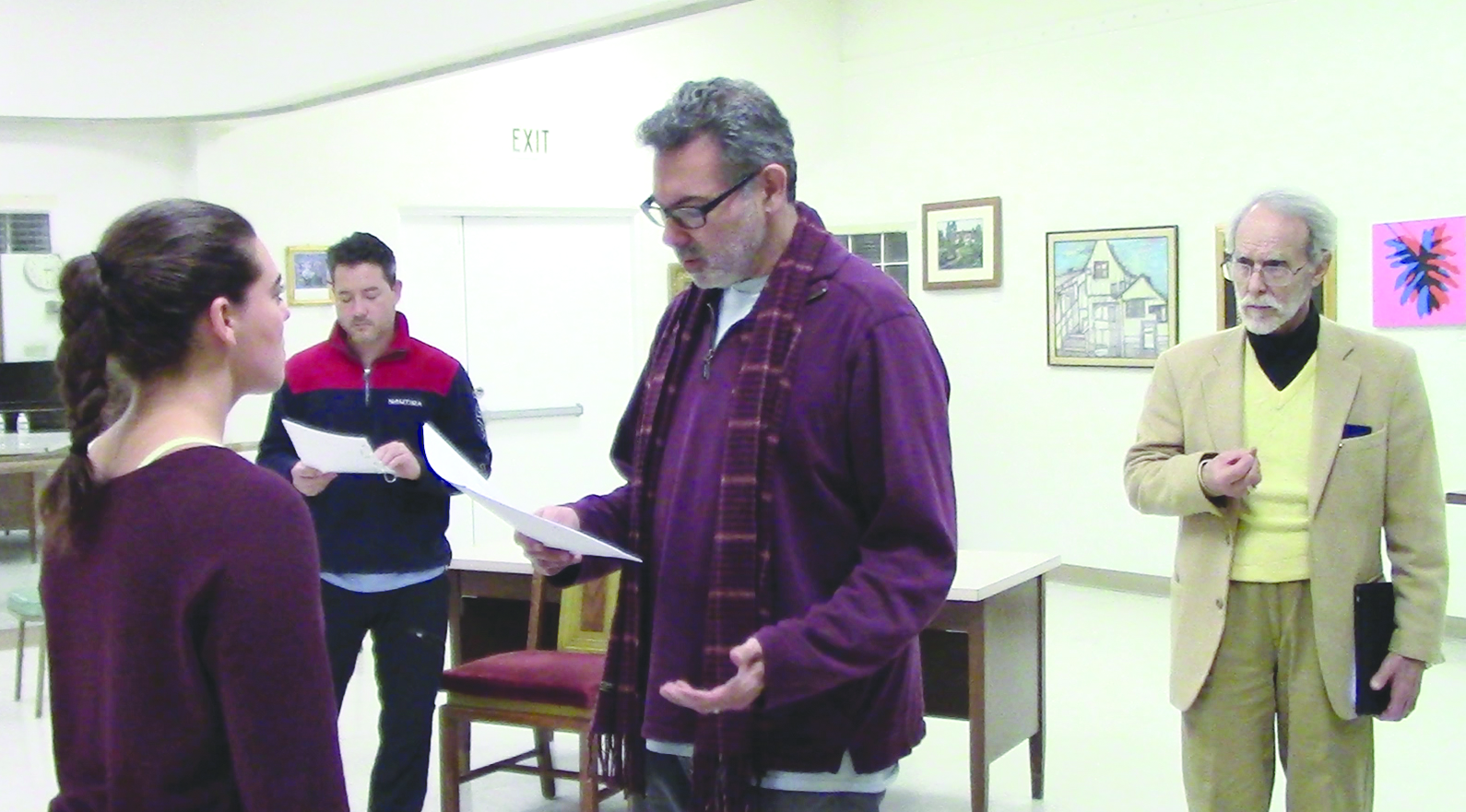
It was at that moment at a friend’s Passover seder in the 1980s, Howard Teichman recalled, that his idea for a play was born. The play, called “Fugu” — about the Japanese plan to offer sanctuary to European Jews during World War II and the bizarre rationale behind that campaign — will be presented Jan. 28 to March 19 by the West Coast Jewish Theatre, where Teichman is the artistic director.

“I did some research and then I realized, my goodness, there’s this story about how Lithuanian Jews were given exit visas so they could come to Japan — and all of a sudden there’s this Fugu Plan. And I became so totally enamored with the story. It just kind of blew me away,” said Teichman, the play’s director and co-writer with Steven G. Simon.

While the couple at the seder had been able to stay in Tokyo posing as Nazis, Teichman learned that other Jews were allowed to settle openly in such cities as Kobe, where the play is set.

The Japanese admiration and friendly feeling for the Jews was solidified during the Russo-Japanese War (1904-05), when wealthy Jewish banker Jacob Schiff helped the Japanese prevail by extending them a multimillion-dollar loan.

Then, in 1922, Japan sided with Soviets who made up the White Army in its war against the Communists. The notoriously anti-Semitic Soviets introduced Japanese Col. Norihiro Yasue (a character in the show played by Ryan Moriarty) to the infamous “Protocols of the Jewish Elders” (also known as “The Protocols of the Elders of Zion”), a fabricated document purporting to be the minutes of a meeting during which prominent Jewish figures formulated plans to take control of the world’s economies, governments and media. However, while the fake document was used to justify anti-Jewish oppression around the world, it prompted the Japanese to admire what they believed was the Jews’ wealth and influence, which they hoped could be used to help advocate for Japan in the United States. Yasue even traveled to what was then Palestine in the 1920s, meeting with Chaim Weizmann and David Ben-Gurion, and later got his foreign ministry interested in the Fugu Plan.

“According to the plan,” Teichman explained, “the Japanese wanted one Jewish man to go to America because they believed [President Franklin D.] Roosevelt was Jewish, and they felt that if they could show Roosevelt that they were being good to the Jews, he would lift the oil embargo that was placed on Japan in 1935 — because Japan had attacked China, and China was an ally of ours. If they showed they were nice to the Jews, somehow that would translate into not going to war. That would translate into, hopefully, getting Jewish-American money to Japan to help the Jews who were in Japan.”

As the play begins, leaders of the Jewish community in Kobe, including Rabbi Shlomo Shapira (Peter Altschuler) and Dr. Avram Kaufman (Warren Davis) — in real life, Dr. Abraham Josevich Kaufman — invite Yasue to Shabbat dinner. Yasue decides the dinner should take place at his home and be overseen by his aide, Setsuzo Kotsuji (Scott Keiji Takeda), who has learned about Judaism and studied Hebrew in Palestine. Also present is another member of the Jewish community, along with Kaufman’s daughter (Rosie Moss) and Captain Matsuoko (Marcel Licera), a fervent Japanese nationalist.

During the dinner, the Japanese pressure their guests to participate in the Fugu Plan or end up in a concentration camp. Although he is bewildered by the idea and knows he has little chance of success, Kaufman agrees to be Japan’s emissary to the United States.

In the play, the three main Japanese characters and the leaders of the Jewish community are all based on historical figures, Teichman said, but the Shabbat dinner is a dramatic invention to further the story line, as is the character of Kaufman’s daughter and a fictional love story between her and Kotsuji.

“We decided that, during our process of writing this play, we wanted to create a sense of urgency,” he said. “And the way we did it was to have everything happen in one day. … And so, the Shabbat dinner was a way of introducing the Fugu Plan to the audience.

“That’s why we set it the way we did. That’s why we took dramatic license the way we did, because the story is a long story. It takes up time and time. We tried to synthesize the story so it could be theatrical.”

Into the mix comes Gestapo officer Col. Josef Meisinger (David Preston), known as “the Butcher of Warsaw,” making an unexpected appearance. His entrance effectively puts an end to the Fugu Plan and poses a dire threat to the Jews. “Josef Meisinger was a real person who had come to Japan to ask the Japanese to kill the Jews,” Teichman said. “And the words that we wrote came from his transcripts.”

But the Japanese, who occupied Shanghai, refused to kill the Jews, opting instead to create a ghetto for them in that city. “Go to YouTube and see these people from Steven Spielberg’s ‘Shoah’ who speak about their time in Shanghai,” Teichman suggested. “These people talk about it being difficult. They didn’t have all the amenities, all the food, but they look back on it as a time when they survived. They were living in conditions that were better than being in a concentration camp. They were able to come and go. They had newspapers. They may not have had fancy clothes and all the amenities, but they were able to survive. And to me, that’s the real story — that these people survive.”

The Fugu Plan: How the Japanese saved Jewish refugees Read More »

Oscars salute a city of stars — and many are Jewish

Oscar belted out “City of Stars” on Jan. 24, with a special nod to Jewish talent, as the 89th Academy Award nominations were announced at 5:30 a.m. local time.

The uplifting musical “La La Land” danced off with 14 nominations, including one for best picture — tying the records of “All About Eve” and “Titanic,” thanks mainly to two former Harvard roommates, Justin Hurwitz and Damien Chazelle, both 32.

Hurwitz (see profile on Page 63) received nods for musical score and original song (with Benj Pasek’s lilting lyrics) for both “City of Stars” and “Audition (The Fools Who Dream).” Chazelle was nominated in the director and screenplay categories.

Chazelle told the Jewish Journal last year that his parents, although Catholic, were dissatisfied with their son’s education at a church Sunday school so they enrolled him in the Hebrew school of a liberal synagogue.

Over the next four years, Chazelle recalled, “I had that period of my life where I was very, very into Hebrew and the Old Testament, and then I went with my class to Israel when we were in the sixth grade. I don’t think they even knew I wasn’t Jewish; I was, like, ‘passing.’ ”

Two noted thespians were nominated in the lead actress race: Jerusalem native Natalie Portman for her role as former first lady Jacqueline Kennedy in “Jackie,” and veteran French star Isabelle Huppert in the French film “Elle.”

Huppert, who plays a successful businesswoman who plots an elaborate revenge on the home intruder who raped her, is the daughter of a Jewish father and a Catholic mother. Her parents were married while France was under Nazi occupation, with her father hiding his Jewish roots.

In the lead actor category, a nod went to American-British actor Andrew Garfield, whose paternal grandparents were Jews who emigrated from Eastern Europe to London. He stars in “Hacksaw Ridge,” the story of the only conscientious objector ever awarded the Medal of Honor.

The movie also earned a nomination for director Mel Gibson, still living down his anti-Semitic outbursts of the past. However, actor and director got along well, with Garfield declaring in a TV interview, “I am proud to be Jewish.”

Also in the running for outstanding achievement in direction is Kenneth Lonergan for the critically acclaimed “Manchester by the Sea.” Lonergan’s mother and stepfather are Jewish.

“Joe’s Violin,” a film by Kahane Cooperman and Raphaela Neihausen, made the cut in the short documentary category. It explores the friendship between a 91-year-old Holocaust survivor and a 12-year-old Bronx schoolgirl and how the power of music can brighten the darkest of times.

The winners will be crowned Feb. 26 at the Dolby Theatre in Hollywood. The ceremony will be broadcast to 225 countries and territories worldwide.

Oscars salute a city of stars — and many are Jewish Read More »

More than symbolism involved with moving U.S. Embassy to Jerusalem

The location of the United States Embassy in Israel has been an issue of controversy for decades, but it is newly on the front burner. Moving the embassy from Tel Aviv to Jerusalem was a persistent Donald Trump campaign promise, one of its strongest advocates is U.S. ambassador to Israel nominee David Friedman, and Israeli officials called on Trump to relocate the embassy in their messages of congratulations on his election.

Like so many other variables in the Israeli-Palestinian conflict, this one boils down to whether you feel more strongly about principles or outcomes. Unlike other areas of contention between Israel and the Palestinians, this is one where the smart solution is one against which I instinctively recoil.

The historical reason for the embassy being located in Tel Aviv is because the international community views the overall status of Jerusalem as being subject to negotiations between Israel and the Palestinians. This is not an issue in which the U.S. is an outlier in any way — while there were a small number of primarily Latin American countries that located their embassies in Jerusalem in the past, there have been no embassies in Jerusalem for more than a decade.

Aside from the American position that the status of Jerusalem should not be prejudged, there is a daily and ongoing practical reason for having the embassy in Tel Aviv. American regional allies are adamant that locating the embassy in Jerusalem would be a literally explosive issue, and indeed Presidents Bill Clinton, George W. Bush, and Barack Obama have on national security grounds waived the requirement in the Jerusalem Embassy Act that the embassy be moved to Jerusalem. It is taken as an article of faith that moving the embassy will create protests not only in Israel but against American embassies and consulates throughout the Middle East and subject American diplomats and soldiers to the threat of violence.

The argument for moving the embassy to Jerusalem relies on a basic notion of fairness. Israel defines its capital as Jerusalem, and yet it is the only country in the world whose capital — determined by its own democratically elected and sovereign government — is not accepted by the rest of the international community. Despite the fact that Jerusalem does indeed represent a complex problem whose ultimate settlement must be resolved through negotiations, this is a red herring. Israel’s capital is in West Jerusalem, the newer section of the city that was built by Jewish residents of Palestine and was part of Israel from the very beginning. Its status is not and never has been disputed, was not and is not subject to any past or future negotiations, and is not the part of the city that is viewed by some as being more appropriately internationalized. Many Israelis and American Jews view the refusal to locate the American embassy in West Jerusalem as an unfair double standard and believe the Palestinian and larger Arab red line over moving the embassy to be evidence that the issue is acceptance of Israel in any borders rather than a stand against Israel’s presence in the West Bank.

Many people and organizations on both sides of this issue feel very strongly about it, as evidenced by the flood of statements and commentary on it since Trump’s election. Similar to the debate over the president using the phrase “radical Islamic terrorism,” it is an example of the divide over whether powerful symbolism should take precedence over more easily measurable consequences, and as with that debate, there are legitimate arguments for both. Irrespective of where one falls out, I wish that those on opposite sides of this divide would recognize that it is not a cut-and-dried debate.

To keep the embassy where it is does not constitute a purely neutral move. Israelis rightly feel that it signals an unwillingness to accept Jerusalem as the capital of Israel and the Jewish people, the return to which was the object of centuries of Jewish longing. An American embassy in West Jerusalem does not prejudice the status of the Old City or negate the eminently reasonable desire of Palestinians to have their future capital in East Jerusalem. Keeping the embassy in Tel Aviv grants a hecklers’ veto to those whose real problem is with any Israeli presence in Jerusalem and who aim to deny the Jewish connection to Jerusalem. As with the Temple Mount status quo, having the world’s diplomatic corps to Israel live and work in Tel Aviv is a painful concession, even if it is one that ultimately is wise for security purposes.

To move the embassy is an ideological move completely devoid of any practical considerations. It doesn’t mean that it is ultimately the wrong policy to adopt, but it is highly misleading to pretend that moving the embassy to Jerusalem is the clear “pro-Israel” move and that keeping it in Tel Aviv is a sign of less than full support for Israel. Moving the embassy will not necessarily result in chaos and riots in Jerusalem itself, but there is no question it will result in chaos and riots somewhere, whether in other spots in Israel, the West Bank, Muslim-majority countries, or at American and Israeli embassies around the world. Is making a completely symbolic statement of moving the embassy worth even one American, Israeli, or Palestinian life? Is it worth even one dollar of property damage? Is it worth the Palestine Liberation Organization following through on its threat to withdraw its recognition of Israel, or halt the security cooperation that is preventing mass terrorism and rockets from the West Bank? The idea that the American embassy can be moved in a cost-free manner is laughable.

The embassy issue is hard. Do not use it as a litmus test for what is right or wrong, what is supportive of Israel or not, what should be done or should not be done. Above all, do not turn it into such a sacred cow that keeping the embassy in Tel Aviv will automatically result in a 50 percent cut to American embassy security worldwide, as the absolutely insane bill introduced in the Senate last week will do. Policies have consequences, and moving the American embassy or keeping it where it is involves a lot more than whether diplomats will have to order new business cards. We are entering an era where every policy is in danger of being reduced to a mere rhetorical argument; do not give in to that temptation with regard to this one.


MICHAEL J. KOPLOW is the Israel Policy Forum’s policy director, based in Washington, D.C. Reach him at mkoplow@ipforum.org.

More than symbolism involved with moving U.S. Embassy to Jerusalem Read More »

Flying mohel goes above and beyond to offer his service

It’s not all that rare for apparent strangers to approach Rabbi Yehuda Lebovics on the street, in a terminal at Los Angeles International Airport or even when he’s checking out cucumbers in the supermarket.

“Hey, I know you!” they will say. “You’re the mohel who did the brit for my son!” And, on occasion, a man might add: “And mine, as well!”

Lebovics usually will answer: “Yes, how are you, and how is your baby?” But there is a slim chance he remembers the man or his son. After all, Lebovics has performed more than 20,000 brit milahs during the almost 40 years he has provided the service.

Lebovics may just be the busiest and most-traveled mohel in California. Sometimes he is asked to perform two or three brits a day over a large region, with little time to spare in between. So you can understand why he has chosen the fastest means to get around — by airplane.

For 20 years Lebovics has been flying to remote areas of the state, relying on his friend and amateur pilot Yehuda (Yuda) Hagouel to get him there.

“We flew to small towns where there are no temples around, and if there is one, there is no mohel,” Lebovics said. “There are different reasons why [a Jewish couple] live in such small or remote areas. I remember getting to a small town in the San Joaquin Valley where there was only one Israeli guy. He was working there as a drip irrigation expert.”

Hagouel, a professional videographer who owns a single-engine Cessna 182 Skylane aircraft, added, “Many times we land and then we need to take a car and drive another half an hour to an hour to get to where the brit is going to take place. I’m always amazed to find people living in such remote areas, let alone Jews.”

The two had met during a brit Lebovics was performing and Hagouel was videotaping. When the rabbi found out the guy with the camera also had a pilot’s license, he immediately recruited him as his personal pilot.

They’ve had their share of adventures.

“One time, we were about to take off, and in the middle of the runway the motor started making funny noises and then completely died,” Lebovics said. “We were going to be late for the brit ceremony, so we quickly ran to the airport’s office and chartered a fancy helicopter with a pilot. I asked Yuda if he still wanted to come with me, and he did, so we flew off to San Diego. On the way back, I noticed it’s getting late. It was Friday and I needed to get home in time before the Shabbat. I live close to [CBS Television City in the Fairfax District], so I asked the pilot to do me a favor and drop me off on CBS’ roof so I could get home quickly. He asked permission to land and they granted it, and I was able to get home safely before the Shabbat entered. Then he continued to [Van Nuys Airport] and dropped off Yuda.”

Lebovics, originally from Connecticut, studied at a yeshiva in Jerusalem, where he learned shechitah (the ritual of kosher slaughtering) and how to perform a brit milah. Upon his return to the United States, he studied education at Trinity College in Connecticut, where he earned a master’s degree. He moved to Los Angeles and became a ninth-grade teacher at Valley Torah High School in Valley Village, where he also served as the first assistant administrator.

“I loved being a teacher but I noticed the need for a mohel in town,” he said. “There were hardly any mohels around, so I quit my teaching position and became a full-time mohel.”

That was almost 40 years ago.

One of the main concerns for parents of a baby boy, of course, is that something will go wrong during the brit. So they search for a mohel with a long history of performing successful circumcisions. Lebovics was able to build such a respected reputation, spread by word of mouth, that he said he never needed to advertise (although he now has a website at torahview.com).

Muslims also have sought his services, which he readily provides. “As long as it’s a religious ceremony, there is no problem for me to perform a circumcision,” Lebovics said.

At times, he performs the ritual in hospitals with adult clients.

“Those are men who have converted to Judaism and [also] many Russians who didn’t have brit milah as babies and now want to do it,” he said. “The oldest man I circumcised was a 76-year-old Russian. I first did the brit for his son who became ba’al teshuvah [a more religious Jew], and he told his dad, ‘You are a Jew and you will die as a Jew.’ And so the father, who was Jewish but never circumcised, came to me and said that he wants to be circumcised. It was very important for him to feel and become full Jewish.”

Lebovics has many children but declines to say how many. Among religious families, it’s believed to be bad luck to count the number of your children. None of his sons, by the way, has chosen to follow in his father’s footsteps.

Lebovics said he doesn’t plan to retire anytime soon. “I am very busy, Baruch ha-Shem,” he said. “Sometimes more busy than others. … June through September used to be very busy months, but I don’t see it anymore. Now, the brits are scattered evenly throughout the year.”

He has performed brits for all types of Jewish families — secular, religious, ultra-Orthodox — but none moved him as much as an encounter he had with a Russian woman who had never met a rabbi before.

He tells the story:

“One day, I get this call from a Russian-Jewish woman who asked me to be the mohel in her son’s brit. The night before the brit, I called her and asked her to say the Shema Israel prayer over the baby’s crib. It’s a Jewish custom to say this prayer before the brit. She told me she has no idea how to say this prayer. She never heard it. So, I asked her to place the phone next to the baby’s crib and put me on speakerphone. I started reciting the prayer, and the woman started crying. It was such a deep cry, from the bottom of her soul. She was sobbing hard as I was reciting the Shema.

“The prayer awakened something in her — her Jewish soul — and if my entire career was for this one single night, it was well worth it.”

Flying mohel goes above and beyond to offer his service Read More »

Rally calls for protection of abortion rights

Hundreds rallied near the intersection of Fairfax and Melrose avenues on Jan. 19 to mark the anniversary of Roe v. Wade, the 1973 U.S. Supreme Court decision that legalized abortion.

Hosted by the National Council of Jewish Women in Los Angeles, the rally drew about 500 people, who converged outside the council’s office to defend women’s reproductive rights.

Cheers and chants of “Save Roe” and “We won’t go back” rippled through the crowd as demonstrators gathered around a makeshift stage. Several protesters held wire hangers and signs with slogans, including “My body, my choice,” “Keep abortion safe and legal” and “We will protect each other.”

“We need to throw a monkey wrench into everything that we don’t like that’s coming out of Washington,” L.A. County Supervisor Sheila Kuehl told the rally. “We are going to do a Planned Parenthood defense and we are going to do an immigrant defense.”

The Supreme Court’s Roe v. Wade decision ruled that it is a woman’s right to have an abortion within the first trimester of pregnancy.

According to a 2016 Pew Research study, about 57 percent of Americans say abortion should be legal in all or most cases, while 39 percent oppose abortion.

Further, the Guttmacher Institute, a New York-based research and policy organization, has found:

• 1 in 3 American women will undergo an abortion by the time she is 45 years old.

• About 45 percent of all pregnancies in the United States in 2011 were unintended, and nearly 4 in 10 pregnancies were aborted.

• In 2014, more than 920,000 abortions were performed across the country, a 12 percent decrease from 1.06 million in 2011.

The majority of women who underwent abortion in 2014 were in their 20s, according to the Centers for Disease Control and Prevention. Nearly 75 percent of women who had an abortion in 2014 were low-income and lived below the poverty line, according to the CDC.  According to the Guttmacher Institute, the reason the number of abortions has declined is the Affordable Care Act (ACA), which requires insurance companies to cover various contraceptive procedures. Now, some fear that President Donald Trump’s actions will deprive women of access to affordable contraception and safe abortions.

“Abortion rights are critical,” said Sarah Bradshaw, an activist with Texas-based Feminist Majority Foundation, who was part of the L.A. rally. “There are women lying in graves today because they didn’t have an access to legal abortion. We refuse to go back because we know what it means for women.”

Treasure Cary, a student at the American Musical and Dramatic Academy, said she joined the rally to remind herself and other young women that they shouldn’t take their freedom of choice for granted.

“If you don’t do anything, they will take your freedom away from you,” the 18-year-old said. “Everyone has the right to make their own choices.”

She said many pro-life politicians and activists have little respect for women and children.

“Some people say they are pro-life, but they don’t care about women’s lives,” Cary said. “They don’t care about children’s lives. There are many kids in foster care and nobody wants to adopt them.”

Holding a “Love trumps hate” sign, Nikki Bayat, 15, a student at the Oakwood School in North Hollywood, said she wanted to let the new president know that people care about women’s issues.

“I’m offering what I can to people and trying to be supportive,” she said. “I want to make sure that our basic rights are not taken away.”

Liza Zipursky, a 29-year-old resident of the Pico-Fairfax neighborhood, said she wants women to continue fighting for their rights.

“I want women to be able to have a choice,” Zipursky said. “With Trump in the White House, it’s getting scary, and I hope people won’t get discouraged.”

Brandon Johnson, a TV writer, said he joined the protest because he wanted to support women.

“Real men stand up for women,” he said. “It’s the least I can do to give back to women who helped me.”

Princess Damalgi, 19, a student from the American Musical and Dramatic Academy, said she wanted to rally with other women because she was passionate about human rights.

“I want to educate our younger generation,” she said. “If we all stand together, we can win. Trump is not my president, and all he speaks is hate, but we are not going to live in fear.”

Rally calls for protection of abortion rights Read More »

Local JCCs respond to bomb threats in U.S.

Local Jewish community centers are examining security practices following bomb threats this month that targeted Jewish community centers across the country, including two in the San Francisco Bay Area.

None of the threats proved credible, authorities said.

“We used it as an opportunity to review internal procedures and took that as our priority takeaway,” Ayana Morse, director of the Silverlake Independent Jewish Community Center (SIJCC), said. “Our whole professional staff went through emergency procedures to make sure everyone felt comfortable and clear on how to respond in the event of anything happening.”

On Jan. 9, 16 Jewish community centers in Florida, Tennessee, Maryland, South Carolina, Delaware and elsewhere received bomb threats through live and prerecorded phone calls, according to the Jewish Community Center (JCC) Association of North America. Nine days later, Osher Marin Jewish Community Center in San Rafael and the Ronald C. Wornick Jewish Day School in Foster City, on the campus of the Peninsula Jewish Community Center, were among more than two dozen Jewish community centers in 17 states that received threatening calls.

In a statement, the FBI said it is working with the Department of Justice Civil Rights Division in investigating possible “civil rights violations in connection with threats to Jewish Community Centers across the country. The FBI will collect all available facts and evidence, and will ensure this matter is investigated in a fair, thorough, and impartial manner. As this matter is ongoing, we are not able to comment further.”

In the wake of the threats, Jerry Wayne, executive director at the Valley Jewish Community Center in Woodland Hills, participated in a webinar organized by the JCC Association of North America that discussed security concerns and procedures. Additionally, Valley Jewish Community Center board members discussed security precautions and the monthly fire, earthquake and bomb evacuation drills with children that were held as a result of the threats, Wayne said.

“So, everyone knows what’s happening and where to go [in the event of an actual threat],” he said in a phone interview.

Similarly, Brian Greene, executive director of the Westside Jewish Community Center (WJCC), said his center has reveiwed security procedures in the aftermath of the threats. “The safety of our families, our community and the WJCC staff remains of the utmost importance to us,” he said.

Several resources regarding security are available to local Jewish organizations. The Jewish Federation of Greater Los Angeles provides alerts and training while helping organizations assess areas where they may be most vulnerable. The regional office of the Anti-Defamation League “keeps Jewish institutions informed of security issues through security briefings and alerts,” according to its website. The ADL also holds an annual security briefing before High Holy Days.

“Thank God it hasn’t impacted Los Angeles,” Jay Sanderson, CEO and president of The Jewish Federation of Greater Los Angeles, said in an interview after the recent threats. “It’s been very disruptive, clearly, on these institutions.”

Officer Robert Rothman of the Los Angeles Police Department Operations Valley Bureau, emailed synagogues, schools and other institutions to inform them of the threats that were made and emphasized the need for strong relationships between Jewish organizations and local law enforcement.

“I think there’s a disconnect between synagogues [and law enforcement] … a lot of people don’t know what to do, don’t know the basics, don’t know what to do with suspicious activity — where their police station is, how to talk about a hate crime. They don’t know basic stuff,” he said. “They should make their facilities much more inviting to local law enforcement; they should have better relationships with local law enforcement and take security more seriously.”

It is “not only good for safety and security, but also good for business” when organizations are in frequent contact with law enforcement officials, Rothman said, citing a synagogue in the Los Angeles area that “lost membership” as a result of “an ongoing threat — a specific threat from an individual.”

“People were fearful,” he said, declining to identify the synagogue. He said he hopes community members will attend a security training with the U.S. Department of Homeland Security Office for Bombing Prevention on Feb. 6 at Temple Ramat Zion in Northridge.

Morse, the SIJCC official, said she had already scheduled an in-person meeting with an LAPD officer to discuss security, because of the threats.

Likewise, Wayne said his institutions notified their local police and fire departments to let them know they were aware of the threats that had been made to centers across the country.

Local JCCs respond to bomb threats in U.S. Read More »