fbpx

May 6, 2016

Pro-Israel activist David Horowitz condemns SDSU president at campus speech

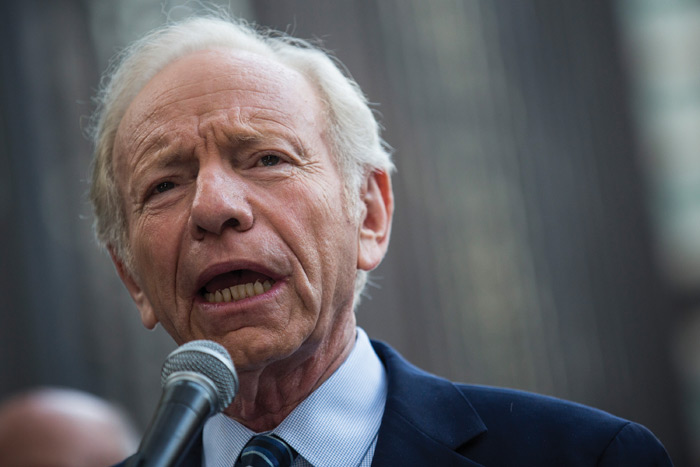
In a speech May 5 on the San Diego State University campus, conservative author and activist David Horowitz defended fliers posted by his organization, the David Horowitz Freedom Center, at SDSU.
The posters listed the names of seven students, all of them members of Students for Justice in Palestine, who support the Boycott, Divest, Sanctions (BDS) movement on the SDSU campus and demand the university boycott Israel and not invest in companies that do business there.

By supporting BDS, the students “have allied themselves with Palestinian terrorists” and are perpetuating “Jew hatred on this campus,” the fliers posted last month announced in advance of Horowitz’s scheduled speech on campus.

The fliers had brought complaints from the Muslim Student Association, which asserted that the students, in effect, were being called terrorists and that the fliers displayed Islamophobia.

In response, San Diego State President Elliot Hirshman declared some aspects of the fliers abhorrent, but stopped short of calling them hate speech or taking as strong a verbal condemnation as had administrators at UCLA, for example, where Horowitz’s group posted similar fliers naming 16 students.

SDSU students on April 27 sought to confront Hirshman. As he left an unrelated gathering, students surrounded a campus police car in which he was a passenger. After an hour-long standoff, Hirshman emerged to make a brief apology to anyone upset by his stance.

There were no protests outside Horowitz’s May 5 speech. Two-dozen campus police were at the ready, but had nothing to do. Horowitz was accompanied by a bodyguard.

The question-and-answer session after Horowitz’s speech did not involve any sense of confrontation or views different than his, according to people in attendance. Members of the press were not allowed to attend the speech.

Horowitz, 77, is the founder of the David Horowitz Freedom Center based in Sherman Oaks and has long asserted in books and speeches that free speech on college campuses is imperiled by political correctness and a liberal tilt among professors.

The only sign at the SDSU speech of a contrary view about Israel came from a non-student who mingled briefly among reporters waiting outside. She quietly handed out pamphlets supporting the boycott and criticizing U.S. financial support of Israel.

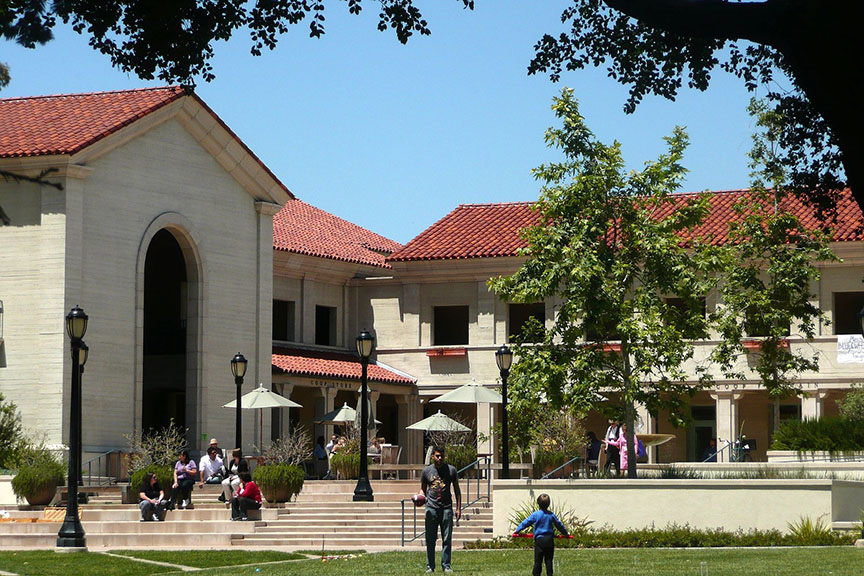
Although mild by comparison with other controversial issues on other campuses, the weeklong contretemps about the fliers was an unusual moment on the sunny campus of 34,000 students known for its basketball and football teams and growing reputation for academics and research.

Hirshman’s attempt to find a middle ground did not satisfy either side. And the media images of him sitting in a police car immobilized by a group of students may linger — fairly or unfairly — as a sign of weak leadership.

Hirshman met May 2 with several students to discuss the fliers and the issue of free speech, but he did not change his decision.

By May 4, students whose names were on the fliers were demanding his resignation, backed by representatives of the Council for American-Islamic Relations.

Fayaz Nawabi, a leader of the Muslim Student Association at SDSU, said the fliers could have “horrendous effects” on the students’ future when they apply for jobs or graduate school.

Rachel Beck, whose name was listed, said she no longer feels safe on campus.

“We are very peaceful activists,” Beck said as her voice quavered.

Meeting with reporters before his speech, Horowitz blasted Hirshman for not seeking to punish the students who had surrounded the police car. Hirshman “was held hostage for two hours before he apologized,” Horowitz said.

Horowitz accused Hirshman of being afraid to confront the anti-Israel movement and said this is true of other campus administrators, as well.

“He’s intimidated,” Horowitz said. “He’s scared.”

Horowitz noted that the fliers did not call the students terrorists or use the word Muslim. The students, he said “support a movement to strangle Israel” that is backed by groups determined by the U.S. State Department to be sponsors of terrorism.

After Hirshman’s May 2 meeting with the students, he issued a statement announcing that students, faculty and administrators will “undertake a review of university policies to ensure we are balancing freedom of expression and protection from harassment.” He declined all interview requests.

Horowitz was invited to campus by the SDSU College Republicans group, which had said the speech would be open to reporters. But as the speech was set to begin, a university official announced that the room was at capacity – about 70 people – and there was no space, standing or sitting, for a trio of reporters.

Horowitz responded that reporters should be allowed to attend his speech.

“Mr. Horowitz does not determine the fire codes,” the campus official said loudly.

Reporters were kept in an outdoor area of tables and chairs where students, who were uninvolved – and seemingly uninterested – continued studying for finals.

Pro-Israel activist David Horowitz condemns SDSU president at campus speech Read More »

Rosner’s Torah-Talk: Parashat Acharei Mot-Kedoshim with Rabbi Elie Abadie

Our guest this week is Rabbi Elie Abadie, founding rabbi and leader of The Edmund J. Safra synagogue in New York City. Rabbi Abadie was born in Beirut Lebanon and grew up in Mexico City, coming to the United States to attend Yeshiva University. He earned his B.A. in Health Sciences in 1983, a B.S.C. in 1984 in Bible Studies, a Hebrew Teacher’s diploma in 1985, and a Master’s degree in Jewish Philosophy from the Bernard Revel Graduate School of Yeshiva University. Rabbi Abadie received his ordination in 1986 from the Rabbi Isaac Elchanan Theological Seminary. He attended SUNY Downstate Medical Center, where he graduated in 1990 with an M.D. degree. He did his residency in Internal Medicine, and later his fellowship in Gastroenterology at Maimonides Medical Center, finishing in 1995. Rabbi Abadie was a member of the Board and an Officer of the Rabbinical Council of America (RCA). As Co-President of Justice for Jews from Arab Countries (JJAC), he was instrumental in passing a Congressional resolution on behalf of Jews from Arab Countries to be recognized by the U.S government in their dealing with the issue of Middle Eastern Refugees.

This week’s Torah Portion – Parashat Acharei Mot (Leviticus 16:1-18:30) – describes the Tabernacle ceremony of the Day of Atonement, establishes general rules for sacrifice and sanctuary, and lays down specific laws about sexual relationships. Our discussion focuses on the idea of becoming holy and on what that might entail.

Our Previous discussions of Acharei Mot-Kedoshim:

Rabbi Ilan Glazer on practice of sending a goat to ‘Azazel’ on Yom Kippur as part of the process of atonement.

Rabbi Laurence Bazer on the relation between Yom Kippur and Passover


Rosner’s Torah-Talk: Parashat Acharei Mot-Kedoshim with Rabbi Elie Abadie Read More »

Israel Air Force destroys Hamas post after mortar fire

Retaliating for the firing of mortars on Israeli troops near the border with Gaza, Israel Air Force aircraft destroyed a Hamas facility south of Gaza City.

The strike Friday morning, in which a missile was launched at a Hamas watch post, followed the targeting from the Gaza Strip of soldiers patrolling the fence along the southern part of the Gaza Strip, Army Radio reported. The firing of two mortar rounds at Israel Defense Forces troops resulted in no injured and no damage.

The strike Friday was the third time in three days that Israel has retaliated for mortar attacks from Gaza. One woman was killed Thursday during one such attack, according to Palestinian sources in the Hamas-controlled Gaza Strip.

At least 16 mortar rounds were launched into Israel from Gaza this week – double the number recorded in the previous four months. Israel holds Hamas directly responsible for the recent attacks, which broke a lull in April, when no launches were recorded, the IDF Spokesperson’s Unit said in a statement.

On Thursday, the IDF said it had uncovered a tunnel from Gaza leading into Israel, whose function was to enable terrorist attacks on Israeli soil. Stretching for hundreds of yards, the tunnel was 90 feet underground, according to the IDF.

Israel Air Force destroys Hamas post after mortar fire Read More »

For 1st time since August, whole month with no Israeli fatalities in terrorist attacks

April was the first month in half a year in which no Israeli was killed in a terrorist attack.

With a total of 115 attacks, the figure for April continued a six-month downward trend in the number of incidents in Israeli-controlled areas and is the lowest monthly total recorded since July, when 103 attacks were observed, according to a report published earlier this week by the Israel Security Agency, or Shin Bet.

Of the 18 victims who were wounded in terrorist attacks against Israelis in April, 16 were injured in an explosion set off on a bus in Jerusalem on April 18. Another victim was stabbed in Rosh Ha’ayin on April 3, and a police officer was wounded from a firebomb hurled at him near Jerusalem that same day.

Of the 115 attacks documented, 91 involved firebombs.

Approximately 30 victims of terrorist attacks have lost their lives in attacks since August and hundreds have been wounded. Approximately 200 Palestinians have also been killed since then, most of them while carrying out attacks or in riots.

In Israel and the West Bank, attacks began increasing in August, when 171 of them were documented, and rose sharply in September and October, with 223 and 620 attacks recorded in those months respectively. Israeli Prime Minister Benjamin Netanyahu in October called the escalation “a terror wave,” whereas many in the Israeli and Palestinian media dubbed it “the third intifada,” or “the knife intifada.”

But the overall number of attacks decreased to 326 in November, 246 in December, 169 in January, 155 in February and 123 in March.

For 1st time since August, whole month with no Israeli fatalities in terrorist attacks Read More »

Dracula – Not Jewish – A poem for Acharei Mot

It’s amazing we invented the concept
of the scapegoat, only to have it used against us
during the second war to end all wars.

And one can’t help but feel bad for the goat
both of them really. One to be sacrificed
the other to be sent off into the desert.

Who decides?
What did either of these goats do?
What did any of us do?

And then there’s the story of the holiest
spot there is, and most of us can never go there.
Just the one person, on the one day,

dressed in white
(don’t worry, it’s ages before Labor Day)
enters through a cloud of smoke.

Apologizes for everything everyone has done.
It’s the ultimate backstage pass.
I guess if someone is willing to

take responsibility for all my sins
I’ll find other places to be holy.
I think it was Han Solo who

famously said “It’s not my fault.”
Honestly, I have nothing else to say about that
I just think it’s important to mention

Han Solo periodically.
And speaking of famous people.
This is the parsha that proves definitively

that Dracula could not be Jewish.
Don’t drink blood. Cover it with dust.
I’m sorry, Vlad, you are not one of us.

And if you ever needed a list of
who not to sleep with, or more specifically
whose nakedness not to uncover

may I suggest Leviticus chapter 18?
This is the one that fuels the fire of the
homophobes. But the text isn’t as specific

as they would have you believe.
Let’s eliminate the prefixes from the word
leaving only sexuality.

I took French in high school
where the word mot means “word.”
Here it means “death.”

Sometimes I
just want to be
in Paris.

Dracula – Not Jewish – A poem for Acharei Mot Read More »

The new Han Solo is Jewish – and he was discovered at a bat mitzvah

The next time you’re kvetching about having to go to another bar or bat mitzvah, think about this: Steven Spielberg could be there, and he could make you a star.

That’s how it worked out for Alden Ehrenreich, who is reportedly finalizing negotiations to be the next Han Solo. Ehrenreich, who is Jewish, is set to star in “Star Wars: A New Hope,” a Disney film about Solo’s backstory. Harrison Ford, now 73, played the character in the original “Star Wars” movies, as well as the latest one.

Ehrenreich, 26, has been in numerous films, most recently playing a hick Cowboy & Western movie star in the Coen Brothers’ “Hail Caesar.”

Ehrenreich’s big Hollywood break came 12 years ago, when he made a movie screened at the ceremony of a friend’s bat mitzvah, according to the Daily Beast.

Although Ehrenreich later described the movie as “a piece of shit,” Spielberg, whose daughter Sasha was friends with the bat mitzvah girl, was in the synagogue — and was impressed.

“I’m this 14-year-old, skinny little kid with long hair,” Ehrenreich told Rolling Stone. “I break into her house, try on her clothes and make up a song. All of this is just us literally taking a camera and going like, ‘Okay, ha ha, do this.’ We showed it to our parents—‘We’re gonna play this at her bat mitzvah!’—and they were like, ‘You look like an idiot in this. I don’t think you should really do that.’ We didn’t care.”

As a result of the film, Spielberg invited Ehrenreich to meet with him at the DreamWorks studio and introduced him to filmmaker Francis Ford Coppola, who cast him as the lead in the 2009 film “Tetro.” Ehrenreich’s performance in that movie spurred film critic Roger Ebert to dub him the “new Leonardo diCaprio.”

The new Han Solo film, announced in 2013, is scheduled to be released in May 2018.

In January, four other Jewish actors — Logan Lerman, Dave Franco, Ansel Elgort and Emory Cohen — made the short list of actors under consideration for the star role, according to a list published by Variety.

Speaking about the project last year, writer Lawrence Kasdan said, “It will not be like, here is where he was born and this is how he was raised. I think what it will be is what was he like 10 years earlier, ya know, maybe a little earlier you’ll get a glimpse, but … what formed the person we meet in the cantina? It is not so much about his specific history. It is about what makes a person like that?”

In other words, what was Solo’s rite of passage into adulthood? Perhaps there was a bar or bat mitzvah involved.

The new Han Solo is Jewish – and he was discovered at a bat mitzvah Read More »

Strong Children vs Broken Men (Omer Day 13)

It is easier to build strong children than to repair broken men”.— Frederick Douglass.