fbpx

November 10, 2015

Budget bites: Simple veggie harvest soup

Whether you're tight on cash due to unforeseen costs (plumbing emergencies, dental emergencies, last minute trips to Vegas…) or you're simply trying to save on your monthly grocery bills, having tasty, easy and affordable recipes at the ready can make your budget-cooking adventures a breeze.

My new blog series, “budget bites,” will try to guide you through the process of budget cooking.

I'll make sure to include something for everyone: ” target=”_blank”>sweet and savory, good for you (like the recipe below) and ” target=”_blank”>multi-course meals and everything in between.

I'll also include tips on pantry staples that will help you avoid flavor-fatigue–just because you're on a budget doesn't mean you want to eat the same thing four nights per week. Well, maybe you do–but options are good!

Enjoy!

Simple Veggie Harvest Soup

Serves: 2-3

Cooking time: 30 minutes

Ingredients

  • 1/2 head green cabbage, shredded
  • 1 large baking potato, chopped
  • 1 yellow onion, chopped
  • 3-4 roma tomatoes, chopped
  • 2-3 splashes Worcestshire sauce
  • garlic powder, to taste
  • seasoned salt, to taste


Directions

1. Combine all vegetables in a large saucepan

2. Add water until the vegetables are completely covered

3. Add 2-3 splashes Worcestshire sauce, 3-4 shakes garlic powder and 1-2 shakes seasoned salt

4. Bring to a boil, then cover and simmer for about 20 minutes, or until the potatoes are fork-tender

Budget bites: Simple veggie harvest soup Read More »

A view from the women’s section on Orthodox spiritual leadership

I have a vivid memory of sitting in my yeshiva high school principal’s office, imploring him to start teaching the girls Mishnah and Gemara, to offer a little more respect to our intellects and our souls by giving us access to all the Jewish texts that form the basis of our heritage, of what we were expected to live every day. He said no, for four years. Did he quote sources at me stating that women’s minds are too feeble for it? Say that it wouldn’t interest me anyway? That it’s simply not done? I’ve shut those details out of my memory, but my mission was clear: If I wanted access to the heritage that is rightfully mine, I was going to have to get out of the principal’s office. And I did. After I graduated from yeshiva high school, I started taking adult Gemara classes, and I continue to do so today. 

Last week, the Rabbinical Council of America (RCA)
I have found a Modern Orthodoxy so meaningful, so relevant and so true to the halachah and values central to the Torah, that I don’t need RCA approval to tell me I’m doing the right thing.

A few months ago, Bnai David installed Morateinu Alissa Thomas-Newborn as the first female clergy member in an Orthodox synagogue in Los Angeles. (Full disclosure: I serve on the board that hired her.)

My shul, my community, my Judaism, are stronger and richer for having a woman as a holy presence among us. Morateinu Alissa delivers heartfelt and learned drashot, offers halachic guidance on highly personal issues with immense sensitivity, and shares deep insights as a teacher. She relates to our teen girls and has brought her unique interests, her brand of empathy, her youthful perspective, to complement Rabbi Kanefsky’s dynamic wisdom and courage and menschlichkayt. 

But mostly I appreciate Morateinu Alissa’s presence. In our shul, men and women are physically divided by a mechitzah, and nearly all the action goes on on the men’s side. That tradition continues, as Morateinu Alissa, like all women, does not lead any of the davening or even count toward a minyan. But now, we women can feel that we own a little more of what goes on in shul. We have a religious leader we can sit next to during davening, with whom we can shake hands or hug when she descends from the bimah after giving a beautiful sermon, to whom we can look during davening as an inspiration for kavanah, of holy intention, without the obstruction of the wooden latticework of our mechitzah barring our full view, our full access. 

Maybe the RCA should feel threatened. Women and men who experience the added dimension and texture that a female perspective can bring to congregational life might realize what they have been missing all along.

And women who experience the sense of belonging and relevance might demand it in other shuls, even in shuls where the mechitzah is not built with the same symmetry and sensitive semi-transparency, or where the velvet-cloaked Torah scroll is not carried through an array of women’s outstretched arms offering kisses or a caress. 

I remember the first time I saw a sefer Torah up close. There I was, 19 years old, already having had about 16 years of formal Jewish education, and I had never seen the letters of the Torah, never read a verse from an actual scroll. I was working at a summer camp, and my then-boyfriend, now-husband, brought me into the tented beit knesset in the middle of a field, took a scroll from the ark, and opened it for me. It was that simple, and that complicated.

A few years later, my husband taught me to lein Torah for the women’s prayer group I had just joined, and I realized that those little symbols I had always ignored were not only a melody, but punctuation. For years, I had been reading the words of the Torah with an unnecessary handicap.

What we are doing in Modern Orthodoxy is removing those unnecessary obstacles so we can use all the tools offered to us to find the truest meaning of our traditions. We are not suggesting a halachic free-for-all, but rather a more authentic adherence to what the halachah does and does not demand of us.

I know I might be naïve and delusional to thumb my nose at the RCA. I am not a professional spiritual leader, so my livelihood and life’s mission are not at stake. And more important, in Orthodoxy, community is everything. I’d like to see the RCA do what the grass-roots community does — recognize that there is a place in the Modern Orthodox community for all of us. Because stepping outside the community has very real consequences. 

I guess what both sides need to figure out now is how to define, and who is defining, today’s Modern Orthodox community.

A view from the women’s section on Orthodox spiritual leadership Read More »

Can Open Orthodoxy help revive Judaism?

There are two ways to look at the controversy raging in the Orthodox world right now over a fledgling movement that calls itself “Open Orthodoxy.” One way is to put the controversy under a microscope and go through all of the arguments and name calling. I will do that, don’t worry. The other way is to consider a question I’m much more interested in: Does this movement have the potential to revive and strengthen not just Orthodoxy, but Judaism?

First, the name calling, and I mean that literally. One of the big issues in the controversy is whether the Open Orthodox movement — which believes in greater religious leadership roles for women, among other things — can call itself Orthodox. This issue has been brewing for several years, but it came to a head last week when a group of leading ultra-Orthodox rabbis, after examining statements and positions put forth by representatives of the Open Orthodox group, proclaimed that the movement is “beyond the pale of Orthodoxy.”

This proclamation followed one a few days earlier from the Rabbinical Council of America (RCA), the largest association of Orthodox rabbis, banning members from employing women clergy in their synagogues, regardless of the title used. 

In response to the RCA proclamation, Los Angeles Rabbi Yosef Kanefsky, whose Orthodox synagogue B’nai David-Judea in the past year hired its first female clergy, wrote a heartfelt and somewhat defiant column in the Jewish Journal, saying: “This is one of the most gratifying and satisfying moments of my life. A cause that emanates from the very root of my faith, from my passion for Torah and Mitzvot, and from my commitment to truth and to justice, has been acknowledged — however grudgingly — as being on the cusp of changing the face of the Jewish people.”

Now, if you’re a liberal Jew, like most American Jews, you might be looking at this and thinking: “Are these Orthodox leaders for real? Haven’t there been female rabbis in other movements for more than 40 years? Don’t they have anything better to worry about?”

Part of me shares that sentiment, but another part has a deep appreciation for the value of maintaining tradition. The easy thing to do would be to label the RCA position as sexist or retrograde, and just dismiss it or get angry. After all, in today’s world, the notion that a woman shouldn’t be allowed to do something only because she’s a woman is not just out of date, it’s offensive.

But what may look like sexism to the modern eye can, to a traditional eye, be a respect for gender roles. Generally speaking, the more you move to the right in Orthodoxy, the more a woman’s religious role is seen as shining inside the home rather than in public. This boundary may offend some people, but it’s not without merit or context.

As Orthodox Rabbi Gil Student wrote in Haaretz, “The synagogue is where we gather for a few hours each week, for some each day. Take away the synagogue and you can still have Judaism. Take away the Jewish home … and Judaism disappears in a generation.”

But if the inclusivity of women is certainly the most publicized and controversial issue, it’s hardly the only one. Rabbi Avi Weiss lays out other issues Open Orthodoxy is confronting that challenge many Orthodox taboos.

I can tell you from personal experience that the most important link in my own Jewish journey has been the thousands of Shabbat and holiday tables that my mother lovingly prepared in our home, with all the rituals involved and the family joy that came with it. She didn’t teach me Torah, but she taught me to love Judaism.

Still, that doesn’t mean Orthodoxy is not broad enough to meet modern challenges. The traditionalist’s question is, always, “Where do we draw the line?”

Rabbi Shlomo Riskin, one of the leading lights of Modern Orthodoxy, is clearly in the camp of broadening the Orthodox tent to include a greater religious and public role for women.

“There is no question whatsoever that throughout the generations women have often provided halachic and spiritual leadership as is shown from Sarah the prophetess to Deborah the judge,” he said last week in an interview in the Jerusalem Post. Riskin also cited rulings from major halachic decisors, such as former Sephardi Chief Rabbi of Israel Eliyahu Bakshi-Doron, who, according to Riskin, “state that women can become the great religious leaders of the generation, the gedolei ha’dor, and that they can provide rulings for halachic direction.”

Respect for halachah is something you hear over and over again when you speak to an Open Orthodox rabbi, which is what makes the movement hard to dismiss.

Many years ago, I met with Rabbi Avi Weiss of Riverdale, N.Y., who founded the flagship institution of Open Orthodoxy, Yeshivat Chovevei Torah, and is credited with inspiring the movement. Before leaving his office, I picked up a copy of one of his books, titled “Women at Prayer: A Halakhic Analysis of Women’s Prayer Groups,” and read it on the flight back home. I got the point: The man takes Jewish law seriously, whether it’s about guidelines for women’s prayers or a yeshiva for women clergy. 

At the heart of the controversy is Yeshivat Maharat, a yeshiva for Orthodox women in Riverdale founded by Weiss and Sara Hurwitz, the first formally ordained “rabba” and the dean of the school. So far, the yeshiva has enrolled 20 women and ordained five. Maharat is an acronym meaning female spiritual, legal and Torah leader and is a title used by some of the ordained women, in addition to or in lieu of rabba.

It is this religious leadership role for women that most irks the RCA. In its recent statement, the RCA specified that its resolution does not apply to “non-rabbinic positions such as Yoatzot Halacha [advisers on Jewish law], community scholars, Yeshiva University’s GPATS [Graduate Program for Women in Advanced Talmudic Study], and non-rabbinic school teachers.” But a clergy status for women? That crosses the line.

The RCA’s position against female clergy, which it has expressed several times in the past, is based on previous rulings by halachic heavyweights such as Rabbi Aharon Lichtenstein, Rabbi Hershel Schachter, Rabbi Gedalia Dov Schwartz and Rabbi Mordechai Willig, according to an article in Cross Currents by RCA executive committee member Avrohom Gordimer.

Sara Hurwitz is the first formally ordained “rabba” and dean of Yeshivat Maharat, which ordains Orthodox women clergy.

So, both sides claim Jewish law is on their side. Where does that leave us? Can both sides be right? What is the heart of the dispute?

“The dividing line within Orthodoxy today revolves around inclusivity,” Weiss wrote recently in Tablet, in a piece titled, “Defining Open Orthodoxy.” He asks: “Is Orthodoxy inclusive of women — encouraging women to become more involved in Jewish ritual and Jewish spiritual leadership?”

But if the inclusivity of women is certainly the most publicized and controversial issue, it’s hardly the only one. Weiss lays out other issues Open Orthodoxy is confronting that challenge many Orthodox taboos. For example:

• Notwithstanding the Torah prohibition on homosexuality, are those in such relationships included as full members in our synagogues, and are their children welcomed into day schools?

• Do we respect, embrace and give a forum to those who struggle with deep religious, theological and ethical questions?

• Do we insist upon forbiddingly stringent measures for conversion, or do we, within halachic parameters, reach out to converts with love and understanding?

• Should Orthodox rabbinic authority be centralized, or should it include the wide range of local rabbis who are not only learned but also more aware of how the law should apply to their particular communal situations and conditions?

• Are we prepared to engage in dialogue and learn from Jews of other denominations, and, for that matter, people of all faiths?

These questions may sound outdated to my liberal friends, but in the Orthodox world where I live, they are deeply disruptive and uncomfortable. When the world is changing so fast around us, when secularism and hedonism and commercialism are encroaching into religious communities like never before, there’s a tendency to circle the wagons and get overly protective.

Weiss is going in the other direction. He looks at the hurricane of social change and sees opportunities. Instead of building walls of protection, he wants to build bridges of connection. Instead of seeing the outside world as a threat, he sees a healthy engagement with it as enriching the Jewish experience.

“Put simply, is our focus on boundaries, fences, high and thick — obsessing and spending inordinate amounts of time ostracizing and condemning and declaring who is not in — or is our focus on creating welcoming spaces to enhance the character of what Orthodoxy could look like in the 21st century?”

Because Modern Orthodoxy has moved to the right in recent years, the word “modern” has lost some of its relevance. As Weiss writes, “'Modern' issues of 40 and 50 years ago are no longer modern. We are, in fact, in the postmodern era, as we face new issues and challenges.”

Weiss believes Open Orthodoxy can inject some vitality that will help Orthodox Judaism better address these issues and challenges. A number of institutions and organizations have emerged over the years that follow in that spirit. In addition to Weiss’ Yeshivat Chovevei Torah, Yeshivat Maharat and Amcha– The Coalition for Jewish Concerns, these include the Jewish Orthodox Feminist Alliance, Edah, the Institute for Jewish Ideas and Ideals, and the International Rabbinic Fellowship.

Which brings me back to the question I mentioned earlier that I’m most interested in: Does this movement have the potential to revive and strengthen not just Orthodoxy, but Judaism?

Let’s go back to my mother’s Shabbat table. One thing I’ve learned from decades of sitting around a joyful Shabbat table every week is that you can’t build a lasting Jewish identity with just words or ideas. You need action. Sacred action. 

Orthodoxy, more than any other denomination, is obsessed with sacred action. It doesn’t matter what you call it—halachah, rituals, commandments, rules — the net effect is an unbending dedication to the kinds of acts that connect you continuously to your Jewish identity. Chabad's success is very much based on this primacy of Jewish action.

I have this theory that the transformational ritual of Orthodoxy is the prohibition against driving on Shabbat. The simple act of walking on Shabbat, whether to a synagogue or a friend’s house, organically creates Jewish neighborhoods and tight-knit communities where Judaism becomes a way of life, not just an occasional episode.

The downside to this way of life, however, is that it can also make you more insular. When your Jewish experience is concentrated in one place, it sometimes feels safest just to hunker down and shut out the rest.

Open Orthodoxy is trying to balance two ideals: It wants to keep the neighborhood-like intimacy and rituals of Torah Judaism but make them more open and inclusive.     

“It’s the model of our forebears Sarah and Abraham,” Weiss writes. “Unlike Noah, who is best known for his ark — insulated and separated by high walls from the rest of society — Abraham and Sarah dwell in a tent. It is open on all sides, welcoming not only those who come in, but they are also prepared to run out of the tent and greet all passersby, encouraging them to drink from the waters of Torah.”

Of course, these waters of Torah will always be open to interpretation and criticism. Liberal Jews may criticize Open Orthodoxy because its interpretation of Torah is not egalitarian enough, and the Orthodox establishment will criticize it because it goes too far. There’s no way around that. It is the fate of the struggler.

In Weiss’ case, his struggle is to insist on the “foundational divinity of Torah and observance of Halachah,” while aiming for an Orthodoxy that “is not rigid” and “open to a wider spectrum.”

This effort to put a genuinely open face on Orthodoxy may be controversial, but it also presents opportunities. For one thing, it makes Open Orthodoxy an ideal movement for Jewish outreach.

Just as Chabad is the outreach arm for ultra-Orthodox Judaism, Open Orthodoxy can be the outreach arm for Orthodox Judaism. Open Orthodoxy could be especially appealing to a new generation that welcomes and expects a more open and inclusive Judaism, including, not least, a leadership role for women.

If the wise sages of the Orthodox world were able to pull back for a minute and look at the big picture, they would see Open Orthodoxy not as a threat but a potential asset.

They would see that the real threat to the Jewish future is a Jewish house that is on fire while we squabble inside about the rules of the household.

Every Saturday throughout America, the great majority of Jews prefers to do anything but visit a house of prayer, and every Friday night, that same majority prefers to do anything but sit around a Shabbat table. When Orthodox Jews complain about a slippery slope, that’s the slope they should worry about most — Jews slipping away from Jewish action and Jewish identity.

If a movement like Open Orthodoxy can come along and make sacred Jewish action more inclusive and attractive to a vanishing generation, what’s not to like? 

And if having Orthodox women as religious leaders means expanding the richness and breadth of Torah study in our community, what’s not to like?  

Our communal bond has eroded in recent years in part because we’re missing a genuine and respectful engagement between Orthodoxy and other streams of Judaism. This is a shame. Open Orthodox rabbis regularly engage with Jewish religious leaders with whom they may have ideological or theological differences, and they’ve taken a lot of heat for it. But if that kind of courageous bridge-building doesn’t promote diversity and Jewish unity, what will?

There’s no bigger mitzvah in the Torah than Kiddush Hashem — sanctifying the name of God. This happens when the world sees Jews doing good deeds in the name of their religion. Perhaps the most memorable example in America was the image of a pious Abraham Joshua Heschel walking alongside the Rev. Martin Luther King Jr. in a 1960s civil rights march. Rabbi Weiss, who for decades has been marching for human rights while proudly wearing his yarmulke, is the Orthodox embodiment of social justice and Kiddush Hashem. Doesn’t that reflect well on all of Orthodoxy?

Here’s what I would say to the big guns at the RCA and others who agree with them: Have different branches. You can call yourselves Traditional Orthodox and call this other group Open Orthodox. Embrace them as an asset. Let them wrestle with this crazy, changing world while you stick to your guns. It’ll make all of Orthodoxy look good.

I know, I’m dreaming. I don’t expect the RCA to do any of that. The RCA believes it must protect its turf and its standing, so it will probably dig in and double down, especially because it believes it has the truth, the whole truth, on its side.

The problem is that you can ostracize Open Orthodoxy, but the issues they’re dealing with won’t go away. If anything, issues such as changing women’s roles will become even more urgent with time. An Orthodoxy that ignores the most crucial social issues of our time is an Orthodoxy that becomes more narrow and less relevant. (Maybe it’s no coincidence that, according to the latest Pew Research Center study, only 48 percent of people raised Orthodox are currently Orthodox.)

Religious luminaries, especially among the ultra-Orthodox, like to say that their Torah is the only “authentic” one. But they’re overlooking something else that is exceedingly authentic: the societal changes Open Orthodoxy is fearlessly confronting within a Torah context. Instead of showing a little respect for this difficult and complex work, some prefer to smugly malign it under the guise of “inauthentic Torah.”

What I’ve always found admirable about Open Orthodox rabbis is that, no matter how alienated they feel or how poorly they’re treated, they refuse to leave Orthodoxy. They believe in it. They don't believe they're on a slippery slope to non-Orthodoxy. Orthodoxy is their home. It’s their tent.

That’s why it’s worth noting that, from what I hear, one place where they feel more welcomed is at the Orthodox Union, a “big tent” global Orthodox organization that over the years has embraced a kind of Orthodox pluralism — refusing to alienate either the right or the left. Let it become a model for Orthodox tolerance.

Ultimately, all the arguments over religious labels and Jewish law, and the antagonism from the establishment, will matter a lot less than the facts on the ground. If Open Orthodoxy can grow from the painful birth pangs of its beginning and become a movement that significantly impacts Jewish identity in America, every Jewish institution in the country will take notice — even groups that refuse to call it Orthodox. 

They may even conclude that Open Orthodoxy is good for the Jews.

Can Open Orthodoxy help revive Judaism? Read More »

At Federation’s General Assembly, grappling with less authority and more division

What’s our mission? How will young Jews react? How do we not alienate the growing number of Jews with left-leaning views on the Israeli-Palestinian conflict?

In a breakout session Nov. 9 at the Jewish Federations of North America’s (JFNA) annual General Assembly (GA) in Washington, D.C., 3,000 Federation professionals and volunteers from across the country grappled with how Federations can handle the changing views of American Jewry vis-à-vis Israel. The session was titled “The Elephant in the Room: Managing Divergent Perspectives on Israel and Beyond.”

Among the questions included on the handout worksheets:

Should someone who supports boycotting “settlement goods” but opposes the BDS [Boycott, Divestment and Sanctions] movement be allowed in as a speaker? 

If Israel bombed an Iranian nuclear site without coordination with Washington, would your local Federation quickly release a statement in support if donors demand that? 

If a synagogue rabbi calls your Federation and says his congregation is being torn apart by members who want to associate with more groups on the left or the right, such as AIPAC, how could Federation intervene?

“There is growing competition in Washington, D.C., on Israel advocacy, leading to an increased ‘which camp are you in?’ kind of environment,” Rabbi Doug Kahn, executive director of the Jewish Community Relations Council in the San Francisco Bay Area, told those in the room. “In addition, there is a rapidly deteriorating support for Israel on one side of the aisle. It’s true, according to all of the polls, that Israel is increasingly seen through much more of a partisan lens.”

Managing divisions within Federations — on Israel, Iran and how to handle the growing anti-Israel BDS movement on American campuses — the same divisions that have manifested themselves in so many other areas of American-Jewish life in the past year, was a persistent theme at this year’s GA. During the opening plenary on Nov. 8, for example, when Canadian Supreme Court Justice Rosalie Abella mentioned Justin Trudeau, the newly elected prime minister from Canada’s Liberal Party, there was significant, although certainly not unanimous, applause — his predecessor from the Conservative Party, Stephen Harper, was widely regarded as the West’s most ardent supporter of Israel.

At the breakout session, Kahn pointed out that in response to President Barack Obama’s signature nuclear agreement with Iran last summer, 24 Jewish Federations came out against the deal, while the remaining 106 did not take a public position.

“There’s not unanimity at all nationally, which is OK, but which is fairly unusual within the system,” Kahn said. At a separate breakout session on defining Federation’s role within Jewish communities, volunteers and professionals from two East Coast Federations discussed how each approached the issue of staying neutral on the Iran deal or publicly opposing it, with one woman saying that her Federation first consulted the executive board and major donors before making a decision.

Jay Sanderson, president and CEO of The Jewish Federation of Greater Los Angeles, said in an interview at the GA that after his office sent a community-wide email in late July stating that the agreement with Iran “threatens the mission of our Federation as we exist to assure the continuity of the Jewish people,” and encouraging people to contact their elected representatives, he had dozens of meetings and conversations about Federation’s outspoken decision. Federation’s email prompted angry responses from some leaders and rabbis in the community who supported the deal and felt it wasn’t Federation’s job to take such a public position.

“The vast majority of people that I heard from over time were happy that the Federation was willing to take a stand,” Sanderson said. “In our mission, it says that we support a strong and safe and secure State of Israel.”

Federation sent its email after a unanimous vote by its executive committee but did not consult its general board, which also upset a handful of board members, none of whom, Sanderson said, has left his or her position or stopped financial support of the organization.

“We [now] have a process to make decisions in a more transparent way,” Sanderson said, when asked whether he wishes Federation had handled the Iran email any differently. “It will get brought to the executive committee, and then to the board, and it will need a very serious majority of the board for us to make a public statement.”

Richard Sandler, former L.A. Federation board chairman and the new board chairman of the JFNA, supported the L.A. Federation’s position on the Iran deal, and said while he wishes it had handled the process of the letter differently, he believes the result would have been the same. “I think we would have come out, quite frankly, in the exact same place,” he said in an interview. “But we owe a responsibility to the entire board.”

Sandler characterized the division among American Jewry as a “symptom of an insidious disease.”

“There are tremendous divisions within the Jewish community,” he said. “It’s not about the Iran deal. If there was no Iran deal, they would still exist.”

In a session titled “Identity Crisis: Defining the Role of Community Organizations,” Rabbi Yehuda Kurtzer, president of the Shalom Hartman Institute of North America, addressed what may have been the most prominent elephant in the Washington Hilton: that Federation, once the longtime go-to Jewish communal organization with no close second, is now just one — albeit a big one — Jewish group among hundreds of influential nonprofits. 

We “can no longer take for granted that we’re in charge and can shape an agenda,” Kurtzer said. “We are living in a post-authority moment for Jewish life,” in which many American Jews feel that “if the leadership decides not to support my views, I am no longer beholden to the institution.”

To add to the problem, while policy on support for Israel used to be a unifying issue,  it has increasingly become a divisive topic in some synagogues, Hillels and Federations. Further, study after study shows that American Jews, particularly young Jews, are becoming less religious and less involved in Jewish communal organizations.

“I’m worried that what’s going on now will alienate a lot of people that we don’t want to alienate,” Sanderson said. “My job is to build the Jewish community first and foremost, and sometimes we’re going to have to build it where Israel is not the central driver.”

The GA’s featured speakers, roundtables and breakout panels reflected the Federation leadership’s hope to appeal to all parts of a community with widely varying religious, social and political priorities. Diverse political views on Israel were covered — with speakers and panelists including Israeli Prime Minister Benjamin Netanyahu, opposition leader Isaac Herzog and Canada’s previous foreign minister, John Baird, as well as Obama administration officials such as Chief of Staff Denis McDonough, Ambassador to Israel Daniel Shapiro and the White House’s Jewish outreach liaison, Matt Nosanchuk. 

There were breakout sessions focused on the successes of Chabad and Hillel, as well as LGBT issues and “tailor-made Judaism” as it pertains to being inclusive toward interfaith families.

For Federation insiders, this year’s GA, like every other year’s, was first and foremost a chance to share best practices and cram weeks’ or months’ worth of meetings and travel into three days in one hotel. For outsiders and observers, it was just the most recent example of how a pillar of American Jewry is adjusting to a community that is more divided and less reliant on the traditional handful of large Jewish institutions.

For Sandler, as a national leader, that means navigating a Jewish community that, when he joined the L.A. Federation eight years ago, saw Federation as being in the “tax-collecting” business.

“You’re Jewish, you have a responsibility to your people; you have to give money to the Jewish world. We have traditionally been the outlet for that money; we distribute it where it needs to go,” Sandler said. “It doesn’t work anymore, because there are so many other places to give your money, and each generation becomes less connected with the prior generation.”

At Federation’s General Assembly, grappling with less authority and more division Read More »

Jewish groups call for protection of Jewish students at U. of Missouri

Thirty-six organizations wrote a letter to University of Missouri Chancellor R. Bowen Loftin calling for protection of the campus Jewish community days before he announced his resignation over questions about his leadership in the wake of racial tensions on campus.

The letter by the Jewish and pro-Israel organizations expressed concern over reports of a swastika drawn in feces in the wall of a bathroom in a residence hall on Oct. 24.

“We are dismayed that neither you nor any other MU administrator has yet to publicly address this act of blatant anti-Semitism, which clearly targets Jewish students and causes them to feel threatened and unsafe,” the letter read, according to reports.

It is not the first act of anti-Semitism on the MU campus. In April, swastikas and anti-Semitic epithets were written in ash in the stairwell of a campus dormitory. A freshman at the university was arrested for the vandalism.

The letter called on Loftin to “demonstrate unequivocally your commitment to protecting Jewish students no less than other students on your campus” and offers steps he should take to confront acts of anti-Semitism on campus.

In a response to the letter, Loftin said that the university administration “did not immediately respond to the feces swastika “in order to give law enforcement time to investigate,” according to the MU student newspaper, The Maneater.

“Our stance has not and will not change — the University of Missouri seeks to be a welcoming and inclusive campus to all students, faculty, staff and visitors,” Loftin also said in his reply. “We are committed to mandatory training of our people in inclusion and diversity and will continue to work with all to build the framework necessary to achieve our goal.”

Loftin announced Monday that he would resign at the end of this calendar year. His resignation came six hours after the university system’s president, Tim Wolfe, resigned in the wake of the backlash over what students said was an inadequate response to racial incidents on campus.

Jewish groups call for protection of Jewish students at U. of Missouri Read More »

Finally, a kosher restaurant with Michelin acclaim in Paris

With 84 Michelin-certified restaurants and a combined total of 115 stars, the French capital offers a dazzling gastronomic selection to anyone willing to stomach the bill.

Anyone but observant Jews, that is.

For years, the kosher-keeping community has been limited to budget pizzerias or moderately priced eateries offering couscous and grilled meat. And while many of the restaurants serve good food, they’re a far cry from Paris’ culinary giants, with their daring interpretations of classic French cuisine.

But that all changed last year with the opening of Le Rafael. The upscale eatery in the posh, heavily Jewish 17th arrondissement is the only kosher-certified establishment in Paris with a Michelin pedigree — probably the most coveted accolade in the restaurant world.

Le Rafael’s Michelin status may only be by association — its chef, Simone Zanoni, also runs the two-star restaurant at Trianon Palace at Versailles — but it’s a major step forward for the kosher-keeping gourmands of Paris. Featured in major French newspapers like Le Figaro and Le Point (“The braised veal and its airy, sweet-tasting potato puree would make any diner melt”), Le Rafael quickly became this city’s best-known kosher restaurant.

Zanoni told JTA he’s aiming “for kosher food that can hold its own against non-kosher food” — and hopes Le Rafael will earn a Michelin star or two of its own.

For now, the eatery — which is supervised by the rabbinical court of Paris — attracts international Jewish tourists as well as about 80 Parisians daily, mostly observant Jews, according to sous chef Eduard Wart, a non-observant English Jew. With such limited options for kosher-keeping gourmands, “it makes little sense to aim for a non-Jewish clientele,” he said.

Despite offering traditional French eats like foie gras terrine or “best end of lamb” with moussaka priced between $50 and $130, Le Rafael is just barely turning a profit, according to Wart.

After struggling to surmount both the culinary handicaps of kosher cuisine and the effects of France’s financial crisis — the country’s economy registered zero percent growth in the second quarter of 2015 — the two chefs said they are facing a noticeable decline in the number of foreign patrons because of security concerns following the slaying of four Jews in January at a Paris kosher supermarket.

“I think it’s the result of media’s description of what happened in Paris,” Zanoni said in an interview last week. “People think it’s a war zone.”

Still, the number of local diners has remained unchanged, he said, which has allowed the restaurant to stay open.

Located amid home design shops and fashion boutiques on the busy Avenue de Villiers, Le Rafael — which is owned by the French Jewish businessman Michael Lehiani — has a transparent domed ceiling that filters soft light into an intimate space of 15 tables. The decor features white tablecloths and purple upholstered chairs. The long corridor off the entrance dampens the sounds of the noisy street, leaving the main dining area pleasantly silent.

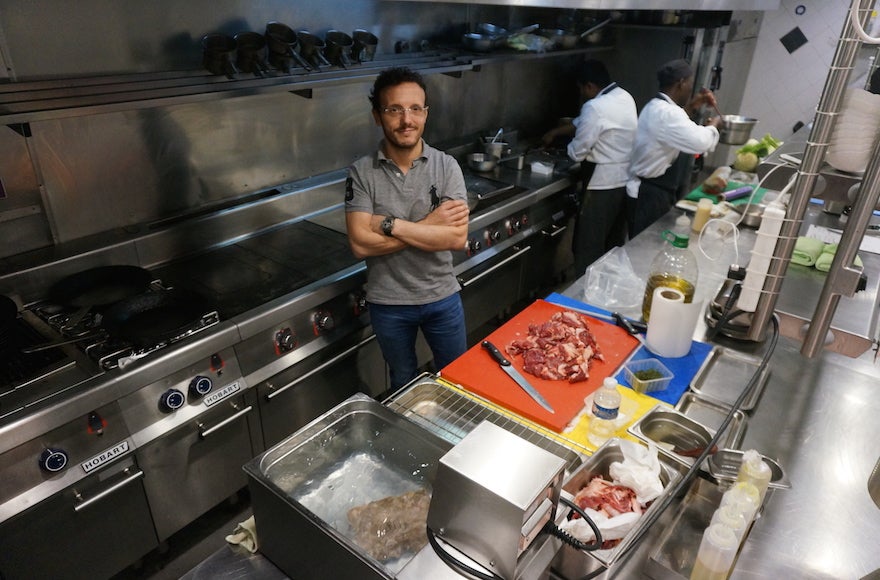
Simone Zanoni, head chef of Le Rafael in Paris, on Nov. 3, 2015. (Cnaan Liphshiz/JTA)Simone Zanoni, head chef of Le Rafael in Paris, on Nov. 3, 2015. Photo by Cnaan Liphshiz/JTA

Before it reopened in February 2014 under Zanoni, it was a simple kosher eatery where a meal cost $25 — on par with Kavod and Jaguar, two of the better kosher restaurants among the approximately 300 eateries in Paris under rabbinic supervision.

Le Rafael’s reopening last year as a gourmet French restaurant, complete with a Michelin-standard new kitchen, took it to a new level gastronomic finesse that no other Parisian kosher restaurant had reached before, according to Yvan Lellouche, a founder of the Union of Kosher Consumers of France.

Aside from the food, Le Rafael is also unique among kosher restaurants in the level of service it offers, complete with valet parking and four impeccably dressed waiters.

Though there are no security guards at Le Rafael, the locals say they feel safe here and in western Paris in general.

“Here, in our neighborhoods, we are privileged enough to enjoy a very high level of safety, we don’t feel at risk,” said Severine Amoyal Dokan, a 44-year-old businesswoman and mother of two who was dining with her strictly observant sister, Aurelie Madar.

“Look at this place, how calm it is,” she added, gesturing her pearl-braceleted arm across the quiet room. “What exactly do I need to fear here?”

Still, the sisters, both Le Rafael regulars, concede that the restaurant’s high media profile may have the undesirable effect of appealing to terrorists seeking a symbolic target.

As for the chefs, they see flavor — and not the threat of terror — as their biggest challenge.

“There is so much adaptation necessary, so many workarounds, that we simply needed to reinvent ourselves,” Zanoni said.

The main hurdles, he said, were the “lower quality of koshered meat, which loses its blood and tenderness in the salting process, ” as well as the need to dispense with all dairy products, like cream – a main ingredient in French cuisine.

To surpass these challenges, Zanoni and Wart employ a slow cooking technique to tenderize meat by sealing it in plastic bags and cooking it in warm water, often for hours.

Zanoni says that “solving such problems is exactly the reason” that he accepted Lehiani’s offer to reinvent Le Rafael last year as a gourmet restaurant.

“A small part of me wondered whether this was professional suicide,” he said. “I am glad it was proven wrong.”

As for Amoyal Dokan, the Jewish mother of two, she says institutions like Le Rafael, and the vibrant Jewish scene they help support, are key to her decision to stay in France at at time when thousands of Jews are leaving for Israel.

“I’m all for Zionism, but it’s not home,” she said over filet mignon. “We live in the best city in the world, in one of its strongest and liveliest Jewish communities, and we’re not about to give it up for the world.”

Finally, a kosher restaurant with Michelin acclaim in Paris Read More »

McDonough: Support for Israel’s security – our values in action

Addressing a mixed Jewish audience in the aftermath of the Iran nuclear deal debate, White House Chief of Staff Denis McDonough on Tuesday peppered his remarks with Yiddish and Hebrew phrases in an attempt to present a reset in the U.S.-Israel relationship following the meeting between President Barack Obama and Israeli Prime Minister Benjamin Netanyahu on Monday.

In a speech at the Jewish Federations of North America’s General Assembly Tuesday afternoon, McDonough said that President Obama remains “grateful” for the strong support he’s always received from the Jewish community, “including so many of you.”

Mentioning the White House tradition of conducting a seder on the first night of Passover, which has led some to call him America’s first Jewish President. McDonough quipped, “I guess that makes me his shamas (a caretaker, servant).”

“I’ll admit, some of the policy debates I’ve been a part of are Talmudic. In the words of an old Irish saying, it can make me feel a little meshuganah,” he added.

Obama’s Chief of Staff also attempted to set the record straight on the president’s record on Israel as he enters the last year of his presidency. “I know that President Obama’s approach to Israel—more specifically, his relationship with Prime Minister Netanyahu—has been the source of endless commentary. It’s practically a cottage industry. It helps sell books,” he said. “So allow me to offer my own perspective… For President Obama, ensuring Israel’s security is not just another element of his foreign policy. It’s not a political issue. It’s a solemn commitment made by all those who sit in the Oval Office—Democrats and Republicans—going back to Harry Truman. It’s sacrosanct.”

“Under President Obama, we’ve provided more than $20 billion in foreign military financing to Israel. We’ve invested billions in missile defense systems that have saved countless Israeli lives. Next year, we’ll deliver the F-35 Joint Strike Fighter, making Israel the first country in the Middle East with this advanced aircraft. And as a result of the major resupply package that the President authorized this year, Israel will be guaranteed some of the most advanced military equipment in the world for years to come,” he added in an extensive line of defense.

Seizing on Netanyahu’s remarks earlier Tuesday that he’s moved on over the Iran deal, McDonough thanked the JFNA for their role “as a neutral forum where people from all sides could come together and express their views.” Like any family, “Americans and Israelis may at times disagree on some things, but our bonds are unbreakable because we always remember our core values—including our shared commitment to Israel’s security and vitality,” he stressed. Adding that Iran “has begun to meet its commitments. Iran has started putting in place the necessary measures so that the International Atomic Energy Agency will get the access and inspections it needs when it needs. Iran has begun preparations to remove two-thirds of its centrifuges. And it is moving ahead with plans to redesign its heavy reactor at Arak so it can never produce plutonium for a nuclear weapon.”

He further pointed out that “Iran has not yet received any additional sanctions relief under this comprehensive deal—and it won’t until the IAEA verifies that Iran has completed every single one of the key nuclear steps required. And if Iran violates the deal over the next decade, we will snap sanctions back into place.”

McDonough: Support for Israel’s security – our values in action Read More »

Sinai Temple mission to Azerbaijan

A delegation of 45 Sinai Temple members returned this week from a 4-day mission to Azerbaijan where they dedicated a Torah scroll which they had previously presented to the Mountainous Jewish Synagogue. The mission, which was led by Rabbi David Wolpe and Cary Lerman, President of the Sinai Temple Men’s Club, also visited and prayed in synagogues in the capital, Baku, as well as in Quba, and met with Azeri governmental and community leaders.

Situated on the western shore of the Caspian Sea and bordered by Iran, Armenia, Georgia and Russia, this country of some 9 million mostly Muslim inhabitants is noteworthy for its long tradition of acceptance of its minorities which include some 12,000 Jews as well as Christians and adherents of other religions. 

One of three Synagogues in Quba. Photo courtesy of Sinai Temple

According to Lerman, the Azeris treated the delegates like high ranking officials, complete with police escorts, non-stop media coverage, sumptuous banquets and briefings by senior officials including the Minister of Foreign Affairs, the Special Assistant to the President for Multiculturalism as well as the Grand Mufti of the Caucasus Region. Additionally, the Ambassadors of Israel and the United States  briefed the delegates on relations between their countries and Azerbaijan.

Cary Lerman said that “for most of the participants the highlight of their visit was the joyous dedication of the Torah at the Mountainous Jewish Synagogue in downtown Baku. The synagogue was overflowing with people, music and high spirits. We danced, sang and basked in the sheer joy of the moment. And we experienced what we had been told: Azerbaijan is a country without antisemitism where Jews are a vital part of the national fabric.”

The Sinai Temple mission to Azerbaijan was arranged with the assistance of the Hon. Nasimi Aghayev, Consul-General of the Republic of Azerbaijan at Los Angeles, the Baku International Multicultural Center and The Knowledge Foundation under the President of the Republic of Azerbaijan.

Sinai Temple mission to Azerbaijan Read More »

At gala dinner, Mexican President Pena Nieto thanks American Jews for pro-immigration stand

Mexican President Enrique Pena Nieto praised the Jewish community of the United States for supporting the rights of Hispanic immigrants.

“You have raised the banner of this cause,” he said.

The president addressed 150 Jews from North and South America at a gala dinner last night at Mexico City's Centro Deportivo Israelita. The event marked the culmination of a three-day conference hosted by the American Jewish Committee to celebrate the 10-year anniversary of its Belfer Institute for Latino and Latin American Affairs.

Guests in sharp evening attire stood as the handsome, young president entered along with three top-level cabinet members. 

AJC Executive Director David Harris welcomed Pena Nieto, affirming the Jewish community’s support for his efforts to bring economic reform and equality to the country.  Conference co-chairman Bruce Ramer introduced the president by stressing the value of “the trilateral relationship” of the United States, Israel and Mexico.

American Jewish Committee conference co-chairman Bruce Ramer shakes hands with Mexican President Enrique Pena Nieto.

In his extended remarks, Pena Nieto did not mention Israel. He did stress the Mexican-Jewish contribution to the country’s development, then returned to the plight of the Mexican-American community.

“Your loud voice protects the rights of the immigrant community in the United states,” Pena Nieto said, “You are great partners.”

Pena Nieto also thanked the American and Mexican-Jewish community for supporting his efforts at developing Mexico's economy and reducing inequality. 

“The cause we share is development of Mexico. You have been part of this,” he said.

Guests included Israeli Ambassador to Mexico Jonathan Peled as well as ambassadors from Azerbaijan, Armenia Turkey, and several other countries.  

After the president spoke, he remained for dinner, dessert, and a performance by the Centro Deportivo Israelita dance troupe, who performed traditional Mexican dances to Jewish music. The president stayed to the end.

“He brought the government with him, and he stayed,” one impressed Mexican-Jewish businessman said. “He’s saluting our people.”

The entire conference began Nov. 9 with a rare ceremony inside the Metropolitan Cathedral.  Mexican television and press turned out in force as the AJC audience gathered in front of the massive gold-leaf main altar to hear a panel of Catholic and Jewish leaders mark the 50 year anniversary of Nostra Aetate.

Billed as a “dialogue,” the event unfolded more as a series of brief speeches lauding Pope Paul VI’s October 28, 1965 declaration that reversed centuries of official Catholic anti-Semitism.

“The Second Vatican Council,” said Cardinal Norberto Rivera, Archbishop of Mexico City,  “was one of the most important events of the 20th century.”

Rivera, who is Mexico’s highest-ranking priest, said that Pope Francis would be very happy to see Jews and Catholics gathered together in Mexico’s central cathedral.

“We have to learn to walk together,” said Rivera.

Archbishop Christophe Pierre, the Apostolic Nuncio to Mexico, declared that Nostra Aetate means, “fighting any form of anti-Semitism, insults, discrimination, or persecution.”

Both priests emphasized that Jews and Catholics can be partners in responding to the pope’s call to address climate change and environmental degradation.

Nostra Aetate, said Rabbi David Rosen, AJC’s Director of Interreligious Affairs, established that, “it is wrong to present Jews as rejected and condemned.”

Rosen recounted several meetings between the American Jewish Committee and the current pope, and praised his deep connection to the Jews.

“Not since St. Peter has a pope known the Jewish community as well as Pope Francis does,” Rosen said.

While the church officials emphasized that Nostra Aetate was a way for “enemies” to reconcile, the Jewish speakers saw the landmark statement as the Church finally coming to terms with its anti-Semitic teachings.

“What we are celebrating is true teshuva,” he said, using the Hebrew word for “repentance,” though its root meaning is “return.”  “The Church is returning to its origins.”

The AJC promotes partnerships among Jewish communities and between Jews and the wider society.  While much of its most important work is behind the scenes—and off the record–this conference focused on very public displays of cooperation between Latin and North American Jewry and Jews and Latin America.

Salomón Chertorivski, Secretary of Economic Development of Mexico City, drove that theme home with a keynote speech during a dinner hosted by the Mexican Jewish community at the Gran Hotel (Jewish-owned, and the location of an opening scene from the new James Bond movie).

The up and coming young Mexican Jewish politician praised the great strides in Mexican development but urged the well-heeled audience to work with Mexico to help close the country’s gaping divide between rich and poor.

The greatest risk to the Jewish community, he said, is a Mexico  “fragmented” along class lines.

During the day, panel presentations on issues pertaining to Jews, Israel and Latin America took center stage.

Israel’s Ambassador to Uruguay, Nina Ben Ami, and Israel’s Ambassador to Mexico Jonathan Peled discussed the challenges of representing Israel during the Gaza War, and cooperation between Israel and Mexico through the Mashav program.

At a state-of-the-Jews session one afternoon, Jewish community leaders from Chile, Argentina, Colombia and Brazil presented the situation of their communities.

The situation ranged from positive if not problem-free to dire, with the majority at the positive end of the scale.  The Colombian government, for instance, is deeply pro-Israel—the only Latin American country that has refused to recognize a Palestinian state. 

The philo-Semitism extends to its people—some 6,000 Colombian Christians have converted to Judaism, and rabbinical officials worry about the increasing demand.

Generally, the problems the Jewish leaders faced tended to be problems shared by their wider societies—their fate is tied to the fate of their countries.

There were, however, deep concerns voiced by experts about the situation of Jews in Venezuela, whose ruling party has aligned itself closely with Iran and Hezbollah.  AJC officials said they continue to monitor the situation there with concern.

But at the gala dinner for Mexico’s president, the focus was on partnerships that are working.

AJC Executive Director David Harris addressed the President of Mexico directly, thanking him for deepening Mexico’s relationship with Israel and declaring, “Mr. President, know that day and night, 24/7 you have friends in the U.S. We at AJC have stood with you and we stand proudly with you tonight.”

At gala dinner, Mexican President Pena Nieto thanks American Jews for pro-immigration stand Read More »

European diplomat: Labeling won’t affect trade with Israel

The European Commission’s newest guidelines on the labeling of products from Israeli settlements will neither impact trade with Israel nor incur sanctions on non-complying EU states, a senior European diplomat said.

The diplomat, who spoke to JTA on Tuesday on condition of anonymity, citing EU regulations that require all messaging go through spokespeople, was referring to a document the diplomat said was due to be published Wednesday or later this week by the European Commission. It carries explanations on EU requirements for labels on products marketed from Israel to the European Union that are produced or packaged in disputed areas under Israel’s control: the West Bank, eastern Jerusalem and the Golan Heights.

“Our statistics show that in countries where this is applied, in the United Kingdom, for example, overall trade volume of Israel has gone up, not down, since separate labeling for products made in occupied territories began,” the diplomat said.

The document recommends separate labeling for each of the three disputed areas under Israeli control, according to the diplomat. The document was drafted following an appeal in April by 16 EU foreign ministers to the union’s foreign policy chief, Federica Mogherini, asking her to push for implementing guidelines published in 2012. The foreign ministers said the guidelines on separate labeling settlement goods were part and parcel of the EU’s commitment to a two-state solution and to its commitment to consumers.

In addition to Britain, settlement goods are labeled as such in the EU only in Belgium and Denmark, the diplomat said. The new guidelines will likely increase compliance, but would probably not incur any sanctions of non-complying states, the diplomat added.

Israel’s deputy foreign minister, Tzipi Hotovely, referred to the labeling as facilitating “boycotting products from Judea and Samaria,” which she said was “a boycott against Israel.” But the diplomat said the European Union was interested in “the opposite” of boycotting Israel.

“Let’s not forget that the trade volume involved is tiny; it’s 1 percent of overall trade,” said the diplomat.

On Tuesday, the Israeli Foreign Ministry published a statement that said “these measures are discriminatory in nature. It is intolerable that Israel is the only country that has been singled out by the EU for such a policy, despite the fact that there are over 200 disputed territories worldwide.”

European diplomat: Labeling won’t affect trade with Israel Read More »