fbpx

May 21, 2015

My dad was in the Army

My dad was like no other. 

He was an accomplished CPA. That in itself might not seem so unusual, but how many accountants do you know who are also adept at wilderness survival? He could identify all of the animal tracks and scat. He knew the differences between poison ivy and poison sumac. He taught me how to climb rocks and tell the time by looking at the sun. He was a wonderful teacher. Out there in the woods, with my father, I felt like Pocahontas. 

One time we were walking along some railroad tracks. We heard a train off in the distance and it was coming our way. Dad took a bunch of pennies out of his pocket and put them on the track. The train thundered by with such force and noise! He picked up the pennies. Now they were flat and paper thin. 

I stared at him in amazement: “Dad, how do you know all this stuff?” 

“The Army,” was his reply.

Then there was that time when Mom was sick and Dad prepared breakfast. My father never, ever went into the kitchen, not even for a Coke. But on this particular morning, Mom had a fever, so there was Dad, hovering over a hot stove, cracking eggs into the skillet.

I was in shock. “Dad, I didn’t know you could cook.” 

“Sure, I can cook. I can do everything.”

“Everything? How did you learn everything?”

“The Army.”

Like many men of his generation, my father’s social circle was the family — immediate and extended. After dealing with all of the aunts, uncles, cousins (related by blood and by marriage), who had time for anyone else? But sometimes, someone from the outside world would penetrate our family cocoon. The phone would ring and a man’s gruff voice — one that I didn’t recognize — would be on the line. 

“Is your father there?”

“Hold on. Dad! Telephone!

“Who is it?” my father asked. 

“I don’t know,” I said. 

“Oh for C’rissakes! Ask who’s calling. Oh, never mind. I’ll take it.” And that’s when Dad would grab the receiver from my little hand and bark into the phone. “Hello? Yeah? Hey! How the hell are you?”

Then Dad, with a dismissive wave of his hand, would tell me, “Clear out. I’m on the phone.” For the next hour, I’d hear raucous laughter, lots of dirty words and more raucous laughter coming from behind the closed door. Then Dad would hang up.

“Who was it, Dad?”

“An old buddy,” he answered. 

“From where?”

“The Army.”

“Dad, was the Army fun?”

“No. It was hell. I hated every minute of it. But they made a man out of me.”

My father, Joseph N. Switkes, fought in the Battle of the Bulge, credited as the turning point in breaking Hitler’s stranglehold on Europe. He served throughout Belgium, France and Germany from March 1943 to November 1945. 

Even when I was only 8 years old, I knew all about Army life … from television: Phil Silvers as Sgt. Bilko. Ernie Bilko sort of looked like my father: Big glasses. Type-A extrovert. Always up to something. I’d sit there, cross-legged, on the carpeted floor of our living room, watching the latest exploits of Bilko and his men. Long after the show went off the air, I could easily picture my father in uniform, kibitzing with Phil Silvers. This image easily coexisted with our family’s suburban life of comfort and convenience. 

But sometimes, a mood crept over my father. He seemed remote and inaccessible. Maybe it was his awesome temper that would flare up when someone did something he deemed foolish. If he got really angry, his glare could freeze the blood in my veins. His eyes, usually so warm and so intelligent, would turn to ice. This steely look showed no mercy, no forgiveness. Sure, physically, he was right there in the living room with all of us, but at these times, his focus was somewhere else. All alone. High up. Silently, standing guard on some distant rocky cliff, protecting everything and everyone he held dear.

And that’s why, when the time came, I wanted to protect him.

After Mom died, my father lived all alone in their home. His house, like him, was falling into disrepair. 

I worried about him, especially as his lung cancer progressed. I would fly in from California every other month, to spend a week with him in Maryland. But that didn’t seem like a really viable plan. We had to talk. 

“Dad. I can’t keep coming back here so often.”

“Who asked you to?”

I looked around the house. Every table surface was covered with mountains of unopened junk mail. In the fireplace there were piles of old newspapers — no, not for kindling, just for storage. The wallpaper was peeling. There was a giant hole in the ceiling, which leaked when it rained.  The tiles on the floor were cracked and chipped. The pull cord on the blinds was frayed. There was an ever-present smell of mold and mildew.

“Dad, it’s dangerous for you to be here.” 

My father looked down. He covered his face with his hands. He took a deep breath and when he looked up, he stared straight at me. The lines and crevices on his face seemed to melt away. He no longer looked old, gray and dusty. For a moment, my father appeared young again. He was red and raw.

“What did you just say?” he asked me.

“I said it’s dangerous for you to live here alone.”

“Dangerous? You call this dangerous?” he demanded. 

“Dad, you could slip on this floor.  A hunk of plaster could fall on your head. The food you eat could kill a moose.”

“You call this dangerous?” He began to pound his chest with his clenched fist. The blue veins in his neck pulsed with rage. He bellowed:

“My home is not dangerous. It’s the world out there that’s dangerous.”

“But, Dad — ”

“I brought Hitler to his knees. So don’t think you’re going to put me in Leisure World.” 

It was at that moment that I finally saw my father in all of his glory. There he was. Clear as day. The power. The rage. The courage. The wit. The temper.

And it was at that moment that I could see through time. I could see my father as a 21-year-old GI, a Jewish kid far from home, trudging through the snow-covered fields of Europe.

And I could also see that against my father, Hitler didn’t stand a chance. Because my dad was in the Army. 


Ellen Switkes writes personal stories for the page and the stage. She also tutors children in language arts.

My dad was in the Army Read More »

Israeli think tank ponders bilateral relations

After President Barack Obama’s March 19 statement that he was going to “reassess” policy options following the pre-election disavowal of a two-state solution by Israeli Prime Minister Benjamin Netanyahu, Bar Ilan University’s Begin-Sadat Center for Strategic Studies (BESA) began convening a comprehensive task force to chart the future of U.S.-Israel relations. 
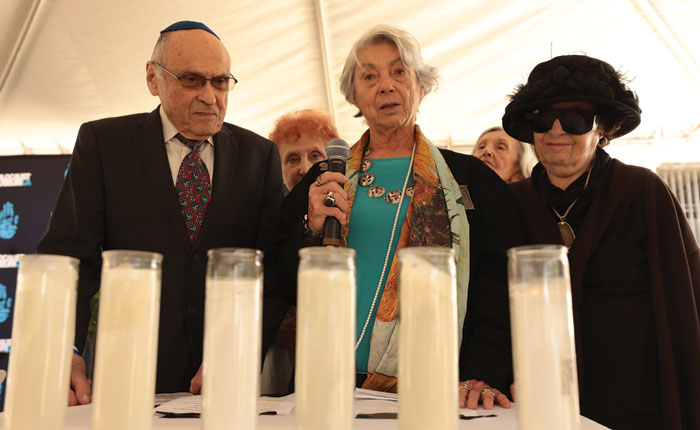
“I believe Obama intends to be engaged until the last days of 2017,” said David Weinberg, director of public affairs at BESA. “He’s ideologically committed to a two-state solution and I don’t agree with those who take his recent statements that he’s walking away from pushing for it or has thrown his hands up at face value.” Bar-Ilan University has assembled a team of Israeli and American experts, mostly supportive of Netanyahu and critical of Obama, who are studying the areas of convergence and divergence going forward.

“We pride ourselves on our ability to think ahead with strategic prescience,” Weinberg told the Journal, citing the center’s early alarm bells over Turkish leader Recep Tayyip Erdogan’s alignment with the Muslim Brotherhood, and the implications of intensified Chinese engagement with the Middle East.

“The post-Obama era is still a ways off, but it’s not too far ahead, and we are trying to develop alternatives to the two-state solution,” Weinberg explained.

With a White House visibly disappointed in the Israel’s election result, and Jerusalem despondent over the Iran nuclear framework, the two countries might be well advised to find a couple’s counselor.

“I think the president is going to bang his head against the wall — and ours. There will be friction for months to come,” Weinberg said.

“Netanyahu’s speech in Congress raised serious issues about the negotiations with Iran,” added Bar-Ilan professor Eytan Gilboa. “It also has further alienated the White House, broken the traditional bi-partisan approach to Israel, divided the American Jewish community, weakened AIPAC, which relies on both, and compromised the ability of the current Israeli ambassador in Washington to effectively accomplish his duties.”

Sunni Israel

“I jokingly say that Israel is the first Sunni state to be Jewish or the first Jewish state to be Sunni,” David Makovsky said at the recent BESA Roundtable. “There is a convergence on Iran, the Muslim Brotherhood, on ISIS, some might say on Turkey — some might say on criticizing the United States.

“It was remarkable to me that after 51 days, no matter what the television pictures were on Al-Jazeera, for the first time the Sunni governments saw Hamas through the prism of Israel — as a terror entity, and the Egyptian government refers to it as such,” Makovsky said.

While the White House may be demonstrating realpolitik conceding an Iranian role in Syria, Iraq and Lebanon, Israel’s views on the matter overlap significantly with Hashemite Jordan and Saudi Arabia, which are ultimately more afraid of Tehran than ISIS.

“In addition to keeping Iran at a reasonable remove form nuclear weapons status, the Obama administration seems to have an additional goal in mind: to bring Iran on board efforts to stabilize the Middle East,” added Brig. Gen. (res.) Yossi Kuperwasser. “For this, Obama is willing to pay a significant price in terms of the legitimization of Iran’s central role in the region.”

Participants at the roundtable concurred with the view that the White House neglected the importance of the Sunni-Shia split in the formation of its nuclear policy.

“Obama believed in a fallacy that our dispute with the Palestinians would stop Sunni Arab leaders from publicly objecting to a deal with Iran,” said Shmuel Sandler, a professor and Mideast policy expert. “Wikileaks divulged that Sunni Arab leaders urged the Americans to keep nuclear weapons from Iran regardless of the Palestinian issue.

“The President got in the way between the convergence between the Gulf Arabs and us. Look at how he went to Turkey and Qatar instead of working with the Egyptians as mediators during the conflict last summer in Gaza,” Sandler said.

The Christianity factor

“The fundamental meaning of Israel for America remains very deep but particularly for religious Christians,” said American diplomat Elliott Abrams at the May 12 BESA Roundtable.

“The rapid growth of the Hispanic population in the United States is important and one of the interesting aspects of this is the percentage of Hispanics who are leaving the Catholic Church and becoming Evangelical Protestants.

“When they do, the likelihood of their becoming more supportive of Israel increases, as it does for all Evangelicals.”

Four months from now, Pope Francis will address Congress. Republicans were hoping he’d have their back on issues such as same-sex marriage and abortion, but this week the Vatican made clear its intention to recognize a Palestinian state.

“It’s interesting how the Vatican has gotten so political, when ultimately the Vatican ought to be working to lead people to Jesus Christ and salvation,” said Rep. Jeff Duncan (R-S.C.).

Duncan and other “Christian Zionists” are being reminded that the Catholic Church nurtures different, and arguably deeper ties to the Holy Land than evangelical denominations and is less receptive to Israeli arguments that the Palestinians can’t pull off statehood.

With data showing that American Catholic voters and lawmakers are marginally more “balanced” in their view of the conflict, Israeli policy experts know their lobbying efforts increasingly will have to factor in denominational affiliations among U.S. Christians.

But Jonathan Rynhold, another BESA participant, thinks the denominational factor might be overstated.

“The thing about American Catholics is they are culturally Protestant when it comes to Israel,” he said. “Over a third of them believe that God gave the land of Israel to the Jewish people in the Bible has relevance to Israel’s legitimacy as the Jewish homeland today. That is not in line with Catholic doctrine, which says the Bible has no significance to the State of Israel.

“So on average, while they are less sympathetic to Israel than American Protestants, they are still very sympathetic by any standard and much more supportive than European Catholics,” said Rynhold, whose extensive findings on U.S. Christians and the Middle East are detailed in his book, “The Arab-Israeli Conflict in American Political Culture,” published last month by Cambridge University Press.

Obama’s Mideast diplomacy had some promising moments according to David Makovsky, who took a year’s leave of absence from The Washington Institute for Near East Policy to join the team Martin Indyk assembled to support the John Kerry initiative.

“There was some good news but that good news was never told to the public’s both sides. Of course, for some of them, it wouldn’t have been good news,” Makovsky said.

“The Palestinians were more flexible on the refugee issue than I would say 99 percent of Israelis would believe, and the Israelis were in the ZOPA, our shorthand for zone of a possible agreement in terms of territory.”

Makovsky said neither Netanyahu nor Mahmoud Abbas wanted to raise expectations by signaling the progress that was made during the Kerry talks.

“Another fact that didn’t help much is the two sides did things that were not helpful,” Makovsky said.

BESA’s “security maven,” retired Maj. Gen. Yaakov Amidror rejects the notion that the American team was able to advance a workable two-state deal.

“The professional judgment of what Gen. [John] Allen offered is that it was not enough for the security of Israel. It could be good for American purposes, but for Israel it depended too much on foreign forces and technology, which is something Israel can not accept,” Amidror told the Jewish Journal.

Unlike the cluster of “technocrat” former generals including retired Maj. Gen. Amnon Reshef and former head of the Mossad, Meir Dagan, who are members of the two-state advocacy group Commanders for Israel’s Security, Amidror says Israel must block statehood for the West Bank and Gaza so long as Palestinian negotiators insist on an Israeli withdraw from the Jordan valley.

“Abu Mazen [Abbas] has shown no flexibility over the past 10 years,” Amidror said. “Yes, he is against violence and against using terror, but when it comes to our security requirements, he hasn’t moved one step.”

Credibility questioned

It was in 2009 at the BESA Center where Netanyahu first suggested a willingness to see the establishment of a Palestinian state alongside Israel, and that is the same venue where in 2013 the Prime Minister began to dial back, saying the Palestinians simply don’t want Jews to live anywhere in Israel.

On the eve of the March Knesset elections, he issued a complete reversal of the 2009 declaration, telling American business magnate Sheldon Adelson’s pro-settler website, NRG, that “anyone who moves to establish a Palestinian state and evacuate territory gives territory away to radical Islamists’ attacks against Israel.”

But even Abrams, who has slammed Obama for bashing Netanyahu, is concerned that Israel is losing credibility in the “two-states” discussion.

“The problem will arise when people think Israel isn’t trying,” Abrams told the BESA forum. “Even if they kind of recognize that the Palestinians don’t want to say yes, and there is no possibility of a peace agreement.

“Israel gains from appearing to try — because the alternative to that is an Israeli position that essentially says there is going to be another 50 to 60 years of occupation; we are going to rule the Palestinians for another couple of generations, and there is no alternative to that.

“That may be true. That may be the way it turns out. But it is harmful to Israel not just internationally but even in the United States to appear to be relaxing into that position and say that is the way it is, grow up.”

Israeli think tank ponders bilateral relations Read More »

Moving and Shaking: Los Angeles Jewish Film Festival, David Myers and Richard Sandler

A red carpet ceremony and a screening of “The Outrageous Sophie Tucker” kicked off the 10th annual Los Angeles Jewish Film Festival (LAJFF) on April 30 at the Saban Theatre in Beverly Hills. 

The opening gala, which drew approximately 700 people, was just the beginning of a week of 25 films — including feature-length movies, shorts and documentaries — at theaters citywide.

Among those seen on the red carpet on opening night were Hilary Helstein, LAJFF executive director; philanthropist Daphna Ziman; and actors Radha Mitchell (“Finding Neverland”), Beverly Todd (“The Bucket List”), Max Ryan (“Death Race”) and Ken Davitian (“Borat”). Helstein spotlighted how far the festival has come since its founding a decade ago.  

“Why is this year different from all other years? We finally made it to our 10th — and what a milestone it is!” she said in a statement.

LAJFF founding co-chairs Kim Cavallo and Michele Kaufman were honored “for their creative vision and dedication to the Jewish community,” Helstein said. 

Annette and Robert Lichtenstein co-sponsored the opening night of the festival. 

TRIBE Media Corp., parent company of the Jewish Journal, is the nonprofit sponsor of the LAJFF.

The opening night event’s centerpiece was “The Outrageous Sophie Tucker,” a documentary about the iconic 20th-century superstar who made a name for herself in vaudeville, Broadway, radio, television and Hollywood. A discussion followed with the film’s producers, husband-and-wife team Lloyd and Susan Ecker.

Later during the festival, E. Randol Schoenberg, board president of the Los Angeles Museum of the Holocaust and art restitution lawyer, participated in a Q-and-A after the May 2 screening of “The Art Dealer,” a movie involving Nazi-looted art. Filmmaker Melissa Donovan participated in a discussion after  screenings of her film about an Ethiopian and an American doctor, “Zemene,” on May 3 and 4. 

The closing night ceremony at ArcLight Cinemas in Sherman Oaks featured the first two episodes of the dramatic Israeli television series “Prisoners of War” (“Hatufim”), which inspired the award-winning Showtime series “Homeland.” A Q-and-A followed with Rob Eshman, the Journal’s publisher and editor-in-chief interviewing series creator Gideon Raff, whose latest show, “Dig,” is now on American television network USA. 


David Myers, the incoming inaugural UCLA Sady and Ludwig Kahn Chair in Jewish History. Photo courtesy of UCLA

UCLA professor David Myers has been named the university’s inaugural Sady and Ludwig Kahn Chair in Jewish History, UCLA announced May 19. 

The chair will provide funds for research, graduate student support and more for Myers, the current Robert N. Burr Department Chair in the history department (a position from which he will step down at the end of June).

 “It is a great honor to be the first holder of this chair, which will ensure that the poignant and powerful story of Sady and Ludwig Kahn — and of so many other Jews from the near and distant past — will be taught to generations of students at UCLA,” Myers said. “The Kahn Chair affirms UCLA’s place as a major center for the study of Jewish history in the United States and the world.” 

The late Sady and Ludwig Kahn were German Jews who fled Germany in the late 1930s before starting a successful hat-making business in Los Angeles. Sady, according to a UCLA press release, did not have any children and felt that UCLA, given its role in educating young people, was a deserving beneficiary of the Kahns’ money. She died in 2009. 

Myers has a bachelor’s degree from Yale and a doctorate from Columbia. He has edited eight books and authored several others, including “Re-inventing the Jewish Past: European Jewish Intellectuals and the Zionist Return to History.”


An architecture contest is underway — and may be nearing completion — at Wilshire Boulevard Temple’s (WBT) Koreatown-based Erika J. Glazer Family Campus, in which four major architectural firms have submitted proposals to create a new, 55,000-square-foot event and meeting building, dubbed The Gathering Place. 

The competing architecture firms are Kengo Kuma and Associates, Morphosis Architects, Rem Koolhaas’ OMA and Steven Holl Architects, according to an April 23 press release. Susan Gordon, WBT director of communications and marketing, told the Journal on May 19 that the contest jury committee has recommended architect Koolhaas for the job and that the synagogue is working with the firm to make its plans work financially. She did not provide a cost estimate.

“We didn’t officially announce the choice because we are in a period of due diligence, finding out if what they proposed could be done with a budget we can afford. … In effect, we are working with them to try to come to an agreement,” she said in a phone interview. 

The “inspiring architectural setting … will include a banquet hall with a commercial kitchen, as well as a cafe, meeting and conference rooms, and administrative space,” a press release said. The hope is for groups and individuals both from WBT and from the greater community to hold meetings, programs and other events there.

WBT Senior Rabbi Steven Leder, a jury committee member, said in a statement that architecture holds an important place in the hearts and minds of his worship community. 

“Architecture is a form of prayer. With this building, the temple brings another strong, radiant landmark to our local community, and the larger city of Los Angeles, to further our role as an institution of learning, gathering and giving,” he said.

Among the others on the jury are philanthropist and famed art collector Eli Broad; Hyatt Hotel heir Anthony Pritzker; Lauren Taschen, wife of art-book publisher Benedikt Taschen; philanthropist Erika Glazer; and Richard Koshalek, former head of the Museum of Contemporary Art. 

The completion of the building, expected in 2020, will represent the final phase of the synagogue’s ambitious, three-phase construction effort, the first phase of which focused on the Byzantine-Revival sanctuary that sits on the northeast corner of Wilshire Boulevard and Western Avenue. That construction was completed in 2013. 

The synagogue is in the midst of its second phase of construction — a 6,000-square-foot Karsh Family Social Services Center. 

WBT already has raised more than $100 million, but additional money will be needed for the new building. Its Koreatown campus is one of two of its campuses in Los Angeles. The Audrey and Sydney Irmas Campus is located in West Los Angeles, at Olympic Boulevard and Barrington Avenue. 


Richard Sandler, incoming Jewish Federations of North America board chair. Photo courtesy of Milken Family Foundation

The Jewish Federations of North America (JFNA) has nominated Richard Sandler — immediate past chair of The Jewish Federation of Greater Los Angeles — as its next chair of the board.

The organization’s board of trustees nominating committee, led by Lori Klinghoffer, will vote on the nomination in November during the JFNA General Assembly, according to a May 14 email from JFNA to its constituents.

Sandler is a past vice chair of the JFNA board and current executive vice president and trustee of the Los Angeles-based Milken Family Foundation. He will succeed Michael Siegal as chair at JFNA, which represents more than 150 federations across the continent.

“As Jewish Federations look to build a strong future for our children and grandchildren, we need a national leadership that will inspire others and help them connect to our critical work,” Siegal said in a statement. “The nominating committee has identified an outstanding slate of individuals that includes a diversity of experience and leadership skills.”

Moving and Shaking highlights events, honors and simchas. Got a tip? Email ryant@jewishjournal.com.

Moving and Shaking: Los Angeles Jewish Film Festival, David Myers and Richard Sandler Read More »

Univ. of California alumni call for steps to curb campus anti-Semitism

More than 500 alumni of the University of California called on the system’s president and Board of Regents to address the “rising tide of anti-Jewish bigotry at the UC.”

The alumni wrote in the open letter published Wednesday in the Daily Bruin, the student newspaper of the University of California, Los Angeles, that they are “deeply concerned about the safety of Jewish students at our alma mater.”

The 521 signers said they “heartily commend” the student senates of three U.C. schools — Berkeley, Los Angeles and Santa Barbara — for “responding to the alarming escalation of anti-Semitic activity on UC campuses by unanimously passing resolutions which condemn anti-Semitism.” They also praised the U.C.’s president, Janet Napolitano, for her own statement condemning anti-Semitism.

The alumni called on Napolitano and the Board of Regents to formally adopt the U.S. State Department’s definition of anti-Semitism in order to properly identify anti-Semitic expression on campus; to train campus staff to identify and address campus anti-Semitism; and to develop initiatives to educate the campus community about anti-Semitism.

The letter echoed a similar open letter released on Tuesday by a coalition of 23 student and community organizations.

Recent incidents on U.C. campuses include swastikas drawn on a Jewish fraternity house at Davis and the inappropriate questioning of a candidate for student judiciary board about her Jewishness and Jewish affiliations at UCLA.

Univ. of California alumni call for steps to curb campus anti-Semitism Read More »

Commemorating Professor Wistrich: A Jewish Scholar Concerned With the Bigger Picture

In October 2014, I had the privilege of meeting with Hebrew University Professor Robert S. Wistrich, head of the Sassoon International Center for the Study of Anti-Semitism, for a televised discussion on the roots of anti-Semitism. Prof. Wistrich, one of the world’s foremost authorities on anti-Semitism described in fascinating detail the “incarnations” of anti-Semitism over the ages. But when I pressed him about the reasons why there is anti-Semitism to begin with, he said—after a long pause—that the information he had provided were his views as an academic. However, his views as an individual who has been studying anti-Semitism for decades, he believes that the reason why there is anti-Semitism has to do with the age-old mission of the Jewish people. After another short pause he added that this mission has to do with the inclusive commandment, “love your neighbor as yourself.”

On October 29, Prof. Wistrich published in Mosaic Magazine an essay titled, “When All Is Said and Done in France…” His concluding words were “Anti-Semitism, as so often in Jewish history, may well be the immediate trigger for change. But much more is involved than that. There is also the haunting … matter of Jewish destiny.”

Earlier in the essay, he pointed out an issue that I believe is relevant to all Jews in Western countries, and not just to French Jewry: “I have also encountered well-placed and upwardly mobile French Jews who may acknowledge the current ‘national malaise’ but refuse to believe it will ultimately affect them, who are altogether disconnected from the hardships experienced by Jews and non-Jews alike at the street level, who basically deny that anti-Semitism even exists in France, or who think it is merely a passing trend that will disappear as soon as economic conditions improve. We have been there before, many times in Jewish history, and sadly it appears that some Jews will never learn.”

Representatives of the Commemorating Professor Wistrich: A Jewish Scholar Concerned With the Bigger Picture Read More »

3 short notes from NY: Iran, US-Israel, Israel-Diaspora

I spent the week in the US, discussing the “triangle” – The US, Israel, and the Jews – at a JPPI brainstorming conference and in several other meetings. Here are a couple of quick thoughts on things that were discussed and their implications:

Iran: accept or fight to the (bitter) end?

Israel is facing a dilemma, and it is not an easy one to unpack. Assuming that a deal with Iran is more likely to occur than not, should Israel accept it as a reality and use the time until the agreement is signed to ask the administration for the things that Israel might want to have after there’s an agreement (weaponry, assurances, understandings)? This question is important because now is a time in which the Obama administration is prepared to offer a lot in exchange for Israel’s good behavior. So the Prime Minister needs to decide what’s more important to him: not giving any hint of Israel’s possible acceptance of a new reality – or getting prepared for the next stage. If he chooses the latter, another great benefit would be an improvement in the relations between the American and the Israeli governments.

US-Israel: what if the deal passes, or fails?

The dilemma is even more profound as we consider it against the two possible outcomes of the Iran negotiations.

They can succeed – namely, there will be an agreement, Israel will fail in stopping it and fail in taking advantage of the time from now until then, and it will then have to face an administration that no longer has much reason to take Israel’s views into account. Different things could happen if such an outcome occurs: it can be nothing much, if the US decides that it is time to turn the page; or it can result in the US putting immense pressure on Israel on the Palestinian issue by letting a Security Council resolution pass.

They can also fail – namely, no agreement. If this happens because of Iranian calculations, that is not bad for Israel, and it can work for the benefit of US-Israel relations (or at least remove one source of great tension). If this happens because of Israel (namely, Congress takes Netanyahu’s side – an unlikely outcome), the Obama administration would go to great lengths to make Israel pay for its actions.

This means two things:

A. Iran alone can save Israel from two unpleasant realities. That is scenario number two (no agreement because of Iran).

B. In two of the three possible scenarios Israel suffers. It either suffers because Iran gets the agreement, or it suffers because of a vengeful American administration. 

American Jews: a crisis with Israel?

Important leaders of the American Jewish community use the term “crisis” to describe the relations between Israel and American Jewry. The reasons for this crisis mode are many, and addressing them could be complicated. They include trends within the American community (interfaith marriage) and the impact of Israel’s policies on the way it is perceived in North America (for example, on things such as conversion).

One thing became clear to me in the many discussions in which I participated: Jewish Americans are up in arms over things that most Israelis consider to be insignificant. This is a recipe for misunderstanding and disappointment. In many of these occasions, the Americans are right when it comes to matters of principle – yes, rabbinate policies in Israel are often enraging. In many of these occasions they are wrong when it comes to matters of setting priorities – no, the Israeli government should not currently spend a lot of political capital on solving something that has little impact on the lives of most Israelis.

I intend to write more about this in the near future. In the meantime, all I can offer is a plea for calm.

3 short notes from NY: Iran, US-Israel, Israel-Diaspora Read More »

Reality Competition Shows: When We All Become Critics.

Troy was a couple of years older.  He was married with one child when we started medical school together.  We had similar interests-  less beer and sports, more art, music and philosophy.

I experienced many firsts with him- from classic movies, to great operas, from staying up all night awaiting shooting stars in Joshua Tree to skipping class for French baguettes and caffeinated hyperbole. 

There are those in whose company you feel you belonged your whole life.

I grew close to him, but every time I let my guard down, he pushed me into an uncomfortable corner.  Troy was a perfectionist.  He judged harshly.  In a beautiful antique masterpiece, he pointed out the crack in the corner.  In a triumphant movie, he took pride in finding flaw.  Where I found wonder, he crushed it with cutting critique.

At times, this atheist was certain that if he were God, the world would be a better place.

In my house, we used to watch the now cancelled American Idol, before we switched over to The Voice.  My kids learned quickly from Simon:  To appear smart, criticize! 

Reality competition shows have trained us to roast the contestants.  We feel superior, not only to the participants, not only to the judges, but also to our friends sitting beside us, in front of the set, when we guess the winner early.  “See,” we say.  “You don’t know what you’re talking about.”

We grow up in schools where grades kill our creative outlet, constantly in fear of failure.  As adults, we are trained to mock those who trip.  When we walk into a magnificent building, we boast, not noticing the grandeur, but zooming in on the “missing tile” as coined by Dennis Prager. 

Trouble is- sometimes all we see is the defect.  The scar becomes the person.

Criticism, constant crucifixion, is the biggest killer of relationships.  Cynicism drives in the nails.  Eventually, the trained knife of judgment slashes the hearts of those closest to the critic.

Troy and I grew apart.  I continued to have distant respect, but did not want to be jaded.

I treasure that curious child within me, who in the words of Picasso, still wants to remain an artist.

Reality Competition Shows: When We All Become Critics. Read More »

Around-the-clock cleanup effort under way on oil-fouled California beach

Santa Barbara– Cleanup teams labored on Thursday for a third day to remove patches of crude petroleum that stained a California beach and fouled offshore waters from a pipeline rupture that may rank as the biggest oil spill to hit the Santa Barbara coastline in more than four decades.

Working around the clock, about 300 people on the beach were scooping up globs of oil from the sand and raking tar balls. Crews will also scrub soiled rocks and hose down contaminated areas, Coast Guard Captain Jennifer Williams said.

Nine cleanup vessels plied the ocean, six to corral the slick with booms and three others skimming oil from the surface.

Refugio State Beach and El Capitan State Beach, both popular seaside camping destinations, were to remain closed to the public through the Memorial Day holiday weekend. The area was also closed to fishing and shellfish harvesting.

Tuesday's rupture released as much as 2,500 barrels (105,000 gallons) of crude oil, five times more than the initial estimate, according to a “worst-case scenario” presented by pipeline owner Plains All American Pipeline. It said up to a fifth of the spill had reached the ocean.

The 24-inch-wide (61-cm-wide) pipeline, which runs underground parallel to a coastal highway west of Santa Barbara, inexplicably burst on Tuesday morning, belching crude oil down a canyon, under a culvert and onto Refugio State Beach before it flowed into the Pacific, U.S. Coast Guard officials said.

Plains Chief Executive Officer Greg Armstrong said control-room operators detected pipeline pressure irregularities on Tuesday morning, and the line was shut off in about 30 minutes.

The company said residual oil continued to drain after the shutdown. The spill was discovered about an hour later, when people in the area noticed a petrochemical odor and alerted authorities, officials said.

By Wednesday, a 4-mile (6-km) stretch of beach was blackened, and an oil slick spanned more than 9 miles (14 km) of ocean, the Coast Guard said.

Tuesday's accident pales in comparison with a 1969 offshore well blowout into the Santa Barbara Channel that released an estimated 80,000 to 100,000 barrels of oil and stands as the largest spill ever in California waters.

Officials said Tuesday's oil spill, if Plains' estimates hold up, likely ranks as the biggest along the Southern California coast since the 1969 blowout, which killed thousands of sea birds and other wildlife and helped spark the modern U.S. environmental movement.

SENSITIVE NESTING SITES

Governor Jerry Brown issued an emergency proclamation on Wednesday to speed cleanup resources to the scene.

The spill zone lies at the edge of a national marine sanctuary and state-designated underwater preserve that is home to 25 marine mammal species and 60 species of sea birds. But the Santa Barbara Channel and surrounding waters are also dotted with nearly two dozen oil platforms and hundreds of wells.

Wildlife teams were dispatched to rescue any animals injured by the spill. Authorities said they did not know the extent of wildlife harm, but photos showed oil-covered pelicans and other sea life washed ashore.

Crews focused on three especially sensitive nesting areas for shore birds, including snowy plovers and least terns, said a state Fish and Wildlife Department spokeswoman.

The pipeline that burst on Tuesday typically carries about 1,200 barrels of oil an hour from an Exxon Mobil Corp processing facility to a distribution hub in Bakersfield hundreds of miles away, company and county officials said.

The company said it had inspected the pipeline a few weeks ago, but results had not yet come back. 

Around-the-clock cleanup effort under way on oil-fouled California beach Read More »

Islamic State says in full control of Syria’s Palmyra after westward advance

Islamic State fighters tightened their grip on the historic city of Palmyra in Syria, days after capturing a provincial capital in neighboring Iraq, suggesting the growing momentum of the group which a monitor says now holds half of Syrian territory.

The twin successes pile pressure not just on Damascus and Baghdad, but also throw doubt on U.S. strategy to rely almost exclusively on air strikes to defeat Islamic State.

Extending its reach in the region, fighters loyal to the Sunni Muslim group have also consolidated their grip on the Libyan city of Sirte, hometown of former leader Muammar Gaddafi.

Islamic State said in a statement posted by followers on Twitter on Thursday it was in full charge of Palmyra, including its military bases, marking the first time it had taken a city directly from the Syrian military and allied forces.

The Britain-based Syrian Observatory for Human Rights said

the al Qaeda offshoot now controls more than half of Syrian territory following more than four years of conflict which grew out of an uprising against President Bashar al-Assad.

The ultra hardline group has destroyed antiquities and monuments in Iraq and there are fears it might now devastate Palmyra, home to renowned Roman-era ruins including well-preserved temples, colonnades and a theater.

The U.N. cultural agency UNESCO describes the site as a historical crossroads between the Roman Empire, India, China and ancient Persia and a testament to the world's diverse heritage.

“We may have different beliefs… different views, but we have to protect such incredible vestiges of human history,” UNESCO Director General Irina Bokova told Reuters Television.

The Observatory's founder Rami Abdulrahman said Islamic State fighters had entered the historical sites by early on Thursday but there were no immediate reports of destruction.

“This is the fall of a civilization,” Syria's antiquities chief Maamoun Abdulkarim told Reuters. “Human, civilized society has lost the battle against barbarism.”

WAR CRIMES

Al-Azhar, the center of Islamic learning in Egypt, called on the world to protect Palmyra, saying the destruction or looting of cultural heritage was religiously forbidden.

Clashes in the Palmyra area since Wednesday killed at least 100 pro-government fighters, said Abdulrahman, who bases his information on a network of sources on the ground.

Syrian state media said pro-government National Defense Forces had evacuated civilians before withdrawing.

The assault on the city is part of a westward advance by Islamic State that is adding to pressures on Syria's overstretched army and militia, which have also recently lost ground in the northwest and south.

Capturing the city marks a strategic military gain for Islamic State, because it is home to modern army installations and situated on a desert highway linking government-held Damascus and Homs with Syria's mainly rebel-held east.

The European Union's foreign policy chief expressed fears that thousands of people in Palmyra were at risk as well as the cultural sites.

“Mass killings and deliberate destruction of archaeological and cultural heritage in Syria and Iraq amount to a war crime,” Federica Mogherini said in a statement.

Although Islamic State has seized large chunks of Syria, the areas it holds are mostly sparsely inhabited. Syria's main cities, including the capital Damascus, are located on its western flank along the border with Lebanon and the coastline.

In the northeast, Kurdish forces backed by U.S.-led air strikes have been pressing an attack on Islamic State in Hasaka province, which links land held by the group in Iraq. Scores of its members have been killed this week and state television also reported progress by the army in the area on Thursday.

IRAQ OFFENSIVE

Palmyra's fall came just five days after the Islamist group seized Ramadi, capital of Iraq's largest province, Anbar.

Iraqi forces said on Thursday that they had thwarted a third attempt by Islamic State militants to break through their defensive lines east of Ramadi overnight.

Police and pro-government Sunni fighters exchanged mortar and sniper fire with insurgents across the new frontline in Husaiba al-Sharqiya, about halfway between Ramadi and a base where a counter-offensive to retake the city is being prepared.

The loss of Ramadi handed the Iraqi government its most significant setback in a year and exposed the limitations of both the army and U.S.-led air strikes designed to “degrade and destroy” Islamic State.

The United States plans to deliver 1,000 anti-tank weapons to Iraq in June to combat suicide bombings like those that helped the Islamist group seize Ramadi, a senior U.S. State Department official said on Thursday.

Iraq's government has ordered Shi'ite militia, some of which have close ties to Iran, to join the battle to retake Ramadi, raising fears of renewed sectarian strife in the country.

Washington wants the counter-offensive to include both Sunni and Shi'ite forces under the direct government command.

The militants in Ramadi are seeking to consolidate their gains in Anbar province by pushing east to the Habbaniya base where security forces and Shi'ite paramilitaries are massing.

“Daesh is desperately trying to breach our defenses but this is impossible now,” Police major Khalid al-Fahdawi said, referring to Islamic State. “They tried overnight to breach our defenses but they failed. Army helicopters were waiting for them.”

Habbaniya is one of only a few remaining pockets of government-held territory in Anbar, and lies between Ramadi and the town of Falluja, which has been controlled by Islamic State for more than a year.

Islamic State says in full control of Syria’s Palmyra after westward advance Read More »

Lieberman calls two-state supporters ‘autistic’

Avigdor Lieberman, Israel’s former foreign minister, called supporters of a two-state solution to the Israel-Palestinian conflict “autistic.”

Lieberman, who heads the right-wing Yisrael Beiteinu party, made his remarks Thursday in an interview with Israel Radio.

“Anyone who thinks going back to the 1967 lines will solve the conflict is autistic,” Lieberman said.

Lieberman, who declined to join the new government coalition after serving in the previous coalition with Prime Minister Benjamin Netanyahu’s Likud Party, accused the prime minister of waffling on the two-state issue – now saying he supports it after indicating during the election that it was no longer in the offing.

Jay Ruderman, president of the Ruderman Family Foundation, called on Lieberman to apologize for using the term autistic as an insult directed at Netanyahu.

“Millions of people around the world and thousands of people in Israel are autistic. By using the word ‘autistic’ as an insult, MK Lieberman has deeply hurt the autism community,” said Ruderman, whose foundation is dedicated to strengthening the relationship between Israelis and American Jews, and to the inclusion of people with disabilities in the broader society. “The term for a disability should never be used in a crude and derogatory manner.

“If Mr. Lieberman had an autistic child, how would he like it if his child heard a highly visible public figure like himself use autism as cudgel against an adversary?”

Also Thursday, Lieberman said Netanyahu should cancel a scheduled meeting with the head of the Joint Arab List party. The Arab-Israeli party, headed by Ayman Odeh and made up of the major Arab-Israeli parties, is the third largest in the Knesset with 13 seats.

Netanyahu went ahead with the meeting, however. He and Odeh discussed the socio-economic advancement of Israel’s Arab citizens, according to a statement from the Prime Minister’s Office, and Netanyahu reminded Odeh of the many investments that his governments has made in the Arab sector over the past six years. The prime minister added that it was necessary to continue reducing the gaps in Israeli society.

Odeh in a statement following the meeting said he took the prime minister to task for his Election Day warning that Arab voters were flocking to the polls.

Lieberman in pushing Netanyahu to cancel the meeting said Odeh “represents a list of terror supporters in the Israeli parliament.”

Lieberman calls two-state supporters ‘autistic’ Read More »