fbpx

January 8, 2014

U.S. Judge approves JPMorgan criminal settlement in Madoff case

A federal judge on Wednesday approved an agreement between JPMorgan Chase & Co and U.S. prosecutors to settle charges that the bank violated anti-money laundering laws by failing to alert authorities to warning signs its employees encountered in dealings with convicted Ponzi schemer Bernard Madoff.


The settlement, which deferred the criminal charges against the bank until Jan. 8 2016, requires the bank to pay a $1.7 billion forfeiture and improve its anti-money laundering controls. If it meets the terms by the appointed date, prosecutors can chose to dismiss the charges against it.

U.S. Judge approves JPMorgan criminal settlement in Madoff case Read More »

Rebecca Joy Fletcher: Illuminating cabaret

When Rebecca Joy Fletcher was a cantorial student at Hebrew Union College-Jewish Institute of Religion, she chanced upon something in the library that would change her life forever. It was a box set of cabaret songs from Weimar-era Germany, and Fletcher knew in that moment of what she calls “extreme deja vu” that she needed to work with the material. 

Now, more than a decade later, she’s produced “Cities of Light,” a one-woman musical show that deals with the rich history of the music that touched her so long ago. Fletcher will present it Feb. 9 at American Jewish University (AJU).

The show came about after Fletcher finished a critically acclaimed run of her show “Kleynkunst!” which ran off-Broadway in New York in 2007 and 2008 and focused on cabaret performers in pre-World War II Warsaw. Fletcher found herself thinking, “What about Tel Aviv?” Although “Kleynkunst!” had been narrowly focused, she knew there was a much wider world of cabaret in Europe and beyond to explore. 

“I ended up getting a grant and going and doing research,” Fletcher said recently in a phone interview from her home in Chicago. 

She discovered that Israel indeed had its own vibrant cabaret scene from the 1920s through the 1940s, and so “Cities of Light” began to take shape. The show tells the story of a fictional Jewish cabaret performer named Katarina Waldorf as she travels around Europe and later, Israel. 

“In a sense, it’s her story, and its also the story of this art form, as it was harnessed and really taken to a whole new level by Jewish artists,” Fletcher said.

Cabaret is a style of theatrical performance, often done in bars or cafes, that features music, comedy, dance and recitation in an intimate setting, often with an audience that’s dining or drinking. “Cabaret is inherently a satiric art form,” according to Fletcher. “It’s a bit like shifting tectonic plates; you don’t know what can happen next.”

“Cities of Light” became a personal journey for Fletcher, who found the experience of researching the piece to be rather eye-opening. “It was exciting and important to me to create ‘Cities of Light’ because it addresses a world before the Holocaust … that doesn’t exist anymore and that celebrates an art form that most of us … know nothing about.”

“We have a bit of a tendency … American Jews … to think it was all ‘Fiddler on the Roof.’ And it was, by and large, not,” Fletcher said. “These were very cutting-edge artists, and they had a vision of what it meant to be a secular Jew.”

Fletcher tried her best to capture the creativity of the art in “Cities of Light,” which runs around one hour and 15 minutes. It features quite a bit of music — all the songs originated or were popular in cabarets — but Fletcher is quick to point out that “theater is at the heart of the piece.” She said that though the songs were originally in other languages, about 70 percent of the show is in English. There are other differences, too.

“We take liberties musically so that the music will be fresh for audiences now,” said Fletcher, who will also be giving a lecture at AJU on Feb. 6. She described it as a supplement for folks who are interested in the back history of the show. 

Fletcher, who tours around the country and abroad as an artist-in-residence and performer, is excited to perform in Los Angeles, because it’s her hometown. Her mother, Rabbi Susan Laemmle, is the former dean of religious life at USC, and her family has deep roots in the city, stretching back to Carl Laemmle, who founded Universal Pictures. 

The performer is equally excited about a new project she’s working on that centers around a real experience in which a beggar in France handed her a man’s gold wedding ring on the street and told her that she’d found it and that Fletcher needed it. Fletcher describes the piece as “part spiritual journey, part wild goose chase, part circus.” For Fletcher, the new piece, which has the working title “Perfect,” is a nice departure from “Cities of Light.” 

“I love cities, and I love that world … but they’re secular,” said Fletcher, who still serves as a cantor from time to time. She’s looking forward to working on a piece that explores the spiritual side of Judaism, a fitting companion to the secular world of “Cities of Light.”

Right now, however, Fletcher is focused on doing her 97-year-old grandmother proud. She’s reportedly “psyched” to see “Cities of Light.” Fletcher hopes the rest of Los Angeles will be, as well.

“Cities of Light” will be performed at American Jewish University on Feb. 9 at 4 p.m. For tickets and information, visit this story at jewishjournal.com.


“Cities of Light” will be performed at American Jewish University on Feb. 9 at 4 p.m. For tickets and information, visit aju.edu.

Rebecca Joy Fletcher: Illuminating cabaret Read More »

Rasheda Ali Inspires Parkinson’s Awareness

In 2003, my mom got the chance to work with Rasheda with her husband Bob Walsh, and their sons Nico and Biaggio

I got to see what an incredibly down to earth person Rasheda is who absolutely adores her father and sees him as her hero.   Also being the daughter of a parent with Parkinson’s disease, I admired her activism and strong voice for her father, and the entire Parkinson’s community.  I hoped to be able to do the same for my mom one day.  I recently corresponded with her and told her how much she has been a role model to me.  She has shown me that we are not powerless when a parent gets a degenerative disorder.  

With her twin sister Jamillah Ali-Joyce, her father and his wife Lonnie 

I decided to look online and see what Rasheda has been up to these days, and came to discover that she serves as a spokesperson for In Israel meeting with Hadassah scientists 

Similar to myself, Rasheda for the majority of her life has grown up having a parent with Parkinson’s disease.  Mr. Ali got Parkinson’s in 1984, when she was around twelve-years-old.  She didn’t really know too much about the disease until her sons, Nico and Biaggio, started asking her questions about their grandfather’s illness.  Inspired by her father’s interaction with her children, Rasheda Ali wrote a book called I’ll Hold Your Hand So You Won’t Fall: A Child’s Guide to Parkinson’s Disease.  Rasheda said, “Children want to understand why their loved ones behave a certain way. By encouraging communication between them and your loved one with Parkinson's disease, you are not only educating them, you are also bringing them closer together.”

The book addresses most commonly asked questions from children who might not understand why their loved ones with Parkinson’s disease behave in certain ways. The book is written for adults to read to children, and encourages dialogue through the use of colorful illustrations, situations depicting symptoms, and interactive questions. 

“>{HERE} to see interview with Rasheda on Fox News about her advocacy and experience with BrainStorm

Click “>{HERE} to purchase book

Rasheda Ali Inspires Parkinson’s Awareness Read More »

ABC News: Missing teen reported seen in Providence

The missing teenage son of Boston Globe columnist Jeff Jacoby may have been sighted in Providence, R.I., a local ABC affiliate reported.

Caleb Jacoby, 16, has been missing since midday Monday. Police believe Caleb, an 11th-grader at the Maimonides School in suburban Boston, may be a runaway.

ABC6 in Providence reported Wednesday afternoon that there have been “several reports” placing the teen in Providence on Tuesday evening. No further details were reported.

Some 200 volunteers, including friends and neighbors of the family as well as members of local Jewish groups, continued to search throughout the Boston area in a coordinated effort on Wednesday. The effort was spearheaded by the Maimonides School.

Caleb’s photo has been circulated on Facebook and Twitter.

“We are so deeply, deeply grateful for everything being done to reunite us with our beloved son Caleb,” Jeff Jacoby, who is Jewish and often writes on Jewish and Israel issues in his column, tweeted late Tuesday night.

For many years, near his oldest son’s birthday, Jacoby wrote a special column called “Letters to Caleb.”

ABC News: Missing teen reported seen in Providence Read More »

Where Are You, Jahi McMath?

For weeks, I’ve been having an internal debate about whether to write about this particular tragedy. If I were to write about it, what point(s) would I want to make that I haven’t seen made elsewhere? What is missing from this discussion?

In case you somehow missed it, Jahi McMath was a 13 year old girl with sleep apnea, a condition which causes a person to stop breathing while they sleep, which leads to several other medical issues. She went into Children’s Hospital in Oakland in order to have tonsil surgery. Tragically, after the surgery, she died.

The issue being debated in the news and social media, at the dinner table and office lunchrooms, has to do with what happened next. While the hospital was trying to save her life, they put Jahi on a respirator. After she became brain dead, the hospital wanted to remove the respirator so her family could begin their mourning process and start making funeral arrangements.

Instead, because the respirator is causing her heart and other organs to continue to function in some fashion, her family refuses to believe Jahi is dead. Last Sunday, they had her body moved to an undisclosed location, since Children’s Hospital is not in the business of caring for dead people, and they were unwilling to keep Jahi’s body on a ventilator indefinitely.

I understand my statement that Jahi is dead may seem controversial to some. However, multiple doctors and a judge, have declared Jahi to be dead. A death certificate had been issued, stating she died on December 12. My purpose here is not to argue about whether or not Jahi is truly dead.

My question is this: Where is Jahi now? I’m not asking where her family has taken her body. I’m asking about the whereabouts of Jahi’s spirit – the essence of who she is. Where is it now?

The Talmud says, when a new person is created, the mother and father supply the different parts of the body, such as the bones, the flesh, and the whites and dark of the eyes. It is God, however, who supplies things like the understanding and the animation to the face. In other words, the parents provide the person’s body, but God provides the spirit. When the person dies, the Talmud says, the parts the mother and father provided remain on earth, while the parts supplied by God return to God.

So, while Jahi’s body remains on a ventilator, has her spirit returned to God? Or is it stuck in some kind of purgatory while her body remains in a state of unrest?

I ask this because there’s a tradition in Judaism that says a person’s spirit, understandably, has a great fondness and feeling of closeness with his/her former body, which housed the spirit while the spirit was on earth. As a result, and perhaps because it can be so difficult for us to let go of the things we love, the spirit hovers near the body until the body is put to rest.

This is one of the reasons we take such pains to be respectful to a person’s body while we wash and dress it, and place it in the coffin. It is why we apologize to the dead person afterward, asking them to forgive us if, during the process, we have caused any offense. It is one of the reasons why someone stays with the body until burial, reading psalms to comfort the spirit hovering nearby.

So, where is Jahi’s spirit now? Is she free to return to God, or is she stuck in this world, hovering near the body, waiting for a burial that may yet be months in coming?

These are the questions nobody else seems to be asking. This is what seems to be missing from the discussion.

—————-
“Like” the “>follow me on Twitter.

Where Are You, Jahi McMath? Read More »

Limmud for special needs

Since the launch in 2011 of Limmud L’Am at Limmud Conference UK, adults with a variety of learning/developmental disabilities have become a welcome addition to the Limmud community around the world — as presenters, volunteers and participants.

Verbal or nonverbal, walking or in a wheelchair, independent or reliant on others for their support needs — whatever each person’s level of ability, he or she is being welcomed to Limmud. How do we do this?

At the latest Limmud conference in the United Kingdom, a small group of volunteers was tasked with the role of ensuring the site was as accessible as possible. But the real challenge was with the learning. After all, Limmud means, quite literally, learning. How could we make learning events accessible to those who have challenges accessing educational material in the traditional formats? How could we empower them to take one more step on their Jewish journey?

We started by focusing on what people can do rather than what they can’t. We looked for sessions that are already accessible and enjoyable to lots of people — music, crafts, cookery, etc. Because this is Limmud, these classes are also designed to have educational value and Jewish content.

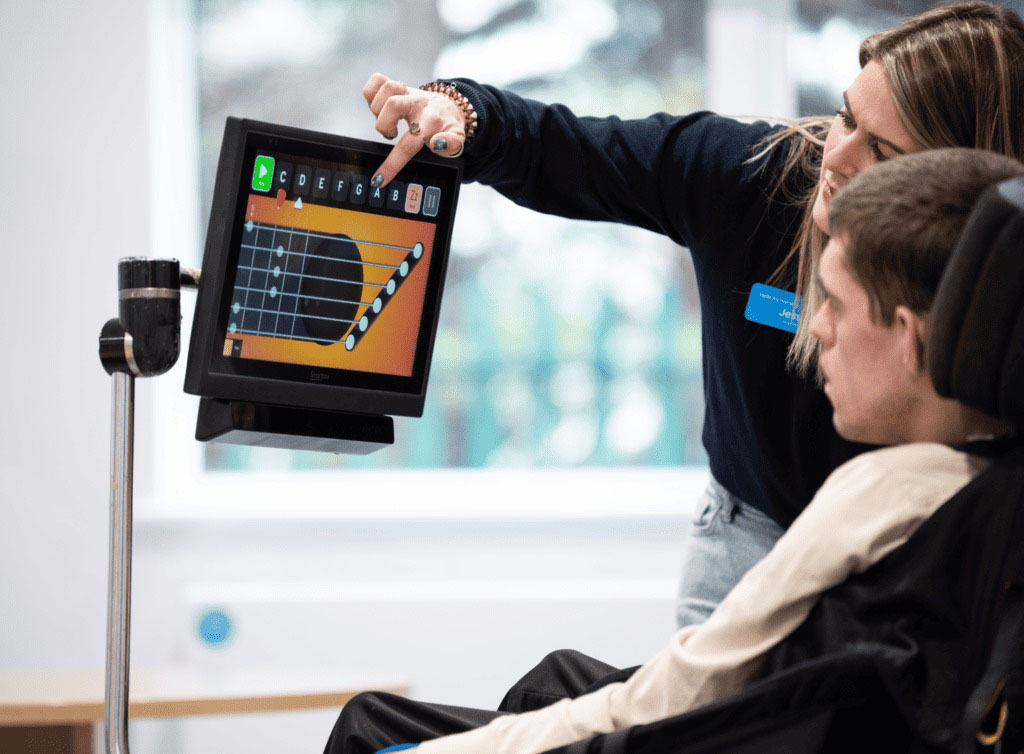
For someone with additional needs, Limmud can sometimes be overwhelming. More and more, we are encouraging presenters to think creatively about making their sessions more accessible — large print, alternative forms of communication, use of new technology, e-mailable content for use on an iPad, handouts in easy-to-read format and so on.

We are just at the beginning of this journey. With time, our goal is that when it comes to Jewish learning, we will leave no Jew behind.

Rachelle, a presenter with special needs, said it best this year: “People with learning or developmental disabilities are just the same as everyone else and should have the same opportunities as everyone else. We should be able to go to Limmud like anyone else, and we should be able to teach people, too. It makes me happy to teach people.”


Shoshana Bloom, an ardent advocate for those with special needs in the Jewish community, serves on the Limmud UK executive committee and has twice co-chaired Limmud Conference.

Limmud for special needs Read More »

The Limmud way: My journey to the future of Judaism

Two distinct visions of Judaism played in my head at the 33rd annual Limmud Conference in England, which I attended during Christmas week. The first vision was alive and kicking at the conference itself, where, under cold and gray skies, 2,600 Jews gathered on a university campus to sample the world’s greatest Jewish buffet. 

If you’ve never been to a Limmud conference, think of it as a Club Med for the Jewishly curious.

No Jewish subject is left behind. The conference I attended offered 1,102 classes, 25 films and 55 panel discussions touching on everything from the spiritual, cultural, religious and mystical aspects of Judaism, to the political, literary, musical and, of course, the controversial.

A major part of the Limmud adventure is learning the art of picking from this dizzying number of options. But another essential aspect of Limmud is the fact that, for several days, you live in an intensely Jewish “neighborhood” and mingle constantly with other members of your tribe.

Not too long ago in many areas of Europe, such a Jewish neighborhood would have been called a ghetto — a place where Jews were forced to huddle in the face of a hostile world. Today, we can be thankful that when Jews huddle, they do so by choice.

And if Limmud is about anything, it’s about the power of choice. The body of Limmud is learning, but its soul is choice.

Which brings me to the other vision of Judaism that played in my head at Limmud, one that was clearly not about choice. 

That vision was articulated in a hard-nosed editorial written by a prominent Orthodox Jew in a British Jewish paper, The Jewish News, which was widely distributed at the conference. Taking issue with Limmud’s pluralistic approach, the author, Brian Gordon, asserted that “the future strength of Anglo-Jewry lies fairly and squarely with the Orthodox camp.”

Freedom of choice is fine, Gordon intimated, as long as one chooses Orthodoxy.

For anyone at the conference seeing this message, it was an odd disconnect. Here we were feasting at this fabulous buffet of Jewish choice but reading that the future of Judaism resides only in one section of that buffet.

Even though England’s new Chief Rabbi Ephraim Mirvis did show up this year, the continued opposition to Limmud among some in British Orthodoxy signifies that these two visions of Judaism — one based on choice, the other on religious boundaries — will continue to clash.   

To Gordon’s credit, he doesn’t mince words when making his case, stating flatly that “there is only one real factor that has sustained the Jewish people throughout the ages — namely adherence to Orthodox doctrines.”

He railed against a Jewish faith that is “a popular democracy based on trends,” or what he called “an ice cream parlor, where customers can pick and mix the mitzvah flavors that suit them and reject those that don’t.”

It was unsettling to read these words even as I was absorbing so much learning at this giant ice cream parlor of innumerable Jewish flavors.

In one session, for example, I learned from Joel Grishaver about God’s “brokenness,” examining Martin Buber and the Lurianic creation myth, and how “each of us is broken … and as we heal ourselves, God and the world are healed as well.”

In another session, I learned from Chicago Torah expert Shoshana Waskow about the 10 instances in the Torah when a woman “takes” something, and how, every time, something transformative happens.

In other sessions, I learned about “Torah and acting theory”; the oldest Jewish sect (the Karaites); the spiritual meaning of Havdalah; the rise and fall (and rise?) of political Islam; and I even saw a film on the once-vibrant but now vanishing culture of my ancestors, the Jews of Morocco.

One night, I skipped out of a class I found dull and stumbled onto what was, perhaps, my favorite session of the conference: “Photography That Cares,” presented by Glenn Jordan, an African-American artist originally from Los Angeles, who now teaches at the University of South Wales. Jordan showed a series of portraits of Welsh Jewry titled “Hineni: Life Portraits From a Jewish Community.”

Each portrait told another Jewish story; each face expressed the complexity of human emotion. Here was a black man from America giving a Jewish audience in England the goose bumps of Jewish peoplehood. 

As I continued to sample the multitude of Jewish flavors throughout the week, meeting Jews from around the world, debating Eliezer Berkovits’ breakthrough ideas about the existence of God, being challenged by a candid examination of King David’s series of sins, seeing an Orthodox woman perform a play imagining her burial, and attending a musical jam session of Iraqi-Israeli music, Gordon’s message was never far from my mind: This ice cream parlor is not the future of Judaism.

Was I enjoying a Judaism of pleasure that could never stick because it doesn’t make any demands on me? Would this very broad sampling of Jewish ideas reinforce my Jewish identity or water it down? And is this Judaism of choice incompatible with stringent Orthodoxy?

Ironically, it was something as silly as a colorful poster that enlightened me the most on this subject. This poster stared at me in every class I attended, and it said: “Taking you one step further on your Jewish journey.” 

That is the essence of the Limmud mission statement, and it frames your whole experience. 

Its brilliance is that it empowers everyone equally: Whether you’re a Charedi Jew or an atheist, there’s always something at Limmud to take you one step further on your Jewish journey.

By honoring individual journeys, Limmud nurtures the collective journey that its conference represents. It’s an artful move. Large Jewish gatherings are usually homogeneous — one movement, one ideology. Limmud is 2,600 attendees, 2,600 movements, 2,600 journeys.

This respect for the individual creates an unthreatening environment in which Jews feel free to explore, discover and break down barriers.

Children learning from parents, and parents learning from children, at a Limmud study session. Photos by Flix ‘n’ Pix

I met two deeply religious Jews at Limmud who embodied this very idea of breaking down barriers. The first was Rabbi Dov Lipman, a member of the Knesset in the centrist Yesh Atid Party. You listen to Lipman speak and you think: “Please, someone make him the Chief Rabbi of Israel — pronto!”

On every issue of controversy, Lipman offered moderate and compassionate views that respect Jewish law. It helps that he’s a Torah scholar trained in some of the most prestigious yeshivot, and that he holds a master’s degree in education from Johns Hopkins University.

When discussing Israel’s conversion crisis, for example, he quoted the halachic concept of zera yisrael (Jewish progeny) that would allow an easier path for hundreds of thousands of Russian Israelis seeking an official conversion to Judaism.  

What’s most intriguing about this Charedi Jew is how fearlessly and respectfully he engages with the secular world. Because he learns from them, they end up learning from him. In one of his sessions, he shared anecdotes about how some of the secular colleagues in his party often ask him, out of respect, “Is this OK with Jewish law?”

The point Lipman made was an old and timeless one. It was a point, in fact, that every Limmud conference makes: Human contact breaks down barriers.

The other religious speaker breaking down barriers was Rabbi Yuval Cherlow, a  halachic scholar, philosopher, author and founding member of the moderate Tzohar rabbinical organization.

In a conversation with Limmud co-founder Clive Lawton, Cherlow explained how Tzohar was conceived after the Yitzhak Rabin assassination — a traumatic turning point that galvanized religious Jews like Cherlow to try to lessen tensions between Israel’s religious and secular communities.

In reaching out to their secular brethren, members of Tzohar wanted to go beyond simple expressions of love to do something concrete that would benefit the secular world. They started by focusing on marriage, providing a halachic alternative to the thousands of Israeli couples whom the chief rabbinate refused to marry for one reason or another.

I got to hang out with Cherlow a little during the conference. One of the unique aspects of Limmud is that everyone is on equal footing. There are no titles on name badges — just your name. Presenters and students mingle in the cafes and bars and eating areas.

If you see a presenter and you feel like shmoozing, you do so. Which is what I did with Cherlow. Beyond his obvious intellect, what I took away was a sweetness and genuine curiosity.

Rabbi Dov Lipman, a Knesset member from the Yesh Atid Party, addresses Limmud International delegates from 40 communities around the globe. Photos by Flix ‘n’ Pix

The sight of these two Orthodox scholars mingling at a pluralist Jewish event was in sharp contrast to the uncompromising attitude I read about in Gordon’s editorial.

I wondered: Would Gordon and his ilk feel the same way if they actually attended this event? Would they still be turned off by “the active presence, on an equal basis, of non-Orthodox clergy” if they had attended a fascinating Torah class by a non-Orthodox rabbi?

We’ll probably never know, because they are not likely ever to set foot at a Limmud conference (at least not until Maschiach shows up first).

Part of me gets it. When you believe in something very deeply — such as the idea that Jewish identity lives or dies on absolute observance of God’s commandments — it’s difficult to expose yourself to anything that might challenge that view.

What these tough chaps are missing, however, is the fact that Limmud itself is hardly a secular venture. For one thing, the food is strictly kosher (which might be its best feature). Limmud also offers Orthodox prayer services, and on Shabbat you might as well be in my Orthodox neighborhood of Pico-Robertson in Los Angeles.

But above and beyond its respect for Orthodoxy, Limmud caters to the individual Jewish journeys reflected in its mission statement. How does it do it? By serving up the whole Jewish buffet.

Jewish groups famously love to say: “Every Jew is welcome! Our doors are wide open!” But wide open to what?  Wide open to their own, individual expression of Judaism.

Limmud goes one crucial step further: It doesn’t just open its doors to all Jews, it opens its doors to all of Judaism.

It opens its doors to talmudic debate and Torah study, yes, but also to Jewish philosophy, Jewish music, Jewish poetry, Jewish mysticism, Jewish activism, Jewish nationhood, Jewish history, Jewish argument … Jewish everything. 

It challenges the assumption that Jewish identity can only come from one vessel. In that sense, Limmud is a movement of modern-day realism. It acknowledges that the religious Orthodoxy of the ghetto days — while proudly one of the flavors offered at Limmud — simply will not fly with everyone in this era of free choice.

It recognizes the human truth that when people are given freedom of choice, using that freedom makes them feel human and alive. So, Limmud offers a diverse Jewish context in which to exercise that freedom.

This makes sense: If you are honoring the freedom to pursue individual Jewish journeys, how can you not open up Judaism to its many delights?

This philosophy has major potential for Jewish communities around the world struggling to keep Jews connected to their tradition. They should recognize that every Jew is on a different journey and their best bet is to nourish those journeys.

They should also recognize that the extraordinary breadth of Judaism is a key ingredient to nourish these journeys. By broadening and enriching the Jewish menu, communities can essentially tell their fellow Jews: No matter who or where you are, there’s a Jewish journey in it for you.

Isn’t this infinitely better than having no Jewish journey at all?

For the faction of Orthodoxy who shun such pluralistic impulses, Limmud offers  a practical question: If you believe so fervently in your way, why not come to Limmud and make your case? 

In today’s wide-open world of Twitter, Facebook and Instagram, ghettos are no longer the way. It’s counterproductive to be insular and dig in your heels, so you might as well join the conversation and put your best foot forward — just as Rabbis Lipman and Cherlow did so effectively at this year’s Limmud. 

If the anti-Limmud faction of British Jewry can swallow its pride, it may discover in Limmud a powerful outreach vehicle for its cherished Orthodoxy.

Of course, outreach works both ways.

So, here’s a word of caution to this anti-Limmud faction: If any of you ever decide to show up at Limmud, you might end up one day in a riveting Torah class taught by a woman rabbi from Chicago who is not Orthodox — and find yourself really enjoying it.

I’d call that a step forward for the future of Judaism.

To find out about Limmud activities in Los Angeles, please visit limmudla.org.


David Suissa is president of TRIBE Media Corp./Jewish Journal and can be reached at davids@jewishjournal.com.

The Limmud way: My journey to the future of Judaism Read More »

Nationalistic parks in East Jerusalem

While negotiations are taking place between the Israeli government and the Palestinian Authority, Israel continues to create facts on the ground and maintain control over Area “C” and East Jerusalem. On 14 November in the Ministry of the Interior, the Jerusalem District Planning and Building Committee approved a plan establishing a national park on the eastern slopes of Mount Scopus, between the Palestinian neighborhoods of Issawiya and a-Tur. The decision was taken despite the opposition of Environment Minister Amir Peretz, and after a marathon session in which residents assisted by the NGO “Bimkom” presented alternatives to the plan.

According to Director of International Relations & Advocacy Betty Herschman of Ir Amim (“City of Peoples”), an organization which “seeks to render Jerusalem a more equitable and sustainable city for the Israelis and Palestinians who share it,” the plan has grave humanitarian concerns for the 50,000 Palestinian residents of Issawiya and A-Tur, does not comply with land usage designations in the Jerusalem 2000 Master Plan, and undercuts the viability of a viable Palestinian state by connecting Hebrew University to the controversial E-1/Ma’ale Adumim land mass.     

Israel Social TV published the following report about the politics of district planning and establishing National Parks in Palestinian areas of East Jerusalem, a subject that is making headlines again in Haaretz today as legal challenges mount against the construction of a visitor’s center in Silwan/City of David that was announced at the same time.

Nationalistic parks in East Jerusalem Read More »

Livni vs. Bennett: Israel’s acrimonious coalition

Judging by the words of Israeli Economy Minister Naftali Bennett, a Palestinian state in the West Bank and Gaza could lead to the destruction of the state of Israel.

Judging by the words of Israeli Justice Minister Tzipi Livni, establishing a Palestinian state is the best way to ensure Israel’s survival.

A pair of speeches by Bennett and Livni, delivered within hours of each other on Tuesday, brought the wide contradictions in Israeli Prime Minister Benjamin Netanyahu’s governing coalition into stark relief.

As Israel’s negotiations with the Palestinians enter a critical stage, the irreconcilable disagreement between Bennett and Livni showed the fragility of the government elected less than a year ago.

It’s no secret that Bennett and Livni dislike each other. Livni has called publicly for Bennett’s pro-settler Jewish Home party to leave the coalition, and Bennett has jabbed back at Livni on Facebook.

Tuesday’s speeches, though, laid out Bennett’s and Livni’s respective, opposing visions for the future of the West Bank, and in both speeches, each politician managed to put the other down.

Speaking at Tel Aviv University’s Institute for National Security Studies, Bennett methodically worked through why a West Bank withdrawal would not bring peace, security, demographic safety, international legitimacy or improved moral standing to Israel.

He said that “the nation elected us… to guard the values of the state of Israel, not to pawn our future to Abu Mazen,” Palestinian Authority President Mahmoud Abbas’ nom de guerre.

Addressing a crowd of law students at Hebrew University that evening, Livni — who chairs the Hatnua party and leads Israel’s delegation to the negotiations —  said a two-state solution would give Israel broader regional alliances and the international legitimacy to fight its true enemies, and would allow Israel to keep the large settlement blocs that contain a majority of settlers.

“The question is whether the Zionist dream is about the land of Israel at the price of the Jewish state, or a Jewish state on part of the land but not all of it,” she said. Livni didn’t shy from accusing Bennett of wanting to “turn Israel into a besieged state.”

Bennett, for his part, pointed out that after running a campaign based on the platform of a two-state solution, Livni garnered all of 5 percent of the vote. He added that Jewish Home would bolt the coalition if it agreed to divide Jerusalem. Livni didn’t make a corresponding demand, though it’s possible that Hatnua would leave the government if negotiations collapse.

Israelis shouldn’t start setting up the ballot boxes just yet, but Bennett’s and Livni’s oppositional posturing shows how unstable Prime Minister Benjamin Netanyahu’s government is — especially compared to his previous coalition. While Bibi had largely right-wing “natural” coalition partners from 2009 to 2013, the current coalition makeup is far more politically divided.

Livni ran last year on the premise that Bibi would bring “catastrophe” to Israel. Now, she’s representing him in negotiations. And though Bennett always planned to sit in a government with Netanyahu, since July he’s found himself in the awkward position of saying that the two-state solution favored by the prime minister would bring ruin to Israel.

That’s not to mention the falling out between Bennett and the centrist Yesh Atid, or the tremors in Netanyahu’s own party. Netanyahu is in the minority of the Likud in supporting a Palestinian state, and the party’s alliance with the hardline Yisrael Beiteinu is reportedly on the verge of collapse.

Netanyahu cruised to victory a year ago through the Yisrael Beiteinu alliance and cobbled a coalition together based on a shared domestic agenda of draft and economic reform. Negotiations with the Palestinians haven’t managed to break those bonds, but they could very well be cut loose should an agreement come to the table.

Livni vs. Bennett: Israel’s acrimonious coalition Read More »