What does a Jew who doesn’t fancy the traditional visit to a Chinese restaurant do on Christmas Eve?
In Los Angeles, the hottest ticket to mark the holiday may be for the 11th annual “Fiddler on the Roof” extravaganza that Laemmle Theatres expects to fill its eight locations throughout the Southland.
“In the very beginning, only about 100 people showed up,” said Greg Laemmle, proprietor of the eponymous movie-house chain. “This year, the eight theaters will hold around 1,800 people, and based on last year’s attendance, we expect an early and complete sellout.”
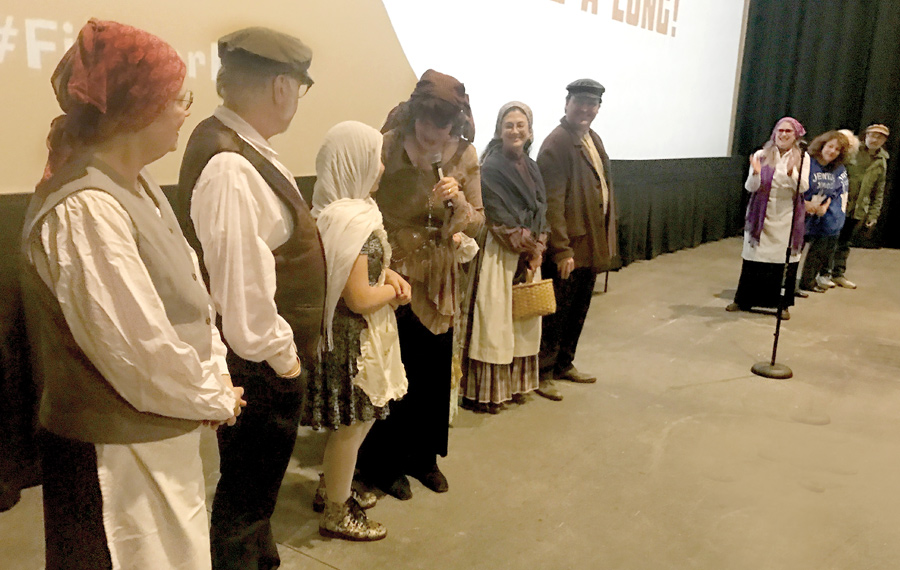
The evening is scheduled to start with a screening of the classic movie version of “Fiddler,” with the audience encouraged to sing along to such songs as “If I Were a Rich Man,” “To Life” and “Matchmaker, Matchmaker.” Patrons are encouraged to arrive in costumes modeled on the musical’s characters, and prizes will be given for the best creations.
At each of the venues, a host or hostess, usually with a show-business background, is expected to keep the action going by leading the singing, quizzing patrons on “Fiddler” trivia, and passing out the prizes.
Laemmle urged patrons not to hold back.
“Here is your once-a-year chance to be the star of the shtetl,” he said. “Sing your heart out alongside Topol and the other screen legends. And it’s OK if you haven’t memorized all the songs. We provide the lyrics.”
The initial idea for the show’s format came to Laemmle when he attended a screening of “The Sound of Music” at the Hollywood Bowl, where the audience sang along lustily.
For Jews, the Christmas season often has a special meaning, depending on their backgrounds and historical memories.
“My grandmother was born in czarist Russia, and when she came to America, she used to tense up and get nervous with the approach of Christmas. That was the time when the pogroms started in the old country,” Laemmle said.
Although the “Fiddler” evening is aimed primarily at a Jewish audience, non-Jews also attend. However, there is wide disagreement on the actual numbers, with Laemmle estimating that audiences were “largely Jewish, but not exclusively so.”
USC adjunct professor Gary Wexler, who hosted a past “Fiddler” evening at the Laemmle theater in Pasadena, had a more evenly balanced estimate.
Wexler said that during his warm-up banter, he asked how many audience members were not Jewish and, to his surprise, more than half raised their hands.
Wexler said he remembered thinking, “Don’t these people want to be with their families on Christmas Eve singing Christmas carols, rather than “If I Were a Rich Man” or “Anatevka”?
Other former hosts related experiences with more heavily Jewish audiences, among them Naomi Ackerman, founder of the Advot Project, which works with disadvantaged youth.
“What I found most extraordinary was how people knew every word of every song in the movie,” Ackerman wrote in an email. “Not to mention that people were fighting over who would answer the trivia questions. How amazing that people knew so many little tidbits and information about this production…. It was a warm and haimish evening, and we felt like we re-created Anatevka, with all its goodness, at the Laemmle theater.”
“Here is your once-a-year chance to be the star of the shtetl.” — Greg Laemmle
USC professor Ron Wolfson described the audience mix as “kippah-wearing Orthodox Jews, leaders of Conservative and Reform synagogues, secular Jews, rabbis, Israelis, Persians and Russians.”
Since its Broadway debut in 1964, “Fiddler” has been staged constantly somewhere in the world, as author and journalist Barbara Isenberg documents in her book, with arguably the longest title ever — “Tradition!: The Highly Improbable, Ultimately Triumphant Broadway-to-Hollywood Story of Fiddler on the Roof, the World’s Most Beloved Musical.”
Among other tidbits, the book reveals that the play’s first draft bore the title of “The Old Country,” then was tentatively changed to “Tevye” and later to “Not So Long Ago, Not So Far Away.”
Stage producer Hal Prince had the final say, and he opted for “Fiddler on the Roof” because the title suggested immediately that the then-unknown play was a musical.
Testifying to the durability of the musical is its current national tour and fifth Broadway revival.
A month ago, a performance at the Hippodrome Theater in Baltimore was marred when a middle-aged man stood up during intermission and started shouting “Heil Hitler! Heil Trump!”
With the recent killing of 11 worshippers at a Pittsburgh synagogue fresh in mind, numerous audience members panicked and rushed for the exits. It later turned out that the man had been drinking heavily and meant to express his opposition to President Trump by comparing him to Hitler.
Asked for comment on the incident, Laemmle said he realized that “security is on people’s minds” and that he had taken necessary precautions without compromising the event’s Jewish tone.
“When Christmas Eve occurs during the Hanukkah period, we display a lighted menorah In the lobby, and when it coincides with Shabbat, we say the blessings over the wine and challah,” he said.
All performances at the eight Laemmle theaters will start at 7:30 p.m. on Monday, Dec. 24. Tickets, which can be purchased online at Laemmle.com/Fiddler, are $18 for adults and $15 for seniors and children, with further discounts for Laemmle Premiere Cardholders.